EP2733659A1 - Appareil de détection de paramètres sociaux au niveau d'emplacements spatiaux et procédé associé - Google Patents
Appareil de détection de paramètres sociaux au niveau d'emplacements spatiaux et procédé associé Download PDFInfo
- Publication number
- EP2733659A1 EP2733659A1 EP13189693.8A EP13189693A EP2733659A1 EP 2733659 A1 EP2733659 A1 EP 2733659A1 EP 13189693 A EP13189693 A EP 13189693A EP 2733659 A1 EP2733659 A1 EP 2733659A1
- Authority
- EP
- European Patent Office
- Prior art keywords
- wireless communication
- communication device
- spatial location
- signals
- characterizing parameters
- Prior art date
- Legal status (The legal status is an assumption and is not a legal conclusion. Google has not performed a legal analysis and makes no representation as to the accuracy of the status listed.)
- Withdrawn
Links
Images


Classifications
-
- H—ELECTRICITY
- H04—ELECTRIC COMMUNICATION TECHNIQUE
- H04W—WIRELESS COMMUNICATION NETWORKS
- H04W4/00—Services specially adapted for wireless communication networks; Facilities therefor
- H04W4/02—Services making use of location information
- H04W4/029—Location-based management or tracking services
-
- G—PHYSICS
- G06—COMPUTING OR CALCULATING; COUNTING
- G06Q—INFORMATION AND COMMUNICATION TECHNOLOGY [ICT] SPECIALLY ADAPTED FOR ADMINISTRATIVE, COMMERCIAL, FINANCIAL, MANAGERIAL OR SUPERVISORY PURPOSES; SYSTEMS OR METHODS SPECIALLY ADAPTED FOR ADMINISTRATIVE, COMMERCIAL, FINANCIAL, MANAGERIAL OR SUPERVISORY PURPOSES, NOT OTHERWISE PROVIDED FOR
- G06Q10/00—Administration; Management
- G06Q10/40—Business processes related to social networking or social networking services
-
- G—PHYSICS
- G06—COMPUTING OR CALCULATING; COUNTING
- G06Q—INFORMATION AND COMMUNICATION TECHNOLOGY [ICT] SPECIALLY ADAPTED FOR ADMINISTRATIVE, COMMERCIAL, FINANCIAL, MANAGERIAL OR SUPERVISORY PURPOSES; SYSTEMS OR METHODS SPECIALLY ADAPTED FOR ADMINISTRATIVE, COMMERCIAL, FINANCIAL, MANAGERIAL OR SUPERVISORY PURPOSES, NOT OTHERWISE PROVIDED FOR
- G06Q30/00—Commerce
- G06Q30/06—Buying, selling or leasing transactions
- G06Q30/0601—Electronic shopping [e-shopping]
- G06Q30/0631—Recommending goods or services
-
- H—ELECTRICITY
- H04—ELECTRIC COMMUNICATION TECHNIQUE
- H04W—WIRELESS COMMUNICATION NETWORKS
- H04W4/00—Services specially adapted for wireless communication networks; Facilities therefor
- H04W4/02—Services making use of location information
Definitions
- the present invention relates to apparatus for sensing socially-related parameters at spatial locations, for example to apparatus utilizing mobile wireless communication devices for sensing socially-related parameters at venues for providing users with an overview of socially-related parameters at the venues for helping to guide the users in their selection of venue.
- the present invention concerns methods of using apparatus for sensing socially-related parameters at spatial locations, for example to methods of using apparatus utilizing mobile wireless communication devices for sensing socially-related parameters at venues for providing users with an overview of socially-related parameters at the venues for helping to guide the users in their selection of venue.
- the present invention relates to software products recorded on machine-readable data storage media, wherein the software products are executable upon computing hardware for implementing aforesaid methods.
- members are providing with access to real-time information about the venues, for example demographics of venue attendees and media posted by attendees concerning venue characteristics.
- venues for example demographics of venue attendees and media posted by attendees concerning venue characteristics.
- members can determine a priori which venue, for example a nightclub or bar, has their preferred type of attendee.
- the system and method relies on the members entering information via their mobile telephones, which can be difficult to achieve if the members are intoxicated or occupied in various amorous activities for example.
- the present invention seeks to provide an apparatus for automatically sensing socially-related parameters at spatial locations, for example venues, which can indicate a subjective "mood” or “atmosphere” present at a given time at the venues.
- the present invention seeks to provide a method of automatically sensing socially-related parameters at spatial locations, for example venues, which can indicate a "mood” or “atmosphere” present at a given time at the venues.
- an apparatus for sensing socially-related parameters at spatial locations, wherein the apparatus includes at least one wireless communication device accompanying an at least one corresponding user, wherein the at least one wireless communication device is coupled in communication with a database arrangement, wherein the apparatus is operable to communicate spatial location characterizing parameters from the at least one wireless communication device to the database arrangement for further communication therefrom to one or more other users for providing the one or more other users with a subjective status of spatial locations associated with the spatial location characterizing parameters, characterized in that the at least one wireless communication device includes a sensor arrangement for automatically generating signals from which the spatial location characterizing parameters are computed, and the apparatus includes computing hardware for analyzing the spatial location characterizing parameters to compute the subjective status ("mood", "atmosphere") of the spatial locations to be communicated to the one or more other users.
- the present invention is of advantage in that the apparatus is capable of automatically, or at least semi-automatically, computing and communicating the subjective status ("mood", "atmosphere”) of the spatial locations in an efficient and unobtrusive manner.
- the at least one wireless communication device includes computing hardware which is operable to execute one or more software products, and wherein the computing hardware is thereby operable to generate the spatial location characterizing parameters from the signals generated by the sensor arrangement, wherein the spatial location characterizing parameters are anonymous in respect of the signals generated by the sensor arrangement.
- the computing hardware is operable to sample the signals generated by the sensor arrangement in a temporarily intermittent manner for achieving anonymity in the spatial location characterizing parameters.
- the computing hardware of the at least wireless communication device is operable to generate the spatial location characterizing parameters by applying one or more stages of Fourier analysis to the signals generated by the sensor arrangement.
- the subjective status ("mood", "atmosphere") of the spatial locations to be communicated to the one or more other users is computed from the spatial location characterizing parameters by employing an analysis engine based upon a neural network and/or a rule-based analysis.
- the rule-based analysis is implemented by correlation of the spatial location characterizing parameters with one or more signal templates which have been a priori attributed with corresponding subjective status ("mood", "atmosphere”).
- the at least one wireless communication device includes a graphical user interface coupled to computing hardware of the at least one wireless communication device, wherein the computing hardware is operable to present in operation one or more maps on the graphical user interface for user viewing, wherein one or more subjective status ("mood", "atmosphere") of spatial locations represented in the one or more maps are shown on or via the one or more maps.
- the signals generated from the sensor arrangement are representative of motion sensor signals and/or acoustic sensor signals and/or image sensor signals.
- a method of sensing socially-related parameters at spatial locations employs at least one wireless communication device accompanying an at least one corresponding user, wherein the at least one wireless communication device is coupled in communication with a database arrangement, wherein the method includes:
- the method includes using computing hardware of the at least one wireless communication device to execute one or more software products, thereby generating the spatial location characterizing parameters from the signals generated by the sensor arrangement, wherein the spatial location characterizing parameters are anonymous in respect of the signals generated by the sensor arrangement.
- the method includes using the computing hardware to sample the signals generated by the sensor arrangement in a temporarily intermittent manner for achieving anonymity in the spatial location characterizing parameters.
- the method includes using computing hardware of the at least wireless communication device to generate the spatial location characterizing parameters by applying one or more stages of Fourier analysis to the signals generated by the sensor arrangement.
- the subjective status ("mood", "atmosphere") of the spatial locations to be communicated to the one or more other users is computed from the spatial location characterizing parameters by employing an analysis engine based upon a neural network and/or a rule-based analysis.
- the rule-based analysis is implemented by correlation of the spatial location characterizing parameters with one or more signal templates which have been a priori attributed with corresponding subjective status ("mood", "atmosphere”).
- the method includes using a graphical user interface coupled to computing hardware of the at least one wireless communication device, wherein the computing hardware is operable to present in operation one or more maps on the graphical user interface for user viewing, wherein one or more subjective status ("mood", "atmosphere") of spatial locations represented in the one or more maps are shown on or via the one or more maps.
- a graphical user interface coupled to computing hardware of the at least one wireless communication device, wherein the computing hardware is operable to present in operation one or more maps on the graphical user interface for user viewing, wherein one or more subjective status ("mood", "atmosphere") of spatial locations represented in the one or more maps are shown on or via the one or more maps.
- the signals generated from the sensor arrangement are representative of motion sensor signals and/or acoustic sensor signals and/or image sensor signals.
- a software product recorded on machine-readable data storage media, characterized in that the software product is executable upon computing hardware for executing a method pursuant to the second aspect of the invention.
- the software product is implemented as a software application which is downloadable to a wireless communication device.
- an underlined number is employed to represent an item over which the underlined number is positioned or an item to which the underlined number is adjacent.
- a non-underlined number relates to an item identified by a line linking the non-underlined number to the item.
- the non-underlined number is used to identify a general item at which the arrow is pointing.
- the present invention is concerned with an apparatus, for example conveniently referred to as a "party meter”, which is operable to sense socially-related parameters at a given venue, namely parameters which enable, for example from interpretation implemented using a neural network or similar form of analysis based upon artificial intelligence, an "atmosphere and mood" of the given venue to be determined.
- the socially-related parameters include several metrics which are susceptible to being sensed via contemporary wireless communication devices including computing hardware, for example contemporary mobile telephones, such as contemporary smart telephones.
- the apparatus is operable to supply recommendations regarding which venues a given user might want to attend.
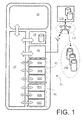
- a contemporary mobile wireless communication device indicated generally by 10 includes:
- the wireless communication device 10 for example implemented as a smart telephone, is operable to execute one or more software applications stored in the data memory 25, for example down-loaded from a remote server arrangement, for example an "App" store", via wireless communication through the wireless interface 40 and the computing hardware 20 to the data memory 25.
- a remote server arrangement for example an "App" store
- One or more of these software applications is operable, when executed upon the computing hardware 20, to implement an embodiment of the present invention on the wireless communication device 10.
- a map is presented to a given user via the graphical user interface 30, namely as indicated by 100 in FIG. 2 .
- the map 100 provides a spatial representation of desirable venues.
- Data associated with the desirable venues which are processed by the one or more software applications executing upon the computing hardware 20 are beneficially stored in an external database 120, and downloaded via a wireless communication network 130 to the wireless communication device 10 at temporal intervals, for example daily or more frequently.
- Information pertaining the desirable venues is optionally uploaded to the external database 120 by a community of users, by proprietors of the desirable venues, by service provides and/or by third parties, these being denoted by 140.
- Information included in the map 100 is beneficially communicated via known social media systems, for example Facebook and similar to users; " Facebook " is a registered trademark.
- proprietors and similar of the venues are able to upload their data to the external database 120 via a communication portal, for example accessible via a personal computer (PC) which is linked via the Internet to the external database 120.
- the portal enables the proprietors to configure various types of advertisements which are presented to the given user via the map 100, for example types of beer, alcohol, food, beverages, cabaret, music, comedy, bingo, roulette and such like.
- the map 100 is updated in a dynamic manner as will now be described.
- the software application implementing the embodiment is operable when executed to cause the wireless communication device 10 to collect data at a given venue whereat its given user is spatially disposed, for example in a bar, a disco, a club.
- the software application is operable to enable the wireless communication device 10 to monitor to which venues the given user migrates, for example during a course of an evening "out in town". Determination of the venues visited is beneficially performed on a basis of location sensors included in the wireless communication device 10, for example GPS, or WiFi identity of a wireless local area network which is installed at the venues.
- the wireless communication device 10 sends information 200 to a service provider which provides the given user with a mapping service via the external database 120; the information 200 concerns the given user bearing the wireless communication device 10 entering a given venue marked on the map 100.
- computing hardware at the external database 120 then sends information 210 concerning a number of people present at the given venue, such that the given user is informed immediately via the map 100 about a degree of people activity at the given venue.
- the one or more software applications then cause the computing hardware 20 to receive audio signals generated by the microphone included amongst the arrangement of sensors 50 to measure sound level at the venue into which the given user has entered.
- the one or more software applications cause the computing hardware 20 to implement algorithms which analyse the measured sound level and determine parameters which describe a "mood” or “atmosphere” of the venue.
- the determined parameters are then communicated as information 220 from the computing hardware 20 via the wireless interface 40 to the external database 120 so that the external database 120 receives in real-time a dynamically updated indication of the "mood” or "atmosphere” present at the venue.
- the algorithms employed here will be described in greater detail later.
- the parameters in the information 220 are processed to be anonymous so that conversations and such like occurring in a vicinity of the given user are not communicated to the external database 120.
- the information 220 is then subsequently communicated from the external database 120 to other users whose wireless communication devices are provided with one or more software applications for implementing the present invention. Since some users prefer to frequent venues, for example pubs or bars, whereat many people are present, a loud noise with complex harmonic temporal variations is indicative of many people at the venues. Conversely, quite noise with simple harmonic content is generally indicative of venues having few people thereat. Users receiving the information 220 pertaining to a given venue via the external database 120 are able to receive on their maps 100 an indication of numbers of people present at various venues marked on their maps 100.
- the one or more software applications executing on the computing hardware 20 of the wireless communication device 10 of the given user are operable to receive motion-indicative signals generated by accelerometers and similar motion sensors included amongst the arrangement of sensors 50.
- the motion-indicative signals are indicative of what the given user is doing in respect of body motion, for example dancing, jiving, sitting tranquilly or similar.
- the one or more software applications are operable to cause the computing hardware 20 to implement algorithms for analysing the motion-indicative signals to generate motion parameters indicative of the venue which are then communicated as information 250 to the external database 120.
- the information 250 is then communicated from the external database 120 to other user so that their maps 100 indicate whether or not venues shown on the map 100 are dancing-like venues and similar.
- Parameters communicated via the external database 120 can be used to compute analyses regarding popularity of various venues which is potentially useful feedback information for proprietors of the venues.
- One or more wireless communication devices 10 arranged to execute one or more software applications to present the map 100 with its associated information regarding venues, the external database 120 and a communication network linking the one or more devices 10 and the external database 120 are beneficially regarded as a system for implementing the present invention.
- the system is operable to provide a mapping service which can provide analysis and associated feedback to one or more users:
- the external database 120 in possession of measurements represented in parameters from a plurality of venues is operable to compare the parameters received in respect of the venues and rank them, for example on a scale 1 to 4, for presentation on the map 100 to users. This allows the users to select, for example, the most "hip" places in town during a given evening.
- the aforementioned one or more software applications executable upon the computing hardware 20 of the user's wireless communication devices 10 also allow for manual user-input of the "mood" or "atmosphere” at given venues shown on the map 100.
- Such manual user-input beneficially includes a progressive scale which is presented on the graphical user interface 30, for example via pop-up window, wherein the user can input data via a quick finger-swiping motion.
- Signals 300 from the arrangement of sensors 50 are beneficially acquired by the computing hardware 20 at time intervals, for example 1 to 2 second duration signals samples acquired each 10 to 20 seconds.
- the signals 300 are subject to a first stage of frequency analysis 310, for example implemented using a Fast Fourier Transform (FFT) algorithm, to generate harmonic component parameters 320. Harmonic content at a given frequency in the signals 300 temporally varies.
- Each parameter 320 is then subject to a second stage 340 of frequency analysis, for example also implemented using a Fast Fourier Transform (FFT) algorithm, to generate further harmonic component parameters 350.
- FFT Fast Fourier Transform
- a neural network or adaptive rule-based analysis engine 360 which analyses the parameters 320 and matches them to different categories of activity having a priori defined "mood” or “atmosphere” characteristics as experienced subjectively by human beings, for example beforehand when programming or otherwise adjusting the neural network or analysis engine 360; the analyzed "mood” or “atmosphere” is provided as analysis parameters 380 for communication via the remote database 120 to users via presentation on the map 100, or via sub-fields accessible via the map 100, for example by way of user swipe contact made upon the map 100 as displayed on the graphical user interface 30.
- analysis is beneficially performed by executing a correlation of the parameters 350 with reference parameter templates corresponding to different "moods" and “atmospheres” and a best match found therebetween.
- the analysis engine 360 is implemented at the external database 120, such that the parameters 350 are communicated from the wireless communication device 10 via its wireless interface 40 to the external database 120.
- the external database 120 is implemented by way of a cluster of data servers, "cloud computing" or similar implementation.
- Output 380 from the analysis engine 360 is a "mood” or “atmosphere” assessment which is stored at the external database 120 and then conveyed to the maps 100 of other users, for example for providing them with an indication of "mood” or “atmosphere” at various venues displayed on the map 100 to users. It will be appreciated that a major part of data processing employed in the aforesaid system pursuant to the present invention is executed in an automatic, or semiautomatic, manner using processing methods akin to artificial intelligence.
- the present invention is especially pertinent to a human nightlife community, namely for enhancing their enjoyment of venues and for guiding them to venues which are most likely to satisfy their tastes and desires. Moreover, the present invention is also potentially capable of avoiding certain venues from becoming grossly over-subscribed such that safety issues arise, for example too many people present at a given venue such that evacuation cannot be adequately performed therefrom in an event of emergence, for example in an event of a fire or explosion incident. Moreover, data from the external database 120 is beneficially useful to fire-fighting authorities so that they are aware of concentrations of people, for example in night clubs, whereat smoking of cigarettes and joints may occur and where a risk of fire is enhanced. Furthermore, data from the external database 120 is beneficially useful to police authorities so that they are aware of concentrations of people, for example in night clubs, for coping with crowd control and similar when activities at venues get out of hand, for example brawls and similar.
- the aforesaid wireless communication device 10 can be implemented in many different manners, for example using smart telephones, tablet computers including wireless interfaces, personal digital assistants (PDA's), personal computers (PC) and similar.
- PDA's personal digital assistants
- PC personal computers
Landscapes
- Engineering & Computer Science (AREA)
- Business, Economics & Management (AREA)
- Signal Processing (AREA)
- Computer Networks & Wireless Communication (AREA)
- Marketing (AREA)
- Finance (AREA)
- Accounting & Taxation (AREA)
- Economics (AREA)
- Strategic Management (AREA)
- Theoretical Computer Science (AREA)
- Physics & Mathematics (AREA)
- General Business, Economics & Management (AREA)
- General Physics & Mathematics (AREA)
- Tourism & Hospitality (AREA)
- Entrepreneurship & Innovation (AREA)
- Quality & Reliability (AREA)
- Operations Research (AREA)
- Human Resources & Organizations (AREA)
- Development Economics (AREA)
- Information Retrieval, Db Structures And Fs Structures Therefor (AREA)
- User Interface Of Digital Computer (AREA)
Applications Claiming Priority (1)
| Application Number | Priority Date | Filing Date | Title |
|---|---|---|---|
| US13/679,319 US20140141807A1 (en) | 2012-11-16 | 2012-11-16 | Apparatus for Sensing Socially-Related Parameters at Spatial Locations and Associated Methods |
Publications (1)
| Publication Number | Publication Date |
|---|---|
| EP2733659A1 true EP2733659A1 (fr) | 2014-05-21 |
Family
ID=49513724
Family Applications (1)
| Application Number | Title | Priority Date | Filing Date |
|---|---|---|---|
| EP13189693.8A Withdrawn EP2733659A1 (fr) | 2012-11-16 | 2013-10-22 | Appareil de détection de paramètres sociaux au niveau d'emplacements spatiaux et procédé associé |
Country Status (2)
| Country | Link |
|---|---|
| US (1) | US20140141807A1 (fr) |
| EP (1) | EP2733659A1 (fr) |
Families Citing this family (3)
| Publication number | Priority date | Publication date | Assignee | Title |
|---|---|---|---|---|
| JP2014130467A (ja) * | 2012-12-28 | 2014-07-10 | Sony Corp | 情報処理装置、情報処理方法及びコンピュータプログラム |
| US20140201276A1 (en) * | 2013-01-17 | 2014-07-17 | Microsoft Corporation | Accumulation of real-time crowd sourced data for inferring metadata about entities |
| US20150319121A1 (en) * | 2014-05-05 | 2015-11-05 | Ashwini Iyer | Communicating a message to users in a geographic area |
Citations (3)
| Publication number | Priority date | Publication date | Assignee | Title |
|---|---|---|---|---|
| US20070179792A1 (en) | 2006-01-30 | 2007-08-02 | Kramer James F | System for providing a service to venues where people aggregate |
| US20080306826A1 (en) * | 2006-01-30 | 2008-12-11 | Hoozware, Inc. | System for Providing a Service to Venues Where People Aggregate |
| WO2009040696A1 (fr) * | 2007-09-25 | 2009-04-02 | Nokia Corporation | Procédé, appareil et produit programme d'ordinateur permettant de déterminer des recommandations implicites |
-
2012
- 2012-11-16 US US13/679,319 patent/US20140141807A1/en not_active Abandoned
-
2013
- 2013-10-22 EP EP13189693.8A patent/EP2733659A1/fr not_active Withdrawn
Patent Citations (3)
| Publication number | Priority date | Publication date | Assignee | Title |
|---|---|---|---|---|
| US20070179792A1 (en) | 2006-01-30 | 2007-08-02 | Kramer James F | System for providing a service to venues where people aggregate |
| US20080306826A1 (en) * | 2006-01-30 | 2008-12-11 | Hoozware, Inc. | System for Providing a Service to Venues Where People Aggregate |
| WO2009040696A1 (fr) * | 2007-09-25 | 2009-04-02 | Nokia Corporation | Procédé, appareil et produit programme d'ordinateur permettant de déterminer des recommandations implicites |
Non-Patent Citations (2)
| Title |
|---|
| EMILIANO MILUZZO ET AL.: "CenceMe -Injecting Sensing Presence into Social Network Application", EUROSSC 2007, LNCS 4793, 28 January 2007 (2007-01-28) |
| EMILIANO MILUZZO: "Sensing Meets Mobile Social Networks: The Design, Implementation and Evaluation of the CenceMe Application", 7 November 2008 (2008-11-07), XP055026265, Retrieved from the Internet <URL:http://nslab.ee.ntu.edu.tw/NetworkSeminar/papers/sensys08.pdf> [retrieved on 20120507] * |
Also Published As
| Publication number | Publication date |
|---|---|
| US20140141807A1 (en) | 2014-05-22 |
Similar Documents
| Publication | Publication Date | Title |
|---|---|---|
| US10146882B1 (en) | Systems and methods for online matching using non-self-identified data | |
| US8281027B2 (en) | System and method for distributing media related to a location | |
| US9626695B2 (en) | Automatically presenting different user experiences, such as customized voices in automated communication systems | |
| RU2610944C2 (ru) | Хронологический журнал действий пользователя и ассоциированных эмоциональных состояний | |
| US20130212501A1 (en) | Perceptual computing with conversational agent | |
| US20160165409A1 (en) | Method and device for wearable display | |
| US20130110617A1 (en) | System and method to record, interpret, and collect mobile advertising feedback through mobile handset sensory input | |
| US11509610B2 (en) | Real-time messaging platform with enhanced privacy | |
| KR101625208B1 (ko) | 정보 구성장치와 전자장치 및 정보 구성방법 | |
| US20100082515A1 (en) | Environmental factor based virtual communication systems and methods | |
| WO2017040044A1 (fr) | Prédiction de caractéristiques acoustiques pour des emplacements géographiques | |
| US20160342693A1 (en) | Automated compatibility matching system for dogs and dog owners | |
| JP2016102968A (ja) | 広告管理装置及び情報通信端末用アプリケーションソフトウエア | |
| EP2733659A1 (fr) | Appareil de détection de paramètres sociaux au niveau d'emplacements spatiaux et procédé associé | |
| FR2997254A1 (fr) | Procede et dispositif de diffusion d'information a un utilisateur muni d'un terminal portable communiquant | |
| Posdorfer et al. | Towards context-aware surveys using bluetooth beacons | |
| EP3388929A1 (fr) | Découverte d'éléments de réalité augmentée dans un affichage de viseur de caméra | |
| US20130124973A1 (en) | Automatic Diary for an Electronic Device | |
| US20230056862A1 (en) | Hearing device, and method for adjusting hearing device | |
| US20150277683A1 (en) | Adaptive user experience | |
| JPWO2016052501A1 (ja) | ユーザインタフェース装置、プログラム及びコンテンツの通知方法 | |
| US20180014158A1 (en) | Mobile Device Recommendation System and Method | |
| US10902471B2 (en) | Voice assistant generated advertisement for a vehicle system and method thereof | |
| KR20200006961A (ko) | 액티비티 알림 제공 방법 및 이를 위한 디바이스 | |
| WO2020251282A3 (fr) | Procédé et système d'évaluation de préférences |
Legal Events
| Date | Code | Title | Description |
|---|---|---|---|
| PUAI | Public reference made under article 153(3) epc to a published international application that has entered the european phase |
Free format text: ORIGINAL CODE: 0009012 |
|
| 17P | Request for examination filed |
Effective date: 20131022 |
|
| AK | Designated contracting states |
Kind code of ref document: A1 Designated state(s): AL AT BE BG CH CY CZ DE DK EE ES FI FR GB GR HR HU IE IS IT LI LT LU LV MC MK MT NL NO PL PT RO RS SE SI SK SM TR |
|
| AX | Request for extension of the european patent |
Extension state: BA ME |
|
| STAA | Information on the status of an ep patent application or granted ep patent |
Free format text: STATUS: THE APPLICATION IS DEEMED TO BE WITHDRAWN |
|
| 18D | Application deemed to be withdrawn |
Effective date: 20141122 |