EP2735242B1 - Verfahren zur Herstellung eines Schuhzubehörs mit mindestens teilweise beflockter Oberfläche und mittels des Verfahrens erzeugtes Schuhzubehör - Google Patents
Verfahren zur Herstellung eines Schuhzubehörs mit mindestens teilweise beflockter Oberfläche und mittels des Verfahrens erzeugtes Schuhzubehör Download PDFInfo
- Publication number
- EP2735242B1 EP2735242B1 EP20120007842 EP12007842A EP2735242B1 EP 2735242 B1 EP2735242 B1 EP 2735242B1 EP 20120007842 EP20120007842 EP 20120007842 EP 12007842 A EP12007842 A EP 12007842A EP 2735242 B1 EP2735242 B1 EP 2735242B1
- Authority
- EP
- European Patent Office
- Prior art keywords
- adhesive
- shoe
- shoe accessory
- solid body
- flocking
- Prior art date
- Legal status (The legal status is an assumption and is not a legal conclusion. Google has not performed a legal analysis and makes no representation as to the accuracy of the status listed.)
- Not-in-force
Links
- 238000000034 method Methods 0.000 title claims description 11
- 238000004519 manufacturing process Methods 0.000 title claims description 5
- 239000000853 adhesive Substances 0.000 claims description 24
- 230000001070 adhesive effect Effects 0.000 claims description 24
- 239000007787 solid Substances 0.000 claims description 17
- 229910052709 silver Inorganic materials 0.000 claims description 16
- 239000004332 silver Substances 0.000 claims description 16
- -1 silver ions Chemical class 0.000 claims description 16
- 244000144992 flock Species 0.000 claims description 14
- 239000000203 mixture Substances 0.000 claims description 13
- 229920000297 Rayon Polymers 0.000 claims description 11
- 239000000463 material Substances 0.000 claims description 8
- 239000006185 dispersion Substances 0.000 claims description 6
- 230000005684 electric field Effects 0.000 claims description 4
- 239000012948 isocyanate Substances 0.000 claims description 4
- 150000002513 isocyanates Chemical class 0.000 claims description 4
- 229920005862 polyol Polymers 0.000 claims description 4
- 150000003077 polyols Chemical class 0.000 claims description 4
- 239000000654 additive Substances 0.000 claims description 3
- 230000000996 additive effect Effects 0.000 claims description 2
- 238000005507 spraying Methods 0.000 claims description 2
- 238000010422 painting Methods 0.000 claims 1
- 239000000835 fiber Substances 0.000 description 10
- 235000019645 odor Nutrition 0.000 description 7
- 230000000844 anti-bacterial effect Effects 0.000 description 6
- 244000052616 bacterial pathogen Species 0.000 description 5
- 238000001035 drying Methods 0.000 description 5
- 230000000694 effects Effects 0.000 description 4
- 230000001580 bacterial effect Effects 0.000 description 2
- 230000015572 biosynthetic process Effects 0.000 description 2
- 238000003860 storage Methods 0.000 description 2
- 235000001674 Agaricus brunnescens Nutrition 0.000 description 1
- 241000894006 Bacteria Species 0.000 description 1
- 229920000742 Cotton Polymers 0.000 description 1
- FOIXSVOLVBLSDH-UHFFFAOYSA-N Silver ion Chemical compound [Ag+] FOIXSVOLVBLSDH-UHFFFAOYSA-N 0.000 description 1
- 238000009395 breeding Methods 0.000 description 1
- 230000001488 breeding effect Effects 0.000 description 1
- 230000001680 brushing effect Effects 0.000 description 1
- 230000003139 buffering effect Effects 0.000 description 1
- 238000007598 dipping method Methods 0.000 description 1
- 239000002657 fibrous material Substances 0.000 description 1
- 239000006260 foam Substances 0.000 description 1
- 239000006261 foam material Substances 0.000 description 1
- 210000002683 foot Anatomy 0.000 description 1
- 230000002070 germicidal effect Effects 0.000 description 1
- 238000010438 heat treatment Methods 0.000 description 1
- 208000015181 infectious disease Diseases 0.000 description 1
- 230000002458 infectious effect Effects 0.000 description 1
- 210000000452 mid-foot Anatomy 0.000 description 1
- 238000000465 moulding Methods 0.000 description 1
- 238000002360 preparation method Methods 0.000 description 1
- 239000002994 raw material Substances 0.000 description 1
- 210000004243 sweat Anatomy 0.000 description 1
- BWMISRWJRUSYEX-SZKNIZGXSA-N terbinafine hydrochloride Chemical compound Cl.C1=CC=C2C(CN(C\C=C\C#CC(C)(C)C)C)=CC=CC2=C1 BWMISRWJRUSYEX-SZKNIZGXSA-N 0.000 description 1
- 201000004647 tinea pedis Diseases 0.000 description 1
Images
Classifications
-
- A—HUMAN NECESSITIES
- A43—FOOTWEAR
- A43D—MACHINES, TOOLS, EQUIPMENT OR METHODS FOR MANUFACTURING OR REPAIRING FOOTWEAR
- A43D3/00—Lasts
- A43D3/14—Stretching or spreading lasts; Boot-trees; Fillers; Devices for maintaining the shape of the shoe
- A43D3/1433—Shoe-trees
- A43D3/1491—Shoe-trees with means for sweaty feet, e.g. with disinfecting or deodorant means
Definitions
- the invention relates to a method for producing a shoe accessory with at least partially flocked surface of the type mentioned in the preamble of claim 1 and a shoe accessory according to the preamble of claim 8.
- a shoe accessory in which at least a portion of the surface of the shoe accessory has a flocking with an antibacterial material.
- the flocking material has a moisture-buffering effect.
- the flocking is applied to a solid body in a contact area provided for an inner surface of the shoe.
- the invention has for its object to provide a method for producing a shoe accessory of the type mentioned in the preamble of claim 1 and a shoe accessory so produced, wherein the function is given as a moisture storage and the odor in the shoe is reduced.
- a mixture of an adhesive and biologically active silver ions is produced, which is then applied to the flocking surface of a solid body.
- the flocking of the surface with a viscose flock takes place in an electric field, so that the fibers of the viscose flock align themselves and protrude from the surface of the solid body. Excess fibers are blown out before drying the flocked, solid body in different temperature zones.
- the biologically active silver ions in the mixture counteract odor formation.
- At least part of the surface of the shoe accessory has flocking with a moisture buffering material.
- the moisture-buffering material is embedded in the flocking.
- the flocking itself consists of a moisture-buffering and antibacterial plastic.
- the flocking also consist of natural fibers with an antibacterial additive, such as cotton.
- the flocking can be applied to any three-dimensionally shaped surfaces and is thus particularly suitable for a contact area of the shoe accessory with an inner surface of the shoe.
- the flock absorbs a lot of moisture and under given circumstances flocking also releases the moisture.
- the drying process of the shoe is accelerated, whereby bacterial germs are deprived of their death.
- Such material also has a marked antibacterial effect by bio-physical processes.
- the macromolecular structure of the flock has a positive surface charge which is not worn or consumed and which is associated with negative electric charge of Germs leading to their killing.
- the biologically active silver ions and the flocking material provide an effective means of odor-binding, moisture-regulating and germicidal shoe care.
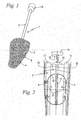
- the Fig. 1 shows a perspective view of a shoe accessory on the example of a shoe tree 1.
- the shoe trees 1 is provided in the embodiment shown for tensioning of shoes. Except for loafers, sports shoes or the like, the shoe accessory according to the invention for shoes can be provided in any design including boots, pumps or the like.
- the shoe tensioner 1 comprises a shaped body 8 corresponding to the toe and midfoot region of a shoe, not shown, and a heel support 10 for the heel region of the shoe.
- the shaped body 8 is a solid body and preferably consists of a foam, for example of polyol and isocyanate.
- the heel support 10 is fixed by means of an elastic spring element 9 on the shaped body 8. In the inserted state, the heel support 10 presses the molded body 8 via the spring force of the elastic spring element 10 in the front region of the shoe, not shown.
- An upper three-dimensionally shaped and adapted to the shape of the shoe surface of the molding 8 forms a contact area 5, which rests flat in the inserted state of the shoe tensioner 1 on the inner surface of the shoe.
- the contact region 5 of the shaped body 8 has a flocking 4 with a moisture-buffering material.
- the flocking 4 consists of a viscose flock applied to the contact region 5.
- the flocking is attached to the molded body 8 by means of a suitable adhesive, in particular a dispersion adhesive.
- a suitable adhesive in particular a dispersion adhesive.
- the flocking 4 absorbs and stores moisture from the inner surface of the shoe, thereby lowering the level of moisture in the previously worn shoe. Due to the biologically active silver ions in the adhesive, odors are bound. The reduction in moisture level reduces the risk of bacterial sprouting.
- the antibacterial effect of flocking 4 made of viscose flock reduces the growth of germs.
- After removing the shoe tensioner 1 acts as a moisture buffer flocking 4 the stored moisture in a short time to the environment.
- the quickly dried shoe trees 1 can be used again after a short interim storage in another pair of shoes.
- the raw materials polyol and isocyanate are first injected into release-treated molds.
- the ratio of polyol to isocyanate is preferably 3: 1.
- the reaction of the components takes place under a heating stretch.
- the adhesive in particular a dispersion adhesive, is mixed with the addition of biologically active silver ions and, if a certain color of the flock 4 is desired, with color paste.
- the proportion of silver ion addition may be between 0.2% and 0.7%, preferably 0.5%.
- the mixture of the adhesive pretreated in this way is placed in a container and thus forms a dip bath for the molded body 8.
- the molded body 8 is placed on a receiving device and pulled through the dipping bath. Thereafter, excess adhesive or mixture of adhesive and biologically active silver ions is spun off.
- the flocking of the shaped body 8 is carried out all around three-dimensionally with the fibers of the viscose flock in an electric field, so that the fibers align themselves in the electric field and are substantially perpendicular to the surface of the shaped body. After flocking excess fibers are blown off and absorbed by a suction device.
- the drying of the shaped body flocked with the fibers then takes place in different temperature zones. For the duration of drying is about 15 minutes.
- a blow-out of excess fibers can then take place again.
- the flocking 4 consists of fibers of a viscose flock, wherein the fibers are applied with the adhesive to the contact region 5 of the molded body 8 consisting of plastic. It may be expedient that the viscose flock consists of different fiber material. In order to support the antibacterial effect, it may also be expedient to add suitable additives.
- Fig. 2 shows a longitudinal sectional view of a variant of the invention, in which the shoe accessory is designed as a boot tensioner 2 for a schematically indicated boot shaft 18.
- the bootstrap 2 comprises two shaft tensioners 11, which are pressed outward by means of an annular spring 12 in the direction indicated by arrows 17.
- a lower handle 15 is formed, through which a push rod 13 is passed.
- the push rod 13 is connected at its lower end to the lower portion of the annular spring 12 and has an upper handle 14 at its upper end.
- the shaft tensioners 11 are in this embodiment, the respective solid body.
- the contact region 5 of the stem tensioners 11 forms the surface which is provided with a flocking 4, which has its odor-binding and moisture-buffering effect on the surface 6 of the bootleg 18 unfolded.
- the boot shaft 18 directed surface of the body serving as a stem tensioner 11 is connected to the Fig. 1 described mixture of adhesive and biologically active silver ions, wherein the order of the mixture is carried out, for example by brushing or spraying. Then the flocking with the viscose flock and the further process steps as described above.
- the flocking 4 corresponds in its properties and its effect according to the execution Fig. 1 ,
- the odor-binding and moisture-buffering effect applies not only to the shoe but also to the flocking 4 itself. This means that the formation of germs is prevented even in the flocking itself away from the use in the shoe.
Landscapes
- Footwear And Its Accessory, Manufacturing Method And Apparatuses (AREA)
Description
- Die Erfindung betrifft ein Verfahren zur Herstellung eines Schuhzubehörs mit mindestens teilweise beflockter Oberfläche der im Oberbegriff des Anspruchs 1 genannten Gattung sowie ein Schuhzubehör nach dem Oberbegriff des Anspruchs 8.
- Beim Tragen von Schuhen spielt neben der Bequemlichkeit auch die Hygiene eine große Rolle. Das Innenfutter der Schuhe nimmt beim Tragen Feuchtigkeit auf. Diese Feuchtigkeit wird im unbenutzten Zustand nur langsam wieder abgegeben. Herkömmliche Schuhspanner oder dergleichen aus Kunststoff beschleunigen die Trocknung nicht. Der Innenbereich eines Schuhs bildet im Zusammenspiel mit Fußschweiß und anderer Feuchtigkeit einen Nährboden für Infektionskeime. Neben Bakterien können sich vor allem Pilze ansiedeln. Dies führt dazu, dass ein erheblicher Prozentsatz der Bevölkerung unter Fußpilz leidet. Außerdem entsteht eine sehr unangenehme Geruchsbildung.
- Im Dokument
DE 20 2006 014 900 U1 ist ein Schuhzubehör beschrieben, bei dem zumindest ein Teil der Oberfläche des Schuhzubehörs eine Beflockung mit einem antibakteriellen Material aufweist. Das Material der Beflockung hat eine feuchtigkeitspuffernde Wirkung. Die Beflockung ist auf einem festen Körper in einem für eine innere Oberfläche des Schuhs vorgesehenen Kontaktbereich aufgebracht. - Dokument
US 2006 005 328 A1 offenbart ein Schuhzbehör mit den Merkmalen des Oberbegriffs des Anspruchs 8 und ein Verfahren zur Herstellung eines Schuhzubehörs mit den Merkmalen des Oberbegriffs des Anspruchs 1. - Der Erfindung liegt die Aufgabe zugrunde, ein Verfahren zur Herstellung eines Schuhzubehörs der im Oberbegriff des Anspruchs 1 genannten Gattung sowie ein so erzeugtes Schuhzubehör zu schaffen, wobei die Funktion als Feuchtigkeitsspeicher gegeben und die Geruchsbildung im Schuh verringert ist.
- Diese Aufgabe wird durch ein Verfahren mit den Merkmalen des Anspruchs 1 und durch ein Schuhzubehör mit den Merkmalen des Anspruchs 8 gelöst.
- Bei dem erfindungsgemäßen Verfahren wird ein Gemisch aus einem Kleber und biologisch aktiven Silberionen erzeugt, das dann auf die zur Beflockung vorgesehene Oberfläche eines festen Körpers aufgetragen wird. Die Beflockung der Oberfläche mit einem Viskose Flock erfolgt in einem elektrischen Feld, damit sich die Fasern des Viskose Flocks ausrichten und von der Oberfläche des festen Körpers abstehen. Überschüssige Fasern werden ausgeblasen, bevor eine Trocknung des beflockten, festen Körpers in unterschiedlichen Temperaturzonen erfolgt. Die biologisch aktiven Silberionen im Gemisch wirken einer Geruchsbildung entgegen.
- Zumindest ein Teil der Oberfläche des Schuhzubehörs weist eine Beflockung mit einem feuchtigkeitspuffernden Material auf. Das feuchtigkeitspuffernde Material ist in die Beflockung eingebettet. Vorteilhaft besteht die Beflockung selbst aus einem feuchtigkeitspuffernden und antibakteriellen Kunststoff. Alternativ kann die Beflockung auch aus natürlichen Fasern mit einem antibakteriell wirkenden Zusatz bestehen, beispielsweise aus Baumwolle. Die Beflockung kann auf beliebig dreidimensional geformte Oberflächen angebracht werden und ist dadurch besonders für einen Kontaktbereich des Schuhzubehörs mit einer inneren Oberfläche des Schuhs geeignet.
- Die Beflockung nimmt viel Feuchtigkeit auf und unter gegebenen Umständen gibt die Beflockung die Feuchtigkeit auch wieder ab. Der Trocknungsprozess des Schuhs wird beschleunigt, wodurch bakteriellen Keimen die Lebensgrundlage entzogen wird. Ein solches Material weist darüber hinaus eine deutliche antibakterielle Wirkung durch bio-physikalische Vorgänge auf. Die makromolekulare Struktur der Beflockung weist eine positive Oberflächenladung auf, die nicht abgenutzt oder verbraucht wird, und die in Verbindung mit negativer elektrischer Ladung von Keimen zu deren Abtötung führt. Durch die biologisch aktiven Silberionen und das Material der Beflockung ist ein wirksames Mittel zur geruchsbindenden, feuchtigkeitsregulierenden und keimtötenden Schuhpflege geschaffen.
- Ausführungsbeispiele der Erfindung sind im Folgenden anhand der Zeichnung näher erläutert. In der Zeichnung zeigt:
- Fig. 1
- eine schematische Perspektivdarstellung eines Schuhzubehörs am Beispiel eines beflockten Schuhspanners,
- Fig. 2
- eine Längsschnittdarstellung eines erfindungsgemäß beflockten Stiefelschaftspanners.
- Die
Fig. 1 zeigt in perspektivischer Darstellung ein Schuhzubehör am Beispiel eines Schuhspanners 1. Der Schuhspanner 1 ist in der gezeigten Ausführung zum Spannen von Halbschuhen vorgesehen. Außer für Halbschuhe, Sportschuhe oder dergleichen kann das erfindungsgemäße Schuhzubehör für Schuhe in beliebiger Ausführung einschließlich Stiefel, Pumps oder dergleichen vorgesehen sein. Der Schuhspanner 1 umfasst einen Formkörper 8 entsprechend dem Zehen- und Mittelfußbereich eines nicht dargestellten Schuhs sowie eine Fersenstütze 10 für den Fersenbereich des Schuhs. Der Formkörper 8 ist ein fester Körper und besteht vorzugsweise aus einem Schaumstoff, beispielsweise aus Polyol und Isocyanat. - Die Fersenstütze 10 ist mittels eines elastischen Federelements 9 am Formkörper 8 befestigt. Im eingesetzten Zustand drückt die Fersenstütze 10 den Formkörper 8 über die Federkraft des elastischen Federelements 10 in den vorderen Bereich des nicht dargestellten Schuhs. Eine obere dreidimensional geformte und der Form des Schuhs angepasste Oberfläche des Formkörpers 8 bildet einen Kontaktbereich 5, der im eingesetzten Zustand des Schuhspanners 1 an der inneren Oberfläche des Schuhs flächig anliegt. Der Kontaktbereich 5 des Formkörpers 8 weist eine Beflockung 4 mit einem feuchtigkeitspuffernden Material auf.
- Im gezeigten Ausführungsbeispiel besteht die Beflockung 4 aus einem auf den Kontaktbereich 5 aufgebrachten Viskose Flock. Die Beflockung ist mittels eines geeigneten Klebers, insbesondere eines Dispersionsklebstoffs an dem Formkörper 8 befestigt. Im eingesetzten Zustand nimmt die Beflockung 4 Feuchtigkeit von der inneren Oberfläche des Schuhs auf und speichert diese, wodurch das Feuchtigkeitsniveau im zuvor getragenen Schuh gesenkt wird. Durch die biologisch aktiven Silberionen im Kleber werden Geruchsstoffe gebunden. Die Verminderung des Feuchtigkeitsniveaus verringert die Gefahr der Ausbreitung von bakteriellen Keimen. Die antibakterielle Wirkung der Beflockung 4 aus Viskose Flock reduziert das Keimwachstum. Nach der Entnahme des Schuhspanners 1 gibt die als Feuchtigkeitspuffer wirkende Beflockung 4 die gespeicherte Feuchtigkeit in kurzer Zeit an die Umgebung ab. Der schnell abgetrocknete Schuhspanner 1 kann schon nach kurzer Zwischenlagerung erneut in ein weiteres paar Schuhe eingesetzt werden.
- Zur Herstellung des Schuhzubehörs am Beispiel des Schuhspanners 1 gemäß
Fig. 1 werden zur Erzeugung des festen Körpers zunächst die Rohmaterialen Polyol und Isocyanat in mit Trennmitteln behandelte Formen injiziert. Das Verhältnis von Polyol zu Isocyanat beträgt vorzugsweise 3:1. Die Reaktion der Komponenten erfolgt unter einer Wärmestrecke. Nach Aushärtung des Schaumstoffmaterials wird der so gebildete Formkörper 8 aus der Form entnommen. Der Kleber, insbesondere ein Dispersionsklebstoff, wird mit einem Zusatz von biologisch aktiven Silberionen und, falls eine bestimmt Farbe der Beflockung 4 gewünscht wird, mit Farbpaste gemischt. Der Anteil des Silberionenzusatzes kann zwischen 0,2% und 0,7% betragen, vorzugsweise ist ein Anteil von 0,5 % vorgesehen. Das Gemisch des auf diese Weise vorbehandelten Klebers wird in einen Behälter gegeben und bildet so ein Tauchbad für den Formkörper 8. Der Formkörper 8 wird auf eine Aufnahmevorrichtung gesteckt und durch das Tauchbad gezogen. Danach wird überschüssiger Kleber bzw. Gemisch aus Kleber und biologisch aktiven Silberionen abgeschleudert. Nun erfolgt die Beflockung des Formkörpers 8 rundum dreidimensional mit den Fasern des Viskose Flocks in einem elektrischen Feld, so dass die Fasern sich in dem elektrischen Feld ausrichten und im Wesentlichen senkrecht zur Oberfläche des Formkörpers stehen. Nach der Beflockung werden überschüssige Fasern abgeblasen und von einer Saugeinrichtung aufgenommen. Es erfolgt dann die Trocknung des mit den Fasern beflockten Formkörpers in unterschiedlichen Temperaturzonen. Für die Dauer der Trocknung sind ca. 15 Minuten vorgesehen. Gegebenenfalls kann danach nochmals ein Ausblasen überschüssiger Fasern erfolgen. - Im beschriebenen Ausführungsbeispiel besteht die Beflockung 4 aus Fasern eines Viskose Flocks, wobei die Fasern mit dem Kleber auf den Kontaktbereich 5 des aus Kunststoff bestehenden Formkörpers 8 aufgebracht sind. Es kann zweckmäßig sein, dass der Viskose Flock aus unterschiedlichem Fasermaterial besteht. Zur Unterstützung der antibakteriellen Wirkung kann es auch zweckmäßig sein, geeignete Zusatzstoffe beizusetzen.
-
Fig. 2 zeigt in einer Längschnittdarstellung eine Variante der Erfindung, bei der das Schuhzubehör als Stiefelspanner 2 für einen schematisch angedeuteten Stiefelschaft 18 ausgebildet ist. Der Stiefelspanner 2 umfasst zwei Schaftspanner 11, die mittels einer Ringfeder 12 entgegen der durch Pfeile 17 angegebenen Richtung nach außen gedrückt werden. An der Oberseite der Ringfeder 12 ist ein unterer Griff 15 angeformt, durch den ein Druckstab 13 hindurchgeführt ist. Der Druckstab 13 ist an seinem unteren Ende mit dem unteren Bereich der Ringfeder 12 verbunden und weist an seinem oberen Ende einen oberen Griff 14 auf. - Zum Einsetzen des Stiefelspanners 2 greifen die Finger einer Hand am unteren Griff 15 an, während der obere Griff 14 gegen die Handfläche abgestützt wird. Hierbei wird der untere Griff 15 in Richtung eines Pfeils 16 zum oberen Griff 14 gezogen. In dessen Folge werden seitliche Bereiche der Ringfeder 12 in Richtung der Pfeile 17 aufeinander zu bewegt. Gleiches gilt für die daran befestigten Schaftspanner 11, deren Abstand sich dabei verringert. In diesem Zustand kann der Stiefelspanner 2 in den Stiefelschaft 18 des Stiefels eingesetzt werden. Nach Loslassen der Griffe 14, 15 drückt die Ringfeder 12 die beiden Schaftspanner 11 entgegen der Pfeile 17 nach außen. Äußere Oberflächen der aus Kunststoff gefertigten Schaftspanner 11 bilden dabei Kontaktbereiche 5, die unter Vorspannung an einer inneren Oberfläche 6 des Stiefelschaftes 18 anliegen.
- Die Schaftspanner 11 sind in diesem Ausführungsbeispiel der jeweilige feste Körper. Der Kontaktbereich 5 der Schaftspanner 11 bildet die Oberfläche, die mit einer Beflockung 4 versehen wird, die ihre geruchsbindende und feuchtigkeitspuffernde Wirkung an der Oberfläche 6 des Stiefelschaftes 18 entfaltet. Die zum Stiefelschaft 18 gerichtete Oberfläche des als fester Körper dienenden Schaftspanners 11 wird mit dem zu
Fig. 1 beschriebenen Gemisch aus Kleber und biologisch aktiven Silberionen versehen, wobei der Auftrag des Gemischs beispielsweise durch Streichen oder Sprühen erfolgt. Dann erfolgt die Beflockung mit dem Viskose Flock und die weiteren Verfahrensschritte wie vorstehend beschrieben. Die Beflockung 4 entspricht in ihren Eigenschaften und ihrer Wirkung der Ausführung nachFig. 1 . Für beide Ausführungen gilt, dass die geruchsbindende und feuchtigkeitspuffernde Wirkung nicht nur für den Schuh, sondern auch für die Beflockung 4 selbst gilt. Dies bedeutet, dass die Bildung von Keimen auch in der Beflockung selbst abseits des Einsatzes im Schuh unterbunden wird.
Claims (14)
- Verfahren zur Herstellung eines Schuhzubehörs mit mindestens teilweise beflockter Oberfläche, wobei ein fester Körper (8, 11) des Schuhzubehörs mit einer aus Fasern bestehenden Beflockung (4) versehen wird,
dadurch kennzeichnet, dass ein Kleber mit einem Zusatz von biologisch aktiven Silberionen gemischt und die zur Beflockung vorgesehene Oberfläche des festen Körpers (8, 11) mit diesem Gemisch aus Kleber und biologisch aktiven Silberionen versehen wird, dass die Beflockung der Oberfläche mit einem Viskose Flock in einem elektrischen Feld erfolgt, so dass die Fasern des Viskose Flocks im Wesentlichen senkrecht zur Oberfläche des festen Körpers (8, 11) stehen, dass danach überschüssige Fasern ausgeblasen werden und eine Trocknung des beflockten, festen Körpers (8, 11) in unterschiedlichen Temperaturzonen erfolgt. - Verfahren nach Anspruch 1,
dadurch gekennzeichnet, dass der Kleber ein Dispersionsklebstoff ist, der mit einem Anteil biologisch aktiver Silberionen zwischen 0,2% und 0,7%, vorzugsweise 0,5 % gemischt wird. - Verfahren nach Anspruch 2,
dadurch gekennzeichnet, dass das Gemisch aus Dispersionsklebstoff und biologisch aktiven Silberionen in einen Behälter als Tauchbad gegeben wird und in das Tauchbad der feste Körper (8) eingetaucht und rundum mit Kleber versehen wird. - Verfahren nach Anspruch 3,
dadurch gekennzeichnet, dass nach der Entnahme des festen Körpers (8) aus dem Tauchbad überschüssiges Gemisch aus Kleber und biologisch aktiven Silberionen abgeschleudert wird. - Verfahren nach Anspruch 2 oder 3,
dadurch gekennzeichnet, dass zusätzlich mit dem Dispersionsklebstoff und den biologisch aktiven Silberionen auch eine Farbpaste gemischt wird. - Verfahren nach einem der Ansprüche 2 bis 5,
dadurch gekennzeichnet, dass der feste Körper (8) in einer Form hergestellt wird, in die Polyol und Isocyanat injiziert werden und die Reaktion der Komponenten unter einer Wärmestrecke erfolgt. - Verfahren nach Anspruch 2,
dadurch gekennzeichnet, dass das Gemisch auf einer Oberfläche des festen Körpers (11) durch Streichen oder Sprühen aufgetragen wird. - Schuhzubehör mit mindestens teilsweise beflockter Oberfläche, wobei ein fester Körper (8, 11) des Schuhzubehörs mit einer aus Fasern bestehenden Beflockung (4) versehen ist, dadurch gekennzeichnet, dass die Beflockung (4) aus Fasern eines Viskose Flocks besteht und diese Fasern mittels eines Klebers an der Oberfläche des festen Körpers (8, 11) befestigt sind, wobei der Kleber einen Zusatz von biologisch aktiven Silberionen enthält, die mit dem Kleber ein Gemisch bilden.
- Schuhzubehör nach Anspruch 8,
dadurch gekennzeichnet, dass der Kleber ein Gemisch aus einem Dispersionsklebstoff und den biologisch aktiven Silberionen ist, wobei der Anteil der Silberionen zwischen 0,2% und 0,7%, vorzugsweise 0,5 % beträgt. - Schuhzubehör nach Anspruch 9,
dadurch gekennzeichnet, dass das Gemisch zusätzlich eine Farbpaste enthält. - Schuhzubehör nach Anspruch 9 oder 10,
dadurch gekennzeichnet, dass das Schuhzubehör ein Schuhspanner (1) ist. - Schuhzubehör nach Anspruch 9 oder 10,
dadurch gekennzeichnet, dass das Schuhzubehör ein Stiefelspanner (2) ist. - Schuhzubehör nach einem der Ansprüche 8 bis 12,
dadurch gekennzeichnet, dass die Beflockung aus einem antibakteriell wirkenden Kunststoff besteht. - Schuhzubehör nach einem der Ansprüche 8 bis 12,
dadurch gekennzeichnet, dass die Beflockung aus natürlichen Fasern mit einem antibakteriell wirkenden Zusatz besteht.
Priority Applications (1)
| Application Number | Priority Date | Filing Date | Title |
|---|---|---|---|
| EP20120007842 EP2735242B1 (de) | 2012-11-21 | 2012-11-21 | Verfahren zur Herstellung eines Schuhzubehörs mit mindestens teilweise beflockter Oberfläche und mittels des Verfahrens erzeugtes Schuhzubehör |
Applications Claiming Priority (1)
| Application Number | Priority Date | Filing Date | Title |
|---|---|---|---|
| EP20120007842 EP2735242B1 (de) | 2012-11-21 | 2012-11-21 | Verfahren zur Herstellung eines Schuhzubehörs mit mindestens teilweise beflockter Oberfläche und mittels des Verfahrens erzeugtes Schuhzubehör |
Publications (2)
| Publication Number | Publication Date |
|---|---|
| EP2735242A1 EP2735242A1 (de) | 2014-05-28 |
| EP2735242B1 true EP2735242B1 (de) | 2015-04-08 |
Family
ID=47355736
Family Applications (1)
| Application Number | Title | Priority Date | Filing Date |
|---|---|---|---|
| EP20120007842 Not-in-force EP2735242B1 (de) | 2012-11-21 | 2012-11-21 | Verfahren zur Herstellung eines Schuhzubehörs mit mindestens teilweise beflockter Oberfläche und mittels des Verfahrens erzeugtes Schuhzubehör |
Country Status (1)
| Country | Link |
|---|---|
| EP (1) | EP2735242B1 (de) |
Family Cites Families (4)
| Publication number | Priority date | Publication date | Assignee | Title |
|---|---|---|---|---|
| US20060005328A1 (en) * | 2004-07-09 | 2006-01-12 | Johnson Rodney V | Inflatable shoe tree |
| US7377054B2 (en) * | 2005-03-15 | 2008-05-27 | Tripco, Inc. | Disposable sole for the shoe or foot of a wearer |
| DE202006014900U1 (de) | 2006-09-28 | 2006-11-23 | Norbert Schmid Gmbh & Co Kg | Schuhzubehör |
| US20110078928A1 (en) * | 2009-10-02 | 2011-04-07 | Scott Barnhill | Shoe protection article |
-
2012
- 2012-11-21 EP EP20120007842 patent/EP2735242B1/de not_active Not-in-force
Also Published As
| Publication number | Publication date |
|---|---|
| EP2735242A1 (de) | 2014-05-28 |
Similar Documents
| Publication | Publication Date | Title |
|---|---|---|
| DE102009028627B4 (de) | Sportschuh | |
| DE202013012926U1 (de) | Sohlen für Sportschuhe | |
| EP3697246B1 (de) | Tanzschuh und set bestehend aus einer sohle-kappe-einheit und einem oberschuh | |
| DE2405091A1 (de) | Rennschuh mit einem schaft, der im wesentlichen aus fasergewebe besteht | |
| AT510836B1 (de) | Schale eines sportschuhs, insbesondere eines schischuhs, und ein verfahren zur herstellung einer solchen schale | |
| DE102010015145B4 (de) | Thermoplastisch verformbare Schuheinlegesohle | |
| DE102013108430A1 (de) | Verfahren zum Herstellen eines Komposit-Formkörpers und entsprechender Komposit-Formkörper | |
| EP2735242A1 (de) | Verfahren zur Herstellung eines Schuhzubehörs mit mindestens teilweise beflockter Oberfläche und mittels des Verfahrens erzeugtes Schuhzubehör | |
| EP1929894A1 (de) | Überzug für Einlegesohlen in Schuhen | |
| DE671405C (de) | Verfahren zum Elastischmachen von Textilstoffen | |
| WO2020193034A1 (de) | Laufschuhsohle mit faserverbundplatte | |
| DE202006014900U1 (de) | Schuhzubehör | |
| DE20318306U1 (de) | Eine veloursartige Oberfläche aufweisender, mit einer Zurichtung versehener Träger | |
| DE102021105090B4 (de) | Lokales Aufweiten eines Schuhs | |
| DE4420536C2 (de) | Sporthandschuh, insbesondere Torwarthandschuh | |
| DE10113824A1 (de) | Schuhsohle | |
| DE19944263C2 (de) | Anatomisch geformter Rohling, Schuheinlagensystem und Verfahren zu seiner Herstellung | |
| DE202009016572U1 (de) | Unterfütterung für eine Tierklaue | |
| DE102013102685A1 (de) | Innenschuh und Verfahren zur Herstellung desselben | |
| AT511937B1 (de) | Verfahren zur herstellung einer negativform für eine einlegesohle | |
| DE870215C (de) | Verfahren zum Herstellen von Schuhen aus Kunstharzen | |
| EP1091663A2 (de) | Sohlenaufbau für einen schuh oder eine einlegesohle | |
| EP0750861B1 (de) | Fussbett sowie Verfahren zu dessen Verwendung | |
| DE102024115856A1 (de) | Verfahren zum Herstellen eines Narbenbehandlungspads für ein Komprimieren und/oder Weichmachen einer Narbe und Narbenbehandlungspad | |
| DE20307051U1 (de) | Schuhhandhabungsvorrichtung |
Legal Events
| Date | Code | Title | Description |
|---|---|---|---|
| PUAI | Public reference made under article 153(3) epc to a published international application that has entered the european phase |
Free format text: ORIGINAL CODE: 0009012 |
|
| 17P | Request for examination filed |
Effective date: 20121121 |
|
| AK | Designated contracting states |
Kind code of ref document: A1 Designated state(s): AL AT BE BG CH CY CZ DE DK EE ES FI FR GB GR HR HU IE IS IT LI LT LU LV MC MK MT NL NO PL PT RO RS SE SI SK SM TR |
|
| AX | Request for extension of the european patent |
Extension state: BA ME |
|
| R17P | Request for examination filed (corrected) |
Effective date: 20140726 |
|
| RBV | Designated contracting states (corrected) |
Designated state(s): AL AT BE BG CH CY CZ DE DK EE ES FI FR GB GR HR HU IE IS IT LI LT LU LV MC MK MT NL NO PL PT RO RS SE SI SK SM TR |
|
| GRAP | Despatch of communication of intention to grant a patent |
Free format text: ORIGINAL CODE: EPIDOSNIGR1 |
|
| INTG | Intention to grant announced |
Effective date: 20141028 |
|
| GRAS | Grant fee paid |
Free format text: ORIGINAL CODE: EPIDOSNIGR3 |
|
| GRAA | (expected) grant |
Free format text: ORIGINAL CODE: 0009210 |
|
| AK | Designated contracting states |
Kind code of ref document: B1 Designated state(s): AL AT BE BG CH CY CZ DE DK EE ES FI FR GB GR HR HU IE IS IT LI LT LU LV MC MK MT NL NO PL PT RO RS SE SI SK SM TR |
|
| REG | Reference to a national code |
Ref country code: GB Ref legal event code: FG4D Free format text: NOT ENGLISH |
|
| REG | Reference to a national code |
Ref country code: CH Ref legal event code: EP |
|
| REG | Reference to a national code |
Ref country code: IE Ref legal event code: FG4D Free format text: LANGUAGE OF EP DOCUMENT: GERMAN |
|
| REG | Reference to a national code |
Ref country code: AT Ref legal event code: REF Ref document number: 719822 Country of ref document: AT Kind code of ref document: T Effective date: 20150515 |
|
| REG | Reference to a national code |
Ref country code: DE Ref legal event code: R096 Ref document number: 502012002749 Country of ref document: DE Effective date: 20150521 |
|
| REG | Reference to a national code |
Ref country code: CH Ref legal event code: NV Representative=s name: ISLER AND PEDRAZZINI AG, CH |
|
| REG | Reference to a national code |
Ref country code: NL Ref legal event code: VDEP Effective date: 20150408 |
|
| REG | Reference to a national code |
Ref country code: LT Ref legal event code: MG4D |
|
| PG25 | Lapsed in a contracting state [announced via postgrant information from national office to epo] |
Ref country code: NL Free format text: LAPSE BECAUSE OF FAILURE TO SUBMIT A TRANSLATION OF THE DESCRIPTION OR TO PAY THE FEE WITHIN THE PRESCRIBED TIME-LIMIT Effective date: 20150408 |
|
| PG25 | Lapsed in a contracting state [announced via postgrant information from national office to epo] |
Ref country code: FI Free format text: LAPSE BECAUSE OF FAILURE TO SUBMIT A TRANSLATION OF THE DESCRIPTION OR TO PAY THE FEE WITHIN THE PRESCRIBED TIME-LIMIT Effective date: 20150408 Ref country code: HR Free format text: LAPSE BECAUSE OF FAILURE TO SUBMIT A TRANSLATION OF THE DESCRIPTION OR TO PAY THE FEE WITHIN THE PRESCRIBED TIME-LIMIT Effective date: 20150408 Ref country code: ES Free format text: LAPSE BECAUSE OF FAILURE TO SUBMIT A TRANSLATION OF THE DESCRIPTION OR TO PAY THE FEE WITHIN THE PRESCRIBED TIME-LIMIT Effective date: 20150408 Ref country code: LT Free format text: LAPSE BECAUSE OF FAILURE TO SUBMIT A TRANSLATION OF THE DESCRIPTION OR TO PAY THE FEE WITHIN THE PRESCRIBED TIME-LIMIT Effective date: 20150408 Ref country code: NO Free format text: LAPSE BECAUSE OF FAILURE TO SUBMIT A TRANSLATION OF THE DESCRIPTION OR TO PAY THE FEE WITHIN THE PRESCRIBED TIME-LIMIT Effective date: 20150708 Ref country code: PT Free format text: LAPSE BECAUSE OF FAILURE TO SUBMIT A TRANSLATION OF THE DESCRIPTION OR TO PAY THE FEE WITHIN THE PRESCRIBED TIME-LIMIT Effective date: 20150810 |
|
| PG25 | Lapsed in a contracting state [announced via postgrant information from national office to epo] |
Ref country code: RS Free format text: LAPSE BECAUSE OF FAILURE TO SUBMIT A TRANSLATION OF THE DESCRIPTION OR TO PAY THE FEE WITHIN THE PRESCRIBED TIME-LIMIT Effective date: 20150408 Ref country code: GR Free format text: LAPSE BECAUSE OF FAILURE TO SUBMIT A TRANSLATION OF THE DESCRIPTION OR TO PAY THE FEE WITHIN THE PRESCRIBED TIME-LIMIT Effective date: 20150709 Ref country code: LV Free format text: LAPSE BECAUSE OF FAILURE TO SUBMIT A TRANSLATION OF THE DESCRIPTION OR TO PAY THE FEE WITHIN THE PRESCRIBED TIME-LIMIT Effective date: 20150408 Ref country code: IS Free format text: LAPSE BECAUSE OF FAILURE TO SUBMIT A TRANSLATION OF THE DESCRIPTION OR TO PAY THE FEE WITHIN THE PRESCRIBED TIME-LIMIT Effective date: 20150808 |
|
| REG | Reference to a national code |
Ref country code: DE Ref legal event code: R097 Ref document number: 502012002749 Country of ref document: DE |
|
| PG25 | Lapsed in a contracting state [announced via postgrant information from national office to epo] |
Ref country code: EE Free format text: LAPSE BECAUSE OF FAILURE TO SUBMIT A TRANSLATION OF THE DESCRIPTION OR TO PAY THE FEE WITHIN THE PRESCRIBED TIME-LIMIT Effective date: 20150408 Ref country code: DK Free format text: LAPSE BECAUSE OF FAILURE TO SUBMIT A TRANSLATION OF THE DESCRIPTION OR TO PAY THE FEE WITHIN THE PRESCRIBED TIME-LIMIT Effective date: 20150408 |
|
| PLBE | No opposition filed within time limit |
Free format text: ORIGINAL CODE: 0009261 |
|
| STAA | Information on the status of an ep patent application or granted ep patent |
Free format text: STATUS: NO OPPOSITION FILED WITHIN TIME LIMIT |
|
| PG25 | Lapsed in a contracting state [announced via postgrant information from national office to epo] |
Ref country code: RO Free format text: LAPSE BECAUSE OF NON-PAYMENT OF DUE FEES Effective date: 20150408 Ref country code: PL Free format text: LAPSE BECAUSE OF FAILURE TO SUBMIT A TRANSLATION OF THE DESCRIPTION OR TO PAY THE FEE WITHIN THE PRESCRIBED TIME-LIMIT Effective date: 20150408 Ref country code: CZ Free format text: LAPSE BECAUSE OF FAILURE TO SUBMIT A TRANSLATION OF THE DESCRIPTION OR TO PAY THE FEE WITHIN THE PRESCRIBED TIME-LIMIT Effective date: 20150408 Ref country code: SK Free format text: LAPSE BECAUSE OF FAILURE TO SUBMIT A TRANSLATION OF THE DESCRIPTION OR TO PAY THE FEE WITHIN THE PRESCRIBED TIME-LIMIT Effective date: 20150408 |
|
| 26N | No opposition filed |
Effective date: 20160111 |
|
| PG25 | Lapsed in a contracting state [announced via postgrant information from national office to epo] |
Ref country code: IT Free format text: LAPSE BECAUSE OF FAILURE TO SUBMIT A TRANSLATION OF THE DESCRIPTION OR TO PAY THE FEE WITHIN THE PRESCRIBED TIME-LIMIT Effective date: 20150408 |
|
| PG25 | Lapsed in a contracting state [announced via postgrant information from national office to epo] |
Ref country code: SI Free format text: LAPSE BECAUSE OF FAILURE TO SUBMIT A TRANSLATION OF THE DESCRIPTION OR TO PAY THE FEE WITHIN THE PRESCRIBED TIME-LIMIT Effective date: 20150408 |
|
| PG25 | Lapsed in a contracting state [announced via postgrant information from national office to epo] |
Ref country code: LU Free format text: LAPSE BECAUSE OF FAILURE TO SUBMIT A TRANSLATION OF THE DESCRIPTION OR TO PAY THE FEE WITHIN THE PRESCRIBED TIME-LIMIT Effective date: 20151121 Ref country code: MC Free format text: LAPSE BECAUSE OF FAILURE TO SUBMIT A TRANSLATION OF THE DESCRIPTION OR TO PAY THE FEE WITHIN THE PRESCRIBED TIME-LIMIT Effective date: 20150408 |
|
| REG | Reference to a national code |
Ref country code: IE Ref legal event code: MM4A |
|
| REG | Reference to a national code |
Ref country code: FR Ref legal event code: ST Effective date: 20160729 |
|
| PG25 | Lapsed in a contracting state [announced via postgrant information from national office to epo] |
Ref country code: IE Free format text: LAPSE BECAUSE OF NON-PAYMENT OF DUE FEES Effective date: 20151121 |
|
| PG25 | Lapsed in a contracting state [announced via postgrant information from national office to epo] |
Ref country code: FR Free format text: LAPSE BECAUSE OF NON-PAYMENT OF DUE FEES Effective date: 20151130 |
|
| PGFP | Annual fee paid to national office [announced via postgrant information from national office to epo] |
Ref country code: CH Payment date: 20161121 Year of fee payment: 5 |
|
| PG25 | Lapsed in a contracting state [announced via postgrant information from national office to epo] |
Ref country code: SM Free format text: LAPSE BECAUSE OF FAILURE TO SUBMIT A TRANSLATION OF THE DESCRIPTION OR TO PAY THE FEE WITHIN THE PRESCRIBED TIME-LIMIT Effective date: 20150408 Ref country code: HU Free format text: LAPSE BECAUSE OF FAILURE TO SUBMIT A TRANSLATION OF THE DESCRIPTION OR TO PAY THE FEE WITHIN THE PRESCRIBED TIME-LIMIT; INVALID AB INITIO Effective date: 20121121 Ref country code: BG Free format text: LAPSE BECAUSE OF FAILURE TO SUBMIT A TRANSLATION OF THE DESCRIPTION OR TO PAY THE FEE WITHIN THE PRESCRIBED TIME-LIMIT Effective date: 20150408 |
|
| PG25 | Lapsed in a contracting state [announced via postgrant information from national office to epo] |
Ref country code: CY Free format text: LAPSE BECAUSE OF FAILURE TO SUBMIT A TRANSLATION OF THE DESCRIPTION OR TO PAY THE FEE WITHIN THE PRESCRIBED TIME-LIMIT Effective date: 20150408 Ref country code: SE Free format text: LAPSE BECAUSE OF FAILURE TO SUBMIT A TRANSLATION OF THE DESCRIPTION OR TO PAY THE FEE WITHIN THE PRESCRIBED TIME-LIMIT Effective date: 20150408 |
|
| GBPC | Gb: european patent ceased through non-payment of renewal fee |
Effective date: 20161121 |
|
| PG25 | Lapsed in a contracting state [announced via postgrant information from national office to epo] |
Ref country code: BE Free format text: LAPSE BECAUSE OF NON-PAYMENT OF DUE FEES Effective date: 20151130 |
|
| PG25 | Lapsed in a contracting state [announced via postgrant information from national office to epo] |
Ref country code: MT Free format text: LAPSE BECAUSE OF FAILURE TO SUBMIT A TRANSLATION OF THE DESCRIPTION OR TO PAY THE FEE WITHIN THE PRESCRIBED TIME-LIMIT Effective date: 20150408 |
|
| PG25 | Lapsed in a contracting state [announced via postgrant information from national office to epo] |
Ref country code: GB Free format text: LAPSE BECAUSE OF NON-PAYMENT OF DUE FEES Effective date: 20161121 |
|
| PG25 | Lapsed in a contracting state [announced via postgrant information from national office to epo] |
Ref country code: MK Free format text: LAPSE BECAUSE OF FAILURE TO SUBMIT A TRANSLATION OF THE DESCRIPTION OR TO PAY THE FEE WITHIN THE PRESCRIBED TIME-LIMIT Effective date: 20150408 |
|
| PG25 | Lapsed in a contracting state [announced via postgrant information from national office to epo] |
Ref country code: LI Free format text: LAPSE BECAUSE OF NON-PAYMENT OF DUE FEES Effective date: 20171130 Ref country code: CH Free format text: LAPSE BECAUSE OF NON-PAYMENT OF DUE FEES Effective date: 20171130 |
|
| PG25 | Lapsed in a contracting state [announced via postgrant information from national office to epo] |
Ref country code: TR Free format text: LAPSE BECAUSE OF FAILURE TO SUBMIT A TRANSLATION OF THE DESCRIPTION OR TO PAY THE FEE WITHIN THE PRESCRIBED TIME-LIMIT Effective date: 20150408 Ref country code: AL Free format text: LAPSE BECAUSE OF FAILURE TO SUBMIT A TRANSLATION OF THE DESCRIPTION OR TO PAY THE FEE WITHIN THE PRESCRIBED TIME-LIMIT Effective date: 20150408 |
|
| REG | Reference to a national code |
Ref country code: AT Ref legal event code: MM01 Ref document number: 719822 Country of ref document: AT Kind code of ref document: T Effective date: 20171121 |
|
| PG25 | Lapsed in a contracting state [announced via postgrant information from national office to epo] |
Ref country code: AT Free format text: LAPSE BECAUSE OF NON-PAYMENT OF DUE FEES Effective date: 20171121 |
|
| PGFP | Annual fee paid to national office [announced via postgrant information from national office to epo] |
Ref country code: DE Payment date: 20201119 Year of fee payment: 9 |
|
| REG | Reference to a national code |
Ref country code: DE Ref legal event code: R119 Ref document number: 502012002749 Country of ref document: DE |
|
| PG25 | Lapsed in a contracting state [announced via postgrant information from national office to epo] |
Ref country code: DE Free format text: LAPSE BECAUSE OF NON-PAYMENT OF DUE FEES Effective date: 20220601 |