EP2736101B1 - Verfahren zur herstellung eines batterieverbundmaterials - Google Patents
Verfahren zur herstellung eines batterieverbundmaterials Download PDFInfo
- Publication number
- EP2736101B1 EP2736101B1 EP12815187.5A EP12815187A EP2736101B1 EP 2736101 B1 EP2736101 B1 EP 2736101B1 EP 12815187 A EP12815187 A EP 12815187A EP 2736101 B1 EP2736101 B1 EP 2736101B1
- Authority
- EP
- European Patent Office
- Prior art keywords
- temperature
- preparation
- phosphoric acid
- precursor
- reaction
- Prior art date
- Legal status (The legal status is an assumption and is not a legal conclusion. Google has not performed a legal analysis and makes no representation as to the accuracy of the status listed.)
- Active
Links
Images



Classifications
-
- H—ELECTRICITY
- H01—ELECTRIC ELEMENTS
- H01M—PROCESSES OR MEANS, e.g. BATTERIES, FOR THE DIRECT CONVERSION OF CHEMICAL ENERGY INTO ELECTRICAL ENERGY
- H01M4/00—Electrodes
- H01M4/02—Electrodes composed of, or comprising, active material
- H01M4/04—Processes of manufacture in general
-
- H—ELECTRICITY
- H01—ELECTRIC ELEMENTS
- H01M—PROCESSES OR MEANS, e.g. BATTERIES, FOR THE DIRECT CONVERSION OF CHEMICAL ENERGY INTO ELECTRICAL ENERGY
- H01M4/00—Electrodes
- H01M4/02—Electrodes composed of, or comprising, active material
- H01M4/36—Selection of substances as active materials, active masses, active liquids
- H01M4/362—Composites
-
- C—CHEMISTRY; METALLURGY
- C01—INORGANIC CHEMISTRY
- C01B—NON-METALLIC ELEMENTS; COMPOUNDS THEREOF; METALLOIDS OR COMPOUNDS THEREOF NOT COVERED BY SUBCLASS C01C
- C01B25/00—Phosphorus; Compounds thereof
- C01B25/16—Oxyacids of phosphorus; Salts thereof
- C01B25/26—Phosphates
- C01B25/45—Phosphates containing plural metal, or metal and ammonium
-
- C—CHEMISTRY; METALLURGY
- C01—INORGANIC CHEMISTRY
- C01B—NON-METALLIC ELEMENTS; COMPOUNDS THEREOF; METALLOIDS OR COMPOUNDS THEREOF NOT COVERED BY SUBCLASS C01C
- C01B25/00—Phosphorus; Compounds thereof
- C01B25/16—Oxyacids of phosphorus; Salts thereof
- C01B25/26—Phosphates
- C01B25/37—Phosphates of heavy metals
- C01B25/375—Phosphates of heavy metals of iron
-
- H—ELECTRICITY
- H01—ELECTRIC ELEMENTS
- H01M—PROCESSES OR MEANS, e.g. BATTERIES, FOR THE DIRECT CONVERSION OF CHEMICAL ENERGY INTO ELECTRICAL ENERGY
- H01M10/00—Secondary cells; Manufacture thereof
- H01M10/05—Accumulators with non-aqueous electrolyte
- H01M10/052—Li-accumulators
-
- H—ELECTRICITY
- H01—ELECTRIC ELEMENTS
- H01M—PROCESSES OR MEANS, e.g. BATTERIES, FOR THE DIRECT CONVERSION OF CHEMICAL ENERGY INTO ELECTRICAL ENERGY
- H01M4/00—Electrodes
- H01M4/02—Electrodes composed of, or comprising, active material
- H01M4/13—Electrodes for accumulators with non-aqueous electrolyte, e.g. for lithium-accumulators; Processes of manufacture thereof
-
- H—ELECTRICITY
- H01—ELECTRIC ELEMENTS
- H01M—PROCESSES OR MEANS, e.g. BATTERIES, FOR THE DIRECT CONVERSION OF CHEMICAL ENERGY INTO ELECTRICAL ENERGY
- H01M4/00—Electrodes
- H01M4/02—Electrodes composed of, or comprising, active material
- H01M4/13—Electrodes for accumulators with non-aqueous electrolyte, e.g. for lithium-accumulators; Processes of manufacture thereof
- H01M4/139—Processes of manufacture
-
- H—ELECTRICITY
- H01—ELECTRIC ELEMENTS
- H01M—PROCESSES OR MEANS, e.g. BATTERIES, FOR THE DIRECT CONVERSION OF CHEMICAL ENERGY INTO ELECTRICAL ENERGY
- H01M4/00—Electrodes
- H01M4/02—Electrodes composed of, or comprising, active material
- H01M4/36—Selection of substances as active materials, active masses, active liquids
- H01M4/48—Selection of substances as active materials, active masses, active liquids of inorganic oxides or hydroxides
- H01M4/52—Selection of substances as active materials, active masses, active liquids of inorganic oxides or hydroxides of nickel, cobalt or iron
- H01M4/525—Selection of substances as active materials, active masses, active liquids of inorganic oxides or hydroxides of nickel, cobalt or iron of mixed oxides or hydroxides containing iron, cobalt or nickel for inserting or intercalating light metals, e.g. LiNiO2, LiCoO2 or LiCoOxFy
-
- H—ELECTRICITY
- H01—ELECTRIC ELEMENTS
- H01M—PROCESSES OR MEANS, e.g. BATTERIES, FOR THE DIRECT CONVERSION OF CHEMICAL ENERGY INTO ELECTRICAL ENERGY
- H01M4/00—Electrodes
- H01M4/02—Electrodes composed of, or comprising, active material
- H01M4/36—Selection of substances as active materials, active masses, active liquids
- H01M4/58—Selection of substances as active materials, active masses, active liquids of inorganic compounds other than oxides or hydroxides, e.g. sulfides, selenides, tellurides, halogenides or LiCoFy; of polyanionic structures, e.g. phosphates, silicates or borates
-
- H—ELECTRICITY
- H01—ELECTRIC ELEMENTS
- H01M—PROCESSES OR MEANS, e.g. BATTERIES, FOR THE DIRECT CONVERSION OF CHEMICAL ENERGY INTO ELECTRICAL ENERGY
- H01M4/00—Electrodes
- H01M4/02—Electrodes composed of, or comprising, active material
- H01M4/36—Selection of substances as active materials, active masses, active liquids
- H01M4/58—Selection of substances as active materials, active masses, active liquids of inorganic compounds other than oxides or hydroxides, e.g. sulfides, selenides, tellurides, halogenides or LiCoFy; of polyanionic structures, e.g. phosphates, silicates or borates
- H01M4/5825—Oxygenated metallic salts or polyanionic structures, e.g. borates, phosphates, silicates, olivines
-
- C—CHEMISTRY; METALLURGY
- C01—INORGANIC CHEMISTRY
- C01P—INDEXING SCHEME RELATING TO STRUCTURAL AND PHYSICAL ASPECTS OF SOLID INORGANIC COMPOUNDS
- C01P2004/00—Particle morphology
- C01P2004/60—Particles characterised by their size
- C01P2004/62—Submicrometer sized, i.e. from 0.1-1 micrometer
-
- C—CHEMISTRY; METALLURGY
- C01—INORGANIC CHEMISTRY
- C01P—INDEXING SCHEME RELATING TO STRUCTURAL AND PHYSICAL ASPECTS OF SOLID INORGANIC COMPOUNDS
- C01P2006/00—Physical properties of inorganic compounds
- C01P2006/40—Electric properties
-
- Y—GENERAL TAGGING OF NEW TECHNOLOGICAL DEVELOPMENTS; GENERAL TAGGING OF CROSS-SECTIONAL TECHNOLOGIES SPANNING OVER SEVERAL SECTIONS OF THE IPC; TECHNICAL SUBJECTS COVERED BY FORMER USPC CROSS-REFERENCE ART COLLECTIONS [XRACs] AND DIGESTS
- Y02—TECHNOLOGIES OR APPLICATIONS FOR MITIGATION OR ADAPTATION AGAINST CLIMATE CHANGE
- Y02E—REDUCTION OF GREENHOUSE GAS [GHG] EMISSIONS, RELATED TO ENERGY GENERATION, TRANSMISSION OR DISTRIBUTION
- Y02E60/00—Enabling technologies; Technologies with a potential or indirect contribution to GHG emissions mitigation
- Y02E60/10—Energy storage using batteries
Definitions
- the present disclosure relates to a preparation method, and more particularly to a preparation method of battery composite material and a precursor thereof.
- the chemical battery is the most actively developing technology. With continued investment in research and development of related industries, the chemical battery technology is not only continuously improved and enhanced, but also widely used in our daily life, such as consuming electronics, medical equipment, electric bicycles, electric motorcycles, electric cars and electric buses.
- Lithium Ferric Phosphate (LiFePO 4 , hereinafter referred as "LFP”) composite batteries are widely accepted by the market because of the large current and long life cycle. Also, the LFP composite batteries have no risk of explosion and have the advantages of high power efficiency and low pollution so as to be used in replace of the conventional lead-acid, nickel-metal hydride and nickel-cadmium batteries. After years of research, the Lithium Ferric Phosphate Nano-Co-crystalline Olivine (hereinafter referred as "LFP-NCO”) battery is developed.
- LFP-NCO Lithium Ferric Phosphate Nano-Co-crystalline Olivine
- the LFP-NCO battery is a single compound consisting Li, Fe, P and metals or precursor of metal composition, and is a non-coated and non-doped material, so that the LFP-NCO battery can significantly improve the power conductivity and eliminate impurities. Moreover, the price of the LFP-NCO battery is lower than conventional lithium ferric phosphate materials, in which the LFP-NCO battery has higher market competitiveness and becomes the main product of the industry.
- ferric phosphate FePO 4
- lithium hydroxide LiOH
- lithium carbonate Li 2 CO 3
- the preparation method includes acid-base neutralization reactions, so the process is quite sensitive to the pH value, which causes the viscosity of materials and the blockage of processing pipes.
- the processing temperature cannot be stably controlled because of the endothermic and exothermic phenomena of the neutralization reactions, such that the operation difficulty is increased over and over again.
- the materials have to be moved for several times, which causes risk of pollutions, thereby decreasing the product quality.
- CN 101 696 001 A discloses a preparation method for obtaining lithium iron phosphate powder comprising step (a) mixing and stirring 1 mol of phosphoric acid with ferric oxide for 1-4 hours at 20-70 °C under protection of 1-10 L/min of nitrogen gas (N 2 ); adding the reduced iron power to react for 1-8 hours.
- US 2006 263 286 A discloses a preparation method for lithium batteries comprising step (A) adding iron powder, lithium salt, and phosphate into an acid solution to form a mixture; (B) stirring the mixture; (C) drying the mixture to obtain solid precursor powder; and (D) heating the precursor solid powder at a temperature over 500 °C, to form olivine structured powders.
- US 2008 008 938 A discloses a preparation method for LiFePO 4 /Li 3 V 2 (PO 4 ) 3 composite cathode materials comprising step (A) with reference to Li x Fe 1-y V y PO 4 , wherein x is between 0.9 and 1.5, and y is between 0 and 1, providing a mixture of iron powder, vanadium, or vanadium compound in a dose ratio to dissolve them into a mixed acid solution (i.e. a mixed acid solution of organic acid and phosphoric acid) to process oxidation reaction.
- the steps (B) and (C) further disclose: (B) drying the solution in order to obtain precursor powders; and (C) heating the precursor powders at a temperature ranging between 400 and 1000 °C.
- An object of the present invention provides a preparation method of a battery composite material and a precursor thereof for reducing the grinding time and the costs per unit of time and money in manner of preparing the battery composite material through the precursor produced via reactions. Meanwhile, the sensitivity of pH value of the process is reduced, the viscosity of the material and the blockage of processing pipes are avoided, the processing temperature is stably controlled, and the operation difficulty of the process is reduced.
- Another object of present invention provides a preparation method of a battery composite material and a precursor thereof in order to reduce the waste of materials and totally enhance the product qualities by the fully reacted phosphoric acid and iron powder of the two-times reactions of the phosphoric acid, the deionized water and the iron powder.
- a preparation method of a battery composite material includes steps of providing phosphoric acid, iron powder, a carbon source and a first reactant, allowing deionized water to dissolve a first quantity of said phosphoric acid for forming a first phosphoric acid solution at a first temperature; processing a reaction of said first phosphoric acid solution and said iron powder at a second temperature, lowering the reaction temperature to a third temperature after said second temperature is reached by the reaction temperature, and maintaining the reaction temperature for a first time period; lowering the reaction temperature to a fourth temperature and adding a second phosphoric acid solution consisting a second quantity of said phosphoric acid, and processing a reaction of said first phosphoric acid solution, said second phosphoric acid solution and said iron powder for a second time period in order to produce a first product; calcining the first
- the first reactant is a lithium hydroxide, a lithium carbonate, a compound consisting of lithium or a mixture of several compounds consisting of lithium.
- the first product is an amorphous body of ferric phosphate, and the formula of said first product is written by a-FePO 4 ⁇ xH 2 O, a stands for amorphous, x > 0.
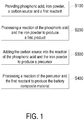
- FIG. 1 schematically illustrates the flow chart of a preparation method of a battery composite material according to an embodiment of the present invention.
- a preparation method of a batter composite material of the present invention includes steps as follows. At first, providing phosphoric acid, iron powder, a carbon source and a first reactant as shown in step S100, among which the carbon source is not limited to a carbohydrate, an organic compound, a polymer or a macromolecule material, the formula of the phosphoric acid is written by H 3 PO 4 , and the formula of the iron powder is written by Fe.
- the carbohydrate is not limited to fructose, sucrose, lactose or galactose.
- the macromolecule material is not limited to polyvinylpyrrolidone, and the formula of the macromolecule material is written by (C 6 H 9 NO) n , among which n is a natural number, and the IUPAC name of the macromolecule material is PVP.
- the first reactant is lithium hydroxide (LiOH), lithium carbonate (Li 2 CO 3 ), a compound consisting of lithium, or a mixture of several compounds consisting of lithium, but not limited thereto.
- the first product is an amorphous body of ferric phosphate
- the formula of the first product is written by a-FePO 4 ⁇ xH 2 O, among which a > 0 and x > 0.
- step S300 adding the carbon source into the reaction of the phosphoric acid and the iron powder, grinding and calcining the first product to produce a precursor as shown in step S300, among which the formula of the precursor is written by Fe 7 (PO 4 ) 6 .
- step S400 processing a reaction of the precursor and the first reactant to produce the battery composite material as shown in step S400, among which the battery composite material is for example LiFePO 4 .
- metal oxide such as V 2 O 5 or MgO
- LFP-NCO lithium ferric phosphate nano-co-crystalline olivine
- the present invention provides a preparation method of a battery composite material for reducing the material cost in manner of preparing the battery composite material through the precursor produced via reactions and compounds consisting of lithium atom, which is not limited to LiOH. Meanwhile, the sensitivity of pH value of the process is reduced, the viscosity of the material and the blockage of processing pipes are avoided, the processing temperature is stably controlled, and the operation difficulty of the process is reduced.
- FIG. 2 schematically illustrates a detailed flow chart of the preparation method of a battery composite material according to an embodiment of the present invention.
- the detailed flow chart of the step S200 of the preparation method of the battery composite material of the present invention includes steps as follows.
- step S201 allowing deionized water to dissolve a first quantity of the phosphoric acid for forming a first phosphoric acid solution at a first temperature, among which the first temperature can be preheated to a temperature equal to or larger than 40°C and equal to or less than 50°C, and is preferred to be preheated to 42°C, but not limited thereto.
- step S202 processing a reaction of the first phosphoric acid solution and the iron powder at a second temperature, lowering the reaction temperature to a third temperature after the second temperature is reached by the reaction temperature, and maintaining the reaction temperature at the third temperature for a first time period.
- the second temperature is equal to or less than 60°C, and is preferably 60°C
- the third temperature is equal to or less than 50°C, and is preferably 50°C.
- the first time period is at least 3 hours, and is preferably 3 hours.
- the preferably embodiment of the step S202 is not limited to be implemented as processing a reaction of the first phosphoric acid solution and the iron powder at 60°C, lowering the reaction temperature to 50°C after the reaction temperature reached 60°C, and maintaining the reaction temperature at 50°C for 3 hours. Then, as shown in step S203, lowering the reaction temperature to a fourth temperature and adding a second phosphoric acid solution consisting a second quantity of the phosphoric acid, and processing a reaction of the first phosphoric acid solution, the second phosphoric acid solution and the iron powder for a second time period in order to produce the first product.
- the fourth temperature is equal to or less than 30°C, and is preferably 30°C.
- the second time period is at least 23 hours, and is preferably 23 hours.
- the weight ratio of the first quantity to the second quantity is 3:1, i.e. the first quantity is 75% and the second quantity is 25%.
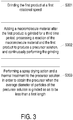
- FIG. 3 schematically illustrates another detailed flow chart of the preparation method of a battery composite material according to an embodiment of the present invention.
- grinding the first product at a first rotational speed among which the first rotational speed is equal to or greater than 450 rpm and equal to or less than 650 rpm, and is preferably 550 rpm.
- step S302 adding the carbon source, such as the macromolecule material PVP, after the first product is grinded for a third time period, which is preferably at least 5 minutes, processing a reaction of the macromolecule material and the first product to produce a precursor solution, and continuously performing the grinding till the step S303.
- the step S303 is shown as performing a spray drying action and a thermal treatment to the precursor solution in order to obtain the precursor when the average diameter of particles (i.e. particle size distribution D50) of the precursor solution is grinded so as to be less than a first length, among which the first length is for example but not limited to 1 micrometer.
- the formula of the precursor is written by Fe 7 (PO4) 6 .
- the spray drying action is implemented by a rotary spray dryer.
- An entrance temperature of the spray drying action or the rotary spray dryer is 210°C
- an exit temperature of the spray drying action or the rotary spray dryer is -95°C
- the rotational speed of the spray drying action or the rotary spray dryer is 350 Hz, but not limited thereto.
- the thermal treatment is sequentially performed at 280°C for 2 hours and at 350°C for 1 hour in helium atmosphere.
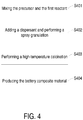
- FIG. 4 schematically illustrates still another detailed flow chart of the preparation method of a battery composite material according to an embodiment of the present invention. As shown in FIG. 4 , the detailed flow chart of the step S400 includes steps of mixing the precursor (i.e.
- the first reactant which is not limited to be a compound consisting of lithium such as LiOH or Li 2 CO 3 , or a mixture of several compounds consisting of lithium, as shown in step S401, adding a dispersant and performing a spray granulation as shown in step S402, performing a high-temperature calcination as shown in step S403, and producing the battery composite material, which is for example lithium ferric phosphate (i.e. LiFePO 4 ), as shown in step S404.
- the battery composite material which is for example lithium ferric phosphate (i.e. LiFePO 4 ), as shown in step S404.
- the calcined compound is analyzed in manner of X-ray diffraction, and the analysis diagram is shown as FIG. 5 .
- the compound is confirmed to be Fe 7 (PO 4 ) 6 .
- the surface exterior is analyzed through SEM, and the SEM analysis diagram is shown as FIG. 6 .
- the calcined compound is analyzed in manner of X-ray diffraction, and the analysis diagram is shown as FIG. 7 . After comparing the diagram with JCPDS card, the compound is confirmed to be LiFePO 4 .
- the surface exterior is analyzed through SEM, and the SEM analysis diagram is shown as FIG. 8 .
- a coin-cell battery is made of the LiFePO 4 obtained in this embodiment.
- the electric characteristics of charging and discharging are tested and analyzed through a charging and discharging machine. The test and the analysis are performed at 0.1 coulombs for two cycles and 2 coulombs for two cycles.
- the charging and discharging characteristic diagram is shown as FIG. 9 .
- the cutoff voltage of the coin-cell battery is 2 to 4.2 volts.
- the present invention provides a preparation method of a battery composite material and a precursor thereof for reducing the grinding time and the costs per unit of time and money in manner of preparing the battery composite material through the precursor produced via reactions. Meanwhile, the sensitivity of pH value of the process is reduced, the viscosity of the material and the blockage of processing pipes are avoided, the processing temperature is stably controlled, and the operation difficulty of the process is reduced. Additionally, the present disclosure also provides a preparation method of a battery composite material and a precursor thereof in order to reduce the waste of materials and totally enhance the product qualities by the fully reacted phosphoric acid and iron powder of the two-times reactions of the phosphoric acid, the deionized water and the iron powder.
Landscapes
- Chemical & Material Sciences (AREA)
- Chemical Kinetics & Catalysis (AREA)
- Electrochemistry (AREA)
- General Chemical & Material Sciences (AREA)
- Inorganic Chemistry (AREA)
- Organic Chemistry (AREA)
- Engineering & Computer Science (AREA)
- Manufacturing & Machinery (AREA)
- Crystallography & Structural Chemistry (AREA)
- Materials Engineering (AREA)
- Composite Materials (AREA)
- Battery Electrode And Active Subsutance (AREA)
- Secondary Cells (AREA)
Claims (13)
- Herstellungsverfahren für ein Batterieverbundmaterial, umfassend die Schritte:(a) Bereitstellen von Phosphorsäure, Eisenpulver, einer Kohlenstoffquelle und einem ersten Reaktionspartner;(b1) Deionisiertes Wasser eine erste Menge der Phosphorsäure lösen zu lassen, um eine erste Phosphorsäurelösung bei einer ersten Temperatur zu bilden;(b2) Durchführen einer Reaktion der ersten Phosphorsäurelösung und des Eisenpulvers bei einer zweiten Temperatur, Absenken der Reaktionstemperatur auf eine dritte Temperatur, nachdem die zweite Temperatur durch die Reaktionstemperatur erreicht ist, und Halten der Reaktionstemperatur für eine erste Zeitspanne; und(b3) Absenken der Reaktionstemperatur auf eine vierte Temperatur und Zugabe einer zweiten Phosphorsäurelösung, die aus einer zweiten Menge Phosphorsäure besteht, und Verarbeiten einer Reaktion der ersten Phosphorsäurelösung, der zweiten Phosphorsäurelösung und des Eisenpulvers für einen zweiten Zeitraum, um ein erstes Produkt herzustellen,(c) Hinzufügen der Kohlenstoffquelle, Mahlen und Kalzinieren des ersten Produkts, um einen Vorläufer herzustellen, wobei die Formel des Vorläufers durch Fe7(PO4)6 beschrieben ist; und(d) Durchführen einer Reaktion des Vorläufers und des ersten Reaktanten, um ein Reaktionsgemisch zu erhalten, und dann Kalzinieren des Reaktionsgemischs, um das Batterieverbundmaterial herzustellen,wobei der erste Reaktant ein Lithiumhydroxid, ein Lithiumcarbonat, eine Verbindung, bestehend aus Lithium, oder eine Mischung aus mehreren Verbindungen, bestehend aus Lithium, ist,
das erste Produkt ein amorpher Körper aus Eisen(III)-Phosphat ist, und die Formel des ersten Produkts durch a-FePO4 • xH2O beschrieben ist, wobei a > 0 und x > 0. - Herstellungsverfahren nach Anspruch 1, wobei die Kohlenstoffquelle ein Kohlenhydrat, eine organische Verbindung, ein Polymer oder ein Makromolekülmaterial ist, und wobei das Makromolekülmaterial Polyvinylpyrrolidon ist und die Formel des Makromolekülmaterials durch (C6H9NO)n beschrieben ist, wobei n eine natürliche Zahl ist und der IUPAC-Name des Makromolekülmaterials PVP ist.
- Herstellungsverfahren nach Anspruch 1, wobei der erste Reaktant ein Lithiumcarbonat ist und die Formel des ersten Reaktanten durch Li2CO3 beschrieben ist, und wobei das Batterieverbundmaterial ein Lithiumferritphosphat-Nanokristallines Olivin (LFP-NCO) ist.
- Herstellungsverfahren nach Anspruch 1, wobei das Gewichtsverhältnis der ersten Menge zu der zweiten Menge 3:1 beträgt.
- Herstellungsverfahren nach Anspruch 1, wobei die erste Temperatur gleich oder größer als 40°C und gleich oder kleiner als 50°C ist, die zweite Temperatur gleich oder kleiner als 60°C ist, die dritte Temperatur gleich oder kleiner als 50°C ist und die vierte Temperatur gleich oder kleiner als 30°C ist.
- Herstellungsverfahren nach Anspruch 1, wobei die erste Zeitspanne mindestens 3 Stunden und die zweite Zeitspanne mindestens 23 Stunden beträgt.
- Herstellungsverfahren nach Anspruch 1, wobei die Kohlenstoffquelle ein Makromolekülmaterial ist, und wobei der Schritt (c) ferner die Schritte umfasst:(c1) Mahlen des ersten Produkts bei einer ersten Drehzahl;(c2) Hinzufügen des Makromolekülmaterials, nachdem das erste Produkt für einen dritten Zeitraum gemahlen wurde, Verarbeiten einer Reaktion des Makromolekülmaterials und des ersten Produkts, um eine Vorläuferlösung herzustellen, und kontinuierliches Durchführen der Vermahlung; und(c3) Durchführen einer Sprühtrocknung und einer Wärmebehandlung der Vorläuferlösung, um den Vorläufer zu erhalten, wenn der durchschnittliche Durchmesser der Partikel der Vorläuferlösung gemahlen wird, so dass er kleiner als eine erste Länge ist.
- Herstellungsverfahren nach Anspruch 7, wobei eine Eintrittstemperatur der Sprühtrocknung 210°C, eine Austrittstemperatur der Sprühtrocknung -95°C und die Drehgeschwindigkeit der Sprühtrocknung 350 Hz beträgt.
- Herstellungsverfahren nach Anspruch 7, wobei die Wärmebehandlung nacheinander bei 280°C für 2 Stunden und bei 350°C für 1 Stunde in Heliumatmosphäre durchgeführt wird.
- Herstellungsverfahren nach Anspruch 7, wobei die erste Drehzahl gleich oder größer als 450 U/min und gleich oder kleiner als 650 U/min ist.
- Herstellungsverfahren nach Anspruch 7, wobei die dritte Zeitspanne mindestens 5 Minuten beträgt.
- Herstellungsverfahren nach Anspruch 7, wobei die erste Länge 1 Mikrometer beträgt.
- Herstellungsverfahren nach Anspruch 1, wobei der Schritt (d) ferner die Schritte umfasst:(d1) Mischen des Vorläufers und des ersten Reaktanten;(d2) Zugabe eines Dispersionsmittels und Durchführung einer Sprühgranulation;(d3) Durchführen einer Hochtemperaturkalzinierung; und(d4) Herstellen des Batterieverbundmaterials.
Applications Claiming Priority (2)
| Application Number | Priority Date | Filing Date | Title |
|---|---|---|---|
| US201161509636P | 2011-07-20 | 2011-07-20 | |
| PCT/CN2012/078973 WO2013010505A1 (zh) | 2011-07-20 | 2012-07-20 | 电池复合材料及其前驱体的制备方法 |
Publications (3)
| Publication Number | Publication Date |
|---|---|
| EP2736101A1 EP2736101A1 (de) | 2014-05-28 |
| EP2736101A4 EP2736101A4 (de) | 2015-03-11 |
| EP2736101B1 true EP2736101B1 (de) | 2020-01-22 |
Family
ID=47557672
Family Applications (1)
| Application Number | Title | Priority Date | Filing Date |
|---|---|---|---|
| EP12815187.5A Active EP2736101B1 (de) | 2011-07-20 | 2012-07-20 | Verfahren zur herstellung eines batterieverbundmaterials |
Country Status (9)
| Country | Link |
|---|---|
| US (1) | US9321648B2 (de) |
| EP (1) | EP2736101B1 (de) |
| JP (1) | JP5980921B2 (de) |
| KR (1) | KR101661823B1 (de) |
| CN (1) | CN103688392B (de) |
| CA (1) | CA2842165C (de) |
| RU (1) | RU2014101412A (de) |
| TW (1) | TWI464109B (de) |
| WO (1) | WO2013010505A1 (de) |
Families Citing this family (11)
| Publication number | Priority date | Publication date | Assignee | Title |
|---|---|---|---|---|
| WO2014032588A1 (zh) | 2012-08-28 | 2014-03-06 | 台湾立凯电能科技股份有限公司 | 电池复合材料及其前驱物的制备方法 |
| WO2014180334A1 (zh) * | 2013-05-08 | 2014-11-13 | 台湾立凯电能科技股份有限公司 | 电池复合材料及其前驱物的制备方法 |
| RU2642425C1 (ru) * | 2016-11-15 | 2018-01-25 | Общество с ограниченной ответственностью "Общество с ограниченной ответственностью "Литиевые нанотехнологии для энергетики" | СПОСОБ СИНТЕЗА АКТИВНОГО КОМПОНЕНТА КАТОДНОЙ МАССЫ НА ОСНОВЕ LiFePO4 И КАТОДНАЯ МАССА, СОДЕРЖАЩАЯ АКТИВНЫЙ КОМПОНЕНТ |
| CN113896182B (zh) * | 2021-09-10 | 2023-05-23 | 上海量孚新能源科技有限公司 | 一种绿色磷酸铁锂前驱体及其制备方法、应用 |
| TWI815629B (zh) * | 2022-08-29 | 2023-09-11 | 台灣立凱電能科技股份有限公司 | 正極材料的製造方法及其製成的電池 |
| TW202411155A (zh) * | 2022-09-05 | 2024-03-16 | 台灣立凱電能科技股份有限公司 | 一種電池複合材料及其前驅物的製作方法 |
| TW202411156A (zh) * | 2022-09-08 | 2024-03-16 | 台灣立凱電能科技股份有限公司 | 磷酸鋰鐵正極材料的回收再製方法 |
| TWI827275B (zh) * | 2022-09-27 | 2023-12-21 | 台灣立凱電能科技股份有限公司 | 磷酸鋰鐵正極材料的製備方法 |
| CN116654892B (zh) * | 2023-07-14 | 2026-01-16 | 湖北碧拓新材料科技有限公司 | 一种利用正极材料生产废料液相合成磷酸铁锂的方法 |
| TWI882533B (zh) * | 2023-11-20 | 2025-05-01 | 台灣立凱電能科技股份有限公司 | 電池用磷酸鐵前驅體之製備方法 |
| TWI882532B (zh) * | 2023-11-20 | 2025-05-01 | 台灣立凱電能科技股份有限公司 | 電池用磷酸鐵前驅體之製備方法 |
Family Cites Families (14)
| Publication number | Priority date | Publication date | Assignee | Title |
|---|---|---|---|---|
| CA2320661A1 (fr) * | 2000-09-26 | 2002-03-26 | Hydro-Quebec | Nouveau procede de synthese de materiaux limpo4 a structure olivine |
| CN100359726C (zh) * | 2002-10-18 | 2008-01-02 | 国立九州大学 | 二次电池用阴极材料的制备方法和二次电池 |
| JP4343618B2 (ja) * | 2003-08-21 | 2009-10-14 | セントラル硝子株式会社 | ポリアニオン型リチウム鉄複合酸化物の製造方法及びそれを用いた電池 |
| TWI279020B (en) | 2004-11-03 | 2007-04-11 | Tatung Co Ltd | Preparation of olivine LiFePO4 cathode materials for lithium batteries via a solution method |
| US7892676B2 (en) | 2006-05-11 | 2011-02-22 | Advanced Lithium Electrochemistry Co., Ltd. | Cathode material for manufacturing a rechargeable battery |
| JP2008004317A (ja) * | 2006-06-21 | 2008-01-10 | Gs Yuasa Corporation:Kk | 電池用リン酸鉄リチウムの製造方法及びそれを用いた電池 |
| TWI319920B (en) * | 2006-07-06 | 2010-01-21 | The preparation and application of the lifepo4/li3v2(po4)3 composite cathode materials for lithium ion batteries | |
| JP5388822B2 (ja) * | 2009-03-13 | 2014-01-15 | Jfeケミカル株式会社 | リン酸鉄リチウムの製造方法 |
| CN101764205A (zh) * | 2009-10-14 | 2010-06-30 | 孙琦 | 一种碳包覆磷酸铁锂的制备方法 |
| CN101693532B (zh) | 2009-10-16 | 2011-06-29 | 清华大学 | 一种磷酸亚铁锂的制备方法 |
| CN101696001B (zh) | 2009-10-26 | 2012-07-25 | 清华大学 | 一种溶液中合成磷酸亚铁锂的方法 |
| JP2011132095A (ja) | 2009-12-25 | 2011-07-07 | Toda Kogyo Corp | オリビン型化合物粒子粉末の製造方法、並びに非水電解質二次電池 |
| CN101830452B (zh) * | 2010-03-18 | 2012-05-30 | 四川大学 | 由磷铁制备LixFeyPzO4的新方法 |
| CN101955175B (zh) * | 2010-07-15 | 2012-07-25 | 北京中新联科技股份有限公司 | 一种磷酸亚铁锂的工业制备方法 |
-
2012
- 2012-07-20 CA CA2842165A patent/CA2842165C/en active Active
- 2012-07-20 TW TW101126332A patent/TWI464109B/zh active
- 2012-07-20 WO PCT/CN2012/078973 patent/WO2013010505A1/zh not_active Ceased
- 2012-07-20 KR KR1020147003479A patent/KR101661823B1/ko active Active
- 2012-07-20 EP EP12815187.5A patent/EP2736101B1/de active Active
- 2012-07-20 US US14/232,726 patent/US9321648B2/en active Active
- 2012-07-20 JP JP2014520520A patent/JP5980921B2/ja active Active
- 2012-07-20 CN CN201280035795.9A patent/CN103688392B/zh active Active
- 2012-07-20 RU RU2014101412/07A patent/RU2014101412A/ru unknown
Non-Patent Citations (1)
| Title |
|---|
| None * |
Also Published As
| Publication number | Publication date |
|---|---|
| JP5980921B2 (ja) | 2016-08-31 |
| US20150030517A1 (en) | 2015-01-29 |
| KR20140064776A (ko) | 2014-05-28 |
| EP2736101A4 (de) | 2015-03-11 |
| CN103688392B (zh) | 2017-04-26 |
| WO2013010505A1 (zh) | 2013-01-24 |
| CN103688392A (zh) | 2014-03-26 |
| TWI464109B (zh) | 2014-12-11 |
| RU2014101412A (ru) | 2015-08-27 |
| EP2736101A1 (de) | 2014-05-28 |
| TW201305046A (zh) | 2013-02-01 |
| KR101661823B1 (ko) | 2016-09-30 |
| CA2842165C (en) | 2017-04-11 |
| US9321648B2 (en) | 2016-04-26 |
| JP2014524123A (ja) | 2014-09-18 |
| CA2842165A1 (en) | 2013-01-24 |
Similar Documents
| Publication | Publication Date | Title |
|---|---|---|
| EP2736101B1 (de) | Verfahren zur herstellung eines batterieverbundmaterials | |
| EP4506306A1 (de) | Herstellungsverfahren für lithiumeisenmanganphosphat, anodenelektrodenmaterial und lithium-ionen-batterie | |
| JP6063503B2 (ja) | 純粋相リン酸リチウムアルミニウムチタンおよびその製造方法ならびにその使用 | |
| CN103515594B (zh) | 碳包覆的磷酸锰锂/磷酸铁锂核壳结构材料及其制备方法 | |
| CN100448071C (zh) | 锂电池正极材料及其制备方法 | |
| JP2003292307A (ja) | リン酸第一鉄含水塩結晶、その製造方法及びリチウム鉄リン系複合酸化物の製造方法 | |
| US9159991B2 (en) | Mixed phosphate-diphosphate electrode materials and methods of manufacturing same | |
| JP5004413B2 (ja) | 燐酸アンモニウム鉄及びリチウムイオン二次電池用正極材料の製造方法、並びにリチウムイオン二次電池 | |
| EP2892091B1 (de) | Verfahren zur herstellung eines batterieverbundwerkstoffs und eines vorläufers davon | |
| CN101315981A (zh) | 一种锂离子电池用磷酸亚铁锂正极材料及改性方法 | |
| CN115132977A (zh) | 正极活性材料及其制备方法、正极、锂二次电池 | |
| Li et al. | Phase structure changes of MnP anode material during electrochemical lithiation and delithiation process | |
| TWI612716B (zh) | 電池複合材料及其前驅物之製備方法 | |
| US12062785B2 (en) | Method of producing a rechargeable high-energy battery having an anionically redox-active composite cathode | |
| EP4345059A1 (de) | Verfahren zur herstellung von lithiumeisenphosphatkathodenmaterial | |
| JP4276469B2 (ja) | コバルト酸リチウムの製造方法 | |
| JP2012056827A (ja) | 酸化鉄粒子 |
Legal Events
| Date | Code | Title | Description |
|---|---|---|---|
| PUAI | Public reference made under article 153(3) epc to a published international application that has entered the european phase |
Free format text: ORIGINAL CODE: 0009012 |
|
| 17P | Request for examination filed |
Effective date: 20140220 |
|
| AK | Designated contracting states |
Kind code of ref document: A1 Designated state(s): AL AT BE BG CH CY CZ DE DK EE ES FI FR GB GR HR HU IE IS IT LI LT LU LV MC MK MT NL NO PL PT RO RS SE SI SK SM TR |
|
| DAX | Request for extension of the european patent (deleted) | ||
| A4 | Supplementary search report drawn up and despatched |
Effective date: 20150210 |
|
| RIC1 | Information provided on ipc code assigned before grant |
Ipc: H01M 4/04 20060101AFI20150203BHEP Ipc: H01M 4/58 20100101ALI20150203BHEP Ipc: C01B 25/45 20060101ALI20150203BHEP |
|
| STAA | Information on the status of an ep patent application or granted ep patent |
Free format text: STATUS: EXAMINATION IS IN PROGRESS |
|
| 17Q | First examination report despatched |
Effective date: 20171116 |
|
| GRAJ | Information related to disapproval of communication of intention to grant by the applicant or resumption of examination proceedings by the epo deleted |
Free format text: ORIGINAL CODE: EPIDOSDIGR1 |
|
| GRAP | Despatch of communication of intention to grant a patent |
Free format text: ORIGINAL CODE: EPIDOSNIGR1 |
|
| GRAP | Despatch of communication of intention to grant a patent |
Free format text: ORIGINAL CODE: EPIDOSNIGR1 |
|
| STAA | Information on the status of an ep patent application or granted ep patent |
Free format text: STATUS: GRANT OF PATENT IS INTENDED |
|
| RIC1 | Information provided on ipc code assigned before grant |
Ipc: C01B 25/45 20060101ALI20191002BHEP Ipc: C01B 25/37 20060101ALI20191002BHEP Ipc: H01M 4/04 20060101AFI20191002BHEP Ipc: H01M 10/052 20100101ALI20191002BHEP Ipc: H01M 4/58 20100101ALI20191002BHEP |
|
| INTG | Intention to grant announced |
Effective date: 20191025 |
|
| GRAS | Grant fee paid |
Free format text: ORIGINAL CODE: EPIDOSNIGR3 |
|
| GRAA | (expected) grant |
Free format text: ORIGINAL CODE: 0009210 |
|
| STAA | Information on the status of an ep patent application or granted ep patent |
Free format text: STATUS: THE PATENT HAS BEEN GRANTED |
|
| AK | Designated contracting states |
Kind code of ref document: B1 Designated state(s): AL AT BE BG CH CY CZ DE DK EE ES FI FR GB GR HR HU IE IS IT LI LT LU LV MC MK MT NL NO PL PT RO RS SE SI SK SM TR |
|
| REG | Reference to a national code |
Ref country code: GB Ref legal event code: FG4D |
|
| REG | Reference to a national code |
Ref country code: CH Ref legal event code: EP |
|
| REG | Reference to a national code |
Ref country code: DE Ref legal event code: R096 Ref document number: 602012067453 Country of ref document: DE |
|
| REG | Reference to a national code |
Ref country code: AT Ref legal event code: REF Ref document number: 1227515 Country of ref document: AT Kind code of ref document: T Effective date: 20200215 |
|
| REG | Reference to a national code |
Ref country code: IE Ref legal event code: FG4D |
|
| REG | Reference to a national code |
Ref country code: NL Ref legal event code: MP Effective date: 20200122 |
|
| REG | Reference to a national code |
Ref country code: LT Ref legal event code: MG4D |
|
| PG25 | Lapsed in a contracting state [announced via postgrant information from national office to epo] |
Ref country code: NL Free format text: LAPSE BECAUSE OF FAILURE TO SUBMIT A TRANSLATION OF THE DESCRIPTION OR TO PAY THE FEE WITHIN THE PRESCRIBED TIME-LIMIT Effective date: 20200122 Ref country code: NO Free format text: LAPSE BECAUSE OF FAILURE TO SUBMIT A TRANSLATION OF THE DESCRIPTION OR TO PAY THE FEE WITHIN THE PRESCRIBED TIME-LIMIT Effective date: 20200422 Ref country code: FI Free format text: LAPSE BECAUSE OF FAILURE TO SUBMIT A TRANSLATION OF THE DESCRIPTION OR TO PAY THE FEE WITHIN THE PRESCRIBED TIME-LIMIT Effective date: 20200122 Ref country code: PT Free format text: LAPSE BECAUSE OF FAILURE TO SUBMIT A TRANSLATION OF THE DESCRIPTION OR TO PAY THE FEE WITHIN THE PRESCRIBED TIME-LIMIT Effective date: 20200614 Ref country code: RS Free format text: LAPSE BECAUSE OF FAILURE TO SUBMIT A TRANSLATION OF THE DESCRIPTION OR TO PAY THE FEE WITHIN THE PRESCRIBED TIME-LIMIT Effective date: 20200122 |
|
| PG25 | Lapsed in a contracting state [announced via postgrant information from national office to epo] |
Ref country code: LV Free format text: LAPSE BECAUSE OF FAILURE TO SUBMIT A TRANSLATION OF THE DESCRIPTION OR TO PAY THE FEE WITHIN THE PRESCRIBED TIME-LIMIT Effective date: 20200122 Ref country code: HR Free format text: LAPSE BECAUSE OF FAILURE TO SUBMIT A TRANSLATION OF THE DESCRIPTION OR TO PAY THE FEE WITHIN THE PRESCRIBED TIME-LIMIT Effective date: 20200122 Ref country code: GR Free format text: LAPSE BECAUSE OF FAILURE TO SUBMIT A TRANSLATION OF THE DESCRIPTION OR TO PAY THE FEE WITHIN THE PRESCRIBED TIME-LIMIT Effective date: 20200423 Ref country code: SE Free format text: LAPSE BECAUSE OF FAILURE TO SUBMIT A TRANSLATION OF THE DESCRIPTION OR TO PAY THE FEE WITHIN THE PRESCRIBED TIME-LIMIT Effective date: 20200122 Ref country code: IS Free format text: LAPSE BECAUSE OF FAILURE TO SUBMIT A TRANSLATION OF THE DESCRIPTION OR TO PAY THE FEE WITHIN THE PRESCRIBED TIME-LIMIT Effective date: 20200522 Ref country code: BG Free format text: LAPSE BECAUSE OF FAILURE TO SUBMIT A TRANSLATION OF THE DESCRIPTION OR TO PAY THE FEE WITHIN THE PRESCRIBED TIME-LIMIT Effective date: 20200422 |
|
| REG | Reference to a national code |
Ref country code: DE Ref legal event code: R097 Ref document number: 602012067453 Country of ref document: DE |
|
| PG25 | Lapsed in a contracting state [announced via postgrant information from national office to epo] |
Ref country code: EE Free format text: LAPSE BECAUSE OF FAILURE TO SUBMIT A TRANSLATION OF THE DESCRIPTION OR TO PAY THE FEE WITHIN THE PRESCRIBED TIME-LIMIT Effective date: 20200122 Ref country code: LT Free format text: LAPSE BECAUSE OF FAILURE TO SUBMIT A TRANSLATION OF THE DESCRIPTION OR TO PAY THE FEE WITHIN THE PRESCRIBED TIME-LIMIT Effective date: 20200122 Ref country code: SM Free format text: LAPSE BECAUSE OF FAILURE TO SUBMIT A TRANSLATION OF THE DESCRIPTION OR TO PAY THE FEE WITHIN THE PRESCRIBED TIME-LIMIT Effective date: 20200122 Ref country code: DK Free format text: LAPSE BECAUSE OF FAILURE TO SUBMIT A TRANSLATION OF THE DESCRIPTION OR TO PAY THE FEE WITHIN THE PRESCRIBED TIME-LIMIT Effective date: 20200122 Ref country code: CZ Free format text: LAPSE BECAUSE OF FAILURE TO SUBMIT A TRANSLATION OF THE DESCRIPTION OR TO PAY THE FEE WITHIN THE PRESCRIBED TIME-LIMIT Effective date: 20200122 Ref country code: RO Free format text: LAPSE BECAUSE OF FAILURE TO SUBMIT A TRANSLATION OF THE DESCRIPTION OR TO PAY THE FEE WITHIN THE PRESCRIBED TIME-LIMIT Effective date: 20200122 Ref country code: ES Free format text: LAPSE BECAUSE OF FAILURE TO SUBMIT A TRANSLATION OF THE DESCRIPTION OR TO PAY THE FEE WITHIN THE PRESCRIBED TIME-LIMIT Effective date: 20200122 Ref country code: SK Free format text: LAPSE BECAUSE OF FAILURE TO SUBMIT A TRANSLATION OF THE DESCRIPTION OR TO PAY THE FEE WITHIN THE PRESCRIBED TIME-LIMIT Effective date: 20200122 |
|
| REG | Reference to a national code |
Ref country code: AT Ref legal event code: MK05 Ref document number: 1227515 Country of ref document: AT Kind code of ref document: T Effective date: 20200122 |
|
| PLBE | No opposition filed within time limit |
Free format text: ORIGINAL CODE: 0009261 |
|
| STAA | Information on the status of an ep patent application or granted ep patent |
Free format text: STATUS: NO OPPOSITION FILED WITHIN TIME LIMIT |
|
| 26N | No opposition filed |
Effective date: 20201023 |
|
| PG25 | Lapsed in a contracting state [announced via postgrant information from national office to epo] |
Ref country code: IT Free format text: LAPSE BECAUSE OF FAILURE TO SUBMIT A TRANSLATION OF THE DESCRIPTION OR TO PAY THE FEE WITHIN THE PRESCRIBED TIME-LIMIT Effective date: 20200122 Ref country code: AT Free format text: LAPSE BECAUSE OF FAILURE TO SUBMIT A TRANSLATION OF THE DESCRIPTION OR TO PAY THE FEE WITHIN THE PRESCRIBED TIME-LIMIT Effective date: 20200122 |
|
| PG25 | Lapsed in a contracting state [announced via postgrant information from national office to epo] |
Ref country code: SI Free format text: LAPSE BECAUSE OF FAILURE TO SUBMIT A TRANSLATION OF THE DESCRIPTION OR TO PAY THE FEE WITHIN THE PRESCRIBED TIME-LIMIT Effective date: 20200122 Ref country code: MC Free format text: LAPSE BECAUSE OF FAILURE TO SUBMIT A TRANSLATION OF THE DESCRIPTION OR TO PAY THE FEE WITHIN THE PRESCRIBED TIME-LIMIT Effective date: 20200122 Ref country code: PL Free format text: LAPSE BECAUSE OF FAILURE TO SUBMIT A TRANSLATION OF THE DESCRIPTION OR TO PAY THE FEE WITHIN THE PRESCRIBED TIME-LIMIT Effective date: 20200122 |
|
| REG | Reference to a national code |
Ref country code: CH Ref legal event code: PL |
|
| REG | Reference to a national code |
Ref country code: BE Ref legal event code: MM Effective date: 20200731 |
|
| PG25 | Lapsed in a contracting state [announced via postgrant information from national office to epo] |
Ref country code: LI Free format text: LAPSE BECAUSE OF NON-PAYMENT OF DUE FEES Effective date: 20200731 Ref country code: CH Free format text: LAPSE BECAUSE OF NON-PAYMENT OF DUE FEES Effective date: 20200731 Ref country code: LU Free format text: LAPSE BECAUSE OF NON-PAYMENT OF DUE FEES Effective date: 20200720 |
|
| PG25 | Lapsed in a contracting state [announced via postgrant information from national office to epo] |
Ref country code: BE Free format text: LAPSE BECAUSE OF NON-PAYMENT OF DUE FEES Effective date: 20200731 |
|
| PG25 | Lapsed in a contracting state [announced via postgrant information from national office to epo] |
Ref country code: IE Free format text: LAPSE BECAUSE OF NON-PAYMENT OF DUE FEES Effective date: 20200720 |
|
| PG25 | Lapsed in a contracting state [announced via postgrant information from national office to epo] |
Ref country code: TR Free format text: LAPSE BECAUSE OF FAILURE TO SUBMIT A TRANSLATION OF THE DESCRIPTION OR TO PAY THE FEE WITHIN THE PRESCRIBED TIME-LIMIT Effective date: 20200122 Ref country code: MT Free format text: LAPSE BECAUSE OF FAILURE TO SUBMIT A TRANSLATION OF THE DESCRIPTION OR TO PAY THE FEE WITHIN THE PRESCRIBED TIME-LIMIT Effective date: 20200122 Ref country code: CY Free format text: LAPSE BECAUSE OF FAILURE TO SUBMIT A TRANSLATION OF THE DESCRIPTION OR TO PAY THE FEE WITHIN THE PRESCRIBED TIME-LIMIT Effective date: 20200122 |
|
| PG25 | Lapsed in a contracting state [announced via postgrant information from national office to epo] |
Ref country code: MK Free format text: LAPSE BECAUSE OF FAILURE TO SUBMIT A TRANSLATION OF THE DESCRIPTION OR TO PAY THE FEE WITHIN THE PRESCRIBED TIME-LIMIT Effective date: 20200122 Ref country code: AL Free format text: LAPSE BECAUSE OF FAILURE TO SUBMIT A TRANSLATION OF THE DESCRIPTION OR TO PAY THE FEE WITHIN THE PRESCRIBED TIME-LIMIT Effective date: 20200122 |
|
| REG | Reference to a national code |
Ref country code: GB Ref legal event code: 732E Free format text: REGISTERED BETWEEN 20230413 AND 20230419 |
|
| P01 | Opt-out of the competence of the unified patent court (upc) registered |
Effective date: 20230525 |
|
| PGFP | Annual fee paid to national office [announced via postgrant information from national office to epo] |
Ref country code: DE Payment date: 20250731 Year of fee payment: 14 |
|
| PGFP | Annual fee paid to national office [announced via postgrant information from national office to epo] |
Ref country code: GB Payment date: 20250731 Year of fee payment: 14 |
|
| PGFP | Annual fee paid to national office [announced via postgrant information from national office to epo] |
Ref country code: FR Payment date: 20250731 Year of fee payment: 14 |