EP2736104A1 - Verbundmaterial für eine positivelektrode aus einer lithiumreichen festen lösung, verfahren zu seiner herstellung, positivelektrodenplatte für eine lithiumionenbatterie und lithiumionenbatterie - Google Patents
Verbundmaterial für eine positivelektrode aus einer lithiumreichen festen lösung, verfahren zu seiner herstellung, positivelektrodenplatte für eine lithiumionenbatterie und lithiumionenbatterie Download PDFInfo
- Publication number
- EP2736104A1 EP2736104A1 EP13795984.7A EP13795984A EP2736104A1 EP 2736104 A1 EP2736104 A1 EP 2736104A1 EP 13795984 A EP13795984 A EP 13795984A EP 2736104 A1 EP2736104 A1 EP 2736104A1
- Authority
- EP
- European Patent Office
- Prior art keywords
- lithium
- mno
- composite material
- xli
- solid solution
- Prior art date
- Legal status (The legal status is an assumption and is not a legal conclusion. Google has not performed a legal analysis and makes no representation as to the accuracy of the status listed.)
- Withdrawn
Links
Images
Classifications
-
- H—ELECTRICITY
- H01—ELECTRIC ELEMENTS
- H01M—PROCESSES OR MEANS, e.g. BATTERIES, FOR THE DIRECT CONVERSION OF CHEMICAL ENERGY INTO ELECTRICAL ENERGY
- H01M4/00—Electrodes
- H01M4/02—Electrodes composed of, or comprising, active material
- H01M4/36—Selection of substances as active materials, active masses, active liquids
- H01M4/362—Composites
- H01M4/366—Composites as layered products
-
- C—CHEMISTRY; METALLURGY
- C01—INORGANIC CHEMISTRY
- C01G—COMPOUNDS CONTAINING METALS NOT COVERED BY SUBCLASSES C01D OR C01F
- C01G45/00—Compounds of manganese
- C01G45/12—Complex oxides containing manganese and at least one other metal element
- C01G45/1221—Manganates or manganites with trivalent manganese, tetravalent manganese or mixtures thereof
- C01G45/125—Manganates or manganites with trivalent manganese, tetravalent manganese or mixtures thereof of the type (MnO3)n-, e.g. CaMnO3
- C01G45/1257—Manganates or manganites with trivalent manganese, tetravalent manganese or mixtures thereof of the type (MnO3)n-, e.g. CaMnO3 containing lithium, e.g. Li2MnO3 or Li2(MxMn1-x)O3
-
- C—CHEMISTRY; METALLURGY
- C01—INORGANIC CHEMISTRY
- C01G—COMPOUNDS CONTAINING METALS NOT COVERED BY SUBCLASSES C01D OR C01F
- C01G51/00—Compounds of cobalt
- C01G51/04—Oxides
-
- C—CHEMISTRY; METALLURGY
- C01—INORGANIC CHEMISTRY
- C01G—COMPOUNDS CONTAINING METALS NOT COVERED BY SUBCLASSES C01D OR C01F
- C01G51/00—Compounds of cobalt
- C01G51/40—Complex oxides containing cobalt and at least one other metal element
- C01G51/42—Complex oxides containing cobalt and at least one other metal element containing alkali metals, e.g. LiCoO2
- C01G51/44—Complex oxides containing cobalt and at least one other metal element containing alkali metals, e.g. LiCoO2 containing manganese
- C01G51/56—Complex oxides containing cobalt and at least one other metal element containing alkali metals, e.g. LiCoO2 containing manganese of the type (MnO3)2-, e.g. Li2(CoxMn1-x)O3 or Li2(MyCoxMn1-x-y)O3
-
- C—CHEMISTRY; METALLURGY
- C01—INORGANIC CHEMISTRY
- C01G—COMPOUNDS CONTAINING METALS NOT COVERED BY SUBCLASSES C01D OR C01F
- C01G53/00—Compounds of nickel
- C01G53/04—Oxides
-
- C—CHEMISTRY; METALLURGY
- C01—INORGANIC CHEMISTRY
- C01G—COMPOUNDS CONTAINING METALS NOT COVERED BY SUBCLASSES C01D OR C01F
- C01G53/00—Compounds of nickel
- C01G53/40—Complex oxides containing nickel and at least one other metal element
- C01G53/42—Complex oxides containing nickel and at least one other metal element containing alkali metals, e.g. LiNiO2
- C01G53/44—Complex oxides containing nickel and at least one other metal element containing alkali metals, e.g. LiNiO2 containing manganese
- C01G53/56—Complex oxides containing nickel and at least one other metal element containing alkali metals, e.g. LiNiO2 containing manganese of the type (MnO3)2-, e.g. Li2(NixMn1-x)O3 or Li2(MyNixMn1-x-y)O3
-
- H—ELECTRICITY
- H01—ELECTRIC ELEMENTS
- H01M—PROCESSES OR MEANS, e.g. BATTERIES, FOR THE DIRECT CONVERSION OF CHEMICAL ENERGY INTO ELECTRICAL ENERGY
- H01M4/00—Electrodes
- H01M4/02—Electrodes composed of, or comprising, active material
- H01M4/36—Selection of substances as active materials, active masses, active liquids
- H01M4/48—Selection of substances as active materials, active masses, active liquids of inorganic oxides or hydroxides
- H01M4/50—Selection of substances as active materials, active masses, active liquids of inorganic oxides or hydroxides of manganese
- H01M4/505—Selection of substances as active materials, active masses, active liquids of inorganic oxides or hydroxides of manganese of mixed oxides or hydroxides containing manganese for inserting or intercalating light metals, e.g. LiMn2O4 or LiMn2OxFy
-
- H—ELECTRICITY
- H01—ELECTRIC ELEMENTS
- H01M—PROCESSES OR MEANS, e.g. BATTERIES, FOR THE DIRECT CONVERSION OF CHEMICAL ENERGY INTO ELECTRICAL ENERGY
- H01M4/00—Electrodes
- H01M4/02—Electrodes composed of, or comprising, active material
- H01M4/36—Selection of substances as active materials, active masses, active liquids
- H01M4/48—Selection of substances as active materials, active masses, active liquids of inorganic oxides or hydroxides
- H01M4/52—Selection of substances as active materials, active masses, active liquids of inorganic oxides or hydroxides of nickel, cobalt or iron
- H01M4/525—Selection of substances as active materials, active masses, active liquids of inorganic oxides or hydroxides of nickel, cobalt or iron of mixed oxides or hydroxides containing iron, cobalt or nickel for inserting or intercalating light metals, e.g. LiNiO2, LiCoO2 or LiCoOxFy
-
- H—ELECTRICITY
- H01—ELECTRIC ELEMENTS
- H01M—PROCESSES OR MEANS, e.g. BATTERIES, FOR THE DIRECT CONVERSION OF CHEMICAL ENERGY INTO ELECTRICAL ENERGY
- H01M4/00—Electrodes
- H01M4/02—Electrodes composed of, or comprising, active material
- H01M4/36—Selection of substances as active materials, active masses, active liquids
- H01M4/58—Selection of substances as active materials, active masses, active liquids of inorganic compounds other than oxides or hydroxides, e.g. sulfides, selenides, tellurides, halogenides or LiCoFy; of polyanionic structures, e.g. phosphates, silicates or borates
- H01M4/5825—Oxygenated metallic salts or polyanionic structures, e.g. borates, phosphates, silicates, olivines
-
- C—CHEMISTRY; METALLURGY
- C01—INORGANIC CHEMISTRY
- C01P—INDEXING SCHEME RELATING TO STRUCTURAL AND PHYSICAL ASPECTS OF SOLID INORGANIC COMPOUNDS
- C01P2004/00—Particle morphology
- C01P2004/80—Particles consisting of a mixture of two or more inorganic phases
- C01P2004/82—Particles consisting of a mixture of two or more inorganic phases two phases having the same anion, e.g. both oxidic phases
- C01P2004/84—Particles consisting of a mixture of two or more inorganic phases two phases having the same anion, e.g. both oxidic phases one phase coated with the other
-
- C—CHEMISTRY; METALLURGY
- C01—INORGANIC CHEMISTRY
- C01P—INDEXING SCHEME RELATING TO STRUCTURAL AND PHYSICAL ASPECTS OF SOLID INORGANIC COMPOUNDS
- C01P2006/00—Physical properties of inorganic compounds
- C01P2006/40—Electric properties
-
- H—ELECTRICITY
- H01—ELECTRIC ELEMENTS
- H01M—PROCESSES OR MEANS, e.g. BATTERIES, FOR THE DIRECT CONVERSION OF CHEMICAL ENERGY INTO ELECTRICAL ENERGY
- H01M4/00—Electrodes
- H01M4/02—Electrodes composed of, or comprising, active material
- H01M4/04—Processes of manufacture in general
- H01M4/0471—Processes of manufacture in general involving thermal treatment, e.g. firing, sintering, backing particulate active material, thermal decomposition, pyrolysis
-
- Y—GENERAL TAGGING OF NEW TECHNOLOGICAL DEVELOPMENTS; GENERAL TAGGING OF CROSS-SECTIONAL TECHNOLOGIES SPANNING OVER SEVERAL SECTIONS OF THE IPC; TECHNICAL SUBJECTS COVERED BY FORMER USPC CROSS-REFERENCE ART COLLECTIONS [XRACs] AND DIGESTS
- Y02—TECHNOLOGIES OR APPLICATIONS FOR MITIGATION OR ADAPTATION AGAINST CLIMATE CHANGE
- Y02E—REDUCTION OF GREENHOUSE GAS [GHG] EMISSIONS, RELATED TO ENERGY GENERATION, TRANSMISSION OR DISTRIBUTION
- Y02E60/00—Enabling technologies; Technologies with a potential or indirect contribution to GHG emissions mitigation
- Y02E60/10—Energy storage using batteries
Definitions
- the present invention relates to the field of lithium-ion batteries, and in particular, to a lithium-enriched solid solution anode composite material and a preparation method for the lithium-enriched solid solution anode composite material, a lithium-ion battery anode plate, and a lithium-ion battery.
- anode material has been a critical factor that constraints the further improvement of the energy density of the lithium-ion battery.
- anode materials are lithium cobalt oxide (LCO), lithium manganese oxide (LMO), lithium ferric phosphate (LFP), and nickel-cobalt-manganese (NCM) ternary materials, but specific capacity of these anode materials is smaller than 160 mAh/g. Energy density of a current lithium-ion battery can be further improved only by developing a new high-capacity anode material.
- the lithium-enriched solid solution anode material has become a development direction of a next generation anode material, because of high discharge capacity (>250 mAh/g, charging voltage>4.6 V) and a low cost.
- a charge-discharge process >4.5 V
- a surface of a lithium-enriched solid solution anode material with such a Layered-Layered structure undergoes sensitization reactions, and the reactions are as follows: LiMO 2 ⁇ Li 1- x MO 2- ⁇ + xLi + + ⁇ /2 O 2 + xe Formula (1), and Li 2 MnO 3 ⁇ MnO 2 + 2 Li + + 1/2 O 2 + 2e Formula (2).
- Influences on electrochemical properties are as follows: Li 2 O is formed due to generation of O 2 , and in a charge process, it is difficult for Li 2 O to be changed back, which causes that initial charge-discharge efficiency is relatively low (about 70%); cycle performance is inhibited with a change of the structure; and damage to the surface has a certain influence on rate performance of the lithium-enriched solid solution anode material.
- a potential of an anode is greater than 4.5 V
- manganese in the material may be separated out, which causes that material capacity fast fades. Therefore, although the lithium-enriched solid solution anode material with a layered-layered structure has high theoretic specific capacity, fast capacity fading is caused because the lithium-enriched solid solution anode material is unstable in a condition of a high voltage.
- a new lithium-enriched solid solution anode material xLi 2 MnO 3 ⁇ (1-x) MO (M is one or more of: Ni, Co, Mn, Ti, and Zr) with a layered-rocksalt structure (layered-rocksalt structure) has been reported.
- M is one or more of: Ni, Co, Mn, Ti, and Zr
- this type of lithium-enriched solid solution anode material with a layered-rocksalt structure does not undergo the reaction represented by Formula (1) in a charge-discharge process, that is, initial charge-discharge efficiency is improved to some extent.
- an embodiment of the present invention provides a lithium-enriched solid solution anode composite material, so as to solve problems in the prior art that a lithium-enriched solid solution anode material is unstable in a condition of a high voltage, and a cycle life, discharge capacity, rate performance, and initial charge-discharge efficiency of a manufactured lithium-ion battery are poor.
- an embodiment of the present invention provides a preparation method for the lithium-enriched solid solution anode composite material.
- an embodiment of the present invention provides a lithium-ion battery anode plate containing the lithium-enriched solid solution anode composite material.
- an embodiment of the present invention provides a lithium-ion battery containing the lithium-ion battery anode plate.
- an embodiment of the present invention provides a lithium-enriched solid solution anode composite material, where the lithium-enriched solid solution anode composite material is formed by xLi 2 MnO 3 ⁇ (1-x) MO and a LiMePO 4 layer that is clad on a surface of xLi 2 MnO 3 ⁇ (1-x) MO, x ⁇ 1, M is one or more selected from: Ni, Co, Mn, Ti, and Zr, and Me is one or more selected from: Co, Ni, V, and Mg.
- xLi 2 MnO 3 ⁇ (1-x) MO (x ⁇ 1, and M is one or more selected from: Ni, Co, Mn, Ti, and Zr) and the LiMePO 4 layer (Me is one or more selected from: Co, Ni, V, and Mg) form a cladding structure.
- LiMePO 4 is a phosphate system.
- the LiMePO 4 layer (Me is one or more selected from: Co, Ni, V, and Mg) can improve stability of xLi 2 MnO 3 ⁇ (1-x) MO (x ⁇ 1, and M is one or more selected from: Ni, Co, Mn, Ti, and Zr) at a high voltage (>4.6 V), thereby improving a cycle life of xLi 2 MnO 3 ⁇ (1-x) MO.
- a reason lies in that a LiPF 6 -based electrolyte is a most basic component in a current lithium-ion battery electrolyte.
- a decomposition product such as PF 5
- LiPF 6 reacts with water to generate HF that is prone to corrode an anode material.
- contact area between the electrolyte and xLi 2 MnO 3 ⁇ (1-x) MO can be reduced, and corrosion performed by the electrolyte on the surface of xLi 2 MnO 3 ⁇ (1-x) MO can be alleviated, so that the corrosion on the surface of xLi 2 MnO 3 ⁇ (1-x) MO in a charge-discharge process is inhibited, and a side reaction on the surface of xLi 2 MnO 3 ⁇ (1-x) MO in the charge-discharge process is inhibited, thereby improving the
- a thickness of the LiMePO 4 layer is 1 - 10nm.
- Me may be clad on the surface of xLi 2 MnO 3 ⁇ (1-x) MO together with Li 3 PO 4 , or may be embedded in a crystal lattice of xLi 2 MnO 3 ⁇ (1-x) MO, or the two situations exist together, where x ⁇ 1, and M is one or more selected from: Ni, Co, Mn, Ti, and Zr.
- Me When Me is clad on the surface of xLi 2 MnO 3 ⁇ (1-x) MO, when being charged, Me is embedded in lithium, thereby improving discharge capacity of xLi 2 MnO 3 ⁇ (1-x) MO, and moreover, Me and Li 3 PO 4 may also improve conductivity of xLi 2 MnO 3 ⁇ (1-x) MO, thereby improving rate performance of xLi 2 MnO 3 ⁇ (1-x) MO.
- a part of Me in LiMePO 4 is clad on the surface of xLi 2 MnO 3 ⁇ (1-x) MO, and the other part is embedded in the crystal lattice of xLi 2 MnO 3 ⁇ (1-x)MO.
- the lithium-enriched solid solution anode composite material provided in the first aspect of the embodiment of the present invention has high stability in an electrolyte, may improve a cycle life, discharge capacity, rate performance, and initial charge-discharge efficiency of a lithium-ion battery, and is applicable in a condition of a high voltage greater than 4.6V.
- an embodiment of the present invention provides a preparation method for a lithium-enriched solid solution anode composite material, which includes the following steps:
- an annealing condition is annealing for 24 h at a temperature of 450°C to obtain a lithium-enriched solid solution anode composite material.
- the molar ratio of the ammonium dihydrogen phosphate, glycolic acid, Me(NO 3 ) 2 , and lithium nitrate is 1:0.05:1:1, where Me is one or more selected from: Co, Ni, V, and Mg.
- the molar ratio at which xLi 2 MnO 3 ⁇ (1-x)MO is added to the Me-containing mixed solution is 75:1.
- baking is baking for 12 h in a stirring condition at a temperature of 80°C.
- xLi 2 MnO 3 ⁇ (1-x)MO is obtained through preparation by adopting the following method: ultrasonically dispersing Li 2 MnO 3 in an HNO 3 solution of M(NO 3 ) 2 at a molar ratio of Li 2 MnO 3 :M(NO 3 ) 2 :HNO 3 of 1 - 2:0.5 - 1:0.1 - 0.5, so as to obtain a mixed solution of Li 2 MnO 3 , M(NO 3 ) 2 , and HNO 3 ; placing the mixed solution of Li 2 MnO 3 , M(NO 3 ) 2 , and HNO 3 in a water bath, and baking for 4 - 24 h in a stirring condition at 50 - 100°C; and grinding a baked solid product into powder, and then placing the powder in a Muffle furnace and annealing for 12 - 48 h at a temperature
- xLi 2 MnO 3 ⁇ (1-x)MO x ⁇ 1, and M is one or a combination of: Ni, Co, Mn, Ti, and Zr, and more preferably, an annealing condition is annealing for 24 h at a temperature of 450°C, so as to obtain xLi 2 MnO 3 ⁇ (1-x)MO.
- Li 2 MnO 3 is obtained through preparation by adopting the following method: adding MnCO 3 to a LiOH solution at a molar ratio of MnCO 3 :LiOH of 1:2 - 4, so as to obtain a mixed solution of MnCO 3 and LiOH; fully stirring the mixed solution of MnCO 3 and LiOH for dissolution, and then placing the solution in an air blast drying cabinet, and baking for 4 - 24 h at a temperature of 50 - 100°C; and grinding a baked solid product into powder, and then placing the powder in a Muffle furnace and annealing for 12 - 48 h at a temperature of 350 - 800°C, so as to obtain Li 2 MnO 3 .
- an annealing condition is annealing for 12 h at a temperature of 750°C, so as to obtain Li 2 MnO 3 .
- the preparation method for a lithium-enriched solid solution anode composite material provided in the second aspect of the embodiment of the present invention is simple and flexible, and the prepared lithium-enriched solid solution anode composite material may improve discharge capacity, rate performance, initial charge-discharge efficiency, and a cycle life of a lithium-ion battery.
- an embodiment of the present invention provides a lithium-ion battery anode plate, where the lithium-ion battery anode plate includes a current collector and a lithium-enriched solid solution anode composite material coated on the current collector, and the lithium-enriched solid solution anode composite material is formed by xLi 2 MnO 3 -(1-x)MO and a LiMePO 4 layer that is clad on a surface of xLi 2 MnO 3 ⁇ (1-x)MO, x ⁇ 1, M is one or more selected from: Ni, Co, Mn, Ti, and Zr, and Me is one or more selected from: Co, Ni, V, and Mg.
- a preparation method for the lithium-ion battery anode plate includes: mixing a lithium-enriched solid solution anode composite material, a conductive agent, an adhesive, and a solvent, so as to obtain a paste; and coating the paste on a current collector, and then performing drying and tabletting, so as to obtain a lithium-ion battery anode plate.
- the lithium-ion battery anode plate provided in the third aspect of the embodiment of the present invention may be used to prepare a lithium-ion battery.
- an embodiment of the present invention provides a lithium-ion battery, which includes a lithium-ion battery anode plate, a lithium-ion battery cathode plate, a membrane, and an electrolyte.
- the lithium-ion battery anode plate includes a current collector and a lithium-enriched solid solution anode composite material coated on the current collector, where the lithium-enriched solid solution anode composite material is formed by xLi 2 MnO 3 ⁇ (1-x) MO and a LiMePO 4 layer that is clad on a surface of xLi 2 MnO 3 ⁇ (1-x) MO, x ⁇ 1, M is one or more selected from: Ni, Co, Mn, Ti, and Zr, and Me is one or more selected from: Co, Ni, V, and Mg.
- the lithium-ion battery provided in the fourth aspect of the embodiment of the present invention has a long cycle life and has excellent discharge capacity, rate performance, and initial charge-discharge efficiency.
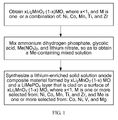
- FIG. 1 is a flow chart of a preparation method for a lithium-enriched solid solution anode composite material according to a specific embodiment of the present invention.
- an embodiment of the present invention provides a lithium-enriched solid solution anode composite material, so as to solve problems in the prior art that a lithium-enriched solid solution anode material is unstable in a condition of a high voltage, and a cycle life, discharge capacity, rate performance, and initial charge-discharge efficiency of a manufactured lithium-ion battery are poor.
- an embodiment of the present invention provides a preparation method for the lithium-enriched solid solution anode composite material.
- an embodiment of the present invention provides a lithium-ion battery anode plate containing the lithium-enriched solid solution anode composite material.
- an embodiment of the present invention provides a lithium-ion battery containing the lithium-ion battery anode plate.
- an embodiment of the present invention provides a lithium-enriched solid solution anode composite material, where the lithium-enriched solid solution anode composite material is formed by xLi 2 MnO 3 ⁇ (1-x)MO and a LiMePO 4 layer that is clad on a surface of xLi 2 MnO 3 ⁇ (1-x) MO, x ⁇ 1, M is one or more selected from: Ni, Co, Mn, Ti, and Zr, and Me is one or more selected from: Co, Ni, V, and Mg.
- xLi 2 MnO 3 ⁇ (1-x) MO (x ⁇ 1, and M is one or more selected from: Ni, Co, Mn, Ti, and Zr) and the LiMePO 4 layer (Me is one or more selected from: Co, Ni, V, and Mg) form a cladding structure.
- LiMePO 4 is a phosphate system.
- the LiMePO 4 layer (Me is one or more selected from: Co, Ni, V, and Mg) can improve stability of xLi 2 MnO 3 ⁇ (1-x) MO(x ⁇ 1, and M is one or more selected from: Ni, Co, Mn, Ti, and Zr) at a high voltage (>4.6 V), thereby improving a cycle life of xLi 2 MnO 3 ⁇ (1-x)MO.
- a reason lies in that a LiPF 6 -based electrolyte is a most basic component in a current lithium-ion battery electrolyte.
- a decomposition product (such as PF 5 ) of LiPF 6 reacts with water to generate HF that is prone to corrode an anode material.
- a decomposition product such as PF 5
- LiPF 6 reacts with water to generate HF that is prone to corrode an anode material.
- contact area between the electrolyte and xLi 2 MnO 3 ⁇ (1-x) MO can be reduced, and corrosion performed by the electrolyte on the surface of xLi 2 MnO 3 ⁇ (1-x) MO can be alleviated, so that the corrosion on the surface of xLi 2 MnO 3 ⁇ (1-x) MO in a charge-discharge process is inhibited, and a side reaction on the surface of xLi 2 MnO 3 ⁇ (1-x)MO in the charge-discharge process is inhibited, thereby improving the
- Discharge capacity of LiMePO 4 is smaller than that of xLi 2 MnO 3 ⁇ (1-x)MO, and an excessively large thickness of the LiMePO 4 layer may inhibit an electrochemical property of xLi 2 MnO 3 ⁇ (1-x)MO. Therefore, in order to have a better electrochemical property of the lithium-enriched solid solution anode composite material, the thickness of the LiMePO 4 layer is 1 - 10nm.
- Me may be clad on the surface of xLi 2 MnO 3 ⁇ (1-x)MO together with Li 3 PO 4 , or may be embedded in a crystal lattice of xLi 2 MnO 3 ⁇ (1-x) MO, or the two situations exist together, where x ⁇ 1, and M is one or more selected from: Ni, Co, Mn, Ti, and Zr.
- Me When Me is clad on the surface of xLi 2 MnO 3 ⁇ (1-x)MO, when being charged, Me is embedded in lithium, thereby improving discharge capacity of xLi 2 MnO 3 ⁇ (1-x) MO, and moreover, Me and Li 3 PO 4 may also improve conductivity of xLi 2 MnO 3 ⁇ (1-x)MO, thereby improving rate performance of xLi 2 MnO 3 ⁇ (1-x) MO.
- a part of Me in LiMePO 4 is clad on the surface of xLi 2 MnO 3 ⁇ (1-x)MO, and the other part is embedded in the crystal lattice of xLi 2 MnO 3 ⁇ (1-x) MO.
- the lithium-enriched solid solution anode composite material provided in the first aspect of the embodiment of the present invention has high stability in an electrolyte, may improve a cycle life, discharge capacity, rate performance, and initial charge-discharge efficiency of a lithium-ion battery, and is applicable in a condition of a high-voltage greater than 4.6V.
- an embodiment of the present invention provides a preparation method for a lithium-enriched solid solution anode composite material, as shown in FIG. 1 , which includes the following steps:
- An annealing condition is annealing for 24 h at a temperature of 450°C to obtain a lithium-enriched solid solution anode composite material.
- the molar ratio of the ammonium dihydrogen phosphate, glycolic acid, Me(NO 3 ) 2 , and lithium nitrate is 1:0.05:1:1, where Me is one or more selected from: Co, Ni, V, and Mg.
- the molar ratio at which xLi 2 MnO 3 ⁇ (1-x)MO is added to the Me-containing mixed solution is 75:1.
- xLi 2 MnO 3 ⁇ (1-x)MO where x ⁇ 1, and M is one or a combination of: Ni, Co, Mn, Ti, and Zr, is obtained through preparation by adopting the following method: ultrasonically dispersing Li 2 MnO 3 in an HNO 3 solution of M(NO 3 ) 2 at a molar ratio of Li 2 MnO 3 :M(NO 3 ) 2 :HNO 3 of 1 - 2:0.5 - 1:0.1 - 0.5, so as to obtain a mixed solution of Li 2 MnO 3 , M(NO 3 ) 2 , and HNO 3 ; placing the mixed solution of Li 2 MnO 3 , M(NO 3 ) 2 , and HNO 3 in a water bath, and baking for 4 - 24 h in a stirring condition at 50 - 100°C; and grinding a baked solid product into powder, and then placing the powder in a Muffle furnace and annealing for 12 - 48 h at a temperature of 350 -
- xLi 2 MnO 3 ⁇ (1-x)MO x ⁇ 1, and M is one or a combination of: Ni, Co, Mn, Ti, and Zr, and an annealing condition is annealing for 24 h at a temperature of 450°C, so as to obtain xLi 2 MnO 3 ⁇ (1-x)MO.
- Li 2 MnO 3 is obtained through preparation by adopting the following method: adding MnCO 3 to a LiOH solution at a molar ratio of MnCO 3 :LiOH of 1:2 - 4, so as to obtain a mixed solution of MnCO 3 and LiOH; fully stirring the mixed solution of MnCO 3 and LiOH for dissolution, and then placing the solution in an air blast drying cabinet, baking for 4 - 24 h at a temperature of 50 - 100°C; and grinding a baked solid product into powder, and then placing the powder in a Muffle furnace and annealing for 12 - 48 h at a temperature of 350 - 800°C, so as to obtain Li 2 MnO 3 .
- an annealing condition is annealing for 12 h at a temperature of 750°C, so as to obtain Li 2 MnO 3 .
- the preparation method for a lithium-enriched solid solution anode composite material provided in the second aspect of the embodiment of the present invention is simple and flexible, and the prepared lithium-enriched solid solution anode composite material may improve discharge capacity, rate performance, initial charge-discharge efficiency, and a cycle life of a lithium-ion battery.
- an embodiment of the present invention provides a lithium-ion battery anode plate, where the lithium-ion battery anode plate includes a current collector and a lithium-enriched solid solution anode composite material coated on the current collector, and the lithium-enriched solid solution anode composite material is formed by xLi 2 MnO 3 ⁇ (1-x) MO and a LiMePO 4 layer that is clad on a surface of xLi 2 MnO 3 ⁇ (1-x) MO, x ⁇ 1, M is one or more selected from: Ni, Co, Mn, Ti, and Zr, and Me is one or more selected from: Co, Ni, V, and Mg.
- a preparation method for the lithium-ion battery anode plate includes: mixing a lithium-enriched solid solution anode composite material, a conductive agent, an adhesive, and a solvent, so as to obtain a paste; and coating the paste on a current collector, and then performing drying and tabletting, so as to obtain a lithium-ion battery anode plate.
- the lithium-ion battery anode plate provided in the third aspect of the embodiment of the present invention may be used to prepare a lithium-ion battery.
- an embodiment of the present invention provides a lithium-ion battery, which includes a lithium-ion battery anode plate, a lithium-ion battery cathode plate, a membrane, and an electrolyte.
- the lithium-ion battery anode plate includes a current collector and a lithium-enriched solid solution anode composite material coated on the current collector, where the lithium-enriched solid solution anode composite material is formed by xLi 2 MnO 3 ⁇ (1-x) MO and a LiMePO 4 layer that is clad on a surface of xLi 2 MnO 3 ⁇ (1-x) MO, x ⁇ 1, M is one or more selected from: Ni, Co, Mn, Ti, and Zr, and Me is one or more selected from: Co, Ni, V, and Mg.
- the lithium-ion battery provided in the fourth aspect of the embodiment of the present invention has a long cycle life and has excellent discharge capacity, rate performance, and initial charge-discharge efficiency.
- a preparation method for a lithium-enriched solid solution anode composite material includes the following steps:
- Li 2 MnO 3 is ultrasonically dispersed in an HNO 3 solution ofNi (NO 3 ) 2 at a molar ratio of Li 2 MnO 3 :Ni(NO 3 ) 2 :HNO 3 of 1.5:0.75:0.25, so as to obtain a mixed solution of Li 2 MnO 3 , Ni(NO 3 ) 2 , and HNO 3 .
- the mixed solution of Li 2 MnO 3 , Ni(NO 3 ) 2 , and HNO 3 is placed in a water bath, and baked for 12 h in a stirring condition at 80°C.
- a baked solid product is ground into powder, and then placed in a Muffle furnace and annealed for 24 h in a condition of 450°C, so as to obtain 0.9Li 2 MnO 3 ⁇ 0.1NiO.
- Ammonium dihydrogen phosphate, glycolic acid, Ni(NO 3 ) 2 , and lithium nitrate are mixed at a molar ratio of 1:0.05:1:1, so as to obtain a Ni-containing mixed solution.
- 0.9Li 2 MnO 3 ⁇ 0.1NiO prepared in step (2) is added to the Ni-containing mixed solution at a molar ratio of 75:1, and ultrasonic dispersion is performed.
- the Ni-containing mixed solution that has undergone ultrasonic dispersion is placed in a water bath, and baked for 12 h in a stirring condition at 80°C.
- the lithium-enriched solid solution anode composite material, conductive graphite, CMC, and water are mixed at a ratio of 8:1:1:100, and the mixture is evenly stirred as a paste by using isopropyl alcohol.
- the paste is evenly coated on a copper sheet, and dried in vacuum for 18 h at 120°C, and tableted, so as to obtain a lithium-ion battery anode plate.
- the lithium-ion battery anode plate prepared in this embodiment, a Li metal cathode plate, a membrane, and an electrolyte are assembled into a button battery of model 2025, and an electrochemical property is tested.
- a preparation method for a lithium-enriched solid solution anode composite material in Embodiment 2 is the same as that for the lithium-enriched solid solution anode composite material in Embodiment 1, and a difference only lies in that an annealing temperature in step (3) is 350°C.
- a preparation method for a lithium-ion battery anode plate and a preparation method for a lithium-ion battery are the same as the preparation method for the lithium-ion battery anode plate and the preparation method for the lithium-ion battery in Embodiment 1.
- a preparation method for a lithium-enriched solid solution anode composite material in Embodiment 3 is the same as that for the lithium-enriched solid solution anode composite material in Embodiment 1, and a difference only lies in that an annealing temperature in step (3) is 750°C.
- a preparation method for a lithium-ion battery anode plate and a preparation method for a lithium-ion battery are the same as the preparation method for the lithium-ion battery anode plate and the preparation method for the lithium-ion battery in Embodiment 1.
- a preparation method for lithium-enriched solid solution anode composite material includes the following steps:
- MnCO 3 is added to a LiOH solution at a molar ratio of MnCO 3 :LiOH of 1:2, so as to obtain a mixed solution of MnCO 3 and LiOH.
- the mixed solution of MnCO 3 and LiOH is fully stirred for dissolution, and then placed in an air blast drying cabinet, and baked for 24 h at a temperature of 50°C.
- a baked solid product is ground into powder, and then placed in a Muffle furnace and annealed for 48 h at a temperature of 350°C, so as to obtain Li 2 MnO 3 .
- Li 2 MnO 3 is ultrasonically dispersed in an HNO 3 solution of Co(NO 3 ) 2 at a molar ratio of Li 2 MnO 3 :Co(NO 3 ) 2 :HNO 3 of 1:1:0.5, so as to obtain a mixed solution of Li 2 MnO 3 , Co(NO 3 ) 2 , and HNO 3 .
- the mixed solution of Li 2 MnO 3 , Co(NO 3 ) 2 , and HNO 3 is placed in a water bath, and baked for 24 h in a stirring condition at 50°C.
- a baked solid product is ground into powder, and then placed in a Muffle furnace and annealed for 48 h at a temperature of 350°C, so as to obtain 0.3Li 2 MnO 3 ⁇ 0.7 CoO.
- a baked solid product is ground into powder, and placed in a Muffle furnace and annealed for 48 h at a temperature of 350°C, so as to obtain a lithium-enriched solid solution anode composite material formed by 0.3Li 2 MnO 3 ⁇ 0.7CoO and a LiCoPO 4 layer that is clad on a surface of 0.3Li 2 MnO 3 ⁇ 0.7CoO.
- a preparation method for lithium-enriched solid solution anode composite material includes the following steps:
- Li 2 MnO 3 is ultrasonically dispersed in an HNO 3 solution of Co(NO 3 ) 2 at a molar ratio of Li 2 MnO 3 :Co(NO 3 ) 2 :HNO 3 of 2:0.5:0.1, so as to obtain a mixed solution of Li 2 MnO 3 , Co(NO 3 ) 2 , and HNO 3 .
- the mixed solution of Li 2 MnO 3 , Co(NO 3 ) 2 , and HNO 3 is placed in a water bath, and baked for 4 h in a stirring condition at 100°C.
- a baked solid product is ground into powder, and then placed in a Muffle furnace and annealed for 12 h at a temperature of 800°C, so as to obtain 0.6Li 2 MnO 3 ⁇ 0.4CoO.
- Ammonium dihydrogen phosphate, glycolic acid, Ni(NO 3 ) 2 , and lithium nitrate are mixed at a molar ratio of 3:0.5:1:5, so as to obtain a Ti-containing mixed solution.
- 0.6Li 2 MnO 3 ⁇ 0.4CoO prepared in step (2) is added to the Ni-containing mixed solution at a molar ratio of 100:1, and ultrasonic dispersion is performed.
- the Ni-containing mixed solution that has undergone ultrasonic dispersion is placed in a water bath, and baked for 4 h in a stirring condition at a temperature of 100°C.
- a baked solid product is ground into powder, and placed in a Muffle furnace and annealed for 12 h at a temperature of 800°C, so as to obtain a lithium-enriched solid solution anode composite material formed by 0.6Li 2 MnO 3 ⁇ 0.4CoO and a LiNiPO 4 layer that is clad on a surface of 0.6Li 2 MnO 3 ⁇ 0.4CoO.
- a preparation method for a lithium-enriched solid solution anode material includes the following steps:
- Li 2 MnO 3 is ultrasonically dispersed in an HNO 3 solution ofNi (NO 3 ) 2 at a molar ratio of Li 2 MnO 3 :Ni(NO 3 ) 2 :HNO 3 of 1.5:0.75:0.25, so as to obtain a mixed solution of Li 2 MnO 3 , Ni(NO 3 ) 2 , and HNO 3 .
- the mixed solution of Li 2 MnO 3 , Ni(NO 3 ) 2 , and HNO 3 is placed in a water bath, and baked for 12 h in a stirring condition at 80°C.
- a baked solid product is ground into powder, and then placed in a Muffle furnace and annealed for 24 h in a condition of 450°C, so as to obtain 0.9Li 2 MnO 3 ⁇ 0.1NiO.
- Lithium-ion batteries prepared in the foregoing embodiments and comparative examples are test batteries, and are used for performance testing in the following effect embodiments.
- Initial discharge capacity of the lithium-ion batteries prepared in the embodiments and comparative examples is measured in conditions that charge and discharge rates are 0.1C and 1C, and charge and discharge voltage ranges are 2 - 4.6 V and 2 - 4.8 V
- Discharge capacity of the lithium-ion batteries prepared in the embodiments and comparative examples after 50 cycles is measured in the conditions that the charge and discharge rates are 0.1C and 1C, and the charge and discharge voltage ranges are 2 - 4.6 V and 2 - 4.8 V.
- Table 1 - Table 3 show results of the initial discharge capacity performance testing, the initial charge-discharge efficiency performance testing, and the 50-cycle capacity performance testing of the embodiments and the comparative examples of the present invention.
- Table 1 Comparison of electrochemical properties when a charge and discharge current is 0.1C and a charge and discharge voltage range is 2 - 4.6 V Lithium-ion Battery Initial Discharge Capacity mAh/g Initial Charge-discharge Efficiency % 50-cycle Capacity mAh/g Embodiment 1 180 85.4 254 Embodiment 2 200 83.2 231 Embodiment 3 250 82.8 247 Comparative Example 1 164 84.1 235 Comparative Example 2 181 82.5 215 Comparative Example 3 210 81.7 230
- Table 2 Comparison of electrochemical properties when a charge and discharge current is 0.1C and a charge and discharge voltage range is 2 - 4.8 V Lithium-ion battery Initial Discharge Capacity mAh/g Initial Charge-discharge Efficiency % 50-cycle Capacity mAh/g Embodi
Landscapes
- Chemical & Material Sciences (AREA)
- Organic Chemistry (AREA)
- Inorganic Chemistry (AREA)
- Chemical Kinetics & Catalysis (AREA)
- Electrochemistry (AREA)
- General Chemical & Material Sciences (AREA)
- Composite Materials (AREA)
- Crystallography & Structural Chemistry (AREA)
- Engineering & Computer Science (AREA)
- Materials Engineering (AREA)
- Battery Electrode And Active Subsutance (AREA)
Applications Claiming Priority (2)
| Application Number | Priority Date | Filing Date | Title |
|---|---|---|---|
| CN201210345356.XA CN103682304A (zh) | 2012-09-17 | 2012-09-17 | 一种富锂固溶体正极复合材料及其制备方法、锂离子电池正极片和锂离子电池 |
| PCT/CN2013/073521 WO2014040410A1 (zh) | 2012-09-17 | 2013-03-30 | 一种富锂固溶体正极复合材料及其制备方法、锂离子电池正极片和锂离子电池 |
Publications (2)
| Publication Number | Publication Date |
|---|---|
| EP2736104A1 true EP2736104A1 (de) | 2014-05-28 |
| EP2736104A4 EP2736104A4 (de) | 2014-08-13 |
Family
ID=50277567
Family Applications (1)
| Application Number | Title | Priority Date | Filing Date |
|---|---|---|---|
| EP13795984.7A Withdrawn EP2736104A4 (de) | 2012-09-17 | 2013-03-30 | Verbundmaterial für eine positivelektrode aus einer lithiumreichen festen lösung, verfahren zu seiner herstellung, positivelektrodenplatte für eine lithiumionenbatterie und lithiumionenbatterie |
Country Status (4)
| Country | Link |
|---|---|
| US (1) | US20140099540A1 (de) |
| EP (1) | EP2736104A4 (de) |
| CN (1) | CN103682304A (de) |
| WO (1) | WO2014040410A1 (de) |
Cited By (2)
| Publication number | Priority date | Publication date | Assignee | Title |
|---|---|---|---|---|
| CN104201337A (zh) * | 2014-09-17 | 2014-12-10 | 河北工业大学 | 一种锂离子电池用钠掺杂富锂锰基正极材料及其制备方法 |
| CN104269551A (zh) * | 2014-09-11 | 2015-01-07 | 李梦思 | 一种Li-Mn-Cu三元复合电池正极材料及其制备方法 |
Families Citing this family (15)
| Publication number | Priority date | Publication date | Assignee | Title |
|---|---|---|---|---|
| CN103996820A (zh) * | 2014-05-30 | 2014-08-20 | 南京安普瑞斯有限公司 | 锂离子电池及其具有协同作用的混合正极电极及活性材料 |
| CN104201351B (zh) * | 2014-08-22 | 2017-01-11 | 武汉理工大学 | 具有介孔微球结构的硅酸亚铁锂/碳复合正极材料及制备方法 |
| KR101675480B1 (ko) * | 2015-05-18 | 2016-11-11 | 울산과학기술원 | 리튬 이차 전지용 양극 활물질, 이의 제조방법 및 이를 포함하는 리튬 이차 전지 |
| CN106299352B (zh) * | 2015-05-26 | 2019-01-15 | 宁德新能源科技有限公司 | 二次锂电池正极材料的制备方法 |
| CN105742622A (zh) * | 2016-03-27 | 2016-07-06 | 华南理工大学 | 一种橄榄石型结构LiMPO4表面修饰层状富锂锰基正极材料及其制备方法 |
| CN105702951A (zh) * | 2016-04-15 | 2016-06-22 | 东华大学 | 一种多重联动改性的富锂锰基材料及其改性方法 |
| KR102091903B1 (ko) * | 2016-07-08 | 2020-05-27 | 주식회사 엘지화학 | 다층 전해질 셀, 다층 전해질 셀을 포함하는 이차 전지 및 이의 제조 방법 |
| CN110459736B (zh) * | 2018-05-07 | 2021-01-12 | 宁德新能源科技有限公司 | 正极材料及含有该正极材料的正极极片和锂离子电池 |
| CN111200120B (zh) * | 2018-11-20 | 2022-08-19 | 深圳市贝特瑞纳米科技有限公司 | 一种三元正极材料及其制备方法和锂离子电池 |
| CN112635722B (zh) * | 2019-10-09 | 2022-04-15 | 北京卫蓝新能源科技有限公司 | 一种锂离子电池复合正极材料及制备方法 |
| CN112803019B (zh) * | 2019-11-13 | 2025-08-01 | 中南大学 | 一种磷酸钛锆锂修饰富锂材料及其制备方法 |
| CN111525109B (zh) * | 2020-04-26 | 2023-04-11 | 陕西红马科技有限公司 | 一种包覆钛钴涂层的层状镍锰二元正极材料制备方法 |
| CN113161535B (zh) * | 2021-03-30 | 2022-10-25 | 华南理工大学 | 一种气相表面磷化处理提升富锂正极材料放电比容量和循环稳定性的方法及材料 |
| CN115295772A (zh) * | 2021-11-22 | 2022-11-04 | 深圳市德方创域新能源科技有限公司 | 富锂复合材料及其制备方法和应用 |
| CN115744998A (zh) * | 2022-12-07 | 2023-03-07 | 电子科技大学长三角研究院(湖州) | 富锂层状Li2MnO3锂离子电池正极材料及制备方法 |
Family Cites Families (3)
| Publication number | Priority date | Publication date | Assignee | Title |
|---|---|---|---|---|
| US8808912B2 (en) * | 2009-01-29 | 2014-08-19 | Uchicago Argonne, Llc | Surface protected lithium-metal-oxide electrodes |
| WO2012067675A1 (en) * | 2010-11-17 | 2012-05-24 | Uchicago Argonne, Llc, Operator Of Argonne National Laboratory | Electrode structures and surfaces for li batteries |
| CN102544475B (zh) * | 2012-03-07 | 2015-06-17 | 湖北万润新能源科技发展有限公司 | 富锂锰酸锂固溶体正极材料的制备方法 |
-
2012
- 2012-09-17 CN CN201210345356.XA patent/CN103682304A/zh not_active Withdrawn
-
2013
- 2013-03-30 EP EP13795984.7A patent/EP2736104A4/de not_active Withdrawn
- 2013-03-30 WO PCT/CN2013/073521 patent/WO2014040410A1/zh not_active Ceased
- 2013-12-09 US US14/100,899 patent/US20140099540A1/en not_active Abandoned
Cited By (2)
| Publication number | Priority date | Publication date | Assignee | Title |
|---|---|---|---|---|
| CN104269551A (zh) * | 2014-09-11 | 2015-01-07 | 李梦思 | 一种Li-Mn-Cu三元复合电池正极材料及其制备方法 |
| CN104201337A (zh) * | 2014-09-17 | 2014-12-10 | 河北工业大学 | 一种锂离子电池用钠掺杂富锂锰基正极材料及其制备方法 |
Also Published As
| Publication number | Publication date |
|---|---|
| WO2014040410A1 (zh) | 2014-03-20 |
| US20140099540A1 (en) | 2014-04-10 |
| EP2736104A4 (de) | 2014-08-13 |
| CN103682304A (zh) | 2014-03-26 |
Similar Documents
| Publication | Publication Date | Title |
|---|---|---|
| EP2736104A1 (de) | Verbundmaterial für eine positivelektrode aus einer lithiumreichen festen lösung, verfahren zu seiner herstellung, positivelektrodenplatte für eine lithiumionenbatterie und lithiumionenbatterie | |
| CN108807926B (zh) | 一种Co/B共包覆镍钴锰锂离子正极材料及其制备方法 | |
| CN102569776B (zh) | 一种球形高电压正极材料尖晶石镍锰酸锂的制备方法 | |
| CN110817972B (zh) | 一种氟改性高电压钴酸锂、其制备方法及电池 | |
| CN107482182B (zh) | 碳包覆离子掺杂磷酸锰锂电极材料及其制备方法 | |
| WO2020258764A1 (zh) | 一种正极活性材料及其制备方法和锂电池 | |
| CN101752562B (zh) | 一种复合掺杂改性锂离子电池正极材料及其制备方法 | |
| EP2448044A1 (de) | Positives aktives elektrodenmaterial für eine lithiumsekundärbatterie und lithiumsekundärbatterie | |
| KR20140081663A (ko) | 리튬 이차 전지용 양극활물질의 제조 방법 및 이에 의하여 제조된 리튬 이차 전지용 양극활물질 | |
| CN110890541A (zh) | 一种表面改性富锂锰基正极材料的制备方法和锂离子电池 | |
| CN109873140B (zh) | 一种锂离子电池石墨烯复合三元正极材料及其制备方法 | |
| CN103390748B (zh) | 一种氧化铝包覆钴酸锂正极材料的制备方法 | |
| CN107492643A (zh) | 一种磷酸钛锂包覆LiNi1/3Co1/3Mn1/3O2正极材料及其制备方法 | |
| CN108807928B (zh) | 一种金属氧化物及锂离子电池的合成 | |
| CN102034967A (zh) | 一种高电压锂电池正极材料氧化镍锰锂的共沉淀制法 | |
| CN106532018A (zh) | 一种富锂锰基正极材料及其制备方法 | |
| US20250083974A1 (en) | Core-shell gradient ternary precursor and preparation method and application thereof | |
| CN109713281B (zh) | 锂离子电池的正极材料及其制备方法 | |
| CN109888252B (zh) | 一种共包覆镍钴锰三元正极材料及制备方法 | |
| CN112397766A (zh) | 一种高电压锂离子电池及其制备方法 | |
| CN103682293B (zh) | 一种富锂固溶体正极材料及其制备方法、锂离子电池正极材料和锂离子电池 | |
| KR20140058800A (ko) | 양극 활물질, 이의 제조방법 및 이를 포함하는 리튬 이차 전지 | |
| CN103490054B (zh) | 钛酸锂复合材料及其制作方法及锂离子电池 | |
| CN110563052B (zh) | 一种碳和氧化镧共包覆改性镍锰酸锂正极材料的制备方法 | |
| CN111137871A (zh) | 一种氧化锡锑包覆的氟磷酸钴锂及其表面沉积原位包覆方法和应用 |
Legal Events
| Date | Code | Title | Description |
|---|---|---|---|
| PUAI | Public reference made under article 153(3) epc to a published international application that has entered the european phase |
Free format text: ORIGINAL CODE: 0009012 |
|
| 17P | Request for examination filed |
Effective date: 20131205 |
|
| AK | Designated contracting states |
Kind code of ref document: A1 Designated state(s): AL AT BE BG CH CY CZ DE DK EE ES FI FR GB GR HR HU IE IS IT LI LT LU LV MC MK MT NL NO PL PT RO RS SE SI SK SM TR |
|
| A4 | Supplementary search report drawn up and despatched |
Effective date: 20140711 |
|
| RIC1 | Information provided on ipc code assigned before grant |
Ipc: H01M 4/04 20060101ALN20140707BHEP Ipc: H01M 4/36 20060101ALI20140707BHEP Ipc: H01M 4/505 20100101ALI20140707BHEP Ipc: H01M 4/58 20100101ALI20140707BHEP Ipc: C01G 45/12 20060101AFI20140707BHEP Ipc: H01M 4/525 20100101ALN20140707BHEP |
|
| STAA | Information on the status of an ep patent application or granted ep patent |
Free format text: STATUS: THE APPLICATION IS DEEMED TO BE WITHDRAWN |
|
| 18D | Application deemed to be withdrawn |
Effective date: 20150210 |