EP2736184A1 - Verfahren und Vorrichtung zur Handhabung einer Downlink-Referenzsignalstörung zu PDSCH bei einer koordinierten Langzeitentwicklungs-Mehrpunktübertragung - Google Patents
Verfahren und Vorrichtung zur Handhabung einer Downlink-Referenzsignalstörung zu PDSCH bei einer koordinierten Langzeitentwicklungs-Mehrpunktübertragung Download PDFInfo
- Publication number
- EP2736184A1 EP2736184A1 EP13193790.6A EP13193790A EP2736184A1 EP 2736184 A1 EP2736184 A1 EP 2736184A1 EP 13193790 A EP13193790 A EP 13193790A EP 2736184 A1 EP2736184 A1 EP 2736184A1
- Authority
- EP
- European Patent Office
- Prior art keywords
- comp
- bit
- pdsch
- res
- user equipment
- Prior art date
- Legal status (The legal status is an assumption and is not a legal conclusion. Google has not performed a legal analysis and makes no representation as to the accuracy of the status listed.)
- Granted
Links
- 230000005540 biological transmission Effects 0.000 title claims abstract description 40
- 238000000034 method Methods 0.000 title description 14
- 230000007774 longterm Effects 0.000 title description 3
- 238000005259 measurement Methods 0.000 claims abstract description 22
- 238000004891 communication Methods 0.000 claims abstract description 11
- 238000013507 mapping Methods 0.000 claims description 6
- 238000012545 processing Methods 0.000 description 34
- 238000013459 approach Methods 0.000 description 30
- 238000010586 diagram Methods 0.000 description 22
- 230000015654 memory Effects 0.000 description 18
- 230000001413 cellular effect Effects 0.000 description 3
- 238000004590 computer program Methods 0.000 description 3
- 230000006870 function Effects 0.000 description 2
- 230000011664 signaling Effects 0.000 description 2
- 230000001629 suppression Effects 0.000 description 2
- 230000006978 adaptation Effects 0.000 description 1
- 230000001627 detrimental effect Effects 0.000 description 1
- 230000010365 information processing Effects 0.000 description 1
- 230000002452 interceptive effect Effects 0.000 description 1
- 239000000463 material Substances 0.000 description 1
- 230000003287 optical effect Effects 0.000 description 1
- 239000007787 solid Substances 0.000 description 1
- 230000003595 spectral effect Effects 0.000 description 1
- 230000001052 transient effect Effects 0.000 description 1
Images



Classifications
-
- H—ELECTRICITY
- H04—ELECTRIC COMMUNICATION TECHNIQUE
- H04J—MULTIPLEX COMMUNICATION
- H04J11/00—Orthogonal multiplex systems, e.g. using WALSH codes
- H04J11/0023—Interference mitigation or co-ordination
- H04J11/005—Interference mitigation or co-ordination of intercell interference
- H04J11/0053—Interference mitigation or co-ordination of intercell interference using co-ordinated multipoint transmission/reception
-
- H—ELECTRICITY
- H04—ELECTRIC COMMUNICATION TECHNIQUE
- H04W—WIRELESS COMMUNICATION NETWORKS
- H04W72/00—Local resource management
- H04W72/50—Allocation or scheduling criteria for wireless resources
- H04W72/54—Allocation or scheduling criteria for wireless resources based on quality criteria
- H04W72/541—Allocation or scheduling criteria for wireless resources based on quality criteria using the level of interference
-
- H—ELECTRICITY
- H04—ELECTRIC COMMUNICATION TECHNIQUE
- H04J—MULTIPLEX COMMUNICATION
- H04J11/00—Orthogonal multiplex systems, e.g. using WALSH codes
- H04J11/0023—Interference mitigation or co-ordination
- H04J11/005—Interference mitigation or co-ordination of intercell interference
- H04J11/0056—Inter-base station aspects
-
- H—ELECTRICITY
- H04—ELECTRIC COMMUNICATION TECHNIQUE
- H04L—TRANSMISSION OF DIGITAL INFORMATION, e.g. TELEGRAPHIC COMMUNICATION
- H04L5/00—Arrangements affording multiple use of the transmission path
- H04L5/003—Arrangements for allocating sub-channels of the transmission path
- H04L5/0032—Distributed allocation, i.e. involving a plurality of allocating devices, each making partial allocation
- H04L5/0035—Resource allocation in a cooperative multipoint environment
-
- H—ELECTRICITY
- H04—ELECTRIC COMMUNICATION TECHNIQUE
- H04L—TRANSMISSION OF DIGITAL INFORMATION, e.g. TELEGRAPHIC COMMUNICATION
- H04L5/00—Arrangements affording multiple use of the transmission path
- H04L5/003—Arrangements for allocating sub-channels of the transmission path
- H04L5/0044—Allocation of payload; Allocation of data channels, e.g. PDSCH or PUSCH
-
- H—ELECTRICITY
- H04—ELECTRIC COMMUNICATION TECHNIQUE
- H04L—TRANSMISSION OF DIGITAL INFORMATION, e.g. TELEGRAPHIC COMMUNICATION
- H04L5/00—Arrangements affording multiple use of the transmission path
- H04L5/003—Arrangements for allocating sub-channels of the transmission path
- H04L5/0058—Allocation criteria
- H04L5/0073—Allocation arrangements that take into account other cell interferences
-
- H—ELECTRICITY
- H04—ELECTRIC COMMUNICATION TECHNIQUE
- H04L—TRANSMISSION OF DIGITAL INFORMATION, e.g. TELEGRAPHIC COMMUNICATION
- H04L1/00—Arrangements for detecting or preventing errors in the information received
- H04L1/004—Arrangements for detecting or preventing errors in the information received by using forward error control
- H04L1/0056—Systems characterized by the type of code used
- H04L1/0067—Rate matching
- H04L1/0068—Rate matching by puncturing
- H04L1/0069—Puncturing patterns
-
- H—ELECTRICITY
- H04—ELECTRIC COMMUNICATION TECHNIQUE
- H04L—TRANSMISSION OF DIGITAL INFORMATION, e.g. TELEGRAPHIC COMMUNICATION
- H04L1/00—Arrangements for detecting or preventing errors in the information received
- H04L1/12—Arrangements for detecting or preventing errors in the information received by using return channel
- H04L1/16—Arrangements for detecting or preventing errors in the information received by using return channel in which the return channel carries supervisory signals, e.g. repetition request signals
- H04L1/18—Automatic repetition systems, e.g. Van Duuren systems
- H04L1/1867—Arrangements specially adapted for the transmitter end
-
- H—ELECTRICITY
- H04—ELECTRIC COMMUNICATION TECHNIQUE
- H04L—TRANSMISSION OF DIGITAL INFORMATION, e.g. TELEGRAPHIC COMMUNICATION
- H04L1/00—Arrangements for detecting or preventing errors in the information received
- H04L2001/0092—Error control systems characterised by the topology of the transmission link
- H04L2001/0093—Point-to-multipoint
Definitions
- macro base stations such as Long Term Evolution-Advanced (LTE-A) network
- BSs macro base stations
- pico BSs may perform coordinated multipoint (CoMP) transmission to a user equipment (UE) on the cell-edge to mitigate the impact of interference.
- CoMP coordinated multipoint
- UE user equipment
- the issue of interference arising from reference signals is a major issue even when multiple BSs perform CoMP transmission.
- a LTE-A network can reduce the impact of neighboring cell interference on cell-edge UEs via CoMP transmission. This requires multiple neighboring BSs cooperation to eliminate co-channel interference to cell-edge UEs (except for possible CRS interference).
- Several BS cooperation methods are provisioned in LTE-A including Joint transmission (JT). In JT, two or more neighboring BSs (macro or pico) simultaneously transmit to a UE, resulting in improved SNR of received data streams which improve its throughput. However, the interference from CRS REs still remains.
- Exemplary embodiments of the invention provide a new interference suppression scheme for CoMP schemes to eliminate the interference arising due to reference signals from the CoMP BSs.
- the proposed method is expected to improve the cell average and cell edge throughput performances of the network.
- a UE is assigned a set of physical resource blocks (PRBs) by one or more cooperating BSs.
- PRBs consist of several resource elements (REs) some of which may be corrupted by the interference arising from the reference signals from cooperating or interfering neighboring BSs.
- the present invention mitigates the detrimental impact of this co-channel interference by performing interference suppression steps for each affected RE received at the UE.
- the UE informs the BS of the interference measurement report from neighboring BSs.
- the BS decides the bit-level muting pattern for PDSCH REs from different CoMP BSs which might overlap with each other's CRS REs.
- the BS informs the UE and the participating CoMP BSs of this bit-level muting pattern.
- the CoMP BSs perform PDSCH RE mapping using the bit-level muting pattern by embedding dummy bits for muted bits.
- CoMP UE Upon data reception, CoMP UE performs the CRS interference cancellation (optional step). Afterwards it discards the dummy bits and retrieves the transmitted data using the remaining bits.
- the UE performs the interference measurement and decides the bit-level puncturing pattern.
- CoMP UE performs the CRS interference cancellation (optional step). Afterwards it punctures the bits from PDSCH REs affected by CRS interference as per the bit-level puncturing pattern and retrieves the transmitted data using the remaining bits.
- a communications system employing CoMP transmission to suppress interference comprises: a CoMP user equipment; and a plurality of base stations, one of the base stations being an associated base station of the CoMP user equipment to transmit data to the CoMP user equipment, the plurality of base stations including multiple CoMP base stations for the CoMP user equipment.
- the CoMP user equipment performs radio resource management (RRM) measurement on received reference signal (RS) strength for each base station of one or more other base stations in a surrounding area of the CoMP user equipment other than the associated base station.
- RRM radio resource management
- RS received reference signal
- the CoMP base stations for the CoMP user equipment transmit CoMP downlink data, including subframes which comprise physical resource blocks having a plurality of resource elements (REs) and cell-specific reference signal (CRS) resource element (RE) locations.
- PDSCH bit-level muting or puncturing information is determined, based on the RRM measurement and the subframes which comprise physical resource blocks having a plurality of REs and CRS RE locations sent from the multiple CoMP base stations, to identify PDSCH REs that suffer strong CRS interference transmission from within the multiple CoMP base stations and are to be subjected to one of (i) bit-level muting whereby the PDSCH REs are allocated a number of bits less than the number of bits allocated to normal REs which are not to be muted and data with the bit-level muting is transferred to the CoMP user equipment, or (ii) bit-level puncturing whereby bit Log-Likelihood ratios (LLRs) corresponding to some bits in the PDSCH REs are punctured or discarded from the
- the CRS RE locations in the physical resource blocks of the subframes sent from the multiple CoMP base stations are different so that the PDSCH REs include one or more sets of multiple PDSCH REs, the multiple PDSCH REs in each set carrying same data symbol at different RE locations after the bit-level muting or puncturing and before combination of the subframes of the multiple CoMP base stations, and becoming repeated PDSCH REs carrying same information bits after combination of the subframes of the multiple CoMP base stations.
- the bit LLRs for bits from the repeated PDSCH REs are added up together to obtain overall bit LLRs for the repeated PDSCH REs in each set.
- the associated base station identifies the PDSCH REs to be subjected to the bit-level muting and decides muted bit positions of the PDSCH REs to be muted so as to have a number of bits less than the number of bits allocated to normal REs, and the multiple CoMP base stations embed dummy bits in the muted bit positions of the PDSCH REs and simultaneously transmit the CoMP downlink data with the bit-level muting to the CoMP user equipment.
- the multiple CoMP base stations are each configured, before assigning dummy bits to the muted bit positions, to perform encoding and rate matching on a bit sequence containing the bits in the PDSCH REs.
- the multiple CoMP base stations are each configured, after assigning the dummy bits to the muted bit positions and before transferring the data with the bit-level muting of the PDSCH REs to the CoMP user equipment, to perform modulation and PDSCH resource mapping on the bit sequence so that each PDSCH RE accommodates one modulated symbol.
- the CoMP user equipment receives the CoMP downlink data from the multiple CoMP base stations, discards the dummy bits, and retrieves data using remaining bits.
- the CoMP user equipment identifies the PDSCH REs to be subjected to the bit-level puncturing and decides punctured bits of the PDSCH REs to be removed so as to have a number of bits less than the number of bits allocated to normal REs.
- the CoMP user equipment receives the CoMP downlink data from the multiple CoMP base stations, removes the punctured bits, and retrieves data using remaining bits, and removing the punctured bits comprises discarding equal or unequal number of bit LLRs from the PDSCH REs.
- Another aspect of the invention is directed to a base station in a communications system which includes a CoMP user equipment and a plurality of base stations, one of the base stations being an associated base station of the CoMP user equipment to transmit data to the CoMP user equipment, the plurality of base stations including multiple CoMP base stations for the CoMP user equipment.
- the associated base station comprises: an interface to receive radio resource management (RRM) measurement from the CoMP user equipment on received reference signal (RS) strength for each base station of one or more other base stations in a surrounding area of the CoMP user equipment other than the associated base station; an X2 interface to receive, from the multiple CoMP base stations, transmission information of subframes which comprise physical resource blocks having a plurality of resource elements (REs) and cell-specific reference signal (CRS) resource elements (RE) locations; and a controller to manage PDSCH (Physical Downlink Shared Channel) bit-level muting information, which includes identifying PDSCH REs that suffer strong CRS interference transmission from within the multiple CoMP base stations and are to be subjected to bit-level muting whereby the PDSCH REs are allocated a number of bits less than the number of bits allocated to normal REs which are not to be muted, based on the RRM measurement and the subframes which comprise physical resource blocks having a plurality of REs and CRS RE
- RRM radio resource management
- the CoMP base station comprises: an X2 interface to receive the bit-level muting information from the associated base station; and a controller to embed dummy bits in the muted bit positions of the PDSCH REs and transmit, simultaneously with other CoMP base stations, CoMP downlink data with the bit-level muting to the CoMP user equipment.
- the controller is configured to allocate to the PDSCH REs a number of bits less than the number of bits allocated to normal REs according to a K-bit bitmap for each PDSCH RE, and to decide the K-bit bitmap identifying one or more bit positions to be muted in each PDSCH RE, the number of bits allocated to an PDSCH RE being less than the number of bits allocated to a normal RE by a difference equal to the number of bit positions to be muted for the PDSCH RE.
- the CoMP base station is configured, before assigning dummy bits to the muted bit positions, to perform encoding and rate matching on a bit sequence containing the bits in the PDSCH REs, and, after assigning the dummy bits to the muted bit positions and before transferring the data with the bit-level muting of the PDSCH REs to the CoMP user equipment, to perform modulation and PDSCH resource mapping on the bit sequence so that each PDSCH RE accommodates one modulated symbol.
- Another aspect of this invention is directed to a CoMP user equipment in a communications system which includes the CoMP user equipment and a plurality of base stations, one of the base stations being an associated base station of the CoMP user equipment to transmit data to the CoMP user equipment, the plurality of base stations including multiple CoMP base stations for the CoMP user equipment.
- the CoMP user equipment comprises: a radio resource management (RRM) module to perform RRM measurement on received reference signal (RS) strength for each base station of one or more other base stations in a surrounding area of the user equipment other than the associated base station; and an interface to receive CoMP downlink data from the multiple CoMP base stations for the CoMP user equipment, including subframes which comprise physical resource blocks having a plurality of resource elements (REs) and cell-specific reference signal (CRS) resource element (RE) locations.
- RRM radio resource management
- PDSCH Physical Downlink Shared Channel
- bit-level muting or puncturing information is determined, based on the RRM measurement and the subframes which comprise physical resource blocks having a plurality of REs and CRS RE locations sent from the multiple CoMP base stations, to identify PDSCH REs that suffer strong CRS interference transmission from within the multiple CoMP base stations and are to be subjected to one of (i) bit-level muting whereby the PDSCH REs are allocated a number of bits less than the number of bits allocated to normal REs which are not to be muted and data with the bit-level muting is transferred to the CoMP user equipment, or (ii) bit-level puncturing whereby bit Log-Likelihood ratios (LLRs) corresponding to some bits in the PDSCH REs are punctured or discarded from the data received by the CoMP user equipment from the associated base station.
- LLRs Log-Likelihood ratios
- the bit-level muting information includes a K-bit bitmap for each PDSCH RE used to allocate to the PDSCH REs a number of bits less than the number of bits allocated to normal REs, and the K-bit bitmap identifies one or more bit positions to be muted in each PDSCH RE, the number of bits allocated to an PDSCH RE being less than the number of bits allocated to a normal RE by a difference equal to the number of bit positions to be muted for the PDSCH RE.
- the dummy bits are added to the muted bit positions of each PDSCH RE in the data with the bit-level muting of the PDSCH REs received by the CoMP user equipment via the interface from the multiple CoMP base stations, and the CoMP user equipment comprises a baseband processor to remove the dummy bits based on the bit-level muting information received from the associated base station.
- the data received includes PDSCH REs, each PDSCH RE accommodating one modulated symbol; the baseband processor is configured, before removing the dummy bits, to demap the received PDSCH REs to a modulated symbol stream and to demodulate the modulated symbol stream to a bit sequence; and the baseband processor is configured, after removing the dummy bits from the bit sequence, to perform rate dematching and decoding on the bit sequence.
- the bit-level PDSCH puncturing module manages bit-level PDSCH puncturing information which includes a K-bit bitmap for each PDSCH RE used to allocate to the PDSCH REs a number of bits less than the number of bits allocated to normal REs; and the K-bit bitmap identifies one or more bit positions to be punctured in each PDSCH RE, the number of bits allocated to an PDSCH RE being less than the number of bits allocated to a normal RE by a difference equal to the number of bit positions to be punctured for the PDSCH RE.
- the CoMP user equipment further comprises a baseband processor to remove punctured bits at the punctured bit positions of each PDSCH RE in the data received.
- the baseband processor is configured to remove the same number of punctured bits from the PDSCH REs, which includes discarding equal number of bit LLRs from the PDSCH REs. If the PDSCH REs have different numbers of bits to be punctured, the baseband processor is configured to remove different numbers of punctured bits from the PDSCH REs, which includes discarding unequal number of bit LLRs from the PDSCH REs. Each PDSCH RE accommodates one modulated symbol.
- the baseband processor is configured, before removing the punctured bits, to demap the received PDSCH REs to a modulated symbol stream and to demodulate the modulated symbol stream to a bit sequence.
- the baseband processor is configured, after removing the punctured bits from the bit sequence, to perform rate dematching and decoding on the bit sequence.
- the CoMP user equipment further comprises a CRS interference cancellation module to perform CRS interference cancellation on the data received before the baseband processor demaps the received PDSCH REs to a modulated symbol stream.
- the present invention also relates to an apparatus for performing the operations herein.
- This apparatus may be specially constructed for the required purposes, or it may include one or more general-purpose computers selectively activated or reconfigured by one or more computer programs.
- Such computer programs may be stored in a computer-readable storage medium including non-transient medium, such as, but not limited to optical disks, magnetic disks, read-only memories, random access memories, solid state devices and drives, or any other types of media suitable for storing electronic information.
- the algorithms and displays presented herein are not inherently related to any particular computer or other apparatus.
- Various general-purpose systems may be used with programs and modules in accordance with the teachings herein, or it may prove convenient to construct a more specialized apparatus to perform desired method steps.
- the present invention is not described with reference to any particular programming language. It will be appreciated that a variety of programming languages may be used to implement the teachings of the invention as described herein.
- the instructions of the programming language(s) may be executed by one or more processing devices, e.g., central processing units (CPUs), processors, or controllers.
- Exemplary embodiments of the invention provide apparatuses, methods and computer programs for handling downlink reference signal interference to PDSCH in LTE CoMP (coordinated multipoint) transmission.
- This invention proposes solutions to handle interference from cell-specific reference signals (CRSs) arising during a CoMP transmission such as Joint Transmission (JT).
- CRSs cell-specific reference signals
- JT Joint Transmission
- one or more macro/pico BSs can cooperatively transmit to a UE on the cell-edge.
- the interference from CRS REs is present and can degrade the performance of CoMP technique.
- Two approaches are described for handling the CRS interference for CoMP UEs. Examples involve the downlink of a cellular network.
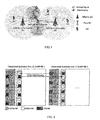
- FIG. 1 shows an example of a heterogeneous network including joint transmission (JT) coordinated multipoint (CoMP) transmission operation.
- JT joint transmission
- CoMP coordinated multipoint
- the macro and pico BSs coexist to serve UEs in an area.
- UE1 is associated with Macro BS1 but receives CoMP downlink data from both Macro BS1 and Macro BS2. Even though these transmissions are coordinated, the UE may still face CRS interference from CoMP BS1 and CoMP BS2.
- a PDSCH RE transmitted by CoMP BS1 may be interfered by CRS RE transmitted by CoMP BS2 and vice versa.
- FIG. 2 shows an example of CRS interference during JT CoMP reception, more specifically, from BS1 and BS2 of FIG. 1 . It can be seen that some PDSCH REs such as RE number 14 of BS1 gets CRS interference from BS2 and vice versa.
- the present invention can be implemented in CoMP BS1, CoMP BS2, and UE1 to reduce the CRS interference during CoMP transmission. It may be noted that CoMP BS may be a macro or pico BS.
- FIG. 3 is a block diagram illustrating an example of a CoMP UE's associated BS (macro BS 1 as shown in FIG. 1 ).
- the associated BS includes the X2 interface, through which the CoMP BSs exchange information (e.g., data and/or channel information, RRM measurement report from the served UE) among each other, and the following three components: (i) a PDSCH muting module, which determines the bit-level PDSCH muting pattern (as will be shown later in FIG. 6 ) and updates the PDSCH muting table (as will be defined in the table shown in FIG. 9 ) in the memory; (ii) a baseband processor, which performs the TX (transmit) processing as will be shown later in FIG. 11 ; and (iii) a memory, where the PDSCH muting table is stored.
- a PDSCH muting module which determines the bit-level PDSCH muting pattern (as will be shown later in FIG.
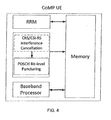
- FIG. 4 is a block diagram illustrating an example of a CoMP UE (UE1 as shown in FIG. 1 ).
- the CoMP UE includes a controller having the following four components and one optional component: (i) a RRM module, where the RRM measurement is performed and reported to the associated BS and shared with all CoMP BSs; (ii) an optional CRS/CSI-RS interference cancellation module, which can cancel out the dominant interference from reference signals; (iii) a PDSCH puncturing module, which receives the bit-level PDSCH muting pattern from its associated BS and updates the PDSCH muting table in the memory; (iv) a baseband processor, which performs the RX (receive) processing as will be shown in FIG. 7 ; and (v) a memory, where the PDSCH muting table is stored.
- a RRM module where the RRM measurement is performed and reported to the associated BS and shared with all CoMP BSs
- an optional CRS/CSI-RS interference cancellation module which
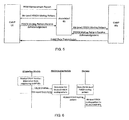
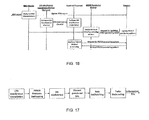
- FIG. 5 shows an example of signaling exchange between a CoMP UE, associated BS (i.e., BS1), and the CoMP BSs.
- the associated BS may or may not be a CoMP BS.
- the UE performs the RRM measurement as defined in e.g., in 3GPP TS36.331 v. 10.4.0 Available online:
- FIG. 6 is an example of a flow diagram illustrating the operation in a CoMP UE's associated BS (i.e., BS1).
- the X2 interface module of the BS receives the information of the CRS RE locations from its neighboring CoMP BSs and inputs such information to the PDSCH muting module (e.g., how much interference there is, which BS signals are received and how strong these signals are).
- the PDSCH muting module determines the bit-level PDSCH muting pattern and sends the information to the CoMP UE and the CoMP BSs.
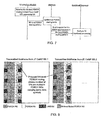
- FIG. 7 is an example of a flow diagram illustrating the operation in a CoMP BS (i.e., BS1, BS2 in the example).
- the X2 interface module of the CoMP BS receives the bit-level PDSCH muting pattern from the CoMP UE's associated BS (which is BS1 in the example). Based on the input of the X2 interface module, the CoMP BS updates the PDSCH muting table in the memory.
- the PDSCH muting table in the memory will be used by baseband processor for transmitter processing.
- FIG. 8 is an example of PDSCH bit level muting to counter CRS interference during JT CoMP reception. This is used to illustrate how to determine the bit-level PDSCH muting pattern and update the PDSCH muting table for the CoMP BSs.
- FIG. 1 shows the example of JT CoMP transmission in the heterogeneous network as shown in FIG. 1 , wherein CoMP UE1 receives subframes from CoMP BS1 and CoMP BS2 simultaneously.
- FIG. 2 shows the transmitted subframes including physical resource blocks (PRBs) from the two BSs along with respective CRS REs. Note that all PRBs from a given CoMP BS will have the same locations of the CRS REs.
- PRBs physical resource blocks
- the CoMP UE's associated BS After receiving the location of the CRS REs from the CoMP BSs, and the RRM report from the CoMP UE (which indicates the signal strength of all CoMP BSs), the CoMP UE's associated BS identifies the REs that suffer strong CRS interference transmission from within the CoMP BSs, i.e., the REs with cross-hatching as shown in FIG. 8 . Afterwards, the PDSCH muting module updates the PDSCH muting table in the memory.
- FIG. 9 shows an example of a PDSCH muting table.
- the PDSCH muting table has columns of RE Muting Pattern Index, Muted REs, bitmap, and status.
- the "Muted REs" column is predefined and fixed.
- the PDSCH muting module chooses the RE muting patterns whose bit-level "muted REs" column covers the largest number of the identified REs with strong CRS interference and sets its status to be “Active.” Note that other RE muting patterns will be automatically set to be “idle” after one RE muting pattern is picked to be “Active.” Assume that each PDSCH RE carries K information bits.
- the associated BS informs the CoMP UE as well as the CoMP BSs of the bit-level PDSCH muting pattern, i.e., the PDSCH muting pattern index and the corresponding bitmap.
- the PDSCH muting module is actually PDSCH bit-level muting module that performs bit-level muting of bits instead of RE-level muting of the entire RE where no data transmission occurs in that particular RE. Another way to characterize its function is that it allows a "muted RE" to carry a number of bits less than the number of bits allocated to normal REs that are not affected or substantially not affected by CRS interference.
- the PDSCH bit-level muting module may also be referred to as RE bit allocation module.
- the circular buffer rate matching defined, e.g., in Ref. 2, is used and configured such that the number of bits after rate matching is K(N-M)-MD, where N is the number of PDSCH REs assigned to the UE, M is the number of bit-level Muted REs, K is the modulation order (i.e., the number of bits carried in each PDSCH RE), and D is the number of "1"s in the bitmap of the active PDSCH muting pattern.
- the number of bits allocated to normal REs is the same as the underlying modulation order.
- D dummy bits are added to each PDSCH RE with CRS interference.
- the modulated symbols are mapped to PDSCH REs such that each PDSCH RE accommodates one modulated symbol.
- FIG. 11 shows an example of adding dummy bits in the proposed scheme at CoMP BS1 under the first approach.
- This relates to TX processing.
- one resource block is assigned to a UE, where twelve REs in the PDSCH region suffer strong CRS interference as shown in FIG. 11 .
- 16QAM is used for modulation and 2 dummy bits are added for each RE with CRS interference.
- N 120
- the bit sequence after rate matching is 00111101110110101110011101110111110001... as shown in FIG. 11 .
- FIG. 12 is an example of a flow diagram illustrating the operation in a CoMP UE of FIG. 4 under the first approach.
- the UE uses the RRM module to perform RRM measurement and reports to its associated BS.
- the UE may support CRS interference cancellation module and, if so, it performs CRS interference cancellation on PDSCH REs which coincide with CRS REs transmitted by CoMP BSs.
- the PDSCH puncturing module updates the PDSCH muting table in the memory by setting the corresponding PDSCH muting pattern to be active and updating the bitmap.
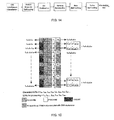
- FIG. 14 shows an example of a flow diagram illustrating the RX processing in the proposed scheme under the first approach. More specifically, the RX processing is RX baseband processing for a CoMP UE, which is the reverse operation of the TX processing.
- the received PDSCH REs are demapped to a modulated symbol stream, which is then demodulated to a bit sequence.
- the dummy bits are removed from the bit sequence according to the active PDSCH muting pattern in the PDSCH muting table stored in the memory.
- rate dematching and turbo decoding are performed. Note that the output of the demodulation is the logarithm of the likelihood ratio or Log-Likelihood ratio (LLR) of each bit.
- LLR Log-Likelihood ratio
- FIG. 15 shows an example of the RX processing in the proposed scheme under the first approach.
- TX processing as shown in FIG. 10 is performed at the CoMP BSs.
- Lk denote the LLR of the k-th bit.
- the LLRs corresponding to discarded dummy bits are L55, L56, L63, L64, L71, L79, and so on.
- the LLR sequence after dropping dummy bits is L1, L2, ... , L53, L54, L57, L58, and so on.
- FIG. 16 shows an example of a flow diagram illustrating the operation in a CoMP UE of FIG. 4 under the second approach according to another embodiment of the invention.
- the UE uses the RRM module to perform RRM measurement and uses the interference information to decide a bit-level PDSCH puncturing pattern for PDSCH REs suffering from CRS interference arising from other BSs.
- the PDSCH puncturing module updates the PDSCH puncturing pattern in the memory.
- the PDSCH puncturing pattern in the memory will be used by the baseband processor for RX processing.
- FIG. 17 is an example of a flow diagram illustrating the RX processing in the proposed scheme under the second approach. More specifically, the RX processing is RX baseband processing for a CoMP UE. After performing optional CRS cancellation, the received PDSCH REs are demapped to a modulated symbol stream, which is then demodulated to a bit sequence. The punctured bits are removed from the bit sequence according to the active PDSCH puncturing pattern in the PDSCH puncturing pattern stored in the memory. Finally, rate dematching and turbo decoding are performed. Note that the output of the demodulation is the logarithm of the likelihood ratio (LLR) of each bit. By removing punctured bits, we mean discarding the LLRs of the punctured bits.
- LLR logarithm of the likelihood ratio
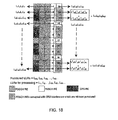
- FIG. 18 shows an example of the RX processing in the proposed scheme under the second approach.
- Lk denote the LLR of the k-th bit.
- the second approach uses a PDSCH puncturing pattern which can discard equal or unequal number of bit LLRs from various PDSCH REs with CRS interference.
- 3 bit LLRs are discarded from PDSCH RE number 14, and 1 bit LLR is discarded from PDSCH RE number 20.
- the LLRs for punctured bits are L54, L55, L56, L80, and so on.
- the LLR sequence fed to the Turbo decoder is: L1, L2, ... , L53, L57, L58, and so on.
- the computers and storage systems implementing the invention can also have known I/O devices (e.g., CD and DVD drives, floppy disk drives, hard drives, etc.) which can store and read the modules, programs and data structures used to implement the above-described invention. These modules, programs and data structures can be encoded on such computer-readable media.
- the data structures of the invention can be stored on computer-readable media independently of one or more computer-readable media on which reside the programs used in the invention.
- the components of the system can be interconnected by any form or medium of digital data communication, e.g., a communication network. Examples of communication networks include local area networks, wide area networks, e.g., the Internet, wireless networks, storage area networks, and the like.
- the operations described above can be performed by hardware, software, or some combination of software and hardware.
- Various aspects of embodiments of the invention may be implemented using circuits and logic devices (hardware), while other aspects may be implemented using instructions stored on a machine-readable medium (software), which if executed by a processor, would cause the processor to perform a method to carry out embodiments of the invention.
- some embodiments of the invention may be performed solely in hardware, whereas other embodiments may be performed solely in software.
- the various functions described can be performed in a single unit, or can be spread across a number of components in any number of ways.
- the methods may be executed by a processor, such as a general purpose computer, based on instructions stored on a computer-readable medium. If desired, the instructions can be stored on the medium in a compressed and/or encrypted format.
Landscapes
- Engineering & Computer Science (AREA)
- Signal Processing (AREA)
- Computer Networks & Wireless Communication (AREA)
- Quality & Reliability (AREA)
- Mobile Radio Communication Systems (AREA)
Applications Claiming Priority (1)
| Application Number | Priority Date | Filing Date | Title |
|---|---|---|---|
| US13/684,327 US9014115B2 (en) | 2012-11-23 | 2012-11-23 | Method and apparatus for handling downlink reference signal interference to PDSCH in long term evolution coordinated multipoint transmission |
Publications (2)
| Publication Number | Publication Date |
|---|---|
| EP2736184A1 true EP2736184A1 (de) | 2014-05-28 |
| EP2736184B1 EP2736184B1 (de) | 2015-05-13 |
Family
ID=49641586
Family Applications (1)
| Application Number | Title | Priority Date | Filing Date |
|---|---|---|---|
| EP20130193790 Not-in-force EP2736184B1 (de) | 2012-11-23 | 2013-11-21 | Verfahren und Vorrichtung zur Handhabung einer Downlink-Referenzsignalstörung zu PDSCH bei einer koordinierten Langzeitentwicklungs-Mehrpunktübertragung |
Country Status (4)
| Country | Link |
|---|---|
| US (1) | US9014115B2 (de) |
| EP (1) | EP2736184B1 (de) |
| JP (1) | JP2014107868A (de) |
| CN (1) | CN103841650A (de) |
Cited By (1)
| Publication number | Priority date | Publication date | Assignee | Title |
|---|---|---|---|---|
| WO2016084268A1 (ja) * | 2014-11-28 | 2016-06-02 | パナソニックIpマネジメント株式会社 | 基地局および協調送信方式選択方法 |
Families Citing this family (23)
| Publication number | Priority date | Publication date | Assignee | Title |
|---|---|---|---|---|
| US9161364B2 (en) * | 2011-12-21 | 2015-10-13 | Qualcomm Incorporated | Methods and apparatus for assignment dependent downlink channel processing for wireless networks |
| US10039116B1 (en) * | 2012-04-02 | 2018-07-31 | Sprint Communications Company L.P. | Long term evolution scheduler to mitigate interference |
| US9553680B1 (en) | 2012-04-02 | 2017-01-24 | Sprint Communications Company L.P. | Uplink interference mitigation |
| US9584276B2 (en) * | 2012-08-10 | 2017-02-28 | Lg Electronics Inc. | Method and apparatus for receiving downlink signal in wireless communication system |
| US9509469B2 (en) | 2013-04-04 | 2016-11-29 | Futurewei Technologies, Inc. | Device, network, and method for utilizing a downlink discovery reference signal |
| US10454651B2 (en) * | 2013-07-25 | 2019-10-22 | Lg Electronics Inc. | Method of reporting channel state information and apparatus thereof |
| US10135586B2 (en) * | 2014-03-20 | 2018-11-20 | Intel IP Corporation | Reference signal enhancement for shared cell |
| CN105636122A (zh) * | 2014-10-28 | 2016-06-01 | 深圳市中兴微电子技术有限公司 | 一种物理资源元素快速映射方法和装置 |
| EP3316637A4 (de) * | 2015-07-17 | 2018-06-27 | Huawei Technologies Co., Ltd. | Verfahren und vorrichtung zur erfassung von konfigurationsinformationen |
| US9686742B1 (en) * | 2015-09-10 | 2017-06-20 | Mbit Wireless, Inc. | Method and apparatus to reduce power consumption in standby mode for wireless communication systems |
| KR102165453B1 (ko) | 2016-04-07 | 2020-10-14 | 엘지전자 주식회사 | 무선 통신 시스템에서 셀 순환 하향링크 송신 방법 및 이를 위한 장치 |
| WO2017181375A1 (zh) * | 2016-04-20 | 2017-10-26 | 华为技术有限公司 | 传输信号的方法、基站和用户设备 |
| US11051208B2 (en) * | 2016-08-25 | 2021-06-29 | Huawei Technologies Co., Ltd. | Co-existence of low latency and latency tolerant downlink communication |
| US11071136B2 (en) | 2016-08-25 | 2021-07-20 | Huawei Technologies Co., Ltd. | System and method for multiplexing traffic |
| US10313074B1 (en) * | 2016-08-30 | 2019-06-04 | Sprint Communications Company L.P. | Channel condition estimation using static user data symbols over user equipment (UE) specific reference signals |
| US11252717B2 (en) | 2016-09-02 | 2022-02-15 | Huawei Technologies Co., Ltd. | Co-existence of latency tolerant and low latency communications |
| US10505697B2 (en) | 2016-11-03 | 2019-12-10 | At&T Intellectual Property I, L.P. | Facilitating a mobile device specific physical downlink shared channel resource element mapping indicator |
| CN106793036B (zh) * | 2016-12-15 | 2019-12-03 | 中国联合网络通信集团有限公司 | 一种控制基站休眠的方法及设备 |
| US10091777B1 (en) | 2017-03-31 | 2018-10-02 | At&T Intellectual Property I, L.P. | Facilitating physical downlink shared channel resource element mapping indicator |
| CN110768760B (zh) * | 2018-07-26 | 2024-02-02 | 华为技术有限公司 | 数据发送的方法及装置 |
| CN112470503B (zh) | 2018-07-24 | 2022-12-16 | 中兴通讯股份有限公司 | 使资源分配静默的方法和装置 |
| EP4200998A4 (de) * | 2020-12-07 | 2024-02-21 | Samsung Electronics Co., Ltd. | Vorrichtung und verfahren zur zwischenzelleninterferenzsteuerung für ein drahtloses kommunikationssystem |
| EP4399933A4 (de) * | 2021-09-06 | 2025-06-04 | Apple Inc. | Verfahren, system und vorrichtung für uplink-ressourcenstummschaltung in der drahtlosen kommunikation |
Citations (3)
| Publication number | Priority date | Publication date | Assignee | Title |
|---|---|---|---|---|
| US20110170435A1 (en) * | 2010-01-12 | 2011-07-14 | Samsung Electronics Co. Ltd. | Method for processing csi-rs in wireless communication system |
| WO2011100520A1 (en) * | 2010-02-12 | 2011-08-18 | Research In Motion Limited | Reference signal for a coordinated multi-point network implementation |
| EP2451202A1 (de) * | 2009-06-29 | 2012-05-09 | Huawei Technologies Co., Ltd. | Verfahren, vorrichtung und system zur verarbeitung von referenzsignalen |
Family Cites Families (15)
| Publication number | Priority date | Publication date | Assignee | Title |
|---|---|---|---|---|
| US9059824B2 (en) * | 2009-02-02 | 2015-06-16 | Texas Instruments Incorporated | Joint processing down link coordinated multi-point reference signal support |
| CN102065465B (zh) * | 2009-11-17 | 2013-11-06 | 中国移动通信集团公司 | 一种数据的传输方法、系统和设备 |
| CN103119873B (zh) * | 2010-02-12 | 2017-04-12 | 黑莓有限公司 | 用于协作多点网络实现的参考信号 |
| US9270347B2 (en) * | 2010-02-12 | 2016-02-23 | Blackberry Limited | Reference signal for a coordinated multi-point network implementation |
| US8873480B2 (en) * | 2010-10-01 | 2014-10-28 | Intel Corporation | Techniques for dynamic spectrum management, allocation, and sharing |
| US8665692B2 (en) * | 2010-12-16 | 2014-03-04 | Nokia Corporation | Method and apparatus providing interference measurement in a coordinated multi-point transmission environment |
| KR20120082717A (ko) * | 2011-01-14 | 2012-07-24 | 주식회사 팬택 | 이종 통신 시스템에서의 위치 참조 신호 뮤팅 방법과 장치, 및 그를 이용한 위치측정 장치와 방법 |
| US9485075B2 (en) * | 2011-04-29 | 2016-11-01 | Futurewei Technologies Inc. | Method and system for transmission and reception of signals and related method of signaling |
| IN2014CN03079A (de) * | 2011-11-04 | 2015-07-03 | Intel Corp | |
| US10250364B2 (en) * | 2011-12-09 | 2019-04-02 | Nokia Corporation | Channel measurements supporting coordinated multi-point operation |
| US9008585B2 (en) * | 2012-01-30 | 2015-04-14 | Futurewei Technologies, Inc. | System and method for wireless communications measurements and CSI feedback |
| US9973955B2 (en) * | 2012-03-16 | 2018-05-15 | Futurewei Technologies, Inc. | Systems and methods for reference signals and CSI feedback |
| US9014109B2 (en) * | 2012-06-05 | 2015-04-21 | Hitachi, Ltd. | Method and apparatus for bit-level PDSCH muting and/or receiver puncturing in LTE-advanced heterogeneous networks |
| US9184889B2 (en) * | 2012-08-08 | 2015-11-10 | Blackberry Limited | Method and system having reference signal design for new carrier types |
| US9402256B2 (en) * | 2012-08-08 | 2016-07-26 | Blackberry Limited | Method and system having reference signal design for new carrier types |
-
2012
- 2012-11-23 US US13/684,327 patent/US9014115B2/en not_active Expired - Fee Related
-
2013
- 2013-11-21 EP EP20130193790 patent/EP2736184B1/de not_active Not-in-force
- 2013-11-21 JP JP2013241011A patent/JP2014107868A/ja active Pending
- 2013-11-22 CN CN201310596612.7A patent/CN103841650A/zh active Pending
Patent Citations (3)
| Publication number | Priority date | Publication date | Assignee | Title |
|---|---|---|---|---|
| EP2451202A1 (de) * | 2009-06-29 | 2012-05-09 | Huawei Technologies Co., Ltd. | Verfahren, vorrichtung und system zur verarbeitung von referenzsignalen |
| US20110170435A1 (en) * | 2010-01-12 | 2011-07-14 | Samsung Electronics Co. Ltd. | Method for processing csi-rs in wireless communication system |
| WO2011100520A1 (en) * | 2010-02-12 | 2011-08-18 | Research In Motion Limited | Reference signal for a coordinated multi-point network implementation |
Cited By (2)
| Publication number | Priority date | Publication date | Assignee | Title |
|---|---|---|---|---|
| WO2016084268A1 (ja) * | 2014-11-28 | 2016-06-02 | パナソニックIpマネジメント株式会社 | 基地局および協調送信方式選択方法 |
| JPWO2016084268A1 (ja) * | 2014-11-28 | 2017-09-07 | パナソニックIpマネジメント株式会社 | 基地局および協調送信方式選択方法 |
Also Published As
| Publication number | Publication date |
|---|---|
| EP2736184B1 (de) | 2015-05-13 |
| JP2014107868A (ja) | 2014-06-09 |
| US20140146689A1 (en) | 2014-05-29 |
| US9014115B2 (en) | 2015-04-21 |
| CN103841650A (zh) | 2014-06-04 |
Similar Documents
| Publication | Publication Date | Title |
|---|---|---|
| EP2736184B1 (de) | Verfahren und Vorrichtung zur Handhabung einer Downlink-Referenzsignalstörung zu PDSCH bei einer koordinierten Langzeitentwicklungs-Mehrpunktübertragung | |
| US9014109B2 (en) | Method and apparatus for bit-level PDSCH muting and/or receiver puncturing in LTE-advanced heterogeneous networks | |
| JP7652825B2 (ja) | ネットワークアシスト干渉相殺及び抑制のためのネットワークシグナリング | |
| US10341152B2 (en) | Interference parameter signaling for efficient interference cancellation and suppression | |
| EP3389204B1 (de) | Dmrs-anzeigeverfahren, endgerät und basisstation | |
| US10555317B2 (en) | Selective configuration of UL/DL information by a base station apparatus | |
| JP6775490B2 (ja) | 無線通信システムで干渉信号除去及び抑制を用いたダウンリンクデータ受信方法及び装置 | |
| JP6728060B2 (ja) | 無線通信システムにおいて干渉信号除去及び抑制のための無線資源活用方法及び装置 | |
| CN103905346B (zh) | 一种干扰信号处理的方法及设备 | |
| US20150264670A1 (en) | Method and apparatus for transmitting control information to remove and suppress interference in wireless communication system | |
| KR102175545B1 (ko) | 무선 통신 시스템에서 수신 신호 복호 방법 및 장치 | |
| WO2014176245A1 (en) | System and method for interference cancellation and/or supression on physical downlink shared channel at the user equipment | |
| CN108029098B (zh) | 用于在无线网络中降低干扰的方法和网络节点 | |
| JP2017508366A (ja) | 干渉信号を処理する方法及び装置 | |
| US20160165616A1 (en) | Base station, user apparatus and interference reduction method | |
| US9258090B2 (en) | Methods and apparatus for transmitting and receiving signal by using modulation order of interference signal | |
| KR102032212B1 (ko) | 무선 통신 시스템에서 간섭 제거 방법 및 장치 | |
| US9554375B1 (en) | Sector selection for coordinated multipoint based on application type | |
| CN105099606B (zh) | 一种控制信息传输方法和设备 | |
| CN105050193B (zh) | 一种信号发送、解调方法以及设备和系统 | |
| KR20150112714A (ko) | 무선통신 시스템에서 다운링크 데이터 수신 방법 및 그 장치 | |
| US10432368B1 (en) | Balancing of transmission time interval bundling and coordinate multipoint | |
| US9614631B2 (en) | Coordination and signaling in NAICS and interference partitioning | |
| HK1257834B (en) | Base station apparatus, terminal apparatus, and integrated circuit | |
| HK1257834A1 (en) | Base station apparatus, terminal apparatus, and integrated circuit |
Legal Events
| Date | Code | Title | Description |
|---|---|---|---|
| PUAI | Public reference made under article 153(3) epc to a published international application that has entered the european phase |
Free format text: ORIGINAL CODE: 0009012 |
|
| 17P | Request for examination filed |
Effective date: 20131213 |
|
| AK | Designated contracting states |
Kind code of ref document: A1 Designated state(s): AL AT BE BG CH CY CZ DE DK EE ES FI FR GB GR HR HU IE IS IT LI LT LU LV MC MK MT NL NO PL PT RO RS SE SI SK SM TR |
|
| AX | Request for extension of the european patent |
Extension state: BA ME |
|
| GRAP | Despatch of communication of intention to grant a patent |
Free format text: ORIGINAL CODE: EPIDOSNIGR1 |
|
| INTG | Intention to grant announced |
Effective date: 20141215 |
|
| GRAS | Grant fee paid |
Free format text: ORIGINAL CODE: EPIDOSNIGR3 |
|
| GRAA | (expected) grant |
Free format text: ORIGINAL CODE: 0009210 |
|
| AK | Designated contracting states |
Kind code of ref document: B1 Designated state(s): AL AT BE BG CH CY CZ DE DK EE ES FI FR GB GR HR HU IE IS IT LI LT LU LV MC MK MT NL NO PL PT RO RS SE SI SK SM TR |
|
| REG | Reference to a national code |
Ref country code: GB Ref legal event code: FG4D |
|
| REG | Reference to a national code |
Ref country code: CH Ref legal event code: EP |
|
| REG | Reference to a national code |
Ref country code: IE Ref legal event code: FG4D |
|
| REG | Reference to a national code |
Ref country code: AT Ref legal event code: REF Ref document number: 727152 Country of ref document: AT Kind code of ref document: T Effective date: 20150615 |
|
| REG | Reference to a national code |
Ref country code: DE Ref legal event code: R096 Ref document number: 602013001750 Country of ref document: DE Effective date: 20150625 |
|
| REG | Reference to a national code |
Ref country code: AT Ref legal event code: MK05 Ref document number: 727152 Country of ref document: AT Kind code of ref document: T Effective date: 20150513 |
|
| REG | Reference to a national code |
Ref country code: NL Ref legal event code: MP Effective date: 20150513 |
|
| REG | Reference to a national code |
Ref country code: LT Ref legal event code: MG4D |
|
| PG25 | Lapsed in a contracting state [announced via postgrant information from national office to epo] |
Ref country code: FI Free format text: LAPSE BECAUSE OF FAILURE TO SUBMIT A TRANSLATION OF THE DESCRIPTION OR TO PAY THE FEE WITHIN THE PRESCRIBED TIME-LIMIT Effective date: 20150513 Ref country code: LT Free format text: LAPSE BECAUSE OF FAILURE TO SUBMIT A TRANSLATION OF THE DESCRIPTION OR TO PAY THE FEE WITHIN THE PRESCRIBED TIME-LIMIT Effective date: 20150513 Ref country code: PT Free format text: LAPSE BECAUSE OF FAILURE TO SUBMIT A TRANSLATION OF THE DESCRIPTION OR TO PAY THE FEE WITHIN THE PRESCRIBED TIME-LIMIT Effective date: 20150914 Ref country code: ES Free format text: LAPSE BECAUSE OF FAILURE TO SUBMIT A TRANSLATION OF THE DESCRIPTION OR TO PAY THE FEE WITHIN THE PRESCRIBED TIME-LIMIT Effective date: 20150513 Ref country code: HR Free format text: LAPSE BECAUSE OF FAILURE TO SUBMIT A TRANSLATION OF THE DESCRIPTION OR TO PAY THE FEE WITHIN THE PRESCRIBED TIME-LIMIT Effective date: 20150513 Ref country code: NO Free format text: LAPSE BECAUSE OF FAILURE TO SUBMIT A TRANSLATION OF THE DESCRIPTION OR TO PAY THE FEE WITHIN THE PRESCRIBED TIME-LIMIT Effective date: 20150813 |
|
| REG | Reference to a national code |
Ref country code: FR Ref legal event code: PLFP Year of fee payment: 3 |
|
| PG25 | Lapsed in a contracting state [announced via postgrant information from national office to epo] |
Ref country code: GR Free format text: LAPSE BECAUSE OF FAILURE TO SUBMIT A TRANSLATION OF THE DESCRIPTION OR TO PAY THE FEE WITHIN THE PRESCRIBED TIME-LIMIT Effective date: 20150814 Ref country code: IS Free format text: LAPSE BECAUSE OF FAILURE TO SUBMIT A TRANSLATION OF THE DESCRIPTION OR TO PAY THE FEE WITHIN THE PRESCRIBED TIME-LIMIT Effective date: 20150913 Ref country code: AT Free format text: LAPSE BECAUSE OF FAILURE TO SUBMIT A TRANSLATION OF THE DESCRIPTION OR TO PAY THE FEE WITHIN THE PRESCRIBED TIME-LIMIT Effective date: 20150513 Ref country code: BG Free format text: LAPSE BECAUSE OF FAILURE TO SUBMIT A TRANSLATION OF THE DESCRIPTION OR TO PAY THE FEE WITHIN THE PRESCRIBED TIME-LIMIT Effective date: 20150813 Ref country code: RS Free format text: LAPSE BECAUSE OF FAILURE TO SUBMIT A TRANSLATION OF THE DESCRIPTION OR TO PAY THE FEE WITHIN THE PRESCRIBED TIME-LIMIT Effective date: 20150513 Ref country code: LV Free format text: LAPSE BECAUSE OF FAILURE TO SUBMIT A TRANSLATION OF THE DESCRIPTION OR TO PAY THE FEE WITHIN THE PRESCRIBED TIME-LIMIT Effective date: 20150513 |
|
| PG25 | Lapsed in a contracting state [announced via postgrant information from national office to epo] |
Ref country code: EE Free format text: LAPSE BECAUSE OF FAILURE TO SUBMIT A TRANSLATION OF THE DESCRIPTION OR TO PAY THE FEE WITHIN THE PRESCRIBED TIME-LIMIT Effective date: 20150513 Ref country code: DK Free format text: LAPSE BECAUSE OF FAILURE TO SUBMIT A TRANSLATION OF THE DESCRIPTION OR TO PAY THE FEE WITHIN THE PRESCRIBED TIME-LIMIT Effective date: 20150513 |
|
| PGFP | Annual fee paid to national office [announced via postgrant information from national office to epo] |
Ref country code: DE Payment date: 20151130 Year of fee payment: 3 |
|
| REG | Reference to a national code |
Ref country code: DE Ref legal event code: R097 Ref document number: 602013001750 Country of ref document: DE |
|
| PG25 | Lapsed in a contracting state [announced via postgrant information from national office to epo] |
Ref country code: SK Free format text: LAPSE BECAUSE OF FAILURE TO SUBMIT A TRANSLATION OF THE DESCRIPTION OR TO PAY THE FEE WITHIN THE PRESCRIBED TIME-LIMIT Effective date: 20150513 Ref country code: CZ Free format text: LAPSE BECAUSE OF FAILURE TO SUBMIT A TRANSLATION OF THE DESCRIPTION OR TO PAY THE FEE WITHIN THE PRESCRIBED TIME-LIMIT Effective date: 20150513 Ref country code: RO Free format text: LAPSE BECAUSE OF NON-PAYMENT OF DUE FEES Effective date: 20150513 Ref country code: PL Free format text: LAPSE BECAUSE OF FAILURE TO SUBMIT A TRANSLATION OF THE DESCRIPTION OR TO PAY THE FEE WITHIN THE PRESCRIBED TIME-LIMIT Effective date: 20150513 |
|
| PGFP | Annual fee paid to national office [announced via postgrant information from national office to epo] |
Ref country code: FR Payment date: 20151124 Year of fee payment: 3 |
|
| PLBE | No opposition filed within time limit |
Free format text: ORIGINAL CODE: 0009261 |
|
| STAA | Information on the status of an ep patent application or granted ep patent |
Free format text: STATUS: NO OPPOSITION FILED WITHIN TIME LIMIT |
|
| 26N | No opposition filed |
Effective date: 20160216 |
|
| PG25 | Lapsed in a contracting state [announced via postgrant information from national office to epo] |
Ref country code: SI Free format text: LAPSE BECAUSE OF FAILURE TO SUBMIT A TRANSLATION OF THE DESCRIPTION OR TO PAY THE FEE WITHIN THE PRESCRIBED TIME-LIMIT Effective date: 20150513 |
|
| PG25 | Lapsed in a contracting state [announced via postgrant information from national office to epo] |
Ref country code: LU Free format text: LAPSE BECAUSE OF FAILURE TO SUBMIT A TRANSLATION OF THE DESCRIPTION OR TO PAY THE FEE WITHIN THE PRESCRIBED TIME-LIMIT Effective date: 20151121 Ref country code: MC Free format text: LAPSE BECAUSE OF FAILURE TO SUBMIT A TRANSLATION OF THE DESCRIPTION OR TO PAY THE FEE WITHIN THE PRESCRIBED TIME-LIMIT Effective date: 20150513 |
|
| REG | Reference to a national code |
Ref country code: IE Ref legal event code: MM4A |
|
| PG25 | Lapsed in a contracting state [announced via postgrant information from national office to epo] |
Ref country code: BE Free format text: LAPSE BECAUSE OF FAILURE TO SUBMIT A TRANSLATION OF THE DESCRIPTION OR TO PAY THE FEE WITHIN THE PRESCRIBED TIME-LIMIT Effective date: 20150513 |
|
| PG25 | Lapsed in a contracting state [announced via postgrant information from national office to epo] |
Ref country code: IE Free format text: LAPSE BECAUSE OF NON-PAYMENT OF DUE FEES Effective date: 20151121 |
|
| PGFP | Annual fee paid to national office [announced via postgrant information from national office to epo] |
Ref country code: IT Payment date: 20161130 Year of fee payment: 4 |
|
| PG25 | Lapsed in a contracting state [announced via postgrant information from national office to epo] |
Ref country code: HU Free format text: LAPSE BECAUSE OF FAILURE TO SUBMIT A TRANSLATION OF THE DESCRIPTION OR TO PAY THE FEE WITHIN THE PRESCRIBED TIME-LIMIT; INVALID AB INITIO Effective date: 20131121 |
|
| REG | Reference to a national code |
Ref country code: DE Ref legal event code: R119 Ref document number: 602013001750 Country of ref document: DE |
|
| PG25 | Lapsed in a contracting state [announced via postgrant information from national office to epo] |
Ref country code: NL Free format text: LAPSE BECAUSE OF FAILURE TO SUBMIT A TRANSLATION OF THE DESCRIPTION OR TO PAY THE FEE WITHIN THE PRESCRIBED TIME-LIMIT Effective date: 20150513 Ref country code: SE Free format text: LAPSE BECAUSE OF FAILURE TO SUBMIT A TRANSLATION OF THE DESCRIPTION OR TO PAY THE FEE WITHIN THE PRESCRIBED TIME-LIMIT Effective date: 20150513 Ref country code: CY Free format text: LAPSE BECAUSE OF FAILURE TO SUBMIT A TRANSLATION OF THE DESCRIPTION OR TO PAY THE FEE WITHIN THE PRESCRIBED TIME-LIMIT Effective date: 20150513 |
|
| REG | Reference to a national code |
Ref country code: CH Ref legal event code: PL |
|
| PG25 | Lapsed in a contracting state [announced via postgrant information from national office to epo] |
Ref country code: CH Free format text: LAPSE BECAUSE OF NON-PAYMENT OF DUE FEES Effective date: 20161130 Ref country code: LI Free format text: LAPSE BECAUSE OF NON-PAYMENT OF DUE FEES Effective date: 20161130 |
|
| REG | Reference to a national code |
Ref country code: FR Ref legal event code: ST Effective date: 20170731 |
|
| PG25 | Lapsed in a contracting state [announced via postgrant information from national office to epo] |
Ref country code: MT Free format text: LAPSE BECAUSE OF FAILURE TO SUBMIT A TRANSLATION OF THE DESCRIPTION OR TO PAY THE FEE WITHIN THE PRESCRIBED TIME-LIMIT Effective date: 20150513 |
|
| PG25 | Lapsed in a contracting state [announced via postgrant information from national office to epo] |
Ref country code: FR Free format text: LAPSE BECAUSE OF NON-PAYMENT OF DUE FEES Effective date: 20161130 |
|
| PG25 | Lapsed in a contracting state [announced via postgrant information from national office to epo] |
Ref country code: DE Free format text: LAPSE BECAUSE OF NON-PAYMENT OF DUE FEES Effective date: 20170601 |
|
| PG25 | Lapsed in a contracting state [announced via postgrant information from national office to epo] |
Ref country code: SM Free format text: LAPSE BECAUSE OF FAILURE TO SUBMIT A TRANSLATION OF THE DESCRIPTION OR TO PAY THE FEE WITHIN THE PRESCRIBED TIME-LIMIT Effective date: 20150513 |
|
| PG25 | Lapsed in a contracting state [announced via postgrant information from national office to epo] |
Ref country code: MK Free format text: LAPSE BECAUSE OF FAILURE TO SUBMIT A TRANSLATION OF THE DESCRIPTION OR TO PAY THE FEE WITHIN THE PRESCRIBED TIME-LIMIT Effective date: 20150513 |
|
| GBPC | Gb: european patent ceased through non-payment of renewal fee |
Effective date: 20171121 |
|
| PG25 | Lapsed in a contracting state [announced via postgrant information from national office to epo] |
Ref country code: TR Free format text: LAPSE BECAUSE OF FAILURE TO SUBMIT A TRANSLATION OF THE DESCRIPTION OR TO PAY THE FEE WITHIN THE PRESCRIBED TIME-LIMIT Effective date: 20150513 Ref country code: AL Free format text: LAPSE BECAUSE OF FAILURE TO SUBMIT A TRANSLATION OF THE DESCRIPTION OR TO PAY THE FEE WITHIN THE PRESCRIBED TIME-LIMIT Effective date: 20150513 Ref country code: IT Free format text: LAPSE BECAUSE OF NON-PAYMENT OF DUE FEES Effective date: 20171121 |
|
| PG25 | Lapsed in a contracting state [announced via postgrant information from national office to epo] |
Ref country code: GB Free format text: LAPSE BECAUSE OF NON-PAYMENT OF DUE FEES Effective date: 20171121 |