EP2736237A1 - Telekommunikationsbetrugsverhinderungssystem und -verfahren - Google Patents
Telekommunikationsbetrugsverhinderungssystem und -verfahren Download PDFInfo
- Publication number
- EP2736237A1 EP2736237A1 EP12194191.8A EP12194191A EP2736237A1 EP 2736237 A1 EP2736237 A1 EP 2736237A1 EP 12194191 A EP12194191 A EP 12194191A EP 2736237 A1 EP2736237 A1 EP 2736237A1
- Authority
- EP
- European Patent Office
- Prior art keywords
- channel
- inbound
- watermark
- outbound
- voice channel
- Prior art date
- Legal status (The legal status is an assumption and is not a legal conclusion. Google has not performed a legal analysis and makes no representation as to the accuracy of the status listed.)
- Withdrawn
Links
- 238000000034 method Methods 0.000 title claims abstract description 94
- 230000002265 prevention Effects 0.000 title description 6
- 238000012545 processing Methods 0.000 claims abstract description 29
- 230000000694 effects Effects 0.000 claims abstract description 17
- 238000012544 monitoring process Methods 0.000 claims abstract description 17
- 230000000903 blocking effect Effects 0.000 claims description 7
- 230000008569 process Effects 0.000 claims description 6
- 238000004590 computer program Methods 0.000 claims description 4
- 238000001514 detection method Methods 0.000 abstract description 29
- 238000012360 testing method Methods 0.000 description 14
- 230000005236 sound signal Effects 0.000 description 12
- 239000000523 sample Substances 0.000 description 11
- 230000001934 delay Effects 0.000 description 6
- 230000008901 benefit Effects 0.000 description 4
- 238000004891 communication Methods 0.000 description 4
- 230000000875 corresponding effect Effects 0.000 description 4
- 238000010586 diagram Methods 0.000 description 4
- 230000004048 modification Effects 0.000 description 4
- 238000012986 modification Methods 0.000 description 4
- 230000003287 optical effect Effects 0.000 description 4
- 239000000969 carrier Substances 0.000 description 3
- 238000001914 filtration Methods 0.000 description 3
- 230000006870 function Effects 0.000 description 3
- 230000006872 improvement Effects 0.000 description 3
- 230000002829 reductive effect Effects 0.000 description 3
- 238000013459 approach Methods 0.000 description 2
- 230000015556 catabolic process Effects 0.000 description 2
- 230000001010 compromised effect Effects 0.000 description 2
- 230000002596 correlated effect Effects 0.000 description 2
- 238000006731 degradation reaction Methods 0.000 description 2
- 238000006073 displacement reaction Methods 0.000 description 2
- 238000005070 sampling Methods 0.000 description 2
- 230000011664 signaling Effects 0.000 description 2
- 230000002123 temporal effect Effects 0.000 description 2
- 230000009471 action Effects 0.000 description 1
- 230000002411 adverse Effects 0.000 description 1
- 238000004458 analytical method Methods 0.000 description 1
- 238000010420 art technique Methods 0.000 description 1
- 230000005540 biological transmission Effects 0.000 description 1
- 239000002131 composite material Substances 0.000 description 1
- 238000010276 construction Methods 0.000 description 1
- 230000003111 delayed effect Effects 0.000 description 1
- 230000001419 dependent effect Effects 0.000 description 1
- 230000009977 dual effect Effects 0.000 description 1
- 238000002592 echocardiography Methods 0.000 description 1
- 238000005516 engineering process Methods 0.000 description 1
- 230000002401 inhibitory effect Effects 0.000 description 1
- 238000013101 initial test Methods 0.000 description 1
- 230000010354 integration Effects 0.000 description 1
- 238000011835 investigation Methods 0.000 description 1
- 230000000670 limiting effect Effects 0.000 description 1
- 230000000135 prohibitive effect Effects 0.000 description 1
- 238000011084 recovery Methods 0.000 description 1
- 230000004044 response Effects 0.000 description 1
- 230000003068 static effect Effects 0.000 description 1
- 230000007704 transition Effects 0.000 description 1
- 230000007306 turnover Effects 0.000 description 1
Images



Classifications
-
- H—ELECTRICITY
- H04—ELECTRIC COMMUNICATION TECHNIQUE
- H04M—TELEPHONIC COMMUNICATION
- H04M3/00—Automatic or semi-automatic exchanges
- H04M3/22—Arrangements for supervision, monitoring or testing
- H04M3/2281—Call monitoring, e.g. for law enforcement purposes; Call tracing; Detection or prevention of malicious calls
Definitions
- the present invention relates to a method and system for preventing fraudulent use of a telephone system.
- the invention relates to a fraud prevention system in private branch exchange (PBX) systems.
- PBX private branch exchange
- PBX private branch exchange
- PBX fraud which is colloquially known as "hacking" or "dial through”
- hacking or "dial through”
- Reports from the Irish Garda Bureau of Fraud Investigation indicate that in 2008, Irish firms were dispossessed of up to €75 millions per year through PBX fraud, and the problem has been estimated at up to US$8 billion globally.
- BDRs billing detail records
- CDRs call detail records
- a fraud analyst may rely upon billing detail records (BDRs) and call detail records (CDRs), which contain information pertaining to calls: each BDR and CDR contains an originating number (where the call is from), a terminating number (where the call is to) and a billing number (where the cost of the call is charged to).
- BDRs billing detail records
- CDRs call detail records
- a call is likely to be fraudulent if it is made using a calling card that has been reported stolen by the owner, and the fraud analyst may thus rely on BDRs to validate call attempts in an effort to identify a fraudulent call, and upon CDRs for responding to fraud when a call has been completed.
- BDRs billing detail records
- CDRs call detail records
- Such techniques remain flawed in some respects. For instance, such systems may not detect a hacker who breaks into a PBX on one line, finds an outside line with a different originating number, and calls another terminating number. Such system also depend upon client-specific configurations and manual intervention at the response stage whereby, if the administrator does not act immediately to a notification, or if a hacker finds a route through the PBX which requires engineering skills to disable the port in use, the fraud will continue until the port is locked down.
- a further problem with PBX fraud is that it typically occurs over a weekend or at night when there is no administrator available.
- This further system advantageously automates the detection and blocking of fraudulent calls within a PBX, relative to earlier systems described above, but still exhibits distinct disadvantages.
- the green channel must not have undergone any audio manipulation (such as gain control or transcoding) or the detection fails.
- Resilience to audio manipulation may be improved by introducing an automatic gain control (AGC) element to the technique.
- AGC automatic gain control
- the W02010/149373 technique already requires about 40 seconds to detect a fraudulent call, if 30 red channels are compared against 30 green channels, and the addition of an AGC component would lead to a significant rise in detection time, since the computational load imposed by the algorithm rises geometrically as the number of channels to test increases. It can therefore be appreciated that the W02010/149373 system can only be scaled at a significant computational expense, with sub-optimal time performance.
- the present invention provides an improved approach for handling fraudulent calls occurring within a PBX, as set out in the appended claims, which maintains detection and blocking for signals distorted by audio processing techniques such as gain control, transcoding and more, at significantly less computational expense than the prior art.
- a system for monitoring telephone calls on a plurality of inbound and outbound voice channels made to and originating from a private branch exchange (PBX) network to detect fraudulent activity comprising means for monitoring and detecting audio data on two or more of the voice channels; wherein the detecting means is configured to process binary data streams on at least one inbound voice channel and at least one outbound voice channel, modify the bit sequence of the binary data stream of the at least one inbound voice channel for introducing a watermark therein, compare the streams and determine whether the watermark is present between the compared at least one inbound channel and at least one outbound channel; and means for blocking the at least one outbound voice channel if the watermark is found therein.
- PBX private branch exchange
- the binary data stream comprises an audio data sample from at least one inbound voice channel and/or at least one outbound voice channel.
- the detecting means is further configured to introduce the watermark at the least significant bit of the sample.
- the audio data sample may be companded according to A-Law G.711 or ⁇ -Law G.711 and comprises 14 bits.
- the detecting means is further configured to introduce the watermark every n th sample of the binary data stream. For instance, for a 64 kbps audio channel, expected to consist of 8000 x 8bits received every second, the watermark may be introduced every 8 th sample.
- the watermark is preferably inaudible to the human ear, so as not to alert participants to a fraudulent call in progress.
- the detecting means is further configured to process a sliding dot product of the at least one inbound voice channel and the at least one outbound voice channel for determining a correlation thereof.
- the watermarking technique cannot accommodate signal distortion, and this embodiment advantageously provides a redundant parallel technique for maintaining the monitoring and detecting in such conditions.
- the system further comprises means for raising an alert or notification about a fraudulent activity, when the monitoring means matches the same audio data on an inbound and an outbound channel.
- a method for monitoring telephone calls on a plurality of inbound and outbound voice channels made to and originating from a common private branch exchange (PBX) to detect fraudulent activity comprising the steps of monitoring and detecting audio data on two or more of the voice channels; wherein the detecting further comprises processing binary data streams on at least one inbound voice channel and at least one outbound voice channel, modifying the bit sequence of the binary data stream of the at least one inbound voice channel for introducing a watermark therein, comparing the streams and determining whether the watermark is present between the compared at least one inbound channel and at least one outbound channel; and blocking the at least one outbound voice channel, if the watermark is found therein.
- PBX common private branch exchange
- the step of modifying the bit sequence further comprises injecting the watermark in place of a least significant bit of the sequence.
- the step of injecting is performed for every n th sample of the binary data stream.
- each watermark comprises data identifying the at least one inbound channel.
- the method may comprise the further step of processing a sliding dot product of the at least one inbound voice channel and the at least one outbound voice channel for determining a correlation thereof.
- the method may comprise the further step of raising an alert or notification about a fraudulent activity, when the step of monitoring matches the same audio data on an inbound and an outbound channel.
- a computer program product which, when processed by a data processing terminal connected to common private branch exchange (PBX), configures the terminal for monitoring telephone calls on a plurality of inbound and outbound voice channels made to and originating from the PBX to detect fraudulent activity, with monitoring and detecting audio data on two or more of the voice channels; wherein the detecting further comprises processing binary data streams on at least one inbound voice channel and at least one outbound voice channel, modifying the bit sequence of the binary data stream of the at least one inbound voice channel for introducing a watermark therein, comparing the streams and determining whether the watermark is present between the compared at least one inbound channel and at least one outbound channel; and blocking the at least one outbound voice channel, if the watermark is found therein.
- PBX common private branch exchange
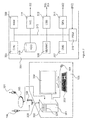
- Figure 1 shows a network environment comprising a communication network in which mobile and static data communication devices are connected to a private branch exchange (PBX), and an embodiment of a system according to the invention.
- PBX private branch exchange
- FIG 2 illustrates call channels in a logic diagram of the private branch exchange (PBX) and the system shown in Figure 1 , including a data processing terminal with memory means.
- PBX private branch exchange
- Figure 3 is a bloc diagram of a typical hardware architecture of the data processing terminal shown in Figure 2 .
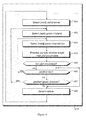
- Figure 4 is a logic diagram of a first embodiment of the fraudulent call detection method performed in the system of Figures 1 to 3 .
- Figure 5 is a logic diagram of a second embodiment of the fraudulent call detection method performed in the system of Figures 1 to 3 .
- FIG. 1 an example embodiment of a system according to the invention is shown within a networked environment, wherein a phone hacker operating a telephone 101 first attempts to gain unauthorised access into a private branch exchange (PBX) 102 via a carrier network (CN) 103.
- the phone hacker 100 identifies a Direct Dial-In (DDI) number 104 routed through the PBX 102, and at this stage will attempt to utilise one or more functions within the PBX 102 that allow a dial back out of the PBX 102.
- the arrows represent the hacker 100 gaining access to a voice mail box 105 of a user extension within the PBX 102, and at this stage the hacker 100 may activate a function allowing a new fraudulent call to be placed.
- PBX private branch exchange
- CN carrier network
- a fraud prevention system 106 of the invention monitors telephone calls on a plurality of inbound and outbound voice channels made to and originating from a common private branch exchange (PBX) 102 to detect fraudulent activity.
- the system 106 automatically monitors audio data on voice channels of the PBX 102 and detects whether the same audio data is present on both incoming and outgoing voice channels. If an audio data match is found with an inbound voice channel, the system blocks the outbound voice channel associated with the matched inbound voice channel.
- the system 106 analyses binary data streams on at least one inbound voice channel and at least one outbound voice channel and the system output can be monitored by an administrator (not shown).
- FIG. 2 shows a PSTN 201 connected to a first 'red zone' 202 of the system 106 and a PBX 102 connected to a second 'green zone' 203 of the system 106.
- the red zone 202 represents inbound calls and the green zone 203 represents outbound calls.
- the PSTN audio data presentation to the system 106 or the system audio data presentation to the PBX 102 is irrelevant to the techniques of the present invention, which are only concerned with audio channel processing, thus the environments of Figure 1 and 2 and their descriptions are not to be construed as limiting the present disclosure in any way.
- the system 106 monitors the red zone inbound section "a" 202 and the green zone outbound section "c" 203 in operation.
- the technique of the present invention is embodied in an data processing application 204 and operates when there is at least one call on leg "a" 202 and at least one call on leg "c" 203, this corresponding to the simplest condition for a fraudulent forwarded call to take place.
- a snapshot of audio is taken from each active channel and segregated into red zone channels 202 n and green zone channels 203 n .
- the system compares every red zone inbound channel "a" 202 n against every green zone outbound channel "c" 203 n to detect fraudulent calls.
- both channels are logged (for example to a database) and disconnected, and a corresponding alarm or notice may be automatically raised (for example via email, SMS, SNMP or other).
- This information can be easily accessed by an administrator, for example as shown in the embodiment of Figure 3 .
- the data processing device 106 is a computer configured with a data processing unit 301, data outputting means such as video display unit (VDU) 302, data inputting means such as HiD devices, commonly a keyboard 303 and a pointing device (mouse) 304, as well as the VDU 302 itself if it is a touch screen display, and data inputting/outputting means such as the wired network connection 305 to the communication network 104 via the router 109, a magnetic data-carrying medium reader/writer 306 and an optical data-carrying medium reader/writer 307.
- VDU video display unit
- HiD devices commonly a keyboard 303 and a pointing device (mouse) 304
- HiD devices commonly a keyboard 303 and a pointing device (mouse) 304
- a central processing unit (CPU) 308 provides task co-ordination and data processing functionality.
- Sets of instructions such as the application 204 and data such as sampled audio data for the CPU 308 are stored in memory means 309 and a hard disk storage unit 310 facilitates non-volatile storage for the instructions and the data if required.
- a network interface card (NIC) 311 provides the interface to the PBX 102.
- NIC network interface card
- a dual NIC one for receiving the PRA from the carrier and one for interfacing the PRA on to the PBX can be used.
- a universal serial bus (USB) input/output interface 312 facilitates connection to the keyboard and pointing devices 303, 304.
- All of the above components are connected to a data input/output bus 313, to which the magnetic data-carrying medium reader/writer 306 and optical data-carrying medium reader/writer 307 are also connected.
- a video adapter 314 receives CPU instructions over the bus 313 for outputting processed data to the VDU 302. All the components of data processing unit 301 are powered by a power supply unit 315, which receives electrical power from a local mains power source and transforms same according to component ratings and requirements.
- All audio data both to and from either domain 202, 203 will have been digitized through sampling and is presented to the system 106 as G.711 A-law or ⁇ -law encoded audio.
- various distortions such as fixed & automatic gain control (e.g. imposed by the PBX functionality), delay (from signal routing through devices and networks), transcoding (if several audio codecs are invoked), echo cancellation and/or distortion (from transmission through analogue technologies), may have been applied to the signal during its transition through a domain. Some, or all of the distortions may not occur.
- Managing delays through detection algorithms can be achieved either by time shifting the input signal, or running an algorithm over a number of time marks. Therefore, an ability to detect a time-shifted version of the green signal with respect to the red signal is required. It is expected that distortions such as gain control, or transcoding may be applied before a fraudulent call is re-routed back to the system 106.
- the system 106 is configured to process the red and green channels with a correlation technique, with a watermarking technique, or with both correlation and watermarking techniques.
- the signal correlation technique also known as sliding dot product, has been determined as an optimal method to solve the problem of signal modification(s) as outlined above, in the event that any distortion other than simple delay is applied to the signal.
- an embodiment of the application 204 comprises a correlator module 210, described hereafter in further detail with reference to Figure 4 .
- the signal watermarking technique has been determined as an optimal method to solve the problem of silent signals and to improve upon the computational requirements of the correlator technique. Accordingly, another embodiment of the application 204 comprises a watermarking module 220, described hereafter in further detail with reference to Figure 5 .
- a correlator is a Digital Signal Processing (DSP) technique for determining whether a signal is substantially similar to another signal, and also apt to check whether a signal has time delayed components of itself in auto-correlation.
- DSP Digital Signal Processing
- the correlator relies upon bins, and each correlation bin has the sum of the products of a number of samples multiplied together added to it on each iteration. The number of samples that go to make the dot products determines how quickly each bin will grow or shrink, the number of bins determines how much delay can be catered for.
- the correlation module 210 performs window length multiply/accumulate operations for each bin of each green channel 203 n , for each red channel 202 n .
- the basic operating principle is that if the samples in the red and green channels have the same sign, then the bin grows, and if not the bin shrinks.
- the absolute value held within a bin is a measure of how often the red and green samples are moving in the same direction at the same time, scaled by the amplitude of the signals themselves. Each bin represents the correlation of the two signals at a different delay point. As relative movements are considered, rather than absolute values, the application 204 should be resilient against any gain control and transcoding of the signal.
- the correlating algorithm embodied in the correlator module 210 of the test was set to look for turning points, and to flag a correlation if the signal of the largest peak was 6 times the average of the rest of the peaks, and remained in a stable bin for 6 consecutive runs. Testing has showed that, for a pseudo-random signal, which is a perfect signal for correlation, a suitable window length is 32 samples. To cope with delays of up to 4ms between the red and green channels, 30 bins are required, whereby the computational requirement for each channel is 30*32 (960) operations.
- High pass filtering reduces the number of low frequency signals which obscure the noise floor in the event of non-correlation.
- high-pass filtering remains an option for performance improvement, it is expected to adversely affect the scalability of the technique for accommodating a larger number of channels.
- the correlator module 210 is processing the channels to determine corresponding trends between the two signals so should identify them as being the same. The same mathematical operations must be performed regardless of the signals themselves, and it must be noted that the time required to determine a correlated signal will be entirely dependent on the power of the signal itself.
- a sliding dot-product correlator thus provides for fast detection when a signal is present, is resilient to most distortions of the audio signal, and its implementation in the application 204 exhibits lower complexity, therefore increased scalability, relative to the sliding window technique of the prior art.
- the processing requirements for a correlator algorithm embodied in the correlator module 210 are expected to increase geometrically with the number of channels to test and, as previously noted, a silent signal will defeat the purpose of the correlator module 210 of the invention.
- the watermarking module 220 introduces additional information to the audio signal coming from the red side 202, wherein such additional information is unobtrusive to a participant within the call, i.e. substantially imperceptible to the human hear. All calls entering at the green side 203 are then evaluated against the watermarked red call, to determine whether the watermark data is present in any of them.
- the first watermarking technique consists in adding one or more echo paths to the audio signal.
- An echo is not deemed to be psycho-acoustically noticeable to a call participant, as long as the delay between the original signal and its echo is kept small, of the order of milliseconds. Indeed, in many situations such a substantially imperceptible echo adds a 'richness' to the sound, which can be pleasing. Conclusively, if the echo delay is less than 1 ms, then usually it is not noticeable by a listener.
- the proposed technique involves marking the inbound audio signal with echoes of two different delays, wherein the echo at one delay represents a binary 0 and an echo at the other delay represents a binary 1.
- a watermarking digital data stream for instance "this call originated on red channel 202 1 , can then be inserted into the audio channel by toggling between the two echo delays.
- Recovery of the watermark on the green side 203 is achieved using the autocepstrum DSP technique.
- the core advantages of this first watermarking technique method are that the indefinite repetition of the watermark result in a system wherein temporal displacement of the return signal does not add to the computational complexity of the system, and that it permits a linear increase in processing requirements as the channel count increases, rather than geometric as in the case of the sliding dot product.
- the first watermarking technique is not considered as a first implementation choice, because autocepstrum is a technique which both complicated and complex to implement, with operations per loop so high as to prove prohibitive in computational terms. Moreover, this technique relies on there being an acoustic signal to 'echo' as the watermark, but audio silence does not provide such as signal, whereby the technique will be defeated during silent periods.
- the second watermarking technique consists in modifying the bit sequence of the audio signal to create a digital data channel in which to introduce the watermark.
- the inbound audio signal on the red channel is a sampled digital representation of a continuous analogue waveform.
- samples of 8000 x 8bit are expectedly presented with every second, which represents a 64kbps audio channel.
- the 8 bit samples will have undergone companding using either A-Law G.711 (Europe) or ⁇ -Law G.711 (US, Japan) and expand to a 14bit sample.
- the least significant bit (LSB) of the 14 bit sample lends little to the perceived audio quality, and it is often the case in certain T1 signalling systems that this LSB is 'robbed' to provide a telephony signalling channel.
- the second watermarking technique consists in substantially the same approach of 'robbing' the LSB to provide a digital data channel which can be used to carry the watermark.
- the LSB is replaced with a watermark every 8 th sample.
- the watermark bit may be the same as the bit which is replaced, there is a 50% chance that the sample is actually unaffected.
- a data stream is thus injected into the digital audio stream in the form of 'FLAG, length-of-data, data, FLAG', wherein the data portion is formatted as the text 'NKS.XX:YY', in which XX represents the E1/T1 on which the red channel is present, and YY represents the circuit number within that E1/T1.
- Detection is by bit testing and looking for a FLAG with another FLAG length-of-data octets away. If this condition is met, then the data portion is presented to the application 204 to ensure that it is according to the correct format. There is a theoretical chance that the data sequence will occur naturally within the data stream, therefore the test condition must be met twice to confirm a detection.
- the length of the FLAG can be increased to reduce the likelihood of a false detection.
- Theoretical detection times are extremely low, because the watermarking data channel runs at 1000 bits/s, and the data length is of the order of 100 bits, therefore double detection will require 200 bits and should require approximately 200 ms.
- Testing shows that, for 120x120 channels, fraudulent calls could be detected in real time.
- Testing of the LSB watermarking technique was carried out with 8 samples per bit leading to a Dr of 1000bps.
- the watermark data length was 15 octets, or 120 bits. Allowing two hits to validate a detection, theoretical time to detection was 256ms, or 1/4s.
- the watermark applied to a speech signal was not audible to the tester.
- the time required for detection is a function of the length of the watermark, and the number of LSBs which are 'robbed' to provide the data channel. If audio degradation is determined to be an issue, the rate at which bits are robbed may be reduced, and be balanced against longer detection times. For instance, halving the data rate is expected to result in detection times of the order of 1 ⁇ 2s.
- this second LSB watermarking technique method the core advantages of this second LSB watermarking technique method are that the indefinite repetition of the watermark result in a system wherein temporal displacement of the return signal does not add to the computational complexity of the system, which is effectively independent of delay, and that it permits a linear increase in processing requirements as the channel count increases, rather than geometric as in the case of the sliding dot product. Therefore this technique will scale to large numbers of channels with ease, in comparison to geometrically-complex algorithms, such as the correlation technique described herein.
- the LSB watermarking technique is computationally inexpensive, as very few operations per processing loop are required to implement it. Moreover, and importantly, the LSB watermarking technique is effective regardless of whether the audio signal is silent or not, since the binary form of a silent audio signal is watermarked in the same manner as an audible audio signal.
- an embodiment of the application 204 combines both a correlator module 210 implementing the shifting dot product described herein and a watermarking module 220 implementing the LSB watermarking described herein.
- the LSB watermarking module 220 provides the fastest detection regardless of whether the signal is audible or silent, is simple to implement and computationally less expensive than the shifting dot product module 210, and provides scaling linearity for the number of channels monitored. Any distortion of the audio signal which defeats detection attempts by the LSB module 220 is nevertheless accommodated by the shifting dot product module 210, which is resilient to most distortions of the audio signal, and provides still-faster detection, less complexity and hence more scalability than the shifting window technique of the prior art.
- the invention significantly reduces the risk of PBX fraud.
- the system provides the ability to detect, block and alert an administrator in real time.
- system 106 of the invention can be implemented as a remote hosted solution such that all calls in a PBX are routed via the remote hosted system, for example over the internet or other communication network.
- the present invention provides a real time solution that bridges the ISDN circuits that are connected to a PBX and by using intelligent monitoring software, such that the system can monitor the DSP resources associated with theses ISDN circuits. If system matches the same voice energy on more than one DSP resource, it will immediately block the relevant B-Channels and alert the administrator that there was an attempt to compromise the PBX.
- the present invention operates continually and will automatically continue to detect and block the fraudulent call activity leaving an administrator 7 under no pressure to act immediately to an alert. All detections are immediately notified to the administrator 7, shown in Figure 1 , with an event log stored locally.
- system of the invention can be implemented in a firewall type solution that protects PBX systems (telephone systems) from criminals who are focused on hacking into a PBX for the purposes of generating profit by making long distance and premium rate telephone calls across the telephone lines that are connected to the PBX.
- PBX systems telephone systems
- PBX private branch exchange'
- PABX private automatic branch exchange
- EPAX electronic private automatic branch exchange
- the embodiments of the fraud prevention system 106 and the methods described with reference to the drawings comprise a computer apparatus and/or processes performed in a computer apparatus.
- the invention also extends to computer programs, particularly computer programs stored on or in a carrier adapted to bring the fraud prevention system of the invention into practice.
- the program may be in the form of source code, object code, or a code intermediate source and object code, such as in partially compiled form or in any other form suitable for use in the implementation of the method according to the invention.
- the carrier may comprise a storage medium such as ROM, e.g. CD ROM, or magnetic recording medium, e.g. a floppy disk or hard disk.
- the carrier may be an electrical or optical signal which may be transmitted via an electrical or an optical cable or by radio or other means.
Landscapes
- Engineering & Computer Science (AREA)
- Computer Security & Cryptography (AREA)
- Technology Law (AREA)
- Signal Processing (AREA)
- Telephonic Communication Services (AREA)
Priority Applications (1)
| Application Number | Priority Date | Filing Date | Title |
|---|---|---|---|
| EP12194191.8A EP2736237A1 (de) | 2012-11-26 | 2012-11-26 | Telekommunikationsbetrugsverhinderungssystem und -verfahren |
Applications Claiming Priority (1)
| Application Number | Priority Date | Filing Date | Title |
|---|---|---|---|
| EP12194191.8A EP2736237A1 (de) | 2012-11-26 | 2012-11-26 | Telekommunikationsbetrugsverhinderungssystem und -verfahren |
Publications (1)
| Publication Number | Publication Date |
|---|---|
| EP2736237A1 true EP2736237A1 (de) | 2014-05-28 |
Family
ID=47221239
Family Applications (1)
| Application Number | Title | Priority Date | Filing Date |
|---|---|---|---|
| EP12194191.8A Withdrawn EP2736237A1 (de) | 2012-11-26 | 2012-11-26 | Telekommunikationsbetrugsverhinderungssystem und -verfahren |
Country Status (1)
| Country | Link |
|---|---|
| EP (1) | EP2736237A1 (de) |
Citations (6)
| Publication number | Priority date | Publication date | Assignee | Title |
|---|---|---|---|---|
| US5504810A (en) | 1993-09-22 | 1996-04-02 | At&T Corp. | Telecommunications fraud detection scheme |
| US5805686A (en) | 1995-12-22 | 1998-09-08 | Mci Corporation | Telephone fraud detection system |
| US6763099B1 (en) * | 1999-11-05 | 2004-07-13 | T-Netix, Inc. | Advanced three way call detection system and method using spread spectrum techniques |
| US20040234056A1 (en) | 2001-07-17 | 2004-11-25 | Securelogix Corporation | Telephony security system |
| WO2005025185A2 (en) * | 2003-08-05 | 2005-03-17 | Inmate Telephone, Inc. | Three-way call detection using steganography |
| WO2010149373A1 (en) | 2009-06-25 | 2010-12-29 | Tully Liam | Telecommunication fraud prevention system and method |
-
2012
- 2012-11-26 EP EP12194191.8A patent/EP2736237A1/de not_active Withdrawn
Patent Citations (6)
| Publication number | Priority date | Publication date | Assignee | Title |
|---|---|---|---|---|
| US5504810A (en) | 1993-09-22 | 1996-04-02 | At&T Corp. | Telecommunications fraud detection scheme |
| US5805686A (en) | 1995-12-22 | 1998-09-08 | Mci Corporation | Telephone fraud detection system |
| US6763099B1 (en) * | 1999-11-05 | 2004-07-13 | T-Netix, Inc. | Advanced three way call detection system and method using spread spectrum techniques |
| US20040234056A1 (en) | 2001-07-17 | 2004-11-25 | Securelogix Corporation | Telephony security system |
| WO2005025185A2 (en) * | 2003-08-05 | 2005-03-17 | Inmate Telephone, Inc. | Three-way call detection using steganography |
| WO2010149373A1 (en) | 2009-06-25 | 2010-12-29 | Tully Liam | Telecommunication fraud prevention system and method |
Similar Documents
| Publication | Publication Date | Title |
|---|---|---|
| US9674350B2 (en) | Telecommunication fraud prevention system and method | |
| US20070041517A1 (en) | Call transfer detection method using voice identification techniques | |
| US5796811A (en) | Three way call detection | |
| US5805685A (en) | Three way call detection by counting signal characteristics | |
| CA2864316C (en) | Centralized call processing | |
| US7826604B2 (en) | Three-way call detection using steganography | |
| US20180294959A1 (en) | Identity and content authentication for phone calls | |
| US6763099B1 (en) | Advanced three way call detection system and method using spread spectrum techniques | |
| GB2391373A (en) | A system for the automatic detection of a fraudulent transaction | |
| JP2010528520A (ja) | 統合ネットワークにおける発呼者身元が偽装されたスパム/電話勧誘販売の電話活動の検出 | |
| US20120099711A1 (en) | Telecommunication fraud prevention system and method | |
| EP1958341B1 (de) | Echoerkennung | |
| Sherr et al. | Signaling vulnerabilities in wiretapping systems | |
| US6718024B1 (en) | System and method to discriminate call content type | |
| EP3603043B1 (de) | Telefonsignalverarbeitung | |
| EP2736237A1 (de) | Telekommunikationsbetrugsverhinderungssystem und -verfahren | |
| CN101222379B (zh) | 一种垃圾语音信息的监控方法和装置 | |
| Pörschmann et al. | Analysis of Spectral Parameters of Audio Signals for the Identification of Spam Over IP Telephony. | |
| US20020141568A1 (en) | Dual threshold correlator | |
| US20020076039A1 (en) | Method and apparatus for securing telephone passwords | |
| KR102800516B1 (ko) | 불법 통신장비 탐지 장치 및 방법 | |
| US20070206761A1 (en) | Comparative tone return time three-way call detect | |
| Pörschmann et al. | Spectral analysis of audio signals for the identification of spam over IP telephony | |
| Rebahi et al. | A SPIT Detection Mechanism Based on Audio Analysis. | |
| Sengar et al. | Wiretap-proof: What they hear is not what you speak, and what you speak they do not hear |
Legal Events
| Date | Code | Title | Description |
|---|---|---|---|
| PUAI | Public reference made under article 153(3) epc to a published international application that has entered the european phase |
Free format text: ORIGINAL CODE: 0009012 |
|
| 17P | Request for examination filed |
Effective date: 20121126 |
|
| AK | Designated contracting states |
Kind code of ref document: A1 Designated state(s): AL AT BE BG CH CY CZ DE DK EE ES FI FR GB GR HR HU IE IS IT LI LT LU LV MC MK MT NL NO PL PT RO RS SE SI SK SM TR |
|
| AX | Request for extension of the european patent |
Extension state: BA ME |
|
| STAA | Information on the status of an ep patent application or granted ep patent |
Free format text: STATUS: THE APPLICATION IS DEEMED TO BE WITHDRAWN |
|
| 18D | Application deemed to be withdrawn |
Effective date: 20141129 |