EP2737896A2 - Verwendung von Umirolimus und seiner Derivate zur Behandlung von Krebs - Google Patents
Verwendung von Umirolimus und seiner Derivate zur Behandlung von Krebs Download PDFInfo
- Publication number
- EP2737896A2 EP2737896A2 EP13195503.1A EP13195503A EP2737896A2 EP 2737896 A2 EP2737896 A2 EP 2737896A2 EP 13195503 A EP13195503 A EP 13195503A EP 2737896 A2 EP2737896 A2 EP 2737896A2
- Authority
- EP
- European Patent Office
- Prior art keywords
- poly
- umirolimus
- polymer
- cancer
- formulation
- Prior art date
- Legal status (The legal status is an assumption and is not a legal conclusion. Google has not performed a legal analysis and makes no representation as to the accuracy of the status listed.)
- Granted
Links
Images
Classifications
-
- A—HUMAN NECESSITIES
- A61—MEDICAL OR VETERINARY SCIENCE; HYGIENE
- A61K—PREPARATIONS FOR MEDICAL, DENTAL OR TOILETRY PURPOSES
- A61K9/00—Medicinal preparations characterised by special physical form
- A61K9/10—Dispersions; Emulsions
- A61K9/127—Synthetic bilayered vehicles, e.g. liposomes or liposomes with cholesterol as the only non-phosphatidyl surfactant
- A61K9/1271—Non-conventional liposomes, e.g. PEGylated liposomes or liposomes coated or grafted with polymers
- A61K9/1273—Polymersomes; Liposomes with polymerisable or polymerised bilayer-forming substances
-
- A—HUMAN NECESSITIES
- A61—MEDICAL OR VETERINARY SCIENCE; HYGIENE
- A61K—PREPARATIONS FOR MEDICAL, DENTAL OR TOILETRY PURPOSES
- A61K31/00—Medicinal preparations containing organic active ingredients
- A61K31/33—Heterocyclic compounds
- A61K31/395—Heterocyclic compounds having nitrogen as a ring hetero atom, e.g. guanethidine or rifamycins
- A61K31/435—Heterocyclic compounds having nitrogen as a ring hetero atom, e.g. guanethidine or rifamycins having six-membered rings with one nitrogen as the only ring hetero atom
- A61K31/4353—Heterocyclic compounds having nitrogen as a ring hetero atom, e.g. guanethidine or rifamycins having six-membered rings with one nitrogen as the only ring hetero atom ortho- or peri-condensed with heterocyclic ring systems
- A61K31/436—Heterocyclic compounds having nitrogen as a ring hetero atom, e.g. guanethidine or rifamycins having six-membered rings with one nitrogen as the only ring hetero atom ortho- or peri-condensed with heterocyclic ring systems the heterocyclic ring system containing a six-membered ring having oxygen as a ring hetero atom, e.g. rapamycin
-
- A—HUMAN NECESSITIES
- A61—MEDICAL OR VETERINARY SCIENCE; HYGIENE
- A61K—PREPARATIONS FOR MEDICAL, DENTAL OR TOILETRY PURPOSES
- A61K9/00—Medicinal preparations characterised by special physical form
- A61K9/0012—Galenical forms characterised by the site of application
- A61K9/0019—Injectable compositions; Intramuscular, intravenous, arterial, subcutaneous administration; Compositions to be administered through the skin in an invasive manner
-
- A—HUMAN NECESSITIES
- A61—MEDICAL OR VETERINARY SCIENCE; HYGIENE
- A61K—PREPARATIONS FOR MEDICAL, DENTAL OR TOILETRY PURPOSES
- A61K9/00—Medicinal preparations characterised by special physical form
- A61K9/10—Dispersions; Emulsions
- A61K9/107—Emulsions ; Emulsion preconcentrates; Micelles
-
- A—HUMAN NECESSITIES
- A61—MEDICAL OR VETERINARY SCIENCE; HYGIENE
- A61K—PREPARATIONS FOR MEDICAL, DENTAL OR TOILETRY PURPOSES
- A61K9/00—Medicinal preparations characterised by special physical form
- A61K9/10—Dispersions; Emulsions
- A61K9/107—Emulsions ; Emulsion preconcentrates; Micelles
- A61K9/1075—Microemulsions or submicron emulsions; Preconcentrates or solids thereof; Micelles, e.g. made of phospholipids or block copolymers
-
- A—HUMAN NECESSITIES
- A61—MEDICAL OR VETERINARY SCIENCE; HYGIENE
- A61K—PREPARATIONS FOR MEDICAL, DENTAL OR TOILETRY PURPOSES
- A61K9/00—Medicinal preparations characterised by special physical form
- A61K9/10—Dispersions; Emulsions
- A61K9/127—Synthetic bilayered vehicles, e.g. liposomes or liposomes with cholesterol as the only non-phosphatidyl surfactant
- A61K9/1271—Non-conventional liposomes, e.g. PEGylated liposomes or liposomes coated or grafted with polymers
-
- A—HUMAN NECESSITIES
- A61—MEDICAL OR VETERINARY SCIENCE; HYGIENE
- A61P—SPECIFIC THERAPEUTIC ACTIVITY OF CHEMICAL COMPOUNDS OR MEDICINAL PREPARATIONS
- A61P35/00—Antineoplastic agents
-
- A—HUMAN NECESSITIES
- A61—MEDICAL OR VETERINARY SCIENCE; HYGIENE
- A61P—SPECIFIC THERAPEUTIC ACTIVITY OF CHEMICAL COMPOUNDS OR MEDICINAL PREPARATIONS
- A61P35/00—Antineoplastic agents
- A61P35/02—Antineoplastic agents specific for leukemia
Definitions
- Tumors tend to develop resistance to chemotherapy drugs over time. To overcome such drug resistance, doctors routinely prescribe different chemotherapy drugs at different stages of treatment. Therefore, cancer patients will have a higher probability of surviving their particular cancer as the number of novel anti-cancer drugs increases.
- Sirolimus also known as rapamycin, is a lipophilic macrolide antibiotic initially developed for use as an immune suppressor for transplant patients. It was subsequently used in a drug coating for coronary artery stents, where it functions to reduce restenosis following angioplasty by inhibiting smooth muscle cell proliferation. Sirolimus also has anti-tumor activity. See US Patent 4,885,171 .
- sirolimus derivatives have also been found to be effective for treating certain cancers.
- everolimus a sirolimus derivative
- Umirolimus 40-alkoxyalkyl rapamycin or biolimus A9
- Umirolimus a highly lipophilic derivative of sirolimus
- This property gives umirolimus a higher affinity for lipid-rich cell membranes.
- umirolimus less soluble in typical pharmaceutical preparations. Consequently, special formulations of umirolimus are needed to effectively deliver it to the site of a tumor.
- the main objective of the present invention is to provide umirolimus formulations for treating cancer.
- the main aspect of this invention relates to vehicle-encapsulated umirolimus or umirolimus conjugates.
- a pharmaceutical formulation that includes umirolimus encapsulated in a liposome or a polymer micelle, together with a pharmaceutically acceptable excipient, carrier, or diluent.
- a pharmaceutical formulation in another embodiment, includes umirolimus conjugated to a polymer, together with a pharmaceutically acceptable excipient, carrier, or diluent.
- a method for treating cancer by administering to a subject an effective amount of the pharmaceutical formulation that includes umirolimus conjugated to a polymer.
- the main aspect of the invention relates to vehicle-encapsulated umirolimus formulations and umirolimus conjugate formulations for treating cancer.
- a pharmaceutical formulation in one embodiment, includes umirolimus encapsulated in a liposome.
- the liposome includes a polyethylene glycol (PEG) conjugated phospholipid (PEGylated phospholipid) and a phosphatidylcholine (PC).
- PEG polyethylene glycol
- the PEG has a length of 10-3000 monomeric units. In a preferred embodiment, the PEG has a length of 40-150 monomeric units.
- the umirolimus is present at a molar ratio of 0.1-10% based on the amounts of PEGylated phospholipid and PC.
- the phospholipid can be, but is not limited to, distearoylphosphatidylcholine (DSPC), distearoylphosphatidylethanolamine (DSPE), distearoylphosphatidylglycerol (DSPG), dimyristoylphosphatidylcholine (DMPC), dioleoylphosphatidylcholine (DOPC), dioleoylphosphatidylethanolamine (DOPE), or dipalmitoylphosphatidylglycerol (DPPG).
- the PC can be, but is not limited to, hydrogenated soy PC (HSPC), egg PC, or soy PC.
- the phospholipid is DSPE
- the PC is HSPC
- a molar ratio between the umirolimus, the PEGylated phospholipid, and the PC is 10:60:30.
- the formulations described above also include cholesterol.
- the formulation can include cholesterol, PEGylated DSPE, HSPC, and umirolimus at a molar ratio of 0.1-2%, where the molar ratio between the PEGylated DSPE, HSPC, and cholesterol is 55-65:2-10:20-40.
- a pharmaceutical formulation that includes umirolimus encapsulated in a polymer micelle.
- the umirolimus can be present at 5-40% by weight of the polymer micelle.
- the polymer can be a tri-arm block co-polymer or a block co-polymer.
- the tri-arm block co-polymer can contain a hydrophilic polymer conjugated to two hydrophobic polymers.
- the hydrophilic polymer can be PEG and the two hydrophobic polymers can both be polylactide (PLA), i.e., PEG(PLA) 2 .
- the hydrophilic polymer is PEG and the hydrophobic polymers are both polycaprolactone (PCL), i.e., PEG(PCL) 2 .
- the tri-arm block co-polymer can also contain a hydrophilic peptide conjugated to two hydrophobic polymers.
- the hydrophilic peptide can be poly-Asp, poly-Gln, poly-Asn, or poly-Glu.
- the two hydrophobic polymers can both be PLA or PCL.
- the molecular weight of the hydrophobic polymer can be 1000-5000 Da.
- the hydrophobic polymer is PCL.
- the hydrophilic peptide can be 20-50 amino acids in length.
- the tri-arm block co-polymer contains a hydrophilic peptide conjugated to two hydrophobic peptides.
- the hydrophilic peptides can be poly-Asp, poly-Gln, poly-Asn, or poly-Glu.
- the hydrophobic peptides can be poly-Tyr, poly-Leu, poly-Phe, poly-Ala, or poly-Ile.
- the hydrophilic peptide can be 20-50 amino acids in length, and the hydrophobic peptide can be 5-40 amino acids in length. In a preferred embodiment, the hydrophobic peptide is poly-Ile or poly-Leu.
- the umirolimus can be encapsulated in a polymer micelle in which the polymer is a block co-polymer.
- the umirolimus can be present at 5-40% by weight of the polymer micelle.
- the block co-polymer can contain a hydrophilic polymer conjugated to a hydrophobic polymer.
- the hydrophilic polymer can be PEG and the hydrophobic polymer can be PLA, i.e., PEG-PLA.
- the hydrophilic polymer is PEG and the hydrophobic polymer is PCL, i.e., PEG-PCL.
- the PEG can have a length of 10-3000 monomeric units.
- the molecular weight of the hydrophobic polymers PLA and PCL can be 1000-10000 Da.
- the block co-polymer can contain a hydrophilic peptide conjugated to a hydrophobic peptide or a hydrophobic peptide conjugated to a hydrophilic polymer.
- the block co-polymer can contain the hydrophilic peptide poly-Asp, poly-Gln, poly-Asn, or poly-Glu.
- the hydrophobic peptide can be poly-Ala, poly-Leu, poly-Ile, poly-Val, poly-Phe, poly-Tyr, or poly-Trp.
- the hydrophobic peptide can be 10-40 amino acids in length, while the hydrophilic peptide can be 40-300 amino acids in length.
- any of the above amino acid residues making up the hydrophobic and hydrophilic peptides can be an L amino acid or a D amino acid. In other embodiments, a racemic mixture (rac) of the above-mentioned amino acids can be used.
- the block co-polymer contains the hydrophilic peptide poly-rac-Asp and the hydrophobic peptide poly-rac-Phe. In another embodiment, the hydrophobic peptide is 10-40 amino acids in length and the hydrophilic peptide is 40-300 amino acids in length.
- the umirolimus is encapsulated in a polymer micelle that includes a block co-polymer containing a hydrophobic peptide conjugated to a hydrophilic polymer.
- the hydrophobic peptide can be 5-40 amino acids in length, and the hydrophilic polymer can have a molecular weight of 2,000-100,000 Dal.
- the hydrophobic peptide can be, for example, poly-Tyr, poly-Leu, poly-Phe, poly-Ala, poly-Ile, poly-Val, or poly-Phe. In preferred embodiments, the hydrophobic peptide is poly-Leu or poly-Ile.
- the hydrophilic polymer can be PEG.
- a pharmaceutical formulation that includes umirolimus conjugated to a polymer.
- the umirolimus can be present at 10% to 50% by weight of the polymer conjugate.
- the molecular weight of the polymer is in the range of 20,000 Dal to 100,000 Dal.
- the polymer can be, but is not limited to, poly-Glu, poly-Asp, poly-Lys, poly-Tyr, and PEG.
- the PEG is a 4-arm or 8-arm branched polymer.
- the PEG is a 4-arm branched polymer.
- umirolimus in another embodiment, can be conjugated to a block co-polymer that includes a hydrophobic polymer and a hydrophilic polymer, where the umirolimus is bonded to the hydrophobic polymer.
- the hydrophobic polymer can be PLA, PCL, or a hydrophobic peptide.
- the hydrophilic polymer can be PEG.
- the hydrophobic polymer is a hydrophobic peptide
- the hydrophobic peptide can be poly-Ala, poly-Leu, poly-Ile, poly-Val, poly-Phe, poly-Tyr, or poly-Trp.
- any of the above-mentioned umirolimus-containing formulations can be used to produce a medicament for treating cancer.
- the current invention provides a method for treating cancer by administering to a subject an effective amount of the pharmaceutical formulations described above that include encapsulated umirolimus or umirolimus conjugates.
- a pharmaceutical formulation including umirolimus encapsulated in a liposome can be administered to a cancer patient via any conventional method, including, but not limited to, intraperitoneal injection, intravenous injection, direct injection into a tumor, injection into the arterial circulation upstream of a tumor, and nasal inhalation.
- the pharmaceutical formulations described above can also be administered orally in pill form or in capsule form.
- umirolimus a lipid soluble drug
- lipid bilayer of a liposome lipid bilayer of a liposome
- umirolimus loaded into liposomes is released slowly and continuously after administration, and (iii) encapsulation provides higher aqueous solubility and stability to umirolimus as compared to pure umirolimus.
- a pharmaceutical formulation including umirolimus encapsulated in a polymer micelle can be administered to a cancer patient via the above-described methods, including, but not limited to, intraperitoneal injection, intravenous injection, direct injection into a tumor, injection into the arterial circulation upstream of a tumor, and nasal inhalation.
- Umirolimus delivered in encapsulated form would tend to accumulate at sites of a tumor, an infection, or an inflammation, where these sites have a larger than normal porous microvascular structure.
- a method for treating cancer by administering to a subject an effective amount of the above-described pharmaceutical formulations that include umirolimus conjugated to a polymer.
- Formulations including conjugated umirolimus can be administered to a subject by conventional means, including, but not limited to, intraperitoneal injection, intravenous injection, direct injection into a tumor, injection into the arterial circulation upstream of a tumor, and nasal inhalation.
- Conjugated umirolimus would act as a prodrug. More specifically, umirolimus would be released from an umirolimus/polymer conjugate by hydrolysis in body tissues after administration of the conjugate.
- Umirolimus-polymer conjugates as compared to pure umirolimus, are expected to demonstrate increased water solubility, enhanced drug stability, prolonged drug circulation time in the blood, increased tumor vascular permeability for tumor targeting (an EPR effect), and improved pharmacokinetics.
- the types of cancer that can be treated by administering the above-described formulations include but are not limited to acute lymphocytic leukemia, acute myeloid leukemia, adrenal cancer, adult soft tissue sarcoma, anal cancer, aplastic anemia, basal and squamous cell skin cancer, bile duct cancer, bladder cancer, bone cancer, brain/CNS tumors, breast cancer, breast cancer in man, cancer in children, cancer of unknown primary, Castleman's disease, cervical cancer, chronic lymphocytic leukemia, chronic myeloid leukemia, chronic myelomonocytic leukemia, colorectal cancer, endometrial cancer, esophagus cancer, Ewing Family of tumors, eye cancer, gallbladder cancer, gastric cancer, gastrointestinal carcinoid, gastrointestinal stromal tumor, gestational trophoblastic disease, Hodgkin's disease, Kaposi's sarcoma, kidney cancer, laryngeal and hypopharyngeal cancer, le
- Example 1 Umirolimus inhibits cancer cell growth
- Umirolimus was added to cultured cell lines derived from 9 types of human cancer. After 72 hours of in vitro culture, the 50% inhibitory concentration (IC 50 ) of umirolimus on cell growth was measured using the CellTiter-Glo luminescent cell viability assay. Table 1.
- Example 2 Inhibition of cancer cell growth by umirolimus as compared to sirolimus and everolimus.
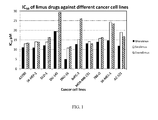
- the IC 50 for 3 "limus” drugs for inhibiting the growth of 10 human cancer cell lines was measured using the CellTiter-Glo luminescent cell viability assay as described in Example 1.
- the ten exemplary human cancer cell lines tested were SK-MES-1 (lung cancer), BxPC-3 (pancreatic cancer), AZ-521 (gastric cancer), SNU-16 (gastric cancer), SK-HEP-1 (liver cancer), A2780 (ovarian cancer), MDA-MB-231 (breast cancer), DLD-1 (colorectal cancer), DU-145 (prostate cancer) and 786-O (kidney cancer). The results are shown in FIG. 1 .
- umirolimus was unexpectedly superior to that of sirolimus and everolimus for 8 out of the 10 cancer cell lines tested. More specifically, umirolimus was superior in inhibiting the growth of the following cell lines: A2780, SK-HEP-1, DLD-1, SNU-16,BxPC-3, 786-O, SK-MES-1, andAZ-521.
- Umirolimus (0.1-2 mM ofumirolimus/100 mM total lipid), PEGylated distearoyl phosphatidyl ethanolamine (mPEG-DSPE; polyethylene glycol monomer chain length of 2,000), hydrogenated soy phosphatidylcholine (HSPC), and cholesterol (DSPE/HSPC/cholesterol ratio: 55-65/2-10/20-40) are dissolved in ethanol (10-30% of total volume of liposome). The mixture is then injected into 10 mL of distilled water with constant stirring. The liposome solution thus formed is extruded 10 times through a 0.5 ⁇ m polycarbonate filter and then 10 times through a 0.22 ⁇ m polycarbonate filter to reduce the particle size to 100-200 nm.
- mPEG-DSPE polyethylene glycol monomer chain length of 2,000
- HSPC hydrogenated soy phosphatidylcholine
- cholesterol DSPE/HSPC/cholesterol ratio: 55-65/2-10/20-40
- Umirolimus, mPEG-DSPE (polyethylene glycol monomer chain length of 2,000), and HSPC, (umirolimus/DSPE/HSPC ratio: 10-30/60-80/10-20) are dissolved in ethanol (10-30% of total volume of liposome).
- the mixture is then injected into 10 mL of distilled water with constant stirring.
- the liposome solution thus formed is extruded 10 times through a 0.5 ⁇ m polycarbonate filter and then 10 times through a 0.22 ⁇ m polycarbonate filter to reduce the particle size to 100-200 nm.
- methyl PEG-OH is reacted with 4-(chloromethyl)-2,2-dimethyl-1,3-dioxolane to form a ketal derivative.
- the resulting diol is used for lactide polymerization to obtain a PEG(PLA) 2 tri-arm block co-polymer.
- a hydrophobic peptide of 5-40 amino acids in length is synthesized by solid phase peptide synthesis (SPPS) using an automated peptide synthesizer on Rink amide methylbenzhydrylamine (MBHA) resin using standard Fmoc/t-Butyl protected amino acids and O-7 azabenzotriazol tetramethyluronium hexafluorophospahate (HATU) active-ester based coupling.
- the synthesized peptides can be poly-Tyr, poly-Leu, poly-Phe, poly-Ala, poly-Ile, poly-Val, or poly-Phe.
- a hydrophilic peptide of 20-50 amino acids in length terminating in a lysine residue is also synthesized by solid phase peptide synthesis as described above.
- the synthesized peptides can be poly-Asp, poly-Gln, poly-Asn, or poly-Glu.
- the two active amine groups in the terminal lysine are each used for conjugating to the hydrophobic polypeptide described above utilizing HATU as the coupling reagent.
- Protecting groups on the peptide side chains are removed by treatment with 95% trifluoroacetic acid (TFA) and the peptide-based tri-arm block co-polymer is obtained by methanol precipitation.
- TFA trifluoroacetic acid
- peptide-based tri-arm block co-polymer and 5-20 mg ofumirolimus are dissolved in 2.0 mL of acetonitrile.
- the acetonitrile is then removed using a rotary evaporator.
- the resulting film is hydrated with 2.0 mL of water to form micelles.
- the solution of umirolimus-containing micelles is filtered through a 0.22 ⁇ m filter to sterilize it before use.
- Example 7 Umirolimus-containing peptide/polymer-based tri-arm block co-polymer micelle
- a hydrophilic peptide of 20-50 amino acids in length terminating in a lysine residue is synthesized by solid phase peptide synthesis as described above in Example 5.
- the synthesized peptides can be poly-Asp, poly-Gln, poly-Asn, or poly-Glu.
- the two active amine groups in the terminal lysine are each used for polylactide (PLA) synthesis as described above in Example 4.
- Polycaprolactone (PCL) can also be synthesized instead of the polylactide.
- peptide/polymer tri-arm block co-polymer and 5-20 mg of umirolimus are dissolved in 2.0 mL of acetonitrile.
- the acetonitrile is then removed using a rotary evaporator.
- the resulting film is hydrated with 2.0 mL of water to form micelles.
- the solution of umirolimus-containing peptide/polymer micelles is filtered through a 0.22 ⁇ m filter to sterilize it before use.
- Example 8 Umirolimus-containing peptide/polymer-based block co-polymer micelle
- Peptides of 5-40 residues in length containing hydrophobic amino acids are synthesized by SPPS using an automated peptide synthesizer on Rink amide MBHA resin using standard Fmoc/t-Butyl protected amino acids and HATU active-ester based coupling.
- the hydrophobic peptide can be polyAla, polyIle, polyVal, or polyTrp. Both levo and racemic amino acids can be used.
- the hydrophobic peptide is attached to ⁇ -methyl- ⁇ -proprionic acid-poly(ethylene oxide) (PEO-OCH 2 CH 2 -COOH) by solution phase condensation.
- PEO-OCH 2 CH 2 -COOH ⁇ -methyl- ⁇ -proprionic acid-poly(ethylene oxide)
- peptide/polymer block co-polymer and 5-20 mg of umirolimus are dissolved in 2.0 mL of acetonitrile.
- the acetonitrile is then removed using a rotary evaporator.
- the resulting film is hydrated with 2.0 mL of water to form micelles.
- the solution ofumirolimus-containing peptide/polymer micelles is filtered through a 0.22 ⁇ m filter to sterilize it before use.
- Example 9 Umirolimus-containing peptide micelle including hydrophilic and hydrophobic peptide domains
- a hydrophobic peptide is purchased or synthesized by N-carboxyanhydride (NCA) polymerization to serve as a macroinitiator.
- a hydrophilic peptide is then assembled by adding the macroinitiator into a solution of dichloromethane containing the desired amino acid-NCA conjugates. The reaction is carried out at 40 °C for 24 h under an Ar atmosphere. The reaction mixture is poured into cooled methanol, causing the precipitation of a white solid product. The product is characterized by NMR and gel permeation chromatography. The removal of amino acid side chain protecting groups is carried out by treatment of the product with 95% TFA in water. The deprotection reaction mixture is poured into cooled diethyl ether to precipitate a white solid polymer. The resulting hydrophilic-hydrophobic peptide block polymer is dried under vacuum and characterized by NMR.
- hydrophilic-hydrophobic peptide block co-polymer and 5-20 mg of umirolimus are dissolved in 2.0 mL of acetonitrile.
- the acetonitrile is then removed using a rotary evaporator.
- the resulting peptide polymer film is hydrated with 2.0 mL of water to form micelles.
- the solution of umirolimus-containing peptide micelle is filtered through a 0.22 ⁇ m filter to sterilize it before use.
- mPEG-PLA-COOH co-polymer is synthesized by ring-opening polymerization. Briefly, lactide and 2 mol % ⁇ -methyl- ⁇ -proprionic acid-PEO (PEO-OCH2CH2-COOH) are dissolved at 160 °C under nitrogen. 0.2% stannous 2-ethylhexanoate was added and the reaction carried out under vacuum at a temperature of 140 °C for 90 min. The co-polymer thus formed is then dissolved in dichloromethane and precipitated in cold ether.
- PEO-OCH2CH2-COOH 2 mol % ⁇ -methyl- ⁇ -proprionic acid-PEO
- the mPEG-PLA co-polymer (1000 g) and umirolimus (50 mg) are dissolved in anhydrous DCM. 20 mg 4-dimethyl aminopyridine, 70 mg bromotripyrrolidino phosphonium hexafluorophosphate, and 50 ⁇ L diisopropyl ethylamine (DIPEA) are then added. The reaction is stirred for 24 h at room temperature followed by complete removal of the solvent by rotary evaporation. The resulting co-polymer/drug conjugate is washed with an excess of ethanol to remove unreacted umirolimus and catalysts. The prodrug structure and degree of conjugation are determined by dissolving the conjugate polymer in deuterated dimethylsulfoxide and analyzing it by 1 H and 13 C NMR.
- Example 11 Umirolimus conjugated to a hydrophilic polypeptide
- Example 12 Umirolimus encapsulated in a PEG-PLA block copolymer
- a mixture of 23.42 mg of PEG-PLA block copolymer was dissolved together with 2.23 mg of umirolimus in 0.5 mL of dichloromethane.
- the dichloromethane was evaporated in a laminar flow hood at room temperature.
- the polymer film thus formed was rehydrated in 2.2 mL of HPLC grade H 2 0.
- the resulting solution was filtered through a polytetrafluoroethylene (PTFE) membrane having a pore size of 0.22 ⁇ m.
- PTFE polytetrafluoroethylene
- Example 13 Umirolimus encapsulated in a PEG-PCL block copolymer
- a mixture of 33.24 mg of PEG-PCL block copolymer was dissolved together with 3.17 mg of umirolimus in 0.5 mL of dichloromethane.
- the dichloromethane was evaporated in a laminar flow hood at room temperature.
- the polymer film thus formed was rehydrated in 4.0 mL of HPLC grade H 2 0.
- the resulting solution was filtered through a PTFE membrane having a pore size of 0.22 ⁇ m.
- Example 14 Physical properties of block copolymer polymer-encapsulated umirolimus. Solubility
- the solubility of umirolimus in H 2 O was determined and compared to the solubility in H 2 O ofumirolimus encapsulated in PEG-PLA and PEG-PCL described, respectively, in Example 12 and Example 13 above.
- HPLC was used to measure the umirolimus concentration after dissolving the drug or encapsulated drug. The results are shown in Table 2 below.
- Pure umirolimus had a solubility of 0.11 ⁇ g/mL in water.
- the solubility of umirolimus was lower than that of sirolimus (2.6 ⁇ g/mL) reported in the literature.
- Umirolimus encapsulated in PEG-PCL and PEG-PLA had a solubility of 55.6 g/mL and 739.1 g/mL, respectively.
- Table 2 Water solubility of umirolimus preparations Solubility ( ⁇ g/mL) Fold increase umirolimus 0.11 1 umirolimus + PEG-PCL 55.6 505 umirolimus + PEG-PLA 739.1 6719
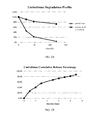
- the stability of umirolimus was compared to that ofumirolimus encapsulated in a PEG-PLA block copolymer micelle as described in Example 12 above. Solutions of umirolimus (50 ⁇ g/mL) and encapsulated umirolimus (157.4 ⁇ g/mL) in 90% PBS, 10% MeOH were placed in water bath at 37 °C. The stability of the umirolimus was determined by measuring the drug content at different incubation times. The results are shown in FIG. 2A . Umirolimus encapsulated in a PEG-PLA block copolymer micelle was significantly more stable than the unencapsulated drug.
- the cumulative drug release profile of umirolimus encapsulated in PEG-PLA block copolymer micelles was determined.
- the polymer micelles (380 ⁇ g) were suspended in 5 mL of a 90% PBS/10% methanol solution. The suspension was incubated in a water bath at 37 °C. At each time point, 0.2 mL of the suspension was transferred to a microcentrifuge tube. The polymer micelles in the tube were collected by centrifugation at 15,000 x g for 15 min. at 5 °C. After removal of the supernatant, the resulting pellet was re-suspended by sonication in 0.2 mL fresh methanol. The resulting solution was analyzed by HPLC to determine the amount ofumirolimus remaining in the polymer micelles. The results are shown in FIG. 2B . Approximately 80% of the umirolimus is released within 8 days of incubation.
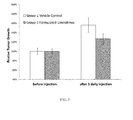
- the SNU-16 human gastric cancer xenograft model in BALB/c nude mice was employed to evaluate the inhibitory efficacy of encapsulated umirolimus,.
- SNU-16 tumor cells were cultured in suspension in RPMI-1640 medium supplemented with 10% heat inactivated fetal bovine serum at 37 °C in 5% CO 2 . Cells are routinely subcultured twice weekly. Cells in the exponential growth phase were harvested and counted prior to inoculating them into Nu/nu mice to establish a tumor.
- QDx5 PEG-PLA Encapsulated Umirolimus (Group 2) 10 Measure 70 mg test compound (4.5 mg drug equivalent after filtration) in a 10 mL glass vial, add 6mL injection water, and vortex/sonicate until the test compound is fully suspended in solution and no precipitate is observed. The resulting solution is then filtered through a 0.45 micron filter (23mm or 40 mm, PDVF or PTFE) to produce a 0.75 mg/mL nano-suspension. 15 i.p. QDx5
- the animals were checked daily for morbidity and mortality. At the time of routine monitoring, the animals were checked for any effects of tumor burden and treatments on normal behavior, e.g., mobility, visual estimation of food and water consumption, body weight gain/loss, eye matting, and any other abnormal effect. Death and observed clinical signs were recorded for each animal.
Landscapes
- Health & Medical Sciences (AREA)
- Chemical & Material Sciences (AREA)
- Life Sciences & Earth Sciences (AREA)
- Veterinary Medicine (AREA)
- Public Health (AREA)
- Medicinal Chemistry (AREA)
- General Health & Medical Sciences (AREA)
- Animal Behavior & Ethology (AREA)
- Pharmacology & Pharmacy (AREA)
- Epidemiology (AREA)
- Dispersion Chemistry (AREA)
- Biophysics (AREA)
- Molecular Biology (AREA)
- Dermatology (AREA)
- Organic Chemistry (AREA)
- Nuclear Medicine, Radiotherapy & Molecular Imaging (AREA)
- General Chemical & Material Sciences (AREA)
- Chemical Kinetics & Catalysis (AREA)
- Oncology (AREA)
- Hematology (AREA)
- Medicinal Preparation (AREA)
- Pharmaceuticals Containing Other Organic And Inorganic Compounds (AREA)
Applications Claiming Priority (1)
| Application Number | Priority Date | Filing Date | Title |
|---|---|---|---|
| US201261732629P | 2012-12-03 | 2012-12-03 |
Publications (3)
| Publication Number | Publication Date |
|---|---|
| EP2737896A2 true EP2737896A2 (de) | 2014-06-04 |
| EP2737896A3 EP2737896A3 (de) | 2014-08-06 |
| EP2737896B1 EP2737896B1 (de) | 2020-04-08 |
Family
ID=49726546
Family Applications (1)
| Application Number | Title | Priority Date | Filing Date |
|---|---|---|---|
| EP13195503.1A Active EP2737896B1 (de) | 2012-12-03 | 2013-12-03 | Umirolimus Mizellen zur Behandlung von Krebs |
Country Status (5)
| Country | Link |
|---|---|
| US (2) | US10172796B2 (de) |
| EP (1) | EP2737896B1 (de) |
| JP (1) | JP6358797B2 (de) |
| CN (2) | CN103845290A (de) |
| ES (1) | ES2788524T3 (de) |
Families Citing this family (6)
| Publication number | Priority date | Publication date | Assignee | Title |
|---|---|---|---|---|
| AU2016219004A1 (en) * | 2015-02-13 | 2017-09-07 | Op Nano Co., Ltd. | Compositions and methods of tumor treatment utilizing nanoparticles |
| WO2017027017A1 (en) * | 2015-08-11 | 2017-02-16 | Peregrine Ophthalmic PTE LTD. | Stable liposomal formulations of carbonic anhydrase inhibitors for ocular drug delivery |
| US20170065520A1 (en) * | 2015-09-09 | 2017-03-09 | Manli International Ltd | Stable liposomal formulations of rapamycin and rapamycin derivatives for treating cancer |
| US20190029970A1 (en) * | 2017-07-31 | 2019-01-31 | The Chinese University Of Hong Kong | Fatty acid conjugated nanoparticles and uses thereof |
| WO2022040006A1 (en) * | 2020-08-19 | 2022-02-24 | The Trustees Of The University Of Pennsylvania | Targeting cartilage egfr pathway for osteoarthritis treatment |
| JP2023163355A (ja) * | 2022-04-28 | 2023-11-10 | プレシエンス バイオテクノロジー インコーポレイテッド | ラパマイシンまたはその誘導体を含むリポソーム、およびそれらの治療における使用 |
Citations (1)
| Publication number | Priority date | Publication date | Assignee | Title |
|---|---|---|---|---|
| US4885171A (en) | 1978-11-03 | 1989-12-05 | American Home Products Corporation | Use of rapamycin in treatment of certain tumors |
Family Cites Families (24)
| Publication number | Priority date | Publication date | Assignee | Title |
|---|---|---|---|---|
| KR940003548U (ko) | 1992-08-14 | 1994-02-21 | 김형술 | 세탁물 건조기 |
| JPH09208494A (ja) | 1995-11-30 | 1997-08-12 | Kanebo Ltd | 微粒子製剤 |
| US20060198867A1 (en) * | 1997-09-25 | 2006-09-07 | Abbott Laboratories, Inc. | Compositions and methods of administering rapamycin analogs using medical devices for long-term efficacy |
| US6890546B2 (en) * | 1998-09-24 | 2005-05-10 | Abbott Laboratories | Medical devices containing rapamycin analogs |
| CA2408548C (en) | 2000-05-12 | 2008-03-11 | Samyang Corporation | Method for the preparation of polymeric micelle via phase separation of block copolymer |
| FR2822834B1 (fr) * | 2001-04-02 | 2005-02-25 | Flamel Tech Sa | Suspension colloidale de nanoparticules a base de copolymeres amphiphile pour la vectorisation de principes actifs et leur mode de preparation |
| US20050175683A1 (en) | 2003-10-24 | 2005-08-11 | Yuanpeng Zhang | Preparation of lipid particles |
| US7220755B2 (en) | 2003-11-12 | 2007-05-22 | Biosensors International Group, Ltd. | 42-O-alkoxyalkyl rapamycin derivatives and compositions comprising same |
| JP5110880B2 (ja) * | 2004-11-18 | 2012-12-26 | テルモ株式会社 | 医薬組成物、製剤および組み合わせ製剤 |
| AU2006235538A1 (en) | 2005-04-12 | 2006-10-19 | Wisconsin Alumni Research Foundation | Micelle composition of polymer and passenger drug |
| EP2178517B1 (de) | 2007-08-21 | 2017-01-25 | The Regents of The University of California | Copolymer-stabilisierte emulsionen |
| US20090149511A1 (en) | 2007-10-30 | 2009-06-11 | Syndax Pharmaceuticals, Inc. | Administration of an Inhibitor of HDAC and an mTOR Inhibitor |
| US8012508B2 (en) | 2008-01-15 | 2011-09-06 | Abbott Cardiovascular Systems Inc. | Method of targeting sustained release formulations of therapeutic agents to treat lung diseases |
| JP5322476B2 (ja) | 2008-03-31 | 2013-10-23 | テルモ株式会社 | リポソームの製造装置およびリポソームの製造方法 |
| US20110200556A1 (en) | 2008-08-20 | 2011-08-18 | The United States Of America, As Represented By Th E Secretary, Department Of Health And Human Servi | Chemoprevention of head and neck squamous cell carcinomas |
| CA2756072A1 (en) | 2009-03-30 | 2010-10-14 | Cerulean Pharma Inc. | Polymer-agent conjugates, particles, compositions, and related methods of use |
| WO2011024168A2 (en) | 2009-08-26 | 2011-03-03 | Yissum Research Development Company Of The Hebrew University Of Jerusalem, Ltd | Sustained release delivery systems for the prevention and treatment of head and neck cancers |
| EP2480207B1 (de) | 2009-09-25 | 2016-11-09 | Wisconsin Alumni Research Foundation | Verkapselung von arzneistoffen in mizellen |
| JP2013509444A (ja) | 2009-10-30 | 2013-03-14 | アリアド・ファーマシューティカルズ・インコーポレイテッド | がんの治療方法及び治療用組成物 |
| KR101267813B1 (ko) | 2009-12-30 | 2013-06-04 | 주식회사 삼양바이오팜 | 향상된 수용해도를 갖는 라파마이신 함유 고분자나노입자 주사제형 조성물 및 그 제조방법, 및 방사선 요법과 병용하기 위한 항암 조성물 |
| ES2845398T3 (es) * | 2009-12-30 | 2021-07-26 | Caliber Therapeutics Llc | Sistemas de catéter de balón para administración de vesículas de administración de fármacos secos a un vaso en el cuerpo |
| WO2011133668A2 (en) | 2010-04-20 | 2011-10-27 | President And Fellows Of Harvard College | Methods and compositions for the treatment of cancer |
| US9636309B2 (en) | 2010-09-09 | 2017-05-02 | Micell Technologies, Inc. | Macrolide dosage forms |
| US8691777B2 (en) | 2011-01-27 | 2014-04-08 | Emory University | Combination therapy |
-
2013
- 2013-12-02 CN CN201310631940.6A patent/CN103845290A/zh active Pending
- 2013-12-02 US US14/093,876 patent/US10172796B2/en active Active
- 2013-12-02 CN CN201910188594.6A patent/CN110123759A/zh active Pending
- 2013-12-03 EP EP13195503.1A patent/EP2737896B1/de active Active
- 2013-12-03 ES ES13195503T patent/ES2788524T3/es active Active
- 2013-12-03 JP JP2013250414A patent/JP6358797B2/ja not_active Expired - Fee Related
-
2018
- 2018-11-30 US US16/206,694 patent/US20190091152A1/en not_active Abandoned
Patent Citations (1)
| Publication number | Priority date | Publication date | Assignee | Title |
|---|---|---|---|---|
| US4885171A (en) | 1978-11-03 | 1989-12-05 | American Home Products Corporation | Use of rapamycin in treatment of certain tumors |
Non-Patent Citations (1)
| Title |
|---|
| J. MED. CHEM., vol. 43, 2000, pages 2922 - 2928 |
Also Published As
| Publication number | Publication date |
|---|---|
| CN110123759A (zh) | 2019-08-16 |
| JP6358797B2 (ja) | 2018-07-18 |
| US20190091152A1 (en) | 2019-03-28 |
| JP2014111596A (ja) | 2014-06-19 |
| CN103845290A (zh) | 2014-06-11 |
| EP2737896A3 (de) | 2014-08-06 |
| EP2737896B1 (de) | 2020-04-08 |
| US20140154305A1 (en) | 2014-06-05 |
| US10172796B2 (en) | 2019-01-08 |
| ES2788524T3 (es) | 2020-10-21 |
Similar Documents
| Publication | Publication Date | Title |
|---|---|---|
| Chen et al. | Enhanced tumour penetration and prolonged circulation in blood of polyzwitterion–drug conjugates with cell-membrane affinity | |
| US20190091152A1 (en) | Use of umirolimus and its derivatives for treating cancer | |
| Zheng et al. | Improving breast cancer therapy using doxorubicin loaded solid lipid nanoparticles: Synthesis of a novel arginine-glycine-aspartic tripeptide conjugated, pH sensitive lipid and evaluation of the nanomedicine in vitro and in vivo | |
| Gothwal et al. | Polymeric Micelles: Recent Advancements in the Delivery of Anticancer Drugs: Gothwal, Khan and Gupta | |
| Liang et al. | Terminal modification of polymeric micelles with π-conjugated moieties for efficient anticancer drug delivery | |
| KR101444274B1 (ko) | 약제복합체용 블록 공중합체 및 의약조성물 | |
| Chuan et al. | Novel free-paclitaxel-loaded redox-responsive nanoparticles based on a disulfide-linked poly (ethylene glycol)–drug conjugate for intracellular drug delivery: synthesis, characterization, and antitumor activity in vitro and in vivo | |
| Khandare et al. | Novel polymeric prodrug with multivalent components for cancer therapy | |
| Zhang et al. | A PEG-Fmoc conjugate as a nanocarrier for paclitaxel | |
| Zhou et al. | Polymeric micelles loading with ursolic acid enhancing anti-tumor effect on hepatocellular carcinoma | |
| Zhong et al. | αvβ3 Integrin-targeted reduction-sensitive micellar mertansine prodrug: superb drug loading, enhanced stability, and effective inhibition of melanoma growth in vivo | |
| US20130071482A1 (en) | Block copolymer cross-linked nanoassemblies as modular delivery vehicles | |
| CN110964187B (zh) | 一种聚酯-聚酯型生物可降解两亲性嵌段共聚物、其制备方法及应用 | |
| US20250009895A1 (en) | Drug loading monomolecular nano polymer, prodrug, micelle, drug delivery system, preparation method, and use | |
| Fu et al. | A novel redox-responsive ursolic acid polymeric prodrug delivery system for osteosarcoma therapy | |
| WO2022052413A1 (zh) | 具有不对称膜结构的载药聚合物囊泡及其制备方法与在制备治疗急性髓系白血病药物中的应用 | |
| CN103800915B (zh) | 一种靶向整合素受体的联合载药胶束及其制备方法 | |
| CA3045367A1 (en) | Vap polypeptide and use thereof in preparation of drug for targeted diagnosis and treatment of tumour | |
| US20150231271A1 (en) | Formulations and carrier systems including farnesylthiosalycylic moities | |
| US20170027868A1 (en) | Peptide-conjugated liposome | |
| WO2014084378A1 (ja) | 環状rgd配列含有ペプチドを含む抗癌剤 | |
| Zhang et al. | Fmoc-conjugated PEG-vitamin E2 micelles for tumor-targeted delivery of paclitaxel: enhanced drug-carrier interaction and loading capacity | |
| Xu et al. | The design and synthesis of redox-responsive oridonin polymeric prodrug micelle formulation for effective gastric cancer therapy | |
| US20150065443A1 (en) | Embelin-based delivery system for water-insoluble active agents | |
| WO2007145455A1 (en) | Water soluble micelle-forming and biodegradable cyclotriphosphazene-taxol conjugate anticancer agent and preparation method thereof |
Legal Events
| Date | Code | Title | Description |
|---|---|---|---|
| PUAI | Public reference made under article 153(3) epc to a published international application that has entered the european phase |
Free format text: ORIGINAL CODE: 0009012 |
|
| 17P | Request for examination filed |
Effective date: 20131203 |
|
| AK | Designated contracting states |
Kind code of ref document: A2 Designated state(s): AL AT BE BG CH CY CZ DE DK EE ES FI FR GB GR HR HU IE IS IT LI LT LU LV MC MK MT NL NO PL PT RO RS SE SI SK SM TR |
|
| AX | Request for extension of the european patent |
Extension state: BA ME |
|
| PUAL | Search report despatched |
Free format text: ORIGINAL CODE: 0009013 |
|
| AK | Designated contracting states |
Kind code of ref document: A3 Designated state(s): AL AT BE BG CH CY CZ DE DK EE ES FI FR GB GR HR HU IE IS IT LI LT LU LV MC MK MT NL NO PL PT RO RS SE SI SK SM TR |
|
| AX | Request for extension of the european patent |
Extension state: BA ME |
|
| RIC1 | Information provided on ipc code assigned before grant |
Ipc: A61K 9/107 20060101ALI20140702BHEP Ipc: A61K 9/00 20060101AFI20140702BHEP Ipc: A61K 31/436 20060101ALI20140702BHEP Ipc: A61P 35/00 20060101ALI20140702BHEP Ipc: A61K 9/127 20060101ALI20140702BHEP |
|
| R17P | Request for examination filed (corrected) |
Effective date: 20150109 |
|
| RBV | Designated contracting states (corrected) |
Designated state(s): AL AT BE BG CH CY CZ DE DK EE ES FI FR GB GR HR HU IE IS IT LI LT LU LV MC MK MT NL NO PL PT RO RS SE SI SK SM TR |
|
| STAA | Information on the status of an ep patent application or granted ep patent |
Free format text: STATUS: EXAMINATION IS IN PROGRESS |
|
| 17Q | First examination report despatched |
Effective date: 20170227 |
|
| GRAP | Despatch of communication of intention to grant a patent |
Free format text: ORIGINAL CODE: EPIDOSNIGR1 |
|
| STAA | Information on the status of an ep patent application or granted ep patent |
Free format text: STATUS: GRANT OF PATENT IS INTENDED |
|
| INTG | Intention to grant announced |
Effective date: 20191119 |
|
| GRAS | Grant fee paid |
Free format text: ORIGINAL CODE: EPIDOSNIGR3 |
|
| GRAA | (expected) grant |
Free format text: ORIGINAL CODE: 0009210 |
|
| STAA | Information on the status of an ep patent application or granted ep patent |
Free format text: STATUS: THE PATENT HAS BEEN GRANTED |
|
| AK | Designated contracting states |
Kind code of ref document: B1 Designated state(s): AL AT BE BG CH CY CZ DE DK EE ES FI FR GB GR HR HU IE IS IT LI LT LU LV MC MK MT NL NO PL PT RO RS SE SI SK SM TR |
|
| REG | Reference to a national code |
Ref country code: AT Ref legal event code: REF Ref document number: 1253371 Country of ref document: AT Kind code of ref document: T Effective date: 20200415 Ref country code: CH Ref legal event code: EP |
|
| REG | Reference to a national code |
Ref country code: IE Ref legal event code: FG4D |
|
| REG | Reference to a national code |
Ref country code: DE Ref legal event code: R096 Ref document number: 602013067632 Country of ref document: DE |
|
| REG | Reference to a national code |
Ref country code: CH Ref legal event code: NV Representative=s name: VALIPAT S.A. C/O BOVARD SA NEUCHATEL, CH |
|
| REG | Reference to a national code |
Ref country code: NL Ref legal event code: MP Effective date: 20200408 |
|
| REG | Reference to a national code |
Ref country code: LT Ref legal event code: MG4D |
|
| REG | Reference to a national code |
Ref country code: ES Ref legal event code: FG2A Ref document number: 2788524 Country of ref document: ES Kind code of ref document: T3 Effective date: 20201021 |
|
| PG25 | Lapsed in a contracting state [announced via postgrant information from national office to epo] |
Ref country code: GR Free format text: LAPSE BECAUSE OF FAILURE TO SUBMIT A TRANSLATION OF THE DESCRIPTION OR TO PAY THE FEE WITHIN THE PRESCRIBED TIME-LIMIT Effective date: 20200709 Ref country code: NO Free format text: LAPSE BECAUSE OF FAILURE TO SUBMIT A TRANSLATION OF THE DESCRIPTION OR TO PAY THE FEE WITHIN THE PRESCRIBED TIME-LIMIT Effective date: 20200708 Ref country code: FI Free format text: LAPSE BECAUSE OF FAILURE TO SUBMIT A TRANSLATION OF THE DESCRIPTION OR TO PAY THE FEE WITHIN THE PRESCRIBED TIME-LIMIT Effective date: 20200408 Ref country code: PT Free format text: LAPSE BECAUSE OF FAILURE TO SUBMIT A TRANSLATION OF THE DESCRIPTION OR TO PAY THE FEE WITHIN THE PRESCRIBED TIME-LIMIT Effective date: 20200817 Ref country code: IS Free format text: LAPSE BECAUSE OF FAILURE TO SUBMIT A TRANSLATION OF THE DESCRIPTION OR TO PAY THE FEE WITHIN THE PRESCRIBED TIME-LIMIT Effective date: 20200808 Ref country code: LT Free format text: LAPSE BECAUSE OF FAILURE TO SUBMIT A TRANSLATION OF THE DESCRIPTION OR TO PAY THE FEE WITHIN THE PRESCRIBED TIME-LIMIT Effective date: 20200408 Ref country code: NL Free format text: LAPSE BECAUSE OF FAILURE TO SUBMIT A TRANSLATION OF THE DESCRIPTION OR TO PAY THE FEE WITHIN THE PRESCRIBED TIME-LIMIT Effective date: 20200408 Ref country code: SE Free format text: LAPSE BECAUSE OF FAILURE TO SUBMIT A TRANSLATION OF THE DESCRIPTION OR TO PAY THE FEE WITHIN THE PRESCRIBED TIME-LIMIT Effective date: 20200408 |
|
| REG | Reference to a national code |
Ref country code: AT Ref legal event code: MK05 Ref document number: 1253371 Country of ref document: AT Kind code of ref document: T Effective date: 20200408 |
|
| PG25 | Lapsed in a contracting state [announced via postgrant information from national office to epo] |
Ref country code: LV Free format text: LAPSE BECAUSE OF FAILURE TO SUBMIT A TRANSLATION OF THE DESCRIPTION OR TO PAY THE FEE WITHIN THE PRESCRIBED TIME-LIMIT Effective date: 20200408 Ref country code: HR Free format text: LAPSE BECAUSE OF FAILURE TO SUBMIT A TRANSLATION OF THE DESCRIPTION OR TO PAY THE FEE WITHIN THE PRESCRIBED TIME-LIMIT Effective date: 20200408 Ref country code: BG Free format text: LAPSE BECAUSE OF FAILURE TO SUBMIT A TRANSLATION OF THE DESCRIPTION OR TO PAY THE FEE WITHIN THE PRESCRIBED TIME-LIMIT Effective date: 20200708 Ref country code: RS Free format text: LAPSE BECAUSE OF FAILURE TO SUBMIT A TRANSLATION OF THE DESCRIPTION OR TO PAY THE FEE WITHIN THE PRESCRIBED TIME-LIMIT Effective date: 20200408 |
|
| PG25 | Lapsed in a contracting state [announced via postgrant information from national office to epo] |
Ref country code: AL Free format text: LAPSE BECAUSE OF FAILURE TO SUBMIT A TRANSLATION OF THE DESCRIPTION OR TO PAY THE FEE WITHIN THE PRESCRIBED TIME-LIMIT Effective date: 20200408 |
|
| REG | Reference to a national code |
Ref country code: DE Ref legal event code: R097 Ref document number: 602013067632 Country of ref document: DE |
|
| PG25 | Lapsed in a contracting state [announced via postgrant information from national office to epo] |
Ref country code: DK Free format text: LAPSE BECAUSE OF FAILURE TO SUBMIT A TRANSLATION OF THE DESCRIPTION OR TO PAY THE FEE WITHIN THE PRESCRIBED TIME-LIMIT Effective date: 20200408 Ref country code: AT Free format text: LAPSE BECAUSE OF FAILURE TO SUBMIT A TRANSLATION OF THE DESCRIPTION OR TO PAY THE FEE WITHIN THE PRESCRIBED TIME-LIMIT Effective date: 20200408 Ref country code: EE Free format text: LAPSE BECAUSE OF FAILURE TO SUBMIT A TRANSLATION OF THE DESCRIPTION OR TO PAY THE FEE WITHIN THE PRESCRIBED TIME-LIMIT Effective date: 20200408 Ref country code: SM Free format text: LAPSE BECAUSE OF FAILURE TO SUBMIT A TRANSLATION OF THE DESCRIPTION OR TO PAY THE FEE WITHIN THE PRESCRIBED TIME-LIMIT Effective date: 20200408 Ref country code: CZ Free format text: LAPSE BECAUSE OF FAILURE TO SUBMIT A TRANSLATION OF THE DESCRIPTION OR TO PAY THE FEE WITHIN THE PRESCRIBED TIME-LIMIT Effective date: 20200408 Ref country code: IT Free format text: LAPSE BECAUSE OF FAILURE TO SUBMIT A TRANSLATION OF THE DESCRIPTION OR TO PAY THE FEE WITHIN THE PRESCRIBED TIME-LIMIT Effective date: 20200408 Ref country code: RO Free format text: LAPSE BECAUSE OF FAILURE TO SUBMIT A TRANSLATION OF THE DESCRIPTION OR TO PAY THE FEE WITHIN THE PRESCRIBED TIME-LIMIT Effective date: 20200408 |
|
| PLBE | No opposition filed within time limit |
Free format text: ORIGINAL CODE: 0009261 |
|
| STAA | Information on the status of an ep patent application or granted ep patent |
Free format text: STATUS: NO OPPOSITION FILED WITHIN TIME LIMIT |
|
| PG25 | Lapsed in a contracting state [announced via postgrant information from national office to epo] |
Ref country code: PL Free format text: LAPSE BECAUSE OF FAILURE TO SUBMIT A TRANSLATION OF THE DESCRIPTION OR TO PAY THE FEE WITHIN THE PRESCRIBED TIME-LIMIT Effective date: 20200408 Ref country code: SK Free format text: LAPSE BECAUSE OF FAILURE TO SUBMIT A TRANSLATION OF THE DESCRIPTION OR TO PAY THE FEE WITHIN THE PRESCRIBED TIME-LIMIT Effective date: 20200408 |
|
| 26N | No opposition filed |
Effective date: 20210112 |
|
| PG25 | Lapsed in a contracting state [announced via postgrant information from national office to epo] |
Ref country code: SI Free format text: LAPSE BECAUSE OF FAILURE TO SUBMIT A TRANSLATION OF THE DESCRIPTION OR TO PAY THE FEE WITHIN THE PRESCRIBED TIME-LIMIT Effective date: 20200408 |
|
| PG25 | Lapsed in a contracting state [announced via postgrant information from national office to epo] |
Ref country code: MC Free format text: LAPSE BECAUSE OF FAILURE TO SUBMIT A TRANSLATION OF THE DESCRIPTION OR TO PAY THE FEE WITHIN THE PRESCRIBED TIME-LIMIT Effective date: 20200408 |
|
| REG | Reference to a national code |
Ref country code: BE Ref legal event code: MM Effective date: 20201231 |
|
| PG25 | Lapsed in a contracting state [announced via postgrant information from national office to epo] |
Ref country code: LU Free format text: LAPSE BECAUSE OF NON-PAYMENT OF DUE FEES Effective date: 20201203 Ref country code: IE Free format text: LAPSE BECAUSE OF NON-PAYMENT OF DUE FEES Effective date: 20201203 |
|
| PG25 | Lapsed in a contracting state [announced via postgrant information from national office to epo] |
Ref country code: TR Free format text: LAPSE BECAUSE OF FAILURE TO SUBMIT A TRANSLATION OF THE DESCRIPTION OR TO PAY THE FEE WITHIN THE PRESCRIBED TIME-LIMIT Effective date: 20200408 Ref country code: MT Free format text: LAPSE BECAUSE OF FAILURE TO SUBMIT A TRANSLATION OF THE DESCRIPTION OR TO PAY THE FEE WITHIN THE PRESCRIBED TIME-LIMIT Effective date: 20200408 Ref country code: CY Free format text: LAPSE BECAUSE OF FAILURE TO SUBMIT A TRANSLATION OF THE DESCRIPTION OR TO PAY THE FEE WITHIN THE PRESCRIBED TIME-LIMIT Effective date: 20200408 |
|
| PG25 | Lapsed in a contracting state [announced via postgrant information from national office to epo] |
Ref country code: MK Free format text: LAPSE BECAUSE OF FAILURE TO SUBMIT A TRANSLATION OF THE DESCRIPTION OR TO PAY THE FEE WITHIN THE PRESCRIBED TIME-LIMIT Effective date: 20200408 |
|
| PG25 | Lapsed in a contracting state [announced via postgrant information from national office to epo] |
Ref country code: BE Free format text: LAPSE BECAUSE OF NON-PAYMENT OF DUE FEES Effective date: 20201231 |
|
| P01 | Opt-out of the competence of the unified patent court (upc) registered |
Effective date: 20230614 |
|
| PGFP | Annual fee paid to national office [announced via postgrant information from national office to epo] |
Ref country code: GB Payment date: 20231227 Year of fee payment: 11 |
|
| PGFP | Annual fee paid to national office [announced via postgrant information from national office to epo] |
Ref country code: FR Payment date: 20231227 Year of fee payment: 11 |
|
| PGFP | Annual fee paid to national office [announced via postgrant information from national office to epo] |
Ref country code: ES Payment date: 20240102 Year of fee payment: 11 |
|
| PGFP | Annual fee paid to national office [announced via postgrant information from national office to epo] |
Ref country code: DE Payment date: 20231229 Year of fee payment: 11 Ref country code: CH Payment date: 20240101 Year of fee payment: 11 |
|
| REG | Reference to a national code |
Ref country code: DE Ref legal event code: R119 Ref document number: 602013067632 Country of ref document: DE |
|
| REG | Reference to a national code |
Ref country code: CH Ref legal event code: PL |
|
| GBPC | Gb: european patent ceased through non-payment of renewal fee |
Effective date: 20241203 |
|
| PG25 | Lapsed in a contracting state [announced via postgrant information from national office to epo] |
Ref country code: DE Free format text: LAPSE BECAUSE OF NON-PAYMENT OF DUE FEES Effective date: 20250701 |
|
| PG25 | Lapsed in a contracting state [announced via postgrant information from national office to epo] |
Ref country code: GB Free format text: LAPSE BECAUSE OF NON-PAYMENT OF DUE FEES Effective date: 20241203 |
|
| PG25 | Lapsed in a contracting state [announced via postgrant information from national office to epo] |
Ref country code: FR Free format text: LAPSE BECAUSE OF NON-PAYMENT OF DUE FEES Effective date: 20241231 |
|
| PG25 | Lapsed in a contracting state [announced via postgrant information from national office to epo] |
Ref country code: CH Free format text: LAPSE BECAUSE OF NON-PAYMENT OF DUE FEES Effective date: 20241231 |
|
| REG | Reference to a national code |
Ref country code: ES Ref legal event code: FD2A Effective date: 20260126 |
|
| PG25 | Lapsed in a contracting state [announced via postgrant information from national office to epo] |
Ref country code: ES Free format text: LAPSE BECAUSE OF NON-PAYMENT OF DUE FEES Effective date: 20241204 |