EP2738155B1 - Verbindung, aufhellungsmittel, flüssigkristallzusammensetzung, polymermaterial und film - Google Patents
Verbindung, aufhellungsmittel, flüssigkristallzusammensetzung, polymermaterial und film Download PDFInfo
- Publication number
- EP2738155B1 EP2738155B1 EP12818188.0A EP12818188A EP2738155B1 EP 2738155 B1 EP2738155 B1 EP 2738155B1 EP 12818188 A EP12818188 A EP 12818188A EP 2738155 B1 EP2738155 B1 EP 2738155B1
- Authority
- EP
- European Patent Office
- Prior art keywords
- group
- compound
- liquid crystal
- carbon atoms
- formula
- Prior art date
- Legal status (The legal status is an assumption and is not a legal conclusion. Google has not performed a legal analysis and makes no representation as to the accuracy of the status listed.)
- Active
Links
- 0 CC(C*1)*(C)=C2C1C(C)=C(*)*2 Chemical compound CC(C*1)*(C)=C2C1C(C)=C(*)*2 0.000 description 7
- BFIMMTCNYPIMRN-UHFFFAOYSA-N Cc1cc(C)c(C)c(C)c1 Chemical compound Cc1cc(C)c(C)c(C)c1 BFIMMTCNYPIMRN-UHFFFAOYSA-N 0.000 description 2
- BJQAVPRDKUDGLN-UHFFFAOYSA-N CC1C=[O]C(C)OC1 Chemical compound CC1C=[O]C(C)OC1 BJQAVPRDKUDGLN-UHFFFAOYSA-N 0.000 description 1
- RPMUDXVQHUECRE-UHFFFAOYSA-N CC1COC(C)OC1 Chemical compound CC1COC(C)OC1 RPMUDXVQHUECRE-UHFFFAOYSA-N 0.000 description 1
Images
Classifications
-
- C—CHEMISTRY; METALLURGY
- C09—DYES; PAINTS; POLISHES; NATURAL RESINS; ADHESIVES; COMPOSITIONS NOT OTHERWISE PROVIDED FOR; APPLICATIONS OF MATERIALS NOT OTHERWISE PROVIDED FOR
- C09K—MATERIALS FOR MISCELLANEOUS APPLICATIONS, NOT PROVIDED FOR ELSEWHERE
- C09K19/00—Liquid crystal materials
- C09K19/52—Liquid crystal materials characterised by components which are not liquid crystals, e.g. additives with special physical aspect: solvents, solid particles
- C09K19/54—Additives having no specific mesophase characterised by their chemical composition
-
- C—CHEMISTRY; METALLURGY
- C07—ORGANIC CHEMISTRY
- C07C—ACYCLIC OR CARBOCYCLIC COMPOUNDS
- C07C69/00—Esters of carboxylic acids; Esters of carbonic or haloformic acids
- C07C69/76—Esters of carboxylic acids having a carboxyl group bound to a carbon atom of a six-membered aromatic ring
- C07C69/84—Esters of carboxylic acids having a carboxyl group bound to a carbon atom of a six-membered aromatic ring of monocyclic hydroxy carboxylic acids, the hydroxy groups and the carboxyl groups of which are bound to carbon atoms of a six-membered aromatic ring
- C07C69/92—Esters of carboxylic acids having a carboxyl group bound to a carbon atom of a six-membered aromatic ring of monocyclic hydroxy carboxylic acids, the hydroxy groups and the carboxyl groups of which are bound to carbon atoms of a six-membered aromatic ring with etherified hydroxyl groups
-
- C—CHEMISTRY; METALLURGY
- C09—DYES; PAINTS; POLISHES; NATURAL RESINS; ADHESIVES; COMPOSITIONS NOT OTHERWISE PROVIDED FOR; APPLICATIONS OF MATERIALS NOT OTHERWISE PROVIDED FOR
- C09K—MATERIALS FOR MISCELLANEOUS APPLICATIONS, NOT PROVIDED FOR ELSEWHERE
- C09K19/00—Liquid crystal materials
- C09K19/04—Liquid crystal materials characterised by the chemical structure of the liquid crystal components, e.g. by a specific unit
- C09K19/06—Non-steroidal liquid crystal compounds
- C09K19/08—Non-steroidal liquid crystal compounds containing at least two non-condensed rings
- C09K19/10—Non-steroidal liquid crystal compounds containing at least two non-condensed rings containing at least two benzene rings
- C09K19/20—Non-steroidal liquid crystal compounds containing at least two non-condensed rings containing at least two benzene rings linked by a chain containing carbon and oxygen atoms as chain links, e.g. esters or ethers
- C09K19/2007—Non-steroidal liquid crystal compounds containing at least two non-condensed rings containing at least two benzene rings linked by a chain containing carbon and oxygen atoms as chain links, e.g. esters or ethers the chain containing -COO- or -OCO- groups
-
- C—CHEMISTRY; METALLURGY
- C09—DYES; PAINTS; POLISHES; NATURAL RESINS; ADHESIVES; COMPOSITIONS NOT OTHERWISE PROVIDED FOR; APPLICATIONS OF MATERIALS NOT OTHERWISE PROVIDED FOR
- C09K—MATERIALS FOR MISCELLANEOUS APPLICATIONS, NOT PROVIDED FOR ELSEWHERE
- C09K19/00—Liquid crystal materials
- C09K19/04—Liquid crystal materials characterised by the chemical structure of the liquid crystal components, e.g. by a specific unit
- C09K19/06—Non-steroidal liquid crystal compounds
- C09K19/32—Non-steroidal liquid crystal compounds containing condensed ring systems, i.e. fused, bridged or spiro ring systems
- C09K19/322—Compounds containing a naphthalene ring or a completely or partially hydrogenated naphthalene ring
-
- C—CHEMISTRY; METALLURGY
- C09—DYES; PAINTS; POLISHES; NATURAL RESINS; ADHESIVES; COMPOSITIONS NOT OTHERWISE PROVIDED FOR; APPLICATIONS OF MATERIALS NOT OTHERWISE PROVIDED FOR
- C09K—MATERIALS FOR MISCELLANEOUS APPLICATIONS, NOT PROVIDED FOR ELSEWHERE
- C09K19/00—Liquid crystal materials
- C09K19/04—Liquid crystal materials characterised by the chemical structure of the liquid crystal components, e.g. by a specific unit
- C09K19/06—Non-steroidal liquid crystal compounds
- C09K19/34—Non-steroidal liquid crystal compounds containing at least one heterocyclic ring
- C09K19/3441—Non-steroidal liquid crystal compounds containing at least one heterocyclic ring having nitrogen as hetero atom
- C09K19/3475—Non-steroidal liquid crystal compounds containing at least one heterocyclic ring having nitrogen as hetero atom the heterocyclic ring being a six-membered aromatic ring containing at least three nitrogen atoms
-
- C—CHEMISTRY; METALLURGY
- C09—DYES; PAINTS; POLISHES; NATURAL RESINS; ADHESIVES; COMPOSITIONS NOT OTHERWISE PROVIDED FOR; APPLICATIONS OF MATERIALS NOT OTHERWISE PROVIDED FOR
- C09K—MATERIALS FOR MISCELLANEOUS APPLICATIONS, NOT PROVIDED FOR ELSEWHERE
- C09K19/00—Liquid crystal materials
- C09K19/52—Liquid crystal materials characterised by components which are not liquid crystals, e.g. additives with special physical aspect: solvents, solid particles
- C09K19/58—Dopants or charge transfer agents
- C09K19/586—Optically active dopants; chiral dopants
- C09K19/588—Heterocyclic compounds
-
- G—PHYSICS
- G02—OPTICS
- G02F—OPTICAL DEVICES OR ARRANGEMENTS FOR THE CONTROL OF LIGHT BY MODIFICATION OF THE OPTICAL PROPERTIES OF THE MEDIA OF THE ELEMENTS INVOLVED THEREIN; NON-LINEAR OPTICS; FREQUENCY-CHANGING OF LIGHT; OPTICAL LOGIC ELEMENTS; OPTICAL ANALOGUE/DIGITAL CONVERTERS
- G02F1/00—Devices or arrangements for the control of the intensity, colour, phase, polarisation or direction of light arriving from an independent light source, e.g. switching, gating or modulating; Non-linear optics
- G02F1/01—Devices or arrangements for the control of the intensity, colour, phase, polarisation or direction of light arriving from an independent light source, e.g. switching, gating or modulating; Non-linear optics for the control of the intensity, phase, polarisation or colour
- G02F1/13—Devices or arrangements for the control of the intensity, colour, phase, polarisation or direction of light arriving from an independent light source, e.g. switching, gating or modulating; Non-linear optics for the control of the intensity, phase, polarisation or colour based on liquid crystals, e.g. single liquid crystal display cells
- G02F1/133—Constructional arrangements; Operation of liquid crystal cells; Circuit arrangements
- G02F1/1333—Constructional arrangements; Manufacturing methods
- G02F1/1335—Structural association of cells with optical devices, e.g. polarisers or reflectors
- G02F1/13363—Birefringent elements, e.g. for optical compensation
-
- C—CHEMISTRY; METALLURGY
- C09—DYES; PAINTS; POLISHES; NATURAL RESINS; ADHESIVES; COMPOSITIONS NOT OTHERWISE PROVIDED FOR; APPLICATIONS OF MATERIALS NOT OTHERWISE PROVIDED FOR
- C09K—MATERIALS FOR MISCELLANEOUS APPLICATIONS, NOT PROVIDED FOR ELSEWHERE
- C09K19/00—Liquid crystal materials
- C09K19/04—Liquid crystal materials characterised by the chemical structure of the liquid crystal components, e.g. by a specific unit
- C09K2019/0425—Liquid crystal materials characterised by the chemical structure of the liquid crystal components, e.g. by a specific unit characterized by a specific unit that results in a functional effect
- C09K2019/0429—Liquid crystal materials characterised by the chemical structure of the liquid crystal components, e.g. by a specific unit characterized by a specific unit that results in a functional effect the specific unit being a carbocyclic or heterocyclic discotic unit
-
- C—CHEMISTRY; METALLURGY
- C09—DYES; PAINTS; POLISHES; NATURAL RESINS; ADHESIVES; COMPOSITIONS NOT OTHERWISE PROVIDED FOR; APPLICATIONS OF MATERIALS NOT OTHERWISE PROVIDED FOR
- C09K—MATERIALS FOR MISCELLANEOUS APPLICATIONS, NOT PROVIDED FOR ELSEWHERE
- C09K19/00—Liquid crystal materials
- C09K19/04—Liquid crystal materials characterised by the chemical structure of the liquid crystal components, e.g. by a specific unit
- C09K2019/0425—Liquid crystal materials characterised by the chemical structure of the liquid crystal components, e.g. by a specific unit characterized by a specific unit that results in a functional effect
- C09K2019/044—Liquid crystal materials characterised by the chemical structure of the liquid crystal components, e.g. by a specific unit characterized by a specific unit that results in a functional effect the specific unit being a perfluoro chain used as an end group
-
- C—CHEMISTRY; METALLURGY
- C09—DYES; PAINTS; POLISHES; NATURAL RESINS; ADHESIVES; COMPOSITIONS NOT OTHERWISE PROVIDED FOR; APPLICATIONS OF MATERIALS NOT OTHERWISE PROVIDED FOR
- C09K—MATERIALS FOR MISCELLANEOUS APPLICATIONS, NOT PROVIDED FOR ELSEWHERE
- C09K19/00—Liquid crystal materials
- C09K19/04—Liquid crystal materials characterised by the chemical structure of the liquid crystal components, e.g. by a specific unit
- C09K19/06—Non-steroidal liquid crystal compounds
- C09K19/08—Non-steroidal liquid crystal compounds containing at least two non-condensed rings
- C09K19/10—Non-steroidal liquid crystal compounds containing at least two non-condensed rings containing at least two benzene rings
- C09K19/20—Non-steroidal liquid crystal compounds containing at least two non-condensed rings containing at least two benzene rings linked by a chain containing carbon and oxygen atoms as chain links, e.g. esters or ethers
- C09K19/2007—Non-steroidal liquid crystal compounds containing at least two non-condensed rings containing at least two benzene rings linked by a chain containing carbon and oxygen atoms as chain links, e.g. esters or ethers the chain containing -COO- or -OCO- groups
- C09K2019/2078—Ph-COO-Ph-COO-Ph
-
- G—PHYSICS
- G02—OPTICS
- G02F—OPTICAL DEVICES OR ARRANGEMENTS FOR THE CONTROL OF LIGHT BY MODIFICATION OF THE OPTICAL PROPERTIES OF THE MEDIA OF THE ELEMENTS INVOLVED THEREIN; NON-LINEAR OPTICS; FREQUENCY-CHANGING OF LIGHT; OPTICAL LOGIC ELEMENTS; OPTICAL ANALOGUE/DIGITAL CONVERTERS
- G02F1/00—Devices or arrangements for the control of the intensity, colour, phase, polarisation or direction of light arriving from an independent light source, e.g. switching, gating or modulating; Non-linear optics
- G02F1/01—Devices or arrangements for the control of the intensity, colour, phase, polarisation or direction of light arriving from an independent light source, e.g. switching, gating or modulating; Non-linear optics for the control of the intensity, phase, polarisation or colour
- G02F1/13—Devices or arrangements for the control of the intensity, colour, phase, polarisation or direction of light arriving from an independent light source, e.g. switching, gating or modulating; Non-linear optics for the control of the intensity, phase, polarisation or colour based on liquid crystals, e.g. single liquid crystal display cells
- G02F1/133—Constructional arrangements; Operation of liquid crystal cells; Circuit arrangements
- G02F1/1333—Constructional arrangements; Manufacturing methods
- G02F1/1335—Structural association of cells with optical devices, e.g. polarisers or reflectors
- G02F1/13363—Birefringent elements, e.g. for optical compensation
- G02F1/133638—Waveplates, i.e. plates with a retardation value of lambda/n
Definitions
- the present invention relates to compounds and haze-lowering agents useful in a variety of applications, including materials of various types of optical members such as optically anisotropic films and heat shield films, and to liquid crystal compositions and polymer materials containing such compounds and haze-lowering agents.
- the invention also relates to films that use such materials.
- Liquid crystals orderly align themselves upon being applied onto a film subj ected to an alignment process (alignment film).
- the alignment state of liquid crystal can be controlled with the use of two alignment films disposed on the both sides of the liquid crystal.
- An example of such a structure is a liquid crystal display device that includes a liquid crystal cell constructed from rod-like liquid crystal molecules and a pair of substrates sealing the liquid crystal molecules, and an electrode layer provided to apply voltage to the rod-like liquid crystal molecules.
- the rod-like liquid crystal molecules are injected into the gap between the alignment films formed on the two substrates, and the alignment state of the rod-like liquid crystal molecules can be controlled relatively easily.
- an optical compensation sheet (retardation plate) between a liquid crystal cell and a polarizing plate for the purpose of increasing the viewing angle or preventing coloring of a liquid crystal display device.
- an optically anisotropic element having an optically anisotropic layer formed from liquid crystal molecules is used as an optical compensation sheet on a transparent support.
- the optically anisotropic layer is formed by aligning liquid crystal molecules, and fixing the alignment state.
- the liquid crystal molecules are aligned with a single alignment film provided between the transparent support and the optically anisotropic layer.
- Patent Documents 1 and 2 techniques are developed that regulate alignment of a liquid crystal and uniformly align the liquid crystal also on the side of the interface (air interface) not subjected to an alignment process, without using an alignment film.
- alignment of the liquid crystal molecules is controlled by adding a liquid crystal alignment promoting agent.
- a liquid crystal alignment promoting agent By using a liquid crystal alignment promoting agent, a liquid crystal composition is provided that allows liquid crystal molecules to uniformly align themselves with ease.
- JP 2005 539077 A (THE TRUSTEES OF THE UNIVERSITY OF PENNSYLVANIA) 22 December 2005 ,
- JP 2001 081465 A (FUJI PHOTO FILM CO., LTD.) 27 March 2001 .
- the liquid crystal alignment promoting agents described in Patent Documents 1 and 2 are not necessarily sufficient in terms of usable concentration range and solubility, and need further improvements. There is accordingly a need for a material that has a liquid crystal alignment promoting effect at least comparable to that of the liquid crystal alignment promoting agents described in Patent Documents 1 and 2, and that can lower the haze of the product film. It is accordingly an object of the present invention to solve the foregoing problems of related art, and provide a compound having sufficient solubility, a wide usable concentration range, and excellent haze-lowering performance. Another object is to provide a novel liquid crystal composition that can lower the haze of the product film by allowing liquid crystal molecules to uniformly align themselves with ease or the like.
- the present invention is intended to provide a compound useful for a variety of applications, including materials of various types of optical members such as optically anisotropic films and heat shield films.
- the invention is also intended to provide a liquid crystal composition and a polymer material containing such a compound, and a film that uses such materials.
- the present invention uses a compound of formula (I) having a wide usable concentration range, high solvent solubility, and high haze lowering effect, and can provide a liquid crystal composition and a polymer material useful for a variety of applications, including materials of various types of optical members such as optically anisotropic films and heat shield films.
- the invention also can provide a film that uses such materials.
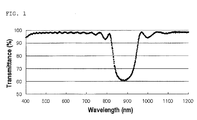
- FIG. 1 represents a transmission spectrum of a film produced with compound (2) used as a haze-lowering agent in Example 25.
- the compound of the present invention is represented by the formula (I) below.
- the compound of the formula (I) has a center divalent group, and terminal alkyl. Compounds with terminal fluoroalkyl are effective as alignment promoting agents.
- conventional alignment promoting agents are limited to certain uses because of the narrow usable concentration range and low solubility.
- the compound represented by the formula (I) below has comparable or even greater alignment performance in a wider concentration range with more desirable solubility, and can desirably be used as a haze-lowering agent.
- the compound represented by the formula (I) also can be desirably used as a liquid crystal alignment promoting agent.
- One of the advantages of a composition containing the compound represented by the following formula (I) is that it is easy to use for production.
- L 1 , L 2 , L 3 , L 4 , L 5 , and L 6 each independently represent a single bond, -O-, -S-, -CO-, -COO-, -OCO-, -COS-, -SCO-, -NRCO-, or -CONR- (R in the formula (I) represents a hydrogen atom, or an alkyl group of 1 to 6 carbon atoms), more preferably -O-, -S-, -CO-, -COO-, -OCO-, -COS-, -SCO- because -NRCO- and -CONR- have the effect to lower solubility, and tend to increase haze value during film production, and further preferably -O-, -CO-, -COO-, -OCO- from the standpoint of compound stability.
- the alkyl group represented by R may be linear or branched, and has preferably 1 to 3 carbon atoms. Examples include a
- Sp 1 , Sp 2 , Sp 3 , and Sp 4 each independently represent a single bond or an alkylene group of 1 to 10 carbon atoms, more preferably a single bond or an alkylene group of 1 to 7 carbon atoms, further preferably a single bond or an alkylene group of 1 to 4 carbon atoms.
- Each of the hydrogen atoms of the alkylene group may be substituted with a fluorine atoms.
- the alkylene group may be branched or unbranched, and is preferably unbranched linear alkylene. From the standpoint of synthesis, preferably, Sp 1 and Sp 4 are the same, and Sp 2 and Sp 3 are the same.
- a 1 and A 2 represent a trivalent or tetravalent aromatic hydrocarbon group.
- the trivalent or tetravalent aromatic hydrocarbon group has preferably 6 to 22 carbon atoms, more preferably 6 to 14 carbon atoms, further preferably 6 to 10 carbon atoms, even more preferably 6 carbon atoms.
- the trivalent or tetravalent aromatic hydrocarbon group represented by A 1 and A 2 may have optional substituents. Examples of such substituents include an alkyl group of 1 to 8 carbon atoms, an alkoxy group, a halogen atom, a cyano group, and an ester group.
- the corresponding descriptions for T below should be referred to for explanations and the preferred ranges of these groups.
- Examples of the substituents for the trivalent or tetravalent aromatic hydrocarbon group represented by A 1 and A 2 include a methyl group, an ethyl group, a methoxy group, an ethoxy group, a bromine atom, a chlorine atom, and a cyano group.
- a 1 and A 2 are tetravalent to contain more perfluoroalkyl moieties within the molecule, because molecules containing larger numbers of perfluoroalkyl moieties within the molecule can align a liquid crystal with less addition amounts, and can thus lower the haze. From the standpoint of synthesis, A 1 and A 2 are the same.
- T represents a divalent group or a divalent aromatic heterocyclic group of the following formulae: wherein X represents alkyl of 1 to 8 carbon atoms, alkoxy, a halogen atom, cyano, or R'COO- (R' represents a hydrogen atom; alkyl or fluoroalkyl in which linking CH 2 may be substituted with O or S; or Sp 5 -P, wherein Sp 5 represents a single bond or alkylene of 1 to 10 carbon atoms (the hydrogen atoms of the alkylene may be substituted with fluorine atoms), and P represents a polymerizable group), Ya, Yb, Yc, and Yd each independently represent a hydrogen atom or alkyl of 1 to 4 carbon atoms; more preferably: further preferably: even more preferably:
- the alkyl group represented by X has 1 to 8 carbon atoms, preferably 1 to 5 carbon atoms, more preferably 1 to 3 carbon atoms.
- the alkyl group may be linear, branched, or cyclic, and is preferably linear or branched.
- Preferred examples of the alkyl group include a methyl group, an ethyl group, a n-propyl group, and an isopropyl group, of which methyl is more preferred.
- the descriptions and the preferred ranges of the alkyl represented by X should be referred to for the alkyl moiety of the alkoxy group represented by X.
- halogen atom represented by X examples include a fluorine atom, a chlorine atom, a bromine atom, and an iodine atom, of which a chlorine atom and a bromine atom are preferred.
- the -COOR 0 represented by X may be one in which R 0 represents a hydrogen atom; an alkyl or fluoroalkyl group in which linking CH 2 may be substituted with O or S; or -Sp 5 -P.
- R 0 represents an alkyl or fluoroalkyl group in which linking CH 2 may be substituted with O or S
- the group is preferably one represented by -Sp 6 -(L 7 -Sp 7 ) q -CH 3 or -Sp 8 -(L 8 -Sp 9 ) r -Hb 0 .
- Sp 6 , Sp 7 , Sp 8 , and Sp 9 each independently represent a single bond or an alkylene group of 1 to 10 carbon atoms, preferably a single bond or an alkylene group of 1 to 7 carbon atoms, more preferably a single bond or an alkylene group of 1 to 4 carbon atoms.
- Each of the hydrogen atoms of the alkylene group represented by Sp 6 , Sp 7 , Sp 8 , and Sp 9 may be substituted with a fluorine atom, and is preferably not substituted with a fluorine atom.
- the alkylene group may be branched or unbranched, and is preferably unbranched linear alkylene group.
- L 7 and L 8 each independently represent a single bond, -O-, -S-, -CO-, -COO-, -OCO-, -COS-, -SCO-, -NRCO-, -CONR- (R in L 7 and L 8 represents a hydrogen atom or an alkyl group of 1 to 6 carbon atoms), more preferably -O-, -S-, -CO-, -COO-, -OCO-, -COS-, or -SCO- because -NRCO- and -CONR- have the effect to lower solubility, and tend to increase the haze value during film production, further preferably -O-, -CO-, -COO-, -OCO-, even more preferably -O- from the standpoint of compound stability.
- q represents an integer of 1 to 4, preferably an integer of 1 to 3, more preferably 2 or 3, particularly preferably 3.
- r represents an integer of 1 to 4, preferably an integer of 1 to 3, more preferably 1 or 2, particularly preferably 1.
- q and r are integers of 2 or more, a plurality of L 7 , L 8 , Sp 7 , and Sp 9 may be independent or different from each other.
- Hb 0 represents a perfluoroalkyl or fluoroalkyl group of 2 to 30 carbon atoms, more preferably a perfluoroalkyl or fluoroalkyl group of 3 to 20 carbon atoms, further preferably a perfluoroalkyl or fluoroalkyl group of 3 to 10 carbon atoms.
- the perfluoroalkyl or fluoroalkyl group may be linear, branched, or cyclic, and are preferably linear or branched, more preferably linear.
- Hb 0 representing a perfluoroalkyl group of 2 to 30 carbon atoms, or a fluoroalkyl group of 2 to 30 carbon atoms is preferably a perfluoroalkyl group of 2 to 30 carbon atoms.
- Sp 5 represents a single bond or an alkylene group of 1 to 10 carbon atoms, preferably a single bond or an alkylene group of 1 to 7 carbon atoms, more preferably an alkylene group of 1 to 4 carbon atoms.
- Each of the hydrogen atoms of the alkylene group represented by Sp 5 may be substituted with a fluorine atom.
- the alkylene group may be branched or unbranched, and is preferably an unbranched linear alkylene.
- P represents a polymerizable group.
- the polymerizable group is not particularly limited, and is preferably an ethylenic unsaturated double bond group, more preferably a methacryloyl group or an acryloyl group, particularly preferably an acryloyl group.
- the alkyl of 1 to 4 carbon atoms represented by Ya, Yb, Yc, and Yd may be linear or branched. Examples include a methyl group, an ethyl group, a n-propyl group, and an isopropyl group.
- the divalent aromatic heterocyclic group preferably has a five-membered, six-membered, or seven-membered heterocyclic ring, preferably a five-membered ring or a six-membered ring, most preferably a six-membered ring.
- the heteroatom forming the heterocyclic ring is preferably a nitrogen atom, an oxygen atom, or a sulfur atom.
- the heterocyclic ring is preferably an aromatic heterocyclic ring.
- the aromatic heterocyclic ring is typically an unsaturated heterocyclic ring, preferably an unsaturated heterocyclic ring having the maximum number of double bonds.
- heterocyclic ring examples include a furan ring, a thiophene ring, a pyrrole ring, a pyrroline ring, a pyrrolidine ring, an oxazole ring, an isooxazole ring, a thiazole ring, an isothiazole ring, an imidazole ring, an imidazoline ring, an imidazolysine ring, a pyrazole ring, a pyrazoline ring, a pyrazolidine ring, a triazole ring, a furazan ring, a tetrazole ring, a pyran ring, a thiin ring, a pyridine ring, a piperidine ring, an oxazine ring, a morpholine ring, a thiazine ring, a pyridazine ring, a pyrimidine ring, a
- the divalent heterocyclic group may have optional substituents.
- the explanations and the descriptions of the possible substituents of the trivalent or tetravalent aromatic hydrocarbon group represented by A 1 and A 2 should be referred to for explanations and the preferred ranges of these exemplary substituents.
- Hb represents a perfluoroalkyl or fluoroalkyl group of 2 to 30 carbon atoms, more preferably a perfluoroalkyl or fluoroalkyl group of 3 to 20 carbon atoms, further preferably a perfluoroalkyl or fluoroalkyl group of 3 to 10 carbon atoms.
- the perfluoroalkyl or fluoroalkyl group may be linear, branched, or cyclic, preferably linear or branched, more preferably linear.
- the fluoroalkyl group represented by Hb is preferably a fluoroalkyl group with terminal -CF 2 -H, more preferably a fluoroalkyl group with -CF 2 -H joined to one of the terminals of perfluoroalkylene moiety.
- Hb representing a perfluoroalkyl group of 2 to 30 carbon atoms, or a fluoroalkyl group of 2 to 30 carbon atoms is preferably a perfluoroalkyl group of 2 to 30 carbon atoms.
- n and n are each independently 2 or 3.
- the structures in a plurality of parentheses may be the same or different, and are preferably the same.
- m and n in the formula (I) are determined by the valency of A 1 and A 2
- the preferred ranges are also determined by the preferred valency ranges of A 1 and A 2 .
- the greatly improved haze-lowering performance achieved despite small addition amounts of the compounds of the present invention in which m and n are 2 or 3 compared to conventional compounds in which n is 1 is considered to be due to the fluorine content in the compound.
- o and p are each independently an integer of 0 or more, and a plurality of X when o and p are 2 or more may be the same or different.
- o is 1 or 2.
- p is preferably an integer of 1 to 4, more preferably 1 or 2.
- the compound represented by formula (I) may be one having a symmetric molecular structure, or may be a compound with no symmetry.
- symmetry is intended to mean point symmetry, line symmetry, or rotational symmetry, and “asymmetry” means anything that is not classified into point symmetry, line symmetry, or rotational symmetry.
- the compound represented by formula (I) is a compound that combines the perfluoroalkyl group (Hb), the linking groups -(-Sp 1 -L 1 -Sp 2 -L 2 ) m -A 1 -L 3 - and -L 4 -A 2 -(L 5 -Sp 3 -L 6 -Sp 4 -) n -, and preferably the bivalent group T having an excluded volume effect.
- the two perfluoroalkyls (Hb) that exist within the molecule are preferably the same, and the linking groups -(-Sp 1 -L 1 -Sp 2 -L 2 ) m -A 1 -L 3 - and -L 4 -A 2 -(L 5 -Sp 3 -L 6 -Sp 4 -) n - that exist within the molecule are preferably the same.
- the terminal Hb-Sp 1 -L 1 -Sp 2 - and -Sp 3 -L 6 -Sp 4 -Hb are preferably groups represented by any of the following formulae.
- a is preferably 2 to 30, more preferably 3 to 20, further preferably 3 to 10.
- b is preferably 0 to 20, more preferably 0 to 10, further preferably 0 to 5.
- a+b is 3 to 30.
- r is preferably 1 to 10, more preferably 1 to 4.
- the terminal Hb-Sp 1 -L 1 -Sp 2 -L 2 - and -L 5 -Sp 3 -L 6 -Sp 4 -Hb in formula (I) are preferably groups represented by any of the following formulae.
- the compounds represented by formula (I) may be synthesized by appropriately selecting and combining the synthesis methods described in JP-A-2002-129162 and JP-A-2002-97170 , and in literatures cited in these publications. Other known synthesis methods also may be used in combination, as required.
- the liquid crystal composition of the present invention includes a polymerizable liquid crystal molecule, and the compound represented by formula (I).
- one or more polymerizable liquid crystal molecules and one or more unpolymerizable liquid crystal molecules may be used in combination.
- the compound represented by formula (I) may be used in a combination of two or more, or in combination with other compounds.
- the compound represented by formula (I) is used in preferably 0.01 to 20 mass% of the liquid crystal molecule.
- the compound represented by formula (I) is used in more preferably 0.1 to 10 mass% of the liquid crystal molecule.
- the polymerizable liquid crystal molecule is preferably a discotic liquid crystal molecule, or a rod-like liquid crystal molecule.
- Discotic liquid crystal molecules are described in various literatures ( C. Destrade et al., Mol. Crysr. Liq. Cryst., vol. 71, page 111 (1981 ) ; The Chemical Society of Japan, Kikan Kagaku Sousetsu, No.22, Liquid Crystal Chemistry, Chapter 5, Chapter 10, Section 2 (1994 ) ; B. Kohne et al., Angew. Chem. Soc. Chem. Comm., page 1794 (1985 ) ; and J. Zhang et al., J. Am. Chem. Soc., vol. 116, page 2655 (1994 )). Polymerization of discotic liquid crystal molecules is described in JP-A-8-27284 .
- the discotic liquid crystal molecule having a polymerizable group be a compound represented by the following formula. D - L - Q d
- D is the discotic core
- L is a divalent linking group
- Q is a polymerizable group
- d is an integer of 4 to 12.
- LQ or QL
- Q means a combination of a divalent linking group (L) and a polymerizable group (Q).
- Triphenylene (D4) is particularly preferred in the following specific examples.
- JP-A-2002-129162 may be referred to for details and the preferred ranges of the linking group L and the polymerizable group Q.
- Preferred for use as the rod-like liquid crystal molecule are, for example, azomethines, azoxys, cyanobiphenyls, cyanophenyl esters, benzoic acid esters, cyclohexane carboxylic acid phenyl esters, cyanophenyl cyclohexanes, cyano-substituted phenylpyrimidines, alkoxy-substituted phenylpyrimidines, phenyldioxanes, tolans, and alkenylcyclohexylbenzonitriles.
- the birefringence of the rod-like liquid crystal molecule is preferably 0.001 to 0.7.
- Paragraph [0169] of JP-A-2002-129162 may be referred to for specific examples of the polymerizable group.
- the rod-like liquid crystal molecule preferably has a substantially symmetrical molecular structure with respect to the short axis direction. It is therefore preferable that the molecule has polymerizable groups at the both ends of the rod-like molecular structure. Specific examples of the rod-like liquid crystal molecule are given below.
- the liquid crystal composition may include a solvent, an asymmetric carbon atom-containing compound, a polymerization initiator (described later), and other additives (for example, cellulose ester), as required, in addition to the polymerizable liquid crystal molecule, and the compound represented by formula (I).
- An organic solvent is preferably used as the solvent of the liquid crystal composition.
- organic solvent examples include amides (for example, N,N-dimethylformamide), sulfoxides (for example, dimethylsulfoxide), hetero ring compounds (for example, pyridine), hydrocarbon (for example, benzene, and hexane), alkyl halides (for example, chloroform, and dichloromethane), esters (for example, methyl acetate, and butyl acetate), ketones (for example, acetone, and methyl ethyl ketone), and ethers (for example, tetrahydrofuran, and 1,2-dimethoxyethane). Alkyl halides, and ketone are preferred. Two or more organic solvents may be used in combination.
- amides for example, N,N-dimethylformamide
- sulfoxides for example, dimethylsulfoxide
- hetero ring compounds for example, pyridine
- hydrocarbon for example, benzene, and hexane
- a film may be formed by depositing a liquid crystal composition containing the compound represented by formula (I), using a method such as coating. Further, an optically anisotropic element may be produced by forming a liquid crystal layer with a liquid crystal composition applied onto an alignment film.
- the liquid crystal composition may be applied by using known methods (for example, extrusion coating, direct gravure coating, reverse gravure coating, die coating, and bar coating).
- the liquid crystal molecules are fixed with the maintained alignment state.
- the liquid crystal molecules are preferably fixed through a polymerization reaction of the polymerizable group (Q) introduced to the liquid crystal molecules.
- the polymerization reaction includes a thermal polymerization reaction that uses a thermal polymerization initiator, and a photopolymerization reaction that uses a photopolymerization initiator.
- a photopolymerization reaction is preferred.
- the photopolymerization initiator include ⁇ -carbonyl compounds (described in the specifications of US Patent No. 2367661 , and US Patent No.
- acyloin ethers (described in the specification of US Patent No. 2448828 ), ⁇ -hydrocarbon-substituted aromatic acyloin compounds (described in the specification of US Patent No. 2722512 ), polynuclear quinone compounds (described in the specifications of US Patent No. 3046127 and US Patent No. 2951758 ), combinations of triarylimidazole dimer and p-aminophenylketone (described in the specification of US Patent No. 3549367 ), acridine and phenazine compounds (described in the specifications of JP-A-60-105667 and US Patent No.
- the photopolymerization initiator is used in preferably 0.01 to 20 mass%, more preferably 0.5 to 5 mass% of the solid content of the coating liquid.
- ultraviolet light is used for the polymerizing photoirradiation of the discotic liquid crystal molecules.
- Irradiation energy is preferably 20 mJ/cm 2 to 50 J/cm 2 , more preferably 100 to 800 mJ/cm 2 .
- the photoirradiation may be performed under heated conditions to promote the photopolymerization reaction.
- the thickness of the liquid crystal layer is preferably 0.1 to 50 ⁇ m, more preferably 1 to 30 ⁇ m, most preferably 5 to 20 ⁇ m.
- the applied amount of the compound represented by formula (I) in the liquid crystal layer is preferably 0.005 to 0.5 g/m 2 , more preferably 0.01 to 0.45 g/m 2 , further preferably 0.02 to 0.4 g/m 2 , most preferably 0.03 to 0.35 g/m 2 .
- the alignment film may be provided by using various means, including rubbing of an organic compound (preferably, a polymer), oblique vapor deposition of an inorganic compound, formation of a layer with microgrooves, and accumulation of an organic compound (for example, ⁇ -tricosanoic acid, dioctadecyl methyl ammonium chloride, and methyl stearate) using the Langmuir-Blodgett technique (LB film).
- Alignment films that develop an alignment function under an applied electric field, an applied magnetic field, or photoirradiation are also known.
- An alignment film formed by rubbing a polymer is particularly preferable. Rubbing is performed by rubbing a polymer layer surface with a paper or a fabric in certain directions several times.
- the type of the polymer used for the alignment film is decided according to the alignment (particularly, the average tilt angle) of the liquid crystal molecules.
- a polymer (common alignment film polymer) that does not lower the surface energy of the alignment film is used to horizontally (average tilt angle: 0 to 50°) align the liquid crystal molecules, whereas a polymer that lowers the surface energy of the alignment film is used to vertically (average tilt angle: 50 to 90°) align the liquid crystal molecules.
- a hydrocarbon group having 10 to 100 carbon atoms is introduced to the polymer side chain.
- the thickness of the alignment film is preferably 0.01 to 5 ⁇ m, more preferably 0.05 to 1 ⁇ m.
- a liquid crystal layer may be transferred onto a transparent support after aligning the liquid crystal molecules of an optically anisotropic layer with an alignment film. The liquid crystal molecules fixed in the alignment state can remain aligned without the alignment film. Rubbing is not required, and the alignment film is unnecessary when the average tilt angle is less than 5°.
- an alignment film JP-A-9-152509
- Rubbing may be omitted when such an alignment film is used to improve adhesion.
- the liquid crystal layer formed on the transparent support may serve as an alignment film for the overlying liquid crystal layer.
- the film of the present invention, and an optically anisotropic element having the film of the present invention may have a transparent support.
- the transparent support is a glass plate, or a polymer film, preferably a polymer film.
- the support being transparent means an optical transmittance of 80% or more.
- the transparent support is typically an optically isotropic polymer film. Specifically, by "optically isotropic", it means an in-plane retardation (Re) of preferably less than 10 nm, more preferably less than 5 nm.
- the optically isotropic transparent support has a thicknesswise retardation (Rth) of preferably less than 10 nm, more preferably less than 5 nm.
- Re nx - ny ⁇ d
- Rth nx + ny / 2 - nz ⁇ d
- nx and ny are the in-plane refractive indices of the transparent support
- nz is the thicknesswise refractive index of the transparent support
- d is the thickness of the transparent support.
- the transparent support may be an optically anisotropic polymer film.
- the transparent support preferably has an optically uniaxial property, or an optically biaxial property.
- the support may be optically positive (the refractive index of the optical axis direction being greater than the refractive index of the direction perpendicular to the optical axis), or negative (the refractive index of the optical axis direction being smaller than the refractive index of the direction perpendicular to the optical axis).
- the refractive indices nx, ny, and nz in the foregoing formulae all take different values (nx ⁇ ny ⁇ nz).
- the in-plane retardation (Re) of the optically anisotropic transparent support is preferably 10 to 1,000 nm, more preferably 15 to 300 nm, most preferably 20 to 200 nm.
- the thicknesswise retardation (Rth) of the optically anisotropic transparent support is preferably 10 to 1,000 nm, more preferably 15 to 300 nm, further preferably 20 to 200 nm.
- the material used to form the transparent support depends on whether the transparent support is provided as an optically isotropic support or an optically anisotropic support.
- an optically isotropic support glass or cellulose ester is typically used.
- synthetic polymers for example, polycarbonate, polysulfone, polyethersulfone, polyacrylate, polymethacrylate, norbornene resin
- An optically anisotropic (high retardation) cellulose ester film also may be produced by using the film producing methods described in the specification of European Patent No.
- the transparent support formed of a polymer film is preferably formed by using a solvent casting method.
- the optically anisotropic transparent support is obtained by drawing a polymer film.
- the optically uniaxial support may be produced by using a common uniaxial drawing process or a biaxial drawing process.
- the optically biaxial support is produced preferably through an unbalanced biaxial drawing process.
- a polymer film is drawn in a certain direction at a certain rate (for example, 3 to 100%, preferably 5 to 30%), and in a direction perpendicular to this direction at a higher rate (for example, 6 to 200%, preferably 10 to 90%).
- the drawing may be simultaneously performed in two directions.
- the drawing direction (the direction with a higher drawing rate in the case of unbalanced biaxial drawing) and the in-plane slow axis of the drawn film direct in substantially the same direction.
- the angle between the drawing direction and the slow axis is preferably less than 10°, more preferably less than 5°, further preferably less than 3°.
- the thickness of the transparent support is preferably 10 to 500 ⁇ m, more preferably 50 to 200 ⁇ m.
- the transparent support may be subjected to a surface treatment (for example, glow discharge process, corona discharge process, ultraviolet (UV) treatment, and flame treatment) to improve the adhesion between the transparent support and the overlying layer (adhesive layer, alignment film, or optically anisotropic layer).
- a ultraviolet absorber may be added to the transparent support.
- An adhesive layer (primer layer) may be provided on the transparent support.
- the adhesive layer is described in JP-A-7-333433 .
- the thickness of the adhesive layer is preferably 0.1 to 2 ⁇ m, more preferably 0.2 to 1 ⁇ m.
- Compound (1) was synthesized by using the following route.
- Carboxylic acid (1d; 2.3 g, 2.0 mmol) was reacted with thionyl chloride (0.22 ml, 3.0 mmol) in toluene (10 ml) and a catalytic amount of DMF to produce an acid chloride.
- thionyl chloride (0.22 ml, 3.0 mmol
- DMF catalytic amount of DMF
- Compound (2) was synthesized by using the following route.
- Alcohol (3a; 45.7 ml, 300 mmol) and para-toluenesulfonyl chloride (60.1 g, 315 mmol) were reacted in 120 ml of methylene chloride under ice-cooled condition for 1 hour.
- the reaction mixture was subjected to a separation procedure, and the organic layer was concentrated with an evaporator to obtain a tosyl ether (3b) as a crude yellow liquid.
- the product was directly used as raw material in the next step without being purified.
- Tosyl derivative (3b; 16.2 g, 50 mmol) and 2-(perfluorohexyl)ethanol (12.1 ml, 55 ml) were added to 100 ml of toluene, and a benzyltrimethylammonium hydroxide aqueous solution (105 ml) was added thereto. After heating the mixture to 70°C and stirring the mixture for 30 min, a potassium hydroxide aqueous solution (3.1 g/water 20 ml) was added. The mixture was heated to 80°C, and a reaction was allowed for 5 hours.
- Ether (3c; 20.0 g, 40 mmol) was reacted with hydrogen in ethyl acetate (40 ml) in the presence of a palladium catalyst (1.2 g, 5% palladium/activated carbon, Degussa type E 101 O/W 5%Pd, Wako). After the reaction, the palladium catalyst was removed by celite filtration, and the resulting liquid was concentrated to obtain alcohol (2e) as a crude product. The product was directly used as raw material in the next step without being purified.
- 1 H NMR 400 MHz, CDCl 3 ) ⁇ 2.4 (m, 2H), 3.6 (d, 2H), 3.7 (d, 2H), 3.8 (d, 2H)
- Carboxylic acid (3g; 2.0 g, 1.5 mmol) was reacted with thionyl chloride (0.16 ml, 2.2 mmol) in toluene (10 ml) and a catalytic amount of DMF to produce an acid chloride.
- THF 5 ml
- a catalytic amount of DMAP were added to the system.
- THF 5 ml
- methylhydroquinone 93 mg, 0.76 mmol
- diisopropylethylamine (0.28 ml) were then dropped into the mixture.
- Carboxylic acid (5a; 15 g, 32 mmol) was reacted with thionyl chloride (2.6 mL, 36 mmol) in toluene to prepare acid chloride 4b.
- Gallic acidmonohydrate 1.5 g, 8 mmol was heated under reflux to dehydrate in toluene (10 mL).
- tetrahydrofuran (12 mL) was added and dissolved, and the acid chloride 4b prepared in advance was added.
- pyridine (4 mL) was slowly dropped, and a reaction was allowed at room temperature for 1 hour.
- Compound (9) was synthesized by using the following route.
- Compound (50) was synthesized by using the following route.
- Carboxylic acid (13b; 2.45 g, 3.0 mmol) was reacted with thionyl chloride (0.33 ml, 4.5 mmol) in toluene (10 ml) and a catalytic amount of DMF to produce an acid chloride.
- THF 5 ml
- a catalytic amount of DMAP were added to the system.
- THF 5 ml
- methylhydroquinone 186 mg, 1. 5 mmol
- diisopropylethylamine (0.57 ml) were then dropped into the mixture, and a reaction was allowed at room temperature for 3 hours.
- Compound (51) was synthesized by using the following route.
- Carboxylic acid (14b; 2.45 g, 3.0 mmol) was reacted with thionyl chloride (0.33 ml, 4.5 mmol) in toluene (10 ml) and a catalytic amount of DMF to produce an acid chloride.
- THF 5 ml
- a catalytic amount of DMAP were added to the system.
- THF 5 ml
- methylhydroquinone 186 mg, 1. 5 mmol
- 0.57 ml of diisopropylethylamine were dropped into the mixture, and a reaction was allowed at room temperature for 3 hours.
- Compound (35) was synthesized by using the following route.
- Carboxylic acid (3 g; 1.0 g, 0.75 mmol) described in Synthesis Example 3 was dissolved in THF (1 ml) to which a catalytic amount of DMF had been added.
- Thionyl chloride (97.4 ⁇ l 1.35 mmol) was then dropped into the mixture. After being stirred at room temperature for 1 hour, the mixture was heated to 50°C to remove the thionyl chloride, and THF (1 ml) was added to prepare a solution (*).
- Compound (39) was synthesized by using the following route, in the same manner as in the synthesis of compound (35), except that sulfonic acid ester (17a) was used instead of (3e) .
- Sulfonic acid ester (17a) may be synthesized by using a known method, using 4-hydroxybutylacrylate as raw material.
- Compound (40) was synthesized by using the following route, in the same manner as in the synthesis of compound (35), except that sulfonic acid ester (19a) was used instead of (3e) .
- Sulfonic acid ester (19a) may be synthesized by using a known method, using triethylene glycol monomethyl ether as raw material.
- 1 H NMR 300 MHz, CDCl 3 ) ⁇ 2.3-2.6 (m, 12H), 3.3 (s, 3H), 3.5-3.7 (m, 10H), 3.8-4.0 (m, 24H), 4.2 (m, 12H), 4.3 (t, 2H), 7.3 (2H), 7.5 (s ⁇ 2, 4H), 7.9 (1H)
- Compound (33) was synthesized by using the following route.
- Optically anisotropic films were formed with the compounds shown in Table 1, and each film was evaluated.
- a coating liquid of the composition below was prepared.
- the compound concentration was 0.01 parts by mass, 0.02 mass%, 0.03 parts by mass, 0.05 mass%, 0.10 parts by mass, and 0.20 parts by mass with respect to the rod-like liquid crystal compound.
- the coating liquid prepared was taken into a micropipetter, dropped onto an alignment film-attached glass (SE-130), and spin coated at a 2,000 rpm rotation speed.
- the sample was heated at 85°C for 2 min, allowed to cool for 1 min, and irradiated with ultraviolet light in a nitrogen atmosphere (ultraviolet intensity: 500 mJ/m 2 ) to form an optically anisotropic film.
- the optically anisotropic film had a thickness of about 5 ⁇ m.
- each optically anisotropic film was evaluated by visual inspection and haze. Haze was measured with a haze mater NDH2000 (Nippon Denshoku).
- the compounds' alignment promoting effect was evaluated according to the following criteria in an alignment promotion test, using the haze value of the optically anisotropic films that had the compound concentration of 0.01 mass%. At 0.01 mass% concentration, the compounds were completely dissolved in the solvent, and smaller haze values mean greater liquid crystal alignment promoting effects.
- Dissolution and alignment promoting effect were evaluated according to the following criteria in a dissolution and alignment promotion test, using the haze value of the optically anisotropic films that had the compound concentrations of 0.02 mass%, 0.03 mass%, 0.05 mass%, 0.10 mass%, and 0.20 mass%. Samples with higher ratings have more desirable solubility and greater alignment promoting effects. Lower ratings basically mean poorer solubility.
- the compounds of the present invention had greater haze lowering effects, and higher solubility for the solvent even at increased concentrations. Though not being bound to any theory, such haze reductions are believed to be due to the large liquid crystal alignment effect of the compounds of the present invention providing desirable liquid crystal alignment also on the air interface side. Specifically, the compounds of the present invention are believed to be liquid crystal alignment promoting agents. The tendency remained the same with different solvents, confirming that the compounds of the present invention were applicable to a wide range of coating solvents, and were highly competent.
- a composition liquid was prepared by using the following composition.
- composition liquid Fifty microliters of the composition liquid was taken into a micropipetter, dropped onto an alignment film-attached glass (SE-130), and spin coated at a 2,000 rpm rotation speed. The sample was heated at 85°C for 2 min, allowed to cool for 1 min, and irradiated with ultraviolet light in a nitrogen atmosphere (ultraviolet intensity: 500 mJ/m 2 ) to form an optically anisotropic film.
- the optically anisotropic film had a thickness of about 5 ⁇ m.
- the transmission spectrum of the optically anisotropic film was then measured with a spectrophotometer UV-3100PC (SHIMADZU). The result is shown in FIG. 1 .
- the film produced in Example 35 was a selective reflecting film that had a center wavelength in the near-infrared region near 900 nm, and had optical anisotropy.
Landscapes
- Chemical & Material Sciences (AREA)
- Organic Chemistry (AREA)
- Crystallography & Structural Chemistry (AREA)
- Engineering & Computer Science (AREA)
- Materials Engineering (AREA)
- Physics & Mathematics (AREA)
- Nonlinear Science (AREA)
- Mathematical Physics (AREA)
- General Physics & Mathematics (AREA)
- Optics & Photonics (AREA)
- Polarising Elements (AREA)
- Liquid Crystal (AREA)
- Organic Low-Molecular-Weight Compounds And Preparation Thereof (AREA)
- Liquid Crystal Substances (AREA)
- Compositions Of Macromolecular Compounds (AREA)
Claims (14)
- Verbindung der nachstehenden Formel (I):
[Chemische Formel 1]
(Hb-Sp1-L1-Sp2-L2)m-A1-L3-T-L4-A2-(L5-Sp3-L6-Sp4-Hb)n Formel (I)
worin L1, L2, L3, L4, L5 und L6 jeweils unabhängig eine Einfachbindung, -O-, -S-, -CO-, -COO-, -OCO-, -COS-, -SCO-, -NRCO- oder -CONR- darstellen, die R in Formel (I) jeweils unabhängig ein Wasserstoffatom oder eine Alkylgruppe mit 1 bis 6 Kohlenstoffatomen darstellt, Sp1, Sp2, Sp3 und Sp4 jeweils unabhängig eine Einfachbindung oder eine Alkylengruppe mit 1 bis 10 Kohlenstoffatomen darstellen, wobei jedes der Wasserstoffatome in der Alkylengruppe durch ein Fluoratom substituiert sein kann, A1 und A2 eine trivalente oder tetravalente aromatische Kohlenwasserstoffgruppe darstellen, T eine divalente Gruppe oder eine divalente aromatische heterocyclische Gruppe der nachstehenden Formeln darstellt:

die Hb jeweils unabhängig eine Perfluoralkyl- oder Fluoralkylgruppe mit 2 bis 30 Kohlenstoffatomen darstellen, m und n jeweils unabhängig 2 oder 3 sind und die Strukturen in mehreren der Klammern gleich oder verschieden sein können, o und p jeweils unabhängig eine ganze Zahl von 0 oder mehr sind und mehrere X gleich oder verschieden sein können, wenn o und p 2 oder mehr sind. - Verbindung gemäss Anspruch 1, worin T in Formel (I) ist:

- Verbindung gemäss Anspruch 1 oder 2, wobei in Formel (I) L3 -COO- ist, L4 -OCO- ist und A1 und A2 jeweils unabhängig eines der Nachstehenden sind:

- Verbindung gemäss irgendeinem der Ansprüche 1 bis 3, wobei die Hb in Formel (I) unabhängig eine Perfluoralkylgruppe mit 2 bis 30 Kohlenstoffatomen sind.
- Trübungserniedrigendes Mittel, das die Verbindung gemäss irgendeinem der Ansprüche 1 bis 4 verwendet.
- Flüssigkristall-Zusammensetzung, die ein polymerisierbares Flüssigkristallmolekül und eine Verbindung der nachstehenden Formel (I) umfasst:
[Chemische Formel 5]
(Hb-Sp1-L1-Sp2-L2)m-A1-L3-T-L4-A2-(L5-Sp3-L6-Sp4-Hb)n Formel (I)
worin L1, L2, L3, L4, L5 und L6 jeweils unabhängig eine Einfachbindung, -O-, -S-, -CO-, -COO-, -OCO-, -COS-, -SCO-, -NRCO- oder -CONR- darstellen, die R in Formel (I) jeweils unabhängig ein Wasserstoffatom oder eine Alkylgruppe mit 1 bis 6 Kohlenstoffatomen darstellt, Sp1, Sp2, Sp3 und Sp4 jeweils unabhängig eine Einfachbindung oder eine Alkylengruppe mit 1 bis 10 Kohlenstoffatomen darstellen, wobei jedes der Wasserstoffatome in der Alkylengruppe durch ein Fluoratom substituiert sein kann, A1 und A2 eine trivalente oder tetravalente aromatische Kohlenwasserstoffgruppe darstellen, T eine divalente Gruppe oder eine divalente aromatische heterocyclische Gruppe der nachstehenden Formeln darstellt:
die Hb jeweils unabhängig eine Perfluoralkyl- oder Fluoralkylgruppe mit 2 bis 30 Kohlenstoffatomen darstellen, m und n jeweils unabhängig 2 oder 3 sind und die Strukturen in mehreren der Klammern gleich oder verschieden sein können, o und p jeweils unabhängig eine ganze Zahl von 0 oder mehr sind und mehrere X gleich oder verschieden sein können, wenn o und p 2 oder mehr sind. - Flüssigkristall-Zusammensetzung gemäss Anspruch 6, wobei das polymerisierbare Flüssigkristallmolekül ein stabartiges Flüssigkristallmolekül ist.
- Flüssigkristall-Zusammensetzung gemäss Anspruch 6 oder 7, die zumindest eine chirale Verbindung enthält.
- Polymermaterial, hergestellt durch Polymerisieren der Flüssigkristall-Zusammensetzung gemäss irgendeinem der Ansprüche 6 bis 8.
- Film/Folie, der/die zumindest ein Polymermaterial gemäss Anspruch 9 enthält.
- Film/Folie mit einer festen cholesterischen Flüssigkristallphase der Flüssigkristall-Zusammensetzung gemäss irgendeinem der Ansprüche 6 bis 8.
- Film/Folie gemäss Anspruch 10 oder 11, der/die optische Anisotropie aufweist.
- Film/Folie gemäss irgendeinem der Ansprüche 10 bis 12, der/die selektive Reflexionseigenschaften aufweist.
- Film/Folie gemäss Anspruch 13, der/die selektive Reflexionseigenschaften im Infrarot-Wellenlängenbereich aufweist.
Applications Claiming Priority (3)
| Application Number | Priority Date | Filing Date | Title |
|---|---|---|---|
| JP2011164777 | 2011-07-27 | ||
| JP2012036512A JP5774518B2 (ja) | 2011-07-27 | 2012-02-22 | 化合物、ヘイズ低下剤、液晶組成物、高分子材料およびフィルム |
| PCT/JP2012/066957 WO2013015077A1 (ja) | 2011-07-27 | 2012-07-03 | 化合物、ヘイズ低下剤、液晶組成物、高分子材料およびフィルム |
Publications (3)
| Publication Number | Publication Date |
|---|---|
| EP2738155A1 EP2738155A1 (de) | 2014-06-04 |
| EP2738155A4 EP2738155A4 (de) | 2015-04-08 |
| EP2738155B1 true EP2738155B1 (de) | 2016-02-24 |
Family
ID=47600932
Family Applications (1)
| Application Number | Title | Priority Date | Filing Date |
|---|---|---|---|
| EP12818188.0A Active EP2738155B1 (de) | 2011-07-27 | 2012-07-03 | Verbindung, aufhellungsmittel, flüssigkristallzusammensetzung, polymermaterial und film |
Country Status (6)
| Country | Link |
|---|---|
| US (1) | US9481829B2 (de) |
| EP (1) | EP2738155B1 (de) |
| JP (1) | JP5774518B2 (de) |
| KR (1) | KR101629587B1 (de) |
| CN (1) | CN103702971B (de) |
| WO (1) | WO2013015077A1 (de) |
Families Citing this family (22)
| Publication number | Priority date | Publication date | Assignee | Title |
|---|---|---|---|---|
| JP5812823B2 (ja) | 2011-11-25 | 2015-11-17 | 富士フイルム株式会社 | フィルムおよびその製造方法 |
| JP5852469B2 (ja) * | 2012-02-27 | 2016-02-03 | 富士フイルム株式会社 | 化合物、液晶組成物、高分子材料およびフィルム |
| JP5798066B2 (ja) * | 2012-03-08 | 2015-10-21 | 富士フイルム株式会社 | 化合物、液晶組成物、高分子材料およびフィルム |
| TWI634105B (zh) * | 2013-05-29 | 2018-09-01 | 迪愛生股份有限公司 | 聚合性組成物溶液、及使用其之光學異向體 |
| GB2541310B (en) * | 2014-06-23 | 2017-09-06 | Dainippon Ink & Chemicals | Polymerizable liquid crystal composition and optically anisotropic body, retardation film, and patterned retardation film using the same |
| US9849654B2 (en) | 2014-10-29 | 2017-12-26 | Solutia Inc. | Polymer interlayers comprising a compatibilizer |
| US9669605B2 (en) | 2014-12-08 | 2017-06-06 | Solutia Inc. | Poly(vinyl acetal) resin compositions, layers and interlayers having enhanced properties |
| KR102530333B1 (ko) * | 2014-12-08 | 2023-05-08 | 솔루티아인코포레이티드 | 개선된 광학 특성을 갖는 조성물, 층 및 중간층을 위한 폴리(비닐 아세탈) 수지 배합물 |
| US9724899B2 (en) | 2014-12-08 | 2017-08-08 | Solutia Inc. | Poly(vinyl acetal) resin compositions, layers and interlayers having enhanced properties |
| WO2016094204A1 (en) * | 2014-12-08 | 2016-06-16 | Solutia Inc. | Poly(vinyl acetal) resin compositions, layers, and interlayers having enhanced properties |
| US9758662B2 (en) | 2014-12-08 | 2017-09-12 | Solutia Inc. | Poly(vinyl acetal) resin compositions, layers and interlayers having enhanced properties |
| US9840617B2 (en) | 2014-12-08 | 2017-12-12 | Solutia Inc. | Blends of poly(vinyl acetal) resins for compositions, layers, and interlayers having enhanced optical properties |
| US9926431B2 (en) | 2014-12-08 | 2018-03-27 | Solutia Inc. | Poly(vinyl acetal) resin compositions, layers and interlayers having enhanced properties |
| US10005899B2 (en) | 2014-12-08 | 2018-06-26 | Solutia Inc. | Blends of poly(vinyl acetal) resins for compositions, layers, and interlayers having enhanced optical properties |
| DE102017010942A1 (de) * | 2016-12-08 | 2018-06-14 | Merck Patent Gmbh | Additive für Flüssigkristallmischungen |
| WO2019181247A1 (ja) | 2018-03-23 | 2019-09-26 | 富士フイルム株式会社 | コレステリック液晶層、積層体、光学異方体、反射膜、コレステリック液晶層の製造方法、偽造防止媒体、および、判定方法 |
| WO2019182052A1 (ja) | 2018-03-23 | 2019-09-26 | 富士フイルム株式会社 | コレステリック液晶層の製造方法、コレステリック液晶層、液晶組成物、硬化物、光学異方体、反射層 |
| CN115461320B (zh) * | 2020-04-28 | 2024-09-13 | 富士胶片株式会社 | 化合物、液晶组合物、固化物及薄膜 |
| WO2021246402A1 (ja) | 2020-06-03 | 2021-12-09 | 富士フイルム株式会社 | 反射フィルム、合わせガラスの製造方法、および、合わせガラス |
| WO2023074732A1 (ja) * | 2021-10-27 | 2023-05-04 | 富士フイルム株式会社 | 光学フィルム及び光学フィルムの製造方法 |
| CN119422086A (zh) | 2022-06-21 | 2025-02-11 | 富士胶片株式会社 | 图像记录物及图像记录物的制造方法、以及装饰成型体 |
| CN121263424A (zh) | 2023-07-11 | 2026-01-02 | 富士胶片株式会社 | 化合物的制造方法、化合物 |
Family Cites Families (34)
| Publication number | Priority date | Publication date | Assignee | Title |
|---|---|---|---|---|
| US2367661A (en) | 1941-12-31 | 1945-01-23 | Du Pont | Process of photopolymerization |
| US2367670A (en) | 1941-12-31 | 1945-01-23 | Du Pont | Cementing process |
| US2448828A (en) | 1946-09-04 | 1948-09-07 | Du Pont | Photopolymerization |
| US2722512A (en) | 1952-10-23 | 1955-11-01 | Du Pont | Photopolymerization process |
| NL227834A (de) | 1957-05-17 | |||
| US3046127A (en) | 1957-10-07 | 1962-07-24 | Du Pont | Photopolymerizable compositions, elements and processes |
| US3549367A (en) | 1968-05-24 | 1970-12-22 | Du Pont | Photopolymerizable compositions containing triarylimidazolyl dimers and p-aminophenyl ketones |
| US4212970A (en) | 1977-11-28 | 1980-07-15 | Fuji Photo Film Co., Ltd. | 2-Halomethyl-5-vinyl-1,3,4-oxadiazole compounds |
| JPS5928328B2 (ja) | 1977-11-29 | 1984-07-12 | 富士写真フイルム株式会社 | 光重合性組成物 |
| DE2830927A1 (de) | 1978-07-14 | 1980-01-31 | Basf Ag | Acylphosphinoxidverbindungen und ihre verwendung |
| DE2909992A1 (de) | 1979-03-14 | 1980-10-02 | Basf Ag | Photopolymerisierbare aufzeichnungsmassen, insbesondere zur herstellung von druckplatten und reliefformen |
| DE2909994A1 (de) | 1979-03-14 | 1980-10-02 | Basf Ag | Acylphosphinoxidverbindungen, ihre herstellung und verwendung |
| DE3337024A1 (de) | 1983-10-12 | 1985-04-25 | Hoechst Ag, 6230 Frankfurt | Lichtempfindliche, trichlormethylgruppen aufweisende verbindungen, verfahren zu ihrer herstellung und diese verbindungen enthaltendes lichtempfindliches gemisch |
| DE3443221A1 (de) | 1984-11-27 | 1986-06-05 | ESPE Fabrik pharmazeutischer Präparate GmbH, 8031 Seefeld | Bisacylphosphinoxide, ihre herstellung und verwendung |
| US5635105A (en) | 1994-05-13 | 1997-06-03 | Fuji Photo Film Co., Ltd. | Liquid crystal display and optical compensatory sheet and process for preparation of the same |
| JP2692035B2 (ja) | 1994-05-13 | 1997-12-17 | 富士写真フイルム株式会社 | 薄膜の製造方法 |
| JP2747789B2 (ja) | 1994-06-08 | 1998-05-06 | 富士写真フイルム株式会社 | 光学補償シート及びそれを用いた液晶表示素子 |
| JP3907735B2 (ja) | 1995-02-08 | 2007-04-18 | 富士フイルム株式会社 | 光学補償シート |
| DE69634620T2 (de) | 1995-02-08 | 2006-03-02 | Fuji Photo Film Co., Ltd., Minami-Ashigara | Optische Kompensationsfolie |
| SE520727C2 (sv) | 1996-03-04 | 2003-08-19 | Ciba Sc Holding Ag | Alkylfenylbisacylfosfinoxid och fotoinitiatorblandningar |
| US6361925B1 (en) | 1996-03-04 | 2002-03-26 | Ciba Specialty Chemicals Corporation | Photoinitiator mixtures and compositions with alkylphenylbisacylphosphine oxides |
| SG53043A1 (en) | 1996-08-28 | 1998-09-28 | Ciba Geigy Ag | Molecular complex compounds as photoinitiators |
| DE69828733T2 (de) | 1997-10-20 | 2005-12-29 | Fuji Photo Film Co., Ltd., Minami-Ashigara | Optische Kompensationsfolie und Flüssigkristall- Anzeigevorrichtung |
| US6485798B1 (en) | 1999-03-16 | 2002-11-26 | Fuji Photo Film Co., Ltd. | Optical compensatory sheet comprising substrate and optically anisotropic layer |
| JP2000345164A (ja) | 1999-03-31 | 2000-12-12 | Fuji Photo Film Co Ltd | 液晶配向促進剤、液晶組成物および光学異方性素子 |
| US6338808B1 (en) | 1999-03-31 | 2002-01-15 | Fuji Photo Film Co., Ltd. | Liquid crystal composition comprising liquid crystal molecules and alignment promoter |
| JP2001081465A (ja) * | 1999-09-10 | 2001-03-27 | Fuji Photo Film Co Ltd | ディスコティック液晶組成物、光学補償シートおよび液晶表示装置 |
| JP4592225B2 (ja) * | 2000-07-06 | 2010-12-01 | 富士フイルム株式会社 | 液晶組成物および光学異方性素子 |
| DE60114518T2 (de) | 2000-07-06 | 2006-08-10 | Fuji Photo Film Co. Ltd., Minamiashigara | Flüssigkristallzusammensetzung, die Flüssigkristallmoleküle und Ausrichtungsmittel enthält |
| EP1174411B1 (de) | 2000-07-21 | 2003-10-08 | Fuji Photo Film Co., Ltd. | Verfahren zur Herstellung von aromatischen Karbonsäure |
| JP4397550B2 (ja) | 2000-07-21 | 2010-01-13 | 富士フイルム株式会社 | 芳香族カルボン酸の製造方法 |
| US6733883B2 (en) * | 2002-09-18 | 2004-05-11 | The Trustees Of The University Of Pennsylvania | Fluorinated dendrons and self-organizing ultrahigh density nanocylinder compositions |
| EP1907452B1 (de) * | 2005-05-21 | 2017-04-05 | University Of Durham | Neue oberflächenaktive polymer-dendron-systeme |
| JP5852469B2 (ja) * | 2012-02-27 | 2016-02-03 | 富士フイルム株式会社 | 化合物、液晶組成物、高分子材料およびフィルム |
-
2012
- 2012-02-22 JP JP2012036512A patent/JP5774518B2/ja active Active
- 2012-07-03 CN CN201280036066.5A patent/CN103702971B/zh active Active
- 2012-07-03 KR KR1020147004785A patent/KR101629587B1/ko active Active
- 2012-07-03 WO PCT/JP2012/066957 patent/WO2013015077A1/ja not_active Ceased
- 2012-07-03 EP EP12818188.0A patent/EP2738155B1/de active Active
-
2014
- 2014-01-24 US US14/163,901 patent/US9481829B2/en active Active
Also Published As
| Publication number | Publication date |
|---|---|
| EP2738155A4 (de) | 2015-04-08 |
| JP2013047204A (ja) | 2013-03-07 |
| KR101629587B1 (ko) | 2016-06-13 |
| KR20140049022A (ko) | 2014-04-24 |
| EP2738155A1 (de) | 2014-06-04 |
| US20140138580A1 (en) | 2014-05-22 |
| US9481829B2 (en) | 2016-11-01 |
| CN103702971B (zh) | 2015-12-23 |
| WO2013015077A1 (ja) | 2013-01-31 |
| JP5774518B2 (ja) | 2015-09-09 |
| CN103702971A (zh) | 2014-04-02 |
Similar Documents
| Publication | Publication Date | Title |
|---|---|---|
| EP2738155A1 (de) | Verbindung, aufhellungsmittel, flüssigkristallzusammensetzung, polymermaterial und film | |
| JP6744963B2 (ja) | 化合物、光学フィルム及び光学フィルムの製造方法 | |
| JP5797132B2 (ja) | 化合物、液晶組成物、高分子材料およびフィルム | |
| US20130109825A1 (en) | Polymerizable composition, polymer, and film | |
| WO2019182129A1 (ja) | 化合物、組成物、硬化物、光学異方体、反射膜 | |
| JP5798066B2 (ja) | 化合物、液晶組成物、高分子材料およびフィルム | |
| JP2006301614A (ja) | 位相差板 | |
| US8765235B2 (en) | Polymerizable compound | |
| JP5750069B2 (ja) | 液晶配向促進剤、液晶組成物、高分子材料およびフィルム | |
| US9464232B2 (en) | Compound, liquid crystal composition, polymer material, and film | |
| JP4491366B2 (ja) | 位相差板 | |
| JP6511407B2 (ja) | 重合性化合物、重合性組成物、およびフィルム | |
| JP2000111734A (ja) | 光学補償シート、液晶表示素子および液晶組成物 |
Legal Events
| Date | Code | Title | Description |
|---|---|---|---|
| PUAI | Public reference made under article 153(3) epc to a published international application that has entered the european phase |
Free format text: ORIGINAL CODE: 0009012 |
|
| 17P | Request for examination filed |
Effective date: 20140205 |
|
| AK | Designated contracting states |
Kind code of ref document: A1 Designated state(s): AL AT BE BG CH CY CZ DE DK EE ES FI FR GB GR HR HU IE IS IT LI LT LU LV MC MK MT NL NO PL PT RO RS SE SI SK SM TR |
|
| DAX | Request for extension of the european patent (deleted) | ||
| RA4 | Supplementary search report drawn up and despatched (corrected) |
Effective date: 20150310 |
|
| RIC1 | Information provided on ipc code assigned before grant |
Ipc: C09K 19/58 20060101ALI20150304BHEP Ipc: C09K 19/04 20060101ALI20150304BHEP Ipc: C09K 19/20 20060101ALI20150304BHEP Ipc: C09K 19/32 20060101ALI20150304BHEP Ipc: C09K 19/34 20060101ALI20150304BHEP Ipc: G02F 1/13363 20060101ALI20150304BHEP Ipc: C09K 19/54 20060101ALI20150304BHEP Ipc: C07C 69/94 20060101AFI20150304BHEP |
|
| GRAP | Despatch of communication of intention to grant a patent |
Free format text: ORIGINAL CODE: EPIDOSNIGR1 |
|
| INTG | Intention to grant announced |
Effective date: 20150917 |
|
| GRAS | Grant fee paid |
Free format text: ORIGINAL CODE: EPIDOSNIGR3 |
|
| RAP1 | Party data changed (applicant data changed or rights of an application transferred) |
Owner name: FUJIFILM CORPORATION |
|
| RIN1 | Information on inventor provided before grant (corrected) |
Inventor name: UEMURA MINORU Inventor name: MATSUYAMA HIROSHI Inventor name: MIZUMURA MASATOSHI Inventor name: YOSHIKAWA MASARU Inventor name: ISHIWATA YASUHIRO Inventor name: KATOH SHUNYA |
|
| GRAA | (expected) grant |
Free format text: ORIGINAL CODE: 0009210 |
|
| AK | Designated contracting states |
Kind code of ref document: B1 Designated state(s): AL AT BE BG CH CY CZ DE DK EE ES FI FR GB GR HR HU IE IS IT LI LT LU LV MC MK MT NL NO PL PT RO RS SE SI SK SM TR |
|
| REG | Reference to a national code |
Ref country code: GB Ref legal event code: FG4D |
|
| REG | Reference to a national code |
Ref country code: CH Ref legal event code: EP |
|
| REG | Reference to a national code |
Ref country code: AT Ref legal event code: REF Ref document number: 776629 Country of ref document: AT Kind code of ref document: T Effective date: 20160315 |
|
| REG | Reference to a national code |
Ref country code: IE Ref legal event code: FG4D |
|
| REG | Reference to a national code |
Ref country code: DE Ref legal event code: R096 Ref document number: 602012015055 Country of ref document: DE |
|
| REG | Reference to a national code |
Ref country code: FR Ref legal event code: PLFP Year of fee payment: 5 |
|
| REG | Reference to a national code |
Ref country code: LT Ref legal event code: MG4D |
|
| REG | Reference to a national code |
Ref country code: NL Ref legal event code: MP Effective date: 20160224 |
|
| REG | Reference to a national code |
Ref country code: AT Ref legal event code: MK05 Ref document number: 776629 Country of ref document: AT Kind code of ref document: T Effective date: 20160224 |
|
| PG25 | Lapsed in a contracting state [announced via postgrant information from national office to epo] |
Ref country code: ES Free format text: LAPSE BECAUSE OF FAILURE TO SUBMIT A TRANSLATION OF THE DESCRIPTION OR TO PAY THE FEE WITHIN THE PRESCRIBED TIME-LIMIT Effective date: 20160224 Ref country code: NO Free format text: LAPSE BECAUSE OF FAILURE TO SUBMIT A TRANSLATION OF THE DESCRIPTION OR TO PAY THE FEE WITHIN THE PRESCRIBED TIME-LIMIT Effective date: 20160524 Ref country code: IT Free format text: LAPSE BECAUSE OF FAILURE TO SUBMIT A TRANSLATION OF THE DESCRIPTION OR TO PAY THE FEE WITHIN THE PRESCRIBED TIME-LIMIT Effective date: 20160224 Ref country code: GR Free format text: LAPSE BECAUSE OF FAILURE TO SUBMIT A TRANSLATION OF THE DESCRIPTION OR TO PAY THE FEE WITHIN THE PRESCRIBED TIME-LIMIT Effective date: 20160525 Ref country code: FI Free format text: LAPSE BECAUSE OF FAILURE TO SUBMIT A TRANSLATION OF THE DESCRIPTION OR TO PAY THE FEE WITHIN THE PRESCRIBED TIME-LIMIT Effective date: 20160224 Ref country code: HR Free format text: LAPSE BECAUSE OF FAILURE TO SUBMIT A TRANSLATION OF THE DESCRIPTION OR TO PAY THE FEE WITHIN THE PRESCRIBED TIME-LIMIT Effective date: 20160224 |
|
| PG25 | Lapsed in a contracting state [announced via postgrant information from national office to epo] |
Ref country code: PT Free format text: LAPSE BECAUSE OF FAILURE TO SUBMIT A TRANSLATION OF THE DESCRIPTION OR TO PAY THE FEE WITHIN THE PRESCRIBED TIME-LIMIT Effective date: 20160624 Ref country code: AT Free format text: LAPSE BECAUSE OF FAILURE TO SUBMIT A TRANSLATION OF THE DESCRIPTION OR TO PAY THE FEE WITHIN THE PRESCRIBED TIME-LIMIT Effective date: 20160224 Ref country code: LT Free format text: LAPSE BECAUSE OF FAILURE TO SUBMIT A TRANSLATION OF THE DESCRIPTION OR TO PAY THE FEE WITHIN THE PRESCRIBED TIME-LIMIT Effective date: 20160224 Ref country code: SE Free format text: LAPSE BECAUSE OF FAILURE TO SUBMIT A TRANSLATION OF THE DESCRIPTION OR TO PAY THE FEE WITHIN THE PRESCRIBED TIME-LIMIT Effective date: 20160224 Ref country code: NL Free format text: LAPSE BECAUSE OF FAILURE TO SUBMIT A TRANSLATION OF THE DESCRIPTION OR TO PAY THE FEE WITHIN THE PRESCRIBED TIME-LIMIT Effective date: 20160224 Ref country code: RS Free format text: LAPSE BECAUSE OF FAILURE TO SUBMIT A TRANSLATION OF THE DESCRIPTION OR TO PAY THE FEE WITHIN THE PRESCRIBED TIME-LIMIT Effective date: 20160224 Ref country code: LV Free format text: LAPSE BECAUSE OF FAILURE TO SUBMIT A TRANSLATION OF THE DESCRIPTION OR TO PAY THE FEE WITHIN THE PRESCRIBED TIME-LIMIT Effective date: 20160224 Ref country code: PL Free format text: LAPSE BECAUSE OF FAILURE TO SUBMIT A TRANSLATION OF THE DESCRIPTION OR TO PAY THE FEE WITHIN THE PRESCRIBED TIME-LIMIT Effective date: 20160224 |
|
| PG25 | Lapsed in a contracting state [announced via postgrant information from national office to epo] |
Ref country code: DK Free format text: LAPSE BECAUSE OF FAILURE TO SUBMIT A TRANSLATION OF THE DESCRIPTION OR TO PAY THE FEE WITHIN THE PRESCRIBED TIME-LIMIT Effective date: 20160224 Ref country code: EE Free format text: LAPSE BECAUSE OF FAILURE TO SUBMIT A TRANSLATION OF THE DESCRIPTION OR TO PAY THE FEE WITHIN THE PRESCRIBED TIME-LIMIT Effective date: 20160224 |
|
| REG | Reference to a national code |
Ref country code: DE Ref legal event code: R097 Ref document number: 602012015055 Country of ref document: DE |
|
| PG25 | Lapsed in a contracting state [announced via postgrant information from national office to epo] |
Ref country code: CZ Free format text: LAPSE BECAUSE OF FAILURE TO SUBMIT A TRANSLATION OF THE DESCRIPTION OR TO PAY THE FEE WITHIN THE PRESCRIBED TIME-LIMIT Effective date: 20160224 Ref country code: RO Free format text: LAPSE BECAUSE OF FAILURE TO SUBMIT A TRANSLATION OF THE DESCRIPTION OR TO PAY THE FEE WITHIN THE PRESCRIBED TIME-LIMIT Effective date: 20160224 Ref country code: SM Free format text: LAPSE BECAUSE OF FAILURE TO SUBMIT A TRANSLATION OF THE DESCRIPTION OR TO PAY THE FEE WITHIN THE PRESCRIBED TIME-LIMIT Effective date: 20160224 Ref country code: SK Free format text: LAPSE BECAUSE OF FAILURE TO SUBMIT A TRANSLATION OF THE DESCRIPTION OR TO PAY THE FEE WITHIN THE PRESCRIBED TIME-LIMIT Effective date: 20160224 |
|
| PG25 | Lapsed in a contracting state [announced via postgrant information from national office to epo] |
Ref country code: BE Free format text: LAPSE BECAUSE OF FAILURE TO SUBMIT A TRANSLATION OF THE DESCRIPTION OR TO PAY THE FEE WITHIN THE PRESCRIBED TIME-LIMIT Effective date: 20160224 |
|
| PLBE | No opposition filed within time limit |
Free format text: ORIGINAL CODE: 0009261 |
|
| STAA | Information on the status of an ep patent application or granted ep patent |
Free format text: STATUS: NO OPPOSITION FILED WITHIN TIME LIMIT |
|
| 26N | No opposition filed |
Effective date: 20161125 |
|
| PG25 | Lapsed in a contracting state [announced via postgrant information from national office to epo] |
Ref country code: SI Free format text: LAPSE BECAUSE OF FAILURE TO SUBMIT A TRANSLATION OF THE DESCRIPTION OR TO PAY THE FEE WITHIN THE PRESCRIBED TIME-LIMIT Effective date: 20160224 Ref country code: BG Free format text: LAPSE BECAUSE OF FAILURE TO SUBMIT A TRANSLATION OF THE DESCRIPTION OR TO PAY THE FEE WITHIN THE PRESCRIBED TIME-LIMIT Effective date: 20160524 |
|
| REG | Reference to a national code |
Ref country code: CH Ref legal event code: PL |
|
| PG25 | Lapsed in a contracting state [announced via postgrant information from national office to epo] |
Ref country code: MC Free format text: LAPSE BECAUSE OF FAILURE TO SUBMIT A TRANSLATION OF THE DESCRIPTION OR TO PAY THE FEE WITHIN THE PRESCRIBED TIME-LIMIT Effective date: 20160224 |
|
| PG25 | Lapsed in a contracting state [announced via postgrant information from national office to epo] |
Ref country code: LI Free format text: LAPSE BECAUSE OF NON-PAYMENT OF DUE FEES Effective date: 20160731 Ref country code: CH Free format text: LAPSE BECAUSE OF NON-PAYMENT OF DUE FEES Effective date: 20160731 |
|
| REG | Reference to a national code |
Ref country code: IE Ref legal event code: MM4A |
|
| REG | Reference to a national code |
Ref country code: FR Ref legal event code: PLFP Year of fee payment: 6 |
|
| PG25 | Lapsed in a contracting state [announced via postgrant information from national office to epo] |
Ref country code: IE Free format text: LAPSE BECAUSE OF NON-PAYMENT OF DUE FEES Effective date: 20160703 |
|
| PG25 | Lapsed in a contracting state [announced via postgrant information from national office to epo] |
Ref country code: LU Free format text: LAPSE BECAUSE OF NON-PAYMENT OF DUE FEES Effective date: 20160703 |
|
| PG25 | Lapsed in a contracting state [announced via postgrant information from national office to epo] |
Ref country code: HU Free format text: LAPSE BECAUSE OF FAILURE TO SUBMIT A TRANSLATION OF THE DESCRIPTION OR TO PAY THE FEE WITHIN THE PRESCRIBED TIME-LIMIT; INVALID AB INITIO Effective date: 20120703 Ref country code: CY Free format text: LAPSE BECAUSE OF FAILURE TO SUBMIT A TRANSLATION OF THE DESCRIPTION OR TO PAY THE FEE WITHIN THE PRESCRIBED TIME-LIMIT Effective date: 20160224 |
|
| REG | Reference to a national code |
Ref country code: FR Ref legal event code: PLFP Year of fee payment: 7 |
|
| PG25 | Lapsed in a contracting state [announced via postgrant information from national office to epo] |
Ref country code: MT Free format text: LAPSE BECAUSE OF NON-PAYMENT OF DUE FEES Effective date: 20160731 Ref country code: MK Free format text: LAPSE BECAUSE OF FAILURE TO SUBMIT A TRANSLATION OF THE DESCRIPTION OR TO PAY THE FEE WITHIN THE PRESCRIBED TIME-LIMIT Effective date: 20160224 Ref country code: IS Free format text: LAPSE BECAUSE OF FAILURE TO SUBMIT A TRANSLATION OF THE DESCRIPTION OR TO PAY THE FEE WITHIN THE PRESCRIBED TIME-LIMIT Effective date: 20160224 |
|
| PG25 | Lapsed in a contracting state [announced via postgrant information from national office to epo] |
Ref country code: TR Free format text: LAPSE BECAUSE OF FAILURE TO SUBMIT A TRANSLATION OF THE DESCRIPTION OR TO PAY THE FEE WITHIN THE PRESCRIBED TIME-LIMIT Effective date: 20160224 Ref country code: AL Free format text: LAPSE BECAUSE OF FAILURE TO SUBMIT A TRANSLATION OF THE DESCRIPTION OR TO PAY THE FEE WITHIN THE PRESCRIBED TIME-LIMIT Effective date: 20160224 |
|
| P01 | Opt-out of the competence of the unified patent court (upc) registered |
Effective date: 20230515 |
|
| PGFP | Annual fee paid to national office [announced via postgrant information from national office to epo] |
Ref country code: GB Payment date: 20250529 Year of fee payment: 14 |
|
| PGFP | Annual fee paid to national office [announced via postgrant information from national office to epo] |
Ref country code: FR Payment date: 20250610 Year of fee payment: 14 |
|
| PGFP | Annual fee paid to national office [announced via postgrant information from national office to epo] |
Ref country code: DE Payment date: 20250528 Year of fee payment: 14 |