EP2741065A1 - Positionsveränderungsdetektor, roboterhand und robotersystem - Google Patents
Positionsveränderungsdetektor, roboterhand und robotersystem Download PDFInfo
- Publication number
- EP2741065A1 EP2741065A1 EP20110870313 EP11870313A EP2741065A1 EP 2741065 A1 EP2741065 A1 EP 2741065A1 EP 20110870313 EP20110870313 EP 20110870313 EP 11870313 A EP11870313 A EP 11870313A EP 2741065 A1 EP2741065 A1 EP 2741065A1
- Authority
- EP
- European Patent Office
- Prior art keywords
- contact
- positional displacement
- contact member
- prohibition
- fixation
- Prior art date
- Legal status (The legal status is an assumption and is not a legal conclusion. Google has not performed a legal analysis and makes no representation as to the accuracy of the status listed.)
- Withdrawn
Links
Images




Classifications
-
- B—PERFORMING OPERATIONS; TRANSPORTING
- B25—HAND TOOLS; PORTABLE POWER-DRIVEN TOOLS; MANIPULATORS
- B25J—MANIPULATORS; CHAMBERS PROVIDED WITH MANIPULATION DEVICES
- B25J19/00—Accessories fitted to manipulators, e.g. for monitoring, for viewing; Safety devices combined with or specially adapted for use in connection with manipulators
- B25J19/02—Sensing devices
-
- B—PERFORMING OPERATIONS; TRANSPORTING
- B25—HAND TOOLS; PORTABLE POWER-DRIVEN TOOLS; MANIPULATORS
- B25J—MANIPULATORS; CHAMBERS PROVIDED WITH MANIPULATION DEVICES
- B25J9/00—Program-controlled manipulators
- B25J9/16—Program controls
- B25J9/1612—Program controls characterised by the hand, wrist, grip control
-
- B—PERFORMING OPERATIONS; TRANSPORTING
- B25—HAND TOOLS; PORTABLE POWER-DRIVEN TOOLS; MANIPULATORS
- B25J—MANIPULATORS; CHAMBERS PROVIDED WITH MANIPULATION DEVICES
- B25J13/00—Controls for manipulators
- B25J13/08—Controls for manipulators by means of sensing devices, e.g. viewing or touching devices
- B25J13/081—Touching devices, e.g. pressure-sensitive
- B25J13/082—Grasping-force detectors
- B25J13/083—Grasping-force detectors fitted with slippage detectors
-
- B—PERFORMING OPERATIONS; TRANSPORTING
- B25—HAND TOOLS; PORTABLE POWER-DRIVEN TOOLS; MANIPULATORS
- B25J—MANIPULATORS; CHAMBERS PROVIDED WITH MANIPULATION DEVICES
- B25J15/00—Gripping heads and other end effectors
- B25J15/0028—Gripping heads and other end effectors with movable, e.g. pivoting gripping jaw surfaces
-
- G—PHYSICS
- G01—MEASURING; TESTING
- G01H—MEASUREMENT OF MECHANICAL VIBRATIONS OR ULTRASONIC, SONIC OR INFRASONIC WAVES
- G01H17/00—Measuring mechanical vibrations or ultrasonic, sonic or infrasonic waves, not provided for in the other groups of this subclass
-
- G—PHYSICS
- G01—MEASURING; TESTING
- G01L—MEASURING FORCE, STRESS, TORQUE, WORK, MECHANICAL POWER, MECHANICAL EFFICIENCY, OR FLUID PRESSURE
- G01L5/00—Apparatus for, or methods of, measuring force, work, mechanical power, or torque, specially adapted for specific purposes
- G01L5/0061—Force sensors associated with industrial machines or actuators
- G01L5/0076—Force sensors associated with manufacturing machines
- G01L5/009—Force sensors associated with material gripping devices
-
- G—PHYSICS
- G05—CONTROLLING; REGULATING
- G05B—CONTROL OR REGULATING SYSTEMS IN GENERAL; FUNCTIONAL ELEMENTS OF SUCH SYSTEMS; MONITORING OR TESTING ARRANGEMENTS FOR SUCH SYSTEMS OR ELEMENTS
- G05B2219/00—Program-control systems
- G05B2219/30—Nc systems
- G05B2219/39—Robotics, robotics to robotics hand
- G05B2219/39507—Control of slip motion
-
- G—PHYSICS
- G05—CONTROLLING; REGULATING
- G05B—CONTROL OR REGULATING SYSTEMS IN GENERAL; FUNCTIONAL ELEMENTS OF SUCH SYSTEMS; MONITORING OR TESTING ARRANGEMENTS FOR SUCH SYSTEMS OR ELEMENTS
- G05B2219/00—Program-control systems
- G05B2219/30—Nc systems
- G05B2219/40—Robotics, robotics mapping to robotics vision
- G05B2219/40567—Purpose, workpiece slip sensing
-
- Y—GENERAL TAGGING OF NEW TECHNOLOGICAL DEVELOPMENTS; GENERAL TAGGING OF CROSS-SECTIONAL TECHNOLOGIES SPANNING OVER SEVERAL SECTIONS OF THE IPC; TECHNICAL SUBJECTS COVERED BY FORMER USPC CROSS-REFERENCE ART COLLECTIONS [XRACs] AND DIGESTS
- Y10—TECHNICAL SUBJECTS COVERED BY FORMER USPC
- Y10S—TECHNICAL SUBJECTS COVERED BY FORMER USPC CROSS-REFERENCE ART COLLECTIONS [XRACs] AND DIGESTS
- Y10S901/00—Robots
- Y10S901/30—End effector
- Y10S901/31—Gripping jaw
-
- Y—GENERAL TAGGING OF NEW TECHNOLOGICAL DEVELOPMENTS; GENERAL TAGGING OF CROSS-SECTIONAL TECHNOLOGIES SPANNING OVER SEVERAL SECTIONS OF THE IPC; TECHNICAL SUBJECTS COVERED BY FORMER USPC CROSS-REFERENCE ART COLLECTIONS [XRACs] AND DIGESTS
- Y10—TECHNICAL SUBJECTS COVERED BY FORMER USPC
- Y10S—TECHNICAL SUBJECTS COVERED BY FORMER USPC CROSS-REFERENCE ART COLLECTIONS [XRACs] AND DIGESTS
- Y10S901/00—Robots
- Y10S901/46—Sensing device
Definitions
- the present invention relates to a positional displacement detector, a robot hand, and a robot system.
- a slip sensor is described in Patent Literature 1.
- the slip sensor is configured to allow a tuning fork, which is assembled in a finger that is for gripping an object, to vibrate when a slip occurs between the tuning fork and the object to be gripped.
- the slip sensor is configured to be able to sense the vibration to inform the occurrence of the slip.
- Patent Literature 1 JP 61-56891 A
- An object of the present invention is to provide a positional displacement detector, a robot hand, and a robot system that are capable of detecting an object's positional displacement equal to or beyond a set range.
- a positional displacement detector including:
- a robot hand including:
- a robot system including a robot hand and a processor, the robot hand including: gripping claws configured to grip an object; a contact member configured to make contact with the object gripped by the gripping claws and deform with a positional displacement of the object; a prohibition member configured to make contact with the deformed contact member to prohibit a deformation of a magnitude equal to or more than a predetermined magnitude from being caused to the contact member; and a vibration detector configured to detect a vibration generated when the contact member has made contact with the prohibition member, the processor being configured to determine that the gripping of the object by the gripping claws has failed when a signal based on the vibration detected by the vibration detector does not become equal to or more than a predetermined magnitude before a predetermined time elapses after a command to close the gripping claws is output.
- This invention allows detection of an object's positional displacement equal to or beyond a set range.
- the XYZ coordinate system is defined in Fig. 1 for convenience of the description.
- the XYZ coordinate system is composed of an X axis extending in one direction, a Y axis extending in a direction intersecting the X axis, and a Z axis extending in a direction intersecting the X axis and the Y axis.
- This XYZ coordinate system may be a rectangular coordinate system.
- a robot hand 10 according to a first embodiment of the invention is provided, for example, at an end portion of a robot arm 12 as illustrated in Fig. 1 .
- the robot hand 10 includes a base 13 and a pair of gripping claws 14 extending from the base 13 in an X axis direction.
- An object to be gripped by the robot hand 10 is gripped by the pair of gripping claws 14, which open and close in a Z axis direction.
- the robot hand 10 also includes a positional displacement detector 20 provided on a side face of one of the gripping claws 14.
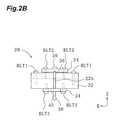
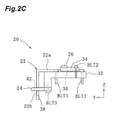
- the positional displacement detector 20 includes a contact member 22, a prohibition member 24, and a vibration detector 26 as illustrated in Figs. 2A to 2C .
- the contact member 22 is capable of making contact with the object gripped by the gripping claws 14.
- the contact member 22 has a shape of a rod-like component bent at a midpoint and has elasticity.
- the contact member may be configured with, for example, metal or resin.
- the contact member 22 includes a fixation portion 22a extending in a Y-axis positive direction (a first direction) and a contact portion 22b extending from an end portion of the fixation portion 22a in a Z-axis negative direction (a second direction).
- the fixation portion 22a of the contact member 22 is fixed to the side face of the gripping claw 14 with bolts BLT1.
- a support member (an example of a member to be fixed) 32 which is an angle member, is disposed between the fixation portion 22a and the side face of the gripping claw 14.
- the fixation portion 22a is interposed between the support member 32 and a plate-like fixation member 34.
- the fixation member 34 is fastened to the support member 32 with bolts BLT2 to fix the fixation portion 22a.
- the fixation member 34 has a groove 36 on its surface facing the fixation portion 22a to allow the fixation portion 22a to fit in the groove 36.
- the groove 36 extends in a Y axis direction.
- An end portion of the contact portion 22b of the contact member 22 is capable of making contact with the object gripped by the gripping claws 14.
- a friction member 38 having a higher coefficient of friction than the object is provided at the end portion of the contact portion 22b.
- This friction member 38 may be, for example, rubber in the case of an object being a metallic workpiece.
- the prohibition member 24 is capable of making contact with the contact member 22 and thereby prohibiting a deformation of a magnitude equal to or more than a predetermined magnitude from being caused to the contact member 22.
- the prohibition member 24 is fixed to the support member 32 with bolts BLT3.
- the prohibition member 24 has a hole 42 with a central axis along the Z axis direction. The contact portion 22b of the contact member 22 passes through the hole 42 at a central portion of the hole 42.
- the hole 42 has a diameter of a size corresponding to a tolerable positional displacement quantity to be set for an object. For example, to tolerate a positional displacement of 3 mm, the radius of the hole 42 is set to 3 mm.
- the tolerable positional displacement quantity can be changed by making a plurality of prohibition members with the holes 42 having different diameters available for replacement. Provision of a mechanism for adjusting the diameter of the hole 42 is also viable in place of the making available of the plurality of prohibition members with the holes 42 having different diameters.
- the hole 42 formed in the prohibition member 24 may be a notch as long as the notch can prohibit a deformation of the contact member 22.
- the vibration detector 26 is capable of detecting a vibration of the contact member 22 and the prohibition member 24.
- the vibration detector 26 has, for example, electric resistance varying with vibration detected.
- the vibration detector 26 is provided, for example, on a surface opposite to the fixed surface of the fixation member 34.
- the vibration detector 26 is desirably provided on this surface, especially over the fixation portion 22a of the contact member 22 and toward the Y-axis positive direction.
- the vibration detector 26 is provided desirably on the fixation member 34 near the contact portion 22b.
- the contact member 22 may be partially enlarged to have a widened portion, so that the vibration detector 26 is provided on the widened portion instead of the fixation member 34.
- the vibration detector 26 may be configured with, for example, a strain gauge (an example of a strain detection sensor), which detects a strain caused by a vibration in the form of a change in electric resistance.
- a strain gauge an example of a strain detection sensor
- the change in electric resistance of the vibration detector 26 is converted to a change in voltage by an amplifier substrate 52 illustrated in Fig. 1 .
- the change in voltage is subjected to conversion from an analog signal to a digital signal by an A/D board 56, which is an A/D converter, connected to a microcomputer 54.
- the digital signal is input into a processor 60, which processes data. This processor 60 is achieved by software executed by the microcomputer 54.
- the processor may be construed as part of the positional displacement detector.
- a robot system 64 is configured with at least the robot hand 10 and the processor 60.
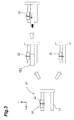
- a control device that controls the robot hand 10 outputs a command (a closing command) to close the gripping claws 14, the robot hand 10 enables the pair of gripping claws 14 to grip an object OBJ as illustrated at an upper level in Fig. 3 . If a slip occurring during the gripping causes, to the object OBJ, a positional displacement equal to or more than a tolerable positional displacement quantity that is tolerated, the contact member 22 moves (deforms) to make contact with the prohibition member 24, allowing the positional displacement to be detected and prompting the processor 60 (see Fig. 1 ) to output a positional displacement detection signal.
- the robot hand 10 fails to grip the object OBJ as illustrated at a lower level in Fig. 3 , the failure in the gripping of the object OBJ is detected, prompting the processor 60 to output a grip error signal.
- the processor 60 executes grip verification processing S1 to verify whether the object has been griped. Subsequently, the processor 60 executes positional displacement detection processing S2 to detect the positional displacement after the gripping of the object.
- the processor 60 executes processing as described below and illustrated in Fig. 4B .
- the processor 60 acquires a voltage value V based on an electric resistance value of the vibration detector 26 via the A/D board 56.
- the contact member 22 upon the making contact of the contact member 22 with the object, the contact member 22 deforms to cause a change in electric resistance of the vibration detector 26, increasing the voltage value V (see B1 illustrated in Fig. 5 ). If the voltage value V becomes equal to or more than a threshold Vthr1 (see B2 illustrated in Fig. 5 ), it can be determined that the gripping claws 14 have gripped the object. Note that the threshold Vthr1 is set to such a magnitude that a minute deformation caused to the contact member 22 due to inertia of the opening and closing of the gripping claws 14 is not detected.
- step S1-3 If the voltage value V is equal to or more than the threshold Vthr1, the processor 60 determines that the contact member 22 has made contact with the object and has deformed. This is followed by the execution of step S1-3.
- step S1-4 If the voltage value V is less than the threshold Vthr1, the processor 60 determines that the contact member 22 is not in contact with the object. This is followed by the execution of step S1-4.
- the processor 60 outputs a grip verification signal on the basis of the determination that the object has been gripped. Then, the grip verification processing S1 is finished.
- step S1-1 and step S1-2 are repeated until the elapse of the time T1 (second).
- step S1-5 proceeds to step S1-5 if the time T1 (second) has elapsed after the outputting of the command to close the gripping claws 14 of the robot hand 10.
- the processor 60 outputs a grip error signal indicative of a failure in the gripping of the object. Then, the grip verification processing S1 is finished.
- the robot hand 10 Upon the outputting of the grip error signal, the robot hand 10 is allowed to stop the operation to hold the object and inform an on-site operator of the failure in the gripping of the object.
- the processor 60 executes processing described below and illustrated in Fig. 4C .
- the processor 60 acquires a voltage value V based on an electric resistance value of the vibration detector 26 via the A/D board 56.
- the processor 60 performs low-pass filter processing on the voltage value V to obtain a voltage value Vflt.
- the processor 60 performs differentiation processing on the voltage value Vflt to obtain a voltage differential value Vdif.
- the contact member 22 in contact with the object deforms to vibrate with the positional displacement of the object.
- the vibration generated manifests itself in the form of a change in electric resistance of the vibration detector 26, and the voltage differential value Vdif increases with the change in electric resistance (see C1 illustrated in Fig. 6 ).
- the contact portion 22b of the contact member 22 makes contact with the prohibition member 24, producing an impact. This reverses the increase/decrease of the voltage differential value Vdif (see C2 illustrated in Fig. 6 ).
- the absolute value of the voltage differential value Vdif becomes equal to or more than a threshold Vthr2 (see C4 illustrated in Fig. 6 ), allowing determination of the positional displacement of the object.
- the processor 60 determines that the contact member 22 has made contact with the prohibition member 24 and that the positional displacement of the object equal to or more than the tolerable positional displacement quantity has occurred if two conditions A and B described below are satisfied.
- of the voltage differential value Vdif is equal to or more than the threshold Vthr2 that has been preset.
- step S2-5 This is followed by the execution of step S2-5.
- the processor 60 determines that the quantity of the positional displacement of the object is within the tolerable positional displacement quantity, and the flowchart reverts to step S2-1.
- the processor 60 outputs the positional displacement detection signal.
- the robot hand 10 Upon the outputting of the positional displacement detection signal, the robot hand 10 puts the object being gripped to another location temporarily and starts the gripping operation on a succeeding object to be gripped.
- an action against another positional displacement can be taken by increasing a gripping force.
- an object's positional displacement equal to or more than a tolerable positional displacement quantity can be detected as described above.
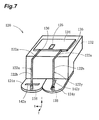
- the robot hand according to the second embodiment includes a positional displacement detector 120.
- the positional displacement detector 120 includes an X-axis contact member 122x and a Y-axis contact member 122y, an X-axis prohibition member 124x and a Y-axis prohibition member 124y, and a vibration detector 126.
- the contact members 122x and 122y are capable of making contact with an object gripped by gripping claws 14.
- the contact members 122x and 122y are spaced from each other in the X axis direction.
- the contact members 122x and 122y each have a shape of a rod-like component bent at a midpoint and have elasticity.
- the contact members 122x and 122y each have a fixation portion 122a extending in the Y-axis positive direction (the first direction) and a contact portion 122b extending from an end portion of the fixation portion 122a in the Z-axis negative direction (the second direction).
- the fixation portion 122a of each of the contact members 122x and 122y is fixed to a side surface of a gripping claw 14 with a bolt.
- a support member (an example of a member to be fixed) 132 which is an angle member, is disposed between the fixation portions 122a and the side surface of the gripping claw 14.
- the fixation portions 122a are interposed between the support member 132 and a plate-like fixation member 134.
- the fixation member 134 is fastened to the support member 132 with a bolt (not shown) to fix the fixation portions 122a.
- the fixation member 134 has grooves 136 on its surface facing the fixation portions 122a to allow the fixation portions 122a to fit in the grooves 136.
- End portions of the contact portions 122b of the contact members 122x and 122y are capable of making contact with the object gripped by the gripping claws 14.
- Friction members 138 having higher coefficients of friction than the object are provided at the end portions of the contact portions 122b.
- the X-axis prohibition member 124x and the Y-axis prohibition member 124y, which are spaced from each other in the X axis direction, are individually fixed to the support member 132.
- the X-axis prohibition member 124x has a rectangular hole 142x with a longer length in the X axis direction.
- the contact portion 122b of the X-axis contact member 122x passes through the hole 142x at a central portion of the hole 142x.
- the Y-axis prohibition member 124y has a rectangular hole 142y with a longer length in the Y axis direction.
- the contact portion 122b of the Y-axis contact member 122y passes through the hole 142y at a central portion of the hole 142y.
- the lengths of the holes 142x and 142y in longitudinal directions are twice as long as positional displacement quantities to be set for the object. For example, to set positional displacements of 3 mm in the X axis and Y axis directions, the lengths of the holes 142x and 142y are each set to 6 mm.
- the tolerable positional displacement quantities can be changed by making a plurality of prohibition members with the holes 142x and 142y having different lengths available for replacement.
- the widths of the holes 142x and 142y are set to be slightly larger than the thicknesses of the contact members 122x and 122y extending through the holes 142x and 142y (for example, to be 1 to 10% larger than the thicknesses of the contact members 122x and 122y).
- the vibration detector 126 is capable of detecting vibrations of the X-axis contact member 122x and the X-axis prohibition member 124x and vibrations of the Y-axis contact member 122y and the Y-axis prohibition member 124y.
- the positional displacement detector 120 includes the X-axis contact member 122x and the X-axis prohibition member 124x, and the Y-axis contact member 122y and the Y-axis prohibition member 124y, allowing the positional displacements of the object in the X axis direction and in the Y axis direction to be detected.
- the support member 132 may include an X-axis vibration detector to detect a vibration in the X axis direction and a Y-axis vibration detector to detect a vibration in the Y axis direction.
- an A/D board can be connected to a PCI bus or the like of the robot control device.
- a vibration detector may output, for example, a voltage on the basis of a vibration detected.
- an amplifier substrate amplifies the voltage for outputting.
- the vibration detector may be any detector that detects some type of change in response to a vibration.
- a vibration detector may be configured with another type of strain detection sensor, such as a piezoelectric element.
- a sensor capable of detecting a vibration of a contact member or the magnitude of an impact may be used as a vibration detector.
- the vibration detector detects the making contact between the contact member and the prohibition member in the embodiments described above
- any means capable of detecting the making contact between the contact member and the prohibition member may be used.
- a contact may be configured with a contact member having electrical conductivity and a prohibition member having electrical conductivity. The making contact between the contact member and the prohibition member (the occurrence of a positional displacement of an object) may be detected when this contact is closed.
- a contact portion of a contact member may be arranged to pass through a hole formed in a gripping claw at its central portion in the Y axis direction when observed in a plan view in the Z axis direction, so that the contact portion makes contact with an object at the central portion of the gripping claw in the Y axis direction.
Landscapes
- Engineering & Computer Science (AREA)
- Robotics (AREA)
- Mechanical Engineering (AREA)
- Chemical & Material Sciences (AREA)
- Analytical Chemistry (AREA)
- Physics & Mathematics (AREA)
- General Physics & Mathematics (AREA)
- Health & Medical Sciences (AREA)
- General Health & Medical Sciences (AREA)
- Orthopedic Medicine & Surgery (AREA)
- Human Computer Interaction (AREA)
- Manipulator (AREA)
Applications Claiming Priority (1)
| Application Number | Priority Date | Filing Date | Title |
|---|---|---|---|
| PCT/JP2011/067791 WO2013018213A1 (ja) | 2011-08-03 | 2011-08-03 | 位置ずれ検出器、ロボットハンド及びロボットシステム |
Publications (2)
| Publication Number | Publication Date |
|---|---|
| EP2741065A1 true EP2741065A1 (de) | 2014-06-11 |
| EP2741065A4 EP2741065A4 (de) | 2015-06-03 |
Family
ID=47628775
Family Applications (1)
| Application Number | Title | Priority Date | Filing Date |
|---|---|---|---|
| EP11870313.1A Withdrawn EP2741065A4 (de) | 2011-08-03 | 2011-08-03 | Positionsveränderungsdetektor, roboterhand und robotersystem |
Country Status (4)
| Country | Link |
|---|---|
| US (1) | US20140145458A1 (de) |
| EP (1) | EP2741065A4 (de) |
| CN (1) | CN103814281A (de) |
| WO (1) | WO2013018213A1 (de) |
Cited By (1)
| Publication number | Priority date | Publication date | Assignee | Title |
|---|---|---|---|---|
| EP3552777A1 (de) * | 2018-04-11 | 2019-10-16 | TRUMPF Maschinen Austria GmbH & Co. KG. | Verfahren zur bewegungssteuerung eines ein werkstück haltenden manipulators |
Families Citing this family (6)
| Publication number | Priority date | Publication date | Assignee | Title |
|---|---|---|---|---|
| DE102014017855A1 (de) * | 2014-12-03 | 2016-06-09 | Dürr Systems GmbH | Handhabungseinrichtung zum Öffnen einer Klappe und entsprechendes Verfahren |
| EP3220148B1 (de) * | 2016-03-17 | 2020-07-15 | Siemens Healthcare Diagnostics Products GmbH | Verfahren zur überwachung des transports von flüssigkeitsbehältern in einem automatischen analysegerät |
| CN105880904B (zh) * | 2016-04-11 | 2017-09-19 | 浙江陆虎汽车有限公司 | 顶盖横梁防错导向检测机构 |
| CN105945999A (zh) * | 2016-06-01 | 2016-09-21 | 淮南市鸿裕工业产品设计有限公司 | 一种抓取装置的接触感应调控模块 |
| DE102019129417B4 (de) * | 2019-10-31 | 2022-03-24 | Sick Ag | Verfahren zum automatischen Handhaben von Objekten |
| JP7446581B2 (ja) * | 2019-12-10 | 2024-03-11 | 国立大学法人 名古屋工業大学 | 振動センサを備えるロボットハンドおよびそれを備えるロボットシステム |
Family Cites Families (13)
| Publication number | Priority date | Publication date | Assignee | Title |
|---|---|---|---|---|
| JPS4853464A (de) * | 1971-11-04 | 1973-07-27 | ||
| JPS536890A (en) * | 1976-07-09 | 1978-01-21 | Hitachi Ltd | Contact sensor |
| EP0173234A1 (de) * | 1984-08-24 | 1986-03-05 | The Perkin-Elmer Corporation | Robotergreifer |
| JPS6156891A (ja) | 1984-08-24 | 1986-03-22 | 日本電信電話株式会社 | すべり覚センサ |
| JPS6259886A (ja) * | 1985-09-11 | 1987-03-16 | Fuji Facom Corp | 移動体の接触検出装置 |
| JPS63117242A (ja) * | 1986-11-04 | 1988-05-21 | Koyo Seiko Co Ltd | ロボツトにおける把握状態検出装置 |
| JP2728182B2 (ja) * | 1990-10-30 | 1998-03-18 | キヤノン株式会社 | ワーク把持装置 |
| GB9204592D0 (en) * | 1992-03-03 | 1992-04-15 | The Technology Partnership Plc | Movement detector using mechanical vibrations |
| US5616590A (en) * | 1994-06-30 | 1997-04-01 | Ciba-Geigy Corporation | Plant microbicides |
| JP3652444B2 (ja) * | 1996-06-19 | 2005-05-25 | 本田技研工業株式会社 | 応力測定装置 |
| DE102006057881C5 (de) * | 2006-12-08 | 2010-07-22 | Norma Germany Gmbh | Spannbare Schelle |
| US8490501B2 (en) * | 2008-05-29 | 2013-07-23 | Harmonic Drive Systems Inc. | Complex sensor and robot hand |
| JP2010149262A (ja) * | 2008-12-26 | 2010-07-08 | Nihon Univ | 把持部を有するロボットハンドシステム |
-
2011
- 2011-08-03 WO PCT/JP2011/067791 patent/WO2013018213A1/ja not_active Ceased
- 2011-08-03 CN CN201180073382.5A patent/CN103814281A/zh active Pending
- 2011-08-03 EP EP11870313.1A patent/EP2741065A4/de not_active Withdrawn
-
2014
- 2014-01-31 US US14/169,153 patent/US20140145458A1/en not_active Abandoned
Cited By (1)
| Publication number | Priority date | Publication date | Assignee | Title |
|---|---|---|---|---|
| EP3552777A1 (de) * | 2018-04-11 | 2019-10-16 | TRUMPF Maschinen Austria GmbH & Co. KG. | Verfahren zur bewegungssteuerung eines ein werkstück haltenden manipulators |
Also Published As
| Publication number | Publication date |
|---|---|
| EP2741065A4 (de) | 2015-06-03 |
| US20140145458A1 (en) | 2014-05-29 |
| CN103814281A (zh) | 2014-05-21 |
| WO2013018213A1 (ja) | 2013-02-07 |
Similar Documents
| Publication | Publication Date | Title |
|---|---|---|
| EP2741065A1 (de) | Positionsveränderungsdetektor, roboterhand und robotersystem | |
| CA2996698C (en) | Systems and methods for providing contact detection in an articulated arm | |
| JP4977825B2 (ja) | 剪断力検出装置及び物体把持システム | |
| JP6988757B2 (ja) | エンドエフェクタおよびエンドエフェクタ装置 | |
| US9909852B2 (en) | Operation position detection apparatus and vehicular apparatus | |
| WO2020194393A1 (ja) | ロボットハンド、ロボットハンド制御方法及びプログラム | |
| US11931887B2 (en) | End effector device | |
| US8516891B2 (en) | Multi-stage stopper system for MEMS devices | |
| JP2019023639A5 (de) | ||
| JP5215331B2 (ja) | 作業判定システム及び作業判定方法並びに該作業判定方法を記録した記録媒体 | |
| JP7830846B2 (ja) | 圧電センサーおよびハンド | |
| JPWO2013018213A1 (ja) | 位置ずれ検出器、ロボットハンド及びロボットシステム | |
| JP5884456B2 (ja) | 介在センサー、およびロボット | |
| CN210791052U (zh) | 一种用于机器人碰撞检测的防撞装置 | |
| CN113043071B (zh) | 可感测低频力与高频力的力感测装置 | |
| JP5874435B2 (ja) | 車両用入力装置 | |
| KR20110136036A (ko) | 로봇 교시 장치 및 방법 | |
| CN106932123B (zh) | 一种手腕传感器 | |
| WO2023065102A1 (en) | Gripper and robot having the same | |
| CN206510862U (zh) | 一种ecu固定装置 | |
| JP2023051285A (ja) | 力覚センサ | |
| CN110539335A (zh) | 一种用于机器人碰撞检测的防撞装置 | |
| Petchartee et al. | Pre-slip detection based Tactile Sensing | |
| US20220227011A1 (en) | Tactile Sensor, Robot Hand, and Robot | |
| JP2008157706A (ja) | センサ |
Legal Events
| Date | Code | Title | Description |
|---|---|---|---|
| PUAI | Public reference made under article 153(3) epc to a published international application that has entered the european phase |
Free format text: ORIGINAL CODE: 0009012 |
|
| 17P | Request for examination filed |
Effective date: 20140226 |
|
| AK | Designated contracting states |
Kind code of ref document: A1 Designated state(s): AL AT BE BG CH CY CZ DE DK EE ES FI FR GB GR HR HU IE IS IT LI LT LU LV MC MK MT NL NO PL PT RO RS SE SI SK SM TR |
|
| DAX | Request for extension of the european patent (deleted) | ||
| RA4 | Supplementary search report drawn up and despatched (corrected) |
Effective date: 20150508 |
|
| RIC1 | Information provided on ipc code assigned before grant |
Ipc: B25J 13/08 20060101ALI20150429BHEP Ipc: G01L 5/00 20060101AFI20150429BHEP Ipc: B25J 15/08 20060101ALI20150429BHEP |
|
| STAA | Information on the status of an ep patent application or granted ep patent |
Free format text: STATUS: THE APPLICATION IS DEEMED TO BE WITHDRAWN |
|
| 18D | Application deemed to be withdrawn |
Effective date: 20151208 |