EP2743708A2 - Dispositif de test et procédé de contrôle associé - Google Patents
Dispositif de test et procédé de contrôle associé Download PDFInfo
- Publication number
- EP2743708A2 EP2743708A2 EP13192245.2A EP13192245A EP2743708A2 EP 2743708 A2 EP2743708 A2 EP 2743708A2 EP 13192245 A EP13192245 A EP 13192245A EP 2743708 A2 EP2743708 A2 EP 2743708A2
- Authority
- EP
- European Patent Office
- Prior art keywords
- electrical
- testing
- point
- layer substrate
- flexible multi
- Prior art date
- Legal status (The legal status is an assumption and is not a legal conclusion. Google has not performed a legal analysis and makes no representation as to the accuracy of the status listed.)
- Withdrawn
Links
Images



Classifications
-
- H—ELECTRICITY
- H10—SEMICONDUCTOR DEVICES; ELECTRIC SOLID-STATE DEVICES NOT OTHERWISE PROVIDED FOR
- H10P—GENERIC PROCESSES OR APPARATUS FOR THE MANUFACTURE OR TREATMENT OF DEVICES COVERED BY CLASS H10
- H10P74/00—Testing or measuring during manufacture or treatment of wafers, substrates or devices
-
- G—PHYSICS
- G01—MEASURING; TESTING
- G01R—MEASURING ELECTRIC VARIABLES; MEASURING MAGNETIC VARIABLES
- G01R1/00—Details of instruments or arrangements of the types included in groups G01R5/00 - G01R13/00 and G01R31/00
- G01R1/02—General constructional details
- G01R1/06—Measuring leads; Measuring probes
- G01R1/067—Measuring probes
- G01R1/073—Multiple probes
- G01R1/07307—Multiple probes with individual probe elements, e.g. needles, cantilever beams or bump contacts, fixed in relation to each other, e.g. bed of nails fixture or probe card
- G01R1/0735—Multiple probes with individual probe elements, e.g. needles, cantilever beams or bump contacts, fixed in relation to each other, e.g. bed of nails fixture or probe card arranged on a flexible frame or film
-
- G—PHYSICS
- G01—MEASURING; TESTING
- G01R—MEASURING ELECTRIC VARIABLES; MEASURING MAGNETIC VARIABLES
- G01R31/00—Arrangements for testing electric properties; Arrangements for locating electric faults; Arrangements for electrical testing characterised by what is being tested not provided for elsewhere
- G01R31/26—Testing of individual semiconductor devices
-
- G—PHYSICS
- G01—MEASURING; TESTING
- G01R—MEASURING ELECTRIC VARIABLES; MEASURING MAGNETIC VARIABLES
- G01R31/00—Arrangements for testing electric properties; Arrangements for locating electric faults; Arrangements for electrical testing characterised by what is being tested not provided for elsewhere
- G01R31/26—Testing of individual semiconductor devices
- G01R31/2601—Apparatus or methods therefor
Definitions
- the present invention generally relates to a testing substrate and a testing method thereof, and more particularly to a testing substrate for fine pitch wafer level tests and a testing method thereof.
- WLP wafer level package
- CSP chip scale package
- WLCSP wafer level chip scale package
- Probes among the soldering balls and the bumps are decreased (fine pitch) for meeting design trends of miniaturization of electronic products.
- Current probing technologies utilized in the wafer level comprise cantilever probe cards and vertical probe cards. In order to match with the increasing numbers of the solder balls and the bumps, the small sizes and the fine pitch requirements, a number of probes is required to be increased and probe spacing between the probes should be decreased.
- Material of the probes comprises tungsten (W), beryllium copper (BeCu), palladium alloy and so on. Regardless of the probe cards are the cantilever probe cards or the vertical probe cards, the probing technologies faces difficulties and disadvantages due to the small sizes of the soldering balls and the bumps.
- the probes have to destroy oxidation layers on the soldering balls and the bumps for forming probe marks on surfaces of pads, thereby achieving a requirement of contact resistance in electrical tests.
- the probe marks must occur for ensuing that the probes of one probe card contact the pads.
- the electrical tests fail due to poor contact.
- the probe marks are large, the surfaces of the pads are destroyed and gaps are formed in bonding surfaces, such that poor bonding occurs in the following bonding processes. Even more seriously, oxidation is formed after the surfaces of the pads are destroyed, and thus the bonding surfaces are oxidized and bonding strength is decreased.
- soldering balls and the bumps are not similar to the pads which are flat. After miniaturization, the structures do not have enough flat surfaces. It is impossible to test the soldering balls and the bumps by the probes. Accordingly, it is necessary to develop a testing device and a testing method thereof for a wafer level and fine-pitch test.
- An objective of the present invention is to provide a testing device and a method thereof, which is suitable for high density and fine pitch wafer level tests without utilizing the conventional probe technology for performing an electrical test to electrical connecting points (soldering balls and bumps).
- electrical testing points and electrical connecting points are not damaged. Appearances, shapes and structures of the electrical connecting points (soldering balls and bumps) and electrical testing points can maintain completeness, and a requirement for a contact resistance in the electrical test can be met.
- the testing device of the present invention comprises:
- a frame positioned corresponding to a chip, and at least one electrical connecting point formed on a surface of the chip
- a contact area between the at least one electrical connecting point and the at least one electrical testing point is larger than 1 ⁇ m 2 . Furthermore, a surface structure of the contact area maintains completeness, and thus probe marks are not produced easily. Structures of the at least one electrical connecting point and the least one electrical testing point maintain completeness after the electrical test is performed. Furthermore, a height of the at least one electrical connecting point or at least one electrical testing point is less than 100 ⁇ m in the present invention.
- a contact resistance as the at least one electrical connecting point contacts the at least one electrical testing point may be less than 5 ohm.
- a preferred value of the contact resistance is less than 1 ohm.
- the at least one electrical connecting point is a bump.
- An inert metal or a precious metal may be formed on or cover a surface of the at least one electrical connecting point and a surface of the at least one electrical testing point.
- the testing device of the present invention further comprises an elastic supporting body disposed between the frame and the flexible multi-layer substrate.
- the elastic supporting body is utilized for providing a supporting force to the flexible multi-layer substrate.
- the testing device of the present invention further comprises at least one supporting protruding point formed on a lower surface of the flexible multi-layer substrate and corresponding to the at least one electrical testing point for providing a supporting force to the flexible multi-layer substrate.
- the flexible multi-layer substrate may be fixed in the frame by soldering edges of the flexible multi-layer substrate.
- the frame further comprises a plurality of clamping elements for clamping or comprises an upper clamping board and a lower clamping board for fixing the flexible multi-layer substrate in the frame.
- the present invention further comprises a testing method of the above-mentioned testing device.
- the method comprises:
- the present invention Since the testing device and the testing method thereof of the present invention do not utilize the conventional probe technology to perform the electrical test to the electrical connecting point (soldering balls and bumps), the present invention has advantages that the electrical connecting points (soldering balls and bumps) on the chip or a wafer are not broken, and appearances, shapes and structures of the electrical connecting points and electrical testing points can maintain completeness. Furthermore, the present invention can be applied to high density and fine pitch wafer level tests with the development of fine pitch technology. Furthermore, the present invention further has an advantage that the requirement for the contact resistance in the electrical test can be met.
- FIG. 1 depicts a sectional view of a testing device according to a first embodiment of the present invention.
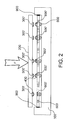
- FIG. 2 depicts a sectional view of a testing device according to a second embodiment of the present invention.
- FIG. 3 depicts a diagram showing that the flexible multi-layer substrate is fixed in the testing device of the present invention by a clamping method.
- FIG. 4 depicts a diagram showing that the flexible multi-layer substrate is fixed in the testing device of the present invention with clamping boards.
- FIG. 5 depicts a flowchart of a testing method of a testing device according to the present invention.
- FIG. 1 depicts a sectional view of a testing device according to a first embodiment of the present invention.
- the testing device of the present invention is utilized for performing an electrical test to a chip 200 or a wafer which is not cut and has a plurality of chips 200.
- the testing device comprises a frame 100, a flexible multi-layer substrate 500, at least one electrical testing point 600 formed on an upper surface of the flexible multi-layer substrate 500 and an elastic supporting body 700.
- a method for manufacturing the flexible multi-layer substrate 500 is to alternately form a plurality of metal layers and a plurality dielectric layers on a temporary substrate.
- the dielectric layers for example, are formed of polyimide by a spin coating method.
- the metal layers are formed by a metal lift-off process.
- a thickness of one layer in the flexible multi-layer substrate 500 can be less than 20 ⁇ m or even 10 ⁇ m. Since the dielectric layers are formed of one material, stresses between layers of the flexible multi-layer substrate 500 are consistent. As a result, when the flexible multi-layer substrate 500 is separated from the temporary substrate, a warpage problem can be avoided.
- the electrical testing points 600 are formed on the upper surface of the flexible multi-layer substrate 500.
- at least one electrical connecting point 300 is formed on a surface of the chip 200.
- the electrical connecting point 300 is a micro bump (MB) utilized for a flip-chip process after a test.
- the chip 200 (die) is packaged by a micro bump bonding method.
- the electrical testing points 600 on the flexible multi-layer substrate 500 are formed corresponding to the electrical connecting points 300 on the surface of the chip 200.
- the electrical testing points 600 are utilized for contacting the electrical connecting points 300 for performing an electrical test to the chip 200. It is well known that the flexible multi-layer substrate 500 will be electrically connected to an external circuit and an electrical testing system (not shown in FIG. 1 ) for testing the chip.
- each of the electrical testing points 600 may be a bump or a metal pad.
- Each of the electrical connecting points 300 may be a bump or a metal pad as well.
- each of the electrical testing points 600 is a bump.
- the electrical connecting points 300 contact the electrical testing points 600 for performing the electrical test.
- each of the electrical connecting points 300 is a bump, while each of the electrical testing points 600 is a metal pad.
- the electrical connecting points 300 contact the electrical testing points 600 for performing the electrical test.
- both of the electrical connecting points 300 and the electrical testing points 600 are bumps, and they contact each other for performing the electrical test.
- the testing device of the present invention is utilized for performing the electrical test to the chip 200 or a wafer which is not cut and have a plurality of chips 200.
- An area formed in the frame 100 is larger than the chip 200 required to be electrically tested, such that the chip 200 can be positioned in the frame 100.
- a shape of the frame 100 of the present invention may be rectangular, circular and so on. It is not limited to a specific shape.
- the surface having the electrical testing points 600 faces upward.
- the electrical test can be performed to the chip 200.
- the surface of the chip 200 having the electrical connecting points 300 faces downward.
- the chip 200 is moved, such that the electrical connecting points 300 contact the electrical testing points 600.
- a specific force F is applied to the chip 200. It is noted that the applied specific force F can make a contact area between each electrical connecting point 300 and the corresponding electrical testing point 600 larger than 1 ⁇ m 2 and can make a contact resistance as each electrical connecting point 300 contacts the corresponding electrical testing point 600 less than 5 ohm. A preferred value of the contact resistance is less than 1 ohm.
- the present invention is mostly applied to high density and fine pitch wafer level package. Accordingly, a height of each electrical connecting point 300 or each electrical testing point 600 is less than 100 ⁇ m.
- each electrical connecting point 300 utilized in the industry is a small-sized bump.
- a metal 400 i.e. an inert metal or a precious metal, is further formed on a surface of each electrical connecting point 300 for providing a low reactive surface to prevent oxidation.
- gold (Au) or platinum (Pt) is utilized for covering the surface of each electrical connecting point 300.
- An inert metal or a precious metal may be formed on the surface of each electrical testing point 600.
- a low reactive surface which is capable of efficiently isolating the connecting point 300 from the outer atmosphere can be formed to prevent oxidation.
- gold (Au) or platinum (Pt) is utilized for covering the surface of each electrical testing point 600.
- each electrical testing point 600 is manufactured by an inert metal or a precious metal.
- An object of forming the inert metal or the precious metal is to ensure that there is no oxidation layer between each electrical connecting point 300 and the corresponding electrical testing point 600. Accordingly, the step of mechanically destroying the oxidation layer in the prior arts for acquiring the electrical contact is not required when each electrical connecting point 300 contacts the electrical testing point 600. Any conductive material which is not oxidized easily may be served as the metal 400 (inert metal or precious metal). The concept that the oxidation layer is not required to be mechanically destroyed can implement a structural completeness between the surface of each electrical connecting point 300 and the surface of the corresponding electrical testing point 600.
- each electrical connecting point 300 solddering balls or bumps
- the present invention not only appearances, shapes and structural completenesses of each electrical connecting point 300 and each electrical testing point 600 can maintain, but also the structural completeness of the contact area can maintain. Accordingly, probe marks are not easily produced.
- each electrical connecting point 300 and the shape of each electrical testing point 600 can maintain completeness after the electrical tests. That is, the present invention can achieve the advantages that the contact area between each electrical connecting point 300 and the corresponding electrical testing point 600 is larger than 1 ⁇ m 2 , the contact resistance is less than 5 ohm, and a preferred value of the contact resistance is less than 1 ohm.
- the flexible multi-layer substrate 500 of the present invention utilized in the electrical tests can be reused for more times because each electrical testing point 600 does not destroy the corresponding electrical connecting point 300. Accordingly, usage life can be extended greatly.
- a thickness of the metal 400 may be ranged from 10 nm to 100 nm for ensuring good electrical contact between each electrical connecting point 300 and the corresponding electrical testing point 600.
- the thickness may be larger.
- the metal 400 can be dissolved in the electrical connecting point 300 or the electrical testing point 600 which is formed of tin. Since a portion of ingredients is quite low, the following soldering and bonding processes are not affected.
- the elastic supporting body 700 of the testing device of the present invention is disposed between the frame 100 and the flexible multi-layer substrate 500.
- the elastic supporting body 700 provides a supporting force to the flexible multi-layer substrate 500.
- a material and a shape of the elastic supporting body 700 are not limited, as long as the elastic supporting body 700 can have supporting effect.
- FIG. 2 depicts a sectional view of a testing device according to a second embodiment of the present invention.
- the testing device comprises a frame 100, a flexible multi-layer substrate 500, at least one electrical testing point 600' formed on an upper surface of the flexible multi-layer substrate 500 and at least one supporting protruding point 800.
- a plurality of metal layers and a plurality dielectric layers are alternately formed on a temporary substrate.
- the dielectric layers for example, are formed of polyimide by a spin coating method.
- the metal layers are formed by a metal lift-off process.
- a thickness of one layer in the flexible multi-layer substrate 500 can be less than 20 ⁇ m or even 10 ⁇ m. Since the dielectric layers are formed of one material, stresses between layers of the flexible multi-layer substrate 500 are consistent. As a result, when the flexible multi-layer substrate 500 is separated from the temporary substrate, a warpage problem can be avoided. Then, the electrical testing points 600' are formed on the upper surface of the flexible multi-layer substrate 500. As shown in FIG.
- the electrical connecting point 300' is a micro bump (MB) utilized for a flip-chip process after a test.
- the chip 200 (die) is packaged by a micro bump bonding method. Accordingly, the electrical testing points 600' on the flexible multi-layer substrate 500 are formed corresponding to the electrical connecting points 300' on the surface of the chip 200.
- the testing device of the present invention is utilized for performing the electrical test to the chip 200 or a wafer which is not cut and have a plurality of chips 200.
- An area formed in the frame 100 is larger than the chip 200 required to be electrically tested, such that the chip 200 can be positioned in the frame 100.
- a shape of the frame 100 of the present invention may be rectangular, circular and so on. It is not limited to a specific shape.
- a metal 400 i.e. an inert metal or a precious metal, is further formed on a surface of each electrical connecting point 300' for providing a low reactive surface to prevent oxidation.
- gold (Au) or platinum (Pt) is utilized for covering the surface of each electrical connecting point 300'.
- An inert metal or a precious metal may be formed on the surface of each electrical testing point 600'.
- a low reactive surface which is capable of efficiently isolating the electrical testing point 600' from the outer atmosphere can be formed to prevent oxidation.
- gold (Au) or platinum (Pt) is utilized for covering the surface of each electrical testing point 600'.
- each electrical testing point 600' is manufactured by an inert metal or a precious metal.
- An object of forming the inert metal or the precious metal is to ensure that there is no oxidation layer between each electrical connecting point 300' and the corresponding electrical testing point 600'. Accordingly, the step of mechanically destroying the oxidation layer in the prior arts for acquiring the electrical contact is not required when each electrical connecting point 300' contacts the electrical testing point 600'. Any conductive material which is not oxidized easily may be served as the metal 400 (inert metal or precious metal). The concept that the oxidation layer is not required to be mechanically destroyed can implement a structural completeness between the surface of each electrical connecting point 300' and the surface of the corresponding electrical testing point 600'. Furthermore, the present invention is mostly applied to high density and fine pitch wafer level package.
- the second embodiment of the present invention comprises the supporting protruding points 800. Positions of the supporting protruding points 800 are formed on a lower surface of the flexible multi-layer substrate 500 (a surface opposite to the surface on which the electrical testing points 600' are formed), and the supporting protruding points 800 are formed corresponding to the electrical testing points 600'. When each electrical connecting point 300' contacts the corresponding electrical testing point 600' and the specific force F is generated, the supporting protruding points 800 provide a supporting force to the flexible multi-layer substrate 500.
- a material and a shape of each supporting protruding point 800 are not limited, as long as the supporting protruding points 800 can have supporting effect.
- a testing method is the same as that in the first embodiment.
- the surface having the electrical testing points 600' faces upward.
- the electrical test can be performed to the chip 200.
- the surface of the chip 200 having the electrical connecting points 300' faces downward.
- the chip 200 is moved, such that the electrical connecting points 300' contact the electrical testing points 600' and applies the specific force F to the chip 200 as shown in FIG. 2 .
- the applied specific force F can make a contact area between each electrical connecting point 300' and the corresponding electrical testing point 600' larger than 1 ⁇ m 2 and can make a contact resistance as each electrical connecting point 300' contacts the corresponding electrical testing point 600' less than 5 ohm.
- a preferred value of the contact resistance is less than 1 ohm.
- each electrical connecting point 300' solddering balls or bumps
- the oxidation layer of each electrical connecting point 300' is required to be broken for ensuring validity of the test.
- the present invention not only appearances, shapes and structural completenesses of each electrical connecting point 300' and each electrical testing point 600' can maintain, but also the structural completeness of the contact area can maintain. Accordingly, probe marks are not easily produced.
- the shape of each electrical connecting point 300' and the shape of each electrical testing point 600' can maintain completeness after the electrical tests.
- the present invention can achieve the advantages that the contact area between each electrical connecting point 300' and the corresponding electrical testing point 600' is larger than 1 ⁇ m 2 , the contact resistance is less than 5 ohm, and a preferred value of the contact resistance is less than 1 ohm.
- the flexible multi-layer substrate 500 of the present invention utilized in the electrical tests can be reused for more times because each electrical testing point 600' does not destroy the corresponding electrical connecting point 300'. Accordingly, usage life can be extended greatly.
- each of the electrical connecting points 300' and the electrical testing points 600' may be a bump or a metal pad. If each of the electrical connecting points 300' and the electrical testing points 600' is a bump, the bump may be a semi-spherical shape as shown in FIG. 2 or a flat metal pad. The shape may be cylindrical, bulk-shaped, protruding, a pyramidal with a ball-shaped apex and so on. The shape is not limited as long as the above-mentioned conditions, that is, the probe marks are not produced easily, the contact area is larger than 1 ⁇ m 2 , the contact resistance is less than 5 ohm, and the preferred value of the contact resistance is less than 1 ohm, are met.
- FIG. 3 depicts a diagram showing that the flexible multi-layer substrate is fixed in the testing device of the present invention by a clamping method.
- FIG. 4 depicts a diagram showing that the flexible multi-layer substrate is fixed in the testing device of the present invention with clamping boards.
- the flexible multi-layer substrate 500 is fixed in the frame 100 with fixing contacts 900.
- the flexible multi-layer substrate 500 may be fixed in the frame 100 by soldering edges of the flexible multi-layer substrate 500.
- the frame 100 of the present invention may further comprise a plurality of clamping elements 102 as shown in FIG. 3 .
- Each clamping element 102 comprises a clamping screw 108 and an adjustable spring 110 for clamping the flexible multi-layer substrate 500 in the frame 100, and it can adjust tension of the flexible multi-layer substrate 500.
- the frame 100 of the present invention may further comprise an upper clamping board 104 and a lower clamping board 106 for fixing the flexible multi-layer substrate 500 in the frame 100.
- the lower clamping board 106 comprises an absorbing hole 112 for stably clamping the flexible multi-layer substrate 500 by a suction method.
- FIG. 5 depicts a flowchart of a testing method of a testing device according to the present invention.
- the testing method of the testing device according to the present invention comprises the following steps:
- step S101 providing a flexible multi-layer substrate 500 having at least one electrical testing point 600 formed on an upper surface of the flexible multi-layer substrate 500;
- step S102 moving a chip 200, such that electrical connecting points 300 contact the electrical testing points 600;
- step S103 performing an electrical test to the chip 200.
- the shape of flexible multi-layer substrate 500 is flexible. Accordingly, height differences of the plural electrical connecting points 300 resulted from warpage of the substrate utilized for supporting the chip 200 can be compensated when the flexible multi-layer substrate 500 of the present invention is utilized for electrically testing the chip 200. That is, if the height differences of the electrical connecting points 300 of the chip 200 or another device to be tested are large, a tolerance degree by utilizing the flexible multi-layer substrate 500 of the present invention for the electrical test is larger than that in the prior arts. Accordingly, other compensating methods are not required.
- the contact area between each electrical connecting point 300 and the corresponding electrical testing point 600 is larger than 1 ⁇ m 2
- the contact resistance as each electrical connecting point 300 contacts the corresponding electrical testing point 600 is less than 5 ohm
- a preferred value of the contact resistance is smaller than 1 ohm according to the present invention.
- the method further comprises a step of forming an inert metal or a precious metal 400 on a surface of each electrical connecting point 300 or each electrical testing point 600 for providing a low reactive surface to prevent oxidation before the step of providing the flexible multi-layer substrate 500.
- the method further comprises a step of performing a thermal process, like a reflow process, to the chip 200 after the step of performing the electrical test to the chip 200, to dissolve the inert metal or the precious metal 400 in the electrical connecting point 300.
- a thermal process like a reflow process
- the method further comprises a step of disposing an elastic supporting body 700 between the frame 100 and flexible multi-layer substrate 500, to provide a supporting force to the flexible multi-layer substrate 500 in the step of performing the electrical test to the chip 200 before the step of providing the flexible multi-layer substrate 500.
- the method further comprises a step of forming at least one supporting protruding point 800 on a lower surface of the flexible multi-layer substrate 500, to provide a supporting force to the flexible multi-layer substrate 500 in the step of performing the electrical test to the chip 200 before the step of providing the flexible multi-layer substrate 500.
- the method further comprises a step of fixing the flexible multi-layer substrate 500 in the frame 100 in the step of providing the flexible multi-layer substrate 500.
- the flexible multi-layer substrate 500 is fixed in the frame 100 by soldering edges of the flexible multi-layer substrate 500.
- the edges of the flexible multi-layer substrate 500 are soldered for forming the fixing contacts 900.
- the frame 100 may further comprise a plurality of clamping elements 102 or comprise an upper clamping board 104 and a lower clamping board 106, so as to clamp the flexible multi-layer substrate 500 and fix the flexible multi-layer substrate 500 in the frame 100 in the step of fixing the flexible multi-layer substrate 500.
- the testing device and the testing method of the testing device are different from the conventional probe technology and adopts the electrical test where gold contacts gold, the soldering balls or bumps on the chip or the wafer are not destroyed. Furthermore, the present invention has a better contact resistance. Finally, the present invention is suitable for the electrical tests with high density and fine pitch wafer level package.
Landscapes
- Physics & Mathematics (AREA)
- General Physics & Mathematics (AREA)
- Measuring Leads Or Probes (AREA)
- Testing Or Measuring Of Semiconductors Or The Like (AREA)
- Testing Of Individual Semiconductor Devices (AREA)
Applications Claiming Priority (1)
| Application Number | Priority Date | Filing Date | Title |
|---|---|---|---|
| TW101147926A TWI490508B (zh) | 2012-12-17 | 2012-12-17 | 軟性測試裝置及其測試方法 |
Publications (2)
| Publication Number | Publication Date |
|---|---|
| EP2743708A2 true EP2743708A2 (fr) | 2014-06-18 |
| EP2743708A3 EP2743708A3 (fr) | 2017-11-15 |
Family
ID=49679300
Family Applications (1)
| Application Number | Title | Priority Date | Filing Date |
|---|---|---|---|
| EP13192245.2A Withdrawn EP2743708A3 (fr) | 2012-12-17 | 2013-11-08 | Dispositif de test et procédé de contrôle associé |
Country Status (6)
| Country | Link |
|---|---|
| US (1) | US9182443B2 (fr) |
| EP (1) | EP2743708A3 (fr) |
| JP (1) | JP5918205B2 (fr) |
| KR (1) | KR20140079283A (fr) |
| CN (1) | CN103869235A (fr) |
| TW (1) | TWI490508B (fr) |
Cited By (1)
| Publication number | Priority date | Publication date | Assignee | Title |
|---|---|---|---|---|
| WO2016048626A1 (fr) * | 2014-09-26 | 2016-03-31 | Qualcomm Incorporated | Substrats d'essai électrique à film souple avec une ou plusieurs bornes de couplage conductrices pour l'essai électrique d'un ou plusieurs bossages de circuit intégré (ci), et procédé et appareils d'essai associés |
Families Citing this family (13)
| Publication number | Priority date | Publication date | Assignee | Title |
|---|---|---|---|---|
| JP5936579B2 (ja) * | 2013-05-08 | 2016-06-22 | 本田技研工業株式会社 | 電流印加装置 |
| US9726691B2 (en) * | 2014-01-07 | 2017-08-08 | International Business Machines Corporation | 3D chip testing through micro-C4 interface |
| KR101477243B1 (ko) * | 2014-07-14 | 2014-12-30 | 양진석 | 프로브유닛 및 이를 갖는 엘이디 칩 검사장치 |
| CN104407281B (zh) * | 2014-10-29 | 2020-06-05 | 上海斐讯数据通信技术有限公司 | 一种用于集成电路板测试点布局方法 |
| TWI593970B (zh) * | 2016-07-25 | 2017-08-01 | 日月光半導體製造股份有限公司 | 測試治具 |
| CN109752413B (zh) * | 2018-12-27 | 2021-08-03 | 苏州佳世达电通有限公司 | 测试两基板之间多个焊球的结构及其方法 |
| CN110286310B (zh) * | 2019-07-30 | 2021-04-27 | 河北普兴电子科技股份有限公司 | 基于半导体晶片表面的测试装置 |
| CN110849526B (zh) * | 2019-11-25 | 2021-12-07 | 上海航天控制技术研究所 | 一种机械臂力柔顺算法测试系统及测试方法 |
| CN112924844A (zh) * | 2019-12-06 | 2021-06-08 | 迪科特测试科技(苏州)有限公司 | 探测装置 |
| US12400993B2 (en) * | 2020-08-19 | 2025-08-26 | Shinkawa Ltd. | Substrate holder and bonding system |
| CN116047246A (zh) * | 2021-10-28 | 2023-05-02 | 深圳市江波龙电子股份有限公司 | 电子器件的测试方法及测试装置 |
| TWI868876B (zh) * | 2023-08-25 | 2025-01-01 | 頎邦科技股份有限公司 | 軟性電路板 |
| CN117976564B (zh) * | 2023-12-29 | 2024-12-10 | 上海捷策创电子科技有限公司 | 一种多层基板与测试载板的无缝接合方法 |
Family Cites Families (34)
| Publication number | Priority date | Publication date | Assignee | Title |
|---|---|---|---|---|
| DE68913318T2 (de) * | 1988-03-11 | 1994-09-15 | Ibm | Elastomerische Verbinder für elektronische Bausteine und für Prüfungen. |
| JP2716663B2 (ja) | 1993-09-21 | 1998-02-18 | マイクロン・テクノロジー・インコーポレイテッド | 半導体ダイの試験装置 |
| JP2925964B2 (ja) | 1994-04-21 | 1999-07-28 | 松下電器産業株式会社 | 半導体ウェハ収納器及び半導体集積回路の検査方法 |
| KR970707444A (ko) * | 1994-10-28 | 1997-12-01 | 야마모토 히데키 | 프로브 구조(probe structure) |
| JP3500834B2 (ja) * | 1996-02-29 | 2004-02-23 | 株式会社デンソー | 半導体試験装置 |
| US5729896A (en) * | 1996-10-31 | 1998-03-24 | International Business Machines Corporation | Method for attaching a flip chip on flexible circuit carrier using chip with metallic cap on solder |
| US5929521A (en) * | 1997-03-26 | 1999-07-27 | Micron Technology, Inc. | Projected contact structure for bumped semiconductor device and resulting articles and assemblies |
| JPH11160356A (ja) | 1997-11-25 | 1999-06-18 | Matsushita Electric Ind Co Ltd | ウェハ一括型測定検査用プローブカードおよびセラミック多層配線基板ならびにそれらの製造方法 |
| JP3674300B2 (ja) * | 1998-03-16 | 2005-07-20 | Jsr株式会社 | 半導体素子検査装置および検査方法 |
| JP2000180506A (ja) | 1998-12-15 | 2000-06-30 | Nec Corp | 半導体装置検査用コンタクト装置 |
| JP2000180469A (ja) * | 1998-12-18 | 2000-06-30 | Fujitsu Ltd | 半導体装置用コンタクタ及び半導体装置用コンタクタを用いた試験装置及び半導体装置用コンタクタを用いた試験方法及び半導体装置用コンタクタのクリーニング方法 |
| JP2001056346A (ja) * | 1999-08-19 | 2001-02-27 | Fujitsu Ltd | プローブカード及び複数の半導体装置が形成されたウエハの試験方法 |
| JP2001351945A (ja) * | 2000-06-05 | 2001-12-21 | Matsushita Electric Ind Co Ltd | 半導体装置の製造方法 |
| KR100745104B1 (ko) * | 2000-06-16 | 2007-08-01 | 니혼 하츠쵸 가부시키가이샤 | 컨택터 프로브, 전기 프로브 유닛, 컨택터 프로브를 위한 프로브 어셈블리와 절연체의 조합체 및 컨택터 프로브를 위한 탄성의 도전성 프로브 어셈블리 |
| JP2003232831A (ja) * | 2002-02-13 | 2003-08-22 | Hitachi Cable Ltd | 検査用配線基板及びその製造方法 |
| US6703851B1 (en) * | 2002-08-05 | 2004-03-09 | Exatron, Inc. | Test socket interposer |
| TW200532837A (en) * | 2004-03-26 | 2005-10-01 | Renesas Tech Corp | Method for manufacturing semiconductor integrated circuit device |
| US7235412B1 (en) * | 2004-05-11 | 2007-06-26 | Xilinx, Inc. | Semiconductor component having test pads and method and apparatus for testing same |
| TWI268129B (en) * | 2004-10-04 | 2006-12-01 | Himax Tech Ltd | Verification method and fabricating method for flexible circuit board |
| JP4829879B2 (ja) * | 2005-03-11 | 2011-12-07 | ルネサスエレクトロニクス株式会社 | 半導体集積回路装置の製造方法 |
| US7501839B2 (en) * | 2005-04-21 | 2009-03-10 | Endicott Interconnect Technologies, Inc. | Interposer and test assembly for testing electronic devices |
| JP4916717B2 (ja) * | 2005-12-27 | 2012-04-18 | 日本発條株式会社 | 導電性接触子ホルダおよび導電性接触子ユニット |
| TWM309109U (en) * | 2006-09-25 | 2007-04-01 | Global Master Tech Co Ltd | Contacting test apparatus |
| WO2009119904A1 (fr) * | 2008-03-28 | 2009-10-01 | 日本電気株式会社 | Dispositif à semi-conducteurs, procédé de fabrication d'un dispositif à semi-conducteurs, carte de circuit imprimé et dispositif électronique |
| US8901950B2 (en) * | 2009-02-19 | 2014-12-02 | Advantest America, Inc | Probe head for a microelectronic contactor assembly, and methods of making same |
| US8430676B2 (en) * | 2009-08-10 | 2013-04-30 | Sv Probe Pte. Ltd. | Modular space transformer for fine pitch vertical probing applications |
| TWI398639B (zh) * | 2010-01-08 | 2013-06-11 | Nat Univ Kaohsiung | The carrier of the package |
| JP4944982B2 (ja) | 2010-08-10 | 2012-06-06 | ルネサスエレクトロニクス株式会社 | 半導体ウェハの検査方法および半導体装置の製造方法 |
| US8797057B2 (en) * | 2011-02-11 | 2014-08-05 | Taiwan Semiconductor Manufacturing Company, Ltd. | Testing of semiconductor chips with microbumps |
| US9721912B2 (en) * | 2011-11-02 | 2017-08-01 | Maxim Integrated Products, Inc. | Wafer-level chip-scale package device having bump assemblies configured to furnish shock absorber functionality |
| WO2013070201A1 (fr) * | 2011-11-09 | 2013-05-16 | Advantest America, Inc. | Réseau de contact microélectronique de pas fin et procédé de réalisation de celui-ci |
| TWI474444B (zh) * | 2011-12-28 | 2015-02-21 | 巨擘科技股份有限公司 | 超薄多層基板之封裝方法 |
| TWI433621B (zh) * | 2011-12-28 | 2014-04-01 | 巨擘科技股份有限公司 | 超薄多層基板之封裝方法 |
| US9385006B2 (en) * | 2012-06-21 | 2016-07-05 | STATS ChipPAC Pte. Ltd. | Semiconductor device and method of forming an embedded SOP fan-out package |
-
2012
- 2012-12-17 TW TW101147926A patent/TWI490508B/zh active
-
2013
- 2013-01-24 CN CN201310025296.8A patent/CN103869235A/zh active Pending
- 2013-11-08 EP EP13192245.2A patent/EP2743708A3/fr not_active Withdrawn
- 2013-11-13 US US14/079,349 patent/US9182443B2/en active Active
- 2013-11-27 KR KR1020130145011A patent/KR20140079283A/ko not_active Ceased
- 2013-12-10 JP JP2013254872A patent/JP5918205B2/ja active Active
Non-Patent Citations (1)
| Title |
|---|
| None * |
Cited By (1)
| Publication number | Priority date | Publication date | Assignee | Title |
|---|---|---|---|---|
| WO2016048626A1 (fr) * | 2014-09-26 | 2016-03-31 | Qualcomm Incorporated | Substrats d'essai électrique à film souple avec une ou plusieurs bornes de couplage conductrices pour l'essai électrique d'un ou plusieurs bossages de circuit intégré (ci), et procédé et appareils d'essai associés |
Also Published As
| Publication number | Publication date |
|---|---|
| CN103869235A (zh) | 2014-06-18 |
| JP5918205B2 (ja) | 2016-05-18 |
| TWI490508B (zh) | 2015-07-01 |
| JP2014119450A (ja) | 2014-06-30 |
| EP2743708A3 (fr) | 2017-11-15 |
| KR20140079283A (ko) | 2014-06-26 |
| US20140167803A1 (en) | 2014-06-19 |
| TW201425952A (zh) | 2014-07-01 |
| US9182443B2 (en) | 2015-11-10 |
Similar Documents
| Publication | Publication Date | Title |
|---|---|---|
| US9182443B2 (en) | Testing device and testing method thereof | |
| JP3727540B2 (ja) | 隆起した接触要素を有するウェハのプロービングを行うためのプローブカード | |
| KR100847034B1 (ko) | 콘택터 및 그 제조 방법 | |
| US6672876B1 (en) | Probe card with pyramid shaped thin film contacts | |
| KR101250167B1 (ko) | 반도체 집적 회로 장치의 제조 방법 | |
| US7172431B2 (en) | Electrical connector design and contact geometry and method of use thereof and methods of fabrication thereof | |
| US20130147505A1 (en) | Test probing structure | |
| WO2008147803A1 (fr) | Système d'essai de sonde et procédé permettant de contrôler un boîtier de semi-conducteur | |
| KR100980369B1 (ko) | 프로브 카드의 프로브 니들 구조체와 그 제조 방법 | |
| US7888953B2 (en) | Probe card | |
| US7271611B2 (en) | Method for testing semiconductor components using bonded electrical connections | |
| CN1954225A (zh) | 半导体集成电路器件的制造方法 | |
| JP2000121673A (ja) | コンタクタ | |
| KR20090117097A (ko) | 재배선 탐침 구조물을 갖는 프로브 카드 및 이를 이용하는프로브 카드 모듈 | |
| CN1204613C (zh) | 可适探针装置 | |
| US6605954B1 (en) | Reducing probe card substrate warpage | |
| JPH05267393A (ja) | 半導体装置及びその製造方法 | |
| US20210173003A1 (en) | Probe apparatus | |
| JP2010098046A (ja) | プローブカードおよび半導体装置の製造方法 | |
| JP3318891B2 (ja) | メンブレン型プローブ装置 | |
| CN102455373A (zh) | 探针卡结构 | |
| JP2011038930A (ja) | プローブカード及び被検査装置のテスト方法 | |
| CN222994543U (zh) | 探针组件结构 | |
| JP2005127961A (ja) | テスト用基板及びそれを使用したテスト装置 | |
| JP3707857B2 (ja) | マウント用基板およびそれを用いた半導体装置ならびに半導体チップの評価方法 |
Legal Events
| Date | Code | Title | Description |
|---|---|---|---|
| PUAI | Public reference made under article 153(3) epc to a published international application that has entered the european phase |
Free format text: ORIGINAL CODE: 0009012 |
|
| 17P | Request for examination filed |
Effective date: 20131108 |
|
| AK | Designated contracting states |
Kind code of ref document: A2 Designated state(s): AL AT BE BG CH CY CZ DE DK EE ES FI FR GB GR HR HU IE IS IT LI LT LU LV MC MK MT NL NO PL PT RO RS SE SI SK SM TR |
|
| AX | Request for extension of the european patent |
Extension state: BA ME |
|
| PUAL | Search report despatched |
Free format text: ORIGINAL CODE: 0009013 |
|
| AK | Designated contracting states |
Kind code of ref document: A3 Designated state(s): AL AT BE BG CH CY CZ DE DK EE ES FI FR GB GR HR HU IE IS IT LI LT LU LV MC MK MT NL NO PL PT RO RS SE SI SK SM TR |
|
| AX | Request for extension of the european patent |
Extension state: BA ME |
|
| RIC1 | Information provided on ipc code assigned before grant |
Ipc: G01R 31/26 20140101ALI20171012BHEP Ipc: G01R 1/073 20060101AFI20171012BHEP |
|
| R17P | Request for examination filed (corrected) |
Effective date: 20180515 |
|
| RBV | Designated contracting states (corrected) |
Designated state(s): AL AT BE BG CH CY CZ DE DK EE ES FI FR GB GR HR HU IE IS IT LI LT LU LV MC MK MT NL NO PL PT RO RS SE SI SK SM TR |
|
| 17Q | First examination report despatched |
Effective date: 20191018 |
|
| STAA | Information on the status of an ep patent application or granted ep patent |
Free format text: STATUS: THE APPLICATION IS DEEMED TO BE WITHDRAWN |
|
| 18D | Application deemed to be withdrawn |
Effective date: 20200229 |