EP2745914A2 - Verfahren zur Entschwefelung von Gasen - Google Patents
Verfahren zur Entschwefelung von Gasen Download PDFInfo
- Publication number
- EP2745914A2 EP2745914A2 EP13198447.8A EP13198447A EP2745914A2 EP 2745914 A2 EP2745914 A2 EP 2745914A2 EP 13198447 A EP13198447 A EP 13198447A EP 2745914 A2 EP2745914 A2 EP 2745914A2
- Authority
- EP
- European Patent Office
- Prior art keywords
- hydroquinone
- process according
- elemental sulphur
- salt
- hydrogen sulphide
- Prior art date
- Legal status (The legal status is an assumption and is not a legal conclusion. Google has not performed a legal analysis and makes no representation as to the accuracy of the status listed.)
- Withdrawn
Links
Images



Classifications
-
- B—PERFORMING OPERATIONS; TRANSPORTING
- B01—PHYSICAL OR CHEMICAL PROCESSES OR APPARATUS IN GENERAL
- B01D—SEPARATION
- B01D53/00—Separation of gases or vapours; Recovering vapours of volatile solvents from gases; Chemical or biological purification of waste gases, e.g. engine exhaust gases, smoke, fumes, flue gases, aerosols
- B01D53/34—Chemical or biological purification of waste gases
- B01D53/46—Removing components of defined structure
- B01D53/48—Sulfur compounds
- B01D53/52—Hydrogen sulfide
-
- C—CHEMISTRY; METALLURGY
- C01—INORGANIC CHEMISTRY
- C01B—NON-METALLIC ELEMENTS; COMPOUNDS THEREOF; METALLOIDS OR COMPOUNDS THEREOF NOT COVERED BY SUBCLASS C01C
- C01B17/00—Sulfur; Compounds thereof
- C01B17/02—Preparation of sulfur; Purification
- C01B17/04—Preparation of sulfur; Purification from gaseous sulfur compounds including gaseous sulfides
- C01B17/05—Preparation of sulfur; Purification from gaseous sulfur compounds including gaseous sulfides by wet processes
-
- B—PERFORMING OPERATIONS; TRANSPORTING
- B01—PHYSICAL OR CHEMICAL PROCESSES OR APPARATUS IN GENERAL
- B01D—SEPARATION
- B01D2251/00—Reactants
- B01D2251/30—Alkali metal compounds
- B01D2251/304—Alkali metal compounds of sodium
-
- B—PERFORMING OPERATIONS; TRANSPORTING
- B01—PHYSICAL OR CHEMICAL PROCESSES OR APPARATUS IN GENERAL
- B01D—SEPARATION
- B01D2251/00—Reactants
- B01D2251/60—Inorganic bases or salts
- B01D2251/606—Carbonates
-
- B—PERFORMING OPERATIONS; TRANSPORTING
- B01—PHYSICAL OR CHEMICAL PROCESSES OR APPARATUS IN GENERAL
- B01D—SEPARATION
- B01D2251/00—Reactants
- B01D2251/70—Organic acids
-
- B—PERFORMING OPERATIONS; TRANSPORTING
- B01—PHYSICAL OR CHEMICAL PROCESSES OR APPARATUS IN GENERAL
- B01D—SEPARATION
- B01D2251/00—Reactants
- B01D2251/80—Organic bases or salts
-
- B—PERFORMING OPERATIONS; TRANSPORTING
- B01—PHYSICAL OR CHEMICAL PROCESSES OR APPARATUS IN GENERAL
- B01D—SEPARATION
- B01D2255/00—Catalysts
- B01D2255/20—Metals or compounds thereof
- B01D2255/207—Transition metals
- B01D2255/20723—Vanadium
-
- B—PERFORMING OPERATIONS; TRANSPORTING
- B01—PHYSICAL OR CHEMICAL PROCESSES OR APPARATUS IN GENERAL
- B01D—SEPARATION
- B01D2256/00—Main component in the product gas stream after treatment
- B01D2256/24—Hydrocarbons
-
- B—PERFORMING OPERATIONS; TRANSPORTING
- B01—PHYSICAL OR CHEMICAL PROCESSES OR APPARATUS IN GENERAL
- B01D—SEPARATION
- B01D2257/00—Components to be removed
- B01D2257/30—Sulfur compounds
- B01D2257/304—Hydrogen sulfide
-
- B—PERFORMING OPERATIONS; TRANSPORTING
- B01—PHYSICAL OR CHEMICAL PROCESSES OR APPARATUS IN GENERAL
- B01D—SEPARATION
- B01D2258/00—Sources of waste gases
- B01D2258/02—Other waste gases
-
- B—PERFORMING OPERATIONS; TRANSPORTING
- B01—PHYSICAL OR CHEMICAL PROCESSES OR APPARATUS IN GENERAL
- B01D—SEPARATION
- B01D2258/00—Sources of waste gases
- B01D2258/05—Biogas
Definitions
- the present invention relates to a process for the desulphurization of gases, including natural gas, industrial off-gases, e.g. from cokeworks, and off-gases generated by biomethanization, particularly to a wet process for desulphurization of gases containing hydrogen sulphide, more specifically to an improved Stretford process.
- Industrial off-gases mostly still contain usable components and re-use of such gases may appear as economically interesting. Such gases may for instance find application as fuel in heat generation equipment. However, there is nowadays an ever increasing pressure to reduce environmental contamination and more particularly contamination by sulphur and derivatives thereof such as SO 2 , H 2 S and others. Industrial off gases hence have to undergo one or more treatment before any further use.
- Natural gas contains hydrogen sulphide to variable extents and there is a need to remove this sulphur containing component prior to further use of natural gas, e.g. as fuel in heat generating equipment, in order to reduce environmental contamination.
- oxidative dry processes such as those making use of iron or zinc oxide
- oxidative wet processes such as the Stretford process, the Perox process, Takahaz, Thylox and others
- neutralization processes such as Sulfiban, Cyclasulf, Combiclaus and Vacasulf.
- the Stretford process is the most widely used desulphurization process in the US and Europe. It is known to allow removal of more than 99.9 % of hydrogen sulphide by conversion into elemental sulphur. Extremely low residual hydrogen sulphide concentrations in the order of parts per million (ppm) may be reached in the gas finally rejected to the atmosphere. It is used to remove hydrogen sulphide from off-gas generated in coke works, synthesis gas, natural gas, refinery off-gas and others.
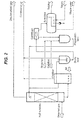
- Fig. 1 is a schematic representation of the main reactions occurring in the Stretford process.
- the hydrogen sulphide containing gas is passed into a scrubber in which H 2 S is absorbed by carbonate, preferably sodium carbonate, at a pH between 8 and 9, and converted into HS - .
- Sodium hygrogen sulphide is then oxidized into S 8 in the presence of a vanadium salt at oxidation state +5.
- This reaction is effected at a pH in the range of 8.5 to 9.5.
- the precipitation of sulphur is relatively fast, depending on the concentration of the vanadate compound.
- the S 8 in solid form may then easily be removed from the solution.
- the vanadium salt is reduced from state +5 to state +4 which is insoluble in water. Citrate is generally added in order to prevent precipitation of vanadium, leading to a water-soluble vanadium complex.
- the vanadium at state +4 is oxidized back into state +5 again by anthraquinone-2,7-disulfonic acid (ADA) which acts as electron acceptor and catalyzes the conversion of sulphides into sulphur.
- ADA in its reduced form may then be oxidized by oxygen (air), e.g. by air bubbling. Air injection simultaneously allows for separation of sulphur fines by flotation.
- a Stretford desulphurization plant generally comprises (i) a scrubber unit in which hydrogen sulphide is removed from the gas to be treated flowing through it, by absorption in an aqueous solution comprising a carbonate absorber, and is further oxidized to elemental sulphur as described above, and (ii) an oxidizer vessel equipped with air injection, in which the elemental sulphur is obtained as a foam or froth while the catalyst is re-oxidized by the oxygen contained in the bubbled air.
- the froth loaded with elemental sulphur is transferred into a slurry tank and sent to a centrifuge for separation of elemental sulphur that may then be further treated, such as in an autoclave.
- the so-called Stretford liquor is withdrawn from said oxidizer vessel and recycled to the scrubber unit.
- the anthraquinone-2,7-disulfonic acid (ADA) catalyst plays an important role in the Stretford process.
- This compound is prepared from anthraquinone and oleum at high temperatures in the presence of a mercury salt. Sulphuric acid vapors are corrosive for the mouth and gastro-intestinal tract. Sulphuric acid is not environmentally friendly. As far as mercury salts are concerned, human exposure to derivatives of mercury is known to cause among others lesions to the gastro-intestinal tract and headache.
- anthraquinone-2,7-disulfonic acid concomitantly produces the 2,6-disulfonic isomer which is far less soluble and needs to be removed prior to use in the Stretford process, thus constituting a major waste material and source of environmental pollution.
- US-3937795 is related to a process for the desulphurization of gases containing hydrogen sulphide, as well as their decyanization and removal of sulfurous acid, in which process naphtoquino chelate compounds are employed on a component of an absorption medium.
- US-4460554 discloses a process for removing hydrogen sulphide from sour gas streams wherein the hydrogen sulphide is brought into contact with a liquid alkaline absorption medium containing a vanadium-boron complex sequestrant capable of oxidizing hydrogen sulphide in the solution to elemental sulphur.
- the solution is regenerated by reoxidizing the reduced vanadium with an oxygen-containing gas in the presence of a reoxidation catalyst.
- the reoxidation catalyst comprises hydroquinone or quinone that contains hydroxyl or keto radicals on the same ring separated by two carbon atoms.
- WO82/01364 discloses a Stretford type process making use of a quinone-free washing solution and an inorganic catalyst.
- FR-1211130 discloses a process for removal of hydrogen sulphide from gas mixtures in the presence of an arsenic based oxidation agent and a catalyst that comprises polyvalent phenol compounds, derivates and oxidation products thereof.
- Hydroquinone and hydroquinone sulfonic acid are cited in an extensive list of possible catalysts. The example makes use of hydroquinone.
- these catalysts are known to cause side reactions and formation of sulphur oxidation products in the absence of free arseniate, and thus are believed suitable as catalysts for the Stretford process when such free arseniate compounds are present.
- RU-2041871 and RU-1660357 concern methods of preparation of hydroquinone-2-sulfonic acid salts.
- the use in gas treatment processes such as a Stretford process is not disclosed.
- US-3509207 describes the preparation of hydroquinone-2-sulfonic acid for use in the pharmaceutical area.
- the present invention thus provides a wet process for desulphurization of gases containing hydrogen sulphide, comprising absorption of hydrogen sulphide in aqueous medium by a carbonate salt, oxidation of hydrogenosulphide into elemental sulphur in the presence of a vanadium compound with concomitant reduction of said vanadium compound, re-oxidation of said vanadium compound in the presence of the couple quinone-2-sulfonic acid/hydroquinone-2-sulfonic acid or quinone-2-phosphoric acid/hydroquinone-2-phosphoric acid or a salt thereof, the substituted hydroquinone compound being re-oxidized in the presence of oxygen.
- the elemental sulphur may be withdrawn from the reaction medium and further treated by means known per se.
- the said vanadium compound advantageously is a vanadate salt at oxidation state +5 which is reduced to oxidation state +4.
- Latter is known to be largely water insoluble and may be maintained in solution by addition of citric acid which is believed to form a water-soluble complex of the +4 vanadium compound.
- Oxygen is advantageously brought into the medium by air bubbling.
- the present invention provides an improved Stretford process in which the couple hydroquinone-2-sulfonic acid/quinone-2-sulfonic acid or a salt thereof is used as the catalyst for re-oxidation of the 4+ vanadium compound.
- the elemental sulphur is found in a foam or froth which may be transferred to a centrifuge and possibly additionally to an autoclave in order to further improve the sulphur product quality for later use.
- the vanadate salt advantageously is the sodium ammonium vanadate.
- the process may be performed in a processing unit comprising a scrubber through which hydrogen sulphide loaded gas is circulated prior to being sent to the atmosphere, and in which the hydrogen sulphide is absorbed into the aqueous medium by a carbonate salt and oxidized into elemental sulphur in the presence of a vanadium compound.
- the aqueous medium loaded with elemental sulphur is circulated to a so-called oxidizer in which air is bubbled preferably from the bottom in order to regenerate the catalyst by re-oxidation of the substituted hydroquinone catalyst and to ease separation by flotation of finely divided elemental sulphur in suspension.
- the foam or froth may be drawn off and transferred to a slurry tank.
- a centrifuge may be arranged for further treatment of the slurry and the recovered elemental sulphur may be transferred to an autoclave.
- the Stretford liquor is withdrawn from the oxidizer, preferably from the top of the oxidizer, as well as from the centrifuge and may be recirculated to the scrubber for further and repeated absorption of hydrogen sulphide from hydrogen sulphide laden gas.
- the catalyst based on quinone-2-sulfonic acid or quinone-2-phosphoric acid or a salt thereof shows an improved efficacy per weight unit as compared to the ADA catalyst. It has been found that for a same level of efficacy, the mass of organic material, that is of catalyst, expressed in parts by weight, can be divided by a factor two.
- benzoquinone-2-sulfonic acid or a salt thereof is preferred.
- the invention catalyst is more water-soluble than ADA. As a result, it may be transported in more concentrated solutions, at reduced freight costs and energy consumption, and thus at reduced environmental fingerprint.
- Quinone-2-sulfonic acid, quinone-2-phosphoric acid and salts thereof show reduced toxicity and better degradability while showing increased efficacy as compared to ADA. These compounds further show essentially no coloring effect on water, thus reducing the environmental impact of waste water that may result from the process.
- the catalyst may be added in its reduced state, as the hydroquinone-2-sulfonic acid, the hydroquinone-2-phosphoric acid or a salt thereof, to the reaction medium contrary to the prior art Stretford process in which the ADA catalyst is added into the medium in its oxidized state, and still provides excellent efficacy.
- hydroquinone-2-sulfonic acid, hydroquinone-2-phosphoric acid and salts thereof are known in the art and the skilled person has preparation processes at hands. It has now been found that hydroquinone-2-sulfonic acid and salts thereof may advantageously be prepared as follows: preparation of a solution of benzoquinone in ethyl acetate or 2-propanol and cooling at approx. 0°C, preparation of a solution of bisulfite in water, mixing both solutions and stirring at a temperature between 0°C and ambient temperature, allowing the mixture to settle, drawing off the aqueous layer. The aqueous layer contains the final product and may be used as such or evaporated in order to isolate the hydroquinone-2-sulfonic acid or salt thereof. The organic layer may be recycled.
- the aqueous layer may be washed at least once with ethyl acetate or propanol, respectively.
- the benzoquinone solution (in organic solvent) is added to the bisulfite aqueous solution under stirring. It has been found that this measure provides an increased yield. Contrary to expectations, the reaction may advantageously be performed at ambient temperature.
- the other components of the mixture used in the Stretford process namely the vanadium salt, such as more specifically sodium ammonium vanadate, the citric acid or salt thereof, more specifically sodium citrate, and carbonate, preferably sodium carbonate, may be added directly into the aqueous layer containing hydroquinone-2-sulphonic acid, hydroquinone-2-phosphoric acid or a salt thereof without prior isolation of those species. This obviously reduces the production costs, the environmental impact and further improves the economics.
- the present invention concerns a wet process for desulphurization of gases containing hydrogen sulphide, more specifically a process by absorption of hydrogen sulphide into an aqueous solution and oxidation thereof into elemental sulphur.
- the process is suitable to treat off-gases from energy producing plants, natural gas, synthesis gas and other industrial off-gases, such as gas from coke works.
- the absorption is advantageously carried out in a scrubber unit.
- the gas to be treated passes through the scrubber unit, is brought into contact with an absorption solution comprising carbonate, preferably sodium carbonate, and is liberated to the atmosphere in a treated state.
- an absorption solution comprising carbonate, preferably sodium carbonate
- oxidation is caused by the presence of a vanadium salt at oxidation state +5, such as sodium ammonium vanadate, which is converted into its reduced form at oxidation state +4, preferably at a pH between 8.5 and 9.5.
- the reduced vanadium compound is known to be insoluble in water but may be maintained in solution by citric acid or a salt thereof which forms a vanadium complex which in turn is water soluble .
- the reduced vanadium compound may be re-oxidized in the presence of an oxido-redox couple selected from quinone-2-sulphonic acid/hydroquinone-2-sulphonic acid or a salt thereof and quinone-2-phosphoric acid/hydroquinone-2-phosphoric acid or a salt thereof.
- the catalyst is preferably added initially in its reduced form, more preferably as hydroquinone-2-sulphonic acid or a salt thereof.
- the counter ion may advantageously be selected from sodium, potassium, ammonium and calcium; sodium is the most preferred.
- the catalyst needs to be regenerated for repeated or further use in the process.
- the process is preferably a continuous process in which the resulting solution is continuously or at regular intervals drawn off and transferred to a reaction vessel in which air is bubbled preferably from the bottom in order to re-oxidize the invention quinone catalyst and to generate a foam or froth at the top that allows for separation of elemental sulphur according to flotation techniques known per se.
- the foam or froth comprises elemental sulphur and may be transferred to a slurry tank and from there to a centrifuge. Further drying may be effected in an autoclave or similar equipment if so desired.
- the liquor in the reaction vessel, which in upper layers contains the catalyst in its oxidized state may be drawn off and recycled for repeated use as absorption solution, back to the scrubber unit. These reactions are carried out at ambient temperature and under ambient pressure.
- hydroquinone-2-sulfonic acid and salts may advantageously be prepared according to the following steps: preparation of a solution of benzoquinone in ethyl acetate or propanol and cooling at approx. 0°C, preparation of a solution of bisulfite in water, mixing both solutions and stirring at a temperature between 0°C and ambient temperature, allowing the mixture to settle, and drawing off the aqueous layer.
- the aqueous layer contains the final product and may be used as such or evaporated in order to isolate the hydroquinone-2-sulfonic acid or salt thereof.
- the organic layer may be recycled.
- the aqueous layer may be washed at least once with ethyl acetate or propanol, respectively.
- the benzoquinone solution in organic solvent
- this sequence of addition provides an increased yield in catalyst. Contrary to expectations, it has been found that the reaction produces the desired product at advantageous yields when performed at ambient temperature.
- the aim of this exercise is to develop a process for the preparation of the sodium salt of hydroquinone-2-sulfonic acid that is environmentally friendly. While it is known to react under acidic conditions sulfuric acid and/or oleum at high temperatures with hydroquinone, or bisulfite with quinone at low temperatures in ether based solvent, it has been found that satisfactory (almost quantitative) yields of the sodium salt of hydroquinone-2-sulphonic acid can be obtained when using ethyl acetate or 2-propanol as solvent for the quinone starting material.
- the process advantageously comprises the preparation of a solution of the hydroquinone or quinone in the said solvent at a temperature between 0°C and ambient temperature, the preparation of a solution of bisulfite in water, slowly adding the organic layer to the aqueous layer under vigorous stirring, and reacting the reagents at ambient temperature.
- a solution of 34 ml of a 33% sodium bisulphite solution in water and 30 ml water has been stirred at ambient temperature in a 500 ml reactor vessel.
- a solution of 15 g benzoquinone in a final volume of 240 ml of ethyl acetate has been added under vigorous stirring. After further stirring for one hour, a pasty mixture is obtained to which 50 ml water has been added in order to homogenize the aqueous layer. The mixture is allowed to settle and produces 128 ml aqueous layer and 224 ml organic layer. From the aqueous layer, a 25 ml sample has been drawn off and evaporated under reduced pressure for infra-red and NMR analyses on the 6.38 g residue.
- the aqueous layer contains 32.67 g of product.
- HPLC analysis of the aqueous layer has shown a mixture of hydroquinonesulfonic acid and hydroquinone (3 %w/w). The dominating presence of hydroquinonesulfonic acid is confirmed by NMR.
- the organic layer contains 0.18 g of product. The NMR results confirm the presence of hydroquinone.
- the aqueous layer contains 687.58 g of product.
- HPLC analysis of the aqueous layer has shown a mixture of hydroquinonesulfonic acid and hydroquinone (6% w/w). The dominating presence of hydroquinonesulfonic acid is confirmed by NMR.
- the organic layer contains 7.76 g of product. HPLC and NMR analysis of the organic layer have confirmed the sole presence of hydroquinone in that layer.
- the organic layer may be recycled for further repeated use in the process, which further reduces the production costs and the environmental impact, and improves the economics. It has been found that under optimized conditions after 4 cycles, the organic layer still contains less than 1.5 w% ethyl acetate.
- Example 2 Use of Hydroxyquinone-2sulfonic acid produced as catalyst in a Stretford process
- a Stretford type reaction system is simulated as follows:
- Example 3 Use of Hydroxyquinone-2sulfonic acid produced as catalyst in a Stretford process
- a solution of 204 ml of a 33% sodium bisulphite solution in water and 180 ml water has been cooled at 4°C in a reactor vessel.
- a solution of 90 g benzoquinone in a final volume of 1440 ml of ethyl acetate has been added under vigorous stirring. After further stirring for one hour, a pasty mixture is obtained to which 600 ml water has been added in order to homogenize the aqueous layer. The mixture is allowed to settle and produces 1090 ml aqueous layer and 1335 ml organic layer. From the aqueous layer, a 25 ml sample has been drawn off and evaporated under reduced pressure for infra-red and NMR analyses on the 4.65 g residue.
- HPLC analysis shows the single presence of hydroquinone sulphonic acid; 223.39 g. This finding is also confirmed by NMR.
- a Stretford type reaction system is simulated as follows:
Landscapes
- Chemical & Material Sciences (AREA)
- Engineering & Computer Science (AREA)
- Organic Chemistry (AREA)
- General Chemical & Material Sciences (AREA)
- Environmental & Geological Engineering (AREA)
- Analytical Chemistry (AREA)
- Health & Medical Sciences (AREA)
- Oil, Petroleum & Natural Gas (AREA)
- Chemical Kinetics & Catalysis (AREA)
- Biomedical Technology (AREA)
- Inorganic Chemistry (AREA)
- Organic Low-Molecular-Weight Compounds And Preparation Thereof (AREA)
- Gas Separation By Absorption (AREA)
- Treating Waste Gases (AREA)
Priority Applications (1)
| Application Number | Priority Date | Filing Date | Title |
|---|---|---|---|
| EP13198447.8A EP2745914A3 (de) | 2012-12-24 | 2013-12-19 | Verfahren zur Entschwefelung von Gasen |
Applications Claiming Priority (2)
| Application Number | Priority Date | Filing Date | Title |
|---|---|---|---|
| EP12199317 | 2012-12-24 | ||
| EP13198447.8A EP2745914A3 (de) | 2012-12-24 | 2013-12-19 | Verfahren zur Entschwefelung von Gasen |
Publications (2)
| Publication Number | Publication Date |
|---|---|
| EP2745914A2 true EP2745914A2 (de) | 2014-06-25 |
| EP2745914A3 EP2745914A3 (de) | 2015-03-25 |
Family
ID=47563106
Family Applications (1)
| Application Number | Title | Priority Date | Filing Date |
|---|---|---|---|
| EP13198447.8A Withdrawn EP2745914A3 (de) | 2012-12-24 | 2013-12-19 | Verfahren zur Entschwefelung von Gasen |
Country Status (2)
| Country | Link |
|---|---|
| US (1) | US20140178280A1 (de) |
| EP (1) | EP2745914A3 (de) |
Cited By (1)
| Publication number | Priority date | Publication date | Assignee | Title |
|---|---|---|---|---|
| CN111847626A (zh) * | 2020-07-27 | 2020-10-30 | 南昌航空大学 | 一种利用催化氧化法对电镀清洗废水中络合态重金属进行预处理的装置及其使用方法 |
Families Citing this family (1)
| Publication number | Priority date | Publication date | Assignee | Title |
|---|---|---|---|---|
| CN109395555A (zh) * | 2018-12-27 | 2019-03-01 | 陈萌 | 一种脱除冶炼烟气中三氧化硫的方法 |
Citations (9)
| Publication number | Priority date | Publication date | Assignee | Title |
|---|---|---|---|---|
| FR1211130A (fr) | 1957-10-07 | 1960-03-14 | Vetrocoke | Perfectionnement au procédé d'élimination de l'hydrogène sulfuré des mélanges gazeux en contenant au moyen de solutions arsénicales |
| US3509207A (en) | 1966-01-20 | 1970-04-28 | Om Lab Sa | Therapeutically active derivatives of p-dihydroxybenzene |
| US3629327A (en) | 1967-11-09 | 1971-12-21 | Om Lab Sa | Lithium salt of hydroquinone sulfonic acid |
| FR2218104A1 (de) | 1973-02-20 | 1974-09-13 | Esteve Labor Dr | |
| US3937795A (en) | 1970-12-21 | 1976-02-10 | Nobuyasu Hasebe | Desulfurizing process for hydrogen sulfide-containing gases |
| WO1982001364A1 (en) | 1980-10-14 | 1982-04-29 | Oil Co Union | Method for removing hydrogen sulfide from gas streams |
| US4460554A (en) | 1983-03-31 | 1984-07-17 | Purtec Systems, Inc. | Method of removing H2 S from a gas stream utilizing boron-vanadium, quinone solution and iron scavaging composition |
| RU1660357C (ru) | 1989-12-13 | 1994-09-30 | Всесоюзный научный центр по безопасности биологически активных соединений | Способ получения диэтиламмониевой соли гидрохинонсульфокислоты |
| RU2041871C1 (ru) | 1988-06-01 | 1995-08-20 | ЭЙСАЙ КО, Лтд. | Производные бутеновой или пропеновой кислоты |
Family Cites Families (3)
| Publication number | Priority date | Publication date | Assignee | Title |
|---|---|---|---|---|
| GB1488659A (en) * | 1974-01-18 | 1977-10-12 | British Gas Corp | Gas and non-polar liquid purification |
| US4243648A (en) * | 1979-06-20 | 1981-01-06 | Union Oil Company Of California | Method for removing hydrogen sulfide from gas streams |
| US4432962A (en) * | 1979-06-20 | 1984-02-21 | Union Oil Company Of California | Method for removing hydrogen sulfide from gas streams |
-
2013
- 2013-12-19 EP EP13198447.8A patent/EP2745914A3/de not_active Withdrawn
- 2013-12-20 US US14/135,738 patent/US20140178280A1/en not_active Abandoned
Patent Citations (9)
| Publication number | Priority date | Publication date | Assignee | Title |
|---|---|---|---|---|
| FR1211130A (fr) | 1957-10-07 | 1960-03-14 | Vetrocoke | Perfectionnement au procédé d'élimination de l'hydrogène sulfuré des mélanges gazeux en contenant au moyen de solutions arsénicales |
| US3509207A (en) | 1966-01-20 | 1970-04-28 | Om Lab Sa | Therapeutically active derivatives of p-dihydroxybenzene |
| US3629327A (en) | 1967-11-09 | 1971-12-21 | Om Lab Sa | Lithium salt of hydroquinone sulfonic acid |
| US3937795A (en) | 1970-12-21 | 1976-02-10 | Nobuyasu Hasebe | Desulfurizing process for hydrogen sulfide-containing gases |
| FR2218104A1 (de) | 1973-02-20 | 1974-09-13 | Esteve Labor Dr | |
| WO1982001364A1 (en) | 1980-10-14 | 1982-04-29 | Oil Co Union | Method for removing hydrogen sulfide from gas streams |
| US4460554A (en) | 1983-03-31 | 1984-07-17 | Purtec Systems, Inc. | Method of removing H2 S from a gas stream utilizing boron-vanadium, quinone solution and iron scavaging composition |
| RU2041871C1 (ru) | 1988-06-01 | 1995-08-20 | ЭЙСАЙ КО, Лтд. | Производные бутеновой или пропеновой кислоты |
| RU1660357C (ru) | 1989-12-13 | 1994-09-30 | Всесоюзный научный центр по безопасности биологически активных соединений | Способ получения диэтиламмониевой соли гидрохинонсульфокислоты |
Cited By (1)
| Publication number | Priority date | Publication date | Assignee | Title |
|---|---|---|---|---|
| CN111847626A (zh) * | 2020-07-27 | 2020-10-30 | 南昌航空大学 | 一种利用催化氧化法对电镀清洗废水中络合态重金属进行预处理的装置及其使用方法 |
Also Published As
| Publication number | Publication date |
|---|---|
| EP2745914A3 (de) | 2015-03-25 |
| US20140178280A1 (en) | 2014-06-26 |
Similar Documents
| Publication | Publication Date | Title |
|---|---|---|
| US3644087A (en) | Process for scrubbing sulfur dioxide from a gas stream | |
| US4163043A (en) | Process for removing H2 S and CO2 from gases and regenerating the adsorbing solution | |
| US4133650A (en) | Removing sulfur dioxide from exhaust air | |
| AU2011201818B2 (en) | Process for preparation of calcium thiosulfate liquid solution from lime, sulfur, and sulfur dioxide | |
| AU2010224320A1 (en) | Process for conversion of waste fluid streams from chemical processing plants to beneficiary agriculture products | |
| US20030072707A1 (en) | Process for aqueous phase oxidation of sulfur or sulfide to thiosulfate, bisulfite or sulfite ions using air | |
| CN103030207A (zh) | 一种氧化法处理氨法脱硫废液的方法 | |
| JPS60153921A (ja) | サワーh↓2s含有気体流からのh↓2sの除去方法 | |
| Mazurek et al. | Application of sulphate and magnesium enriched waste rapeseed cake biochar for recovery of Cu (II) and Zn (II) from industrial wastewater generated in sulphuric acid plants | |
| IT8922189A1 (it) | Rimozione di acido solfidrico da correnti di fluidi con produzione minima di sostanze solide | |
| EP2745914A2 (de) | Verfahren zur Entschwefelung von Gasen | |
| US3882222A (en) | Process for purifying a gas containing oxygenated sulfur compounds and recovering sulfur using ammonia liquors | |
| CA2589666C (en) | Process for the recovery of elemental sulphur from residues produced in hydrometallurgical processes | |
| EP0002880B1 (de) | Regenerierung einer Absorptionslösung | |
| CA1076273A (en) | Oxidation of waste water containing sulphide, sulphite and/or thiosulphate | |
| AU696509B2 (en) | Process for removing SO2 from gases which contain it, with direct production of elemental sulfur | |
| US4267162A (en) | Process and apparatus for the exploitation of the sulfur compounds contained in gases containing oxygen and a high water vapor content | |
| US1401937A (en) | Purification of maleic acid by reducing agents | |
| US3535083A (en) | Gas purification | |
| US3954955A (en) | Process for working up the wash solution obtained in the washing of SO2 -containing off-gases | |
| US3966891A (en) | Process for manufacturing sulfur from a solution of sodium sulfite | |
| US4861577A (en) | Method for removing the sulphur content of a weak gas containing sulfur dioxide | |
| US2972512A (en) | Method of removing hydrogen sulphide from gases and recovering sulphur therefrom | |
| US3095276A (en) | Production of sulfur | |
| CA2255483A1 (en) | Method for recovering sulfuric acid from sulfurous by-products of a process for preparing 2-hydroxy-4-methylthiobutyric acid (mha) |
Legal Events
| Date | Code | Title | Description |
|---|---|---|---|
| PUAI | Public reference made under article 153(3) epc to a published international application that has entered the european phase |
Free format text: ORIGINAL CODE: 0009012 |
|
| 17P | Request for examination filed |
Effective date: 20131219 |
|
| AK | Designated contracting states |
Kind code of ref document: A2 Designated state(s): AL AT BE BG CH CY CZ DE DK EE ES FI FR GB GR HR HU IE IS IT LI LT LU LV MC MK MT NL NO PL PT RO RS SE SI SK SM TR |
|
| AX | Request for extension of the european patent |
Extension state: BA ME |
|
| RIC1 | Information provided on ipc code assigned before grant |
Ipc: C01B 17/05 20060101ALI20141006BHEP Ipc: B01D 53/52 20060101AFI20141006BHEP |
|
| PUAL | Search report despatched |
Free format text: ORIGINAL CODE: 0009013 |
|
| AK | Designated contracting states |
Kind code of ref document: A3 Designated state(s): AL AT BE BG CH CY CZ DE DK EE ES FI FR GB GR HR HU IE IS IT LI LT LU LV MC MK MT NL NO PL PT RO RS SE SI SK SM TR |
|
| AX | Request for extension of the european patent |
Extension state: BA ME |
|
| RIC1 | Information provided on ipc code assigned before grant |
Ipc: C01B 17/05 20060101ALI20150218BHEP Ipc: B01D 53/52 20060101AFI20150218BHEP |
|
| STAA | Information on the status of an ep patent application or granted ep patent |
Free format text: STATUS: THE APPLICATION IS DEEMED TO BE WITHDRAWN |
|
| 18D | Application deemed to be withdrawn |
Effective date: 20150925 |