EP2745933A1 - Wabenstruktur, herstellungsverfahren dafür, abgasreinigungsvorrichtung und silicoaluminophosphatteilchen - Google Patents
Wabenstruktur, herstellungsverfahren dafür, abgasreinigungsvorrichtung und silicoaluminophosphatteilchen Download PDFInfo
- Publication number
- EP2745933A1 EP2745933A1 EP11870891.6A EP11870891A EP2745933A1 EP 2745933 A1 EP2745933 A1 EP 2745933A1 EP 11870891 A EP11870891 A EP 11870891A EP 2745933 A1 EP2745933 A1 EP 2745933A1
- Authority
- EP
- European Patent Office
- Prior art keywords
- silicoaluminophosphate particles
- range
- honeycomb structure
- honeycomb
- concentration
- Prior art date
- Legal status (The legal status is an assumption and is not a legal conclusion. Google has not performed a legal analysis and makes no representation as to the accuracy of the status listed.)
- Granted
Links
Images


Classifications
-
- B—PERFORMING OPERATIONS; TRANSPORTING
- B01—PHYSICAL OR CHEMICAL PROCESSES OR APPARATUS IN GENERAL
- B01D—SEPARATION
- B01D53/00—Separation of gases or vapours; Recovering vapours of volatile solvents from gases; Chemical or biological purification of waste gases, e.g. engine exhaust gases, smoke, fumes, flue gases, aerosols
- B01D53/02—Separation of gases or vapours; Recovering vapours of volatile solvents from gases; Chemical or biological purification of waste gases, e.g. engine exhaust gases, smoke, fumes, flue gases, aerosols by adsorption, e.g. preparative gas chromatography
- B01D53/04—Separation of gases or vapours; Recovering vapours of volatile solvents from gases; Chemical or biological purification of waste gases, e.g. engine exhaust gases, smoke, fumes, flue gases, aerosols by adsorption, e.g. preparative gas chromatography with stationary adsorbents
- B01D53/0407—Constructional details of adsorbing systems
-
- B—PERFORMING OPERATIONS; TRANSPORTING
- B01—PHYSICAL OR CHEMICAL PROCESSES OR APPARATUS IN GENERAL
- B01J—CHEMICAL OR PHYSICAL PROCESSES, e.g. CATALYSIS OR COLLOID CHEMISTRY; THEIR RELEVANT APPARATUS
- B01J29/00—Catalysts comprising molecular sieves
- B01J29/82—Phosphates
- B01J29/84—Aluminophosphates containing other elements, e.g. metals, boron
- B01J29/85—Silicoaluminophosphates [SAPO compounds]
-
- B—PERFORMING OPERATIONS; TRANSPORTING
- B01—PHYSICAL OR CHEMICAL PROCESSES OR APPARATUS IN GENERAL
- B01D—SEPARATION
- B01D53/00—Separation of gases or vapours; Recovering vapours of volatile solvents from gases; Chemical or biological purification of waste gases, e.g. engine exhaust gases, smoke, fumes, flue gases, aerosols
- B01D53/34—Chemical or biological purification of waste gases
- B01D53/92—Chemical or biological purification of waste gases of engine exhaust gases
- B01D53/94—Chemical or biological purification of waste gases of engine exhaust gases by catalytic processes
- B01D53/9404—Removing only nitrogen compounds
- B01D53/9409—Nitrogen oxides
- B01D53/9413—Processes characterised by a specific catalyst
- B01D53/9418—Processes characterised by a specific catalyst for removing nitrogen oxides by selective catalytic reduction [SCR] using a reducing agent in a lean exhaust gas
-
- B—PERFORMING OPERATIONS; TRANSPORTING
- B01—PHYSICAL OR CHEMICAL PROCESSES OR APPARATUS IN GENERAL
- B01J—CHEMICAL OR PHYSICAL PROCESSES, e.g. CATALYSIS OR COLLOID CHEMISTRY; THEIR RELEVANT APPARATUS
- B01J35/00—Catalysts, in general, characterised by their form or physical properties
- B01J35/40—Catalysts, in general, characterised by their form or physical properties characterised by dimensions, e.g. grain size
-
- B—PERFORMING OPERATIONS; TRANSPORTING
- B01—PHYSICAL OR CHEMICAL PROCESSES OR APPARATUS IN GENERAL
- B01J—CHEMICAL OR PHYSICAL PROCESSES, e.g. CATALYSIS OR COLLOID CHEMISTRY; THEIR RELEVANT APPARATUS
- B01J35/00—Catalysts, in general, characterised by their form or physical properties
- B01J35/50—Catalysts, in general, characterised by their form or physical properties characterised by their shape or configuration
- B01J35/56—Foraminous structures having flow-through passages or channels, e.g. grids or three-dimensional [3D] monoliths
- B01J35/57—Honeycombs
-
- B—PERFORMING OPERATIONS; TRANSPORTING
- B29—WORKING OF PLASTICS; WORKING OF SUBSTANCES IN A PLASTIC STATE IN GENERAL
- B29C—SHAPING OR JOINING OF PLASTICS; SHAPING OF MATERIAL IN A PLASTIC STATE, NOT OTHERWISE PROVIDED FOR; AFTER-TREATMENT OF THE SHAPED PRODUCTS, e.g. REPAIRING
- B29C48/00—Extrusion moulding, i.e. expressing the moulding material through a die or nozzle which imparts the desired form; Apparatus therefor
- B29C48/03—Extrusion moulding, i.e. expressing the moulding material through a die or nozzle which imparts the desired form; Apparatus therefor characterised by the shape of the extruded material at extrusion
- B29C48/09—Articles with cross-sections having partially or fully enclosed cavities, e.g. pipes or channels
- B29C48/11—Articles with cross-sections having partially or fully enclosed cavities, e.g. pipes or channels comprising two or more partially or fully enclosed cavities, e.g. honeycomb-shaped
-
- C—CHEMISTRY; METALLURGY
- C01—INORGANIC CHEMISTRY
- C01B—NON-METALLIC ELEMENTS; COMPOUNDS THEREOF; METALLOIDS OR COMPOUNDS THEREOF NOT COVERED BY SUBCLASS C01C
- C01B37/00—Compounds having molecular sieve properties but not having base-exchange properties
- C01B37/06—Aluminophosphates containing other elements, e.g. metals, boron
- C01B37/08—Silicoaluminophosphates [SAPO compounds], e.g. CoSAPO
-
- C—CHEMISTRY; METALLURGY
- C01—INORGANIC CHEMISTRY
- C01B—NON-METALLIC ELEMENTS; COMPOUNDS THEREOF; METALLOIDS OR COMPOUNDS THEREOF NOT COVERED BY SUBCLASS C01C
- C01B39/00—Compounds having molecular sieve and base-exchange properties, e.g. crystalline zeolites; Their preparation; After-treatment, e.g. ion-exchange or dealumination
- C01B39/54—Phosphates, e.g. APO or SAPO compounds
-
- C—CHEMISTRY; METALLURGY
- C04—CEMENTS; CONCRETE; ARTIFICIAL STONE; CERAMICS; REFRACTORIES
- C04B—LIME, MAGNESIA; SLAG; CEMENTS; COMPOSITIONS THEREOF, e.g. MORTARS, CONCRETE OR LIKE BUILDING MATERIALS; ARTIFICIAL STONE; CERAMICS; REFRACTORIES; TREATMENT OF NATURAL STONE
- C04B35/00—Shaped ceramic products characterised by their composition; Ceramics compositions; Processing powders of inorganic compounds preparatory to the manufacturing of ceramic products
- C04B35/622—Forming processes; Processing powders of inorganic compounds preparatory to the manufacturing of ceramic products
- C04B35/64—Burning or sintering processes
- C04B35/65—Reaction sintering of free metal- or free silicon-containing compositions
-
- B—PERFORMING OPERATIONS; TRANSPORTING
- B01—PHYSICAL OR CHEMICAL PROCESSES OR APPARATUS IN GENERAL
- B01D—SEPARATION
- B01D2251/00—Reactants
- B01D2251/20—Reductants
- B01D2251/206—Ammonium compounds
- B01D2251/2062—Ammonia
-
- B—PERFORMING OPERATIONS; TRANSPORTING
- B01—PHYSICAL OR CHEMICAL PROCESSES OR APPARATUS IN GENERAL
- B01D—SEPARATION
- B01D2251/00—Reactants
- B01D2251/20—Reductants
- B01D2251/206—Ammonium compounds
- B01D2251/2067—Urea
-
- B—PERFORMING OPERATIONS; TRANSPORTING
- B01—PHYSICAL OR CHEMICAL PROCESSES OR APPARATUS IN GENERAL
- B01D—SEPARATION
- B01D2255/00—Catalysts
- B01D2255/20—Metals or compounds thereof
- B01D2255/207—Transition metals
- B01D2255/20738—Iron
-
- B—PERFORMING OPERATIONS; TRANSPORTING
- B01—PHYSICAL OR CHEMICAL PROCESSES OR APPARATUS IN GENERAL
- B01D—SEPARATION
- B01D2255/00—Catalysts
- B01D2255/20—Metals or compounds thereof
- B01D2255/207—Transition metals
- B01D2255/20761—Copper
-
- B—PERFORMING OPERATIONS; TRANSPORTING
- B01—PHYSICAL OR CHEMICAL PROCESSES OR APPARATUS IN GENERAL
- B01D—SEPARATION
- B01D2255/00—Catalysts
- B01D2255/50—Zeolites
-
- B—PERFORMING OPERATIONS; TRANSPORTING
- B01—PHYSICAL OR CHEMICAL PROCESSES OR APPARATUS IN GENERAL
- B01D—SEPARATION
- B01D2255/00—Catalysts
- B01D2255/90—Physical characteristics of catalysts
- B01D2255/92—Dimensions
- B01D2255/9202—Linear dimensions
-
- B—PERFORMING OPERATIONS; TRANSPORTING
- B01—PHYSICAL OR CHEMICAL PROCESSES OR APPARATUS IN GENERAL
- B01D—SEPARATION
- B01D2255/00—Catalysts
- B01D2255/90—Physical characteristics of catalysts
- B01D2255/92—Dimensions
- B01D2255/9205—Porosity
-
- B—PERFORMING OPERATIONS; TRANSPORTING
- B01—PHYSICAL OR CHEMICAL PROCESSES OR APPARATUS IN GENERAL
- B01D—SEPARATION
- B01D2255/00—Catalysts
- B01D2255/90—Physical characteristics of catalysts
- B01D2255/92—Dimensions
- B01D2255/9207—Specific surface
-
- B—PERFORMING OPERATIONS; TRANSPORTING
- B01—PHYSICAL OR CHEMICAL PROCESSES OR APPARATUS IN GENERAL
- B01J—CHEMICAL OR PHYSICAL PROCESSES, e.g. CATALYSIS OR COLLOID CHEMISTRY; THEIR RELEVANT APPARATUS
- B01J2229/00—Aspects of molecular sieve catalysts not covered by B01J29/00
- B01J2229/30—After treatment, characterised by the means used
- B01J2229/42—Addition of matrix or binder particles
-
- B—PERFORMING OPERATIONS; TRANSPORTING
- B29—WORKING OF PLASTICS; WORKING OF SUBSTANCES IN A PLASTIC STATE IN GENERAL
- B29C—SHAPING OR JOINING OF PLASTICS; SHAPING OF MATERIAL IN A PLASTIC STATE, NOT OTHERWISE PROVIDED FOR; AFTER-TREATMENT OF THE SHAPED PRODUCTS, e.g. REPAIRING
- B29C48/00—Extrusion moulding, i.e. expressing the moulding material through a die or nozzle which imparts the desired form; Apparatus therefor
- B29C48/022—Extrusion moulding, i.e. expressing the moulding material through a die or nozzle which imparts the desired form; Apparatus therefor characterised by the choice of material
-
- Y—GENERAL TAGGING OF NEW TECHNOLOGICAL DEVELOPMENTS; GENERAL TAGGING OF CROSS-SECTIONAL TECHNOLOGIES SPANNING OVER SEVERAL SECTIONS OF THE IPC; TECHNICAL SUBJECTS COVERED BY FORMER USPC CROSS-REFERENCE ART COLLECTIONS [XRACs] AND DIGESTS
- Y10—TECHNICAL SUBJECTS COVERED BY FORMER USPC
- Y10T—TECHNICAL SUBJECTS COVERED BY FORMER US CLASSIFICATION
- Y10T428/00—Stock material or miscellaneous articles
- Y10T428/24—Structurally defined web or sheet [e.g., overall dimension, etc.]
- Y10T428/24149—Honeycomb-like
-
- Y—GENERAL TAGGING OF NEW TECHNOLOGICAL DEVELOPMENTS; GENERAL TAGGING OF CROSS-SECTIONAL TECHNOLOGIES SPANNING OVER SEVERAL SECTIONS OF THE IPC; TECHNICAL SUBJECTS COVERED BY FORMER USPC CROSS-REFERENCE ART COLLECTIONS [XRACs] AND DIGESTS
- Y10—TECHNICAL SUBJECTS COVERED BY FORMER USPC
- Y10T—TECHNICAL SUBJECTS COVERED BY FORMER US CLASSIFICATION
- Y10T428/00—Stock material or miscellaneous articles
- Y10T428/29—Coated or structually defined flake, particle, cell, strand, strand portion, rod, filament, macroscopic fiber or mass thereof
- Y10T428/2982—Particulate matter [e.g., sphere, flake, etc.]
Definitions
- the present invention relates to a honeycomb structure, a method for manufacturing the honeycomb structure, an exhaust gas purifying apparatus and silicoaluminophosphate particles.
- SCR selective catalytic reduction
- zeolite is known as a material that adsorbs ammonia in the selective catalytic reduction system.
- PTL 1 discloses a honeycomb structure including a honeycomb unit that contains zeolite, an inorganic fiber and/or whisker, and an inorganic binder.
- SAPO-34 is known as zeolite having excellent NOx purification performance.
- SAPO-34 contracts or expands due to the adsorption or desorption of water, which causes a change in the lattice constant. Therefore, in the honeycomb structure including honeycomb unit that contains SAPO-34, there is a problem in that the honeycomb unit is easily broken due to SAPO-34 adsorbing or desorbing water.
- the invention has been made in consideration of the problem of the related art, and an object of the invention is to provide a honeycomb structure that has excellent NOx purification performance and can suppress the breakage of a honeycomb unit due to the adsorption or desorption of water, a method for manufacturing the honeycomb structure, and an exhaust gas purifying apparatus including the honeycomb structure.
- Another object of the invention is to provide silicoaluminophosphate particles that have excellent NOx purification performance and can suppress water adsorption-caused contraction and water desorption-caused expansion.
- a honeycomb structure including a honeycomb unit provided with a plurality of through holes arrayed in a longitudinal direction with a partition wall therebetween, in which the honeycomb unit is produced by extruding and firing raw material paste containing silicoaluminophosphate particles and an inorganic binder, and the silicoaluminophosphate particles have a ratio of an amount of Si to a sum of amounts of Al and P in a range of 0.16 to 0.33, a specific surface area in a range of 200 m 2 /g to 400 m 2 /g, and an average diameter of original silicoaluminophosphate particles in a range of 2.0 ⁇ m to 6.0 ⁇ m.
- the silicoaluminophosphate particles are desirably ion-exchanged with copper ions and/or iron ions.
- a content of the silicoaluminophosphate particles per apparent volume is desirably in a range of 230 g/L to 360 g/L.
- the apparent volume refers to a volume of an outer circumference including a volume of voids.
- the inorganic binder is desirably a solid content contained in one or more selected from a group consisting of an alumina sol, a silica sol, a titania sol, water glass, sepiolite, attapulgite and boehmite.
- the raw material paste desirably further contains one or more selected from a group consisting of inorganic fibers, scale-like substances, tetrapot-like substances and three dimensional needle-like substances.
- the inorganic fiber is desirably one or more selected from a group consisting of alumina, silica, silicon carbide, silica alumina, glass, potassium titanate and aluminum borate
- the scale-like substance is desirably one or more selected from a group consisting of glass, muscovite, alumina and silica
- the tetrapot-like substance is desirably zinc oxide
- the three dimensional needle-like substance is desirably one or more selected from a group consisting of alumina, silica, silicon carbide, silica alumina, glass, potassium titanate, aluminum borate and boehmite.
- the honeycomb structure of the invention desirably includes a plurality of the honeycomb units.
- a NOx purification rate is desirably 85% or more in a case in which 200°C-hot simulant gas is made to flow into the honeycomb structure so that a space velocity becomes 80000/h
- the space velocity is desirably a ratio of a flow rate [m 3 /h] of the simulant gas to an apparent volume [m 3 ] of the honeycomb structure
- the simulant gas desirably contains nitrogen monoxide at a concentration of 350 ppm, ammonia at a concentration of 350 ppm, oxygen at a concentration of 10%, water at a concentration of 5% and carbon dioxide at a concentration of 5% with a balance of nitrogen.
- a method for manufacturing a honeycomb structure including a honeycomb unit provided with a plurality of through holes arrayed in a longitudinal direction with a partition wall therebetween.
- the method includes a step of extruding raw material paste containing silicoaluminophosphate particles and an inorganic binder; and a step of firing the extruded raw material paste so as to produce the honeycomb unit, in which the silicoaluminophosphate particles have a ratio of an amount of Si to a sum of amounts of Al and P in a range of 0.16 to 0.33, a specific surface area in a range of 200 m 2 /g to 400 m 2 /g, and an average diameter of original silicoaluminophosphate particles in a range of 2 ⁇ m to 6 ⁇ m.
- a concentration of oxygen is in a range of 1% to 10%
- a temperature at which the extruded raw material paste is fired is in a range of 600°C to 1000°C
- a time during which the extruded raw material paste is fired is in a range of 7 hours to 10 hours.
- an exhaust gas purifying apparatus accommodated in a metal container in a state in which a holding seal material is disposed on an outer circumferential surface of the honeycomb structure of the invention excluding both end surfaces.
- silicoaluminophosphate particles in which a ratio of an amount of Si to a sum of amounts of Al and P is in a range of 0.16 to 0.33, a specific surface area is in a range of 200 m 2 /g to 400 m 2 /g, and an average diameter of original silicoaluminophosphate particles is in a range of 2.0 ⁇ m to 6.0 ⁇ m.
- the honeycomb structure that has excellent NOx purification performance and can suppress the breakage of a honeycomb unit due to the adsorption or desorption of water, a method for manufacturing the honeycomb structure, and an exhaust gas purifying apparatus including the honeycomb structure.
- silicoaluminophosphate particles that have excellent NOx purification performance and can suppress water adsorption-caused contraction and water desorption-caused expansion.
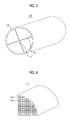
- FIG. 1 illustrates an example of a honeycomb structure of the invention.
- a honeycomb structure 10 includes a sole honeycomb unit 11 provided with a plurality of through holes 11a arrayed in a longitudinal direction with a partition wall 11b therebetween.
- the honeycomb unit 11 is produced by extruding and firing raw material paste containing silicoaluminophosphate (SAPO) particles and an inorganic binder.
- SAPO silicoaluminophosphate
- an outer circumference coating layer 12 is formed on an outer circumferential surface of the honeycomb unit 11 excluding both end surfaces.
- the silicoaluminophosphate particles refer to the silicoaluminophosphate particles contained in the raw material paste.
- the ratio of the amount of Si to the sum of the amounts of Al and P is in a range of 0.16 to 0.33, preferably in a range of 0.16 to 0.28, more preferably in a range of 0.20 to 0.28, and still more preferably 0.22 to 0.26.
- the ratio of the amount of Si to the sum of the amounts of Al and P in the silicoaluminophosphate particles is less than 0.16, it becomes difficult to suppress the water adsorption-caused contraction and water desorption-caused expansion of the silicoaluminophosphate particles.
- the ratio of the amount of Si to the sum of the amounts of Al and P in the silicoaluminophosphate particles exceeds 0.33, the silicoaluminophosphate particles become amorphous, and it becomes difficult to produce the honeycomb unit 11.
- the ratio (molar ratio) of the amount [mol] of Si to the sum of the amounts [mol] of Al and P in the silicoaluminophosphate particles can be measured using energy dispersive X-ray spectroscopy (EDS).
- EDS energy dispersive X-ray spectroscopy
- the specific surface area of the silicoaluminophosphate particles is in a range of 200 m 2 /g to 400 m 2 /g, preferably in a range of 210 m 2 /g to 385 m 2 /g, more preferably in a range of 250 m 2 /g to 360 m 2 /g, and still more preferably in a range of 280 m 2 /g to 330 m 2 /g.
- the specific surface area of the silicoaluminophosphate particles is less than 200 m 2 /g, since the number of pores in the honeycomb unit 11 decreases, exhaust gas cannot easily infiltrate into an inside of the partition wall 11b in the honeycomb unit 11, and it becomes impossible to effectively use the silicoaluminophosphate particles for NOx purification.
- the specific surface area of the silicoaluminophosphate particles exceeds 400 m 2 /g, it becomes difficult to suppress the water adsorption-caused contraction and water desorption-caused expansion of the silicoaluminophosphate particles.
- the specific surface area of the silicoaluminophosphate particles is approximately 500 m 2 /g; however, in the invention, it is possible to set the specific surface area of the silicoaluminophosphate particles to 400 m 2 /g or less by carrying out an alkali treatment on the silicoaluminophosphate particles so as to make some of crystals amorphous.
- An alkali used in the alkali treatment is not particularly limited, and examples thereof include ammonia, sodium hydroxide and the like.
- the specific surface area of the silicoaluminophosphate particles can be measured using a BET multipoint method (N 2 adsorption method).
- a BET multipoint method N 2 adsorption method
- an automatic surface area and porosimetry analyzer TriStar-3000 manufactured by Shimadzu Corporation
- the average diameter of original silicoaluminophosphate particles of the silicoaluminophosphate particles is in a range of 2.0 ⁇ m to 6.0 ⁇ m, preferably in a range of 3.0 ⁇ m to 5.0 ⁇ m, and more preferably in a range of 3.5 ⁇ m to 4.5 ⁇ m.
- exhaust gas cannot easily infiltrate into the inside of the partition wall 11b, and it becomes impossible to effectively use the silicoaluminophosphate particles for NOx purification.
- the porosity of the honeycomb unit 11 increases such that the strength of the honeycomb unit 11 decreases or the specific surface area of the silicoaluminophosphate particles decreases such that NOx purification performance degrades.
- the average diameter of original silicoaluminophosphate particles of the silicoaluminophosphate particles is approximately 20 ⁇ m, but the average diameter of original silicoaluminophosphate particles can be decreased by crushing the silicoaluminophosphate particles.
- the average diameter of original silicoaluminophosphate particles of the silicoaluminophosphate particles can be measured using a laser diffraction-type particle size distribution analyzer.
- the silicoaluminophosphate particles preferable have a ratio of the amount of Si to the sum of the amounts of Al and P in a range of 0.16 to 0.28, a specific surface area in a range of 210 m 2 /g to 385 m 2 /g, and an average diameter of original silicoaluminophosphate particles in a range of 2.0 ⁇ m to 6.0 ⁇ m. Then, it is possible to obtain a honeycomb structure 10 that has excellent NOx purification performance and can further suppress the breakage of a honeycomb unit due to the adsorption or desorption of water.
- the silicoaluminophosphate particles can be produced by adding phosphoric acid, aluminum hydroxide, silica and a structure directing agent (SDA) to water so as to produce a precursor gel, and then carrying out heating and an alkali treatment on the precursor gel.
- SDA structure directing agent
- the structure directing agent refers to a mold used to form a fine regular structure when producing the silicoaluminophosphate particles.
- the structure directing agent is not particularly limited, examples thereof include morpholine, diethylamine, tetraethylammonium hydroxide, triethylamine and the like, and two or more structure directing agents may be jointly used.
- the silicoaluminophosphate particles are preferably ion-exchanged with copper ions and/or iron ions in consideration of NOx purification performance.
- the ion exchange amount is preferably in a range of 1.0% by mass to 5.0% by mass.
- the ion exchange amount of the silicoaluminophosphate particles is less than 1.0% by mass, the effect that improves NOx purification performance becomes small.
- the ion exchange amount of the silicoaluminophosphate particles exceeds 5.0% by mass, hydrothermal durability degrades, and NOx purification performance degrades at a high temperature of, for example, 500°C or higher.
- the silicoaluminophosphate particles may be ion-exchanged with other metallic ions.
- the content of the silicoaluminophosphate particles per apparent volume is preferably in a range of 230 g/L to 360 g/L.
- the content of the silicoaluminophosphate particles per apparent volume of the honeycomb unit 11 is less than 230 g/L, it is necessary to increase the apparent volume of the honeycomb unit 11 in order to improve NOx purification performance.
- the content of the silicoaluminophosphate particles per apparent volume of the honeycomb unit 11 exceeds 360 g/L, the strength of the honeycomb unit 11 becomes insufficient, or the aperture ratio of the honeycomb unit 11 becomes small.
- the apparent volume refers to the volume of the outer circumference including the volume of voids.
- the inorganic binder contained in the raw material paste is not particularly limited, examples thereof include solid contents contained in an alumina sol, a silica sol, a titania sol, water glass, sepiolite, attapulgite, boehmite and the like, and two or more inorganic binders may be jointly used.
- the content of the inorganic binder contained in the solid content of the raw material paste is preferably in a range of 5% by mass to 30% by mass, and more preferably in a range of 10% by mass to 20% by mass.
- the content of the inorganic binder in the solid content of the raw material paste is less than 5% by mass, the strength of the honeycomb unit 11 decreases.
- the content of the solid content of the inorganic binder contained in the solid content of the raw material paste exceeds 30% by mass, it becomes difficult to extrude the honeycomb unit 11.
- the raw material paste preferably further contains one or more selected from a group consisting of inorganic fibers, scale-like substances, tetrapot-like substances and three dimensional needle-like substances in order to improve the strength of the honeycomb unit 11.
- a material that configures the inorganic fiber contained in the raw material paste is not particularly limited, examples thereof include alumina, silica, silicon carbide, silica alumina, glass, potassium titanate, aluminum borate and the like, and two or more materials may be jointly used.
- the aspect ratio of the inorganic fiber contained in the raw material paste is preferably in a range of 2 to 1000, more preferably in a range of 5 to 800, and still more preferably in a range of 10 to 500.
- the aspect ratio of the inorganic fiber contained in the raw material paste is smaller than 2, the effect that improves the strength of the honeycomb unit 11 becomes small.
- the aspect ratio of the inorganic fiber contained in the raw material paste exceeds 1000, clogging and the like occur in a mold when extruding the honeycomb unit 11 or the inorganic fiber breaks such that the effect that improves the strength of the honeycomb unit 11 becomes small.
- the scale-like substance refers to a flat substance
- the thickness is preferably in a range of 0.2 ⁇ m to 5.0 ⁇ m
- the maximum length is preferably in a range of 10 ⁇ m to 160 ⁇ m
- the ratio of the maximum length to the thickness is preferably in a range of 3 to 250.
- a material that configures the scale-like substance contained in the raw material paste is not particularly limited, examples thereof include glass, muscovite, alumina, silica and the like, and two or more materials may be jointly used.
- the tetrapot-like substance refers to a substance in which a needle-like portion three-dimensionally extends, the average length of the needle shapes in the needle-like portion is preferably in a range of 5 ⁇ m to 30 ⁇ m, and the average diameter of the needle-like portion is preferably in a range of 0.5 ⁇ m to 5.0 ⁇ m.
- a material that configures the tetrapot-like substance contained in the raw material paste is not particularly limited, examples thereof include zinc oxide, and two or more materials may be jointly used.
- the three dimensional needle-like substance refers to a substance in which needle-like portions are bonded to each other near the centers of the respective needle-like portions through an inorganic compound such as glass, the average length of the needle shapes in the needle-like portion is preferably in a range of 5 ⁇ m to 30 ⁇ m, and the average diameter of the needle-like portion is preferably in a range of 0.5 ⁇ m to 5.0 ⁇ m.
- the diameter of the needle-like portion is preferably in a range of 0.1 ⁇ m to 5.0 ⁇ m
- the length is preferably in a range of 0.3 ⁇ m to 30.0 ⁇ m
- the ratio of the length to the diameter is preferably in a range of 1.4 to 50.0.
- a material that configures the three dimensional needle-like substance contained in the raw material paste is not particularly limited, examples thereof include alumina, silica, silicon carbide, silica alumina, glass, potassium titanate, aluminum borate, boehmite and the like, and two or more materials may be jointly used.
- the content of the inorganic fibers, the scale-like substances, the tetrapot-like substances and the three dimensional needle-like substances in the solid content of the raw material paste is preferably in a range of 3% by mass to 50% by mass, more preferably in a range of 3% by mass to 30% by mass, and still more preferably in a range of 5% by mass to 20% by mass.
- the content of the inorganic fibers, the scale-like substances, the tetrapot-like substances and the three dimensional needle-like substances in the solid content of the raw material paste is less than 3% by mass, the effect that improves the strength of the honeycomb unit 11 becomes small.
- the porosity of the honeycomb unit 11 is preferably in a range of 40% to 60%.
- the porosity of the honeycomb unit 11 is less than 40%, exhaust gas cannot easily infiltrate into the inside of the partition wall 11b, and it becomes impossible to effectively use the silicoaluminophosphate particles for NOx purification.
- the porosity of the honeycomb unit 11 exceeds 60%, the strength of the honeycomb unit 11 becomes insufficient.
- the porosity of the honeycomb unit 11 can be measured using a mercury intrusion method.
- the porosity of the honeycomb unit 11 in a cross-section vertical to the longitudinal direction is preferably in a range of 50% to 75%.
- the porosity of the honeycomb unit 11 in a cross-section vertical to the longitudinal direction is less than 50%, it becomes impossible to effectively use the silicoaluminophosphate particles for NOx purification.
- the porosity of the honeycomb unit 11 in a cross-section vertical to the longitudinal direction exceeds 75%, the strength of the honeycomb unit 11 becomes insufficient.
- the density of the through holes 11a in the honeycomb unit 11 on a cross-section vertical to the longitudinal direction is preferably in a range of 31 holes/cm 2 to 155 holes/cm 2 .
- the density of the through holes 11a in the honeycomb unit 11 on a cross-section vertical to the longitudinal direction is less than 31 holes/cm 2 , it becomes difficult for the silicoaluminophosphate particles to come into contact with exhaust gas, and NOx purification performance degrades.
- the density of the through holes 11a in the honeycomb unit 11 on a cross-section vertical to the longitudinal direction exceeds 155 holes/cm 2 , the pressure loss of the honeycomb structure 10 increases.
- the thickness of the partition wall 11b in the honeycomb unit 11 is preferably in a range of 0.10 mm to 0.50 mm, and more preferably in a range of 0.15 mm to 0.35 mm.
- the thickness of the partition wall 11b is less than 0.10 mm, the strength of the honeycomb unit 11 decreases.
- the thickness of the partition wall 11b exceeds 0.50 mm, exhaust gas cannot easily infiltrate into the inside of the partition wall 11b, and it becomes impossible to effectively use the silicoaluminophosphate particles for NOx purification.
- the thickness of the outer circumference coating layer 12 is preferably in a range of 0.1 mm to 2.0 mm.
- the thickness of the outer circumference coating layer 12 is less than 0.1 mm, the effect that improves the strength of the honeycomb structure 10 becomes insufficient.
- the thickness of the outer circumference coating layer 12 exceeds 2.0 mm, the content of the silicoaluminophosphate particles per unit volume of the honeycomb structure 10 decreases such that NOx purification performance degrades.
- the shape of the honeycomb structure 10 is not limited to a circular column shape, and examples thereof include a rectangular column shape, an oval column shape, a long circular column shape, a round-chamferred rectangular column shape (for example, a round-chamferred triangular column shape) and the like.
- the shape of the through hole 11a is not limited to a rectangular column shape, and examples thereof include a triangular column shape, a hexagonal column shape and the like.
- the NOx purification rate is preferably 85% or more in a case in which 200°C-hot simulant gas is made to flow so that the space velocity becomes 80000/h.
- the space velocity refers to the ratio of the flow rate [m 3 /h] of the simulant gas to the apparent volume [m 3 ] of the honeycomb structure 10, and the simulant gas contains nitrogen monoxide at a concentration of 350 ppm, ammonia at a concentration of 350 ppm, oxygen at a concentration of 10%, water at a concentration of 5% and carbon dioxide at a concentration of 5% with a balance of nitrogen.
- raw material paste containing the silicoaluminophosphate particles and the inorganic binder, and, furthermore, one or more selected from a group consisting of inorganic fibers, scale-like substances, tetrapot-like substances and three dimensional needle-like substances as necessary is extruded, thereby producing a circular column-shaped honeycomb compact provided with a plurality of through holes arrayed in the longitudinal direction with a partition wall therebetween.
- the raw material paste may further contain an organic binder, a dispersion medium, a molding assistant and the like as necessary.
- the organic binder is not particularly limited, examples thereof include methyl cellulose, carboxymethyl cellulose, hydroxyethyl cellulose, polyethylene glycol, phenol resins, epoxy resins and the like, and two or more organic binders may be jointly used.
- the content of the organic binder in the raw material paste is preferably in a range of 1% by mass to 10% by mass with respect to the total amount of the silicoaluminophosphate particles, the inorganic binder, the inorganic fiber, the scale-like substance, the tetrapot-like substance and the three dimensional needle-like substance.
- the dispersion medium is not particularly limited, examples thereof include water, organic solvents such as benzene, alcohols such as methanol, and the like, and two or more dispersion media may be jointly used.
- the molding assistant is not particularly limited, examples thereof include ethylene glycol, dextrin, aliphatic acids, aliphatic soap, polyalcohols and the like, and two or more molding assistants may be jointly used.
- the components are preferably mixed and kneaded.
- the components may be mixed using a mixer, an attritor or the like, and may be kneaded using a kneader or the like.
- the honeycomb compact is dried using a dryer such as a microwave dryer, a hot air dryer, a dielectric dryer, a reduced-pressure dryer, a vacuum dryer or a freeze dryer, thereby producing a dried honeycomb.
- a dryer such as a microwave dryer, a hot air dryer, a dielectric dryer, a reduced-pressure dryer, a vacuum dryer or a freeze dryer, thereby producing a dried honeycomb.
- the dried honeycomb is defatted, thereby producing a defatted honeycomb.
- the defatting conditions can be appropriately selected depending on the kinds and amounts of organic substances contained in the dried honeycomb, and the dried honeycomb is preferably defatted at 400°C for 2 hours.
- the concentration of oxygen is preferably in a range of 1% to 10%.
- the concentration of oxygen is less than 1% in the firing atmosphere, organic substances in the defatted honeycomb are not sufficiently oxidized and remain, and the strength of the honeycomb unit 11 decreases.
- the concentration of oxygen exceeds 10% in the firing atmosphere, organic substances in the defatted honeycomb are combusted.
- the firing temperature is preferably in a range of 600°C to 1000°C, and the firing time is preferably in a range of 7 hours to 10 hours. In a case in which the firing temperature is lower than 600°C or the firing time is shorter than 7 hours, sintering does not proceed, and the strength of the honeycomb unit 11 decreases. On the other hand, in a case in which the firing temperature exceeds 1000°C or the firing time exceeds 10 hours, sintering excessively proceeds such that the number of reaction sites of the silicoaluminophosphate particles decreases.
- paste for outer circumference coating layers is applied to the outer circumferential surface of the circular column-shaped honeycomb unit 11 excluding both end surfaces.
- the paste for outer circumference coating layers is not particularly limited, and examples thereof include mixtures of an inorganic binder and inorganic particles, mixtures of an inorganic binder and an inorganic fiber, mixtures of an inorganic binder, inorganic particles and an inorganic fiber, and the like.
- the inorganic binder contained in the paste for outer circumference coating layers is not particularly limited, examples thereof include solid content contained in a silica sol, an alumina sol or the like, and two or more inorganic binders may be jointly used. Among the above, the solid content contained in silica sol is preferable.
- a material that configures the inorganic particles contained in the paste for outer circumference coating layers is not particularly limited, examples thereof include carbides such as silicon carbide, nitrides such as silicon nitride and boron nitride, and the like, and two or more inorganic particles may be jointly used.
- silicon carbide is preferable due to the excellent thermal conductivity.
- a material that configures the inorganic fiber contained in the paste for outer circumference coating layers is not particularly limited, examples thereof include silica alumina, mullite, alumina, silica and the like, and two or more inorganic fibers may be jointly used. Among the above, alumina is preferable.
- the paste for outer circumference coating layers may further contain an organic binder.
- the organic binder contained in the paste for outer circumference coating layers is not particularly limited, examples thereof include polyvinyl alcohol, methyl cellulose, ethyl cellulose, carboxymethyl cellulose and the like, and two or more organic binders may be jointly used.
- the paste for outer circumference coating layers may further contain a balloon that is a minute hollow sphere of an oxide-based ceramic, a pore-forming agent and the like.
- the balloon contained in the paste for outer circumference coating layers is not particularly limited, examples thereof include alumina balloons, glass micro balloons, shirasu balloons, fly ash balloons, mullite balloons and the like, and two or more balloons may be jointly used. Among the above, alumina balloons are preferable.
- the pore-forming agent contained in the paste for outer circumference coating layers is not particularly limited, examples thereof include spherical acrylic particles, graphite and the like, and two or more pore-forming agents may be jointly used.
- the honeycomb unit 11 to which the paste for outer circumference coating layers has been applied is dried and solidified, thereby producing a circular column-shaped honeycomb structure 10.
- the paste for outer circumference coating layers is preferably defatted.
- the defatting conditions can be appropriately selected depending on the kinds and amounts of organic substances, and the paste for outer circumference coating layers is preferably defatted at 600°C for 1 hour.
- the silicoaluminophosphate particles can be ion-exchanged by immersing the honeycomb unit 11 in an aqueous solution containing copper ions and/or iron ions.
- raw material paste containing silicoaluminophosphate particles which have been ion-exchanged with copper ions and/or iron ions may also be used.
- Fig. 2 illustrates an example of the exhaust gas purifying apparatus of the invention.
- the honeycomb structure 10 is accommodated in a metal container (shell) 30 in a state in which a holding seal material 20 is disposed on the outer circumferential surface of the honeycomb structure excluding both end surfaces.
- spraying means such as a spraying nozzle that sprays ammonia or a compound that generates ammonia when being decomposed is installed in a pipe (not illustrated) in the upper stream side of the honeycomb structure 10 in a direction in which exhaust gas flows.
- the compound that generates ammonia when being decomposed is not particularly limited as long as the compound is heated by exhaust gas in the pipe so as to generate ammonia, but aqueous urea is preferable due to the excellent storage stability.
- the aqueous urea is heated by exhaust gas in the pipe and decomposed, thereby generating ammonia.
- Fig. 3 illustrates another example of the honeycomb structure of the invention.
- a honeycomb structure 10' has the same configuration as the honeycomb structure 10 except that a plurality of honeycomb units 11' (refer to Fig. 4 ) provided with a plurality of the through holes 11a arrayed in a longitudinal direction with the partition wall 11b therebetween is adhered to each other through an adhesion layer 13.
- the cross-sectional area of a cross-section of the honeycomb unit 11' vertical to the longitudinal direction is preferably in a range of 5 cm 2 to 50 cm 2 .
- the cross-sectional area of a cross-section of the honeycomb unit 11' vertical to the longitudinal direction is smaller than 5 cm 2 , the pressure loss of the honeycomb structure 10' increases.
- the cross-sectional area of a cross-section of the honeycomb unit 11' vertical to the longitudinal direction exceeds 50 cm 2 , the strength against thermal stress generated in the honeycomb unit 11' becomes insufficient.
- the shape of the honeycomb unit 11' is not limited to a rectangular column shape, and examples thereof include a hexagonal column shape and the like.
- the honeycomb unit 11' has the same configuration as the honeycomb unit 11 except for the cross-sectional area of a cross-section vertical to the longitudinal direction and the shape.
- the thickness of the adhesion layer 13 is preferably in a range of 0.5 mm to 2.0 mm. When the thickness of the adhesion layer 13 is less than 0.5 mm, the adhesion strength of the honeycomb unit 11' becomes insufficient. On the other hand, when the thickness of the adhesion layer 13 exceeds 2.0 mm, the pressure loss of the honeycomb structure 10' increases.
- honeycomb structure 10' Similar column-shaped honeycomb units 11' are produced. Next, paste for the adhesion layer is applied to the outer circumferential surfaces of a plurality of the honeycomb units 11' excluding both end surfaces, the honeycomb units are adhered to each other, then, dried and solidified, thereby producing a collection of the honeycomb units 11'.
- the paste for the adhesion layer is not particularly limited, and examples thereof include mixtures of an inorganic binder and inorganic particles, mixtures of an inorganic binder and an inorganic fiber, mixtures of an inorganic binder, inorganic particles and an inorganic fiber, and the like.
- the organic binder contained in the paste for the adhesion layer is not particularly limited, examples thereof include solid content contained in a silica sol, an alumina sol or the like, and two or more inorganic binders may be jointly used. Among the above, the solid content contained in silica sol is preferable.
- a material that configures the inorganic particles contained in the paste for the adhesion layer is not particularly limited, examples thereof include carbides such as silicon carbide, nitrides such as silicon nitride and boron nitride, and the like, and two or more inorganic particles may be jointly used. Among the above, silicon carbide is preferable due to the excellent thermal conductivity.
- a material that configures the inorganic fiber contained in the paste for the adhesion layer is not particularly limited, examples thereof include silica alumina, mullite, alumina, silica and the like, and two or more inorganic fibers may be jointly used. Among the above, alumina is preferable.
- the paste for the adhesion layer may further contain an organic binder.
- the organic binder contained in the paste for the adhesion layer is not particularly limited, examples thereof include polyvinyl alcohol, methyl cellulose, ethyl cellulose, carboxymethyl cellulose and the like, and two or more organic binders may be jointly used.
- the paste for the adhesion layer may further contain a balloon that is a minute hollow sphere of an oxide-based ceramic, a pore-forming agent and the like.
- the balloon contained in the paste for the adhesion layer is not particularly limited, examples thereof include alumina balloons, glass micro balloons, shirasu balloons, fly ash balloons, mullite balloons and the like, and two or more balloons may be jointly used. Among the above, alumina balloons are preferable.
- the pore-forming agent contained in the paste for the adhesion layer is not particularly limited, examples thereof include spherical acrylic particles, graphite and the like, and two or more pore-forming agents may be jointly used.
- the collection of the honeycomb units 11' is cut into a circular column shape, and then ground as necessary, thereby producing a circular column-shaped collection of the honeycomb units 11'.
- honeycomb units 11' instead of cutting the collection of the honeycomb units 11' into a circular column shape, it is also possible to adhere the honeycomb units 11' to honeycomb units having a predetermined cross-sectional shape vertical to the longitudinal direction, thereby producing a circular column-shaped collection of the honeycomb units.
- paste for outer circumference coating layers is applied to the outer circumferential surfaces of the circular column-shaped collection of the honeycomb units 11' excluding both end surfaces.
- the paste for outer circumference coating layers may be the same as or different from the paste for the adhesion layer.
- the circular column-shaped collection of the honeycomb units 11' to which the paste for outer circumference coating layers has been applied is dried and solidified, thereby producing a circular column-shaped honeycomb structure 10'.
- the paste for the adhesion layer and/or the paste for outer circumference coating layers contain the organic binder
- the paste is preferably defatted.
- the defatting conditions can be appropriately selected depending on the kinds and amounts of organic substances, and the paste is preferably defatted at 600°C for 1 hour.
- Fig. 5 illustrates another example of the honeycomb structure of the invention.
- the honeycomb structure 10" has the same configuration as the honeycomb structure 10' except that four honeycomb units 11" having a cross-sectional shape vertical to the longitudinal direction which is shaped like a fan with a center angle of 90 degrees are adhered to each other (refer to Fig. 6 ).
- honeycomb structures 10, 10' and 10" may not have the outer circumference coating layer 12 formed therein.
- 'parts' refer to 'parts by mass'.
- aqueous solution of phosphoric acid with a concentration of 85% by mass (9.8 parts), an aqueous solution of aluminum hydroxide with a concentration of 95% by mass (7.0 parts), a silica sol containing 30% by mass of a solid content (5.5 parts) and morpholine (11.3 parts) as a structure directing agent were sequentially added to water, and stirred, thereby obtaining a precursor gel.
- the precursor gel was sealed in an autoclave (200 ml), heated to 200°C at a temperature-rise rate of 5°C/minute while being rotated at a rotation rate of 10 rpm, and held for 24 hours, thereby producing silicoaluminophosphate particles.
- the ratio of the amount of Si to the sum of the amounts of Al and P was 0.16, and the specific surface area was 320 m 2 /g.
- aqueous solution of phosphoric acid with a concentration of 85% by mass (9.8 parts), an aqueous solution of aluminum hydroxide with a concentration of 95% by mass (7.0 parts), a silica sol containing 30% by mass of a solid content (5.5 parts) and morpholine (11.3 parts) as a structure directing agent were sequentially added to water, and stirred, thereby obtaining a precursor gel.
- the precursor gel was sealed in an autoclave (200 ml), heated to 200°C at a temperature-rise rate of 5°C/minute while being rotated at a rotation rate of 10 rpm, and held for 24 hours, thereby producing silicoaluminophosphate particles.
- the ratio of the amount of Si to the sum of the amounts of Al and P was 0.16, and the specific surface area was 355 m 2 /g.
- aqueous solution of phosphoric acid with a concentration of 85% by mass (9.8 parts), an aqueous solution of aluminum hydroxide with a concentration of 95% by mass (7.0 parts), a silica sol containing 30% by mass of a solid content (5.5 parts) and morpholine (11.3 parts) as a structure directing agent were sequentially added to water, and stirred, thereby obtaining a precursor gel.
- the precursor gel was sealed in an autoclave (200 ml), heated to 200°C at a temperature-rise rate of 5°C/minute while being rotated at a rotation rate of 10 rpm, and held for 24 hours, thereby producing silicoaluminophosphate particles.
- the ratio of the amount of Si to the sum of the amounts of Al and P was 0.16, and the specific surface area was 310 m 2 /g.
- aqueous solution of phosphoric acid with a concentration of 85% by mass (9.8 parts), an aqueous solution of aluminum hydroxide with a concentration of 95% by mass (7.0 parts), a silica sol containing 30% by mass of a solid content (5.5 parts) and morpholine (11.3 parts) as a structure directing agent were sequentially added to water, and stirred, thereby obtaining a precursor gel.
- the precursor gel was sealed in an autoclave (200 ml), heated to 200°C at a temperature-rise rate of 5°C/minute while being rotated at a rotation rate of 10 rpm, and held for 24 hours, thereby producing silicoaluminophosphate particles.
- the ratio of the amount of Si to the sum of the amounts of Al and P was 0.16, and the specific surface area was 210 m 2 /g.
- aqueous solution of phosphoric acid with a concentration of 85% by mass (9.8 parts), an aqueous solution of aluminum hydroxide with a concentration of 95% by mass (7.0 parts), a silica sol containing 30% by mass of a solid content (8.2 parts) and morpholine (11.3 parts) as a structure directing agent were sequentially added to water, and stirred, thereby obtaining a precursor gel.
- the precursor gel was sealed in an autoclave (200 ml), heated to 200°C at a temperature-rise rate of 5°C/minute while being rotated at a rotation rate of 10 rpm, and held for 24 hours, thereby producing silicoaluminophosphate particles.
- the ratio of the amount of Si to the sum of the amounts of Al and P was 0.24, and the specific surface area was 330 m 2 /g.
- aqueous solution of phosphoric acid with a concentration of 85% by mass (9.8 parts), an aqueous solution of aluminum hydroxide with a concentration of 95% by mass (7.0 parts), a silica sol containing 30% by mass of a solid content (8.2 parts) and morpholine (11.3 parts) as a structure directing agent were sequentially added to water, and stirred, thereby obtaining a precursor gel.
- the precursor gel was sealed in an autoclave (200 ml), heated to 200°C at a temperature-rise rate of 5°C/minute while being rotated at a rotation rate of 10 rpm, and held for 24 hours, thereby producing silicoaluminophosphate particles.
- the ratio of the amount of Si to the sum of the amounts of Al and P was 0.24, and the specific surface area was 280 m 2 /g.
- aqueous solution of phosphoric acid with a concentration of 85% by mass (9.8 parts), an aqueous solution of aluminum hydroxide with a concentration of 95% by mass (7.0 parts), a silica sol containing 30% by mass of a solid content (9.6 parts) and morpholine (11.3 parts) as a structure directing agent were sequentially added to water, and stirred, thereby obtaining a precursor gel.
- the precursor gel was sealed in an autoclave (200 ml), heated to 200°C at a temperature-rise rate of 5°C/minute while being rotated at a rotation rate of 10 rpm, and held for 24 hours, thereby producing silicoaluminophosphate particles.
- the ratio of the amount of Si to the sum of the amounts of Al and P was 0.28, and the specific surface area was 385 m 2 /g.
- aqueous solution of phosphoric acid with a concentration of 85% by mass (9.8 parts), an aqueous solution of aluminum hydroxide with a concentration of 95% by mass (7.0 parts), a silica sol containing 30% by mass of a solid content (5.1 parts) and morpholine (11.3 parts) as a structure directing agent were sequentially added to water, and stirred, thereby obtaining a precursor gel.
- the precursor gel was sealed in an autoclave (200 ml), heated to 200°C at a temperature-rise rate of 5°C/minute while being rotated at a rotation rate of 10 rpm, and held for 24 hours, thereby producing silicoaluminophosphate particles.
- the ratio of the amount of Si to the sum of the amounts of Al and P was 0.15, and the specific surface area was 420 m 2 /g.
- aqueous solution of phosphoric acid with a concentration of 85% by mass (9.8 parts), an aqueous solution of aluminum hydroxide with a concentration of 95% by mass (7.0 parts), a silica sol containing 30% by mass of a solid content (5.1 parts) and morpholine (11.3 parts) as a structure directing agent were sequentially added to water, and stirred, thereby obtaining a precursor gel.
- the precursor gel was sealed in an autoclave (200 ml), heated to 200°C at a temperature-rise rate of 5°C/minute while being rotated at a rotation rate of 10 rpm, and held for 24 hours, thereby producing silicoaluminophosphate particles.
- the ratio of the amount of Si to the sum of the amounts of Al and P was 0.15, and the specific surface area was 345 m 2 /g.
- aqueous solution of phosphoric acid with a concentration of 85% by mass (9.8 parts), an aqueous solution of aluminum hydroxide with a concentration of 95% by mass (7.0 parts), a silica sol containing 30% by mass of a solid content (5.5 parts) and morpholine (11.3 parts) as a structure directing agent were sequentially added to water, and stirred, thereby obtaining a precursor gel.
- the precursor gel was sealed in an autoclave (200 ml), heated to 200°C at a temperature-rise rate of 5°C/minute while being rotated at a rotation rate of 10 rpm, and held for 24 hours, thereby producing silicoaluminophosphate particles.
- the ratio of the amount of Si to the sum of the amounts of Al and P was 0.16, and the specific surface area was 415 m 2 /g.
- aqueous solution of phosphoric acid with a concentration of 85% by mass (9.8 parts), an aqueous solution of aluminum hydroxide with a concentration of 95% by mass (7.0 parts), a silica sol containing 30% by mass of a solid content (5.5 parts) and morpholine (11.3 parts) as a structure directing agent were sequentially added to water, and stirred, thereby obtaining a precursor gel.
- the precursor gel was sealed in an autoclave (200 ml), heated to 200°C at a temperature-rise rate of 5°C/minute while being rotated at a rotation rate of 10 rpm, and held for 24 hours, thereby producing silicoaluminophosphate particles.
- the ratio of the amount of Si to the sum of the amounts of Al and P was 0.16, and the specific surface area was 320 m 2 /g.
- aqueous solution of phosphoric acid with a concentration of 85% by mass (9.8 parts), an aqueous solution of aluminum hydroxide with a concentration of 95% by mass (7.0 parts), a silica sol containing 30% by mass of a solid content (8.2 parts) and morpholine (11.3 parts) as a structure directing agent were sequentially added to water, and stirred, thereby obtaining a precursor gel.
- the precursor gel was sealed in an autoclave (200 ml), heated to 200°C at a temperature-rise rate of 5°C/minute while being rotated at a rotation rate of 10 rpm, and held for 24 hours, thereby producing silicoaluminophosphate particles.
- the ratio of the amount of Si to the sum of the amounts of Al and P was 0.24, and the specific surface area was 287 m 2 /g.
- aqueous solution of phosphoric acid with a concentration of 85% by mass (9.8 parts), an aqueous solution of aluminum hydroxide with a concentration of 95% by mass (7.0 parts), a silica sol containing 30% by mass of a solid content (9.6 parts) and morpholine (11.3 parts) as a structure directing agent were sequentially added to water, and stirred, thereby obtaining a precursor gel.
- the precursor gel was sealed in an autoclave (200 ml), heated to 200°C at a temperature-rise rate of 5°C/minute while being rotated at a rotation rate of 10 rpm, and held for 24 hours, thereby producing silicoaluminophosphate particles.
- the ratio of the amount of Si to the sum of the amounts of Al and P was 0.28, and the specific surface area was 190 m 2 /g.
- the ratio of the amount of Si to the sum of the amounts of Al and P in the silicoaluminophosphate particles was measured using a silicon drift energy dispersive X-ray detector XFlash5030 (manufactured by Bruker Corporation).
- the plot of the adsorption amount V [cm 3 (STP) ⁇ -1 ] with respect to the relative pressure P/P 0 was produced using an automatic surface area and porosimetry analyzer TriStar-3000 (manufactured by Shimadzu Corporation), and the specific surface area of the silicoaluminophosphate particles were obtained using a BET multipoint method. Specifically, the specific surface area was obtained from the plot of P/V(P 0 -P) [g ⁇ cm 3 (STP) -1 ] with respect to the relative pressure P/P 0 , that is, a BET plot.
- the average diameter of original silicoaluminophosphate particles of the silicoaluminophosphate particles was measured using a laser diffraction particle size distribution analyzer MAS5001 (manufactured by Malvern Instruments Ltd.).
- Each of the silicoaluminophosphate particles of the examples and the comparative examples were immersed in an aqueous solution of copper nitrate so as to be ion-exchanged with copper ions.
- the amount of the silicoaluminophosphate particles exchanged with copper ions was measured by carrying out ICP atomic emission spectrometry using an ICPS-8100 (manufactured by Shimadzu Corporation), and the amount was 2.7% by mass.
- the silicoaluminophosphate particles ion-exchanged with copper ions (3000 parts), boehmite (1190 parts), an alumina fiber having an average fiber diameter of 6 ⁇ m and an average fiber length of 100 ⁇ m (720 parts), methyl cellulose (290 parts), oleic acid (310 parts) and ion exchange water (1820 parts) were mixed and kneaded, thereby producing raw material paste.
- the raw material paste was extruded using an extruder, thereby producing a honeycomb compact having a fan-like column shape.
- the honeycomb compact was dried at 110°C for 10 minutes using a microwave dryer and a hot air dryer, thereby producing a dried honeycomb.
- the honeycomb compact was defatted at 400°C for 5 minutes, thereby producing a defatted honeycomb.
- the defatted honeycomb was fired in an atmosphere having a concentration of oxygen of 1% at 700°C for 8 hours, thereby producing a honeycomb unit.
- the honeycomb unit has a fan-like column shape with a radius of 132 mm, a center angle of 90° and a length of 76.2 mm, the thickness of a partition wall was 0.20 mm, and the density of through holes was 124 holes/cm 2 .
- an alumina fiber having an average fiber diameter of 6 ⁇ m and an average fiber length of 100 ⁇ m (767 parts), silica glass (2500 parts), carboxymethyl cellulose (17 parts), a silica sol containing 30% by mass of a solid content (600 parts), a polyalcohol (167 parts) and an aluminum balloon (17 parts) were mixed and kneaded, thereby producing paste for the adhesion layer.
- the paste for the adhesion layer was applied to the outer circumferential surface of the honeycomb unit excluding end surfaces so that the thickness of the adhesion layer 13 becomes 1.0 mm, four honeycomb units are adhered to each other, then, dried and solidified at 150°C for 10 minutes, thereby producing a circular column-shaped collection of the honeycomb units.
- the paste for the adhesion layer was applied to the outer circumferential surface of the collection of the honeycomb units excluding end surfaces so that the thickness of the outer circumference coating layer 12 becomes 1.0 mm, then, the paste for the adhesion layer was dried, solidified at 150°C for 10 minutes using a microwave dryer and a hot air dryer, and defatted at 600°C for 1 hour, thereby producing a honeycomb structure.
- a circular column-shaped test specimen with a diameter of 25.4 mm and a length of 76.2 mm was cut using a diamond cutter.
- the amount of NOx flowing out of the test specimen was measured using an automotive exhaust gas measuring apparatus MEXA-6000FT (manufactured by Horiba, Ltd.) while flowing a 200°C-hot simulant gas into the test specimen at a space velocity (SV) of 80000/h, and the purification rate [%] of NOx represented by a formula the inflow amount of NOx - the outflow amount of NOx / the inflow amount of NOx ⁇ 100 was computed.
- MEXA-6000FT manufactured by Horiba, Ltd.
- the space velocity (SV) refers to the ratio of the flow rate [m 3 /h] of the simulant gas to the apparent volume [m 3 ] of the test specimen, and the simulant gas contains nitrogen monoxide at a concentration of 350 ppm, ammonia at a concentration of 350 ppm, oxygen at a concentration of 10%, water at a concentration of 5% and carbon dioxide at a concentration of 5% with a balance of nitrogen.
- Table 1 describes the evaluation results of the Si/(Al+P) of the silicoaluminophosphate particles of Examples 1 to 7 and Comparative Example 1 to 6, the specific surface areas and areas average diameter of original silicoaluminophosphate particless of the silicoaluminophosphate particles, whether cracking occurred in the honeycomb structures, and the NOx purification rates of the honeycomb structures.
- Example 1 Silicoaluminophosphate particles Honeycomb structure Si/(Al+P) Specific surface area [m 2 /g] Average diameter of original silicoalumi nophosphate particles [ ⁇ m] Cracking Purification rate of NOx [%]
- Example 1 0.16 320 4.0 ⁇ 88
- Example 2 0.16 355 2.0 ⁇ 89
- Example 3 0.16 310 6.0 ⁇ 87
- Example 4 0.16 210 4.0 ⁇ 85
- Example 5 0.24 330 4.0 ⁇ 93
- Example 6 0.24 280 6.0 ⁇ 87
- Example 7 0.28 385 2.0 ⁇ 95
- Comparative Example 1 0.15 420 4.0 X 86 Comparative Example 2 0.15 345 4.0 X 78
- Comparative Example 3 0.16 415 4.0 X 90
- Comparative Example 4 0.16 320 1.0 ⁇ 80 Comparative Example 5 0.24 287 8.0 ⁇ 77 Comparative Example 6 0.28 190 4.0 ⁇ 75
- Si/(Al+P) refers to the ratio of the amount of Si to the sum of the amounts of Al and P.
- the Si/(Al+P) is in a range of 0.16 to 0.28
- the specific surface areas are in a range of 210 m 2 /g to 385 m 2 /g
- the average diameter of original silicoaluminophosphate particless are in a range of 2.0 ⁇ m to 6.0 ⁇ m
- cracking does not occur in the honeycomb unit.
- the silicoaluminophosphate particles of Examples 1 to 7 can suppress the occurrence of cracking in the honeycomb unit which is induced by contraction and expansion caused by water adsorption and desorption.
- the NOx purification rates are in a range of 85% to 95%, and therefore it is found that the silicoaluminophosphate particles are excellent in terms of NOx purification performance.
- the Si/(Al+P) is 0.15, and the specific surface area is 420 m 2 /g, and, in the honeycomb structure produced using the silicoaluminophosphate particles of Comparative Example 1, cracking occurs in the honeycomb unit. Therefore, it is considered that the silicoaluminophosphate particles of Comparative Example 1 cannot suppress the occurrence of cracking in the honeycomb unit which is induced by contraction and expansion caused by water adsorption and desorption.
- the Si/(Al+P) is 0.15
- the honeycomb structure produced using the silicoaluminophosphate particles of Comparative Example 2 cracking occurs in the honeycomb unit. Therefore, it is considered that the silicoaluminophosphate particles of Comparative Example 1 cannot suppress the occurrence of cracking in the honeycomb unit which is induced by contraction and expansion caused by water adsorption and desorption.
- the NOx purification rate is 78%, and therefore it is found that the NOx purification performance degrades.
- the specific surface area is 415 m 2 /g, and, in the honeycomb structure produced using the silicoaluminophosphate particles of Comparative Example 3, cracking occurs in the honeycomb unit. Therefore, it is considered that the silicoaluminophosphate particles of Comparative Example 1 cannot suppress the occurrence of cracking in the honeycomb unit which is induced by contraction and expansion caused by water adsorption and desorption.
Landscapes
- Chemical & Material Sciences (AREA)
- Engineering & Computer Science (AREA)
- Organic Chemistry (AREA)
- Chemical Kinetics & Catalysis (AREA)
- Materials Engineering (AREA)
- Inorganic Chemistry (AREA)
- Analytical Chemistry (AREA)
- General Chemical & Material Sciences (AREA)
- Oil, Petroleum & Natural Gas (AREA)
- Ceramic Engineering (AREA)
- Manufacturing & Machinery (AREA)
- Environmental & Geological Engineering (AREA)
- Biomedical Technology (AREA)
- Health & Medical Sciences (AREA)
- Combustion & Propulsion (AREA)
- Mechanical Engineering (AREA)
- Life Sciences & Earth Sciences (AREA)
- General Life Sciences & Earth Sciences (AREA)
- Geology (AREA)
- Structural Engineering (AREA)
- Catalysts (AREA)
- Silicates, Zeolites, And Molecular Sieves (AREA)
- Exhaust Gas Treatment By Means Of Catalyst (AREA)
- Exhaust Gas After Treatment (AREA)
Applications Claiming Priority (1)
| Application Number | Priority Date | Filing Date | Title |
|---|---|---|---|
| PCT/JP2011/068707 WO2013024548A1 (ja) | 2011-08-18 | 2011-08-18 | ハニカム構造体及びその製造方法、排ガス浄化装置並びにシリコアルミノホスフェート粒子 |
Publications (3)
| Publication Number | Publication Date |
|---|---|
| EP2745933A1 true EP2745933A1 (de) | 2014-06-25 |
| EP2745933A4 EP2745933A4 (de) | 2015-04-29 |
| EP2745933B1 EP2745933B1 (de) | 2019-05-01 |
Family
ID=47714891
Family Applications (1)
| Application Number | Title | Priority Date | Filing Date |
|---|---|---|---|
| EP11870891.6A Not-in-force EP2745933B1 (de) | 2011-08-18 | 2011-08-18 | Wabenstruktur, herstellungsverfahren dafür, abgasreinigungsvorrichtung und silicoaluminophosphatteilchen |
Country Status (4)
| Country | Link |
|---|---|
| US (1) | US20140147673A1 (de) |
| EP (1) | EP2745933B1 (de) |
| JP (1) | JP5814373B2 (de) |
| WO (1) | WO2013024548A1 (de) |
Families Citing this family (5)
| Publication number | Priority date | Publication date | Assignee | Title |
|---|---|---|---|---|
| DE102014205760A1 (de) * | 2014-03-27 | 2015-10-01 | Johnson Matthey Public Limited Company | Verfahren zum Herstellen eines Katalysator sowie Katalysator |
| US9221694B1 (en) | 2014-10-22 | 2015-12-29 | Gradiant Corporation | Selective scaling in desalination water treatment systems and associated methods |
| CN105152655B (zh) * | 2015-07-15 | 2018-01-16 | 东莞华南设计创新院 | 一种陶瓷的织构化方法 |
| JP6764451B2 (ja) * | 2018-09-12 | 2020-09-30 | イビデン株式会社 | ハニカム構造体の製造方法 |
| JP6771005B2 (ja) * | 2018-09-12 | 2020-10-21 | イビデン株式会社 | ハニカム構造体の製造方法 |
Family Cites Families (12)
| Publication number | Priority date | Publication date | Assignee | Title |
|---|---|---|---|---|
| JP5151041B2 (ja) * | 2005-03-03 | 2013-02-27 | 三菱化学株式会社 | アルミノフォスフェート類の合成方法 |
| JP2006289237A (ja) * | 2005-04-08 | 2006-10-26 | Ibiden Co Ltd | ハニカム構造体 |
| KR100915024B1 (ko) * | 2007-06-27 | 2009-09-02 | 한국화학연구원 | 혼합 유기주형체를 이용한 경질 올레핀 제조용 실리코알루미노포스페이트 (sapo)-34 분자체 촉매의 제조방법 |
| US20090196812A1 (en) * | 2008-01-31 | 2009-08-06 | Basf Catalysts Llc | Catalysts, Systems and Methods Utilizing Non-Zeolitic Metal-Containing Molecular Sieves Having the CHA Crystal Structure |
| EP2687284A1 (de) * | 2009-06-08 | 2014-01-22 | Basf Se | Cu-haltiges Silicoaluminiumphosphat (Cu-SAPO-34) |
| WO2011042990A1 (ja) * | 2009-10-09 | 2011-04-14 | イビデン株式会社 | ハニカムフィルタ |
| JP5815220B2 (ja) * | 2009-11-19 | 2015-11-17 | イビデン株式会社 | ハニカム構造体及び排ガス浄化装置 |
| JP5681431B2 (ja) * | 2009-11-19 | 2015-03-11 | イビデン株式会社 | ハニカム構造体 |
| JP5560158B2 (ja) * | 2009-11-19 | 2014-07-23 | イビデン株式会社 | ハニカム構造体及び排ガス浄化装置 |
| WO2011061841A1 (ja) * | 2009-11-19 | 2011-05-26 | イビデン株式会社 | ハニカム構造体及び排ガス浄化装置 |
| JP2011125849A (ja) * | 2009-11-19 | 2011-06-30 | Ibiden Co Ltd | ハニカム構造体及び排ガス浄化装置 |
| KR101800699B1 (ko) * | 2010-02-01 | 2017-11-23 | 존슨 맛쎄이 퍼블릭 리미티드 컴파니 | 산화 촉매 |
-
2011
- 2011-08-18 JP JP2013528897A patent/JP5814373B2/ja not_active Expired - Fee Related
- 2011-08-18 US US14/128,565 patent/US20140147673A1/en not_active Abandoned
- 2011-08-18 WO PCT/JP2011/068707 patent/WO2013024548A1/ja not_active Ceased
- 2011-08-18 EP EP11870891.6A patent/EP2745933B1/de not_active Not-in-force
Also Published As
| Publication number | Publication date |
|---|---|
| JPWO2013024548A1 (ja) | 2015-03-05 |
| EP2745933B1 (de) | 2019-05-01 |
| EP2745933A4 (de) | 2015-04-29 |
| JP5814373B2 (ja) | 2015-11-17 |
| WO2013024548A1 (ja) | 2013-02-21 |
| US20140147673A1 (en) | 2014-05-29 |
Similar Documents
| Publication | Publication Date | Title |
|---|---|---|
| EP2324920B1 (de) | Wabenstrukturkörper und Abgasumwandlungsvorrichtung | |
| EP2505569B1 (de) | Wabenstruktur und herstellungsverfahren für wabenstruktur | |
| EP2425892B1 (de) | Siliko-Aluminiumphosphat, Wabenstrukturkörper und Abgasumwandlungsvorrichtung | |
| JP5756714B2 (ja) | シリコアルミノリン酸塩、ハニカム構造体及び排ガス浄化装置 | |
| EP2966040B1 (de) | CHA-Zeolith, Wabenkatalysator und Abgasreinigungsvorrichtung | |
| EP2324905B1 (de) | Wabenstrukturkörper und Abgasumwandlungsvorrichtung | |
| EP2745933B1 (de) | Wabenstruktur, herstellungsverfahren dafür, abgasreinigungsvorrichtung und silicoaluminophosphatteilchen | |
| EP2905075A1 (de) | Wabenstruktur | |
| EP2845646A2 (de) | Wabenkatalysator und Abgasreinigungsvorrichtung | |
| US9410463B2 (en) | Composite particles, honeycomb structure, method for manufacturing honeycomb structure, and exhaust gas purifying apparatus | |
| EP2745935A1 (de) | Wabenstruktur, herstellungsverfahren dafür, abgasreinigungsvorrichtung und silicoaluminophosphatteilchen | |
| EP2746224B1 (de) | Silicoaluminophosphatteilchen, wabenstruktur, herstellungsverfahren dafür und abgasreinigungsvorrichtung | |
| EP2889269A2 (de) | Verfahren zur herstellung eines cha-zeolithen und wabenförmiger katalysator | |
| EP3205401A1 (de) | Wabenkatalysator | |
| EP2505250A1 (de) | Wabenstrukturkörper und Abgasumwandlungsvorrichtung | |
| US20140127088A1 (en) | Honeycomb structure and exhaust gas scrubber | |
| JP2012213753A (ja) | ハニカム構造体およびハニカム構造体の製造方法 | |
| JPWO2013024547A1 (ja) | ハニカム構造体及びその製造方法、排ガス浄化装置並びにシリコアルミノホスフェート粒子 |
Legal Events
| Date | Code | Title | Description |
|---|---|---|---|
| PUAI | Public reference made under article 153(3) epc to a published international application that has entered the european phase |
Free format text: ORIGINAL CODE: 0009012 |
|
| 17P | Request for examination filed |
Effective date: 20131227 |
|
| AK | Designated contracting states |
Kind code of ref document: A1 Designated state(s): AL AT BE BG CH CY CZ DE DK EE ES FI FR GB GR HR HU IE IS IT LI LT LU LV MC MK MT NL NO PL PT RO RS SE SI SK SM TR |
|
| DAX | Request for extension of the european patent (deleted) | ||
| RA4 | Supplementary search report drawn up and despatched (corrected) |
Effective date: 20150327 |
|
| RIC1 | Information provided on ipc code assigned before grant |
Ipc: C01B 39/54 20060101ALI20150323BHEP Ipc: B01J 35/02 20060101ALI20150323BHEP Ipc: B01J 35/04 20060101ALI20150323BHEP Ipc: B01J 37/30 20060101ALI20150323BHEP Ipc: C01B 37/08 20060101ALI20150323BHEP Ipc: B01D 53/94 20060101ALI20150323BHEP Ipc: B01J 37/00 20060101ALI20150323BHEP Ipc: B01J 35/06 20060101ALI20150323BHEP Ipc: B01D 53/86 20060101ALI20150323BHEP Ipc: B01J 29/85 20060101AFI20150323BHEP Ipc: B01J 37/08 20060101ALI20150323BHEP Ipc: B01J 35/10 20060101ALI20150323BHEP |
|
| STAA | Information on the status of an ep patent application or granted ep patent |
Free format text: STATUS: EXAMINATION IS IN PROGRESS |
|
| 17Q | First examination report despatched |
Effective date: 20180208 |
|
| GRAP | Despatch of communication of intention to grant a patent |
Free format text: ORIGINAL CODE: EPIDOSNIGR1 |
|
| STAA | Information on the status of an ep patent application or granted ep patent |
Free format text: STATUS: GRANT OF PATENT IS INTENDED |
|
| INTG | Intention to grant announced |
Effective date: 20181121 |
|
| GRAJ | Information related to disapproval of communication of intention to grant by the applicant or resumption of examination proceedings by the epo deleted |
Free format text: ORIGINAL CODE: EPIDOSDIGR1 |
|
| STAA | Information on the status of an ep patent application or granted ep patent |
Free format text: STATUS: EXAMINATION IS IN PROGRESS |
|
| GRAR | Information related to intention to grant a patent recorded |
Free format text: ORIGINAL CODE: EPIDOSNIGR71 |
|
| GRAS | Grant fee paid |
Free format text: ORIGINAL CODE: EPIDOSNIGR3 |
|
| STAA | Information on the status of an ep patent application or granted ep patent |
Free format text: STATUS: GRANT OF PATENT IS INTENDED |
|
| GRAA | (expected) grant |
Free format text: ORIGINAL CODE: 0009210 |
|
| STAA | Information on the status of an ep patent application or granted ep patent |
Free format text: STATUS: THE PATENT HAS BEEN GRANTED |
|
| INTG | Intention to grant announced |
Effective date: 20190321 |
|
| RAP1 | Party data changed (applicant data changed or rights of an application transferred) |
Owner name: IBIDEN CO., LTD. |
|
| RIN1 | Information on inventor provided before grant (corrected) |
Inventor name: NISHIO, YOSHITOYO Inventor name: KUNIEDA, MASAFUMI |
|
| AK | Designated contracting states |
Kind code of ref document: B1 Designated state(s): AL AT BE BG CH CY CZ DE DK EE ES FI FR GB GR HR HU IE IS IT LI LT LU LV MC MK MT NL NO PL PT RO RS SE SI SK SM TR |
|
| REG | Reference to a national code |
Ref country code: GB Ref legal event code: FG4D |
|
| REG | Reference to a national code |
Ref country code: CH Ref legal event code: EP Ref country code: AT Ref legal event code: REF Ref document number: 1126191 Country of ref document: AT Kind code of ref document: T Effective date: 20190515 |
|
| REG | Reference to a national code |
Ref country code: DE Ref legal event code: R096 Ref document number: 602011058627 Country of ref document: DE |
|
| REG | Reference to a national code |
Ref country code: IE Ref legal event code: FG4D |
|
| REG | Reference to a national code |
Ref country code: NL Ref legal event code: MP Effective date: 20190501 |
|
| REG | Reference to a national code |
Ref country code: LT Ref legal event code: MG4D |
|
| PG25 | Lapsed in a contracting state [announced via postgrant information from national office to epo] |
Ref country code: NO Free format text: LAPSE BECAUSE OF FAILURE TO SUBMIT A TRANSLATION OF THE DESCRIPTION OR TO PAY THE FEE WITHIN THE PRESCRIBED TIME-LIMIT Effective date: 20190801 Ref country code: LT Free format text: LAPSE BECAUSE OF FAILURE TO SUBMIT A TRANSLATION OF THE DESCRIPTION OR TO PAY THE FEE WITHIN THE PRESCRIBED TIME-LIMIT Effective date: 20190501 Ref country code: FI Free format text: LAPSE BECAUSE OF FAILURE TO SUBMIT A TRANSLATION OF THE DESCRIPTION OR TO PAY THE FEE WITHIN THE PRESCRIBED TIME-LIMIT Effective date: 20190501 Ref country code: NL Free format text: LAPSE BECAUSE OF FAILURE TO SUBMIT A TRANSLATION OF THE DESCRIPTION OR TO PAY THE FEE WITHIN THE PRESCRIBED TIME-LIMIT Effective date: 20190501 Ref country code: AL Free format text: LAPSE BECAUSE OF FAILURE TO SUBMIT A TRANSLATION OF THE DESCRIPTION OR TO PAY THE FEE WITHIN THE PRESCRIBED TIME-LIMIT Effective date: 20190501 Ref country code: PT Free format text: LAPSE BECAUSE OF FAILURE TO SUBMIT A TRANSLATION OF THE DESCRIPTION OR TO PAY THE FEE WITHIN THE PRESCRIBED TIME-LIMIT Effective date: 20190901 Ref country code: ES Free format text: LAPSE BECAUSE OF FAILURE TO SUBMIT A TRANSLATION OF THE DESCRIPTION OR TO PAY THE FEE WITHIN THE PRESCRIBED TIME-LIMIT Effective date: 20190501 Ref country code: SE Free format text: LAPSE BECAUSE OF FAILURE TO SUBMIT A TRANSLATION OF THE DESCRIPTION OR TO PAY THE FEE WITHIN THE PRESCRIBED TIME-LIMIT Effective date: 20190501 Ref country code: HR Free format text: LAPSE BECAUSE OF FAILURE TO SUBMIT A TRANSLATION OF THE DESCRIPTION OR TO PAY THE FEE WITHIN THE PRESCRIBED TIME-LIMIT Effective date: 20190501 |
|
| PG25 | Lapsed in a contracting state [announced via postgrant information from national office to epo] |
Ref country code: GR Free format text: LAPSE BECAUSE OF FAILURE TO SUBMIT A TRANSLATION OF THE DESCRIPTION OR TO PAY THE FEE WITHIN THE PRESCRIBED TIME-LIMIT Effective date: 20190802 Ref country code: RS Free format text: LAPSE BECAUSE OF FAILURE TO SUBMIT A TRANSLATION OF THE DESCRIPTION OR TO PAY THE FEE WITHIN THE PRESCRIBED TIME-LIMIT Effective date: 20190501 Ref country code: LV Free format text: LAPSE BECAUSE OF FAILURE TO SUBMIT A TRANSLATION OF THE DESCRIPTION OR TO PAY THE FEE WITHIN THE PRESCRIBED TIME-LIMIT Effective date: 20190501 Ref country code: BG Free format text: LAPSE BECAUSE OF FAILURE TO SUBMIT A TRANSLATION OF THE DESCRIPTION OR TO PAY THE FEE WITHIN THE PRESCRIBED TIME-LIMIT Effective date: 20190801 |
|
| REG | Reference to a national code |
Ref country code: AT Ref legal event code: MK05 Ref document number: 1126191 Country of ref document: AT Kind code of ref document: T Effective date: 20190501 |
|
| PG25 | Lapsed in a contracting state [announced via postgrant information from national office to epo] |
Ref country code: IS Free format text: LAPSE BECAUSE OF FAILURE TO SUBMIT A TRANSLATION OF THE DESCRIPTION OR TO PAY THE FEE WITHIN THE PRESCRIBED TIME-LIMIT Effective date: 20190901 |
|
| PG25 | Lapsed in a contracting state [announced via postgrant information from national office to epo] |
Ref country code: EE Free format text: LAPSE BECAUSE OF FAILURE TO SUBMIT A TRANSLATION OF THE DESCRIPTION OR TO PAY THE FEE WITHIN THE PRESCRIBED TIME-LIMIT Effective date: 20190501 Ref country code: CZ Free format text: LAPSE BECAUSE OF FAILURE TO SUBMIT A TRANSLATION OF THE DESCRIPTION OR TO PAY THE FEE WITHIN THE PRESCRIBED TIME-LIMIT Effective date: 20190501 Ref country code: RO Free format text: LAPSE BECAUSE OF FAILURE TO SUBMIT A TRANSLATION OF THE DESCRIPTION OR TO PAY THE FEE WITHIN THE PRESCRIBED TIME-LIMIT Effective date: 20190501 Ref country code: AT Free format text: LAPSE BECAUSE OF FAILURE TO SUBMIT A TRANSLATION OF THE DESCRIPTION OR TO PAY THE FEE WITHIN THE PRESCRIBED TIME-LIMIT Effective date: 20190501 Ref country code: DK Free format text: LAPSE BECAUSE OF FAILURE TO SUBMIT A TRANSLATION OF THE DESCRIPTION OR TO PAY THE FEE WITHIN THE PRESCRIBED TIME-LIMIT Effective date: 20190501 Ref country code: SK Free format text: LAPSE BECAUSE OF FAILURE TO SUBMIT A TRANSLATION OF THE DESCRIPTION OR TO PAY THE FEE WITHIN THE PRESCRIBED TIME-LIMIT Effective date: 20190501 |
|
| REG | Reference to a national code |
Ref country code: DE Ref legal event code: R097 Ref document number: 602011058627 Country of ref document: DE |
|
| PG25 | Lapsed in a contracting state [announced via postgrant information from national office to epo] |
Ref country code: IT Free format text: LAPSE BECAUSE OF FAILURE TO SUBMIT A TRANSLATION OF THE DESCRIPTION OR TO PAY THE FEE WITHIN THE PRESCRIBED TIME-LIMIT Effective date: 20190501 Ref country code: SM Free format text: LAPSE BECAUSE OF FAILURE TO SUBMIT A TRANSLATION OF THE DESCRIPTION OR TO PAY THE FEE WITHIN THE PRESCRIBED TIME-LIMIT Effective date: 20190501 |
|
| PLBE | No opposition filed within time limit |
Free format text: ORIGINAL CODE: 0009261 |
|
| STAA | Information on the status of an ep patent application or granted ep patent |
Free format text: STATUS: NO OPPOSITION FILED WITHIN TIME LIMIT |
|
| PG25 | Lapsed in a contracting state [announced via postgrant information from national office to epo] |
Ref country code: TR Free format text: LAPSE BECAUSE OF FAILURE TO SUBMIT A TRANSLATION OF THE DESCRIPTION OR TO PAY THE FEE WITHIN THE PRESCRIBED TIME-LIMIT Effective date: 20190501 |
|
| 26N | No opposition filed |
Effective date: 20200204 |
|
| GBPC | Gb: european patent ceased through non-payment of renewal fee |
Effective date: 20190818 |
|
| PG25 | Lapsed in a contracting state [announced via postgrant information from national office to epo] |
Ref country code: PL Free format text: LAPSE BECAUSE OF FAILURE TO SUBMIT A TRANSLATION OF THE DESCRIPTION OR TO PAY THE FEE WITHIN THE PRESCRIBED TIME-LIMIT Effective date: 20190501 |
|
| PG25 | Lapsed in a contracting state [announced via postgrant information from national office to epo] |
Ref country code: SI Free format text: LAPSE BECAUSE OF FAILURE TO SUBMIT A TRANSLATION OF THE DESCRIPTION OR TO PAY THE FEE WITHIN THE PRESCRIBED TIME-LIMIT Effective date: 20190501 Ref country code: LU Free format text: LAPSE BECAUSE OF NON-PAYMENT OF DUE FEES Effective date: 20190818 Ref country code: LI Free format text: LAPSE BECAUSE OF NON-PAYMENT OF DUE FEES Effective date: 20190831 Ref country code: CH Free format text: LAPSE BECAUSE OF NON-PAYMENT OF DUE FEES Effective date: 20190831 Ref country code: MC Free format text: LAPSE BECAUSE OF FAILURE TO SUBMIT A TRANSLATION OF THE DESCRIPTION OR TO PAY THE FEE WITHIN THE PRESCRIBED TIME-LIMIT Effective date: 20190501 |
|
| REG | Reference to a national code |
Ref country code: BE Ref legal event code: MM Effective date: 20190831 |
|
| PG25 | Lapsed in a contracting state [announced via postgrant information from national office to epo] |
Ref country code: FR Free format text: LAPSE BECAUSE OF NON-PAYMENT OF DUE FEES Effective date: 20190831 Ref country code: IE Free format text: LAPSE BECAUSE OF NON-PAYMENT OF DUE FEES Effective date: 20190818 |
|
| PG25 | Lapsed in a contracting state [announced via postgrant information from national office to epo] |
Ref country code: GB Free format text: LAPSE BECAUSE OF NON-PAYMENT OF DUE FEES Effective date: 20190818 Ref country code: BE Free format text: LAPSE BECAUSE OF NON-PAYMENT OF DUE FEES Effective date: 20190831 |
|
| PG25 | Lapsed in a contracting state [announced via postgrant information from national office to epo] |
Ref country code: CY Free format text: LAPSE BECAUSE OF FAILURE TO SUBMIT A TRANSLATION OF THE DESCRIPTION OR TO PAY THE FEE WITHIN THE PRESCRIBED TIME-LIMIT Effective date: 20190501 |
|
| PG25 | Lapsed in a contracting state [announced via postgrant information from national office to epo] |
Ref country code: MT Free format text: LAPSE BECAUSE OF FAILURE TO SUBMIT A TRANSLATION OF THE DESCRIPTION OR TO PAY THE FEE WITHIN THE PRESCRIBED TIME-LIMIT Effective date: 20190501 Ref country code: HU Free format text: LAPSE BECAUSE OF FAILURE TO SUBMIT A TRANSLATION OF THE DESCRIPTION OR TO PAY THE FEE WITHIN THE PRESCRIBED TIME-LIMIT; INVALID AB INITIO Effective date: 20110818 |
|
| PG25 | Lapsed in a contracting state [announced via postgrant information from national office to epo] |
Ref country code: MK Free format text: LAPSE BECAUSE OF FAILURE TO SUBMIT A TRANSLATION OF THE DESCRIPTION OR TO PAY THE FEE WITHIN THE PRESCRIBED TIME-LIMIT Effective date: 20190501 |
|
| PGFP | Annual fee paid to national office [announced via postgrant information from national office to epo] |
Ref country code: DE Payment date: 20220629 Year of fee payment: 12 |
|
| REG | Reference to a national code |
Ref country code: DE Ref legal event code: R119 Ref document number: 602011058627 Country of ref document: DE |
|
| PG25 | Lapsed in a contracting state [announced via postgrant information from national office to epo] |
Ref country code: DE Free format text: LAPSE BECAUSE OF NON-PAYMENT OF DUE FEES Effective date: 20240301 |