EP2747366A1 - Authentification d'accès client/serveur - Google Patents
Authentification d'accès client/serveur Download PDFInfo
- Publication number
- EP2747366A1 EP2747366A1 EP12250188.5A EP12250188A EP2747366A1 EP 2747366 A1 EP2747366 A1 EP 2747366A1 EP 12250188 A EP12250188 A EP 12250188A EP 2747366 A1 EP2747366 A1 EP 2747366A1
- Authority
- EP
- European Patent Office
- Prior art keywords
- user
- images
- server
- challenge
- response
- Prior art date
- Legal status (The legal status is an assumption and is not a legal conclusion. Google has not performed a legal analysis and makes no representation as to the accuracy of the status listed.)
- Ceased
Links
Images


Classifications
-
- H—ELECTRICITY
- H04—ELECTRIC COMMUNICATION TECHNIQUE
- H04L—TRANSMISSION OF DIGITAL INFORMATION, e.g. TELEGRAPHIC COMMUNICATION
- H04L9/00—Cryptographic mechanisms or cryptographic arrangements for secret or secure communications; Network security protocols
- H04L9/32—Cryptographic mechanisms or cryptographic arrangements for secret or secure communications; Network security protocols including means for verifying the identity or authority of a user of the system or for message authentication, e.g. authorization, entity authentication, data integrity or data verification, non-repudiation, key authentication or verification of credentials
- H04L9/3226—Cryptographic mechanisms or cryptographic arrangements for secret or secure communications; Network security protocols including means for verifying the identity or authority of a user of the system or for message authentication, e.g. authorization, entity authentication, data integrity or data verification, non-repudiation, key authentication or verification of credentials using a predetermined code, e.g. password, passphrase or PIN
- H04L9/3228—One-time or temporary data, i.e. information which is sent for every authentication or authorization, e.g. one-time-password, one-time-token or one-time-key
-
- H—ELECTRICITY
- H04—ELECTRIC COMMUNICATION TECHNIQUE
- H04L—TRANSMISSION OF DIGITAL INFORMATION, e.g. TELEGRAPHIC COMMUNICATION
- H04L63/00—Network architectures or network communication protocols for network security
- H04L63/08—Network architectures or network communication protocols for network security for authentication of entities
- H04L63/083—Network architectures or network communication protocols for network security for authentication of entities using passwords
- H04L63/0838—Network architectures or network communication protocols for network security for authentication of entities using passwords using one-time-passwords
-
- H—ELECTRICITY
- H04—ELECTRIC COMMUNICATION TECHNIQUE
- H04L—TRANSMISSION OF DIGITAL INFORMATION, e.g. TELEGRAPHIC COMMUNICATION
- H04L63/00—Network architectures or network communication protocols for network security
- H04L63/08—Network architectures or network communication protocols for network security for authentication of entities
- H04L63/0876—Network architectures or network communication protocols for network security for authentication of entities based on the identity of the terminal or configuration, e.g. MAC address, hardware or software configuration or device fingerprint
-
- H—ELECTRICITY
- H04—ELECTRIC COMMUNICATION TECHNIQUE
- H04L—TRANSMISSION OF DIGITAL INFORMATION, e.g. TELEGRAPHIC COMMUNICATION
- H04L9/00—Cryptographic mechanisms or cryptographic arrangements for secret or secure communications; Network security protocols
- H04L9/32—Cryptographic mechanisms or cryptographic arrangements for secret or secure communications; Network security protocols including means for verifying the identity or authority of a user of the system or for message authentication, e.g. authorization, entity authentication, data integrity or data verification, non-repudiation, key authentication or verification of credentials
- H04L9/3271—Cryptographic mechanisms or cryptographic arrangements for secret or secure communications; Network security protocols including means for verifying the identity or authority of a user of the system or for message authentication, e.g. authorization, entity authentication, data integrity or data verification, non-repudiation, key authentication or verification of credentials using challenge-response
-
- H—ELECTRICITY
- H04—ELECTRIC COMMUNICATION TECHNIQUE
- H04W—WIRELESS COMMUNICATION NETWORKS
- H04W12/00—Security arrangements; Authentication; Protecting privacy or anonymity
- H04W12/06—Authentication
-
- H—ELECTRICITY
- H04—ELECTRIC COMMUNICATION TECHNIQUE
- H04W—WIRELESS COMMUNICATION NETWORKS
- H04W12/00—Security arrangements; Authentication; Protecting privacy or anonymity
- H04W12/60—Context-dependent security
- H04W12/69—Identity-dependent
- H04W12/77—Graphical identity
Definitions
- This invention relates to the authentication of a user of a remote server using an unsecured network such as the Internet.
- the objectives of authentication are to make it simple for the end-user to use but difficult for an attacker - that is to say, an unauthorised third party - to impersonate either the user or the remote server.
- the present invention can make use of a conventional "smart phone" as a part of the authentication system, without the need to provide any additional equipment to the end user.
- PINs personal identification numbers
- PINs can be made notionally more secure by increasing their complexity, for example by making them longer, or requiring mixtures of upper and lower case letters and numerical digits, disallowing passwords which are easy to guess, such as "1234" or "password”, or requiring passwords to be changed periodically.
- the present invention provides an innovative authentication system based on a "dynamic" PIN, which changes at each use.
- the invention makes use of a novel combination of security techniques which cooperate in a way which combines the advantages of each technique such that the user interface can be made simpler than systems using only one or other of the individual techniques.
- an authentication process to control access from a user terminal to a remote server via an unsecure network, comprising the transmission of a challenge from the server to the client, and the transmission of a response from the client to the server generated in response to a user input, wherein access is granted if the response received by the server from the client corresponds with a predetermined rule, and wherein the challenge is generated dynamically such that the required user input also changes dynamically, and the client response is generated in response to the user input by convolving the user input according to a dynamically generated encryption algorithm.
- a second aspect provides a communications terminal arranged to control access from the client terminal to a remote server via an unsecure network, having a communications interface for connection to the network, and a processor arranged to process a challenge received from a server by way of the communications interface, to present the challenge to a human interface, to receive by way of the human interface a user input in response to the challenge, and to generate a response for transmission to the server, by way of the communications interface, by convolving the user input according to a dynamically generated encryption algorithm.
- a third aspect complementary to the second, provides an authentication server arranged to control access to the server from client terminals via an unsecure network, comprising a communications interface for transmission of challenges to user terminals, and receipt of responses to such challenges, by way of the communications network, and a processor for generating such challenges dynamically such that the required user input also changes dynamically according to a dynamically generated encryption algorithm.
- the challenge may accompanied by a public key authenticating the identity of the server, which may be encoded in a matrix barcode having the challenge data embedded therein.
- the challenge may relate to the presentation of a set of predetermined images, requiring a user input which is dependent on that presentation.
- the images are preferably selected by the server from a set of images previously registered by the user. They may have been registered in a predetermined order, and the challenge presented to the user is to identify the predetermined order in which the images presented in the challenge should be arranged. Alternatively, one or more of the user's registered images may be presented along with other, unregistered, images, requiring the user to identify the registered images.
- the encryption process may use a convolvement of the user input with data intrinsic to the client terminal.
- the authentication from the user occurs because the operations that are performed depend on the choices made by the user, ("What the user knows") and the device information (IMEI and IMSI - "What the user has”), which combine to form the operations. These operations are then applied to a random sequence which has previously been received from the server.
- the method ensures that the correlation between the random sequence and dynamic identification code (PIN) is something that only the server knows and can only be reproduced by using the correct combination of the registered Terminal/Device/SIM and the registered user.
- PIN random sequence and dynamic identification code
- the present invention provides a methodology for dynamic PIN-based authentication, in which a new PIN is produced in each user authentication attempt. Furthermore, the dynamic PIN is generated cryptographically in a method which itself changes dynamically at each attempt. Thereby, there is no predictable backward and forward correlation between the processes by which successive PINs are generated, making it practically infeasible for an outside observer to determine how to emulate either party (server or client) taking part in the authentication process. If an unauthorised "man-in-the-middle" were to intercept the interactions between the server and client, bypassing any common security controls, and thereby identify the PINs that have been used in a sequence of access attempts, the process of the present invention would make it difficult to predict, from such a sequence, what would be the next dynamic PIN. The dynamic nature of the PIN also frustrates the use of key-logging or shoulder-surfing to compromise the account, because the order of tapping recognisable images changes in every authentication attempt.
- the invention also avoids the need to transport a PIN from an authentication server to the device.
- the cryptographic process also depends on the sequence of authentication attempts.
- Embodiments will be described which use a variation of the "substitutional box" ("S-Box”), an established cryptographic tool that is traditionally used in symmetric key algorithms.
- S-Box substitutional box
- the embodiment to be described also uses a simple sequence of images with different features (e.g. in terms of shape and colours) which can be readily memorised by the user This allows a different challenge to be sent at each authentication attempt, each requiring a different response from the user.
- the embodiments also use technology with high Error Correction Level, such as matrix barcodes, (also known as a two-dimensional barcodes or QR codes) in order to overlay images selected from a set of images that the user previously chose as part of the authentication sequence combined with a set of random images.
- matrix barcodes also known as a two-dimensional barcodes or QR codes
- the combination is generated by the remote server and transmitted over the Internet to the user's remote terminal.
- the matrix barcode incorporates a certificate which authenticates its origin, thus providing a level of assurance to the end user that he is not inadvertently logging onto a "phishing" website (a site which fraudulently emulates a genuine one, set up to persuade users to disclose their log in details).
- a high error-correction background layer such as a matrix barcode protects against spoofing of user-selected images, and protects security-relevant information from human reading (shoulder-surfing) by overlaying the images
- Further auxiliary information such as a server certificate or a shared secret can be embedded to facilitate the terminal or user establishing trust with the server.
- the client part of the invention requires no additional devices such as cards or readers, and no additional communication channels or biometric readers, but can be installed on any programmable device as a downloaded application.
- the user device reads the matrix barcode and validates the authentication of the remote site. If this validation is passed, a challenge is displayed on the user terminal to which the user is required to respond.
- An example of a challenge may take the form of a grid of images that the user is asked to re-order by indicating the correct sequence by using the user input. This sequence can be considered as a PIN, which is then convolved with other data to provide the dynamic PIN to be transmitted to the server.
- a further enhancement can be made, particularly for touch-sensitive screens, in which the device can randomise the order the images are presented on the user screen, such that an identical presentation (grid of images) will be generated by different sequences and vice versa.
- the serialisation may be cyclic, and use a different start point on different challenges.
- the RSP can be used in the selection algorithm.
- the action of the user tapping on identical images on identical grids may result in different sequences of SEEDs and therefore a different PIN.
- This challenge is based on presenting the user with a question about a code or sequence which the user has previously been required to commit to memory. The user does not enter the code or sequence itself, but responds to the question in the challenge, for example by a sequence of keystrokes or tapping on a touch-sensitive screen. The response is transformed into a numerical value and used by the device during the dynamic PIN generation process.
- the code or sequence can be made relatively simple, as an unauthorised interceptor, even if he intercepts the answer to the challenge, will not know what the question was, and will therefore have difficulty reverse-engineering the code from the responses given.
- the user's response to the challenge combined with the dynamic PIN generation algorithm, effectively produces a one-time "dynamic PIN", for whose correct entry it is necessary to have successfully decoded the challenge message from the remote server, to have knowledge of the user's own code in order to be able to answer the challenge correctly, and have knowledge of the correct instance of the dynamic PIN generation algorithm used for each authentication instance.
- This "dynamic PIN" is returned to the remote site.
- the "dynamic PIN” is based on the user's response (i.e. the user's "password”) - uniquely interpreted in the context of the server's challenge - in a one-direction only manner, That is to say that it is only possible to recalculate the dynamic PIN if the following information is known:
- the algorithm may also depend on other factors, such as information related to previous successful attempts in the form of a numerical value.
- a remote server requires all these data to recreate the required dynamic PIN, and compare this with the received dynamic PIN to authenticate the user.
- these data are generated on different platforms, at different times, by different users, it is difficult for an interloper to gain unauthorised access to all of them - for example even knowledge of the password will not allow the dynamic PIN to be generated without the dynamically generated algorithms to correctly decode the challenge and encode the response to the remote site.
- the combination of associating seeds with the images and the steganographic (concealed) embedding of information in the matrix barcode make the process quite different in practice from a simple challenge of whether the user knows a pre-agreed user-password.
- the Images are associated with seeds
- the matrix barcode includes information that facilitates trust establishment between user, device and remote server, and the user activity results in a sequence of images which induces a further randomization.
- the challenge, the response of the user to the challenge, the dynamic pin generation algorithm, and the dynamic PIN generated all vary each time. Even if both the challenge and the response can be intercepted, it will be difficult for an unauthorised observer to replicate the correct response should the same challenge be presented on a subsequent occasion, as the ROS, and consequently the dynamic PIN will change.
- the one-way nature of the dynamic PIN generation process also makes it very difficult to determine the user's input terms from the resulting dynamic PIN.
- the set of transformations used by the cryptographic algorithms to generate this dynamic PIN are different at every instance of user authentication, and the way that this set of transformations changes over time can only be derived from information that is known to the user's device and the authentication server. Consequently, the use of a RPS allows the same response (e.g set of keystrokes) entered on the same device in relation to the same challenge to generate different dynamic PINs at each instance.
- the invention therefore provides a strong PIN authentication system, with various security improvements relating to dynamicity, strength of randomness, better information obfuscation, and better protection against man-in-the-middle and end-user attacks such as phishing, key logging, shoulder surfing, etc.
- the invention is also easier to use by humans as it does not involve use of intrusive or complex authentication mechanisms by the human user and the user does not have to remember any complex information (e.g. long numbers, complex passwords, complex patterns etc. It is also easier to trust because the user does not have to disclose sensitive information and there is no need for synchronization action between the authentication server and the end-user device after user registration, and no security-sensitive item of persistent end-user knowledge is transmitted over the network.
- Figure 1 depicts a user terminal 2 connected to a service platform 3 through a data network 1 such as the Internet.
- Figure 2 depicts a client device (user terminal) 2 configured to operate according to the invention.
- client device user terminal
- it comprises a human interface 20, depicted as a touch-sensitive screen, for receiving data inputs from the user and displaying information to the user.
- human interface depicted as a touch-sensitive screen
- FIG. 2 depicts a client device (user terminal) 2 configured to operate according to the invention.
- a human interface depicted as a touch-sensitive screen, for receiving data inputs from the user and displaying information to the user.
- other types of interface may be used both for input and for output, for example audio or haptic.
- the user device also has an interface 21 with the data network 1, illustrated here as a wireless interface but it may use other communication means.
- a processing unit 22 controls the operation of the device, including the reception and transmission of data over the human and network interfaces 20, 21, making use of programme data maintained in a programme store 23.
- the programme store 23 may include programmes installed at manufacture, and other programmes downloaded subsequently. Such programmes include the encryption processes used in the present invention.
- the user device also maintains a data store 24 which maintains data to be used in running the process.
- data includes the "seeds" associated to the images to be displayed, as well as intrinsic data such as the IMEI and IMSI for the device.
- Figure 3 depicts a service platform configured to operate according to the invention.
- the service platform has a communications interface 31 for communicating with user terminals (e.g.2) over the data communications network 1, and a processing unit 32 operating according to inherent programming data and programming data called-in from a programme store 33, making use of user data in a store 34.
- user terminals e.g.2
- processing unit 32 operating according to inherent programming data and programming data called-in from a programme store 33, making use of user data in a store 34.
- the functional elements are typically implemented in software controlling the hardware components.
- the platform may be distributed over several different co-operating elements at different locations, and most components will not be specific to a single user terminal 2 but will be capable of supporting sessions with several user terminals.
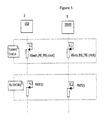
- the process involves three main functions: registration ( Figure 4 ), session key set-up ( Figure 5 ) and dynamic PIN generation ( figures 6 to 8 ).
- the user terminal is used to register a set of information in order to identify the user device and to execute the cognitive phase. This is done by having the user device 2 access the service platform to register a memorable sequence of pictures, and a set of associated "seeds".
- the images 201, 202, 203, are illustrated in Figure 2 as simple geometrical shapes, but can be anything that the user will be able to remember.
- the seeds are generated dynamically by the device, using a pseudo-random number generation algorithm, and are associated to each picture. These seeds are codes associated with the image interpretation and assist in improving the security of the user challenge. Even if an attacker identifies the images (by intercepting communication, shoulder-surfing etc), the attacker would need to guess the association of images to seeds in order to correctly generate the corresponding result of the user challenge.
- the user first selects images he wishes to use (step 41). These may be selected from a library of such images stored on the server 3, or may be generated on the user device 2 as shown in Figure 4 . In the embodiment to be described the user selects twenty images.
- the device then uses a pseudo-random process to generate the "seeds" (step 42). Seeds are codes which are used to label these images.
- the device generates a concordance between the seeds and the images (step 43). This concordance is transmitted to the server 3 (step 44)
- the user registers a sequence of images that are associated with seeds and are then used by the server for generating and sending challenges to the user.
- Such a sequence 201, 202, 203 is illustrated in Figure 2 . Note that the symbols are not displayed in Figure 2 in the sequence specified by the user. For security, the sequence should be chosen so as to be easy to recall but not immediately apparent from casual inspection of the images.
- the user may register a collection of images that are associated with seeds and are then used by the server for generating challenges for the user.
- the registered collection may be taken from a larger selection offered by the server, or may be generated by the user. In either case the unregistered images should be selected such that to a casual observer they are not readily distinct from the registered ones, but not so similar that the user who selected them might have difficulty in distinguishing them.
- the user can choose a selection from that set to be his registered images.
- the unregistered images should be drawn from a set of similar images - that is, showing as much, or as little, variety as the registered images.
- the images selected by the user could be human faces, and the server could maintain a register of other faces for use as the unregistered images, selected such that the user can readily distinguish the pictures he has registered from the random ones, but that a casual user should not be able to do so.
- the random selection therefore needs to be selected from a set which excludes all of the user's own set, but must not be so different that a casual observer of the challenge screen would recognise the user's images as an obvious set. So, if the user has chosen photographs of family members as his images, the random images should also be of people, (and not, for example, abstract shapes, cartoon characters, animals, or a mixture of such images), so that to a casual observer there are sixteen people/(shapes/cartoon characters/animals etc), but only the authorised user knows which six are of special significance.
- the number of images is a sufficiently large number to make guessing difficult.
- the sequence of selected images may be incorporated into a larger set, for example a array of sixteen images including five images selected from the set of twenty chosen by the user at registration, together with eleven random images, and asking the user to identify the five secret images in a particular order. This would produce 524,160 possible sequences of images per authentication attempt.
- the seed is an associated representation of the images that is used as input to the dynamic PIN generation algorithm.
- the correct answer generated by the user on the device (terminal) in response to the challenge (images sent by the server) is already known by the server at the time of sending the challenge. This answer is used to generate the dynamic PIN.
- session-specific PIN interpretations namely a sequence of seeds, and a sequence of relative positions of images, each of which is used in different ways.
- S-Box generation function based on the seeds of which the output is a different S-Box at each use.
- a preferred arrangement also has the terminal retrieve its IMEI (International Mobile Equipment Identity - a number that uniquely identifies the handset) and the IMSI (International Mobile Subscriber Identity - a number that uniquely identifies the "SIM" card loaded in the handset, and thus its user) (step 45). This information is transmitted to the server (step 46). Use of this information ensures that any user accessing the account must be in possession of the correct terminal.
- IMEI International Mobile Equipment Identity - a number that uniquely identifies the handset
- IMSI International Mobile Subscriber Identity - a number that uniquely identifies the "SIM" card loaded in the handset, and thus its user
- the user may initiate any number of sessions, by transmitting a "dynamic PIN" - that is to say, a PIN which varies in an unpredictable way such that unauthorised access to the PIN for one session, (through eavesdropping, shoulder-surfing, key-logging etc) provides no information on the PIN required for subsequent sessions.
- a "dynamic PIN” that is to say, a PIN which varies in an unpredictable way such that unauthorised access to the PIN for one session, (through eavesdropping, shoulder-surfing, key-logging etc) provides no information on the PIN required for subsequent sessions.
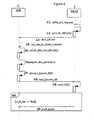
- a preliminary security enhancement is provided at application level ( Figure 5 ) by providing a certificate-based server authentication as well as the conventional session key setup.
- the certificate-based server authentication provides that, during the protocol negotiation (step 46), the client device 2 requests a digital certificate (Public key) from the server 3, to be used in the authentication phase.
- a digital certificate Public key
- this embodiment uses a matrix barcode as part of the challenge message.
- the certificate can be embedded in this code.
- the session key set-up phase sets up a pseudo random algorithm to be used to encrypt communications between the user terminal 2 and the service platform 3.
- all subsequent communications can be encrypted using a light-weight protocol, based on the information exchanged during the registration phase.
- the process can include a "key stretching" technique, to derive a secret key from a partial secret value - in the present case a concatenation of the picture seeds, IMEI and IMSI, which are already known to both the client and the server.
- the user device 2 and server platform 3 both create a password by concatenating this information (step 51) and use a password key derivation function (PKDF) (step 52), part of an RSA algorithm, to derive a secret key from this concatenated value.
- PKDF password key derivation function
- Both the client and the server can perform these functions in parallel, using the information exchanged in the registration stage.
- the server 3 selects a sequence of the images previously uploaded by the user, using a pseudo-random sequence to select the seed values (step 61).
- the server 3 selects a sequence of images from those selected at registration (step 61), and a shared secret that instructs the device how to interpret the sequencing of the images sent in the given challenge.
- the shared sequence can be for example a parameter to an image-sequencing algorithm known to the server and pre-installed on the device/terminal.
- the image set to be displayed may include images that were initially registered by the user, and other images that are not registered by the user. The user has simply to identify those images that he had previously registered. Alternatively, the user may be required to sort the images into a predetermined order.
- the selected sequence of images is generated, together with their associated seeds that the server intends to be used for the dynamic pin generation.
- the user does not need to be aware of the chosen order of pre-registered images, but only needs to recognise which of the symbols displayed belong to his chosen set.
- the server selects a subset of images (e.g. five) from the set (e.g. twenty images) previously defined by the user and uploaded to the server.
- the server combines the five images with another subset of images (e.g. eleven) from a set of random images generated by the server.
- This second subset of images must not include any of those initially defined by the user. They may, for example, be selected from those members of the original library not selected by the user at registration.
- the server then generates a matrix barcode with a high error correction level in order to embed the images (step 62).
- the code is built from a random PIN string (RPS) selected by the server.
- RPS random PIN string
- An example of RPS is a string of 160 cryptographically generated random bytes, identified herein as RPV i , where i takes values from 0 to 159. Each authentication causes the generation of a new RPS.
- matrix barcodes it is known for matrix barcodes to have images overlaid for customisation purposes, for example to embed a company logo in a matrix barcode.
- the present invention embeds an image (or an array of images) in a matrix barcode in a way that each image is difficult to separate from the matrix barcode, while the combination matrix barcode and image(s) can be signed and the signature can be conveyed with the matrix barcode or the session/message associated with the matrix barcode.
- the amount of data that can be encoded in a matrix barcode depends on the size of the matrix barcode (in pixels), the error correction level used during the encoding process and which ranges from 7% up to 30%. The more error correction the less the amount of data that can be embedded.
- An image of size 100x100 pixels can be overlaid on a matrix barcode with 30% error correction level and of size 250x250 pixels while allowing the matrix barcode to be read.
- the matrix barcode is used as a means of passing additional hidden information (steganography) from a server to a user terminal.
- the matrix barcode operates as a container of information that assists with establishing the authenticity of the challenge and facilitate the dynamic PIN generation process.
- the sequence of images sent to the user are generated by the server based on the pre-registered images or sequences.
- the images are imposed on the matrix barcode by the server, and can be further protected by embedding a signature of the images into the matrix barcode for verification by the user device.
- the server 3 then transmits the matrix barcode with its embedded images to the user terminal 2 (step 63), which displays the images.
- Figure 2 depicts a touchscreen display presented to a user during operation of the process.
- the display comprises a number of symbols selected, in some randomised order, from a sequence of symbols previously defined and memorised by the user.
- the symbols may be differentiated by colour, shape etc.
- Figure 2 only illustrates three symbols, to demonstrate the principle - as discussed above the image may typically comprise sixteen symbols, or which five are from the set selected by the user and the rest are randomly generated (but should not include any from the set initially selected by the user).
- the user is then presented with a challenge, in the form of one or more questions about the depicted sequence (step 64).
- the actual questions may be generated by the terminal, for example identify the registered images, or to tap on the images in the order previously registered.
- the server 3 chooses a sub-sequence of the registered sequence, and the user's response to the challenge essentially confirms the relative order of the images in relation to the registered sequence.
- the user makes three successive keystrokes 211, 212, 213 on the keypad to indicate the correct sequence for the images 201, 202, 203, according to the sequence stored in the server 3 (in response to step 44 above), and memorised by the user. (In practice more than three images will be displayed, and they may be taken from a longer sequence that has been stored and memorised.
- the user responds using an input 23 such as a keypad, touchscreen, or audio input to indicate the correct answer, e.g "1 st ".
- the process is repeated for a number of other questions.
- the sequence of answers is "1 st , 3 rd , 2 nd ".
- substitution-box is a basic component of symmetric key algorithms which performs substitution. In block ciphers, they are typically used to obscure the relationship between the key and the ciphertext (Shannon's property of confusion). The actual substitutions can be carefully chosen to resist cryptanalysis. In general, an S-Box takes some number of input bits, m, and transforms them into some number of output bits, n.
- An S-box instance can then be generated (step 66) applying a pseudo-random algorithm to a number of values derived from several parameters (shared secrets):
- Another stronger alternative is to also include a dependency on previous successful authentication attempts from the same device/terminal. This improves significantly the unpredictability of the S-Box selection
- a further strengthening can be achieved by also including the whole grid of images in the challenge (as a separate "addition" parameter to the selected SEEDs). This ensures that the gird of images associated with the challenge cannot be tampered
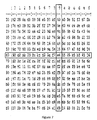
- a suitable transformation is the Rijndael S-box, as illustrated in Figure 7 .
- the data to be encrypted is divided into bytes, each being representable by a two-digit hexadecimal number (e.g. 69, highlighted), and each byte is transformed to another hexadecimal number pair (e4 in the example), such that the Rijndael S-box is resistant to linear and differential cryptanalysis.
- a new S-Box instance is therefore generated for each authentication session, by using a session-specific user challenge (i.e. sequence of seeds), information from the device/terminal (e.g. IMSI/IMEI).
- a session-specific user challenge i.e. sequence of seeds
- information from the device/terminal e.g. IMSI/IMEI
- An S-Box generating algorithm is used to generate the transformation.
- an exclusive or (XOR) function can be used to obtain a PIN (steps 65, 66, 67).
- some iterative substitutions driven by the PIN and RPS values can be used to create a second PIN. Provided the substitution process is known to both the client and the server, the original PIN can be retrieved.
- the dynamic PIN is generated (step 67) using the substitutions of the newly generated S-Box, the RPS that has been chosen by the server for this session, and the session-specific PIN derived from the sequence of seeds, by applying an XOR function.
- S-box transformation would be to use the notion of dual ciphers - i.e. producing an S-Box with equivalent crypto-analysis properties as the original, thereby guaranteeing that the new dynamic pin generation algorithm retains desired cryptographic properties.
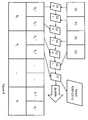
- the dynamic pin generation algorithm (step 67) consists of iterative substitutions between RPS bits and the PIN value bits via the S-Box (Where the PIN is a XOR of the seeds, IMEI and IMSI), as shown in Figure 8 .
- a four-(decimal)-digit PIN is to be encoded.
- it can be represented by half a byte (four bits), and four digits D(0) D(1) D(2) D(3) can therefore be represented by two bytes.
- four digits could be represented by a single byte provided that 0 and 9 are not valid digits - for example if the user is required to sort eight images
- the RPS is an array of 160 bytes R(i), where i takes values 0 to 159. Each byte is composed of two half-bytes ("nibbles") R(iH) and R(iL) . For the purposes of this algorithm the RPS is subdivided into four groups each of forty bytes.
- S1 is a byte, and can also be subdivided into half-bytes S1(H), S1(L), one of which is used in the next step.
- the process is then repeated for three further iterations, replacing (R(0) and R(1) by bytes selected from the second, third and fourth quarters (groups of forty bytes) in the RPS, respectively, to produce three further values for S7.
- the actual bytes selected may be determined from the value of S7 derived from the previous iteration, e.g R(40j+
- ) where j 0,1,2 or 3 and
- the PIN Once the PIN has been generated (step 67), it can be sent to the server over an encrypted channel (step 68).
- the server can verify the PIN using the substitution process (step 69) to grant or deny access to the user (step 70).
- the user can acquire the picture and RPS from an independent synchronised source such as a badge -reader. This allows the user to acquire the picture and RPS without any initial communication with the server.
- an independent synchronised source such as a badge -reader.
- the authentication from the user occurs because the operations that are performed on the RPS (ie the s-box iterations) depend on the choice of images made by the user information ( "What the user knows") and the device information (IMEI and IMSI - "What the user has”), which combine to form the operations. These operations are then applied to the RPS which has previously been received from the server.
- the method utilising the S-Box generation ensures that the correlation between the RPS and Dynamic PIN is something that only the Server knows and can only be reproduced by using the correct combination of the registered Terminal/Device/SIM and the registered user.
- the essence of the invention is making this RPS and DynamicPIN correlation very secure and difficult for anyone except the authorised user.
Landscapes
- Engineering & Computer Science (AREA)
- Computer Security & Cryptography (AREA)
- Computer Networks & Wireless Communication (AREA)
- Signal Processing (AREA)
- Computer Hardware Design (AREA)
- Computing Systems (AREA)
- General Engineering & Computer Science (AREA)
- Power Engineering (AREA)
- Telephonic Communication Services (AREA)
- Storage Device Security (AREA)
Priority Applications (4)
| Application Number | Priority Date | Filing Date | Title |
|---|---|---|---|
| EP12250188.5A EP2747366A1 (fr) | 2012-12-24 | 2012-12-24 | Authentification d'accès client/serveur |
| US14/654,918 US20150349966A1 (en) | 2012-12-24 | 2013-12-17 | Client/server access authentication |
| PCT/GB2013/000553 WO2014102522A1 (fr) | 2012-12-24 | 2013-12-17 | Authentification d'accès client/serveur |
| EP13821701.3A EP2936774A1 (fr) | 2012-12-24 | 2013-12-17 | Authentification d'accès client/serveur |
Applications Claiming Priority (1)
| Application Number | Priority Date | Filing Date | Title |
|---|---|---|---|
| EP12250188.5A EP2747366A1 (fr) | 2012-12-24 | 2012-12-24 | Authentification d'accès client/serveur |
Publications (1)
| Publication Number | Publication Date |
|---|---|
| EP2747366A1 true EP2747366A1 (fr) | 2014-06-25 |
Family
ID=47552841
Family Applications (2)
| Application Number | Title | Priority Date | Filing Date |
|---|---|---|---|
| EP12250188.5A Ceased EP2747366A1 (fr) | 2012-12-24 | 2012-12-24 | Authentification d'accès client/serveur |
| EP13821701.3A Withdrawn EP2936774A1 (fr) | 2012-12-24 | 2013-12-17 | Authentification d'accès client/serveur |
Family Applications After (1)
| Application Number | Title | Priority Date | Filing Date |
|---|---|---|---|
| EP13821701.3A Withdrawn EP2936774A1 (fr) | 2012-12-24 | 2013-12-17 | Authentification d'accès client/serveur |
Country Status (3)
| Country | Link |
|---|---|
| US (1) | US20150349966A1 (fr) |
| EP (2) | EP2747366A1 (fr) |
| WO (1) | WO2014102522A1 (fr) |
Cited By (5)
| Publication number | Priority date | Publication date | Assignee | Title |
|---|---|---|---|---|
| CN106534135A (zh) * | 2016-11-16 | 2017-03-22 | 杭州华三通信技术有限公司 | 一种流量检测规则的生成方法及装置 |
| CN107171789A (zh) * | 2017-04-20 | 2017-09-15 | 努比亚技术有限公司 | 一种安全登录方法、客户端设备及服务器 |
| CN110225054A (zh) * | 2019-06-20 | 2019-09-10 | 腾讯科技(深圳)有限公司 | 远程协助连接建立方法、装置、服务器及存储介质 |
| US10565569B2 (en) | 2015-07-30 | 2020-02-18 | NXT-ID, Inc. | Methods and systems related to multi-factor, multidimensional, mathematical, hidden and motion security pins |
| CN115021931A (zh) * | 2022-05-30 | 2022-09-06 | 中控数科(陕西)信息科技有限公司 | 一种移动数字证书服务方法 |
Families Citing this family (19)
| Publication number | Priority date | Publication date | Assignee | Title |
|---|---|---|---|---|
| EP3159820B1 (fr) | 2014-06-19 | 2025-01-22 | Nec Corporation | Dispositif d'authentification, système d'authentification, procédé d'authentification et support de mémoire programme |
| US10057240B2 (en) * | 2014-08-25 | 2018-08-21 | Sap Se | Single sign-on to web applications from mobile devices |
| EP3206200B1 (fr) * | 2014-10-08 | 2020-12-09 | Nippon Telegraph and Telephone Corporation | Dispositif, procédé et programme de détection de position de chaînes de caractères partielles |
| TWI544419B (zh) * | 2015-11-20 | 2016-08-01 | 王碩騰 | 二維條碼之編碼方法、解碼方法與電子裝置 |
| JP2017130069A (ja) * | 2016-01-20 | 2017-07-27 | 富士通株式会社 | パスワード入力装置 |
| US10248784B2 (en) * | 2016-12-01 | 2019-04-02 | International Business Machines Corporation | Sequential object set passwords |
| US11057362B2 (en) * | 2017-10-05 | 2021-07-06 | Ca, Inc. | Adaptive selection of authentication schemes in MFA |
| US10869194B2 (en) * | 2017-12-22 | 2020-12-15 | Dish Network L.L.C. | Devices, systems, and processes for authenticating devices |
| US10792557B1 (en) * | 2018-03-16 | 2020-10-06 | Gemiini Educational Systems, Inc. | Memory puzzle system |
| US11005971B2 (en) * | 2018-08-02 | 2021-05-11 | Paul Swengler | System and method for user device authentication or identity validation without passwords or matching tokens |
| US11949677B2 (en) * | 2019-04-23 | 2024-04-02 | Microsoft Technology Licensing, Llc | Resource access based on audio signal |
| US11921830B2 (en) | 2019-07-25 | 2024-03-05 | Seaton Gras | System and method for verifying unique user identification |
| CN111131162B (zh) * | 2019-11-26 | 2022-04-05 | 广州羊城通有限公司 | 一种启动二维码显示的方法及装置 |
| US11973755B1 (en) * | 2021-07-30 | 2024-04-30 | Wells Fargo Bank, N.A. | Apparatuses, methods, and computer program products for offline authentication |
| US11947642B1 (en) | 2021-08-17 | 2024-04-02 | Wells Fargo Bank, N.A. | Apparatuses, methods, and computer program products for proactive offline authentication |
| CN114266030B (zh) * | 2022-03-01 | 2022-06-17 | 北京信创数安科技有限公司 | 基于二维图形的访问认证方法、装置、设备及存储介质 |
| CN116935520B (zh) * | 2022-04-08 | 2025-12-23 | 深圳市光鉴科技有限公司 | 一种带有实名认证功能的门锁 |
| US12361430B2 (en) | 2022-06-24 | 2025-07-15 | Bank Of America Corporation | System for dynamic data encryption in an active network session |
| US12511390B2 (en) | 2023-10-02 | 2025-12-30 | Bank Of America Corporation | Amalgamation platform providing concealed detection of code-passing using steganography |
Citations (5)
| Publication number | Priority date | Publication date | Assignee | Title |
|---|---|---|---|---|
| US20040230843A1 (en) * | 2003-08-20 | 2004-11-18 | Wayne Jansen | System and method for authenticating users using image selection |
| WO2009039223A1 (fr) * | 2007-09-17 | 2009-03-26 | Vidoop Llc | Procédés et systèmes de gestion de comptes à mots de passe basés sur une image |
| WO2010014386A1 (fr) * | 2008-07-29 | 2010-02-04 | Motorola, Inc. | Procédé et système de sécurisation des sessions de communication |
| US20100186074A1 (en) * | 2009-01-16 | 2010-07-22 | Angelos Stavrou | Authentication Using Graphical Passwords |
| US20100325706A1 (en) * | 2009-06-18 | 2010-12-23 | John Hachey | Automated test to tell computers and humans apart |
Family Cites Families (3)
| Publication number | Priority date | Publication date | Assignee | Title |
|---|---|---|---|---|
| US8429287B2 (en) * | 2009-04-29 | 2013-04-23 | Rangecast Technologies, Llc | Network audio distribution system and method |
| GB201018970D0 (en) * | 2010-11-10 | 2010-12-22 | Tricerion Ltd | User authentication system and method thereof |
| US20130126619A1 (en) * | 2011-11-18 | 2013-05-23 | Unisys Corporation | Method and system for certifying contact information |
-
2012
- 2012-12-24 EP EP12250188.5A patent/EP2747366A1/fr not_active Ceased
-
2013
- 2013-12-17 WO PCT/GB2013/000553 patent/WO2014102522A1/fr not_active Ceased
- 2013-12-17 US US14/654,918 patent/US20150349966A1/en not_active Abandoned
- 2013-12-17 EP EP13821701.3A patent/EP2936774A1/fr not_active Withdrawn
Patent Citations (5)
| Publication number | Priority date | Publication date | Assignee | Title |
|---|---|---|---|---|
| US20040230843A1 (en) * | 2003-08-20 | 2004-11-18 | Wayne Jansen | System and method for authenticating users using image selection |
| WO2009039223A1 (fr) * | 2007-09-17 | 2009-03-26 | Vidoop Llc | Procédés et systèmes de gestion de comptes à mots de passe basés sur une image |
| WO2010014386A1 (fr) * | 2008-07-29 | 2010-02-04 | Motorola, Inc. | Procédé et système de sécurisation des sessions de communication |
| US20100186074A1 (en) * | 2009-01-16 | 2010-07-22 | Angelos Stavrou | Authentication Using Graphical Passwords |
| US20100325706A1 (en) * | 2009-06-18 | 2010-12-23 | John Hachey | Automated test to tell computers and humans apart |
Non-Patent Citations (2)
| Title |
|---|
| JERRY GAO ET AL: "A 2D Barcode-Based Mobile Payment System", MULTIMEDIA AND UBIQUITOUS ENGINEERING, 2009. MUE '09. THIRD INTERNATIONAL CONFERENCE ON, IEEE, PISCATAWAY, NJ, USA, 4 June 2009 (2009-06-04), pages 320 - 329, XP031561633, ISBN: 978-0-7695-3658-3 * |
| LUIGI CATUOGNO ET AL: "A Graphical PIN Authentication Mechanism with Applications to Smart Cards and Low-Cost Devices", 13 May 2008, INFORMATION SECURITY THEORY AND PRACTICES. SMART DEVICES, CONVERGENCE AND NEXT GENERATION NETWORKS; [LECTURE NOTES IN COMPUTER SCIENCE], SPRINGER BERLIN HEIDELBERG, BERLIN, HEIDELBERG, PAGE(S) 16 - 35, ISBN: 978-3-540-79965-8, XP019089180 * |
Cited By (8)
| Publication number | Priority date | Publication date | Assignee | Title |
|---|---|---|---|---|
| US10565569B2 (en) | 2015-07-30 | 2020-02-18 | NXT-ID, Inc. | Methods and systems related to multi-factor, multidimensional, mathematical, hidden and motion security pins |
| CN106534135A (zh) * | 2016-11-16 | 2017-03-22 | 杭州华三通信技术有限公司 | 一种流量检测规则的生成方法及装置 |
| CN106534135B (zh) * | 2016-11-16 | 2020-07-17 | 新华三技术有限公司 | 一种流量检测规则的生成方法及装置 |
| CN107171789A (zh) * | 2017-04-20 | 2017-09-15 | 努比亚技术有限公司 | 一种安全登录方法、客户端设备及服务器 |
| CN110225054A (zh) * | 2019-06-20 | 2019-09-10 | 腾讯科技(深圳)有限公司 | 远程协助连接建立方法、装置、服务器及存储介质 |
| CN110225054B (zh) * | 2019-06-20 | 2021-12-14 | 腾讯科技(深圳)有限公司 | 远程协助连接建立方法、装置、服务器及存储介质 |
| CN115021931A (zh) * | 2022-05-30 | 2022-09-06 | 中控数科(陕西)信息科技有限公司 | 一种移动数字证书服务方法 |
| CN115021931B (zh) * | 2022-05-30 | 2024-05-07 | 中控数科(陕西)信息科技有限公司 | 一种移动数字证书服务方法 |
Also Published As
| Publication number | Publication date |
|---|---|
| WO2014102522A1 (fr) | 2014-07-03 |
| US20150349966A1 (en) | 2015-12-03 |
| EP2936774A1 (fr) | 2015-10-28 |
Similar Documents
| Publication | Publication Date | Title |
|---|---|---|
| EP2747366A1 (fr) | Authentification d'accès client/serveur | |
| US10592651B2 (en) | Visual image authentication | |
| EP3319069B1 (fr) | Procédé d'authentification d'un utilisateur au moyen d'un terminal non sécurisé | |
| US8775794B2 (en) | System and method for end to end encryption | |
| JP5330567B2 (ja) | コンピュータ実施認証インターフェイスシステム | |
| US20100332841A1 (en) | Authentication Method and System | |
| CN103380592B (zh) | 用于个人认证的方法、服务器以及系统 | |
| JP2018521559A (ja) | 認証方法及び認証システム | |
| NO324315B1 (no) | Metode og system for sikker brukerautentisering ved personlig dataterminal | |
| CN107111967A (zh) | 使用增强现实的视觉密码术与混淆 | |
| CN101819614A (zh) | 利用语音核验USBKey增强网络交易安全性的系统和方法 | |
| US20020091932A1 (en) | Qualification authentication method using variable authentication information | |
| Shaju et al. | BISC authentication algorithm: An efficient new authentication algorithm using three factor authentication for mobile banking | |
| US20030097559A1 (en) | Qualification authentication method using variable authentication information | |
| CN100557556C (zh) | 在线数据加密与解密 | |
| EP3319000A1 (fr) | Procédé de sécurisation d'une transaction effectuée à partir d'un terminal non sécurisé | |
| CN1980127A (zh) | 口令认证系统及口令认证方法 | |
| EP3319067B1 (fr) | Procédé d'authentification d'un utilisateur au moyen d'un terminal non sécurisé | |
| Amin et al. | An efficient remote mutual authentication scheme using smart mobile phone over insecure networks | |
| US20090125994A1 (en) | Communication between a human user and a computer resistant to automated eavesdropping | |
| EP3319001A1 (fr) | Procédé de transmission sécurisée de données secrètes à un utilisateur d'un terminal | |
| Riaz et al. | OSAP: Online Smartphone's User Authentication Protocol | |
| Cheng | A secure mobile OTP Token | |
| Balilo et al. | Design of physical authentication based on OTP KeyPad | |
| Ginesu et al. | Mutual image-based authentication framework with JPEG2000 in wireless environment |
Legal Events
| Date | Code | Title | Description |
|---|---|---|---|
| PUAI | Public reference made under article 153(3) epc to a published international application that has entered the european phase |
Free format text: ORIGINAL CODE: 0009012 |
|
| 17P | Request for examination filed |
Effective date: 20121224 |
|
| AK | Designated contracting states |
Kind code of ref document: A1 Designated state(s): AL AT BE BG CH CY CZ DE DK EE ES FI FR GB GR HR HU IE IS IT LI LT LU LV MC MK MT NL NO PL PT RO RS SE SI SK SM TR |
|
| AX | Request for extension of the european patent |
Extension state: BA ME |
|
| STAA | Information on the status of an ep patent application or granted ep patent |
Free format text: STATUS: THE APPLICATION HAS BEEN REFUSED |
|
| 18R | Application refused |
Effective date: 20140810 |