EP2755493B1 - Verfahren zur herstellung von schokolade - Google Patents
Verfahren zur herstellung von schokolade Download PDFInfo
- Publication number
- EP2755493B1 EP2755493B1 EP12832511.5A EP12832511A EP2755493B1 EP 2755493 B1 EP2755493 B1 EP 2755493B1 EP 12832511 A EP12832511 A EP 12832511A EP 2755493 B1 EP2755493 B1 EP 2755493B1
- Authority
- EP
- European Patent Office
- Prior art keywords
- composition
- chocolate
- heat
- treatment
- mixing
- Prior art date
- Legal status (The legal status is an assumption and is not a legal conclusion. Google has not performed a legal analysis and makes no representation as to the accuracy of the status listed.)
- Active
Links
Images
Classifications
-
- A—HUMAN NECESSITIES
- A23—FOODS OR FOODSTUFFS; TREATMENT THEREOF, NOT COVERED BY OTHER CLASSES
- A23G—COCOA; COCOA PRODUCTS, e.g. CHOCOLATE; SUBSTITUTES FOR COCOA OR COCOA PRODUCTS; CONFECTIONERY; CHEWING GUM; ICE-CREAM; PREPARATION THEREOF
- A23G1/00—Cocoa; Cocoa products, e.g. chocolate; Substitutes therefor
-
- A—HUMAN NECESSITIES
- A23—FOODS OR FOODSTUFFS; TREATMENT THEREOF, NOT COVERED BY OTHER CLASSES
- A23G—COCOA; COCOA PRODUCTS, e.g. CHOCOLATE; SUBSTITUTES FOR COCOA OR COCOA PRODUCTS; CONFECTIONERY; CHEWING GUM; ICE-CREAM; PREPARATION THEREOF
- A23G1/00—Cocoa; Cocoa products, e.g. chocolate; Substitutes therefor
- A23G1/0003—Processes of manufacture not relating to composition or compounding ingredients
- A23G1/0026—Mixing; Roller milling for preparing chocolate
-
- A—HUMAN NECESSITIES
- A23—FOODS OR FOODSTUFFS; TREATMENT THEREOF, NOT COVERED BY OTHER CLASSES
- A23G—COCOA; COCOA PRODUCTS, e.g. CHOCOLATE; SUBSTITUTES FOR COCOA OR COCOA PRODUCTS; CONFECTIONERY; CHEWING GUM; ICE-CREAM; PREPARATION THEREOF
- A23G1/00—Cocoa; Cocoa products, e.g. chocolate; Substitutes therefor
- A23G1/0003—Processes of manufacture not relating to composition or compounding ingredients
- A23G1/0026—Mixing; Roller milling for preparing chocolate
- A23G1/0036—Conching
-
- A—HUMAN NECESSITIES
- A23—FOODS OR FOODSTUFFS; TREATMENT THEREOF, NOT COVERED BY OTHER CLASSES
- A23G—COCOA; COCOA PRODUCTS, e.g. CHOCOLATE; SUBSTITUTES FOR COCOA OR COCOA PRODUCTS; CONFECTIONERY; CHEWING GUM; ICE-CREAM; PREPARATION THEREOF
- A23G1/00—Cocoa; Cocoa products, e.g. chocolate; Substitutes therefor
- A23G1/30—Cocoa products, e.g. chocolate; Substitutes therefor
- A23G1/32—Cocoa products, e.g. chocolate; Substitutes therefor characterised by the composition containing organic or inorganic compounds
- A23G1/36—Cocoa products, e.g. chocolate; Substitutes therefor characterised by the composition containing organic or inorganic compounds characterised by the fats used
Definitions
- the present invention relates to a method of producing chocolate.
- the method facilitates the manufacture of chocolate that is heat resistant without requiring any particular downstream processing.
- the method achieves these effects with similar or reduced efforts when compared with other methods of the art.
- Chocolate is consumed more for pleasure than nutrition, so consumer appeal is of paramount importance in chocolate production. Consumer appeal dictates that chocolate should remain relatively brittle during storage so that it can be broken or snapped prior to consumption, but then melts quickly in the mouth.
- chocolate can, for instance, melt and stick to packaging which results in diminished consumer appeal. This problem is acutely felt when distributing and selling chocolate in warm or hot climates.
- the temperature inside the mouth of the consumer is similar to the air temperature in hot climates. It is therefore difficult to maintain the relatively brittle nature and the storage stability of chocolate in hot climates whilst also maintaining consumer satisfaction once the product is placed in the mouth.
- Heat-resistant chocolate was described in WO-A-93/12664 comprising a water-in-oil (w/o) microemulsion. The chocolate was reported to resist temperatures of 35-40°C for up to 3 hours.
- EP-A-1 673 977 A method of producing heat-resistant chocolate was described in EP-A-1 673 977 which also related to the addition of a water-in-oil (w/o) emulsion or have an otherwise elevated water content.
- the chocolate was reported to retain its form when subjected to temperatures of up to about 45°C.
- the present invention relates to a method of producing chocolate comprising mixing for 10-120 minutes a composition having a temperature of 35-50°C, the composition comprising:
- This method has the benefit of facilitating the production of chocolate with much improved heat-resistance whilst maintaining satisfactory flavour and mouthfeel. Moreover, the method does not place any particular demands on subsequent processing steps meaning that it has wide applicability.
- the wide applicability and versatility of the method means that integration into a chocolate-making process requires little extra effort on the part of the manufacturer.
- Heat-resistance can be augmented by heat-treating the composition e.g. by exposing the mixed composition to microwave radiation and/or thermal heat-treatment.
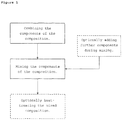
- Figure 1 A flow diagram illustrating a method according to the present invention including optional steps.
- the terms “comprising”, “comprise(s)", “containing” and “contain(s)” in the context of one or more components cover the case (i) where the referenced components are the only components and also the case (ii) where other components are also present.
- a composition is defined as containing a generic compound (e.g. a surfactant) in a certain amount
- a subset of compounds (e.g. anionic surfactants) falling within the generic class means that the subset of compounds can be present in said amount, and other compounds within the generic class but not within the subset may or may not also be contained in the composition. This applies mutatis mutandis to an individual compound(s) within the generic class or subset of the generic class.
- a range described in terms of "X-Y” or “from X to Y” means a range including the values "X” and "Y”.
- the term “average” denotes a mean average.
- something is "heat-resistant" when it can be exposed for prolonged periods of time to temperature of up to 40°C, or up to 50°C, without losing its shape.
- something is regarded as heat-resistant if it exhibits a penetration force of 100 g or higher after maintained at 50°C for 2 hours and measured with a Stevens texture analyzer using a 45° cone with a speed of 1 mm/s to a depth of 3 mm.
- something that is non-heat-resistant would typically exhibit a penetration of 55 g or less when measured under the same conditions.
- the method of the present invention involves mixing a composition. This composition is described below.
- the fat content of the composition is 22-30 wt.% relative to the total mass of the composition. In some embodiments, the fat content of the composition is 23-29 wt.%, 24-28 wt.% or 25-27 wt.% relative to the total mass of the composition. A fat content within this range contributes to improved heat-resistance and good taste and mouthfeel.
- the fat content of the composition can be measured by acid hydrolysis followed by solvent extraction based on the industry standard method IOCC /AOAC 963.15 method - Fat in Cacao Products (1973).
- components of the composition contributing to the fat content are those which would be measured by the above method.
- Material within the chocolate base mass can, for instance, contribute to the fat content.
- CBAs cocoa butter substitutes
- CBRs cocoa butter replacers
- CBEs cocoa butter equivalents
- Cocoa butter is the fat of the beans of the fruit of Theobroma cacao. It can be used as such or it can be added as part of a component comprising cocoa butter, such as cocoa liquor (usually containing about 50 wt.% of cocoa butter) .
- CBS designates lauric fats, i.e. short-chain fatty acid glycerides, such as those based on palm kernel and coconut, fractionated and hydrogenated. Because of poor miscibility with cocoa butter, CBS is normally used with only low-fat cocoa powder (10-12% fat).
- Suitable CBEs include illipe, Borneo tallow, tengkawang, palm oil, sal, shea, kokum gurgi and mango kernel. CBEs are usually used in combination with cocoa butter. In one embodiment, the composition comprises no more than 5 wt.% of CBEs. CBEs also encompass a harder version also known as cocoa butter improver (CBI), having a content of triacylglycerol containing stearic-oleic-stearic acids. It is specifically used in chocolate formulations having a high content of milk fat or those meant for tropical climates. According to European legislation, as long as CBEs are present at no more than 5 wt.% (to replace cocoa butter), the resulting product may still be labeled as chocolate (and need not be labeled as a substitute).
- CBI cocoa butter improver
- CBR designates non-tempering, non-lauric fats differing in composition from cocoa butter and the tempering CBE (including CBI). It is produced by fractionation and hydrogenation of oils rich in C16 and C18 fatty acids, forming trans acids, which increases the solid phase of the fat.
- Suitable sources for CBR include soya, cottonseed, peanut, rapeseed and corn (maize) oil.
- a liquid vegetable fat may be employed when a liquid chocolate product is desired.
- Suitable vegetable fats include corn oil, cotton seed oil, rapeseed oil, palm oil, safflower oil, and sunflower oil.
- the present invention is further applicable to chocolate products in which some or all of the fat is constituted by a partly or wholly non-metabolizable fat, for example Caprenin.
- the water content of the composition is between 1.2 wt% to 2.5 wt% relative to the total mass of the composition.
- the water content can, in some embodiments, be ⁇ 1.25 wt.%, ⁇ 1.3 wt.%, ⁇ 1.35 wt.% or ⁇ 1.4 wt.% relative to the total mass of the composition.
- the water content can also be, in some embodiments, ⁇ 2.4 wt.%, ⁇ 2.3 wt.%, ⁇ 2.2 wt.%, ⁇ 2.1 wt.% or ⁇ 2.0 wt.%.
- the composition results in chocolate with improved heat-resistance and also good taste and mouthfeel.
- the water content of the composition can be determined by e.g. Karl Fischer titration. Karl Fischer titration is suitably conducted at 50°C using a 3:2:1 (v/v) mixture of methanol:chloroform:formamide to dissolve the sample.
- the chocolate base mass included in the composition is not particularly limited and can be plain, dark, milk, white and compound chocolate base mass.
- the chocolate base mass comprises milk chocolate base mass, white chocolate base mass or a mixture of the two.
- the total amount of chocolate base mass in the composition is not particularly limited.
- the composition comprises ⁇ 97 wt.%, ⁇ 95 wt.%, ⁇ 93 wt.% or ⁇ 90 wt.% relative to the total mass of the composition.
- the composition comprises one or more surfactants.
- the total content of the one or more surfactants is, in some embodiments ⁇ 0.01 wt%, ⁇ 0.05 wt%, ⁇ 0.1 wt% or ⁇ 0.2 wt%, and is sometimes in the range 0.3-2.0 wt.%, 0.4-1.9 wt.%, 0.5-1.8 wt.%, 0.55-1.7 wt.%, 0.6-1.6 wt.% or 0.65-1.5 wt.%.
- a subset of surfactants or an individual surfactant can also be present in these ranges.
- the one or more surfactants can include lecithin, lecithin derived from soya bean, safflower, sunflower, corn etc., fractionated lecithins enriched with either phosphatidyl choline, phosphatidyl ethanolamine, phosphatidyl inositol; emulsifiers derived from oats, mono- and diglycerides and their tartaric esters, monosodium phosphate derivatives of mono- and diglycerides of edible fats and oils, sorbitan monostearate, polyoxyethylene sorbitan monostearate, hydroxylated lecithin, synthetic phospholipids such as ammonium phosphatides, polyglycerol polyricinoleate (PGPR), lactylated fatty acid esters of glycerol and propylene glycol, polyglycerol esters of fatty acids, citric acid esters of fatty acids, propylene glycol mono- and diesters
- ⁇ 0.2 wt.%, ⁇ 0.1 wt.%, ⁇ 0.05 wt.% or ⁇ 0.025 wt.% of pure water is added to the composition relative to the total mass of the composition.
- the water content of the composition results from water content within the components added to the composition.
- the chocolate base mass can, for instance, contain water which therefore contributes to the water content of the composition.
- the particles within the composition have a d90 diameter in the range of 10-25 ⁇ m, 12-23 ⁇ m, or 14-21 ⁇ m.
- a d90 diameter is a term used in the art and can be summarised as the diameter of the 90 th percentile i.e. 90% of particles have a diameter below this value.
- Particle size distribution of chocolate is measured using a Malvern Mastersizer 2000 and organic solvent as the dispersant.
- a subsample of the chocolate is dispersed in the organic solvent in a test tube and ultrasonicated for 3-5 mins to obtain discrete, individual particles prior to being added into the Mastersizer for measurement.
- the composition optionally comprises one or more dairy products, examples of which include modified whey powder, sweet whey powder and skimmed milk powder.
- the total content of dairy products is, in some embodiments, 0-10 wt.%, 0-7 wt.%, 0-5 wt.% or 0-1 wt.% relative to the total mass of the composition.
- the composition may optionally comprise one or more components for altering its flavour, which are sometimes referred to as flavourants. These components may alter the degree to which the composition is sweet, sour, bitter, salty or savoury.
- Suitable flavours include those of fruit, citrus fruit, chocolate, mint, caramel, cream, spices, coffee, toffee, nuts and plant extracts.
- the composition can, in some embodiments, comprise one or more of hydrated salts, hydrated sugars and hydrated sugar alcohols in a total amount of 1-15 wt.% relative to the total mass of the composition.
- Hydrated salts include, for example, hydrates of alkali metal salts and hydrates of alkaline earth metal salts, such as sodium carbonate decahydrate and magnesium carbonate pentahydrate.
- the composition comprises up to 15 wt.% of hydrated salts or part thereof, sometimes ⁇ 0.1 wt.%, ⁇ 0.25 wt.% or ⁇ 0.5 wt.% and ⁇ 15 wt.%, ⁇ 12 wt.% or ⁇ 10 wt.%.
- the content of hydrated salts is sometimes in the range of 0.5-4 wt.%, and sometimes 1-3 wt.%.
- Hydrated sugars include, for example, hydrated monosaccharides, hydrated disaccharides and hydrated polysaccharides.
- Monosaccharides include, for example, dextrose (glucose), fructose (levulose), galactose, xylose and ribose
- disaccharides include, for example, saccharose (sucrose) and lactose
- polysaccharides include, for example, starch, glycogen and cellulose.
- An exemplary and preferred hydrated monosaccharide is dextrose monohydrate
- an exemplary and preferred hydrated disaccharide is lactose monohydrate.
- the composition comprises 5-15 wt.% of hydrated sugars and sometimes comprises 5-15 wt.%, 8-12 wt.% or 9-11 wt.% of dextrose monohydrate.
- Hydrated sugar alcohols include, for example, the hydrated forms of glycerol, sorbitol, erythritol, xylitol, mannitol, lactitol and maltitol.
- the composition comprises up to 15 wt.% or 5-15 wt.% of hydrated sugar alcohols.
- all the components of the composition are brought together prior to commencing mixing. In other embodiments, some of the components are added after the mixing has commenced as illustrated in Figure 1 , provided that the combined components satisfy the description of the composition above and that all components are added before halfway through the mixing.
- the composition is mixed for 10-120 minutes at a temperature described below. In some embodiments, mixing occurs for 12-110 minutes, 15-100 minutes, 17-90 minutes, 20-80 minutes, or 22-70 minutes. Mixing for these time intervals contributes to improved heat-resistance whilst maintaining good flavour and mouthfeel.
- the composition is mixed at a temperature of 35-50°C. In some embodiments, mixing occurs at a temperature of 36-45°C, or 37-42°C. Mixing at this temperature contributes to improved heat-resistance whilst maintaining good flavour and mouthfeel.
- the temperature at which the composition is mixed refers to the mean average temperature determined over the course of the mixing.
- mixing does not substantially aerate the composition. That is to say, the composition is not mixed to deliberately include bubbles of air or any of its constituent gases, but mixing can tolerate the incidental inclusion of bubbles of air or any of its constituent gases.
- the mixing step is a step of conching, which is a term known to those skilled in the art.
- a conching step can be used to alter the flavour of the composition by releasing volatile components or by oxidizing components of the composition.
- the mixing step can be performed with a Lipp, Aoustin or Elk conche or a Hobart mixer.
- conching can be conducted using conventional apparatus.
- conventional conching apparatus include a long conche, a rotary conche or a continuous low volume conche.
- Optional further processing steps include, separately or in combination, tempering the chocolate mass, molding and cooling the optionally tempered chocolate mass chocolate mass (to produce a molded product) and/or packaging the optionally tempered or molded chocolate mass.
- tempering the chocolate mass molding and cooling the optionally tempered chocolate mass chocolate mass (to produce a molded product) and/or packaging the optionally tempered or molded chocolate mass.
- One of the benefits of the method of the present invention is that specific further processing steps are not required to furnish a final product having the desired heat-resistance, flavour and mouthfeel.
- further processing can be optionally used to improve heat-resistance.
- improving heat-resistance includes enhancing the degree of heat-resistance already present in the chocolate or making the heat-resistance property more robust to subsequent handling.
- the mixed composition can undergo heat-treatment to improve the heat-resistance as illustrated in Figure 1 . Heat-treatment can be conducted before during or after optional processing steps performed after the composition has been mixed, provided that the optional heat-treatment is conducted after the mixing.
- heat-treatment can be conducted by exposing the composition to microwave radiation.
- Any conventional microwave source can be used for this purpose, such as a conventional 3.3 kW microwave oven or larger scale microwave tunnel. Any frequency suitable for heating purposes is appropriate e.g. 2.45 GHz and 5.8 GHz.
- the distance between microwave source and sample to be heat-treated is typically is the range of 5-15 cm.
- the microwave treatment can be applied from the top and/or the bottom of the sample can also be performed from the top and the bottom alternately.
- the energy density induced by the magnetrons can be in the range of 66-1085 kJ/kg whereby higher energy density values reduce the processing time from approximately 3-8 minutes to approximately 30-60 seconds.
- heat-treatment is conducted by thermal treatment i.e. heat-treatment not implemented by deliberate exposure to microwave radiation.
- This mode of heat-treatment can be conducted using conventional heating equipment such as an oven.
- Thermal heat-treatment can, in some embodiments, be conducted at 30-50°C, 32-45°C or 35-40°C. In some embodiments, thermal heat-treatment is conducted at 30-35°C for compositions comprising ⁇ 5 wt.% cocoa butter. In some embodiments, thermal heat-treatment is conducted at 30-50°C for compositions comprising ⁇ 5 wt.% cocoa butter and ⁇ 5 wt.% cocoa butter alternative.
- Thermal heat-treatment is, in some embodiments, conducted for 2-5 weeks, or 3-4 weeks. Conducting thermal heat-treatment within this timeframe contributes to excellent heat-resistance whilst also maintaining good flavour and mouthfeel.
- heat-treatment is conducted using both microwave-based heat-treatment and thermal heat-treatment.
- the order, combination and number of heat-treatments are not particularly limited and the two types of heat-treatment can be used simultaneously.
- Fat Content Total fat was determined by acid hydrolysis followed by solvent extraction based on the industry standard method IOCC /AOAC 963.15 method - Fat in Cacao Products (1973).
- Hardness penetration force was measured with a Stable Microsystems texture analyzer using a 45° cone with a speed of 1 mm/s to a depth of 3 mm.
- the chocolate base mass comprised cocoa liquor (10.2 wt.%), sucrose (47.0 wt.%), skimmed milk powder (12.5 wt.%), anhydrous milk fat (4.8 wt.%), cocoa butter (17.5 wt.%) and sweet whey powder (8.0 wt.%) and had an overall fat content of 29 wt.%; the lecithin was purchased from a commercial supplier; the cocoa butter substitute was CERES MC 80 manufactured by AAK; and the chocolate flakes comprised the same components as the chocolate base mass.
- Example 1 The components of Example 1 shown in Table 1 were combined in a Brabender® mixer and mixed for 20 minutes at 40°C before being poured into a mould. The components of Comparative Example 1 were combined without using the Brabender® mixer treatment and then poured into a mould.
- Example 2 The results shown in Table 2 illustrate the improved heat-resistance of chocolate formed by a method according to the present invention. Although the initial hardness of Example 1 was slightly below the prescribed cut-off, this level of heat-resistance is nevertheless useful and represents a very significant improvement over the level obtained by standard methods as represented by Comparative Example 1.
- Example 2 shown in Table 3 The components of Example 2 shown in Table 3 were combined in a Brabender® mixer and mixed for 20 minutes at 40°C before being poured into a mould.
- the components of Comparative Example 2 were combined without using the Brabender® mixer treatment and then poured into a mould. Once poured into moulds, the compositions of Example 2 and Comparative Example 2 were subjected to microwave radiation by passing samples twice through a microwave tunnel: 1 st pass at 3.3 m/s and 100% energy input; 2 nd pass at 3.5 m/s and 100% energy input.
- Table 4 further illustrate the excellent heat-resistance provided by the present invention. Excellent hardness was obtained using the microwave treatment and this hardness was amplified by the subsequent thermal heat-treatment. In comparison, Comparative Example 2 shows that heat-treatment alone cannot compensate for the low heat-resistance caused by the absence of the mixing step according to the present invention.
Landscapes
- Chemical & Material Sciences (AREA)
- Life Sciences & Earth Sciences (AREA)
- Engineering & Computer Science (AREA)
- Food Science & Technology (AREA)
- Polymers & Plastics (AREA)
- Inorganic Chemistry (AREA)
- Confectionery (AREA)
Claims (12)
- Verfahren zur Herstellung von Schokolade, umfassend das Mischen einer Zusammensetzung mit einer Temperatur von 35 bis 50 °C für 10 bis 120 Minuten, wobei die Zusammensetzung Folgendes umfasst: eine Schokoladengrundmasse: und
eines oder mehrere Tenside;
wobei die Zusammensetzung einen Fettgehalt von 22 bis 30 Gew.-% und einen Wassergehalt von zwischen 1,2 Gew.-% bis 2,5 Gew.-% relativ zur Gesamtmasse der Zusammensetzung aufweist. - Verfahren nach Anspruch 1, wobei das Mischen der Zusammensetzung ein Conchierschritt ist.
- Verfahren nach Anspruch 1 oder Anspruch 2, wobei der Gesamttensidgehalt der Zusammensetzung 0,3 bis 2,0 Gew.-% beträgt.
- Verfahren nach einem der vorstehenden Ansprüche, wobei die Temperatur der Zusammensetzung während des Mischens 37 bis 45 °C beträgt.
- Verfahren nach einem der vorstehenden Ansprüche, wobei die Zusammensetzung 10 bis 70 Minuten lang gemischt wird.
- Verfahren nach einem der vorstehenden Ansprüche, wobei die Zusammensetzung eines oder mehrere hydratisierte Salze, hydratisierte Zucker und hydratisierte Zuckeralkohole in einer Gesamtmenge von 1 bis 15 Gew.-% relativ zur Gesamtmasse der Zusammensetzung umfasst.
- Verfahren nach einem der vorstehenden Ansprüche, wobei die Schokoladengrundmasse Milchschokolade, weiße Schokolade oder eine Mischung aus Milchschokolade und weißer Schokolade umfasst.
- Verfahren nach einem der vorstehenden Ansprüche, wobei die Teilchen in der Zusammensetzung einen d90-Durchmesser von 10-25 / µm aufweisen.
- Verfahren nach einem der vorstehenden Ansprüche, wobei die Zusammensetzung nach dem Mischen einer Wärmebehandlung unterzogen wird.
- Verfahren nach Anspruch 9, wobei die Wärmebehandlung das Aussetzen der Zusammensetzung gegenüber einer Mikrowellenstrahlung umfasst.
- Verfahren nach Anspruch 9, wobei die Wärmebehandlung ein Thermohärten bei 30 bis 50 °C umfasst.
- Verfahren nach Anspruch 11, wobei die Zusammensetzung für 2 bis 5 Wochen thermogehärtet wird.
Priority Applications (2)
| Application Number | Priority Date | Filing Date | Title |
|---|---|---|---|
| PL12832511T PL2755493T3 (pl) | 2011-09-12 | 2012-09-11 | Sposób wytwarzania czekolady |
| EP12832511.5A EP2755493B1 (de) | 2011-09-12 | 2012-09-11 | Verfahren zur herstellung von schokolade |
Applications Claiming Priority (3)
| Application Number | Priority Date | Filing Date | Title |
|---|---|---|---|
| EP11180876A EP2567621A1 (de) | 2011-09-12 | 2011-09-12 | Verfahren zur Herstellung von Schokolade |
| PCT/US2012/054594 WO2013039873A1 (en) | 2011-09-12 | 2012-09-11 | Method of producing chocolate |
| EP12832511.5A EP2755493B1 (de) | 2011-09-12 | 2012-09-11 | Verfahren zur herstellung von schokolade |
Publications (3)
| Publication Number | Publication Date |
|---|---|
| EP2755493A1 EP2755493A1 (de) | 2014-07-23 |
| EP2755493A4 EP2755493A4 (de) | 2015-10-28 |
| EP2755493B1 true EP2755493B1 (de) | 2019-05-08 |
Family
ID=44677697
Family Applications (2)
| Application Number | Title | Priority Date | Filing Date |
|---|---|---|---|
| EP11180876A Withdrawn EP2567621A1 (de) | 2011-09-12 | 2011-09-12 | Verfahren zur Herstellung von Schokolade |
| EP12832511.5A Active EP2755493B1 (de) | 2011-09-12 | 2012-09-11 | Verfahren zur herstellung von schokolade |
Family Applications Before (1)
| Application Number | Title | Priority Date | Filing Date |
|---|---|---|---|
| EP11180876A Withdrawn EP2567621A1 (de) | 2011-09-12 | 2011-09-12 | Verfahren zur Herstellung von Schokolade |
Country Status (10)
| Country | Link |
|---|---|
| US (1) | US20150024110A1 (de) |
| EP (2) | EP2567621A1 (de) |
| CN (1) | CN103929972A (de) |
| AU (1) | AU2012309814B2 (de) |
| BR (1) | BR112014005614A2 (de) |
| CA (1) | CA2848306C (de) |
| ES (1) | ES2736008T3 (de) |
| PL (1) | PL2755493T3 (de) |
| RU (1) | RU2608723C2 (de) |
| WO (1) | WO2013039873A1 (de) |
Families Citing this family (7)
| Publication number | Priority date | Publication date | Assignee | Title |
|---|---|---|---|---|
| BRPI1009679B1 (pt) | 2009-06-12 | 2017-11-21 | Mars Incorporated | Composition of chocolate containing etilcellulose |
| GB2485421B (en) | 2010-11-15 | 2016-05-25 | Mars Inc | Dough products exhibiting reduced oil migration |
| AU2013323765B2 (en) | 2012-09-28 | 2016-03-17 | Mars, Incorporated | Heat resistant chocolate |
| CN106068082B (zh) * | 2014-03-11 | 2020-12-08 | Wm.雷格利Jr.公司 | 耐热糖食 |
| MX2017003345A (es) * | 2014-09-15 | 2017-06-21 | Hershey Co | Producto de confiteria de chocolate estable en el calor y metodos para elaborarlos. |
| JP6833991B2 (ja) | 2016-11-01 | 2021-02-24 | サムヤン コーポレイション | 加工性が向上したチョコレート組成物およびその製造方法 |
| RU2765250C2 (ru) * | 2017-04-12 | 2022-01-27 | Сосьете Де Продюи Нестле С.А. | Способ снижения вязкости композиций на жировой основе |
Citations (1)
| Publication number | Priority date | Publication date | Assignee | Title |
|---|---|---|---|---|
| US5989619A (en) * | 1994-12-09 | 1999-11-23 | Cadbury Schweppes Plc | Process for manufacture of reduced fat chocolate |
Family Cites Families (18)
| Publication number | Priority date | Publication date | Assignee | Title |
|---|---|---|---|---|
| CH399891A (fr) * | 1961-11-29 | 1965-09-30 | Nestle Sa | Procédé de fabrication d'un chocolat thermoconsistant |
| US5120566A (en) * | 1989-11-10 | 1992-06-09 | Fuji Oil Company, Limited | Process for producing water-containing chocolate |
| US5244690A (en) * | 1990-11-22 | 1993-09-14 | Cerestar Holding B.V. | Process for the production of chocolate |
| SE507450C2 (sv) | 1991-12-20 | 1998-06-08 | Karlshamns Oils & Fats Ab | Värmebeständig chokladkomposition och förfarande för framställning därav |
| US5238698A (en) * | 1992-06-17 | 1993-08-24 | Jacobs Suchard Ag | Product and process for producing milk chocolate |
| US5464649A (en) * | 1992-10-30 | 1995-11-07 | Hershey Foods Corporation | Reduced fat confectionery products and process |
| GB2282952A (en) * | 1993-10-20 | 1995-04-26 | Albert Zumbe | Process for manufacture of reduced fat and reduced calorie chocolate |
| US5490996A (en) * | 1994-01-11 | 1996-02-13 | Kraft Jacobs Suchard Ag | Process for producing an improved sucrose-free milk chocolate |
| US5505982A (en) * | 1994-01-28 | 1996-04-09 | Fmc Corporation | Chocolate confection |
| US5468509A (en) * | 1994-03-29 | 1995-11-21 | Kraft Jacobs Suchard | Process for producing water-containing milk chocolate |
| US5474795A (en) * | 1994-08-19 | 1995-12-12 | Kraft Foods, Inc. | Dextrose-containing chocolate products with sucrose fatty acid polyester fat substitutes |
| GB9804401D0 (en) * | 1998-03-02 | 1998-04-29 | Nestle Sa | Chocolate crumb |
| US6117478A (en) * | 1998-03-12 | 2000-09-12 | Nestec S.A. | Method of making a reduced fat agglomerated chocolate |
| DE69827365T2 (de) * | 1998-05-11 | 2005-03-17 | Doveurope S.A. | Formulierungsverfahren für Schokolade |
| CN1225179C (zh) * | 2001-03-30 | 2005-11-02 | 不二制油株式会社 | 制造含水巧克力的方法 |
| ATE401006T1 (de) * | 2004-12-22 | 2008-08-15 | Kraft Foods R & D Inc | Schneller wärmewiderstandsaufbau in schokoladen oder schokoladenähnlichen süsswaren |
| MY139020A (en) * | 2006-07-13 | 2009-08-28 | Lembaga Koko Malaysia | Prebiotic chocolate and method for producing the same |
| ES2390637T3 (es) * | 2009-07-09 | 2012-11-14 | Kraft Foods R & D, Inc. | Proceso para producir un producto de confitería |
-
2011
- 2011-09-12 EP EP11180876A patent/EP2567621A1/de not_active Withdrawn
-
2012
- 2012-09-11 US US14/344,551 patent/US20150024110A1/en not_active Abandoned
- 2012-09-11 EP EP12832511.5A patent/EP2755493B1/de active Active
- 2012-09-11 RU RU2014108662A patent/RU2608723C2/ru active
- 2012-09-11 WO PCT/US2012/054594 patent/WO2013039873A1/en not_active Ceased
- 2012-09-11 CN CN201280055457.1A patent/CN103929972A/zh active Pending
- 2012-09-11 CA CA2848306A patent/CA2848306C/en active Active
- 2012-09-11 AU AU2012309814A patent/AU2012309814B2/en active Active
- 2012-09-11 PL PL12832511T patent/PL2755493T3/pl unknown
- 2012-09-11 BR BR112014005614A patent/BR112014005614A2/pt active IP Right Grant
- 2012-09-11 ES ES12832511T patent/ES2736008T3/es active Active
Patent Citations (1)
| Publication number | Priority date | Publication date | Assignee | Title |
|---|---|---|---|---|
| US5989619A (en) * | 1994-12-09 | 1999-11-23 | Cadbury Schweppes Plc | Process for manufacture of reduced fat chocolate |
Also Published As
| Publication number | Publication date |
|---|---|
| EP2755493A4 (de) | 2015-10-28 |
| US20150024110A1 (en) | 2015-01-22 |
| AU2012309814A1 (en) | 2014-03-27 |
| RU2014108662A (ru) | 2015-10-27 |
| BR112014005614A2 (pt) | 2017-04-04 |
| CA2848306C (en) | 2019-10-29 |
| EP2755493A1 (de) | 2014-07-23 |
| PL2755493T3 (pl) | 2020-03-31 |
| CA2848306A1 (en) | 2013-03-21 |
| WO2013039873A1 (en) | 2013-03-21 |
| AU2012309814B2 (en) | 2015-08-13 |
| EP2567621A1 (de) | 2013-03-13 |
| CN103929972A (zh) | 2014-07-16 |
| NZ621969A (en) | 2015-08-28 |
| RU2608723C2 (ru) | 2017-01-23 |
| ES2736008T3 (es) | 2019-12-23 |
Similar Documents
| Publication | Publication Date | Title |
|---|---|---|
| EP2755493B1 (de) | Verfahren zur herstellung von schokolade | |
| EP3536160B1 (de) | Schokoladenprodukt | |
| EP3042569B1 (de) | Schokolade | |
| KR20150079555A (ko) | 내열성 초콜릿 및 내열성 초콜릿의 제조방법 | |
| JP2018174943A (ja) | チョコレート | |
| EP3262948A1 (de) | Pulverförmige fettzusammensetzung für schokolade | |
| EP3042568B1 (de) | Schokolade | |
| EP3305085A1 (de) | Schokolade | |
| JP6313554B2 (ja) | チョコレート | |
| JPWO2015016044A1 (ja) | チョコレート及びハードバター | |
| US20230413852A1 (en) | Composition and use of the composition as an edible coating or insertion for cold or frozen products | |
| WO2017018339A1 (ja) | チョコレート |
Legal Events
| Date | Code | Title | Description |
|---|---|---|---|
| PUAI | Public reference made under article 153(3) epc to a published international application that has entered the european phase |
Free format text: ORIGINAL CODE: 0009012 |
|
| 17P | Request for examination filed |
Effective date: 20140228 |
|
| AK | Designated contracting states |
Kind code of ref document: A1 Designated state(s): AL AT BE BG CH CY CZ DE DK EE ES FI FR GB GR HR HU IE IS IT LI LT LU LV MC MK MT NL NO PL PT RO RS SE SI SK SM TR |
|
| DAX | Request for extension of the european patent (deleted) | ||
| RA4 | Supplementary search report drawn up and despatched (corrected) |
Effective date: 20150930 |
|
| RIC1 | Information provided on ipc code assigned before grant |
Ipc: A23G 1/00 20060101AFI20150924BHEP Ipc: A23G 1/36 20060101ALI20150924BHEP |
|
| STAA | Information on the status of an ep patent application or granted ep patent |
Free format text: STATUS: EXAMINATION IS IN PROGRESS |
|
| 17Q | First examination report despatched |
Effective date: 20180713 |
|
| GRAP | Despatch of communication of intention to grant a patent |
Free format text: ORIGINAL CODE: EPIDOSNIGR1 |
|
| STAA | Information on the status of an ep patent application or granted ep patent |
Free format text: STATUS: GRANT OF PATENT IS INTENDED |
|
| INTG | Intention to grant announced |
Effective date: 20181214 |
|
| GRAS | Grant fee paid |
Free format text: ORIGINAL CODE: EPIDOSNIGR3 |
|
| GRAA | (expected) grant |
Free format text: ORIGINAL CODE: 0009210 |
|
| STAA | Information on the status of an ep patent application or granted ep patent |
Free format text: STATUS: THE PATENT HAS BEEN GRANTED |
|
| AK | Designated contracting states |
Kind code of ref document: B1 Designated state(s): AL AT BE BG CH CY CZ DE DK EE ES FI FR GB GR HR HU IE IS IT LI LT LU LV MC MK MT NL NO PL PT RO RS SE SI SK SM TR |
|
| REG | Reference to a national code |
Ref country code: GB Ref legal event code: FG4D |
|
| REG | Reference to a national code |
Ref country code: CH Ref legal event code: EP Ref country code: AT Ref legal event code: REF Ref document number: 1128757 Country of ref document: AT Kind code of ref document: T Effective date: 20190515 |
|
| REG | Reference to a national code |
Ref country code: DE Ref legal event code: R096 Ref document number: 602012059995 Country of ref document: DE Ref country code: IE Ref legal event code: FG4D |
|
| REG | Reference to a national code |
Ref country code: NL Ref legal event code: MP Effective date: 20190508 |
|
| REG | Reference to a national code |
Ref country code: LT Ref legal event code: MG4D |
|
| PG25 | Lapsed in a contracting state [announced via postgrant information from national office to epo] |
Ref country code: FI Free format text: LAPSE BECAUSE OF FAILURE TO SUBMIT A TRANSLATION OF THE DESCRIPTION OR TO PAY THE FEE WITHIN THE PRESCRIBED TIME-LIMIT Effective date: 20190508 Ref country code: SE Free format text: LAPSE BECAUSE OF FAILURE TO SUBMIT A TRANSLATION OF THE DESCRIPTION OR TO PAY THE FEE WITHIN THE PRESCRIBED TIME-LIMIT Effective date: 20190508 Ref country code: PT Free format text: LAPSE BECAUSE OF FAILURE TO SUBMIT A TRANSLATION OF THE DESCRIPTION OR TO PAY THE FEE WITHIN THE PRESCRIBED TIME-LIMIT Effective date: 20190908 Ref country code: AL Free format text: LAPSE BECAUSE OF FAILURE TO SUBMIT A TRANSLATION OF THE DESCRIPTION OR TO PAY THE FEE WITHIN THE PRESCRIBED TIME-LIMIT Effective date: 20190508 Ref country code: NL Free format text: LAPSE BECAUSE OF FAILURE TO SUBMIT A TRANSLATION OF THE DESCRIPTION OR TO PAY THE FEE WITHIN THE PRESCRIBED TIME-LIMIT Effective date: 20190508 Ref country code: LT Free format text: LAPSE BECAUSE OF FAILURE TO SUBMIT A TRANSLATION OF THE DESCRIPTION OR TO PAY THE FEE WITHIN THE PRESCRIBED TIME-LIMIT Effective date: 20190508 Ref country code: NO Free format text: LAPSE BECAUSE OF FAILURE TO SUBMIT A TRANSLATION OF THE DESCRIPTION OR TO PAY THE FEE WITHIN THE PRESCRIBED TIME-LIMIT Effective date: 20190808 Ref country code: HR Free format text: LAPSE BECAUSE OF FAILURE TO SUBMIT A TRANSLATION OF THE DESCRIPTION OR TO PAY THE FEE WITHIN THE PRESCRIBED TIME-LIMIT Effective date: 20190508 |
|
| PG25 | Lapsed in a contracting state [announced via postgrant information from national office to epo] |
Ref country code: GR Free format text: LAPSE BECAUSE OF FAILURE TO SUBMIT A TRANSLATION OF THE DESCRIPTION OR TO PAY THE FEE WITHIN THE PRESCRIBED TIME-LIMIT Effective date: 20190809 Ref country code: LV Free format text: LAPSE BECAUSE OF FAILURE TO SUBMIT A TRANSLATION OF THE DESCRIPTION OR TO PAY THE FEE WITHIN THE PRESCRIBED TIME-LIMIT Effective date: 20190508 Ref country code: BG Free format text: LAPSE BECAUSE OF FAILURE TO SUBMIT A TRANSLATION OF THE DESCRIPTION OR TO PAY THE FEE WITHIN THE PRESCRIBED TIME-LIMIT Effective date: 20190808 Ref country code: RS Free format text: LAPSE BECAUSE OF FAILURE TO SUBMIT A TRANSLATION OF THE DESCRIPTION OR TO PAY THE FEE WITHIN THE PRESCRIBED TIME-LIMIT Effective date: 20190508 |
|
| REG | Reference to a national code |
Ref country code: AT Ref legal event code: MK05 Ref document number: 1128757 Country of ref document: AT Kind code of ref document: T Effective date: 20190508 |
|
| REG | Reference to a national code |
Ref country code: ES Ref legal event code: FG2A Ref document number: 2736008 Country of ref document: ES Kind code of ref document: T3 Effective date: 20191223 |
|
| PG25 | Lapsed in a contracting state [announced via postgrant information from national office to epo] |
Ref country code: CZ Free format text: LAPSE BECAUSE OF FAILURE TO SUBMIT A TRANSLATION OF THE DESCRIPTION OR TO PAY THE FEE WITHIN THE PRESCRIBED TIME-LIMIT Effective date: 20190508 Ref country code: RO Free format text: LAPSE BECAUSE OF FAILURE TO SUBMIT A TRANSLATION OF THE DESCRIPTION OR TO PAY THE FEE WITHIN THE PRESCRIBED TIME-LIMIT Effective date: 20190508 Ref country code: DK Free format text: LAPSE BECAUSE OF FAILURE TO SUBMIT A TRANSLATION OF THE DESCRIPTION OR TO PAY THE FEE WITHIN THE PRESCRIBED TIME-LIMIT Effective date: 20190508 Ref country code: AT Free format text: LAPSE BECAUSE OF FAILURE TO SUBMIT A TRANSLATION OF THE DESCRIPTION OR TO PAY THE FEE WITHIN THE PRESCRIBED TIME-LIMIT Effective date: 20190508 Ref country code: EE Free format text: LAPSE BECAUSE OF FAILURE TO SUBMIT A TRANSLATION OF THE DESCRIPTION OR TO PAY THE FEE WITHIN THE PRESCRIBED TIME-LIMIT Effective date: 20190508 Ref country code: SK Free format text: LAPSE BECAUSE OF FAILURE TO SUBMIT A TRANSLATION OF THE DESCRIPTION OR TO PAY THE FEE WITHIN THE PRESCRIBED TIME-LIMIT Effective date: 20190508 |
|
| REG | Reference to a national code |
Ref country code: ES Ref legal event code: PC2A Owner name: KRAFT FOODS SCHWEIZ HOLDING GMBH Effective date: 20200131 |
|
| REG | Reference to a national code |
Ref country code: DE Ref legal event code: R097 Ref document number: 602012059995 Country of ref document: DE |
|
| PG25 | Lapsed in a contracting state [announced via postgrant information from national office to epo] |
Ref country code: SM Free format text: LAPSE BECAUSE OF FAILURE TO SUBMIT A TRANSLATION OF THE DESCRIPTION OR TO PAY THE FEE WITHIN THE PRESCRIBED TIME-LIMIT Effective date: 20190508 |
|
| PLBE | No opposition filed within time limit |
Free format text: ORIGINAL CODE: 0009261 |
|
| STAA | Information on the status of an ep patent application or granted ep patent |
Free format text: STATUS: NO OPPOSITION FILED WITHIN TIME LIMIT |
|
| REG | Reference to a national code |
Ref country code: BE Ref legal event code: PD Owner name: KRAFT FOODS SCHWEIZ HOLDING GMBH; CH Free format text: DETAILS ASSIGNMENT: CHANGE OF OWNER(S), CESSION; FORMER OWNER NAME: KRAFT FOODS R & D, INC. Effective date: 20191227 |
|
| PG25 | Lapsed in a contracting state [announced via postgrant information from national office to epo] |
Ref country code: TR Free format text: LAPSE BECAUSE OF FAILURE TO SUBMIT A TRANSLATION OF THE DESCRIPTION OR TO PAY THE FEE WITHIN THE PRESCRIBED TIME-LIMIT Effective date: 20190508 |
|
| REG | Reference to a national code |
Ref country code: DE Ref legal event code: R081 Ref document number: 602012059995 Country of ref document: DE Owner name: KRAFT FOODS SCHWEIZ HOLDING GMBH, CH Free format text: FORMER OWNER: KRAFT FOODS R & D, INC., DEERFIELD, ILL., US |
|
| 26N | No opposition filed |
Effective date: 20200211 |
|
| REG | Reference to a national code |
Ref country code: GB Ref legal event code: 732E Free format text: REGISTERED BETWEEN 20200402 AND 20200408 |
|
| PG25 | Lapsed in a contracting state [announced via postgrant information from national office to epo] |
Ref country code: SI Free format text: LAPSE BECAUSE OF FAILURE TO SUBMIT A TRANSLATION OF THE DESCRIPTION OR TO PAY THE FEE WITHIN THE PRESCRIBED TIME-LIMIT Effective date: 20190508 Ref country code: MC Free format text: LAPSE BECAUSE OF FAILURE TO SUBMIT A TRANSLATION OF THE DESCRIPTION OR TO PAY THE FEE WITHIN THE PRESCRIBED TIME-LIMIT Effective date: 20190508 |
|
| REG | Reference to a national code |
Ref country code: CH Ref legal event code: PUE Owner name: KRAFT FOODS SCHWEIZ HOLDING GMBH, CH Free format text: FORMER OWNER: KRAFT FOODS R AND D, INC., US |
|
| PG25 | Lapsed in a contracting state [announced via postgrant information from national office to epo] |
Ref country code: LU Free format text: LAPSE BECAUSE OF NON-PAYMENT OF DUE FEES Effective date: 20190911 Ref country code: IE Free format text: LAPSE BECAUSE OF NON-PAYMENT OF DUE FEES Effective date: 20190911 |
|
| PG25 | Lapsed in a contracting state [announced via postgrant information from national office to epo] |
Ref country code: CY Free format text: LAPSE BECAUSE OF FAILURE TO SUBMIT A TRANSLATION OF THE DESCRIPTION OR TO PAY THE FEE WITHIN THE PRESCRIBED TIME-LIMIT Effective date: 20190508 |
|
| PG25 | Lapsed in a contracting state [announced via postgrant information from national office to epo] |
Ref country code: IS Free format text: LAPSE BECAUSE OF FAILURE TO SUBMIT A TRANSLATION OF THE DESCRIPTION OR TO PAY THE FEE WITHIN THE PRESCRIBED TIME-LIMIT Effective date: 20190908 |
|
| PG25 | Lapsed in a contracting state [announced via postgrant information from national office to epo] |
Ref country code: MT Free format text: LAPSE BECAUSE OF FAILURE TO SUBMIT A TRANSLATION OF THE DESCRIPTION OR TO PAY THE FEE WITHIN THE PRESCRIBED TIME-LIMIT Effective date: 20190508 Ref country code: HU Free format text: LAPSE BECAUSE OF FAILURE TO SUBMIT A TRANSLATION OF THE DESCRIPTION OR TO PAY THE FEE WITHIN THE PRESCRIBED TIME-LIMIT; INVALID AB INITIO Effective date: 20120911 |
|
| PG25 | Lapsed in a contracting state [announced via postgrant information from national office to epo] |
Ref country code: MK Free format text: LAPSE BECAUSE OF FAILURE TO SUBMIT A TRANSLATION OF THE DESCRIPTION OR TO PAY THE FEE WITHIN THE PRESCRIBED TIME-LIMIT Effective date: 20190508 |
|
| P01 | Opt-out of the competence of the unified patent court (upc) registered |
Effective date: 20230324 |
|
| REG | Reference to a national code |
Ref country code: CH Ref legal event code: U11 Free format text: ST27 STATUS EVENT CODE: U-0-0-U10-U11 (AS PROVIDED BY THE NATIONAL OFFICE) Effective date: 20251001 |
|
| PGFP | Annual fee paid to national office [announced via postgrant information from national office to epo] |
Ref country code: DE Payment date: 20250929 Year of fee payment: 14 |
|
| PGFP | Annual fee paid to national office [announced via postgrant information from national office to epo] |
Ref country code: PL Payment date: 20250821 Year of fee payment: 14 Ref country code: IT Payment date: 20250919 Year of fee payment: 14 |
|
| PGFP | Annual fee paid to national office [announced via postgrant information from national office to epo] |
Ref country code: BE Payment date: 20250929 Year of fee payment: 14 Ref country code: GB Payment date: 20250929 Year of fee payment: 14 |
|
| PGFP | Annual fee paid to national office [announced via postgrant information from national office to epo] |
Ref country code: FR Payment date: 20250925 Year of fee payment: 14 |
|
| PGFP | Annual fee paid to national office [announced via postgrant information from national office to epo] |
Ref country code: CH Payment date: 20251001 Year of fee payment: 14 |
|
| PGFP | Annual fee paid to national office [announced via postgrant information from national office to epo] |
Ref country code: ES Payment date: 20251001 Year of fee payment: 14 |