EP2757843A1 - Réservation de capacité de transmission de liaison montante - Google Patents
Réservation de capacité de transmission de liaison montante Download PDFInfo
- Publication number
- EP2757843A1 EP2757843A1 EP13151883.9A EP13151883A EP2757843A1 EP 2757843 A1 EP2757843 A1 EP 2757843A1 EP 13151883 A EP13151883 A EP 13151883A EP 2757843 A1 EP2757843 A1 EP 2757843A1
- Authority
- EP
- European Patent Office
- Prior art keywords
- service
- bearer
- bit rate
- transmission capacity
- uplink transmission
- Prior art date
- Legal status (The legal status is an assumption and is not a legal conclusion. Google has not performed a legal analysis and makes no representation as to the accuracy of the status listed.)
- Withdrawn
Links
- 230000005540 biological transmission Effects 0.000 title claims abstract description 68
- 238000004891 communication Methods 0.000 claims abstract description 54
- 238000000034 method Methods 0.000 claims description 76
- 230000011664 signaling Effects 0.000 claims description 40
- 238000004590 computer program Methods 0.000 claims description 24
- 230000001413 cellular effect Effects 0.000 claims 4
- 238000010586 diagram Methods 0.000 description 25
- 230000006870 function Effects 0.000 description 14
- 238000007726 management method Methods 0.000 description 10
- 230000004048 modification Effects 0.000 description 6
- 238000012986 modification Methods 0.000 description 6
- 238000013507 mapping Methods 0.000 description 4
- 230000001747 exhibiting effect Effects 0.000 description 2
- 230000007774 longterm Effects 0.000 description 2
- 230000014759 maintenance of location Effects 0.000 description 2
- 230000007246 mechanism Effects 0.000 description 2
- 238000010295 mobile communication Methods 0.000 description 2
- 230000004044 response Effects 0.000 description 2
- 239000004065 semiconductor Substances 0.000 description 2
- 238000003491 array Methods 0.000 description 1
- 230000008901 benefit Effects 0.000 description 1
- 230000008859 change Effects 0.000 description 1
- 230000000295 complement effect Effects 0.000 description 1
- 238000005516 engineering process Methods 0.000 description 1
- 230000006872 improvement Effects 0.000 description 1
- 230000000977 initiatory effect Effects 0.000 description 1
- 229910044991 metal oxide Inorganic materials 0.000 description 1
- 150000004706 metal oxides Chemical class 0.000 description 1
- 238000012913 prioritisation Methods 0.000 description 1
- 230000008569 process Effects 0.000 description 1
- 238000012545 processing Methods 0.000 description 1
Images






Classifications
-
- H—ELECTRICITY
- H04—ELECTRIC COMMUNICATION TECHNIQUE
- H04W—WIRELESS COMMUNICATION NETWORKS
- H04W4/00—Services specially adapted for wireless communication networks; Facilities therefor
- H04W4/06—Selective distribution of broadcast services, e.g. multimedia broadcast multicast service [MBMS]; Services to user groups; One-way selective calling services
-
- H—ELECTRICITY
- H04—ELECTRIC COMMUNICATION TECHNIQUE
- H04W—WIRELESS COMMUNICATION NETWORKS
- H04W28/00—Network traffic management; Network resource management
- H04W28/16—Central resource management; Negotiation of resources or communication parameters, e.g. negotiating bandwidth or QoS [Quality of Service]
- H04W28/26—Resource reservation
-
- H—ELECTRICITY
- H04—ELECTRIC COMMUNICATION TECHNIQUE
- H04W—WIRELESS COMMUNICATION NETWORKS
- H04W72/00—Local resource management
Definitions
- the present invention relates to reserving uplink transmission capacity for a service. More specifically, the present invention exemplarily relates to measures (including methods, apparatuses and computer program products) for realizing uplink resource reservation per service.
- the present specification generally relates to communications-resource management including but not limited to radio resource management (RRM) in providing a group-communication service in Long Term Evolution (LTE) network deployments.
- RRM radio resource management
- LTE Long Term Evolution
- One purpose may be to make LTE usable for mission-critical group communication for public-safety officials such as for example police, which is currently encouraged by the 3 rd Generation Partnership Project (3GPP).
- 3GPP 3 rd Generation Partnership Project
- Such a service may be imaginable to pose strict requirements on the voice-path setup delay.
- Such a service may be envisioned to come with floor control, i.e. functionality to hand the right to speak (the speaker right) to only one participant at a time in order to avoid the group call becoming incomprehensible by many people attempting to speak on the line simultaneously. It is further conceivable that such floor control may most likely be handled at application layer.
- the participants of a group call need to have their bearers used for their possible uplink transmission in the call readily established, i.e. the delay requirements may not allow setting up the bearer and the required resources not until a speaker-right request.
- eNB evolved NodeB
- QoS parameters defined according to current specifications may fail in providing a solution to this. Namely, according to the current specifications a per-bearer guaranteed bit rate (GBR), a coupled maximum bit rate (MBR), a per access point name (APN, which is specific to a user equipment (UE)) aggregate maximum bit rate (APN-AMBR) and a per UE aggregate maximum bit rate (UE-AMBR) may be defined. At least the APN-AMBR and UE-AMBR may apply only to non-GBR traffic.
- an eNB's admission control may deny uplink access of UEs to a group call because of the seemingly overwhelming uplink-resource-reservation requirement, even though there is actually no overload, e.g. even if the group-call downlink may be delivered as a common broadcast transmission to all participants of a group call.
- an uplink bottleneck possibly becoming a problem may be e.g. the air interface between the UEs and the eNB(s) or the network side backhaul.
- GSM Global System for Mobile Communications
- VGCS voice group call service
- VGCS may have floor control built-in.
- a voice group call channel may have an uplink for shared use, which may be subject to the floor control.
- a solution of the problem preferably should be transparent to UEs in order to prevent necessary modifications at the terminals side.
- a method comprising reserving uplink transmission capacity for a service, and assigning said reserved uplink transmission capacity jointly to a plurality of bearers associated with said service.
- a method comprising controlling uplink transmission capacity reservation for a service and assignment of said uplink transmission capacity reservation jointly to a plurality of bearers associated with said service.
- an apparatus comprising reserving means configured to reserve uplink transmission capacity for a service, and assigning means configured to assign said reserved uplink transmission capacity jointly to a plurality of bearers associated with said service.
- an apparatus comprising controlling means configured to control uplink transmission capacity reservation for a service and assignment of said uplink transmission capacity reservation jointly to a plurality of bearers associated with said service.
- an apparatus comprising means for reserving uplink transmission capacity for a service, and means for assigning said reserved uplink transmission capacity jointly to a plurality of bearers associated with said service.
- an apparatus comprising means for controlling uplink transmission capacity reservation for a service and assignment of said uplink transmission capacity reservation jointly to a plurality of bearers associated with said service.
- an apparatus comprising a reserving module configured to reserve uplink transmission capacity for a service, and an assigning module configured to assign said reserved uplink transmission capacity jointly to a plurality of bearers associated with said service.
- an apparatus comprising a controlling module configured to control uplink transmission capacity reservation for a service and assignment of said uplink transmission capacity reservation jointly to a plurality of bearers associated with said service.
- a system comprising at least two apparatuses according to different one of the aforementioned apparatus-related exemplary aspects of the present invention.
- a computer program product comprising computer-executable computer program code which, when the program is run on a computer (e.g. a computer of an apparatus according to any one of the aforementioned apparatus-related exemplary aspects of the present invention), is configured to cause the computer to carry out the method according to any one of the aforementioned method-related exemplary aspects of the present invention.
- Such computer program product may comprise (or be embodied) a (tangible) computer-readable (storage) medium or the like on which the computer-executable computer program code is stored, and/or the program may be directly loadable into an internal memory of the computer or a processor thereof.
- Any one of the above aspects enables an efficient radio resource management in group call scenarios to thereby solve at least part of the problems and drawbacks identified in relation to the prior art.
- shared uplink resource reservation per service for example a group-communication service. More specifically, by way of exemplary embodiments of the present invention, there are provided measures and mechanisms for realizing shared uplink resource reservation per such a service.
- the following description of the present invention and its embodiments mainly refers to specifications being used as non-limiting examples for certain exemplary network configurations and deployments. Namely, the present invention and its embodiments are mainly described in relation to 3GPP specifications being used as non-limiting examples for certain exemplary network configurations and deployments.
- Group call or group communication services and scenarios are used as a non-limiting example for the applicability of thus described exemplary embodiments.
- the description of exemplary embodiments given herein specifically refers to terminology which is directly related thereto. Such terminology is only used in the context of the presented non-limiting examples, and does naturally not limit the invention in any way. Rather, any other communication or communication related system deployment, etc. may also be utilized as long as compliant with the features described herein.
- measures and mechanisms for (enabling/realizing) shared uplink resource reservation per service for example a group-communication service.
- the present invention considers that because in a group call scenario typically only one call participant may be speaking in a group call at a time (being a strict bound if floor control is applied), it is not necessary to establish dedicated, guaranteed uplink resources for every UE participating in the call. In particular in view of that the number of UEs in such group call may be high even in one cell. Unnecessary loss of resources would be a result of establishing dedicated, guaranteed uplink resources for every UE participating in such group call.
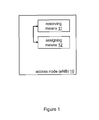
- Figure 1 is a block diagram illustrating an apparatus according to exemplary embodiments of the present invention.
- the apparatus is an access node 10 comprising a reserving means 11 and an assigning means 12.
- the reserving means 11 reserves uplink transmission capacity for a service.
- the assigning means 12 assigns the reserved uplink transmission capacity jointly to a plurality of bearers associated with said service.
- a shared uplink resource reservation is introduced into the quality of service (QoS) framework. It is to be noted that such shared uplink resource reservation is not to be confused with a shared uplink resource, or shared uplink logical channel with given identifier according to current LTE specifications.
- the reservation (the uplink transmission capacity) according to the present invention may be shared by the individual bearers of UEs participating in the service. That is, the uplink transmission capacity may be reserved jointly for the individual bearers.
- such uplink transmission capacity reservation may be made once in any terminating entity common to the individual bearers, i.e. per cell for radio bearers, per gateway for S1 bearers, etc (per group call).
- Figure 2 is a block diagram illustrating an apparatus according to exemplary embodiments of the present invention.
- Figure 2 shows variations of the apparatus shown in Figure 1 .
- the apparatus may further comprise a receiving means 21.
- the receiving means 21 may receive a signaling message comprising at least an indication of a bit rate for said service.
- the reserving means 11 may further allocate the uplink transmission capacity based on said bit rate.
- the shared uplink resource reservation according to exemplary embodiments of the present invention may be a quantity in units of bit rate per group-communication service.
- an eNB may associate individual radio bearers to this reservation at radio-bearer setup as (possibly) instructed by a mobility management entity (MME).
- MME mobility management entity
- Figure 9 is a diagram illustrating principle and possible scopes of reserved uplink transmission capacity according to exemplary embodiments of the present invention.
- a UE 91 is provided with a radio bearer 94 between the UE 91 and its serving eNB 92.
- the UE 91 is further provided with S1 bearer 95 between the eNB 92 and a serving gateway (S-GW) 93.
- S-GW serving gateway
- the UE's 91 radio bearer 94 has a possible uplink GBR
- this possible uplink GBR parameter may be overridden by the uplink transmission capacity 96 for a service.
- the UE's 91 S1 bearer 95 has a possible uplink GBR
- this possible uplink GBR parameter may be overridden by the uplink transmission capacity 97 for the service.
- this reservation 96, 97 may override any possible uplink GBR parameter of any UE-dedicated bearer associated to this reservation, meaning that the eNB 92 only may need to reserve this newly proposed bit rate, no matter how much total uplink GBR of UE-dedicated bearers might be associated to it. That is, an eNB 92 may not need to reserve at all in uplink a GBR of a UE-dedicated bearer associated with such a shared reservation.
- the new parameter may be coupled with a corresponding maximum bit rate (MBR) parameter similar with like the current GBR.
- MBR maximum bit rate
- the signaling message may further comprise a service identifier identifying said service.
- an identifier for group-communication service is proposed, that may uniquely identify a given group-communication service across a predefined domain, e.g. public land mobile network (PLMN).
- PLMN public land mobile network
- the existing temporary mobile group identity TMGI may be reused, which is currently used to identify multimedia broadcast multicast service (MBMS) services.
- MBMS multimedia broadcast multicast service
- the signaling message may be a group communication service setup signaling message.
- Figure 10 is a diagram illustrating possible signaling according to exemplary embodiments of the present invention.
- a possible group communication service setup message 101 is shown.
- a new context-management procedure named e.g. "Group-communication-service context setup" is proposed for the MME 104 to request the eNB 103 to set up a context for a group-communication-service with given identifier (i.e. the group communication service identifier) and GC-GBR.
- a setup response 102 might be transmitted by the eNB 103 to the MME 104.
- this context-management procedure may be introduced in the M2 application protocol (M2AP) and/or M3 application protocol (M3AP) specification.
- M2AP M2 application protocol
- M3AP M3 application protocol
- the receiving means 21 may further receive a bearer setup message which may comprise at least a bearer identifier identifying a bearer and a service identifier identifying a service to which the bearer identified by said bearer identifier is to be associated, and the apparatus may further comprise a setup means 22.
- the setup means 22 may set up the bearer identified by said bearer identifier as one of said plurality of bearers associated with said service identified by said service identifier.
- the core network may be enabled to instruct an eNB to associate a given radio bearer with an indicated group-communication service context (and its shared uplink-resource reservation), which the eNB possibly has previously been instructed to establish by the core network.
- Figure 11 is a diagram illustrating possible signaling according to exemplary embodiments of the present invention.
- a possible bearer setup message 111 is shown.
- new information element(s) in the E-RAB SETUP REQUEST message 111 are proposed, which may indicate group-communication-service context(s) to which the uplink of this bearer should be associated.
- a setup response 112 might be transmitted by the eNB 113 to the MME 114.
- the above mentioned context-management procedure to set up a context for a certain group-communication-service may also be implemented by adding a GC-GBR to at least the first E-RAB SETUP REQUEST message 111 associated with the certain group-communication-service.
- the group-communication service context setup may be communicated implicitly to the eNB 113 from a first occurrence of an E-RAB SETUP REQUEST message 111 associated with the certain group-communication-service, with which also the GC-GBR is signalled.
- the bit rate conforms with a needed bit rate of one active participant of said service. According to further exemplary embodiments of the present invention, the bit rate conforms with a multiple of said needed bit rate of one active participant of said service.
- How much to assign as the GC-GBR of a given group call may depend among others on whether floor control is in place. If floor control is in place, it may be sufficient to only allocate what is needed by one participant active in the uplink, assuming that the related signalling such as speaker-right requests are carried on separate, most likely low-delay, low-bit rate bearers. In the absence of floor control, assigning just a few concurrent uplink-active participants' worth of resources may be sufficient to cover situations where colliding speakers quickly notice the situation. Alternatively, in such case a coupled MBR parameter greater than the GC-GBR may be set to accommodate such situations.
- the bearer setup message may comprise a plurality of service identifiers identifying services to which the bearer identified by said bearer identifier is to be associated.
- a number of separate group calls may be ongoing in a cell, and a UE may belong to a number of groups with such a call ongoing.
- Such UE may conceivably need to be able to switch between those calls near-instantaneously.
- the present application handles the question how a UE's any given dedicated bearer may be mappable to group-communication service contexts and the related GC-GBRs.
- the mapping may be one-to-one i.e. one bearer can be associated to only one service.
- EPS evolved packet system
- An alternative according to the present invention is thus a one-to-many mapping, i.e. any UE's single bearer may be associated to any number of group-communication services, i.e. one bearer may be used as a general-purpose bearer for group-communication services in general.
- An eNB scheduler may then be willing to schedule that radio bearer up to the greatest of the different associated GC-GBRs.
- the apparatus of Figure 2 may further comprise a transmitting means 23.
- the transmitting means 23 transmits a signaling indication of a maximum out of a plurality of bit rates corresponding to said plurality of services to which the bearer identified by said bearer identifier is to be associated.
- the GC-GBR may override a radio bearer's GBR. This does not mean that no GBR (prioritized bit rate at radio resource control (RRC) level, respectively) may be signalled to the UE at setup of the associated bearer.
- RRC radio resource control
- the greatest one of the different GC-GBRs (if several) associated to a UE's bearer may be signalled to the UE as the uplink GBR of the bearer, in order to get the UE to properly prioritize its uplink traffic to the group-communication service, when present, among possible other uplink traffic in its logical-channel prioritization process at the medium access control (MAC) protocol.
- MAC medium access control
- the apparatus may further comprise a transmitting means 23.
- the transmitting means 23 may transmit a handover request for a participant of said service, comprising a service identifier identifying said service and a bearer identifier identifying a bearer associated with said service.
- the receiving means 21 shown in Figure 2 may receive a handover request comprising a service identifier identifying said service and a bearer identifier identifying a bearer associated with said service.
- a source eNB may be enabled to indicate the possible group-communication services associated to each radio bearer of a UE, so that also a target eNB can properly treat this association.
- Figure 12 is a diagram illustrating possible signaling according to exemplary embodiments of the present invention. In particular, a possible handover request message 121 is shown.
- new information element(s) in the HANDOVER REQUEST message 121 are proposed for indicating such association information of evolved UMTS terrestrial radio access network (EUTRAN) radio access bearers (E-RAB) to the potential handover-target eNB 124. It is to be noted that those new information element(s) may also be incorporated into the message with same name in the X2 application protocol (X2AP) specification.
- EUTRAN evolved UMTS terrestrial radio access network
- E-RAB radio access bearers
- a handover request acknowledge 122 might be transmitted by the target eNB 124 to the initiating source eNB 123.
- the service may be a group communication service.
- the bit rate may be a group communication service guaranteed bit rate.
- the reserved uplink transmission capacity may be reserved jointly to each bearer of said plurality of bearers associated with said service.
- Such jointly reservation of transmission capacity resources for each bearer of said plurality of bearers associated with a service may be done per network (e.g. per base station, for example an eNB) element or per cell.
- Figure 3 is a block diagram illustrating an apparatus according to exemplary embodiments of the present invention.
- the apparatus may be a network node 30 comprising a controlling means 31.
- the controlling means 31 may control reservation of uplink transmission capacity for a service and assignment of said uplink transmission capacity reservation jointly to a plurality of bearers associated with said service.
- Figure 4 is a block diagram illustrating an apparatus according to exemplary embodiments of the present invention.
- Figure 4 shows variations of the apparatus shown in Figure 3 .
- the apparatus 30 may further comprise a transmitting means 41.
- the transmitting means 41 may transmit a signaling message comprising at least an indication of a bit rate for said service.
- the signaling message may further comprise a service identifier identifying said service.
- the transmitting means 41 may further transmit a bearer setup message comprising at least a bearer identifier identifying a bearer and a service identifier identifying a service to which the bearer identified by said bearer identifier is to be associated.
- the bit rate conforms with a needed bit rate of one active participant of said service.
- the bit rate conforms with a multiple of said needed bit rate of one active participant of said service.
- the bearer setup message may comprise a plurality of service identifiers identifying services to which the bearer identified by said bearer identifier may be associated.
- the service may be a group communication service.
- the signaling message may be a group communication service setup signaling message.
- the bit rate may be a group communication service guaranteed bit rate.
- the reserved uplink transmission capacity may be reserved jointly to each bearer of said plurality of bearers associated with said service.
- Such jointly reservation of transmission capacity resources for each bearer of said plurality of bearers associated with a service may be done per network (e.g. per base station, for example an eNB) element or per cell.
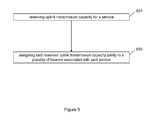
- Figure 5 is a schematic diagram of a procedure according to exemplary embodiments of the present invention.
- a procedure according to exemplary embodiments of the present invention may comprise an operation of reserving S51 uplink transmission capacity for a service, and an operation of assigning S52 said reserved uplink transmission capacity jointly to a plurality of bearers associated with said service.
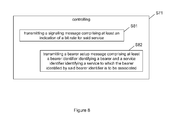
- Figure 6 is a schematic diagram of a procedure according to exemplary embodiments of the present invention.
- Figure 6 shows variations of the procedure shown in Figure 5 .
- an exemplary method according to exemplary embodiments of the present invention may comprise an operation of receiving S63 a signaling message comprising at least an indication of a bit rate for said service.
- Such exemplary reserving S51 operation may comprise an operation of allocating S64 said uplink transmission capacity based on said bit rate.
- the signaling message may further comprise a service identifier identifying said service.
- an exemplary method may comprise an operation of receiving S61 a bearer setup message comprising at least a bearer identifier identifying a bearer and a service identifier identifying a service to which the bearer identified by said bearer identifier is to be associated, and an operation of setting up S62 the bearer identified by said bearer identifier as one of said plurality of bearers associated with said service identified by said service identifier.
- bit rate conforms with a needed bit rate of one active participant of said service.
- bit rate conforms with a multiple of said needed bit rate of one active participant of said service.
- the bearer setup message may comprise a plurality of service identifiers identifying services to which the bearer identified by said bearer identifier is to be associated.
- an exemplary method according to exemplary embodiments of the present invention may comprise an operation of transmitting S65 a signaling indication of a maximum out of a plurality of bit rates corresponding to said plurality of services to which the bearer identified by said bearer identifier is to be associated.
- an exemplary method according to exemplary embodiments of the present invention may comprise an operation of transmitting S66 a handover request for a participant of said service, comprising a service identifier identifying said service and a bearer identifier identifying a bearer associated with said service.
- an exemplary method according to exemplary embodiments of the present invention may comprise an operation of receiving S67 a handover request comprising a service identifier identifying said service and a bearer identifier identifying a bearer associated with said service.
- the reserved uplink transmission capacity may be reserved jointly to each bearer of said plurality of bearers associated with said service.
- Such jointly reservation of transmission capacity resources for each bearer of said plurality of bearers associated with a service may be done per network (e.g. per base station, for example an eNB) element or per cell.
- Figure 7 is a schematic diagram of a procedure according to exemplary embodiments of the present invention.
- a procedure according to exemplary embodiments of the present invention may comprise an operation of controlling S71 reservation of uplink transmission capacity for a service and assignment of said uplink transmission capacity reservation jointly to a plurality of bearers associated with said service.
- Figure 8 is a schematic diagram of a procedure according to exemplary embodiments of the present invention.
- Figure 8 shows variations of the procedure shown in Figure 7 .
- Such exemplary controlling S71 operation may comprise an operation of transmitting S81 a signaling message comprising at least an indication of a bit rate for said service.
- the signaling message may further comprise a service identifier identifying said service.
- Such exemplary controlling S71 operation may comprise an operation of transmitting S82 a bearer setup message comprising at least a bearer identifier identifying a bearer and a service identifier identifying a service to which the bearer identified by said bearer identifier is to be associated.
- bit rate conforms with a needed bit rate of one active participant of said service.
- bit rate conforms with a multiple of said needed bit rate of one active participant of said service.
- the bearer setup message may comprise a plurality of service identifiers identifying services to which the bearer identified by said bearer identifier is to be associated.
- the reserved uplink transmission capacity may be reserved jointly to each bearer of said plurality of bearers associated with said service.
- Such jointly reservation of transmission capacity resources for each bearer of said plurality of bearers associated with a service may be done per network (e.g. per base station, for example an eNB) element or per cell.
- the downlink of the group service may be delivered over individual unicast bearers. According to further modifications of exemplary embodiments of the present invention, the downlink of the group service may be delivered over a common broadcast transmission that the participating UEs need to receive.
- each radio bearer may be coupled with its own S1-bearer counterpart, as in the current bearer model.
- Entities impacted by the invention may be at least the MME and the eNB. In contrast thereto, and as opposed to introducing the VGCS-type solution in LTE, there may be no impact to the UE. It is noted that as a new enabler for transmission-resource management, the needed scope of signalling for the proposed new parameters may be similar to the existing allocation and retention priority (ARP).
- ARP allocation and retention priority
- the network entity may comprise further units that are necessary for its respective operation. However, a description of these units is omitted in this specification.
- the arrangement of the functional blocks of the devices is not construed to limit the invention, and the functions may be performed by one block or further split into sub-blocks.
- the apparatus i.e. network entity (or some other means) is configured to perform some function
- this is to be construed to be equivalent to a description stating that a (i.e. at least one) processor or corresponding circuitry, potentially in cooperation with computer program code stored in the memory of the respective apparatus, is configured to cause the apparatus to perform at least the thus mentioned function.
- a (i.e. at least one) processor or corresponding circuitry potentially in cooperation with computer program code stored in the memory of the respective apparatus, is configured to cause the apparatus to perform at least the thus mentioned function.
- function is to be construed to be equivalently implementable by specifically configured circuitry or means for performing the respective function (i.e. the expression "unit configured to” is construed to be equivalent to an expression such as "means for").
- the apparatus (access node) 10' (corresponding to the access node 10) comprises a processor 131, a memory 132 and an interface 133, which may be connected by a bus 134 or the like.
- the apparatus (network node) 30' (corresponding to the network node 30) comprises a processor 135, a memory 136 and an interface 137, which may be connected by a bus 138 or the like, and the apparatuses may be connected via link 139, respectively, thus forming a system.
- the processor 131/135 and/or the interface 133/137 may also include a modem or the like to facilitate communication over a (hardwire or wireless) link, respectively.
- the interface 133/137 may include a suitable transceiver coupled to one or more antennas or communication means for (hardwire or wireless) communications with the linked or connected device(s), respectively.
- the interface 133/137 is generally configured to communicate with at least one other apparatus, i.e. the interface thereof.
- the memory 132/136 may store respective programs assumed to include program instructions or computer program code that, when executed by the respective processor, enables the respective electronic device or apparatus to operate in accordance with the exemplary embodiments of the present invention.
- the respective devices/apparatuses may represent means for performing respective operations and/or exhibiting respective functionalities, and/or the respective devices (and/or parts thereof) may have functions for performing respective operations and/or exhibiting respective functionalities.
- processor or some other means
- the processor is configured to perform some function
- this is to be construed to be equivalent to a description stating that at least one processor, potentially in cooperation with computer program code stored in the memory of the respective apparatus, is configured to cause the apparatus to perform at least the thus mentioned function.
- function is to be construed to be equivalently implementable by specifically configured means for performing the respective function (i.e. the expression "processor configured to [cause the apparatus to] perform xxx-ing” is construed to be equivalent to an expression such as "means for xxx-ing").
- an apparatus representing the access node 10 comprises at least one processor 131, at least one memory 132 including computer program code, and at least one interface 133 configured for communication with at least another apparatus.
- the processor i.e. the at least one processor 131, with the at least one memory 132 and the computer program code
- the processor is configured to perform reserving uplink transmission capacity for a service (thus the apparatus comprising corresponding means for reserving), and to perform assigning said reserved uplink transmission capacity jointly to a plurality of bearers associated with said service (thus the apparatus comprising corresponding means for assigning).
- an apparatus representing the network node 30 comprises at least one processor 135, at least one memory 136 including computer program code, and at least one interface 137 configured for communication with at least another apparatus.
- the processor i.e. the at least one processor 135, with the at least one memory 136 and the computer program code
- the processor is configured to perform controlling reservation of uplink transmission capacity for a service and assignment of said uplink transmission capacity reservation jointly to a plurality of bearers associated with said service (thus the apparatus comprising corresponding means for controlling).
- respective functional blocks or elements according to above-described aspects can be implemented by any known means, either in hardware and/or software, respectively, if it is only adapted to perform the described functions of the respective parts.
- the mentioned method steps can be realized in individual functional blocks or by individual devices, or one or more of the method steps can be realized in a single functional block or by a single device.
- any method step is suitable to be implemented as software or by hardware without changing the idea of the present invention.
- Devices and means can be implemented as individual devices, but this does not exclude that they are implemented in a distributed fashion throughout the system, as long as the functionality of the device is preserved. Such and similar principles are to be considered as known to a skilled person.
- Software in the sense of the present description comprises software code as such comprising code means or portions or a computer program or a computer program product for performing the respective functions, as well as software (or a computer program or a computer program product) embodied on a tangible medium such as a computer-readable (storage) medium having stored thereon a respective data structure or code means/portions or embodied in a signal or in a chip, potentially during processing thereof.
- the present invention also covers any conceivable combination of method steps and operations described above, and any conceivable combination of nodes, apparatuses, modules or elements described above, as long as the above-described concepts of methodology and structural arrangement are applicable.
- Such measures exemplarily comprise reserving uplink transmission capacity for a group communication service, and assigning said reserved uplink transmission capacity jointly to a plurality of bearers associated with said group communication service.
Landscapes
- Engineering & Computer Science (AREA)
- Multimedia (AREA)
- Computer Networks & Wireless Communication (AREA)
- Signal Processing (AREA)
- Mobile Radio Communication Systems (AREA)
Priority Applications (2)
| Application Number | Priority Date | Filing Date | Title |
|---|---|---|---|
| EP13151883.9A EP2757843A1 (fr) | 2013-01-18 | 2013-01-18 | Réservation de capacité de transmission de liaison montante |
| PCT/EP2013/075108 WO2014111191A1 (fr) | 2013-01-18 | 2013-11-29 | Réservation de capacité de transmission de liaison montante |
Applications Claiming Priority (1)
| Application Number | Priority Date | Filing Date | Title |
|---|---|---|---|
| EP13151883.9A EP2757843A1 (fr) | 2013-01-18 | 2013-01-18 | Réservation de capacité de transmission de liaison montante |
Publications (1)
| Publication Number | Publication Date |
|---|---|
| EP2757843A1 true EP2757843A1 (fr) | 2014-07-23 |
Family
ID=47594554
Family Applications (1)
| Application Number | Title | Priority Date | Filing Date |
|---|---|---|---|
| EP13151883.9A Withdrawn EP2757843A1 (fr) | 2013-01-18 | 2013-01-18 | Réservation de capacité de transmission de liaison montante |
Country Status (2)
| Country | Link |
|---|---|
| EP (1) | EP2757843A1 (fr) |
| WO (1) | WO2014111191A1 (fr) |
Cited By (1)
| Publication number | Priority date | Publication date | Assignee | Title |
|---|---|---|---|---|
| WO2017127673A1 (fr) * | 2016-01-22 | 2017-07-27 | Blackberry Limited | Détermination de nom de point d'accès pour des services essentiels à la mission |
Families Citing this family (1)
| Publication number | Priority date | Publication date | Assignee | Title |
|---|---|---|---|---|
| WO2020034427A1 (fr) * | 2018-11-01 | 2020-02-20 | Zte Corporation | Mises en correspondance de porteuses pour des liaisons d'accès et de liaison terrestre intégrées |
Citations (1)
| Publication number | Priority date | Publication date | Assignee | Title |
|---|---|---|---|---|
| WO2012173623A1 (fr) * | 2011-06-16 | 2012-12-20 | Nokia Siemens Networks Oy | Procédés, appareil, système et produit programme d'ordinateur associé pour l'activation et la désactivation de porteurs |
-
2013
- 2013-01-18 EP EP13151883.9A patent/EP2757843A1/fr not_active Withdrawn
- 2013-11-29 WO PCT/EP2013/075108 patent/WO2014111191A1/fr not_active Ceased
Patent Citations (1)
| Publication number | Priority date | Publication date | Assignee | Title |
|---|---|---|---|---|
| WO2012173623A1 (fr) * | 2011-06-16 | 2012-12-20 | Nokia Siemens Networks Oy | Procédés, appareil, système et produit programme d'ordinateur associé pour l'activation et la désactivation de porteurs |
Non-Patent Citations (3)
| Title |
|---|
| EADS: "EPS and UE functional and performance requirements for GCSE_LTE", vol. SA WG1, no. Edinburgh, UK; 20121108 - 20121109, 19 November 2012 (2012-11-19), XP050681979, Retrieved from the Internet <URL:http://www.3gpp.org/ftp/tsg_sa/WG1_Serv/TSGS1_60_GCSE_adhoc/docs/> [retrieved on 20121119] * |
| QUALCOMM INC: "GCSE_LTE definitions", vol. SA WG1, no. Edinburgh, UK; 20121108 - 20121109, 1 November 2012 (2012-11-01), XP050681958, Retrieved from the Internet <URL:http://www.3gpp.org/ftp/tsg_sa/WG1_Serv/TSGS1_60_GCSE_adhoc/docs/> [retrieved on 20121101] * |
| QUALCOMM INC: "GCSE_LTE functional and high level requirements", vol. SA WG1, no. Edinburgh, UK; 20121108 - 20121109, 1 November 2012 (2012-11-01), XP050681959, Retrieved from the Internet <URL:http://www.3gpp.org/ftp/tsg_sa/WG1_Serv/TSGS1_60_GCSE_adhoc/docs/> [retrieved on 20121101] * |
Cited By (4)
| Publication number | Priority date | Publication date | Assignee | Title |
|---|---|---|---|---|
| WO2017127673A1 (fr) * | 2016-01-22 | 2017-07-27 | Blackberry Limited | Détermination de nom de point d'accès pour des services essentiels à la mission |
| US10716152B2 (en) | 2016-01-22 | 2020-07-14 | Blackberry Limited | Access point name determination for mission critical services |
| US11240856B2 (en) | 2016-01-22 | 2022-02-01 | Blackberry Limited | Access point name determination for mission critical services |
| US11729840B2 (en) | 2016-01-22 | 2023-08-15 | Malikie Innovations Limited | Access point name determination for mission critical services |
Also Published As
| Publication number | Publication date |
|---|---|
| WO2014111191A1 (fr) | 2014-07-24 |
Similar Documents
| Publication | Publication Date | Title |
|---|---|---|
| US10397855B2 (en) | Access attempt method and user equipment, and access control method and base station | |
| CN106412794B (zh) | 一种资源分配的方法和设备 | |
| EP3745798B1 (fr) | Procédé d'attribution de ressource, équipement utilisateur et support d'informations informatique | |
| US9467900B2 (en) | Service scheduling method and apparatus | |
| US11671902B2 (en) | Apparatus and methods for new radio broadcast and multicast access control | |
| US20190394685A1 (en) | Communications system, infrastructure equipment, communications device and methods | |
| CN107592974A (zh) | 用于在无线通信系统中提供服务的方法和设备 | |
| CN104126281A (zh) | 用于站间载波聚合的辅小区准备 | |
| CN108141897A (zh) | 一种终端设备、网络设备以及数据传输方法 | |
| EP3001703A1 (fr) | Amélioration de la couverture de multidiffusion dans un réseau cellulaire | |
| US20170238149A1 (en) | Network sharing for multimedia broadcast multicast service | |
| JP2017506451A (ja) | 無線通信システムにおけるmo−smsに対する適応的遮断制御方法及び装置 | |
| US11497062B2 (en) | Wireless telecommunications apparatus and methods | |
| CN108141867A (zh) | 用于通信系统中数据流传输的改进的优先级处理 | |
| CN110475382A (zh) | 无线回程节点的承载映射方法、无线回程节点和施主基站 | |
| CN111294140A (zh) | 数据传输方法与通信装置 | |
| CN103888963B (zh) | 无线网络临时标识的配置方法、站点和用户设备 | |
| US20160337876A1 (en) | Methods, User Node and Network Node in an MBMS Network | |
| WO2022000180A1 (fr) | Procédés et appareil de transmission en multidiffusion fiable avec rétroaction de liaison montante | |
| WO2015032362A1 (fr) | Procédé, dispositif et appareil d'établissement d'une porteuse de session de groupe | |
| EP2757843A1 (fr) | Réservation de capacité de transmission de liaison montante | |
| CN114765475B (zh) | 一种时钟传播方法、网络设备及第一终端设备 | |
| WO2019113739A1 (fr) | Procédés, dispositifs et supports lisibles par ordinateur pour une communication de dispositif à dispositif | |
| CN103391616A (zh) | 公共增强专用信道资源重配方法和系统以及基站、rnc | |
| CN115278815A (zh) | 数据传输方法、装置、设备及计算机可读存储介质 |
Legal Events
| Date | Code | Title | Description |
|---|---|---|---|
| PUAI | Public reference made under article 153(3) epc to a published international application that has entered the european phase |
Free format text: ORIGINAL CODE: 0009012 |
|
| 17P | Request for examination filed |
Effective date: 20130118 |
|
| AK | Designated contracting states |
Kind code of ref document: A1 Designated state(s): AL AT BE BG CH CY CZ DE DK EE ES FI FR GB GR HR HU IE IS IT LI LT LU LV MC MK MT NL NO PL PT RO RS SE SI SK SM TR |
|
| AX | Request for extension of the european patent |
Extension state: BA ME |
|
| R17P | Request for examination filed (corrected) |
Effective date: 20150123 |
|
| RBV | Designated contracting states (corrected) |
Designated state(s): AL AT BE BG CH CY CZ DE DK EE ES FI FR GB GR HR HU IE IS IT LI LT LU LV MC MK MT NL NO PL PT RO RS SE SI SK SM TR |
|
| 17Q | First examination report despatched |
Effective date: 20151022 |
|
| STAA | Information on the status of an ep patent application or granted ep patent |
Free format text: STATUS: THE APPLICATION IS DEEMED TO BE WITHDRAWN |
|
| 18D | Application deemed to be withdrawn |
Effective date: 20161201 |