EP2759538B1 - Composé marqué par du fluor radioactif - Google Patents
Composé marqué par du fluor radioactif Download PDFInfo
- Publication number
- EP2759538B1 EP2759538B1 EP12833263.2A EP12833263A EP2759538B1 EP 2759538 B1 EP2759538 B1 EP 2759538B1 EP 12833263 A EP12833263 A EP 12833263A EP 2759538 B1 EP2759538 B1 EP 2759538B1
- Authority
- EP
- European Patent Office
- Prior art keywords
- group
- compound
- dioxane
- dimethyl
- tumor
- Prior art date
- Legal status (The legal status is an assumption and is not a legal conclusion. Google has not performed a legal analysis and makes no representation as to the accuracy of the status listed.)
- Active
Links
Images


Classifications
-
- A—HUMAN NECESSITIES
- A61—MEDICAL OR VETERINARY SCIENCE; HYGIENE
- A61K—PREPARATIONS FOR MEDICAL, DENTAL OR TOILETRY PURPOSES
- A61K51/00—Preparations containing radioactive substances for use in therapy or testing in vivo
- A61K51/02—Preparations containing radioactive substances for use in therapy or testing in vivo characterised by the carrier, i.e. characterised by the agent or material covalently linked or complexing the radioactive nucleus
- A61K51/04—Organic compounds
- A61K51/041—Heterocyclic compounds
- A61K51/044—Heterocyclic compounds having nitrogen as a ring hetero atom, e.g. guanethidine, rifamycins
- A61K51/0453—Heterocyclic compounds having nitrogen as a ring hetero atom, e.g. guanethidine, rifamycins having five-membered rings with two or more ring hetero atoms, at least one of which being nitrogen, e.g. tetrazole
-
- C—CHEMISTRY; METALLURGY
- C07—ORGANIC CHEMISTRY
- C07B—GENERAL METHODS OF ORGANIC CHEMISTRY; APPARATUS THEREFOR
- C07B59/00—Introduction of isotopes of elements into organic compounds ; Labelled organic compounds per se
- C07B59/002—Heterocyclic compounds
-
- C—CHEMISTRY; METALLURGY
- C07—ORGANIC CHEMISTRY
- C07D—HETEROCYCLIC COMPOUNDS
- C07D233/00—Heterocyclic compounds containing 1,3-diazole or hydrogenated 1,3-diazole rings, not condensed with other rings
- C07D233/54—Heterocyclic compounds containing 1,3-diazole or hydrogenated 1,3-diazole rings, not condensed with other rings having two double bonds between ring members or between ring members and non-ring members
- C07D233/66—Heterocyclic compounds containing 1,3-diazole or hydrogenated 1,3-diazole rings, not condensed with other rings having two double bonds between ring members or between ring members and non-ring members with hetero atoms or with carbon atoms having three bonds to hetero atoms with at the most one bond to halogen, e.g. ester or nitrile radicals, directly attached to ring carbon atoms
- C07D233/91—Nitro radicals
-
- C—CHEMISTRY; METALLURGY
- C07—ORGANIC CHEMISTRY
- C07D—HETEROCYCLIC COMPOUNDS
- C07D405/00—Heterocyclic compounds containing both one or more hetero rings having oxygen atoms as the only ring hetero atoms, and one or more rings having nitrogen as the only ring hetero atom
- C07D405/02—Heterocyclic compounds containing both one or more hetero rings having oxygen atoms as the only ring hetero atoms, and one or more rings having nitrogen as the only ring hetero atom containing two hetero rings
- C07D405/06—Heterocyclic compounds containing both one or more hetero rings having oxygen atoms as the only ring hetero atoms, and one or more rings having nitrogen as the only ring hetero atom containing two hetero rings linked by a carbon chain containing only aliphatic carbon atoms
-
- A—HUMAN NECESSITIES
- A61—MEDICAL OR VETERINARY SCIENCE; HYGIENE
- A61K—PREPARATIONS FOR MEDICAL, DENTAL OR TOILETRY PURPOSES
- A61K2123/00—Preparations for testing in vivo
-
- Y—GENERAL TAGGING OF NEW TECHNOLOGICAL DEVELOPMENTS; GENERAL TAGGING OF CROSS-SECTIONAL TECHNOLOGIES SPANNING OVER SEVERAL SECTIONS OF THE IPC; TECHNICAL SUBJECTS COVERED BY FORMER USPC CROSS-REFERENCE ART COLLECTIONS [XRACs] AND DIGESTS
- Y02—TECHNOLOGIES OR APPLICATIONS FOR MITIGATION OR ADAPTATION AGAINST CLIMATE CHANGE
- Y02P—CLIMATE CHANGE MITIGATION TECHNOLOGIES IN THE PRODUCTION OR PROCESSING OF GOODS
- Y02P20/00—Technologies relating to chemical industry
- Y02P20/50—Improvements relating to the production of bulk chemicals
- Y02P20/55—Design of synthesis routes, e.g. reducing the use of auxiliary or protecting groups
Definitions
- the present invention relates to a radioactive fluorine-labeled compound.
- a hypoxic state provides important information regarding physiology, pathology, and proliferative tissue such as a tumor.
- the tumor In the interior of a solid tumor, since the formation of blood vessels and capillary vessels is insufficient, the tumor is placed in a state in which nutrients and oxygen are deficient, and it survives in a hypoxic state until it dies. Due to the concentration of oxygen, which has excellent radiosensitivity, being low, tumor cells in a seriously hypoxic state acquire the property of exhibiting resistance to radiotherapy. It has been reported that in chemotherapy also it is difficult to deliver a drug due to ischemia caused by a fully-functioning blood vessel structure being incomplete, and the prognosis is poor (Non-patent Documents 1 to 5).
- Non-patent Documents 3, 6, and 7 a method of identifying in vivo a hypoxic region formed from cells in a hypoxic state and quantitatively evaluate the level of hypoxia is important.
- a method of identifying a hypoxic region for example, a method employing an oxygen electrode is known (Non-patent Documents 3, 6, and 7).
- misonidazole which has a 2-nitroimidazole skeleton. This compound undergoes nitroreduction under hypoxic conditions and accumulates within a cell as an electrophilic chemical species that forms an adduct with cellular macromolecules such as DNA or protein (Non-patent Documents 8 and 9).
- Non-patent Documents 13 to 16 compounds having a 2-nitroimidazole skeleton have been labeled with various radioactive nucleides and subjected to, for example, single-photon emission computed tomography (SPECT) (Non-patent Documents 13 to 16) or positron emission tomography (PET) employing [ 18 F]fluoromisonidazole ([ 18 F]FMISO), which is a radioactive fluorine-labeled misonidazole derivative (Non-patent Document 17).
- SPECT single-photon emission computed tomography
- PET positron emission tomography
- [ 18 F]fluoromisonidazole [ 18 F]FMISO
- radioactive fluorine-labeled compounds having a 2-nitroimidazole skeleton there are [ 18 F]fluoroetanidazole ([ 18 F]FETA) (Non-patent Document 18), [ 18 F]fluoroerythronitroimidazole ([ 18 F]FETNIM) (Patent Document 3, Non-patent Document 19), 2-(2-nitro-1H-imidazol-1-yl)- N -(3-[ 18 F]fluoropropyl)-acetamide ([ 18 F]EF1) (Patent Document 4, Non-patent Document 20), 2-(2-nitro-1H-imidazol-1-yl)-N-(2,2,3,3-[ 18 F]pentafluoropropyl)-acetamide ([ 18 F]EF5) (Patent Document 5, Non-patent Document 21), [ 18 F]fluoroazomycinarabinofuranoside ([ 18 F]FAZA) (Non-patent Document 22, Non-patent Document 23), 4-
- WO 95/09844 discloses nitro-imidazole compounds having a 18F group, such as 18F-fluoromisonidazole and analogue compounds having 2 CHOH groups in the side chain, in particular 18F-fluoroerythro-nitro-imidazole ([18F]FETNIM).
- JP H06 211805 and JP H06 298739 disclose pentaerythritol nitro-imidazole compounds which are capable of reoxygenating hypoxic cells.
- Non-patent Document 18 discloses an example in which oxygen concentration and accumulation of [ 18 F]FETA were examined using various types of tumor cells, but a correlation between tracer accumulation and oxygen concentration in vivo was not evaluated. Furthermore, Patent Documents 3 to 5 and Non-patent Documents 19 to 24 do not disclose a technique that focuses on a correlation between tracer accumulation and oxygen concentration in a hypoxic region.
- the present invention has been accomplished in light of the above circumstances, and it is an object thereof to provide a radioactive fluorine-labeled compound that enables an in vivo hypoxic region to be quantitatively evaluated with good precision.
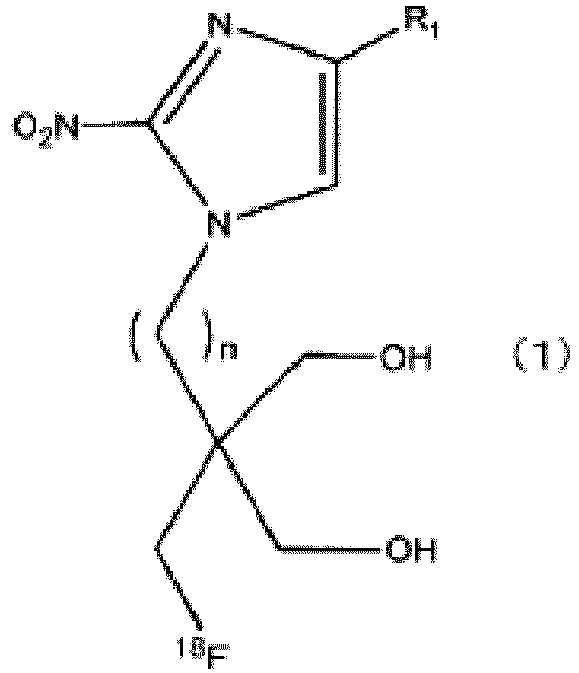
- the present invention provides a compound represented by the following formula (1) or a salt thereof.
- R 1 denotes a hydrogen atom, a methyl group, or a hydroxymethyl group, and n is an integer of 1 or 2.
- the present invention provides a compound represented by the following formula (2) or a salt thereof.
- R 2 and R 3 denote the same or mutually different hydroxy protecting groups, or R 2 and R 3 together denote a diol protecting group
- R 4 denotes a non-radioactive halogen, a trialkylammonium having 3 to 12 carbon atoms, a straight-chain or branched alkylsulfonyloxy group having 1 to 10 carbon atoms, a straight-chain or branched haloalkylsulfonyloxy group having 1 to 10 carbon atoms, a substituted or unsubstituted arylsulfonyloxy group, or a dialkylsulfonium having 2 to 8 carbon atoms
- R 5 denotes a hydrogen atom, a methyl group, or -CH 2 OR 6
- R 6 denotes a hydroxy protecting group
- n is an integer of 1 or 2.
- the present invention provides a radioactive pharmaceutical composition containing a compound represented by the formula (1) or a salt thereof.
- the present invention provides a method of producing a compound represented by the formula (1) or a salt thereof from a compound represented by the formula (2) or a salt thereof.
- the present invention provides an apparatus for producing a compound represented by the formula (1) or a salt thereof from a compound represented by the formula (2) or a salt thereof.
- radioactive fluorine-labeled compound that enables an in vivo hypoxic region to be quantitatively evaluated with good precision.
- the radioactive fluorine-labeled compound related to the present invention is a compound represented by the formula (1) or a salt thereof, and in accordance with particularly preferred embodiments, it may be for example 1-(2,2-dihydroxymethyl-3-[ 18 F]fluoropropyl)-2-nitroimidazole, which is represented by the following formula (4), 1-(2,2-dihydroxymethyl-3-[ 18 F]fluoropropyl)-4-hydroxymethyl-2-nitroimidazole, which is represented by the following formula (5), or 1-(3,3-dihydroxymethyl-4-[ 18 F]fluorobutyl)-2-nitroimidazole, which is represented by the following formula (6).
- radioactive fluorine-labeled compound related to the present invention there is a case in which a compound represented by the formula (1) forms a salt, and such a salt may be included in the present invention as long as it is a pharmaceutically acceptable salt.
- the salt include an inorganic salt with hydrochloric acid, hydrobromic acid, hydroiodic acid, sulfuric acid, nitric acid, phosphoric acid, etc.
- an organic acid such as formic acid, acetic acid, propionic acid, oxalic acid, malonic acid, succinic acid, fumaric acid, maleic acid, lactic acid, malic acid, tartaric acid, citric acid, methanesulfonic acid, ethanesulfonic acid, p -toluenesulfonic acid, aspartic acid, or glutamic acid.
- organic acid such as formic acid, acetic acid, propionic acid, oxalic acid, malonic acid, succinic acid, fumaric acid, maleic acid, lactic acid, malic acid, tartaric acid, citric acid, methanesulfonic acid, ethanesulfonic acid, p -toluenesulfonic acid, aspartic acid, or glutamic acid.
- the radioactive fluorine-labeled compound related to the present invention may be produced using a compound represented by the formula (2) or a salt thereof as a labeling precursor.
- the 'labeling precursor' is a compound that is a starting material in a step of introducing fluorine 18, which is a radioactive isotope.
- R 2 and R 3 denote the same or mutually different hydroxy protecting groups, or R 2 and R 3 together denote a diol protecting group.
- hydroxy protecting group and the diol protecting group those described in Greene's Protective Groups in Organic Synthesis, p.17-245 (Wiley-Interscience; 4th editi on) may be used.
- R 2 and R 3 may preferably be selected from the group consisting of a trityl group, a monomethoxytrityl group, a dimethoxytrityl group, a trimethoxytrityl group, a methoxymethyl group, a 1-ethoxyethyl group, a methoxyethoxymethyl group, a benzyl group, a p -methoxybenzyl group, a 2-tetrahydropyranyl group, a trimethylsilyl group, a triethylsilyl group, a t -butyldimethylsilyl group, a t -butyldiphenylsilyl group, an acetyl group, a propanoyl group, a pivaloyl group, a palmitoyl group, a dimethylaminomethylcarbonyl group, an alanyl
- R 2 and R 3 together denote a diol protecting group
- R 2 and R 3 together denote for example a methylene group [-CH 2 -], a 1-methylethan-1,1-diyl group [-C(CH 3 ) 2 -], an ethan-1,1-diyl group [-CH(CH 3 )-], or a 1-phenylmethan-1,1-diyl group [-CHPh] and, as a result, may form a 1,3-dioxane ring.
- R 2 and R 3 are particularly preferably an acetonide group.
- R 4 is not particularly limited as long as it is a functional group that can undergo a nucleophilic substitution reaction, and is a non-radioactive halogen atom, a trialkylammonium having 3 to 12 carbon atoms, a straight-chain or branched alkylsulfonyloxy group having 1 to 10 carbon atoms, a straight-chain or branched haloalkylsulfonyloxy group having 1 to 10 carbon atoms, a substituted or unsubstituted arylsulfonyloxy group, or a dialkylsulfonium having 2 to 8 carbon atoms.
- non-radioactive halogen atom examples include a fluorine atom, a chlorine atom, a bromine atom, and an iodine atom, and a bromine atom or an iodine atom is preferable.
- the trialkylammonium having 3 to 12 carbon atoms is represented by -N + (R 11 ) (R 12 ) (R 13 )X a - .
- R 11 , R 12 , and R 13 are mutually independently selected from the group consisting of substituted or unsubstituted alkyl, may be straight-chain alkyl or branched alkyl, and are preferably straight-chain unsubstituted alkyl. Among them, trimethylammonium or triethylammonium is preferable.
- X a - may be an organic acid anion such as CF 3 S(O) 2 O - , C 4 F 9 S(O) 2 O - , or trifluoroacetic acid anion (CF 3 -C(O)O - ) or an inorganic acid anion such as iodide anion, bromide anion, chloride anion, perchlorate anion (ClO 4 - ), or phosphate anion.
- organic acid anion such as CF 3 S(O) 2 O - , C 4 F 9 S(O) 2 O -
- trifluoroacetic acid anion CF 3 -C(O)O -
- an inorganic acid anion such as iodide anion, bromide anion, chloride anion, perchlorate anion (ClO 4 - ), or phosphate anion.
- Examples of the straight-chain or branched alkylsulfonyloxy group having 1 to 10 carbon atoms include a methanesulfonyloxy group and an ethanesulfonyloxy group.
- Examples of the straight-chain or branched haloalkylsulfonyloxy group having 1 to 10 carbon atoms include a trifluoromethanesulfonyloxy group.
- arylsulfonyloxy group examples include an arylsulfonyloxy group having 6 to 10 carbon atoms, such as a benzenesulfonyloxy group or a naphthalenesulfonyloxy group.
- Examples of a group with which these arylsulfonyloxy groups may be substituted include an optionally substituted alkyl group such as a methyl group, an ethyl group, a n -propyl group, an isopropyl group, a n -butyl group, an isobutyl group, a sec-butyl group, a tert -butyl group, or a n- pentyl group; a halogen atom such as a fluorine atom, a chlorine atom, or a bromine atom; an alkoxy group such as a methoxy group or an ethoxy group; an alkylcarbonyl group such as an acetyl group or a propionyl group; and a nitro group.
- Specific examples of an alkylsulfonyloxy group substituted with such a group include a p- toluenesulfonyloxy group and a 2-nitrobenz
- the dialkylsulfonium having 2 to 8 carbon atoms is represented by -S + (R 14 ) (R 15 )X b - .
- R 14 and R 15 are mutually independently selected from the group consisting of substituted or unsubstituted alkyls, may be straight-chain alkyl or branched alkyl, and are preferably straight-chain unsubstituted alkyls. Among them, dimethylsulfonium or diethylsulfonium is preferable.
- X b - may be an organic acid anion such as CF 3 S(O) 2 O - , C 4 F 9 S(O) 2 O - , or trifluoroacetic acid anion (CF 3 -C(O)O - ), or an inorganic acid anion such as iodide anion, bromide anion, chloride anion, perchloric acid anion (ClO 4 - ), or phosphate anion.
- organic acid anion such as CF 3 S(O) 2 O - , C 4 F 9 S(O) 2 O - , or trifluoroacetic acid anion (CF 3 -C(O)O - )
- an inorganic acid anion such as iodide anion, bromide anion, chloride anion, perchloric acid anion (ClO 4 - ), or phosphate anion.
- R 4 is preferably a non-radioactive bromine atom or iodine atom, a p -toluenesulfonyloxy group, a trifluoromethylsulfonyloxy group, a methanesulfonyloxy group, or a 2-nitrobenzenesulfonyloxy group.
- a non-radioactive bromine atom or iodine atom or a p -toluenesulfonyloxy group are particularly preferable.
- R 5 denotes a hydrogen atom, a methyl group, or -CH 2 OR 6 .
- R 6 is not particularly limited as long as it is a protecting group used for a hydroxy group; those described in Greene's Protective Groups in Organic Synthesis, p.17-245 (Wiley-Interscience; 4th editi on) may be used.
- a trityl group a monomethoxytrityl group, a dimethoxytrityl group, a trimethoxytrityl group, a methoxymethyl group, a 1-ethoxyethyl group, a methoxyethoxymethyl group, a benzyl group, a p -methoxybenzyl group, a 2-tetrahydropyranyl group, a trimethylsilyl group, a triethylsilyl group, a t -butyldimethylsilyl group, a t -butyldiphenylsilyl group, an acetyl group, a propanoyl group, a pivaloyl group, a palmitoyl group, a dimethylaminomethylcarbonyl group, an alanyl group, a 2,2,2-trichloroethoxycarbonyl group, a benzoyl group, an allyloxycarbonyl group,
- R 2 and R 3 independently denote the same or mutually different hydroxy protecting groups
- R 2 , R 3 , and R 6 may be the same hydroxy protecting group or may be mutually different hydroxy protecting groups.
- a method for synthesizing a labeling precursor for the radioactive fluorine-labeled compound related to the present invention is explained below with 2,2-dimethyl-5-[(2-nitro-1H-imidazol-1-yl)methyl]-5-( p -toluenesulfonyloxymethyl)-1,3-dioxane as an example.
- FIG. 1 The synthetic scheme for 2,2-dimethyl-5-[(2-nitro-1H-imidazol-1-yl)methyl]-5-( p -toluenesulfonyloxymethyl)-1,3-dioxane is shown in FIG. 1 .
- a protecting group is first introduced to two hydroxy groups of 2-bromomethyl-2-hydroxymethyl-1,3-propanediol.
- the protecting group used here one that does not exhibit reactivity under neutral or basic conditions but is easily removed by deprotection under acidic conditions may be used.
- 2-bromomethyl-2-hydroxymethyl-1,3-propanediol and acetone are reacted with an acid as a catalyst to thus prepare 5-bromomethyl-2,2-dimethyl-5-hydroxymethyl-1,3-dioxane, in which the protecting group is introduced on the diol ( FIG. 1 , Step 1).
- the acid catalyst used here various acids that do not exhibit reactivity toward these starting material compounds may be used.
- an acid such as 10-camphorsulfonic acid, sulfuric acid, or p-toluenesulfonic acid may be used, and 10-camphorsulfonic acid may preferably be used.
- This step may be carried out by for example a method of Piganiol, P et al. (Bulletin de la Societe Chimique de France, 1959, p.1860-1863 ).
- hydroxy protecting group in this case, various types of protecting groups normally used as a hydroxy protecting group may be used, but it is necessary to use one that does not require acidic conditions for deprotection.
- a t-butyldimethylsilyl group may be used as the protecting group.
- Introduction of a t -butyldimethylsilyl group may be carried out by for example a method of E. J. Corey et al. (Journal of American Chemical Society, 1972, 94, p.6190 ).
- each of protecting groups may be introduced to the respective hydroxy groups of the diol, or one protecting group may be introduced for the two hydroxy groups.
- the labeling precursor for the radioactive fluorine-labeled compound related to the present invention may be synthesized by combining known reactions using generally available starting materials without being limited to the above examples.
- a compound represented by the formula (2) in which R 2 and R 3 are oxygens bonded to a 1-methylethan-1,1-diyl group, R 4 is a p-toluenesulfonyloxy group, R 6 is a methoxymethoxymethyl group, and n is 1 may be synthesized in accordance with the steps of FIG. 1 above by adding a reaction of replacing a hydrogen atom at the 4-position of the imidazole skeleton with a hydroxymethyl group after Step 3 of FIG. 1 .
- the labeling precursor of the radioactive fluorine-labeled compound related to the present invention can include a case in which a compound represented by the formula (2) forms a salt.
- the salt include an inorganic salt such as hydrochloric acid, hydrobromic acid, hydroiodic acid, sulfuric acid, nitric acid or phosphoric acid, and an organic acid such as formic acid, acetic acid, propionic acid, oxalic acid, malonic acid, succinic acid, fumaric acid, maleic acid, lactic acid, malic acid, tartaric acid, citric acid, methanesulfonic acid, ethanesulfonic acid, p-toluenesulfonic acid, aspartic acid or glutamic acid.
- an inorganic salt such as hydrochloric acid, hydrobromic acid, hydroiodic acid, sulfuric acid, nitric acid or phosphoric acid
- an organic acid such as formic acid, acetic acid, propionic acid, ox
- a method of synthesizing a radioactive fluorine-labeled compound related to the present invention using the obtained labeling precursor for example, there can be cited a method of synthesizing a compound represented by the formula (1) or a salt thereof by reacting [ 18 F]fluoride ion which has been obtained by a known method in the presence of a base to synthesize a compound represented by the following formula (3) or a salt thereof from a compound represented by the formula (2) or a salt thereof, and then deprotecting the mutually independent hydroxy protecting groups or the diol protecting group for R 2 and R 3 in the formula (3).
- R 2 and R 3 denote the same or mutually different hydroxy protecting groups, or R 2 and R 3 together denote a diol protecting group, R 5 denotes a hydrogen atom, a methyl group, or -CH 2 OR 6 , R 6 denotes a hydroxy protecting group, and n is an integer of 1 or 2.
- the compound of the formula (3) is preferably obtained by carrying out reaction at a temperature of 20°C to 120°C using an [ 18 F]fluoride ion aqueous solution produced as the [ 18 F]fluoride ion from [ 18 O] water by means of a cyclotron, and an base such as a tetrabutylammonium or potassium carbonate/Kryptofix 222, in an appropriate solvent such as an aprotic solvent like acetonitrile, N,N-dimethylformamide or dimethylsulfoxide.
- the hydroxy protecting groups or diol protecting group denoted by R 2 , R 3 and R 6 may be removed by a known method.
- Production steps of obtaining the radioactive fluorine-labeled compound related to the present invention from a compound represented by the formula (2) or a salt thereof may be carried out using for example a synthetic apparatus equipped with a reaction container and a shielding body. Furthermore, this synthetic apparatus may be an automated synthetic apparatus for which all the steps are automated.
- a radioactive pharmaceutical composition may also be prepared from the produced radioactive fluorine-labeled compound.
- the 'radioactive pharmaceutical composition' may be defined as a formulation preparation that contains a compound represented by the formula (1) or a salt thereof in a form that is suitable for administration into a living body.
- This radioactive pharmaceutical composition is preferably administered parenterally, that is, via injection, and is more preferably an aqueous solution.
- Such a composition may contain as appropriate an additional component such as a pH-adjusting agent or a pharmaceutically acceptable solubilizing agent, stabilizer, or antioxidant.
- a hypoxic region may be imaged by introducing the radioactive fluorine-labeled compound related to the present invention into an organism, and detecting radioactivity using a radiation detector, a positron emission tomography scanner, autoradiography, etc.
- the radioactive fluorine-labeled compound related to the present invention has a structure represented by the formula (1), it is quickly washed out from normal tissue while having affinity for an in vivo hypoxic region. It is therefore possible to obtain a hypoxic region diagnostic agent having an excellent ability to image an in vivo hypoxic region.
- the radioactive fluorine-labeled compound related to the present invention can preferably be used in imaging of a hypoxic region of a tumor, and is useful also as a tumor diagnostic agent.
- the structure of a non-radioactive compound was identified by NMR spectroscopy.
- An NMR spectrum was obtained using a JNM-ECP-500 (manufactured by JEOL) as an NMR spectrometer.
- the resonance frequency was 500 MHz for 1 H-NMR and 470 MHz for 19 F-NMR.
- DMSO-d ⁇ 2.5; CD 3 OD ⁇ 3.3; CDCl 3 ⁇ 7.26
- TLC plate Silica Gel 60 F 254 (product name; manufactured by Merck) Development phase: ethyl acetate
- 1-(2,2-Dihydroxymethyl-3-fluoropropyl)-2-nitroimidazole is a compound (non-radioactive compound 1) having the same structure as that of compound 1 except that the fluorine atom of compound 1 is changed from fluorine 18 to fluorine 19.
- FIG. 2 shows the synthetic scheme therefor.
- Step 1 shown in FIG. 2 was repeated so as to synthesize an amount of 2,2-dimethyl-5-fluoromethyl-5-[(2-nitro-1H-imidazol-1-yl)methyl]-1,3-dioxane sufficient to be used in the following step.
- FIG. 3 shows the synthetic scheme therefor.
- [ 1V F]Fluoride ion-containing H 2 18 O (amount of radioactivity 1393 MBq, value corrected when synthesis started) was passed through an anion-exchange column (Sep-Pak (registered trademark) Accell Plus QMA Plus Light (trade name), manufactured by Nihon Waters K.K.) that had been pretreated with an aqueous solution of potassium carbonate to collect [ 18 F]fluoride ion by adsorption.
- an anion-exchange column Sep-Pak (registered trademark) Accell Plus QMA Plus Light (trade name), manufactured by Nihon Waters K.K.
- Step 1 to Step 3 shown in FIG. 4 were repeated to thus synthesize an amount of 5- ⁇ (4-bromo-2-nitro-1H-imidazol-1-yl)methyl ⁇ -5-( t -butyldiphenylsiloxymethyl)-2,2-dimethyl-1,3-dioxane sufficient to be used in the following step.
- 1-(2,2-Dihydroxymethyl-3-fluoropropyl)-4-hydroxymethyl-2-nitroimidazole is a compound (non-radioactive compound 2) having the same structure as that of compound 2 except that the fluorine atom of compound 2 is changed from fluorine 18 to fluorine 19.
- FIG. 5 shows the synthetic scheme therefor.
- FIG. 6 shows the synthetic scheme therefor.
- This eluate was heated under a flow of argon gas to 110°C so as to evaporate water, acetonitrile (0.3 mL ⁇ 2) was then added, and the mixture was subjected to azeotropic distillation to dryness.
- 1-(3,3-Dihydroxymethyl-4-fluorobutyl)-2-nitroimidazole is a compound (non-radioactive compound 3) having the same structure as that of compound 3 except that the fluorine atom of compound 3 is changed from fluorine 18 to fluorine 19.
- FIG. 8 shows the synthetic scheme therefor.
- FIG. 9 shows the synthetic scheme therefor.
- EMT6 mouse-derived breast cancer cell line
- mice were six-week-old female Balb/c nu/nu mice (obtained from Japan SLC). Using these animals, a Matrigel suspension (cell count 2.5 ⁇ 10 6 cells/0.05 mL) of EMT6, which is a mouse-derived breast cancer cell line (obtained from ATCC), was subcutaneously implanted in a site from the right rib to the right shoulder. It was confirmed on the third day after implantation that the tumor cells were fixed, and the tumor volume attained 200 to 400 mm 3 9 to 11 days after implantation.
- EMT6 mouse-derived breast cancer cell line
- the tumor-bearing model mouse thus prepared was placed under isoflurane anesthesia, and about 20 MBq of these sample solutions was administered via a tail vein.
- static imaging was carried out using a PET system for animals (model: explore Vista, manufactured by GE) at 60 minutes after administration.
- the collection time was 20 minutes for a tumor-bearing model mouse to which compound 1 had been administered, and 10 minutes for tumor-bearing model mice to which compound 2, compound 3 or [ 18 F]FMISO had been administered.
- Data thus collected were reconstituted by the OSEM method to thus form an image, and a coronal tomographic image and an axial tomographic image were formed using image analysis software.
- FIG. 10 is a coronal tomographic image of the tumor-bearing model mouse to which compound 1 had been administered.
- FIG. 11 is an axial tomographic image of the tumor-bearing model mouse to which compound 1 had been administered.
- FIG. 12(a), FIG. 12 (b), and FIG. 12 (c) are coronal tomographic images of tumor-bearing model mice.
- FIG. 12(a) is a image of a mouse to which compound 2 had been administered
- FIG. 12(b) is a image of a mouse to which compound 3 had been administered
- FIG. 12(c) is a image of a mouse to which [ 18 F]FMISO had been administered.
- FIGS. 11 to 13 are axial tomographic images of tumor-bearing model mice.
- FIG. 13 (a) is a image of a mouse to which compound 2 had been administered
- FIG. 13 (b) is a image of a mouse to which compound 3 had been administered
- FIG. 13 (c) is a image of a mouse to which [ 18 F]FMISO had been administered.
- the tumor sites are present in the direction of the extremities of the arrows.
- Example 11 Measurement of SUV (standardized uptake value) within tumor and calculation of tumor/normal tissue ratio
- the maximum value for SUV within the tumor was measured using the axial tomographic images acquired in the Example 10. For all slice planes of an axial tomographic image where the tumor was visualized, a region of interest (hereinafter, called an ROI) was set for the entire tumor and measured. The axial tomographic image was formed from 61 slice planes, and the SUV that was the highest among the measured slice planes was defined as a maximum value for SUV 60 minutes after administration (SUV maximum value in tumor).
- ROI region of interest
- the SUV of normal tissue was obtained using as a target site the lung and muscle tissue on the left body side, which was opposite to the side of the tumor-bearing model mouse where the tumor was implanted on the right body side, and an ROI was set for the entire left body side including the lung and muscle at 60 minutes after administration, and thereby the measurement was preformed.
- the average value for signal intensity within the ROI was determined, and the average value for values measured for the slice planes was defined as the average value for SUV in normal tissue.
- Table 2 shows the SUV maximum value and tumor/normal tissue ratio of compounds 1 to 3 and [ 18 F]FMISO. Compounds 1 to 3 all showed a higher tumor/normal tissue ratio than [ 18 F]FMISO at 60 minutes after administration. From these results, it is suggested that compound 1, compound 2, and compound 3 can give an image representing a hypoxic region within a tumor with high contrast at an early time after administration.
- Table 2 Compound SUV maximum value Tumor/normal tissue ratio [ 18 F]FMISO 0.98 2.03 Compound 1 0.58 2.34 Compound 2 0.31 2.68 Compound 3 0.53 2.40
- nuclear counterstaining which stains the cell nucleus
- nuclear counterstaining which stains the cell nucleus
- One adjacent section from consecutive sliced sections was used as a negative control, the same experiment as above was carried out without reacting the primary antibody, and it was confirmed that no non-specific reaction between the tumor tissue section and any component other than the primary antibody was observed.
- An entire image of a sample image obtained by immunohistochemical staining was acquired using a microscope system (model: BZ-9000, manufactured by Keyence Corporation). The entire image thus acquired was subjected to image processing, and a pimonidazole-positive site showing a hypoxic region was extracted.
- FIG. 14(b) shows autoradiography of the accumulation of compound 1 within the tumor
- FIG. 14(a) shows an immunohistochemical staining image of the same section as for FIG. 14(b).
- FIG. 15(b) shows autoradiography of the accumulation of compound 2 within the tumor
- FIG. 15(a) shows an immunohistochemical staining image of the same section as for FIG. 15(b) .
- FIG. 16 (b) shows autoradiography of the accumulation of compound 3 within the tumor
- FIG. 16(a) shows an immunohistochemical staining image of the same section as for FIG. 16(b).
- FIG. 17(b) shows autoradiography of the accumulation of [ 18 F]FMISO within the tumor
- FIG. 18 F]FMISO shows autoradiography of the accumulation of [ 18 F]FMISO within the tumor
- FIG. 17 (a) shows an immunohistochemical staining image of the same section as for FIG. 17(b) .
- the sites where compounds 1 to 3 accumulated coincided visually with localization of pimonidazole that is a hypoxic marker.
- FIG. 17 there were places (circled by broken lines in FIG. 17 ) where the site where [ 18 F]FMISO was accumulated did not visually coincide with localization of pimonidazole that is a hypoxic marker.
- a high magnification image of a pimonidazole-positive site was acquired using the entire image of a pathology image obtained by immunohistochemical staining in the Example 12 and a 10x objective lens.
- the high magnification image was formed with respect to a randomly selected image region.
- the image acquisition site was recorded as a navigation image by use of the navigation function of the microscope system.
- the acquired high magnification image was subjected to image processing, and a pimonidazole-positive area present in the high magnification image was determined.
- the autoradiographic image and the stained image of each labeled compound used were those acquired in the Example 12.
- the resolution of the navigation image was made to match the resolution of the autoradiographic image, and the geometrical positions of two images were aligned using image analysis software.
- an ROI was set for the site that coincided with the high magnification image acquisition site, and the PSL value (Photo-Stimulated Luminescence value) of the ROI was determined. Furthermore, an ROI was set for a site of the same image that contained no sample, and the PSL value thereof was defined as the background. The PSL value of the background was subtracted from the PSL value of the high magnification image acquisition site to obtain the net PSL value. The hypoxic marker pimonidazole-positive area was plotted on the abscissa and the PSL value in the autoradiographic image on the ordinate, and the correlation factor was determined. This series of operations was carried out for each of the labeled compounds.
- FIG. 18 is a chart showing the correlation between the signal intensity and the area of a hypoxic region in autoradiography for the accumulation of compounds 1 to 3 and [ 18 F]FMISO within the tumor.
- Table 3 shows the correlation factor between the immunohistological image and autoradiography.
- Tumor-bearing model mice used in this experiment were the same as those prepared in Example 10, and 3 or 4 cases that had attained a tumor volume of 200 to 400 mm 3 were selected from each group.
- the tumor-bearing model mouse was placed under isoflurane anesthesia, pimonidazole that is a hypoxic marker, was administered via a tail vein, and at 10 minutes thereafter, the respective labeled compound was administered.
- the tumor-bearing model mouse was sacrificed at 60 minutes and 120 minutes after administration. All of the tumor-bearing model mice were sacrificed by blood-letting from the abdominal aorta or by cardiocentesis, and dissection was carried out immediately thereafter.
- the blood, heart, lung, stomach, liver, gallbladder, kidney, small intestine and large intestine, muscle, and urine were sampled, and the other tissues were defined as the remaining whole body.
- the amount of radioactivity of the tissue was measured using a gamma counter, and the biodistribution of each of the labeled compounds was compared by converting it into %ID/g (%injection dose/g organ) of each tissue.
- immunohistochemical staining of the sample tumor was carried out so as to ascertain whether or not the interior of the tumor was hypoxic.
- the sampled tumor was fixed using a 20% formalin buffer, and a paraffin block was prepared using an automatic paraffin-embedding apparatus (model: VIP-5-Jr-J0, Sakura Finetek).
- a slice was prepared by means of a microtome (model: Tissue-Tek Feather Trustome, Sakura Finetek). Immunohistochemical staining was carried out by the same method as in Example 12.
- Table 4 shows %ID/g for each tissue at 60 minutes after administration.
- Table 5 shows %ID/g for each tissue at 120 minutes after administration, but in Tables 4 and 5 urine is given as %ID.
- T/B denotes tumor/blood ratio
- T/M denotes tumor/muscle ratio.
- the radioaccumulation of each of the labeled compounds in the tumor in the tumor-bearing model mouse was lower than that of [ 18 F]FMISO, but the distribution concentrations of compound 1 and compound 3 in the blood were 1.70%ID/g and 2.81%ID/g respectively at 60 minutes after administration of the respective labeled compounds, and decreased to 0.75%ID/g and 1.14%ID/g respectively at 120 minutes after administration of the respective labeled compounds. Furthermore, the distribution concentrations in the urine were 62.13%ID and 45.80%ID respectively at 60 minutes after administration of the respective labeled compounds, and increased to 77.76%ID and 68.78%ID respectively at 120 minutes after administration.
- the radioactive fluorine-labeled compound related to the present invention can give an image that reflects a hypoxic state within a tumor with high contrast at a comparatively early time after administration.
- the radioactive fluorine-labeled compound related to the present invention may be applied in the field of imaging diagnostic agents in nuclear medicine.
Landscapes
- Chemical & Material Sciences (AREA)
- Organic Chemistry (AREA)
- Health & Medical Sciences (AREA)
- Life Sciences & Earth Sciences (AREA)
- Pharmacology & Pharmacy (AREA)
- Physics & Mathematics (AREA)
- Medicinal Chemistry (AREA)
- Optics & Photonics (AREA)
- Proteomics, Peptides & Aminoacids (AREA)
- Epidemiology (AREA)
- Animal Behavior & Ethology (AREA)
- General Health & Medical Sciences (AREA)
- Public Health (AREA)
- Veterinary Medicine (AREA)
- Medicines Containing Antibodies Or Antigens For Use As Internal Diagnostic Agents (AREA)
- Organic Low-Molecular-Weight Compounds And Preparation Thereof (AREA)
- Plural Heterocyclic Compounds (AREA)
Claims (9)
- Composé représenté par la formule (1) suivante ou un sel de celui-ci,
- Composé représenté par la formule (2) suivante ou un sel de celui-ci,

- Composé selon la revendication 2, dans lequel R2 et R3 indiquent ensemble un groupe méthylène, un groupe 1-méthyléthan-1,1-diyle, un groupe éthan-1,1-diyle ou un groupe 1-phénylméthan-1-1,diyle, entraînant la formation d'un cycle 1,3-dioxane.
- Composé selon la revendication 2 ou 3, dans lequel R4 est un atome de brome ou un atome d'iode non radioactif, ou un groupe p-toluènesulfonyloxy.
- Composition pharmaceutique radioactive comprenant le composé ou un sel de celui-ci selon la revendication 1.
- Composition pharmaceutique radioactive selon la revendication 5, dans laquelle elle est utilisée pour l'imagerie d'une région hypoxique.
- Composition pharmaceutique radioactive selon la revendication 5 ou 6, dans laquelle elle est utilisée pour l'imagerie d'une tumeur.
- Procédé de production du composé représenté par la formule (1) ou d'un sel de celui-ci selon la revendication 1 à partir du composé représenté par la formule (2) ou d'un sel de celui-ci selon la revendication 2.
- Procédé selon la revendication 8, dans lequel il comprend
une étape de production d'un composé représenté par la formule (3) suivante ou d'un sel de celui-ci à partir du composé représenté par la formule (2) ou un sel de celui-ci,
une étape de déprotection des groupes protecteurs d'hydroxy mutuellement indépendants ou du groupe protecteur de diol de R2 et R3 dans la formule (3).
Applications Claiming Priority (2)
| Application Number | Priority Date | Filing Date | Title |
|---|---|---|---|
| JP2011207926 | 2011-09-22 | ||
| PCT/JP2012/073858 WO2013042668A1 (fr) | 2011-09-22 | 2012-09-18 | Composé marqué par du fluor radioactif |
Publications (3)
| Publication Number | Publication Date |
|---|---|
| EP2759538A1 EP2759538A1 (fr) | 2014-07-30 |
| EP2759538A4 EP2759538A4 (fr) | 2015-03-11 |
| EP2759538B1 true EP2759538B1 (fr) | 2016-03-23 |
Family
ID=47914432
Family Applications (1)
| Application Number | Title | Priority Date | Filing Date |
|---|---|---|---|
| EP12833263.2A Active EP2759538B1 (fr) | 2011-09-22 | 2012-09-18 | Composé marqué par du fluor radioactif |
Country Status (8)
| Country | Link |
|---|---|
| US (1) | US9107964B2 (fr) |
| EP (1) | EP2759538B1 (fr) |
| JP (1) | JP5208328B1 (fr) |
| AU (1) | AU2012310674B2 (fr) |
| CA (1) | CA2849278C (fr) |
| ES (1) | ES2569196T3 (fr) |
| TW (1) | TW201317218A (fr) |
| WO (1) | WO2013042668A1 (fr) |
Families Citing this family (11)
| Publication number | Priority date | Publication date | Assignee | Title |
|---|---|---|---|---|
| JP6226322B2 (ja) * | 2013-10-23 | 2017-11-08 | 日本メジフィジックス株式会社 | 放射性医薬組成物の製造方法 |
| CA2959776A1 (fr) * | 2014-09-25 | 2016-03-31 | Nihon Medi-Physics Co., Ltd. | Agent d'imagerie renale |
| JP6523107B2 (ja) * | 2015-09-08 | 2019-05-29 | 日本メジフィジックス株式会社 | 放射性フッ素標識前駆体化合物及びそれを用いた放射性フッ素標識化合物の製造方法 |
| JP7159157B2 (ja) | 2017-06-23 | 2022-10-24 | 日本メジフィジックス株式会社 | 放射性フッ素標識化合物の製造方法および放射性医薬の製造方法 |
| JP6472493B2 (ja) * | 2017-08-01 | 2019-02-20 | 日本メジフィジックス株式会社 | 放射性医薬組成物 |
| CN111372940A (zh) * | 2017-09-19 | 2020-07-03 | 阿尔伯塔大学理事会 | 生物还原活化的化合物、其前药、放射性药物、组合物及其在包括癌症在内的低氧疾病的多模式治疗控制中的应用 |
| JP7370520B2 (ja) * | 2018-01-31 | 2023-10-30 | 国立大学法人千葉大学 | 放射性医薬 |
| JP7100841B2 (ja) | 2018-03-07 | 2022-07-14 | 日本メジフィジックス株式会社 | 放射性医薬組成物の製造方法 |
| WO2022186273A1 (fr) * | 2021-03-03 | 2022-09-09 | 国立大学法人千葉大学 | Composé radioactif |
| WO2024019014A1 (fr) * | 2022-07-19 | 2024-01-25 | 国立大学法人東京工業大学 | Ester activé radiomarqué et précurseur de celui-ci |
| CN117430556A (zh) * | 2023-10-26 | 2024-01-23 | 上海安谱实验科技股份有限公司 | 替硝唑氘代物的合成方法 |
Family Cites Families (9)
| Publication number | Priority date | Publication date | Assignee | Title |
|---|---|---|---|---|
| US5086068A (en) | 1988-02-26 | 1992-02-04 | Alberta Cancer Board | Immunochemical detection of hypoxia in normal and tumor tissue |
| US6252087B1 (en) | 1992-11-19 | 2001-06-26 | The Trustees Of The University Of Pennsylvania | Nitroaromatic compounds for the detection of hypoxia |
| JPH06211805A (ja) * | 1993-01-19 | 1994-08-02 | Pola Chem Ind Inc | ペンタエリトリトール誘導体及びこれを含有する低酸素性細胞放射線増感剤 |
| JPH06298739A (ja) * | 1993-04-20 | 1994-10-25 | Pola Chem Ind Inc | 低酸素性細胞放射線増感剤 |
| WO1995009844A1 (fr) * | 1993-10-04 | 1995-04-13 | Board Of Regents, The University Of Texas System | Synthese rapide et utilisation de 18f-fluoromisonidazole et d'analogues |
| US5674693A (en) | 1994-03-18 | 1997-10-07 | Natural Pharmacia International Inc. | Derivatives of 2-nitro-imidazoles as hypoxic cell markers |
| US7230115B1 (en) | 1999-07-21 | 2007-06-12 | The Trustees Of The University Of Pennsylvania | Preparation of compounds useful for the detection of hypoxia |
| ATE293607T1 (de) * | 1999-09-13 | 2005-05-15 | Pola Chem Ind Inc | Nitroimidazolderivate und diese enthaltende diagnostische bilderzeugungsmittel |
| JP4328874B2 (ja) * | 2002-08-12 | 2009-09-09 | 株式会社ポーラファルマ | 7−置換−8−ニトロキサンチン誘導体 |
-
2012
- 2012-09-18 ES ES12833263.2T patent/ES2569196T3/es active Active
- 2012-09-18 WO PCT/JP2012/073858 patent/WO2013042668A1/fr not_active Ceased
- 2012-09-18 AU AU2012310674A patent/AU2012310674B2/en not_active Ceased
- 2012-09-18 CA CA2849278A patent/CA2849278C/fr not_active Expired - Fee Related
- 2012-09-18 US US14/345,493 patent/US9107964B2/en active Active
- 2012-09-18 JP JP2012553103A patent/JP5208328B1/ja active Active
- 2012-09-18 EP EP12833263.2A patent/EP2759538B1/fr active Active
- 2012-09-21 TW TW101134652A patent/TW201317218A/zh unknown
Also Published As
| Publication number | Publication date |
|---|---|
| JPWO2013042668A1 (ja) | 2015-03-26 |
| AU2012310674A2 (en) | 2014-06-05 |
| US20140364620A1 (en) | 2014-12-11 |
| AU2012310674A1 (en) | 2014-04-03 |
| WO2013042668A1 (fr) | 2013-03-28 |
| JP5208328B1 (ja) | 2013-06-12 |
| TW201317218A (zh) | 2013-05-01 |
| ES2569196T3 (es) | 2016-05-09 |
| EP2759538A1 (fr) | 2014-07-30 |
| CA2849278A1 (fr) | 2013-03-28 |
| US9107964B2 (en) | 2015-08-18 |
| CA2849278C (fr) | 2019-01-22 |
| ES2569196T8 (es) | 2016-05-18 |
| AU2012310674B2 (en) | 2016-07-14 |
| EP2759538A4 (fr) | 2015-03-11 |
Similar Documents
| Publication | Publication Date | Title |
|---|---|---|
| EP2759538B1 (fr) | Composé marqué par du fluor radioactif | |
| KR101523257B1 (ko) | 니트로-이미다졸 저산소증 영상화제 | |
| Brock et al. | Phase I trial of temozolomide using an extended continuous oral schedule | |
| Koch et al. | Pharmacokinetics of EF5 [2-(2-nitro-1-H-imidazol-1-yl)-N-(2, 2, 3, 3, 3-pentafluoropropyl) acetamide] in human patients: implications for hypoxia measurements in vivo by 2-nitroimidazoles | |
| JP2019520328A (ja) | Petイメージング用免疫修飾因子 | |
| EP2986609B1 (fr) | Formulations pharmaceutiques, procédés, formes solides et méthodes d'utilisation associés à la 1-éthyl-7-(2-méthyl-6-(1h-1,2,4-triazol-3-yl)pyridin-3-yl)-3,4-dihydropyrazino[2,3-b]pyrazin-2(1h)-one | |
| Brandau et al. | Structure distribution relationship of iodine-123-iodobenzamides as tracers for the detection of melanotic melanoma | |
| Lu et al. | Synthesis and preliminary evaluation of 18F-icotinib for EGFR-targeted PET imaging of lung cancer | |
| WO2012174285A2 (fr) | Sondes inhibitrices pour imagerie de co-transporteurs sodium-glucose chez des patients sains et malades | |
| EP1470129B1 (fr) | Antagonistes radiomarques du recepteur y5 du neuropeptide y | |
| JP5085824B2 (ja) | 低酸素の検出のために有用な化合物の製造 | |
| Oum et al. | A benzenesulfonamide derivative as a novel PET radioligand for CXCR4 | |
| EP3058960B1 (fr) | Agent diagnostique pour un effet thérapeutique sur un cancer | |
| CA1304364C (fr) | Derive radioactif benzodiazepine et procede pour sa production | |
| JP2019043882A (ja) | 代替抗癌剤の治療効果予測剤 | |
| EP4088745A1 (fr) | Composé pour le diagnostic du cancer | |
| EP3339309A1 (fr) | Composé dérivé de pyrido[1,2-a]benzimidazole marqué d'un halogène radioactif | |
| EP3111960B1 (fr) | Agent d'imagerie de diagnostic de médecine nucléaire | |
| CN112638919A (zh) | 放射性咪唑并噻二唑衍生物化合物 | |
| CN108997372B (zh) | 正电子显像用化合物、其中间体、制备方法和显像剂 | |
| Xie et al. | Synthesis, radiolabeling, and evaluation of a 68Ga-labeled tyrosine kinase inhibitor for detecting EGFRT790M mutations in vivo | |
| EP3112365B1 (fr) | Agent d'imagerie de diagnostic de médecine nucléaire | |
| US20050026974A1 (en) | Detection of hypoxia | |
| KR20220146218A (ko) | 베타-아드레날린성 수용체에 특이적인 pet용 추적자 | |
| CN118324760A (zh) | 一种雌激素受体α靶向PET分子探针及其应用 |
Legal Events
| Date | Code | Title | Description |
|---|---|---|---|
| PUAI | Public reference made under article 153(3) epc to a published international application that has entered the european phase |
Free format text: ORIGINAL CODE: 0009012 |
|
| 17P | Request for examination filed |
Effective date: 20140324 |
|
| AK | Designated contracting states |
Kind code of ref document: A1 Designated state(s): AL AT BE BG CH CY CZ DE DK EE ES FI FR GB GR HR HU IE IS IT LI LT LU LV MC MK MT NL NO PL PT RO RS SE SI SK SM TR |
|
| DAX | Request for extension of the european patent (deleted) | ||
| A4 | Supplementary search report drawn up and despatched |
Effective date: 20150206 |
|
| RIC1 | Information provided on ipc code assigned before grant |
Ipc: C07B 59/00 20060101ALI20150202BHEP Ipc: A61K 51/04 20060101ALI20150202BHEP Ipc: C07D 233/91 20060101AFI20150202BHEP Ipc: C07D 405/06 20060101ALI20150202BHEP |
|
| GRAP | Despatch of communication of intention to grant a patent |
Free format text: ORIGINAL CODE: EPIDOSNIGR1 |
|
| INTG | Intention to grant announced |
Effective date: 20151118 |
|
| GRAS | Grant fee paid |
Free format text: ORIGINAL CODE: EPIDOSNIGR3 |
|
| GRAA | (expected) grant |
Free format text: ORIGINAL CODE: 0009210 |
|
| AK | Designated contracting states |
Kind code of ref document: B1 Designated state(s): AL AT BE BG CH CY CZ DE DK EE ES FI FR GB GR HR HU IE IS IT LI LT LU LV MC MK MT NL NO PL PT RO RS SE SI SK SM TR |
|
| REG | Reference to a national code |
Ref country code: GB Ref legal event code: FG4D |
|
| REG | Reference to a national code |
Ref country code: CH Ref legal event code: EP |
|
| REG | Reference to a national code |
Ref country code: AT Ref legal event code: REF Ref document number: 782979 Country of ref document: AT Kind code of ref document: T Effective date: 20160415 |
|
| REG | Reference to a national code |
Ref country code: IE Ref legal event code: FG4D |
|
| REG | Reference to a national code |
Ref country code: DE Ref legal event code: R096 Ref document number: 602012016121 Country of ref document: DE |
|
| REG | Reference to a national code |
Ref country code: ES Ref legal event code: FG2A Ref document number: 2569196 Country of ref document: ES Kind code of ref document: T3 Effective date: 20160509 |
|
| REG | Reference to a national code |
Ref country code: NO Ref legal event code: T2 Effective date: 20160323 |
|
| REG | Reference to a national code |
Ref country code: LT Ref legal event code: MG4D |
|
| REG | Reference to a national code |
Ref country code: NL Ref legal event code: MP Effective date: 20160323 |
|
| PG25 | Lapsed in a contracting state [announced via postgrant information from national office to epo] |
Ref country code: FI Free format text: LAPSE BECAUSE OF FAILURE TO SUBMIT A TRANSLATION OF THE DESCRIPTION OR TO PAY THE FEE WITHIN THE PRESCRIBED TIME-LIMIT Effective date: 20160323 Ref country code: HR Free format text: LAPSE BECAUSE OF FAILURE TO SUBMIT A TRANSLATION OF THE DESCRIPTION OR TO PAY THE FEE WITHIN THE PRESCRIBED TIME-LIMIT Effective date: 20160323 Ref country code: GR Free format text: LAPSE BECAUSE OF FAILURE TO SUBMIT A TRANSLATION OF THE DESCRIPTION OR TO PAY THE FEE WITHIN THE PRESCRIBED TIME-LIMIT Effective date: 20160624 |
|
| REG | Reference to a national code |
Ref country code: AT Ref legal event code: MK05 Ref document number: 782979 Country of ref document: AT Kind code of ref document: T Effective date: 20160323 |
|
| PG25 | Lapsed in a contracting state [announced via postgrant information from national office to epo] |
Ref country code: LT Free format text: LAPSE BECAUSE OF FAILURE TO SUBMIT A TRANSLATION OF THE DESCRIPTION OR TO PAY THE FEE WITHIN THE PRESCRIBED TIME-LIMIT Effective date: 20160323 Ref country code: LV Free format text: LAPSE BECAUSE OF FAILURE TO SUBMIT A TRANSLATION OF THE DESCRIPTION OR TO PAY THE FEE WITHIN THE PRESCRIBED TIME-LIMIT Effective date: 20160323 Ref country code: SE Free format text: LAPSE BECAUSE OF FAILURE TO SUBMIT A TRANSLATION OF THE DESCRIPTION OR TO PAY THE FEE WITHIN THE PRESCRIBED TIME-LIMIT Effective date: 20160323 Ref country code: NL Free format text: LAPSE BECAUSE OF FAILURE TO SUBMIT A TRANSLATION OF THE DESCRIPTION OR TO PAY THE FEE WITHIN THE PRESCRIBED TIME-LIMIT Effective date: 20160323 Ref country code: RS Free format text: LAPSE BECAUSE OF FAILURE TO SUBMIT A TRANSLATION OF THE DESCRIPTION OR TO PAY THE FEE WITHIN THE PRESCRIBED TIME-LIMIT Effective date: 20160323 |
|
| REG | Reference to a national code |
Ref country code: FR Ref legal event code: PLFP Year of fee payment: 5 |
|
| PG25 | Lapsed in a contracting state [announced via postgrant information from national office to epo] |
Ref country code: EE Free format text: LAPSE BECAUSE OF FAILURE TO SUBMIT A TRANSLATION OF THE DESCRIPTION OR TO PAY THE FEE WITHIN THE PRESCRIBED TIME-LIMIT Effective date: 20160323 Ref country code: IS Free format text: LAPSE BECAUSE OF FAILURE TO SUBMIT A TRANSLATION OF THE DESCRIPTION OR TO PAY THE FEE WITHIN THE PRESCRIBED TIME-LIMIT Effective date: 20160723 Ref country code: PL Free format text: LAPSE BECAUSE OF FAILURE TO SUBMIT A TRANSLATION OF THE DESCRIPTION OR TO PAY THE FEE WITHIN THE PRESCRIBED TIME-LIMIT Effective date: 20160323 |
|
| PG25 | Lapsed in a contracting state [announced via postgrant information from national office to epo] |
Ref country code: SK Free format text: LAPSE BECAUSE OF FAILURE TO SUBMIT A TRANSLATION OF THE DESCRIPTION OR TO PAY THE FEE WITHIN THE PRESCRIBED TIME-LIMIT Effective date: 20160323 Ref country code: PT Free format text: LAPSE BECAUSE OF FAILURE TO SUBMIT A TRANSLATION OF THE DESCRIPTION OR TO PAY THE FEE WITHIN THE PRESCRIBED TIME-LIMIT Effective date: 20160725 Ref country code: CZ Free format text: LAPSE BECAUSE OF FAILURE TO SUBMIT A TRANSLATION OF THE DESCRIPTION OR TO PAY THE FEE WITHIN THE PRESCRIBED TIME-LIMIT Effective date: 20160323 Ref country code: AT Free format text: LAPSE BECAUSE OF FAILURE TO SUBMIT A TRANSLATION OF THE DESCRIPTION OR TO PAY THE FEE WITHIN THE PRESCRIBED TIME-LIMIT Effective date: 20160323 Ref country code: SM Free format text: LAPSE BECAUSE OF FAILURE TO SUBMIT A TRANSLATION OF THE DESCRIPTION OR TO PAY THE FEE WITHIN THE PRESCRIBED TIME-LIMIT Effective date: 20160323 Ref country code: RO Free format text: LAPSE BECAUSE OF FAILURE TO SUBMIT A TRANSLATION OF THE DESCRIPTION OR TO PAY THE FEE WITHIN THE PRESCRIBED TIME-LIMIT Effective date: 20160323 |
|
| PG25 | Lapsed in a contracting state [announced via postgrant information from national office to epo] |
Ref country code: BE Free format text: LAPSE BECAUSE OF FAILURE TO SUBMIT A TRANSLATION OF THE DESCRIPTION OR TO PAY THE FEE WITHIN THE PRESCRIBED TIME-LIMIT Effective date: 20160323 |
|
| REG | Reference to a national code |
Ref country code: DE Ref legal event code: R097 Ref document number: 602012016121 Country of ref document: DE |
|
| PLBE | No opposition filed within time limit |
Free format text: ORIGINAL CODE: 0009261 |
|
| STAA | Information on the status of an ep patent application or granted ep patent |
Free format text: STATUS: NO OPPOSITION FILED WITHIN TIME LIMIT |
|
| PG25 | Lapsed in a contracting state [announced via postgrant information from national office to epo] |
Ref country code: DK Free format text: LAPSE BECAUSE OF FAILURE TO SUBMIT A TRANSLATION OF THE DESCRIPTION OR TO PAY THE FEE WITHIN THE PRESCRIBED TIME-LIMIT Effective date: 20160323 |
|
| PG25 | Lapsed in a contracting state [announced via postgrant information from national office to epo] |
Ref country code: BG Free format text: LAPSE BECAUSE OF FAILURE TO SUBMIT A TRANSLATION OF THE DESCRIPTION OR TO PAY THE FEE WITHIN THE PRESCRIBED TIME-LIMIT Effective date: 20160623 |
|
| 26N | No opposition filed |
Effective date: 20170102 |
|
| PG25 | Lapsed in a contracting state [announced via postgrant information from national office to epo] |
Ref country code: MC Free format text: LAPSE BECAUSE OF FAILURE TO SUBMIT A TRANSLATION OF THE DESCRIPTION OR TO PAY THE FEE WITHIN THE PRESCRIBED TIME-LIMIT Effective date: 20160323 |
|
| REG | Reference to a national code |
Ref country code: CH Ref legal event code: PL |
|
| PG25 | Lapsed in a contracting state [announced via postgrant information from national office to epo] |
Ref country code: SI Free format text: LAPSE BECAUSE OF FAILURE TO SUBMIT A TRANSLATION OF THE DESCRIPTION OR TO PAY THE FEE WITHIN THE PRESCRIBED TIME-LIMIT Effective date: 20160323 |
|
| REG | Reference to a national code |
Ref country code: IE Ref legal event code: MM4A |
|
| PG25 | Lapsed in a contracting state [announced via postgrant information from national office to epo] |
Ref country code: IE Free format text: LAPSE BECAUSE OF NON-PAYMENT OF DUE FEES Effective date: 20160918 Ref country code: LI Free format text: LAPSE BECAUSE OF NON-PAYMENT OF DUE FEES Effective date: 20160930 Ref country code: CH Free format text: LAPSE BECAUSE OF NON-PAYMENT OF DUE FEES Effective date: 20160930 |
|
| PG25 | Lapsed in a contracting state [announced via postgrant information from national office to epo] |
Ref country code: LU Free format text: LAPSE BECAUSE OF NON-PAYMENT OF DUE FEES Effective date: 20160918 |
|
| REG | Reference to a national code |
Ref country code: FR Ref legal event code: PLFP Year of fee payment: 6 |
|
| PG25 | Lapsed in a contracting state [announced via postgrant information from national office to epo] |
Ref country code: HU Free format text: LAPSE BECAUSE OF FAILURE TO SUBMIT A TRANSLATION OF THE DESCRIPTION OR TO PAY THE FEE WITHIN THE PRESCRIBED TIME-LIMIT; INVALID AB INITIO Effective date: 20120918 |
|
| PG25 | Lapsed in a contracting state [announced via postgrant information from national office to epo] |
Ref country code: MT Free format text: LAPSE BECAUSE OF NON-PAYMENT OF DUE FEES Effective date: 20160930 Ref country code: CY Free format text: LAPSE BECAUSE OF FAILURE TO SUBMIT A TRANSLATION OF THE DESCRIPTION OR TO PAY THE FEE WITHIN THE PRESCRIBED TIME-LIMIT Effective date: 20160323 Ref country code: MK Free format text: LAPSE BECAUSE OF FAILURE TO SUBMIT A TRANSLATION OF THE DESCRIPTION OR TO PAY THE FEE WITHIN THE PRESCRIBED TIME-LIMIT Effective date: 20160323 |
|
| REG | Reference to a national code |
Ref country code: FR Ref legal event code: PLFP Year of fee payment: 7 |
|
| PG25 | Lapsed in a contracting state [announced via postgrant information from national office to epo] |
Ref country code: AL Free format text: LAPSE BECAUSE OF FAILURE TO SUBMIT A TRANSLATION OF THE DESCRIPTION OR TO PAY THE FEE WITHIN THE PRESCRIBED TIME-LIMIT Effective date: 20160323 Ref country code: TR Free format text: LAPSE BECAUSE OF FAILURE TO SUBMIT A TRANSLATION OF THE DESCRIPTION OR TO PAY THE FEE WITHIN THE PRESCRIBED TIME-LIMIT Effective date: 20160323 |
|
| PGFP | Annual fee paid to national office [announced via postgrant information from national office to epo] |
Ref country code: NO Payment date: 20200922 Year of fee payment: 9 |
|
| REG | Reference to a national code |
Ref country code: NO Ref legal event code: MMEP |
|
| PG25 | Lapsed in a contracting state [announced via postgrant information from national office to epo] |
Ref country code: NO Free format text: LAPSE BECAUSE OF NON-PAYMENT OF DUE FEES Effective date: 20210930 |
|
| P01 | Opt-out of the competence of the unified patent court (upc) registered |
Effective date: 20230530 |
|
| PGFP | Annual fee paid to national office [announced via postgrant information from national office to epo] |
Ref country code: DE Payment date: 20250919 Year of fee payment: 14 |
|
| PGFP | Annual fee paid to national office [announced via postgrant information from national office to epo] |
Ref country code: IT Payment date: 20250923 Year of fee payment: 14 |
|
| PGFP | Annual fee paid to national office [announced via postgrant information from national office to epo] |
Ref country code: GB Payment date: 20250918 Year of fee payment: 14 |
|
| PGFP | Annual fee paid to national office [announced via postgrant information from national office to epo] |
Ref country code: FR Payment date: 20250922 Year of fee payment: 14 |
|
| PGFP | Annual fee paid to national office [announced via postgrant information from national office to epo] |
Ref country code: ES Payment date: 20251028 Year of fee payment: 14 |