EP2763371A1 - Datenübertragung - Google Patents
Datenübertragung Download PDFInfo
- Publication number
- EP2763371A1 EP2763371A1 EP13275019.1A EP13275019A EP2763371A1 EP 2763371 A1 EP2763371 A1 EP 2763371A1 EP 13275019 A EP13275019 A EP 13275019A EP 2763371 A1 EP2763371 A1 EP 2763371A1
- Authority
- EP
- European Patent Office
- Prior art keywords
- virtual partition
- data
- devices
- switch
- virtual
- Prior art date
- Legal status (The legal status is an assumption and is not a legal conclusion. Google has not performed a legal analysis and makes no representation as to the accuracy of the status listed.)
- Ceased
Links
- 238000012546 transfer Methods 0.000 title claims abstract description 23
- 239000000872 buffer Substances 0.000 claims description 29
- 238000012913 prioritisation Methods 0.000 claims description 7
- 238000000034 method Methods 0.000 claims description 6
- 238000004891 communication Methods 0.000 claims description 5
- 238000013507 mapping Methods 0.000 claims description 3
- 230000005540 biological transmission Effects 0.000 description 4
- 230000006870 function Effects 0.000 description 4
- 238000005192 partition Methods 0.000 description 4
- 230000000694 effects Effects 0.000 description 3
- 230000003993 interaction Effects 0.000 description 3
- 238000000638 solvent extraction Methods 0.000 description 2
- 230000002411 adverse Effects 0.000 description 1
- 230000000903 blocking effect Effects 0.000 description 1
- 238000004422 calculation algorithm Methods 0.000 description 1
- 238000004364 calculation method Methods 0.000 description 1
- 230000008859 change Effects 0.000 description 1
- 238000004590 computer program Methods 0.000 description 1
- 238000013461 design Methods 0.000 description 1
- 238000007689 inspection Methods 0.000 description 1
- 230000007246 mechanism Effects 0.000 description 1
- 230000004048 modification Effects 0.000 description 1
- 238000012986 modification Methods 0.000 description 1
- 230000006855 networking Effects 0.000 description 1
- 230000004044 response Effects 0.000 description 1
- 238000012360 testing method Methods 0.000 description 1
Images
Classifications
-
- H—ELECTRICITY
- H04—ELECTRIC COMMUNICATION TECHNIQUE
- H04L—TRANSMISSION OF DIGITAL INFORMATION, e.g. TELEGRAPHIC COMMUNICATION
- H04L63/00—Network architectures or network communication protocols for network security
- H04L63/02—Network architectures or network communication protocols for network security for separating internal from external traffic, e.g. firewalls
- H04L63/0272—Virtual private networks
Definitions
- the present invention relates to data transfer.
- connections could be charged for on the basis only of the guaranteed bandwidth provided and/or the maximum end-to-end latency, as well as the length of time they exist, without the service provider needing to monitor or collect data on their actual use.
- Embodiments of the present invention are intended to address at least some of the issues discussed above.
- Embodiments of the present invention are intended to support virtual partitions that allow a subset of network traffic to be: secure (i.e. only come from and go to where it ought to); reliable (i.e. transmissions would not be lost due to excessive loads on the network), and, possibly, delivered in a timely manner (i.e. maximum transfer times across the network can be predicted).
- Embodiments can allow for both point-to-point and multi-source, multidrop connections.
- These multi-source/drop connections may be equivalent to slices taken off the Internet's physical layer (or layer 2 or 3 of the OSI 7-layer model), and reserved for special purposes. There may be multiple such virtual partitions within any portion of the layer, which could touch, overlap, or be entirely separate, and could be physically connected to the parts of the Internet physical layer that does not use or support such partitioning.
- the virtual partitions may only reduce the bandwidth available to the remainder of users by the bandwidth that is actually used by them, not the bandwidth that is accessible to them. Thus, whilst guaranteed bandwidth is reserved for them, it may not be actually allocated to them until it is needed. This may not be true of the buffer memory in the switch-router devices, where some specific amount of memory would be reserved and would therefore be inaccessible to other users. However, as the cost of memory continues to fall this may be less of a problem over time.
- the requirements can apply to the entire set of networks, any portions thereof, and any interconnections in or between these networks, that the connections of a virtual partition are routed through, from the first switch or router to the last that is outside any user network at the source and destination.
- the first and last of these switch-routers could be within the user/customer's premises, if the security of their configuration can be guaranteed.
- a data transfer system including or comprising:
- the devices in the set may be configured to provide prioritization, secure routing, and strict bandwidth control of the virtual partition data. At least one of the devices in the set may also be able to transfer data that is not designated as virtual physical layer partition data by resources other than those provided to the virtual partition.
- the virtual partition data may be assigned a high priority level.
- the high priority level may be provided by re-mapping a set of service classes to one less priority than conventionally used.
- a said device in the set can be configured to use a separate buffer for the virtual partition traffic.
- the separate buffer will normally be given strict priority over other buffer(s) in the device.
- the device may be configured not to transmit data from the other buffer(s) unless the separate buffer for the virtual partition traffic is empty.
- the virtual partition data may be identified with a specific VLAN Id.
- a said specific VLAN Id used for a virtual partition can be associated with a subset of the ports of the devices in the set.
- Devices in the network may be configured to prevent the specific VLAN Id being changed.
- a said device in the set may include bandwidth control means to limit traffic on the virtual partition to a traffic profile.
- the traffic profile will be described by a nominal bandwidth, a maximum message length and a maximum delay variation or jitter tolerance.
- the devices in the virtual partition set can be used to transfer data relating to television/video data to a user terminal separately from conventional television/video programmes being broadcast over conventional cable/satellite links.
- a communications network including at least one switch and/or router device and a plurality of computing devices substantially as described herein.
- a layer 1, 2 and/or 3 device of OSI seven-layer model configured substantially as described herein.
- a method of providing data transfer between computing devices including configuring at least one switch and/or router device, in use, to transfer data, directly or indirectly between computing devices substantially as described herein.
- the method may be in the form of a computer program product or firmware in a processor on board, or associated with, a said device in the set.
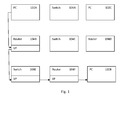
- Figure 1 shows part of a network including a plurality of computing devices 102A, 102B, 102C that are in communication with each other via a plurality of switch and router devices 104A - 104F, all of which are at layer 1, 2 and/or 3 of OSI seven-layer model.
- switch/router devices comprising devices 104B, 104E, 104F are configured to provide a virtual partition (designated "VP" in the Figure) that can be used to transfer secure data between computing devices 102A and 102B.
- VP virtual partition
- an example secure virtual partition connection is defined from device 104B via device 104E to device 104F, as shown by the arrows.
- FIG. 1 the arrangement of Figure 1 is exemplary only and that many variations are possible in terms of the number and interconnection of the devices.
- all of the switch/router devices 104A - 104F may be configured to provide the virtual partition between more than two computing devices 102.
- all or some of the devices 104A - 104F may be configured to provide more than one virtual partition, which can be different virtual partitions for providing secure communication between different combinations of computing devices 102A - 102C.
- the virtual partitions may be provided by devices 104B, 104E, 104F at ISO layer 2, using VLANs; however, in some cases it is possible for switches within the infrastructure to be dumb layer 1 or 2 switches, or even IP layer (layer 3) switches, as long as all those at the periphery of the virtual partition can be configured to abide by partitioning rules, which will be described below.
- Some embodiments can implement the virtual partition on the devices 104 using OpenFlow, an open version of a Software Defined Networking (SDN) protocol. Version 1.3 of OpenFlow includes functionality including traffic policing for packet inspection, which can enforce prioritization.
- SDN Software Defined Networking
- Hardware compliant with Version 1.3 of OpenFlow can be configured to provide connection admission control to avoid real-time connections being congested (statistically or in reality).
- the virtual partition devices will require specific functions to support the connections, e.g. VLANs that can be securely configured. Switches require per connection traffic policing, and for truly reliable transfers, the buffer sizes have to be known and the bandwidths and burstiness (jitter) values of all connections routed through a buffer have to be used to check that it will not overflow. This can be done at the time the system is designed, or as part of connection admission control.
- Hardware including a processor and memory on board, or associated with, a device 104B, 104E, 104F in the virtual partition set can include instructions that provide secure prioritization, secure routeing and strict bandwidth control of the virtual partition traffic.
- the instructions can check if received data can be identified (e.g. using an identifier in its header) as virtual partition data and then treat it as data that is to be transferred via the virtual partition.
- Secure prioritization of the traffic using the virtual partition (or one of several virtual partitions) separates the virtual partition from all other traffic using the same layers/devices. Secure routeing of the connections separates traffic of different virtual partitions that do not share resources, such as switch outputs and switch buffers. Strict bandwidth control of this traffic can limit the possible interactions between virtual partitions that do share resources to predictable levels, in effect, separating virtual partitions form one another.
- DCSPs Deterministic Connection Service Providers
- DCSPs Deterministic Connection Service Providers
- DCSPs Deterministic Connection Service Providers
- the switch-router devices 104 in the virtual partition set can be configured to use separate buffers for the virtual partition traffic, which will be given strict priority over all the others. This means that no traffic is transmitted from a lower priority buffer unless this highest priority buffer is empty. It is assumed that, to allow for the prediction of the interactions between traffic in these highest priority buffers, each is either associated with specific output of the switch-router or they are parts of a shared, centralized buffer, which may be modelled as a set of virtual output buffer. However, there may also be techniques for predicting the interactions in input buffers, especially where head of line blocking can be avoided, and distributed buffers.
- all traffic using one of the virtual partitions can be identified with a specific VLAN Id.
- a VLAN used for a virtual partition is then associated with a subset of the ports of a subset of the switches in the network.
- this association would have to be inaccessible except to the virtual partition data, i.e. it cannot be possible for any other party to change the associations for this VLAN.
- secure configuration of those aspects that control the route, prioritization, and bandwidth control, of these deterministic connections means that the routes, priority, and policing, of the VLANs VCs that these connections use cannot be altered other than by the DCSPs/virtual partition devices.
- This modification can be important, since the number of such connections is limited by the size of the VLAN Id, at 12 bits, to 4094 (two values are reserved). If this were a per switch limit, there can still be very large numbers of them, as the can be reused for connections that do not cross at these switches. However, if it were a per port limit, then there can be significantly more such deterministic connections, as the limit is then that connections with the same VLAN Id cannot share a serial, physical layer connection between two switch-routers, but can cross at the switch routers with greatity.
- Bandwidth control means that every switch-router that comprises any virtual partition can limit the traffic on each of these connections, independently, to a traffic profile. Typically, this profile will be described by a nominal bandwidth, a maximum message length, and a maximum delay variation or jitter tolerance. However, where a token bucket or leaky bucket (as a meter) algorithm is used to do test of conformance as part of bandwidth limitation, the message length and jitter parameters can be combined into a single bucket depth parameter.
- switch-router devices 104 in the virtual partition set should limit the traffic on each of the virtual partition connections, this may not be a requirement that must be applied to all switches. If this traffic control is applied in every switch that connects hosts to a virtual partition (Usage Parameter Control) then this can protect the reliability of the virtual partition against faulty and malicious users. However, it may also be necessary to implement this traffic control wherever different virtual partitions overlap (Network Parameter Control), to protect one partition against faults and failures in the other.
- Providing reliability, and in some cases timeliness, may be achieved by ensuring that the path through each switch-router in the virtual partition set has to be assigned a maximum value for the delay and jitter (delay variation) it can add to any of these deterministic connections that are routed through it, and these maximums cannot be allowed to be exceeded.
- the maximum delay and jitter for a switch-router can then be used as part of the calculation of the maximum end-to-end delay for any connection routed through that switch-router, and the jitter it adds used as part of calculating the expected maximum jitter at any downstream switch-router on these paths.
- the maximum buffer requirement for the deterministic traffic at any switch output can then be calculated from the policed bandwidths, maximum message lengths and jitter tolerances for each of the connection as set by the traffic policing functions in the switches.
- This maximum buffer usage can then be used to check that the switch in the virtual partition set has a big enough buffer for that priority at that output, or that the total requirement for all the outputs of a switch is less than the buffer memory available, for that priority, in the switch.
- the buffer usage value for a single switch output can then also be used to calculate a maximum buffer delay (the usage divided by the output's bandwidth). This can be compared with the values for the maximum possible delay and the maximum possible jitter that it can added, that have been allocated to that switch and output. If the computed maximum delay and added jitter are less than the allocated values, then the set of connections routed through that output is acceptable. If either is larger than the allocated value, then one or more of the connections cannot be supported. This makes it possible to check if a new deterministic connection can be routed through a specific switch-router without adversely affecting the guarantees for the connections that have already been established.
- connections can be configured so that there are multiple paths between the hosts connected to it, exactly as can be done with physical networks. In which case, it would be possible to use spanning tree protocols to provide tolerance of failures in the network; albeit with a hiatus in service whilst the connections are, in effect, routed around a failed component or path element.
- the users of virtual partitions can also have access to the normal Internet through the same connections, or, their access to these virtual partitions would be through their current connections to the Internet. All that is required for this is that they identify the different types of traffic appropriately.
- the identification could be by VLAN Id.
- VLAN Id the identification of the switch-routers.
- the first and last of these switch-routers could be within the user/customer's premises (or sole control), if the security of their configuration can be guaranteed.
- the first switch outside the user's network can identify those destinations on the virtual partition by, e.g. their IP address.
- One particular embodiment of the system can provide video/television content to users.
- broadband connections to home users have a small bandwidth in comparison to the full range of scheduled TV being broadcast in real-time on BBC, ITV, 4, C5, and SKY, etc in the UK, but not catch-up TV or "timed repeat", e.g. +1h, channels.
- a real-time network partly, delivers the selected channels (a small number to watch and, possibly, a small number to record), but also to transport all the viewers' channel selection demands to wherever the selection is made (somewhere where there is sufficient bandwidth, so that the full set of channels can be delivered there, e.g. a local exchange).
- the virtual partition arrangement can be used to transfer data relating to television/video data to a user terminal in addition to conventional programmes being broadcast in real-time over conventional cable/satellite links. Therefore, on-demand type programmes can be delivered to consumers without the transmission problems currently associated with home broadband. Servers running an application such as the BBC's iPlayerTM have to have separate TCP connections to each viewer (or any other protocol that responds to congestion by re-trying lost frames (packets), and thus uses acknowledgments of those received), and if there are too many users at the same time then they fail to deliver an acceptable performance. However, using the virtual partition arrangement described herein can make the connections sufficiently reliable (real-time).
Landscapes
- Engineering & Computer Science (AREA)
- Computer Hardware Design (AREA)
- Computer Security & Cryptography (AREA)
- Computing Systems (AREA)
- General Engineering & Computer Science (AREA)
- Computer Networks & Wireless Communication (AREA)
- Signal Processing (AREA)
- Data Exchanges In Wide-Area Networks (AREA)
Priority Applications (4)
| Application Number | Priority Date | Filing Date | Title |
|---|---|---|---|
| EP13275019.1A EP2763371A1 (de) | 2013-01-31 | 2013-01-31 | Datenübertragung |
| EP14702906.0A EP2951973B1 (de) | 2013-01-31 | 2014-01-29 | Datenübertragung |
| PCT/GB2014/050223 WO2014118526A1 (en) | 2013-01-31 | 2014-01-29 | Data transfer |
| US14/762,668 US9992168B2 (en) | 2013-01-31 | 2014-01-29 | Data transfer |
Applications Claiming Priority (1)
| Application Number | Priority Date | Filing Date | Title |
|---|---|---|---|
| EP13275019.1A EP2763371A1 (de) | 2013-01-31 | 2013-01-31 | Datenübertragung |
Publications (1)
| Publication Number | Publication Date |
|---|---|
| EP2763371A1 true EP2763371A1 (de) | 2014-08-06 |
Family
ID=47720448
Family Applications (1)
| Application Number | Title | Priority Date | Filing Date |
|---|---|---|---|
| EP13275019.1A Ceased EP2763371A1 (de) | 2013-01-31 | 2013-01-31 | Datenübertragung |
Country Status (1)
| Country | Link |
|---|---|
| EP (1) | EP2763371A1 (de) |
Citations (2)
| Publication number | Priority date | Publication date | Assignee | Title |
|---|---|---|---|---|
| US20020022483A1 (en) * | 2000-04-18 | 2002-02-21 | Wayport, Inc. | Distributed network communication system which allows multiple wireless service providers to share a common network infrastructure |
| US20080013481A1 (en) * | 2006-07-17 | 2008-01-17 | Michael Terry Simons | Wireless VLAN system and method |
-
2013
- 2013-01-31 EP EP13275019.1A patent/EP2763371A1/de not_active Ceased
Patent Citations (2)
| Publication number | Priority date | Publication date | Assignee | Title |
|---|---|---|---|---|
| US20020022483A1 (en) * | 2000-04-18 | 2002-02-21 | Wayport, Inc. | Distributed network communication system which allows multiple wireless service providers to share a common network infrastructure |
| US20080013481A1 (en) * | 2006-07-17 | 2008-01-17 | Michael Terry Simons | Wireless VLAN system and method |
Similar Documents
| Publication | Publication Date | Title |
|---|---|---|
| US8908522B2 (en) | Transmission rate control | |
| CN104272653B (zh) | 分组数据联网中的拥塞控制 | |
| EP2951973B1 (de) | Datenübertragung | |
| Clark et al. | Explicit allocation of best-effort packet delivery service | |
| US9667570B2 (en) | Fabric extra traffic | |
| US8737205B2 (en) | Weight-based bandwidth allocation for network traffic | |
| US20170118108A1 (en) | Real Time Priority Selection Engine for Improved Burst Tolerance | |
| EP2721785B1 (de) | Datenübertragung | |
| US10892994B2 (en) | Quality of service in virtual service networks | |
| US20150139636A1 (en) | Self-healing data transmission system and method to achieve deterministic and lower latency | |
| EP2985961A1 (de) | Paketverkehrsteuerungsverfahren und vorrichtung auf basis von mehrwegübertragung | |
| US20200028786A1 (en) | Flow rate based network load balancing | |
| EP3201777B1 (de) | Bereitstellung von funktionalen anforderungen für eine netzwerkverbindung aus einer lokalen bibliothek | |
| US20160094430A1 (en) | Sampling Packets To Measure Network Performance | |
| US10015101B2 (en) | Per queue per service buffering capability within a shaping window | |
| CN110868357B (zh) | 网络流量控制方法、vtep设备和存储介质 | |
| CN112838992B (zh) | 报文调度方法及网络设备 | |
| US20090245263A1 (en) | Apparatus and method for transmitting packets in a packet switched network | |
| EP2536070A1 (de) | Datenübertragung | |
| EP2763371A1 (de) | Datenübertragung | |
| CN108512771A (zh) | 一种数据流负载分担的方法和设备 | |
| US8953449B2 (en) | Virtual subport data traffic management | |
| GB2511205A (en) | Data transfer | |
| Duque et al. | On the features of Software Defined Networking for the QoS provision in data networks | |
| WO2025073086A1 (en) | Qos class reduction for bursty flows |
Legal Events
| Date | Code | Title | Description |
|---|---|---|---|
| PUAI | Public reference made under article 153(3) epc to a published international application that has entered the european phase |
Free format text: ORIGINAL CODE: 0009012 |
|
| 17P | Request for examination filed |
Effective date: 20130131 |
|
| AK | Designated contracting states |
Kind code of ref document: A1 Designated state(s): AL AT BE BG CH CY CZ DE DK EE ES FI FR GB GR HR HU IE IS IT LI LT LU LV MC MK MT NL NO PL PT RO RS SE SI SK SM TR |
|
| AX | Request for extension of the european patent |
Extension state: BA ME |
|
| STAA | Information on the status of an ep patent application or granted ep patent |
Free format text: STATUS: THE APPLICATION HAS BEEN REFUSED |
|
| 18R | Application refused |
Effective date: 20141101 |