EP2763452A1 - Procédé et système permettant de surveiller les performances d'un réseau - Google Patents
Procédé et système permettant de surveiller les performances d'un réseau Download PDFInfo
- Publication number
- EP2763452A1 EP2763452A1 EP20140155657 EP14155657A EP2763452A1 EP 2763452 A1 EP2763452 A1 EP 2763452A1 EP 20140155657 EP20140155657 EP 20140155657 EP 14155657 A EP14155657 A EP 14155657A EP 2763452 A1 EP2763452 A1 EP 2763452A1
- Authority
- EP
- European Patent Office
- Prior art keywords
- event
- notification
- weighting factor
- network
- value
- Prior art date
- Legal status (The legal status is an assumption and is not a legal conclusion. Google has not performed a legal analysis and makes no representation as to the accuracy of the status listed.)
- Granted
Links
Images


Classifications
-
- H—ELECTRICITY
- H04—ELECTRIC COMMUNICATION TECHNIQUE
- H04W—WIRELESS COMMUNICATION NETWORKS
- H04W24/00—Supervisory, monitoring or testing arrangements
- H04W24/08—Testing, supervising or monitoring using real traffic
Definitions
- the present invention relates to a method and an associated apparatus/system for monitoring the performance of a network, e.g. a wireless network, and for providing corresponding reports which are used to establish characterstics of the network and/or network service.
- a network e.g. a wireless network
- the present invention relates to a telecommunications network which incorporates (e.g. wireless) telecommunications devices, e.g. mobile telephones (sometimes referred to as "cell phones").
- Telecommunications devices are typically remotely operated and rely for their implementation on remote access to a telecommunications network (see Fig. 1 ).
- Wireless examples of this include telecommunications devices such as (mobile) telephones (see Fig. 2 ) which enjoy wireless access (e.g. via a Radio Access Network, see Fig. 1 ) to a telephone network (Core Network, see Fig. 3 ).
- the network infrastructure In order identify the subscriber and determine whether or not they are authorised to use service provided over such a network, the network infrastructure typically maintains a list of (mobile telephone) handsets that are allowed to make use of the network. However, typically, instead of the handsets themselves being identified, a specialized kind of smart card (called a SIM - Subscriber Identity Module) is installed in each handset. The network infrastructure queries the SIM directly via the handset in order to determine eligibility for service. As the SIM is constructed in a secure way, the user is unable to make unauthorized use of the network, or to impersonate another user, by tampering with the identifying mechanisms but is merely allowed to use service they are entitled to.
- SIM Subscriber Identity Module
- the user also has the convenience of using a different handset by simply moving the SIM to the new handset.
- the SIM device is not just a means of storing identifying information. It contains a small computer, augmented by cryptographic hardware, and is capable of running programs independent of any computing ability of the host handset.
- the communications link between the handset and the SIM allow the handset to request SIM services, both on behalf of the network and for its own purposes. It also allows programs in the SIM to make use of handset services.
- the reliable implementation of telecommunication devices such as this requires both reliable access to a telecommunications network and reliable operation of the telecommunications device itself.
- (network) operators of such telecommunications networks typically continuously monitor the performance of their network equipment and service consumption by subscribers to their service, with a view to understanding the correct and incorrect performance of their service.
- performance monitoring can take the form of quantitative measurement(s) of certain characteristics relating to particular elements of the telecommunications network and/or of qualitative assessment(s) of such characteristics, for example.
- monitoring can be either passive or active.
- Passive means that drive test equipment or network probing equipment e.g. CN probes simply listen and gather data for processing.
- Active means that the network being tested is stimulated by the testing to see how the network responds (drive test makes a call, network probing equipment inject pseudo data into the NE or NE communication pathways).
- terminal based service monitoring it is also known to configure telecommunications devices (terminals) used by the users (e.g. “mobile telephones” or “cell phones”) to monitor the network performance, and to report, for example, to the network operator.
- terminal based service monitoring is that it provides the network operator with an accurate report on the performance of the service across the network all the way down to the individual user.
- terminal based service monitoring is disadvantageous in that a telecommunications network has a finite available bandwidth, which ideally should be reserved for user operation. Allocating a significant portion of the bandwidth to the transmission of network performance reports from user terminals is therefore undesirable, and has the consequence that such terminal based service monitoring could cause a "snowballing" effect leading to overload of the network, as more and more user terminals monitor and identify problems in the network and issue reports, leading in turn to bandwidth reduction and therefore more reports being issued.
- the present inventors have realized that there is a need for a method of monitoring a telecommunications network, which fairly represents the performance of the network as perceived by users, but which during its operation does not adversely affect the network (e.g. the operating bandwidth of the network), to the detriment of the network service provided to (and as desired by) the users.
- a method of monitoring a telecommunications network which fairly represents the performance of the network as perceived by users, but which during its operation does not adversely affect the network (e.g. the operating bandwidth of the network), to the detriment of the network service provided to (and as desired by) the users.
- the present invention provides a method of monitoring the performance of a telecommunications network, which network includes one or more user terminals each configured to be capable of communicating with a monitoring means of the network, wherein the method includes the steps of:
- the present invention provides a method of monitoring the performance of a telecommunications network, which network includes one or more user terminals each configured to be capable of communicating with a monitoring means of the network, wherein the method includes the steps of:
- the present invention aims to provide a method which eliminates the need to send a respective notification for each identified event occurrence.
- a network operator is able to measure the service provided to individual users (user terminals) over the network. Furthermore, it is preferred that the network operator is able, by aggregating data from user devices (terminals), to measure the performance of one or more elements of the serving (service) network, e.g. across the entire geographical area of intended use, and/or e.g. across the entire intended scope of services (telephone calls, SMS, MMS, data transfer and/or internet provision, etc.).
- the present invention aims to provide a method (and means) for achieving this without burdening the network with an excessive number of notifications.
- the weighting factor or an indication of the value of the weighting factor, is provided in the notification (or, is provided in such a manner that it can be determined by the monitoring means and/or user terminal as being associated with a particular notification (e.g. concerning a particular event or type of event)) such that when the notification is received and processed by the monitoring means, the relative importance of the notification can be assessed because the value of the weighting factor provides an indication of the likelihood that the notification would be sent.
- each weighting factor is preferably indicative of the likelihood of a notification being issued/sent for each respective (associated) event.
- the weighting factor preferably makes the issuance of a notification relatively more or less likely - relative, that is, to the issuance of a notification concerning a respectively different type of event having a respectively different weighting factor.
- the or each weighting factor for a given service event may be made to be dependent on the one or more characteristics of the user terminal relative to the network. For example, when the user terminal is present at a particular node in the network (e.g. when the mobile telephone is, preferably wirelessly, linked to a particular network cell), then the weighting factor may be modified in response, e.g. so as to make notification of the associated service event type more likely - or alternatively, less likely.
- An example of a benefit associated with this is that if a known problem exists at a particular node, then when a user terminal is associated with that node, the weighting factor provided in the user terminal which is associated with one or service events indicative of the known problem can be modified.
- the modification may reduce the likelihood that a notification will be issued reporting one or more service events associated with that problem, so as to try to prevent a high rate (and/or a high absolute number) of notifications concerning the problem from unnecessarily burdening the network.
- the characteristics of the user terminal relative to the network may include, but are not limited to: spatial variations, temporal variations, cell ID variations etc.
- Each weighting factor may include or may be related to a respective rate index indicative of the number of times that a notification has been issued for the associated type of service event in a predetermined period of time.
- the method may include the step of modifying the value of each weighting factor, on the basis of the value of the respective related rate index, to maintain a rate of notification for each type of service event within a predetermined range for the respective type of service event. This allows the rate of notifications to be "throttled” according to the conditions of the network. Thus, it is possible to balance the amount of network bandwidth consumed by service event reporting with the desired accuracy of the resulting performance analysis.
- each related weighting factor is modified to reduce the likelihood of a notification, concerning the associated type of service event, being issued during the predefined period of time.
- the first threshold may be an upper threshold of rate notification.
- each related weighting factor is modified to increase the likelihood of a notification, concerning the associated type of service event, being issued during the predefined period of time.
- the second threshold may be a lower threshold of rate notification.
- the value of each weighting factor indicates, or determines, that one in every n th identified event occurrence should result in the notification being issued for the respective type of service event.
- the value of n may be 1 for one or more important types of event, so as to guarantee that the event is notified to the network operator. However, it is preferable that for most (and even more preferable that for all) types of event, that the value of n can be represented as a positive integer greater than 1. Therefore, there is no requirement to send a notification for every identified event occurrence.
- the present invention includes the step of modifying the respective weighting factor associated with the type of service event to which the first event belongs, in response to the identification of the first event by the user terminal. Therefore, the issuance of a notification can be controlled on the basis of the number of times a particular type of event has been identified as occurring. Furthermore, preferably, for a second event identified by the user terminal, being of the same type of service event as the first event, and being identified as occurring subsequent to the first event, the step of deriving the value of the notify factor is performed on the basis of the modified weighting factor.
- each weighting factor may include, or may be related to, a count index indicative:
- the count index related to, or included in, the respective weighting factor may be modified to reflect the identified occurrence.
- the weighting factor is modified
- a relatively common event such as an "expected end of call” (e.g. where one of the parties to a call willfully terminates the connection) will have associated with it a weighting factor such that a notification is relatively unlikely to be issued when the event is detected.
- a less common event such as an "unexpected end of call” (e.g. a "dropped call", when a telephone call is not successfully connected or terminates unexpectedly e.g. due to a poor radio link) will have associated with it a weighting factor such that a notification is relatively more likely to be made.
- the probability of sending a report of a successful call that ends normally will be much lower than the probability of sending a report of a call that ends unexpectedly - as most calls are successful.
- it is still preferable to report successful calls as often it is more desirable to report the number of unexpected call drops or failed calls as a ratio to the number of successful calls to give an indication of the health of the network.
- the step of deriving the notify factor may include the step of generating a random number on the basis of the weighting factor, the notify factor being derived from the generated random number.
- the random number generated may be limited to a predefined number of significant figures.
- the random number generated is an integer.
- the range in which the random number to be generated is set to be between 0 and the value of (or indicative of) the weighting factor.
- the notify factor indicates that a notification should be sent, for example.
- an aspect of the present invention provides that the issuance of a notification concerning a particular event (event type) takes place at random but with a predefined likelihood of occurring, according to the weighting factor.
- the analysis can return an indication as to the relative importance which should be ascribed to the received notification, and/or the information contained therein.
- the notification judged to be sent is configured to include event information, which is information indicative of the nature of the first event.
- the monitoring means determines the event type from the event information included in the received notification.
- a network operator can be provided with a (performance) report on the actual service as it is being experienced e.g. by a user (e.g. via a user terminal), and preferably the report is not derived from 2 nd order data.
- Network operators typically derive service experience from information the network infrastructure provides. Their KPIs (key performance indicators) are thus related to the network parameters, rather than the actual experience, e.g. Handoff Success Ratio (HOSR) is the ratio of attempts to move a call from one cell to another that succeed.
- HOSR Handoff Success Ratio
- a low HOSR is indicative of the users' experience of dropped calls.
- HOSR Handoff Success Ratio
- a low HOSR is indicative of the users' experience of dropped calls.
- a complete measure or dropped calls must be derived by adding all the network events that indicate a dropped call.
- the value of one or more of the respective weighting factors provided in the or each user terminal is modifiable by sending a modification instruction via the network to the or each user terminals. Therefore, the notification rate for one or more types of service event can be adjusted dynamically e.g. in response to received notifications.
- the present invention also generally provides a user terminal for use in a telecommunications network, which network includes a monitoring means, the user terminal including:
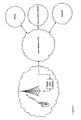
- Figure 1 illustrates through remote mobile telephone handset devices 150, 160, 170 each operable to access a telecommunications network (not shown) by forming a telecommunications link therewith to enable access to telecommunication network services provided thereby.
- Each mobile phone device is also arranged to communicate with a remote server station not forming a part of the aforesaid network and including a transceiver 110 operably linked to, and in communication with, a server device 180.
- Each of the mobile telephones 150, 160, 170 is able to transmit telecommunications messages to, and to receive telecommunications messages from 130, 140, 120 the server station whilst within the transmission or reception range 100 of the transceiver 110.
- the following description refers to a "mobile telephone”.
- this term is intended also to refer to any user terminal capable of operating in a network, preferably a wireless network as described herein.
- the user terminal may be in the form of a remote mobile telephone handset or a cellular telephone handset.
- a mobile telephone 200 is provided for use in a network, for example a mobile telephone network.
- the steps of the present inventive method executed within the mobile telephone may be executable by a SIM card 250 which is able to be received within the mobile telephone 200.
- some or all of the steps of the present inventive method executed within the mobile telephone may be executable by means provided as one or more component parts of the mobile telephone handset itself.
- the user terminal may include a Universal Subscriber Identity Module such as a USIM card which performs one or more steps of the present inventive method.
- the invention in any of its aspects, may be applied to fixed-line, mobile or wireless communications technologies or telephone technologies.
- FIG. 2 schematically illustrates a mobile phone device arranged to implement the methods described above.
- the mobile phone device 200 contains a processor 220 programmable or operable to implement the present inventive method, a permanent memory unit 210 and preferably a supplementary memory unit 260 in the form of a replaceable memory card.
- Each of the memory facilities serves, and is operably connected to, the processor 220 of the mobile phone.
- a subscriber identity module 250 (SIM card) is contained within the mobile phone device and is operably connected to the processor 220.
- the processor may contain a computer program, or executable code, which, when executed by the processor, implements the method described herein any desired embodiment.
- the implementation may be realised as a "smart phone" application which may be installed on the mobile phone device at the time of manufacture, or thereafter e.g. in the mobile phone factory, in the receiving service provider's distribution centre, or by a user/subscriber of the mobile phone device.
- the implementation may, alternatively, be deeply embedded as an application integrated into the low-level software architecture of the mobile phone device.
- the code implementing the invention may be part of, or combined with, the code which controls and operates the other functions of the mobile phone device.
- the programmable card may contain an executable computer programme which implements the above methods, in any embodiment, as, for example, a SIM application.
- execution may be performed in a "Java Virtual Machine (JVM)" contained within a SIM card or the like.
- JVM Java Virtual Machine
- the mobile telephone is adapted to be able to detect and register respective service events, such as an unexpected end of call (e.g. an erroneous end of call) and an expected end of call (e.g. an end of call executed by a participant in the call).
- an unexpected end of call e.g. an erroneous end of call
- an expected end of call e.g. an end of call executed by a participant in the call.
- a radio transmitter 240 in conjunction with transmission control software implemented by the processor 220, provide a means to prepare and transmit information from the mobile telephone.
- the mobile telephone is adapted to be capable of notifying the network operator of service events via a report.
- the mobile telephone may be configured to issue a report in the form of an SMS text message to the network operator to alert the operator to one or more service events.
- each report is configured to include a plurality of such notifications, for example 5 or 10 notifications.
- the mobile telephone 170, 200 preferably includes the memory 210 or 260 as a buffer for storing one or more reports until a desired number of notifications is included in the or each report.
- the or each report may be stored in the memory for a predetermined period of time or until a predetermined point of time is reached (e.g. midnight local time) prior to being sent - for example, in the event that the desired number of notifications has not been reached in the respective report.
- the present invention is not limited to the use of SMS text messages
- alternative means by which the report (e.g. one or notifications) can be transmitted to the network operator includes, but is not limited to: MMS, USSD, GPRS, email etc.
- the present invention can be implemented by means of a software agent provided in a mobile telephone (user terminal) 170, 200 as shown in Figs. 1 and 2 .
- the software agent should require relatively little computation and storage resources so that a regular SIM (provided in e.g. a mobile telephone handset) can execute the present inventive method instead of the handset itself.
- the software runs in "background mode", meaning that the user does not perceive that the software is being executed by his or her terminal, e.g. mobile telephone.
- the mobile phone device 200 further includes display means 230 to allow the display of information to a user and input means 270, such as keys of a keypad, enabling operation of the mobile phone by a user.
- a microphone and a speaker 280, 290 are provided to permit audible communication when using the mobile phone.
- the display means, the input means and the speaker and microphone are each operably connected, and in functional communication with, the processor unit 220.
- the processor unit 220 is preferably arranged to monitor the operation of the mobile telephone to detect the occurrence of service events, e.g. a network access failure. Detection of such events may be achieved using any of the suitable existing methods available for this purpose such as would be readily apparent to the skilled person. For example, this may be achieved by implementing a software application on the SIM card via the processor.
- various data is acquired in the mobile telephone and is processed into an Event Notification.
- Each Event Notification type has an associated probability factor associated with it.
- a randomising function derives a number, for example in the range 0 to "probability", where probability is related to the probability factor. If the random number generated is zero then the Event notification is added to the memory (buffer) for transmission to the network operator as a report.
- the network operator Upon receipt, the network operator preferably disassembles the report into individual Event Notifications (assuming there are a plurality of notifications in the report) and each notified service event is ascribed a weight based on the "probability" that was set.
- events can be notified each time they occur (if desired for one or more types of service event) or (more preferable) at random depending upon the event type probability and the outcome of the randomising function.
- the probability factor is adaptive to allow dynamic control of the frequency and/or rate of notification issuance over time.
- an index may be provided which keeps track of e.g. the notification rate (e.g. the number of notifications per unit time), the number of times a particular type of event has occurred, or the number of times a particular type of event has been notified has having occurred. Accordingly, when the index reaches or surpasses (i.e. drops below or exceeds) a predetermined threshold, the probability factor may be modified in response so as to adjust the likelihood of a notification being issued.
- the notification rate e.g. the number of notifications per unit time
- the probability factor may be modified in response so as to adjust the likelihood of a notification being issued.
- the or each index could be related to a particular network node, for example a cell site (e.g. a mobile telephone network transceiver 110 or a geographic area covered by a plurality of such transceivers). Therefore, it is possible, according to the present invention to throttle the notification rate, for example, for a given network node to optimize usage of the available network bandwidth.
- a cell site e.g. a mobile telephone network transceiver 110 or a geographic area covered by a plurality of such transceivers. Therefore, it is possible, according to the present invention to throttle the notification rate, for example, for a given network node to optimize usage of the available network bandwidth.
- the present invention allows for the notification rate, for example, for a given type of service event to be throttled to optimize usage of the available network bandwidth.
- the notification rate for example, for a given type of service event to be throttled to optimize usage of the available network bandwidth.
- one or more indexes may be provided to cover a subset of service events.
- an index may be provided to cover all identified service events.
- One or more indexes may be provided which gives an indication of the ratio of different types of service events that have been identified.
- the probability factor can be based on a random determination of whether to send the notification or not, biased in the ratio 1:n.
- the probability factor can be related to a simple count, in which e.g. the first identified occurrence of a particular type service event results in a notification being issued, and then subsequently identified n-1 occurrences of the same type of service event do not result in a notification being issued.
- the probability values should be chosen in order to balance the amount of network bandwidth consumed by service event notification, and the desired accuracy of the resulting performance analysis.
- the probability of sending a notification of a successful call that ends normally will be much lower than the probability of sending a report of a call that ends unexpectedly, as most calls are successful.
- it is still preferable to report successful calls as it is often desirable to report the number of unexpected call drops or failed calls as a ratio relative to the number of successful calls.
- the probability factors may be controlled centrally from within the network, and modified "over-the-air" by issuing a modification signal to the or each user terminal instructing modification of one or more of the probability factors.
- a modification signal to the or each user terminal instructing modification of one or more of the probability factors.
- the present invention allows for tracking of the ending of calls and reporting calls that are dropped (i.e., end without user involvement). Accordingly, the status of a call can be tracked by analysing the data that arrives on various events:
- An extension of the present invention yields a system that provides a network wide 'finger print' of service performance.
- the rate of change in the data collected by the method can be made dependent on the frequency and amount of service consumed by subscribers and the rate at which prevailing network conditions change (e.g. in Winter trees have no leaves so there less signal interference from wet leaves or, during the holiday season, subscribers travel abroad and roam onto other networks).
- an aspect of this invention has handsets, e.g. selected at random, being more active with respect to monitoring of the network. This can be achieved as follows:
- SMS text messages
- 10 call notifications can be included in a single SMS to be sent from a user terminal (e.g. a mobile telephone) to the network operator.
- a user terminal e.g. a mobile telephone
- the present inventors have therefore devised the present invention in order to try to reduce the notification rate, but still maintain a useful resolution on performance indicators that we are interested in.
- the present invention provides a means of reducing the probability, or likelihood, of a notification being generated for a normal call end so that the rate of reporting of such "successful" calls is reasonable - i.e. is not burdensome to the network.
- the present invention provides a means for reporting service events across a network with a useful accuracy, whilst also not leading to a burden, or overloading, of the network.
- the invention includes the combination of the aspects and preferred features described except where such a combination is clearly impermissible or expressly avoided.
Landscapes
- Engineering & Computer Science (AREA)
- Computer Networks & Wireless Communication (AREA)
- Signal Processing (AREA)
- Mobile Radio Communication Systems (AREA)
Applications Claiming Priority (2)
| Application Number | Priority Date | Filing Date | Title |
|---|---|---|---|
| GB201001068A GB201001068D0 (en) | 2010-01-22 | 2010-01-22 | Methods and system for monitoring the performance of a network |
| EP11703238.3A EP2526710B1 (fr) | 2010-01-22 | 2011-01-20 | Procédé et système de surveillance du fonctionnement d'un réseau |
Related Parent Applications (2)
| Application Number | Title | Priority Date | Filing Date |
|---|---|---|---|
| EP11703238.3A Division EP2526710B1 (fr) | 2010-01-22 | 2011-01-20 | Procédé et système de surveillance du fonctionnement d'un réseau |
| EP11703238.3A Division-Into EP2526710B1 (fr) | 2010-01-22 | 2011-01-20 | Procédé et système de surveillance du fonctionnement d'un réseau |
Publications (2)
| Publication Number | Publication Date |
|---|---|
| EP2763452A1 true EP2763452A1 (fr) | 2014-08-06 |
| EP2763452B1 EP2763452B1 (fr) | 2016-09-14 |
Family
ID=42045940
Family Applications (2)
| Application Number | Title | Priority Date | Filing Date |
|---|---|---|---|
| EP11703238.3A Not-in-force EP2526710B1 (fr) | 2010-01-22 | 2011-01-20 | Procédé et système de surveillance du fonctionnement d'un réseau |
| EP14155657.1A Not-in-force EP2763452B1 (fr) | 2010-01-22 | 2011-01-20 | Procédé et système permettant de surveiller les performances d'un réseau |
Family Applications Before (1)
| Application Number | Title | Priority Date | Filing Date |
|---|---|---|---|
| EP11703238.3A Not-in-force EP2526710B1 (fr) | 2010-01-22 | 2011-01-20 | Procédé et système de surveillance du fonctionnement d'un réseau |
Country Status (3)
| Country | Link |
|---|---|
| EP (2) | EP2526710B1 (fr) |
| GB (1) | GB201001068D0 (fr) |
| WO (1) | WO2011089389A1 (fr) |
Families Citing this family (3)
| Publication number | Priority date | Publication date | Assignee | Title |
|---|---|---|---|---|
| CN105024872B (zh) * | 2014-04-25 | 2019-02-26 | 腾讯科技(北京)有限公司 | 网络性能测试的方法及装置 |
| WO2019030464A1 (fr) | 2017-08-07 | 2019-02-14 | Wadaro Limited | Méthode de géolocalisation |
| US20240236709A1 (en) * | 2023-01-11 | 2024-07-11 | Charter Communications Operating, Llc | METHODS AND APPARATUS FOR DETERMINING AND/OR USING KPIs IN WIRELESS SYSTEMS |
Citations (4)
| Publication number | Priority date | Publication date | Assignee | Title |
|---|---|---|---|---|
| WO1998043455A2 (fr) * | 1997-03-25 | 1998-10-01 | Northern Telecom Limited | Procede et terminal sans fil permettant de surveiller des communications et de delivrer au reseau des donnees relatives au fonctionnement de terminaux |
| WO2000067507A1 (fr) * | 1999-05-04 | 2000-11-09 | Telefonaktiebolaget Lm Ericsson (Publ) | Gestion assistee par terminal pour systemes de radiocommunications |
| WO2003041422A2 (fr) * | 2001-11-05 | 2003-05-15 | Nokia Corporation | Transmission de resultat de test d'auto-performance et d'operation de station mobile a un reseau en reponse a un message de demande code |
| WO2008014421A2 (fr) * | 2006-07-26 | 2008-01-31 | Qualcomm Incorporated | Appareil et procédés de détermination de mesures de la qualité des connexions |
-
2010
- 2010-01-22 GB GB201001068A patent/GB201001068D0/en not_active Ceased
-
2011
- 2011-01-20 WO PCT/GB2011/000068 patent/WO2011089389A1/fr not_active Ceased
- 2011-01-20 EP EP11703238.3A patent/EP2526710B1/fr not_active Not-in-force
- 2011-01-20 EP EP14155657.1A patent/EP2763452B1/fr not_active Not-in-force
Patent Citations (4)
| Publication number | Priority date | Publication date | Assignee | Title |
|---|---|---|---|---|
| WO1998043455A2 (fr) * | 1997-03-25 | 1998-10-01 | Northern Telecom Limited | Procede et terminal sans fil permettant de surveiller des communications et de delivrer au reseau des donnees relatives au fonctionnement de terminaux |
| WO2000067507A1 (fr) * | 1999-05-04 | 2000-11-09 | Telefonaktiebolaget Lm Ericsson (Publ) | Gestion assistee par terminal pour systemes de radiocommunications |
| WO2003041422A2 (fr) * | 2001-11-05 | 2003-05-15 | Nokia Corporation | Transmission de resultat de test d'auto-performance et d'operation de station mobile a un reseau en reponse a un message de demande code |
| WO2008014421A2 (fr) * | 2006-07-26 | 2008-01-31 | Qualcomm Incorporated | Appareil et procédés de détermination de mesures de la qualité des connexions |
Also Published As
| Publication number | Publication date |
|---|---|
| GB201001068D0 (en) | 2010-03-10 |
| WO2011089389A1 (fr) | 2011-07-28 |
| EP2526710A1 (fr) | 2012-11-28 |
| EP2763452B1 (fr) | 2016-09-14 |
| EP2526710B1 (fr) | 2014-03-26 |
Similar Documents
| Publication | Publication Date | Title |
|---|---|---|
| EP1908196B1 (fr) | Systeme et procede de gestion de qualite de service de dispositifs sans fil | |
| US10831641B2 (en) | Method and apparatus for determining a performance impact by a software upgrade of a mobile user endpoint device | |
| US8190145B2 (en) | Apparatus and method for mobile station-assisted optimization of a wireless network | |
| US6298233B1 (en) | Method and apparatus in a two-way wireless communication system for detection and deferred reporting of a communication difficulty | |
| EP2360958B1 (fr) | Surveillance d'un réseau mobile par mésurer la qualité de service | |
| US10687204B1 (en) | Intelligent SIM profile procurement | |
| US20150181449A1 (en) | Method And Apparatus For Monitoring Mobile Communication Networks | |
| US8233891B2 (en) | Telecommunications network | |
| US20040058652A1 (en) | Method and system for quality of service (QoS) monitoring for wireless devices | |
| CN105357699B (zh) | 无线网络质量监测系统及方法 | |
| US20120071157A1 (en) | Method for Mobile Network Coverage Experience Analysis and Monitoring | |
| US9769678B2 (en) | Network monitoring and analysis tool | |
| KR101598068B1 (ko) | 통신들에서의 용량 할당 | |
| US20160066171A1 (en) | Method and Arrangement for Gathering Data from a Communication Network | |
| EP2526710B1 (fr) | Procédé et système de surveillance du fonctionnement d'un réseau | |
| US8649272B2 (en) | Methods, systems and computer readable media for mobile-communication-device-initiated network monitoring services | |
| JP4103614B2 (ja) | 移動通信における異常切断原因解析システム,方法,異常切断呼調査装置およびプログラム | |
| US8929883B2 (en) | System, method, and software program product for tracking call failures on a wireless phone | |
| US6895001B2 (en) | System and method for monitoring congestion paging | |
| EP3545711B1 (fr) | Sélection d'une infrastructure de télécommunication | |
| GB2551357A (en) | Network edge data monitoring | |
| CN116032808B (zh) | 流量保护方法、装置、电子设备和存储介质 | |
| WO2011106940A1 (fr) | Entité de réseau et procédé pour fournir un service basé sur l'entité utilisateur dans un réseau de communication | |
| KR20030054162A (ko) | 이동통신 단말기의 원격 상태 관리 방법 | |
| KR100706900B1 (ko) | 데이터 서비스를 위한 무선망 성능 정보 제공 방법 |
Legal Events
| Date | Code | Title | Description |
|---|---|---|---|
| PUAI | Public reference made under article 153(3) epc to a published international application that has entered the european phase |
Free format text: ORIGINAL CODE: 0009012 |
|
| 17P | Request for examination filed |
Effective date: 20140218 |
|
| AC | Divisional application: reference to earlier application |
Ref document number: 2526710 Country of ref document: EP Kind code of ref document: P |
|
| AK | Designated contracting states |
Kind code of ref document: A1 Designated state(s): AL AT BE BG CH CY CZ DE DK EE ES FI FR GB GR HR HU IE IS IT LI LT LU LV MC MK MT NL NO PL PT RO RS SE SI SK SM TR |
|
| R17P | Request for examination filed (corrected) |
Effective date: 20150206 |
|
| RBV | Designated contracting states (corrected) |
Designated state(s): AL AT BE BG CH CY CZ DE DK EE ES FI FR GB GR HR HU IE IS IT LI LT LU LV MC MK MT NL NO PL PT RO RS SE SI SK SM TR |
|
| RIC1 | Information provided on ipc code assigned before grant |
Ipc: H04W 24/08 20090101AFI20150226BHEP |
|
| GRAP | Despatch of communication of intention to grant a patent |
Free format text: ORIGINAL CODE: EPIDOSNIGR1 |
|
| INTG | Intention to grant announced |
Effective date: 20150506 |
|
| INTG | Intention to grant announced |
Effective date: 20151204 |
|
| GRAS | Grant fee paid |
Free format text: ORIGINAL CODE: EPIDOSNIGR3 |
|
| GRAA | (expected) grant |
Free format text: ORIGINAL CODE: 0009210 |
|
| AC | Divisional application: reference to earlier application |
Ref document number: 2526710 Country of ref document: EP Kind code of ref document: P |
|
| AK | Designated contracting states |
Kind code of ref document: B1 Designated state(s): AL AT BE BG CH CY CZ DE DK EE ES FI FR GB GR HR HU IE IS IT LI LT LU LV MC MK MT NL NO PL PT RO RS SE SI SK SM TR |
|
| REG | Reference to a national code |
Ref country code: GB Ref legal event code: FG4D |
|
| REG | Reference to a national code |
Ref country code: CH Ref legal event code: EP |
|
| REG | Reference to a national code |
Ref country code: IE Ref legal event code: FG4D |
|
| REG | Reference to a national code |
Ref country code: AT Ref legal event code: REF Ref document number: 830166 Country of ref document: AT Kind code of ref document: T Effective date: 20161015 |
|
| REG | Reference to a national code |
Ref country code: DE Ref legal event code: R096 Ref document number: 602011030471 Country of ref document: DE |
|
| REG | Reference to a national code |
Ref country code: FR Ref legal event code: PLFP Year of fee payment: 7 |
|
| REG | Reference to a national code |
Ref country code: LT Ref legal event code: MG4D |
|
| REG | Reference to a national code |
Ref country code: NL Ref legal event code: MP Effective date: 20160914 |
|
| PG25 | Lapsed in a contracting state [announced via postgrant information from national office to epo] |
Ref country code: RS Free format text: LAPSE BECAUSE OF FAILURE TO SUBMIT A TRANSLATION OF THE DESCRIPTION OR TO PAY THE FEE WITHIN THE PRESCRIBED TIME-LIMIT Effective date: 20160914 Ref country code: LT Free format text: LAPSE BECAUSE OF FAILURE TO SUBMIT A TRANSLATION OF THE DESCRIPTION OR TO PAY THE FEE WITHIN THE PRESCRIBED TIME-LIMIT Effective date: 20160914 Ref country code: NO Free format text: LAPSE BECAUSE OF FAILURE TO SUBMIT A TRANSLATION OF THE DESCRIPTION OR TO PAY THE FEE WITHIN THE PRESCRIBED TIME-LIMIT Effective date: 20161214 Ref country code: HR Free format text: LAPSE BECAUSE OF FAILURE TO SUBMIT A TRANSLATION OF THE DESCRIPTION OR TO PAY THE FEE WITHIN THE PRESCRIBED TIME-LIMIT Effective date: 20160914 Ref country code: FI Free format text: LAPSE BECAUSE OF FAILURE TO SUBMIT A TRANSLATION OF THE DESCRIPTION OR TO PAY THE FEE WITHIN THE PRESCRIBED TIME-LIMIT Effective date: 20160914 |
|
| PGFP | Annual fee paid to national office [announced via postgrant information from national office to epo] |
Ref country code: IE Payment date: 20161124 Year of fee payment: 7 |
|
| REG | Reference to a national code |
Ref country code: AT Ref legal event code: MK05 Ref document number: 830166 Country of ref document: AT Kind code of ref document: T Effective date: 20160914 |
|
| PG25 | Lapsed in a contracting state [announced via postgrant information from national office to epo] |
Ref country code: SE Free format text: LAPSE BECAUSE OF FAILURE TO SUBMIT A TRANSLATION OF THE DESCRIPTION OR TO PAY THE FEE WITHIN THE PRESCRIBED TIME-LIMIT Effective date: 20160914 Ref country code: GR Free format text: LAPSE BECAUSE OF FAILURE TO SUBMIT A TRANSLATION OF THE DESCRIPTION OR TO PAY THE FEE WITHIN THE PRESCRIBED TIME-LIMIT Effective date: 20161215 Ref country code: NL Free format text: LAPSE BECAUSE OF FAILURE TO SUBMIT A TRANSLATION OF THE DESCRIPTION OR TO PAY THE FEE WITHIN THE PRESCRIBED TIME-LIMIT Effective date: 20160914 Ref country code: LV Free format text: LAPSE BECAUSE OF FAILURE TO SUBMIT A TRANSLATION OF THE DESCRIPTION OR TO PAY THE FEE WITHIN THE PRESCRIBED TIME-LIMIT Effective date: 20160914 |
|
| PG25 | Lapsed in a contracting state [announced via postgrant information from national office to epo] |
Ref country code: EE Free format text: LAPSE BECAUSE OF FAILURE TO SUBMIT A TRANSLATION OF THE DESCRIPTION OR TO PAY THE FEE WITHIN THE PRESCRIBED TIME-LIMIT Effective date: 20160914 Ref country code: RO Free format text: LAPSE BECAUSE OF FAILURE TO SUBMIT A TRANSLATION OF THE DESCRIPTION OR TO PAY THE FEE WITHIN THE PRESCRIBED TIME-LIMIT Effective date: 20160914 |
|
| PGFP | Annual fee paid to national office [announced via postgrant information from national office to epo] |
Ref country code: DE Payment date: 20161124 Year of fee payment: 7 |
|
| PG25 | Lapsed in a contracting state [announced via postgrant information from national office to epo] |
Ref country code: PL Free format text: LAPSE BECAUSE OF FAILURE TO SUBMIT A TRANSLATION OF THE DESCRIPTION OR TO PAY THE FEE WITHIN THE PRESCRIBED TIME-LIMIT Effective date: 20160914 Ref country code: CZ Free format text: LAPSE BECAUSE OF FAILURE TO SUBMIT A TRANSLATION OF THE DESCRIPTION OR TO PAY THE FEE WITHIN THE PRESCRIBED TIME-LIMIT Effective date: 20160914 Ref country code: BE Free format text: LAPSE BECAUSE OF FAILURE TO SUBMIT A TRANSLATION OF THE DESCRIPTION OR TO PAY THE FEE WITHIN THE PRESCRIBED TIME-LIMIT Effective date: 20160914 Ref country code: IS Free format text: LAPSE BECAUSE OF FAILURE TO SUBMIT A TRANSLATION OF THE DESCRIPTION OR TO PAY THE FEE WITHIN THE PRESCRIBED TIME-LIMIT Effective date: 20170114 Ref country code: SM Free format text: LAPSE BECAUSE OF FAILURE TO SUBMIT A TRANSLATION OF THE DESCRIPTION OR TO PAY THE FEE WITHIN THE PRESCRIBED TIME-LIMIT Effective date: 20160914 Ref country code: SK Free format text: LAPSE BECAUSE OF FAILURE TO SUBMIT A TRANSLATION OF THE DESCRIPTION OR TO PAY THE FEE WITHIN THE PRESCRIBED TIME-LIMIT Effective date: 20160914 Ref country code: BG Free format text: LAPSE BECAUSE OF FAILURE TO SUBMIT A TRANSLATION OF THE DESCRIPTION OR TO PAY THE FEE WITHIN THE PRESCRIBED TIME-LIMIT Effective date: 20161214 Ref country code: AT Free format text: LAPSE BECAUSE OF FAILURE TO SUBMIT A TRANSLATION OF THE DESCRIPTION OR TO PAY THE FEE WITHIN THE PRESCRIBED TIME-LIMIT Effective date: 20160914 Ref country code: ES Free format text: LAPSE BECAUSE OF FAILURE TO SUBMIT A TRANSLATION OF THE DESCRIPTION OR TO PAY THE FEE WITHIN THE PRESCRIBED TIME-LIMIT Effective date: 20160914 Ref country code: PT Free format text: LAPSE BECAUSE OF FAILURE TO SUBMIT A TRANSLATION OF THE DESCRIPTION OR TO PAY THE FEE WITHIN THE PRESCRIBED TIME-LIMIT Effective date: 20170116 |
|
| REG | Reference to a national code |
Ref country code: DE Ref legal event code: R097 Ref document number: 602011030471 Country of ref document: DE |
|
| PG25 | Lapsed in a contracting state [announced via postgrant information from national office to epo] |
Ref country code: IT Free format text: LAPSE BECAUSE OF FAILURE TO SUBMIT A TRANSLATION OF THE DESCRIPTION OR TO PAY THE FEE WITHIN THE PRESCRIBED TIME-LIMIT Effective date: 20160914 |
|
| PLBE | No opposition filed within time limit |
Free format text: ORIGINAL CODE: 0009261 |
|
| STAA | Information on the status of an ep patent application or granted ep patent |
Free format text: STATUS: NO OPPOSITION FILED WITHIN TIME LIMIT |
|
| PG25 | Lapsed in a contracting state [announced via postgrant information from national office to epo] |
Ref country code: DK Free format text: LAPSE BECAUSE OF FAILURE TO SUBMIT A TRANSLATION OF THE DESCRIPTION OR TO PAY THE FEE WITHIN THE PRESCRIBED TIME-LIMIT Effective date: 20160914 |
|
| 26N | No opposition filed |
Effective date: 20170615 |
|
| REG | Reference to a national code |
Ref country code: CH Ref legal event code: PL |
|
| PG25 | Lapsed in a contracting state [announced via postgrant information from national office to epo] |
Ref country code: MC Free format text: LAPSE BECAUSE OF FAILURE TO SUBMIT A TRANSLATION OF THE DESCRIPTION OR TO PAY THE FEE WITHIN THE PRESCRIBED TIME-LIMIT Effective date: 20160914 |
|
| PG25 | Lapsed in a contracting state [announced via postgrant information from national office to epo] |
Ref country code: LI Free format text: LAPSE BECAUSE OF NON-PAYMENT OF DUE FEES Effective date: 20170131 Ref country code: CH Free format text: LAPSE BECAUSE OF NON-PAYMENT OF DUE FEES Effective date: 20170131 |
|
| PG25 | Lapsed in a contracting state [announced via postgrant information from national office to epo] |
Ref country code: SI Free format text: LAPSE BECAUSE OF FAILURE TO SUBMIT A TRANSLATION OF THE DESCRIPTION OR TO PAY THE FEE WITHIN THE PRESCRIBED TIME-LIMIT Effective date: 20160914 Ref country code: LU Free format text: LAPSE BECAUSE OF NON-PAYMENT OF DUE FEES Effective date: 20170120 |
|
| REG | Reference to a national code |
Ref country code: FR Ref legal event code: PLFP Year of fee payment: 8 |
|
| REG | Reference to a national code |
Ref country code: DE Ref legal event code: R119 Ref document number: 602011030471 Country of ref document: DE |
|
| PG25 | Lapsed in a contracting state [announced via postgrant information from national office to epo] |
Ref country code: MT Free format text: LAPSE BECAUSE OF NON-PAYMENT OF DUE FEES Effective date: 20170120 |
|
| PG25 | Lapsed in a contracting state [announced via postgrant information from national office to epo] |
Ref country code: AL Free format text: LAPSE BECAUSE OF FAILURE TO SUBMIT A TRANSLATION OF THE DESCRIPTION OR TO PAY THE FEE WITHIN THE PRESCRIBED TIME-LIMIT Effective date: 20160914 Ref country code: DE Free format text: LAPSE BECAUSE OF NON-PAYMENT OF DUE FEES Effective date: 20180801 |
|
| REG | Reference to a national code |
Ref country code: IE Ref legal event code: MM4A |
|
| PG25 | Lapsed in a contracting state [announced via postgrant information from national office to epo] |
Ref country code: IE Free format text: LAPSE BECAUSE OF NON-PAYMENT OF DUE FEES Effective date: 20180120 |
|
| PGFP | Annual fee paid to national office [announced via postgrant information from national office to epo] |
Ref country code: FR Payment date: 20190328 Year of fee payment: 9 |
|
| PG25 | Lapsed in a contracting state [announced via postgrant information from national office to epo] |
Ref country code: HU Free format text: LAPSE BECAUSE OF FAILURE TO SUBMIT A TRANSLATION OF THE DESCRIPTION OR TO PAY THE FEE WITHIN THE PRESCRIBED TIME-LIMIT; INVALID AB INITIO Effective date: 20110120 |
|
| PG25 | Lapsed in a contracting state [announced via postgrant information from national office to epo] |
Ref country code: CY Free format text: LAPSE BECAUSE OF NON-PAYMENT OF DUE FEES Effective date: 20160914 |
|
| PGFP | Annual fee paid to national office [announced via postgrant information from national office to epo] |
Ref country code: GB Payment date: 20190401 Year of fee payment: 9 |
|
| PG25 | Lapsed in a contracting state [announced via postgrant information from national office to epo] |
Ref country code: MK Free format text: LAPSE BECAUSE OF FAILURE TO SUBMIT A TRANSLATION OF THE DESCRIPTION OR TO PAY THE FEE WITHIN THE PRESCRIBED TIME-LIMIT Effective date: 20160914 |
|
| PG25 | Lapsed in a contracting state [announced via postgrant information from national office to epo] |
Ref country code: TR Free format text: LAPSE BECAUSE OF FAILURE TO SUBMIT A TRANSLATION OF THE DESCRIPTION OR TO PAY THE FEE WITHIN THE PRESCRIBED TIME-LIMIT Effective date: 20160914 |
|
| GBPC | Gb: european patent ceased through non-payment of renewal fee |
Effective date: 20200120 |
|
| PG25 | Lapsed in a contracting state [announced via postgrant information from national office to epo] |
Ref country code: GB Free format text: LAPSE BECAUSE OF NON-PAYMENT OF DUE FEES Effective date: 20200120 Ref country code: FR Free format text: LAPSE BECAUSE OF NON-PAYMENT OF DUE FEES Effective date: 20200131 |