EP2764123B1 - Optimierung von vektoren zur effektiven freisetzung und expression von genetischem inhalt - Google Patents
Optimierung von vektoren zur effektiven freisetzung und expression von genetischem inhalt Download PDFInfo
- Publication number
- EP2764123B1 EP2764123B1 EP12839041.6A EP12839041A EP2764123B1 EP 2764123 B1 EP2764123 B1 EP 2764123B1 EP 12839041 A EP12839041 A EP 12839041A EP 2764123 B1 EP2764123 B1 EP 2764123B1
- Authority
- EP
- European Patent Office
- Prior art keywords
- locus
- row
- lentiviral vector
- amount
- fold
- Prior art date
- Legal status (The legal status is an assumption and is not a legal conclusion. Google has not performed a legal analysis and makes no representation as to the accuracy of the status listed.)
- Active
Links
Images






Classifications
-
- C—CHEMISTRY; METALLURGY
- C12—BIOCHEMISTRY; BEER; SPIRITS; WINE; VINEGAR; MICROBIOLOGY; ENZYMOLOGY; MUTATION OR GENETIC ENGINEERING
- C12N—MICROORGANISMS OR ENZYMES; COMPOSITIONS THEREOF; PROPAGATING, PRESERVING, OR MAINTAINING MICROORGANISMS; MUTATION OR GENETIC ENGINEERING; CULTURE MEDIA
- C12N15/00—Mutation or genetic engineering; DNA or RNA concerning genetic engineering, vectors, e.g. plasmids, or their isolation, preparation or purification; Use of hosts therefor
- C12N15/09—Recombinant DNA-technology
- C12N15/10—Processes for the isolation, preparation or purification of DNA or RNA
- C12N15/1034—Isolating an individual clone by screening libraries
- C12N15/1086—Preparation or screening of expression libraries, e.g. reporter assays
-
- C—CHEMISTRY; METALLURGY
- C12—BIOCHEMISTRY; BEER; SPIRITS; WINE; VINEGAR; MICROBIOLOGY; ENZYMOLOGY; MUTATION OR GENETIC ENGINEERING
- C12N—MICROORGANISMS OR ENZYMES; COMPOSITIONS THEREOF; PROPAGATING, PRESERVING, OR MAINTAINING MICROORGANISMS; MUTATION OR GENETIC ENGINEERING; CULTURE MEDIA
- C12N15/00—Mutation or genetic engineering; DNA or RNA concerning genetic engineering, vectors, e.g. plasmids, or their isolation, preparation or purification; Use of hosts therefor
- C12N15/09—Recombinant DNA-technology
- C12N15/11—DNA or RNA fragments; Modified forms thereof; Non-coding nucleic acids having a biological activity
- C12N15/111—General methods applicable to biologically active non-coding nucleic acids
-
- C—CHEMISTRY; METALLURGY
- C12—BIOCHEMISTRY; BEER; SPIRITS; WINE; VINEGAR; MICROBIOLOGY; ENZYMOLOGY; MUTATION OR GENETIC ENGINEERING
- C12N—MICROORGANISMS OR ENZYMES; COMPOSITIONS THEREOF; PROPAGATING, PRESERVING, OR MAINTAINING MICROORGANISMS; MUTATION OR GENETIC ENGINEERING; CULTURE MEDIA
- C12N2330/00—Production
- C12N2330/50—Biochemical production, i.e. in a transformed host cell
- C12N2330/51—Specially adapted vectors
-
- C—CHEMISTRY; METALLURGY
- C12—BIOCHEMISTRY; BEER; SPIRITS; WINE; VINEGAR; MICROBIOLOGY; ENZYMOLOGY; MUTATION OR GENETIC ENGINEERING
- C12N—MICROORGANISMS OR ENZYMES; COMPOSITIONS THEREOF; PROPAGATING, PRESERVING, OR MAINTAINING MICROORGANISMS; MUTATION OR GENETIC ENGINEERING; CULTURE MEDIA
- C12N2740/00—Reverse transcribing RNA viruses
- C12N2740/00011—Details
- C12N2740/10011—Retroviridae
- C12N2740/16011—Human Immunodeficiency Virus, HIV
- C12N2740/16041—Use of virus, viral particle or viral elements as a vector
- C12N2740/16043—Use of virus, viral particle or viral elements as a vector viral genome or elements thereof as genetic vector
Definitions
- the present invention relates to a plate for selection of a promoter sequence, the plate comprising loci comprising lentiviruses.
- Gene therapy approaches rely on the efficient transfer of genes to the desired target cells.
- researchers have explored ways to use both viral and non-viral vectors.
- Lentiviral vectors make use of lentiviral polynucleotide sequences and are a subclass of retroviral vectors.
- lentiviruses are able to integrate into the genome of non-dividing cells. After entry into a cell, the viral genome, which is in the form of single-stranded RNA, is reverse transcribed to generate a double-stranded DNA, which is then inserted into the host genome. Because lentiviral vectors can cause their sequences to be integrated into non-dividing cells, they provide particularly promising leads for gene therapy.
- RNA inference also referred to as RNAi
- siRNA short interfering RNA
- shRNA hairpin structures
- Lentiviruses have recently been viewed and tried as potential means of efficiently introducing shRNA into cells. When introduced into cells under conditions that permit the lentiviruses to act in their intended manners, these vectors have demonstrated the potential to be important tools for gene therapy.
- lentiviruses like other vectors, are often created and introduced into cells with internal promoter regions, which serve the function of providing control points for transcription.
- promoter activity can vary widely across cell lines and cell types. Inefficient promoter activity can result in poor expression, which can often be misinterpreted as unsuccessful delivery, unsuccessful genomic integration or in the case of shRNA-containing vectors, poor gene silencing efficiency.
- the present disclosure is directed to plates, kits, methods, and vectors that facilitate the design of efficient genetic constructs and the use of these constructs.
- some of these aspects can provide cost-effective strategies for the biotechnology industry to select promoters and other modular elements or a suppression vector, particularly when conducting in vivo experiments that use expensive animal models or other experiments that use primary cells that are difficult to isolate.
- a first aspect described herein provides a plate for selection of a promoter sequence, wherein the plate comprises a first row of a plurality of loci and a second row of a plurality of loci, wherein each of the plurality of loci within the first row comprises a first lentiviral vector comprising: (a) a promoter sequence, e.g., a promoter sequence selected from the group consisting of sequences for human cytomegalovirus (hCMV), mouse cytomegalovirus (mCMV), human elongation factor 1 alpha (hEF1 ⁇ ), mouse elongation factor 1 alpha (mEF1 ⁇ ), CAG (a combination of the cytomegalovirus (CMV) early enhancer element and chicken beta-actin promoter), human phosphoglycerate kinase (hPGK), mouse phosphoglycerate kinase (mPGK), and human ubiquitin (UBC); and (b) optionally, a reporter sequence.
- a promoter sequence
- the lentiviral vector may further comprise one or more if not all of: (c) a scaffolding sequence such as a miRNA scaffolding sequence, wherein the miRNA scaffolding sequence is derived from an endogenous pri-miRNA sequence; (d) a mature strand insert sequence; and (e) a star strand insert sequence.
- the mature strand insert sequence and the star strand insert sequence are each 18 - 30 nucleotides in length, the mature strand insert sequence and the star strand insert sequence are each located within an miRNA scaffolding sequence and the mature strand insert sequence is at least 60% complementary to the star strand insert sequence.
- neither the mature strand insert sequence nor the star strand insert sequence comprise a sequence derived from an endogenous miRNA that comprises the pri-miRNA scaffolding; and each of the plurality of loci within the second row comprises a second lentiviral vector, wherein the second lentiviral vector is the same as the first lentiviral vector except that it comprises a different promoter sequence than in the first row, for example a different promoter sequence selected from the group consisting of sequences for hCMV, mCMV, hEF1 ⁇ , mEF1 ⁇ , CAG, hPGK, mPGK, and UBC.
- a second aspect described herein provides a plate for selection of a promoter sequence, wherein the plate comprises a first row of a plurality of loci and a second row of a plurality of loci, wherein each of the plurality of loci within the first row comprises a first lentiviral vector comprising: (a) a promoter sequence, e.g., a promoter sequence selected from the group consisting of sequences for human cytomegalovirus (hCMV), mouse cytomegalovirus (mCMV), human elongation factor 1 alpha (hEF1 ⁇ ), mouse elongation factor 1 alpha (mEF1 ⁇ ), CAG (a combination of the cytomegalovirus (CMV) early enhancer element and chicken beta-actin promoter), mouse phosphoglycerate kinase (mPGK), and human ubiquitin (UBC); and (b) optionally, a reporter sequence.
- a promoter sequence e.g., a promoter sequence selected from the group consisting
- the lentiviral vector may further comprise one or more if not all of: (c) a scaffolding sequence such as a miRNA scaffolding sequence, wherein the miRNA scaffolding sequence is derived from an endogenous pri-miRNA sequence; (d) a mature strand insert sequence; and (e) a star strand insert sequence.
- the mature strand insert sequence and the star strand insert sequence are each 18 - 30 nucleotides in length, the mature strand insert sequence and the star strand insert sequence are each located within an miRNA scaffolding sequence and the mature strand insert sequence is at least 60% complementary to the star strand insert sequence.
- neither the mature strand insert sequence nor the star strand insert sequence comprise a sequence derived from an endogenous miRNA that comprises the pri-miRNA scaffolding; and each of the plurality of loci within the second row comprises a second lentiviral vector, wherein the second lentiviral vector is the same as the first lentiviral vector except that it comprises a different promoter sequence than in the first row, for example a different promoter sequence selected from the group consisting of sequences for hCMV, mCMV, hEF1 ⁇ , mEF1 ⁇ , CAG, mPGK, and UBC.
- a third aspect described herein provides a method for selecting and obtaining a suppression vector.
- suppression vector may be used herein to refer to the vector that is designed to include a promoter that is selected through aspectss of the present invention.
- a suppression vector may be a lentiviral vector, but it may also be other types of expression vectors such as phages, plasmids or cosmids.
- the expression vector comprises an RNA sequence such as ORF, shRNA or microRNA.
- Some methods described herein comprise: (a) transducing different cells from a cell line of interest with lentiviral vectors located at at least two different loci of a plate described herein; (b) measuring intensities of signals generated by activity in the cells, thereby establishing a plurality of measured intensities; (c) selecting a promoter sequence for insertion into a suppression vector, thereby obtaining a selected promoter sequence, wherein the selected promoter sequence has the highest measured intensity at the lowest multiplicity of infection; and (d) obtaining a suppression vector.
- the method may also require that the highest measured intensity is greater than a predefined level, such as being measureable by a device or visible to the human eye.
- the suppression vector may comprise (i) the selected promoter sequence; (ii) optionally, a reporter sequence; (iii) an miRNA scaffolding sequence, wherein the miRNA scaffolding sequence is derived from an endogenous pri-miRNA sequence; (iv) a mature strand insert sequence; and (v) a star strand insert sequence, wherein the mature strand insert sequence and the star strand insert sequence are each 18 - 30 or 18-23 or 19-23 nucleotides in length, the mature strand insert sequence and the star strand insert sequence are each located within the miRNA scaffolding sequence and the mature strand insert sequence is at least 60% complementary to the star strand insert sequence, and neither the mature strand insert sequence nor the star strand insert sequence comprise a sequence derived from the endogenous pri-miRNA.
- the suppression vector may for example, comprise the promoter that is selected in step (c). It also may comprise a scaffolding sequence that is the same as a scaffolding sequence within the lentiviral vectors of step (a). Alternatively, the suppression vector may contain a different scaffolding or no scaffolding. Moreover, in some aspects, the lentiviral vector contains a non-targeting control sequence, but the suppression vector comprises a sequence designed to target or silence a nucleotide sequence within a cell or organism. The suppression vectors may then be used to introduce genetic material into cells in vitro or into an organism in vivo.
- a fourth aspect described herein provides a lentiviral vector comprising: (a) a promoter sequence selected from the group consisting of sequences for hCMV, mCMV, hEF1 ⁇ , mEF1 ⁇ , CAG, hPGK, mPGK, and UBC; and (b) a reporter sequence.
- the lentiviral vector may further comprise one or more of a scaffolding sequence, a mature strand insert sequence and a star strand insert sequence.
- the promoter sequence may be selected from the group consisting of sequences for hCMV, mCMV, hEF1 ⁇ , mEF1 ⁇ , CAG, mPGK, and UBC
- a fifth aspect described herein provides a lentiviral vector comprising: (a) a promoter sequence selected from the group consisting of sequences for hCMV, mCMV, hEF1 ⁇ , mEF1 ⁇ , CAG, hPGK, mPGK, and UBC; (b) optionally, a reporter sequence; (c) an miRNA scaffolding sequence, wherein the miRNA scaffolding sequence is derived from an endogenous pri-miRNA sequence; (d) a mature strand insert sequence; and (e) a star strand insert sequence, wherein the mature strand insert sequence and the star strand insert sequence are each 18 - 23 nucleotides in length, and the mature strand insert sequence and the star strand insert sequence are each located within the miRNA scaffolding and the mature strand insert sequence is at least 60% complementary to the star strand insert sequence, and neither the mature strand insert sequence nor the star strand insert sequence comprise a sequence derived from the endogenous pri-miRNA.
- a sixth aspect described herein provides a kit for suppressing gene expression comprising a plurality of lentiviral vectors described herein, wherein the plurality of lentiviral vectors comprises at least two lentiviral vectors that have different promoter sequences. Preferably, although having different promoter sequences they otherwise have the same sequences.
- a seventh aspect described herein provides a plate for selection of a promoter sequence, wherein the plate comprises a first row of a plurality of loci and a second row of a plurality of loci, wherein each of at least two of the plurality of loci within the first row comprises a first lentiviral vector comprising: (i) a first promoter sequence; and (ii) a reporter sequence; and at least two of the plurality of loci within the second row each comprises a second lentiviral vector, wherein the second lentiviral vector is the same as the first lentiviral vector except that it does not comprise the first promoter sequence and comprises a second promoter sequence that is different from the first promoter sequence.
- the present invention provides a plate for selection of a promoter sequence, wherein the plate comprises multiple rows of a plurality of loci, wherein at least two of the plurality of loci within each row each comprise a lentiviral vector comprising (a) a promoter sequence selected from the group consisting of sequences for human CMV, mouse CMV, human EF1 ⁇ , mouse EF1 ⁇ , CAG, human PGK, mouse PGK, and human ubiquitin C; and (b) a reporter sequence, wherein the lentiviral vector in each said locus within the same row is the same and the lentiviral vector in each row is the same except that it comprises a different promoter sequence selected from the group consisting of sequences for human CMV, mouse CMV, human EF1 ⁇ , mouse EF1 ⁇ , CAG, human PGK, mouse PGK, and human ubiquitin C wherein the at least two of the plurality of loci within the first row comprise a first locus and a second locus, wherein the amount of
- the plates of the invention and various other aspects described herein may be advantageous for use by researchers who do not necessarily have a priori knowledge of optimal promoters for their biological cells or animal models of interest because they offer cost-effective means by which to design lentiviral particles.
- one may achieve one or more of the following advantages: increased efficiency when testing promoters; increased efficiency when choosing reporters; increased efficiency of transduction; and an improved ability to develop and to use customized vectors that have a likelihood of success.
- the plate comprises multiple rows of a plurality of loci, wherein at least two of the plurality of loci within each row each comprise a lentiviral vector comprising (a) a promoter sequence selected from the group consisting of sequences for human CMV, mouse CMV, human EF1 ⁇ , mouse EF1 ⁇ , CAG, human PGK, mouse PGK, and human ubiquitin C; and (b) a reporter sequence, wherein the lentiviral vector in each said locus within the same row is the same and the lentiviral vector in each row is the same except that it comprises a different promoter sequence selected from the group consisting of sequences for human CMV, mouse CMV, human EF1 ⁇ , mouse EF1 ⁇ , CAG, human PGK, mouse PGK, and human ubiquitin C wherein the at least two of the plurality of loci within the first row comprise a first locus and a second locus, where
- the plate comprises a first row of a first plurality of loci and a second row of a second plurality of loci.
- Each of at least two of the first plurality of loci within the first row comprises a first lentiviral vector and each of at least two of the second plurality of loci within the second row comprises a second lentiviral vector.
- all loci within the first row comprise a first lentiviral vector
- all loci within the second row comprise a second lentiviral vector.
- Each row may, for example, have 2-12 or 3-9 or 4-6 loci. In some aspects, each row has the same number of loci.
- each lentiviral vector comprises a promoter sequence, a reporter sequence, a miRNA scaffolding sequence, a mature strand insert sequence, and a star strand insert sequence.
- a mature strand insert sequence and a star strand insert sequence are examples of genetic content of interest.
- the sequences of the lentiviral vector may be part of a continuous linear or circular polynucleotide, and arranged in the aforementioned order or in any other order that a person of ordinary skill in the art would recognize as being advantageous for use in connection with the present disclosure.
- a "promoter sequence” is a nucleotide sequence that is typically located upstream of another sequence and that provides a control point for transcription.
- the promoter sequence is suitable for microRNA-adapted designs. Thus, in some apescts, one may wish to avoid using H1 and U6 promoters.
- the promoter sequence may be selected from the group consisting of promoter sequences for hCMV, mCMV, hEF1 ⁇ , mEF1 ⁇ , CAG, hPGK, mPGK, and UBC or the group consisting of promoter sequences for hCMV, mCMV, hEF1 ⁇ , mEF1 ⁇ , CAG, mPGK, and UBC.
- each vector will have only one promoter sequence.
- promoter sequences are SEQ ID NO: 1 (hCMV promoter); SEQ ID NO: 2 (mCMV promoter); SEQ ID NO: 3 (hEF1 ⁇ promoter); SEQ ID NO: 4 (mEF1 ⁇ promoter); SEQ ID NO: 5 (CAG promoter); SEQ ID NO: 6 (mPGK promoter); and SEQ ID NO: 7 (UBC promoter).
- reporter sequence is an oligonucleotide sequence that codes for proteins that facilitate assessment and optimization of transduction efficiency and promoter activity.
- the reporter sequence may be selected from the group consisting of a sequence for tGFP, which codes for proteins that provide for green fluorescence, or tRFP, which codes for proteins that provides for red fluorescence.
- the reporter sequence is selected so as to enable a user to select a reporter that fluoresces in the red/orange end of the spectrum and to avoid conflict with an assay that may involve a signal that is in the yellow/green range.
- a "miRNA scaffolding sequence” is an oligonucleotide that is derived from a microRNA.
- MicroRNAs are the endogenous substrates of the RNAi pathway, and microRNAs are transcribed as stem-loop structures that contain imperfect base-pairing in the stem.
- microRNAs may be processed by multiple elements of the RNA pathway to generate duplexes that are approximately 18-30 base pairs in length and that are capable of associating with RISC to target genes for silencing. If the nucleotides that would ultimately form the microRNA (the 18-30 -mer) are removed, what remains is deemed the scaffolding.
- target sequences can be incorporated into these scaffoldings.
- the miRNA scaffolding sequence may be derived from an endogenous pri-miRNA sequence, e.g., pri-miR-196a-2 or pri-miR-204.
- an endogenous pri-miRNA sequence e.g., pri-miR-196a-2 or pri-miR-204.
- a "mature strand insert sequence” is a sequence that is incorporated or inserted into an miRNA scaffolding.
- the sequence may be 18-30 or 19-25 or 19-23 or 19-21 or 18-23 nucleotides long.
- the mature strand insert sequence is at least 65%, at least 70%, at least 80%, at least 90%, at least 95% or 100% complementary to a target sequence.
- the mature strand insert sequence may be derived from an miRNA that is not the scaffolding or it may be derived from a target sequence that is not an miRNA or it may be random or pseudorandom or of an unknown derivation.
- the mature strand insert sequence is a non-targeting control ("NTC") sequence.
- NTC non-targeting control
- a "non-targeting control" sequence is a sequence that does not target a specific mRNA or miRNA or other genetic sequence, i.e., is selected so as not to be complementary to a sequence that is known or expected to be expressed in a cell line into which the vector is introduced.
- a NTC sequence is preferable because it does not target or knockdown any gene.
- a "star strand insert sequence” is a sequence that is partially or completely complementary to a mature strand insert sequence. As with the mature strand insert sequence, it may be inserted within the miRNA scaffolding. Preferably it is inserted sufficiently downstream or upstream of the mature strand insert sequence to allow the scaffolding to form its desired stem and loop structure. Additionally, in some aspects, it is the same length as the mature strand insert sequence.
- the mature strand insert sequence and the star strand insert sequence are each 18-30 or 19-25 or 19-23 or 19-21 or 18-23 nucleotides in length.
- the star strand insert sequence and the mature strand insert sequence are each located within the miRNA scaffolding sequence and the mature strand insert sequence is at least 60%, at least 70%, at least 80%, or at least 90% complementary to the star strand insert sequence, and neither the mature strand insert sequence nor the star strand insert sequence comprise a sequence derived from an endogenous miRNA that comprises the pri-miRNA scaffolding.
- the star strand insert sequence may be 100% complementary to the mature strand insert sequence or it may be 100% complementary to the mature strand insert sequence, except that within a duplex formed between the star strand insert sequence and the mature strand insert sequence the duplex contains mismatches or wobble pairs at one or more of positions 1, 5, 12, 18, and/or if present at any or all of positions 19 - 23 of the mature strand insert sequence of the duplex.
- the scaffolding need not necessarily be derived from a pri-miRNA sequence and in some aspects, the lentiviral vector can omit the scaffolding, mature strand insert sequence and star strand insert sequence. In these aspects, there may be a non-targeting control sequence or a sequence that targets a specific oligonucleotide.
- the NTC shRNA in a vector may be expressed within the context of its flanking miRNA sequences, i.e., the scaffolding.
- the RNA transcript that contains the NTC shRNA may be designed to be identical to a transcript that contains a targeting shRNA sequence with respect to secondary structure, Drosha processing and Dicer processing.
- the processed shRNA hairpin will be present, but based on an algorithmic determination may be designed so that it does not bind to any known transcript or any known transcript of a species such as humans, and thus does not suppress gene expression.
- a sequence corresponding to a mammalian drug selection marker such as a puromycin resistant marker (PuroR) is used.
- PuroR puromycin resistant marker
- markers facilitate selection and isolation of clonal populations when generating stable cell lines.
- Other markers that may be used include but are not limited to fluorescent proteins, drug selectable markers, and luciferase.
- the lentiviruses may be designed to express virus envelope glycoprotein (VSVg), which is expressed on the surfaces the vesicular stomatitis virus.
- VSVg virus envelope glycoprotein
- Pseudotyping lentiviral vector particles with VSVg confers broad tropism and allows end-users to work with a wide range of cell types.
- Additional glycoprotein pseudotypes further expanding the tropism of lentiviral vector particles include but are not limited to mouse retroviral envelopes (ecotropic and amphotropic), rabies virus G protein, and Ebola virus glycoprotein.
- each of the plurality of loci within the second row comprises a second lentiviral vector, wherein the second lentiviral vector is the same as the first lentiviral vector except that it comprises a different promoter sequence.
- the promoter sequence may be a promoter selected from the group consisting of promoter sequences for hCMV, mCMV, hEF1 ⁇ , mEF1 ⁇ , CAG, hPGK, mPGK, and UBC or from the group consisting of promoter sequences for hCMV, mCMV, hEF1 ⁇ , mEF1 ⁇ , CAG, mPGK, and UBC.
- the plate further comprises a third row of a plurality of loci, wherein at least two or each of the plurality of loci within the third row comprises a third lentiviral vector that is the same as the first lentiviral vector, except that it contains a different promoter sequence.
- the promoter sequence may be selected from the group consisting of promoter sequences for hCMV, mCMV, hEF1 ⁇ , mEF1 ⁇ , CAG, hPGK, mPGK, and UBC and be different from the promoter sequences of the first lentiviral vector and of the second lentiviral vector.
- hPGK is omitted from the group from which the promoter sequence for the third lentiviral vector is selected.
- the plate further comprises a fourth row of a plurality of loci, wherein at least two or each of the plurality of loci within the fourth row comprises a fourth lentiviral vector that is the same as the first lentiviral vector, except that it contains a different promoter sequence.
- the promoter sequence may be selected from the group consisting of sequences for hCMV, mCMV, hEF1 ⁇ , mEF1 ⁇ , CAG, hPGK, mPGK, and UBC and be different from the promoter sequences of the first lentiviral vector, of the second lentiviral vector and of the third lentiviral vector.
- hPGK is omitted from the group from which the promoter sequence for the fourth lentiviral vector is selected.
- the plate further comprises a fifth row of a plurality of loci, wherein at least two or each of the plurality of loci within the fifth row comprises a fifth lentiviral vector that is the same as the first lentiviral vector, except that it contains a different promoter sequence.
- the promoter sequence may be selected from the group consisting of promoter sequences for hCMV, mCMV, hEF1 ⁇ , mEF1 ⁇ , CAG, hPGK, mPGK, and UBC and be different from the promoter sequences of the first lentiviral vector, of the second lentiviral vector, of the third lentiviral vector and of the fourth lentiviral vector.
- hPGK is omitted from the group from which the promoter sequence for the fifth lentiviral vector is selected.
- the plate further comprises a sixth row of a plurality of loci, wherein at least two or each of the plurality of loci within the sixth row comprises a sixth lentiviral vector that is the same as the first lentiviral vector, except that it contains a different promoter sequence.
- the promoter sequence may be selected from the group consisting of promoter sequences for hCMV, mCMV, hEF1 ⁇ , mEF1 ⁇ , CAG, mPGK, and UBC and be different from the promoter sequences of the first lentiviral vector, of the second lentiviral vector, of the third lentiviral vector, of the fourth lentiviral vector and of the fifth lentiviral vector.
- hPGK is omitted from the group from which the promoter sequence for the sixth lentiviral vector is selected.
- the plates may also contain a control row.
- the loci within a control row may in some aspects have an absence of lentiviral vectors.
- Each plate may contain a consistent number of loci in each column, regardless of whether loci are used in an experiment and all or fewer than all may contain lentiviral vectors.
- a plate may contain 12 - 96 or 24 - 96 or 36 - 96 loci or exactly 24, 36, 72, or 96 loci, which may be wells, and may be organized in, for example, 2-12 rows. Across a row, the amount of lentivirus in consecutive loci may be determined by serial dilutions.
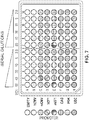
- Figure 7 illustrates a plate according to an embodiment of the present invention in which serial dilutions are performed. Dilutions may for example be 2 fold, 3 fold, 4 fold, 5 fold, 6 fold, etc. between consecutive loci.
- viral particles with a stated dilution or in the same plate column have equivalent titer, and transductions are performed under the same conditions.
- the rows B through H in the figure represent experiments in which different promoters are used (hCMV, mCMV, hEF1, mEF1, CAG, PGK and UBC); row A is empty.
- the columns represent two sets of serial dilutions that correspond to each promoter.
- the Multiplicity of Infection (“MOI") for each locus may for example be, 80, 40, 20, 10, 5, and 2.5.
- lentiviral particles may, for example, be normalized with regard to titer as determined by p24 ELISA.
- a multiplicity of infection refers to the ratio of infectious agents to infection targets, e.g., cells.
- Another aspect described herein provides a method for suppressing gene expression.
- this method first one transduces different wells of a cell line of interest with lentiviral vectors located at at least two different loci of a plate such as one of the plates described in this disclosure.
- the lentiviral vectors contain non-targeting shRNA control sequences as their mature sequences.
- the intensities are measured, one selects a promoter sequence for insertion into a suppression vector, thereby obtaining a selected promoter sequence, wherein the selected promoter sequence has the highest measured intensity at the lowest multiplicity of infection.
- the intensity may be greater than a predetermined level or noticeable to the human eye or machine that is calibrated to analyze intensities.
- the suppression may comprise the selected promoter sequence; optionally a reporter sequence; an miRNA scaffolding sequence; a mature strand insert sequence; and a star strand insert sequence.
- the miRNA scaffolding sequence may for example be derived from an endogenous pri-miRNA sequence.
- the mature strand insert sequence and the star strand insert sequence may be defined as described above.
- the suppression vector that is obtained omits a reporter sequence. Further, it may have an absence of a non-targeting control sequence and instead have a sequence that is selected based on its likelihood to suppress a target gene.
- the suppression vector may subsequently be used either in vitro or in vivo. When used in vivo, the suppression vector may be used as part of a medicament and administered by methods now known or that come to be known and that a person of ordinary skill in the art would appreciate as being useful in connection with the present disclosure.
- the method may further comprise applying an algorithm to a plurality of candidate mature strand insert sequences or candidate star strand insert sequences for the suppression vector.
- the algorithm selects a target sequence on the basis of one or more variables, e.g., position dependent nucleotide preferences, secondary structures, thermodynamic stability profiles, and complementarity or homology to a target sequence.
- the algorithm may contain seed-based filters that help to select sequences with either no off-target effects or satisfactorily low off-target effects.
- the algorithm may for example, comprises at least one, at least two, at least three, at least five, at least ten, at least twenty, or at least thirty variables, wherein each of which has a value that is dependent upon the presence or absence of a base at at least one position of either a candidate mature strand insert sequence or a candidate star strand insert sequence.
- the variables may be weighted different amounts and either positive or negative, and there may be additional variables such as the overall GC content or the GC content at specific positions and internal thermal stability.
- the output of the algorithm assigns a value to each of the candidate mature strand insert sequences or candidate star strand insert sequences and the value indicates a relative ranking of the candidate mature strand insert sequences or candidate star strand insert sequences.
- Examples of algorithms include but are not limited to those disclosed in U.S. Patent Publication Number 2005-0255487, published on November 17, 2005 and in U.S. Patent Publication Number 2007-0031844, published on February 8, 2007 .
- a person of ordinary skill in the art may then select the mature strand (or star strand) insert sequence with the highest value or one of the top two, three, four, five or ten highest values for a target.
- the lentiviral vector may be any of the lentiviral vectors described in this disclosure regardless of whether used in connection with plates, methods or kits described herein.
- Figure 12 is a representation of an example of configuration options of the vectors described herein.
- the viral sequences contained in a vector genome may include:
- the lentiviral vectors may be administered in vivo or in vitro.
- the various lentiviral vectors may be administered to cells from organisms such as mammals, including but not limited to humans and other primates such as chimpanzees, rats, mice, cats, dogs, sheep, horses, cows, etc., as well as to non-mammalian organisms such as, birds, reptiles and amphibians. They also may be administered directly to those organisms themselves or to cells of specific cell lines. Examples of cells from cell lines include but are not limited to the group consisting of HeLa, Ovcar-8, Jurkat, A549, IM-9, CD4, NiH3T3, J774, ES-D3, ES-E14TG2a, RAW 264 and C2C12.
- the lentiviral vector that is administered contains a promoter that is not human CMV.
- a promoter is considered not to be a human CMV promoter if it is not identical to an endogenous human CMV promoter, or is at least 2% or at least 5% or at least 10% or at least 20% or at least 30% or at least 40% or at least 50% different from an endogenous human CMV promoter sequence, the sequence of which is disclosed in U.S. Patent Nos. 5,168,062 and 5,385,839 .
- in order to compare the effects of an element between any two rows of a plate only one element of a construct is varied while all other elements are held constant.
- kits for suppressing gene expression comprising a plurality of lentiviral vectors described in this disclosure.
- the plurality of lentiviral vectors may comprise at least two, at least three, at least four, at least five or at least six lentiviral vectors that have different promoter sequences.
- the lentiviral vectors are otherwise identical.
- Kits may also include cell lines or be used with cell lines.
- Cell lines that prefer human CMV promoters include but are not limited to the human cell lines HEK293T, MCF7, MDA-MB-231, HCT116, PC3 and IMR32; rat cell line H9c2; and hamster cell line CHO-K1.
- Cell lines that prefer other promoters include the human cell lines HeLa, Ovcar-8, Jurkat - T cells in suspension, A549, IM-9 - B cells in suspension, and CD4+ T cells - primary cells; and the mouse cell lines NIH3T3, J774 - macrophage, ES-D3 - stem cells, ES-E14TG2a - stem cells, RAW 264.7 - macrophage and C2C12 cells.
- the kits may be used to discover highly active promoters in particular cell lines such as the mEF1 ⁇ promoter in the human-T-cell line Jurkat.
- the kit comprises one or more if not all of: a 96-well plate described herein with transduction ready lentiviral vector particles arranged in the wells and produced from vectors containing various promoters.
- other components may be one or more of polybrene, one or more multichannel pipettors, cell(s) of choice (e.g., primary cells, hematopoietic cells), DMEM (Thermo Scientific, HyClone), a culture medium that is supplemented with or without antibiotics (e.g., Pen-Strep), base media that corresponds to the preferred culture medium containing no serum or other supplements such as antibiotics, and transduction media corresponding to a 1:1 Base Media to DMEM, preferably containing no serum or other supplements.
- kits described herein may contain vectors with one to seven (i.e., one, two, three, four, five, six or seven) different promoters and may contain a 96-well plate.
- the researcher may leave one row empty as a control and conduct experiments in serial dilutions.
- a 96 well plate there may be twelve columns, which will permit the researcher to run two sets of six wells for each promoter with various levels of transducing units (T.U.) within each set.
- T.U. transducing units
- Conditions for transduction known to persons of ordinary skill in the art may be used.
- the researcher may add particles of the cells of interest, which preferably were optimized for cell density, polybrene, and serum.
- the plate may be allowed to sit for 48 -96 hours, at which time the researcher may analyze the fluorescence, which may for example, be GFP intensity.
- the researcher may then choose the promoter with the highest fluorescence intensity at the lowest MOI or at the lowest MOI for which intensity is detected.
- the researcher may then synthesize either enzymatically or chemically a suppression vector of choice or order one from a commercial source that contains the genetic content of interest.
- the lentivirus may be ordered from Thermo Fisher Scientific in the form of a SMARTvector 2.0 lentiviral shRNA vector that is constructed with the promoter of choice. Lentiviral vector particles may then be produced.
- the lentiviral particle may be designed with the desired promoter, control, scaffolding and gene(s) of interest.
- Step 1 Prepare the promoter selection plate for transduction:
- GFP fluorescence Next one may analyze promoter activity by GFP fluorescence. First, one may visually inspect cultures daily using fluorescence microscopy. Various methods can be utilized to analyze and to quantify GFP fluorescence. Two methods, fluorescence microscopy and flow cytometry, are described below.
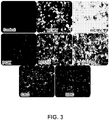
- FIG. 1 depicts the fluorescent images of human A549 cells transduced with viral particles from a SMARTchoiceTM Promoter Selection Plate.
- the mouse CMV promoter consistently ranked highest in fluorescence intensity and therefore would be the optimal promoter choice for delivery and expression in the cells of interest. Generally, there will be a clear choice as to which promoter is the most active in the cell of interest. Furthermore, the highest ranked promoter for a particular cell line should be consistent across all six concentrations. In the above example, the mouse CMV promoter ranked highest at all concentrations tested.
- promoter elements are targets of these epigenetic changes, including promoters present on mammalian expression vectors, resulting in promoter silencing. As with promoter activation, silencing is cell type dependent, with promoters becoming shut down in some cells while staying constitutively active in others.
- the promoter selection plate can also be used to test whether the promoter can sustain expression in a particular cell line. Because lentiviral vectors integrate stably into the host cell chromosome, cells transduced with the viral particles describedherein can be passaged indefinitely in culture. Monitoring and quantifying GFP fluorescence over time provides a good measure of promoter stability in the cell of interest. Decreased fluorescent intensity over time may be an indication that promoter silencing is occurring. The time it takes for the promoter to begin silencing as well as the degree of silencing can differ from cell to cell. One may use the following protocol to determine if the promoters become silenced over time in the cell of interest.
- puromycin selection can be used to remove all untransduced cells in the culture. Removal of the untransduced cells will diminish the possibility of these cells from becoming the predominant cell in the culture, thereby making it difficult to assess promoter silencing.
- the minimal concentration of puromycin needed to eliminate all untransduced cells within 4-6 days may be determined. The following protocol describes how to determine the optimal puromycin concentration.
- Imaging cells Two days post-transduction, observe and image (if possible) cells using fluorescent microscopy. If imaging cells, record all imaging parameters, including exposure time.
- the intent of the promoter selection plate is to determine by empirical observation the promoter that is optimal for expressing a shRNA in the cell of interest.
- the vector is amenable to modularization of vector elements, as the shRNA designs reside in silico until ordered.
- Vectors such as Dharmacon's SMARTvector 2.0 shRNA can be made available with any one of a plurality of promoters.
- SMARTvector 2.0 also can be constructed with for example either turbo GFP or turbo RFP (Evrogen) as the fluorescent marker.
- the transfer plasmid (containing the shRNA gene-targeting construct) and the helper plasmids are co-transfected into cells.
- the viral vector genomes are produced, encapsulated and released as virion particles from the cells into the surrounding medium.
- Transduction of cells with this viral supernatant can be performed at low or high multiplicities of infection (MOI).
- MOI multiplicities of infection
- Lower MOIs may be used for more easily transduced cells or when establishing stable cell lines.
- High MOIs may be needed for difficult-to-transduce cell lines or in vivo applications; however, it is important to note that addition of large volumes of low titer viral supernatant can often be toxic. This is due in part because the viral supernatant also contains cellular debris (metabolites, nucleases and proteases) derived from the packaging and production process that will affect the viability of transduced cells.
- strategies to employ may be: the vectors are shipped on dry ice as 25 uL aliquots and must be stored at -80°C. Under these conditions, particles are stable for at least 6-12 months. Repeated freeze-thaw cycles should be avoided as this can negatively affect viral titer. When setting up a gene knockdown experiment using gene silencing reagents, viral particles should be thawed on ice, aliquoted into smaller volumes (if necessary) and immediately returned to -80°C.
- Non-targeting control vectors that had different promoters were transduced into two cells lines. Seven different promoters were tested and a control was run that did not contain any vector.
- the experimental conditions were:
- Figure 1 shows the results in PC3 cells and figure 2 shows the results in OVCAR8 cells.
- different promoters can have different activity depending on the cell type. Whereas for the PC3 cells the human CMV promoter yielded the greatest fluorescence and the mouse CMV yielded the second greatest fluorescence, in the OVCAR8 cells, the two promoters that yielded the greatest fluorescence were hCMV and hEF1 ⁇ . Thus, promoter activity can vary across cell lines.
- Non-targeting control vectors that had different promoters were again transduced into two cells lines from two different species. Seven different promoters were tested and a control was run that did not contain any vector.
- the experimental conditions were:
- Non-targeting control vectors that had different promoters were transduced into cells from a cell line. Seven different promoters were tested and a control was run that did not contain any vector.
- the experimental conditions were:
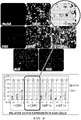
- FIG. 5 shows the greatest fluorescence with the mouse CMV promoter.
- Figure 5 (bottom) shows a bar graph that contains the result of an experiment conducted under the following conditions:
- the experimental conditions were:
- Figure 6 (top) shows the greatest fluorescence with the mouse CMV promoter.
- Figure 6 (bottom) shows a bar graph that contains the result of an experiment conducted under the following conditions:
- figure 5 and figure 6 show how promoter activity and consequently the level of shRNA expression have a significant impact on the level of knockdown.
- the arrayed SMARTchoice Promoter Selection Plate consists of lentiviral vector particles produced from SMARTchoice vectors co-expressing TurboGFP, a puromycin resistance selectable marker, and the Non-Targeting Control (NTC) shRNA in the context of the SMARTvector 2.0 miRNA scaffold.
- NTC Non-Targeting Control
- Figure 10 shows a quantitative analysis of relative expression in each of the systems as normalized relative to the control.
- the expression in systems using the mouse CMV vectors was greatly reduced relative to when using the human CMV vectors, which is consistent with the fluorescence results.
- an shRNA that previously showed poor functionality can be highly efficacious when driven by a more appropriate promoter.
- FIG. 11 shows a quantitative measure of the relative expression of shRNA normalized to a non-targeting control. This figure shows that none of the three shRNAs targeting RHOA in Jurkat cells were functional (knockdown greater than 70%) when expression was driven by the human CMV promoter, whereas two of the three shRNAs expressed by the mouse EF1 ⁇ promoter knocked down gene target gene expression by greater than 80%.
Landscapes
- Life Sciences & Earth Sciences (AREA)
- Health & Medical Sciences (AREA)
- Engineering & Computer Science (AREA)
- Genetics & Genomics (AREA)
- Biomedical Technology (AREA)
- Chemical & Material Sciences (AREA)
- Wood Science & Technology (AREA)
- Organic Chemistry (AREA)
- Biotechnology (AREA)
- General Engineering & Computer Science (AREA)
- Bioinformatics & Cheminformatics (AREA)
- Zoology (AREA)
- Molecular Biology (AREA)
- Physics & Mathematics (AREA)
- Microbiology (AREA)
- Plant Pathology (AREA)
- Biochemistry (AREA)
- General Health & Medical Sciences (AREA)
- Biophysics (AREA)
- Bioinformatics & Computational Biology (AREA)
- Crystallography & Structural Chemistry (AREA)
- Micro-Organisms Or Cultivation Processes Thereof (AREA)
- Medicines That Contain Protein Lipid Enzymes And Other Medicines (AREA)
- Measuring Or Testing Involving Enzymes Or Micro-Organisms (AREA)
Claims (15)
- Platte zur Auswahl einer Promotorsequenz, wobei die Platte mehrere Reihen einer Vielzahl von Orten umfasst, wobei mindestens zwei der Vielzahl von Orten innerhalb jeder Reihe jeweils einen lentiviralen Vektor umfassen, der Folgendes umfasst:(a) eine Promotorsequenz ausgewählt aus der Gruppe bestehend aus Sequenzen für humanes CMV, Maus-CMV, humanes EF1α, Maus-EF1α, CAG, humanes PGK, Maus-PGK und humanes Ubiquitin C; und(b) eine Reportersequenz,wobei der lentivirale Vektor in jedem Ort innerhalb der gleichen Reihe derselbe ist und der lentivirale Vektor in jeder Reihe derselbe ist, mit der Ausnahme, dass er eine andere Promotorsequenz umfasst, ausgewählt aus der Gruppe bestehend aus Sequenzen für humanes CMV, Maus-CMV, humanes EF1α, Maus-EF1α, CAG, humanes PGK, Maus-PGK und humanes Ubiquitin C, wobei die mindestens zwei der Vielzahl von Orten innerhalb der ersten Reihe einen ersten Ort und einen zweiten Ort umfassen, wobei die Menge des ersten lentiviralen Vektors in dem zweiten Ort in der ersten Reihe verglichen mit der Menge des ersten lentiviralen Vektors in dem ersten Ort in der ersten Reihe verdünnt ist, und die mindestens zwei der Vielzahl von Orten innerhalb der zweiten Reihe einen ersten Ort und einen zweiten Ort umfassen, wobei die Menge des zweiten lentiviralen Vektors in dem zweiten Ort in der zweiten Reihe verglichen mit der Menge des zweiten lentiviralen Vektors in dem ersten Ort in der zweiten Reihe verdünnt ist, wobei die Menge des ersten lentiviralen Vektors in dem ersten Ort in der ersten Reihe dieselbe wie die Menge des zweiten lentiviralen Vektors in dem ersten Ort in der zweiten Reihe ist, und wobei die Menge des ersten lentiviralen Vektors in dem zweiten Ort in der ersten Reihe dieselbe wie die Menge des zweiten lentiviralen Vektors in dem zweiten Ort in der zweiten Reihe ist, und wobei sich der erste Ort in der ersten Reihe und der erste Ort in der zweiten Reihe in einer ersten Spalte befinden und sich der zweite Ort in der ersten Reihe und der zweite Ort in der zweiten Reihe in einer zweiten Spalte befinden, die der ersten Spalte folgt.
- Platte nach Anspruch 1, wobei die Menge des ersten lentiviralen Vektors in dem ersten Ort in der ersten Reihe das 2-fache bis 6-fache der Menge des ersten lentiviralen Vektors in dem zweiten Ort in der ersten Reihe beträgt, und die Menge des zweiten lentiviralen Vektors in dem ersten Ort in der zweiten Reihe das 2- bis 6-fache der Menge des zweiten lentiviralen Vektors in dem zweiten Ort in der zweiten Reihe beträgt.
- Platte nach Anspruch 2, wobei die Menge des ersten lentiviralen Vektors in dem ersten Ort in der ersten Reihe das 2-fache, 3-fache, 4-fache, 5-fache oder 6-fache der Menge des ersten lentiviralen Vektors in dem zweiten Ort in der ersten Reihe beträgt und die Menge des zweiten lentiviralen Vektors in dem ersten Ort in der zweiten Reihe das 2-fache, 3-fache, 4-fache, 5-fache oder 6-fache der Menge des zweiten lentiviralen Vektors in dem zweiten Ort in der zweiten Reihe beträgt.
- Platte nach einem der Ansprüche 1 bis 3, wobei jeder lentivirale Vektor ferner Folgendes umfasst:(a) eine miRNA-Gerüstsequenz, wobei die miRNA-Gerüstsequenz von einer endogenen pri-miRNA-Sequenz abgeleitet ist.
- Platte nach Anspruch 4, wobei jeder lentivirale Vektor ferner Folgendes umfasst:(b) eine Insertionssequenz eines reifen Strangs und(c) eine Sternstrang-Insertionssequenz, wobei die Insertionssequenz des reifen Strangs und die Sternstrang-Insertionssequenz jeweils 18 - 23 Nucleotide lang sind und die Insertionssequenz des reifen Strangs und die Sternstrang-Insertionssequenz sich jeweils innerhalb der miRNA-Gerüstsequenz befinden und die Insertionssequenz des reifen Strangs mindestens 60 % komplementär zur Sternstrang-Insertionssequenz ist, und weder die Insertionssequenz des reifen Strangs noch die Sternstrang-Insertionssequenz eine Sequenz umfassen, die von einer endogenen miRNA abgeleitet ist, die das pri-miRNA-Gerüst umfasst.
- Platte nach Anspruch 5, wobei die Insertionssequenz des reifen Strangs eine Nicht-Targeting-Kontrollsequenz ist.
- Platte nach Anspruch 1, die eine dritte Reihe einer Vielzahl von Orten umfasst, wobei jeder von mindestens zwei der Vielzahl von Orten innerhalb der dritten Reihe einen dritten lentiviralen Vektor umfasst, der der gleiche ist wie der erste lentivirale Vektor, mit der Ausnahme, dass er eine Promotorsequenz umfasst, ausgewählt aus der Gruppe bestehend aus Sequenzen für humanes CMV, Maus-CMV, humanes EF1α, Maus-EF1α, CAG, Maus-PGK und UBC, die sich von den Promotorsequenzen des ersten lentiviralen Vektors und des zweiten lentiviralen Vektors unterscheidet, wobei die mindestens zwei der Vielzahl von Orten innerhalb der dritten Reihe einen ersten Ort und einen zweiten Ort umfassen, wobei die Menge des dritten lentiviralen Vektors in dem zweiten Ort in der dritten Reihe verglichen mit der Menge des dritten lentiviralen Vektors in dem ersten Ort in der dritten Reihe verdünnt ist, wobei die Menge des ersten lentiviralen Vektors in dem ersten Ort in der ersten Reihe dieselbe wie die Menge des dritten lentiviralen Vektors in dem ersten Ort in der dritten Reihe ist, und wobei die Menge des ersten lentiviralen Vektors in dem zweiten Ort in der ersten Reihe dieselbe wie die Menge des dritten lentiviralen Vektors in dem zweiten Ort in der dritten Reihe ist, und wobei sich der erste Ort in der dritten Reihe in der ersten Spalte befindet und sich der zweite Ort in der dritten Reihe in der zweiten Spalte befindet.
- Platte nach Anspruch 7, wobei die Menge des dritten lentiviralen Vektors in dem ersten Ort in der dritten Reihe das 2- bis 6-fache der Menge des dritten lentiviralen Vektors in dem zweiten Ort in der dritten Reihe beträgt, optional wobei die Menge des dritten lentiviralen Vektors in dem ersten Ort in der dritten Reihe das 2-fache, 3-fache, 4-fache, 5-fache oder 6-fache der Menge des dritten lentiviralen Vektors in dem zweiten Ort in der dritten Reihe beträgt.
- Platte nach Anspruch 7 oder 8, die ferner eine vierte Reihe einer Vielzahl von Orten umfasst, wobei jeder von mindestens zwei der Vielzahl von Orten innerhalb der vierten Reihe einen vierten lentiviralen Vektor umfasst, der der gleiche ist wie der erste lentivirale Vektor, mit der Ausnahme, dass er eine Promotorsequenz umfasst, ausgewählt aus der Gruppe bestehend aus Sequenzen für humanes CMV, Maus-CMV, humanes EF1α, Maus-EF1α, CAG, Maus-PGK und UBC, die sich von den Promotorsequenzen des ersten lentiviralen Vektors, des zweiten lentiviralen Vektors und des dritten lentiviralen Vektors unterscheidet, wobei die mindestens zwei der Vielzahl von Orten in der vierten Reihe einen ersten Ort und einen zweiten Ort umfassen, wobei die Menge des vierten lentiviralen Vektors in dem zweiten Ort in der vierten Reihe verglichen mit der Menge des vierten lentiviralen Vektors in dem ersten Ort in der vierten Reihe verdünnt ist, wobei die Menge des ersten lentiviralen Vektors in dem ersten Ort in der ersten Reihe dieselbe wie die Menge des vierten lentiviralen Vektors in dem ersten Ort in der vierten Reihe ist, und wobei die Menge des ersten lentiviralen Vektors in dem zweiten Ort in der ersten Reihe dieselbe wie die Menge des vierten lentiviralen Vektors in dem zweiten Ort in der vierten Reihe ist, und wobei sich der erste Ort in der vierten Reihe in der ersten Spalte befindet und sich der zweite Ort in der vierten Reihe in der zweiten Spalte befindet.
- Platte nach Anspruch 9, wobei die Menge des vierten lentiviralen Vektors in dem ersten Ort in der vierten Reihe das 2- bis 6-fache der Menge des vierten lentiviralen Vektors in dem zweiten Ort in der vierten Reihe beträgt, optional wobei die Menge des vierten lentiviralen Vektors in dem ersten Ort in der vierten Reihe das 2-fache, 3-fache, 4-fache, 5-fache oder 6-fache der Menge des vierten lentiviralen Vektors in dem zweiten Ort in der vierten Reihe beträgt.
- Platte nach Anspruch 9 oder 10, die ferner eine fünfte Reihe einer Vielzahl von Orten umfasst, wobei jeder von mindestens zwei der Vielzahl von Orten innerhalb der fünften Reihe einen fünften lentiviralen Vektor umfasst, der der gleiche ist wie der erste lentivirale Vektor, mit der Ausnahme, dass er eine Promotorsequenz umfasst, ausgewählt aus der Gruppe bestehend aus Sequenzen für humanes CMV, Maus-CMV, humanes EF1α, Maus-EF1α, CAG, Maus-PGK und UBC, die sich von den Promotorsequenzen des ersten lentiviralen Vektors, des zweiten lentiviralen Vektors, des dritten lentiviralen Vektors und des vierten lentiviralen Vektors unterscheidet, wobei die mindestens zwei der Vielzahl von Orten in der fünften Reihe einen ersten Ort und einen zweiten Ort umfassen, wobei die Menge des fünften lentiviralen Vektors in dem zweiten Ort in der fünften Reihe verglichen mit der Menge des fünften lentiviralen Vektors in dem ersten Ort in der fünften Reihe verdünnt ist, wobei die Menge des ersten lentiviralen Vektors in dem ersten Ort in der ersten Reihe dieselbe wie die Menge des fünften lentiviralen Vektors in dem ersten Ort in der fünften Reihe ist, und die Menge des ersten lentiviralen Vektors in dem zweiten Ort in der ersten Reihe dieselbe wie die Menge des fünften lentiviralen Vektors in dem zweiten Ort in der fünften Reihe ist, und wobei sich der erste Ort in der fünften Reihe in der ersten Spalte befindet und sich der zweite Ort in der fünften Reihe in der zweiten Spalte befindet.
- Platte nach Anspruch 11, wobei die Menge des fünften lentiviralen Vektors in dem ersten Ort in der fünften Reihe das 2- bis 6-fache der Menge des fünften lentiviralen Vektors in dem zweiten Ort in der fünften Reihe beträgt, optional wobei die Menge des fünften lentiviralen Vektors in dem ersten Ort in der fünften Reihe das 2-fache, 3-fache, 4-fache, 5-fache oder 6-fache der Menge des fünften lentiviralen Vektors in dem zweiten Ort in der fünften Reihe beträgt.
- Platte nach Anspruch 11 oder 12, die ferner eine sechste Reihe einer Vielzahl von Orten umfasst, wobei mindestens zwei der Vielzahl von Orten innerhalb der sechsten Reihe einen sechsten lentiviralen Vektor umfasst, der der gleiche ist wie der erste lentivirale Vektor, mit der Ausnahme, dass er eine Promotorsequenz umfasst, ausgewählt aus der Gruppe bestehend aus Sequenzen für humanes CMV, Maus-CMV, humanes EF1α, Maus-EF1α, CAG, Maus-PGK und UBC, die sich von der Promotorsequenze des ersten lentiviralen Vektors, des zweiten lentiviralen Vektors, des dritten lentiviralen Vektors, des vierten lentiviralen Vektors und des fünften lentiviralen Vektors unterscheidet, wobei die mindestens zwei der Vielzahl von Orten innerhalb der sechsten Reihe einen ersten Ort und einen zweiten Ort umfassen, wobei die Menge des sechsten lentiviralen Vektors in dem zweiten Ort in der sechsten Reihe verglichen mit der Menge des sechsten lentiviralen Vektors in dem ersten Ort in der sechsten Reihe verdünnt ist, wobei die Menge des ersten lentiviralen Vektors in dem ersten Ort in der ersten Reihe dieselbe wie die Menge des sechsten lentiviralen Vektors in dem ersten Ort in der sechsten Reihe ist, und wobei die Menge des ersten lentiviralen Vektors in dem zweiten Ort in der ersten Reihe dieselbe wie die Menge des sechsten lentiviralen Vektors in dem zweiten Ort in der sechsten Reihe ist, und wobei sich der erste Ort in der sechsten Reihe in der ersten Spalte befindet und sich der zweite Ort in der sechsten Reihe in der zweiten Spalte befindet.
- Platte nach Anspruch 13, wobei die Menge des sechsten lentiviralen Vektors in dem ersten Ort in der sechsten Reihe das 2- bis 6-fache der Menge des sechsten lentiviralen Vektors in dem zweiten Ort in der sechsten Reihe beträgt, optional wobei die Menge des sechsten lentiviralen Vektors in dem ersten Ort in der sechsten Reihe das 2-fache, 3-fache, 4-fache, 5-fache oder 6-fache der Menge des sechsten lentiviralen Vektors in dem zweiten Ort in der sechsten Reihe beträgt.
- Platte nach einem der Ansprüche 1 und 7 bis 14, wobei: die erste Reihe ferner einen dritten Ort, einen vierten Ort, einen fünften Ort und einen sechsten Ort umfasst und in dem ersten Ort, dem zweiten Ort, dem dritten Ort, dem vierten Ort, dem fünften Ort und dem sechsten Ort jeweils eine Vielzahl von Infektionen von 80, 40, 20, 10, 5 bzw. 2,5 vorliegt; und die zweite Reihe ferner einen dritten Ort, einen vierten Ort, einen fünften Ort und einen sechsten Ort umfasst und in dem ersten Ort, dem zweiten Ort, dem dritten Ort, dem vierten Ort, dem fünften Ort und dem sechsten Ort jeweils eine Vielzahl von Infektionen von 80, 40, 20, 10, 5 bzw. 2,5 vorliegt.
Applications Claiming Priority (2)
| Application Number | Priority Date | Filing Date | Title |
|---|---|---|---|
| US201161543596P | 2011-10-05 | 2011-10-05 | |
| PCT/US2012/058384 WO2013052432A1 (en) | 2011-10-05 | 2012-10-02 | Optimization of vectors for effective delivery and expression of genetic content |
Publications (3)
| Publication Number | Publication Date |
|---|---|
| EP2764123A1 EP2764123A1 (de) | 2014-08-13 |
| EP2764123A4 EP2764123A4 (de) | 2015-07-01 |
| EP2764123B1 true EP2764123B1 (de) | 2019-01-16 |
Family
ID=48044102
Family Applications (1)
| Application Number | Title | Priority Date | Filing Date |
|---|---|---|---|
| EP12839041.6A Active EP2764123B1 (de) | 2011-10-05 | 2012-10-02 | Optimierung von vektoren zur effektiven freisetzung und expression von genetischem inhalt |
Country Status (3)
| Country | Link |
|---|---|
| US (1) | US9382534B2 (de) |
| EP (1) | EP2764123B1 (de) |
| WO (1) | WO2013052432A1 (de) |
Family Cites Families (11)
| Publication number | Priority date | Publication date | Assignee | Title |
|---|---|---|---|---|
| US5168062A (en) | 1985-01-30 | 1992-12-01 | University Of Iowa Research Foundation | Transfer vectors and microorganisms containing human cytomegalovirus immediate-early promoter-regulatory DNA sequence |
| US20060057651A1 (en) | 2000-12-08 | 2006-03-16 | Bowdish Katherine S | Polypeptides and antibodies derived from chronic lymphocytic leukemia cells and uses thereof |
| EP1451316B1 (de) | 2001-09-13 | 2014-08-06 | California Institute Of Technology | Verfahren zur erzeugung von transgenetischen vögeln |
| AU2003295600A1 (en) | 2002-11-14 | 2004-06-15 | Dharmacon, Inc. | Functional and hyperfunctional sirna |
| US7090837B2 (en) | 2003-01-21 | 2006-08-15 | The Salk Institute For Biological Studies | Compositions and methods for tissue specific targeting of lentivirus vectors |
| GB0419424D0 (en) | 2004-09-02 | 2004-10-06 | Viragen Scotland Ltd | Transgene optimisation |
| WO2006101634A1 (en) | 2005-02-17 | 2006-09-28 | The Regents Of The University Of California | Müller cell specific gene therapy |
| US20070161031A1 (en) * | 2005-12-16 | 2007-07-12 | The Board Of Trustees Of The Leland Stanford Junior University | Functional arrays for high throughput characterization of gene expression regulatory elements |
| WO2008137122A2 (en) | 2007-05-04 | 2008-11-13 | Shiloh Laoratories, Inc. | Inducing premature senescence to stabilize stem cell feeder layer cells |
| WO2008147837A1 (en) * | 2007-05-23 | 2008-12-04 | Dharmacon, Inc. | Micro-rna scaffolds, non-naturally occurring micro-rnas, and methods for optimizing non-naturally occurring micro-rnas |
| DK2164967T3 (en) * | 2007-05-31 | 2015-10-19 | Univ Iowa Res Found | Reduction of off-target rna interferenstoksicitet |
-
2012
- 2012-10-02 EP EP12839041.6A patent/EP2764123B1/de active Active
- 2012-10-02 US US14/238,870 patent/US9382534B2/en active Active
- 2012-10-02 WO PCT/US2012/058384 patent/WO2013052432A1/en not_active Ceased
Non-Patent Citations (2)
| Title |
|---|
| JANE YUXIA QIN ET AL: "Systematic Comparison of Constitutive Promoters and the Doxycycline-Inducible Promoter", PLOS ONE, vol. 5, no. 5, 12 May 2010 (2010-05-12), pages e10611, XP055151992, DOI: 10.1371/journal.pone.0010611 * |
| RAMEZANI A ET AL: "Lentiviral vectors for enhanced gene expression in human hematopoietic cells", MOLECULAR THERAPY, NATURE PUBLISHING GROUP, GB, vol. 2, no. 5, 1 November 2000 (2000-11-01), pages 458 - 469, XP002307687, ISSN: 1525-0016, DOI: 10.1006/MTHE.2000.0190 * |
Also Published As
| Publication number | Publication date |
|---|---|
| EP2764123A4 (de) | 2015-07-01 |
| US20140213639A1 (en) | 2014-07-31 |
| US9382534B2 (en) | 2016-07-05 |
| EP2764123A1 (de) | 2014-08-13 |
| WO2013052432A1 (en) | 2013-04-11 |
Similar Documents
| Publication | Publication Date | Title |
|---|---|---|
| EP1444346B2 (de) | Sirna knockout prüfverfahren und konstrukte | |
| Coyle et al. | The Tpr protein regulates export of mRNAs with retained introns that traffic through the Nxf1 pathway | |
| AU2003254151B2 (en) | Novel siRNA libraries and their production and use | |
| Shu et al. | A simplified system to express circularized inhibitors of miRNA for stable and potent suppression of miRNA functions | |
| CN111936153A (zh) | 评估病毒载体效力的方法 | |
| JP2017513505A5 (de) | ||
| Li et al. | Lentiviral vector delivery of siRNA and shRNA encoding genes into cultured and primary hematopoietic cells | |
| US8901288B2 (en) | High throughput methods for functionally determining RNA interference efficiency | |
| US12391960B2 (en) | Methods and constructs for production of lentiviral vector | |
| Adams et al. | An optimized lentiviral vector system for conditional RNAi and efficient cloning of microRNA embedded short hairpin RNA libraries | |
| Osório et al. | Viral vectors expressing a single microRNA-based short-hairpin RNA result in potent gene silencing in vitro and in vivo | |
| Simmons et al. | Retroviral transduction of T cells and T cell precursors | |
| Li et al. | Lentiviral vector delivery of recombinant small interfering RNA expression cassettes | |
| JP2015096067A (ja) | 熱非対称インターレース(tail)pcrを用いたランダムホモ接合性遺伝子摂動(rhgp) | |
| Volkova et al. | The U3 region of Moloney murine leukemia virus contains position-independent cis-acting sequences involved in the nuclear export of full-length viral transcripts | |
| EP2764123B1 (de) | Optimierung von vektoren zur effektiven freisetzung und expression von genetischem inhalt | |
| EP3084008A2 (de) | Verfahren zur identifizierung von menschlichen anti-hiv-mirna-mimetika, mirna-hemmern und anti-hiv arzneimitteln | |
| US20050074889A1 (en) | Methods for gene function analysis | |
| Li et al. | Lentivirus transduction of hematopoietic cells | |
| Ritchie | Rev-Independent Export of Intron containing HIV-1 Env mRNAs | |
| WO2026090356A2 (en) | Modified mammalian cells for improved production | |
| WO2025106726A1 (en) | Engineered lipid bilayer particles displaying sirpa | |
| HK40063602A (en) | Methods and constructs for production of lentiviral vector | |
| Hüllen et al. | Development and implementation of a genome-wide CRISPR/Cas9 screen for identification of cellular factors affecting recombinant adeno-associated virus (rAAV) production | |
| Blondeel | Inhibiting HIV-1 Using RNA Interference (RNAi) to Target Novel HIV Dependency Factors (HDFs) |
Legal Events
| Date | Code | Title | Description |
|---|---|---|---|
| PUAI | Public reference made under article 153(3) epc to a published international application that has entered the european phase |
Free format text: ORIGINAL CODE: 0009012 |
|
| 17P | Request for examination filed |
Effective date: 20140213 |
|
| AK | Designated contracting states |
Kind code of ref document: A1 Designated state(s): AL AT BE BG CH CY CZ DE DK EE ES FI FR GB GR HR HU IE IS IT LI LT LU LV MC MK MT NL NO PL PT RO RS SE SI SK SM TR |
|
| DAX | Request for extension of the european patent (deleted) | ||
| RIC1 | Information provided on ipc code assigned before grant |
Ipc: C12N 15/113 20100101ALI20150513BHEP Ipc: C12N 15/00 20060101ALI20150513BHEP Ipc: C12Q 1/68 20060101AFI20150513BHEP |
|
| RA4 | Supplementary search report drawn up and despatched (corrected) |
Effective date: 20150601 |
|
| STAA | Information on the status of an ep patent application or granted ep patent |
Free format text: STATUS: EXAMINATION IS IN PROGRESS |
|
| 17Q | First examination report despatched |
Effective date: 20161130 |
|
| RAP1 | Party data changed (applicant data changed or rights of an application transferred) |
Owner name: DHARMACON, INC. |
|
| GRAP | Despatch of communication of intention to grant a patent |
Free format text: ORIGINAL CODE: EPIDOSNIGR1 |
|
| STAA | Information on the status of an ep patent application or granted ep patent |
Free format text: STATUS: GRANT OF PATENT IS INTENDED |
|
| INTG | Intention to grant announced |
Effective date: 20180712 |
|
| GRAJ | Information related to disapproval of communication of intention to grant by the applicant or resumption of examination proceedings by the epo deleted |
Free format text: ORIGINAL CODE: EPIDOSDIGR1 |
|
| STAA | Information on the status of an ep patent application or granted ep patent |
Free format text: STATUS: EXAMINATION IS IN PROGRESS |
|
| GRAR | Information related to intention to grant a patent recorded |
Free format text: ORIGINAL CODE: EPIDOSNIGR71 |
|
| GRAS | Grant fee paid |
Free format text: ORIGINAL CODE: EPIDOSNIGR3 |
|
| STAA | Information on the status of an ep patent application or granted ep patent |
Free format text: STATUS: GRANT OF PATENT IS INTENDED |
|
| GRAA | (expected) grant |
Free format text: ORIGINAL CODE: 0009210 |
|
| STAA | Information on the status of an ep patent application or granted ep patent |
Free format text: STATUS: THE PATENT HAS BEEN GRANTED |
|
| INTC | Intention to grant announced (deleted) | ||
| INTG | Intention to grant announced |
Effective date: 20181206 |
|
| AK | Designated contracting states |
Kind code of ref document: B1 Designated state(s): AL AT BE BG CH CY CZ DE DK EE ES FI FR GB GR HR HU IE IS IT LI LT LU LV MC MK MT NL NO PL PT RO RS SE SI SK SM TR |
|
| REG | Reference to a national code |
Ref country code: GB Ref legal event code: FG4D |
|
| REG | Reference to a national code |
Ref country code: CH Ref legal event code: EP |
|
| REG | Reference to a national code |
Ref country code: IE Ref legal event code: FG4D |
|
| REG | Reference to a national code |
Ref country code: DE Ref legal event code: R096 Ref document number: 602012056096 Country of ref document: DE |
|
| REG | Reference to a national code |
Ref country code: AT Ref legal event code: REF Ref document number: 1089730 Country of ref document: AT Kind code of ref document: T Effective date: 20190215 |
|
| REG | Reference to a national code |
Ref country code: NL Ref legal event code: MP Effective date: 20190116 |
|
| REG | Reference to a national code |
Ref country code: LT Ref legal event code: MG4D |
|
| PG25 | Lapsed in a contracting state [announced via postgrant information from national office to epo] |
Ref country code: NL Free format text: LAPSE BECAUSE OF FAILURE TO SUBMIT A TRANSLATION OF THE DESCRIPTION OR TO PAY THE FEE WITHIN THE PRESCRIBED TIME-LIMIT Effective date: 20190116 |
|
| REG | Reference to a national code |
Ref country code: AT Ref legal event code: MK05 Ref document number: 1089730 Country of ref document: AT Kind code of ref document: T Effective date: 20190116 |
|
| PG25 | Lapsed in a contracting state [announced via postgrant information from national office to epo] |
Ref country code: NO Free format text: LAPSE BECAUSE OF FAILURE TO SUBMIT A TRANSLATION OF THE DESCRIPTION OR TO PAY THE FEE WITHIN THE PRESCRIBED TIME-LIMIT Effective date: 20190416 Ref country code: PT Free format text: LAPSE BECAUSE OF FAILURE TO SUBMIT A TRANSLATION OF THE DESCRIPTION OR TO PAY THE FEE WITHIN THE PRESCRIBED TIME-LIMIT Effective date: 20190516 Ref country code: FI Free format text: LAPSE BECAUSE OF FAILURE TO SUBMIT A TRANSLATION OF THE DESCRIPTION OR TO PAY THE FEE WITHIN THE PRESCRIBED TIME-LIMIT Effective date: 20190116 Ref country code: SE Free format text: LAPSE BECAUSE OF FAILURE TO SUBMIT A TRANSLATION OF THE DESCRIPTION OR TO PAY THE FEE WITHIN THE PRESCRIBED TIME-LIMIT Effective date: 20190116 Ref country code: PL Free format text: LAPSE BECAUSE OF FAILURE TO SUBMIT A TRANSLATION OF THE DESCRIPTION OR TO PAY THE FEE WITHIN THE PRESCRIBED TIME-LIMIT Effective date: 20190116 Ref country code: LT Free format text: LAPSE BECAUSE OF FAILURE TO SUBMIT A TRANSLATION OF THE DESCRIPTION OR TO PAY THE FEE WITHIN THE PRESCRIBED TIME-LIMIT Effective date: 20190116 Ref country code: ES Free format text: LAPSE BECAUSE OF FAILURE TO SUBMIT A TRANSLATION OF THE DESCRIPTION OR TO PAY THE FEE WITHIN THE PRESCRIBED TIME-LIMIT Effective date: 20190116 |
|
| PG25 | Lapsed in a contracting state [announced via postgrant information from national office to epo] |
Ref country code: LV Free format text: LAPSE BECAUSE OF FAILURE TO SUBMIT A TRANSLATION OF THE DESCRIPTION OR TO PAY THE FEE WITHIN THE PRESCRIBED TIME-LIMIT Effective date: 20190116 Ref country code: HR Free format text: LAPSE BECAUSE OF FAILURE TO SUBMIT A TRANSLATION OF THE DESCRIPTION OR TO PAY THE FEE WITHIN THE PRESCRIBED TIME-LIMIT Effective date: 20190116 Ref country code: IS Free format text: LAPSE BECAUSE OF FAILURE TO SUBMIT A TRANSLATION OF THE DESCRIPTION OR TO PAY THE FEE WITHIN THE PRESCRIBED TIME-LIMIT Effective date: 20190516 Ref country code: GR Free format text: LAPSE BECAUSE OF FAILURE TO SUBMIT A TRANSLATION OF THE DESCRIPTION OR TO PAY THE FEE WITHIN THE PRESCRIBED TIME-LIMIT Effective date: 20190417 Ref country code: BG Free format text: LAPSE BECAUSE OF FAILURE TO SUBMIT A TRANSLATION OF THE DESCRIPTION OR TO PAY THE FEE WITHIN THE PRESCRIBED TIME-LIMIT Effective date: 20190416 Ref country code: RS Free format text: LAPSE BECAUSE OF FAILURE TO SUBMIT A TRANSLATION OF THE DESCRIPTION OR TO PAY THE FEE WITHIN THE PRESCRIBED TIME-LIMIT Effective date: 20190116 |
|
| REG | Reference to a national code |
Ref country code: DE Ref legal event code: R097 Ref document number: 602012056096 Country of ref document: DE |
|
| PG25 | Lapsed in a contracting state [announced via postgrant information from national office to epo] |
Ref country code: DK Free format text: LAPSE BECAUSE OF FAILURE TO SUBMIT A TRANSLATION OF THE DESCRIPTION OR TO PAY THE FEE WITHIN THE PRESCRIBED TIME-LIMIT Effective date: 20190116 Ref country code: IT Free format text: LAPSE BECAUSE OF FAILURE TO SUBMIT A TRANSLATION OF THE DESCRIPTION OR TO PAY THE FEE WITHIN THE PRESCRIBED TIME-LIMIT Effective date: 20190116 Ref country code: EE Free format text: LAPSE BECAUSE OF FAILURE TO SUBMIT A TRANSLATION OF THE DESCRIPTION OR TO PAY THE FEE WITHIN THE PRESCRIBED TIME-LIMIT Effective date: 20190116 Ref country code: AT Free format text: LAPSE BECAUSE OF FAILURE TO SUBMIT A TRANSLATION OF THE DESCRIPTION OR TO PAY THE FEE WITHIN THE PRESCRIBED TIME-LIMIT Effective date: 20190116 Ref country code: AL Free format text: LAPSE BECAUSE OF FAILURE TO SUBMIT A TRANSLATION OF THE DESCRIPTION OR TO PAY THE FEE WITHIN THE PRESCRIBED TIME-LIMIT Effective date: 20190116 Ref country code: RO Free format text: LAPSE BECAUSE OF FAILURE TO SUBMIT A TRANSLATION OF THE DESCRIPTION OR TO PAY THE FEE WITHIN THE PRESCRIBED TIME-LIMIT Effective date: 20190116 Ref country code: CZ Free format text: LAPSE BECAUSE OF FAILURE TO SUBMIT A TRANSLATION OF THE DESCRIPTION OR TO PAY THE FEE WITHIN THE PRESCRIBED TIME-LIMIT Effective date: 20190116 Ref country code: SK Free format text: LAPSE BECAUSE OF FAILURE TO SUBMIT A TRANSLATION OF THE DESCRIPTION OR TO PAY THE FEE WITHIN THE PRESCRIBED TIME-LIMIT Effective date: 20190116 |
|
| PLBE | No opposition filed within time limit |
Free format text: ORIGINAL CODE: 0009261 |
|
| STAA | Information on the status of an ep patent application or granted ep patent |
Free format text: STATUS: NO OPPOSITION FILED WITHIN TIME LIMIT |
|
| PG25 | Lapsed in a contracting state [announced via postgrant information from national office to epo] |
Ref country code: SM Free format text: LAPSE BECAUSE OF FAILURE TO SUBMIT A TRANSLATION OF THE DESCRIPTION OR TO PAY THE FEE WITHIN THE PRESCRIBED TIME-LIMIT Effective date: 20190116 |
|
| 26N | No opposition filed |
Effective date: 20191017 |
|
| PG25 | Lapsed in a contracting state [announced via postgrant information from national office to epo] |
Ref country code: SI Free format text: LAPSE BECAUSE OF FAILURE TO SUBMIT A TRANSLATION OF THE DESCRIPTION OR TO PAY THE FEE WITHIN THE PRESCRIBED TIME-LIMIT Effective date: 20190116 |
|
| PG25 | Lapsed in a contracting state [announced via postgrant information from national office to epo] |
Ref country code: TR Free format text: LAPSE BECAUSE OF FAILURE TO SUBMIT A TRANSLATION OF THE DESCRIPTION OR TO PAY THE FEE WITHIN THE PRESCRIBED TIME-LIMIT Effective date: 20190116 |
|
| PG25 | Lapsed in a contracting state [announced via postgrant information from national office to epo] |
Ref country code: MC Free format text: LAPSE BECAUSE OF FAILURE TO SUBMIT A TRANSLATION OF THE DESCRIPTION OR TO PAY THE FEE WITHIN THE PRESCRIBED TIME-LIMIT Effective date: 20190116 |
|
| REG | Reference to a national code |
Ref country code: CH Ref legal event code: PL |
|
| PG25 | Lapsed in a contracting state [announced via postgrant information from national office to epo] |
Ref country code: LU Free format text: LAPSE BECAUSE OF NON-PAYMENT OF DUE FEES Effective date: 20191002 Ref country code: LI Free format text: LAPSE BECAUSE OF NON-PAYMENT OF DUE FEES Effective date: 20191031 Ref country code: CH Free format text: LAPSE BECAUSE OF NON-PAYMENT OF DUE FEES Effective date: 20191031 |
|
| REG | Reference to a national code |
Ref country code: BE Ref legal event code: MM Effective date: 20191031 |
|
| PG25 | Lapsed in a contracting state [announced via postgrant information from national office to epo] |
Ref country code: BE Free format text: LAPSE BECAUSE OF NON-PAYMENT OF DUE FEES Effective date: 20191031 |
|
| PG25 | Lapsed in a contracting state [announced via postgrant information from national office to epo] |
Ref country code: IE Free format text: LAPSE BECAUSE OF NON-PAYMENT OF DUE FEES Effective date: 20191002 |
|
| PG25 | Lapsed in a contracting state [announced via postgrant information from national office to epo] |
Ref country code: CY Free format text: LAPSE BECAUSE OF FAILURE TO SUBMIT A TRANSLATION OF THE DESCRIPTION OR TO PAY THE FEE WITHIN THE PRESCRIBED TIME-LIMIT Effective date: 20190116 |
|
| PG25 | Lapsed in a contracting state [announced via postgrant information from national office to epo] |
Ref country code: MT Free format text: LAPSE BECAUSE OF FAILURE TO SUBMIT A TRANSLATION OF THE DESCRIPTION OR TO PAY THE FEE WITHIN THE PRESCRIBED TIME-LIMIT Effective date: 20190116 Ref country code: HU Free format text: LAPSE BECAUSE OF FAILURE TO SUBMIT A TRANSLATION OF THE DESCRIPTION OR TO PAY THE FEE WITHIN THE PRESCRIBED TIME-LIMIT; INVALID AB INITIO Effective date: 20121002 |
|
| PG25 | Lapsed in a contracting state [announced via postgrant information from national office to epo] |
Ref country code: MK Free format text: LAPSE BECAUSE OF FAILURE TO SUBMIT A TRANSLATION OF THE DESCRIPTION OR TO PAY THE FEE WITHIN THE PRESCRIBED TIME-LIMIT Effective date: 20190116 |
|
| P01 | Opt-out of the competence of the unified patent court (upc) registered |
Effective date: 20230425 |
|
| PGFP | Annual fee paid to national office [announced via postgrant information from national office to epo] |
Ref country code: DE Payment date: 20251029 Year of fee payment: 14 |
|
| PGFP | Annual fee paid to national office [announced via postgrant information from national office to epo] |
Ref country code: GB Payment date: 20251027 Year of fee payment: 14 |
|
| PGFP | Annual fee paid to national office [announced via postgrant information from national office to epo] |
Ref country code: FR Payment date: 20251027 Year of fee payment: 14 |