EP2765567A1 - Verfahren, Vorrichtung und Empfänger zur Verarbeitung eines Videos - Google Patents
Verfahren, Vorrichtung und Empfänger zur Verarbeitung eines Videos Download PDFInfo
- Publication number
- EP2765567A1 EP2765567A1 EP13305148.2A EP13305148A EP2765567A1 EP 2765567 A1 EP2765567 A1 EP 2765567A1 EP 13305148 A EP13305148 A EP 13305148A EP 2765567 A1 EP2765567 A1 EP 2765567A1
- Authority
- EP
- European Patent Office
- Prior art keywords
- traffic situation
- vehicle
- information
- video
- receiver
- Prior art date
- Legal status (The legal status is an assumption and is not a legal conclusion. Google has not performed a legal analysis and makes no representation as to the accuracy of the status listed.)
- Withdrawn
Links
- 238000000034 method Methods 0.000 title claims abstract description 29
- 238000012545 processing Methods 0.000 title description 2
- 230000006870 function Effects 0.000 description 3
- 230000007774 longterm Effects 0.000 description 3
- 230000005540 biological transmission Effects 0.000 description 2
- 238000004891 communication Methods 0.000 description 2
- 238000013500 data storage Methods 0.000 description 2
- 230000001419 dependent effect Effects 0.000 description 2
- 238000001514 detection method Methods 0.000 description 2
- 230000000977 initiatory effect Effects 0.000 description 2
- 230000015654 memory Effects 0.000 description 2
- 230000005236 sound signal Effects 0.000 description 2
- 238000012360 testing method Methods 0.000 description 2
- 238000011161 development Methods 0.000 description 1
- 230000018109 developmental process Effects 0.000 description 1
- 238000010586 diagram Methods 0.000 description 1
- 230000003993 interaction Effects 0.000 description 1
- 238000010295 mobile communication Methods 0.000 description 1
- 238000012544 monitoring process Methods 0.000 description 1
- 230000011664 signaling Effects 0.000 description 1
Images
Classifications
-
- G—PHYSICS
- G08—SIGNALLING
- G08G—TRAFFIC CONTROL SYSTEMS
- G08G1/00—Traffic control systems for road vehicles
- G08G1/20—Monitoring the location of vehicles belonging to a group, e.g. fleet of vehicles, countable or determined number of vehicles
- G08G1/205—Indicating the location of the monitored vehicles as destination, e.g. accidents, stolen, rental
Definitions
- the invention relates to a method, a device and a receiver for processing video.
- Modern cars are equipped with cameras, mainly for viewing the car environment while parking or while entering a crossing or for reading traffic signs.
- Modern cars comprise communication assistance systems for the driver or passenger to make voice calls through the communication network.
- the object of the invention is thus to automatically improve safety while driving.
- the main idea of the invention is a device comprising an analyzer adapted to assess a traffic situation from a captured image of the outside of a vehicle, and a sender adapted to send information about the assessed traffic situation.
- the device comprises a multiplexer adapted to join the captured image with recorded audio from a passenger compartment of the vehicle.
- the device comprises a microphone for recording audio of the passenger compartment of the vehicle.
- the device comprises a camera for capturing the image of the outside of the vehicle.
- the invention also concerns a vehicle comprising such device and a second device comprising a receiver and an output, wherein the receiver is adapted to receive information about an assessed traffic situation and adapted to determine whether to send an assistive message to the output or not depending on the information about the assessed traffic situation.
- the assistive message is determined from the information about the assessed traffic situation.
- Passenger compartment in case of the vehicle is the inside of the vehicle. More generally the area where the driver or the passengers sit is the passenger compartment, even when the vehicle has no closed interior room.
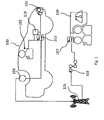
- the device may comprise a sender 104 adapted to send the video.
- the device is connectable to the sender 104.
- the analyzer 110 and the multiplexer 103 are adapted to interact for joining information about the assessed traffic situation to the video, e.g. via a data link or data bus.
- Figure 1 depicts also the receiver comprising an output 109 adapted to output the video received from aforementioned device and a de-multiplexer 107 adapted to decode the video or separate the information about the assessed traffic situation from the video, to determine an assistive message from the information, and to interact with the output 109 to output the assistive message on the output 109.
- the output 109 for example comprises a display and speaker to output images and audio of the video respectively.
- the sender 104 is adapted to connect to the receiver via a data link including in the example of figure 1 an antenna 105 and a computer network 108.
- the data link for example includes a local area network (LAN), wireless local area network (WLAN, 802.11n) or wide area network (WAN).
- the connection is for example according to the well known internet protocol (IP), user datagram protocol (UDP), transmission control protocol (TCP) or stream control transmission protocol (SCTP).
- IP internet protocol
- UDP user datagram protocol
- TCP transmission control protocol
- SCTP stream control transmission protocol
- Signaling is for example according to the well known session initiation protocol (SIP) or Internet Protocol Multimedia Subsystem (IMS). Addressing may be done using the well known uniform resource locators (URL), uniform resource identifiers (URI).
- URL uniform resource locators
- URI uniform resource identifiers
- the data link between the sender 104 and the antenna 105 is in the example according to the Long Term Evolution standard, well known as LTE.
- Any other type of data link suitable to connect the sender 104 of the vehicle 100 to the receiver may be used.
- a Global System for Mobile Communications link may be used.
- multiplexer 103 and the de-multiplexer 107 operate in the example according to the well known H.263 Codec. Any other type of video coding/decoding may be used. For example any of the well known MPEG-4 compatible video-codec may be used.
- the multiplexer 103 is adapted to receive the audio from the microphone 102, the image from the camera 101 and join audio and image into the video using the codec.
- the camera 101 and the microphone 102 are adapted to send audio and images to the multiplexer 103 continuously while the multiplexer 103 creates the video stream.
- multiplexer 103 is adapted to receive information about the assessed traffic situation from the analyzer 110 and add it to the video.
- the analyzer 110 for example is adapted to determine the distance or the change of the distance between the vehicle 100 and other objects captured by the camera 101 in the image. For example two consecutive images from the camera 101 are compared to decide from the size difference between the same object in both images the approximate change in distance. In an example in case the distance changes too quickly, the sentence "Heavy traffic Warning” is determined by the analyzer 110. Likewise in case an object moves from a position outside of the lane closer to a position in the lane of the vehicle 100, the sentence "Proximity Warning" is determined.
- the information about the assessed traffic situation is for example a text image indicating the warning as the word "Warning" or a situation dependent text explaining the reason, such as "Heavy traffic Warning" or "Proximity Warning".
- an audio signal playing the word “Warning” or the sentence “Heavy traffic Warning” or “Proximity Warning” may be generated as information about the assessed traffic situation by the analyzer 110.
- the analyzer 110 is adapted to output the information about the assessed traffic situation to the multiplexer 103.
- the multiplexer 103 determines a video stream from the input by the camera 101, the microphone 102 and the analyzer 110.
- the recording of the audio, the capturing of the images, the assessment of the traffic situation and the joining to the video is in the example started upon detection of a request to establish a connection between the sender 104 and the receiver.
- a person in the passenger compartment of the vehicle 110 speaks a number as user input requesting a connection to the receiver.
- the number may be a telephone number or a short cut, like a name, mapped to a telephone number.
- a Session Initiation Protocol connection request message to the sender 104 from the receiver may trigger the start.
- the sender 104 in the example is adapted to establish the data link according the Long Term Evolution standard from the sender 104 to the antenna 105 and further to the receiver upon detection of the number by the analyzer 110.
- this is detected by the analyzer 110 by monitoring input from the microphone 102 via speech recognition.
- a keyboard may be used to dial the number as indication of the request.
- the analyzer 110 is adapted to determine the address of the receiver according to the used data link.
- the multiplexer 103 is connected to the sender 104 and adapted to output the video to the sender 104 via the connection.
- the video in the example is coded using the H.263 standard.
- the sender 104 is adapted to send the coded video to the receiver upon receipt of the coded video, e.g. using the internet protocol address of the receiver.
- the antenna 105 is connected to the receiver via the computer network 105 and adapted to forward the coded video.
- the receiver is adapted to receive the coded video via an interface.
- the interface is according to the part of the de-multiplexer 107.
- the de-multiplexer 107 Upon receipt of the video, the de-multiplexer 107 is adapted to separate the information about the assessed traffic situation from the coded video.
- the decoder uses the H.263 standard to decode the video.
- the warning information is separated from the video. Furthermore the warning information is used to determine an assistive message.
- the assistive message may comprise of text instructions to be displayed on the output 109 via the display or audio instructions output by the speaker.
- the multiplexer 107 interacts with the output 109 to display only the sentence "Heavy traffic Warning” rather than the images of the video.
- the audio may be muted.
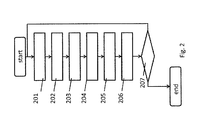
- the first method for example starts whenever the request to establish the connection between the sender 104 and the receiver is detected.
- step 201 the image of the outside of the vehicle 100 is captured. Afterwards a step 202 is executed.
- step 202 the audio of the passenger compartment of the vehicle 100 is recorded.
- Steps 201 and 202 may be performed simultaneously.
- step 203 is executed.
- step 203 the traffic situation is assessed from the captured image. For example the change of the distance between the vehicle 100 and an object is determined from two consecutively captured images. This means that the traffic situation is assessed from a captured image of the outside of the vehicle. The assessment is for example stored as text "Heavy traffic Warning" in a variable. Afterwards a step 204 is executed.
- step 204 the information on about the assessed traffic situation is determined for example from the variable.
- the information is determined for example from the variable containing the sentence "Heavy traffic Warning" as the equivalent text image or audio. In case no warning is determined, the information about the assessed traffic situation is for example "normal”.
- a step 205 is executed.
- step 205 the captured image, the recorded audio and the information about the assessed traffic situation are joined to the video.
- the captured image is joined with recorded audio from the passenger compartment of the vehicle and information about the assessed traffic situation as the video.
- the video may be compressed or coded as well.
- the video is compressed or coded according to the H.263 standard. This means that several captured images, recorded audio are joined with the information about the assessed traffic situation.
- step 206 the video signal or the coded video signal is sent.
- step 207 is executed.
- step 207 a test is performed to determine whether the connection between the sender 104 and the receiver is active, or whether at least one of the devices is switched off. In case the connection is active, the step 201 is executed. Otherwise the first method ends.
- the vehicle 100 for example has the aforementioned device integrated permanently. Permanently means that once mounted, the individual parts are fixed as part of the vehicle. Instead of permanently mounting the parts to the vehicle, the device may be integrated into a single housing, e.g. a smart phone. In this case the mounting may be via a special bracket or clamp that guarantees the mounting position while the smart phone is mounted.
- the system according to another embodiment comprises of the same devices. However in this other embodiment, the analyzer 110 or the multiplexer 107 are not in the vehicle 100 but in the network, e.g. as part of a computing cloud.
- the steps of the first method are for example executed in the same order however on the respective device.
- additional steps of sending the audio the images or the information are performed before the step of joining (205).
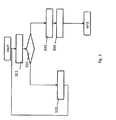
- the second method for example starts whenever reception of the video starts at the receiver.
- the information about the assessed traffic situation is separated from the video.
- the received video is decoded according to the H.263 standard and the text or audio containing the information about the assessed traffic situation is separated from the image or audio.
- a variable is set to the text "Heavy traffic Warning”. In case the information about the assessed traffic situation is indicating "normal", in the video, the variable is set to "normal".
- step 302 is executed.
- step 302 a test is performed to determine whether the information about the assessed traffic situation indicates "normal". In case the information indicates "normal” a step 305 is executed. Otherwise a step 303 is executed. For example in case the variable contains the text "normal” the step 305 is executed. This means that it is determined whether to send an assistive message to the output 109 or not depending on the information about the assessed traffic situation.
- step 303 an assistive message is determined from the information.
- an assistive message corresponding to a request to mute is created. This is for example a text "please mute audio" or a respective symbol is used This means that the assistive message is determined from the information about the assessed traffic situation.
- a step 304 is executed.
- step 304 the assistive message is output.
- the text "please mute audio" or the symbol is displayed on the display.
- a corresponding audio signal may be played. Afterwards the method ends.
- Step 304 may be repeated before the end of the second method for one or several times until the connection is ended.
- step 305 the video is output without the information about the assessed traffic situation.
- the image is for example displayed on the display and the audio played via the speaker.
- step 301 is executed.
- the information about the traffic situation, the image of the video or the audio of the video coincide with one or more of the other.
- the image of the video, the audio of the video or the video are live image, live audio or live video respectively.
- any functional blocks labeled as multiplexer, de-multiplexer, sender, receiver or analyzer may be provided through the use of dedicated hardware as well as hardware capable of executing software in association with appropriate software.
- the functions may be provided by a single dedicated processor, by a single shared processor, or by a plurality of individual processors, some of which may be shared.
- DSP digital signal processor
- ASIC application specific integrated circuit
- FPGA field programmable gate array
- ROM read only memory
- RAM random access memory
- switches shown in the figures are conceptual only. Their function may be carried out through the operation of program logic, through dedicated logic, through the interaction of program control and dedicated logic, or even manually, the particular technique being selectable by the implementer as more specifically understood from the context.
- program storage devices e.g., digital data storage media, which are machine or computer readable and encode machine-executable or computer-executable programs of instructions, wherein said instructions perform some or all of the steps of said above-described methods.
- the program storage devices may be, e.g., digital memories, magnetic storage media such as a magnetic disks and magnetic tapes, hard drives, or optically readable digital data storage media.
- the embodiments are also intended to cover computers programmed to perform said steps of the above-described methods.
Landscapes
- Physics & Mathematics (AREA)
- General Physics & Mathematics (AREA)
- Traffic Control Systems (AREA)
Priority Applications (1)
| Application Number | Priority Date | Filing Date | Title |
|---|---|---|---|
| EP13305148.2A EP2765567A1 (de) | 2013-02-07 | 2013-02-07 | Verfahren, Vorrichtung und Empfänger zur Verarbeitung eines Videos |
Applications Claiming Priority (1)
| Application Number | Priority Date | Filing Date | Title |
|---|---|---|---|
| EP13305148.2A EP2765567A1 (de) | 2013-02-07 | 2013-02-07 | Verfahren, Vorrichtung und Empfänger zur Verarbeitung eines Videos |
Publications (1)
| Publication Number | Publication Date |
|---|---|
| EP2765567A1 true EP2765567A1 (de) | 2014-08-13 |
Family
ID=47757529
Family Applications (1)
| Application Number | Title | Priority Date | Filing Date |
|---|---|---|---|
| EP13305148.2A Withdrawn EP2765567A1 (de) | 2013-02-07 | 2013-02-07 | Verfahren, Vorrichtung und Empfänger zur Verarbeitung eines Videos |
Country Status (1)
| Country | Link |
|---|---|
| EP (1) | EP2765567A1 (de) |
Citations (6)
| Publication number | Priority date | Publication date | Assignee | Title |
|---|---|---|---|---|
| US20020115423A1 (en) * | 2001-02-19 | 2002-08-22 | Yasuhiko Hatae | Emergency information notifying system, and apparatus, method and moving object utilizing the emergency information notifying system |
| US20060257024A1 (en) * | 2003-10-16 | 2006-11-16 | Bayerische Motoren Werke Aktiengesellschaft | Method and device for visualizing the surroundings of a vehicle |
| FR2887064A1 (fr) * | 2005-06-14 | 2006-12-15 | Peugeot Citroen Automobiles Sa | Systeme et procede d'appel d'urgence pour vehicule automobile |
| US20090207007A1 (en) * | 2004-12-21 | 2009-08-20 | Robert Bosch Gmb | Method for Sending an Emergency Call and Device |
| JP2009214838A (ja) * | 2008-03-12 | 2009-09-24 | Fuji Heavy Ind Ltd | 車両用運転支援装置 |
| EP2463842A2 (de) * | 2010-12-13 | 2012-06-13 | Scania CV AB | Verfahren und System für ein Fahrzeug zum Erzeugen und Senden eines Alarms über einen Unfall |
-
2013
- 2013-02-07 EP EP13305148.2A patent/EP2765567A1/de not_active Withdrawn
Patent Citations (6)
| Publication number | Priority date | Publication date | Assignee | Title |
|---|---|---|---|---|
| US20020115423A1 (en) * | 2001-02-19 | 2002-08-22 | Yasuhiko Hatae | Emergency information notifying system, and apparatus, method and moving object utilizing the emergency information notifying system |
| US20060257024A1 (en) * | 2003-10-16 | 2006-11-16 | Bayerische Motoren Werke Aktiengesellschaft | Method and device for visualizing the surroundings of a vehicle |
| US20090207007A1 (en) * | 2004-12-21 | 2009-08-20 | Robert Bosch Gmb | Method for Sending an Emergency Call and Device |
| FR2887064A1 (fr) * | 2005-06-14 | 2006-12-15 | Peugeot Citroen Automobiles Sa | Systeme et procede d'appel d'urgence pour vehicule automobile |
| JP2009214838A (ja) * | 2008-03-12 | 2009-09-24 | Fuji Heavy Ind Ltd | 車両用運転支援装置 |
| EP2463842A2 (de) * | 2010-12-13 | 2012-06-13 | Scania CV AB | Verfahren und System für ein Fahrzeug zum Erzeugen und Senden eines Alarms über einen Unfall |
Similar Documents
| Publication | Publication Date | Title |
|---|---|---|
| US10720169B2 (en) | Audio watermark and synchronization tones for recording devices | |
| US8878889B1 (en) | Method and system for originating and receiving emergency push-to-talk calls | |
| US20200204280A1 (en) | Media exchange between devices | |
| CA2814995C (en) | Method and apparatus for adjusting video compression parameters for encoding source video based on a viewer's environment | |
| US11095924B1 (en) | Method and device for providing a time-compressed preview of a pre-buffered video during a push-to-video communication session | |
| EP2847987B1 (de) | Nahtlose sprachnotizen während eines anrufes | |
| EP3048780B1 (de) | Sicherheit für drahtlosanrufe | |
| CN106856540A (zh) | 一种移动终端通信的方法和装置 | |
| WO2018208394A1 (en) | Emergency call detection system | |
| WO2015002586A1 (en) | Audio and video synchronization | |
| CN117193685A (zh) | 投屏数据的处理方法、电子设备及存储介质 | |
| US20180041735A1 (en) | Body Worn Video Device and Process Having Cellular Enabled Video Streaming | |
| EP3843059B1 (de) | Notfallrettungsgerät für fahrzeuge zur übertragung von erweiterten unfallinformationen und verfahren dafür | |
| US20150237304A1 (en) | Method and device for processing an audio input state | |
| CN111083407A (zh) | 一种录播方法、装置及设备 | |
| CN107743177A (zh) | 通话控制方法、装置、移动终端及可读取存储介质 | |
| US10237402B1 (en) | Management of communications between devices | |
| JP7778815B2 (ja) | 通信システム、情報処理装置、情報処理方法、プログラム及び記録媒体 | |
| CN110225364B (zh) | 一种视频处理方法、装置、终端、服务器及存储介质 | |
| JP2017152952A (ja) | 通信制御装置、会議システムおよびプログラム | |
| CN116798442A (zh) | 一种多应用语音采集的方法、拾音设备及系统 | |
| JP2005244394A (ja) | 撮像機能付き携帯電話機 | |
| CN107844288B (zh) | 一种话题自动播放处理方法、服务器以及司机终端 | |
| CN120319252A (zh) | 音频编码方法、音频解码方法及音频传输系统 | |
| CN119135984A (zh) | 车辆远程伴随方法、装置、设备及存储介质 |
Legal Events
| Date | Code | Title | Description |
|---|---|---|---|
| PUAI | Public reference made under article 153(3) epc to a published international application that has entered the european phase |
Free format text: ORIGINAL CODE: 0009012 |
|
| 17P | Request for examination filed |
Effective date: 20130207 |
|
| AK | Designated contracting states |
Kind code of ref document: A1 Designated state(s): AL AT BE BG CH CY CZ DE DK EE ES FI FR GB GR HR HU IE IS IT LI LT LU LV MC MK MT NL NO PL PT RO RS SE SI SK SM TR |
|
| AX | Request for extension of the european patent |
Extension state: BA ME |
|
| RAP1 | Party data changed (applicant data changed or rights of an application transferred) |
Owner name: ALCATEL LUCENT |
|
| STAA | Information on the status of an ep patent application or granted ep patent |
Free format text: STATUS: THE APPLICATION IS DEEMED TO BE WITHDRAWN |
|
| 18D | Application deemed to be withdrawn |
Effective date: 20150214 |