EP2765727A1 - Verfahren und Vorrichtung zum Senden/Empfangen von Feedbackinformation zur Darstellung der Kanalqualitätsinformationen in einem MIMO-OFDM-System - Google Patents
Verfahren und Vorrichtung zum Senden/Empfangen von Feedbackinformation zur Darstellung der Kanalqualitätsinformationen in einem MIMO-OFDM-System Download PDFInfo
- Publication number
- EP2765727A1 EP2765727A1 EP14167017.4A EP14167017A EP2765727A1 EP 2765727 A1 EP2765727 A1 EP 2765727A1 EP 14167017 A EP14167017 A EP 14167017A EP 2765727 A1 EP2765727 A1 EP 2765727A1
- Authority
- EP
- European Patent Office
- Prior art keywords
- subbands
- feedback information
- channel quality
- cqi
- precoding
- Prior art date
- Legal status (The legal status is an assumption and is not a legal conclusion. Google has not performed a legal analysis and makes no representation as to the accuracy of the status listed.)
- Withdrawn
Links
Images



Classifications
-
- H—ELECTRICITY
- H04—ELECTRIC COMMUNICATION TECHNIQUE
- H04L—TRANSMISSION OF DIGITAL INFORMATION, e.g. TELEGRAPHIC COMMUNICATION
- H04L1/00—Arrangements for detecting or preventing errors in the information received
- H04L1/0001—Systems modifying transmission characteristics according to link quality, e.g. power backoff
- H04L1/0023—Systems modifying transmission characteristics according to link quality, e.g. power backoff characterised by the signalling
- H04L1/0026—Transmission of channel quality indication
-
- H—ELECTRICITY
- H04—ELECTRIC COMMUNICATION TECHNIQUE
- H04B—TRANSMISSION
- H04B7/00—Radio transmission systems, i.e. using radiation field
- H04B7/02—Diversity systems; Multi-antenna system, i.e. transmission or reception using multiple antennas
- H04B7/04—Diversity systems; Multi-antenna system, i.e. transmission or reception using multiple antennas using two or more spaced independent antennas
- H04B7/0413—MIMO systems
- H04B7/0417—Feedback systems
-
- H—ELECTRICITY
- H04—ELECTRIC COMMUNICATION TECHNIQUE
- H04B—TRANSMISSION
- H04B7/00—Radio transmission systems, i.e. using radiation field
- H04B7/02—Diversity systems; Multi-antenna system, i.e. transmission or reception using multiple antennas
- H04B7/04—Diversity systems; Multi-antenna system, i.e. transmission or reception using multiple antennas using two or more spaced independent antennas
- H04B7/06—Diversity systems; Multi-antenna system, i.e. transmission or reception using multiple antennas using two or more spaced independent antennas at the transmitting station
- H04B7/0613—Diversity systems; Multi-antenna system, i.e. transmission or reception using multiple antennas using two or more spaced independent antennas at the transmitting station using simultaneous transmission
- H04B7/0615—Diversity systems; Multi-antenna system, i.e. transmission or reception using multiple antennas using two or more spaced independent antennas at the transmitting station using simultaneous transmission of weighted versions of same signal
- H04B7/0619—Diversity systems; Multi-antenna system, i.e. transmission or reception using multiple antennas using two or more spaced independent antennas at the transmitting station using simultaneous transmission of weighted versions of same signal using feedback from receiving side
- H04B7/0621—Feedback content
- H04B7/0634—Antenna weights or vector/matrix coefficients
-
- H—ELECTRICITY
- H04—ELECTRIC COMMUNICATION TECHNIQUE
- H04B—TRANSMISSION
- H04B7/00—Radio transmission systems, i.e. using radiation field
- H04B7/02—Diversity systems; Multi-antenna system, i.e. transmission or reception using multiple antennas
- H04B7/04—Diversity systems; Multi-antenna system, i.e. transmission or reception using multiple antennas using two or more spaced independent antennas
- H04B7/06—Diversity systems; Multi-antenna system, i.e. transmission or reception using multiple antennas using two or more spaced independent antennas at the transmitting station
- H04B7/0613—Diversity systems; Multi-antenna system, i.e. transmission or reception using multiple antennas using two or more spaced independent antennas at the transmitting station using simultaneous transmission
- H04B7/0615—Diversity systems; Multi-antenna system, i.e. transmission or reception using multiple antennas using two or more spaced independent antennas at the transmitting station using simultaneous transmission of weighted versions of same signal
- H04B7/0619—Diversity systems; Multi-antenna system, i.e. transmission or reception using multiple antennas using two or more spaced independent antennas at the transmitting station using simultaneous transmission of weighted versions of same signal using feedback from receiving side
- H04B7/0636—Feedback format
- H04B7/0639—Using selective indices, e.g. of a codebook, e.g. pre-distortion matrix index [PMI] or for beam selection
-
- H—ELECTRICITY
- H04—ELECTRIC COMMUNICATION TECHNIQUE
- H04B—TRANSMISSION
- H04B7/00—Radio transmission systems, i.e. using radiation field
- H04B7/02—Diversity systems; Multi-antenna system, i.e. transmission or reception using multiple antennas
- H04B7/04—Diversity systems; Multi-antenna system, i.e. transmission or reception using multiple antennas using two or more spaced independent antennas
- H04B7/06—Diversity systems; Multi-antenna system, i.e. transmission or reception using multiple antennas using two or more spaced independent antennas at the transmitting station
- H04B7/0613—Diversity systems; Multi-antenna system, i.e. transmission or reception using multiple antennas using two or more spaced independent antennas at the transmitting station using simultaneous transmission
- H04B7/0615—Diversity systems; Multi-antenna system, i.e. transmission or reception using multiple antennas using two or more spaced independent antennas at the transmitting station using simultaneous transmission of weighted versions of same signal
- H04B7/0619—Diversity systems; Multi-antenna system, i.e. transmission or reception using multiple antennas using two or more spaced independent antennas at the transmitting station using simultaneous transmission of weighted versions of same signal using feedback from receiving side
- H04B7/0658—Feedback reduction
- H04B7/066—Combined feedback for a number of channels, e.g. over several subcarriers like in orthogonal frequency division multiplexing [OFDM]
-
- H—ELECTRICITY
- H04—ELECTRIC COMMUNICATION TECHNIQUE
- H04L—TRANSMISSION OF DIGITAL INFORMATION, e.g. TELEGRAPHIC COMMUNICATION
- H04L5/00—Arrangements affording multiple use of the transmission path
- H04L5/0001—Arrangements for dividing the transmission path
- H04L5/0014—Three-dimensional division
- H04L5/0023—Time-frequency-space
-
- H—ELECTRICITY
- H04—ELECTRIC COMMUNICATION TECHNIQUE
- H04L—TRANSMISSION OF DIGITAL INFORMATION, e.g. TELEGRAPHIC COMMUNICATION
- H04L5/00—Arrangements affording multiple use of the transmission path
- H04L5/003—Arrangements for allocating sub-channels of the transmission path
- H04L5/0058—Allocation criteria
- H04L5/006—Quality of the received signal, e.g. BER, SNR, water filling
-
- H—ELECTRICITY
- H04—ELECTRIC COMMUNICATION TECHNIQUE
- H04B—TRANSMISSION
- H04B7/00—Radio transmission systems, i.e. using radiation field
- H04B7/02—Diversity systems; Multi-antenna system, i.e. transmission or reception using multiple antennas
- H04B7/04—Diversity systems; Multi-antenna system, i.e. transmission or reception using multiple antennas using two or more spaced independent antennas
- H04B7/0413—MIMO systems
- H04B7/0452—Multi-user MIMO systems
-
- H—ELECTRICITY
- H04—ELECTRIC COMMUNICATION TECHNIQUE
- H04L—TRANSMISSION OF DIGITAL INFORMATION, e.g. TELEGRAPHIC COMMUNICATION
- H04L1/00—Arrangements for detecting or preventing errors in the information received
- H04L1/0001—Systems modifying transmission characteristics according to link quality, e.g. power backoff
- H04L1/0002—Systems modifying transmission characteristics according to link quality, e.g. power backoff by adapting the transmission rate
- H04L1/0003—Systems modifying transmission characteristics according to link quality, e.g. power backoff by adapting the transmission rate by switching between different modulation schemes
-
- H—ELECTRICITY
- H04—ELECTRIC COMMUNICATION TECHNIQUE
- H04L—TRANSMISSION OF DIGITAL INFORMATION, e.g. TELEGRAPHIC COMMUNICATION
- H04L1/00—Arrangements for detecting or preventing errors in the information received
- H04L1/0001—Systems modifying transmission characteristics according to link quality, e.g. power backoff
- H04L1/0009—Systems modifying transmission characteristics according to link quality, e.g. power backoff by adapting the channel coding
-
- H—ELECTRICITY
- H04—ELECTRIC COMMUNICATION TECHNIQUE
- H04L—TRANSMISSION OF DIGITAL INFORMATION, e.g. TELEGRAPHIC COMMUNICATION
- H04L25/00—Baseband systems
- H04L25/02—Details ; arrangements for supplying electrical power along data transmission lines
- H04L25/03—Shaping networks in transmitter or receiver, e.g. adaptive shaping networks
- H04L25/03006—Arrangements for removing intersymbol interference
- H04L2025/0335—Arrangements for removing intersymbol interference characterised by the type of transmission
- H04L2025/03426—Arrangements for removing intersymbol interference characterised by the type of transmission transmission using multiple-input and multiple-output channels
-
- H—ELECTRICITY
- H04—ELECTRIC COMMUNICATION TECHNIQUE
- H04L—TRANSMISSION OF DIGITAL INFORMATION, e.g. TELEGRAPHIC COMMUNICATION
- H04L25/00—Baseband systems
- H04L25/02—Details ; arrangements for supplying electrical power along data transmission lines
- H04L25/03—Shaping networks in transmitter or receiver, e.g. adaptive shaping networks
- H04L25/03006—Arrangements for removing intersymbol interference
- H04L2025/03777—Arrangements for removing intersymbol interference characterised by the signalling
- H04L2025/03802—Signalling on the reverse channel
-
- H—ELECTRICITY
- H04—ELECTRIC COMMUNICATION TECHNIQUE
- H04L—TRANSMISSION OF DIGITAL INFORMATION, e.g. TELEGRAPHIC COMMUNICATION
- H04L25/00—Baseband systems
- H04L25/02—Details ; arrangements for supplying electrical power along data transmission lines
- H04L25/03—Shaping networks in transmitter or receiver, e.g. adaptive shaping networks
- H04L25/03006—Arrangements for removing intersymbol interference
- H04L25/03343—Arrangements at the transmitter end
-
- H—ELECTRICITY
- H04—ELECTRIC COMMUNICATION TECHNIQUE
- H04L—TRANSMISSION OF DIGITAL INFORMATION, e.g. TELEGRAPHIC COMMUNICATION
- H04L5/00—Arrangements affording multiple use of the transmission path
- H04L5/003—Arrangements for allocating sub-channels of the transmission path
- H04L5/0058—Allocation criteria
- H04L5/0064—Rate requirement of the data, e.g. scalable bandwidth, data priority
-
- H—ELECTRICITY
- H04—ELECTRIC COMMUNICATION TECHNIQUE
- H04W—WIRELESS COMMUNICATION NETWORKS
- H04W28/00—Network traffic management; Network resource management
- H04W28/02—Traffic management, e.g. flow control or congestion control
- H04W28/06—Optimizing the usage of the radio link, e.g. header compression, information sizing, discarding information
Definitions
- An aspect of the present invention generally relates to a mobile communication system. More particularly, an aspect of the present invention relates to a method and apparatus for transmitting/receiving channel quality information in a Multiple Input Multiple Output (MIMO)-Orthogonal Frequency Division Multiplexing (OFDM) mobile communication system.
- MIMO Multiple Input Multiple Output
- OFDM Orthogonal Frequency Division Multiplexing
- MIMO is essential to enable high-speed mobile data services in a broadband mobile communication system.
- a MIMO system is an antenna system with multiple inputs and multiple outputs. Since the MIMO system can transmit different information from each antenna, the MIMO system can increase the amount and reliability of processed information.
- 2G and 3 rd Generation (3G) mobile communication systems have limitations in fast processing of a wide range of data due to the use of a single transmit/receive antenna.
- OFDM Global System for Mobile Communications
- DAB Digital Audio Broadcasting
- DVD Digital Video Broadcasting
- WLAN Wireless Local Area Network
- CDMA Code Division Multiple Access
- the current wireless communication systems attempt to achieve high-quality transmission of data and large multimedia data transmission with limited frequency resources. Therefore, techniques for transmitting a large amount of data with limited frequency resources have been proposed.
- a major technique is the MIMO system that can transmit more data without using more frequency resources.
- MIMO is vulnerable to Inter-Symbol Interference (ISI) and frequency selective fading involved in high-speed data transmission.
- ISI Inter-Symbol Interference
- MIMO is used in combination with OFDM.
- An OFDM system divides high-rate data streams into low-rate data streams by parallel data processing and transmits the low-rate data streams on a plurality of subcarriers simultaneously.
- the use of low-rate parallel subcarriers increases a symbol period, thereby decreasing ISI. Since guard intervals are used, the ISI is almost perfectly cancelled.
- the MIMO system typically has a plurality of transmitter antennas and a plurality of receiver antennas.
- a system using MIMO and OFDM in combination is called a MIMO-OFDM system.
- a transmitter selects at least one appropriate transmitter antenna for a Mobile Station (MS) with one or more receiver antennas.
- the transmitter for example, a Base Station (BS) needs feedback of channel quality information from the MS.
- the feedback information further includes channel quality information about a plurality of individual subcarriers (i.e. subbands), adding to the uplink signaling overhead. Accordingly, many techniques are under development to reduce the amount of feedback information, while enabling the transmitter to efficiently map data streams to the transmitter antennas.
- the simplest method for transmitting feedback information in the MIMO-OFDM system is to transmit channel quality information about all subbands or N best subbands, which results in a very large signaling overhead. Another method is to select a few subbands and schedule the selected subbands only. However, this method gives up an advantage of OFDM (i.e. frequency selection diversity).
- a third method is to generate channel quality information on a subband group basis, each subband grouping having M adjacent subbands. Considering a grouping size dominantly affects signaling efficiency, an optimal grouping size should be adapted according to channel status. Moreover, the third method suffers resource use inefficiency when the channel statuses of adjacent subbands are different.
- An aspect of the present invention is to address at least the problems and/or disadvantages and to provide at least the advantages described below. Accordingly, an aspect of the present invention is to provide a method and apparatus for efficiently feeding back channel quality information in a MIMO-OFDM mobile communication system.
- Another aspect of the present invention is to provide a method and apparatus for reducing the amount of feedback information by which channel qualities are reported in a MIMO-OFDM system.
- a method for receiving feedback information representing channel quality in a receiver in a MIMO-OFDM system in which the receiver measures channel qualities of signals transmitted on a plurality of subbands through a plurality of transmitter antennas by a transmitter, selects a predetermined number of subbands with a best transmission performance for each piece of precoding information based on the measured channel qualities, determines at least one subband group with a maximum rate from among the selected subbands and precoding information associated with the at least one subband group, and transmits feedback information to the transmitter, the feedback information including channel quality information about the at least one subband group and the associated precoding information.
- an apparatus for transmitting feedback information representing channel quality in a receiver in a MIMO-OFDM system in which a channel quality measurer measures channel qualities of signals transmitted on a plurality of subbands through a plurality of transmitter antennas by a transmitter, and a feedback information generator selects a predetermined number of subbands with a best transmission performance for each piece of precoding information based on the channel quality measurements, determines at least one subband group with a maximum rate from among the selected subbands and precoding information associated with the at least one subband group, and transmits feedback information to the transmitter, the feedback information including channel quality information about the at least one subband group and the associated precoding information.
- a method for receiving feedback information representing channel quality from at least one receiver in a transmitter in a MIMO-OFDM system in which the transmitter receives feedback information from the at least one receiver, the feedback information including channel quality information about at least one subband group and an associated precoding information, and determines a transmission parameter for subband allocation and precoding according to the feedback information in order to transmit a transmission signal.
- the at least one subband group is selected from among a predetermined number of subbands with a best transmission performance for each piece of precoding information based on channel qualities measured in the at least one receiver.
- an apparatus for receiving feedback information representing channel quality from at least one receiver in a transmitter in a MIMO-OFDM system in which a feedback information receiver receives feedback information from the at least one receiver, the feedback information including channel quality information about at least one subband group and an associated precoding information, and a scheduler determines a transmission parameter for subband allocation and precoding according to the feedback information in order to transmit a transmission signal.
- the at least one subband group is selected from among a predetermined number of subbands with a best transmission performance for each precoding information based on channel qualities measured in the at least one receiver.
- Exemplary embodiments of the present invention provide a method for transmitting feedback information (i.e. channel quality information) representing downlink channel quality, especially a method for reducing the size of the feedback information in a MIMO-OFDM system.
- feedback information i.e. channel quality information
- a total frequency band is divided into a plurality of subbands and the subbands are allocated to individual MSs.
- Feedback information transmitted from the plurality of MSs to a BS causes a large overhead. Therefore, one task to tackle in the MIMO-OFDM system is to reduce the size of the feedback information.
- An aspect of the present invention makes an approach regarding reduction of feedback information as follows, although the following exemplary embodiment does not limit the spirit and scope of the present invention.
- Subbands are grouped based on feedback information in terms of overhead reduction (successive subbands are simply not grouped into one group).
- Multi-user diversity can be supported (but, not limited to multiple users).
- FIG. 1 illustrates a system model according to an exemplary embodiment of the present invention.
- a transmitter 120 can be a BS in a cellular system or an Access Point (AP) in a WLAN system.
- the transmitter 120 receives data streams for at least one MS, herein a plurality of MSs 130, 132 and 134 from a user data source 110.
- the transmitter 120 transmits a reference signal by which to measure channel quality, i.e., a pilot signal to the MSs 130, 132 and 134.
- the MSs 130, 132 and 134 measure downlink channel qualities using the pilot signal, generate feedback information representing the channel quality measurements, and transmit the feedback information on predetermined channels, i.e., feedback channels to the transmitter 120.
- the transmitter 120 selects the MSs 130, 132 and 134 to receive data streams in a current transmission period, and the transmitter antennas through which the data streams are to be transmitted to the MSs130, 132 and 134, transmit power for the data streams and Modulation and Coding Scheme (MCS) levels for the data streams, according to the feedback information.
- MCS Modulation and Coding Scheme
- the data streams are transmitted to the selected MSs 130, 132 and 134 using the MCS levels and the transmit power through the selected transmitter antennas.
- the data streams Prior to the transmission, the data streams may be precoded so that the signals transmitted through the transmitter antennas are mutually orthogonal.
- the precoding is a technique for increasing transmission diversity efficiency by multiplying encoded and modulated signals by a predetermined precoding matrix so that they are orthogonal.
- the precoding matrix is composed of complex weights to be multiplied by input signals. It is a unitary or non-unitary matrix, which can be selected according to feedback information received from each MS.
- the MSs 130, 132 and 134 preserve a codebook with a set of available precoding matrices and transmit to the transmitter 120 the feedback information including information which indicates an appropriate precoding matrix for a measured channel quality.
- the transmitter 120 has the same codebook and multiplies precoding matrices indicated by the feedback information from the MSs 130, 132 and 134 by signals directed to the MSs 130, 132 and 134, prior to transmission through the transmitter antennas.
- precoding matrices are used, combinations of data streams and transmitter antennas are called virtual antennas.
- feedback information from an MS includes precoding information indicating at least one precoding matrix selected by the MS and the CQI of a selected subband group that maximizes transmission performance for the selected precoding matrix.
- subbands are grouped such that each group includes successive subbands.
- subbands are optimally grouped according to a selected precoding matrix and channel quality measurements.
- the transmitter selects a precoding matrix that maximizes transmission performance according to the feedback information from the MS and determines other transmission parameters (e.g. transmit power, MCS level, etc.) based on associated channel qualities. If the transmitter receives feedback information from a plurality of MSs, it selects a precoding matrix that maximizes a sum rate based on the feedback information.
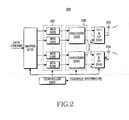
- FIG. 2 is a detailed block diagram of a transmitter in a MIMO-OFDM system according to an exemplary embodiment of the present invention.
- a transmitter 200 includes a mapper 210, an encoder and modulator 220, a precoder unit 230, OFDM modulators 242 to 244, and M t transmitter antennas 252 to 254. While the following description is made in the context of transmitting data streams to a plurality of MSs through a plurality of transmitter antennas, it is clearly to be understood that one MS and one transmitter antenna can be selected in real transmission.
- the mapper 210 receives one or more data streams to be transmitted to the MSs, i.e., users and also receives scheduling information from the users from a controller 260.
- the controller 260 has a feedback information receiver (not shown) for receiving feedback information with the Channel Quality Indications (CQIs) of grouped subbands and precoding information representing precoding matrices for which the CQIs are measured from at least one MS, and a scheduler (not shown) for, based on the feedback information, selecting at least one MS that maximizes transmission efficiency and determining transmission parameters including data streams, subbands, an MCS level, a precoding matrix, and a transmitter antenna to be used for the at least one MS.
- the CQI can be a Carrier-to-Interference (C/I) ratio.
- the mapper 210 extracts data streams to be transmitted from among the received data streams under the control of the controller 260.
- the encoder and modulator 220 include a plurality of MCS blocks 222 to 228. Each MCS block receives one data stream from the mapper 210 and encodes and modulates the data stream at an MCS level decided by the controller 260.
- the precoder unit 230 has, for example, K precoders 232 to 234, each receiving up to M t signals for precoding.
- the precoders 232 to 234 receive the coded and modulated signals from the MCS blocks 222 to 228, multiply the received signals by precoding matrices decided by the controller 260, and provide the resulting precoded signals to OFDM modulators 242 to 244 mapped to the respective transmitter antennas 252 to 254.
- the OFDM modulators 242 to 244 each have an Inverse Fast Fourier Transform (IFFT) processor and a Cyclic Prefix (CP) adder.
- IFFT Inverse Fast Fourier Transform
- CP Cyclic Prefix
- Each IFFT processor converts Nc received signals to time signals each including N c subband components.
- Each CP adder adds a CP to the time signals and serializes the CP-added time signals.
- the serial time signals from the OFDM modulators 242 to 244 are transmitted through the transmitter antennas 252 to 254 mapped to the OFDM modulators 242 to 244.
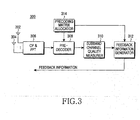
- FIG. 3 is a block diagram of an MS for transmitting feedback information according to an exemplary embodiment of the present invention.
- a receiver 300 includes at least one receiver antenna, herein a plurality of receiver antennas 302 to 304, an OFDM demodulator 306, a pre-decoder 308, a precoding matrix allocator 314, a subband channel quality measurer 310, and a feedback information generator 312. Components related to data reception are not shown in FIG. 3 .
- the OFDM demodulator 306 removes CPs from OFDM signals received from the receiver antennas 302 to 304, processes the CP-removed OFDM signals by Fast Fourier Transform (FFT), and provides FFT signals to the pre-decoder 308.
- FFT Fast Fourier Transform
- the pre-decoder 308 multiplies the FFT signals by a precoding matrix received from the precoding matrix allocator 314.
- the precoding matrix allocator 314 provides the precoding matrices of a codebook preset between the MS and the transmitter, one by one to the pre-decoder 308.
- the subband channel quality measurer 310 detects a pilot signal from a pre-decoded signal received from the pre-decoder 308 and measures the CQIs of the respective subbands of the pilot signal.
- the feedback information generator 312 collects the CQIs of the subbands for all precoding matrices, creates channel quality lists each having the CQIs of the subbands in a descending order for each precoding matrix, and generates feedback information representing the CQIs of a predetermined number of subbands that maximize transmission efficiency and their associated precoding matrices.
- the feedback information is transmitted on a feedback channel to the transmitter.
- the feedback information generation will be described in more detail with reference to FIG. 4 .
- FIG. 4 is a flowchart illustrating an operation for generating feedback information according to an exemplary embodiment of the present invention.
- the operations illustrated in FIG. 4 can take place in the feedback information generator 312 of each MS.
- variables used herein are defined as follows. The variables are all positive integers.
- N the number of available subbands.
- M the number of best subbands that each MS selects to generate feedback information.
- G the number of grouped subbands, also called the size of the subband group. It is preferably a factor of M or a positive integer less than or equal to M.
- L the number of subband groups associated with feedback information. It is equal to M/G.
- K the total number of precoding matrices stored in the transmitter and the receiver, for use in mapping data streams. It is also called a codebook size.
- the MS selects M best subbands for each precoding matrix included in a preset codebook based on the CQIs of signals that the transmitter has transmitted on N subbands in operation 402.
- M best subbands for a precoding matrix are defined as M subbands with the highest CQIs when the precoding matrix is applied.
- the CQIs of M selected subbands are expressed as
- the MS selects a precoding matrix and G subbands associated with the precoding matrix, which maximize transmission efficiency in terms of sum rate.
- the G subbands form a subband group associated with the selected precoding matrix. That is, the MS calculates the sum of the rates of a data stream on G subbands for each precoding matrix and selects a precoding matrix with the highest sum rate and the G subbands of the selected precoding matrix.
- the MS eliminates the selected G subbands from the M subbands of each precoding matrix in order to prevent redundant inclusion of the selected G subbands in feedback information.
- the MS compares the number of subbands selected so far with the number M of subbands transmittable in feedback information. In other words, the MS compares the number of subband groups with L. If the number of the selected subbands is less than M, the MS returns to operation 404. If the number of the selected subbands reaches M, the MS generates feedback information including channel quality information and precoding information associated with the channel quality information, and transmits the feedback information to the transmitter in operation 410.
- the channel quality information represents the CQIs of the selected M subbands and the precoding information includes the indexes of precoding matrices associated with the M subbands.
- the channel quality lists include the CQIs of the subbands that can be achieved when the transmitter applies U 1 and U 2 . That is, the CQIs of the subbands are values measured after applying U 1 and U 2 to a received OFDM signal.
- CQI_SB3 For U 2 , four CQIs that maximize transmission efficiency are CQI_SB3, CQI-SB5, CQI-SB1 and CQI-SB8.
- a specific algorithm for determining the best CQIs for each precoding matrix is beyond the scope of the present invention and thus will not be described herein in detail.
- CQI_SB5 is compared with the best CQI for U 2 , CQI_SB3. If CQI_SB5 is larger than CQI_SB3, the MS selects CQI_SB5 for U 1 as feedback information. Then the MS eliminates the selected CQI_SB5 from the channel quality lists of U 1 and U 2 .
- CQI_SB2 is compared with CQI_SB3 in the channel quality list of U 2 . If CQI_SB2 is less than CQI_SB3, the MS selects CQI_SB3 for U 2 as feedback information. Then, since CQI_SB1 for U 2 is larger than CQI_SB2 for U 1 , CQI-SB1 for U 2 is selected as feedback information. Finally, since CQI_SB2 for U 1 is larger than CQI_SB8 for U 2 , CQI_SB2 is selected as feedback information.
- Table 1 Precoding information Channel quality information U 1 CQI_SB5 U 2 CQI_SB3 U 2 CQI_SB1 U 1 CQI_SB2
- the CQIs are sorted in a descending order in the feedback information.
- CQI_SB3 For U 2 , four CQIs that maximize transmission efficiency are CQI_SB3, CQI_SB5, CQI-SB1 and CQI-SB8.
- the MS selects CQI_SB5 and CQI_SB2 from U 1 as feedback information. Then the MS eliminates the selected CQI_SB5 and CQI_SB2 from the channel quality lists of U 1 and U 2 .
- the sum of the next two best CQIs, CQI-SB9 and CQI_SB7 in the channel quality list of U 1 is compared with that of the two best CQIs, CQI_SB3 and CQI-SB1 in the channel quality list of U 2 . If the sum of CQI-SB9 and CQI_SB7 is less than the sum of CQI_SB3 and CQI_SB1, the MS selects CQI_SB3 and CQI-SB1 from U 2 as feedback information.
- CQI_SB3 For U 2 , four CQIs that maximize transmission efficiency are CQI_SB3, CQI-SB5, CQI-SB1 and CQI-SB8.
- CQI-SB5, CQI_SB2, CQI_SB9 and CQI_SB7 are larger than that of CQI_SB3, CQI_SB5, CQI-SB1 and CQI_SB8, the MS selects CQI-SB5, CQI_SB2, CQI-SB9 and CQI_SB7 for U 1 as feedback information.
- each column vector of a precoding matrix corresponding to a transmitter antenna can be included in feedback information. Therefore, an intended number (referred to as rank) of transmitter antennas can be allocated to each MS, instead of all transmitter antennas. Therefore, the MS groups subbands on a precoding vector basis to transmit feedback information. In this case, the operations of FIG. 4 are performed on a precoding vector basis.
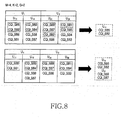
- the MS measures the CQIs of total subbands for each of the precoding vectors U 11 , U 12 , U 21 and U 22 and makes channel quality lists for U 11 , U 12 , U 21 and U 22 by arranging the CQIs in a descending order.
- U 22 four CQIs that maximize transmission efficiency are CQI_SB1, CQI_SB5, CQI_SB4 and CQI_SB3.
- the MS selects CQI_SB5 and CQI_SB2 for U 11 as feedback information. Then, the MS eliminates the selected CQI_SB5 and CQI_SB2 from the channel quality lists of U 11 , U 12 , U 21 and U 22 , as indicated by dotted rectangles.
- Table 4 Precoding information Channel quality information U 11 CQI_SB5, CQI_SB2 U 21 CQI_SB9, CQI_SB7
- each MS selects the CQIs of subbands and associated precoding matrices/vectors jointly, time and space resources can be appropriately selected without decreasing frequency and space diversity efficiency. Also, since a few subbands with highest CQIs are selected according to a subband grouping size for each precoding matrix/vector, the Signal-to-Interference and Noise Ratios (SINRs) of signals on the subbands are flat and a sufficient diversity gain is achieved. Therefore, feedback overhead is reduced.
- SINRs Signal-to-Interference and Noise Ratios
Landscapes
- Engineering & Computer Science (AREA)
- Signal Processing (AREA)
- Computer Networks & Wireless Communication (AREA)
- Quality & Reliability (AREA)
- Physics & Mathematics (AREA)
- Mathematical Physics (AREA)
- Radio Transmission System (AREA)
- Mobile Radio Communication Systems (AREA)
Applications Claiming Priority (2)
| Application Number | Priority Date | Filing Date | Title |
|---|---|---|---|
| KR1020060078339A KR101249359B1 (ko) | 2006-08-18 | 2006-08-18 | 다중 입력 다중 출력을 지원하는 직교 주파수 분할 다중화 시스템에서 채널 품질 정보를 송수신하는 방법 및 장치 |
| EP07016290.4A EP1890413B1 (de) | 2006-08-18 | 2007-08-20 | Verfahren und Vorrichtung zum Senden/Empfangen von Feedbackinformation zur Darstellung der Kanalqualitätsinformationen in einem MIMO-OFDM-System |
Related Parent Applications (1)
| Application Number | Title | Priority Date | Filing Date |
|---|---|---|---|
| EP07016290.4A Division EP1890413B1 (de) | 2006-08-18 | 2007-08-20 | Verfahren und Vorrichtung zum Senden/Empfangen von Feedbackinformation zur Darstellung der Kanalqualitätsinformationen in einem MIMO-OFDM-System |
Publications (1)
| Publication Number | Publication Date |
|---|---|
| EP2765727A1 true EP2765727A1 (de) | 2014-08-13 |
Family
ID=38896906
Family Applications (2)
| Application Number | Title | Priority Date | Filing Date |
|---|---|---|---|
| EP07016290.4A Not-in-force EP1890413B1 (de) | 2006-08-18 | 2007-08-20 | Verfahren und Vorrichtung zum Senden/Empfangen von Feedbackinformation zur Darstellung der Kanalqualitätsinformationen in einem MIMO-OFDM-System |
| EP14167017.4A Withdrawn EP2765727A1 (de) | 2006-08-18 | 2007-08-20 | Verfahren und Vorrichtung zum Senden/Empfangen von Feedbackinformation zur Darstellung der Kanalqualitätsinformationen in einem MIMO-OFDM-System |
Family Applications Before (1)
| Application Number | Title | Priority Date | Filing Date |
|---|---|---|---|
| EP07016290.4A Not-in-force EP1890413B1 (de) | 2006-08-18 | 2007-08-20 | Verfahren und Vorrichtung zum Senden/Empfangen von Feedbackinformation zur Darstellung der Kanalqualitätsinformationen in einem MIMO-OFDM-System |
Country Status (4)
| Country | Link |
|---|---|
| US (1) | US7764931B2 (de) |
| EP (2) | EP1890413B1 (de) |
| JP (1) | JP4505001B2 (de) |
| KR (1) | KR101249359B1 (de) |
Families Citing this family (74)
| Publication number | Priority date | Publication date | Assignee | Title |
|---|---|---|---|---|
| US8594207B2 (en) | 2005-10-31 | 2013-11-26 | Motorola Mobility Llc | Method and apparatus for providing channel quality feedback in an orthogonal frequency division multiplexing communication system |
| US7894505B2 (en) * | 2006-04-19 | 2011-02-22 | Samsung Electronics Co., Ltd. | Apparatus and method for selecting effective channel in a multi-user MIMO system |
| US8020075B2 (en) | 2007-03-16 | 2011-09-13 | Apple Inc. | Channel quality index feedback reduction for broadband systems |
| US8831116B2 (en) * | 2007-03-20 | 2014-09-09 | Motorola Mobility Llc | Method and apparatus for providing channel quality and precoding metric feedback in an orthogonal frequency division multiplexing communication system |
| US8179775B2 (en) * | 2007-08-14 | 2012-05-15 | Texas Instruments Incorporated | Precoding matrix feedback processes, circuits and systems |
| KR101481166B1 (ko) | 2007-06-25 | 2015-01-28 | 엘지전자 주식회사 | 다중안테나 시스템에서의 귀환데이터 전송 방법 |
| WO2009002087A1 (en) * | 2007-06-25 | 2008-12-31 | Lg Electronics Inc. | Method of transmitting feedback data in multiple antenna system |
| US8125884B1 (en) * | 2007-07-11 | 2012-02-28 | Marvell International Ltd. | Apparatus for pre-coding using multiple codebooks and associated methods |
| CN101785220A (zh) * | 2007-08-09 | 2010-07-21 | 松下电器产业株式会社 | 终端装置、基站装置、以及频率资源分配方法 |
| KR101478362B1 (ko) | 2007-08-10 | 2015-01-28 | 엘지전자 주식회사 | 다중안테나 시스템에서 귀환데이터 전송방법 |
| GB0721027D0 (en) * | 2007-10-26 | 2007-12-05 | Univ Bristol | A selective cluster index scheduling implementation of OFDMA |
| EP3503425B1 (de) * | 2008-02-28 | 2020-02-19 | Apple Inc. | Kommunikation einer rückmeldungsdatenstruktur mit informationsidentifizierungscodierung, die auf drahtlos kommunizierte signalisierung angewendet wird |
| US8233559B2 (en) * | 2008-03-12 | 2012-07-31 | Lg Electronics Inc. | Method and apparatus for transmitting a pilot in multi-antenna system |
| DE102008020141A1 (de) | 2008-04-22 | 2009-10-29 | Rohde & Schwarz Gmbh & Co. Kg | Beurteilung der Feedback-Qualität in Kommunikationssystemen |
| CN101567714A (zh) * | 2008-04-24 | 2009-10-28 | 夏普株式会社 | 用于信息反馈的子带判决方法、基站、用户设备以及通信系统 |
| US8199836B2 (en) * | 2008-05-02 | 2012-06-12 | Nec Laboratories America, Inc. | Multi-resolution precoding codebook |
| JP5262332B2 (ja) * | 2008-06-17 | 2013-08-14 | 住友電気工業株式会社 | 無線通信システム、基地局装置、及び無線端末装置 |
| CN104284317B (zh) * | 2008-06-25 | 2017-09-29 | 苹果公司 | 报告关于无线信道的单独子带的反馈信息的方法、基站、移动站 |
| TW201545494A (zh) | 2008-07-02 | 2015-12-01 | Interdigital Patent Holdings | 多蘇入多輸出通訊排序及預編碼矩陣測量及報告方法及裝置 |
| CN101651890A (zh) * | 2008-08-11 | 2010-02-17 | 夏普株式会社 | 反馈上行控制信令的方法、基站、用户设备及通信系统 |
| US8204453B2 (en) * | 2008-08-20 | 2012-06-19 | Intel Mobile Communications GmbH | Method, apparatus and communication unit |
| CN101729474B (zh) * | 2008-10-10 | 2013-05-08 | 中兴通讯股份有限公司 | 信道质量指数反馈方法和接收机 |
| EP2352266A4 (de) * | 2008-10-29 | 2016-03-23 | Lg Electronics Inc | Verfahren zur effizienten übertragung physikalischer kanäle in einem mehrträger-aggregationszustand an ein unterstützendes breitband |
| US8582678B2 (en) | 2008-12-12 | 2013-11-12 | Electronics And Telecommunications Research Institute | Communication system using multi-user multiple input multiple output (MU-MIMO) communication scheme |
| KR101707680B1 (ko) | 2008-12-21 | 2017-02-17 | 엘지전자 주식회사 | 무선 통신 시스템에서 정보 전송 장치 및 방법 |
| JP4693897B2 (ja) * | 2008-12-24 | 2011-06-01 | 株式会社エヌ・ティ・ティ・ドコモ | 無線基地局及び通信制御方法 |
| KR100988717B1 (ko) * | 2009-01-14 | 2010-10-18 | 고려대학교 산학협력단 | 다중 입출력 시스템의 선처리 장치 및 방법 |
| DE102009019685A1 (de) * | 2009-02-09 | 2010-08-12 | Rohde & Schwarz Gmbh & Co. Kg | Verfahren und Testvorrichtung zur Analyse eines über eine Funkstrecke kommunizierenden Geräts |
| KR101753391B1 (ko) | 2009-03-30 | 2017-07-04 | 엘지전자 주식회사 | 무선 통신 시스템에서 신호 전송 방법 및 장치 |
| US8923143B2 (en) * | 2009-06-29 | 2014-12-30 | Qualcomm Incorporated | Open loop channel reporting in a wireless communication system |
| WO2011014034A2 (ko) * | 2009-07-31 | 2011-02-03 | 엘지전자 주식회사 | 무선 통신 시스템에서 피드백 전송 방법 및 장치 |
| US8923844B2 (en) * | 2009-08-14 | 2014-12-30 | Futurewei Technologies, Inc. | Coordinated beam forming and multi-user MIMO |
| WO2011024524A1 (ja) | 2009-08-24 | 2011-03-03 | 日本電気株式会社 | 通信端末 |
| WO2011053069A2 (ko) * | 2009-10-30 | 2011-05-05 | 한국전자통신연구원 | 다중 사용자 무선 통신 시스템에서 데이터의 전송 방법 |
| WO2011074816A2 (ko) * | 2009-12-15 | 2011-06-23 | (주)팬택 | 채널정보를 송수신하는 방법과 이를 이용하는 단말 및 기지국 |
| US8599708B2 (en) | 2010-01-14 | 2013-12-03 | Qualcomm Incorporated | Channel feedback based on reference signal |
| US8614981B2 (en) * | 2010-01-29 | 2013-12-24 | Qualcomm Incorporated | Reporting of channel information to support coordinated multi-point data transmission |
| US9288089B2 (en) | 2010-04-30 | 2016-03-15 | Ecole Polytechnique Federale De Lausanne (Epfl) | Orthogonal differential vector signaling |
| US9083576B1 (en) | 2010-05-20 | 2015-07-14 | Kandou Labs, S.A. | Methods and systems for error detection and correction using vector signal prediction |
| US9667379B2 (en) * | 2010-06-04 | 2017-05-30 | Ecole Polytechnique Federale De Lausanne (Epfl) | Error control coding for orthogonal differential vector signaling |
| JP5746349B2 (ja) | 2010-09-01 | 2015-07-08 | エンパイア テクノロジー ディベロップメント エルエルシー | 転送されたチャネル条件情報に基づくデータの事前符号化 |
| US20130058239A1 (en) | 2010-10-21 | 2013-03-07 | James June-Ming Wang | Integrity and Quality Monitoring and Signaling for Sounding and Reduced Feedback |
| US11152977B2 (en) | 2010-10-21 | 2021-10-19 | Mediatek Singapore Pte. Ltd. | Integrity and quality monitoring and signaling for sounding and reduced feedback |
| EP2647149A1 (de) * | 2010-12-02 | 2013-10-09 | Interdigital Patent Holdings, Inc. | Systeme und verfahren zur verbesserung der genauigkeit von kanalqualitätsanzeigefeedback in der drahtlosen kommunikation mittels interferenzvorhersage |
| CN102487290B (zh) * | 2010-12-03 | 2014-05-21 | 财团法人工业技术研究院 | 传送终端及其传送天线选择方法 |
| US8442145B2 (en) * | 2010-12-03 | 2013-05-14 | Industrial Technology Research Institute | Transmitting terminal and transmit antenna selecting method thereof |
| US8934466B2 (en) * | 2010-12-16 | 2015-01-13 | Qualcomm Incorporated | Method and apparatus for supporting modulation-coding scheme set in very high throughput wireless systems |
| US9100162B2 (en) | 2012-04-11 | 2015-08-04 | Apple Inc. | Adaptive generation of channel state feedback (CSF) based on base station CSF scheduling |
| US8867448B2 (en) | 2012-05-15 | 2014-10-21 | Apple Inc. | Power-efficient adaptive channel state feedback in discontinuous reception scenarios |
| US9300373B2 (en) * | 2012-06-19 | 2016-03-29 | Telefonaktiebolaget L M Ericsson (Publ) | Selection of precoding vectors in lean-carrier systems |
| US8798590B2 (en) | 2012-07-06 | 2014-08-05 | Apple Inc. | Mobile device which deletes duplicate preferred roaming list system records for improved performance |
| JP2014027608A (ja) * | 2012-07-30 | 2014-02-06 | Ntt Docomo Inc | 基地局装置、ユーザ端末、通信システム及び通信制御方法 |
| US8989743B2 (en) | 2012-08-28 | 2015-03-24 | Apple Inc. | Battery conservation in stationary conditions for a wireless device |
| WO2014172377A1 (en) | 2013-04-16 | 2014-10-23 | Kandou Labs, S.A. | Methods and systems for high bandwidth communications interface |
| CN105993151B (zh) | 2014-02-02 | 2019-06-21 | 康杜实验室公司 | 低isi比低功率芯片间通信方法和装置 |
| US9509437B2 (en) | 2014-05-13 | 2016-11-29 | Kandou Labs, S.A. | Vector signaling code with improved noise margin |
| US11240076B2 (en) | 2014-05-13 | 2022-02-01 | Kandou Labs, S.A. | Vector signaling code with improved noise margin |
| US9473286B1 (en) * | 2014-12-01 | 2016-10-18 | Sprint Spectrum L.P. | Management of carrier-aggregation based on predicted intermodulation distortion |
| US9780847B2 (en) * | 2015-03-27 | 2017-10-03 | Qualcomm Incorporated | Channel feedback design for frequency selective channels |
| KR101978470B1 (ko) | 2015-06-26 | 2019-05-14 | 칸도우 랩스 에스에이 | 고속 통신 시스템 |
| EP3300439B1 (de) * | 2015-06-30 | 2021-04-07 | Huawei Technologies Co., Ltd. | Datenübertragungsverfahren und -vorrichtung |
| US10219169B1 (en) * | 2015-07-09 | 2019-02-26 | Quantenna Communications, Inc. | Hybrid MU-MIMO spatial mapping using both explicit sounding and crosstalk tracking in a wireless local area network |
| EP3610576B1 (de) | 2017-04-14 | 2022-12-28 | Kandou Labs, S.A. | Pipeline-vorwärtsfehlerkorrektur für vektorsignalisierungscodekanal |
| DE112018002643T5 (de) | 2017-05-22 | 2020-05-07 | Invention Mine, Llc | Multimodale datengetriebene taktwiederherstellungsschaltung |
| US10116468B1 (en) | 2017-06-28 | 2018-10-30 | Kandou Labs, S.A. | Low power chip-to-chip bidirectional communications |
| US10693587B2 (en) | 2017-07-10 | 2020-06-23 | Kandou Labs, S.A. | Multi-wire permuted forward error correction |
| CN111316692B (zh) * | 2017-11-17 | 2022-04-26 | 华为技术有限公司 | 信道状态信息的反馈方法、通信装置和系统 |
| CN111684772B (zh) | 2017-12-28 | 2023-06-16 | 康杜实验室公司 | 同步切换多输入解调比较器 |
| US10420161B1 (en) | 2018-03-20 | 2019-09-17 | Sprint Spectrum L.P. | Controlling RF communication in a dual-connectivity scenario |
| US10873958B1 (en) | 2019-05-10 | 2020-12-22 | Sprint Spectrum L.P. | Controlling PRB allocation for dual-connectivity service |
| US10797805B1 (en) * | 2019-07-24 | 2020-10-06 | Cisco Technology, Inc. | Optimized frequency searching for simultaneously received packet detection |
| CN113056003B (zh) * | 2019-12-26 | 2024-03-22 | 大唐移动通信设备有限公司 | 一种通信方法和装置 |
| US11909472B2 (en) | 2021-11-16 | 2024-02-20 | Samsung Electronics Co., Ltd | Method and apparatus for selection of linear combination coefficients for precoding in frequency-selective channels |
| WO2024049482A1 (en) | 2022-08-30 | 2024-03-07 | Kandou Labs SA | Pre-scaler for orthogonal differential vector signalling |
Citations (1)
| Publication number | Priority date | Publication date | Assignee | Title |
|---|---|---|---|---|
| WO2006048037A1 (en) * | 2004-11-05 | 2006-05-11 | Ntt Docomo, Inc. | Multiuser transmission system |
Family Cites Families (15)
| Publication number | Priority date | Publication date | Assignee | Title |
|---|---|---|---|---|
| US6859503B2 (en) | 2001-04-07 | 2005-02-22 | Motorola, Inc. | Method and system in a transceiver for controlling a multiple-input, multiple-output communications channel |
| US7020110B2 (en) * | 2002-01-08 | 2006-03-28 | Qualcomm Incorporated | Resource allocation for MIMO-OFDM communication systems |
| US7613248B2 (en) * | 2002-06-24 | 2009-11-03 | Qualcomm Incorporated | Signal processing with channel eigenmode decomposition and channel inversion for MIMO systems |
| US7065144B2 (en) * | 2003-08-27 | 2006-06-20 | Qualcomm Incorporated | Frequency-independent spatial processing for wideband MISO and MIMO systems |
| US7668125B2 (en) * | 2003-09-09 | 2010-02-23 | Qualcomm Incorporated | Incremental redundancy transmission for multiple parallel channels in a MIMO communication system |
| US6917821B2 (en) * | 2003-09-23 | 2005-07-12 | Qualcomm, Incorporated | Successive interference cancellation receiver processing with selection diversity |
| US7508748B2 (en) * | 2003-10-24 | 2009-03-24 | Qualcomm Incorporated | Rate selection for a multi-carrier MIMO system |
| KR100946923B1 (ko) | 2004-03-12 | 2010-03-09 | 삼성전자주식회사 | 직교 주파수 분할 다중 방식을 사용하는 통신 시스템에서 채널 품질 정보의 송수신 장치 및 방법, 그리고 그에 따른 시스템 |
| KR20060044335A (ko) * | 2004-03-12 | 2006-05-16 | 삼성전자주식회사 | 직교 주파수 분할 다중 접속 통신 시스템에서 안정적 채널운용을 위한 시스템 및 방법 |
| US20060039489A1 (en) | 2004-08-17 | 2006-02-23 | Texas Instruments Incorporated | Method and apparatus for providing closed-loop transmit precoding |
| CN1741412B (zh) * | 2004-08-27 | 2011-06-08 | 清华大学 | 无线网络中子信道分配的方法 |
| KR100981514B1 (ko) * | 2004-12-30 | 2010-09-10 | 삼성전자주식회사 | 직교 주파수 분할 다중 접속 통신 시스템에서 부분 채널 정보 피드백을 이용한 적응 부채널 및 비트 할당 방법 |
| US7466749B2 (en) * | 2005-05-12 | 2008-12-16 | Qualcomm Incorporated | Rate selection with margin sharing |
| TWI274482B (en) * | 2005-10-18 | 2007-02-21 | Ind Tech Res Inst | MIMO-OFDM system and pre-coding and feedback method therein |
| US8315213B2 (en) | 2006-03-31 | 2012-11-20 | Intel Corporation | System and method for allocating subchannels among mobile stations in a wireless access network |
-
2006
- 2006-08-18 KR KR1020060078339A patent/KR101249359B1/ko not_active Expired - Fee Related
-
2007
- 2007-08-17 US US11/840,918 patent/US7764931B2/en not_active Expired - Fee Related
- 2007-08-17 JP JP2007213189A patent/JP4505001B2/ja not_active Expired - Fee Related
- 2007-08-20 EP EP07016290.4A patent/EP1890413B1/de not_active Not-in-force
- 2007-08-20 EP EP14167017.4A patent/EP2765727A1/de not_active Withdrawn
Patent Citations (1)
| Publication number | Priority date | Publication date | Assignee | Title |
|---|---|---|---|---|
| WO2006048037A1 (en) * | 2004-11-05 | 2006-05-11 | Ntt Docomo, Inc. | Multiuser transmission system |
Non-Patent Citations (1)
| Title |
|---|
| JIHOON CHOI ET AL: "Interpolation based unitary precoding for spatial multiplexing MIMO-OFDM with limited feedback", PROCEEDINGS OF THE IEEE GLOBAL TELECOMMUNICATIONS CONFERENCE, vol. 1, 29 November 2004 (2004-11-29), pages 214 - 218, XP010758883, ISBN: 978-0-7803-8794-2 * |
Also Published As
| Publication number | Publication date |
|---|---|
| EP1890413A3 (de) | 2008-09-17 |
| US20080043677A1 (en) | 2008-02-21 |
| KR101249359B1 (ko) | 2013-04-01 |
| EP1890413B1 (de) | 2014-05-07 |
| JP2008048418A (ja) | 2008-02-28 |
| US7764931B2 (en) | 2010-07-27 |
| KR20080016335A (ko) | 2008-02-21 |
| EP1890413A2 (de) | 2008-02-20 |
| JP4505001B2 (ja) | 2010-07-14 |
Similar Documents
| Publication | Publication Date | Title |
|---|---|---|
| US7764931B2 (en) | Method and apparatus for transmitting/receiving feedback information representing channel quality in a MIMO-OFDM system | |
| US11356227B2 (en) | Wireless communication apparatus and wireless communication method | |
| US10356805B2 (en) | Methods and systems for scheduling in a virtual MIMO communication environment | |
| US7907677B2 (en) | Open loop MU-MIMO | |
| KR100945341B1 (ko) | 시분할 복신 시스템에서 주파수 영역 디스패치를 실현하는방법 및 통신시스템 | |
| RU2560818C2 (ru) | Способ и устройство для определения индикатора качества канала в сетях связи, работающих в режиме mu-mimo | |
| EP2137858B1 (de) | Verfahren und vorrichtung zur bereitstellung eines kanalqualitäts- und vorkodierungsskalen-feedbacks in einem orthogonalen frequenzteilungs-multiplex-kommunikationssystem | |
| WO2011132727A1 (ja) | フィードバック情報送信方法、移動局装置及び基地局装置 | |
| US8130868B2 (en) | Radio communication apparatus, radio communication method and program storage medium | |
| WO2010032810A1 (ja) | 基地局装置、ユーザ装置及びプリコーディング方法 | |
| KR101403134B1 (ko) | 다중안테나 시스템에서 다중사용자 데이터 전송 방법 | |
| WO2011125994A1 (ja) | 通信制御方法、移動局装置及び基地局装置 | |
| WO2007121568A1 (en) | Method and system for closed loop multiple input/output antenna environments in wireless communication | |
| CN101517929A (zh) | 用于在多天线系统中报告信道信息的方法 | |
| US8165537B2 (en) | Wireless transmitter and wireless transmission method | |
| JP2007189360A (ja) | 通信制御装置、通信端末装置、及び、通信制御方法 | |
| EP3573252A1 (de) | Vorcodierungsstrategie für daten-multicasting | |
| KR101384960B1 (ko) | 무선 지역 범위 망 채널 환경을 위한 폐쇄루프 통신시스템의 되먹임 주기 결정 방법 및 이를 이용한 다중입력다중출력 통신 시스템 | |
| KR20100046345A (ko) | 다중 입출력 무선통신 시스템에서 셀 간 간섭 제거 장치 및방법 |
Legal Events
| Date | Code | Title | Description |
|---|---|---|---|
| PUAI | Public reference made under article 153(3) epc to a published international application that has entered the european phase |
Free format text: ORIGINAL CODE: 0009012 |
|
| 17P | Request for examination filed |
Effective date: 20140505 |
|
| AC | Divisional application: reference to earlier application |
Ref document number: 1890413 Country of ref document: EP Kind code of ref document: P |
|
| AK | Designated contracting states |
Kind code of ref document: A1 Designated state(s): DE FR GB NL |
|
| STAA | Information on the status of an ep patent application or granted ep patent |
Free format text: STATUS: THE APPLICATION IS DEEMED TO BE WITHDRAWN |
|
| 18D | Application deemed to be withdrawn |
Effective date: 20150214 |