EP2766882B1 - Procédé pour la commande automatique d'un élément de fermeture d'un véhicule, dispositif correspondant et véhicule y relatif - Google Patents
Procédé pour la commande automatique d'un élément de fermeture d'un véhicule, dispositif correspondant et véhicule y relatif Download PDFInfo
- Publication number
- EP2766882B1 EP2766882B1 EP12772075.3A EP12772075A EP2766882B1 EP 2766882 B1 EP2766882 B1 EP 2766882B1 EP 12772075 A EP12772075 A EP 12772075A EP 2766882 B1 EP2766882 B1 EP 2766882B1
- Authority
- EP
- European Patent Office
- Prior art keywords
- movement
- sensor
- vehicle
- detected
- environmental conditions
- Prior art date
- Legal status (The legal status is an assumption and is not a legal conclusion. Google has not performed a legal analysis and makes no representation as to the accuracy of the status listed.)
- Active
Links
Images

Classifications
-
- B—PERFORMING OPERATIONS; TRANSPORTING
- B60—VEHICLES IN GENERAL
- B60R—VEHICLES, VEHICLE FITTINGS, OR VEHICLE PARTS, NOT OTHERWISE PROVIDED FOR
- B60R25/00—Fittings or systems for preventing or indicating unauthorised use or theft of vehicles
- B60R25/20—Means to switch the anti-theft system on or off
- B60R25/2054—Means to switch the anti-theft system on or off by foot gestures
-
- G—PHYSICS
- G07—CHECKING-DEVICES
- G07C—TIME OR ATTENDANCE REGISTERS; REGISTERING OR INDICATING THE WORKING OF MACHINES; GENERATING RANDOM NUMBERS; VOTING OR LOTTERY APPARATUS; ARRANGEMENTS, SYSTEMS OR APPARATUS FOR CHECKING NOT PROVIDED FOR ELSEWHERE
- G07C9/00—Individual registration on entry or exit
- G07C9/00174—Electronically operated locks; Circuits therefor; Nonmechanical keys therefor, e.g. passive or active electrical keys or other data carriers without mechanical keys
- G07C9/00563—Electronically operated locks; Circuits therefor; Nonmechanical keys therefor, e.g. passive or active electrical keys or other data carriers without mechanical keys using personal physical data of the operator, e.g. finger prints, retinal images, voicepatterns
Definitions
- the present invention relates to a method and a device for safely automatically actuating a closing element (eg a door or a flap) of a vehicle even under changing environmental conditions.
- a closing element eg a door or a flap
- the DE 103 36 335 A1 discloses a locking device for vehicles with a capacitive proximity switch on a door or flap of the vehicle, wherein large and small capacity changes are counted. Normally, to open the door or flap, a lower reference threshold is used, which must be exceeded by a capacity change to open the door or flap. However, if, for example, due to rain, the number of capacity changes exceeds a limit, an upper reference threshold will apply.
- the DE 10 2010 018 164 A1 describes a virtual switch, for example, to operate a tailgate or a door of a vehicle. This results in the signaling of an intention of the operation, a predetermined movement pattern. Environmental malfunctions can be prevented.
- the DE 10 2005 032 402 B3 discloses an approach detection of a person to a vehicle. If a movement pattern is detected, a control command (eg the opening of a boot lid) is triggered. Detection lobes can be changed depending on a distance between the vehicle and other objects.
- a control command eg the opening of a boot lid
- gesture-controlled locking devices for opening and closing doors and flaps of a vehicle
- movements of objects for example, hands or feet
- the doors and flaps are only actuated if the movement of the corresponding object is evaluated as valid.
- the present invention has the object to reduce the probability of false triggering in such closing devices.
- this object is achieved by a method for automatically actuating a closing element according to claim 1, by a device for actuating a closing element according to claim 8 and by a vehicle according to claim 11.
- the dependent claims define preferred and advantageous embodiments of the invention.
- a method for the automatic actuation of a closing element of a vehicle is provided.
- Ambient conditions in a surrounding area of the vehicle are detected.
- movement of an object in the surrounding area of the vehicle is detected.
- the detected movement is compared with a predetermined motion profile. If the detected movement corresponds to the predetermined movement profile, the closing element is automatically actuated.
- the detection of the movement of the object in the surrounding area and / or the comparison of the detected movement with the predetermined movement profile depends on the detected environmental conditions.
- the detection of the movement of the object and / or the comparison of the detected movement with the predetermined motion profile By detecting the movement of the object and / or the comparison of the detected movement with the predetermined motion profile depending on the detected environment conditions, the detection of the movement of the object and / or the comparison of the detected movement with the predetermined motion profile to the current environment conditions or better adapted to the strength of an environmental influence, with which the current environmental conditions adversely affect the detection of the movement of the object and / or the comparison of the detected movement with the given movement profile.
- ambient conditions for example, precipitation, temperature and light conditions are understood.
- the detection of the movement of the object in the surrounding area takes place only if a vehicle key assigned to the vehicle (for example, a keyless entry keyless entry key) is detected simultaneously in the surrounding area.
- a sensor system with which the movement of the object is detected can be informed of the presence of a key authorized for the vehicle at a recognized approach. This allows the sensor system to better distinguish between detected disturbances (movements) in a parked vehicle which are to be ignored and attempted movements to actuate the closure element.
- a closing element is understood as meaning, for example, a door (including a sliding door), a flap (eg trunk lid), a window or a sunroof of the vehicle.
- the operation of the closing element is in particular an opening of the closing element when the closing element is closed, and a closing of the closing element when the closing element is open.
- the movement of the object is detected by means of a first sensor of the vehicle, while the ambient conditions are detected with a second sensor of the vehicle.
- output values of the second sensor are averaged over a predetermined time interval in order to generate an average value.
- the time interval ends at the time at which the movement of the object is detected.
- a minimum threshold which must be exceeded by an output value of the first sensor, so that the detected movement is detected as corresponding to the predetermined motion profile, is chosen to be greater, the greater the average value.
- This average value is used to define a degree of raggedness which, under normal environmental conditions, assumes only low values and assumes higher values in the case of abnormal environmental conditions, so that the value or mean value allows conclusions to be drawn as to the extent of a negative influence of the environment.
- the second sensor may be a rain sensor whose initial value is greater, the greater the rainfall per unit time detected by the rain sensor. Since the evaluation of the first sensor is all the more negatively affected the more it rains, it is advantageous to adjust the minimum threshold accordingly, in order to avoid a false trigger regardless of the intensity of the rain.
- a light sensor or a temperature sensor can be used as the second sensor, wherein a combination of several sensors (eg light sensor and Rain sensor) is possible.
- the first sensor and the second sensor may also be the same sensor, which thus detects both the movement of the object and the ambient conditions.
- Similar sensors for the first and second sensors can detect ambient conditions better by means of a correspondingly spaced arrangement on the vehicle than if the first sensor is of a different sensor type than the second sensor.
- the first and second sensors are each a capacitive sensor, with the first sensor attached to the outer shell of the vehicle and the second sensor mounted below the vehicle (eg, each at the rear of the vehicle), the first sensor will have higher output values and the second sensor in a Unterêticasche (in the car wash) on higher output values.
- the output values of the one sensor are higher than the output values of the other sensor over a predetermined time interval.
- the higher the quality of the filter i.e., the ratio of center frequency to bandwidth of the filter
- the average which is to be regarded as a disturbance measure of the surrounding conditions, is redetermined, in particular after a change of ignition of the vehicle.
- a change of ignition occurs when the ignition of the vehicle is switched on or off. Since leaving the vehicle often follows the ignition change (in particular the switching off of the ignition),
- the ignition change (in particular the switching off of the ignition) follows an end of a drive of the vehicle, it is advantageous to recalculate the average value after the ignition change, since the ambient conditions change when the vehicle is stationary in comparison to the vehicle. In other words, long-term effects are eliminated by the recalculation of the unrest. Since the uneasiness level or the mean value is redetermined after the ignition change, the new uneasiness level is available only a predetermined period of time after the ignition change.
- the output values of the sensor with which the ambient conditions are detected are above a predetermined maximum threshold value, it may be advantageous to deactivate an actuation of the closing element for a predetermined period of time.
- the deactivation of the automatic actuation of the closing element is a proven means to avoid false triggering of the closing element due to the environmental conditions.
- the movement of the object in the surrounding area can be detected by means of an optical sensor or by means of a capacitive sensor. If the movement of the object in the surrounding area is detected by means of an optical sensor and if the detected environmental conditions indicate an optical contrast which is below a predetermined contrast threshold value, it may be advantageous to amplify a gain with which an output signal of the optical sensor is amplified increase or activate a light source of the vehicle to better illuminate the object.
- low-reflection objects may still advantageously be detected by the optical sensor when the gain of the sensor is increased or an additional light source is activated to illuminate the object.
- a counter is incremented if the detected movement does not correspond to the predetermined motion profile. For example, this counter is reset to zero when a change of ignition occurs, when no vehicle-authorized key is detected, or when the detected movement corresponds to the predetermined motion profile. If the counter value of the counter exceeds a predetermined threshold, an optical and / or audible warning (eg, with lights of the vehicle or the horn of the vehicle) is issued to inform the driver of the vehicle that consecutively failed (or detected as erroneous movement) failed Environment conditions) have been recorded.
- an optical and / or audible warning eg, with lights of the vehicle or the horn of the vehicle
- the unrest dimension can assume dimensions which are above a barrier. This, too, can advantageously be communicated to the driver by optical and / or acoustic indications, since in this case at least disturbances in the actuation of the closing element according to the invention can be expected.
- a device for actuating a closing element of a vehicle comprises a mechanism for automatically actuating the closing element, a control device and one or more sensors.
- the control unit detects surrounding conditions in the surrounding area of the vehicle with the aid of the one or more sensors.
- the controller detects, with the aid of the one or more sensors, a movement of an object in the surrounding area of the vehicle.
- the control unit compares the detected movement with a predetermined movement profile, which is stored for example in a memory of the device.
- the controller controls the mechanism for automatically actuating the closure member when the controller detects that the sensed movement corresponds to the movement profile.
- the movement of the object in the surrounding area is detected by the control unit and / or the comparison of the detected movement with the movement profile by the control unit is dependent on the detected surroundings conditions.
- one and the same sensor of the device is used to detect both the environmental conditions and the movement of the object. It is also possible that when using several sensors of the device, each of these sensors detects both the environmental conditions and the movement of the object.
- the device comprises one or more sensors in order to detect the movement of the object with the latter, and that the device comprises one or more other sensors in order to detect the environmental conditions therewith.
- an optical sensor or a capacitive sensor can be used as the sensor both for detecting the movement of the object and for detecting the environmental conditions.
- a thermal sensor, an infrared sensor, an ultrasonic sensor or a camera is also conceivable.
- a combination of sensors of different types and a networked structure of sensors are conceivable.
- a vehicle which comprises a closing element and a device according to the invention.
- the invention advantageously allows a targeted cause-related prevention of false triggering.
- the present invention is particularly suitable for actuating a closing element of a motor vehicle.
- the present invention is not limited to this preferred application, since the present invention is also applicable to ships, aircraft and track-bound or track-guided vehicles.
- Fig. 1 Function blocks of a method according to the invention are shown.
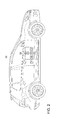
- Fig. 2 shows a vehicle according to the invention with a device according to the invention.
- Fig. 1 Functional blocks are shown, which must be carried out for carrying out the method according to the invention. It can be seen that according to the invention between an environmental analysis 12 and a movement analysis (here kick analysis or analysis of a Stand Gesture) 13 is distinguished.
- the environmental analysis 12 influences the motion analysis 13, as will be described in detail below.
- a kick gesture which is analyzed with a kick analysis, comprises in particular a back and forth movement, for example of the foot.
- a standing gesture involves only parking an object (e.g., the foot) at a particular location relative to the vehicle (e.g., centrally below the rear bumper).
- environmental conditions for example rain, light and temperature
- environmental detector 11 which additionally receives sensor data from two motion sensors 1.
- the environment detection 11 may for example determine a rainfall or detect whether the vehicle is in a car wash or is cleaned by a high-pressure cleaner.
- the environment detection 11 transmits the environment data 23 determined by it for parameter adaptation 14 and for setting a validation mode 15.
- the motion sensors 1 also transmit their sensor data to a preprocessing or noise reduction 18, which in particular performs a filtering of the sensor data and forwards the filtered sensor data to a motion detection (here kick detection) 19.
- the kick detection works with the parameters 16 (for example, a kick quality or a tolerance measure), which have been adjusted via the parameter adjustment 14 to the current environment conditions. If the kick detection 19 detects a kick in the sensor data, the correspondingly prepared sensor data are forwarded to the kick validation 21.
- the kick validation 21 checks with the validation parameters 17 whether the detected kick corresponds to a predetermined movement profile. If so, a kick dependent function 22 of the vehicle 10 is activated.
- the validation parameters 17 depend on the one hand on the current environment conditions and on the other hand on the settings of the validation mode 15, which include the predetermined motion profile, whereby the currently selected settings of the validation mode 15 also depend on the current environment conditions.
- the validation mode settings 15 determine whether kick validation 21 is performed with one sensor or multiple (two sensors 1 in the illustrated case).
- the settings of the validation mode 15 indicate via the motion profile whether a single kick or a double kick is required to activate the function 22. Blocking of the function activation 22 (including a blocking period) in poor environmental conditions can be done via the settings of the validation mode 15 by instructing the kick validation to not activate the function independently of the results of the kick detection 19.
- Fig. 1 illustrated embodiment provides that the environmental analysis 12 is performed in parallel (simultaneously) with the motion analysis 13. If, for example, rain with a low intensity is detected via the sensors 1, 2, the movement analysis 13 can operate normally. From a defined rain intensity detected by the sensors 1, 2, the approval parameters 16 are adapted accordingly and an optimized motion validation 21 is carried out, so that additional requirements for the motion detection or movement analysis 13 can be made.
- FIG. 2 an inventive vehicle 10 is shown, which comprises a device 20 according to the invention and a closing element 3 (for example a door) of the vehicle 10.
- the device 20 according to the invention in turn comprises a control unit 5, a motion sensor 1, an environment sensor 2, a mechanism 4 for actuating the closing element 3 and a memory 6 for storing a movement profile.
- the control unit 5 detects a movement via the movement sensor 1, it compares the detected movement with the movement profile stored in the memory 6. In this case, both the detection of the movement and the comparison of the movement with the movement profile are carried out as a function of environmental conditions which have been detected by means of the environmental sensor 2 in the vicinity of the vehicle 10. If the detected movement in certain tolerance limits, which are in particular dependent on the currently detected environmental conditions, corresponds to the movement profile, the control device 5 actuates the closing element 3 with the aid of the mechanism 4.
- the device according to the invention can issue a visual and / or audible feedback, e.g. to inform the driver of the vehicle about it.
- a driver drives with the vehicle 10 according to the invention in the rain.
- the driver stops the vehicle 10, switches off the ignition of the vehicle 10 and leaves the vehicle 10. Then, by means of a kicking motion, he opens the boot lid of the vehicle 10. Due to the ignition change or the switching off of the ignition, the uneasiness with which the environmental conditions are detected, discarded and recalculated from the time of ignition change. Only after a predetermined period of time (for example 4 s) is the new uneasiness (eg the new mean of the output values of the environmental sensor 2 available), so that at the earliest after this predetermined period of time after the ignition change the trunk (or another closing element of the vehicle 10) can be opened to the driver.
- a predetermined period of time for example 4 s
- the new uneasiness eg the new mean of the output values of the environmental sensor 2 available
- Both the detection of the kicking motion and the comparison of the detected kicking motion with the given movement profile are dependent on the uneasiness. Any kind of gesture of the driver before the expiration of the predetermined period of time is ignored by the method according to the invention and does not lead to the actuation of a closing element of the vehicle 10.
- the recalculation of the rip-off level after the change of ignition has the advantage that the newly calculated ripple only reflects the amount of rain at standstill of the vehicle 10 (i.e., the amount of rain detected by the rip-off is advantageously not affected by the vehicle 10's vehicle speed).
- a driver approaches the vehicle 10 of the invention and opens a door of the vehicle 10 with a kicking motion.
- the noise amount (e.g., mean value of the output values of the environmental sensor 2) is calculated over a predetermined time interval (for example, 30 seconds) ending at the time of kicking.
- the disturbance reflects the environment conditions of the vehicle 10 in the last predetermined time interval and therefore provides a special protection against false triggering under severe environmental influences by both the detection of the kicking motion of the driver and the comparison of the detected kicking motion with the predetermined movement profile is dependent on the uneasiness.
- the driver passes through the vehicle 10 according to the invention a car wash, turns off the ignition of the vehicle 10 after leaving the car wash and leaves the vehicle 10. Then the driver opens the trunk of the vehicle by means of a standing motion or kick.
- the uneasiness is discarded and recalculated from the time of the ignition change. Similar to the first Use case is the new unrest measure only after the expiry of the predetermined period of time available, so that the driver only then the trunk (or another closing element of the vehicle 10) can open with the stationary motion or kicking motion. Both the detection of the stationary movement or kicking movement and the comparison of the detected standing movement or kicking movement with the predetermined movement profile takes place as a function of the newly calculated uneasiness.
- the recalculation of the unrest measure after the ignition change has the advantage in this application that the newly calculated uneasiness is not influenced by the ambient conditions within the car wash, since the new uneasiness was recalculated only after the ignition change which took place after leaving the car wash.
- the driver cleans the vehicle 10 according to the invention with a high-pressure cleaner and inadvertently performs a kicking motion in front of a door of the vehicle 10.
- the noise amount (eg, average value of the output values of the environmental sensor 2) is calculated over the predetermined time interval until the kicking motion time.
- the uneasiness therefore includes the extreme environmental conditions due to the high-pressure cleaning, so that the Unruermepens or output values of the environmental sensor 2 are above a maximum threshold, which means that the inventive operation of the door is disabled.
- the door advantageously does not open in this application, although the driver accidentally carried out the kicking motion in front of the door.
Landscapes
- Engineering & Computer Science (AREA)
- Physics & Mathematics (AREA)
- General Physics & Mathematics (AREA)
- Human Computer Interaction (AREA)
- Mechanical Engineering (AREA)
- Power-Operated Mechanisms For Wings (AREA)
Claims (11)
- Procédé d'actionnement automatique d'un élément de fermeture (3) d'un véhicule (10), des conditions environnantes dans une zone environnante du véhicule (10) étant détectées,
un mouvement d'un objet dans la zone environnante du véhicule (10) étant détecté,
le mouvement détecté étant comparé avec un profil de mouvement prédéfini,
l'élément de fermeture (3) étant actionné automatiquement lorsque le mouvement détecté correspond au profil de mouvement prédéfini,
la détection du mouvement de l'objet dans la zone environnante et/ou la comparaison du mouvement détecté avec le profil de mouvement prédéfini s'effectuant en fonction des conditions environnantes détectées, caractérisé en ce que
un premier détecteur (1) du véhicule (10) détecte le mouvement de l'objet,
en ce qu'un deuxième détecteur (2) du véhicule (10) détecte les conditions environnantes,
en ce que la moyenne d'une valeur de sortie du deuxième détecteur (2) est calculée sur un intervalle de temps prédéterminé, qui se termine à l'instant de la détection du mouvement de l'objet, afin de générer une valeur moyenne, et
en ce qu'une valeur de seuil, laquelle doit être dépassée par une valeur de sortie du premier détecteur (1) pour que le mouvement détecté soit reconnu comme étant le profil de mouvement prédéfini, est choisie d'autant plus grande que la valeur moyenne est élevée. - Procédé selon la revendication 1, caractérisé en ce que la détection du mouvement de l'objet dans la zone environnante et/ou la comparaison du mouvement détecté avec le profil de mouvement prédéfini s'effectue en fonction des conditions environnantes détectées* en ce qu'un paramètre (16) du profil de mouvement prédéfini est adapté en fonction des conditions environnantes, et/ou* en ce qu'un premier algorithme (18), avec lequel le mouvement de l'objet est détecté, est choisi en fonction des conditions environnantes, et/ou* en ce qu'un deuxième algorithme (15), avec lequel est effectuée la comparaison du mouvement détecté avec le profil de mouvement prédéfini, est choisi en fonction des conditions environnantes.
- Procédé selon la revendication 1 ou 2, caractérisé en ce que le premier algorithme comprend un filtrage des valeurs de sortie du premier détecteur (1) et en ce qu'une qualité du filtre est réglée d'autant plus grande que la valeur moyenne est élevée.
- Procédé selon l'une des revendications précédentes, caractérisé en ce que la valeur moyenne est de nouveau détermine après un changement d'allumage du véhicule (10).
- Procédé selon l'une des revendications précédentes, caractérisé en ce qu'un détecteur (2) du véhicule (10) détecte les conditions environnantes et en ce qu'un actionnement de l'élément de fermeture (3) est désactivé pendant une durée prédéterminée lorsqu'une valeur de sortie du détecteur (2) se trouve au-dessus d'une valeur de seuil prédéterminée.
- Procédé selon l'une des revendications précédentes, caractérisé en ce que le mouvement de l'objet dans la zone environnante est détectée par l'intermédiaire d'un détecteur optique (1) et en ce que lorsque les conditions environnantes détectées indiquent un contraste optique qui se trouve au-dessous d'une valeur de seuil de contraste, un gain avec lequel un signal de sortie du détecteur optique (1) est amplifié est augmenté, ou alors une source de lumière du véhicule (10) est activée afin d'éclairer l'objet.
- Procédé selon l'une des revendications précédentes, caractérisé en ce qu'un certain nombre de comparaisons est défini, lors desquelles, successivement, le mouvement détecté ne correspond pas au profil de mouvement prédéfini, et en ce qu'une alerte visuelle et/ou sonore est délivrée sur le véhicule (10) lorsque le nombre dépasse une valeur de seuil prédéterminée.
- Dispositif d'actionnement d'un élément de fermeture (3) d'un véhicule (10), le dispositif (20) comprenant un mécanisme (4) destiné à actionner automatiquement l'élément de fermeture (3), un contrôleur (5) et au moins un détecteur (1, 2),
le dispositif (20) étant configuré de telle sorte que le contrôleur (5) détecte les conditions environnantes dans une zone environnante du véhicule (10) à l'aide de l'au moins un détecteur (1, 2),
que le contrôleur (5) détecte un mouvement d'un objet dans la zone environnante du véhicule (10) à l'aide de l'au moins un détecteur (1, 2),
que le contrôleur (5) compare le mouvement détecté avec un profil de mouvement prédéfini,
que le contrôleur (5) commande le mécanisme (4) destiné à actionner automatiquement l'élément de fermeture (3) lorsque le contrôleur (5) reconnaît que le mouvement détecté correspond au profil de mouvement, et
que le contrôleur (5) effectue la détection du mouvement de l'objet dans la zone environnante et/ou la comparaison du mouvement détecté avec le profil de mouvement en fonction des conditions environnantes détectées,
caractérisé en ce que
l'au moins un détecteur comprend un premier détecteur (1) destiné à détecter le mouvement de l'objet et un deuxième détecteur (2) destiné à détecter les conditions environnantes,
et en ce que le dispositif (20) est configuré pour calculer la moyenne d'une valeur de sortie du deuxième détecteur (2) sur un intervalle de temps prédéterminé, qui se termine à l'instant de la détection du mouvement de l'objet, afin de générer une valeur moyenne, et pour choisir une valeur de seuil, laquelle doit être dépassée par une valeur de sortie du premier détecteur (1) pour que le mouvement détecté soit reconnu comme étant le profil de mouvement prédéfini, d'autant plus grande que la valeur moyenne est élevée. - Dispositif selon la revendication 8, caractérisé en ce que l'au moins un détecteur comprend un détecteur qui détecte à la fois les conditions environnantes et le mouvement de l'objet.
- Dispositif selon la revendication 8 ou 9, caractérisé en ce que le dispositif (20) est configuré pour mettre en oeuvre le procédé selon l'une des revendications 2 à 7.
- Véhicule équipé d'un élément de fermeture (3) et d'un dispositif (20) selon l'une des revendications 8 à 10.
Applications Claiming Priority (2)
| Application Number | Priority Date | Filing Date | Title |
|---|---|---|---|
| DE201110115760 DE102011115760A1 (de) | 2011-10-12 | 2011-10-12 | Verfahren zur automatischen Betätigung eines Schließelements eines Fahrzeugs sowie entsprechende Vorrichtung und Fahrzeug |
| PCT/EP2012/004175 WO2013053451A1 (fr) | 2011-10-12 | 2012-10-05 | Procédé pour la commande automatique d'un élément de fermeture d'un véhicule, dispositif correspondant et véhicule y relatif |
Publications (2)
| Publication Number | Publication Date |
|---|---|
| EP2766882A1 EP2766882A1 (fr) | 2014-08-20 |
| EP2766882B1 true EP2766882B1 (fr) | 2015-12-30 |
Family
ID=47016681
Family Applications (1)
| Application Number | Title | Priority Date | Filing Date |
|---|---|---|---|
| EP12772075.3A Active EP2766882B1 (fr) | 2011-10-12 | 2012-10-05 | Procédé pour la commande automatique d'un élément de fermeture d'un véhicule, dispositif correspondant et véhicule y relatif |
Country Status (4)
| Country | Link |
|---|---|
| EP (1) | EP2766882B1 (fr) |
| CN (1) | CN103858150B (fr) |
| DE (1) | DE102011115760A1 (fr) |
| WO (1) | WO2013053451A1 (fr) |
Families Citing this family (21)
| Publication number | Priority date | Publication date | Assignee | Title |
|---|---|---|---|---|
| DE102014101201A1 (de) * | 2014-01-31 | 2015-08-06 | Huf Hülsbeck & Fürst Gmbh & Co. Kg | Montagemodul für ein Kraftfahrzeug |
| DE102014101206A1 (de) | 2014-01-31 | 2015-08-06 | Huf Hülsbeck & Fürst Gmbh & Co. Kg | Montagemodul für ein Kraftfahrzeug |
| DE102014101190A1 (de) * | 2014-01-31 | 2015-08-06 | Huf Hülsbeck & Fürst Gmbh & Co. Kg | Montagemodul |
| DE102014101198A1 (de) | 2014-01-31 | 2015-08-06 | Huf Hülsbeck & Fürst Gmbh & Co. Kg | Emblem für ein Kraftfahrzeug mit einem optischen Sensorsystem sowie Verfahren hierzu |
| DE102014101208A1 (de) | 2014-01-31 | 2015-08-06 | Huf Hülsbeck & Fürst Gmbh & Co. Kg | Montagemodul |
| DE102014101199A1 (de) * | 2014-01-31 | 2015-08-06 | Huf Hülsbeck & Fürst Gmbh & Co. Kg | Montagemodul für ein Kraftfahrzeug mit einem optischen Sensorsystem und einer Notbetätigung |
| DE102014101192A1 (de) * | 2014-01-31 | 2015-08-06 | Huf Hülsbeck & Fürst Gmbh & Co. Kg | Verfahren zum Bereitstellen eines Arbeitssignals |
| DE102014101204A1 (de) * | 2014-01-31 | 2015-08-06 | Huf Hülsbeck & Fürst Gmbh & Co. Kg | Montagemodul für ein Kraftfahrzeug |
| DE102014101195A1 (de) * | 2014-01-31 | 2015-08-06 | Huf Hülsbeck & Fürst Gmbh & Co. Kg | Montagemodul für ein Kraftfahrzeug |
| EP2930071B1 (fr) | 2014-04-10 | 2018-11-14 | U-Shin France | Procédé d'ouverture d'un panneau mobile de véhicule automobile et dispositif de commande d'ouverture correspondant |
| DE102014007464B4 (de) * | 2014-05-19 | 2025-05-08 | Elmos Semiconductor Se | Verfahren zur Bedienung einer mechanischen Vorrichtung |
| DE102014019708B4 (de) | 2014-05-19 | 2026-02-12 | Elmos Semiconductor Se | Verfahren zur Bedienung einer mechanischen Vorrichtung und Vorrichtung zur Vermessung der Lage und/oder Position von Objekten |
| DE102014020188B4 (de) * | 2014-05-19 | 2025-06-05 | Elmos Semiconductor Se | Verfahren zur Bedienung einer mechanischen Vorrichtung |
| DE102014019709A1 (de) | 2014-05-19 | 2015-11-19 | Elmos Semiconductor Aktiengesellschaft | Verfahren zur Bedienung einer mechanischen Vorrichtung |
| DE102014008430A1 (de) | 2014-06-06 | 2015-12-17 | Man Truck & Bus Ag | Verfahren zum berührungslosen Öffnen eines Zugangs und/oder Ausgangs an einem Fahrzeug |
| DE102015208611A1 (de) * | 2015-05-08 | 2016-11-10 | Volkswagen Aktiengesellschaft | Betätigung eines Schließelements eines Fahrzeugs mit Ultraschallsensor |
| DE102015014208B4 (de) | 2015-11-04 | 2018-01-25 | Audi Ag | Fahrzeug mit einem Schließsystem |
| DE102016210140A1 (de) * | 2016-06-08 | 2017-12-14 | Bayerische Motoren Werke Aktiengesellschaft | Verfahren zum Bestimmen eines Nutzungsrechts an einem Fahrzeug, Betriebsverfahren für ein Fahrzeug und Fahrzeug |
| DE102017205383A1 (de) * | 2017-03-30 | 2018-10-04 | Robert Bosch Gmbh | Verfahren und Vorrichtung zum Überwachen eines Umfelds eines Kraftfahrzeugs |
| DE102018002969A1 (de) | 2018-04-12 | 2018-11-22 | Daimler Ag | Verfahren zum Verifizieren einer Fahrberechtigung |
| DE102018004997A1 (de) | 2018-06-22 | 2019-12-24 | Giesecke+Devrient Mobile Security Gmbh | Diebstahlschutz eines Automobils mittels Kontextmodellierung eines berechtigten Benutzers |
Family Cites Families (11)
| Publication number | Priority date | Publication date | Assignee | Title |
|---|---|---|---|---|
| JP4161420B2 (ja) * | 1998-08-04 | 2008-10-08 | マツダ株式会社 | キーレスエントリシステム |
| US7366595B1 (en) * | 1999-06-25 | 2008-04-29 | Seiko Epson Corporation | Vehicle drive assist system |
| DE10104053A1 (de) * | 2001-01-31 | 2002-08-22 | Bosch Gmbh Robert | Notbetätigungseinrichtung für einen Innenraum eines Fahrzeuges |
| US7126453B2 (en) * | 2001-02-21 | 2006-10-24 | Kiekert Ag | Keyless system for actuating a motor-vehicle door latch |
| CA2456896C (fr) * | 2003-02-06 | 2009-04-28 | Nabco Limited | Detecteur composite pour porte |
| DE10336335B4 (de) | 2003-08-08 | 2015-03-12 | Huf Hülsbeck & Fürst Gmbh & Co. Kg | Schließvorrichtung für Fahrzeuge |
| DE102004019571B4 (de) * | 2004-04-22 | 2006-02-23 | Huf Hülsbeck & Fürst Gmbh & Co. Kg | Vorrichtung zum Betätigen einer elektrischen oder mechanischen Schließeinrichtung an einer Tür und/oder einer Klappe eines Fahrzeugs |
| DE102005032402B3 (de) * | 2005-07-12 | 2006-09-28 | Daimlerchrysler Ag | Verfahren zum Nachweis einer Berechtigung zum Ver- oder Entriegeln eines Objekts sowie Sicherheitsvorrichtung |
| DE102007055639A1 (de) * | 2007-11-21 | 2009-05-28 | Robert Bosch Gmbh | Vorrichtung zur Ermittlung eines aktuellen Fahrzeugzustands |
| DE102008063366B4 (de) * | 2008-12-30 | 2022-04-28 | Huf Hülsbeck & Fürst Gmbh & Co. Kg | Einrichtung zum berührungslosen Betätigen einer Heckklappe eines Kraftfahrzeugs sowie Verfahren zum Betätigen einer Heckklappe eines Kraftfahrzeuges und Kraftfahrzeug |
| DE102010018164B4 (de) * | 2010-02-01 | 2023-03-02 | Huf Hülsbeck & Fürst Gmbh & Co. Kg | Virtueller Schalter und Verfahren zum Betrieb eines solchen |
-
2011
- 2011-10-12 DE DE201110115760 patent/DE102011115760A1/de not_active Withdrawn
-
2012
- 2012-10-05 EP EP12772075.3A patent/EP2766882B1/fr active Active
- 2012-10-05 CN CN201280050411.0A patent/CN103858150B/zh active Active
- 2012-10-05 WO PCT/EP2012/004175 patent/WO2013053451A1/fr not_active Ceased
Also Published As
| Publication number | Publication date |
|---|---|
| CN103858150A (zh) | 2014-06-11 |
| EP2766882A1 (fr) | 2014-08-20 |
| WO2013053451A1 (fr) | 2013-04-18 |
| CN103858150B (zh) | 2016-09-21 |
| DE102011115760A1 (de) | 2013-04-18 |
Similar Documents
| Publication | Publication Date | Title |
|---|---|---|
| EP2766882B1 (fr) | Procédé pour la commande automatique d'un élément de fermeture d'un véhicule, dispositif correspondant et véhicule y relatif | |
| DE102004041709C5 (de) | Fahrzeug mit automatisch öffnender Klappe | |
| EP2437962B1 (fr) | Methode et dispositif pour actionner un ouvrnat d'un véhicule | |
| DE102012008914B4 (de) | Verfahren und Vorrichtung zur Steuerung eines Außenspiegels eines Fahrzeugs aus einer ausgeklappten Position in eine eingeklappte Position | |
| DE102011107279B4 (de) | Fehlervermeidung bei der gestengesteuerten Öffnung eines Kraftfahrzeug-Stellelements | |
| EP0968863B1 (fr) | Véhicule à moteur ayant un hayon | |
| EP2844528B1 (fr) | Procédé d'actionnement d'un ensemble élément de fermeture d'un véhicule automobile | |
| EP2664501B1 (fr) | Procédé et dispositif d'actionnement automatique d'un élément de fermeture d'un véhicule | |
| DE102010052582A1 (de) | Verfahren zum Erkennen einer geöffneten Tür eines Fahrzeugs und zugehöriges Fahrzeug | |
| DE102008041354A1 (de) | Verfahren und Vorrichtung zum automatischen Öffnen einer Fahrzeugtüre oder dergleichen | |
| WO2009049749A2 (fr) | Système de détection multifonction permettant de détecter des précipitations ainsi que l'environnement de véhicules | |
| WO2017021203A1 (fr) | Dispositif de manœuvre d'une porte latérale motorisée d'un véhicule | |
| DE102012209048A1 (de) | Verfahren zur Erkennung von Hindernissen | |
| DE102005017250A1 (de) | Betätigungsvorrichtung für eine Fahrzeugtür | |
| DE102013224810A1 (de) | System zur Überwachung eines Innenraums eines Fahrzeugs | |
| WO2022179999A1 (fr) | Procédé de commande d'un ensemble rabat motorisé d'un véhicule automobile | |
| DE102007043477B4 (de) | Kraftfahrzeug mit einer fremdkraftbetriebenen Heckklappe | |
| WO2007028488A1 (fr) | Vehicule automobile pourvu d'un hayon a ouverture automatique | |
| DE102014220713A1 (de) | Verfahren und Vorrichtung zur Verstellung eines Außenspiegels | |
| DE102006019581B4 (de) | Kraftfahrzeug mit einer Türvorrichtung zur manuellen und automatischen Türbetätigung | |
| DE102008021689A1 (de) | Warnverfahren für automatisch schließende Fahrzeugtüren sowie Warnvorrichtung | |
| DE102018204537A1 (de) | Verfahren und Steuervorrichtung zum Betreiben eines Kraftfahrzeugs | |
| DE102020209093A1 (de) | Verfahren zum Betrieb eines Türaußengriffes für eine Fahrzeugtür eines Fahrzeuges | |
| DE102015014208B4 (de) | Fahrzeug mit einem Schließsystem | |
| DE102013013846A1 (de) | Verfahren zur Ermittlung des Lenkradkontakts durch einen Fahrer |
Legal Events
| Date | Code | Title | Description |
|---|---|---|---|
| PUAI | Public reference made under article 153(3) epc to a published international application that has entered the european phase |
Free format text: ORIGINAL CODE: 0009012 |
|
| 17P | Request for examination filed |
Effective date: 20140512 |
|
| AK | Designated contracting states |
Kind code of ref document: A1 Designated state(s): AL AT BE BG CH CY CZ DE DK EE ES FI FR GB GR HR HU IE IS IT LI LT LU LV MC MK MT NL NO PL PT RO RS SE SI SK SM TR |
|
| DAX | Request for extension of the european patent (deleted) | ||
| GRAP | Despatch of communication of intention to grant a patent |
Free format text: ORIGINAL CODE: EPIDOSNIGR1 |
|
| INTG | Intention to grant announced |
Effective date: 20150508 |
|
| GRAS | Grant fee paid |
Free format text: ORIGINAL CODE: EPIDOSNIGR3 |
|
| GRAA | (expected) grant |
Free format text: ORIGINAL CODE: 0009210 |
|
| AK | Designated contracting states |
Kind code of ref document: B1 Designated state(s): AL AT BE BG CH CY CZ DE DK EE ES FI FR GB GR HR HU IE IS IT LI LT LU LV MC MK MT NL NO PL PT RO RS SE SI SK SM TR |
|
| REG | Reference to a national code |
Ref country code: GB Ref legal event code: FG4D Free format text: NOT ENGLISH |
|
| REG | Reference to a national code |
Ref country code: CH Ref legal event code: EP |
|
| REG | Reference to a national code |
Ref country code: AT Ref legal event code: REF Ref document number: 767787 Country of ref document: AT Kind code of ref document: T Effective date: 20160115 |
|
| REG | Reference to a national code |
Ref country code: IE Ref legal event code: FG4D Free format text: LANGUAGE OF EP DOCUMENT: GERMAN |
|
| REG | Reference to a national code |
Ref country code: DE Ref legal event code: R096 Ref document number: 502012005597 Country of ref document: DE |
|
| REG | Reference to a national code |
Ref country code: LT Ref legal event code: MG4D |
|
| PG25 | Lapsed in a contracting state [announced via postgrant information from national office to epo] |
Ref country code: LT Free format text: LAPSE BECAUSE OF FAILURE TO SUBMIT A TRANSLATION OF THE DESCRIPTION OR TO PAY THE FEE WITHIN THE PRESCRIBED TIME-LIMIT Effective date: 20151230 Ref country code: NO Free format text: LAPSE BECAUSE OF FAILURE TO SUBMIT A TRANSLATION OF THE DESCRIPTION OR TO PAY THE FEE WITHIN THE PRESCRIBED TIME-LIMIT Effective date: 20160330 Ref country code: HR Free format text: LAPSE BECAUSE OF FAILURE TO SUBMIT A TRANSLATION OF THE DESCRIPTION OR TO PAY THE FEE WITHIN THE PRESCRIBED TIME-LIMIT Effective date: 20151230 |
|
| REG | Reference to a national code |
Ref country code: NL Ref legal event code: MP Effective date: 20151230 |
|
| PG25 | Lapsed in a contracting state [announced via postgrant information from national office to epo] |
Ref country code: SE Free format text: LAPSE BECAUSE OF FAILURE TO SUBMIT A TRANSLATION OF THE DESCRIPTION OR TO PAY THE FEE WITHIN THE PRESCRIBED TIME-LIMIT Effective date: 20151230 Ref country code: RS Free format text: LAPSE BECAUSE OF FAILURE TO SUBMIT A TRANSLATION OF THE DESCRIPTION OR TO PAY THE FEE WITHIN THE PRESCRIBED TIME-LIMIT Effective date: 20151230 Ref country code: GR Free format text: LAPSE BECAUSE OF FAILURE TO SUBMIT A TRANSLATION OF THE DESCRIPTION OR TO PAY THE FEE WITHIN THE PRESCRIBED TIME-LIMIT Effective date: 20160331 Ref country code: LV Free format text: LAPSE BECAUSE OF FAILURE TO SUBMIT A TRANSLATION OF THE DESCRIPTION OR TO PAY THE FEE WITHIN THE PRESCRIBED TIME-LIMIT Effective date: 20151230 Ref country code: FI Free format text: LAPSE BECAUSE OF FAILURE TO SUBMIT A TRANSLATION OF THE DESCRIPTION OR TO PAY THE FEE WITHIN THE PRESCRIBED TIME-LIMIT Effective date: 20151230 |
|
| PG25 | Lapsed in a contracting state [announced via postgrant information from national office to epo] |
Ref country code: NL Free format text: LAPSE BECAUSE OF FAILURE TO SUBMIT A TRANSLATION OF THE DESCRIPTION OR TO PAY THE FEE WITHIN THE PRESCRIBED TIME-LIMIT Effective date: 20151230 |
|
| PG25 | Lapsed in a contracting state [announced via postgrant information from national office to epo] |
Ref country code: IT Free format text: LAPSE BECAUSE OF FAILURE TO SUBMIT A TRANSLATION OF THE DESCRIPTION OR TO PAY THE FEE WITHIN THE PRESCRIBED TIME-LIMIT Effective date: 20151230 Ref country code: ES Free format text: LAPSE BECAUSE OF FAILURE TO SUBMIT A TRANSLATION OF THE DESCRIPTION OR TO PAY THE FEE WITHIN THE PRESCRIBED TIME-LIMIT Effective date: 20151230 |
|
| PG25 | Lapsed in a contracting state [announced via postgrant information from national office to epo] |
Ref country code: SK Free format text: LAPSE BECAUSE OF FAILURE TO SUBMIT A TRANSLATION OF THE DESCRIPTION OR TO PAY THE FEE WITHIN THE PRESCRIBED TIME-LIMIT Effective date: 20151230 Ref country code: PL Free format text: LAPSE BECAUSE OF FAILURE TO SUBMIT A TRANSLATION OF THE DESCRIPTION OR TO PAY THE FEE WITHIN THE PRESCRIBED TIME-LIMIT Effective date: 20151230 Ref country code: PT Free format text: LAPSE BECAUSE OF FAILURE TO SUBMIT A TRANSLATION OF THE DESCRIPTION OR TO PAY THE FEE WITHIN THE PRESCRIBED TIME-LIMIT Effective date: 20160502 Ref country code: SM Free format text: LAPSE BECAUSE OF FAILURE TO SUBMIT A TRANSLATION OF THE DESCRIPTION OR TO PAY THE FEE WITHIN THE PRESCRIBED TIME-LIMIT Effective date: 20151230 Ref country code: RO Free format text: LAPSE BECAUSE OF FAILURE TO SUBMIT A TRANSLATION OF THE DESCRIPTION OR TO PAY THE FEE WITHIN THE PRESCRIBED TIME-LIMIT Effective date: 20151230 Ref country code: EE Free format text: LAPSE BECAUSE OF FAILURE TO SUBMIT A TRANSLATION OF THE DESCRIPTION OR TO PAY THE FEE WITHIN THE PRESCRIBED TIME-LIMIT Effective date: 20151230 Ref country code: IS Free format text: LAPSE BECAUSE OF FAILURE TO SUBMIT A TRANSLATION OF THE DESCRIPTION OR TO PAY THE FEE WITHIN THE PRESCRIBED TIME-LIMIT Effective date: 20160430 |
|
| REG | Reference to a national code |
Ref country code: DE Ref legal event code: R097 Ref document number: 502012005597 Country of ref document: DE |
|
| REG | Reference to a national code |
Ref country code: FR Ref legal event code: PLFP Year of fee payment: 5 |
|
| PG25 | Lapsed in a contracting state [announced via postgrant information from national office to epo] |
Ref country code: DK Free format text: LAPSE BECAUSE OF FAILURE TO SUBMIT A TRANSLATION OF THE DESCRIPTION OR TO PAY THE FEE WITHIN THE PRESCRIBED TIME-LIMIT Effective date: 20151230 |
|
| PLBE | No opposition filed within time limit |
Free format text: ORIGINAL CODE: 0009261 |
|
| STAA | Information on the status of an ep patent application or granted ep patent |
Free format text: STATUS: NO OPPOSITION FILED WITHIN TIME LIMIT |
|
| 26N | No opposition filed |
Effective date: 20161003 |
|
| PG25 | Lapsed in a contracting state [announced via postgrant information from national office to epo] |
Ref country code: SI Free format text: LAPSE BECAUSE OF FAILURE TO SUBMIT A TRANSLATION OF THE DESCRIPTION OR TO PAY THE FEE WITHIN THE PRESCRIBED TIME-LIMIT Effective date: 20151230 Ref country code: BE Free format text: LAPSE BECAUSE OF NON-PAYMENT OF DUE FEES Effective date: 20161031 |
|
| REG | Reference to a national code |
Ref country code: CH Ref legal event code: PL |
|
| GBPC | Gb: european patent ceased through non-payment of renewal fee |
Effective date: 20161005 |
|
| REG | Reference to a national code |
Ref country code: IE Ref legal event code: MM4A |
|
| PG25 | Lapsed in a contracting state [announced via postgrant information from national office to epo] |
Ref country code: CH Free format text: LAPSE BECAUSE OF NON-PAYMENT OF DUE FEES Effective date: 20161031 Ref country code: GB Free format text: LAPSE BECAUSE OF NON-PAYMENT OF DUE FEES Effective date: 20161005 Ref country code: LI Free format text: LAPSE BECAUSE OF NON-PAYMENT OF DUE FEES Effective date: 20161031 |
|
| PG25 | Lapsed in a contracting state [announced via postgrant information from national office to epo] |
Ref country code: LU Free format text: LAPSE BECAUSE OF NON-PAYMENT OF DUE FEES Effective date: 20161005 |
|
| REG | Reference to a national code |
Ref country code: FR Ref legal event code: PLFP Year of fee payment: 6 |
|
| PG25 | Lapsed in a contracting state [announced via postgrant information from national office to epo] |
Ref country code: IE Free format text: LAPSE BECAUSE OF NON-PAYMENT OF DUE FEES Effective date: 20161005 |
|
| REG | Reference to a national code |
Ref country code: BE Ref legal event code: MM Effective date: 20161031 |
|
| PG25 | Lapsed in a contracting state [announced via postgrant information from national office to epo] |
Ref country code: HU Free format text: LAPSE BECAUSE OF FAILURE TO SUBMIT A TRANSLATION OF THE DESCRIPTION OR TO PAY THE FEE WITHIN THE PRESCRIBED TIME-LIMIT; INVALID AB INITIO Effective date: 20121005 |
|
| PG25 | Lapsed in a contracting state [announced via postgrant information from national office to epo] |
Ref country code: MC Free format text: LAPSE BECAUSE OF FAILURE TO SUBMIT A TRANSLATION OF THE DESCRIPTION OR TO PAY THE FEE WITHIN THE PRESCRIBED TIME-LIMIT Effective date: 20151230 Ref country code: MT Free format text: LAPSE BECAUSE OF FAILURE TO SUBMIT A TRANSLATION OF THE DESCRIPTION OR TO PAY THE FEE WITHIN THE PRESCRIBED TIME-LIMIT Effective date: 20151230 Ref country code: MK Free format text: LAPSE BECAUSE OF FAILURE TO SUBMIT A TRANSLATION OF THE DESCRIPTION OR TO PAY THE FEE WITHIN THE PRESCRIBED TIME-LIMIT Effective date: 20151230 Ref country code: CY Free format text: LAPSE BECAUSE OF FAILURE TO SUBMIT A TRANSLATION OF THE DESCRIPTION OR TO PAY THE FEE WITHIN THE PRESCRIBED TIME-LIMIT Effective date: 20151230 |
|
| PG25 | Lapsed in a contracting state [announced via postgrant information from national office to epo] |
Ref country code: BG Free format text: LAPSE BECAUSE OF FAILURE TO SUBMIT A TRANSLATION OF THE DESCRIPTION OR TO PAY THE FEE WITHIN THE PRESCRIBED TIME-LIMIT Effective date: 20151230 |
|
| REG | Reference to a national code |
Ref country code: FR Ref legal event code: PLFP Year of fee payment: 7 |
|
| PG25 | Lapsed in a contracting state [announced via postgrant information from national office to epo] |
Ref country code: AL Free format text: LAPSE BECAUSE OF FAILURE TO SUBMIT A TRANSLATION OF THE DESCRIPTION OR TO PAY THE FEE WITHIN THE PRESCRIBED TIME-LIMIT Effective date: 20151230 Ref country code: TR Free format text: LAPSE BECAUSE OF FAILURE TO SUBMIT A TRANSLATION OF THE DESCRIPTION OR TO PAY THE FEE WITHIN THE PRESCRIBED TIME-LIMIT Effective date: 20151230 |
|
| REG | Reference to a national code |
Ref country code: AT Ref legal event code: MM01 Ref document number: 767787 Country of ref document: AT Kind code of ref document: T Effective date: 20171005 |
|
| PG25 | Lapsed in a contracting state [announced via postgrant information from national office to epo] |
Ref country code: AT Free format text: LAPSE BECAUSE OF NON-PAYMENT OF DUE FEES Effective date: 20171005 |
|
| P01 | Opt-out of the competence of the unified patent court (upc) registered |
Effective date: 20230523 |
|
| PGFP | Annual fee paid to national office [announced via postgrant information from national office to epo] |
Ref country code: CZ Payment date: 20240927 Year of fee payment: 13 |
|
| PGFP | Annual fee paid to national office [announced via postgrant information from national office to epo] |
Ref country code: FR Payment date: 20241025 Year of fee payment: 13 |
|
| PGFP | Annual fee paid to national office [announced via postgrant information from national office to epo] |
Ref country code: DE Payment date: 20251031 Year of fee payment: 14 |