EP2767520A2 - Zweifarbige Beschichtung von optischen Fasern mit UV-härtbaren Tinten - Google Patents
Zweifarbige Beschichtung von optischen Fasern mit UV-härtbaren Tinten Download PDFInfo
- Publication number
- EP2767520A2 EP2767520A2 EP14155699.3A EP14155699A EP2767520A2 EP 2767520 A2 EP2767520 A2 EP 2767520A2 EP 14155699 A EP14155699 A EP 14155699A EP 2767520 A2 EP2767520 A2 EP 2767520A2
- Authority
- EP
- European Patent Office
- Prior art keywords
- color
- coating
- layer
- fiber
- applying
- Prior art date
- Legal status (The legal status is an assumption and is not a legal conclusion. Google has not performed a legal analysis and makes no representation as to the accuracy of the status listed.)
- Granted
Links
Images


Classifications
-
- C—CHEMISTRY; METALLURGY
- C03—GLASS; MINERAL OR SLAG WOOL
- C03C—CHEMICAL COMPOSITION OF GLASSES, GLAZES OR VITREOUS ENAMELS; SURFACE TREATMENT OF GLASS; SURFACE TREATMENT OF FIBRES OR FILAMENTS MADE FROM GLASS, MINERALS OR SLAGS; JOINING GLASS TO GLASS OR OTHER MATERIALS
- C03C25/00—Surface treatment of fibres or filaments made from glass, minerals or slags
- C03C25/10—Coating
- C03C25/104—Coating to obtain optical fibres
- C03C25/1065—Multiple coatings
-
- G—PHYSICS
- G02—OPTICS
- G02B—OPTICAL ELEMENTS, SYSTEMS OR APPARATUS
- G02B6/00—Light guides; Structural details of arrangements comprising light guides and other optical elements, e.g. couplings
- G02B6/02—Optical fibres with cladding with or without a coating
Definitions
- the present invention in some embodiments thereof, relates to color coating of optical fibers with UV curable inks, and more particularly but not exclusively to an approach to the problem of color coding that allows for distinguishing between more than twelve individual fibers in a bundle.
- UV-curable, special coding ink is used for coloring the surface of optical fibers.
- Optical fibers used in the optical cable require connecting correctly, which means that the same fiber must be identified at both ends. Different colored optical fibers are useful to distinguish between the various optical fibers in the cable. The need for optical fiber identification increases dramatically when optical fiber counts per cable increase from tens to hundreds or even thousands.
- UV-curable ink can provide a quick cure rate, excellent gel resistance, and good adhesion to the surface of the optical fibers.
- This kind of ink usually consists of a UV-curable prepolymer, pigment or dye, photoinitiator, and other additives.
- the present art involves the use of UV-curable inks for coloring optical fibers with a single color for the purpose of visual identification. This is done by adding a thin layer (up to 10 ⁇ m) of the UV-curable ink directly on the primary coating of the fiber (o.d. - 245 ⁇ m) at processing speeds of 1000 - 2000 meters/min, or more recently 1500-3000 meters/minute. This is implementable for use in cable units, specifically loose tubes, containing up to 12 fibers requiring different colors for identification. The reason is that there are 12 internationally accepted colors in the standard which is used in most international and regional standards for coloring.
- the present art either involves placing a thin colored filament around each 12-fiber grouping in the cable element, or involves using a solvent based-ink, on top of or below the UV-curable base color, to impart an additional marking e.g. a ring, stripe or hash, of contrasting color.
- an additional marking e.g. a ring, stripe or hash, of contrasting color.
- the coloring process must not adversely affect the optical performance, attenuation, strippability of the primary coating of the fiber, spliceability of the fiber or the visual identification, and both the base color and additional marking must be clear, indelible and must not smudge or smear.
- the present art can only achieve the above requirements by either adding additional process stages and or/materials through a second coating run, or by adding the filament as a separate stage, or by drastically reducing production speeds to 150-300 meters/min in one process.
- a relatively modest coloring operation may color over 1 million kilometers of fiber per year, so that the commercial implications of such additional stages are very large.
- the present embodiments may provide a coloring material and a coating application device that allow for the addition of primary and secondary colors in a single high-speed coloring process.
- a method of coating a silica-silica optical fiber comprising, in a single pass on a fiber coating machine:
- the primary layer is applied continuously over the fiber, thereby to color the fiber continuously with the first color.
- the second layer is applied in a plurality of patterns to differentiate between different fibers having a same first color, the plurality of patterns including a null pattern.
- the first color is one of twelve different colors.
- lengths of the fiber are bundled and placed in loose tubes such that each loose tube contains a first group of twelve fibers with each of the different first color respectively and a null pattern of the second color, and additional fibers with each of the first color respectively and a first non-null pattern of the second color.
- the loose tube contains more than twelve of the additional fibers, the tube being provided with a second non-null pattern of the second color.
- An embodiment may comprise applying UV curing between applying the primary layer and applying the second layer.
- An embodiment may involve applying for the primary layer a UV curable acrylate having a viscosity sufficiently high to avoid color mixing when applying the second layer.
- An embodiment may comprise applying for the primary layer a UV curable acrylate having a viscosity sufficiently high combined with the UV curing to avoid color mixing when applying the second layer.
- An embodiment may comprise feeding the silica-silica optical fiber at a rate of at least a thousand meters per minute.
- An embodiment may comprise defining a relationship between a viscosity of the first color layer and a viscosity of the second color layer, the relationship being optimized to minimize color mixing when applying the second color layer over the first color layer.
- a method of coating a silica-silica optical fiber comprising, in a single pass on a fiber coating machine:
- a machine for single pass coating of a silica-silica optical fiber comprising:
- a machine for single pass coating of a silica-silica optical fiber comprising:
- Implementation of the method and/or system of embodiments of the invention can involve performing or completing selected tasks manually, automatically, or a combination thereof.
- the present invention in some embodiments thereof, relates to color coating of optical fibers with UV curable inks, and more particularly but not exclusively to an approach to the problem of color coding that allows for a single - pass high speed coating process that provides multi-colored or colored and marked fibers, so as to allow for distinguishing between more than twelve individual fibers in a bundle.
- the present embodiments relate to the use of an acrylic based UV-curable ink for additional marking in a secondary color during the same base coloring process, while as far as possible maintaining present line speeds, (typically 1000 - 2000 meters/min).
- the secondary coloring is achieved without impairing visual identification or negatively affecting attenuation in the fiber.
- the embodiments comprise a combination of identifying a chemical base of the UV-curable ink and modifying the processing equipment used in the present art such that it is able to apply two inks at once and not just the one base color presently achievable in the present art.
- One embodiment relates to a secondary color that is readily visibly discerned, however additional embodiments relate to a secondary color that can be discerned only upon slightly bending, twisting or illuminating the fiber etc.
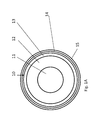
- Figure 1A illustrates a silica - silica optical fiber.
- Optical fiber 10 may be of a conventional construction.
- a fiber includes an optical fiber core 11 of silica, a cladding 12 thereover, and a colorless primary coating layer 13 over the cladding.
- the primary coating is typically urethane acrylate.
- a first, colored coating layer 14 which is also UV curable and acrylate based, is applied over the colorless primary coating layer.
- the first, colorless primary coating 13 may itself include two layers, and the first colored ink layer 14 may then be imparted on the outer of the two primary layers.
- acrylate is used as the first colored ink layer because it has the correct mechanical properties, does not interfere with the optical properties and allows for faster application. UV curing is used for the same reason.
- a second colored ink layer 15 is applied over at least part of the layer 14.
- the second colored ink layer 15 may be applied over only parts of the first colored layer 14, so as to provide a differential coloring system.
- the two colors may be applied as different parts of the same layer so that there are not two independent levels or coats over the whole fiber, and the term layer is to be so construed throughout this document.
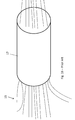
- Fig. 1B shows a conventional tube 17 containing twelve optical fibers 19, which extend out of an open end to be connected or terminated.
- the fibers thus share a common tube in bundles of twelve or more fibers. Multiples of twelve are common, but bundles of 18 or 30 fibers are also common.
- the present embodiments relate to the challenge, as discussed above, of making the individual fibers identifiable when there are more than twelve fibers sharing the same loose tube. Clear identification is needed for the purpose of correctly connecting or testing the fibers at the terminations, and it is not sufficient that the fibers are visibly different from each other. The differences may need to be such that a technician at one end of the tube can communicate to his colleague at the other end of the tube and describe in unambiguous terms which fiber to test or connect. Thus different shades of the same color, or different lengths of dashes or different sizes of patterns in general may not be suitable as they may give rise to ambiguities when attempting to distinguish verbally.
- Unambiguous differential coloring with a combination of colors on the same fiber or a color plus a clearly differentiated pattern allows each basic color to be used multiple times and still to lead to clear identification.
- the present embodiments relate to silica / silica optical fibers, meaning that both the core and cladding are silica/glass.
- the primary coating is urethane acrylate, and thus the embodiments involve the use of an acrylic based UV-curable ink for additional marking as the secondary color during a coloring process in which base colors are applied.
- urethane acrylate There are four families of urethane acrylate commercially used in primary coating of optical fibers, polyester, polyether, polyalkane, and polycarbonate. Each can be found on primary coatings today, and there are monomeric and photometric as well as polymeric options.
- Fig. 2 shows an example of a generalized urethane acrylate molecule.
- the inking process involves the UV curable ink being placed in a vessel and pressurized, then imparted through a die or nozzle onto the fiber as it passes at high speed.
- the flow rate is measured to effectively coat the fiber. It is not possible to simply impart the two colors together as might be done in digital color printing, as the colors, both uncured, would mix and smudge, and fail to produce clear color coding. Likewise, use of soluble or vaporising inks would cause smudging.
- UV curable acrylates may be used, so that advantage can be taken of the curing or viscosity, to allow for a two color process without smudging.
- the coating machine through which the fiber passes has three inking locations, each made up of one or more dies or nozzles.
- the dies allow for laminar flow of the ink to provide a thin smooth coating, although, as an alternative, injection needles or nozzles could be used.
- Fig. 3 is a schematic block diagram showing a part of a coating machine.
- An optical fiber 30 passes a first inking location where a die 32 imparts the colored first or primary coat or layer. There is a need to ensure that the layer is provided uniformly around the fiber, so the die optimizes the laminar flow of the ink.
- the geometry of the die depends on the coating material, and the fluid dynamics of the coating machine.
- the different dies may be of different sizes.
- a curing region defined by UV curing lamp/s 36 is located downstream of the first inking location. Radiation from the UV curing lamp cures the layers as the fiber continues on its way.
- the fiber wet with ink from the first inking point, passes the UV curing area so that the primary color is dried at least sufficiently so as not to cause smudging when the secondary color is applied.
- the fiber then arrives at a second inking location, downstream of the UV curing lamp, at which a third die 38 imparts a second color partially over the first color to provide a partial covering, preferably in a defined pattern.
- the fiber reaches the second inking point and the secondary color is then applied without smudging.
- the length of the UV curing area, or the power of the UV light used in combination with the coloring line speed, does not have to be so long as to completely cure the primary ink. Rather it is only necessary to cure the primary ink sufficiently so that the secondary ink can be imparted without smudging.
- the procedure is illustrated in Fig. 4 , where the fiber is fed in - 40, the first color is imparted- 42 and then curing is carried out - 44. Finally the second color is imparted- 46.
- Fig. 5 illustrates another embodiment of the two-color process.
- the fiber is fed as before, 50, then in stages 52 and 54 the first and second layers are imparted with the first and second colors.
- One or both of the first and second color inks is prepared with an elevated viscosity or the relationship between the viscosities of the two inks is optimized, again to reduce smudging and avoid causing attenuation of the optical signal.
- Fig. 6 illustrates a third embodiment of the two-color process.
- the first and second embodiments, of Figures 4 and 5 respectively are combined.
- the fiber is fed in - 60
- the first color, prepared as a high viscosity ink is imparted - 62 and then curing is carried out - 64.
- the second color, also prepared as a high viscosity ink is imparted - 66.
- either of the two colors is prepared as a high viscosity ink, but not both.
- the relationship between the two viscosities of the two inks is optimized to reduce smudging.
- two inking points are separated by a UV curing area and an optimized viscosity relationship is used between the two inks or a high viscosity ink is used either for the main or secondary color or preferably for both, so that less UV curing is needed and thus less distance, between the first and second applications of ink.
- the embodiments comprise a combination of a suitable chemical base of the UV-curable ink and a modification of the processing equipment used in the present art such that it may apply both primary and secondary inks at once.
- a suitable chemical base of the UV-curable ink and a modification of the processing equipment used in the present art such that it may apply both primary and secondary inks at once.
- Today, 24 or 36 fibers or any other number may be included in a single bundle or tube. Twelve basic colors are available in the coloring standard, and two secondary markings are needed to indicate second and third sets of twelve fibers, or indeed any fibers beyond the initial twelve.
- the secondary markings may be dots or a stripe or rings or patches or hash marks or the like, of any color that shows up in contrast on the primary color.
- the secondary color may be a color which is not one of the basic colors and which is selected to show up clearly against all the basic colors. Any two different markings or shapes may then be used to distinguish the further groups of twelve. Thus for example, in one group of twelve fibers the secondary color may be applied as a line, and in the second group the secondary color may be applied as a ring.
- the system is extendable for any number of groups of twelve fibers as long as a unique marking remains available.
- the secondary color may be any of the basic colors. For each basic color a contrasting basic color is selected and used as the secondary color. Again any two different markings or shapes are used to distinguish the second and third groups of twelve.
- the secondary color is readily visibly discerned. In additional embodiments the secondary color is discerned only upon slightly bending or twisting the fiber, or illuminating the fiber with visible light, or under IR light or under UV light etc.
- FIG. 7 illustrates a further embodiment of the two-color coating machine.
- An optical fiber 70 passes a first inking or coloring location, as before, where a die 72 imparts the primary or first coat of colored ink.
- Ink is supplied from one side via an ink supply tube 74.
- the geometry of the die depends on the coating material, in particular its viscosity, and the fluid dynamics of the coating machine. The different dies may have different geometries.
- a curing region defined by UV curing lamp 76 may be located downstream of the first inking location, although in some versions the curing region may be dispensed with in this embodiment. Radiation from the UV curing lamp then cures the layer as the fiber continues on its way. The fiber then arrives at a second inking location, downstream of the UV curing lamp, at which a second die 78 imparts a second color at a second side, opposite the first color, to provide a fiber that has two clear colors, one on each side.
- the ink is supplied from ink supply tube 80, which is schematically illustrated to be on the opposite side from ink supply tube 74. Either or both of UV curing and high or optimized viscosity ink may or may not be necessary in addition to avoid smudging at the boundaries.
- the basic color is imparted on the fiber from one side and the secondary color is imparted on the fiber from the other side, and the nozzles or dies are suitably positioned. UV curing may be carried out.
- One of the colors is a base color.
- Fig. 8 illustrates exemplary patterns that may be made with the second color.
- Fig. 8a one or more solid horizontal stripes are used.
- Fig. 8b one or more stripes made up of combinations of dots and dashes are used.
- the line consists of single dashes separated by two dots.
- Fig. 8c one or more stripes of equal length dashes are used.
- Fig. 8d solid stripes of increased thickness are shown.
- Fig. 8e one or more lines of dots are used.
- fig. 8f stripes of greater thickness are shown.
- Fig. 8g stripes of yet greater thickness are shown, and in Fig. 8h , stripes of even greater thickness are used.
- Diagonal or spiral or any other suitable patterns may also be used.
- Figures 8b, 8c and 8e are examples of non-continuous application of the second color. Such non-continuous coloring may be achieved through intermittent axial application of the lines or stripes.
- the fiber can be verbally described, so that an operator at one end of the fiber can tell his colleague at the far end which fiber to look for.
- patterns with unambiguous names such as rings, dots, dashes, or dot-dashes, and stripes are preferred over say different sized patches.
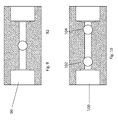
- FIG. 9 is a simplified schematic diagram that illustrates a die housing.
- a die housing 90 incorporates a die 92 for inserting a single color ink onto a passing fiber.
- Such a die may be used in accordance with prior art systems and may also be used in the present embodiments where application of one color is followed by UV curing before applying a second color.
- Die housing 100 includes two dies, 102 and 104, for inserting two ink colors onto a passing fiber in accordance with an embodiment of the present invention.
- UV-curable, special coding ink that is used for optical fibers consists chiefly of UV-curable prepolymers, coloring materials, and a photoinitiator.
- the UV-curable prepolymers are silicone epoxy benzoic acrylate (SEBA) and alicyclic hydrocarbon epoxy acrylate (ACEA).
- SEBA silicone epoxy benzoic acrylate
- ACEA alicyclic hydrocarbon epoxy acrylate
- the coloring materials depend on the desired color and include disperse red urethane acrylate (RUA), disperse blue urethane acrylate (BUA), acridine yellow urethane acrylate (YUA), and their mixtures.
- Another example is an aliphatic polyether-based urethane acrylate; a monomer having a plurality of acrylate or methacrylate moieties; an alkyl acrylate or methacrylate; and an optional photoinitiator.
- a further example of a UV-curable acrylate ink consists of an acrylate oligomer and a vinyl acrylate compound, the latter of which can act as both a reactive diluent and an adhesion promoter.
- the vinyl acrylate compounds have good miscibility and low viscosity, and impart to the cured primary coating a high adhesion to glass. With the use of a free radical photoinitiator, the vinyl acrylate compound increases the speed of cure of the uncured primary coating.
- Sources of commercially available UV-curable acrylate inks include DSM, Herkula, and Borden.
Landscapes
- Life Sciences & Earth Sciences (AREA)
- Chemical & Material Sciences (AREA)
- Physics & Mathematics (AREA)
- Engineering & Computer Science (AREA)
- General Life Sciences & Earth Sciences (AREA)
- Chemical Kinetics & Catalysis (AREA)
- General Chemical & Material Sciences (AREA)
- Geochemistry & Mineralogy (AREA)
- Materials Engineering (AREA)
- Organic Chemistry (AREA)
- Optics & Photonics (AREA)
- General Physics & Mathematics (AREA)
- Optical Fibers, Optical Fiber Cores, And Optical Fiber Bundles (AREA)
- Surface Treatment Of Glass Fibres Or Filaments (AREA)
Applications Claiming Priority (1)
| Application Number | Priority Date | Filing Date | Title |
|---|---|---|---|
| US201361766209P | 2013-02-19 | 2013-02-19 |
Publications (3)
| Publication Number | Publication Date |
|---|---|
| EP2767520A2 true EP2767520A2 (de) | 2014-08-20 |
| EP2767520A3 EP2767520A3 (de) | 2014-11-26 |
| EP2767520B1 EP2767520B1 (de) | 2020-02-19 |
Family
ID=50115728
Family Applications (1)
| Application Number | Title | Priority Date | Filing Date |
|---|---|---|---|
| EP14155699.3A Active EP2767520B1 (de) | 2013-02-19 | 2014-02-19 | Zweifarbige Beschichtung von optischen Fasern mit UV-härtbaren Tinten |
Country Status (3)
| Country | Link |
|---|---|
| US (1) | US9517971B2 (de) |
| EP (1) | EP2767520B1 (de) |
| IL (1) | IL231049B (de) |
Cited By (2)
| Publication number | Priority date | Publication date | Assignee | Title |
|---|---|---|---|---|
| CN104267477A (zh) * | 2014-10-20 | 2015-01-07 | 安徽天龙电器线缆集团有限公司 | 一种大容量低损耗全干式光缆 |
| WO2019203639A1 (en) | 2018-04-16 | 2019-10-24 | Artofil Coatings B.V. | Method for coating an optical fibre and an optical fibre comprising the same |
Families Citing this family (3)
| Publication number | Priority date | Publication date | Assignee | Title |
|---|---|---|---|---|
| NL2020318B1 (en) * | 2017-12-07 | 2019-07-31 | Corning Inc | Improved method of applying an ink layer onto an optical fibre |
| CN110053234B (zh) * | 2019-05-08 | 2024-07-26 | 成都亨通光通信有限公司 | 一种光缆生产用三芯着色模具 |
| CN110346864B (zh) * | 2019-06-04 | 2020-10-27 | 烽火通信科技股份有限公司 | 一种多芯少模光纤及其制造方法 |
Citations (3)
| Publication number | Priority date | Publication date | Assignee | Title |
|---|---|---|---|---|
| EP0501339B1 (de) | 1991-02-25 | 1996-05-08 | Sumitomo Electric Industries, Ltd. | Verfahren zur Herstellung von farbbeschichteten, optischen Fasern |
| US6470128B1 (en) | 2001-03-30 | 2002-10-22 | Alcatel | UV-curable coating composition for optical fiber for a fast cure and with improved adhesion to glass |
| EP1497237B1 (de) | 2002-04-24 | 2007-11-14 | Prysmian Cavi e Sistemi Energia S.r.l. | Optische faser mit verringerten dämpfungsverlusten |
Family Cites Families (13)
| Publication number | Priority date | Publication date | Assignee | Title |
|---|---|---|---|---|
| US5062685A (en) * | 1989-10-11 | 1991-11-05 | Corning Incorporated | Coated optical fibers and cables and method |
| JP3166602B2 (ja) * | 1996-04-04 | 2001-05-14 | 住友電気工業株式会社 | 光ファイバの製造方法 |
| US6317553B1 (en) * | 1999-05-07 | 2001-11-13 | Lucent Technologies Inc. | Coated fiber strands having one or more heterogeneous regions and methods of making the same |
| US6630242B1 (en) * | 1999-07-30 | 2003-10-07 | Dsm N.V. | Radiation-curable composition with simultaneous color formation during cure |
| JP2002029787A (ja) * | 2000-07-21 | 2002-01-29 | Mitsubishi Electric Corp | 光ファイバ及び光ファイバの着色方法 |
| US20020164133A1 (en) * | 2001-03-13 | 2002-11-07 | Rattazzi Dean J. | Method and system for identifying optical fibers and buffer tubes |
| US6849333B2 (en) * | 2001-05-18 | 2005-02-01 | Corning Incorporated | Optical fiber with an improved primary coating composition |
| US6904212B2 (en) * | 2001-12-11 | 2005-06-07 | Tyco Telecommunications (Us) Inc. | System and method for coloring an optical fiber |
| FR2838182B1 (fr) * | 2002-04-08 | 2006-09-29 | Cit Alcatel | Tube de refroidissement de fibre optique |
| US20040037521A1 (en) * | 2002-08-22 | 2004-02-26 | Shunhe Xiong | Methods and apparatus for coloring optical fibers during draw |
| US20040042743A1 (en) * | 2002-09-03 | 2004-03-04 | Kariofilis Konstadinidis | Optical fiber cables for microduct installations |
| FR2847895B1 (fr) * | 2002-11-28 | 2006-06-02 | Cit Alcatel | Procede de fabrication d'une fibre optique a revetements de natures distinctes |
| US8374473B2 (en) * | 2010-05-05 | 2013-02-12 | Ofs Fitel, Llc | Tight-buffered optical fiber having improved fiber access |
-
2014
- 2014-02-19 US US14/183,627 patent/US9517971B2/en active Active
- 2014-02-19 EP EP14155699.3A patent/EP2767520B1/de active Active
- 2014-02-19 IL IL231049A patent/IL231049B/en active IP Right Grant
Patent Citations (3)
| Publication number | Priority date | Publication date | Assignee | Title |
|---|---|---|---|---|
| EP0501339B1 (de) | 1991-02-25 | 1996-05-08 | Sumitomo Electric Industries, Ltd. | Verfahren zur Herstellung von farbbeschichteten, optischen Fasern |
| US6470128B1 (en) | 2001-03-30 | 2002-10-22 | Alcatel | UV-curable coating composition for optical fiber for a fast cure and with improved adhesion to glass |
| EP1497237B1 (de) | 2002-04-24 | 2007-11-14 | Prysmian Cavi e Sistemi Energia S.r.l. | Optische faser mit verringerten dämpfungsverlusten |
Cited By (3)
| Publication number | Priority date | Publication date | Assignee | Title |
|---|---|---|---|---|
| CN104267477A (zh) * | 2014-10-20 | 2015-01-07 | 安徽天龙电器线缆集团有限公司 | 一种大容量低损耗全干式光缆 |
| WO2019203639A1 (en) | 2018-04-16 | 2019-10-24 | Artofil Coatings B.V. | Method for coating an optical fibre and an optical fibre comprising the same |
| US11099320B2 (en) | 2018-04-16 | 2021-08-24 | Fractal Coatings B.V. | Method for coating an optical fibre and an optical fibre comprising the same |
Also Published As
| Publication number | Publication date |
|---|---|
| US9517971B2 (en) | 2016-12-13 |
| EP2767520B1 (de) | 2020-02-19 |
| IL231049A0 (en) | 2014-09-30 |
| EP2767520A3 (de) | 2014-11-26 |
| IL231049B (en) | 2021-04-29 |
| US20150259246A1 (en) | 2015-09-17 |
Similar Documents
| Publication | Publication Date | Title |
|---|---|---|
| EP2767520B1 (de) | Zweifarbige Beschichtung von optischen Fasern mit UV-härtbaren Tinten | |
| US10782495B2 (en) | Flexible optical-fiber ribbon | |
| CN1038618C (zh) | 具有彩色标记的光学纤维 | |
| AU2020247710B2 (en) | Colored ribbon with discrete color layers | |
| US6381390B1 (en) | Color-coded optical fiber ribbon and die for making the same | |
| US6731844B2 (en) | Identification of optical ribbons | |
| US4629285A (en) | Color coded optical fiber waveguides and method for coloring same | |
| US8358894B2 (en) | Optical cable with identifiable optical fibers | |
| EP0562259A1 (de) | Optische Faser mit zusätzlicher Farbmarkierung | |
| US5645899A (en) | Method and apparatus for applying color identifiers to a lead | |
| EP2757080A2 (de) | Farbkodierte optische Fasern | |
| CN108463757A (zh) | 间断性连结型光纤带芯线、光缆、及间断性连结型光纤带芯线的制法 | |
| CN114008500A (zh) | 间歇连结型光纤带 | |
| WO2002081396A1 (en) | Optical fiber ribbon with pigmented matrix, and methods for making and using same | |
| CN102508332A (zh) | 一种具有色带标识的光纤及其着色工艺方法 | |
| EP0964280A2 (de) | Optische Faser und Verfahren zum Kennzeichnen einer optischen Faser | |
| WO2020041199A1 (en) | Optical ribbon with printing between opaque primary layer and colored secondary layer | |
| AU2022229782B2 (en) | Ribbon print scheme utilizing color pointers | |
| CN202153266U (zh) | 一种便于识别的紧套光纤 | |
| JP3927051B2 (ja) | 光ファイバテープ心線の集合体 | |
| US20250051225A1 (en) | Optical fiber marking on the draw | |
| JP3984173B2 (ja) | 光ファイバテープ心線 |
Legal Events
| Date | Code | Title | Description |
|---|---|---|---|
| PUAI | Public reference made under article 153(3) epc to a published international application that has entered the european phase |
Free format text: ORIGINAL CODE: 0009012 |
|
| 17P | Request for examination filed |
Effective date: 20140219 |
|
| AK | Designated contracting states |
Kind code of ref document: A2 Designated state(s): AL AT BE BG CH CY CZ DE DK EE ES FI FR GB GR HR HU IE IS IT LI LT LU LV MC MK MT NL NO PL PT RO RS SE SI SK SM TR |
|
| AX | Request for extension of the european patent |
Extension state: BA ME |
|
| PUAL | Search report despatched |
Free format text: ORIGINAL CODE: 0009013 |
|
| AK | Designated contracting states |
Kind code of ref document: A3 Designated state(s): AL AT BE BG CH CY CZ DE DK EE ES FI FR GB GR HR HU IE IS IT LI LT LU LV MC MK MT NL NO PL PT RO RS SE SI SK SM TR |
|
| AX | Request for extension of the european patent |
Extension state: BA ME |
|
| RIC1 | Information provided on ipc code assigned before grant |
Ipc: C03C 25/10 20060101AFI20141023BHEP |
|
| STAA | Information on the status of an ep patent application or granted ep patent |
Free format text: STATUS: EXAMINATION IS IN PROGRESS |
|
| 17Q | First examination report despatched |
Effective date: 20170303 |
|
| GRAP | Despatch of communication of intention to grant a patent |
Free format text: ORIGINAL CODE: EPIDOSNIGR1 |
|
| STAA | Information on the status of an ep patent application or granted ep patent |
Free format text: STATUS: GRANT OF PATENT IS INTENDED |
|
| INTG | Intention to grant announced |
Effective date: 20191121 |
|
| GRAS | Grant fee paid |
Free format text: ORIGINAL CODE: EPIDOSNIGR3 |
|
| GRAA | (expected) grant |
Free format text: ORIGINAL CODE: 0009210 |
|
| STAA | Information on the status of an ep patent application or granted ep patent |
Free format text: STATUS: THE PATENT HAS BEEN GRANTED |
|
| AK | Designated contracting states |
Kind code of ref document: B1 Designated state(s): AL AT BE BG CH CY CZ DE DK EE ES FI FR GB GR HR HU IE IS IT LI LT LU LV MC MK MT NL NO PL PT RO RS SE SI SK SM TR |
|
| REG | Reference to a national code |
Ref country code: CH Ref legal event code: EP |
|
| REG | Reference to a national code |
Ref country code: DE Ref legal event code: R096 Ref document number: 602014061124 Country of ref document: DE |
|
| REG | Reference to a national code |
Ref country code: AT Ref legal event code: REF Ref document number: 1234785 Country of ref document: AT Kind code of ref document: T Effective date: 20200315 |
|
| REG | Reference to a national code |
Ref country code: IE Ref legal event code: FG4D |
|
| REG | Reference to a national code |
Ref country code: NL Ref legal event code: FP |
|
| PG25 | Lapsed in a contracting state [announced via postgrant information from national office to epo] |
Ref country code: NO Free format text: LAPSE BECAUSE OF FAILURE TO SUBMIT A TRANSLATION OF THE DESCRIPTION OR TO PAY THE FEE WITHIN THE PRESCRIBED TIME-LIMIT Effective date: 20200519 Ref country code: FI Free format text: LAPSE BECAUSE OF FAILURE TO SUBMIT A TRANSLATION OF THE DESCRIPTION OR TO PAY THE FEE WITHIN THE PRESCRIBED TIME-LIMIT Effective date: 20200219 Ref country code: RS Free format text: LAPSE BECAUSE OF FAILURE TO SUBMIT A TRANSLATION OF THE DESCRIPTION OR TO PAY THE FEE WITHIN THE PRESCRIBED TIME-LIMIT Effective date: 20200219 |
|
| REG | Reference to a national code |
Ref country code: LT Ref legal event code: MG4D |
|
| PG25 | Lapsed in a contracting state [announced via postgrant information from national office to epo] |
Ref country code: GR Free format text: LAPSE BECAUSE OF FAILURE TO SUBMIT A TRANSLATION OF THE DESCRIPTION OR TO PAY THE FEE WITHIN THE PRESCRIBED TIME-LIMIT Effective date: 20200520 Ref country code: HR Free format text: LAPSE BECAUSE OF FAILURE TO SUBMIT A TRANSLATION OF THE DESCRIPTION OR TO PAY THE FEE WITHIN THE PRESCRIBED TIME-LIMIT Effective date: 20200219 Ref country code: LV Free format text: LAPSE BECAUSE OF FAILURE TO SUBMIT A TRANSLATION OF THE DESCRIPTION OR TO PAY THE FEE WITHIN THE PRESCRIBED TIME-LIMIT Effective date: 20200219 Ref country code: IS Free format text: LAPSE BECAUSE OF FAILURE TO SUBMIT A TRANSLATION OF THE DESCRIPTION OR TO PAY THE FEE WITHIN THE PRESCRIBED TIME-LIMIT Effective date: 20200619 Ref country code: SE Free format text: LAPSE BECAUSE OF FAILURE TO SUBMIT A TRANSLATION OF THE DESCRIPTION OR TO PAY THE FEE WITHIN THE PRESCRIBED TIME-LIMIT Effective date: 20200219 Ref country code: BG Free format text: LAPSE BECAUSE OF FAILURE TO SUBMIT A TRANSLATION OF THE DESCRIPTION OR TO PAY THE FEE WITHIN THE PRESCRIBED TIME-LIMIT Effective date: 20200519 |
|
| REG | Reference to a national code |
Ref country code: CH Ref legal event code: PL |
|
| REG | Reference to a national code |
Ref country code: BE Ref legal event code: MM Effective date: 20200229 |
|
| PG25 | Lapsed in a contracting state [announced via postgrant information from national office to epo] |
Ref country code: LT Free format text: LAPSE BECAUSE OF FAILURE TO SUBMIT A TRANSLATION OF THE DESCRIPTION OR TO PAY THE FEE WITHIN THE PRESCRIBED TIME-LIMIT Effective date: 20200219 Ref country code: DK Free format text: LAPSE BECAUSE OF FAILURE TO SUBMIT A TRANSLATION OF THE DESCRIPTION OR TO PAY THE FEE WITHIN THE PRESCRIBED TIME-LIMIT Effective date: 20200219 Ref country code: PT Free format text: LAPSE BECAUSE OF FAILURE TO SUBMIT A TRANSLATION OF THE DESCRIPTION OR TO PAY THE FEE WITHIN THE PRESCRIBED TIME-LIMIT Effective date: 20200712 Ref country code: SM Free format text: LAPSE BECAUSE OF FAILURE TO SUBMIT A TRANSLATION OF THE DESCRIPTION OR TO PAY THE FEE WITHIN THE PRESCRIBED TIME-LIMIT Effective date: 20200219 Ref country code: EE Free format text: LAPSE BECAUSE OF FAILURE TO SUBMIT A TRANSLATION OF THE DESCRIPTION OR TO PAY THE FEE WITHIN THE PRESCRIBED TIME-LIMIT Effective date: 20200219 Ref country code: LU Free format text: LAPSE BECAUSE OF NON-PAYMENT OF DUE FEES Effective date: 20200219 Ref country code: RO Free format text: LAPSE BECAUSE OF FAILURE TO SUBMIT A TRANSLATION OF THE DESCRIPTION OR TO PAY THE FEE WITHIN THE PRESCRIBED TIME-LIMIT Effective date: 20200219 Ref country code: ES Free format text: LAPSE BECAUSE OF FAILURE TO SUBMIT A TRANSLATION OF THE DESCRIPTION OR TO PAY THE FEE WITHIN THE PRESCRIBED TIME-LIMIT Effective date: 20200219 Ref country code: CZ Free format text: LAPSE BECAUSE OF FAILURE TO SUBMIT A TRANSLATION OF THE DESCRIPTION OR TO PAY THE FEE WITHIN THE PRESCRIBED TIME-LIMIT Effective date: 20200219 Ref country code: SK Free format text: LAPSE BECAUSE OF FAILURE TO SUBMIT A TRANSLATION OF THE DESCRIPTION OR TO PAY THE FEE WITHIN THE PRESCRIBED TIME-LIMIT Effective date: 20200219 |
|
| REG | Reference to a national code |
Ref country code: AT Ref legal event code: MK05 Ref document number: 1234785 Country of ref document: AT Kind code of ref document: T Effective date: 20200219 |
|
| REG | Reference to a national code |
Ref country code: DE Ref legal event code: R097 Ref document number: 602014061124 Country of ref document: DE |
|
| PG25 | Lapsed in a contracting state [announced via postgrant information from national office to epo] |
Ref country code: LI Free format text: LAPSE BECAUSE OF NON-PAYMENT OF DUE FEES Effective date: 20200229 Ref country code: CH Free format text: LAPSE BECAUSE OF NON-PAYMENT OF DUE FEES Effective date: 20200229 Ref country code: MC Free format text: LAPSE BECAUSE OF FAILURE TO SUBMIT A TRANSLATION OF THE DESCRIPTION OR TO PAY THE FEE WITHIN THE PRESCRIBED TIME-LIMIT Effective date: 20200219 |
|
| PLBE | No opposition filed within time limit |
Free format text: ORIGINAL CODE: 0009261 |
|
| STAA | Information on the status of an ep patent application or granted ep patent |
Free format text: STATUS: NO OPPOSITION FILED WITHIN TIME LIMIT |
|
| 26N | No opposition filed |
Effective date: 20201120 |
|
| PG25 | Lapsed in a contracting state [announced via postgrant information from national office to epo] |
Ref country code: AT Free format text: LAPSE BECAUSE OF FAILURE TO SUBMIT A TRANSLATION OF THE DESCRIPTION OR TO PAY THE FEE WITHIN THE PRESCRIBED TIME-LIMIT Effective date: 20200219 Ref country code: IE Free format text: LAPSE BECAUSE OF NON-PAYMENT OF DUE FEES Effective date: 20200219 |
|
| PG25 | Lapsed in a contracting state [announced via postgrant information from national office to epo] |
Ref country code: SI Free format text: LAPSE BECAUSE OF FAILURE TO SUBMIT A TRANSLATION OF THE DESCRIPTION OR TO PAY THE FEE WITHIN THE PRESCRIBED TIME-LIMIT Effective date: 20200219 Ref country code: BE Free format text: LAPSE BECAUSE OF NON-PAYMENT OF DUE FEES Effective date: 20200229 Ref country code: PL Free format text: LAPSE BECAUSE OF FAILURE TO SUBMIT A TRANSLATION OF THE DESCRIPTION OR TO PAY THE FEE WITHIN THE PRESCRIBED TIME-LIMIT Effective date: 20200219 |
|
| PG25 | Lapsed in a contracting state [announced via postgrant information from national office to epo] |
Ref country code: TR Free format text: LAPSE BECAUSE OF FAILURE TO SUBMIT A TRANSLATION OF THE DESCRIPTION OR TO PAY THE FEE WITHIN THE PRESCRIBED TIME-LIMIT Effective date: 20200219 Ref country code: MT Free format text: LAPSE BECAUSE OF FAILURE TO SUBMIT A TRANSLATION OF THE DESCRIPTION OR TO PAY THE FEE WITHIN THE PRESCRIBED TIME-LIMIT Effective date: 20200219 Ref country code: CY Free format text: LAPSE BECAUSE OF FAILURE TO SUBMIT A TRANSLATION OF THE DESCRIPTION OR TO PAY THE FEE WITHIN THE PRESCRIBED TIME-LIMIT Effective date: 20200219 |
|
| PG25 | Lapsed in a contracting state [announced via postgrant information from national office to epo] |
Ref country code: MK Free format text: LAPSE BECAUSE OF FAILURE TO SUBMIT A TRANSLATION OF THE DESCRIPTION OR TO PAY THE FEE WITHIN THE PRESCRIBED TIME-LIMIT Effective date: 20200219 Ref country code: AL Free format text: LAPSE BECAUSE OF FAILURE TO SUBMIT A TRANSLATION OF THE DESCRIPTION OR TO PAY THE FEE WITHIN THE PRESCRIBED TIME-LIMIT Effective date: 20200219 |
|
| P01 | Opt-out of the competence of the unified patent court (upc) registered |
Effective date: 20230529 |
|
| PGFP | Annual fee paid to national office [announced via postgrant information from national office to epo] |
Ref country code: NL Payment date: 20260218 Year of fee payment: 13 |
|
| PGFP | Annual fee paid to national office [announced via postgrant information from national office to epo] |
Ref country code: GB Payment date: 20260219 Year of fee payment: 13 |
|
| PGFP | Annual fee paid to national office [announced via postgrant information from national office to epo] |
Ref country code: DE Payment date: 20260218 Year of fee payment: 13 |
|
| PGFP | Annual fee paid to national office [announced via postgrant information from national office to epo] |
Ref country code: IT Payment date: 20260224 Year of fee payment: 13 |
|
| PGFP | Annual fee paid to national office [announced via postgrant information from national office to epo] |
Ref country code: FR Payment date: 20260218 Year of fee payment: 13 |