EP2767585A1 - Procédé microbiologique pour l'élimination de H2S contenu dans un biogaz - Google Patents
Procédé microbiologique pour l'élimination de H2S contenu dans un biogaz Download PDFInfo
- Publication number
- EP2767585A1 EP2767585A1 EP13168886.3A EP13168886A EP2767585A1 EP 2767585 A1 EP2767585 A1 EP 2767585A1 EP 13168886 A EP13168886 A EP 13168886A EP 2767585 A1 EP2767585 A1 EP 2767585A1
- Authority
- EP
- European Patent Office
- Prior art keywords
- biogas
- concentration
- medium
- filter bed
- range
- Prior art date
- Legal status (The legal status is an assumption and is not a legal conclusion. Google has not performed a legal analysis and makes no representation as to the accuracy of the status listed.)
- Withdrawn
Links
Images


Classifications
-
- C—CHEMISTRY; METALLURGY
- C10—PETROLEUM, GAS OR COKE INDUSTRIES; TECHNICAL GASES CONTAINING CARBON MONOXIDE; FUELS; LUBRICANTS; PEAT
- C10L—FUELS NOT OTHERWISE PROVIDED FOR; NATURAL GAS; SYNTHETIC NATURAL GAS OBTAINED BY PROCESSES NOT COVERED BY SUBCLASSES C10G OR C10K; LIQUIFIED PETROLEUM GAS; USE OF ADDITIVES TO FUELS OR FIRES; FIRE-LIGHTERS
- C10L3/00—Gaseous fuels; Natural gas; Synthetic natural gas obtained by processes not covered by subclass C10G, C10K; Liquefied petroleum gas
- C10L3/06—Natural gas; Synthetic natural gas obtained by processes not covered by C10G, C10K3/02 or C10K3/04
- C10L3/08—Production of synthetic natural gas
-
- C—CHEMISTRY; METALLURGY
- C10—PETROLEUM, GAS OR COKE INDUSTRIES; TECHNICAL GASES CONTAINING CARBON MONOXIDE; FUELS; LUBRICANTS; PEAT
- C10L—FUELS NOT OTHERWISE PROVIDED FOR; NATURAL GAS; SYNTHETIC NATURAL GAS OBTAINED BY PROCESSES NOT COVERED BY SUBCLASSES C10G OR C10K; LIQUIFIED PETROLEUM GAS; USE OF ADDITIVES TO FUELS OR FIRES; FIRE-LIGHTERS
- C10L3/00—Gaseous fuels; Natural gas; Synthetic natural gas obtained by processes not covered by subclass C10G, C10K; Liquefied petroleum gas
- C10L3/06—Natural gas; Synthetic natural gas obtained by processes not covered by C10G, C10K3/02 or C10K3/04
- C10L3/10—Working-up natural gas or synthetic natural gas
- C10L3/101—Removal of contaminants
-
- C—CHEMISTRY; METALLURGY
- C10—PETROLEUM, GAS OR COKE INDUSTRIES; TECHNICAL GASES CONTAINING CARBON MONOXIDE; FUELS; LUBRICANTS; PEAT
- C10L—FUELS NOT OTHERWISE PROVIDED FOR; NATURAL GAS; SYNTHETIC NATURAL GAS OBTAINED BY PROCESSES NOT COVERED BY SUBCLASSES C10G OR C10K; LIQUIFIED PETROLEUM GAS; USE OF ADDITIVES TO FUELS OR FIRES; FIRE-LIGHTERS
- C10L3/00—Gaseous fuels; Natural gas; Synthetic natural gas obtained by processes not covered by subclass C10G, C10K; Liquefied petroleum gas
- C10L3/06—Natural gas; Synthetic natural gas obtained by processes not covered by C10G, C10K3/02 or C10K3/04
- C10L3/10—Working-up natural gas or synthetic natural gas
- C10L3/101—Removal of contaminants
- C10L3/102—Removal of contaminants of acid contaminants
- C10L3/103—Sulfur containing contaminants
-
- C—CHEMISTRY; METALLURGY
- C12—BIOCHEMISTRY; BEER; SPIRITS; WINE; VINEGAR; MICROBIOLOGY; ENZYMOLOGY; MUTATION OR GENETIC ENGINEERING
- C12M—APPARATUS FOR ENZYMOLOGY OR MICROBIOLOGY; APPARATUS FOR CULTURING MICROORGANISMS FOR PRODUCING BIOMASS, FOR GROWING CELLS OR FOR OBTAINING FERMENTATION OR METABOLIC PRODUCTS, i.e. BIOREACTORS OR FERMENTERS
- C12M47/00—Means for after-treatment of the produced biomass or of the fermentation or metabolic products, e.g. storage of biomass
- C12M47/18—Gas cleaning, e.g. scrubbers; Separation of different gases
-
- Y—GENERAL TAGGING OF NEW TECHNOLOGICAL DEVELOPMENTS; GENERAL TAGGING OF CROSS-SECTIONAL TECHNOLOGIES SPANNING OVER SEVERAL SECTIONS OF THE IPC; TECHNICAL SUBJECTS COVERED BY FORMER USPC CROSS-REFERENCE ART COLLECTIONS [XRACs] AND DIGESTS
- Y02—TECHNOLOGIES OR APPLICATIONS FOR MITIGATION OR ADAPTATION AGAINST CLIMATE CHANGE
- Y02E—REDUCTION OF GREENHOUSE GAS [GHG] EMISSIONS, RELATED TO ENERGY GENERATION, TRANSMISSION OR DISTRIBUTION
- Y02E50/00—Technologies for the production of fuel of non-fossil origin
- Y02E50/30—Fuel from waste, e.g. synthetic alcohol or diesel
Definitions
- the subject of the present invention is a method of eliminating contaminants from biogas, particularly sulphur compounds, conducted in the presence of nitrogen oxides in a biofilter containing a biological filter bed.
- the present invention is part of the science of biotechnical methods for the purification of biogas obtained from various sources.
- Biogas is a mixture of fermentation gasses arising from the activity of anaerobic bacteria resulting in the degradation of organic substances. This is a substrate obtained from the degradation of organic substances by methanogenic anaerobic bacteria, characterised by its varying composition which is dependent on many factors which may include: initial composition and form of the organic substance, its moisture, pH, temperature and pressure.
- the biogas mixture usually contains about 55-65% methane (CH 4 ), 30-45% carbon dioxide (CO 2 ), 0.01-5% hydrogen sulphide (H 2 S) and low concentrations of nitrogen, oxygen and water vapour.
- the percentage composition of methane in biogas constitutes the combustible value of this fuel.
- Two types of biogas are differentiable: landfill biogas which arises spontaneously in waste dumps and production biogas produced via the purposeful fermentation in bioreactors (mainly in wastewater treatment plants or in agricultural biogas installations).
- Landfill biogas arises as a result of the biochemical conversion of waste containing biodegradable substances.
- the main components of landfill biogas are: methane, carbon dioxide and nitrogen. In addition, it may also contain: oxygen, hydrogen, ammonia, sulphur compounds, aliphatic hydrocarbons other than methane, aromatic hydrocarbons and chloride derivatives.
- Landfill gas may pose numerous dangers attributable to environmental degradation such as acid rain and potentiating of greenhouse gasses. Landfill gas also poses a threat to humans, which is connected with the dispersal of odorants, toxins and groundwater contamination. For the above reasons, it is becoming common to collect landfill gasses. However, its treatment to make a composition capable of being added to the gas supply system is very troublesome and expensive using conventional methods, mainly based on the absorptive properties of activated carbon.
- Anaerobic stabilization consists of the degradation of organic substances contained in deposits under anaerobic conditions.
- Anaerobic bacteria degrade organic substances into simple compounds.
- the end products of biochemical processes therein are gasses, mainly methane and carbon dioxide. H 2 S, hydrogen, nitrogen and precipitates are also formed.
- Biogas production from animal wastes in agricultural biogas plants eliminates such pathogens as Salmonella, Escherichia coli, tuberculosis, and foot-and-mouth viruses. Additionally, improved field fertilization conditions are achieved in comparison to unfermented dung, as well as the ability to maintain humus equilibrium in soil and the destruction of weed seeds, thereby reducing herbicide use.
- the transformation and utilization of biogas from animal wastes results in an 80% reduction of odours, reduced risk of groundwater contamination and free greenhouse gas emission, including methane.
- H 2 S is formed during methane fermentation due to: a) anaerobic decomposition of organic compounds (proteins containing sulphur-containing amino-acids, thioalcohols, thioglycosides, alkaloids), b) dissimilative reduction of sulphates (sulphate respiration), c) reduction of elemental sulphur (sulphur respiration).
- H 2 S is a significant component affecting the costs connected with biogas use, because its concentration may be from 0.1 to 10 g H 2 S/m 3 (0.01 - 5% by volume). Thus, the most important process in readying biogas for use in burning is sulphur removal.
- the need to remove sulphur from biogas also stems from the negative effect of H 2 S on biogas combustion devices, the need to protect electrical generators, and the protection of boiler burners and boilers from corrosion.
- the sulphur present in biogas may cause failures in co-generation systems, which greatly reduces their service life.
- the need to remove H 2 S from biogas stems, amongst other reasons, from its direct participation in the formation of aggressive sulphuric acid.
- the sulphur-loaded gas corrodes piping, fittings and boiler elements, as well as gas storage vessels, which leads to frequent interruptions and greatly reduces their service life. Due to the combustion of sulphurous biogas, there is an increase in sulphur dioxide emissions, which is a cause of acid rain.
- the remaining percentage of other contaminants comprises ammonia and carbon monoxide as well as organic substances and dust.
- desulphuring methods for biogas, it is possible to base upon methods of desulphuring gaseous fuels designed and optimized for the petrochemical and gas industries.
- desulphuring methods may be divided into: a) dry, b) wet, c) biological.
- Dry methods of desulphuring methods are based mainly on adsorption on solid sorbents, metal oxides or activated carbon. They are characterised by the fact that the chemical process of H 2 S binding occurs in a dry state, in a gas-solid system.
- Another dry technology are desulphuring methods using granulated iron oxide. Therein, due to surface contact with the filter bed, H 2 S reacts with iron hydroxide. As a result of this reaction, sulphur binds with the iron to form iron sulphide and water vapour or water is released.
- the efficacy of dry methods of desulphuring is mainly dependent on the initial concentration of H 2 S fed into the desulphuring system. With an initial H 2 S concentration of about 1400 mg/m 3 the desulphuring efficiency is about 30%. For H 2 S initially at 280 mg/m 3 , it is reduced by 75%.
- a solid filter bed desulphurs biogas with decreasing efficiency over time. In the first month, a freshly loaded filter bed cleans biogas from 2000 mg/m 3 H 2 S to 280 mg/m 3 . After a month, the same filter bed cleans biogas from 2700 mg/m 3 to 1700 mg/m 3 .
- the manual removal of the filter bed is also troublesome, both in the case of bog ore and granulated iron oxide. This is compounded by the need to use additives, coagulants, in the purification process, which greatly increases effluent purification costs. There are also difficulties in maintaining the stability of the entire desulphuring process.
- Biotechnical methods are based on the biodegradation of H 2 S, the removal of H 2 S from biogas using sulphurous bacteria via biochemical processes in special vessels, bioreactors. They are an attractive option due to low capital outlay as well as no negative environmental effects. The contaminants formed during microbial activity settled on the reactor fill are degraded into harmless products such as water, CO 2 and mineral compounds.
- the main point of biotechnical methods is to possess appropriate, specially selected microorganisms, as well as to know the conditions under which they may be used.
- Document WO2008131034 discloses a method of removing H 2 S from biogas arising in an anoxic environment using a sprayed biofilter system.
- the process makes use of natural or artificial substrates (polyurethane foam), and of H 2 S - oxidizing bacteria which were obtained from hot springs, wherein they develop in a pH of 3.
- the spraying medium is a liquid effluent containing microelements: potassium, phosphorus and iron.
- H 2 S is oxidized to sulphur and SO4 2- .
- Publication WO05037403 discloses a biofilter containing a designed filler, on which bacteria selected from the group of Thiobacillus thioparus, begigiatoa, thopthrix genera, feroxidants have been immobilized.
- bacteria selected from the group of Thiobacillus thioparus, begigiatoa, thopthrix genera, feroxidants have been immobilized.
- One of the end products of purification is elemental sulphur.
- the goal of the present invention is a 97-100% reduction of H 2 S conducted under industrial conditions, which will make it possible to attain parameters akin to natural gas.
- the goal of the present invention is the selection of the optimal conditions for the process, ensuring highly effective desulphuring on an industrial scale.
- the next goal of the present invention is the minimalisation of sulphur production in biogas purification and of deposits formed in the installation.
- the present invention is a method for the microbiological purification of biogas arising from the methane fermentation of organic deposits in a fermentation tank based on the removal of contaminants, particularly H 2 S, in anoxic conditions, on an installation containing a biofilter loaded with a filter bed sprayed with a mineral medium, on which hydrogen sulphide degrading microorganisms have been immobilized, characterised in that the biological filter bed is sprinkled with a medium in the form of a solution nitrous salts of alkali metals of the I and II group, wherein the concentration of nitrogen ions in the medium is contained in the range of 20 to 2500 mg/1, preferably in the range of 50 to 1000 mg/L, whereas the concentration of purified H 2 S is 100 - 3000 ppm.
- the concentration of nitrogen in the medium is contained in the range of 50 - 200 mg/L, wherein the concentration of loaded H 2 S into the installation is 300 ppm.
- the concentration of nitrogen in the medium is contained in the range of 260-800 mg/L, wherein the concentration of H 2 S loaded into the installation is 720 ppm.
- the medium flow volume intensity sprinkled onto the biological filter bed is contained in the range of 5 L/h to 500 L/h per cubic metre of filter bed.
- the S/N value is from 1 to 30, more preferably 2 to 20.
- the process temperature is 10 to 35°C, preferably 20-30 °C.
- the medium pH is 5-8, preferably no less than 5.5 and no more than 7.0-7.5.
- the biological purification of gasses is realized mainly in the following types of installations: biofilter, bioscrubber and biofilter with a sprinkled layer, called a three-phase bioreactor. These systems are composed of three phases: solid (fill), liquid and gas. Processes conducted therein also occur according to the same mechanism. Gaseous contaminants are absorbed and brought into the liquid phase, and are then degraded by microbes into inorganic compounds such as water and mineral salts.
- Nishimura and Yoda Nashimura S., and Yoda M., 1997. Removal of hydrogen sulphide from anaerobie biogas using a bio-scrubber. Water Science and Technology 36 (6-7): 349-356 ) successfully used a bioscrubber purify biogas from anaerobic fermentation. The bioreactor was supplied with air and settlement from sewage treatment. 99% of H 2 S was oxidized to sulphates.
- the main element of the biological filter is a porous filter material layer colonized by microorganisms.
- the carrier is often a biological material (bark, peat, compost, sewage solids) containing nutrients.
- the premoistened efflux gasses are passed through solid biological beds in which they are degraded by the immobilized microorganisms.
- the contaminants are absorbed, and then degraded by the microorganisms.
- the microorganism activity regenerates the filter bed, the absorbent.
- the absorption and degradation of contaminants occur in the same location in the device.
- the drawback of bio filters is filter bed dishomogeneity that may periodically occur, acidification (H 2 SO 4 , HC1) and filter bed compaction.
- microorganisms are settled onto a solid fill that is neutral to microorganisms (Raschiga rings, glass spheres, ceramics, plastics or other synthetic materials).
- the liquid phase water with nutritive salts
- the gas flows concurrently with the liquid.
- the liquid-absorbed contaminants diffuse to the biological layer (biofilm on the fill surface) and are biodegraded. Absorption and regeneration of contaminants occur in the same unit.
- the medium for the microorganisms consists of the water from a gravity settlement tank.
- the present invention was embodied using a system based on a sprinkled biofilter.
- a sprinkled biofilter is one filled with a synthetic or ceramic fill, or with activated carbon. Contaminated gas is fed in from the bottom of the device and recirculated water containing nutrients is sprinkled onto the fill from the top.
- Microorganisms are immobilised on the carrier.
- An example of the industrial use of a sprinkled biofilter in the microbiological desulphuring is the MICROBIAL system. This system is based on the activity of sulphur bacteria in oxic conditions, which are sprinkled with initially treated sewage.
- Bacteria desirable in the biodegradation of H 2 S should have: a) the ability to efficiently oxidize H 2 S and b) minimal nutritive requirements. In recent years, research has been performed on photoautotrophic as well as chemotrophic bacteria.
- Thiobacillus denitrificans is the best known species possessing the ability to oxidize inorganic sulphur compounds (H 2 S, thiosulphate). Additionally under anoxic conditions, it has the ability to reduce nitrogen to N 2 . It differs from many other known oxidizing-oxidizing chemolithotrophic such as Acidiothiobacillus ferrooxidans in that it is a facultative aerobe and may respire oxically or through denitrification. Furthermore, in contrast to obligate chemolithotrophic anaerobes, it does not acidify the environment and prefers a neutral pH. Due to their properties, these bacteria are particularly important for environmental bioremediation.
- Microorganisms used in the present invention constitute a microbial consortium isolated from natural environments rich in sulphur. They form a specific group capable of purifying biogas.
- the process is conducted in anoxic conditions, and the purified biogas is not diluted with oxygen. This is significant, because it makes it possible to avoid the dangerous formation of an explosive oxygen-biogas mixture.
- the lack of the need to aerate also decreases the maintenance costs of the installation. Systems present on the market require oxygen supply.
- the process according to the present invention does not result in the deposition of elemental sulphur nor in decreased pH, which is greatly advantageous, because there is no need to remove excess sulphur from the system, nor to correct the pH. Most sulphur bacteria develop at a low pH, whereas the embodied process runs at a neutral pH and requires no correction.
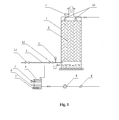
- Fig. 1 represents an biogas purification installation consisting of a biofilter filled with a carrier. Contaminated gas is fed in through the bottom of the device, and the recirculated water containing nutrients is sprinkled from the top. Microorganisms are immobilized on the carrier.
- Fig. 2 represents the effect of the concentration of nitrogen, one of the components of medium for the reduction of H 2 S as well as for the process of sulphide ion formation instead of elemental sulphur.
- the concentration of H 2 S in the output purified biogas is 300 ppm.
- the graph represents changes in sulphide concentration over time. It is clearly visible that the process occurs with sulphide formation and their concentration grew continuously.
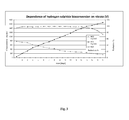
- Fig 3 represents the effect of nitrogen concentration on H 2 S reduction, as well as the process of sulphate ion formation instead of elemental sulphur.
- concentration of H 2 S supplied to the biogas purification is 720 ppm.
- Fig. 4 represents the rate of nitrogen depletion (V) as well as changes in sulphate concentration depending on the concentration of hydrogen sulphide in the biogas being desulphured.
- Biogas formed during methane fermentation is directed with a pressure of 3-5 kPa to a pipeline (3) and thence to a system for biological desulphuring.
- the amount of gas flow is regulated using a flow regulator (13).
- H 2 S concentration measurement and recording at the input and output from the biofilter is performed using H 2 S concentration sensors (11).
- the biological filter bed being a porous filter material (2) that facilitates the formation of a specific biofilm exhibiting a biogas purification securing activity and is found in the biofilter column (1).
- the filter bed is sprinkled from a sprinkler (10) at the top of the biofilter with a specific medium containing nitrogen at an appropriate concentration.
- the medium percolating through the filter bed to the bottom of the column is carried off to a container (4). From there, the medium is returned using a pump (8) through a medium flow meter (9) to the sprinkler (10).
- the medium holding container (4) possesses a heater (7) along with a temperature sensor (5) which facilitates the maintenance of a constant temperature, as well as a medium level sensor (6).
- the biogas supply to the installation is cut off with a valve (12).
- the experiment was performed using an installation input H 2 S concentration of 300 ppm.
- the concentration of nitrogen in the medium is contained in the range of 200 mg/L - 50 mg/L.
- the reduction of H 2 S from biogas by 97-100 % is attained with a nitrogen concentration in the medium no lower than 50 mg/L. This dependence occurs when the concentration of H 2 S in the biogas does not exceed 500 mg/dm 3 ( Fig. 2 ). Lower concentrations of nitrogen do not ensure such high levels of H 2 S reduction. For example, a 90,1% reduction of H 2 S was attained with a medium nitrogen concentration of 29.3 mg/dm 3 , and a 54.8% H 2 S reduction with a medium nitrogen concentration of 14.4 mg/dm 3 .
- Fig. 3 shows the dependence of the effect of biogas desulphuring on the medium nitrogen concentration.
- the desulphuring system was supplied with a biogas containing 720 ppm hydrogen sulphide.
- the data shown in Fig. 3 show that a high, in excess of 99%, hydrogen sulphide reduction was attained when the concentration of nitrogen in the medium was maintained at a level from 800 mg/dm 3 to about 260 mg/dm 3 .
- Below this value we noted a deterioration of the reduction of hydrogen sulphide and with a medium nitrogen concentration of 146 mg/dm 3 we only attained a 73% reduction of hydrogen sulphide.
- Biogas is a renewable energy, environmentally friendly and easily available.
- Biogas purification technology is a solution essential to the development of an energy industry based on biogas, because it makes it possible to remove contaminants, which at present make the mass use of biogas as an ecological fuel impossible.
- the resulting, purified biogas is suitable for a wide array of uses. It may be used for heating energy, electrical energy, heat and electricity generation in combined systems, vehicle fuel, in methane production, or else fed into the gas supply system.
Landscapes
- Chemical & Material Sciences (AREA)
- Engineering & Computer Science (AREA)
- Oil, Petroleum & Natural Gas (AREA)
- Organic Chemistry (AREA)
- Chemical Kinetics & Catalysis (AREA)
- General Chemical & Material Sciences (AREA)
- Life Sciences & Earth Sciences (AREA)
- Wood Science & Technology (AREA)
- Biotechnology (AREA)
- Health & Medical Sciences (AREA)
- Bioinformatics & Cheminformatics (AREA)
- Zoology (AREA)
- Biomedical Technology (AREA)
- Sustainable Development (AREA)
- Microbiology (AREA)
- Biochemistry (AREA)
- General Engineering & Computer Science (AREA)
- General Health & Medical Sciences (AREA)
- Genetics & Genomics (AREA)
- Treating Waste Gases (AREA)
Priority Applications (1)
| Application Number | Priority Date | Filing Date | Title |
|---|---|---|---|
| EP13168886.3A EP2767585A1 (fr) | 2013-02-18 | 2013-05-23 | Procédé microbiologique pour l'élimination de H2S contenu dans un biogaz |
Applications Claiming Priority (2)
| Application Number | Priority Date | Filing Date | Title |
|---|---|---|---|
| EP13461504 | 2013-02-18 | ||
| EP13168886.3A EP2767585A1 (fr) | 2013-02-18 | 2013-05-23 | Procédé microbiologique pour l'élimination de H2S contenu dans un biogaz |
Publications (1)
| Publication Number | Publication Date |
|---|---|
| EP2767585A1 true EP2767585A1 (fr) | 2014-08-20 |
Family
ID=48795398
Family Applications (1)
| Application Number | Title | Priority Date | Filing Date |
|---|---|---|---|
| EP13168886.3A Withdrawn EP2767585A1 (fr) | 2013-02-18 | 2013-05-23 | Procédé microbiologique pour l'élimination de H2S contenu dans un biogaz |
Country Status (1)
| Country | Link |
|---|---|
| EP (1) | EP2767585A1 (fr) |
Cited By (7)
| Publication number | Priority date | Publication date | Assignee | Title |
|---|---|---|---|---|
| CN104190245A (zh) * | 2014-09-12 | 2014-12-10 | 北京科技大学 | 一种以缓释碳为填料的生物除臭装置 |
| CN104258724A (zh) * | 2014-10-21 | 2015-01-07 | 华新水泥股份有限公司 | 可连续培养的超大规模生物滤池除臭装置及方法 |
| EP3000891A1 (fr) * | 2014-09-26 | 2016-03-30 | Politechnika Lódzka | Consortium microbiologique pour la purification de biogaz |
| CN109231451A (zh) * | 2018-10-29 | 2019-01-18 | 东华大学 | 一种基于电子穿梭体和内部铁循环强化的深度反硝化滤池 |
| WO2019074357A2 (fr) | 2017-10-13 | 2019-04-18 | Unilib Energy Sdn Bhd | Biodésulfuration acidophile aérobie de biogaz (sulfure d'hydrogène) |
| CN109966883A (zh) * | 2019-04-25 | 2019-07-05 | 常州南大常高新环保产业技术研究院有限公司 | 一种内部补氧与外部补氧相结合的生物脱硫系统 |
| EP3000872B1 (fr) * | 2014-09-26 | 2019-09-18 | Politechnika Lódzka | Milieu de culture microbiologique d'un consortium microbiologique appliqué dans la technologie de purification biologique de biogaz |
Citations (3)
| Publication number | Priority date | Publication date | Assignee | Title |
|---|---|---|---|---|
| WO2005037403A1 (fr) | 2003-10-20 | 2005-04-28 | Biorem Technologies Inc. | Filtre biologique |
| EP1604727A1 (fr) | 2004-06-04 | 2005-12-14 | Applikations- und Technikzentrum für Energieverfahrens-, Umwelt- und Strömungstechnik (ATZ-EVUS) | Procédé pour l'élimination de composés soufrés contenus dans du biogaz |
| WO2008131034A2 (fr) | 2007-04-16 | 2008-10-30 | Moser Mark A | Épurateur de sulfure d'hydrogène |
-
2013
- 2013-05-23 EP EP13168886.3A patent/EP2767585A1/fr not_active Withdrawn
Patent Citations (3)
| Publication number | Priority date | Publication date | Assignee | Title |
|---|---|---|---|---|
| WO2005037403A1 (fr) | 2003-10-20 | 2005-04-28 | Biorem Technologies Inc. | Filtre biologique |
| EP1604727A1 (fr) | 2004-06-04 | 2005-12-14 | Applikations- und Technikzentrum für Energieverfahrens-, Umwelt- und Strömungstechnik (ATZ-EVUS) | Procédé pour l'élimination de composés soufrés contenus dans du biogaz |
| WO2008131034A2 (fr) | 2007-04-16 | 2008-10-30 | Moser Mark A | Épurateur de sulfure d'hydrogène |
Non-Patent Citations (4)
| Title |
|---|
| ANDREA M. MONTEBELLO ET AL: "Simultaneous methylmercaptan and hydrogen sulfide removal in the desulfurization of biogas in aerobic and anoxic biotrickling filters", CHEMICAL ENGINEERING JOURNAL, vol. 200-202, 1 August 2012 (2012-08-01), pages 237 - 246, XP055122165, ISSN: 1385-8947, DOI: 10.1016/j.cej.2012.06.043 * |
| GABRIELA SOREANU ET AL: "Empirical modelling and dual-performance optimisation of a hydrogen sulphide removal process for biogas treatment", BIORESOURCE TECHNOLOGY, ELSEVIER BV, GB, vol. 101, no. 23, 24 June 2010 (2010-06-24), pages 9387 - 9390, XP028320962, ISSN: 0960-8524, [retrieved on 20100710], DOI: 10.1016/J.BIORTECH.2010.06.113 * |
| MAIKEL FERNÁNDEZ ET AL: "Hydrogen sulphide removal from biogas by an anoxic biotrickling filter packed with Pall rings", CHEMICAL ENGINEERING JOURNAL, vol. 225, 13 April 2013 (2013-04-13), pages 456 - 463, XP055122164, ISSN: 1385-8947, DOI: 10.1016/j.cej.2013.04.020 * |
| NASHIMURA S.; YODA M.: "Removal of hydrogen sulphide from anaerobie biogas using a bio-scrubber", WATER SCIENCE AND TECHNOLOGY, vol. 36, no. 6-7, 1997, pages 349 - 356 |
Cited By (8)
| Publication number | Priority date | Publication date | Assignee | Title |
|---|---|---|---|---|
| CN104190245A (zh) * | 2014-09-12 | 2014-12-10 | 北京科技大学 | 一种以缓释碳为填料的生物除臭装置 |
| CN104190245B (zh) * | 2014-09-12 | 2017-01-18 | 北京科技大学 | 一种以缓释碳为填料的生物除臭装置 |
| EP3000891A1 (fr) * | 2014-09-26 | 2016-03-30 | Politechnika Lódzka | Consortium microbiologique pour la purification de biogaz |
| EP3000872B1 (fr) * | 2014-09-26 | 2019-09-18 | Politechnika Lódzka | Milieu de culture microbiologique d'un consortium microbiologique appliqué dans la technologie de purification biologique de biogaz |
| CN104258724A (zh) * | 2014-10-21 | 2015-01-07 | 华新水泥股份有限公司 | 可连续培养的超大规模生物滤池除臭装置及方法 |
| WO2019074357A2 (fr) | 2017-10-13 | 2019-04-18 | Unilib Energy Sdn Bhd | Biodésulfuration acidophile aérobie de biogaz (sulfure d'hydrogène) |
| CN109231451A (zh) * | 2018-10-29 | 2019-01-18 | 东华大学 | 一种基于电子穿梭体和内部铁循环强化的深度反硝化滤池 |
| CN109966883A (zh) * | 2019-04-25 | 2019-07-05 | 常州南大常高新环保产业技术研究院有限公司 | 一种内部补氧与外部补氧相结合的生物脱硫系统 |
Similar Documents
| Publication | Publication Date | Title |
|---|---|---|
| Nikiema et al. | Elimination of methane generated from landfills by biofiltration: a review | |
| Rattanapan et al. | Removal of H2S in down-flow GAC biofiltration using sulfide oxidizing bacteria from concentrated latex wastewater | |
| EP2767585A1 (fr) | Procédé microbiologique pour l'élimination de H2S contenu dans un biogaz | |
| Jiang et al. | Nitric oxide removal from flue gas with a biotrickling filter using Pseudomonas putida | |
| Ma et al. | Removal of H2S by Thiobacillus denitrificans immobilized on different matrices | |
| Barbusiński et al. | Use of biological methods for removal of H2S from biogas in wastewater treatment plants–a review | |
| Lee et al. | Simultaneous removal of H2S and NH3 in biofilter inoculated with Acidithiobacillus thiooxidans TAS | |
| Zhang et al. | Current advances of integrated processes combining chemical absorption and biological reduction for NO x removal from flue gas | |
| WO2010103819A1 (fr) | Milieu filtrant utilisant du charbon actif granulaire pour purifier des boues eutrophes provoquées par l'azote ou le phosphore, installation de purification de l'eau l'utilisant, procédé de traitement des boues par une fine poudre de charbon actif comme matière échangeuse d'ions et diverses matières de recyclage obtenues par le procédé | |
| Prado et al. | Removal of formaldehyde, methanol, dimethylether and carbon monoxide from waste gases of synthetic resin-producing industries | |
| CN103111184A (zh) | 一种同时脱除NOx、SO2和PM2.5的装置 | |
| Ma et al. | Removal of H2S in waste gases by an activated carbon bioreactor | |
| Parzentna-Gabor et al. | Odor and volatile organic compounds biotreatment using compact trickle bed bioreactors (CTBB) in a wastewater treatment plant | |
| Deng et al. | Deodorization of the off-gas from livestock manure aerobic composting tank using biotrickling filters and its mechanism | |
| Wei et al. | Performance and mechanism of nitric oxide removal using a thermophilic membrane biofilm reactor | |
| EP2767584B1 (fr) | Procédé de réduction de dioxide de carbone d'un biogaz | |
| Sinha et al. | Biofiltration: An emerging and promising technology for the treatment of water and air pollutants | |
| Baek et al. | Behavior of nitrogen and sulfur compounds in the rice husk pellet bioscrubber and its circulation water | |
| KR100906900B1 (ko) | 바이오필터를 이용한 질소산화물 제거방법 | |
| Huang et al. | Biofilter: a promising tool for mitigating methane emission from manure storage | |
| Miller et al. | Application of biological deodorization methods in the aspect of sustainable development | |
| Sundari et al. | A Review of Parameters, Performance Models, And Applications of Biofiltration Technology In Reducing H2S Compounds In The Air | |
| Kwarciak-Kozłowska et al. | Biofiltration as an ecological method of removing sewage sludge odors by solar drying | |
| PL230394B1 (pl) | Sposób mikrobiologicznego oczyszczania biogazu w obecności tlenowych form azotu | |
| Wambugu et al. | Conventional bioprocesses for the removal of gas-phase contaminants |
Legal Events
| Date | Code | Title | Description |
|---|---|---|---|
| PUAI | Public reference made under article 153(3) epc to a published international application that has entered the european phase |
Free format text: ORIGINAL CODE: 0009012 |
|
| 17P | Request for examination filed |
Effective date: 20130604 |
|
| AK | Designated contracting states |
Kind code of ref document: A1 Designated state(s): AL AT BE BG CH CY CZ DE DK EE ES FI FR GB GR HR HU IE IS IT LI LT LU LV MC MK MT NL NO PL PT RO RS SE SI SK SM TR |
|
| AX | Request for extension of the european patent |
Extension state: BA ME |
|
| STAA | Information on the status of an ep patent application or granted ep patent |
Free format text: STATUS: THE APPLICATION IS DEEMED TO BE WITHDRAWN |
|
| 18D | Application deemed to be withdrawn |
Effective date: 20181201 |