EP2768978B1 - Diagnostic d'une aneuploïdie chromosomique f tale - Google Patents
Diagnostic d'une aneuploïdie chromosomique f tale Download PDFInfo
- Publication number
- EP2768978B1 EP2768978B1 EP12787077.2A EP12787077A EP2768978B1 EP 2768978 B1 EP2768978 B1 EP 2768978B1 EP 12787077 A EP12787077 A EP 12787077A EP 2768978 B1 EP2768978 B1 EP 2768978B1
- Authority
- EP
- European Patent Office
- Prior art keywords
- chromosome
- dna
- fetal
- dna sequences
- amplified
- Prior art date
- Legal status (The legal status is an assumption and is not a legal conclusion. Google has not performed a legal analysis and makes no representation as to the accuracy of the status listed.)
- Active
Links
Images

Classifications
-
- C—CHEMISTRY; METALLURGY
- C12—BIOCHEMISTRY; BEER; SPIRITS; WINE; VINEGAR; MICROBIOLOGY; ENZYMOLOGY; MUTATION OR GENETIC ENGINEERING
- C12Q—MEASURING OR TESTING PROCESSES INVOLVING ENZYMES, NUCLEIC ACIDS OR MICROORGANISMS; COMPOSITIONS OR TEST PAPERS THEREFOR; PROCESSES OF PREPARING SUCH COMPOSITIONS; CONDITION-RESPONSIVE CONTROL IN MICROBIOLOGICAL OR ENZYMOLOGICAL PROCESSES
- C12Q1/00—Measuring or testing processes involving enzymes, nucleic acids or microorganisms; Compositions therefor; Processes of preparing such compositions
- C12Q1/68—Measuring or testing processes involving enzymes, nucleic acids or microorganisms; Compositions therefor; Processes of preparing such compositions involving nucleic acids
- C12Q1/6844—Nucleic acid amplification reactions
- C12Q1/686—Polymerase chain reaction [PCR]
-
- C—CHEMISTRY; METALLURGY
- C12—BIOCHEMISTRY; BEER; SPIRITS; WINE; VINEGAR; MICROBIOLOGY; ENZYMOLOGY; MUTATION OR GENETIC ENGINEERING
- C12Q—MEASURING OR TESTING PROCESSES INVOLVING ENZYMES, NUCLEIC ACIDS OR MICROORGANISMS; COMPOSITIONS OR TEST PAPERS THEREFOR; PROCESSES OF PREPARING SUCH COMPOSITIONS; CONDITION-RESPONSIVE CONTROL IN MICROBIOLOGICAL OR ENZYMOLOGICAL PROCESSES
- C12Q1/00—Measuring or testing processes involving enzymes, nucleic acids or microorganisms; Compositions therefor; Processes of preparing such compositions
- C12Q1/68—Measuring or testing processes involving enzymes, nucleic acids or microorganisms; Compositions therefor; Processes of preparing such compositions involving nucleic acids
- C12Q1/6876—Nucleic acid products used in the analysis of nucleic acids, e.g. primers or probes
- C12Q1/6883—Nucleic acid products used in the analysis of nucleic acids, e.g. primers or probes for diseases caused by alterations of genetic material
-
- C—CHEMISTRY; METALLURGY
- C12—BIOCHEMISTRY; BEER; SPIRITS; WINE; VINEGAR; MICROBIOLOGY; ENZYMOLOGY; MUTATION OR GENETIC ENGINEERING
- C12Q—MEASURING OR TESTING PROCESSES INVOLVING ENZYMES, NUCLEIC ACIDS OR MICROORGANISMS; COMPOSITIONS OR TEST PAPERS THEREFOR; PROCESSES OF PREPARING SUCH COMPOSITIONS; CONDITION-RESPONSIVE CONTROL IN MICROBIOLOGICAL OR ENZYMOLOGICAL PROCESSES
- C12Q1/00—Measuring or testing processes involving enzymes, nucleic acids or microorganisms; Compositions therefor; Processes of preparing such compositions
- C12Q1/68—Measuring or testing processes involving enzymes, nucleic acids or microorganisms; Compositions therefor; Processes of preparing such compositions involving nucleic acids
- C12Q1/6869—Methods for sequencing
-
- G—PHYSICS
- G16—INFORMATION AND COMMUNICATION TECHNOLOGY [ICT] SPECIALLY ADAPTED FOR SPECIFIC APPLICATION FIELDS
- G16B—BIOINFORMATICS, i.e. INFORMATION AND COMMUNICATION TECHNOLOGY [ICT] SPECIALLY ADAPTED FOR GENETIC OR PROTEIN-RELATED DATA PROCESSING IN COMPUTATIONAL MOLECULAR BIOLOGY
- G16B25/00—ICT specially adapted for hybridisation; ICT specially adapted for gene or protein expression
-
- G—PHYSICS
- G16—INFORMATION AND COMMUNICATION TECHNOLOGY [ICT] SPECIALLY ADAPTED FOR SPECIFIC APPLICATION FIELDS
- G16B—BIOINFORMATICS, i.e. INFORMATION AND COMMUNICATION TECHNOLOGY [ICT] SPECIALLY ADAPTED FOR GENETIC OR PROTEIN-RELATED DATA PROCESSING IN COMPUTATIONAL MOLECULAR BIOLOGY
- G16B25/00—ICT specially adapted for hybridisation; ICT specially adapted for gene or protein expression
- G16B25/20—Polymerase chain reaction [PCR]; Primer or probe design; Probe optimisation
-
- G—PHYSICS
- G16—INFORMATION AND COMMUNICATION TECHNOLOGY [ICT] SPECIALLY ADAPTED FOR SPECIFIC APPLICATION FIELDS
- G16B—BIOINFORMATICS, i.e. INFORMATION AND COMMUNICATION TECHNOLOGY [ICT] SPECIALLY ADAPTED FOR GENETIC OR PROTEIN-RELATED DATA PROCESSING IN COMPUTATIONAL MOLECULAR BIOLOGY
- G16B40/00—ICT specially adapted for biostatistics; ICT specially adapted for bioinformatics-related machine learning or data mining, e.g. knowledge discovery or pattern finding
-
- G—PHYSICS
- G16—INFORMATION AND COMMUNICATION TECHNOLOGY [ICT] SPECIALLY ADAPTED FOR SPECIFIC APPLICATION FIELDS
- G16H—HEALTHCARE INFORMATICS, i.e. INFORMATION AND COMMUNICATION TECHNOLOGY [ICT] SPECIALLY ADAPTED FOR THE HANDLING OR PROCESSING OF MEDICAL OR HEALTHCARE DATA
- G16H50/00—ICT specially adapted for medical diagnosis, medical simulation or medical data mining; ICT specially adapted for detecting, monitoring or modelling epidemics or pandemics
- G16H50/20—ICT specially adapted for medical diagnosis, medical simulation or medical data mining; ICT specially adapted for detecting, monitoring or modelling epidemics or pandemics for computer-aided diagnosis, e.g. based on medical expert systems
-
- C—CHEMISTRY; METALLURGY
- C12—BIOCHEMISTRY; BEER; SPIRITS; WINE; VINEGAR; MICROBIOLOGY; ENZYMOLOGY; MUTATION OR GENETIC ENGINEERING
- C12Q—MEASURING OR TESTING PROCESSES INVOLVING ENZYMES, NUCLEIC ACIDS OR MICROORGANISMS; COMPOSITIONS OR TEST PAPERS THEREFOR; PROCESSES OF PREPARING SUCH COMPOSITIONS; CONDITION-RESPONSIVE CONTROL IN MICROBIOLOGICAL OR ENZYMOLOGICAL PROCESSES
- C12Q2600/00—Oligonucleotides characterized by their use
- C12Q2600/156—Polymorphic or mutational markers
-
- C—CHEMISTRY; METALLURGY
- C12—BIOCHEMISTRY; BEER; SPIRITS; WINE; VINEGAR; MICROBIOLOGY; ENZYMOLOGY; MUTATION OR GENETIC ENGINEERING
- C12Q—MEASURING OR TESTING PROCESSES INVOLVING ENZYMES, NUCLEIC ACIDS OR MICROORGANISMS; COMPOSITIONS OR TEST PAPERS THEREFOR; PROCESSES OF PREPARING SUCH COMPOSITIONS; CONDITION-RESPONSIVE CONTROL IN MICROBIOLOGICAL OR ENZYMOLOGICAL PROCESSES
- C12Q2600/00—Oligonucleotides characterized by their use
- C12Q2600/16—Primer sets for multiplex assays
Definitions
- This invention generally relates to the diagnostic testing of a fetal chromosomal aneuploidy by the identification of aneuploidy in chromosomes 13, 18, 21, X and/or Y via testing a maternal sample such as blood.
- Aneuploidy refers to an abnormal number of chromosomes (or part of chromosomes) that is a common cause of birth defects.
- genes can be present in three copies “trisomy” or in only one copy “monosomy”.
- trisomy resulting from nondisjunction of chromosomes during meiosis
- monosomies resulting from nondisjunction of chromosomes during meiosis
- the most occurring aneuploidies among live births are chromosomes 21, 18, 13 trisomy's and a distorted number of sex chromosomes.
- the most common autosomal aneuploidy that infants can survive with is trisomy 21 (Down syndrome), affecting 1 in 800 births.
- Trisomy 18 (Edwards syndrome) affects 1 in 6,000 births
- trisomy 13 (Patau syndrome) affects 1 in 10,000 births.
- Sex chromosome aneuploidy (SCA) affects 1 in 400 newborns and is therefore, as a whole, more common than Down syndrome.
- SCA include a variety of abnormalities of the sex chromosomes
- SCA include a variety of abnormalities of the sex chromosomes
- SCA include a variety of abnormalities of the sex chromosomes
- the most commonly occurring SCA is the deletion of chromosome X (45,X-Turner syndrome) or the addition of an X or Y chromosome (47,XXY-Klinefelter syndrome, 47,XYY, 47,XXX).
- Turner syndrome results in an easily identifiable physical phenotype.
- subtle language and learning difficulties have been identified in most forms of SCA.
- the most important risk factor for aneuploidy is maternal age since the majority of children with aneuploidy are born to mothers over the age of 35, so the prevalence is increasing as more women choose or need to delay childbearing.
- Contemporary prenatal screening programs typically include the common fetal chromosomal aneuploidies 21, 18 and 13.
- the risk of a pregnancy is assessed by a number of means.
- non-invasive screening tests based on ultrasonography and the measurement of markers in maternal serum have been implemented to identify high-risk pregnancies in the first 3 months of pregnancy (11-14 weeks).
- the sonogram measures the fluid underneath the skin along the back of the baby's neck, called the nuchal translucency (NT). The sonogram will also determine if the baby's nasal bone is present or absent.
- a maternal blood sample is used to analyze two serum markers called free beta-human chorionic gonadotropin (hCG) and pregnancy associated plasma protein-A (PAPP-A), which are found in the blood of all pregnant women.
- hCG free beta-human chorionic gonadotropin
- PAPP-A pregnancy associated plasma protein-A
- a baby's nasal bone may be absent in some pregnancies with a chromosome abnormality. Combining age-related risk with the NT measurement, nasal bone data, and blood markers provide a risk figure for Down syndrome and one risk figure for trisomy 13 or trisomy 18.
- the first trimester screen's detection rate is approximately 90% with a 5% false positive rate for pregnancies in which the baby has Down syndrome, and is somewhat higher for pregnancies with trisomy 13 or trisomy 18.
- a nuchal translucency sonogram can be performed without measuring hCG and PAPP-A. In this case, however, the aneuploidy detection rate is reduced to about 70%.
- Prenatal diagnosis is an integral part of obstetric practice. To perform a genetic diagnosis prenatally, genetic material from the unborn fetus is required. Conventionally, fetal DNA is sampled by invasive procedures such as amniocentesis or chorionic villus sampling. These procedures are associated with a risk of miscarriage of respectively 0,5 and 1-2%.
- Fetal DNA can be detected in maternal plasma just weeks after conception and is rapidly cleared from maternal plasma and disappears within hours after delivery.
- free floating fetal DNA in maternal plasma is a promising source of fetal genetic material for the development of a non-invasive prenatal test.
- fetal DNA represents only a minor fraction of the total free floating DNA in plasma with the remaining portion of DNA contributed by the mother, mainly derived from maternal white blood cells.
- non-invasive methodologies for aneuploidy detection have been described in the last decade.
- One method is to focus on the analysis of nucleic acid molecules that are fetal-specific in maternal plasma and hence overcome the interference caused by the background maternal DNA.
- placental expressed mRNA or placenta-specific epigenetic signatures originating from the chromosome of interest In a series of developments since 2000, the basis for plasma RNA as a prenatal diagnostic tool has been established. Poon et al. (2000) 2 showed that mRNA transcribed from the Y chromosome could be detected in the plasma of women carrying male fetuses. Later, it was shown that the placenta is a major source of fetal-derived RNA in maternal plasma using human placental lactogen mRNA and mRNA coding for the beta subunit of human chorionic gonadotrophin as examples 3 .
- RNA-SNP allelic ratio approach was used to determine the dosage of chromosome 21 using PLAC4 mRNA in maternal plasma. This method is based on the presence of a SNP in the coding region of the PLAC4 gene. If a fetus is heterozygous for this SNP, it possesses two alleles that are distinguishable by DNA sequence. If the fetus is euploid, the ratio of these two SNP alleles is 1:1.
- RNA-SNP allelic ratio would become 1:2 or 2:1.
- Lo et al. (2007) 4 demonstrated that this strategy could be applied to non-invasively determine the chromosome 21 trisomy status of a fetus.
- the RNA-SNP approach was also applied for the non-invasive detection of trisomy 18 through the analysis of the allelic ratio of SERPINB2 mRNA 5 .
- the main limitation of the RNA-SNP allelic ratio approach is that only fetuses heterozygous for the analyzed SNP can be successfully diagnosed.
- methylation status of certain genes also exhibits tissue-specific patterns.
- Evidence shows that fetal DNA in maternal plasma originates from the placenta and that the maternal DNA background is derived from maternal blood cells. Therefore, one way to develop epigenetic fetal DNA markers is to identify genes whose methylation status differs between placental tissues and maternal blood cells.
- Chim et al. (2005) 7 studied the methylation profile of the SERPINB5 ( maspin ) promoter and showed that it was hypomethylated in placental tissues but hypermethylated in maternal blood cells. Using methylation specific PCR, the placental-derived hypomethylated SERPINB5 could be detected and distinguished from the maternally derived hypermethylated molecules in maternal plasma.
- SERPINB5 located on chromosome 18, the first universal circulating fetal DNA marker that could be used for all pregnancies regardless of fetal gender and genotype. Since the SERPINB5 gene is located on chromosome 18, it allowed the development of a strategy that is analogous to the RNA-SNP allelic ratio approach, the so-called epigenetic allelic ratio approach. Thus, if a fetus is heterozygous for an SNP located in the promoter region of SERPINB5, measuring the ratio of the SNP alleles in the hypomethylated version of the gene, allows ascertainment of the fetus's trisomy 18 status.
- methylation-specific PCR requires the use of a bisulphite conversion, which alters unmethylated cytosines to uracil nucleotides.
- bisulphite conversion degrades up to 95% of the DNA molecules in a sample and therefore substantially reduces the amount of fetal DNA in a maternal plasma sample and may result in false-negative detection. Consequently, researchers developed fetal epigenetic markers that could be detected in maternal plasma without the need for bisulphite conversion.
- Chan et al. (2006) 8 used the promoter of RASSF1, located on chromosome 3, which is hypermethylated in placental tissues but hypomethylated in maternal blood cells.
- hypomethylated RASSF1 sequences derived from the maternal blood cells can be removed from maternal plasma using methylation sensitive restriction enzyme digestion. Indeed, after restriction enzyme digestion, fetal RASSF1 sequences could be detected in maternal plasma before delivery but completely disappeared from maternal plasma within 24h after delivery. Chan et al. (2006) 9 used the differential methylation pattern of the RASSF1 promoter as the positive control for fetal DNA detection in a non-invasive prenatal fetal rhesus D blood group typing for 54 early-gestation RhD-negative women.
- RNA-SNP allelic ratio approach and the DNA methylation approach target subsets of nucleic acid molecules present in maternal plasma in a molecular fashion.
- An alternative is using physical methods that result in the relative enrichment of fetal DNA present in the maternal plasma.
- size fractioning methods such as gel electrophoresis allow size-fractionation of plasma DNA and enrichment of the shorter, fetal DNA fragments. This approach has been used successfully to enrich for free floating fetal DNA.
- Dhallan 10 demonstrated the benefit of this approach for the noninvasive prenatal diagnosis of trisomy 21 showing a mean proportion fetal DNA of 34% in an experiment comprising 60 pregnant women.
- the beneficial effects of formaldehyde treatment could not be replicated by several other groups.
- Digital PCR refers to the performance of multiple PCRs in parallel in which each PCR typically contains either a single or no target molecule. Through the counting of the number of positive reactions at the end of amplification it is possible to determine the number of input target molecules. Thus, they can precisely quantify small increments in the total (maternal vs. fetal) amount of DNA molecules derived from the aneuploid chromosome. Indeed, Lo et al. (2007) 11 demonstrated that the aneuploidy status detection is possible even when the trisomic DNA is present as a minor (10%) fraction. The lower the fetal DNA concentration, the smaller the expected increment in the amount of aneuploidy chromosome DNA. For digital PCR, quantitative precision improves with increasing number of PCR analyses performed.
- target enrichment was used to obtain a more efficient and cost-effective massive parallel sequencing approach 15 .
- This study investigated the applicability in enriching selected genomic regions from plasma DNA and the quantitative performance of this approach. The experiment showed that the mean sequence coverage of the enriched samples was ⁇ 200-fold higher than that of the non-enriched samples and more importantly that maternal and fetal DNA molecules were enriched evenly. Furthermore, by using SNP data the authors were able to show that the coverage of fetus-specific alleles within the targeted region increased from 3.5% to 95.9%.
- targeted sequencing of maternal plasma DNA allows efficient and unbiased detection of fetal alleles and is a powerful method for measuring the proportion of fetal DNA in a maternal plasma sample.
- WO 2007/147079 discloses systems, apparatuses, and methods to detect the presence of fetal cells when mixed with a population of maternal cells in a sample and to test fetal abnormalities, e.g. aneuploidy.
- WO 2007/147074 discloses apparatus and methods for enriching components or cells from a sample and conducting genetic analysis, such as SNP genotyping to provide diagnostic results for fetal disorders or conditions.
- the present invention provides a non-invasive diagnostic DNA test for aneuploidy detection of chromosomes 21 and/or 18 and/or 13 and/or X and/or Y by combining multiplex PCR based amplification of specific DNA sequences (i.e. targets) which contain at least one SNP in combination with sequencing technologies.
- the invention provides a non-invasive diagnostic DNA test for aneuploidy detection of chromosomes 21 and 18 and 13 and X and Y by combining multiplex PCR based amplification of specific DNA sequences (i.e. targets) which contain at least one SNP in combination with sequencing technologies.
- the present invention is directed to a method of differential detection of a predetermined set of target sequences in a mixture of maternal and fetal genetic material.
- the methods and materials described herein apply techniques for analyzing numerous nucleic acids prepared from a biological sample (preferably serum or plasma) containing free floating DNA which is a mixture of DNA from both the mother and the fetus, and allowing detection of statistically significant difference between euploid and triploid fetuses.
- a biological sample preferably serum or plasma
- free floating DNA which is a mixture of DNA from both the mother and the fetus
- the present invention provides a non-invasive diagnostic assay with a specificity and sensitivity close to 100% (respectively 99.99% specificity and 99.5% sensitivity) for the simultaneous detection of chromosome 13, 18, 21, X and Y aneuploidies.
- the invention provides a method for determining the presence or absence of fetal aneuploidy in chromosome 13 and/or chromosome 18 and/or chromosome 21 and/or chromosome X and/or chromosome Y in free floating DNA prepared from a maternal biological sample, amplifying a selected set of target DNA sequences in a quantitative (i.e.
- the invention provides a method for determining the presence or absence of fetal aneuploidy in chromosome 13 and/or chromosome 18 and/or chromosome 21 and/or chromosome X and/or chromosome Y in free-floating DNA prepared from a maternal biological sample, amplifying a selected set of target DNA sequences in a quantitative multiplex PCR reaction wherein each amplified DNA sequence comprises at least one SNP, and wherein the amplified DNA sequences have lengths below 140 base pairs which is considered informative in case the pregnant female is heterozygous for this SNP, conducting DNA sequencing of said amplified selected set of target DNA sequences to determine the sequence of said DNA sequences, using the obtained sequence data to compare an amount of amplified sequences which carry an informative SNP derived from at least one first chromosome in said mixture of maternal and fetal derived DNA to an amount of amplified DNA sequences which carry an informative SNP derived from at least one second chromosome in said mixture of maternal and fetal
- the present invention offers a solution for this problem by using a multiplex-PCR based approach to amplify a number of selected chromosomal regions.
- Selected chromosomal regions are amplified in a multiplex PCR reaction from one or more chromosomes which are presumed to be aneuploid and selected set of chromosomal regions are amplified, preferably in the same multiplex PCR reaction, from one or more chromosomes which are presumed to be euploid.
- Chromosomes which are presumed to be euploid are herein further designated as a 'reference chromosome'.
- the present invention provides in a first embodiment a method for the detection of a fetal chromosomal aneuploidy in a pregnant female comprising i) preparing free floating DNA from a biological sample from said pregnant female, ii) amplifying a selected set of target DNA sequences from one or more chromosomes which are presumed to be aneuploidy and amplifying a selected set of target DNA sequences from one or more chromosomes which are presumed to be euploid in at least one quantitative multiplex PCR reaction wherein at least one amplified DNA sequence comprises at least one SNP which is considered informative if the pregnant female is heterozygous for this SNP wherein the amplified DNA sequences have lengths below 140 base pairs, iii) sequencing of the amplified target DNA sequences and iv) calculating the sum of read counts for all amplified DNA sequences of a suspected chromosomal aneuploidy followed by normalization, against the sum of read counts for all amplified DNA sequences
- biological sample refers to any sample that is taken from a subject which is a pregnant female or a pregnant woman and contains one or more nucleic acid molecule(s) of interest. Accordingly a biological sample comprises for example blood, sputum, urine, cerebrospinal fluid (CSF), tears, plasma, serum, saliva or transcervical lavage fluid.
- CSF cerebrospinal fluid
- nucleic acid refers to a deoxyribonucleic acid (DNA) or ribonucleic acid (RNA) and a polymer thereof in either single- or double-stranded form. Unless specifically limited, the term encompasses nucleic acids containing known analogs of natural nucleotides that have similar binding properties as the reference nucleic acid and are metabolized in a manner similar to naturally occurring nucleotides. Unless otherwise indicated, a particular nucleic acid sequence also implicitly encompasses conservatively modified variants thereof (e.g., degenerate codon substitutions), alleles, orthologs, SNPs, and complementary sequences as well as the sequence explicitly indicated.
- DNA deoxyribonucleic acid
- RNA ribonucleic acid
- degenerate codon substitutions may be achieved by generating sequences in which the third position of one or more selected (or all) codons is substituted with mixed-base and/or deoxyinosine residues
- nucleic acid is used interchangeably with gene, cDNA, mRNA, small noncoding RNA, micro RNA (miRNA), Piwi-interacting RNA, and short hairpin RNA (shRNA) encoded by a gene or locus.
- gene means the segment of DNA involved in producing a polypeptide chain. It may include regions preceding and following the coding region (leader and trailer) as well as intervening sequences (introns) between individual coding segments (exons).
- reaction refers to any process involving a chemical, enzymatic, or physical action that is indicative of the presence or absence of a particular polynucleotide sequence of interest.
- An example of a “reaction” is an amplification reaction such as a polymerase chain reaction (PCR), preferably a multiplex PCR reaction.
- PCR polymerase chain reaction
- Another example of a “reaction” is a sequencing reaction, either by synthesis or by ligation.
- clinical relevant nucleic acid sequence as used herein can refer to a polynucleotide sequence corresponding to a segment of a larger genomic sequence whose potential imbalance is being tested or to the larger genomic sequence itself. Examples include chromosome 18, 13, 21, X and Y.
- background nucleic acid sequence as used herein may refer to nucleic acid sequences originating from the mother or originating from the chromosome not tested for aneuploidy in a particular analysis.
- free-floating DNA is DNA which is derived from genomic DNA, free-floating DNA is in fact degraded genomic DNA and occurs in the extra-cellular space. As such free-floating DNA can be isolated from body fluids (e.g. serum, plasma, sputum).
- quantitative data as used herein means data that are obtained from one or more reactions and that provide one or more numerical values.
- parameter means a numerical value that characterizes a quantitative data set and/or a numerical relationship between quantitative data sets. For example, a ratio (or function of a ratio) between a first amount of a first nucleic acid sequence and a second amount of a second nucleic acid sequence is a parameter.
- cutoff value means a numerical value whose value is used to arbitrate between two or more states (e.g. diseased and non-diseased) of classification for a biological sample. For example, if a parameter is greater than the cutoff value, a first classification of the quantitative data is made (e.g. diseased state); or if the parameter is less than the cutoff value, a different classification of the quantitative data is made (e.g. non-diseased state).
- chromosomal aneuploidy means a variation in the quantitative amount of a chromosome from that of a diploid genome.
- the variation may be a gain or a loss. It may involve the whole of one chromosome or a region of a chromosome.
- chromosomal aneuploidies are derived from chromosome 13, 18, 21, X and Y.
- random sequencing refers to sequencing whereby the nucleic acid fragments sequenced have not been specifically identified or targeted before the sequencing procedure. Sequence-specific primers to target specific gene loci are not required when random sequencing is applied. The pools of nucleic acids sequenced vary from sample to sample and even from analysis to analysis for the same sample. In random sequencing the identities of the sequenced nucleic acids are only revealed from the sequencing output generated in contrast to sequencing of multiplex-PCR amplified nucleotide sequences.
- Embodiments of this disclosure provide methods, systems, and apparatus for determining whether an increase or decrease (diseased state) of a clinically-relevant chromosomal region exists compared to a non-diseased state. This determination may be done by using a parameter of an amount of a clinically-relevant chromosomal region in relation to other non-clinically-relevant chromosomal regions (background regions) within a biological sample. Nucleic acid molecules of the biological sample are sequenced, such that a fraction of the genome is sequenced, and the amount may be determined from results of the sequencing. One or more cutoff values are chosen for determining whether a change compared to a reference quantity exists (i.e.
- the change detected in the reference quantity may be any deviation (upwards or downwards) in the relation of the clinically-relevant nucleic acid sequence to the other non-clinically-relevant sequences.
- the reference state may be any ratio or other quantity (e.g. other than a 1-1 correspondence), and a measured state signifying a change may be any ratio or other quantity that differs from the reference quantity as determined by the one or more cutoff values.
- the clinically relevant chromosomal region also called a clinically relevant nucleic acid sequence or suspected aneuploid chromosome or chromosomal region
- the background nucleic acid sequence may come from a first type of cells and from one or more second types of cells.
- fetal nucleic acid sequences originating from fetal/placental cells are present in a biological sample, such as maternal plasma, which contains a background of maternal nucleic acid sequences originating from maternal cells.
- aternal and fetal nucleic acid sequences are derived from free-floating DNA.
- the cutoff value is determined based at least in part on a percentage of the first type of cells in a biological sample. Note the percentage of fetal sequences in a sample may be determined by any fetal-derived loci and not limited to measuring the clinically-relevant nucleic acid sequences.
- the methods of the invention use cell (e.g. blood cells) stabilizing chemicals in the preparation of the nucleic acids present in the biological sample which is received from the pregnant female.
- cell e.g. blood cells
- the low fraction of fetal DNA present in the sample is typically between 10 and 20% in the first trimester of pregnancy (week 11-14), which corresponds with the stage where an aneuploidy DNA test is best performed.
- This low fraction of fetal DNA is even for molecular counting methods challenging with respect to the sensitivity and specificity of the test. Therefore it is important to maximize the ratio fetal/maternal free floating DNA.
- the present invention provides different solutions for this problem.
- the disruption of nucleated blood cells is prevented during the collection, storage or transport of the biological material, in particular a maternal blood sample prior to plasma isolation. This is important to prevent dilution of fetal DNA resulting in a decreased ratio fetal/maternal free floating DNA.
- Several commercial cell stabilizing blood collection tubes are available which stabilize blood cells for at least 14 days at room temperature allowing convenient sample collection, transport and storage (available for example at www.streck.com).
- a size fractionation is used in the methods of the invention to prepare maternal and fetal nucleic acids. Indeed, the prior art shows that fetal and maternal free-floating DNA have different size distributions.
- Free floating fetal DNA is generally 20 bp shorter than the maternal free floating DNA and this observation can be used to further enrich the free-floating fetal DNA fraction if this smaller sized fraction is specifically separated from the maternal fraction.
- One way to accomplish this is by means of gel electrophoresis.
- a gel electrophoresis based size-fractionating device is used as marketed by Sage Science (www.sagescience.com). This device is a fully automated system enabling tight size selection and a high recovery rate. Furthermore, it eliminates the cross contamination risk completely since all samples are separated from each other during the whole size fractionation process.
- the amplified DNA sequences obtained in the quantitative multiplex PCR reaction in the methods of the invention have a size between 80 and 140 base pairs. In view of the size distributions of the fetal and maternal free floating DNA populations it is essential to keep the amplified DNA sequence lengths below 140 bp to ensure efficient amplification of the shorter fetal free-floating DNA fraction. Preferred amplified DNA sequence lengths are between 80 and 140 basepairs. In yet another embodiment the amplified DNA sequences obtained in one single multiplex PCR reaction are between 30 and 60. In yet another embodiment the amplified DNA sequences obtained in one single multiplex PCR reaction are between 60 and 80. In yet another embodiment the amplified DNA sequences obtained in one single multiplex PCR reaction are between 70 and 80.
- the GC-content of the target DNA sequences is between 30% and 70%.
- Our experimental data point out that a range of 40%-60% GC is optimal for a close to 100% sensitivity and specificity of the methods of the invention.
- An essential step in the methods of the present invention is the sequencing of the amplified target DNA sequences.
- the resultant sequenced reads form a representative profile of the mix of nucleic acid species in the original biological sample.
- the person skilled in the art would know how many runs to perform based on the stage of pregnancy (which is correlated with the amount of free-floating fetal DNA in the biological sample) and based on the origin of the biological sample derived from a pregnant female. The most important aspect is that a high degree of statistical confidence is obtained.
- a large number of reads preferably between 10.000 and 100.000 or more reads, depending on the percentage of fetal DNA present in the mixture.
- a commonly used measure of statistical significance when a highly significant result is desired is p ⁇ 0.01, i.e. a 99% confidence interval based on a chi-square or t-test.
- massive parallel sequencing methods are used.
- the sequencing is done using massively parallel sequencing. Massively parallel sequencing, such as for example on the 454 platform (Roche) ( Margulies, M. et al.
- An important advantage of the limited set of amplified nucleotide sequences which is generated by the methods of the present invention is that emerging low cost and lower capacity massive parallel sequencers can be used such as the 454 junior (Roche), PGM (Life Technologies) or MiSeq (Illumina).
- the combination of the methods of the invention and the low end sequencers results in a fast turnaround time per test since these platforms typically take only a few hours per sequencing run.
- the lower cost is also an important improvement over the methods used in the prior art.
- the massive parallel sequencing data are analyzed by calculating the sum of read counts for all amplified DNA sequences of a suspected chromosomal aneuploidy (e.g. all amplified DNA sequences derived from chromosome 21 and/or chromosome 13 and/or chromosome 18 and/or chromosome X and/or chromosome Y) are counted (i.e. the number of times a specific amplified chromosomal sequence is present in the biological sample).
- the sum of read counts for the amplified DNA sequences derived from a particular suspected aneuploid chromosome e.g.
- chromosome 13 or 18 or 21 or X or Y is then normalized against the sum of read counts for the amplified DNA sequences derived from a reference chromosome (i.e. a chromosome for which no aneuploidy is reported).
- a reference chromosome i.e. a chromosome for which no aneuploidy is reported.
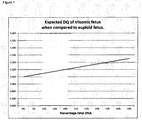
- the multiplex PCR allows the calculation of dosage quotients (DQs) by comparing (target region read count, i.e. the suspected aneuploidy chromosome or chromosomal region)/(control region read count, i.e. the reference chromosome or chromosomal region) ratios between the pregnant female and the fetus.
- DQs in function of the percentage fetal DNA is depicted in Figure 1 .
- An essential element of the methods of the present invention is that the amplified target DNA sequences are reflecting identical ratios of the amounts of maternal and fetal free floating nucleic acids in the biological sample and hence the methods require quantitative amplification.
- a Z-score of 1 means that there is no aneuploidy for the suspected aneuploidy chromosome.
- a Z-score higher than 1, preferentially higher than 2, more preferentially higher than 3, is an indication for the presence of an aneuploidy of the chromosome. It is understood that Z-scores are determined for all the suspected aneuploidy chromosomes for which a selected set of target DNA sequences are obtained by the methods of the invention. The normalization and the calculation of the Z-score is assisted by the use of statistical methods. Useful statistical methods which can be used in the context of the present invention include Bayesian-type likelihood method, sequential probability ratio testing (SPRT), false discovery, confidence interval and receiver operating characteristic (ROC).
- SPRT sequential probability ratio testing
- ROC receiver operating characteristic
- the massive parallel sequencing data of the amplified target DNA sequences are analyzed based on the determination of the allelic ratios of the informative SNPs wherein a distorted ratio is indicative for the presence of a fetal chromosomal aneuploidy in the pregnant female.
- the allelic ratio is distorted for informative SNPs on aneuploid chromosomes. This distortion can be measured when the mother is heterozygous for a given SNP (referred herein as "informative SNP"). Therefore, sequence analysis of the MASTR assay will result in a number of informative SNPs that can be used to determine the fetal ploidy status on top of the fetal ploidy status determination by molecular counting as described above.
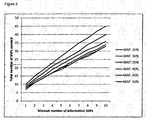
- Figure 2 shows the result of a calculation of the number of informative SNPs with a 99% probability provided a minor allele frequency (MAF) between 0,25 and 0,50. Based on this calculation it is depicted in Figure 2 that with a minimal MAF of 0,25 at least 7 informative SNPs are present in a set of 35 amplified target DNA sequences, while 10 informative SNPs are identified for SNPs with a MAF of 0,50.
- MAF minor allele frequency
- the massive parallel sequencing data of the amplified target DNA sequences are analyzed based on the determination of the allelic ratios of the informative SNPs wherein a distorted ratio is indicative for the presence of a fetal chromosomal aneuploidy in the pregnant female in combination with calculating the sum of read counts for all amplified DNA sequences of a suspected chromosomal aneuploidy (e.g. all amplified DNA sequences derived from chromosome 21 and/or chromosome 13 and/or chromosome 18 and/or chromosome X and/or chromosome Y) are counted (i.e. the number of times a specific amplified chromosomal sequence is present in the biological sample).
- a suspected chromosomal aneuploidy e.g. all amplified DNA sequences derived from chromosome 21 and/or chromosome 13 and/or chromosome 18 and/or chromosome X and/or chromosome Y
- a classification of whether a fetal chromosomal aneuploidy exists for one or more suspected aneuploid chromosomes determined wherein the chromosomes are chromosome 13 and/or chromosome 18 and/or chromosome 21 and/or chromosome X and/or chromosome Y.
- the classification is a definitive yes or no.
- a classification may be unclassifiable or uncertain.
- the classification may be a score that is to be interpreted at a later date, for example, by a medical doctor.
- bioinformatics, computational and statistical approaches used to determine if a biological sample obtained from a pregnant woman conceived with an aneuploid chromosome or chromosomal region or euploid fetus could be compiled into a computer program product used to determine parameters from the sequencing output.
- the operation of the computer program would involve the determining of a quantitative amount from the potentially aneuploid chromosome as well as amount(s) from one or more of the other chromosomes.
- a parameter would be determined and compared with appropriate cut-off values to determine if a fetal chromosomal aneuploidy exists for the potentially aneuploid chromosome.
- a diagnostic kit for carrying out the method.
- a diagnostic kit comprises at least a set of primers to amplify target maternal and target fetal nucleic acids wherein these target nucleic acids are derived from chromosome 13 and/or chromosome 18 and/or chromosome 21 and/or chromosome X and/or chromosome Y.
- the kit comprises primers for amplifying target nucleic acids derived from chromosomes 13, 18, 21, X and Y.
- the diagnostic kit comprises a set of primers which are able to identify target DNA sequences of a reference chromosome or a reference chromosomal part.
- a reference chromosome or part thereof is an euploid chromosome.
- Euploid refers to the normal number of chromosomes.
- Other reagents which can optionally be included in the diagnostic kit are instructions and a polymerase and buffers to carry out the quantitative polymerase multiplex PCR reaction.
- the DNA samples used in the present examples are samples prepared by mixing a diploid DNA sample derived from a female (representing the maternal DNA) with either a male DNA sample sample euploid for chromosome 21 (referred to as artificial euploid pregnancy or AEP) or with a male DNA sample triploid for chromosome 21 (referred to as artificial trisomy pregnancy or ATP).
- AEP artificial euploid pregnancy
- ATP trisomy pregnancy
- Each artificial sample was comprised of a mixture of 80% maternal DNA and 20% of male DNA.
- included in the analysis was a DNA sample derived from a Down syndrome individual, having 3 copies of chromosome 21. Measurements were performed on 4 AEP samples, 2 ATP samples and 1 Down syndrome DNA sample.
- the fetal chromosome 21 MASTR assay is comprised of 20 primer pairs derived from chromosome 21 and 10 primer pairs derived from chromosome 18.
- the resulting amplicons from each MASTR amplified individual DNA sample contained a specific barcode.
- the resulting barcoded amplicons of each DNA sample were equimolarly mixed and subjected to the 454 junior emulsion PCR protocol as described by the manufacturer. After emulsion PCR, beads were isolated and loaded on a 454 junior according to the manufacturer's protocol.
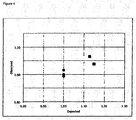
- Figure 3 shows a plot of the observed (calculated as above) and expected (i.e. theoretical values) number of read counts for chromosome 21 amplicons of the Down DNA sample.
- Table 1 list of 30 primer pairs composing the chromosome 21 aneuploidy detection MASTR assay Amplicon Chrom Forw Rev NITT_089 chr18 AAGACTCGGCAGCATCTCCATTTGGAGTTAGCTTGACTTTGG GCGATCGTCACTGTTCTCCAGAGATGGTATTAGGAAGGTTTGGT NITT_092 chr18 AAGACTCGGCAGCATCTCCACACTTTCTCCTAACACCCTTGG GCGATCGTCACTGTTCTCCAGTGGGTGTCCTTAGGGGTCT NITT_096 chr18 AAGACTCGGCAGCATCTCCATCAGCACTCCCTCCATGA GCGATCGTCACTGTTCTCCACTCAAAGAAATGGAAGAATACAAAA NITT_097 chr18 AAGACTCGGCAGCATCTCCACCTGCATCTTGACACAGTCG GCGATCGTCACTGTTCTCCAGGCATCCAGGAGGAGAAAAAA NITT_093 chr18 AAGACTCGGCAGCATCTCCAG
- Primerpairs were first tested in simplex PCR reactions on 20 ng of genomic DNA using 10 pmol per primer; the other parameters were equal to those of the multiplex PCR.
- the multiplex PCR reactions were performed on 50 ng genomic DNA in a 25-ml reaction containing TitaniumTM Taq PCR buffer (Clontech, Palo Alto, CA) with a final concentration of 0.25mM for each dNTP (Invitrogen, Carlsbad, CA) and a total of 0.125 ml of TitaniumTM Taq DNA Polymerase (Clontech). Primer concentrations were optimized and varied between 0.05 pmol/ml and 0.2 pmol/ml final concentration.
- the final multiplex assay (MASTR assay) was used to amplify all DNA samples.
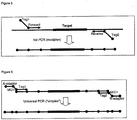
- the first PCR reaction was performed on 50 ng of DNA with following settings: initial sample denaturation 10 min at 95°C followed by 20 cycles each consisting of: 45 sec at 95°C, 45 sec at 60°C and 2 min at 68°C ending with a final extension step of 10 min of 72°C (see Figure 5 ).
- the resulting PCR fragments were 1000 times diluted followed by a second PCR step to incorporate the individual barcode.
- the PCR conditions of this step are identical to the conditions of the first PCR step (see Figure 6 ).
- the resulting barcoded amplicons are equimolarly mix and used in an emulsion PCR reaction as described by the manufacturer (Roche diagnostics).
Landscapes
- Chemical & Material Sciences (AREA)
- Life Sciences & Earth Sciences (AREA)
- Health & Medical Sciences (AREA)
- Engineering & Computer Science (AREA)
- Organic Chemistry (AREA)
- Physics & Mathematics (AREA)
- Proteomics, Peptides & Aminoacids (AREA)
- General Health & Medical Sciences (AREA)
- Zoology (AREA)
- Wood Science & Technology (AREA)
- Genetics & Genomics (AREA)
- Bioinformatics & Cheminformatics (AREA)
- Biotechnology (AREA)
- Biophysics (AREA)
- Medical Informatics (AREA)
- Molecular Biology (AREA)
- Analytical Chemistry (AREA)
- Chemical Kinetics & Catalysis (AREA)
- Biochemistry (AREA)
- General Engineering & Computer Science (AREA)
- Immunology (AREA)
- Microbiology (AREA)
- Evolutionary Biology (AREA)
- Bioinformatics & Computational Biology (AREA)
- Theoretical Computer Science (AREA)
- Spectroscopy & Molecular Physics (AREA)
- Public Health (AREA)
- Pathology (AREA)
- Databases & Information Systems (AREA)
- Data Mining & Analysis (AREA)
- Epidemiology (AREA)
- Biomedical Technology (AREA)
- Artificial Intelligence (AREA)
- Bioethics (AREA)
- Computer Vision & Pattern Recognition (AREA)
- Evolutionary Computation (AREA)
- Software Systems (AREA)
- Primary Health Care (AREA)
- Measuring Or Testing Involving Enzymes Or Micro-Organisms (AREA)
- Apparatus Associated With Microorganisms And Enzymes (AREA)
Claims (8)
- Procédé de détection d'une aneuploïdie chromosomique foetale chez une femme enceinte comprenanti) la préparation d'ADN libre flottant à partir d'un échantillon biologique de ladite femme enceinte,ii) l'amplification d'un ensemble choisi de séquences d'ADN cible d'un ou plusieurs chromosomes qui sont supposés être aneuploïdes et l'amplification d'un ensemble choisi de séquences d'ADN cible d'un ou plusieurs chromosomes qui sont supposés être euploïdes dans au moins une réaction PCR multiplex quantitative dans laquelle au moins une séquence d'ADN amplifiée comprend au moins un SNP pour lequel la femme est hétérozygote dans laquelle les séquences d'ADN amplifiées présentent des longueurs inférieures à 140 paires de base,iii) le séquençage des séquences d'ADN cible amplifiées etiv) le calcul de la somme de comptes lus pour toutes les séquences d'ADN amplifiées d'une aneuploïdie chromosomique suspectée suivi par une normalisation, contre la somme de comptes lus pour toutes les séquences d'ADN amplifiées d'un chromosome euploïde de référence pour déterminer par des méthodes statistiques un score établi indicateur de la présence d'une aneuploïdie chromosomique foetale et/ou déterminer les rapports alléliques des SNP informatifs dans lesquels un rapport allélique déformé est indicatif de la présence d'une aneuploïdie chromosomique foetale chez ladite femme enceintedans lequel ladite aneuploïdie chromosomique foetale est un chromosome 13 et/ou un chromosome 18 et/ou un chromosome 21 et/ou un chromosome X et/ou un chromosome Y.
- Procédé selon la revendication 1, dans lequel ledit échantillon biologique est du sang, du plasma, de l'urine, du fluide cérébrospinal, du sérum ou de la salive d'origine maternelle, ou est un fluide de lavage transcervical.
- Procédé selon la revendication 1 ou 2, dans lequel des produits chimiques de stabilisation de cellules sont utilisés dans la préparation dudit ADN libre flottant.
- Procédé selon l'une quelconque des revendications 1 à 3, dans lequel la teneur en GC des séquences d'ADN cible se situe entre 20 et 70 %.
- Procédé selon l'une quelconque des revendications 1 à 4, dans lequel un fractionnement dimensionnel est utilisé dans la préparation de l'ADN libre flottant.
- Procédé selon l'une quelconque des revendications 1 à 5, dans lequel les séquences d'ADN amplifiées sont obtenues dans une seule réaction PCR.
- Procédé selon la revendication 6, dans lequel, dans ladite seule réaction PCR multiplex, plus de 40 séquences ADN amplifiées sont obtenues.
- Procédé selon la revendication 6, dans lequel, dans ladite seule réaction PCR multiplex, plus de 60 séquences ADN amplifiées sont obtenues.
Priority Applications (1)
| Application Number | Priority Date | Filing Date | Title |
|---|---|---|---|
| EP17193790.7A EP3301190B1 (fr) | 2011-10-18 | 2012-10-18 | Diagnostic d'une aneuploïdie chromosomique f tale |
Applications Claiming Priority (2)
| Application Number | Priority Date | Filing Date | Title |
|---|---|---|---|
| US201161548632P | 2011-10-18 | 2011-10-18 | |
| PCT/IB2012/002091 WO2013057568A1 (fr) | 2011-10-18 | 2012-10-18 | Diagnostic d'une aneuploïdie chromosomique fœtale |
Related Child Applications (2)
| Application Number | Title | Priority Date | Filing Date |
|---|---|---|---|
| EP17193790.7A Division EP3301190B1 (fr) | 2011-10-18 | 2012-10-18 | Diagnostic d'une aneuploïdie chromosomique f tale |
| EP17193790.7A Division-Into EP3301190B1 (fr) | 2011-10-18 | 2012-10-18 | Diagnostic d'une aneuploïdie chromosomique f tale |
Publications (2)
| Publication Number | Publication Date |
|---|---|
| EP2768978A1 EP2768978A1 (fr) | 2014-08-27 |
| EP2768978B1 true EP2768978B1 (fr) | 2017-11-22 |
Family
ID=47178768
Family Applications (2)
| Application Number | Title | Priority Date | Filing Date |
|---|---|---|---|
| EP12787077.2A Active EP2768978B1 (fr) | 2011-10-18 | 2012-10-18 | Diagnostic d'une aneuploïdie chromosomique f tale |
| EP17193790.7A Active EP3301190B1 (fr) | 2011-10-18 | 2012-10-18 | Diagnostic d'une aneuploïdie chromosomique f tale |
Family Applications After (1)
| Application Number | Title | Priority Date | Filing Date |
|---|---|---|---|
| EP17193790.7A Active EP3301190B1 (fr) | 2011-10-18 | 2012-10-18 | Diagnostic d'une aneuploïdie chromosomique f tale |
Country Status (13)
| Country | Link |
|---|---|
| US (3) | US9598730B2 (fr) |
| EP (2) | EP2768978B1 (fr) |
| JP (2) | JP6159336B2 (fr) |
| CN (1) | CN103946394A (fr) |
| AU (1) | AU2012324532B2 (fr) |
| BR (1) | BR112014009269A8 (fr) |
| CA (1) | CA2850912C (fr) |
| DK (1) | DK2768978T3 (fr) |
| ES (1) | ES2651612T3 (fr) |
| IL (1) | IL232119B (fr) |
| NO (1) | NO2810062T3 (fr) |
| RU (1) | RU2638456C2 (fr) |
| WO (1) | WO2013057568A1 (fr) |
Families Citing this family (23)
| Publication number | Priority date | Publication date | Assignee | Title |
|---|---|---|---|---|
| WO2013057568A1 (fr) | 2011-10-18 | 2013-04-25 | Multiplicom Nv | Diagnostic d'une aneuploïdie chromosomique fœtale |
| US20130309666A1 (en) | 2013-01-25 | 2013-11-21 | Sequenom, Inc. | Methods and processes for non-invasive assessment of genetic variations |
| US10801067B2 (en) | 2014-05-09 | 2020-10-13 | Eurofins Lifecodexx Gmbh | Detection of DNA that originates from a specific cell-type and related methods |
| EP2942400A1 (fr) | 2014-05-09 | 2015-11-11 | Lifecodexx AG | Détection multiplexe d'ADN qui provient d'un type cellulaire spécifique |
| JPWO2016038929A1 (ja) * | 2014-09-11 | 2017-04-27 | 富士フイルム株式会社 | 胎児染色体の異数性の有無を検出する方法 |
| WO2016045106A1 (fr) * | 2014-09-26 | 2016-03-31 | 深圳华大基因股份有限公司 | Procédé d'analyse de la variation du nombre de copies pour des chromosomes de cellule unique et dispositif de détection |
| JP2016067268A (ja) * | 2014-09-29 | 2016-05-09 | 富士フイルム株式会社 | 胎児の染色体異数性の非侵襲的判別方法 |
| EP3271481B1 (fr) * | 2015-01-15 | 2020-04-08 | Good Start Genetics, Inc. | Procédés de contrôle de la qualité à l'aide de polymorphismes mononucléotidiques au cours d'un dépistage génétique préimplantatoire |
| CN104593503B (zh) * | 2015-01-22 | 2016-08-17 | 北京嘉宝仁和医疗科技有限公司 | 一种检测胎儿三倍体的引物组、方法及试剂盒 |
| BE1022789B1 (nl) * | 2015-07-17 | 2016-09-06 | Multiplicom Nv | Werkwijze en systeem voor geslachtsinschatting van een foetus van een zwangere vrouw |
| BE1023274A9 (nl) * | 2015-07-17 | 2017-03-17 | Multiplicom Nv | Schattingswerkwijze en -systeem voor het schatten van een foetale fractie |
| BE1022771B1 (nl) | 2015-10-14 | 2016-08-31 | Multiplicom Nv | Werkwijze en systeem om te bepalen of een vrouw zwanger is op basis van een bloedstaal |
| HUE050491T2 (hu) | 2015-11-10 | 2020-12-28 | Eurofins Lifecodexx Gmbh | Magzati kromoszomális aneuploidiák kimutatása olyan DNS régiókat alkalmazva, amelyek különbözõképpen vannak metilezve a magzat és a terhes nõstény között |
| BR112018011141A2 (pt) * | 2015-12-04 | 2018-11-21 | Green Cross Genome Corp | método para detectar o gênero fetal e as anormalidades no número de cópias, aparelho e meio legível por computador para realizar o mesmo |
| EP3529378A4 (fr) * | 2016-10-19 | 2020-05-27 | Samuel Williams | Évaluation chromosomique par analyse rapide à la lampe |
| CN110914456A (zh) * | 2017-03-31 | 2020-03-24 | 普莱梅沙有限公司 | 检测胎儿染色体异常的方法 |
| EP3612644B1 (fr) * | 2017-04-18 | 2021-12-15 | Agilent Technologies Belgium NV | Utilisation de séquences hors cible pour l'analyse d'adn |
| CN108342455B (zh) * | 2017-06-25 | 2021-11-30 | 北京新羿生物科技有限公司 | 一种从母体外周血检测胎儿非整倍体染色体的方法及其试剂盒 |
| CN109112209B (zh) * | 2017-06-25 | 2022-06-24 | 国家卫生计生委科学技术研究所 | 用于无创产前检测胎儿非整倍体染色体的参考品 |
| CN109321641B (zh) * | 2018-11-06 | 2019-09-13 | 苏州首度基因科技有限责任公司 | 一种基于dna片段富集及测序技术的产前无创胎儿染色体检测系统 |
| CN109971846A (zh) * | 2018-11-29 | 2019-07-05 | 时代基因检测中心有限公司 | 使用双等位基因snp靶向下一代测序的非侵入性产前测定非整倍体的方法 |
| CN111226281B (zh) * | 2019-12-31 | 2023-03-21 | 深圳华大医学检验实验室 | 确定染色体非整倍性、构建分类模型的方法和装置 |
| CN114898802B (zh) * | 2022-07-14 | 2022-09-30 | 臻和(北京)生物科技有限公司 | 基于血浆游离dna甲基化测序数据的末端序列频率分布特征确定方法、评价方法及装置 |
Family Cites Families (21)
| Publication number | Priority date | Publication date | Assignee | Title |
|---|---|---|---|---|
| GB9704444D0 (en) | 1997-03-04 | 1997-04-23 | Isis Innovation | Non-invasive prenatal diagnosis |
| EP1165839A2 (fr) * | 1999-03-26 | 2002-01-02 | Whitehead Institute For Biomedical Research | Reseaux universels |
| US6979541B1 (en) | 2001-07-26 | 2005-12-27 | University Of Utah Research Foundation | Methods for identifying chromosomal aneuploidy |
| US6977162B2 (en) | 2002-03-01 | 2005-12-20 | Ravgen, Inc. | Rapid analysis of variations in a genome |
| SG119192A1 (en) * | 2003-06-27 | 2006-02-28 | Parkway Lab Services Ltd | Detection of aneuploidy |
| US20050277147A1 (en) * | 2004-06-11 | 2005-12-15 | Ameet Patki | Identifying chromosomal abnormalities in cells obtained from follicular fluid |
| WO2006031524A2 (fr) * | 2004-09-10 | 2006-03-23 | The Regents Of The Unversity Of Colorado | Detection precoce de l'hemangiosarcome et de l'angiosarcome |
| US7645576B2 (en) * | 2005-03-18 | 2010-01-12 | The Chinese University Of Hong Kong | Method for the detection of chromosomal aneuploidies |
| US7799531B2 (en) | 2006-02-28 | 2010-09-21 | University Of Louisville Research Foundation | Detecting fetal chromosomal abnormalities using tandem single nucleotide polymorphisms |
| EP2029779A4 (fr) * | 2006-06-14 | 2010-01-20 | Living Microsystems Inc | Utilisation de génotypage snp fortement parallèle pour diagnostic fétal |
| EP3424598B1 (fr) * | 2006-06-14 | 2022-06-08 | Verinata Health, Inc. | Analyse de cellules rares utilisant la division d'échantillons et les marqueurs d'adn |
| US12180549B2 (en) | 2007-07-23 | 2024-12-31 | The Chinese University Of Hong Kong | Diagnosing fetal chromosomal aneuploidy using genomic sequencing |
| HUE061020T2 (hu) | 2007-07-23 | 2023-05-28 | Univ Hong Kong Chinese | Nukleinsav-szekvencia kiegyensúlyozatlanságának meghatározására |
| ES2620012T3 (es) | 2008-09-20 | 2017-06-27 | The Board Of Trustees Of The Leland Stanford Junior University | Diagnóstico no invasivo de la aneuploidia fetal por secuenciación |
| DK2516680T3 (en) | 2009-12-22 | 2016-05-02 | Sequenom Inc | Method and kits to identify aneuploidy |
| CA2786916A1 (fr) | 2010-01-15 | 2011-07-21 | The University Of British Columbia | Amplification multiplex pour la detection de variations d'acide nucleique |
| US20140186827A1 (en) | 2010-05-14 | 2014-07-03 | Fluidigm, Inc. | Assays for the detection of genotype, mutations, and/or aneuploidy |
| EP2633311A4 (fr) | 2010-10-26 | 2014-05-07 | Univ Stanford | Dépistage génétique f tal non invasif par analyse de séquençage |
| US20120219950A1 (en) | 2011-02-28 | 2012-08-30 | Arnold Oliphant | Assay systems for detection of aneuploidy and sex determination |
| EP3456844B1 (fr) | 2011-04-12 | 2020-06-10 | Verinata Health, Inc. | Résolution de fractions de génome à l'aide de comptes de polymorphisme |
| WO2013057568A1 (fr) | 2011-10-18 | 2013-04-25 | Multiplicom Nv | Diagnostic d'une aneuploïdie chromosomique fœtale |
-
2012
- 2012-10-18 WO PCT/IB2012/002091 patent/WO2013057568A1/fr not_active Ceased
- 2012-10-18 ES ES12787077.2T patent/ES2651612T3/es active Active
- 2012-10-18 EP EP12787077.2A patent/EP2768978B1/fr active Active
- 2012-10-18 US US14/352,755 patent/US9598730B2/en active Active
- 2012-10-18 AU AU2012324532A patent/AU2012324532B2/en active Active
- 2012-10-18 DK DK12787077.2T patent/DK2768978T3/en active
- 2012-10-18 BR BR112014009269A patent/BR112014009269A8/pt active IP Right Grant
- 2012-10-18 RU RU2014119928A patent/RU2638456C2/ru active
- 2012-10-18 EP EP17193790.7A patent/EP3301190B1/fr active Active
- 2012-10-18 CN CN201280051198.5A patent/CN103946394A/zh active Pending
- 2012-10-18 JP JP2014536346A patent/JP6159336B2/ja active Active
- 2012-10-18 CA CA2850912A patent/CA2850912C/fr active Active
-
2013
- 2013-01-18 NO NO13703198A patent/NO2810062T3/no unknown
-
2014
- 2014-04-13 IL IL232119A patent/IL232119B/en active IP Right Grant
-
2017
- 2017-02-13 US US15/431,349 patent/US9994906B2/en active Active
- 2017-04-13 JP JP2017079843A patent/JP6585117B2/ja active Active
-
2018
- 2018-05-21 US US15/985,092 patent/US10767228B2/en active Active
Non-Patent Citations (1)
| Title |
|---|
| A. J. SEHNERT ET AL: "Optimal Detection of Fetal Chromosomal Abnormalities by Massively Parallel DNA Sequencing of Cell-Free Fetal DNA from Maternal Blood", CLINICAL CHEMISTRY, vol. 57, no. 7, 1 July 2011 (2011-07-01), pages 1042 - 1049, XP055035090, ISSN: 0009-9147, DOI: 10.1373/clinchem.2011.165910 * |
Also Published As
| Publication number | Publication date |
|---|---|
| JP2014530024A (ja) | 2014-11-17 |
| US20140272979A1 (en) | 2014-09-18 |
| ES2651612T3 (es) | 2018-01-29 |
| US10767228B2 (en) | 2020-09-08 |
| RU2014119928A (ru) | 2015-11-27 |
| IL232119B (en) | 2018-04-30 |
| AU2012324532B2 (en) | 2017-11-02 |
| JP6585117B2 (ja) | 2019-10-02 |
| WO2013057568A1 (fr) | 2013-04-25 |
| US20180363058A1 (en) | 2018-12-20 |
| DK2768978T3 (en) | 2017-12-18 |
| BR112014009269A8 (pt) | 2017-06-20 |
| NO2810062T3 (fr) | 2018-02-03 |
| IL232119A0 (en) | 2014-05-28 |
| US20170204465A1 (en) | 2017-07-20 |
| BR112014009269A2 (pt) | 2017-06-13 |
| EP3301190B1 (fr) | 2025-02-12 |
| EP2768978A1 (fr) | 2014-08-27 |
| EP3301190A1 (fr) | 2018-04-04 |
| CA2850912A1 (fr) | 2013-04-25 |
| JP6159336B2 (ja) | 2017-07-05 |
| RU2638456C2 (ru) | 2017-12-13 |
| CN103946394A (zh) | 2014-07-23 |
| CA2850912C (fr) | 2021-06-22 |
| JP2017176181A (ja) | 2017-10-05 |
| US9994906B2 (en) | 2018-06-12 |
| AU2012324532A1 (en) | 2014-04-24 |
| US9598730B2 (en) | 2017-03-21 |
Similar Documents
| Publication | Publication Date | Title |
|---|---|---|
| US10767228B2 (en) | Fetal chromosomal aneuploidy diagnosis | |
| US20260009078A1 (en) | Determining a nucleic acid sequence imbalance associated with cancer using multiple markers | |
| US20120003636A1 (en) | Diagnosing fetal chromosomal aneuploidy using massively parallel genomic sequencing | |
| HK40033135A (en) | Determining a nucleic acid sequence imbalance | |
| HK1182195B (en) | Determining a nucleic acid sequence imbalance | |
| HK1182193B (en) | Determining a nucleic acid sequence imbalance | |
| HK1182193A (en) | Determining a nucleic acid sequence imbalance | |
| HK1182778B (en) | Determining a nucleic acid sequence imbalance | |
| HK1182778A (en) | Determining a nucleic acid sequence imbalance | |
| HK1182194B (en) | Determining a genotype of a fetus |
Legal Events
| Date | Code | Title | Description |
|---|---|---|---|
| PUAI | Public reference made under article 153(3) epc to a published international application that has entered the european phase |
Free format text: ORIGINAL CODE: 0009012 |
|
| 17P | Request for examination filed |
Effective date: 20140515 |
|
| AK | Designated contracting states |
Kind code of ref document: A1 Designated state(s): AL AT BE BG CH CY CZ DE DK EE ES FI FR GB GR HR HU IE IS IT LI LT LU LV MC MK MT NL NO PL PT RO RS SE SI SK SM TR |
|
| DAX | Request for extension of the european patent (deleted) | ||
| 17Q | First examination report despatched |
Effective date: 20150302 |
|
| STAA | Information on the status of an ep patent application or granted ep patent |
Free format text: STATUS: EXAMINATION IS IN PROGRESS |
|
| GRAP | Despatch of communication of intention to grant a patent |
Free format text: ORIGINAL CODE: EPIDOSNIGR1 |
|
| STAA | Information on the status of an ep patent application or granted ep patent |
Free format text: STATUS: GRANT OF PATENT IS INTENDED |
|
| INTG | Intention to grant announced |
Effective date: 20170602 |
|
| RIN1 | Information on inventor provided before grant (corrected) |
Inventor name: DEL-FAVERO, JURGEN Inventor name: GOOSSENS, DIRK Inventor name: HEYRMAN, LIEN |
|
| GRAS | Grant fee paid |
Free format text: ORIGINAL CODE: EPIDOSNIGR3 |
|
| GRAA | (expected) grant |
Free format text: ORIGINAL CODE: 0009210 |
|
| STAA | Information on the status of an ep patent application or granted ep patent |
Free format text: STATUS: THE PATENT HAS BEEN GRANTED |
|
| AK | Designated contracting states |
Kind code of ref document: B1 Designated state(s): AL AT BE BG CH CY CZ DE DK EE ES FI FR GB GR HR HU IE IS IT LI LT LU LV MC MK MT NL NO PL PT RO RS SE SI SK SM TR |
|
| REG | Reference to a national code |
Ref country code: GB Ref legal event code: FG4D |
|
| REG | Reference to a national code |
Ref country code: CH Ref legal event code: EP |
|
| REG | Reference to a national code |
Ref country code: IE Ref legal event code: FG4D |
|
| REG | Reference to a national code |
Ref country code: AT Ref legal event code: REF Ref document number: 948444 Country of ref document: AT Kind code of ref document: T Effective date: 20171215 |
|
| REG | Reference to a national code |
Ref country code: DK Ref legal event code: T3 Effective date: 20171213 |
|
| REG | Reference to a national code |
Ref country code: SE Ref legal event code: TRGR |
|
| REG | Reference to a national code |
Ref country code: DE Ref legal event code: R096 Ref document number: 602012040143 Country of ref document: DE |
|
| REG | Reference to a national code |
Ref country code: ES Ref legal event code: FG2A Ref document number: 2651612 Country of ref document: ES Kind code of ref document: T3 Effective date: 20180129 |
|
| REG | Reference to a national code |
Ref country code: NO Ref legal event code: T2 Effective date: 20171122 |
|
| REG | Reference to a national code |
Ref country code: NL Ref legal event code: MP Effective date: 20171122 |
|
| REG | Reference to a national code |
Ref country code: LT Ref legal event code: MG4D |
|
| REG | Reference to a national code |
Ref country code: AT Ref legal event code: MK05 Ref document number: 948444 Country of ref document: AT Kind code of ref document: T Effective date: 20171122 |
|
| PG25 | Lapsed in a contracting state [announced via postgrant information from national office to epo] |
Ref country code: LT Free format text: LAPSE BECAUSE OF FAILURE TO SUBMIT A TRANSLATION OF THE DESCRIPTION OR TO PAY THE FEE WITHIN THE PRESCRIBED TIME-LIMIT Effective date: 20171122 Ref country code: NL Free format text: LAPSE BECAUSE OF FAILURE TO SUBMIT A TRANSLATION OF THE DESCRIPTION OR TO PAY THE FEE WITHIN THE PRESCRIBED TIME-LIMIT Effective date: 20171122 Ref country code: FI Free format text: LAPSE BECAUSE OF FAILURE TO SUBMIT A TRANSLATION OF THE DESCRIPTION OR TO PAY THE FEE WITHIN THE PRESCRIBED TIME-LIMIT Effective date: 20171122 |
|
| PG25 | Lapsed in a contracting state [announced via postgrant information from national office to epo] |
Ref country code: LV Free format text: LAPSE BECAUSE OF FAILURE TO SUBMIT A TRANSLATION OF THE DESCRIPTION OR TO PAY THE FEE WITHIN THE PRESCRIBED TIME-LIMIT Effective date: 20171122 Ref country code: HR Free format text: LAPSE BECAUSE OF FAILURE TO SUBMIT A TRANSLATION OF THE DESCRIPTION OR TO PAY THE FEE WITHIN THE PRESCRIBED TIME-LIMIT Effective date: 20171122 Ref country code: RS Free format text: LAPSE BECAUSE OF FAILURE TO SUBMIT A TRANSLATION OF THE DESCRIPTION OR TO PAY THE FEE WITHIN THE PRESCRIBED TIME-LIMIT Effective date: 20171122 Ref country code: AT Free format text: LAPSE BECAUSE OF FAILURE TO SUBMIT A TRANSLATION OF THE DESCRIPTION OR TO PAY THE FEE WITHIN THE PRESCRIBED TIME-LIMIT Effective date: 20171122 Ref country code: BG Free format text: LAPSE BECAUSE OF FAILURE TO SUBMIT A TRANSLATION OF THE DESCRIPTION OR TO PAY THE FEE WITHIN THE PRESCRIBED TIME-LIMIT Effective date: 20180222 |
|
| REG | Reference to a national code |
Ref country code: GR Ref legal event code: EP Ref document number: 20170403491 Country of ref document: GR Effective date: 20180518 |
|
| PG25 | Lapsed in a contracting state [announced via postgrant information from national office to epo] |
Ref country code: EE Free format text: LAPSE BECAUSE OF FAILURE TO SUBMIT A TRANSLATION OF THE DESCRIPTION OR TO PAY THE FEE WITHIN THE PRESCRIBED TIME-LIMIT Effective date: 20171122 Ref country code: CY Free format text: LAPSE BECAUSE OF FAILURE TO SUBMIT A TRANSLATION OF THE DESCRIPTION OR TO PAY THE FEE WITHIN THE PRESCRIBED TIME-LIMIT Effective date: 20171122 Ref country code: SK Free format text: LAPSE BECAUSE OF FAILURE TO SUBMIT A TRANSLATION OF THE DESCRIPTION OR TO PAY THE FEE WITHIN THE PRESCRIBED TIME-LIMIT Effective date: 20171122 |
|
| REG | Reference to a national code |
Ref country code: DE Ref legal event code: R097 Ref document number: 602012040143 Country of ref document: DE |
|
| PG25 | Lapsed in a contracting state [announced via postgrant information from national office to epo] |
Ref country code: PL Free format text: LAPSE BECAUSE OF FAILURE TO SUBMIT A TRANSLATION OF THE DESCRIPTION OR TO PAY THE FEE WITHIN THE PRESCRIBED TIME-LIMIT Effective date: 20171122 Ref country code: RO Free format text: LAPSE BECAUSE OF FAILURE TO SUBMIT A TRANSLATION OF THE DESCRIPTION OR TO PAY THE FEE WITHIN THE PRESCRIBED TIME-LIMIT Effective date: 20171122 Ref country code: SM Free format text: LAPSE BECAUSE OF FAILURE TO SUBMIT A TRANSLATION OF THE DESCRIPTION OR TO PAY THE FEE WITHIN THE PRESCRIBED TIME-LIMIT Effective date: 20171122 |
|
| REG | Reference to a national code |
Ref country code: FR Ref legal event code: PLFP Year of fee payment: 7 |
|
| PLBE | No opposition filed within time limit |
Free format text: ORIGINAL CODE: 0009261 |
|
| STAA | Information on the status of an ep patent application or granted ep patent |
Free format text: STATUS: NO OPPOSITION FILED WITHIN TIME LIMIT |
|
| 26N | No opposition filed |
Effective date: 20180823 |
|
| PG25 | Lapsed in a contracting state [announced via postgrant information from national office to epo] |
Ref country code: SI Free format text: LAPSE BECAUSE OF FAILURE TO SUBMIT A TRANSLATION OF THE DESCRIPTION OR TO PAY THE FEE WITHIN THE PRESCRIBED TIME-LIMIT Effective date: 20171122 |
|
| PGFP | Annual fee paid to national office [announced via postgrant information from national office to epo] |
Ref country code: GR Payment date: 20180911 Year of fee payment: 7 |
|
| PGFP | Annual fee paid to national office [announced via postgrant information from national office to epo] |
Ref country code: SE Payment date: 20181011 Year of fee payment: 7 |
|
| REG | Reference to a national code |
Ref country code: CH Ref legal event code: PL |
|
| PG25 | Lapsed in a contracting state [announced via postgrant information from national office to epo] |
Ref country code: MC Free format text: LAPSE BECAUSE OF FAILURE TO SUBMIT A TRANSLATION OF THE DESCRIPTION OR TO PAY THE FEE WITHIN THE PRESCRIBED TIME-LIMIT Effective date: 20171122 Ref country code: LU Free format text: LAPSE BECAUSE OF NON-PAYMENT OF DUE FEES Effective date: 20181018 |
|
| REG | Reference to a national code |
Ref country code: IE Ref legal event code: MM4A |
|
| PG25 | Lapsed in a contracting state [announced via postgrant information from national office to epo] |
Ref country code: LI Free format text: LAPSE BECAUSE OF NON-PAYMENT OF DUE FEES Effective date: 20181031 Ref country code: CH Free format text: LAPSE BECAUSE OF NON-PAYMENT OF DUE FEES Effective date: 20181031 |
|
| PG25 | Lapsed in a contracting state [announced via postgrant information from national office to epo] |
Ref country code: IE Free format text: LAPSE BECAUSE OF NON-PAYMENT OF DUE FEES Effective date: 20181018 |
|
| PG25 | Lapsed in a contracting state [announced via postgrant information from national office to epo] |
Ref country code: MT Free format text: LAPSE BECAUSE OF NON-PAYMENT OF DUE FEES Effective date: 20181018 |
|
| PG25 | Lapsed in a contracting state [announced via postgrant information from national office to epo] |
Ref country code: PT Free format text: LAPSE BECAUSE OF FAILURE TO SUBMIT A TRANSLATION OF THE DESCRIPTION OR TO PAY THE FEE WITHIN THE PRESCRIBED TIME-LIMIT Effective date: 20171122 |
|
| PG25 | Lapsed in a contracting state [announced via postgrant information from national office to epo] |
Ref country code: HU Free format text: LAPSE BECAUSE OF FAILURE TO SUBMIT A TRANSLATION OF THE DESCRIPTION OR TO PAY THE FEE WITHIN THE PRESCRIBED TIME-LIMIT; INVALID AB INITIO Effective date: 20121018 Ref country code: MK Free format text: LAPSE BECAUSE OF NON-PAYMENT OF DUE FEES Effective date: 20171122 |
|
| PG25 | Lapsed in a contracting state [announced via postgrant information from national office to epo] |
Ref country code: AL Free format text: LAPSE BECAUSE OF FAILURE TO SUBMIT A TRANSLATION OF THE DESCRIPTION OR TO PAY THE FEE WITHIN THE PRESCRIBED TIME-LIMIT Effective date: 20171122 Ref country code: GR Free format text: LAPSE BECAUSE OF NON-PAYMENT OF DUE FEES Effective date: 20200506 Ref country code: IS Free format text: LAPSE BECAUSE OF FAILURE TO SUBMIT A TRANSLATION OF THE DESCRIPTION OR TO PAY THE FEE WITHIN THE PRESCRIBED TIME-LIMIT Effective date: 20180322 |
|
| PG25 | Lapsed in a contracting state [announced via postgrant information from national office to epo] |
Ref country code: SE Free format text: LAPSE BECAUSE OF NON-PAYMENT OF DUE FEES Effective date: 20191019 |
|
| REG | Reference to a national code |
Ref country code: DE Ref legal event code: R082 Ref document number: 602012040143 Country of ref document: DE Representative=s name: PATENTANWAELTE BRESSEL UND PARTNER MBB, DE |
|
| REG | Reference to a national code |
Ref country code: DE Ref legal event code: R082 Ref document number: 602012040143 Country of ref document: DE Representative=s name: PATENTANWAELTE BRESSEL UND PARTNER MBB, DE Ref country code: DE Ref legal event code: R081 Ref document number: 602012040143 Country of ref document: DE Owner name: AGILENT TECHNOLOGIES, INC., SANTA CLARA, US Free format text: FORMER OWNER: MULTIPLICOM NV, NIEL, BE |
|
| REG | Reference to a national code |
Ref country code: NO Ref legal event code: CHAD Owner name: AGILENT TECHNOLOGIES, US |
|
| REG | Reference to a national code |
Ref country code: BE Ref legal event code: PD Owner name: AGILENT TECHNOLOGIES, INC.; US Free format text: DETAILS ASSIGNMENT: CHANGE OF OWNER(S), ASSIGNMENT; FORMER OWNER NAME: MULTIPLICOM NV Effective date: 20210315 |
|
| REG | Reference to a national code |
Ref country code: ES Ref legal event code: PC2A Owner name: AGILENT TECHNOLOGIES INC Effective date: 20210614 |
|
| REG | Reference to a national code |
Ref country code: GB Ref legal event code: 732E Free format text: REGISTERED BETWEEN 20210617 AND 20210623 |
|
| PG25 | Lapsed in a contracting state [announced via postgrant information from national office to epo] |
Ref country code: TR Free format text: LAPSE BECAUSE OF NON-PAYMENT OF DUE FEES Effective date: 20191018 |
|
| P01 | Opt-out of the competence of the unified patent court (upc) registered |
Effective date: 20230711 |
|
| PGFP | Annual fee paid to national office [announced via postgrant information from national office to epo] |
Ref country code: IT Payment date: 20250922 Year of fee payment: 14 |
|
| PGFP | Annual fee paid to national office [announced via postgrant information from national office to epo] |
Ref country code: BE Payment date: 20250917 Year of fee payment: 14 Ref country code: GB Payment date: 20250828 Year of fee payment: 14 |
|
| PGFP | Annual fee paid to national office [announced via postgrant information from national office to epo] |
Ref country code: FR Payment date: 20250821 Year of fee payment: 14 |
|
| PGFP | Annual fee paid to national office [announced via postgrant information from national office to epo] |
Ref country code: DE Payment date: 20250827 Year of fee payment: 14 |
|
| PGFP | Annual fee paid to national office [announced via postgrant information from national office to epo] |
Ref country code: NO Payment date: 20251009 Year of fee payment: 14 |
|
| PGFP | Annual fee paid to national office [announced via postgrant information from national office to epo] |
Ref country code: DK Payment date: 20251014 Year of fee payment: 14 |
|
| PGFP | Annual fee paid to national office [announced via postgrant information from national office to epo] |
Ref country code: CZ Payment date: 20251006 Year of fee payment: 14 |
|
| PGFP | Annual fee paid to national office [announced via postgrant information from national office to epo] |
Ref country code: ES Payment date: 20251105 Year of fee payment: 14 |