EP2769760A1 - Katalysator zur Reduktion von Stickoxiden - Google Patents
Katalysator zur Reduktion von Stickoxiden Download PDFInfo
- Publication number
- EP2769760A1 EP2769760A1 EP13156095.5A EP13156095A EP2769760A1 EP 2769760 A1 EP2769760 A1 EP 2769760A1 EP 13156095 A EP13156095 A EP 13156095A EP 2769760 A1 EP2769760 A1 EP 2769760A1
- Authority
- EP
- European Patent Office
- Prior art keywords
- washcoat
- washcoat layer
- palladium
- platinum
- amount
- Prior art date
- Legal status (The legal status is an assumption and is not a legal conclusion. Google has not performed a legal analysis and makes no representation as to the accuracy of the status listed.)
- Withdrawn
Links
Images


Classifications
-
- B—PERFORMING OPERATIONS; TRANSPORTING
- B01—PHYSICAL OR CHEMICAL PROCESSES OR APPARATUS IN GENERAL
- B01D—SEPARATION
- B01D53/00—Separation of gases or vapours; Recovering vapours of volatile solvents from gases; Chemical or biological purification of waste gases, e.g. engine exhaust gases, smoke, fumes, flue gases, aerosols
- B01D53/34—Chemical or biological purification of waste gases
- B01D53/92—Chemical or biological purification of waste gases of engine exhaust gases
- B01D53/94—Chemical or biological purification of waste gases of engine exhaust gases by catalytic processes
- B01D53/9481—Catalyst preceded by an adsorption device without catalytic function for temporary storage of contaminants, e.g. during cold start
-
- B—PERFORMING OPERATIONS; TRANSPORTING
- B01—PHYSICAL OR CHEMICAL PROCESSES OR APPARATUS IN GENERAL
- B01D—SEPARATION
- B01D53/00—Separation of gases or vapours; Recovering vapours of volatile solvents from gases; Chemical or biological purification of waste gases, e.g. engine exhaust gases, smoke, fumes, flue gases, aerosols
- B01D53/34—Chemical or biological purification of waste gases
- B01D53/92—Chemical or biological purification of waste gases of engine exhaust gases
- B01D53/94—Chemical or biological purification of waste gases of engine exhaust gases by catalytic processes
- B01D53/9404—Removing only nitrogen compounds
- B01D53/9409—Nitrogen oxides
- B01D53/9413—Processes characterised by a specific catalyst
- B01D53/9422—Processes characterised by a specific catalyst for removing nitrogen oxides by NOx storage or reduction by cyclic switching between lean and rich exhaust gases (LNT, NSC, NSR)
-
- B—PERFORMING OPERATIONS; TRANSPORTING
- B01—PHYSICAL OR CHEMICAL PROCESSES OR APPARATUS IN GENERAL
- B01D—SEPARATION
- B01D53/00—Separation of gases or vapours; Recovering vapours of volatile solvents from gases; Chemical or biological purification of waste gases, e.g. engine exhaust gases, smoke, fumes, flue gases, aerosols
- B01D53/34—Chemical or biological purification of waste gases
- B01D53/92—Chemical or biological purification of waste gases of engine exhaust gases
- B01D53/94—Chemical or biological purification of waste gases of engine exhaust gases by catalytic processes
- B01D53/9459—Removing one or more of nitrogen oxides, carbon monoxide, or hydrocarbons by multiple successive catalytic functions; systems with more than one different function, e.g. zone coated catalysts
- B01D53/9463—Removing one or more of nitrogen oxides, carbon monoxide, or hydrocarbons by multiple successive catalytic functions; systems with more than one different function, e.g. zone coated catalysts with catalysts positioned on one brick
- B01D53/9468—Removing one or more of nitrogen oxides, carbon monoxide, or hydrocarbons by multiple successive catalytic functions; systems with more than one different function, e.g. zone coated catalysts with catalysts positioned on one brick in different layers
-
- B—PERFORMING OPERATIONS; TRANSPORTING
- B01—PHYSICAL OR CHEMICAL PROCESSES OR APPARATUS IN GENERAL
- B01J—CHEMICAL OR PHYSICAL PROCESSES, e.g. CATALYSIS OR COLLOID CHEMISTRY; THEIR RELEVANT APPARATUS
- B01J23/00—Catalysts comprising metals or metal oxides or hydroxides, not provided for in group B01J21/00
- B01J23/10—Catalysts comprising metals or metal oxides or hydroxides, not provided for in group B01J21/00 of rare earths
-
- B—PERFORMING OPERATIONS; TRANSPORTING
- B01—PHYSICAL OR CHEMICAL PROCESSES OR APPARATUS IN GENERAL
- B01J—CHEMICAL OR PHYSICAL PROCESSES, e.g. CATALYSIS OR COLLOID CHEMISTRY; THEIR RELEVANT APPARATUS
- B01J23/00—Catalysts comprising metals or metal oxides or hydroxides, not provided for in group B01J21/00
- B01J23/38—Catalysts comprising metals or metal oxides or hydroxides, not provided for in group B01J21/00 of noble metals
- B01J23/40—Catalysts comprising metals or metal oxides or hydroxides, not provided for in group B01J21/00 of noble metals of the platinum group metals
- B01J23/44—Palladium
-
- B—PERFORMING OPERATIONS; TRANSPORTING
- B01—PHYSICAL OR CHEMICAL PROCESSES OR APPARATUS IN GENERAL
- B01J—CHEMICAL OR PHYSICAL PROCESSES, e.g. CATALYSIS OR COLLOID CHEMISTRY; THEIR RELEVANT APPARATUS
- B01J23/00—Catalysts comprising metals or metal oxides or hydroxides, not provided for in group B01J21/00
- B01J23/38—Catalysts comprising metals or metal oxides or hydroxides, not provided for in group B01J21/00 of noble metals
- B01J23/40—Catalysts comprising metals or metal oxides or hydroxides, not provided for in group B01J21/00 of noble metals of the platinum group metals
- B01J23/46—Ruthenium, rhodium, osmium or iridium
- B01J23/464—Rhodium
-
- B—PERFORMING OPERATIONS; TRANSPORTING
- B01—PHYSICAL OR CHEMICAL PROCESSES OR APPARATUS IN GENERAL
- B01J—CHEMICAL OR PHYSICAL PROCESSES, e.g. CATALYSIS OR COLLOID CHEMISTRY; THEIR RELEVANT APPARATUS
- B01J23/00—Catalysts comprising metals or metal oxides or hydroxides, not provided for in group B01J21/00
- B01J23/38—Catalysts comprising metals or metal oxides or hydroxides, not provided for in group B01J21/00 of noble metals
- B01J23/54—Catalysts comprising metals or metal oxides or hydroxides, not provided for in group B01J21/00 of noble metals combined with metals, oxides or hydroxides provided for in groups B01J23/02 - B01J23/36
- B01J23/56—Platinum group metals
- B01J23/63—Platinum group metals with rare earths or actinides
-
- B—PERFORMING OPERATIONS; TRANSPORTING
- B01—PHYSICAL OR CHEMICAL PROCESSES OR APPARATUS IN GENERAL
- B01J—CHEMICAL OR PHYSICAL PROCESSES, e.g. CATALYSIS OR COLLOID CHEMISTRY; THEIR RELEVANT APPARATUS
- B01J35/00—Catalysts, in general, characterised by their form or physical properties
- B01J35/19—Catalysts containing parts with different compositions
-
- B—PERFORMING OPERATIONS; TRANSPORTING
- B01—PHYSICAL OR CHEMICAL PROCESSES OR APPARATUS IN GENERAL
- B01J—CHEMICAL OR PHYSICAL PROCESSES, e.g. CATALYSIS OR COLLOID CHEMISTRY; THEIR RELEVANT APPARATUS
- B01J35/00—Catalysts, in general, characterised by their form or physical properties
- B01J35/30—Catalysts, in general, characterised by their form or physical properties characterised by their physical properties
-
- B—PERFORMING OPERATIONS; TRANSPORTING
- B01—PHYSICAL OR CHEMICAL PROCESSES OR APPARATUS IN GENERAL
- B01J—CHEMICAL OR PHYSICAL PROCESSES, e.g. CATALYSIS OR COLLOID CHEMISTRY; THEIR RELEVANT APPARATUS
- B01J37/00—Processes, in general, for preparing catalysts; Processes, in general, for activation of catalysts
- B01J37/02—Impregnation, coating or precipitation
- B01J37/024—Multiple impregnation or coating
- B01J37/0244—Coatings comprising several layers
-
- F—MECHANICAL ENGINEERING; LIGHTING; HEATING; WEAPONS; BLASTING
- F01—MACHINES OR ENGINES IN GENERAL; ENGINE PLANTS IN GENERAL; STEAM ENGINES
- F01N—GAS-FLOW SILENCERS OR EXHAUST APPARATUS FOR MACHINES OR ENGINES IN GENERAL; GAS-FLOW SILENCERS OR EXHAUST APPARATUS FOR INTERNAL-COMBUSTION ENGINES
- F01N3/00—Exhaust or silencing apparatus having means for purifying, rendering innocuous, or otherwise treating exhaust
- F01N3/08—Exhaust or silencing apparatus having means for purifying, rendering innocuous, or otherwise treating exhaust for rendering innocuous
- F01N3/0807—Exhaust or silencing apparatus having means for purifying, rendering innocuous, or otherwise treating exhaust for rendering innocuous by using absorbents or adsorbents
- F01N3/0814—Exhaust or silencing apparatus having means for purifying, rendering innocuous, or otherwise treating exhaust for rendering innocuous by using absorbents or adsorbents combined with catalytic converters, e.g. NOx absorption/storage reduction catalysts
-
- B—PERFORMING OPERATIONS; TRANSPORTING
- B01—PHYSICAL OR CHEMICAL PROCESSES OR APPARATUS IN GENERAL
- B01D—SEPARATION
- B01D2255/00—Catalysts
- B01D2255/10—Noble metals or compounds thereof
- B01D2255/102—Platinum group metals
- B01D2255/1021—Platinum
-
- B—PERFORMING OPERATIONS; TRANSPORTING
- B01—PHYSICAL OR CHEMICAL PROCESSES OR APPARATUS IN GENERAL
- B01D—SEPARATION
- B01D2255/00—Catalysts
- B01D2255/10—Noble metals or compounds thereof
- B01D2255/102—Platinum group metals
- B01D2255/1023—Palladium
-
- B—PERFORMING OPERATIONS; TRANSPORTING
- B01—PHYSICAL OR CHEMICAL PROCESSES OR APPARATUS IN GENERAL
- B01D—SEPARATION
- B01D2255/00—Catalysts
- B01D2255/10—Noble metals or compounds thereof
- B01D2255/102—Platinum group metals
- B01D2255/1025—Rhodium
-
- B—PERFORMING OPERATIONS; TRANSPORTING
- B01—PHYSICAL OR CHEMICAL PROCESSES OR APPARATUS IN GENERAL
- B01D—SEPARATION
- B01D2255/00—Catalysts
- B01D2255/20—Metals or compounds thereof
-
- B—PERFORMING OPERATIONS; TRANSPORTING
- B01—PHYSICAL OR CHEMICAL PROCESSES OR APPARATUS IN GENERAL
- B01D—SEPARATION
- B01D2255/00—Catalysts
- B01D2255/40—Mixed oxides
-
- B—PERFORMING OPERATIONS; TRANSPORTING
- B01—PHYSICAL OR CHEMICAL PROCESSES OR APPARATUS IN GENERAL
- B01D—SEPARATION
- B01D2255/00—Catalysts
- B01D2255/90—Physical characteristics of catalysts
- B01D2255/902—Multilayered catalyst
- B01D2255/9022—Two layers
-
- B—PERFORMING OPERATIONS; TRANSPORTING
- B01—PHYSICAL OR CHEMICAL PROCESSES OR APPARATUS IN GENERAL
- B01D—SEPARATION
- B01D2255/00—Catalysts
- B01D2255/90—Physical characteristics of catalysts
- B01D2255/903—Multi-zoned catalysts
- B01D2255/9032—Two zones
-
- B—PERFORMING OPERATIONS; TRANSPORTING
- B01—PHYSICAL OR CHEMICAL PROCESSES OR APPARATUS IN GENERAL
- B01D—SEPARATION
- B01D2255/00—Catalysts
- B01D2255/90—Physical characteristics of catalysts
- B01D2255/908—O2-storage component incorporated in the catalyst
-
- B—PERFORMING OPERATIONS; TRANSPORTING
- B01—PHYSICAL OR CHEMICAL PROCESSES OR APPARATUS IN GENERAL
- B01D—SEPARATION
- B01D2255/00—Catalysts
- B01D2255/90—Physical characteristics of catalysts
- B01D2255/91—NOx-storage component incorporated in the catalyst
-
- B—PERFORMING OPERATIONS; TRANSPORTING
- B01—PHYSICAL OR CHEMICAL PROCESSES OR APPARATUS IN GENERAL
- B01D—SEPARATION
- B01D2255/00—Catalysts
- B01D2255/90—Physical characteristics of catalysts
- B01D2255/911—NH3-storage component incorporated in the catalyst
-
- B—PERFORMING OPERATIONS; TRANSPORTING
- B01—PHYSICAL OR CHEMICAL PROCESSES OR APPARATUS IN GENERAL
- B01J—CHEMICAL OR PHYSICAL PROCESSES, e.g. CATALYSIS OR COLLOID CHEMISTRY; THEIR RELEVANT APPARATUS
- B01J2523/00—Constitutive chemical elements of heterogeneous catalysts
Definitions
- the present invention relates to a catalyst for the reduction of nitrogen oxides, which is contained in the exhaust lean burned internal combustion engines.
- nitrogen oxide storage catalysts for which the term "lean NOx trap" or LNT is common, known.
- Their cleaning effect is based on the fact that in a lean operating phase of the engine, the nitrogen oxides are stored by the storage material of the storage catalyst mainly in the form of nitrates and decomposes it again in a subsequent rich operating phase of the engine and the thus released nitrogen oxides with the reducing exhaust gas components on the storage catalyst to nitrogen , Carbon dioxide and water are converted. This procedure is described for example in SAE SAE 950809.
- Suitable storage materials are, in particular, oxides, carbonates or hydroxides of magnesium, calcium, strontium, barium, the alkali metals, the rare earth metals or mixtures thereof. Due to their basic properties, these compounds are capable of forming nitrates with the acidic nitrogen oxides of the exhaust gas and of storing them in this way. They are deposited to produce a large interaction surface with the exhaust gas in the highest possible dispersion on suitable carrier materials.
- nitrogen oxide storage catalysts generally contain noble metals such as platinum, palladium and / or rhodium as catalytically active components. Their task is on the one hand to oxidize NO to NO 2 under lean conditions, as well as CO and HC to CO 2 and on the other hand during the rich operating phases in which the nitrogen oxide storage catalyst is regenerated to reduce NO 2 released to nitrogen.
- the EP 0 885 650 A2 describes an exhaust gas purification catalyst for internal combustion engines with two catalytically active layers on a support body.
- the layer located on the support body comprises one or more highly dispersed alkaline earth oxides, at least one platinum group metal, as well as at least one finely divided, oxygen-storing material.
- the platinum group metals are in close contact with all components of the first layer.
- the second layer is in direct contact with the exhaust gas and contains at least one platinum group metal, as well as at least a finely divided, oxygen-storing material. Only part of the finely divided solids of the second layer serve as a carrier for the platinum group metals.
- a nitrogen oxide storage catalyst which comprises two superimposed catalyst layers on a carrier substrate.
- the lower layer lying directly on the carrier substrate comprises one or more noble metals, as well as one or more nitrogen oxide storage components.
- the top layer comprises one or more noble metals, as well as ceria, and is free of alkali or alkaline earth components.
- Catalyst substrates containing nitrogen oxide storage materials and having two or more layers are also known in the art WO 2012/029050 described.
- the first layer is directly on the carrier substrate and comprises platinum and / or palladium, while the second layer is on the first and comprises platinum.
- Both layers also contain one or more oxygen storage materials and one or more nitric oxide storage materials comprising one or more alkali and / or alkaline earth metals.
- the total amount of alkali and alkaline earth metal in the nitrogen oxide storage materials is 0.18 to 2.5 g / in 3 , calculated as alkali metal oxide M 2 O and alkaline earth metal oxide MO.
- the cerium oxide used in the washcoat layers A and B may be of commercial quality, ie have a cerium oxide content of 90 to 100% by weight.
- cerium oxide is used in the washcoat layer A in an amount of 30 to 120 g / l, in particular 30 to 80 g / l.
- the minimum mass fraction in% of cerium oxide calculated according to the above formula. For a washcoat loading of 50 g / l, this results in a minimum mass fraction of cerium oxide of 35%, corresponding to 17.5 g / l based on the volume of the support body. For a washcoat loading of 200 g / l thus results in a minimum mass fraction of cerium oxide of 50%, corresponding to 100 g / l based on the volume of the support body.
- the mass fraction of cerium oxide in the washcoat layer B is at least 50%, which, depending on the total loading of washcoat B, corresponds to amounts of at least 25 to 100 g / l, based on the volume of the carrier body.
- the washcoat layer B is present in an amount of 75 to 150 g / l, based on the volume of the support body. Accordingly, in this case, the amounts of cerium oxide are at least 28.1 to 67.5 g / l, each based on the volume of the support body.
- the washcoat layer B is present in an amount of 80 to 130 g / l, based on the volume of the support body. Accordingly, in this case, the amounts of cerium oxide are at least 30.4 to 55.9 g / l, each based on the volume of the support body.
- washcoat layer B contains no further constituents besides cerium oxide, noble metal and support materials for the noble metal.
- the maximum amount of cerium oxide, which may be contained in washcoat B, can thus be calculated in a simple manner.
- washcoat layer B contains not only no alkaline earth compound but also no alkali compound.
- the washcoat layers A and B may each contain platinum or palladium, but in preferred embodiments of the present invention they both contain platinum and palladium.
- the ratio of platinum to palladium is 1: 2 to 20: 1, in particular 1: 1 1 to 10: 1, for example 1: 1, 2: 1, 4: 1 and 10: 1.
- washcoat A and / or washcoat B contain rhodium as another precious metal.
- Rhodium is in this case, in particular in amounts of 0.1 to 10 g / ft 3 (equivalent to 0.003 to 0.35 g / l), based on the volume of the support body before.
- the noble metals platinum and / or palladium and optionally rhodium are usually present on suitable support materials.
- High-surface-area, high-melting oxides are used as such, for example aluminum oxide, silicon dioxide, titanium dioxide, but also mixed oxides such as, for example, cerium-zirconium mixed oxides.
- alumina is used as support material for the noble metals, in particular those stabilized by 1 to 6 wt.%, In particular 4 wt.%, Lanthanum oxide.
- Suitable alkaline earth compounds in the washcoat A are, in particular, oxides, carbonates or hydroxides of strontium and barium, in particular barium oxide and strontium oxide.
- Suitable alkali compounds in the washcoat A are, in particular, oxides, carbonates or hydroxides of lithium, potassium and sodium.
- the alkaline earth or, alkali compound is present in amounts of 10 to 50 g / l, especially 15 to 20 g / l, calculated as alkaline earth or alkali oxide.
- the nitrogen oxide storage catalysts according to the invention are outstandingly suitable for the conversion of NOx in exhaust gases of motor vehicles which are operated with lean-burn engines, such as diesel engines. They achieve good NOx conversion at temperatures of around 200 to 450 ° C without adversely affecting NOx conversion at high temperatures.
- the nitrogen oxide storage catalysts according to the invention are thus suitable for Euro 6 applications.
- Embodiments of the method according to the invention with regard to the nitrogen oxide storage catalyst correspond to the above descriptions.
- a honeycomb ceramic substrate is coated with a first washcoat A containing Pt, Pd and Rh supported on a lanthanum stabilized alumina, ceria in an amount of 47 g / l, and 17 g / l of barium oxide and 15 g / l Contains magnesium oxide.
- the loading of Pt and Pd is 50 g / cft (1.776 g / l) and 5 g / cft (0.177 g / l) and the total loading of the washcoat layer is 181 g / l based on the volume of the ceramic carrier.
- washcoat layer B which also contains Pt and Pd and Rh supported on a lanthanum stabilized alumina.
- the loading of Pt, Pd and Rh in this Washcoat layer is 50 g / cft (1.776 g / l), 5 g / cft (0.177 g / l) and 5 g / cft (0.177 g / l).
- the washcoat layer B also contains 93 g / L of cerium oxide with a layer B washcoat loading of 181 g / L.
- the catalyst thus obtained is hereinafter called K1.
- Comparative Examples 1a to 1c differ from Example 1 in that the amounts of cerium oxide in washcoat A and B are varied at a constant total ceria amount of 140 g / l and constant washcoat loading of the washcoat A and B.
- the cerium oxide distribution Comparative Examples 1a to 1c are shown in Table 1 below.
- the catalysts thus obtained are hereinafter called VK1A, VK1B and VK1C, respectively.
- Example 2 differs from the preceding examples in that the lower washcoat layer A has a washcoat loading of 300 g / l and a cerium oxide amount of 116 g / l.
- the upper washcoat B has a washcoat loading of 62 g / l and a ceria loading of 24 g / l. This corresponds to a cerium oxide content in the washcoat layer B of 39%.
- the catalyst thus obtained is hereinafter called K2.
- Comparative Examples 2a to 2c differ from Example 2 in that washcoat loadings of the washcoat layers A and B are varied, with the total washcoat loadings of both layers being constant at 362 g / l. Similarly, the ceria content in the washcoat layer B is constant at 39% and the total amount of cerium oxide is constant at 140 g / l based on the catalyst volume.
- the washcoat loadings of the washcoat layer B and the amounts of cerium oxide in the washcoat layers A and B are shown in Table 1 below.
- the catalysts thus obtained are hereinafter called VK2A, VK2B and VK2C, respectively.
- Example 3 differs from the previous examples in that lower washcoat A has a washcoat loading of 235 g / L and a cerium oxide amount of 65 g / L.
- the upper washcoat B has a washcoat loading of 127 g / L and a ceria loading of 75 g / L. This corresponds to a cerium oxide content in the washcoat layer B of 75%.
- the catalyst thus obtained is hereinafter called K2.
- example catalyst 1 exhibits improved NOx conversion at temperatures ⁇ 300 ° C. compared to catalyst A, while shows poorer conversion at T> 350 ° C.
- Example Catalyst 1 has two washcoat layers, the first layer having a washcoat loading of 1.7 g / in 3 (104 g / L) and the second layer having a washcoat loading of 2.6 g / in 3 (159 g / L) , The amount of ceria in the second washcoat layer is not clear.
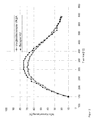
- FIG. 1 the NOx conversion of the catalyst according to the invention K1 and the comparative catalyst VK1A is shown as a function of the temperature before the catalyst in a model gas reactor.
- the catalyst alternately for 80s with "lean” exhaust gas and for 10s with "rich” exhaust gas applied.
- a constant amount of 500 ppm NO and 33 ppm propene and 17 ppm propane are metered.
- Comparison of catalysts K1 and VK1A in FIG. 1 shows that the catalyst of the invention K1 has an improved NOx conversion at temperatures ⁇ 350 ° C, while the NOx conversion has remained the same at higher temperatures.
- FIG. 2 is the NOx conversion of the inventive catalyst K2 and the comparative catalyst VK2A from the temperature before the catalyst measured according to the same procedure as in FIG. 1 shown. It can be seen that by reducing the washcoat loading of the washcoat layer B, the NOx conversion can be increased while the cerium oxide content remains the same.
- Table 1 shows the summary of all catalysts.
- the amount of NOx stored relative to catalyst volume is shown in the first 800 seconds of a NEDC drive cycle.
- the exhaust gas of a typical Euro 6 diesel engine is simulated in a model gas reactor and passed over the catalyst sample.
- the first 800s of the NEDC cycle show the NOx storage behavior at temperatures ⁇ 200 ° C.
- the values for the stored NOx mass in Table 1 show that only in the examples according to the invention the storage capacity is> 850 mg / l based on the catalyst volume.
- FIG. 3 the relationship between the amount of NOx stored in the first 800 seconds of a NEDC drive cycle and the washcoat loading of the washcoat layer B and the ceria fraction therein is shown.
- the dots above the black line correspond to the examples of the invention having sufficient NOx storage properties.
Landscapes
- Chemical & Material Sciences (AREA)
- Engineering & Computer Science (AREA)
- Chemical Kinetics & Catalysis (AREA)
- Materials Engineering (AREA)
- Organic Chemistry (AREA)
- Combustion & Propulsion (AREA)
- Oil, Petroleum & Natural Gas (AREA)
- General Chemical & Material Sciences (AREA)
- Analytical Chemistry (AREA)
- Environmental & Geological Engineering (AREA)
- Biomedical Technology (AREA)
- Health & Medical Sciences (AREA)
- Mechanical Engineering (AREA)
- General Engineering & Computer Science (AREA)
- Catalysts (AREA)
- Exhaust Gas After Treatment (AREA)
Abstract
Description
- Die vorliegende Erfindung betrifft einen Katalysator zur Reduktion von Stickoxiden, das im Abgas mager betriebener Verbrennungsmotoren enthalten ist.
- Das Abgas von Kraftfahrzeugen, die mit mager betriebenen Verbrennungsmotoren, beispielsweise mit Dieselmotoren, betrieben werden, enthält neben Kohlenmonoxid (CO) und Stickoxiden (NOx) auch Bestandteile, die aus der unvollständigen Verbrennung des Kraftstoffs im Brennraum des Zylinders herrühren. Dazu gehören neben Rest-Kohlenwasserstoffen (HC), die meist ebenfalls überwiegend gasförmig vorliegen, Partikelemissionen, auch als "Dieselruß" oder "Russpartikel" bezeichnet. Dabei handelt es sich um komplexe Agglomerate aus überwiegend Kohlenstoff-haltigen FeststoffTeilchen und einer anhaftenden Flüssigphase, die meist mehrheitlich aus längerkettigen Kohlenwasserstoff-Kondensaten besteht. Die auf den festen Bestandteilen anhaftende Flüssigphase wird auch als "Soluble Organic Fraction SOF" oder "Volatile Organic Fraction VOF" bezeichnet.
- Zur Reinigung dieser Abgase müssen die genannten Bestandteile möglichst vollständig in unschädliche Verbindungen umgewandelt werden, was nur unter Einsatz geeigneter Katalysatoren möglich ist.
- Zur Entfernung der Stickoxide sind sogenannte Stickoxid-Speicherkatalysatoren, für die auch der Begriff "Lean NOx Trap" oder LNT üblich ist, bekannt. Deren Reinigungswirkung beruht darauf, dass in einer mageren Betriebsphase des Motors die Stickoxide vom Speichermaterial des Speicherkatalysators vorwiegend in Form von Nitraten gespeichert werden und diese in einer darauf folgenden fetten Betriebsphase des Motors wieder zersetzt und die so freiwerdenden Stickoxide mit den reduzierenden Abgasanteilen am Speicherkatalysator zu Stickstoff, Kohlendioxid und Wasser umgesetzt werden. Diese Arbeitsweise ist beispielsweise in der SAE-Schrift SAE 950809 beschrieben.
- Als Speichermaterialien kommen insbesondere Oxide, Carbonate oder Hydroxide von Magnesium, Calcium, Strontium, Barium, der Alkalimetalle, der Seltenerdmetalle oder Mischungen davon in Frage. Diese Verbindungen sind aufgrund ihrer basischen Eigenschaften in der Lage, mit den sauren Stickoxiden des Abgases Nitrate zu bilden und sie auf diese Weise abzuspeichern. Sie sind zur Erzeugung einer großen Wechselwirkungsfläche mit dem Abgas in möglichst hoher Dispersion auf geeigneten Trägermaterialien abgeschieden. Stickoxid-Speicherkatalysatoren enthalten darüber hinaus in der Regel Edelmetalle wie Platin, Palladium und/oder Rhodium als katalytisch aktive Komponenten. Deren Aufgabe ist es einerseits, unter mageren Bedingungen NO zu NO2, sowie CO und HC zu CO2 zu oxidieren und andererseits während der fetten Betriebsphasen, in denen der Stickoxid-Speicherkatalysator regeneriert wird, freigesetztes NO2 zu Stickstoff zu reduzieren.
- Mit der Veränderung der Abgasgesetzgebung nach Euro 6 werden zukünftige Abgassysteme sowohl bei kalten Temperaturen im Stadtzyklus, als auch bei hohen Temperaturen, wie sie bei hohen Lasten auftreten, ausreichende NOx-Konvertierung aufweisen müssen. Bekannte Stickoxid-Speicherkatalysatoren zeigen aber entweder eine ausgeprägte NOx-Speicherung bei niedrigen oder bei hohen Temperaturen. Eine gute NOx-Konvertierung über einen breiten Temperaturbereich von 200 bis 450°C, die zur Erfüllung künftiger Abgasgesetzgebung unerlässlich ist, kann bisher nicht erreicht werden.
- Die
EP 0 885 650 A2 beschreibt einen Abgasreinigungskatalysator für Verbrennungsmotoren mit zwei katalytisch aktiven Schichten auf einem Tragkörper. Die auf dem Tragkörper befindliche Schicht umfasst ein oder mehrere hochdisperse Erdalkalioxide, mindestens ein Platingruppenmetall, sowie wenigstens ein feinteiliges, Sauerstoff speicherndes Material. Dabei stehen die Platingruppenmetalle mit allen Bestandteilen der ersten Schicht in enger Berührung. Die zweite Schicht steht mit dem Abgas in direktem Kontakt und enthält mindestens ein Platingruppenmetall, sowie wenigstens ein feinteiliges, Sauerstoff speicherndes Material. Nur ein Teil der feinteiligen Feststoffe der zweiten Schicht dient als Träger für die Platingruppenmetalle. - Aus der
US2009/320457 ist ein Stickoxid-Speicherkatalysator bekannt, der zwei übereinander liegende Katalysatorschichten auf einem Trägersubstrat umfasst. Die untere, direkt auf dem Trägersubstrat liegende Schicht umfasst ein oder mehrere Edelmetalle, sowie ein oder mehrere Stickoxid-Speicherkomponenten. Die obere Schicht umfasst ein oder mehrere Edelmetalle, sowie Ceroxid und ist frei von Alkali- oder Erdalkalikomponenten. - Katalysatorsubstrate, die Stickoxid-Speichermaterialien enthalten und zwei oder mehr Schichten aufweisen, sind auch in der
WO 2012/029050 beschrieben. Die erste Schicht befindet sich direkt auf dem Trägersubstrat und umfasst Platin und/oder Palladium, während sich die zweite Schicht auf der ersten befindet und Platin umfasst. Beide Schichten enthalten außerdem ein oder mehrere Sauerstoffspeichermaterialien und ein oder mehrere Stickoxid-Speichermaterialien, die ein oder mehrere Alkali- und/oder Erdalkalimetalle umfassen. Die Gesamtmenge an Alkali- und Erdalkalimetall in den Stickoxid-Speichermaterialien beträgt 0,18 bis 2,5 g/in3, berechnet als Alkalimetalloxid M2O und Erdalkalimetalloxid MO. - Die vorliegende Erfindung betrifft einen Stickoxid-Speicherkatalysator aus mindestens zwei katalytisch aktiven Washcoatschichten auf einem Tragköper,
wobei - eine untere Washcoatschicht A Ceroxid, eine Erdalkaliverbindung und/oder eine Alkaliverbindung, sowie Platin und/oder Palladium enthält und
- eine obere Washcoatschicht B, die über der Washcoatschicht A angeordnet ist, Ceroxid, sowie Platin und/oder Palladium und keine Erdalkaliverbindung enthält
und wobei die Washcoatschicht B in einer Menge von 50 bis 200g/l , bezogen auf das Volumen des Tragkörpers, vorliegt und der Mindest-Massenanteil in % von Ceroxid in der Washcoatschicht B sich aus der Formel
errechnet. - Das in den Washcoatschichten A und B eingesetzte Ceroxid kann handelsüblicher Qualität sein, d.h. einen Ceroxid-Anteil von 90 bis 100 Gew.% aufweisen.
In einer Ausführungsform der vorliegenden Erfindung wird Ceroxid in der Washcoatschicht A in einer Menge von 30 bis 120 g/l, insbesondere 30 bis 80 g/l, eingesetzt.
In der Washcoatschicht B errechnet sich der Mindest-Massenanteil in % von Ceroxid nach oben genannter Formel.
Für eine Washcoatbeladung von 50g/l ergibt sich somit ein Mindest-Massenanteil von Ceroxid von 35%, entsprechend 17,5 g/l bezogen auf das Volumen des Tragkörpers.
Für eine Washcoatbeladung von 200g/l ergibt sich somit ein Mindest-Massenanteil von Ceroxid von 50%, entsprechend 100 g/l bezogen auf das Volumen des Tragkörpers. - In einer Ausführungsform der vorliegenden Erfindung beträgt der Massenanteil von Ceroxid in der Washcoatschicht B mindestens 50%, was je nach Gesamtbeladung von Washcoatschicht B Mengen von mindestens 25 bis 100 g/l, bezogen auf das Volumen des Tragkörpers, entspricht.
- In einer weiteren Ausführungsform der vorliegenden Erfindung liegt die Washcoatschicht B in einer Menge von 75 bis 150g/l, bezogen auf das Volumen des Tragkörpers, vor. Dementsprechend betragen in diesem Fall die Ceroxid-Mengen mindestens 28,1 bis 67,5 g/l, jeweils bezogen aus das Volumen des Tragkörpers.
- In einer weiteren Ausführungsform der vorliegenden Erfindung liegt die Washcoatschicht B in einer Menge von 80 bis 130g/l, bezogen auf das Volumen des Tragkörpers, vor. Dementsprechend betragen in diesem Fall die Ceroxid-Mengen mindestens 30,4 bis 55,9 g/l, jeweils bezogen aus das Volumen des Tragkörpers.
- Die Obergrenze der in Washcoatschicht B enthaltenen Ceroxid-Menge ergibt sich aus der maximalen Washcoatbeladung von 200g/l abzüglich der
Mengen an Edelmetall und den Trägermaterialien für die Edelmetalle, sowie gegebenenfalls enthaltenen weiteren Bestandteilen von Washcoatschicht B. In bevorzugten Ausführungsformen der vorliegenden Erfindung enthält aber Washcoatschicht B außer Ceroxid, Edelmetall und Trägermaterialien für das Edelmetall keine weiteren Bestandteile.
Die maximale Menge Ceroxid, die in Washcoatschicht B enthalten sein kann, kann also in einfacher Weise errechnet werden. - In einer Ausführungsform der vorliegenden Erfindung enthält Washcoatschicht B nicht nur keine Erdalkaliverbindung, sondern auch keine Alkaliverbindung.
- Die Washcoatschichten A und B können jeweils Platin oder Palladium enthalten, in bevorzugten Ausführungsformen der vorliegenden Erfindung enthalten sie aber beide Platin und Palladium. Dabei beträgt Verhältnis Platin zu Palladium 1:2 bis 20: 1, insbesondere 1:1 1 bis 10: 1, beispielsweise 1:1, 2:1, 4:1 und 10:1.
- In Ausführungsformen der vorliegenden Erfindung enthalten Washcoatschicht A und/oder Washcoatschicht B als weiteres Edelmetall Rhodium. Rhodium liegt in diesem Fall insbesondere in Mengen von 0,1 bis 10 g/ft3 (entspricht 0,003 bis 0,35 g/l), bezogen auf das Volumen des Tragkörpers, vor.
- Sowohl in der Washcoatschicht A, als auch in der Washcoatschicht B liegen die Edelmetalle Platin und/oder Palladium und gegebenenfalls Rhodium üblicherweise auf geeigneten Trägermaterialien vor. Als solche werden hochoberflächige, hochschmelzende Oxide verwendet, beispielsweise Aluminiumoxid, Siliziumdioxid, Titandioxid, aber auch Mischoxide wie beispielsweise Cer-Zirkon-Mischoxide.
In Ausführungsformen der vorliegenden Erfindung wird als Trägermaterial für die Edelmetalle Aluminiumoxid verwendet, insbesondere solches, das durch 1 bis 6 Gew.%, insbesondere 4 Gew.-%, Lanthanoxid stabilisiert ist. - Als Erdalkaliverbindung in der Washcoatschicht A kommen insbesondere Oxide, Carbonate oder Hydroxide von Strontium und Barium in Frage, besonders Bariumoxid und Strontiumoxid.
Als Alkaliverbindung in der Washcoatschicht A kommen insbesondere Oxide, Carbonate oder Hydroxide von Lithium, Kalium und Natrium in Frage. - In Ausführungsformen der vorliegenden Erfindung liegt die Erdalkali- bzw, Alkaliverbindung in Mengen von 10 bis 50 g/l, besonders 15 bis 20 g/l, berechnet als Erdalkali- bzw. Alkalioxid, vor.
- In einer bevorzugten Ausführungsform betrifft die vorliegende Erfindung einen Stickoxid-Speicherkatalysator aus mindestens zwei katalytisch aktiven Washcoatschichten auf einem Tragköper,
wobei - eine untere Washcoatschicht A
- o Ceroxid in einer Menge von 30 bis 80 g/l,
- o Platin und Palladium im Verhältnis 10:1, sowie
- o Bariumoxid; enthält und
- eine obere Washcoatschicht B über der unteren Washcoatschicht A angeordnet ist und
- o keine Erdalkaliverbindung und keine Alkaliverbindung,
- o Platin und Palladium im Verhältnis 10:1, sowie
- o Ceroxid in einer Menge von 40 bis 100 g/l
- Die Aufbringung der katalytisch aktiven Waschcoatschichten A und B auf den Tragkörper erfolgt nach den üblichen Tauchbeschichtungsverfahren bzw. Pump- und Saug-Beschichtungsverfahren mit sich anschließender thermischer Nachbehandlung (Kalzination und gegebenenfalls Reduktion mit Formiergas oder Wasserstoff). Diese Verfahren sind aus dem Stand der Technik hinreichend bekannt.
- Die erfindungsgemäßen Stickoxid-Speicherkatalysatoren eignen sich in hervorragender Weise zur Konvertierung von NOx in Abgasen von Kraftfahrzeugen, die mit mager betriebenen Motoren, etwa Dieselmotoren, betrieben werden. Sie erreichen eine gute NOx-Konvertierung bei Temperaturen von circa 200 bis 450°C, ohne dass NOx-Konvertierung bei hohen Temperaturen negativ beeinflusst wird. Die erfindungsgemäßen Stickoxid-Speicherkatalysatoren sind somit für Euro 6 Anwendungen geeignet.
- Die vorliegende Erfindung betrifft somit auch ein Verfahren zur Konvertierung von NOx in Abgasen von Kraftfahrzeugen, die mit mager betriebenen Motoren, etwa Dieselmotoren, betrieben werden, das dadurch gekennzeichnet ist, dass das Abgas über einen Stickoxid-Speicherkatalysator aus mindestens zwei katalytisch aktiven Washcoatschichten auf einem Tragköper geleitet wird,
wobei - eine untere Washcoatschicht A Ceroxid, eine Erdalkaliverbindung und/oder einer Alkaliverbindung, sowie Platin und/oder Palladium enthält und
- eine obere Washcoatschicht B, die über der Washcoatschicht A angeordnet ist, Ceroxid, sowie Platin und/oder Palladium und keine Erdalkaliverbindung enthält
- Ausgestaltungen des erfindungsgemäßen Verfahrens hinsichtlich des Stickoxid-Speicherkatalysators entsprechen den oben stehenden Beschreibungen.
- Die Erfindung wird in den nachstehenden Beispielen und Figuren näher erläutert.
-
Figur 1 : NOx-Konvertierung der Katalysatoren K1, VK1A in Abhängigkeit der Temperatur. -
Figur 2 : NOx-Konvertierung der Katalysatoren K2 und VK2A in Abhängigkeit von der Temperatur. -
Figur 3 : Gespeicherte NOx-Masse in den ersten 800s eines NEDC-Fahrzyklus bezogen auf das Katalysatorvolumen in Abhängigkeit der Washcoatbeladung der oberen Washcoatschicht B und dem Ceroxid-Massenanteil in der Washcoatschicht B. - Zur Herstellung eines erfindungsgemäßen Katalysators wird ein wabenförmiger Keramikträger mit einer ersten Washcoatschicht A beschichtet, die Pt, Pd und Rh geträgert auf einem Lanthan-stabilisiertem Alumina, Ceroxid in einer Menge 47 g/l, sowie 17 g/l Bariumoxid und 15 g/l Magnesiumoxid enthält. Die Beladung von Pt und Pd beträgt dabei 50 g/cft (1,766 g/l) und 5 g/cft (0,177 g/l) und die Gesamtbeladung der Washcoatschicht 181 g/l bezogen auf das Volumen des Keramik-Trägers. Auf die erste Washcoatschicht wird eine weitere Washcoatschicht B aufgebracht, die ebenfalls Pt und Pd sowie Rh geträgert auf einem Lanthan-stabilisiertem Alumina enthält. Die Beladung von Pt, Pd und Rh in dieser Washcoatschicht beträgt 50 g/cft (1,766 g/l), 5 g/cft (0,177 g/l) und 5 g/cft (0,177 g/I). Die Washcoatschicht B enthält außerdem 93 g/l Ceroxid bei einer Washcoatbeladung der Schicht B von 181 g/l.
Der so erhaltene Katalysator wird nachstehend K1 genannt. - Die Vergleichsbeispiele 1a bis 1c unterscheiden sich von Beispiel 1 dadurch, dass die Mengen an Ceroxid in Washcoatschicht A und B variiert sind bei einer konstanten Gesamt-Ceroxidmenge von 140 g/l und konstanter Washcoat-Beladung der Washcoatschicht A und B. Die Ceroxid-Aufteilung der Vergleichsbeispiele 1a bis 1c ergeben sich aus nachfolgender Tabelle 1. Die so erhaltenen Katalysatoren werden nachstehend VK1A, VK1B bzw. VK1C genannt.
- Beispiel 2 unterscheidet sich von den vorangegangenen Beispielen dadurch, dass die untere Washcoatschicht A eine Washcoatbeladung von 300 g/l und eine Ceroxid-Menge von 116 g/l aufweist. Dagegen hat die obere Washcoatschicht B eine Washcoatbeladung von 62 g/l und eine Ceroxid-Beladung von 24 g/l. Dies entspricht einem Ceroxid-Anteil in der Washcoatschicht B von 39%.
Der so erhaltene Katalysator wird nachstehend K2 genannt. - Die Vergleichsbeispiele 2a bis 2c unterscheiden sich von Beispiel 2 dadurch, dass Washcoatbeladungen der Washcoatschichten A und B variiert sind, wobei die Gesamt-Washcoatbeladungen beider Schichten konstant 362 g/l beträgt. Ebenso ist die Ceroxid-Anteil in der Washcoatschicht B konstant bei 39% und die Gesamt-Ceroxide-Menge konstant bei 140 g/l bezogen auf das Katalysatorvolumen. Die Washcoatbeladungen der Washcoatschicht B und die Ceroxid-Mengen in den Washcoatschichten A und B ergeben sich aus nachfolgender Tabelle 1.
Die so erhaltenen Katalysatoren werden nachstehend VK2A, VK2B bzw. VK2C genannt. - Beispiel 3 unterscheidet sich von den vorangegangenen Beispielen dadurch, dass untere Washcoatschicht A eine Washcoatbeladung von 235 g/l und eine Ceroxid-Menge von 65 g/l aufweist. Dagegen hat die obere Washcoatschicht B eine Washcoatbeladung von 127 g/l und eine Ceroxid-Beladung von 75 g/l. Dies entspricht einem Ceroxid-Anteil in der Washcoatschicht B von 75%.
Der so erhaltene Katalysator wird nachstehend K2 genannt. - Vor der Durchführung von Vergleichsversuchen wurden alle Katalystoren 16h bei 750°C unter wechselnder fett/mager Atmosphäre gealtert. Dabei dauerte jede fett-Phase 60s und enthielt 4 vol% CO, während die mager-Phase ebenfalls 60 s dauerte und 10vol% O2 enthielt. Während der gesamten Alterung wurden zusätzlich 10vol% H2O dosiert.
- In der
US2009/320457 wird in Figur 8 gezeigt, dass Beispiel-Katalysator 1 im Vergleich zu einem Katalysator A eine verbesserte NOx-Konvertierung bei Temperaturen < 300°C aufweist, dagegen bei T > 350°C schlechtere Konvertierung zeigt. Beispiel-Katalysator 1 weist zwei Washcoatschichten auf, wobei die erste Schicht eine Washcoatbeladung von 1,7 g/in3 (104 g/l) und die zweite Schicht eine Washcoatbeladung von 2,6 g/in3 (159 g/l) hat. Über die Ceroxid-Menge in der zweiten Washcoatschicht sind keine klaren Angaben gemacht. - In
Figur 1 ist die NOx-Konvertierung des erfindungsgemäßen Katalysators K1 und des Vergleichskatalysators VK1A in Abhängigkeit von der Temperatur vor dem Katalysator in einem Modellgasreaktor gezeigt. Dabei wird, während die Temperatur von 600°C auf 150°C mit 7,5°C pro Minute abgesenkt wird, der Katalysator abwechselnd für 80s mit "magerem" Abgas und für 10s mit "fettem" Abgas beaufschlagt. Während des Testes wird konstant 500 ppm NO und 33 ppm Propen sowie 17 ppm Propan dosiert. Der Vergleich der Katalysatoren K1 und VK1A inFigur 1 zeigt, dass der erfindungsgemäße Katalysator K1 eine verbesserte NOx-Konvertierung bei Temperaturen < 350°C aufweist, während die NOx-Konvertierung bei höheren Temperaturen gleich geblieben ist. - In
Figur 2 ist die NOx-Konvertierung des erfindungsgemäßen Katalysators K2 und des Vergleichskatalysators VK2A von der Temperatur vor dem Katalysator gemessen nach derselben Prozedur wie inFigur 1 dargestellt. Dabei zeigt sich, dass durch Verringerung der Washcoatbeladung der Washcoatschicht B bei gleich bleibenden Ceroxid-Anteil die NOx-Konvertierung gesteigert werden kann. - Tabelle 1 zeigt die Zusammenfassung aller Katalysatoren. Zusätzlich ist die gespeicherte NOx-Menge bezogen auf das Katalysatorvolumen in den ersten 800s eines NEDC-Fahrzyklus gezeigt. Dazu wird das Abgas eines typischen Euro 6 Diesel-Motors in einem Modellgasreaktor simuliert und über die Katalysatorprobe geleitet. Die ersten 800s des NEDC-Zyklus zeigen das NOx-Einspeicherverhalten bei Temperaturen < 200°C. Um die Euro 6 Abgasnorm zu erfüllen, ist es dabei besonders wichtig in diesem Bereich eine hohe NOx-Speicherkapazität zu zeigen. Die Werte für die eingespeicherte NOx-Masse in Tabelle 1 zeigen, dass nur bei den erfindungsgemäßen Beispielen die Speicherkapazität > 850 mg/l bezogen auf das Katalysatorvolumen beträgt.
Tabelle 1 Katalysator Ceroxid Washcoat Ceroxid Washcoat Ceroxid-Massenanteil Washcoat-beladung Gespeicherte NOx-Menge A [g/l] B [g/l] B [%] B [g/] [g/l] VK1A 116 24 13 181 732 VK1B 93 47 26 181 746 VK1C 70 70 39 181 777 K1 47 93 52 181 868 VK2A 47 93 39 241 796 VK2B 70 70 39 181 809 VK2C 93 47 39 121 850 K2 116 24 39 62 860 K3 65 75 59 127 870 - In
Figur 3 ist der Zusammenhang zwischen der eingespeicherten NOx-Menge in den ersten 800s eines NEDC-Fahrzyklus und der Washcoatbeladung der Washcoatschicht B sowie dem Ceroxid-Anteil in dieser gezeigt. Die Punkte oberhalb der schwarzen Linie entsprechen den erfindungsgemäßen Beispielen mit ausreichenden NOx-Speichereigenschaften. Der Ceroxid-Anteil in der Washcoatschicht B muss daher mindestes dem mit folgender Formel berechnetem Anteil entsprechen: Mindest-Ceroxid-Anteil in der Washcoatschicht B [%] = 0,1 x Washcoatbeladung B [g/l] + 30.

errechnet.
Claims (11)
- Stickoxid-Speicherkatalysator aus mindestens zwei katalytisch aktiven Washcoatschichten auf einem Tragköper,
wobei- eine untere Washcoatschicht A Ceroxid, eine Erdalkaliverbindung und/oder eine Alkaliverbindung, sowie Platin und/oder Palladium enthält und- eine obere Washcoatschicht B, die über der Washcoatschicht A angeordnet ist, Ceroxid, sowie Platin und/oder Palladium und keine Erdalkaliverbindung enthältund wobei die Washcoatschicht B in einer Menge von 50 bis 200g/l , bezogen auf das Volumen des Tragkörpers, vorliegt und der Mindest-Massenanteil in % von Ceroxid in der Washcoatschicht B sich aus der Formel
errechnet. - Stickoxid-Speicherkatalysator nach Anspruch 1, dadurch gekennzeichnet, dass die Washcoatschicht A Ceroxid in einer Menge von 30 bis 100 g/l enthält.
- Stickoxid-Speicherkatalysator nach Anspruch 1 und/oder 2, dadurch gekennzeichnet, die Washcoatschicht B in einer Menge von 80 bis 130 g/l, bezogen auf das Volumen des Tragkörpers, vorliegt.
- Stickoxid-Speicherkatalysator nach einem oder mehreren der Ansprüche 1 bis 3, dadurch gekennzeichnet, dass der Massenanteil von Ceroxid in der Washcoatschicht B mindestens 50% beträgt.
- Stickoxid-Speicherkatalysator nach einem oder mehreren der Ansprüche 1 bis 4, dadurch gekennzeichnet, dass die Washcoatschicht B keine Alkaliverbindung enthält.
- Stickoxid-Speicherkatalysator nach einem oder mehreren der Ansprüche 1 bis 5, dadurch gekennzeichnet, dass die Washcoatschicht A und die Washcoatschicht B jeweils Platin und Palladium enthält.
- Stickoxid-Speicherkatalysator nach Anspruch 6, dadurch gekennzeichnet, dass das Verhältnis Platin zu Palladium 1:2 bis 20:1 beträgt.
- Stickoxid-Speicherkatalysator nach einem oder mehreren der Ansprüche 1 bis 7, dadurch gekennzeichnet, dass die Washcoatschicht A Erdalkaliverbindung und/oder Alkaliverbindung in Mengen von 10 bis 50 g/l, bezogen auf das Volumen des Tragkörpers, enthält.
- Stickoxid-Speicherkatalysator nach einem oder mehreren der Ansprüche 1 bis 8, dadurch gekennzeichnet, dass die Erdalkaliverbindung in Washcoatschicht A Bariumoxid oder Strontiumoxid ist.
- Stickoxid-Speicherkatalysator nach einem oder mehreren der Ansprüche 1 bis 9, dadurch gekennzeichnet, dass er- eine untere Washcoatschicht A, dieo Ceroxid in einer Menge von 30 bis 80 g/l,o Platin und Palladium im Verhältnis 10:1, sowieo Bariumoxid; enthält und- eine obere Washcoatschicht B über der unteren Washcoatschicht A angeordnet ist, dieo keine Erdalkaliverbindung und keine Alkaliverbindung,o Platin und Palladium im Verhältnis 10:1, sowieo Ceroxid in einer Menge von 40 bis 100 g/l enthältumfasst, wobei die Washcoatschicht B in Mengen von 80 bis 130 g/l vorliegt und wobei sich die Mengenangabe g/l jeweils auf das Volumen des Tragkörpers bezieht.
- Verfahren zur Konvertierung von NOx in Abgasen von Kraftfahrzeugen, die mit mager betriebenen Motoren betrieben werden, dadurch gekennzeichnet, dass das Abgas über einen Stickoxid-Speicherkatalysator aus mindestens zwei katalytisch aktiven Washcoatschichten auf einem Tragköper geleitet wird,
wobei- eine untere Washcoatschicht A Ceroxid, eine Erdalkaliverbindung und/oder eine Alkaliverbindung, sowie Platin und/oder Palladium enthält und- eine obere Washcoatschicht B, die über der Washcoatschicht A angeordnet ist, Ceroxid, sowie Platin und/oder Palladium und keine Erdalkaliverbindung enthält,und wobei die Washcoatschicht B in einer Menge von 50 bis 200g/l , bezogen auf das Volumen des Tragkörpers, vorliegt und der Mindest-Massenanteil in % von Ceroxid in der Washcoatschicht B sich aus der Formel
errechnet.
Priority Applications (7)
| Application Number | Priority Date | Filing Date | Title |
|---|---|---|---|
| EP13156095.5A EP2769760A1 (de) | 2013-02-21 | 2013-02-21 | Katalysator zur Reduktion von Stickoxiden |
| KR1020157025593A KR20150120460A (ko) | 2013-02-21 | 2014-02-21 | 질소 산화물의 감소를 위한 방법 및 촉매 |
| JP2015558455A JP2016508872A (ja) | 2013-02-21 | 2014-02-21 | 窒素酸化物を低減するための触媒および方法 |
| CN201480007639.0A CN104968416A (zh) | 2013-02-21 | 2014-02-21 | 用于还原氮氧化物的催化剂和方法 |
| EP14706538.7A EP2958660A1 (de) | 2013-02-21 | 2014-02-21 | Katalysator und verfahren zur reduktion von stickoxiden |
| US14/763,241 US20150352495A1 (en) | 2013-02-21 | 2014-02-21 | Catalyst and method for the reduction of nitrogen oxides |
| PCT/EP2014/053383 WO2014128236A1 (de) | 2013-02-21 | 2014-02-21 | Katalysator und verfahren zur reduktion von stickoxiden |
Applications Claiming Priority (1)
| Application Number | Priority Date | Filing Date | Title |
|---|---|---|---|
| EP13156095.5A EP2769760A1 (de) | 2013-02-21 | 2013-02-21 | Katalysator zur Reduktion von Stickoxiden |
Publications (1)
| Publication Number | Publication Date |
|---|---|
| EP2769760A1 true EP2769760A1 (de) | 2014-08-27 |
Family
ID=47750469
Family Applications (2)
| Application Number | Title | Priority Date | Filing Date |
|---|---|---|---|
| EP13156095.5A Withdrawn EP2769760A1 (de) | 2013-02-21 | 2013-02-21 | Katalysator zur Reduktion von Stickoxiden |
| EP14706538.7A Withdrawn EP2958660A1 (de) | 2013-02-21 | 2014-02-21 | Katalysator und verfahren zur reduktion von stickoxiden |
Family Applications After (1)
| Application Number | Title | Priority Date | Filing Date |
|---|---|---|---|
| EP14706538.7A Withdrawn EP2958660A1 (de) | 2013-02-21 | 2014-02-21 | Katalysator und verfahren zur reduktion von stickoxiden |
Country Status (6)
| Country | Link |
|---|---|
| US (1) | US20150352495A1 (de) |
| EP (2) | EP2769760A1 (de) |
| JP (1) | JP2016508872A (de) |
| KR (1) | KR20150120460A (de) |
| CN (1) | CN104968416A (de) |
| WO (1) | WO2014128236A1 (de) |
Cited By (2)
| Publication number | Priority date | Publication date | Assignee | Title |
|---|---|---|---|---|
| EP3097977A4 (de) * | 2014-01-22 | 2017-09-27 | Umicore Shokubai Japan Co., Ltd. | Abgasreinigungskatalysator für magermotor |
| EP3411143A1 (de) * | 2016-02-02 | 2018-12-12 | Umicore Ag & Co. Kg | Mehrschichtiger stickoxidspeicherkatalysator mit mangan |
Families Citing this family (10)
| Publication number | Priority date | Publication date | Assignee | Title |
|---|---|---|---|---|
| KR102222544B1 (ko) | 2013-01-08 | 2021-03-05 | 우미코레 아게 운트 코 카게 | 질소 산화물 환원을 위한 촉매 |
| KR102611568B1 (ko) * | 2015-03-03 | 2023-12-11 | 바스프 코포레이션 | 고온 및 저온 성능이 향상된 희박 NOx 트랩 |
| CN108778490A (zh) * | 2016-02-22 | 2018-11-09 | 优美科股份公司及两合公司 | 用于还原氮氧化物的催化剂 |
| CN105749911B (zh) * | 2016-02-26 | 2019-02-12 | 凯龙蓝烽新材料科技有限公司 | 一种氨氧化催化剂的制备方法 |
| DE102016207484A1 (de) * | 2016-05-02 | 2017-11-02 | Umicore Ag & Co. Kg | Dieseloxidationskatalysator |
| GB2557673A (en) * | 2016-12-15 | 2018-06-27 | Johnson Matthey Plc | NOx adsorber catalyst |
| GB2560943A (en) * | 2017-03-29 | 2018-10-03 | Johnson Matthey Plc | NOx adsorber catalyst |
| KR101971638B1 (ko) * | 2017-08-28 | 2019-04-23 | 희성촉매 주식회사 | 비-백금족 NOx 트랩층을 가지는 NOx 트랩 촉매 |
| US20220118427A1 (en) | 2018-12-28 | 2022-04-21 | Rhodia Operations | Use of cerium oxide for the preparation of a lean nox trap catalytic composition and a method of treatment of an exhaust gas using the composition |
| JPWO2024014409A1 (de) * | 2022-07-13 | 2024-01-18 |
Citations (7)
| Publication number | Priority date | Publication date | Assignee | Title |
|---|---|---|---|---|
| EP0764459A2 (de) * | 1995-09-21 | 1997-03-26 | Ford Motor Company Limited | Stickstoffoxid-Abscheider |
| EP0885650A2 (de) | 1997-06-20 | 1998-12-23 | Degussa Aktiengesellschaft | Abgasreinigungskatalysator für Verbrennungsmotoren mit zwei katalytisch aktiven Schichten auf einem Tragkörper |
| US20090320457A1 (en) | 2008-06-27 | 2009-12-31 | Wan Chung Z | NOx Adsorber Catalyst with Superior Low Temperature Performance |
| US20110305612A1 (en) * | 2010-06-10 | 2011-12-15 | Basf Se | Nox storage catalyst with improved hydrocarbon conversion activity |
| EP2404669A1 (de) * | 2009-03-06 | 2012-01-11 | ICT Co., Ltd. | Katalysator zur abgasreinigung |
| WO2012029050A1 (en) | 2010-09-02 | 2012-03-08 | Basf Se | Catalyst for gasoline lean burn engines with improved no oxidation activity |
| WO2012085564A1 (en) * | 2010-12-21 | 2012-06-28 | Johnson Matthey Public Limited Company | NOx ABSORBER CATALYST |
Family Cites Families (5)
| Publication number | Priority date | Publication date | Assignee | Title |
|---|---|---|---|---|
| US6348430B1 (en) * | 1997-06-20 | 2002-02-19 | Degussa Ag | Exhaust gas treatment catalyst for internal combustion engines with two catalytically active layers on a carrier structure |
| DE19838282A1 (de) * | 1998-08-24 | 2000-03-02 | Degussa | Stickoxid-Speichermaterial und daraus hergestellter Stickoxid-Speicherkatalysator |
| JP4751916B2 (ja) * | 2008-06-30 | 2011-08-17 | トヨタ自動車株式会社 | 排ガス浄化用触媒 |
| BR112012031330B1 (pt) * | 2010-06-10 | 2018-12-11 | Basf Se | catalisador armazenador de óxido de nitrogênio, sistema de tratamento para uma corrente de gás de escape de automóvel, e, método para o tratamento de gás de escape de motor de automóvel |
| EP2844388B1 (de) * | 2012-04-06 | 2019-07-17 | BASF Corporation | DIESELOXIDATIONSKATALYSATOR mit Magerbetrieb-NOx-Falle und KOHLENWASSERSTOFFSPEICHERFUNKTION |
-
2013
- 2013-02-21 EP EP13156095.5A patent/EP2769760A1/de not_active Withdrawn
-
2014
- 2014-02-21 US US14/763,241 patent/US20150352495A1/en not_active Abandoned
- 2014-02-21 WO PCT/EP2014/053383 patent/WO2014128236A1/de not_active Ceased
- 2014-02-21 JP JP2015558455A patent/JP2016508872A/ja active Pending
- 2014-02-21 EP EP14706538.7A patent/EP2958660A1/de not_active Withdrawn
- 2014-02-21 CN CN201480007639.0A patent/CN104968416A/zh active Pending
- 2014-02-21 KR KR1020157025593A patent/KR20150120460A/ko not_active Withdrawn
Patent Citations (7)
| Publication number | Priority date | Publication date | Assignee | Title |
|---|---|---|---|---|
| EP0764459A2 (de) * | 1995-09-21 | 1997-03-26 | Ford Motor Company Limited | Stickstoffoxid-Abscheider |
| EP0885650A2 (de) | 1997-06-20 | 1998-12-23 | Degussa Aktiengesellschaft | Abgasreinigungskatalysator für Verbrennungsmotoren mit zwei katalytisch aktiven Schichten auf einem Tragkörper |
| US20090320457A1 (en) | 2008-06-27 | 2009-12-31 | Wan Chung Z | NOx Adsorber Catalyst with Superior Low Temperature Performance |
| EP2404669A1 (de) * | 2009-03-06 | 2012-01-11 | ICT Co., Ltd. | Katalysator zur abgasreinigung |
| US20110305612A1 (en) * | 2010-06-10 | 2011-12-15 | Basf Se | Nox storage catalyst with improved hydrocarbon conversion activity |
| WO2012029050A1 (en) | 2010-09-02 | 2012-03-08 | Basf Se | Catalyst for gasoline lean burn engines with improved no oxidation activity |
| WO2012085564A1 (en) * | 2010-12-21 | 2012-06-28 | Johnson Matthey Public Limited Company | NOx ABSORBER CATALYST |
Cited By (3)
| Publication number | Priority date | Publication date | Assignee | Title |
|---|---|---|---|---|
| EP3097977A4 (de) * | 2014-01-22 | 2017-09-27 | Umicore Shokubai Japan Co., Ltd. | Abgasreinigungskatalysator für magermotor |
| US10376839B2 (en) | 2014-01-22 | 2019-08-13 | Umicore Shokubai Japan Co., Ltd. | Exhaust gas purification catalyst for lean burn engine |
| EP3411143A1 (de) * | 2016-02-02 | 2018-12-12 | Umicore Ag & Co. Kg | Mehrschichtiger stickoxidspeicherkatalysator mit mangan |
Also Published As
| Publication number | Publication date |
|---|---|
| EP2958660A1 (de) | 2015-12-30 |
| KR20150120460A (ko) | 2015-10-27 |
| WO2014128236A1 (de) | 2014-08-28 |
| US20150352495A1 (en) | 2015-12-10 |
| CN104968416A (zh) | 2015-10-07 |
| JP2016508872A (ja) | 2016-03-24 |
Similar Documents
| Publication | Publication Date | Title |
|---|---|---|
| EP3177400B1 (de) | Katalysator zur reduktion von stickoxiden und nox-reduktionsverfahren mittels desselben | |
| EP2943276B1 (de) | Katalysator zur reduktion von stickoxiden | |
| EP2958660A1 (de) | Katalysator und verfahren zur reduktion von stickoxiden | |
| EP4365421B1 (de) | Katalytisch aktives partikelfilter | |
| DE102014110701B4 (de) | Oxidationskatalysator zum Behandeln eines Abgases aus einem Dieselmotor, dessen Verwendungen und Verfahren zu dessen Herstellung | |
| EP1911506B1 (de) | Stickoxidspeicherkatalysator mit abgesenkter Entschwefelungstemperatur | |
| DE102016101761A1 (de) | Katalysator zur Reduktion von Stickoxiden | |
| EP2985068A1 (de) | Katalysator-System zur Reduktion von Stickoxiden | |
| DE112014000481T5 (de) | Abgasreinigungskatalysator und Herstellungsverfahren dafür | |
| DE4402436A1 (de) | Katalysator zur Abgasreinigung | |
| DE19606822A1 (de) | Katalysator zur Abgasreinigung | |
| EP1316354A1 (de) | Katalysator zur Verminderung der Stickoxide im Abgas von Magermotoren | |
| DE202007019526U1 (de) | NOx-Speichermaterialien und -Fallen, die gegenüber Wärmealterung beständig sind | |
| DE202016008848U1 (de) | Doppelschichtiger Dreiweg-Katalysator mit verbesserter Alterungsstabilität | |
| DE102014102023A1 (de) | Oxidationskatalysator für einen verbrennungsmotor | |
| WO2017144426A1 (de) | Katalysator zur reduktion von stickoxiden | |
| EP3623047B1 (de) | Katalysator zur reduktion von stickoxiden | |
| DE102013210557A1 (de) | Katalysatorzusammensetzung | |
| DE102017201568A1 (de) | Perowskit basierte sauerstoff-speichermaterialien | |
| EP3695902B1 (de) | Katalysator zur reduktion von stickoxiden | |
| WO2015059164A1 (de) | Katalysator zur oxidation von co und hc bei niedrigen temperaturen | |
| EP2905076B1 (de) | Verfahren zur herstellung eines katalysators mit hochgetemperter pd-schicht | |
| DE4435074B4 (de) | Katalysatorkomponente zur Abgasreinigung, ein Verfahren zu deren Herstellung und deren Verwendung zur Herstellung eines Abgasreinigungskatalysatorbestandteils | |
| EP3191222B1 (de) | Beschichtungssuspension | |
| DE102018102421A1 (de) | Katalysator zur emissionssteuerung eines kraftfahrzeugs |
Legal Events
| Date | Code | Title | Description |
|---|---|---|---|
| PUAI | Public reference made under article 153(3) epc to a published international application that has entered the european phase |
Free format text: ORIGINAL CODE: 0009012 |
|
| 17P | Request for examination filed |
Effective date: 20130221 |
|
| AK | Designated contracting states |
Kind code of ref document: A1 Designated state(s): AL AT BE BG CH CY CZ DE DK EE ES FI FR GB GR HR HU IE IS IT LI LT LU LV MC MK MT NL NO PL PT RO RS SE SI SK SM TR |
|
| AX | Request for extension of the european patent |
Extension state: BA ME |
|
| R17P | Request for examination filed (corrected) |
Effective date: 20150227 |
|
| RBV | Designated contracting states (corrected) |
Designated state(s): AL AT BE BG CH CY CZ DE DK EE ES FI FR GB GR HR HU IE IS IT LI LT LU LV MC MK MT NL NO PL PT RO RS SE SI SK SM TR |
|
| 17Q | First examination report despatched |
Effective date: 20171106 |
|
| STAA | Information on the status of an ep patent application or granted ep patent |
Free format text: STATUS: THE APPLICATION IS DEEMED TO BE WITHDRAWN |
|
| 18D | Application deemed to be withdrawn |
Effective date: 20180317 |