EP2771852B1 - Verfahren und anordnung zum autorisieren eines benutzers - Google Patents
Verfahren und anordnung zum autorisieren eines benutzers Download PDFInfo
- Publication number
- EP2771852B1 EP2771852B1 EP12844101.1A EP12844101A EP2771852B1 EP 2771852 B1 EP2771852 B1 EP 2771852B1 EP 12844101 A EP12844101 A EP 12844101A EP 2771852 B1 EP2771852 B1 EP 2771852B1
- Authority
- EP
- European Patent Office
- Prior art keywords
- server
- mobile terminal
- barcode
- app
- transaction
- Prior art date
- Legal status (The legal status is an assumption and is not a legal conclusion. Google has not performed a legal analysis and makes no representation as to the accuracy of the status listed.)
- Active
Links
Images

Classifications
-
- H—ELECTRICITY
- H04—ELECTRIC COMMUNICATION TECHNIQUE
- H04W—WIRELESS COMMUNICATION NETWORKS
- H04W12/00—Security arrangements; Authentication; Protecting privacy or anonymity
- H04W12/06—Authentication
-
- G—PHYSICS
- G06—COMPUTING OR CALCULATING; COUNTING
- G06Q—INFORMATION AND COMMUNICATION TECHNOLOGY [ICT] SPECIALLY ADAPTED FOR ADMINISTRATIVE, COMMERCIAL, FINANCIAL, MANAGERIAL OR SUPERVISORY PURPOSES; SYSTEMS OR METHODS SPECIALLY ADAPTED FOR ADMINISTRATIVE, COMMERCIAL, FINANCIAL, MANAGERIAL OR SUPERVISORY PURPOSES, NOT OTHERWISE PROVIDED FOR
- G06Q20/00—Payment architectures, schemes or protocols
- G06Q20/30—Payment architectures, schemes or protocols characterised by the use of specific devices or networks
- G06Q20/32—Payment architectures, schemes or protocols characterised by the use of specific devices or networks using wireless devices
- G06Q20/322—Aspects of commerce using mobile devices [M-devices]
- G06Q20/3227—Aspects of commerce using mobile devices [M-devices] using secure elements embedded in M-devices
-
- G—PHYSICS
- G06—COMPUTING OR CALCULATING; COUNTING
- G06Q—INFORMATION AND COMMUNICATION TECHNOLOGY [ICT] SPECIALLY ADAPTED FOR ADMINISTRATIVE, COMMERCIAL, FINANCIAL, MANAGERIAL OR SUPERVISORY PURPOSES; SYSTEMS OR METHODS SPECIALLY ADAPTED FOR ADMINISTRATIVE, COMMERCIAL, FINANCIAL, MANAGERIAL OR SUPERVISORY PURPOSES, NOT OTHERWISE PROVIDED FOR
- G06Q20/00—Payment architectures, schemes or protocols
- G06Q20/30—Payment architectures, schemes or protocols characterised by the use of specific devices or networks
- G06Q20/32—Payment architectures, schemes or protocols characterised by the use of specific devices or networks using wireless devices
- G06Q20/327—Short range or proximity payments by means of M-devices
- G06Q20/3276—Short range or proximity payments by means of M-devices using a pictured code, e.g. barcode or QR-code, being read by the M-device
-
- G—PHYSICS
- G06—COMPUTING OR CALCULATING; COUNTING
- G06Q—INFORMATION AND COMMUNICATION TECHNOLOGY [ICT] SPECIALLY ADAPTED FOR ADMINISTRATIVE, COMMERCIAL, FINANCIAL, MANAGERIAL OR SUPERVISORY PURPOSES; SYSTEMS OR METHODS SPECIALLY ADAPTED FOR ADMINISTRATIVE, COMMERCIAL, FINANCIAL, MANAGERIAL OR SUPERVISORY PURPOSES, NOT OTHERWISE PROVIDED FOR
- G06Q20/00—Payment architectures, schemes or protocols
- G06Q20/38—Payment protocols; Details thereof
- G06Q20/382—Payment protocols; Details thereof insuring higher security of transaction
-
- H—ELECTRICITY
- H04—ELECTRIC COMMUNICATION TECHNIQUE
- H04L—TRANSMISSION OF DIGITAL INFORMATION, e.g. TELEGRAPHIC COMMUNICATION
- H04L63/00—Network architectures or network communication protocols for network security
- H04L63/08—Network architectures or network communication protocols for network security for authentication of entities
-
- H—ELECTRICITY
- H04—ELECTRIC COMMUNICATION TECHNIQUE
- H04L—TRANSMISSION OF DIGITAL INFORMATION, e.g. TELEGRAPHIC COMMUNICATION
- H04L63/00—Network architectures or network communication protocols for network security
- H04L63/18—Network architectures or network communication protocols for network security using different networks or channels, e.g. using out of band channels
Definitions
- the present invention relates to a method, device and system for enabling secure interaction between a user and a service provider in general, and secure transaction services in particular.
- each user is provided with his personalized code-generating device, whereby the user can, when appropriate, generate codes which can be used as, for example, passwords or digital signatures.
- the code generating device may comprise a display and a numerical keypad.
- the user connects to the bank server using the browser, then uses the pin pad to prove her identity.
- This scenario uses a bank as an example, but the procedure is applicable to any application where authentication is necessary, e.g., secure communication within a company or for VPN access.
- a challenge code generated by a transaction server system
- a transaction server system is typically displayed to the user on the display of the terminal, such as an internet-connected computer or a mobile terminal.
- the user subsequently enters this challenge code in his code-generating device.
- the code-generating device Based on the entered code, the code-generating device generates a response code, a digital signature, which the user provides to the transaction server system through his communication device. If the digital signature can be verified by the transaction server system, the transaction is carried out.
- codes into the code-generating device may, however, be seen as cumbersome by the user, which may motivate the transaction service provider to make a trade-off between security and ease-of-use which may, for example, involve limiting the complexity and/or occurrence of digital signature challenges.
- the security level is decreased without achieving a truly user-friendly method for secure interaction.
- US2011251892 relates to systems and methods for using mobile devices to conduct payment transactions at merchant locations as well as for person to person transactions. This document does not define erasing said first authentication data from a memory of said first terminal by said first application, storing said challenge number in a local database of said server along with current time and information about a browser session, converting the challenge number to a short text string and creating the recognition data in form of a barcode containing the text string.
- visual codes such as barcodes are used to facilitate authentication of users and to perform actions such as signing documents or performing peer-to-peer transactions/payments.
- a method of using a barcode to facilitate an authentication of a first mobile terminal of a seller and a second mobile terminal of a buyer when performing a transaction between the seller and the buyer comprises:
- the secret is a PIN code.
- said barcode is provided through image recording.
- the method may further comprise one or several steps of: entering a description of the transaction, entering a private description of the transaction, selecting a different transaction currency, or entering an alias for a user.
- encryption is based on Public Key Infrastructure, PKI, where the server has a private key and every terminal has a corresponding public key.
- a SSL protocol is used for communication to and from the server.
- step k. executed on the second mobile terminal further comprises: composing a confirmation message comprising the unique code, the session number, the transaction id, the second identity and the third identity; adding a random data to the confirmation message; encrypting the confirmation message using a server public key; and sending the confirmation message over a secure connection to the server.
- the server receives the confirmation message, decrypts the message and compares the unique code in the confirmation message with the one stored in the server. If the unique code is correct, the server validates the session number, and if the session number is valid, the transaction id, the second identity and the third identity are further controlled by the server.
- the server creates and provides a barcode in form of a barcode containing a challenge, using a standard image tag for the challenge barcode in a HTML page, when the browser renders the HTML page, automatically sending an HTTPS GET request to the server for a URL in the tag.
- step of effectuating or storing information about the event by said server In one embodiment the step of effectuating or storing information about the event by said server.
- the invention also relates to a system comprising a first mobile terminal, a second mobile terminal, and a server, the system being able to carry out the previously mentioned methods.
- the invention also relates to non-transitory computer-readable medium comprising a plurality of computer-readable instructions which, when executed by a system, cause the system to carry the previously mentioned methods.
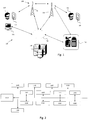
- Fig. 1 illustrates a first embodiment of a transaction system 100 implementing the teachings of the invention.
- the system 100 involve a first user 110 having a mobile terminal 111, a computer 112, a second user 120 having a mobile terminal 121, a communication network 130 comprising a number of communication nodes 131 and 132, a transaction service provider server 140, a shop (physical or virtual) 150 and a second communication network 160.
- the first communication network 130 may be a collection of terminals, links and nodes which connect to enable telecommunication between users of the terminals and configured in accordance with the Global System for Mobile Communication (GSM) and General Packet Radio Services (GPRS) standards.
- GSM Global System for Mobile Communication
- GPRS General Packet Radio Services
- the GSM/GPRS wireless network is used worldwide and it is expected that these standards may be supplemented or superseded eventually by Enhanced Data GSM Environment (EDGE) and Universal Mobile Telecommunications Service (UMTS), and Ultra Mobile Broadband (UMB).
- EDGE Enhanced Data GSM Environment
- UMTS Universal Mobile Telecommunications Service
- UMB Ultra Mobile Broadband
- the communication network may further comprise of one or several of CSD, HSCSD, EDGE (EGPRS), Evolved EDGE (EGPRS2B), UTRA-FDD (W-CDMA), FOMA, UTRA-TDD, UTRA-TDD, HCR (TD-CDMA), UTRA-TDD LCR (TD-SCDMA), HSPA, HSDPA, HSUPA, DC-HSDPA, 3GPP(Pre-4G) Evolved HSPA (HSPA+; Rel. 7), Long Term Evolution, LTE Advanced (4G), CDMA2000 (evolutionary 3G), etc.
- CSD CSD
- HSCSD EDGE
- W-CDMA UTRA-FDD
- FOMA UTRA-TDD
- UTRA-TDD UTRA-TDD
- HCR TD-CDMA
- UTRA-TDD LCR TD-SCDMA
- HSPA HSDPA
- HSUPA Long Term Evolution
- CDMA2000 Code Division Multiple
- the wireless link connecting communication subsystems with network 130 may represent one or more different Radio Frequency (RF) channels, operating according to defined protocols.
- the mobile terminals 111 and 121 may be a two-way communication device with advanced data communication capabilities having the capability to communicate with other computer systems.
- a mobile terminal may also include the capability for voice communications.
- it may be referred to as a data messaging device, a two-way pager, a cellular teleterminal with data messaging capabilities, a wireless Internet appliance, or a data communication device (with or without telephony capabilities), for example.
- a mobile terminal may communicate with other devices through a network of transceiver stations. In the following examples a mobile terminal is exemplified as mobile terminal.
- Mobile terminal 111 comprises a number of components: a controller (microprocessor) 1112.
- Microprocessor 1112 controls the overall operation of mobile terminal 111.
- Communication functions, including data and voice communications, may be performed through a transceiver 1114.
- the transceiver 1114 may be configured to receive messages from and send messages to the wireless network 130.
- the transceiver 1114 may be configured in accordance with the above mentioned networks and standards.
- wireless network associated with the exemplary mobile terminal 111 of the present invention is a GSM/GPRS based wireless network
- other wireless networks may also be associated with mobile terminal in variant implementations.
- Different types of wireless networks include, for example, Wireless Local Network (WLAN), data-centric wireless networks, voice-centric wireless networks, and dual-mode networks that can support both voice and data communications over the same physical base stations.
- WLAN Wireless Local Network
- data-centric wireless networks data-centric wireless networks
- voice-centric wireless networks voice-centric wireless networks
- dual-mode networks that can support both voice and data communications over the same physical base stations.
- the microprocessor 1112 may also interact with additional subsystems such as a Random Access Memory (RAM) 1116, flash memory 1118, display 1120, auxiliary input/output (I/O) subsystem 1121, serial port 1122, keyboard 1123, speaker 1124, microphone 1125, camera unit 1126, short-range communications subsystem 1127 and other device subsystems 1128.
- RAM Random Access Memory
- I/O auxiliary input/output subsystem
- Some of the subsystems of mobile terminal 111 perform communication-related functions, whereas other subsystems may provide "resident" or on-device functions.
- display 1120 and keyboard 1123 may be used for both communication-related functions, such as entering a text message for transmission over network, as well as device-resident functions such as a calculator or task list.
- Operating system software used by microprocessor 1112 is typically stored in a persistent store such as flash memory 1118, which may alternatively be a read-only memory (ROM) or similar storage element (not shown).
- ROM read-only memory
- the mobile terminal 111 may send and receive communication signals over the network 130 after network registration or activation procedures have been completed.
- Network access may be associated with a subscriber or user of a mobile terminal 111.
- mobile terminal 111 may provide for a Subscriber Identity Module (“SIM”) card 1129 (or e.g. USIM for UMTS, or CSIM or RUIM for CDMA) to be inserted in a SIM interface in order to communicate with a network.
- SIM 1129 may be one example type of a conventional "smart card" used to identify a subscriber of mobile terminal 111 and to personalize the mobile terminal 111, among other things.
- SIM 1129 may contain some user parameters such as an International Mobile Subscriber Identity (IMSI).
- IMSI International Mobile Subscriber Identity
- the microprocessor 1112 in addition to its operating system functions, enables execution of software applications on mobile terminal 111.
- a set of applications that control basic device operations, including data and voice communication applications, may be installed on mobile terminal 111 during its manufacture.
- Another application that may be loaded onto mobile terminal 111 is a Personal Information Manager (PIM).
- PIM may have functionality to organize and manage data items of interest to a subscriber, such as, but not limited to, e-mail, calendar events, voice mails, appointments, and task items.
- a PIM application may have the ability to send and receive data items via the wireless networks.
- the short-range communications subsystem 1127 may provide for communication between mobile terminal 111 and different systems or devices, without the use of network 130. Examples of short-range communication may include Infrared (IR), Bluetooth, and the 802.11 family of standards (Wi-Fi).
- a received signal such as a text message, an e-mail message, or web page download may be processed by communication subsystem 1114 and input to microprocessor 1112.
- Microprocessor 1112 then processes the received signal for output to display 1120 or alternatively to auxiliary I/O subsystem 1121.
- a subscriber may also compose data items, such as e-mail messages, for example, using keyboard 1123 in conjunction with display 1120 and possibly auxiliary I/O subsystem 1121.
- Auxiliary I/O subsystem 1121 may include devices such as: a touch screen, mouse, track ball, infrared fingerprint detector, or a roller wheel with dynamic button pressing capability.
- Keyboard 1123 may comprise an alphanumeric keyboard and/or teleterminal-type keypad, for example.
- a composed item may be transmitted over network through communication subsystem 1114.
- mobile terminal 111 For voice communications, the overall operation of mobile terminal 111 may be substantially similar, except that the received signals may be processed and output to speaker 1124, and signals for transmission may be generated by a terminal.
- Alternative voice or audio I/O subsystems such as a voice message recording subsystem, may also be implemented on mobile terminal 111.
- voice or audio signal output may be accomplished primarily through speaker 1124, display 1120 may also be used to provide additional information such as the identity of a calling party, duration of a voice call, or other voice call related information.
- the communication network 160 may be computer network, e.g. based on Internet Protocol (IP), such as Internet, Intranet, TCP based, wireless (RF, IR, light), cable based or the like,
- IP Internet Protocol
- TCP Transmission Control Protocol
- RF Radio Resource Control
- IR IR
- light light
- cable based or the like
- the server 140 is a computer comprising a processing unit, memory, data storage, communication interfaces provided on the Internet. It could, for example, be a web server for a bank.
- the user is someone who wants to identify herself to the server, e. g., to pay a bill via the server
- An attacker is someone who wants to gain access to the information passing between the user and the server.
- a buyer is a user who wants to make a payment via a terminal.
- a seller is a user who wants to receive a payment via the mobile terminal.
- An alias is a name that a user may use during transactions. It does not have to be her rea name.
- a browser is an application for accessing the web running on the user's computer.
- a pin pad is a small device with a numerical keypad, a display and a secret key.
- a PIN code is a short, secret code that only the user knows. It is usually four digits.
- An application is here a piece of custom software that runs on the user's terminal.
- a setting is a piece of information stored in the app, e.g., the user's name or SSN. Every instance of the app has its own settings.
- a barcode generally refers to a visual representation of data.
- a typical "1-dimensional" barcode may be represented by a series of lines of varying widths and spacing.
- a "2-dimensional" barcode may be represented by squares, dots, hexagons or other geometric patterns.
- One example of 2-dimensional barcode is Quick Response (QR) code.
- QR Quick Response
- a barcode may be a black-and-white barcode.
- a barcode may be a color barcode.
- a browser session is a connection between the browser and the server.
- An app session is a connection between the app and the server, in effect a series of messages identified by a common session number.
- Fig. 3 (in conjunction with Fig. 1 ), illustrating one example of the invention, with the use of barcodes, for example QR codes, and a mobile terminal connected to the Internet, the process of authentication for a transaction can be made much easier for the user:
- the pin pad scenario In the scenario described in the background part, called the pin pad scenario, the user had to enter a total of 30 digits, on two different devices (her 10-digit SSN, the 4-digit PIN, the 8-digit challenge and the 8-digit response). 16 of these digits, the challenge and the response, had to be read from one device and entered on the other.
- the authentication scenario the user need to enter a memorized 4-digit PIN code. This is a dramatic difference, especially for people not good with numbers, such as elderly users.
- the PIN code or secret can be stored on the server rather than on the mobile terminal.
- the authentication scenario again, with an extra step added after step 3 (dashed lines in Fig. 3 ): 4'.
- the app sends the PIN/secret together with the terminals unique identity to the server, where they are validated and an app session is started
- the security is improved by letting a user to "pair" a terminal using a barcode.
- only devices explicitly paired to the user are allowed to access the user's account, even if the correct, e.g. Social Security Number (SSN) and PIN are entered.
- SSN Social Security Number
- the basic concept is to allow this pairing only when the user is securely identified, for example while logged in using a regular pin pad or at the bank where a bank employee can check the user's identity before allowing her to pair the terminal.
- the server To protect against attackers scanning the barcode before the user to gain access to the account, the server must make sure that it doesn't receive the challenge twice from different devices. Other checks to make, may include stopping the procedure immediately if the user leaves or closes the browser page and checking the time elapsed while the user selects and enters her PIN, to make sure that at least a few seconds have elapsed.
- a simpler procedure can be used if the user is present in a bank office or any place where a bank representative has a browser with a secure connection to the server:
- the technical foundation for the security may be based on PKI, Public Key Infrastructure, where the server has a private key and every app has a corresponding public key. Anything encrypted with one key is only readable with the other.
- HTTPS or another Secure Sockets Layer (SSL) protocol is used for all communication to and from the server.
- regular HTTPS is assumed, but it is possible to increase security even more by issuing unique certificates to each app instance (i.e., every terminal that runs the app has a different certificate).
- the user opens the browser to the server's address on her computer
- the server generates barcode containing a random number, called a challenge, and shows the barcode to the user
- the user enters her secret four-digit PIN in an "app" on her mobile terminal
- the user picks up her mobile terminal, starts the app and enters her personal identification number.
- the app sends the PIN together with the terminal's unique identity to the server, where they are validated and an app session is started
- the app does not have access to the correct PIN. Instead, it constructs a message in this way:
- the app reads the barcode through the camera's video feed and decodes it to find the challenge
- the first step, reading the barcode is a standard process.
- the app takes a snapshot of what the camera sees and looks for barcodes in the picture. If no barcodes are found, it takes another snapshot and repeats the process.
- the app creates and sends a response containing the challenge and the app session number back to the server:
- the server now knows that the user is someone who both has possession of the terminal and knows the app's PIN.
- the app session number identifies the user and the challenge number identifies the browser session, so the server finally knows which user has scanned the barcode in the browser window.
- the server can safely consider the browser session to be logged into the user's account.
- the server can immediately update the contents of the browser window to show the user's account data.
- the server can also send a success message back to the app and then immediately terminate the app session.
- the app can then re-lock itself and display a success message to the user.
- the user is already logged in but navigates to a special web page within the server's site.
- the server can make the following validation checks:
- a variation of the sign scenario can be used when a transaction must be signed by several users, for example not located at the same place.
- the present invention may be used for transactions between two users, e.g. a buyer and a seller.
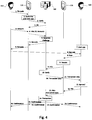
- Fig. 1 we assume that user 110 is a seller and user 120 is a buyer and that both the buyer and the seller are assumed to have mobile terminals 111 and 121 respectively, running an application according to the invention. They are also assumed to have connected the app to their accounts on the server 140, and may have entered aliases in the app and to have obtained (determined) secret PIN codes/secrets. Following is the basic flow for performing a "peer-to-peer" payment ( Fig. 4 ):
- the technical foundation for the security may be based on PKI, Public Key Infrastructure, where the server has a private key and every app has the corresponding public key. Anything encrypted with one key is only readable with the other.
- HTTPS or another SSL protocol is used for all communication to and from the server. This description will assume regular HTTPS, but it is possible to increase security even more by issuing unique certificates to each app instance (i.e., every terminal that runs the app has a different certificate).
- the seller's app verifies the PIN with the server and then erases it from memory
- the app does not have access to the correct PIN. Instead, it constructs a message in this way:
- the seller's app sends the seller's identity, the terminal's unique identity and the entered information to the server:
- the server generates a barcode containing a random number, a challenge, and sends it to the seller's app.
- the barcode may be constructed in the following way:
- the seller's app displays the barcode on the mobile terminal's screen:
- the barcode is displayed like any other image. It should be as large as the screen allows, making it easier to scan.
- the buyer scans the barcode directly from the seller's mobile terminal with the app: The buyer simply holds the terminal with the camera facing the barcode on the seller's mobile terminal. There is no need for the user to press any buttons to scan.
- Reading the barcode is a standard process. The app takes a snapshot of what the camera sees and looks for barcodes in the picture. If no barcodes are found, it takes another snapshot and repeats the process.
- the server verifies the challenge number and sends the transaction data (transaction ID, currency, amount, seller's alias and the optional transaction description) to the buyer's app:
- the buyer's app sends the PIN, the transaction ID and the terminal's unique identity to the server where the data is validated.
- the buyer's app then erases the PIN from memory:
- the server can create and show a barcode containing a challenge and pass show it in the user's browser.
- the browser When the browser renders the HTML page, it will automatically send an HTTPS GET request to the server for the URL in the tag.
- the barcode is constructed in the following way:
- the server sends the barcode to the browser over the HTTPS connection, and the browser displays the image on the user's screen.
- the server could also check that only one challenge barcode at a time is in effect for a particular browser session. Another way of strengthening this process slightly is to have a random name for the bar image file, so rather than "challenge.png", it could be called “s34HjDu8.png". The server could then validate the image name in the HTTPS request to make sure it matches the one generated on the HTML page.
- a computer-readable medium may include removable and non-removable storage devices including, but not limited to, Read Only Memory (ROM), Random Access Memory (RAM), compact discs (CDs), digital versatile discs (DVD), etc.
- program modules may include routines, programs, objects, components, data structures, etc. that perform particular tasks or implement particular abstract data types.
- Computer-executable instructions, associated data structures, and program modules represent examples of program code for executing steps of the methods disclosed herein. The particular sequence of such executable instructions or associated data structures represents examples of corresponding acts for implementing the functions described in such steps or processes.
Landscapes
- Engineering & Computer Science (AREA)
- Computer Networks & Wireless Communication (AREA)
- Business, Economics & Management (AREA)
- Computer Security & Cryptography (AREA)
- Signal Processing (AREA)
- Accounting & Taxation (AREA)
- General Engineering & Computer Science (AREA)
- Computing Systems (AREA)
- Computer Hardware Design (AREA)
- Strategic Management (AREA)
- Physics & Mathematics (AREA)
- General Business, Economics & Management (AREA)
- General Physics & Mathematics (AREA)
- Theoretical Computer Science (AREA)
- Finance (AREA)
- Mobile Radio Communication Systems (AREA)
Claims (13)
- Verfahren zum Verwenden eines Strichcodes, um eine Autorisierung eines ersten mobilen Endgeräts (111) eines Verkäufers und eines zweiten mobilen Endgeräts (121) eines Käufers zu erleichtern, wenn eine Transaktion zwischen dem Verkäufer und dem Käufer durchgeführt wird, wobei das Verfahren umfasst:a. Empfangen von ersten Autorisierungsdaten, welche ein Geheimnis umfassen, von dem ersten mobilen Endgerät durch einen Server (140) unter Verwendung einer ersten Anwendung;b. Verifizieren der ersten Autorisierungsdaten und des Verkäufers durch den Server;c. bei Verifizierung Löschen der ersten Autorisierungsdaten aus einem Speicher des ersten mobilen Endgeräts durch die erste Anwendung;d. Bereitstellen einer eindeutigen Identität und eines ersten Datensatzes, welcher Transaktionsdaten umfasst, für den Server durch das erste mobile Endgerät;e. Erzeugen und Bereitstellen eines Strichcodes durch den Server, wobei der Strichcode die Transaktionsdaten nicht enthält, für das erste mobile Endgerät (111);f. Übertragen des Strichcodes von dem ersten mobilen Endgerät an das zweite mobile Endgerät (121);g. Decodieren des Strichcodes durch das zweite mobile Endgerät unter Verwendung einer zweiten Anwendung, um die Authentisierungsabfrage wiederherzustellen;h. Bereitstellen der Nummer der Authentisierungsabfrage und einer zweiten Identität für den Server (140) durch das zweite mobile Endgerät (121), um Transaktionsinformationen zu erhalten;i. Verifizieren der Nummer der Authentisierungsabfrage durch den Server und Bereitstellen eines zweiten Datensatzes, welcher die Transaktionsinformationen enthält, für das zweite mobile Endgerät, wobei die Transaktionsinformationen einen festgelegten Betrag, welcher von dem Konto des Käufers auf das Konto des Verkäufers überwiesen werden soll, und eine Transaktions-ID umfassen;j. Verifizieren des zweiten Datensatzes durch den Käufer in dem zweiten mobilen Endgerät unter Verwendung eines eindeutigen Codes;k. Bereitstellen des eindeutigen Codes, der Transaktions-ID und einer dritten Identität von dem zweiten mobilen Endgerät für den Server;l. Validieren von Daten, welche in dem Schritt (k) bereitgestellt wurden, durch den Server und bei Validierung, Überweisen des festgelegten Betrags von dem Konto des Käufers auf das Konto des Verkäufers;
wobei der Strichcode erzeugt wird durch:• Erzeugen einer Nummer einer Authentisierungsabfrage durch den Server und Speichern dieser in einer lokalen Datenbank gemeinsam mit einer aktuellen Zeit und Informationen über eine Browsersitzung; wobei die Nummer der Authentisierungsabfrage zufällig erzeugt wird,• Umwandeln der Nummer der Authentisierungsabfrage in eine kurze Textzeichenfolge durch den Server, und• Erzeugen des Strichcodes, welcher die kurze Textzeichenfolge enthält, durch den Server. - Verfahren nach Anspruch 1, wobei das Geheimnis ein PIN-Code ist.
- Verfahren nach Anspruch 1, wobei in dem Schritt f. der Strichcode durch Bildaufzeichnung bereitgestellt wird.
- Verfahren nach Anspruch 1, weiter einen oder weitere folgende Schritte umfassend:• Eingeben einer Beschreibung der Transaktion,• Eingeben einer persönlichen Beschreibung der Transaktion,• Auswählen einer anderen Transaktionswährung, oder• Eingeben eines Synonyms für einen Benutzer.
- Verfahren nach einem der vorstehenden Ansprüche unter Verwendung von Verschlüsselung auf Basis von Public Key Infrastructure, PKI, worin der Server einen persönlichen Schlüssel hat und jedes Endgerät einen entsprechenden öffentlichen Schlüssel hat.
- Verfahren nach einem der vorstehenden Ansprüche, unter Verwendung eines SSL-Protokolls für Kommunikation zu und von dem Server.
- Verfahren nach Anspruch 1, wobei der Schritt i. weiter umfasst:- Validieren der gelieferten Daten durch den Server, um die zweite Identität und die dritte Identität zu bestimmen, welche gemeinsam in der Datenbank gespeichert waren,- Suchen nach der Nummer der Authentisierungsabfrage durch den Server in seiner Datenbank, und- wenn die Nummer der Authentisierungsabfrage gültig ist, dann Erstellen einer neuen Anwendungssitzung für eine zweite Anwendung, welche eine Sitzungsnummer an das zweite mobile Endgerät überträgt,- Übertragen des zweiten Datensatzes an das zweite mobile Endgerät bei Verifizierung der Nummer der Authentisierungsabfrage.
- Verfahren nach Anspruch 7, wobei Schritt k., welcher auf dem zweiten mobilen Endgerät ausgeführt wird, umfasst:- Zusammenstellen einer Bestätigungsnachricht, welche den eindeutigen Code, die Sitzungsnummer, die Transaktions-ID, die zweite Identität und die dritte Identität umfasst;- Hinzufügen von zufälligen Daten zu der Bestätigungsnachricht;- Verschlüsseln der Bestätigungsnachricht unter Verwendung eines öffentlichen Serverschlüssels; und- Senden der Bestätigungsnachricht über einen sichere Verbindung an den Server.
- Verfahren nach Anspruch 8, wobei der Server die Bestätigungsnachricht erhält und:- die Bestätigungsnachricht entschlüsselt und den eindeutigen Code in der Bestätigungsnachricht mit dem vergleicht, welcher auf dem Server gespeichert ist,- wenn der eindeutige Code korrekt ist, validiert der Server die Sitzungsnummer, und- wenn die Sitzungsnummer gültig ist, werden die die Transaktions-ID, die zweite Identität und die dritte Identität weiter durch den Server kontrolliert.
- Verfahren nach Anspruch 1, wobei der Server einen Strichcode in Form eines Strichcodes, welcher eine Authentisierungsabfrage enthält, unter Verwendung eines Standardbild-Tags für den Authentisierungsabfrage-Strichcode in einer HTML-Seite erstellt und bereitstellt, wobei wenn der Browser die HTML-Seite rendert, automatisch eine HTTPS GET-Anfrage für eine URL in dem Tag an den Server gesendet wird.
- Verfahren nach Anspruch 1, umfassend den Schritt des Bewirkens oder Speicherns von Informationen über das Ereignis durch den Server.
- System, umfassend ein erstes mobiles Endgerät, ein zweites mobiles Endgerät und einen Server, wobei das System in der Lage ist, das Verfahren nach Anspruch 1-11 auszuführen.
- Nichtflüchtiges computerlesbares Medium, umfassend eine Vielzahl von computerlesbaren Anweisungen, welche bei Ausführung durch ein System das System veranlassen, Verfahren nach einem der Ansprüche 1-11 auszuführen.
Applications Claiming Priority (2)
| Application Number | Priority Date | Filing Date | Title |
|---|---|---|---|
| US201161551491P | 2011-10-26 | 2011-10-26 | |
| PCT/SE2012/000167 WO2013062459A2 (en) | 2011-10-26 | 2012-10-26 | Method and arrangement for authorizing a user |
Publications (3)
| Publication Number | Publication Date |
|---|---|
| EP2771852A2 EP2771852A2 (de) | 2014-09-03 |
| EP2771852A4 EP2771852A4 (de) | 2015-07-29 |
| EP2771852B1 true EP2771852B1 (de) | 2020-07-01 |
Family
ID=48168744
Family Applications (1)
| Application Number | Title | Priority Date | Filing Date |
|---|---|---|---|
| EP12844101.1A Active EP2771852B1 (de) | 2011-10-26 | 2012-10-26 | Verfahren und anordnung zum autorisieren eines benutzers |
Country Status (3)
| Country | Link |
|---|---|
| US (1) | US10423950B2 (de) |
| EP (1) | EP2771852B1 (de) |
| WO (1) | WO2013062459A2 (de) |
Families Citing this family (22)
| Publication number | Priority date | Publication date | Assignee | Title |
|---|---|---|---|---|
| US9280643B2 (en) * | 2012-05-11 | 2016-03-08 | Netgear, Inc. | Establishing access to a secure network based on user-created credential indicia |
| DE102013201027A1 (de) * | 2013-01-23 | 2014-07-24 | Bundesdruckerei Gmbh | Verfahren zur Authentisierung eines Nutzers gegenüber einem Automat |
| US20150248676A1 (en) * | 2014-02-28 | 2015-09-03 | Sathish Vaidyanathan | Touchless signature |
| DE102014206949A1 (de) * | 2014-04-10 | 2015-10-29 | Vodafone Gmbh | Transaktionsverfahren |
| US9077713B1 (en) * | 2014-09-02 | 2015-07-07 | Google Inc. | Typeless secure login to web-based services |
| TWI696975B (zh) * | 2015-08-19 | 2020-06-21 | 香港商阿里巴巴集團服務有限公司 | 通信建立方法及通信終端 |
| AU2016340025B2 (en) * | 2015-10-16 | 2021-12-09 | Kasada Pty Ltd | Dynamic Cryptographic Polymorphism (DCP) system and method |
| EP3373622B1 (de) * | 2015-12-01 | 2020-10-28 | Huawei Technologies Co., Ltd. | Verfahren und vorrichtung zur sicheren interaktion zwischen endgeräten |
| GB2551543A (en) * | 2016-06-21 | 2017-12-27 | Eckoh Uk Ltd | Methods of authenticating a user for data exchange |
| CN111865603B (zh) * | 2016-09-05 | 2025-02-28 | 华为技术有限公司 | 认证方法、认证装置和认证系统 |
| US10296905B2 (en) * | 2016-09-08 | 2019-05-21 | Eyl Inc. | Method and system using quantum random generator |
| WO2018165146A1 (en) | 2017-03-06 | 2018-09-13 | Cummins Filtration Ip, Inc. | Genuine filter recognition with filter monitoring system |
| KR20180129476A (ko) * | 2017-05-26 | 2018-12-05 | 삼성에스디에스 주식회사 | 인증 시스템 및 방법 |
| US10868677B2 (en) * | 2018-06-06 | 2020-12-15 | Blackberry Limited | Method and system for reduced V2X receiver processing load using certificates |
| CN111193761B (zh) * | 2019-09-11 | 2021-09-28 | 腾讯科技(深圳)有限公司 | 一种文件传输方法、装置及可读存储介质 |
| US20210125194A1 (en) * | 2019-10-23 | 2021-04-29 | Allclear Id, Inc. | Method and system for completing cross-channel transactions |
| US11544695B2 (en) | 2020-09-10 | 2023-01-03 | Block, Inc. | Transaction identification by comparison of merchant transaction data and context data |
| US11055692B1 (en) * | 2020-09-10 | 2021-07-06 | Square, Inc. | Application integration for contactless payments |
| CN120498642A (zh) * | 2020-10-09 | 2025-08-15 | 崔云虎 | 使用公钥基础设施的认证链 |
| CN116915520B (zh) * | 2023-09-14 | 2023-12-19 | 南京龟兔赛跑软件研究院有限公司 | 基于分布式计算的农业产品信息化数据安全优化方法 |
| US20250238801A1 (en) * | 2024-01-23 | 2025-07-24 | Wells Fargo Bank, N.A. | Merchant and customer authentication interface |
| US12488208B2 (en) * | 2024-05-16 | 2025-12-02 | Scandit Ag | Secure ID scanning using image analysis |
Citations (1)
| Publication number | Priority date | Publication date | Assignee | Title |
|---|---|---|---|---|
| US20110251892A1 (en) * | 2010-04-09 | 2011-10-13 | Kevin Laracey | Mobile Phone Payment Processing Methods and Systems |
Family Cites Families (11)
| Publication number | Priority date | Publication date | Assignee | Title |
|---|---|---|---|---|
| US7657489B2 (en) | 2006-01-18 | 2010-02-02 | Mocapay, Inc. | Systems and method for secure wireless payment transactions |
| WO2007092525A2 (en) * | 2006-02-07 | 2007-08-16 | The Trustees Of Columbia University In The City Of New York | Systemes, procedes et supports pouvant inhiber les attaques contre des donnees |
| US8249965B2 (en) * | 2006-03-30 | 2012-08-21 | Obopay, Inc. | Member-supported mobile payment system |
| WO2008090568A2 (en) * | 2007-01-22 | 2008-07-31 | Rakesh Deshmukh | Methods and system for secure data processing using mobile devices |
| US8935187B2 (en) * | 2007-03-07 | 2015-01-13 | Playspan, Inc. | Distributed payment system and method |
| US20090281949A1 (en) * | 2008-05-12 | 2009-11-12 | Appsware Wireless, Llc | Method and system for securing a payment transaction |
| EP2128809A1 (de) * | 2008-05-30 | 2009-12-02 | Luc Stals | Servervorrichtung zur Steuerung einer Transaktion, erste und zweite Einheit |
| PL2166697T3 (pl) * | 2008-09-17 | 2012-02-29 | Gmv Soluciones Globales Internet S A | Sposób i system uwierzytelniania użytkownika za pomocą urządzenia mobilnego |
| US20110119190A1 (en) * | 2009-11-18 | 2011-05-19 | Magid Joseph Mina | Anonymous transaction payment systems and methods |
| EP2546791A1 (de) * | 2010-03-08 | 2013-01-16 | Telefónica, S.A. | Verfahren und system zur durchführung einer transaktion |
| US9280768B2 (en) * | 2010-03-17 | 2016-03-08 | Verifone, Inc. | Payment systems and methodologies |
-
2012
- 2012-10-26 EP EP12844101.1A patent/EP2771852B1/de active Active
- 2012-10-26 WO PCT/SE2012/000167 patent/WO2013062459A2/en not_active Ceased
- 2012-10-26 US US14/354,490 patent/US10423950B2/en active Active
Patent Citations (1)
| Publication number | Priority date | Publication date | Assignee | Title |
|---|---|---|---|---|
| US20110251892A1 (en) * | 2010-04-09 | 2011-10-13 | Kevin Laracey | Mobile Phone Payment Processing Methods and Systems |
Also Published As
| Publication number | Publication date |
|---|---|
| US20140310185A1 (en) | 2014-10-16 |
| WO2013062459A3 (en) | 2013-07-11 |
| WO2013062459A2 (en) | 2013-05-02 |
| US10423950B2 (en) | 2019-09-24 |
| EP2771852A4 (de) | 2015-07-29 |
| EP2771852A2 (de) | 2014-09-03 |
Similar Documents
| Publication | Publication Date | Title |
|---|---|---|
| US10423950B2 (en) | Method and arrangement for authorizing a user | |
| US11405380B2 (en) | Systems and methods for using imaging to authenticate online users | |
| US10592872B2 (en) | Secure registration and authentication of a user using a mobile device | |
| US11108558B2 (en) | Authentication and fraud prevention architecture | |
| US8079082B2 (en) | Verification of software application authenticity | |
| US9836741B2 (en) | Authenticating users to ATMs and other secure machines for cardless transactions | |
| US9521548B2 (en) | Secure registration of a mobile device for use with a session | |
| US7379921B1 (en) | Method and apparatus for providing authentication | |
| US20130311768A1 (en) | Secure authentication of a user using a mobile device | |
| US11636482B2 (en) | Method and system for validation of identity of a user during a digital payment process | |
| US20100191972A1 (en) | Method and Apparatus for Providing Secure Document Distribution | |
| US9256724B2 (en) | Method and system for authorizing an action at a site | |
| CN109684801B (zh) | 电子证件的生成、签发和验证方法及装置 | |
| WO2012167941A1 (en) | Method to validate a transaction between a user and a service provider | |
| KR101025807B1 (ko) | 인증방법 및 인증서버 | |
| US20140223520A1 (en) | Guardian control over electronic actions | |
| US11736476B2 (en) | Biometric one touch system | |
| CN114730334A (zh) | 使用网络认证来增强安全远程平台系统的安全性 | |
| EP2533486A1 (de) | Verfahren zur Validierung einer Transaktion zwischen einem Nutzer und einem Dienstanbieter | |
| EP2747363A1 (de) | Transaktionsvalidierungsverfahren unter Verwendung einer Kommunikationsvorrichtung | |
| Hammoudeh et al. | Enhancing Security Using E-Authentication System |
Legal Events
| Date | Code | Title | Description |
|---|---|---|---|
| PUAI | Public reference made under article 153(3) epc to a published international application that has entered the european phase |
Free format text: ORIGINAL CODE: 0009012 |
|
| 17P | Request for examination filed |
Effective date: 20140523 |
|
| AK | Designated contracting states |
Kind code of ref document: A2 Designated state(s): AL AT BE BG CH CY CZ DE DK EE ES FI FR GB GR HR HU IE IS IT LI LT LU LV MC MK MT NL NO PL PT RO RS SE SI SK SM TR |
|
| DAX | Request for extension of the european patent (deleted) | ||
| A4 | Supplementary search report drawn up and despatched |
Effective date: 20150630 |
|
| RIC1 | Information provided on ipc code assigned before grant |
Ipc: G06Q 20/02 20120101ALI20150624BHEP Ipc: G06Q 20/32 20120101AFI20150624BHEP Ipc: H04L 29/06 20060101ALI20150624BHEP Ipc: G06Q 20/40 20120101ALI20150624BHEP |
|
| STAA | Information on the status of an ep patent application or granted ep patent |
Free format text: STATUS: EXAMINATION IS IN PROGRESS |
|
| 17Q | First examination report despatched |
Effective date: 20180302 |
|
| GRAP | Despatch of communication of intention to grant a patent |
Free format text: ORIGINAL CODE: EPIDOSNIGR1 |
|
| STAA | Information on the status of an ep patent application or granted ep patent |
Free format text: STATUS: GRANT OF PATENT IS INTENDED |
|
| INTG | Intention to grant announced |
Effective date: 20191030 |
|
| GRAS | Grant fee paid |
Free format text: ORIGINAL CODE: EPIDOSNIGR3 |
|
| GRAJ | Information related to disapproval of communication of intention to grant by the applicant or resumption of examination proceedings by the epo deleted |
Free format text: ORIGINAL CODE: EPIDOSDIGR1 |
|
| GRAL | Information related to payment of fee for publishing/printing deleted |
Free format text: ORIGINAL CODE: EPIDOSDIGR3 |
|
| STAA | Information on the status of an ep patent application or granted ep patent |
Free format text: STATUS: EXAMINATION IS IN PROGRESS |
|
| INTC | Intention to grant announced (deleted) | ||
| GRAP | Despatch of communication of intention to grant a patent |
Free format text: ORIGINAL CODE: EPIDOSNIGR1 |
|
| STAA | Information on the status of an ep patent application or granted ep patent |
Free format text: STATUS: GRANT OF PATENT IS INTENDED |
|
| INTG | Intention to grant announced |
Effective date: 20200422 |
|
| GRAS | Grant fee paid |
Free format text: ORIGINAL CODE: EPIDOSNIGR3 |
|
| GRAA | (expected) grant |
Free format text: ORIGINAL CODE: 0009210 |
|
| STAA | Information on the status of an ep patent application or granted ep patent |
Free format text: STATUS: THE PATENT HAS BEEN GRANTED |
|
| AK | Designated contracting states |
Kind code of ref document: B1 Designated state(s): AL AT BE BG CH CY CZ DE DK EE ES FI FR GB GR HR HU IE IS IT LI LT LU LV MC MK MT NL NO PL PT RO RS SE SI SK SM TR |
|
| REG | Reference to a national code |
Ref country code: GB Ref legal event code: FG4D |
|
| REG | Reference to a national code |
Ref country code: CH Ref legal event code: EP Ref country code: AT Ref legal event code: REF Ref document number: 1286855 Country of ref document: AT Kind code of ref document: T Effective date: 20200715 |
|
| REG | Reference to a national code |
Ref country code: IE Ref legal event code: FG4D |
|
| REG | Reference to a national code |
Ref country code: DE Ref legal event code: R096 Ref document number: 602012071062 Country of ref document: DE |
|
| REG | Reference to a national code |
Ref country code: LT Ref legal event code: MG4D |
|
| PG25 | Lapsed in a contracting state [announced via postgrant information from national office to epo] |
Ref country code: BG Free format text: LAPSE BECAUSE OF FAILURE TO SUBMIT A TRANSLATION OF THE DESCRIPTION OR TO PAY THE FEE WITHIN THE PRESCRIBED TIME-LIMIT Effective date: 20201001 |
|
| REG | Reference to a national code |
Ref country code: NL Ref legal event code: MP Effective date: 20200701 |
|
| REG | Reference to a national code |
Ref country code: AT Ref legal event code: MK05 Ref document number: 1286855 Country of ref document: AT Kind code of ref document: T Effective date: 20200701 |
|
| PG25 | Lapsed in a contracting state [announced via postgrant information from national office to epo] |
Ref country code: CZ Free format text: LAPSE BECAUSE OF FAILURE TO SUBMIT A TRANSLATION OF THE DESCRIPTION OR TO PAY THE FEE WITHIN THE PRESCRIBED TIME-LIMIT Effective date: 20200701 Ref country code: FI Free format text: LAPSE BECAUSE OF FAILURE TO SUBMIT A TRANSLATION OF THE DESCRIPTION OR TO PAY THE FEE WITHIN THE PRESCRIBED TIME-LIMIT Effective date: 20200701 Ref country code: GR Free format text: LAPSE BECAUSE OF FAILURE TO SUBMIT A TRANSLATION OF THE DESCRIPTION OR TO PAY THE FEE WITHIN THE PRESCRIBED TIME-LIMIT Effective date: 20201002 Ref country code: SE Free format text: LAPSE BECAUSE OF FAILURE TO SUBMIT A TRANSLATION OF THE DESCRIPTION OR TO PAY THE FEE WITHIN THE PRESCRIBED TIME-LIMIT Effective date: 20200701 Ref country code: HR Free format text: LAPSE BECAUSE OF FAILURE TO SUBMIT A TRANSLATION OF THE DESCRIPTION OR TO PAY THE FEE WITHIN THE PRESCRIBED TIME-LIMIT Effective date: 20200701 Ref country code: AT Free format text: LAPSE BECAUSE OF FAILURE TO SUBMIT A TRANSLATION OF THE DESCRIPTION OR TO PAY THE FEE WITHIN THE PRESCRIBED TIME-LIMIT Effective date: 20200701 Ref country code: LT Free format text: LAPSE BECAUSE OF FAILURE TO SUBMIT A TRANSLATION OF THE DESCRIPTION OR TO PAY THE FEE WITHIN THE PRESCRIBED TIME-LIMIT Effective date: 20200701 Ref country code: NO Free format text: LAPSE BECAUSE OF FAILURE TO SUBMIT A TRANSLATION OF THE DESCRIPTION OR TO PAY THE FEE WITHIN THE PRESCRIBED TIME-LIMIT Effective date: 20201001 Ref country code: ES Free format text: LAPSE BECAUSE OF FAILURE TO SUBMIT A TRANSLATION OF THE DESCRIPTION OR TO PAY THE FEE WITHIN THE PRESCRIBED TIME-LIMIT Effective date: 20200701 Ref country code: PT Free format text: LAPSE BECAUSE OF FAILURE TO SUBMIT A TRANSLATION OF THE DESCRIPTION OR TO PAY THE FEE WITHIN THE PRESCRIBED TIME-LIMIT Effective date: 20201102 |
|
| PG25 | Lapsed in a contracting state [announced via postgrant information from national office to epo] |
Ref country code: PL Free format text: LAPSE BECAUSE OF FAILURE TO SUBMIT A TRANSLATION OF THE DESCRIPTION OR TO PAY THE FEE WITHIN THE PRESCRIBED TIME-LIMIT Effective date: 20200701 Ref country code: LV Free format text: LAPSE BECAUSE OF FAILURE TO SUBMIT A TRANSLATION OF THE DESCRIPTION OR TO PAY THE FEE WITHIN THE PRESCRIBED TIME-LIMIT Effective date: 20200701 Ref country code: RS Free format text: LAPSE BECAUSE OF FAILURE TO SUBMIT A TRANSLATION OF THE DESCRIPTION OR TO PAY THE FEE WITHIN THE PRESCRIBED TIME-LIMIT Effective date: 20200701 Ref country code: IS Free format text: LAPSE BECAUSE OF FAILURE TO SUBMIT A TRANSLATION OF THE DESCRIPTION OR TO PAY THE FEE WITHIN THE PRESCRIBED TIME-LIMIT Effective date: 20201101 |
|
| PG25 | Lapsed in a contracting state [announced via postgrant information from national office to epo] |
Ref country code: NL Free format text: LAPSE BECAUSE OF FAILURE TO SUBMIT A TRANSLATION OF THE DESCRIPTION OR TO PAY THE FEE WITHIN THE PRESCRIBED TIME-LIMIT Effective date: 20200701 |
|
| REG | Reference to a national code |
Ref country code: DE Ref legal event code: R097 Ref document number: 602012071062 Country of ref document: DE |
|
| PG25 | Lapsed in a contracting state [announced via postgrant information from national office to epo] |
Ref country code: SM Free format text: LAPSE BECAUSE OF FAILURE TO SUBMIT A TRANSLATION OF THE DESCRIPTION OR TO PAY THE FEE WITHIN THE PRESCRIBED TIME-LIMIT Effective date: 20200701 Ref country code: RO Free format text: LAPSE BECAUSE OF FAILURE TO SUBMIT A TRANSLATION OF THE DESCRIPTION OR TO PAY THE FEE WITHIN THE PRESCRIBED TIME-LIMIT Effective date: 20200701 Ref country code: IT Free format text: LAPSE BECAUSE OF FAILURE TO SUBMIT A TRANSLATION OF THE DESCRIPTION OR TO PAY THE FEE WITHIN THE PRESCRIBED TIME-LIMIT Effective date: 20200701 Ref country code: DK Free format text: LAPSE BECAUSE OF FAILURE TO SUBMIT A TRANSLATION OF THE DESCRIPTION OR TO PAY THE FEE WITHIN THE PRESCRIBED TIME-LIMIT Effective date: 20200701 Ref country code: EE Free format text: LAPSE BECAUSE OF FAILURE TO SUBMIT A TRANSLATION OF THE DESCRIPTION OR TO PAY THE FEE WITHIN THE PRESCRIBED TIME-LIMIT Effective date: 20200701 |
|
| PLBE | No opposition filed within time limit |
Free format text: ORIGINAL CODE: 0009261 |
|
| STAA | Information on the status of an ep patent application or granted ep patent |
Free format text: STATUS: NO OPPOSITION FILED WITHIN TIME LIMIT |
|
| PG25 | Lapsed in a contracting state [announced via postgrant information from national office to epo] |
Ref country code: AL Free format text: LAPSE BECAUSE OF FAILURE TO SUBMIT A TRANSLATION OF THE DESCRIPTION OR TO PAY THE FEE WITHIN THE PRESCRIBED TIME-LIMIT Effective date: 20200701 |
|
| REG | Reference to a national code |
Ref country code: CH Ref legal event code: PL |
|
| 26N | No opposition filed |
Effective date: 20210406 |
|
| REG | Reference to a national code |
Ref country code: DE Ref legal event code: R081 Ref document number: 602012071062 Country of ref document: DE Owner name: PIRO PROGRAMUTVECKLING AB, SE Free format text: FORMER OWNER: MOPPER AB, STOCKHOLM, SE |
|
| GBPC | Gb: european patent ceased through non-payment of renewal fee |
Effective date: 20201026 |
|
| PG25 | Lapsed in a contracting state [announced via postgrant information from national office to epo] |
Ref country code: LU Free format text: LAPSE BECAUSE OF NON-PAYMENT OF DUE FEES Effective date: 20201026 Ref country code: MC Free format text: LAPSE BECAUSE OF FAILURE TO SUBMIT A TRANSLATION OF THE DESCRIPTION OR TO PAY THE FEE WITHIN THE PRESCRIBED TIME-LIMIT Effective date: 20200701 Ref country code: SK Free format text: LAPSE BECAUSE OF FAILURE TO SUBMIT A TRANSLATION OF THE DESCRIPTION OR TO PAY THE FEE WITHIN THE PRESCRIBED TIME-LIMIT Effective date: 20200701 |
|
| REG | Reference to a national code |
Ref country code: BE Ref legal event code: MM Effective date: 20201031 |
|
| PG25 | Lapsed in a contracting state [announced via postgrant information from national office to epo] |
Ref country code: FR Free format text: LAPSE BECAUSE OF NON-PAYMENT OF DUE FEES Effective date: 20201031 |
|
| PG25 | Lapsed in a contracting state [announced via postgrant information from national office to epo] |
Ref country code: SI Free format text: LAPSE BECAUSE OF FAILURE TO SUBMIT A TRANSLATION OF THE DESCRIPTION OR TO PAY THE FEE WITHIN THE PRESCRIBED TIME-LIMIT Effective date: 20200701 Ref country code: LI Free format text: LAPSE BECAUSE OF NON-PAYMENT OF DUE FEES Effective date: 20201031 Ref country code: GB Free format text: LAPSE BECAUSE OF NON-PAYMENT OF DUE FEES Effective date: 20201026 Ref country code: CH Free format text: LAPSE BECAUSE OF NON-PAYMENT OF DUE FEES Effective date: 20201031 Ref country code: BE Free format text: LAPSE BECAUSE OF NON-PAYMENT OF DUE FEES Effective date: 20201031 |
|
| PG25 | Lapsed in a contracting state [announced via postgrant information from national office to epo] |
Ref country code: IE Free format text: LAPSE BECAUSE OF NON-PAYMENT OF DUE FEES Effective date: 20201026 |
|
| PG25 | Lapsed in a contracting state [announced via postgrant information from national office to epo] |
Ref country code: TR Free format text: LAPSE BECAUSE OF FAILURE TO SUBMIT A TRANSLATION OF THE DESCRIPTION OR TO PAY THE FEE WITHIN THE PRESCRIBED TIME-LIMIT Effective date: 20200701 Ref country code: MT Free format text: LAPSE BECAUSE OF FAILURE TO SUBMIT A TRANSLATION OF THE DESCRIPTION OR TO PAY THE FEE WITHIN THE PRESCRIBED TIME-LIMIT Effective date: 20200701 Ref country code: CY Free format text: LAPSE BECAUSE OF FAILURE TO SUBMIT A TRANSLATION OF THE DESCRIPTION OR TO PAY THE FEE WITHIN THE PRESCRIBED TIME-LIMIT Effective date: 20200701 |
|
| PG25 | Lapsed in a contracting state [announced via postgrant information from national office to epo] |
Ref country code: MK Free format text: LAPSE BECAUSE OF FAILURE TO SUBMIT A TRANSLATION OF THE DESCRIPTION OR TO PAY THE FEE WITHIN THE PRESCRIBED TIME-LIMIT Effective date: 20200701 |
|
| PGFP | Annual fee paid to national office [announced via postgrant information from national office to epo] |
Ref country code: DE Payment date: 20251014 Year of fee payment: 14 |