EP2774423B1 - Réduction de consommation d'énergie et du surdébit de signalisation de dispositif sans fil pour messages d'arrière-plan d'application internet - Google Patents
Réduction de consommation d'énergie et du surdébit de signalisation de dispositif sans fil pour messages d'arrière-plan d'application internet Download PDFInfo
- Publication number
- EP2774423B1 EP2774423B1 EP12844787.7A EP12844787A EP2774423B1 EP 2774423 B1 EP2774423 B1 EP 2774423B1 EP 12844787 A EP12844787 A EP 12844787A EP 2774423 B1 EP2774423 B1 EP 2774423B1
- Authority
- EP
- European Patent Office
- Prior art keywords
- message
- background
- mode
- background message
- low power
- Prior art date
- Legal status (The legal status is an assumption and is not a legal conclusion. Google has not performed a legal analysis and makes no representation as to the accuracy of the status listed.)
- Not-in-force
Links
Images





Classifications
-
- H—ELECTRICITY
- H04—ELECTRIC COMMUNICATION TECHNIQUE
- H04W—WIRELESS COMMUNICATION NETWORKS
- H04W28/00—Network traffic management; Network resource management
- H04W28/02—Traffic management, e.g. flow control or congestion control
- H04W28/06—Optimizing the usage of the radio link, e.g. header compression, information sizing, discarding information
-
- H—ELECTRICITY
- H04—ELECTRIC COMMUNICATION TECHNIQUE
- H04W—WIRELESS COMMUNICATION NETWORKS
- H04W52/00—Power management, e.g. Transmission Power Control [TPC] or power classes
- H04W52/02—Power saving arrangements
- H04W52/0209—Power saving arrangements in terminal devices
- H04W52/0261—Power saving arrangements in terminal devices managing power supply demand, e.g. depending on battery level
- H04W52/0264—Power saving arrangements in terminal devices managing power supply demand, e.g. depending on battery level by selectively disabling software applications
-
- H—ELECTRICITY
- H04—ELECTRIC COMMUNICATION TECHNIQUE
- H04W—WIRELESS COMMUNICATION NETWORKS
- H04W52/00—Power management, e.g. Transmission Power Control [TPC] or power classes
- H04W52/02—Power saving arrangements
- H04W52/0209—Power saving arrangements in terminal devices
-
- Y—GENERAL TAGGING OF NEW TECHNOLOGICAL DEVELOPMENTS; GENERAL TAGGING OF CROSS-SECTIONAL TECHNOLOGIES SPANNING OVER SEVERAL SECTIONS OF THE IPC; TECHNICAL SUBJECTS COVERED BY FORMER USPC CROSS-REFERENCE ART COLLECTIONS [XRACs] AND DIGESTS
- Y02—TECHNOLOGIES OR APPLICATIONS FOR MITIGATION OR ADAPTATION AGAINST CLIMATE CHANGE
- Y02D—CLIMATE CHANGE MITIGATION TECHNOLOGIES IN INFORMATION AND COMMUNICATION TECHNOLOGIES [ICT], I.E. INFORMATION AND COMMUNICATION TECHNOLOGIES AIMING AT THE REDUCTION OF THEIR OWN ENERGY USE
- Y02D30/00—Reducing energy consumption in communication networks
- Y02D30/70—Reducing energy consumption in communication networks in wireless communication networks
Definitions
- WWAN Wireless Wide Area Networks
- the frequent communications between the WWAN and certain internet applications can be power intensive resulting in undesirable drain on battery power.
- the relatively slow improvement in battery technology places a larger emphasis on minimizing unnecessary communications to maximize the length a wireless mobile device can remain operational using it's battery.
- US 2010/0246591 A1 discloses a network adapter comprising a controller to change to a first mode from a second mode based on a number of transmit packets, sizes of received packets, and intervals between arrivals of the received packets.
- the network controller can further comprise a memory to buffer received packets, where the received packets are buffered for a longer period in the first mode than in the second mode.
- EP 1 826 941 A1 discloses an apparatus and an associated method for facilitating delivery and processing of asynchronous push content communicated to a mobile station of a radio communication system. Outdated background messages are replaced upon the receipt of new communication content. This avoids displaying any other than the most-recent content and permits the operations to be performed upon the push content, even when an application with which the push content is associated, is not active.
- US 2007/147330 A1 discloses a method for dynamic packet polling during a power save mode.
- the method can include polling an access point for packets at a first rate on at least one access category, determining a polling time-out as a function of a packet priority, and possibly changing the rate to a second rate in view of a second packet priority.
- a wireless mobile device can be a User Equipment (UE) or a Mobile Station (MS), among other possibilities.
- UE User Equipment
- MS Mobile Station
- transmission point is defined as a wireless communication device in a Wireless Wide Area Network (WWAN) configured to communicate with a plurality of wireless mobile devices located within a geographic region referred to as a cell.
- WWAN Wireless Wide Area Network
- Different terminologies for transmission points are used in different specifications. Terminology used for different variations of a transmission point can include, but are not limited to, a Base Station (BS), an evolved Node B (eNodeB or eNB), a WWAN transmission point, a transmission point, a wireless transmission point, and a WWAN node.
- BS Base Station
- eNodeB or eNB evolved Node B
- WWAN transmission point a transmission point
- transmission point a wireless transmission point
- WWAN node wireless transmission point
- the terms are used interchangeably, unless otherwise noted.
- the actual definition of a BS or eNodeB is provided in their Institute of Electronics and Electrical Engineers (IEEE) 802.16 and Third Generation Partnership Project (3GPP) specifications.
- IEEE Institute of Electronics
- the term “substantially” refers to the complete or nearly complete extent or degree of an action, characteristic, property, state, structure, item, or result.
- an object that is “substantially” enclosed would mean that the object is either completely enclosed or nearly completely enclosed.
- the exact allowable degree of deviation from absolute completeness may in some cases depend on the specific context. However, generally speaking the nearness of completion will be so as to have the same overall result as if absolute and total completion were obtained.
- the use of “substantially” is equally applicable when used in a negative connotation to refer to the complete or near complete lack of an action, characteristic, property, state, structure, item, or result.
- Many types of applications no longer operate on stand-alone devices. Rather, the applications can operate, at least in part, on a server that is in communication with a computing device.
- Internet applications configured to operate on mobile wireless devices can continue to communicate with a server via a wireless network after a user ceases to interact with such applications, i.e., when these internet applications are minimized or placed in the background. These communications can result in frequent messaging.
- the sending of short, frequent messages by internet applications which are referred to herein as background messages, can place strains on mobile battery power and on Wireless Wide Area Networks (WWAN).
- WWAN Wireless Wide Area Networks
- background message refers to a message generated by an internet application with a low significance and/or low urgency.
- a background message can refer to a type of packet produced by an application when it is running in the "background", i.e. when the application is no longer actively interacting with the user, but still consuming Central Processing Unit (CPC) resources in order to perform tasks such as keeping a connection open, providing periodic update information, sending presence updates etc.
- CPC Central Processing Unit
- Examples of internet applications that require support for these background messages include SKYPE, YAHOO MESSANGER, GTALK, FACEBOOK, TWITTER, and many more. Applications related to what has been termed "social media” are particularly prone to such short, frequent messages.
- a wireless mobile device can cause a wireless mobile device to transition out of a power saving mode to send or receive the background messages.
- a wireless mobile device consumes power.
- the wireless mobile device also consumes power as it goes through the process of reestablishing connections with a WWAN.
- the wireless mobile device also consumes power by sending and/or receiving background messages and by spending time out of a power saving mode (i.e. setup to actively transmit and receive information via the WWAN).
- background messages can increase signaling traffic both over the air interface and within the core network of the WWAN. These increases in signaling traffic can be due to the large amount of signaling required to reestablish connections between a wireless mobile device and the WWAN in the process of transitioning the wireless mobile device out of a power saving mode.
- Background messages are often of relatively minor significance and typically do not have strict latency requirements. Background messages with low significance and/or low urgency can be identified at a transmission point and/or at a wireless mobile device before they are sent across a WWAN. Once they are identified, many of such background messages can be buffered or dropped. Messages that are buffered can be buffered for a period of time to allow a wireless mobile device to stay in a low power mode longer and/or reduce re-connection overhead in a WWAN.
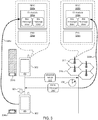
- FIG. 1 depicts a transition 100 at a wireless mobile device 102 from a relatively low power, power saving mode 104a to a relatively high power connection mode 104b to receive a background message 106 associated with an internet application 108.
- the internet application is accessible over the internet 110 in communication with a WWAN 112.
- the particular WWAN depicted can be consistent with the standards for Third Generation Partnership Project (3GPP) Long Term Evolution (LTE).
- 3GPP Third Generation Partnership Project
- LTE Long Term Evolution
- several different types of WWAN architectures consistent with alternative standards for wireless communication are possible.
- the WWAN 112 can comprise a Core Network (CN) 114 and a Radio Access Network (RAN) 116.
- the CN can comprise an Evolved Packet Core
- the RAN can comprise an Evolved-Universal Terrestrial Network (E-UTRAN).
- the EPC can communicate with the internet 110 through a Packet Data Network Gate Way (PDN-GW) 118.
- PDN-GW Packet Data Network Gate Way
- S-GW Serving Gate Way
- the wireless mobile device 102 which can be a User Equipment (UE) can communicate with the internet application 108 operating on a server by means of the WWAN 112, the UE needs to be in a connection mode 104b, such as Radio Resource Control (RRC)_CONNECTED, for communication to take place.
- RRC Radio Resource Control
- a UE can expend 500 to 1500 milliwatts to maintain itself in RRC_CONNECTED mode.
- the same UE can save a large portion of this power in a power saving mode 104a, such as Discontinuous Reception (DRX) mode, or RRC_IDLE mode.
- DRX Discontinuous Reception
- RRC_IDLE mode such as Discontinuous Reception (DRX) mode
- the UE can expend only 5 to 10 milliwatts in RRC_IDLE mode, potentially one-hundredth (two orders of magnitude), or less, of the power used to maintain the RRC_CONNECTED mode.
- the UE 102 depicted in FIG. 1 is first depicted in a power saving mode 104a, as indicated by the adjacent, low power-consumption bar depicted with the battery icon and the diamond cross-hatching.
- the internet application 108 can generate a background message 106 intended for the UE.
- the background message is depicted at various points in time as it can be communicated from the internet application 108 to the UE 102.
- the background message is depicted as it is generated in the internet application.
- the background message is depicted as it is communicated to the PDN-GW 118 within the EPC 114.
- the background message is depicted as communicated to the S-GW 120, and, then, the background message is depicted as it is communicated to the E-UTRAN 116.
- the E-UTRAN 116 can page 122 the UE to indicate the presence of a communication for the UE.
- the UE can transition from a power saving mode 104a to a communication mode 104b, as depicted by the high power-consumption bar, depicted with the battery icon and the diamond cross-hatching adjacent to the UE in connected mode.
- a large increase in power between the UE in power save mode and connected mode can be noted.
- This difference in power consumption can potentially be disproportionate to the levels of power consumption depicted.
- the difference in power consumption can vary depending on the power saving mode 104a from which the UE transitions and/or the communication mode 104b to which the UE transitions.
- Examples of a power saving mode can include DRX mode during an opportunity period, referred to herein as DRX mode unless otherwise indicated, and RRC_IDLE mode.
- DRX mode provides an example of one type of power saving mode 104a for which a connection can be maintained between the UE 102 and the E-UTRAN 116.
- a power saving mode that can maintain a connection between UE and E-UTRAN is referred to herein as a "mid low power mode.”
- DRX can be applied when the UE is in RRC_IDLE or RRC_CONNECTED mode.
- RRC_CONNECTED mode When DRX is applied during RRC_CONNECTED mode, a connection can be maintained with the E-UTRAN.
- the UE can power down for some pre-negotiated intervals of time known as "opportunity periods," as opposed to "on-duration periods" when the UE can receive transmissions. Therefore, the UE may not be in a receiving mode for each and every frame, and can shut down for some frames in a periodic fashion.
- the UE While applying DRX in RRC_CONNECTED mode, the UE can transition to an "on-duration period" to receive the background message 106.
- the connection between the UE and the E-UTRAN does not need to be re-established when switching from an "opportunity period" to an "on-duration period.”
- signaling overhead is less of a concern when applying DRX in RRC_CONNECTED mode.
- Power consumption can remain a big problem. The magnitude of the problem can be particularly significant because of the frequency with which background messages can be sent and received, and the frequency with which the UE is powered up to transition to an "on-duration period.”
- RRC_IDLE provides an example of one type of power saving mode 104a for which a connection is not maintained between the UE 102 and the E-UTRAN 116.
- a power saving mode that does not maintain a connection between UE and E-UTRAN is referred to herein as a "deep low power mode.”
- the UE can also engage in signaling to reconnect 124 with the E-UTRAN.
- Reconnection with the network can involve a large amount of signaling overhead.
- signaling can be involved to establish the connection as such, but additional signaling can be involved over the air interface and at the CN 114.
- the additional signaling can be, for example, to show that the UE is a bona-fide subscriber, access authentication servers, establish IP tunneling, etc.
- Messages involved in re-establishing 124 the connection can number between twenty to thirty messages, many of them involving bidirectional communication.
- significant signaling overhead can also be imposed across the backbone of the WWAN 112 and at the servers in the CN 114.
- the UE 102 can remain in a relatively high power mode 104b for extended periods as it engages in the signaling involved in reestablishing the connection with the WWAN. Similar problems can arise when background messages are generated at the UE.
- frequent disconnection and reconnection by a wireless mobile device to enable frequent communication with internet applications can result in significant battery drain as well as relatively high overhead in the CN.
- FIG. 2 depicts a transition 200 at a wireless mobile device 202 from a relatively low power, power saving mode 204a to a relatively high power mode 204b to send a background message 206 associated with an internet application 208.
- a first instance of an internet application 208a can reside at a wireless mobile device, which can be a UE.
- the first instance of the internet application can generate a background message 206 intended for a second instance of the internet application 208b that can reside on a server 207 connected to the internet 210, or directly to the CN 214.
- the second instance of the internet application 208b can comprise a plurality of instances of the internet application.
- the UE 202 may not be able to send 226 the background message 206 to the second instance of the internet application 208b over a WWAN 212, because the UE can be in a power saving mode 204a, as indicated by the adjacent, low power-consumption bar depicted with the battery icon and the diamond cross-hatching.
- the power saving mode can include DRX mode and RRC_IDLE mode. Other examples of a power saving mode consistent with 3GPP LTE and other standards are also possible. Therefore, the UE can transition 200 from the power saving mode to a communication mode 204b.
- a non-limiting example, provided by way of illustration, of a communication mode 204b can include RRC_CONNECTED mode.
- the nature of the transition 200 from the power saving mode 204a to the communication mode can differ depending on the nature of the power saving mode.
- certain examples of the power saving mode such as DRX mode, can maintain a connection with the WWAN 212 while powering down to conserve power.
- RRC_IDLE the connection is not maintained.
- the UE In examples for which a connection is maintained between the UE 202 and the WWAN 212, the UE still needs to power up to a communication mode 204b to send 226 the background message 206. As before, the difference in power consumption, which can span orders of magnitude, can potentially be disproportionate to the levels of power consumption depicted. In examples where the connection is not maintained, however, not only must the UE power up to receive the background message, but the UE can also engage in signaling to reconnect 224 with the WWAN. As discussed previously, reconnection with the network can involve a large amount of signaling overhead. Again, the frequency with which background messages can be sent from and to the UE can result in a high cost in power and signaling overhead.
- the background message 206 can be sent 226 to a second instance of the internet application 208b over the WWAN 212.
- the background message is depicted at various points in time as it can be communicated from the first instance of the internet application 208a to the second instance of the internet application.
- the background message is first depicted at the UE, where it is generated.
- the background message is depicted as it is sent to the RAN 216, which can be an E-UTRAN, within the WWAN 212.
- the background message 206 is also depicted at the E-UTRAN 216 and, then, at an S-GW 220, which can serve to connect the E-UTRAN to the CN 214, which can be an EPC.
- the background message is depicted as delivered to the PDN-GW 218, which can connect the EPN to the internet 210.
- the background message is depicted as delivered to the second instance of the internet application 208b.
- the cost of power consumption due to background messages 206 can be great, as can the cost of signaling overhead due to background messages. These costs become increasingly more and more important as more wireless mobile devices come to support internet applications that send such background messages on a frequent basis. The rise of social-media internet applications, which are particularly prone to sending such background messages, further compounds the problem.
- background messages 206 are of comparatively small significance.
- the internet application SKYPE can send status updates to indicate whether the application is attended or unattended by a user. Receiving such a status update, for example, which is typically received periodically, is of little significance for a UE 202 that is unattended and in a power saving mode 204a. Additionally, whether such background messages are received immediately, or at some time later, is of little significance.
- FIG. 3 depicts an identification (ID) module 330a, 330b that can reside at a wireless mobile device 302, a transmission point 317 within a RAN 316, or both.
- the ID module can further reside within a Media Access Control (MAC) layer 332a of a wireless mobile device, which can be a UE, and/or a MAC layer 332b of a transmission point, which can be an eNodeB.
- the MAC layer at the UE can be in communication with a PHYsical layer (PHY) 334a at the UE, and the MAC layer at the eNodeB can be in communication with a PHY layer 334b at the eNodeB.
- the ID module(s) can be configured to buffer and/or drop background messages 306a-d to reduce power costs and signaling overhead otherwise incurred by background messages, in accordance with various examples.
- a "handling action,” can refer to buffering and/or dropping a background message.
- the packet analysis can be performed on a set of transmission packets to identify one or more packets as a background message for which performing a handling action, such as buffering and/or dropping, is appropriate.
- a set of transmission packets can comprise any number of transmission packets.
- the step of identifying one or more packets as a background message by packet analysis can take place at an identification module 330a residing at a UE 302 where a set of transmission packets is scheduled to be sent from the UE to the eNodeB 317. Where the set of transmission packets is scheduled to be sent from the eNodeB to the UE, an ID module 330b residing at the eNodeB can perform the packet analysis.
- packet analysis can consume time, power, and other resources.
- packet analysis can comprise deep packet inspection. Therefore, in one embodiment, the ID Module 330a, 330b can remain inactive when the UE 302 is in a communication mode 304b. When the ID module is in communication mode, additional power costs and signaling overhead that can be associated with the reception of background packets are less of an issue, and may not be an issue at all. Hence, the potential consumption of resources associated with packet analysis may not be warranted.
- an ID module 330a, 330b whether residing with a UE 302 or an eNodeB 317, can be triggered 336a, 336b, or turned-on, when the UE enters a power saving mode 304a. Otherwise, the ID module can remain inactive. The ID module can become deactivated when the UE transitions back to communication mode 304b.
- the UE can monitor and communicate its mode to the ID module residing therein to trigger 336a activation of the module.
- the ID module can monitor the UE, triggering 336a itself when the UE transitions to a power saving mode 304a.
- the ID module 304b resides at an eNodeB 317, one or more timers 338 at the eNodeB can indicate when a sufficient period of inactivity has passed for the UE to enter a power saving mode 304a.
- One or more timers can be used to determine when it is appropriate for the UE to enter different types of low power modes 304a, such as a mid low power mode, where a connection to the E-UTRAN 316 can be maintained, and/or a deep low power mode, where a connection to the E-UTRAN is not maintained.
- a mid low power mode can include DRX mode.
- a non-limiting example of a deep low power mode can include RRC_IDLE.
- a transition message 340 can be sent to the UE 302 from an eNodeB 317 indicating the UE can transition to a power saving mode.
- the transition message can indicate a particular type of transition mode to which the UE can transition.
- the UE and/or an ID module 332a residing thereon can monitor for a transition message.
- the UE and the eNodeB can contain synchronous timers, making the transition message unnecessary.
- the eNodeB 317 can monitor one or more timers 338. When one or more of these timer expires, the eNodeB 317 can trigger 336b an ID module 330b residing thereon.
- the UE 302 can initiate a request to transition into a low power mode, such as a power saving mode 304a, which the eNodeB can approve or reject.
- the eNodeB can trigger the ID module residing on the eNodeB upon approval of such a request.
- the UE can decide to transition to a low power mode on its own.
- the transition message 340 can be sent from the UE to the eNodeB.
- the eNodeB 317 and/or an ID module 332b residing at the eNodeB can monitor one or more timers, approval determinations, and/or transition messages at the eNodeB to trigger 336b the ID module.
- the eNodeB and/or the ID module can know that the UE supports the buffering and/or dropping of background messages based on an advance notice 342 sent from the UE to the E-UTRAN 316 and/or an eNodeB residing thereon.
- the advance notice can indicate that the UE supports the performing of a handling action, such as buffering and/or dropping, on a background message and can accommodate the resultant latency and/or disappearance of such messages.
- an advance notice 342 can be embedded in a new Media Access Control (MAC) message configured to communicate the advance notice.
- the advance notice can be conveyed in a legacy message sent from a UE 302 to indicate features, modalities, routines, etc. that the UE is configured to support.
- a non-limiting example of such a legacy message can be a Feature Group Indicator (FGI).
- FGI Feature Group Indicator
- an unassigned index bit within an FGI can be assigned to convey this information.
- the ID module can perform actions, such a packet analysis, buffering, and dropping. These actions can reduce the frequency with which power is consumed at a UE 302 and/or the frequency of additional overhead associated with reception of background messages.
- actions such as a packet analysis, buffering, and dropping. These actions can reduce the frequency with which power is consumed at a UE 302 and/or the frequency of additional overhead associated with reception of background messages.
- the following figure serves to expound on actions that can be taken by ID modules.
- FIG. 4 depicts certain activities of an ID module 430.
- the ID module can analyze, or review, 444 a packet 446 in a set of packets to determine a performance action to take with respect to the packet. Packet analysis, as performed by the ID module, can be used to identify a background message and/or determine the appropriateness of buffering 448 and/or dropping 450 such a message. Where a packet does not comprise a background message, the ID module can allow the packet to proceed 452 unaffected.
- the ID module 430 can analyze 444 the packet 446 by reading information from one or more Internet Protocol (IP) headers.
- IP Internet Protocol
- One or more of these IP headers can carry information for packet analysis.
- the information can be used to identify a packet as a background message.
- the information can be embedded in a Time To Live (TTL) header field 554 and/or a Differentiated Service Code Point (DSCP) IP header field 556.
- TTL Time To Live
- DSCP Differentiated Service Code Point
- Additional non-limiting examples of IP headers can include an application header and/or a predefined background message header.
- the predefined background message header field can be known a priori by a transmission point and/or a wireless mobile device.
- the ID module 430 can identify a packet 446 as a background message on the basis of a substantial match between a value of an IP header field, such as those discussed above, with a predefined value. Additionally, a value of an IP header field within a predetermined region with respect to a threshold, such as above or below the threshold, can provide an indication that a packet is a background message. The presence of a predefined application header and/or background message header can also provide an indication that a packet is a background message. In addition to, or in place of, reading an IP header, the ID module can review the payload of the packet 446.
- the IP module 430 can be configured to determine whether the payload size is odd or even.
- the ID module can be configured to interpret an odd or even value as an indication that the packet is a background message. In certain embodiments multiple indications can be necessary for an overall indication of the packet's status.
- a background message can be dropped on the basis, in part or whole, of the type of background message to which the background message pertains.
- status reports can comprise a type of background message that, in some embodiments, can be dropped, or can be more likely to be dropped. Identification of a background message as a status update can be a particularly strong factor when the status update indicates an internet application is unattended.
- the ID module 430 can determine whether to buffer 448 or drop 450 a packet 446 based on the mode of the relevant UE 402.
- FIG. 4 three different instances of the same UE are depicted to represent the UE in communication mode 404b and two power saving modes comprising a mid low power mode 404c, where a connection with a WWAN can be maintained, and a deep low power mode 404a, where the connection is not maintained.
- the mode of the UE can be communicated to the ID module.
- an importance value can be embedded in an IP header that can be used to determine whether to buffer or drop a background message.
- a background message may be dropped if an updated background message is received that contains the same, but updated information. For instance, a status of whether a person is active or inactive on their social media application may be received at a periodic rate. When a next "status" background message is received, the previous background message can be dropped.
- the ID module 430 can simply determine to drop 450 a background message or use this information as a factor suggestive of the appropriates of dropping the background message. Conversely, if the UE is in a mid low power mode 404c, the ID module can determine to buffer 448 background message, or use this information as a factor suggestive of the appropriateness of buffering the background message. Where the UE is in a communication mode 404a, the ID module can be suspended and the background message can be allowed to proceed 452.
- the ID module 430 can include a buffer 458 in which the packet 446 can be buffered 448.
- the buffer can also be located outside of the ID module while remaining in communication with the ID module.
- the buffer can hold a set of packets, where the set can be a wide range of sizes.
- the buffer 458 can retain and the delay the packets/background messages therein for a period of time.
- the period of time can reduce the frequency with which the UE 402 has to draw on power and/or impose additional signaling overhead to send and receive background messages.
- the period of time can be determined so as to place reasonable demands of the power of the UE and/or WWAN resources with respect to signaling overhead.
- a timer used to determine whether a UE 402 can remain in a mid low power mode 404c and/or a deep power mode 404a can be the basis of such a determination. If messages are sent or received during this timer, the UE may not be allowed to stay in mid low power mode, a deep power mode, or transmission from a mid low power mode to a deep power mode. Therefore, background messages can be buffered until after such a timer has expired, allowing the UE to receive the background message and then return, or proceed to, a low power, or lower power mode respectively. Many different approaches to determining a period of time buffering can be recognized by those of ordinary skill in the art.
- the buffered background messages can be sent on their way after the UE enters one of its pre-scheduled wake-up periods.
- a wake-up scheduled to check a paging channel can comprise one example of such a wake-up period.
- This wake-up period can span one or more wake-up periods, that would otherwise be observed, but which are ignored to reduce resource demands.
- FIG. 4 can also serve as a basis for a discussion of actions that can take place to facilitate the identification of background messages and the performance of actions with respect to these messages.
- IP headers such as a TTL field 454 and DSCP field 456
- an indication and/or handling information can be embedded in the packet at the IP layer. Since battery power and signaling issues can primarily be issues where wireless mobile devices are concerned, this step can also be accomplished between the IP and Radio layers.
- the packet can be sent to its destination. For the sake of additional clarity, additional examples of consistent methods and devices are provided below.
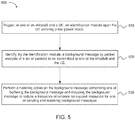
- FIG. 5 is a flowchart consistent with examples of a method 500 to reduce power consumption and signaling overhead for internet applications associated with UEs.
- the method can, but need not necessarily, be embedded in a computer program product comprising a non-transitory computer usable medium.
- Non-transitory refers to a storage medium that is enduring and not in transit, to positively affirm that the computer usable medium is not a transitory electrical signal.
- the computer readable medium can have a computer readable program code embodied therein.
- the computer readable program code can be adapted to be executed to implement instructions for the method.
- the method 500 can comprise triggering 510, at one of an eNodeB and a UE, an ID module upon the UE entering a low power mode.
- the low power mode can be a power saving mode, such as, by way of example and not limitation, DRX mode and RRC_IDLE mode.
- the ID module can identify 520 a background message by packet analysis of a set of packets. Packets in the set of packets can be intended for transmission to an eNodeB or UE.
- a handling action can be performed 530 on the background message. Such a handling action can comprise buffering the background message and/or dropping the background message to reduce a frequency of reliance on support resources, such as battery power and signaling overhead, for sending and receiving background messages.
- the method 500 can further comprise reading, by the ID module, an IP header field of a packet in the set of packets.
- the IP header can be read to acquire information for the packet analysis.
- the IP header field can comprise a TTL IP header field, a DSCP IP header field, an application header, and/or a predefined background message header known a priori by an eNodeB and/or the UE on which an ID module resides.
- the method 500 can also comprise determining whether performing the handling action comprises buffering the background message and/or dropping the background message.
- the determination can be based on at least one of a substantial match between a value of the IP header field with a predefined value.
- the determination can also be based on whether the value of the IP header field is below a threshold, and/or a payload with an even-sized, or odd-sized payload.
- the determination can be based on the presence of a predefined application header and/or the presence of a predefined background message header known a priori by at least one of an eNodeB and a UE on which an ID module resides.
- Some examples of the method 500 can further comprise determining whether performing the handling action comprises one of buffering the background message and dropping the background message. The determination can be based, at least in part, on the low power/power saving mode of the UE.
- the low power/power saving mode of the devise can comprise a mid low power mode.
- a power saving mode such as DRX mode, which can maintain a connection with a WWAN, provides one non-limiting example of such a mid low power mode.
- the low power/power saving mode of the devise can also comprise a deep low power mode.
- a power saving mode, such as RRC_IDLE mode which does maintain a connection with a WWAN, provides one non-limiting example of such a deep low power mode.
- the method 500 can also comprise providing advance notice from the UE to the eNodeB.
- the advance notice can indicate that the UE supports performing the handling action on the background message, the handling action comprising buffering the background message and/or dropping the background message.
- the triggering of the ID module can occur as a corollary of the UE entering the low power mode.
- Providing such an advance notice can comprise sending a MAC message configured to provide the advance notice and/or embedding the advance notice in an FGI.
- some embodiments can send the buffered background message when the UE performs a periodic wake-up consistent with the low power mode of the UE. Also, in some embodiments, triggering the ID module, identifying the background message, and performing the handling action can occur within a MAC layer at the eNodeB where downlink transmission occurs and/or within a MAC layer at the UE where uplink transmission occurs.
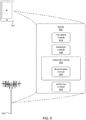
- FIG. 6 depicts a device 600 for reducing power consumption at a wireless mobile device and signaling overhead caused by frequent wireless communication of background messages, in accordance with an example.
- the device may or may not comprise an identification module similar to those discussed with respect to previous figures.
- the device can reside at a transmission point 602, such as, without limitation, an eNodeB, and/or a wireless mobile device 604, such as, without limitation, a UE.
- the device can comprise a monitoring module 610, an inspection module 620, and/or a response module 630.
- the monitoring module 610 can be configured to monitor the UE 610, to determine whether the UE is in one of a power saving mode and not in the power saving mode.
- the inspection module 620 which can be in communication with the monitoring module, can be configured to review a set of packets.
- the inspection module can review the set of packets for an indication that a packet in the set of packets comprises a background message when the UE is in the power saving mode.
- the response module 630 can be in communication with the inspection module. Furthermore, the response module can be configured to buffer the background message until the UE enters a wake-up phase or a period of time has elapsed, when the indication does not contain a parameter value contrary to buffering. Where a packet does not include an overall indication that the packet is a background message, such a parameter value contrary to buffering can be considered present.
- Some embodiments of the device 600 can further comprise a determination module 640 in communication with the response module 630.
- the determination module can be configured to direct the response module to perform buffering the message and/or dropping the message based.
- the direction can be based on the parameter value in the indication.
- the indication can reside in an IP header field of the background message.
- the determination module 640 can direct the response module 630 to buffer the background message when: (1) a parameter value in an IP header corresponds with a first predetermined value; (2) the parameter value is within a first predetermined region being one of above and below a threshold; (3) the background message has a payload with an even-sized payload and the payload also has a size below a first payload threshold; (4) the background message has a predefined application header corresponding to a first set of application headers; and/or, the background message has a predefined buffer header known a priori by at least the eNodeB 602 and/or the UE 604.
- the determination module 640 can direct the response module 630 to drop the background message when: (1) the parameter value corresponds with a second predetermined value; (2) the parameter value is within a second predetermined region, being one of above and below the threshold, the second predetermined region defined as an opposite of the first predetermined region relative to the threshold; (3) the background message has an even-sized payload, when the payload also has a size below a payload threshold; (3) the background message has a predefined application header corresponding to a first set of application headers; and/or (4) the background message has a predefined drop header known a priori by the eNodeB and/or the UE.
- the determination module 640 can direct the response module to buffer the background message when the power saving mode comprises a mid low power mode. Conversely, the determination module can direct the response module to drop the background message when the power saving mode comprises a deep low power mode.
- the mid low power mode can be a DRX mode
- the deep low power mode can be an RRC_IDLE mode.
- the IP header field can be a TTL IP header field, DSCP IP header field, an application header, and/or a predefined background message header.
- the predefined background message header can be known a priori by the eNodeB and/or the UE.
- Certain embodiments can include a notification module 650.
- the notification module can be configured to provide a notice to the eNodeB that the UE supports at least one of buffering background messages and dropping background messages.
- the monitoring, inspection, and response modules can reside within a MAC layer.
- FIG. 7 is a flowchart of a method 700 for reducing power consumption and signaling overhead from background messages associated with applications running in a wireless environment.
- the method can, but need not necessarily, be embedded in a computer program product comprising a non-transitory computer usable medium.
- the computer readable medium can have a computer readable program code embodied therein.
- the computer readable program code can be adapted to be executed to implement instructions for the method.
- the method 700 can comprise reading 710 an IP header field, at one of a UE and an eNodeB, for a series of packets. The reading can begin when the UE enters a low power mode. Additionally, the method can comprise indicating 720 the presence of a background message when a parameter value is read from the IP header field that is: (1) substantially a predetermined value; (2) within a predetermined region relative to a threshold; (3) corresponds to a predefined application header; (4) corresponds to a predefined background message header known a priori by at the wireless eNodeB and/or the UE; and/or indicating the presence of a background message when, the background message has a packet size that: (1) can be one of an even size and an odd size and/or (2) within a predetermined range.
- the method 700 can comprise determining 730 a handling action with respect to the background message.
- the handling action can comprise buffering the background message and/or dropping the background message.
- the handling action can also be performed 740 on the background message.
- determining 730 a handling action can further comprise determining to buffer the background message when the parameter value correlates to an importance value above an importance threshold. Additionally, determining the handling action can also comprise dropping the background message when the parameter value correlates to an importance value not above the importance threshold.
- Determining 730 the handling action can also comprise determining to buffer the background message when a combination of a weighted importance value and a weighted mode value produce a combined value correlated to a first determination to buffer the background message.
- the weighted importance value can be correlated to the parameter value.
- the weighted mode value can be correlated to the UE being in a mid low power mode and/or a deep low power mode.
- determining 730 the handling action can also comprise determining to drop the background message when a combination of a weighted importance value and a weighted mode value combine to produce a combined value correlated to a second determination to drop the background message.
- the weighted importance value can be correlated to the parameter value.
- the weighted mode value can also be correlated to the UE being in a mid low power mode and/or a deep low power mode.
- a determination can be made to drop the background message when the parameter value indicates the background message is a status update conveying a message that an application is in an unattended mode.
- the mid low power mode can be a DRX mode
- the deep low power mode can be an RRC_IDLE mode.
- reading the IP header field, indicating the presence of the background message, determining the handling action, and performing the handling action can take place in a MAC layer.
- some embodiments of the method can further comprise first indicating, by the UE to the eNodeB, that the UE is configured for a background message buffering scenario and/or a background message dropping scenario.
- actions can be taken with respect to the background messages to facilitate the buffering and dropping of such messages.
- Such actions can configure background messages to provide indications about the appropriateness of buffering and/or dropping such messages.
- the following figure can illustrates examples of a method consistent with such additional actions.
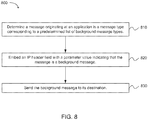
- FIG. 8 is a flowchart of a method 800 to configure background messages for power and signaling reduction measures.
- the method can, but need not necessarily, be embedded in a computer program product comprising a non-transitory computer usable medium.
- the computer readable medium can have a computer readable program code embodied therein.
- the computer readable program code can be adapted to be executed to implement instructions for the method.
- the method 800 can comprise determining 810 that a message originating at an application is of a message type corresponding to a predetermined list of background message types.
- An IP header field can be embedded 820 with a parameter value indicating that the message is a background message.
- the background message can then be sent 830 to its destination.
- Some embodiments can further comprise evaluating the message to assign an importance level.
- the importance level can be assigned to the message within a predetermined code included in the parameter value.
- the IP header field can be a TTL IP header field, a DSCP IP header field, an application header, and/or a predefined background message header.
- the background header can be known a priori by at least one of an eNodeB and a UE.
- Certain embodiments can further comprise providing an indication encoded in the parameter value.
- the indication can be about a first handling action where the UE is in a DRX mode. Conversely, the indication can be about a second handling action where the UE is in an RRC_IDLE mode.
- FIG. 9 provides an example illustration of a mobile device, such as UE, a mobile station (MS), a mobile wireless mobile device, a mobile communication device, a tablet, a handset, or other type of mobile wireless mobile device.
- the mobile device can include one or more antennas configured to communicate with a BS, an eNodeB, or other type of WWAN transmission point. While two antennas are shown, the mobile device may have between one and four or more antennas.
- the mobile device can be configured to communicate using at least one wireless communication standard including 3GPP LTE, Worldwide interoperability for Microwave Access (WiMAX), High Speed Packet Access (HSPA), Bluetooth, WiFi, or other wireless standards.
- the mobile device can communicate using separate antennas for each wireless communication standard or shared antennas for multiple wireless communication standards.
- the mobile device can communicate in a Wireless Local Area Network (WLAN), a Wireless Personal Area Network (WPAN), and/or a WWAN.
- WLAN Wireless Local Area Network
- WPAN Wireless Personal Area Network
- WWAN
- FIG. 9 also provides an illustration of a microphone and one or more speakers that can be used for audio input and output from the mobile device.
- the display screen may be a Liquid Crystal Display (LCD) screen, or other type of display screen such as an Organic Light Emitting Diode (OLED) display.
- the display screen can be configured as a touch screen.
- the touch screen may use capacitive, resistive, or another type of touch screen technology.
- An application processor and a graphics processor can be coupled to internal memory to provide processing and display capabilities.
- a non-volatile memory port can also be used to provide data input/output options to a user.
- the non-volatile memory port may also be used to expand the memory capabilities of the mobile device.
- Non-volatile memory can include a Solid State Drive (SSD), Flash Random Access Memory (RAM), and so forth.
- a keyboard may be integrated with the mobile device or wirelessly connected to the mobile device to provide additional user input.
- a virtual keyboard may also be provided using the touch screen.
- modules may be implemented as a hardware circuit comprising custom VLSI circuits or gate arrays, off-the-shelf semiconductors such as logic chips, transistors, or other discrete components.
- a module may also be implemented in programmable hardware devices such as field programmable gate arrays, programmable array logic, programmable logic devices or the like.
- Modules may also be implemented in software for execution by various types of processors.
- An identified module of executable code may, for instance, comprise one or more physical or logical blocks of computer instructions, which may, for instance, be organized as an object, procedure, or function. Nevertheless, the executables of an identified module need not be physically located together, but may comprise disparate instructions stored in different locations which, when joined logically together, comprise the module and achieve the stated purpose for the module.
- a module of executable code may be a single instruction, or many instructions, and may even be distributed over several different code segments, among different programs, and across several memory devices.
- operational data may be identified and illustrated herein within modules, and may be embodied in any suitable form and organized within any suitable type of data structure. The operational data may be collected as a single data set, or may be distributed over different locations including over different storage devices, and may exist, at least partially, merely as electronic signals on a system or network.
- the modules may be passive or active, including agents operable to perform desired functions.
- Various techniques, or certain aspects or portions thereof, may take the form of program code (i.e., instructions) embodied in tangible media, such as floppy diskettes, CD-ROMs, hard drives, Solid State Drives (SSD), flash RAM, or any other machine-readable storage medium wherein, when the program code is loaded into and executed by a machine, such as a computer, the machine becomes an apparatus for practicing the various techniques.
- the computing device may include a processor, a storage medium readable by the processor (including volatile and non-volatile memory and/or storage elements), at least one input device, and at least one output device.
- One or more programs that may implement or utilize the various techniques described herein may use an application programming interface (API), reusable controls, and the like.
- API application programming interface
- Such programs may be implemented in a high level procedural or object oriented programming language to communicate with a computer system.
- the program(s) may be implemented in assembly or machine language, if desired.
- the language may be a compiled or interpreted language, and combined with hardware implementations.
Landscapes
- Engineering & Computer Science (AREA)
- Computer Networks & Wireless Communication (AREA)
- Signal Processing (AREA)
- Mobile Radio Communication Systems (AREA)
- Telephone Function (AREA)
- Information Transfer Between Computers (AREA)
Claims (8)
- Dispositif pour réduire la consommation d'énergie au niveau d'un équipement d'utilisateur, UE, (102) et la surcharge de signalisation causées par la communication sans fil fréquente de messages (106) d'arrière-plan, comportant :un moyen, résidant soit au niveau d'un noeud B évolué, eNodeB, (317) soit au niveau de l'équipement d'utilisateur, UE, servant à surveiller l'UE pour déterminer si l'UE est dans un d'un mode (104a) d'économie d'énergie, et n'est pas dans le mode d'économie d'énergie (104b) ;un moyen servant à examiner un ensemble de paquets à la recherche d'une indication selon laquelle un paquet de l'ensemble de paquets comporte un message d'arrière-plan lorsque l'UE est en mode d'économie d'énergie ;un moyen servant à effectuer une action de gestion comportant soit la mise en tampon dudit message d'arrière-plan, soit l'élimination du message d'arrière-plan pour réduire soit l'émission, soit la réception de messages d'arrière-plan ; etun moyen servant à donner comme consigne à un module de réponse d'effectuer soit la mise en tampon du message, soit l'élimination du message d'après une valeur de paramètre figurant dans l'indication, l'indication résidant dans un champ d'en-tête de protocole Internet, IP, du message d'arrière-plan :le moyen qui sert à donner comme consigne au module de réponse d'effectuer soit la mise en tampon du message, soit l'élimination du message étant configuré pour donner comme consigne au module de réponse :de mettre en tampon le message d'arrière-plan lorsque le mode d'économie d'énergie comporte un mode (404c) de puissance réduite intermédiaire, etd'éliminer le message d'arrière-plan lorsque le mode d'économie d'énergie comporte un mode (404a) de puissance réduite profonde.
- Dispositif selon la revendication 1, le mode de puissance réduite intermédiaire étant un mode de réception discontinue (DRX) et le mode de puissance réduite profonde étant un mode RRC_IDLE.
- Dispositif selon la revendication 1 ou 2, le champ d'en-tête IP étant au moins un champ parmi un champ d'en-tête IP de durée de vie, TTL, un champ d'en-tête IP de point de code de services différenciés, DSCP, un en-tête d'application, et un en-tête prédéfini de message d'arrière-plan connu a priori d'au moins un élément parmi l'eNodeB et l'UE.
- Dispositif selon l'une quelconque des revendications 1 à 3, comportant en outre un moyen, résidant au niveau de l'UE, servant à fournir à l'eNodeB une notification selon laquelle l'UE prend en charge au moins une action parmi la mise en tampon de messages d'arrière-plan et l'élimination de messages d'arrière-plan.
- Dispositif selon l'une quelconque des revendications 1 à 4, le moyen de surveillance, le moyen d'examen et le module de réponse résidant à l'intérieur d'une couche de commande d'accès au support, MAC.
- Procédé pour réduire la consommation d'énergie au niveau d'un équipement d'utilisateur, UE, (102) et la surcharge de signalisation causées par la communication sans fil fréquente de messages d'arrière-plan associés à des applications s'exécutant dans un environnement sans fil, comportant les étapes consistant à :lire un champ d'en-tête de protocole Internet, IP, soit au niveau d'un équipement d'utilisateur, UE, (102) soit au niveau d'un noeud B évolué, eNodeB, (317) pour une série de paquets lorsque l'UE entre dans un mode d'économie d'énergie ;indiquer la présence d'un message d'arrière-plan dans au moins un des cas suivants :une valeur de paramètre est lue à partir du champ d'en-tête IP, qui est sensiblement une valeur prédéterminée, une valeur de paramètre est lue à partir du champ d'en-tête IP, qui se situe à l'intérieur d'une région prédéterminée par rapport à un seuil,une valeur de paramètre est lue à partir du champ d'en-tête IP, qui correspond à un en-tête d'application prédéfini, etune valeur de paramètre est lue à partir du champ d'en-tête IP, qui correspond à un en-tête prédéfini de message d'arrière-plan connu a priori d'au moins un élément parmi l'eNodeB et l'UE,le message d'arrière-plan présente une taille de paquets paire, etle message d'arrière-plan présente une taille de paquets située à l'intérieur d'une plage prédéterminée ;déterminer une action de gestion par rapport au message d'arrière-plan, l'action de gestion consistant soit à mettre en tampon le message d'arrière-plan, soit à éliminer le message d'arrière-plan ; eteffectuer l'action de gestion sur le message d'arrière-plan, la détermination de l'action de gestion comportant les étapes consistant à :déterminer la mise en tampon du message d'arrière-plan lorsque le mode d'économie d'énergie comporte un mode (404c) de puissance réduite intermédiaire, etdéterminer l'élimination du message d'arrière-plan lorsque le mode d'économie d'énergie comporte un mode (404a) de puissance réduite profonde.
- Procédé selon la revendication 6, la détermination de l'action de gestion comportant les étapes consistant à :déterminer la mise en tampon du message d'arrière-plan lorsque :une combinaison d'une valeur d'importance pondérée qui est corrélée à la valeur de paramètre, etd'une valeur de mode pondérée qui est corrélée soit à un mode de puissance réduite intermédiaire, soit à un mode de puissance réduite profonde,produit une valeur combinée corrélée à une première détermination de mise en tampon du message d'arrière-plan ; etdéterminer l'élimination du message d'arrière-plan lorsque :une combinaison d'une valeur d'importance pondérée qui est corrélée à la valeur de paramètre, etd'une valeur de mode pondérée corrélée soit au mode de puissance réduite intermédiaire, soit au mode de puissance réduite profonde,produit une valeur combinée corrélée à une deuxième détermination d'élimination du message d'arrière-plan.
- Procédé selon la revendication 6, la détermination de l'action de gestion comportant l'étape consistant à déterminer l'élimination du message d'arrière-plan lorsque la valeur de paramètre indique que le message d'arrière-plan est une mise à jour d'état transportant un message selon lequel une application est dans un mode non supervisé.
Applications Claiming Priority (3)
| Application Number | Priority Date | Filing Date | Title |
|---|---|---|---|
| US201161556109P | 2011-11-04 | 2011-11-04 | |
| US13/626,342 US9042286B2 (en) | 2011-11-04 | 2012-09-25 | Reducing wireless power consumption and signaling overhead for internet application background messages |
| PCT/US2012/063472 WO2013067469A1 (fr) | 2011-11-04 | 2012-11-03 | Réduction de consommation d'énergie et du surdébit de signalisation de dispositif sans fil pour messages d'arrière-plan d'application internet |
Publications (3)
| Publication Number | Publication Date |
|---|---|
| EP2774423A1 EP2774423A1 (fr) | 2014-09-10 |
| EP2774423A4 EP2774423A4 (fr) | 2015-07-08 |
| EP2774423B1 true EP2774423B1 (fr) | 2017-05-31 |
Family
ID=48192875
Family Applications (1)
| Application Number | Title | Priority Date | Filing Date |
|---|---|---|---|
| EP12844787.7A Not-in-force EP2774423B1 (fr) | 2011-11-04 | 2012-11-03 | Réduction de consommation d'énergie et du surdébit de signalisation de dispositif sans fil pour messages d'arrière-plan d'application internet |
Country Status (7)
| Country | Link |
|---|---|
| US (1) | US9042286B2 (fr) |
| EP (1) | EP2774423B1 (fr) |
| JP (1) | JP5859670B2 (fr) |
| CN (1) | CN103975629A (fr) |
| ES (1) | ES2633900T3 (fr) |
| HU (1) | HUE033408T2 (fr) |
| WO (1) | WO2013067469A1 (fr) |
Cited By (1)
| Publication number | Priority date | Publication date | Assignee | Title |
|---|---|---|---|---|
| US10694462B2 (en) | 2015-05-19 | 2020-06-23 | Huawei Technologies Co., Ltd. | Downlink scheduling data monitoring method, downlink scheduling data sending method, and apparatus |
Families Citing this family (14)
| Publication number | Priority date | Publication date | Assignee | Title |
|---|---|---|---|---|
| CN102938691B (zh) * | 2011-08-15 | 2018-05-01 | 北京三星通信技术研究有限公司 | 一种无线通信系统中反馈ack/nack的方法 |
| US9100854B2 (en) | 2011-12-06 | 2015-08-04 | T-Mobile Usa, Inc. | Quality of service application controller and user equipment application profiler |
| DE112011106072T5 (de) * | 2011-12-29 | 2014-09-11 | Intel Corporation | Datenpaketverkehrsformung |
| US9596697B2 (en) | 2012-04-03 | 2017-03-14 | T-Mobile Usa, Inc. | Application controller for quality-of-service configuration of a telecommunication device radio |
| US20130258929A1 (en) * | 2012-04-03 | 2013-10-03 | T-Mobile Usa, Inc. | Rule-Based Application Controller for Signaling Reduction |
| US20140113616A1 (en) * | 2012-10-19 | 2014-04-24 | Sony Mobile Communications Ab | Network initiated terminal background activity control |
| WO2015020736A1 (fr) | 2013-08-08 | 2015-02-12 | Intel IP Corporation | Procédé, appareil et système d'ajustement d'inclinaison électrique vers le bas dans un système multientrée multisortie |
| JP6378782B2 (ja) * | 2014-05-09 | 2018-08-22 | ノキア テクノロジーズ オーユー | ユーザ端末節電モード構成をネットワークに示す方法および装置 |
| EP3198756B1 (fr) * | 2014-09-26 | 2018-10-10 | Telefonaktiebolaget LM Ericsson (PUBL) | Signalisation pour réduction de brouillage |
| US9705971B2 (en) * | 2014-10-06 | 2017-07-11 | Toyota Jidosha Kabushiki Kaisha | Transferring digital data to and from mobile client devices |
| WO2017011794A1 (fr) * | 2015-07-16 | 2017-01-19 | T-Mobile Usa, Inc. | Surveillance et analyse de la consommation électrique d'un dispositif utilisateur |
| CN110313210B (zh) | 2017-01-05 | 2023-12-08 | 诺基亚技术有限公司 | 用于不连续接收模式和/或窄带操作的下行链路控制信道监测优化 |
| US11228979B2 (en) * | 2018-09-20 | 2022-01-18 | Mediatek Singapore Pte. Ltd. | Method and apparatus for reducing power consumption with wake-up mechanism in mobile communications |
| US11556167B1 (en) * | 2022-07-25 | 2023-01-17 | Ambiq Micro, Inc. | On-chip system with context-based energy reduction |
Family Cites Families (17)
| Publication number | Priority date | Publication date | Assignee | Title |
|---|---|---|---|---|
| DE69936709T2 (de) * | 1998-01-07 | 2008-04-30 | Microsoft Corp., Redmond | System und verfahren zum empfang von drahtloser information an einer mobilen vorrichtung |
| JP2007511174A (ja) * | 2003-11-05 | 2007-04-26 | インターディジタル テクノロジー コーポレイション | 無線lanに対するサービス品質の管理 |
| US7590100B2 (en) * | 2005-12-23 | 2009-09-15 | Motorola, Inc. | Method for packet polling in a WLAN |
| EP2271026B1 (fr) * | 2006-02-22 | 2018-04-11 | BlackBerry Limited | Appareil et procédé correspondant pour faciliter la livraison et le traitement d'un contenu envoyé |
| US8228865B2 (en) | 2006-04-07 | 2012-07-24 | Qualcomm Incorporated | Method and apparatus for operating in a wireless local area network based on information from a wireless wide area network |
| US20070258419A1 (en) * | 2006-05-04 | 2007-11-08 | Hitachi, Ltd. | Network adaptive priority management in wireless local area networks |
| US8023522B2 (en) * | 2009-03-30 | 2011-09-20 | Intel Corporation | Enabling long-term communication idleness for energy efficiency |
| US8351892B2 (en) | 2009-05-26 | 2013-01-08 | Qualcomm Incorporated | Network detection device power conservation |
| KR101627162B1 (ko) * | 2010-02-08 | 2016-06-03 | 삼성전자주식회사 | 휴대용 단말기에서 패킷 필터링을 통해 전력 소모를 줄이기 위한 장치 및 방법 |
| US8787228B2 (en) | 2010-02-23 | 2014-07-22 | Intel Corporation | Method apparatus and system for reducing power consumption of a wireless device |
| US20110252430A1 (en) * | 2010-04-07 | 2011-10-13 | Apple Inc. | Opportunistic Multitasking |
| US8705384B2 (en) * | 2010-05-19 | 2014-04-22 | Dsp Group Inc. | Remote control of transmitter-side rate adaptation |
| US8560026B2 (en) * | 2010-11-23 | 2013-10-15 | Motorola Mobility Llc | Methods and devices for power-aware data synchronization in wireless devices |
| US20120207070A1 (en) * | 2011-02-10 | 2012-08-16 | Qualcomm Incorporated | Mobility enhancements for long term evolution (lte) discontinuous reception (drx) operations |
| US9137737B2 (en) * | 2011-08-29 | 2015-09-15 | Qualcomm Incorporated | Systems and methods for monitoring of background application events |
| US9137841B2 (en) * | 2011-10-03 | 2015-09-15 | Mediatek Inc. | Enhancement for scheduling request triggering based on traffic condition |
| US9137842B2 (en) * | 2011-10-03 | 2015-09-15 | Mediatek Inc. | Methods of UE providing speed information to network |
-
2012
- 2012-09-25 US US13/626,342 patent/US9042286B2/en not_active Expired - Fee Related
- 2012-11-03 EP EP12844787.7A patent/EP2774423B1/fr not_active Not-in-force
- 2012-11-03 CN CN201280059352.3A patent/CN103975629A/zh active Pending
- 2012-11-03 WO PCT/US2012/063472 patent/WO2013067469A1/fr not_active Ceased
- 2012-11-03 JP JP2014540172A patent/JP5859670B2/ja not_active Expired - Fee Related
- 2012-11-03 HU HUE12844787A patent/HUE033408T2/en unknown
- 2012-11-03 ES ES12844787.7T patent/ES2633900T3/es active Active
Cited By (1)
| Publication number | Priority date | Publication date | Assignee | Title |
|---|---|---|---|---|
| US10694462B2 (en) | 2015-05-19 | 2020-06-23 | Huawei Technologies Co., Ltd. | Downlink scheduling data monitoring method, downlink scheduling data sending method, and apparatus |
Also Published As
| Publication number | Publication date |
|---|---|
| ES2633900T3 (es) | 2017-09-25 |
| JP5859670B2 (ja) | 2016-02-10 |
| JP2015503265A (ja) | 2015-01-29 |
| CN103975629A (zh) | 2014-08-06 |
| WO2013067469A1 (fr) | 2013-05-10 |
| HUE033408T2 (en) | 2017-11-28 |
| EP2774423A1 (fr) | 2014-09-10 |
| EP2774423A4 (fr) | 2015-07-08 |
| US20130114485A1 (en) | 2013-05-09 |
| US9042286B2 (en) | 2015-05-26 |
Similar Documents
| Publication | Publication Date | Title |
|---|---|---|
| EP2774423B1 (fr) | Réduction de consommation d'énergie et du surdébit de signalisation de dispositif sans fil pour messages d'arrière-plan d'application internet | |
| US10164693B2 (en) | Reduction of buffer overflow | |
| US9210550B2 (en) | Network vetting of wireless mobile device initiated disconnect | |
| TWI534606B (zh) | 從多輸入多輸出向單輸入單輸出轉變以省電的裝置 | |
| EP3171528B1 (fr) | Systèmes et procédés d'amélioration des informations d'assistance d'équipement utilisateur dans des systèmes de communication sans fil | |
| US8989096B2 (en) | Application-aware radio power saving | |
| US8964611B2 (en) | Data resume indicator for mobile device power conservation | |
| US10244470B2 (en) | Power saving in Wi-Fi devices utilizing bluetooth | |
| CN105025557B (zh) | 应用与基带层操作之间的协调 | |
| US9681342B2 (en) | Assistance information for evolved node B (eNB) parameter tuning | |
| MX2015003474A (es) | Comunicacion de configuraciones de consumo de energia preferido. | |
| KR20230116869A (ko) | 절전 처리 방법, 장치 및 단말 | |
| TW201834490A (zh) | 利用強化學習的自我調整功率節省 | |
| EP3607782B1 (fr) | Gestion d'alimentation de dispositif mobile | |
| WO2021207899A1 (fr) | Procédé de transmission d'informations, équipement utilisateur, dispositif de station de base et support d'enregistrement informatique | |
| CN114449527B (zh) | 资源测量的调整方法及装置、终端及可读存储介质 | |
| CN104768229A (zh) | 一种下行缓存数据上报方法及设备 | |
| JP6779042B2 (ja) | 移動端末及び通信制御方法 | |
| WO2022237678A1 (fr) | Procédé et appareil de traitement de partie de bande passante et terminal | |
| WO2021258962A1 (fr) | Dispositif d'émission de données, et dispositif et support d'enregistrement | |
| HK1217592B (zh) | 缓冲器溢出的减少 |
Legal Events
| Date | Code | Title | Description |
|---|---|---|---|
| PUAI | Public reference made under article 153(3) epc to a published international application that has entered the european phase |
Free format text: ORIGINAL CODE: 0009012 |
|
| 17P | Request for examination filed |
Effective date: 20140509 |
|
| AK | Designated contracting states |
Kind code of ref document: A1 Designated state(s): AL AT BE BG CH CY CZ DE DK EE ES FI FR GB GR HR HU IE IS IT LI LT LU LV MC MK MT NL NO PL PT RO RS SE SI SK SM TR |
|
| DAX | Request for extension of the european patent (deleted) | ||
| RA4 | Supplementary search report drawn up and despatched (corrected) |
Effective date: 20150605 |
|
| RIC1 | Information provided on ipc code assigned before grant |
Ipc: H04W 28/06 20090101ALI20150529BHEP Ipc: H04W 52/02 20090101AFI20150529BHEP |
|
| GRAP | Despatch of communication of intention to grant a patent |
Free format text: ORIGINAL CODE: EPIDOSNIGR1 |
|
| INTG | Intention to grant announced |
Effective date: 20170102 |
|
| GRAS | Grant fee paid |
Free format text: ORIGINAL CODE: EPIDOSNIGR3 |
|
| GRAA | (expected) grant |
Free format text: ORIGINAL CODE: 0009210 |
|
| AK | Designated contracting states |
Kind code of ref document: B1 Designated state(s): AL AT BE BG CH CY CZ DE DK EE ES FI FR GB GR HR HU IE IS IT LI LT LU LV MC MK MT NL NO PL PT RO RS SE SI SK SM TR |
|
| REG | Reference to a national code |
Ref country code: CH Ref legal event code: EP Ref country code: GB Ref legal event code: FG4D |
|
| REG | Reference to a national code |
Ref country code: AT Ref legal event code: REF Ref document number: 898447 Country of ref document: AT Kind code of ref document: T Effective date: 20170615 |
|
| REG | Reference to a national code |
Ref country code: IE Ref legal event code: FG4D |
|
| REG | Reference to a national code |
Ref country code: DE Ref legal event code: R096 Ref document number: 602012033093 Country of ref document: DE |
|
| REG | Reference to a national code |
Ref country code: NL Ref legal event code: FP |
|
| REG | Reference to a national code |
Ref country code: ES Ref legal event code: FG2A Ref document number: 2633900 Country of ref document: ES Kind code of ref document: T3 Effective date: 20170925 |
|
| REG | Reference to a national code |
Ref country code: LT Ref legal event code: MG4D |
|
| REG | Reference to a national code |
Ref country code: EE Ref legal event code: FG4A Ref document number: E014219 Country of ref document: EE Effective date: 20170817 |
|
| REG | Reference to a national code |
Ref country code: FR Ref legal event code: PLFP Year of fee payment: 6 |
|
| PG25 | Lapsed in a contracting state [announced via postgrant information from national office to epo] |
Ref country code: LT Free format text: LAPSE BECAUSE OF FAILURE TO SUBMIT A TRANSLATION OF THE DESCRIPTION OR TO PAY THE FEE WITHIN THE PRESCRIBED TIME-LIMIT Effective date: 20170531 Ref country code: NO Free format text: LAPSE BECAUSE OF FAILURE TO SUBMIT A TRANSLATION OF THE DESCRIPTION OR TO PAY THE FEE WITHIN THE PRESCRIBED TIME-LIMIT Effective date: 20170831 Ref country code: FI Free format text: LAPSE BECAUSE OF FAILURE TO SUBMIT A TRANSLATION OF THE DESCRIPTION OR TO PAY THE FEE WITHIN THE PRESCRIBED TIME-LIMIT Effective date: 20170531 Ref country code: HR Free format text: LAPSE BECAUSE OF FAILURE TO SUBMIT A TRANSLATION OF THE DESCRIPTION OR TO PAY THE FEE WITHIN THE PRESCRIBED TIME-LIMIT Effective date: 20170531 |
|
| REG | Reference to a national code |
Ref country code: HU Ref legal event code: AG4A Ref document number: E033408 Country of ref document: HU |
|
| PG25 | Lapsed in a contracting state [announced via postgrant information from national office to epo] |
Ref country code: IS Free format text: LAPSE BECAUSE OF FAILURE TO SUBMIT A TRANSLATION OF THE DESCRIPTION OR TO PAY THE FEE WITHIN THE PRESCRIBED TIME-LIMIT Effective date: 20170930 Ref country code: SE Free format text: LAPSE BECAUSE OF FAILURE TO SUBMIT A TRANSLATION OF THE DESCRIPTION OR TO PAY THE FEE WITHIN THE PRESCRIBED TIME-LIMIT Effective date: 20170531 Ref country code: BG Free format text: LAPSE BECAUSE OF FAILURE TO SUBMIT A TRANSLATION OF THE DESCRIPTION OR TO PAY THE FEE WITHIN THE PRESCRIBED TIME-LIMIT Effective date: 20170831 Ref country code: RS Free format text: LAPSE BECAUSE OF FAILURE TO SUBMIT A TRANSLATION OF THE DESCRIPTION OR TO PAY THE FEE WITHIN THE PRESCRIBED TIME-LIMIT Effective date: 20170531 Ref country code: LV Free format text: LAPSE BECAUSE OF FAILURE TO SUBMIT A TRANSLATION OF THE DESCRIPTION OR TO PAY THE FEE WITHIN THE PRESCRIBED TIME-LIMIT Effective date: 20170531 |
|
| REG | Reference to a national code |
Ref country code: SK Ref legal event code: T3 Ref document number: E 25103 Country of ref document: SK |
|
| PG25 | Lapsed in a contracting state [announced via postgrant information from national office to epo] |
Ref country code: RO Free format text: LAPSE BECAUSE OF FAILURE TO SUBMIT A TRANSLATION OF THE DESCRIPTION OR TO PAY THE FEE WITHIN THE PRESCRIBED TIME-LIMIT Effective date: 20170531 Ref country code: DK Free format text: LAPSE BECAUSE OF FAILURE TO SUBMIT A TRANSLATION OF THE DESCRIPTION OR TO PAY THE FEE WITHIN THE PRESCRIBED TIME-LIMIT Effective date: 20170531 Ref country code: CZ Free format text: LAPSE BECAUSE OF FAILURE TO SUBMIT A TRANSLATION OF THE DESCRIPTION OR TO PAY THE FEE WITHIN THE PRESCRIBED TIME-LIMIT Effective date: 20170531 |
|
| PGFP | Annual fee paid to national office [announced via postgrant information from national office to epo] |
Ref country code: HU Payment date: 20171107 Year of fee payment: 6 Ref country code: SK Payment date: 20171030 Year of fee payment: 6 Ref country code: FR Payment date: 20171026 Year of fee payment: 6 Ref country code: DE Payment date: 20171031 Year of fee payment: 6 Ref country code: EE Payment date: 20171029 Year of fee payment: 6 |
|
| PG25 | Lapsed in a contracting state [announced via postgrant information from national office to epo] |
Ref country code: PL Free format text: LAPSE BECAUSE OF FAILURE TO SUBMIT A TRANSLATION OF THE DESCRIPTION OR TO PAY THE FEE WITHIN THE PRESCRIBED TIME-LIMIT Effective date: 20170531 Ref country code: SM Free format text: LAPSE BECAUSE OF FAILURE TO SUBMIT A TRANSLATION OF THE DESCRIPTION OR TO PAY THE FEE WITHIN THE PRESCRIBED TIME-LIMIT Effective date: 20170531 Ref country code: IT Free format text: LAPSE BECAUSE OF FAILURE TO SUBMIT A TRANSLATION OF THE DESCRIPTION OR TO PAY THE FEE WITHIN THE PRESCRIBED TIME-LIMIT Effective date: 20170531 |
|
| PGFP | Annual fee paid to national office [announced via postgrant information from national office to epo] |
Ref country code: ES Payment date: 20171201 Year of fee payment: 6 Ref country code: IE Payment date: 20171109 Year of fee payment: 6 Ref country code: GR Payment date: 20171025 Year of fee payment: 6 Ref country code: NL Payment date: 20171031 Year of fee payment: 6 Ref country code: BE Payment date: 20171024 Year of fee payment: 6 Ref country code: CH Payment date: 20171114 Year of fee payment: 6 Ref country code: GB Payment date: 20171101 Year of fee payment: 6 Ref country code: AT Payment date: 20171026 Year of fee payment: 6 |
|
| REG | Reference to a national code |
Ref country code: DE Ref legal event code: R097 Ref document number: 602012033093 Country of ref document: DE |
|
| PLBE | No opposition filed within time limit |
Free format text: ORIGINAL CODE: 0009261 |
|
| STAA | Information on the status of an ep patent application or granted ep patent |
Free format text: STATUS: NO OPPOSITION FILED WITHIN TIME LIMIT |
|
| 26N | No opposition filed |
Effective date: 20180301 |
|
| PG25 | Lapsed in a contracting state [announced via postgrant information from national office to epo] |
Ref country code: SI Free format text: LAPSE BECAUSE OF FAILURE TO SUBMIT A TRANSLATION OF THE DESCRIPTION OR TO PAY THE FEE WITHIN THE PRESCRIBED TIME-LIMIT Effective date: 20170531 |
|
| PG25 | Lapsed in a contracting state [announced via postgrant information from national office to epo] |
Ref country code: MC Free format text: LAPSE BECAUSE OF FAILURE TO SUBMIT A TRANSLATION OF THE DESCRIPTION OR TO PAY THE FEE WITHIN THE PRESCRIBED TIME-LIMIT Effective date: 20170531 |
|
| PG25 | Lapsed in a contracting state [announced via postgrant information from national office to epo] |
Ref country code: LU Free format text: LAPSE BECAUSE OF NON-PAYMENT OF DUE FEES Effective date: 20171103 |
|
| PG25 | Lapsed in a contracting state [announced via postgrant information from national office to epo] |
Ref country code: MT Free format text: LAPSE BECAUSE OF NON-PAYMENT OF DUE FEES Effective date: 20171103 |
|
| REG | Reference to a national code |
Ref country code: DE Ref legal event code: R119 Ref document number: 602012033093 Country of ref document: DE |
|
| REG | Reference to a national code |
Ref country code: EE Ref legal event code: MM4A Ref document number: E014219 Country of ref document: EE Effective date: 20181130 |
|
| REG | Reference to a national code |
Ref country code: CH Ref legal event code: PL |
|
| REG | Reference to a national code |
Ref country code: NL Ref legal event code: MM Effective date: 20181201 |
|
| REG | Reference to a national code |
Ref country code: AT Ref legal event code: MM01 Ref document number: 898447 Country of ref document: AT Kind code of ref document: T Effective date: 20181103 |
|
| GBPC | Gb: european patent ceased through non-payment of renewal fee |
Effective date: 20181103 |
|
| REG | Reference to a national code |
Ref country code: SK Ref legal event code: MM4A Ref document number: E 25103 Country of ref document: SK Effective date: 20181103 |
|
| REG | Reference to a national code |
Ref country code: AT Ref legal event code: UEP Ref document number: 898447 Country of ref document: AT Kind code of ref document: T Effective date: 20170531 |
|
| REG | Reference to a national code |
Ref country code: BE Ref legal event code: MM Effective date: 20181130 |
|
| REG | Reference to a national code |
Ref country code: IE Ref legal event code: MM4A |
|
| PG25 | Lapsed in a contracting state [announced via postgrant information from national office to epo] |
Ref country code: HU Free format text: LAPSE BECAUSE OF NON-PAYMENT OF DUE FEES Effective date: 20181104 Ref country code: EE Free format text: LAPSE BECAUSE OF NON-PAYMENT OF DUE FEES Effective date: 20181130 Ref country code: NL Free format text: LAPSE BECAUSE OF NON-PAYMENT OF DUE FEES Effective date: 20181201 Ref country code: LI Free format text: LAPSE BECAUSE OF NON-PAYMENT OF DUE FEES Effective date: 20181130 Ref country code: CH Free format text: LAPSE BECAUSE OF NON-PAYMENT OF DUE FEES Effective date: 20181130 Ref country code: GR Free format text: LAPSE BECAUSE OF NON-PAYMENT OF DUE FEES Effective date: 20190605 Ref country code: SK Free format text: LAPSE BECAUSE OF NON-PAYMENT OF DUE FEES Effective date: 20181103 |
|
| PG25 | Lapsed in a contracting state [announced via postgrant information from national office to epo] |
Ref country code: CY Free format text: LAPSE BECAUSE OF NON-PAYMENT OF DUE FEES Effective date: 20170531 Ref country code: AT Free format text: LAPSE BECAUSE OF NON-PAYMENT OF DUE FEES Effective date: 20181103 Ref country code: FR Free format text: LAPSE BECAUSE OF NON-PAYMENT OF DUE FEES Effective date: 20181130 Ref country code: DE Free format text: LAPSE BECAUSE OF NON-PAYMENT OF DUE FEES Effective date: 20190601 Ref country code: IE Free format text: LAPSE BECAUSE OF NON-PAYMENT OF DUE FEES Effective date: 20181103 |
|
| PG25 | Lapsed in a contracting state [announced via postgrant information from national office to epo] |
Ref country code: MK Free format text: LAPSE BECAUSE OF FAILURE TO SUBMIT A TRANSLATION OF THE DESCRIPTION OR TO PAY THE FEE WITHIN THE PRESCRIBED TIME-LIMIT Effective date: 20170531 Ref country code: BE Free format text: LAPSE BECAUSE OF NON-PAYMENT OF DUE FEES Effective date: 20181130 |
|
| PG25 | Lapsed in a contracting state [announced via postgrant information from national office to epo] |
Ref country code: GB Free format text: LAPSE BECAUSE OF NON-PAYMENT OF DUE FEES Effective date: 20181103 |
|
| REG | Reference to a national code |
Ref country code: ES Ref legal event code: FD2A Effective date: 20200102 |
|
| PG25 | Lapsed in a contracting state [announced via postgrant information from national office to epo] |
Ref country code: ES Free format text: LAPSE BECAUSE OF NON-PAYMENT OF DUE FEES Effective date: 20181104 |
|
| PG25 | Lapsed in a contracting state [announced via postgrant information from national office to epo] |
Ref country code: TR Free format text: LAPSE BECAUSE OF FAILURE TO SUBMIT A TRANSLATION OF THE DESCRIPTION OR TO PAY THE FEE WITHIN THE PRESCRIBED TIME-LIMIT Effective date: 20170531 |
|
| PG25 | Lapsed in a contracting state [announced via postgrant information from national office to epo] |
Ref country code: PT Free format text: LAPSE BECAUSE OF FAILURE TO SUBMIT A TRANSLATION OF THE DESCRIPTION OR TO PAY THE FEE WITHIN THE PRESCRIBED TIME-LIMIT Effective date: 20170531 |
|
| PG25 | Lapsed in a contracting state [announced via postgrant information from national office to epo] |
Ref country code: AL Free format text: LAPSE BECAUSE OF FAILURE TO SUBMIT A TRANSLATION OF THE DESCRIPTION OR TO PAY THE FEE WITHIN THE PRESCRIBED TIME-LIMIT Effective date: 20170531 |