EP2774749A1 - Presse de laminage et procédé de fabrication de composants en matériau en fibre composite - Google Patents
Presse de laminage et procédé de fabrication de composants en matériau en fibre composite Download PDFInfo
- Publication number
- EP2774749A1 EP2774749A1 EP14155384.2A EP14155384A EP2774749A1 EP 2774749 A1 EP2774749 A1 EP 2774749A1 EP 14155384 A EP14155384 A EP 14155384A EP 2774749 A1 EP2774749 A1 EP 2774749A1
- Authority
- EP
- European Patent Office
- Prior art keywords
- press
- rovings
- fiber composite
- matrix
- laminating press
- Prior art date
- Legal status (The legal status is an assumption and is not a legal conclusion. Google has not performed a legal analysis and makes no representation as to the accuracy of the status listed.)
- Withdrawn
Links
- 238000000034 method Methods 0.000 title claims abstract description 66
- 239000000835 fiber Substances 0.000 title claims abstract description 45
- 239000002131 composite material Substances 0.000 title claims abstract description 44
- 238000010030 laminating Methods 0.000 title claims abstract description 40
- 238000004519 manufacturing process Methods 0.000 title claims description 17
- 239000011159 matrix material Substances 0.000 claims description 42
- 239000012528 membrane Substances 0.000 claims description 29
- 239000007858 starting material Substances 0.000 claims description 17
- 230000005855 radiation Effects 0.000 claims description 9
- 239000000463 material Substances 0.000 claims description 5
- 238000003475 lamination Methods 0.000 claims description 2
- 230000002745 absorbent Effects 0.000 claims 1
- 239000002250 absorbent Substances 0.000 claims 1
- 239000004744 fabric Substances 0.000 abstract description 4
- 238000009423 ventilation Methods 0.000 abstract description 3
- 210000004379 membrane Anatomy 0.000 description 26
- 239000004918 carbon fiber reinforced polymer Substances 0.000 description 6
- 238000010438 heat treatment Methods 0.000 description 6
- 229920000049 Carbon (fiber) Polymers 0.000 description 4
- 239000004917 carbon fiber Substances 0.000 description 4
- 230000000694 effects Effects 0.000 description 4
- 239000011358 absorbing material Substances 0.000 description 3
- 238000000576 coating method Methods 0.000 description 3
- 238000001816 cooling Methods 0.000 description 3
- 238000003825 pressing Methods 0.000 description 3
- 230000004913 activation Effects 0.000 description 2
- 239000011248 coating agent Substances 0.000 description 2
- 238000007789 sealing Methods 0.000 description 2
- 229920001169 thermoplastic Polymers 0.000 description 2
- 239000004416 thermosoftening plastic Substances 0.000 description 2
- 238000012876 topography Methods 0.000 description 2
- 238000013022 venting Methods 0.000 description 2
- OKTJSMMVPCPJKN-UHFFFAOYSA-N Carbon Chemical compound [C] OKTJSMMVPCPJKN-UHFFFAOYSA-N 0.000 description 1
- 229910000831 Steel Inorganic materials 0.000 description 1
- 230000003213 activating effect Effects 0.000 description 1
- XAGFODPZIPBFFR-UHFFFAOYSA-N aluminium Chemical compound [Al] XAGFODPZIPBFFR-UHFFFAOYSA-N 0.000 description 1
- 229910052782 aluminium Inorganic materials 0.000 description 1
- 239000004760 aramid Substances 0.000 description 1
- 229920003235 aromatic polyamide Polymers 0.000 description 1
- 229910052799 carbon Inorganic materials 0.000 description 1
- 239000000919 ceramic Substances 0.000 description 1
- 238000010276 construction Methods 0.000 description 1
- 230000001419 dependent effect Effects 0.000 description 1
- 238000011161 development Methods 0.000 description 1
- 230000018109 developmental process Effects 0.000 description 1
- 238000009826 distribution Methods 0.000 description 1
- 239000003822 epoxy resin Substances 0.000 description 1
- 239000011521 glass Substances 0.000 description 1
- LNEPOXFFQSENCJ-UHFFFAOYSA-N haloperidol Chemical compound C1CC(O)(C=2C=CC(Cl)=CC=2)CCN1CCCC(=O)C1=CC=C(F)C=C1 LNEPOXFFQSENCJ-UHFFFAOYSA-N 0.000 description 1
- VNWKTOKETHGBQD-UHFFFAOYSA-N methane Chemical compound C VNWKTOKETHGBQD-UHFFFAOYSA-N 0.000 description 1
- 238000000465 moulding Methods 0.000 description 1
- 230000002093 peripheral effect Effects 0.000 description 1
- 229920002239 polyacrylonitrile Polymers 0.000 description 1
- 229920000647 polyepoxide Polymers 0.000 description 1
- 239000002994 raw material Substances 0.000 description 1
- 229920006395 saturated elastomer Polymers 0.000 description 1
- 239000010959 steel Substances 0.000 description 1
- 239000002023 wood Substances 0.000 description 1
Images
Classifications
-
- B—PERFORMING OPERATIONS; TRANSPORTING
- B29—WORKING OF PLASTICS; WORKING OF SUBSTANCES IN A PLASTIC STATE IN GENERAL
- B29C—SHAPING OR JOINING OF PLASTICS; SHAPING OF MATERIAL IN A PLASTIC STATE, NOT OTHERWISE PROVIDED FOR; AFTER-TREATMENT OF THE SHAPED PRODUCTS, e.g. REPAIRING
- B29C35/00—Heating, cooling or curing, e.g. crosslinking or vulcanising; Apparatus therefor
- B29C35/02—Heating or curing, e.g. crosslinking or vulcanizing during moulding, e.g. in a mould
- B29C35/08—Heating or curing, e.g. crosslinking or vulcanizing during moulding, e.g. in a mould by wave energy or particle radiation
- B29C35/0888—Heating or curing, e.g. crosslinking or vulcanizing during moulding, e.g. in a mould by wave energy or particle radiation using transparant moulds
-
- B—PERFORMING OPERATIONS; TRANSPORTING
- B29—WORKING OF PLASTICS; WORKING OF SUBSTANCES IN A PLASTIC STATE IN GENERAL
- B29C—SHAPING OR JOINING OF PLASTICS; SHAPING OF MATERIAL IN A PLASTIC STATE, NOT OTHERWISE PROVIDED FOR; AFTER-TREATMENT OF THE SHAPED PRODUCTS, e.g. REPAIRING
- B29C35/00—Heating, cooling or curing, e.g. crosslinking or vulcanising; Apparatus therefor
- B29C35/02—Heating or curing, e.g. crosslinking or vulcanizing during moulding, e.g. in a mould
- B29C35/08—Heating or curing, e.g. crosslinking or vulcanizing during moulding, e.g. in a mould by wave energy or particle radiation
- B29C35/0805—Heating or curing, e.g. crosslinking or vulcanizing during moulding, e.g. in a mould by wave energy or particle radiation using electromagnetic radiation
-
- B—PERFORMING OPERATIONS; TRANSPORTING
- B29—WORKING OF PLASTICS; WORKING OF SUBSTANCES IN A PLASTIC STATE IN GENERAL
- B29C—SHAPING OR JOINING OF PLASTICS; SHAPING OF MATERIAL IN A PLASTIC STATE, NOT OTHERWISE PROVIDED FOR; AFTER-TREATMENT OF THE SHAPED PRODUCTS, e.g. REPAIRING
- B29C70/00—Shaping composites, i.e. plastics material comprising reinforcements, fillers or preformed parts, e.g. inserts
- B29C70/04—Shaping composites, i.e. plastics material comprising reinforcements, fillers or preformed parts, e.g. inserts comprising reinforcements only, e.g. self-reinforcing plastics
- B29C70/28—Shaping operations therefor
- B29C70/40—Shaping or impregnating by compression not applied
- B29C70/42—Shaping or impregnating by compression not applied for producing articles of definite length, i.e. discrete articles
- B29C70/44—Shaping or impregnating by compression not applied for producing articles of definite length, i.e. discrete articles using isostatic pressure, e.g. pressure difference-moulding, vacuum bag-moulding, autoclave-moulding or expanding rubber-moulding
-
- B—PERFORMING OPERATIONS; TRANSPORTING
- B29—WORKING OF PLASTICS; WORKING OF SUBSTANCES IN A PLASTIC STATE IN GENERAL
- B29C—SHAPING OR JOINING OF PLASTICS; SHAPING OF MATERIAL IN A PLASTIC STATE, NOT OTHERWISE PROVIDED FOR; AFTER-TREATMENT OF THE SHAPED PRODUCTS, e.g. REPAIRING
- B29C35/00—Heating, cooling or curing, e.g. crosslinking or vulcanising; Apparatus therefor
- B29C35/02—Heating or curing, e.g. crosslinking or vulcanizing during moulding, e.g. in a mould
- B29C35/08—Heating or curing, e.g. crosslinking or vulcanizing during moulding, e.g. in a mould by wave energy or particle radiation
- B29C35/0805—Heating or curing, e.g. crosslinking or vulcanizing during moulding, e.g. in a mould by wave energy or particle radiation using electromagnetic radiation
- B29C2035/0822—Heating or curing, e.g. crosslinking or vulcanizing during moulding, e.g. in a mould by wave energy or particle radiation using electromagnetic radiation using IR radiation
-
- B—PERFORMING OPERATIONS; TRANSPORTING
- B29—WORKING OF PLASTICS; WORKING OF SUBSTANCES IN A PLASTIC STATE IN GENERAL
- B29C—SHAPING OR JOINING OF PLASTICS; SHAPING OF MATERIAL IN A PLASTIC STATE, NOT OTHERWISE PROVIDED FOR; AFTER-TREATMENT OF THE SHAPED PRODUCTS, e.g. REPAIRING
- B29C33/00—Moulds or cores; Details thereof or accessories therefor
- B29C33/0011—Moulds or cores; Details thereof or accessories therefor thin-walled moulds
- B29C33/0016—Lost moulds, e.g. staying on the moulded object
-
- B—PERFORMING OPERATIONS; TRANSPORTING
- B29—WORKING OF PLASTICS; WORKING OF SUBSTANCES IN A PLASTIC STATE IN GENERAL
- B29C—SHAPING OR JOINING OF PLASTICS; SHAPING OF MATERIAL IN A PLASTIC STATE, NOT OTHERWISE PROVIDED FOR; AFTER-TREATMENT OF THE SHAPED PRODUCTS, e.g. REPAIRING
- B29C33/00—Moulds or cores; Details thereof or accessories therefor
- B29C33/02—Moulds or cores; Details thereof or accessories therefor with incorporated heating or cooling means
- B29C33/06—Moulds or cores; Details thereof or accessories therefor with incorporated heating or cooling means using radiation, e.g. electro-magnetic waves, induction heating
Definitions
- the invention relates to a laminating press for producing fiber composite components according to the preamble of claim 1 and to a method for producing fiber composite components using such a laminating press according to the preamble of claim 10.
- the laminating press here comprises a press bottom for receiving the web of rovings and the starting material for the matrix and a press upper part, which forms a pressure-tight process chamber for the fiber composite component in a closed state of the laminating together with the press bottom.
- the press bottom and / or the press top is movable relative to the other press part, respectively, to open and close the laminating press.
- the process chamber can be evacuated and / or pressurized.
- Rovings are bundles of endless fibers or filaments used to make fiber composites.
- single filaments of glass, ceramic, aramid and the like are used, in particular carbon fibers or carbon fibers.
- Carbon fiber rovings consist of up to several thousand filaments and are often processed in ribbon form.
- such roving tapes Strictly speaking, they consist of several merged rovings, as well as bundles of rovings or roving ribbons called "roving".
- a fiber composite consists essentially of two main components, the rovings and a matrix embedding them.
- a matrix in the context of the present invention is also to be understood as meaning a thermoplastic bonding system for bonding individual layers of rovings optionally already provided with other matrix material to form a preform.
- CFRP carbon fiber reinforced plastics
- CFRP carbon fiber reinforced plastics
- epoxy resins and thermoplastics are used here as matrix.
- the strength properties of fiber composites are critically dependent on the orientation of the rovings running inside. Because the embedded in the matrix rovings are high tensile strength, so that results in an embedding of rovings in example only one spatial direction unidirectional strength of the fiber composite component. The mechanical properties transverse to the fiber direction of the rovings are usually poor. In order to produce fiber composite components with meaningful properties, the rovings are therefore usually placed so that they run oriented in at least two spatial directions. In particular, for the mechanical production of carbon fiber reinforced plastics (CFRP), the rovings are usually woven or knitted, so that they are present as a flat gel layer for embedding in the matrix, wherein the rovings are oriented perpendicular to each other in this gel layer. An example of such a method can be found in the DE 100 05 202 A1 ,
- the semi-finished roving scrim finally has to be embedded in the matrix to make the desired fiber composite component.
- the scrim of rovings and the starting material for the matrix can be introduced into a laminating press, where the starting material for the matrix is melted or activated under pressure and heat and the bond with the rovings is produced.
- the starting material for the matrix can be sprinkled on or inside the press on the scrim or between several gel layers or in the form of a film be launched;
- rovings that are already saturated with matrix material.
- a negative mold of the desired component surface can be introduced into the press base, for example by means of a pallet, which can be introduced into and removed from the laminating press and forms the press lower part.
- the scrim and the matrix material are placed on this negative mold, and during pressing the scrim clings to the negative mold, resulting in the desired three-dimensional shape of the fiber composite component as a result. It can also be laid on top of each other several layers with different orientations.
- Laminating presses of the present type are known for coating furniture parts made of wood-based material or for the manufacture of photovoltaic modules.
- the press base As far as flat, plate-shaped components are laminated, it is customary in the prior art to form the press base as a heating plate in order to introduce the process heat by direct contact with the component in this.
- the press upper part is equipped with a heating plate and a film provided for coating or mounted on the press top membrane brought close to the hot plate to absorb the process heat, which they then during the pressing process, in which the film and / or the membrane is pressed onto the workpiece, delivers to the workpiece.
- a hot gas in particular hot air
- fiber composite components make specific demands on the process heat to be introduced. This should act rapidly and in a specific temperature range on the matrix material to effect its activation, and often it is also necessary to use the fiber composite component after activation of the matrix, cool down under process pressure or load before it can be removed from the laminating press.
- heating and cooling processes are time-consuming when using a hot plate and comparatively large amounts of energy must be used.
- fiber composite components unlike the known workpieces in photovoltaic module manufacturing or furniture panel manufacturing, are often three-dimensionally shaped such that their thickness varies and their surface is very uneven.
- lamination presses of the known type reach their limits and can not be used so far.
- the present invention is therefore based on the object to propose a laminating and a method for producing fiber composite components of the type mentioned, with which the above limits of their use are overcome.
- the process heat is thus introduced by means of infrared heat radiators in the rovings and / or in the starting material for the matrix.
- This has the great advantage that the process heat emitted by the heat radiators is only absorbed by bodies that absorb infrared radiation.
- the heat radiators directed the process heat from. It is therefore possible to introduce the process heat specifically into the fiber-composite component to be produced, without heating up the entire process chamber. This allows a much faster heating of the matrix material.
- infrared heat radiators it is also possible to introduce spatially resolved different amounts of heat in the fiber composite component to be produced, for example, to consider different component thicknesses or edge regions.
- a plurality of infrared heat radiators are present, which can be controlled individually or in groups in order to introduce the process heat spatially resolved into the fiber composite component.
- the infrared heat radiators are arranged on the press upper part and form there a radiator field.
- sensors are present which determine the introduced process heat in or on the fiber composite component in a spatially resolved manner and control the infrared heat radiators on the basis of the determined values.
- sensors may be provided on the press base and determine its temperature by means of direct contact with the component.
- sensors which can determine the temperature, in particular the surface temperature of the component, in a contactless and spatially resolved manner. As a result, a very precise temperature control when activating the matrix material is possible, wherein a three-dimensional shape of the component can be taken into account.
- a membrane can be provided for applying a surcharge to the component to be produced, which is attached to the press upper part or is introduced with the workpiece into the press.
- a membrane divides the process chamber into a lower chamber half and an upper one Chamber half, wherein expediently the lower half of the chamber and the upper half of the chamber are each separately evacuated and / or pressurized.
- the membrane consists of a permeable to infrared radiation material. Because then the membrane itself does not heat up and does not hinder the heat input into the component; the membrane thus acts as a pure Kompakt istsfolie. In this case, it is possible, for example, first to apply the process pressure to the component to be produced by means of a ballast, then to introduce the process heat by means of the infrared heat radiators, to allow the component to cool again while maintaining the ballast, and only then to remove the process pressure.
- the membrane may also deliberately consist of an infrared radiation-absorbing material, so that the membrane is heated by heat input from the infrared heat radiators and emits the thus absorbed process heat by contact with the component to be produced.
- the membrane can not cool even when the heat is given off to the component, since the heat released can be quickly tracked by means of the infrared heat radiator.
- the membrane may also be made of a partially transparent and partially absorbing material for infrared radiation, so that both effects are superimposed.
- a film which is provided as part of the fiber composite component, to assume the function of the membrane, with this film or membrane not then must be attached to the press upper part, but is introduced together with the component or its starting materials in the press.
- this film functioning as a membrane, infrared-transmitting, infrared-absorbing or partially transmitting and partly absorbing materials can be used to achieve the above-mentioned effects.
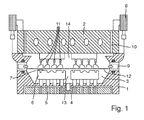
- FIG. 1 Fig. 3 shows in a schematic section a laminating press designed according to the present invention. It comprises a press lower part 1 and a press upper part 2, which can be moved by raising and lowering relative to the press lower part 1 in order to open and close a process chamber 3 formed between these two parts.
- the press base 1 consists essentially of a pallet with ventilation channels 4 and holders 5 for fittings 6 for laying of layers 7 of rovings. This pallet can be removed as a whole, together with the fittings 6 from the position shown below the press upper part 2 and in particular moved away laterally to equip them with 7 layers of rovings or to take the finished laminated fiber composite components.
- Several pallets may be provided to increase throughput.
- the press upper part 2 is provided with a drive 8 for raising and lowering and with a peripheral circumferential seal 9, which comes to lie in the lowered state on sealing surfaces of the pallet or the press base 1 and the process chamber 3 seals pressure-tight. Furthermore, the press upper part 2 ventilation channels 10 and according to the invention infrared heat radiator 11, which at the inner top of the process chamber 3 respectively form a radiator panel for each fitting 6 with 7 located from rovings.
- the radiator field is formed from a plurality of infrared heat radiators 11, which, as in FIG. 1 indicated schematically, each are separately controllable to apply the clutches 7 of rovings spatially resolved differently with thermal radiation.
- This membrane 12 is passed. This membrane divides the process chamber 3 into a lower chamber half 13 and an upper chamber half 14.
- This membrane 12 is in the present embodiment, a thin, transparent to infrared radiation film, which brought together with the formed as a pallet press base 1 in the position shown below the press upper part 2 and is removed again from the press upper part 2 after pressing.
- the lower half of the chamber 13 is first evacuated through the venting channels 4 and, if appropriate, the upper half of the chamber 14 is pressurized via the venting channels 10 so that the membrane 12 contacts the fittings 6 and thus also the latter pressed scrim 7 and a load on the scrim 7 exerts. As a result, they are pressed into the topography of the fittings 6, this topography is a negative mold of the desired shape of the fiber composite component to be produced.
- the infrared heat radiator 11 are activated, in such a way spatially resolved that different areas of the scrim 7 are applied differently with heat.
- the infrared radiation of the infrared heat radiator 11 penetrates through the membrane 12 and is absorbed substantially only by the layer 7 or the matrix material contained therein or on it, so that it is specifically heated and activated on account of the process heat resulting therefrom.
- the infrared heat radiators 11 are turned off, so that the scrim 7 or the finished fiber composite component cools down again quickly. Because of the infrared heat radiator according to the invention has essentially only the fiber composite component heated, but not the other parts of the process chamber or the laminating. After cooling, the upper chamber half 14 is vented and the lower chamber half 13 vented, so that the membrane 12 is released again from the fiber composite components and the corresponding ballast and the process pressure is released. By lifting the press upper part 2, the pallet 1 is free and can be removed laterally from the laminating press, so that the finished fiber composite components can be easily lifted off the shaped pieces 6.
- the scrims 7 made of rovings can also first be heated and then charged with a load, or it is possible to eliminate the load while the process heat is still working and the like more.
- It can also be a membrane 12 are used, which is fixedly attached to the press upper part 2, and optionally absorbs infrared radiation and has a high heat capacity, so that the process heat from the infrared heat radiators 11 only indirectly through the membrane 12 and via a contact thereof with the roving 7 is placed in the same.
- infrared-permeable membrane 12 offers the advantage that the process heat is applied to the scrim 7 within a few seconds and moreover can be controlled very precisely to the temperature window required by the respective matrix material, in particular if the temperature in the resulting fiber composite material Component is detected by sensors. Because infrared heaters 11 can produce device temperatures typically from 30 ° C to typically 220 ° C, many different matrix materials and also different rovings can be used.
Landscapes
- Health & Medical Sciences (AREA)
- Physics & Mathematics (AREA)
- Toxicology (AREA)
- Oral & Maxillofacial Surgery (AREA)
- Thermal Sciences (AREA)
- Electromagnetism (AREA)
- Chemical & Material Sciences (AREA)
- Engineering & Computer Science (AREA)
- Composite Materials (AREA)
- Mechanical Engineering (AREA)
- Casting Or Compression Moulding Of Plastics Or The Like (AREA)
- Moulding By Coating Moulds (AREA)
Applications Claiming Priority (1)
| Application Number | Priority Date | Filing Date | Title |
|---|---|---|---|
| DE201320001996 DE202013001996U1 (de) | 2013-03-04 | 2013-03-04 | Laminierpresse zum Herstellen von Faserverbundwerkstoff-Bauteilen |
Publications (1)
| Publication Number | Publication Date |
|---|---|
| EP2774749A1 true EP2774749A1 (fr) | 2014-09-10 |
Family
ID=48431737
Family Applications (1)
| Application Number | Title | Priority Date | Filing Date |
|---|---|---|---|
| EP14155384.2A Withdrawn EP2774749A1 (fr) | 2013-03-04 | 2014-02-17 | Presse de laminage et procédé de fabrication de composants en matériau en fibre composite |
Country Status (2)
| Country | Link |
|---|---|
| EP (1) | EP2774749A1 (fr) |
| DE (1) | DE202013001996U1 (fr) |
Families Citing this family (2)
| Publication number | Priority date | Publication date | Assignee | Title |
|---|---|---|---|---|
| DE102016209874A1 (de) * | 2016-05-25 | 2017-11-30 | Airbus Operations Gmbh | Vorrichtung zum Verdichten eines Verbundmaterial-Halbzeugs |
| FR3123245B1 (fr) | 2021-05-25 | 2024-01-19 | Inst De Rech Tech Jules Verne | Appareil de chauffage pour réaliser une activation thermique localisée d’une pièce composite |
Citations (5)
| Publication number | Priority date | Publication date | Assignee | Title |
|---|---|---|---|---|
| EP0110698A2 (fr) | 1982-11-29 | 1984-06-13 | E.I. Du Pont De Nemours And Company | Appareil pour former une rangée de fils |
| EP0591822A1 (fr) | 1992-10-09 | 1994-04-13 | COMTEX Textile Composites GmbH | Procédé et installation pour poser des fils |
| FR2777496A1 (fr) * | 1998-04-17 | 1999-10-22 | Sunkiss Aeronautique | Procede d'obtention, reparation ou reconstruction d'un objet avec une piece ou materiau composite |
| DE10005202A1 (de) | 2000-02-03 | 2000-11-02 | Inst Verbundwerkstoffe Gmbh | Kontinuierliche, bauteil- und prozessorientierte Herstellung von Verstärkungsstruktur-Halbzeugen für Faser-Kunststoff-Verbundwerkstoffe |
| GB2492221A (en) * | 2011-06-20 | 2012-12-26 | Williams Ind Services Ltd | Preformer apparatus |
-
2013
- 2013-03-04 DE DE201320001996 patent/DE202013001996U1/de not_active Expired - Lifetime
-
2014
- 2014-02-17 EP EP14155384.2A patent/EP2774749A1/fr not_active Withdrawn
Patent Citations (5)
| Publication number | Priority date | Publication date | Assignee | Title |
|---|---|---|---|---|
| EP0110698A2 (fr) | 1982-11-29 | 1984-06-13 | E.I. Du Pont De Nemours And Company | Appareil pour former une rangée de fils |
| EP0591822A1 (fr) | 1992-10-09 | 1994-04-13 | COMTEX Textile Composites GmbH | Procédé et installation pour poser des fils |
| FR2777496A1 (fr) * | 1998-04-17 | 1999-10-22 | Sunkiss Aeronautique | Procede d'obtention, reparation ou reconstruction d'un objet avec une piece ou materiau composite |
| DE10005202A1 (de) | 2000-02-03 | 2000-11-02 | Inst Verbundwerkstoffe Gmbh | Kontinuierliche, bauteil- und prozessorientierte Herstellung von Verstärkungsstruktur-Halbzeugen für Faser-Kunststoff-Verbundwerkstoffe |
| GB2492221A (en) * | 2011-06-20 | 2012-12-26 | Williams Ind Services Ltd | Preformer apparatus |
Also Published As
| Publication number | Publication date |
|---|---|
| DE202013001996U1 (de) | 2013-04-15 |
Similar Documents
| Publication | Publication Date | Title |
|---|---|---|
| DE69025559T2 (de) | Verfahren und Vorrichtung zum Herstellen von Vorformlingen | |
| EP3365158B1 (fr) | Procédé pour la fabrication d'un élément en matériau composite à base de fibres | |
| DE102014004053B4 (de) | Verfahren zur Konsolidierung von thermoplastischen oder thermoelastischen Faserverbundstrukturen | |
| DE3607647C2 (fr) | ||
| EP3408075B1 (fr) | Procédé pour la fabrication d'une pièce en matériau composite renforcé par des fibres | |
| EP2492074A1 (fr) | Procédé de fabrication d'une ressort à lames en tant que composant composite en fibre et ressort à lames | |
| DE102013013497A1 (de) | Verfahren zur Herstellung eines Bauteils aus Organoblechen | |
| EP3408080B1 (fr) | Procédé pour la fabrication d'une pièce à partir d'un matériau composite renforcé par des fibres | |
| EP2410576A2 (fr) | Composant composite avec une couche solaire active et procédé de fabrication d'un composant composite | |
| WO2015071155A1 (fr) | Production de composites par un procédé en un seul cycle | |
| EP1922197B1 (fr) | Dispositif de compression destine au durcissage a haut rendement energetique d'un composant sandwich d'un aeronef | |
| DE102014109174A1 (de) | Verfahren zum Herstellen eines Formkörpers aus einem Fasermaterial sowie eine Vorrichtung zum Durchführen des Verfahrens | |
| EP3595878B1 (fr) | Procédé et installation pour consolider des structures renforcées par des fibres | |
| DE102017113505A1 (de) | Vorrichtung und Verfahren zur Warmumformung von Faserlagenstapeln | |
| EP0413714A1 (fr) | Procede et installation de traitement en grande serie de materiaux composites renforces par des fibres de haute performance | |
| EP2774749A1 (fr) | Presse de laminage et procédé de fabrication de composants en matériau en fibre composite | |
| DE102011056703A1 (de) | Verfahren zum Herstellen eines Faserverbundwerkstoffbauteils sowie Imprägniervorrichtung zur Durchführung des Verfahrens | |
| DE102015014512B4 (de) | Verfahren und Vorrichtung zur Konsolidierung von imprägnierten Faserverbundstrukturen | |
| DE102005003713B4 (de) | Verfahren zur Herstellung von faserverstärkten Hohlkörperkern-Sandwichbauteilen im vakuumunterstützten Harz-Infusionsprozess | |
| WO2016020252A1 (fr) | Éléments en sandwich faits de corps en mousse à base de poly(méth)acrylate et composites pouvant être réticulés de manière réversible | |
| WO2013007385A1 (fr) | Procédé de fabrication d'une pièce constituée d'un matériau composite renforcé par des fibres ainsi que pièce en matériau composite renforcé par des fibres | |
| WO2003076539A1 (fr) | Procede de production de pieces moulees plates | |
| DE102016111074A1 (de) | Gasführungsanordnung und Verfahren zum unterdruckunterstützten Verarbeiten eines Faserhalbzeugs | |
| DE102016111073A1 (de) | Formelement und Verfahren zum unterdruckunterstützten Verarbeiten eines Faserhalbzeugs | |
| EP2731785B1 (fr) | Procédé de fabrication d'une pièce constituée d'un matériau composite renforcé par des fibres ainsi que pièce en matériau composite renforcé par des fibres |
Legal Events
| Date | Code | Title | Description |
|---|---|---|---|
| PUAI | Public reference made under article 153(3) epc to a published international application that has entered the european phase |
Free format text: ORIGINAL CODE: 0009012 |
|
| 17P | Request for examination filed |
Effective date: 20140217 |
|
| AK | Designated contracting states |
Kind code of ref document: A1 Designated state(s): AL AT BE BG CH CY CZ DE DK EE ES FI FR GB GR HR HU IE IS IT LI LT LU LV MC MK MT NL NO PL PT RO RS SE SI SK SM TR |
|
| AX | Request for extension of the european patent |
Extension state: BA ME |
|
| STAA | Information on the status of an ep patent application or granted ep patent |
Free format text: STATUS: THE APPLICATION IS DEEMED TO BE WITHDRAWN |
|
| 18D | Application deemed to be withdrawn |
Effective date: 20150311 |