EP2774942A1 - Bivalent-trivalenter organisch-anorganischer metallschichtverbundstoff und herstellungsverfahren dafür - Google Patents
Bivalent-trivalenter organisch-anorganischer metallschichtverbundstoff und herstellungsverfahren dafür Download PDFInfo
- Publication number
- EP2774942A1 EP2774942A1 EP20120846468 EP12846468A EP2774942A1 EP 2774942 A1 EP2774942 A1 EP 2774942A1 EP 20120846468 EP20120846468 EP 20120846468 EP 12846468 A EP12846468 A EP 12846468A EP 2774942 A1 EP2774942 A1 EP 2774942A1
- Authority
- EP
- European Patent Office
- Prior art keywords
- divalent
- trivalent metal
- organic
- layered composite
- inorganic layered
- Prior art date
- Legal status (The legal status is an assumption and is not a legal conclusion. Google has not performed a legal analysis and makes no representation as to the accuracy of the status listed.)
- Withdrawn
Links
- SPUISJRZRBRVGK-AXQFOSQISA-O CC[C@H](C)C1C2[OH+]CC2CC(CC[Si+](OC)(OC)OC)C1 Chemical compound CC[C@H](C)C1C2[OH+]CC2CC(CC[Si+](OC)(OC)OC)C1 SPUISJRZRBRVGK-AXQFOSQISA-O 0.000 description 1
Images




Classifications
-
- C—CHEMISTRY; METALLURGY
- C08—ORGANIC MACROMOLECULAR COMPOUNDS; THEIR PREPARATION OR CHEMICAL WORKING-UP; COMPOSITIONS BASED THEREON
- C08G—MACROMOLECULAR COMPOUNDS OBTAINED OTHERWISE THAN BY REACTIONS ONLY INVOLVING UNSATURATED CARBON-TO-CARBON BONDS
- C08G77/00—Macromolecular compounds obtained by reactions forming a linkage containing silicon with or without sulfur, nitrogen, oxygen or carbon in the main chain of the macromolecule
- C08G77/48—Macromolecular compounds obtained by reactions forming a linkage containing silicon with or without sulfur, nitrogen, oxygen or carbon in the main chain of the macromolecule in which at least two but not all the silicon atoms are connected by linkages other than oxygen atoms
- C08G77/58—Metal-containing linkages
-
- C—CHEMISTRY; METALLURGY
- C09—DYES; PAINTS; POLISHES; NATURAL RESINS; ADHESIVES; COMPOSITIONS NOT OTHERWISE PROVIDED FOR; APPLICATIONS OF MATERIALS NOT OTHERWISE PROVIDED FOR
- C09D—COATING COMPOSITIONS, e.g. PAINTS, VARNISHES OR LACQUERS; FILLING PASTES; CHEMICAL PAINT OR INK REMOVERS; INKS; CORRECTING FLUIDS; WOODSTAINS; PASTES OR SOLIDS FOR COLOURING OR PRINTING; USE OF MATERIALS THEREFOR
- C09D183/00—Coating compositions based on macromolecular compounds obtained by reactions forming in the main chain of the macromolecule a linkage containing silicon, with or without sulfur, nitrogen, oxygen, or carbon only; Coating compositions based on derivatives of such polymers
- C09D183/14—Coating compositions based on macromolecular compounds obtained by reactions forming in the main chain of the macromolecule a linkage containing silicon, with or without sulfur, nitrogen, oxygen, or carbon only; Coating compositions based on derivatives of such polymers in which at least two but not all the silicon atoms are connected by linkages other than oxygen atoms
Definitions
- the present invention relates to an organic-inorganic layered composite and a method for producing the composite, and more specifically to an organic-inorganic layered composite comprising an inorganic layer constituted of metal oxides and an organic layer constituted of an organic group bonded to the metal oxides via a silicon atom, and a method for producing the composite. Moreover, the present invention relates to a cationic UV curable coating composition comprising such an organic-inorganic layered composite, a cured coating film using the composition, and a method for producing the cured coating film.
- An organic-inorganic composite material has a portion made of an inorganic material such as a metal or a compound thereof and a portion made of an organic material such as a hydrocarbon chain, and possesses both properties attributed to the inorganic material and properties attributed to the organic material. Such materials are used in various fields.
- Japanese Unexamined Patent Application Publication No. 2009-185148 discloses an organic-inorganic layered composite including an inorganic layer, in which a layer formed of a tetrahedral structure containing a Si atom as a central atom and a layer formed of an octahedral structure containing a metal atom such as a Mg atom or an Al atom as a central atom form a 2:1-type or 1:1-type layered silicate structure, and an organic layer formed of an organic group bonded to the Si atom by a covalent bond.
- J. Phys. Chem. B, 1997, vol. 101, No. 4, pp. 531 to 539 discloses such an organic-inorganic layered composite, that is, a layered inorganic-organic nanocomposite containing a Mg atom or an Al atom as a central atom of an octahedral structure, and also discloses that the degree of silane condensation is higher in a layered inorganic-organic nanocomposite containing only a Mg atom as a central atom of an octahedral structure than one containing only an Al atom.
- cationic UV curable coating compositions have the following advantages over radical UV curable coating compositions: (i) the curing is less likely to be inhibited by oxygen, (ii) the curing reaction progresses even after light irradiation, and (iii) when a monomer used is a ring-opening polymerization type monomer, it can reduce the volume shrinkage at the time of curing, making the residual stress of the cured coating film small, and thereby a cured coating film having an excellent adhesion is obtained. Nevertheless, the polymerization rate of cationic UV curable monomers is slow in comparison with radical UV curable monomers. This makes it difficult to form a cured coating film having a sufficiently high surface hardness.
- a cationic UV curable resin composition having enhanced photocurability resin compositions blended with metal oxide particles are proposed (for example, Japanese Unexamined Patent Application Publication No. 2000-26730 (PTL 2), International Publication No. WO2004/033532 (PTL 3), and Japanese Unexamined Patent Application Publication No. 2005-89697 (PTL 4)).
- a dispersant such as an organic silane compound, or the like, is used to uniformly disperse the metal oxide particles.
- the method for dispersing metal oxide particles using a dispersant is a sufficient method to obtain a cured coating film having a high hardness. It is required that inorganic particles such as metal oxide particles should be dispersed in a resin to a higher degree.
- an organic-inorganic layered composite containing only a Mg atom has a low dispersibility in an organic material such as an organic solvent. If such an organic-inorganic layered composite recovered as a powder is used, it is difficult to uniformly disperse the composite in an organic material again. Further, if the organic-inorganic composites described in PTLs 5 and 6 are blended with a cationic UV curable coating composition, a cured coating film having a sufficient hardness can be obtained, but it is difficult to obtain a transparent cured coating film excellent in water resistance.
- a first object thereof is to provide: an organic-inorganic layered composite comprising a divalent metal atom such as a Mg atom, and being excellent in dispersibility in an organic material such as an organic solvent, particularly dispersibility when dispersed in an organic material such as an organic solvent again after recovered in the form of fine particles (hereinafter referred to as "re-dispersibility"); and a method for producing the composite.
- a second object of the present invention is to provide a cationic UV curable coating composition capable of forming a transparent cured coating film, which has a sufficient hardness and an excellent water resistance without impairing the adhesion to a base material.
- the present inventors have earnestly studied in order to achieve the first object. As a result, the inventors have found out that a divalent metal atom such as a Mg atom and a trivalent metal atom such as an Al atom used in combination as metal atoms in an organic-inorganic layered composite improve the dispersibility (particularly, re-dispersibility) of the organic-inorganic layered composite in an organic material in comparison with one containing only a divalent metal atom.
- a divalent metal atom such as a Mg atom and a trivalent metal atom such as an Al atom used in combination as metal atoms in an organic-inorganic layered composite improve the dispersibility (particularly, re-dispersibility) of the organic-inorganic layered composite in an organic material in comparison with one containing only a divalent metal atom.
- both an organic-inorganic layered composite containing only a divalent metal atom and an organic-inorganic layered composite containing only a trivalent metal atom contain a lot of siloxane bonds in comparison with silanol groups; nevertheless, in a case where a divalent metal atom and a trivalent metal atom are used in combination, if the content of the trivalent metal atom is too high, the content of siloxane bonds is lowered in comparison with silanol groups.
- the present inventors have earnestly further studied, and as a result found out that it is necessary to use a divalent metal atom and a trivalent metal atom in combination and also to suppress the content of the trivalent metal atom in order to obtain an organic-inorganic layered composite excellent in dispersibility (particularly, re-dispersibility) in an organic material and containing a lot of siloxane bonds in comparison with silanol groups.
- a divalent-trivalent metal-based organic-inorganic layered composite of the present invention is represented by the following formula (1): [R 1 n SiO (4-n)/2 ] x [ (M 1 2/2 O) y (M 2 2/3 O) z ] [H 2 O] w (1)
- R 1 represents an organic group
- M 1 represents a divalent metal atom
- M 2 represents a trivalent metal atom
- n is an integer of 1 to 3
- x, y, and z are arbitrary numbers that satisfy a condition represented by 0.5 ⁇ x/(y+2z/3) ⁇ 3
- w represents the number of a structural water molecule
- the number of the trivalent metal atom is 1 to 67% of a total of 100 atoms of the divalent metal atom and the trivalent metal atom.
- the number of the trivalent metal atom is preferably 1 to 45%, particularly preferably 1 to 10%, of a total of 100 atoms of the divalent metal atom and the trivalent metal atom.
- a method for producing a divalent-trivalent metal-based organic-inorganic layered composite of the present invention comprises:
- a divalent-trivalent metal-based organic-inorganic layered composite of the present invention it is preferable that, in the reaction step, water be added to the raw-material solution to synthesize the divalent-trivalent metal-based organic-inorganic layered composite, and it is preferable that, in the removal step, the second solvent, which does not dissolve compatibly with water at least, be added to an aqueous solution after the reaction step, and thereafter the aqueous solution be removed. Moreover, it is preferable that, in the reaction step, a pH of the raw-material solution be adjusted to an alkaline level to promote the reactions of the organoalkoxysilane, the divalent metal compound, and the trivalent metal compound.
- the first solvent is preferably at least one polar solvent selected from the group consisting of inorganic polar solvents and organic polar solvents, and more preferably at least one polar solvent selected from the group consisting of water and water-soluble organic solvents.
- the second solvent is preferably at least one organic solvent selected from the group consisting of ethyl acetate, toluene, and chloroform.
- the method for producing a divalent-trivalent metal-based organic-inorganic layered composite of the present invention preferably further comprises, after the removal step, a recovery step of removing the second solvent to thereby recover the divalent-trivalent metal-based organic-inorganic layered composite.
- a divalent-trivalent metal-based organic-inorganic layered composite having at least one functional group of an epoxy group, an oxetanyl group, and a vinyl ether group, and comprising a divalent metal atom such as a Mg atom and a trivalent metal atom such as an Al atom shows an excellent dispersibility in a cationic UV curable coating composition, and consequently a transparent cured coating film having a sufficient hardness and an excellent water resistance is obtained.
- a cationic UV curable coating composition of the present invention comprises:
- the trivalent metal atom is preferably at least one metal atom of aluminium (Al) and iron(III) (Fe(III)), and the divalent metal atom is preferably at least one metal atom selected from the group consisting of magnesium (Mg), nickel(II) (Ni(II)), cobalt(II) (Co(II)), copper(II) (Cu(II)), manganese (Mn), iron(II) (Fe(II)), lithium (Li), vanadium(II) (V(II)), zirconium (Zr), and zinc (Zn).
- dissolving is a phenomenon in which a substance (solute) dissolves in a solvent and turns into a uniform mixture (solution), and such a phenomenon includes a case where at least a part of a solute turns into ions after dissolving, a case where a solute does not dissociate into ions but exists in a molecular state, a case where molecules and ions exist in an associated state, and the like.
- the divalent-trivalent metal-based organic-inorganic layered composite of the present invention is excellent in dispersibility (particularly, re-dispersibility) in an organic material in comparison with a divalent metal-based organic-inorganic layered composite containing only a divalent metal atom.
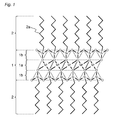
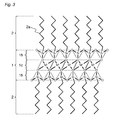
- the present inventors speculate as follows. Specifically, as shown in Figs.
- the divalent-trivalent metal-based organic-inorganic layered composite of the present invention presumably has a layer structure formed from: an inorganic layer 1 constituted of a layer 1a formed of an octahedral structure containing a divalent metal atom M 1 and a trivalent metal atom M 2 as a central atom (hereinafter referred to as "octahedral sheet") and a layer 1b formed of a tetrahedral structure containing a Si atom as a central atom (hereinafter referred to as "tetrahedral sheet”); and an organic layer 2 constituted of an organic group 2a bonded to the Si atom by a covalent bond (including an organic group having a functional group X) ( FIGs. 1 and 2 show a 2:1-type layered silicate structure).
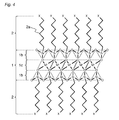
- a conventional divalent metal-based organic-inorganic layered composite presumably has a layer structure formed from: an inorganic layer 1 constituted of an octahedral sheet 1c containing only the divalent metal atom M 1 as a central atom and the tetrahedral sheet 1b containing a Si atom as a central atom; and an organic layer 2 constituted of the organic group 2a bonded to the Si atom by a covalent bond (including the organic group having the functional group X).
- the central atom is only the divalent metal atom M 1 .
- the octahedral sheet 1c is likely to grow in a layer direction; as a result, the resulting organic-inorganic layered composite has a large particle diameter, and is less likely to be dispersed in an organic material, presumably.
- both the divalent metal atom M 1 such as a Mg atom and the trivalent metal atom M 2 such as an Al atom coexist as a central atom.
- the resulting organic-inorganic layered composite has a small particle diameter; in addition, the particles have a high surface potential in comparison with the divalent metal-based organic-inorganic layered composite, and are likely to be dispersed in an organic material such as an organic solvent, presumably.
- the divalent-trivalent metal-based organic-inorganic layered composite having at least one functional group of an epoxy group, an oxetanyl group, and a vinyl ether group as the functional group X and comprising both the divalent metal atom M 1 and the trivalent metal atom M 2 as the central atom of the octahedral sheet tends to be excellent in dispersibility in a cationic UV curable coating composition, in comparison with the divalent metal-based organic-inorganic layered composite having a predetermined functional group such as an epoxy group as the functional group X and containing only the divalent metal atom M 1 as the central atom of the octahedral sheet ( Fig. 4 ).
- the divalent-trivalent metal-based organic-inorganic layered composite having a predetermined functional group such as an epoxy group and comprising both the divalent metal atom M 1 and the trivalent metal atom M 2 as the central atom of the octahedral sheet is dispersed to a high degree in a cured coating film to be obtained, and is capable of forming a cured coating film having a sufficient hardness and an excellent transparency.
- the divalent-trivalent metal-based organic-inorganic layered composite having a predetermined functional group such as an epoxy group is formed by subjecting the organoalkoxysilane having a predetermined functional group such as an epoxy group, the divalent metal compound containing a divalent metal atom, and the trivalent metal compound containing a trivalent metal atom to hydrolysis and dehydration condensation.
- the organoalkoxysilane having a predetermined functional group such as an epoxy group
- the divalent metal compound containing a divalent metal atom and the trivalent metal compound containing a trivalent metal atom
- the trivalent metal compound containing a trivalent metal atom to hydrolysis and dehydration condensation.
- the aluminium chloride acts as a nucleophilic reagent, and cleaves the epoxy group, the oxetanyl group, and the vinyl group by hydrolysis or solvolysis, presumably.
- the predetermined functional group such as an epoxy group does not react with a cationic UV curable monomer.
- the crosslinking reaction between the organic-inorganic layered composite and the cationic UV curable monomer does not progress, reducing the water resistance of the cured coating film, presumably.
- the cleavage of the epoxy group, the oxetanyl group, and the vinyl group significantly takes place as the amount of the aluminium chloride hydrate increases. Accordingly, if a cationic UV curable coating composition contains a divalent-trivalent metal-based organic-inorganic layered composite having an Al atom content of higher than 67%, the cured coating film has a particularly reduced water resistance, presumably.
- the present invention makes it possible to obtain an organic-inorganic layered composite comprising a divalent metal atom, and being excellent in dispersibility (particularly, re-dispersibility) in an organic material such as an organic solvent, the organic-inorganic layered composite containing a lot of siloxane bonds in comparison with silanol groups. Moreover, it is made possible to obtain a transparent cured coating film comprising the organic-inorganic layered composite excellent in dispersibility, and having a sufficient hardness and an excellent water resistance without impairing an excellent adhesion to a base material.
- the divalent-trivalent metal-based organic-inorganic layered composite of the present invention (hereinafter simply may also be referred to as "organic-inorganic layered composite of the present invention”) is represented by the following formula (1): [R 1 n SiO (4-n)/2 ] x [(M 1 2/2 O) y (M 2 2/3 O) z ] [H 2 O] w (1) (in the formula (1), R 1 represents an organic group, M 1 represents a divalent metal atom, M 2 represents a trivalent metal atom, n is an integer of 1 to 3, x, y, and z are arbitrary numbers that satisfy a condition represented by 0.5 ⁇ x/(y+2z/3) ⁇ 3, and w represents the number of a structural water molecule).
- both the divalent metal atom M 1 and the trivalent metal atom M 2 coexist as a central atom of an octahedral sheet. Accordingly, the organic-inorganic layered composite shows a high dispersibility (particularly, re-dispersibility) in an organic material such as an organic solvent in comparison with an organic-inorganic layered composite containing only a divalent metal atom.
- organic-inorganic layered composites preferable is a divalent-trivalent metal-based organic-inorganic layered composite, wherein R 1 in the formula (1) is an organic group having at least one functional group of an epoxy group, an oxetanyl group, and a vinyl ether group (hereinafter simply may also be referred to as "organic-inorganic layered composite of the present invention having a predetermined functional group"), from the viewpoint that a transparent cured coating film having a sufficient hardness and an excellent water resistance without impairing an excellent adhesion to a base material can be obtained by adding the organic-inorganic layered composite to a cationic UV curable coating composition.
- R 1 in the formula (1) is an organic group having at least one functional group of an epoxy group, an oxetanyl group, and a vinyl ether group (hereinafter simply may also be referred to as "organic-inorganic layered composite of the present invention having a predetermined functional group"), from the viewpoint that a transparent cured coating film
- the number of the trivalent metal atom is 1 to 67% of a total of 100 atoms of the divalent metal atom and the trivalent metal atom. If the number of the trivalent metal atom is smaller than the lower limit, the organic-inorganic layered composite has a low dispersibility (particularly, re-dispersibility) in an organic material or in a cationic UV curable coating composition.
- the mechanical strength (for example, hardness) of a tetrahedral sheet is reduced.
- the mechanical strength (for example, hardness) of the organic-inorganic layered composite is reduced.
- a predetermined functional group such as an epoxy group is cleaved; hence, the crosslinking reaction between the organic-inorganic layered composite having a predetermined functional group and a cationic UV curable monomer does not progress, reducing the water resistance of the cured coating film.
- the content of the trivalent metal atom is preferably 66% or less, more preferably 55% or less, further preferably 45% or less, still further preferably 30% or less, and particularly preferably 15% or less.
- the content of the trivalent metal atom is within the above range, the content of siloxane bonds is increased in comparison with silanol groups, the mechanical strength (for example, hardness) of the tetrahedral sheet is increased, and a divalent-trivalent metal-based organic-inorganic layered composite excellent in mechanical strength (for example, hardness) tends to be formed.
- a cured coating film of the present invention tends to have a high surface hardness.
- the content of the trivalent metal atom is preferably 55% or less. This leads to a tendency that the predetermined functional group such as an epoxy group is less likely to be cleaved.
- the content of the trivalent metal atom is most preferably 10% or less.
- the mechanical strength (for example, hardness) of the octahedral sheet is further improved, and the resulting divalent-trivalent metal-based organic-inorganic layered composite is quite excellent in mechanical strength (for example, hardness).
- the cured coating film of the present invention tends to have a high surface hardness.
- a conventional trivalent metal-based organic-inorganic layered composite presumably has a layer structure formed from: an inorganic layer constituted of an octahedral sheet containing only a trivalent metal atom as a central atom and a tetrahedral sheet containing a Si atom as a central atom; and an organic layer constituted of an organic group bonded to the Si atom by a covalent bond.
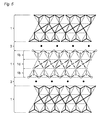
- the central atom of the octahedral sheet is only a trivalent metal atom. Accordingly, a layer structure thereof is presumably similar to a layered silicate structure constituting a dioctahedral smectite-based layered clay mineral as shown in Fig. 5 . It is known that an octahedral sheet in a dioctahedral clay mineral has pores present in a ratio of 1 in 3 octahedral structures. Presumably, an octahedral sheet in a trivalent metal-based organic-inorganic layered composite also has similar pores.
- an octahedral sheet having such pores has a low crystallinity and a low mechanical strength.
- the layered silicate structure grows in a layer direction with interlayer cations as shown in Fig. 5 , thereby suppressing the reduction in mechanical strength.
- an organic group is covalently bonded to a silicon atom in a tetrahedral sheet. Accordingly, the inorganic layer is less likely to grow in a layer direction.
- an organic-inorganic layered composite having a small particle diameter is formed, the reduction in mechanical strength of the inorganic layer is not sufficiently suppressed, presumably.
- an inorganic layer of a divalent metal-based organic-inorganic layered composite shown in Fig. 3 the central atom of an octahedral sheet 1c is only a divalent metal atom. Accordingly, a layer structure thereof is presumably similar to a layered silicate structure constituting a trioctahedral smectite-based layered clay mineral. Since an octahedral sheet in a trioctahedral clay mineral has no pore, the octahedral sheet 1c in the divalent metal-based organic-inorganic layered composite presumably does not have pores.
- the divalent metal-based organic-inorganic layered composite presumably shows a high mechanical strength in comparison with a trivalent metal-based organic-inorganic layered composite.
- an octahedral sheet 1a of the organic-inorganic layered composite of the present invention as shown in Figs. 1 and 2 , both an octahedral structure having the trivalent metal atom M 2 as a central metal and an octahedral structure having the divalent metal atom M 1 as a central atom presumably coexist.
- an octahedral sheet having no pore has a high crystallinity and a high mechanical strength in comparison with an octahedral sheet having pores. Accordingly, in the octahedral sheet 1a of the organic-inorganic layered composite of the present invention in which these coexist in the surface direction, as the proportion of the octahedral sheet having no pore increases, the crystallinity is increased, and thus the mechanical strength is increased, presumably.
- M 1 represents a divalent metal atom.
- a divalent metal atom examples include magnesium (Mg), nickel(II) (Ni(II)), cobalt(II) (Co(II)), copper(II) (Cu(II)), manganese (Mn), iron(II) (Fe(II)), lithium (Li), vanadium(II) (V(II)), zirconium (Zr), and zinc (Zn).
- the organic-inorganic layered composite of the present invention has a high dispersibility (particularly, re-dispersibility) and a small dispersed-particle diameter in an organic material or in a cationic UV curable coating composition
- magnesium (Mg) and nickel(II) (Ni(II)) are preferable, and magnesium (Mg) is particularly preferable.
- the organic-inorganic layered composite of the present invention may comprise one of such divalent metal atoms alone, or two or more thereof.
- M 2 represents a trivalent metal atom.
- a trivalent metal atom examples include aluminium (Al) and iron (III) (Fe(III)).
- aluminium (Al) is preferable from the viewpoint that the organic-inorganic layered composite of the present invention has a high dispersibility (particularly, re-dispersibility) and a small dispersed-particle diameter in an organic material or in a cationic UV curable coating composition.
- the organic-inorganic layered composite of the present invention may comprise one of such trivalent metal atoms alone, or two or more thereof.
- R 1 represents an organic group, which is derived from an organoalkoxysilane used in a method for producing a divalent-trivalent metal-based organic-inorganic layered composite of the present invention to be described later.
- the number of carbon atoms in such an organic group is not particularly limited, but is for example preferably 3 to 18, and more preferably 3 to 12.
- Such an organic group is not particularly limited.
- examples thereof include hydrocarbon groups such as alkyl groups (for example, a methyl group, an ethyl group, a propyl group, a butyl group, a hexyl group, an octyl group, a decyl group, an undecyl group, a dodecyl group, a tridecyl group, a hexadecyl group, an octadecyl group), alkenyl groups (for example, a vinyl group), and aryl groups (for example, a phenyl group), and the like.
- alkyl groups for example, a methyl group, an ethyl group, a propyl group, a butyl group, a hexyl group, an octyl group, a decyl group, an undecyl group, a dodecyl group, a tridecyl group,
- these organic groups are preferably ones substituted with a functional group such as an epoxy group (for example, a glycidoxy group, an epoxycyclohexyl group, a glycidyl group), an oxetanyl group, a vinyl ether group, a (meth)acryloxy group, a phenyl group, an amino group, a phenoxy group, an acetyl group, a ureido group, a halogen atom (for example, a chlorine atom), a mercapto group, an isothiouronium group, an acid anhydride group (for example, a succinic anhydride group), a nitrogen-containing heterocyclic ring (for example, an imidazole ring, an imidazoline ring, a pyridine ring, a pyrrole ring, an aziridine ring, a triazole ring), a nitro group, an amide group, a carbomethoxy group, an alde
- an organic group having a (meth)acryloxy group as a substituent is preferable among the organic groups having such a functional group.
- organic-inorganic layered composite of the present invention when added to a cationic UV curable coating composition, an organic group having at least one functional group of an epoxy group, an oxetanyl group, and a vinyl ether group is preferable, and an organic group formed by bonding at least one of these functional groups to the aforementioned hydrocarbon group is more preferable.
- organic groups having a predetermined functional group are derived from an organoalkoxysilane having a predetermined functional group used in the method for producing an organic-inorganic layered composite of the present invention to be described later.
- the organic-inorganic layered composite of the present invention having a predetermined functional group comprises the organic group having a predetermined functional group such as an epoxy group
- a crosslinking structure can be formed with a cationic UV curable monomer.
- the epoxy group include a glycidyl group, an alicyclic epoxy group, and the like.
- an alicyclic epoxy group is preferable from the viewpoint that the reactivity with the cationic UV curable monomer is high.
- x, y, and z can be determined on the basis of amounts of the silicon atom, the divalent metal atom, and the trivalent metal atom contained in raw materials used in producing the organic-inorganic layered composite of the present invention.
- x/(y+2z/3) represents a molar ratio between the Si atom and the metal atoms (the divalent metal atom and the trivalent metal atom) incorporated in the organic-inorganic layered composite of the present invention.
- the structural water is derived from a hydroxyl group constituting a silanol group in the tetrahedral sheet, a hydroxyl group bonded to the divalent or trivalent metal atom in the octahedral sheet, and so forth.
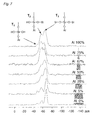
- the presence can be confirmed by a nuclear magnetic resonance (NMR) measurement.
- NMR nuclear magnetic resonance
- w is an arbitrary number not limited to an integer
- w/(y+2z/3) represents a molar ratio between the structural water and the metal atoms (the divalent metal atom and the trivalent metal atom).
- Such an organic-inorganic layered composite of the present invention is excellent in dispersibility (particularly, re-dispersibility) in an organic material such as an organic solvent.
- the organic-inorganic layered composite of the present invention can be dispersed in an organic solvent in such a manner that the maximum dispersed-particle diameter is preferably 100 nm or smaller, more preferably 75 nm or smaller, and particularly preferably 50 nm or smaller.
- the maximum dispersed-particle diameter can be determined as a maximum particle diameter in a particle diameter distribution of the organic-inorganic layered composite of the present invention dispersed in an organic solvent, the particle diameter distribution measured by dynamic light scattering.
- the organic-inorganic layered composite of the present invention can be produced through a preparation step, a reaction step, and a removal step to be described below.
- an organoalkoxysilane, a divalent metal compound containing a divalent metal atom, and a trivalent metal compound containing a trivalent metal atom are dissolved in a first solvent, which is a polar solvent, to thereby prepare a raw-material solution containing a silicon atom, the divalent metal atom, and the trivalent metal atom.
- a first solvent which is a polar solvent
- the term "dissolving" in this step includes such a state in which one or two or more of the organoalkoxysilane, the divalent metal compound, and the trivalent metal compound are dispersed as particles in the first solvent.
- organoalkoxysilane having at least one functional group of an epoxy group, an oxetanyl group, and a vinyl ether group (hereinafter may also be referred to as "organoalkoxysilane having a predetermined functional group").
- the organoalkoxysilane used in the present invention is not particularly limited, as long as it is represented by the following formula (2): R 1 n Si(OR 2 ) (4-n) (2) (in the formula (2), R 1 represents an organic group, OR 2 represents an alkoxy group, and n is an integer of 1 to 3).
- the organoalkoxysilane having a predetermined functional group is preferably such an organoalkoxysilane that R 1 in the formula (2) is an organic group having at least one functional group of an epoxy group, an oxetanyl group, and a vinyl ether group.
- a Si atom constituting these organoalkoxysilanes (including the organoalkoxysilane having a predetermined functional group.
- the Si atom constituting the organic-inorganic layered composite of the present invention preferably, the Si atom that is the central atom of the tetrahedral sheet in the organic-inorganic layered composite of the present invention
- the organic group R 1 in the formula (2) becomes the organic group R 1 constituting the organic layer in the organic-inorganic layered composite of the present invention.
- OR 2 represents an alkoxy group.
- Such an alkoxy group is not particularly limited, but is preferably an alkoxy group having 1 to 3 carbon atoms, such as a methoxy group and an ethoxy group.
- the organoalkoxysilane may contain one of such alkoxy groups alone, or two or more thereof.
- Such organoalkoxysilanes are preferably epoxy-based alkoxysilanes (for example, glycidyl-based alkoxysilanes, alicyclic epoxy-based alkoxysilanes), oxetane-based alkoxysilanes, vinyl ether-based alkoxysilanes, (meth)acryl-based alkoxysilanes, vinyl-based alkoxysilane, alkyl-based alkoxysilanes, aromatic alkoxysilanes, amino-based alkoxysilanes (for example, alkoxysilanes having -NH 2 , -NHCH 3 , or -N(CH 3 ) 2 ) and alkoxysilylamines, ureido-based alkoxysilanes, halogenated alkoxysilanes, mercapto-based alkoxysilanes, isothiouronium salts having an alkoxysilyl group, acid anhydr
- (meth)acryl-based alkoxysilanes are more preferable, and 3-methacryloxypropyl trimethoxysilane is particularly preferable among such organoalkoxysilanes.
- examples of the organoalkoxysilane having a predetermined functional group include alicyclic epoxy-based organoalkoxysilanes such as alkoxysilanes having an epoxycyclohexyl group represented by the following formula (2a), glycidyl-based organoalkoxysilanes such as alkoxysilanes having a glycidyl group represented by the following formula (2b), oxetane-based organoalkoxysilanes such as alkoxysilanes having an oxetanyl group represented by the following formula (2c), vinyl ether-based organoalkoxysilanes such as alkoxysilanes having a vinyloxy group represented by the following formula (2d), and the like.
- alicyclic epoxy-based organoalkoxysilanes such as alkoxysilanes having an epoxycyclohexyl group represented by the following formula (2a)
- alicyclic epoxy-based organoalkoxysilanes represented by the following formula (2a) are preferable from the viewpoint that the reactivity between the organic-inorganic layered composite of the present invention having a predetermined functional group and the cationic UV curable monomer is high, and the water resistance of the cured coating film is improved.
- One of such organoalkoxysilanes having a predetermined functional group may be used alone, or two or more thereof may be used in combination.
- OR 2 is synonymous with OR 2 in the formula (2)
- R 3 represents an organic group having 1 to 8 carbon atoms optionally having an ether bond
- R 4 represents an organic group having 1 to 3 carbon atoms
- n is synonymous with n in the formula (2).
- Examples of the epoxycyclohexyl group-containing alkoxysilanes represented by the formula (2a) include 2-(3,4-epoxycyclohexyl)ethyltrimethoxysilane, 2-(3,4-epoxycyclohexyl)ethyltriethoxysilane, 2-(3,4-epoxycyclohexyl)ethylmethyldiethoxysilane, and the like.
- Examples of the glycidyl group-containing alkoxysilanes represented by the formula (2b) include 3-glycidyloxypropyltrimethoxysilane, 3-glycidyloxypropyltriethoxysilane, 3-glycidyloxypropylmethyldiethoxysilane, and the like.
- examples of the oxetanyl group-containing alkoxysilanes represented by the formula (2c) include alkoxysilanes described in paragraphs [0040] to [0041] of Japanese Unexamined Patent Application Publication No. 2000-26730 such as [(3-methyloxetan-3-yl)-methyloxypropyl]-trimethoxysilane, [(3-methyloxetan-3-yl)-methyloxypropyl]-triethoxysilane, [(3-methyloxetan-3-yl)-methyloxypropyl]-methyldiethoxysilane, 2-[(3-methyloxetan-3-yl)-methyloxypropyl]-ethoxyethyltrimethoxysilane, 2-[(3-methyloxetan-3-yl)-methyloxypropyl]-ethoxyethyltriethoxysilane, and 2-[(3-methyloxetan-3-yl)
- Examples of the vinyl ether group-containing alkoxysilanes represented by the formula (2d) include 2-(vinyloxy)ethyltrimethoxysilane, 2-(vinyloxy)ethyltriethoxysilane, 2-(vinyloxy)ethylmethyldiethoxysilane, and the like.
- an alkoxysilane containing no organic group can be used in combination with the organoalkoxysilane, as necessary.
- examples of such an alkoxysilane containing no organic group include tetramethoxysilane (TMOS), tetraethoxysilane (TEOS), tetra-n-propoxysilane, tetraisopropoxysilane, tetra-n-butoxysilane, tetra-sec-butoxysilane, tetra-tert-butoxysilane, and the like.
- alkoxysilanes may be used alone, or two or more thereof may be used in combination.
- an organic-inorganic layered composite having more inorganic properties is likely to be formed.
- Such an organic-inorganic layered composite having more inorganic properties has a low affinity for an organic material such as an organic solvent, and is not preferable as a filler for resin coating films and resin molded articles.
- a second solvent used in the removal step to be described later is limited to certain types.
- a molar ratio between the organoalkoxysilane and the alkoxysilane containing no organic group is preferably 50:50 or higher, more preferably 70:30 or higher.
- the alkoxysilane containing no organic group or an organoalkoxysilane having no functional group can be used in combination with the organoalkoxysilane having a predetermined functional group, as necessary.
- the organoalkoxysilane having no functional group include alkyl-based alkoxysilanes, aromatic alkoxysilanes, and the like. One of such alkoxysilanes may be used alone, or two or more thereof may be used in combination.
- the organoalkoxysilane having no functional group or the alkoxysilane containing no organic group when used in a large proportion, this reduces the number of sites where the organic-inorganic layered composite of the present invention having a predetermined functional group reacts with the cationic UV curable monomer, and the water resistance of the cured coating film tends to be reduced.
- the amount of these alkoxysilanes used is preferably 50% by mol or less of the amount of all the alkoxysilanes (a sum of the organoalkoxysilane having a predetermined functional group, the organoalkoxysilane having no functional group, and the alkoxysilane containing no organic group).
- the divalent metal compound used in the present invention is not particularly limited, as long as the metal compound contains the divalent metal atom described above.
- the metal compound contains the divalent metal atom described above.
- preferable are inorganic salts, organic salts, and alkoxides of the divalent metal atom.
- the inorganic salts are preferably chlorides, sulfides, sulfates, nitrates, and the like.
- the organic salts are preferably acetates and the like.
- the alkoxides are preferably methoxides, ethoxides, propoxides, butoxides, and the like.
- One of such divalent metal compounds may be used alone, or two or more thereof may be used in combination.
- the trivalent metal compound used in the present invention is not particularly limited, as long as the metal compound contains the trivalent metal atom described above.
- the inorganic salts are preferably chlorides, sulfides, sulfates, nitrates, and the like.
- the organic salts are preferably acetates and the like.
- the alkoxides are preferably methoxides, ethoxides, propoxides, butoxides, and the like.
- One of such trivalent metal compounds may be used alone, or two or more thereof may be used in combination.
- a first solvent which is a polar solvent
- any solvent can be used, as long as it is polar solvent, including inorganic polar solvents (for example, water, inorganic acids), organic polar solvents (for example, alcohols, acetone, organic acids), and mixture solvents of two or more of these.
- inorganic polar solvents for example, water, inorganic acids
- organic polar solvents for example, alcohols, acetone, organic acids
- mixture solvents of two or more of these preferable are water, water-soluble organic solvents (for example, lower alcohols such as chain alcohols having 1 to 5 carbon atoms, acetone), and mixture solvents of two or more of these.
- the raw-material solution is prepared in such a manner that an atomic ratio of the silicon atom to the metal atoms contained in the resulting raw-material solution (the number of the silicon atom/a total number of the divalent metal atom and the trivalent metal atom.
- the number of the silicon atom/the number of the metal atoms is from 0.5 to 3 both inclusive.
- the inorganic layer having a 2:1-type or 1:1-type phyllosilicate structure constituted of the tetrahedral sheet having the silicon atom as the central atom and the octahedral sheet having the divalent and trivalent metal atoms as the central atom.
- the number of the silicon atom/the number of the metal atoms from 1 to 3 both inclusive it is possible to form the inorganic layer having the 2:1-type phyllosilicate structure, and by adjusting from 0.5 to 1 both inclusive, it is possible to form the inorganic layer having the 1:1-type phyllosilicate structure.
- the organic-inorganic layered composite of the present invention may encapsulate core particles, each of which is one organic molecule or an assembly of organic molecules, to thus produce composite particles comprising the core particles and shell layers constituted of the organic-inorganic layered composite of the present invention encapsulating the core particles.
- the organoalkoxysilane, the divalent metal alkoxide, the trivalent metal alkoxide, and organic molecules such as ultraviolet-ray absorbing molecules or dye molecules may be dissolved in the first solvent to prepare the raw-material solution.
- associates are allowed to react to thus obtain the composite particles comprising the core particles and the shell layers constituted of the organic-inorganic layered composite of the present invention encapsulating the core particles.
- such composite particles can be produced without particular problems, if the number of the silicon atom/the number of the metal atoms in the raw-material solution is from 0.5 to 3 both inclusive. Meanwhile, such composite particles can be readily produced by adjusting the number of the silicon atom/the number of the metal atoms from 1 to 3 both inclusive.
- the raw-material solution is prepared in such a manner that the number of the trivalent metal atom contained in the resulting raw-material solution is 1 to 67% of a total of 100 atoms of the divalent metal atom and the trivalent metal atom.
- the number of the trivalent metal atom within the above range, it is possible to increase the content of siloxane bonds in comparison with silanol groups.
- the mechanical strength (for example, hardness) of the tetrahedral sheet is increased, and the mechanical strength (for example, hardness) of the organic-inorganic layered composite of the present invention is also increased.
- the predetermined functional group such as an epoxy group is cleaved, and the crosslinking reaction with the cationic UV curable monomer does not progress, reducing the water resistance of the cured coating film.
- the content of the trivalent metal atom is preferably adjusted to 66% or less, more preferably adjusted to 55% or less, further preferably adjusted to 45% or less, still further preferably adjusted to 30% or less, and particularly preferably adjusted to 15% or less.
- the content of siloxane bonds can be increased in comparison with silanol groups, the mechanical strength (for example, hardness) of the tetrahedral sheet is increased, and a divalent-trivalent metal-based organic-inorganic layered composite excellent in mechanical strength (for example, hardness) tends to be formed.
- the cured coating film of the present invention tends to have a high surface hardness.
- the content of the trivalent metal atom is preferably adjusted to 55% or less. This leads to a tendency that the predetermined functional group such as an epoxy group is less likely to be cleaved.
- the content of the trivalent metal atom is most preferably adjusted to 10% or less.
- the mechanical strength (for example, hardness) of the octahedral sheet is further improved, and a divalent-trivalent metal-based organic-inorganic layered composite quite excellent in mechanical strength (for example, hardness) can be obtained.
- the cured coating film of the present invention tends to have a higher surface hardness.
- the organoalkoxysilane, the divalent metal compound, and the trivalent metal compound are subjected to hydrolysis and dehydration condensation, to thereby synthesize the divalent-trivalent metal-based organic-inorganic layered composite comprising the silicon atom, the divalent metal atom, and the trivalent metal atom.
- the organoalkoxysilane, the divalent metal compound, and the trivalent metal compound undergo the hydrolysis and the dehydration condensation.
- the hydrolysis reaction and the dehydration condensation reaction progress by adding water to the raw-material solution.
- the amount of such water to be added is not particularly limited, as long as the amount enables sufficient hydrolysis of the organoalkoxysilane, the divalent metal compound, and the trivalent metal compound.
- a pH of the raw-material solution is preferably adjusted to an alkaline level.
- the reactions of the organoalkoxysilane, the divalent metal compound, and the trivalent metal compound can be promoted.
- Such pH adjustment is particularly effective in a case where an inorganic salt and/or an organic salt of the divalent and trivalent metal atoms are used as the divalent and trivalent metal compounds.
- An alkali added in the pH adjustment is not particularly limited, but it is preferable to add sodium hydroxide, potassium hydroxide, ammonia, or the like in the form of an aqueous solution.
- the pH of the raw-material solution adjusted in this manner is not particularly limited, as long as crystallization occurs at a desired rate or higher and the pH is not at such a strong alkaline level that impairs the organic group. Meanwhile, such a pH cannot be defined unambiguously because it depends on the types of the organoalkoxysilane and the divalent and trivalent metal compounds. Nevertheless, the pH is preferably adjusted to approximately 8 to 10.
- the divalent and trivalent metal compounds first undergo the hydrolysis or turn into metal hydroxides among the organoalkoxysilane and the divalent and trivalent metal compounds. In either case, -M 1 -OH and -M 2 -OH are formed.
- the crystalline structure of the hydrolysates or the metal hydroxides formed in this event is presumably an octahedral structure containing the divalent metal atom and the trivalent metal atom as the central atom. As the octahedral structure grows, the octahedral sheet is formed, presumably.
- Such hydrolysis reaction and dehydration condensation reaction sufficiently progress at a temperature around room temperature.
- the reactions may be carried out at a certain high temperature that does not impair the organic group.
- such reactions are immediately completed in some cases, or require aging for a certain period (for example, approximately 1 to 2 days) in some cases.
- An initial content of the raw materials of the organic-inorganic layered composite of the present invention (the organoalkoxysilane, the divalent metal compound, and the trivalent metal compound, as well as the alkoxysilane containing no organic group and the organoalkoxysilane having no functional group, if used) in the raw-material solution (including one containing water or the alkali, if these are added) is not particularly limited. Meanwhile, such an initial content cannot be defined unambiguously because it depends on the molecular weights of the organoalkoxysilane and the divalent and trivalent metal compounds.
- a total amount of the raw materials is preferably 25% by mass or less, more preferably 15% by mass or less, and further preferably 10% by mass or less, relative to 100% by mass of a total amount of the raw-material solution. From the viewpoint that a fine divalent-trivalent metal-based organic-inorganic layered composite is obtained with a volume average particle diameter of 10 to 500 nm, 5% by mass or less is particularly preferable.
- a second solvent which does not dissolve compatibly with the solution, is added, to thereby dissolve the organic-inorganic layered composite of the present invention in the second solvent. Since the solution resulting from the reaction step and the second solvent are separated into two phases, removing a solution, which does not dissolve compatibly with the second solvent makes it possible to recover the organic-inorganic layered composite of the present invention in a state of being dissolved in the second solvent.
- the second solvent is not particularly limited, as long as it does not dissolve compatibly with the solution resulting from the reaction step and is capable of dissolving the organic-inorganic layered composite of the present invention.
- the solution resulting from the reaction step is an aqueous solution or a water-soluble solution.
- an organic solvent used as a solvent extracted from the aqueous solution or the water-soluble solution can be used as the second solvent.
- organic solvent examples include aliphatic hydrocarbons such as n-pentane, 2-methylbutane, 2,2-dimethylpropane, n-hexane, 2-methylpentane, 3-methylpentane, 2,2-dimethylbutane, 2,3-dimethylbutane, n-heptane, 2-methylhexane, 3-methylhexane, 2,3-dimethylpentane, 2,4-dimethylpentane, n-octane, 2,2,3-trimethylpentane, 2,2,4-trimethylpentane, n-nonane, and n-decane; alicyclic hydrocarbons such as cyclopentane, methylcyclopentane, cyclohexane, methylcyclohexane, ethylcyclohexane, and cyclooctane; aromatic hydrocarbons such as toluene and xylene; ethers such as to
- the organic-inorganic layered composite of the present invention functions like a surfactant and tends to hinder the phase separation between the solution resulting from the reaction step and the second solvent.
- the second solvent is preferably an organic solvent such as ethyl acetate, toluene, and chloroform, which slightly dissolves compatibly with water and water-soluble solvents.
- the removal step after the second solvent is added to the solution resulting from the reaction step, the mixture is sufficiently mixed and left standing to an equilibrium state. Thereby, the solution is separated into two layers of an upper layer and a lower layer.
- the first solvent usually, the aqueous solution or the water-soluble solution is situated in the lower layer, while a solution including the second solvent is situated in the upper layer.
- the organic-inorganic layered composite of the present invention is mainly present as a solute.
- impurities for example, byproducts formed during the pH adjustment, an organic-inorganic composite including inorganic components more than necessary, unreacted substances, and so forth
- the second solvent is a solvent like a halogenated solvent having a heavier specific gravity than water
- the aqueous solution or the water-soluble solution is situated in the upper layer, while the solution including the second solvent is situated in the lower layer.
- removing the aqueous solution or the water-soluble solution makes it possible to recover the organic-inorganic layered composite of the present invention in a state of being dissolved in the second solvent.
- the solution recovered in this manner can be used directly for a coating composition or a raw material for molding, depending on the type of the organic group constituting the organic-inorganic layered composite of the present invention.
- adding an organic monomer to the solution containing the organic-inorganic layered composite of the present invention or mixing the solution with an existing coating composition or a raw material for molding makes is possible to obtain a coating composition or a raw material for molding, which comprise the organic-inorganic layered composite of the present invention as a filler.
- the organic group constituting the organic-inorganic layered composite of the present invention has at its terminal end a reactive group capable of reacting with (capable of bonding to) an organic group of another organic-inorganic composite, if these organic groups react with each other, the organic-inorganic layered composite of the present invention is bonded to the other organic-inorganic composite.
- a coating film or a molded article can be formed.
- the same procedure extraction operation may be repeated several times by altering the type of the second solvent, or the like, as necessary.
- the method for producing an organic-inorganic layered composite of the present invention may comprise a recovery step of removing the second solvent from the solution containing the organic-inorganic layered composite of the present invention obtained in the removal step, to thereby recover the organic-inorganic layered composite of the present invention in the state of a solid (preferably powder, more preferably fine particles).
- the method for removing the second solvent includes a method for evaporating the second solvent using an evaporator and so on. Particularly, in a case where ethyl acetate, toluene, chloroform, or a mixture solvent of two or more of these is used as the second solvent, the second solvent can be evaporated without exposing the organic-inorganic layered composite of the present invention to high temperature.
- the organic-inorganic layered composite of the present invention recovered by the recovery step may be added as a filler to an existing coating composition or a raw material for molding, or may be dispersed in a solvent for use as a coating composition or a raw material for molding.
- an organic monomer may be added to the composite. In either case, the organic-inorganic layered composite of the present invention can be favorably dispersed.
- the cationic UV curable coating composition of the present invention comprises: the divalent-trivalent metal-based organic-inorganic layered composite of the present invention, wherein R 1 in the formula (1) is an organic group having at least one functional group of an epoxy group, an oxetanyl group, and a vinyl ether group; a cationic UV curable monomer; and a cationic photopolymerization initiator.
- the cationic UV curable monomer used in the present invention is not particularly limited, but a monomer used in conventional cationic UV curable coating compositions can be used.
- a cationic UV curable monomer has advantages that (i) the curing is less likely to be inhibited by oxygen, and (ii) the curing reaction progresses even after light irradiation, and further an advantage that when a ring-opening polymerization type monomer is used, (iii) it can reduce the volume shrinkage at the time of curing, making the residual stress of the cured coating film small, and a cured coating film having an excellent adhesion is obtained.
- the cationic UV curable coating composition of the present invention is photo-cured in air, it is possible to obtain a cured coating film having a high adhesion to a base material and excellent transparency and surface hardness.
- a cationic UV curable monomer examples include epoxy compounds, oxetane compounds, vinyl ether compounds, styrene-based compounds, and the like.
- One of these cationic UV curable monomers may be used alone, or two or more thereof may be used in combination.
- preferable among such cationic UV curable monomers are alicyclic epoxy compounds (more preferably, one represented by the following formula (i)) and oxetane compounds (more preferably, ones represented by the following formulas (ii) to (v)).
- n is an integer of 1 to 3.
- the cationic photopolymerization initiator used in the present invention is not particularly limited, but a cationic photopolymerization initiator used in conventional cationic UV curable coating compositions can be used.
- a cationic photopolymerization initiator onium salts such as iodonium salts and sulfonium salts are preferable.
- Examples of a counter anion in such onium salts include PF 6 - , SbF 6 - , AsF 6 - , B(C 6 F 5 ) 4 - , and the like.
- cationic photopolymerization initiator examples include commercially-available products such as "CYRACURE UVI-6974", “CYRACURE UVI-6990", and “CYRACURE UVI-6992” manufactured by The Dow Chemical Company; "ADEKA OPTOMER SP-150”, “ADEKA OPTOMER SP-152”, “ADEKA OPTOMER SP-170”, and “ADEKA OPTOMER SP-172” manufactured by ADEKA CORPORATION; "CPI-100P”, “CPI-101A”, “CPI-110P”, “CPI-110A”, “CPI-200K”, and “CPI-210S” manufactured by San-Apro Ltd.; “TS-91” manufactured by SANWA Chemical Co., Ltd.; “Esacure1187” and “Esacure1188” manufactured by Lamberti S.p.A.
- aryl sulfonium salts (hereinabove, aryl sulfonium salts); "IRGACURE 250” manufactured by Ciba Specialty Chemicals Inc.; “RP-2074” manufactured by Rhodia (hereinabove, aryl iodonium salts); and the like.
- the cationic UV curable coating composition of the present invention comprises: the organic-inorganic layered composite of the present invention having a predetermined functional group; the cationic UV curable monomer; and the cationic photopolymerization initiator. Further, the cationic UV curable coating composition of the present invention may comprise a known additive such as an anti degradation agent in such a range as not to impair the effects of the present invention.
- the content of the organic-inorganic layered composite of the present invention having a predetermined functional group is preferably 10 to 80 parts by mass, more preferably 10 to 50 parts by mass, relative to 100 parts by mass of a total amount thereof with the cationic UV curable monomer. If the content of the organic-inorganic layered composite of the present invention having a predetermined functional group is less than the lower limit, there is a tendency that the surface hardness of the cured coating film is not sufficiently improved. On the other hand, if the content exceeds the upper limit, the smoothness of the cured coating film tends to be impaired.
- the content of the cationic photopolymerization initiator is preferably 1 to 10 parts by mass, more preferably 2 to 5 parts by mass, relative to 100 parts by mass of the cationic UV curable monomer. If the content of the cationic photopolymerization initiator is less than the lower limit, the curing reaction does not progress even when ultraviolet light is irradiated, and it tends to be difficult to obtain a cured coating film having a high hardness. On the other hand, even if the cationic photopolymerization initiator having a content exceeding the upper limit is added, the action to progress the curing reaction is not improved any more, and the photocurability is disproportionately reduced in some cases.
- a cured coating film of the present invention is formed by photo-curing such a cationic UV curable coating composition of the present invention.
- a base material is coated with the cationic UV curable coating composition of the present invention, and a coating film thus obtained is irradiated with ultraviolet light, so that the photo-curing reaction is initiated or progresses to cure the coating film.
- a cured coating film having a high adhesion to a base material and excellent transparency and surface hardness.
- the base material is not particularly limited. However, from the viewpoint that the cured coating film of the present invention achieves more excellent adhesion, a polycarbonate base material is preferable.
- an ultraviolet light source used in the photo-curing reaction is not particularly limited. Examples thereof include ultraviolet lamps such as low-pressure mercury vapor lamps, high-pressure mercury vapor lamps, ultraviolet lasers, xenon lamps, and alkali metal lamps.
- the intensity of the ultraviolet irradiation on the coating film and the irradiation period are not particularly limited, but are adjusted as appropriate, depending on the types of the cationic UV curable monomer and the cationic photopolymerization initiator used.
- the embodiments of the organic-inorganic layered composite of the present invention and the method for producing the composition as well as the embodiments the cationic UV curable coating composition of the present invention, the cured coating film using the composition, and the method for producing the cured coating film have been described.
- the present invention is not limited to the above-described embodiments.
- the present invention can be carried out in various modes to which modifications, improvements, and so forth can be made by those skilled in the art within the scope not departing from the gist of the present invention.
- Methacryl-Al-Mg-based layered composites were obtained in the same manner as in Example 1, except that the amounts of aluminium chloride hexahydrate, magnesium chloride hexahydrate, and the aqueous solution of 1-mol/L sodium hydroxide were altered to amounts shown in Table 1.
- a colorless methacryl-Mg-based layered composite was obtained in the same manner as in Example 1, except that: aluminium chloride hexahydrate was not used, the amount of magnesium chloride hexahydrate was altered to 2.03 g (0.01 mol), and the amount of the aqueous solution of 1-mol/L sodium hydroxide was altered to 20.0 ml.
- a colorless methacryl-Al-based layered composite was obtained in the same manner as in Example 1, except that: magnesium chloride hexahydrate was not used, the amount of aluminium chloride hexahydrate was altered to 2.41 g (0.01 mol), and the amount of the aqueous solution of 1-mol/L sodium hydroxide was altered to 30.0 ml.
- Methacryl-Al-Mg-based layered composites were obtained in the same manner as in Example 1, except that the amounts of aluminium chloride hexahydrate, magnesium chloride hexahydrate, and the aqueous solution of 1-mol/L sodium hydroxide were altered to amounts shown in Table 1.
- the particle diameter distributions of the layered composites in the PGM solutions prepared as described above were measured by a laser trapping method using a dynamic light scattering particle diameter distribution analyzer ("UPA-EX250" manufactured by Nikkiso Co., Ltd.) under conditions of Set Zero: 60 seconds, a measurement time: 60 seconds, the number of times measurement was performed: 3, a refractive index of PGM (20°C): 1.403, and a viscosity of PGM (25°C): 4.5cP. Note that the measurement was repeated until the variation in 50% particle diameter became 10% or less in the three measurements.
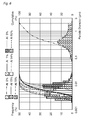
- Fig. 6 shows the particle diameter distributions of the layered composites obtained in Examples 1 to 3, 5, 6 and Comparative Examples 1, 3.
- volume average particle diameters M ⁇ were each calculated from the obtained particle diameter distributions. Further, average values of 10% particle diameter, 50% particle diameter, and 90% particle diameter in the three measurement results (the variation in 50% particle diameter was 10% or less) were calculated as D10, D50, and D90, respectively. Table 2 shows the result. [Table 2] Al:Mg Mv D10 D50 D90 (atomic ratio) ( ⁇ m) ( ⁇ m) ( ⁇ m) ( ⁇ m) Comp. Ex. 1 0:100 0.549 0.204 0.409 1.189 Ex. 1 1:99 0.005 0.004 0.005 0.010 Ex. 2 5:95 0.008 0.006 0.008 0.011 Ex. 3 15:85 0.004 0.003 0.003 0.006 Ex.
- the volume average particle diameters M ⁇ of the divalent-trivalent metal-based organic-inorganic layered composites in which the metal atoms consist of an Al atom and a Mg atom (Examples 1 to 3, 5, 6, and Comparative Example 3) and the trivalent metal-based organic-inorganic layered composite in which the metal atom consists of an Al atom (Comparative Example 2) were 0.008 ⁇ m or smaller.
- a divalent-trivalent metal-based organic-inorganic layered composite and a trivalent metal-based organic-inorganic layered composite were excellent in re-dispersibility in an organic solvent.
- the volume average particle diameter M ⁇ of the divalent metal-based organic-inorganic layered composite in which the metal atom consists of a Mg atom (Al: 0%) obtained in Comparative Example 1 was 0.549 ⁇ m.
- an organic-inorganic composite obtained by substituting part of a divalent metal atom with a trivalent metal atom was excellent in dispersibility (particularly, re-dispersibility) in an organic solvent.
- the divalent-trivalent metal-based organic-inorganic layered composite of the present invention comprising 5% Al atom (95% Mg atom) as the metal atom
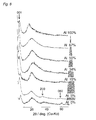
- Al: 5% had favorable orders not only in an interlayer direction but also in an in-plane direction.
- the structure of the divalent metal-based organic-inorganic layered composite in which the metal atom consists of a Mg atom is believed to be a 2:1-type layered silicate structure having no pore in an octahedral sheet according to the diffraction peak shown in Fig. 8 .
- a 2:1-type layered silicate structure having a small number of pores in an octahedral sheet is formed in the divalent-trivalent metal-based organic-inorganic layered composite of the present invention.
- a green methacryl-Al-Ni(II)-based layered composite (4.15 g) was obtained in the same manner as in Example 1, except that: 1.24 g (0.0033 mol) of aluminium nitrate nonahydrate (special grade, manufactured by Wako Pure Chemical Industries, Ltd.) was used in place of aluminium chloride hexahydrate, 1.76 g (0.0067 mol) of nickel(II) sulfate hexahydrate (special grade, manufactured by Wako Pure Chemical Industries, Ltd.) was used in place of magnesium chloride hexahydrate, the amount of the aqueous solution of 1-mol/L sodium hydroxide was altered to 23.1 ml, and the number of times the extraction was performed using ethyl acetate was altered to 1.
- a blue methacryl-Al-Cu(II)-based layered composite (3.72 g) was obtained in the same manner as in Example 1, except that: 1.24 g (0.0033 mol) of aluminium nitrate nonahydrate (special grade, manufactured by Wako Pure Chemical Industries, Ltd.) was used in place of aluminium chloride hexahydrate, 1.14 g (0.0067 mol) of copper(II) chloride dihydrate (purity:99.9%, manufactured by Wako Pure Chemical Industries, Ltd.) was used in place of magnesium chloride hexahydrate, the amount of the aqueous solution of 1-mol/L sodium hydroxide was altered to 23.1 ml, and the number of times the extraction was performed using ethyl acetate was altered to 1.
- a white methacryl-Al-Zn-based layered composite (3.61 g) was obtained in the same manner as in Example 1, except that: 1.24 g (0.0033 mol) of aluminium nitrate nonahydrate (special grade, manufactured by Wako Pure Chemical Industries, Ltd.) was used in place of aluminium chloride hexahydrate, 1.92 g (0.0067 mol) of zinc sulfate heptahydrate (special grade, manufactured by Wako Pure Chemical Industries, Ltd.) was used in place of magnesium chloride hexahydrate, the amount of the aqueous solution of 1-mol/L sodium hydroxide was altered to 23.1 ml, and the number of times the extraction was performed using ethyl acetate was altered to 1.
- a brown methacryl-Fe(III)-Ni(II)-based layered composite (3.63 g) was obtained in the same manner as in Example 1, except that: 0.89 g (0.0033 mol) of iron(III) chloride hexahydrate (special grade, manufactured by Wako Pure Chemical Industries, Ltd.) was used in place of aluminium chloride hexahydrate, 1.76 g (0.0067 mol) of nickel(II) sulfate hexahydrate (special grade, manufactured by Wako Pure Chemical Industries, Ltd.) was used in place of magnesium chloride hexahydrate, the amount of the aqueous solution of 1-mol/L sodium hydroxide was altered to 23.1 ml, and the number of times the extraction was performed using ethyl acetate was altered to 1.
- An aqueous solution containing a green precipitate was obtained in the same manner as in Example 1, except that: aluminium chloride hexahydrate was not used, 2.63 g (0.01 mol) of nickel(II) sulfate hexahydrate (special grade, manufactured by Wako Pure Chemical Industries, Ltd.) was used in place of magnesium chloride hexahydrate.
- the extraction operation using ethyl acetate was performed in the same manner as in Example 1.
- the precipitate was not dissolved in ethyl acetate, and it was difficult to perform the solvent extraction. For this reason, the precipitate was recovered by filtration, followed by water washing and vacuum drying.
- a green methacryl-Ni(II)-based layered composite (6.38 g) was obtained.
- a blue methacryl-Cu(II)-based layered composite (3.54 g) was obtained in the same manner as in Comparative Example 1, except that 1.70 g (0.01 mol) of copper(II) chloride dihydrate (purity:99.9%, manufactured by Wako Pure Chemical Industries, Ltd.) was used in place of magnesium chloride hexahydrate.
- a white methacryl-Zn-based layered composite (3.23 g) was obtained in the same manner as in Comparative Example 1, except that 2.88 g (0.01 mol) of zinc sulfate heptahydrate (special grade, manufactured by Wako Pure Chemical Industries, Ltd.) was used in place of magnesium chloride hexahydrate.
- an organic-inorganic composite obtained by substituting part of a divalent metal atom with a trivalent metal atom had an improved dispersibility (particularly, re-dispersibility) in an organic solvent.
- An alicyclic epoxy-Al-based layered composite (19.0 g) was obtained in the same manner as in Preparation Example 1 , except that: 12.1 g (0.05 mol) of aluminium chloride hexahydrate (special grade, manufactured by Wako Pure Chemical Industries, Ltd.) was used in place of magnesium chloride hexahydrate, and the amount of the aqueous solution of 1-mol/L sodium hydroxide was altered to 150 ml.
- aluminium chloride hexahydrate special grade, manufactured by Wako Pure Chemical Industries, Ltd.
- FIG. 9 shows the 13 C-CP/MAS NMR spectra of the layered composites obtained in Preparation Examples 1 to 5. Note that Fig. 9 also shows the relationship between peak positions in the NMR spectra and carbon atoms in a 2-(3,4-epoxycyclohexyl)ethyl group bonded to a Si atom.
- a peak at 10 ppm was attributed to a carbon atom (h) bonded to the Si atom
- a peak at 53 ppm was attributed to two carbon atoms (a, b) constituting the epoxy group
- a peak from 20 to 40 ppm was attributed to the remaining five carbon atoms (c to g). It is shown that, in the layered composites having a peak at 53 ppm, the ring of the alicyclic epoxy group is not opened, keeping the structure.
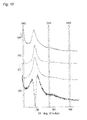
- FIG. 10 shows the X-ray diffraction patterns of (a) the alicyclic epoxy-Al-Mg-based layered composite (Al: 50%), (b) 3,4-epoxycyclohexenylmethyl-3',4'-epoxycyclohexene carboxylate, and (c) the mixture of the alicyclic epoxy-Al-Mg-based layered composite (Al: 50%) and 3,4-epoxycyclohexenylmethyl-3',4'-epoxycyclohexene carboxylate.
- a diffraction peak derived from a (001) plane indicates an order in a layer direction
- diffraction peaks derived from a (200) plane and a (060) plane indicate an order in an in-plane direction.
- the alicyclic epoxy-Al-Mg-based layered composite (Al: 50%) had a layer structure similar to a 2:1-type layered silicate structure of a smectite-based layered clay mineral.
- a diffraction peak derived from a (020) plane is believed to be a peak due to a reflection by an organic material.
- Fig. 10(d) shows a difference between the X-ray diffraction pattern (c) of the mixture and the X-ray diffraction pattern (b) of 3,4-epoxycyclohexenylmethyl-3',4'-epoxycyclohexene carboxylate.
- diffraction peaks derived from a (200) plane and a (060) plane were observed, but no diffraction peak derived from a (001) plane was observed.
- FIG. 11 shows X-ray diffraction patterns of (a) the glycidyl-Mg-based layered composite (Al: 0%), (b) 3,4-epoxycyclohexenylmethyl-3',4'-epoxycyclohexene carboxylate, and (c) the mixture of the glycidyl-Mg-based layered composite (Al: 0%) and 3,4-epoxycyclohexenylmethyl-3',4'-epoxycyclohexene carboxylate.
- Fig. 11(d) shows a difference between the X-ray diffraction pattern (c) of the mixture and the X-ray diffraction pattern (b) of 3,4-epoxycyclohexenylmethyl-3',4'-epoxycyclohexene carboxylate.
- diffraction peaks derived from a (200) plane and a (060) plane indicating an order in an in-plane direction were observed, but no diffraction peak derived from a (001) plane indicating an order in a layer direction was observed.
- the glycidyl-Mg-based layered composite (Al: 0%) also swelled and lost an order in a layer direction in 3,4-epoxycyclohexenylmethyl-3',4'-epoxycyclohexene carboxylate.
- a coating composition was prepared by mixing 25 parts by mass of the alicyclic epoxy-Al-Mg-based layered composite (Al: 50%) obtained in Preparation Example 2 and 75 parts by mass of 3,4-epoxycyclohexenylmethyl-3',4'-epoxycyclohexene carboxylate ("CELLOXIDE 2021P", manufactured by DAICEL-CYTEC Company, Ltd.), which is a cationic UV curable monomer, with 5 PHR of an iodonium salt-based photopolymerization initiator ("IRGACURE 250", a 3:1 mixture of (4-methylphenyl)[4-(2-methylpropyl)phenyl]iodonium-hexafluorophosphate and a solvent propylene carbonate, manufactured by BASF SE).
- the coating composition was applied to a transparent polycarbonate substrate, which had a surface having been washed with 2-propanol, in such a manner that the film thickness after curing was to be 15 ⁇ m. Then, using a UV curing unit (1-kW high-pressure mercury vapor lamp ("Handy1000", manufactured by SEN Lights Corporation)), the coating film was cured by ultraviolet irradiation under conditions of an irradiation intensity: 1200mJ/cm 2 and a irradiation dose: 140 mW.
- a cured coating film was prepared in the same manner as in Example 11, except that 75 parts by mass of 3-ethyl-3-hydroxymethyloxetane ("OXT-101", manufactured by Toagosei Co., Ltd.) was used as a cationic UV curable monomer.
- OXT-101 3-ethyl-3-hydroxymethyloxetane
- a cured coating film was prepared in the same manner as in Example 11, except that 75 parts by mass of 3-ethyl-3 ⁇ [(3-ethyloxetan-3-yl)methoxy]methyl ⁇ oxetane ("OXT-221", manufactured by Toagosei Co., Ltd.) was used as a cationic UV curable monomer.
- a cured coating film was prepared in the same manner as in Example 11, except that 25 parts by mass of the alicyclic epoxy-Al-Mg-based layered composite (Al: 67%) obtained in Preparation Example 3 was used in place of the alicyclic epoxy-Al-Mg-based layered composite (Al: 50%).
- a cured coating film was prepared in the same manner as in Example 11, except that the alicyclic epoxy-Al-Mg-based layered composite (Al: 50%) was not used.
- a cured coating film was prepared in the same manner as in Example 11, except that the glycidyl-Mg-based layered composite (Al: 0%) obtained in Preparation Example 6 was used in place of the alicyclic epoxy-Al-Mg-based layered composite (Al: 50%).
- a cured coating film was prepared in the same manner as in Example 11, except that the alicyclic epoxy-Mg-based layered composite (Al: 0%) obtained in Preparation Example 1 was used in place of the alicyclic epoxy-Al-Mg-based layered composite (Al: 50%).
- a cured coating film was prepared in the same manner as in Example 11, except that the alicyclic epoxy-Al-based layered composite (Al: 100%) obtained in Preparation Example 5 was used in place of the alicyclic epoxy-Al-Mg-based layered composite (Al: 50%).
- a cured coating film was prepared in the same manner as in Example 11, except that 25 parts by mass of the alicyclic epoxy-Al-Mg-based layered composite (Al: 85%) obtained in Preparation Example 4 was used in place of the alicyclic epoxy-Al-Mg-based layered composite (Al: 50%).
- the adhesion of the cured coating films obtained in the above Examples and Comparative Examples was measured according to the method described in the crosscut adhesion test (JIS K5400.8.5). Specifically, a cured coating film was scratched at intervals of 1 mm lengthwise and crosswise to form a grid with 100 squares. A cellulose adhesive tape (product name "CELLOTAPE(registered trademark) CT-24", manufactured by Nichiban Co., Ltd.) was strongly attached with pressure to the surface of this grid portion. The tape was quickly peeled therefrom, and the number of grid squares on which the cured coating film remained was counted. Table 6 shows the result.
- the storage modulus, surface hardness, and maximum indentation depth of the cured coating films obtained in the above Examples and Comparative Examples were measured by a nanoindentation method. Specifically, using a nanoindenter ("TriboScope", manufactured by Hysitron Corporation), the relationship was determined between the indentation depth and the load at the time of pressing an indenter under a condition of a maximum load: 180 ⁇ N. From the obtained result, the storage modulus, surface hardness, and maximum indentation depth of the cured coating films were determined. Table 6 shows the result.
- Figs. 12 to 14 are photographs of thin films (cured coating films) obtained in Examples 11 to 13. Moreover, the appearances of thin films (cured coating films) obtained in Examples 11 and 14 and Comparative Examples 7 to 11 were judged based on the following criteria. Table 6 shows the result.
- Multilayer plate constituted of each of the cured coating films obtained in the above Examples and Comparative Examples and a transparent polycarbonate substrate was immersed in hot water at 40°C for 10 days, and then pulled up and dried.
- the cured coating films were visually observed and judged based on the following criteria. Table 6 shows the result.
- the cured coating films of the present invention comprising the divalent-trivalent metal-based organic-inorganic layered composites containing an alicyclic epoxy group, an Al atom, and a Mg atom (Examples 11, 14) had a storage modulus and a surface hardness 2 to 3 times higher and had a shallower maximum indentation depth (having a higher hardness) than the case where no organic-inorganic layered composite was contained (Comparative Example 7).
- the cured coating films comprising the divalent-trivalent metal-based organic-inorganic layered composites containing an alicyclic epoxy group, an Al atom, and a Mg atom (Examples 11 and 14, Comparative Example 11), the cured coating film comprising no organic-inorganic layered composite (Comparative Example 7), and the cured coating film comprising the trivalent metal-based organic-inorganic layered composite containing an alicyclic epoxy group and an Al atom (Comparative Example 10) were excellent in transparency.
- the divalent metal-based organic-inorganic layered composites containing an alicyclic epoxy group or a glycidyl group and a Mg atom were used (Comparative Examples 8 and 9)
- the divalent metal-based organic-inorganic layered composites were not uniformly dispersed in the coating compositions and in the cured coating films, and the cured coating films were whitened.
- the present invention makes it possible to obtain an organic-inorganic layered composite comprising a divalent metal atom, and being excellent in dispersibility (particularly, re-dispersibility) in an organic material such as an organic solvent, the organic-inorganic layered composite containing a lot of siloxane bonds in comparison with silanol groups.
- the divalent-trivalent metal-based organic-inorganic layered composite of the present invention is excellent in dispersibility (particularly, re-dispersibility) in an organic material such as an organic solvent and also excellent in mechanical strength such as hardness and abrasion resistance. Accordingly, the divalent-trivalent metal-based organic-inorganic layered composite is useful as a filler used in coating compositions and raw materials for molding, and the like, and can provide an excellent mechanical strength to resin coating films and resin molded articles.
- the divalent-trivalent metal-based the organic-inorganic layered composite of the present invention having a predetermined functional group makes it possible to obtain a cationic UV curable coating composition comprising the organic-inorganic layered composite excellent in dispersibility and being excellent in photocurability.
- a cured coating film of the present invention formed by photo-curing a coating film comprising such a cationic UV curable coating composition of the present invention the organic-inorganic layered composite is uniformly dispersed, and thus an excellent transparency is provided. Furthermore, since the cured coating film is uniformly strengthened, the surface hardness is excellent.
- the cationic UV curable coating composition of the present invention is capable of forming a cured coating film having excellent transparency and surface hardness without impairing an excellent adhesion to a base material. Accordingly, the cationic UV curable coating composition is useful as coating materials for automobile exterior, and the like, which require a high abrasion resistance.
- 1 inorganic layer, 1a: octahedral sheet containing divalent and trivalent metal atoms as central atom, 1b: tetrahedral sheet containing Si atom as central atom, 1c: octahedral sheet containing only divalent metal atom as central atom, 1d: octahedral sheet containing only trivalent metal atom as central atom, 2: organic layer, 2a: organic group, 3: interlayer cation.
Landscapes
- Chemical & Material Sciences (AREA)
- Chemical Kinetics & Catalysis (AREA)
- Organic Chemistry (AREA)
- Health & Medical Sciences (AREA)
- Medicinal Chemistry (AREA)
- Polymers & Plastics (AREA)
- Life Sciences & Earth Sciences (AREA)
- Engineering & Computer Science (AREA)
- Materials Engineering (AREA)
- Wood Science & Technology (AREA)
- Silicon Polymers (AREA)
Applications Claiming Priority (3)
| Application Number | Priority Date | Filing Date | Title |
|---|---|---|---|
| JP2011238899A JP5626594B2 (ja) | 2011-10-31 | 2011-10-31 | 2価−3価金属系有機無機層状複合体およびその製造方法 |
| JP2012008999A JP5892464B2 (ja) | 2012-01-19 | 2012-01-19 | Uvカチオン硬化型塗料組成物、それを用いた硬化塗膜およびその製造方法 |
| PCT/JP2012/077887 WO2013065638A1 (ja) | 2011-10-31 | 2012-10-29 | 2価-3価金属系有機無機層状複合体およびその製造方法 |
Publications (2)
| Publication Number | Publication Date |
|---|---|
| EP2774942A1 true EP2774942A1 (de) | 2014-09-10 |
| EP2774942A4 EP2774942A4 (de) | 2015-05-27 |
Family
ID=48191985
Family Applications (1)
| Application Number | Title | Priority Date | Filing Date |
|---|---|---|---|
| EP12846468.2A Withdrawn EP2774942A4 (de) | 2011-10-31 | 2012-10-29 | Bivalent-trivalenter organisch-anorganischer metallschichtverbundstoff und herstellungsverfahren dafür |
Country Status (2)
| Country | Link |
|---|---|
| EP (1) | EP2774942A4 (de) |
| WO (1) | WO2013065638A1 (de) |
Cited By (2)
| Publication number | Priority date | Publication date | Assignee | Title |
|---|---|---|---|---|
| US10414925B2 (en) | 2014-09-26 | 2019-09-17 | Lg Chem, Ltd. | UV-curable ink composition, method for producing bezel pattern of display substrate using same, and bezel pattern produced thereby |
| US11760891B2 (en) | 2016-10-10 | 2023-09-19 | Lg Chem, Ltd. | Infrared ray transmittance ink composition for inkjet, method for preparing a bezel pattern using the same, the bezel pattern using the same method and display panel comprising the bezel pattern |
Families Citing this family (1)
| Publication number | Priority date | Publication date | Assignee | Title |
|---|---|---|---|---|
| CN119951495B (zh) * | 2023-11-07 | 2025-12-30 | 中国石油化工股份有限公司 | 一种芳烃精制剂及其制备方法与应用 |
Family Cites Families (10)
| Publication number | Priority date | Publication date | Assignee | Title |
|---|---|---|---|---|
| JP3722850B2 (ja) * | 1993-11-04 | 2005-11-30 | 株式会社豊田中央研究所 | 有機−無機重合体およびその製造方法 |
| JP3952482B2 (ja) * | 1992-12-28 | 2007-08-01 | 株式会社豊田中央研究所 | 層状有機ケイ素系ポリマー、その成形体及びこれらの製造方法 |
| JP3377303B2 (ja) * | 1994-06-30 | 2003-02-17 | 株式会社豊田中央研究所 | 被覆材組成物及びそれを用いた耐摩耗性物品の製造方法 |
| JP3562669B2 (ja) | 1995-09-05 | 2004-09-08 | 株式会社豊田中央研究所 | 耐熱性接着剤 |
| JP3899546B2 (ja) * | 1996-03-11 | 2007-03-28 | 株式会社豊田中央研究所 | 層状有機チタノシリケートおよび層状有機チタノシリケートの成形体 |
| JP3965789B2 (ja) | 1998-07-09 | 2007-08-29 | Jsr株式会社 | 硬化性組成物、硬化性金属酸化物粒子および硬化性金属酸化物粒子の製造方法 |
| US20060009562A1 (en) | 2002-10-11 | 2006-01-12 | Hiroshi Sasaki | Cationically polymerizable composition containing metal oxide partricles |
| JP2005089697A (ja) | 2003-09-19 | 2005-04-07 | Toagosei Co Ltd | 活性エネルギー線硬化型組成物 |
| JP4795201B2 (ja) | 2006-11-06 | 2011-10-19 | 株式会社豊田中央研究所 | 硬化性樹脂組成物及び接着剤 |
| JP5382400B2 (ja) | 2008-02-05 | 2014-01-08 | 株式会社豊田中央研究所 | 有機無機複合体の合成方法 |
-
2012
- 2012-10-29 EP EP12846468.2A patent/EP2774942A4/de not_active Withdrawn
- 2012-10-29 WO PCT/JP2012/077887 patent/WO2013065638A1/ja not_active Ceased
Cited By (2)
| Publication number | Priority date | Publication date | Assignee | Title |
|---|---|---|---|---|
| US10414925B2 (en) | 2014-09-26 | 2019-09-17 | Lg Chem, Ltd. | UV-curable ink composition, method for producing bezel pattern of display substrate using same, and bezel pattern produced thereby |
| US11760891B2 (en) | 2016-10-10 | 2023-09-19 | Lg Chem, Ltd. | Infrared ray transmittance ink composition for inkjet, method for preparing a bezel pattern using the same, the bezel pattern using the same method and display panel comprising the bezel pattern |
Also Published As
| Publication number | Publication date |
|---|---|
| EP2774942A4 (de) | 2015-05-27 |
| WO2013065638A1 (ja) | 2013-05-10 |
Similar Documents
| Publication | Publication Date | Title |
|---|---|---|
| JP6761972B2 (ja) | 紫外線硬化性樹脂組成物、有機el発光装置の製造方法及び有機el発光装置 | |
| JP5964507B2 (ja) | 金属酸化物多孔質粒子、その製造方法、及びその用途 | |
| CN101410432B (zh) | 光学材料用固化性组合物和光波导 | |
| JP4959892B2 (ja) | 耐磨性及び着色性コーティングを与えるコーティング組成物 | |
| JP5569703B2 (ja) | エポキシ基含有シルセスキオキサン変性エポキシ樹脂、硬化性樹脂組成物、硬化物およびコーティング剤 | |
| GB2444053A (en) | Hybrid UV-curable resins | |
| JP5525152B2 (ja) | 紫外線硬化型コーティング用組成物およびその製造方法、並びにこれを被覆してなる樹脂被覆品 | |
| EP2752392A1 (de) | Transparente dispersion mit einem anorganischen oxid und harzzusammensetzung zur bildung eines transparenten verbundmaterials sowie transparentes verbundmaterial und optisches element | |
| WO2012066520A1 (en) | Dual cure compositions, related hybrid nanocomposite materials and dual cure process for producing same | |
| KR20150013875A (ko) | 유기 무기 복합체 및 그 형성용 조성물 | |
| EP2774942A1 (de) | Bivalent-trivalenter organisch-anorganischer metallschichtverbundstoff und herstellungsverfahren dafür | |
| JP2012180463A (ja) | 硬化性樹脂組成物、当該硬化物、およびこれらから誘導される各種物品 | |
| US20190264032A1 (en) | Inorganic particle/siloxane composite, method for producing same, and inorganic-particle-containing silicone composition | |
| JP2020509105A (ja) | 抗菌性高分子コーティング組成物および抗菌性高分子フィルム | |
| US20140120243A1 (en) | Synthesis and processing of new silsesquioxane/siloxane systems | |
| CN104428135A (zh) | 具有自组织化膜的薄膜层合体 | |
| EP4644456A1 (de) | Härtbare harzzusammensetzung, klebstoff, dichtungsmaterial, gehärtetes produkt, halbleiterbauelement und elektronische vorrichtung | |
| KR20080068033A (ko) | 경화 촉진제로서의 금속화 나노구조화된 화학물질 | |
| JP2005089697A (ja) | 活性エネルギー線硬化型組成物 | |
| EP4263712B1 (de) | Verfahren zur herstellung von film und zusammensetzung dafür | |
| JP5892464B2 (ja) | Uvカチオン硬化型塗料組成物、それを用いた硬化塗膜およびその製造方法 | |
| CN114008113B (zh) | 树脂组合物、其制造方法、以及多组分型固化性树脂组合物 | |
| CN115003759B (zh) | 树脂组合物、其制造方法、以及多组分型固化性树脂组合物 | |
| TW202405057A (zh) | 倍半矽氧烷衍生物及其製造方法、硬化性組成物、硬塗劑、硬化物、硬塗層、以及基材 | |
| JP6960629B2 (ja) | 樹脂組成物、成形体、積層体、ガスバリア材、コーティング材、接着剤及び積層体の製造方法 |
Legal Events
| Date | Code | Title | Description |
|---|---|---|---|
| PUAI | Public reference made under article 153(3) epc to a published international application that has entered the european phase |
Free format text: ORIGINAL CODE: 0009012 |
|
| 17P | Request for examination filed |
Effective date: 20140513 |
|
| AK | Designated contracting states |
Kind code of ref document: A1 Designated state(s): AL AT BE BG CH CY CZ DE DK EE ES FI FR GB GR HR HU IE IS IT LI LT LU LV MC MK MT NL NO PL PT RO RS SE SI SK SM TR |
|
| DAX | Request for extension of the european patent (deleted) | ||
| RA4 | Supplementary search report drawn up and despatched (corrected) |
Effective date: 20150430 |
|
| RIC1 | Information provided on ipc code assigned before grant |
Ipc: C09D 185/00 20060101ALI20150423BHEP Ipc: C08G 79/00 20060101ALI20150423BHEP Ipc: C08G 77/58 20060101AFI20150423BHEP Ipc: C09D 183/14 20060101ALI20150423BHEP |
|
| 17Q | First examination report despatched |
Effective date: 20190122 |
|
| STAA | Information on the status of an ep patent application or granted ep patent |
Free format text: STATUS: THE APPLICATION HAS BEEN WITHDRAWN |
|
| 18W | Application withdrawn |
Effective date: 20190426 |