EP2775366A2 - Unité mobile autonome de guidage d'aéronef - Google Patents
Unité mobile autonome de guidage d'aéronef Download PDFInfo
- Publication number
- EP2775366A2 EP2775366A2 EP14156671.1A EP14156671A EP2775366A2 EP 2775366 A2 EP2775366 A2 EP 2775366A2 EP 14156671 A EP14156671 A EP 14156671A EP 2775366 A2 EP2775366 A2 EP 2775366A2
- Authority
- EP
- European Patent Office
- Prior art keywords
- aircraft
- gmu
- assigned
- location
- tcgs
- Prior art date
- Legal status (The legal status is an assumption and is not a legal conclusion. Google has not performed a legal analysis and makes no representation as to the accuracy of the status listed.)
- Withdrawn
Links
- 238000012545 processing Methods 0.000 claims abstract description 51
- 230000033001 locomotion Effects 0.000 claims abstract description 24
- 238000013500 data storage Methods 0.000 claims abstract description 22
- 238000000034 method Methods 0.000 claims abstract description 17
- 238000004891 communication Methods 0.000 claims description 9
- 238000010586 diagram Methods 0.000 description 7
- 230000004044 response Effects 0.000 description 5
- 230000005540 biological transmission Effects 0.000 description 3
- 230000004397 blinking Effects 0.000 description 2
- 239000003086 colorant Substances 0.000 description 2
- 238000002485 combustion reaction Methods 0.000 description 2
- 238000005516 engineering process Methods 0.000 description 2
- 230000003287 optical effect Effects 0.000 description 2
- 238000013459 approach Methods 0.000 description 1
- 230000008878 coupling Effects 0.000 description 1
- 230000001934 delay Effects 0.000 description 1
- 230000000694 effects Effects 0.000 description 1
- 239000000446 fuel Substances 0.000 description 1
- 238000007726 management method Methods 0.000 description 1
- 238000005259 measurement Methods 0.000 description 1
- 230000000007 visual effect Effects 0.000 description 1
Images


Classifications
-
- G—PHYSICS
- G08—SIGNALLING
- G08G—TRAFFIC CONTROL SYSTEMS
- G08G5/00—Traffic control systems for aircraft
- G08G5/50—Navigation or guidance aids
- G08G5/51—Navigation or guidance aids for control when on the ground, e.g. taxiing or rolling
-
- G—PHYSICS
- G05—CONTROLLING; REGULATING
- G05D—SYSTEMS FOR CONTROLLING OR REGULATING NON-ELECTRIC VARIABLES
- G05D1/00—Control of position, course, altitude or attitude of land, water, air or space vehicles, e.g. using automatic pilots
- G05D1/0083—Control of position, course, altitude or attitude of land, water, air or space vehicles, e.g. using automatic pilots to help an aircraft pilot in the rolling phase
-
- G—PHYSICS
- G05—CONTROLLING; REGULATING
- G05D—SYSTEMS FOR CONTROLLING OR REGULATING NON-ELECTRIC VARIABLES
- G05D1/00—Control of position, course, altitude or attitude of land, water, air or space vehicles, e.g. using automatic pilots
- G05D1/02—Control of position or course in two dimensions
- G05D1/021—Control of position or course in two dimensions specially adapted to land vehicles
- G05D1/0287—Control of position or course in two dimensions specially adapted to land vehicles involving a plurality of land vehicles, e.g. fleet or convoy travelling
- G05D1/0291—Fleet control
- G05D1/0297—Fleet control by controlling means in a control room
-
- G—PHYSICS
- G05—CONTROLLING; REGULATING
- G05D—SYSTEMS FOR CONTROLLING OR REGULATING NON-ELECTRIC VARIABLES
- G05D1/00—Control of position, course, altitude or attitude of land, water, air or space vehicles, e.g. using automatic pilots
- G05D1/02—Control of position or course in two dimensions
- G05D1/021—Control of position or course in two dimensions specially adapted to land vehicles
- G05D1/0268—Control of position or course in two dimensions specially adapted to land vehicles using internal positioning means
- G05D1/0274—Control of position or course in two dimensions specially adapted to land vehicles using internal positioning means using mapping information stored in a memory device
-
- G—PHYSICS
- G05—CONTROLLING; REGULATING
- G05D—SYSTEMS FOR CONTROLLING OR REGULATING NON-ELECTRIC VARIABLES
- G05D1/00—Control of position, course, altitude or attitude of land, water, air or space vehicles, e.g. using automatic pilots
- G05D1/02—Control of position or course in two dimensions
- G05D1/021—Control of position or course in two dimensions specially adapted to land vehicles
- G05D1/0276—Control of position or course in two dimensions specially adapted to land vehicles using signals provided by a source external to the vehicle
- G05D1/0278—Control of position or course in two dimensions specially adapted to land vehicles using signals provided by a source external to the vehicle using satellite positioning signals, e.g. GPS
Definitions
- aircraft are commonly directed through the airport runways and taxiways via light commands provided by ground lights located throughout the airport.
- ATC Air Traffic Control
- the ground lights are configured to display different colors which correspond to simple commands for a pilot, such as green for go forward and red for stop, such as in stop bar lights.
- the light commands are viewed by a pilot in an aircraft and the pilot controls the aircraft in accordance with the light and radio commands to direct the aircraft to the desired gate, runway entrance, or other location.
- the pilots also use onboard paper maps, electronic maps, or airport guidance labels for correct guidance of aircraft and their orientation on complex taxiway structure. In some cases, the complex taxiway structure can lead to incorrect decisions by a pilot, which can lead to an accident. Therefore, it is desirable to simplify aircraft guidance using less onboard and airport equipment.
- the pilots communicate with the air traffic controllers that provide taxi clearance for the particular aircraft on the airport surface.
- the number of air traffic controllers is proportional to the number of taxiing aircraft on the airport surface, and each air traffic controller is an added expense for the airport due to the need to employ the trained air traffic controller.
- the radio communication occupies the pilot which may be increased as new proposed solutions include transmission of messages via datalink between the pilots and an air traffic controller. In some instances, poor communication between an air traffic controller and a pilot can lead to a catastrophic accident.
- follow-me services consist of a follow-me vehicle with beacons and intensive lights to lead an aircraft to a directed location.
- the follow-me vehicles are operated by a human to drive the vehicle and operate the lights.
- the human controls the follow-me vehicle in response to radio commands from the ATC for a particular airport.
- the ATC simultaneously provides commences to the human driver of the follow-me vehicle and the pilots in the guided aircraft.
- Embodiments of the subject application provide methods and systems for an autonomous aircraft guiding mobile unit (GMU).
- the GMU includes one or more light modules, one or more processing units, and one or more data storage mediums.
- the one or more data storage mediums include instructions which, when executed by the one or more processing units, cause the one or more processing units to receive control messages from a traffic control ground station (TCGS), the control messages assigning the GMU to an aircraft and controlling movement of the GMU and its assigned aircraft, and to provide light commands to a pilot of the assigned aircraft with the one or more light modules, the light commands directing movement of the assigned aircraft during taxiing.
- TGS traffic control ground station
- Embodiments of the subject application provide for an autonomous aircraft guiding mobile unit (GMU).
- the GMU is a mobile unit configured to drive on an airport's taxiways and/or other service roads to meet and guide an aircraft to a desired location.
- the GMU operates without direct human control based on control messages from a traffic control ground station (TCGS).
- TCGS traffic control ground station
- the GMU includes one or more light modules to provide light commands to a pilot of an assigned aircraft. The light commands direct a pilot of the assigned aircraft to follow the GMU, such that aircraft can be guided to the desired location.
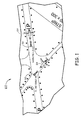
- FIG. 1 is a diagram of an example of part of a follow-me guidance system 100 including a plurality of such GMUs 102.
- a TCGS controls the operation of each of the plurality of GMUs 102.
- the TCGS coordinates the movement of each GMU 102 and the movement of the aircraft 104 to safely direct each aircraft 104 to an appropriate gate, runway entrance, or other location.
- the TCGS assigns a GMU 102 to the aircraft 104.
- the GMU 102 can drive through the airport, for example on dedicated tracks, to meet the aircraft at a pick-up location instructed by the TCGS. Once at the pick-up location, the GMU 102 can commence providing light commands to the aircraft 104 with the one or more light modules.
- the GMU 102 drives through the airport providing the light commands to the aircraft 104, directing the aircraft 104 to the desired location.
- a pilot of the aircraft 104 once in visual contact with the GMU 102 can follow the GMU 102 through the airport with the aid of the light commands provided by the GMU 102.
- the TCGS can be located on the airport property, such as in a control tower of the airport. In an example, the TCGS can operate automatically, but may have a human watching the system to verify safe and appropriate operation.
- the TCGS and each GMU 102 can communicate using any suitable wireless communication means. In an example, the TCGS and each GMU 102 communicate over a ground control datalink. In any case, the TCGS can send command messages to each GMU 102 to control their operation.
- the command messages can include information such as a pick-up location for an assigned aircraft 104, a destination location for an assigned aircraft 104, and a route through the airport from the pick-up location to the destination location.
- the GMU 102 can drive to the pick-up location and meet the assigned aircraft 104.
- the GMU 102 can then provide light commands to the assigned aircraft 104 and drive the route through the airport to the destination location.
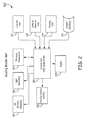
- FIG. 2 is a block diagram of an example GMU 102.
- the GMU 102 includes a control unit 202 which includes one or more processing units and one or more data storage mediums coupled thereto.
- the one or more processing devices can be configured to execute instructions stored (or otherwise embodied) on the one or more data storage mediums.
- the one or more processing units can include a general purpose processor, such as a central processing unit (CPU), or a special purpose processor.
- the one or more data storage mediums can include any suitable non-volatile technology such as flash memory, an optical disk, or a magnetic disk drive.
- the GMU 102 can also include a volatile memory that is coupled to the one or more data storage mediums for storing instructions (and related data) during execution by the one or more processing units.
- Memory comprises, in one implementation, any suitable form of random access memory (RAM) no known or later developed, such as dynamic random access memory (DRAM). In other implementations, other types of memory are used.
- RAM random access memory
- DRAM dynamic random access memory
- the instructions when executed by the one or more processing devices, cause the one or more processing devices, and more generally the control unit 202, to implement the functionality of the GMU 102 described herein. Since the GMU 102 does not have direct human control, the control unit 202 controls the operation of the GMU 102 in response to the command messages from the TCGS.
- the control unit 202 of the GMU 102 is coupled to a wireless transceiver 204 to transmit and receive communication messages, such as the command messages, with the TCGS.
- the wireless transceiver 204 can comprise any suitable wireless transceiver having any suitable wireless hardware using any suitable wireless protocol on a suitable radio frequency to communicate messages with the TCGS.
- the control unit 202 can send messages to the wireless transceiver 204 for transmission to the TCGS and can obtain messages, such as command messages, received by the wireless transceiver 204 from the TCGS.
- the control unit 202 can also be coupled to another wireless receiver to receive identification beacons that are broadcast by aircraft 104. Such identification beacons can be used to verify the identity of the aircraft 104.
- the control unit 202 is also coupled to one or more light modules 206.
- the one or more light modules 206 can comprise any suitable light mechanism capable of emitting light that can be viewed by a pilot of aircraft 104.
- the one or more light modules 102 can comprise a series of lights including, but not limited to, a red, yellow, and green light to communicate light commands including, but not limited to, stop, slow, and go forward, as well as lights to indicate a left turn and a right turn.
- Other light commands such as a blinking red to communicate slow down and a blinking green to communicate speed up can also be used.
- the one or more light modules 206 can also comprise an array of lights (e.g., light emitting diodes (LEDs)) that can be controlled to illuminate lights of desired colors and/or in desired shapes to indicate the desired light command.
- LEDs light emitting diodes
- An example of such an array is shown in Figures 5A-5D .
- the control unit 202 can control the one or more light modules 206 to provide appropriate light commands to a pilot of an assigned aircraft 104 in order to direct the aircraft 104 in accordance with the command messages from the TCGS.
- control unit 202 is also coupled to one or more infrared (IR) emitter modules 207.
- IR infrared
- the one or more IR emitter modules 207 can be used when the one or more light modules 206 include lights having low IR emission characteristics, such as LED lights. In such circumstances, an aircraft's IR sensors (e.g., in an onboard enhanced vision system (EVS)) may not be able to pick up the IR emitted from the one or more light modules 206.
- EVS onboard enhanced vision system
- the pilot may be unable to visually see the light from the one or more light modules 206 and the IR sensors on the aircraft may not be able to pick up the IR emissions from the one or more light modules 206 resulting in the inability of the one or more light modules 206 to provide the light commands to the pilot.
- the one or more IR emitter modules 207 can be used to provide an IR command that can be sensed by the IR sensors of the aircraft, such that the pilot can receive the IR command.
- the IR commands can be the same as the light commands including commands to, for example, follow-me, stop, turn left, and turn right.
- the control unit 202 can control the one or more IR emitter modules 207 to provide appropriate IR commands to a pilot of an assigned aircraft 104 in order to direct the aircraft 104 in accordance with the command messages from the TCGS.
- the one or more light modules 206 and the one or more emitter modules 207 can be used at the same time, where the light commands and IR commands can convey the same command to the pilot.
- the control unit 202 is also coupled to an engine 208 and a heading control system 210.
- the engine 208 is configured to provide the power to drive the GMU 102 throughout the airport.
- engine 208 can be an internal combustion engine or an electric motor.
- the heading control system 210 is configured to control the direction of motion of the GMU 102.
- the heading control system 210 can comprise a mechanism to steer wheels of the GMU 102.
- the control unit 202 controls the operation of the engine 208 and the heading control system 210 to drive the GMU 102 through the airport in response to the command messages from the TCGS.
- the control unit 202 can also be coupled to a location determination unit 212 and a heading determination unit 214.
- the location unit 212 can determine a current location of the GMU 102
- the heading determination unit 214 can determine a current heading for the GMU 102.
- the location and heading unit can be integrated into a single navigation unit.
- the control unit 202 can obtain the location and heading of the GMU 102 from the location unit 212 and the heading unit 214 and use the location and heading to determine how to control the engine 208 and the heading control system 210 to drive the GMU 102 in accordance with the command messages from the TCGS.
- the control unit 202 can also periodically send the location and heading of the GMU 102 to the TCGS via a message transmitted by the wireless transceiver 204.
- the location unit 212 can comprise a satellite navigation system receiver, such as, but not limited to, a Galileo receiver or a global position system (GPS) receiver.
- the heading unit 214 can comprise a magnetic sensor and/or an inertial measurement unit.
- the control unit 202 can also be coupled to an airport database 216 (e.g., a map) including information on the locations of approved paths (e.g., taxiways) through the airport, as well as the locations of runways, gates, service roads, runway entrances, aprons, buildings, and any other information that may aid in driving through the airport.
- the airport database 216 can be stored or otherwise embodied on a data storage medium. Although illustrated as a separate block from the control unit 202, in some examples the airport database 216 can be stored on the one or more data storage mediums of the control unit 202.
- the control unit 202 can access the airport database 216 to determine how to control the engine 208 and the heading control system 210 to drive the GMU 102 in accordance with the command messages from the TCGS.
- control unit 202 can also be coupled to an aircraft distance measuring unit 218.
- the distance measuring unit 218 is configured to measure a distance between the GMU 102 and its assigned aircraft 104.
- the control unit 202 can obtain the distance between the GMU 102 and the assigned aircraft 104 from the distance measuring unit 218 and determine how to control the engine 208 and the heading control system 210 to maintain the distance between the GMU 102 and the assigned aircraft 104 to within a defined range during guiding of the aircraft 104.
- the control unit 202 can also control the one or more light modules 206 based on the distance between the GMU 102 and the assigned aircraft 104 to provide commands to a pilot of the aircraft to help maintain the distance to within a defined range. For example, the control unit 202 can provide commands to the pilot to reduce or increase the distance between the GMU 102 and the assigned aircraft 104.
- FIG. 3 is a block diagram of an example TCGS 300.
- the TCGS 300 includes a control unit 302 which includes one or more processing units and one or more data storage mediums coupled thereto.
- the one or more processing devices can be configured to execute instructions stored (or otherwise embodied) on the one or more data storage mediums.
- the one or more processing units can include a general purpose processor, such as a central processing unit (CPU), or a special purpose processor.
- the one or more data storage mediums can include any suitable non-volatile technology such as flash memory, an optical disk, or a magnetic disk drive.
- the TCGS 300 can also include a volatile memory that is coupled to the one or more data storage mediums for storing instructions (and related data) during execution by the one or more processing units.
- Memory comprises, in one implementation, any suitable form of random access memory (RAM) no known or later developed, such as dynamic random access memory (DRAM). In other implementations, other types of memory are used.
- RAM random access memory
- DRAM dynamic random access memory
- the instructions when executed by the one or more processing devices, cause the one or more processing devices, and more generally the control unit 302, to implement the functionality of the TCGS described herein.
- the control unit 302 is coupled to a wireless transceiver 304 to transmit and receive communication messages, such as the command messages, with each of the plurality of GMUs 102.
- the wireless transceiver 304 can comprise any suitable wireless transceiver having any suitable wireless hardware using any suitable wireless protocol on a suitable radio frequency to communicate messages with the GMUs 102.
- the control unit 302 can send messages, such as command messages, to the wireless transceiver 304 for transmission to one or more GMUs 102 and can obtain messages received by the wireless transceiver 204 from a GMU 102.
- the control unit 302 can also be coupled to an airport database 306 (e.g., a map) including information on the locations of approved paths (e.g., taxiways) through the airport, as well as the locations of runways, gates, service roads, runway entrances, aprons, buildings, and any other information that may aid in driving through the airport.
- the airport database 306 can be stored or otherwise embodied on a data storage medium. Although illustrated as a separate block from the control unit 302, in some examples the airport database 306 can be stored on the one or more data storage mediums of the control unit 302.
- the control unit 302 can access the airport database 306 to determine how to control movement of the plurality of GMUs 102.
- the TCGS 300 is an automated system that receives inputs as to each aircraft 104 that is in, or close to, the taxi phase at the airport including the current location, destination location, and/or route of each such aircraft 104 on the airport driving paths (e.g., taxiways).
- the inputs can be provided by a human operator or from another system, such an air traffic control system.
- the control unit 302 can also determine a current location and heading for each GMU 102 based on communication messages received from each GMU 102.
- the control unit 302 can access the airport database 306 to assign a GMU 102 to any aircraft 104 desiring follow-me service, and to determine a pick-up location, route, and destination location for the GMU 102 with respect to the assigned aircraft 104.
- the control unit 302 can then send command messages to the wireless transceiver 304 to transmit such command messages to one or more GMUs 102 to assign such GMUs 102 to an aircraft 104 and to instruct the GMUs 102 as to the pick-up location, route, and destination location for that aircraft 104.
- the control unit 302 can coordinate the movement of each GMU 102 to safely direct each aircraft 104 to an appropriate gate, service road, runway entrance, or other location and to safely move the GMUs 102 about the airport paths.
- the TCGS 300 can coordinate and control the movement of all aircraft 104 in the taxi phase at the airport.
- the control unit 302 can access the airport database 306 to determine a route for each aircraft from its current location to its destination location.
- the control unit 302 can then send messages to the plurality of ground lights installed throughout the airport to provide light commands to pilots of the aircraft 104 to guide the aircraft 104 to its destination location.
- Such light commands may be in addition to assigning a GMU 102 to an aircraft 104.
- GMU 102 In some examples only a subset of the aircraft 104 in taxi phase are assigned a GMU 102, such as only aircraft 104 that request a GMU 102 are assigned one. In other examples, all aircraft 104 in the taxi phase at an airport are assigned a GMU 102.
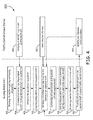
- Figure 4 is an example method 400 for guiding an aircraft 104 with a GMU 102.
- the method 400 includes acts performed by the GMU 102 as controlled by the instructions.
- the instructions when executed by the one or more processing devices of the control unit 202, cause the one or more processing devices, and more generally the control unit 202, to cause the GMU 102 to implement the acts of method 400.
- the control unit 202 of the GMU 102 obtains the location and heading for the GMU 102 (block 402). In many examples, the location and heading for the GMU 102 are periodically obtained by the control unit 202 to maintain a current location and heading for the GMU 102. Based on the determinations by the control unit 302 of the TCGS 300, the TCGS 300 assigns an aircraft 104 to the GMU 102 (block 404). The TCGS 300 sends one or more control messages to the GMU 102 indicating the assigned aircraft 104 and the pick-up location for the assigned aircraft 104.
- the wireless transceiver 204 of the GMU 102 receives the control message(s) and the control unit 202 obtains information regarding the assigned aircraft 104 and the pick-up location from the control message(s) (block 406). Once the pick-up location is identified, the control unit 202 controls the engine 208 and the heading control system 210 to drive the GMU 102 to the pick-up location (block 408). The control unit 202 can access the airport database 216 to determine a route to the pick-up location itself, or how to follow a route provided by the TCGS 300.
- the control unit 202 can determine whether the assigned aircraft 104 is at the pick-up location. If the assigned aircraft 104 is not yet at the pick-up location, the GMU 102 can wait for the assigned aircraft 104 at the pick-up location. Once an aircraft arrives at the pick-up location, the control unit 202 can virtually couple with the aircraft to verify whether that aircraft is the assigned aircraft 104 (block 410) and to initiate guiding of the aircraft. To verify that the aircraft at the pick-up location is the assigned aircraft 104, the control unit 202 can obtain identification information for the aircraft by receiving the identification beacon that is broadcast by the aircraft. The identification information from the identification beacon can be compared with identification information for the assigned aircraft 104 to verify that the aircraft is the assigned aircraft 104.
- control unit 202 can provide a light signal with the one or more light modules 206 to a pilot of the assigned aircraft 104 to indicate that the aircraft 104 has been verified, and that the aircraft 104 will be guided by the GMU 102.
- a light signal can comprise providing the follow-me light command (e.g., a green light) to the pilot of the aircraft 104.
- virtual coupling between the GMU 102 and the aircraft 104 can take place without requiring the aircraft 104 to stop moving.
- the GMU 102 can virtually couple with the aircraft 104 as the aircraft 104 approaches the pick-up location, such that the GMU 102 can immediately begin guiding the aircraft 104 from the pick-up location to the destination location. Since the aircraft 104 is not required to stop, the throughput of the airport can be maintained at a high level.
- the TCGS 300 can generate taxi clearance for the GMU 102 and the assigned aircraft 104 to route through the airport (block 412).
- the taxi clearance can be sent to the GMU 102 in one or more command messages from the TCGS 300.
- the control unit 202 of the GMU 102 can obtain the taxi clearance via receiving the control messages at the wireless receiver 204 (block 414). Such taxi clearance can include a route through the airport to the destination location for the aircraft 104.
- the control unit 202 can then control the engine 208 and the heading control system 210 to drive the GMU 102 along the route to the destination location (block 418).
- the control unit 202 can access the airport database 216 to determine a route to the pick-up location itself, or how to follow a route provided by the TCGS 300.
- the control unit 202 can periodically determine the distance between the GMU 102 and the aircraft 104 using the distance measuring unit 218 (block 416). Based on the distance determined by the distance measuring unit 218, the control unit 102 can control the engine 208 and the heading control system 210 to maintain the distance between the GMU 102 and the aircraft 104 to within a defined range during guiding of the aircraft 104 (block 420). In addition, in some examples, the control unit 202 can provide light commands to the pilot of the aircraft 104 based on the distance determined by the distance measuring unit 218 to help maintain the distance between the GMU 102 and the aircraft 104 to within the defined range during guiding of the aircraft 104. Such light commands can indicate to the pilot to reduce or increase the distance between the GMU 102 and the aircraft 104.
- the GMU 102 can guide the aircraft 104 through the airport according to the route (block 418). Guiding the aircraft through the airport according to the route includes driving the GMU 102 along the route and providing light commands to the pilot of the aircraft 104, such that the pilot can follow the GMU 102 along the route. Based on the location and heading of the GMU 102 on the route, the control unit 202 can determine the appropriate light command to provide on the one or more light modules 206. For example, while the GMU 102 is driving along the route, the GMU 102 can provide a follow-me light command (e.g., a green light) to the pilot of the aircraft 104.
- a follow-me light command e.g., a green light
- the control unit 202 can indicate the upcoming right or left turn by providing the respective right or left turn light command on the one or more light modules 206.
- the control unit 202 can also take other factors into account when providing the appropriate light command on the one or more light modules 206. For example, the control unit 202 can consider the distance between the GMU 102 and the aircraft 104 as discussed above, the control unit 202 can also consider the location of other aircraft 104 and the location of other GMU 102, such as when the other aircraft 104 and assigned GMU 102 will cross an intersection on the route of the GMU 102.
- Information on the location and heading of other aircraft 104 and/or other GMUs 102 can be sent by the TCGS 300 to the GMU 102 in one or more control messages.
- the TCGS 300 can periodically broadcast a message including the location of all active GMUs 102 and aircraft 104 in taxi phase on the airport. Such a broadcast message can also include the intended route, destination location, and taxi clearance for such active GMUs 102 and aircraft 104.
- the GMU 102 (and other GMUs 102) can receive this message and update their airport database 216 to include the information. Since all of the active GMUs 102 are updating the TCGS 300 with their respective current location and heading, the information provided by the TCGS 300 can be accurate and up-to-date.
- the GMU 102 can provide a stop light command (e.g., a red light) on the one or more light modules 206 when necessary, such as prior to an upcoming intersection where another GMU 102 and aircraft 104 will be crossing the route.
- the control unit 202 can adjust the engine 208, heading control unit 210, and the light commands provided on the one or more light modules 206 as the GMU 102 drives along the route to guide the aircraft 104 from the pick-up location to the destination location.
- the GMU 102 includes one or more IR emitter modules 207
- the GMU 102 can provide IR commands in the same manner as the light commands discussed herein.
- the GMU 102 can also periodically send its own location and heading to the TCGS 300 in a message transmitted by the wireless transceiver 204 (block 422). This information can be used by the TCGS 300 to maintain its management of all the GMUs 102 and aircraft 104 in taxi phase.
- the GMU 102 can also provide an indication of the location of the assigned aircraft 104, which can be based on, for example, the location of the GMU 102 and the distance between the GMU 102 and the aircraft 104.
- the TCGS 300 can update the taxi clearance (e.g., the route) taken by the GMU 102 and the assigned aircraft 104 to avoid collisions with other aircraft 104 and/or GMUs 102 at the airport (block 424).
- the updated taxi clearance can be sent from the TCGS 300 to the GMU 102 in one or more control messages.
- the control unit 202 can then obtain the updated taxi clearance via receiving the control message(s) with the wireless receiver 204.
- the control unit 202 can then adjust the controls of the engine 208, heading control system 210, and light commands as necessary in blocks 416, 418, 420, and 422. Accordingly, blocks 414, 416, 418, 420, 422, and 424 can be repeated in various loops to guide the aircraft 104 to the destination location.
- the GMU 102 can be directed to a holding area on the airport.
- the location of the holding area assigned for the GMU 102 can be provided in one or more command messages from the TCGS 300.
- the control unit 102 can indicate to the pilot of the aircraft 104 that the GMU 102 has completed guiding of the aircraft 104.
- Such an indication can include, for example, turning off all lights in the one or more light modules 206. In other examples, however, other means can be used to indicate that the GMU 102 has completed guiding of the aircraft 104.
- the control unit 202 can control the engine 208 and the heading control system 210 to drive the GMU 102 to an assigned holding area.
- the assigned holding area can be a holding area previously assigned by the TCGS 300 or can be a holding area received in a control message from the TCGS 300 more recently, such as after or near the end of guiding the aircraft 104 to the destination location.
- the GMU 102 can then wait in the holding area until being assigned to guide another aircraft.
- the GMU 102 can send a message to the TCGS 300 indicating a need to recharge or refill with fuel.
- the TCGS 300 can assign the GMU 102 to a holding area having a recharge or refill station.
- the GMU 102 can automatically recharge or refill at such a station.
- Such a method 400 can be implemented for each GMU 102 on the airport to guide aircraft 104 to their desired location. Since multiple aircraft 104 and GMUs 102 are likely to be operating simultaneously, the TCGS 300 can coordinate the movement of all the GMUs 102 and the aircraft 104 to ensure safe routes through the airport.
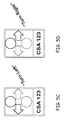
- Figures 5A-5D illustrate example light commands on an example light module 206 of a GMU 102.
- Figure 5A illustrates an example follow-me light command, which can be a lighted green circle near the top of the lightable area of the light module 206.
- the light module 206 can also include other information such as identification information for the assigned aircraft (e.g., CSA 123) and/or the destination location for the assigned aircraft 104 (e.g., gate D24).
- Figure 5B illustrates an example stop light command, which can be a lighted red circle near the bottom of the lightable area of the light module 206.
- Figure 5C illustrates an example turn left light command, which can be the lighted green circle for follow-me along with a left pointing green arrow.
- Figure 5D illustrates an example turn right light command, which can be the lighted green circle for follow-me along with a right pointing green arrow.
- other symbols and/or lights can be used to indicate the various light commands.
- a GMU 102 and system 100 as described where the GMU(s) 102 are autonomous does not require human operators for each follow-me vehicle, thereby eliminating the human error factor for that activity.
- the TCGS 300 coordinates and controls the movement of all GMUs 102 and all aircraft 104 during taxi phase, and all aircraft 104 are assigned a GMU 102 during taxi phase, the amount of communication between pilots and air traffic controllers for the taxi phase can be significantly reduced or eliminated. This is because the pilot of an aircraft 104 may be able to easily identify and follow the appropriate GMU 102 to the destination location based on the easy to follow light commands from the GMU 102.
- Example 1 includes an autonomous aircraft guiding mobile unit (GMU) comprising: one or more light modules; one or more processing units; and one or more data storage mediums, the one or more data storage mediums including instructions which, when executed by the one or more processing units, cause the one or more processing units to: receive control messages from a traffic control ground station (TCGS), the control messages assigning the GMU to an aircraft and controlling movement of the GMU and its assigned aircraft; and provide light commands to a pilot of the assigned aircraft with the one or more light modules, the light commands directing movement of the assigned aircraft during taxiing.
- GMU autonomous aircraft guiding mobile unit
- TGS traffic control ground station
- Example 2 includes the GMU of Example 1, wherein the light commands provided to the pilot include commands of: follow-me, stop, turn right, and turn left.
- Example 3 includes the GMU of any of Examples 1 or 2, comprising: an engine for moving the GMU about an airport; and a heading control system to control a direction of motion for the GMU; wherein the instructions cause the one or more processing units to control the engine and the heading control system based on the control messages from the TCGS to guide the assigned aircraft.
- Example 4 includes the GMU of Example 3, wherein the engine comprises one of an internal combustion engine or an electric motor.
- Example 5 includes the GMU of any of Examples 1-4, comprising: a location unit to determine a location of the GMU; a heading unit to determine a heading of the GMU; wherein the instructions cause the one or more processing units to obtain the location and heading of the GMU from the location unit and the heading unit and provide indications of the location and heading to the TCGS.
- Example 6 includes the GMU of any of Examples 1-5, wherein communication between the TCGS and the GMU occurs over a ground control datalink.
- Example 7 includes the GMU of any of Examples 1-6, wherein the TCGS determines a route on airport taxiways for the GMU, wherein the control messages direct the GMU assigned to an aircraft in accordance with the route; and wherein the GMU includes an airport database indicating a location of the airport taxiways, wherein the instructions cause the one or more processing units to control the engine and the heading control system to drive the GMU over the airport taxiways in accordance with the route.
- Example 8 includes the GMU of any of Examples 1-7, comprising: an aircraft distance measuring unit configured to measure a distance between the GMU and its assigned aircraft, wherein the instructions cause the one or more processing units to maintain the distance between the GMU and its assigned aircraft within a defined range.
- Example 9 includes the GMU of Example 8, wherein the instructions cause the one or more processing units to send an indication of a location of the assigned aircraft to the TCGS.
- Example 10 includes the GMU of any of Examples 1-9, wherein the instructions cause the one or more processing units to verify whether an aircraft is the assigned aircraft by receiving a broadcast identification beacon from the aircraft and comparing identification information in the broadcast identification beacon with identification information of the assigned aircraft.
- Example 11 includes the GMU of Example 10, wherein the instructions cause the one or more processing units to, in response to verifying that the aircraft is the assigned aircraft, commence the providing light commands to the pilot.
- Example 12 includes the GMU of any of Examples 1-11, comprising: one or more infrared (IR) emitter modules, wherein the instructions cause the one or more processing units to provide IR commands to a pilot of the assigned aircraft with the one or more IR emitter modules, the IR commands providing the same directives as the light commands provided to the pilot, such that the pilot can receive the directives in low visibility conditions when the light commands are not easily visible.
- IR infrared
- Example 13 includes a method for guiding an aircraft with an autonomous guiding mobile unit (GMU), the method comprising: receiving control messages including information regarding assigned aircraft and aircraft pick-up location from a traffic control ground station (TCGS); controlling, with one or more processing units, an engine and a heading control system of the GMU to driving to the aircraft pick-up location; verifying, with the one or more processing units, whether an aircraft in proximity of the aircraft pick-up location is the assigned aircraft; determining, with the one or more processing units, light commands to provide to the assigned aircraft based on the control messages from the TCGS; and providing the light commands to the assigned aircraft to guide the assigned aircraft during taxiing.
- GMU autonomous guiding mobile unit
- Example 14 includes the method of Example 13, comprising: maintaining a distance between the GMU and the assigned aircraft during taxiing to within a defined range.
- Example 15 includes the method of any of Examples 13 or 14, wherein verifying whether an aircraft in proximity of the aircraft pick-up location is the assigned aircraft includes receiving a broadcast identification beacon from the aircraft and comparing identification information in the broadcast identification beacon with identification information of the assigned aircraft.
- Example 16 includes the method of any of Examples 13-15, wherein determining light commands includes determining when to provide a follow-me, stop, turn left, and turn right command.
- Example 17 includes the method of any of Examples 13-16, comprising: sending to the TCGS information regarding a location and heading of the GMU and a location of the assigned aircraft.
- Example 18 includes an airport follow-me guidance system comprising: a traffic control ground station (TCGS) for directing aircraft during taxiing; and a plurality of aircraft guiding mobile units (GMUs), each GMU configured to guide an aircraft during taxiing, wherein each GMU includes: one or more light modules; one or more processing units; and one or more data storage mediums, the one or more data storage mediums including instructions which, when executed by the one or more processing units, cause the one or more processing units to: receive control messages from the TCGS, the control messages assigning the GMU to an aircraft and controlling movement of the GMU and its assigned aircraft; and provide light commands to a pilot of the assigned aircraft with the one or more light modules, the light commands directing movement of the assigned aircraft during taxiing.
- TCGS traffic control ground station
- GMUs aircraft guiding mobile units
- Example 19 includes the follow-me guidance system of Example 18, wherein the TCGS is configured to coordinate movement of all the GMUs to safely direct aircraft to an appropriate gate, runway entrance, or other location.
- Example 20 includes the follow-me guidance system of any of Examples 18 or 19, wherein each GMU includes: an engine for moving the GMU about an airport; and a heading control system to control a direction of motion for the GMU; wherein the instructions cause the one or more processing units to control the engine and the heading control system based on the control messages from the TCGS to guide the assigned aircraft.
Landscapes
- Engineering & Computer Science (AREA)
- Aviation & Aerospace Engineering (AREA)
- Physics & Mathematics (AREA)
- General Physics & Mathematics (AREA)
- Radar, Positioning & Navigation (AREA)
- Remote Sensing (AREA)
- Automation & Control Theory (AREA)
- Traffic Control Systems (AREA)
Applications Claiming Priority (1)
| Application Number | Priority Date | Filing Date | Title |
|---|---|---|---|
| US13/783,611 US20140249736A1 (en) | 2013-03-04 | 2013-03-04 | Autonomous aircraft guiding mobile unit |
Publications (1)
| Publication Number | Publication Date |
|---|---|
| EP2775366A2 true EP2775366A2 (fr) | 2014-09-10 |
Family
ID=50179495
Family Applications (1)
| Application Number | Title | Priority Date | Filing Date |
|---|---|---|---|
| EP14156671.1A Withdrawn EP2775366A2 (fr) | 2013-03-04 | 2014-02-25 | Unité mobile autonome de guidage d'aéronef |
Country Status (3)
| Country | Link |
|---|---|
| US (1) | US20140249736A1 (fr) |
| EP (1) | EP2775366A2 (fr) |
| CN (1) | CN104036661A (fr) |
Cited By (1)
| Publication number | Priority date | Publication date | Assignee | Title |
|---|---|---|---|---|
| CN113636095A (zh) * | 2021-10-18 | 2021-11-12 | 中国民用航空总局第二研究所 | 一种用于引导航空器的设备数据处理方法、设备及介质 |
Families Citing this family (17)
| Publication number | Priority date | Publication date | Assignee | Title |
|---|---|---|---|---|
| CN104299455A (zh) * | 2014-10-27 | 2015-01-21 | 重庆布伦坦茨航空技术进出口有限公司 | 机场特种车辆自动驾驶系统 |
| CN104456365B (zh) * | 2014-11-10 | 2016-09-28 | 中国民航大学 | 一种利用gps引导飞机滑行的指示灯系统及控制方法 |
| DE102015208914B4 (de) * | 2015-04-30 | 2020-09-24 | Volkswagen Aktiengesellschaft | Verfahren zur Unterstützung eines Fahrzeugs |
| ES2683546T3 (es) * | 2015-07-16 | 2018-09-26 | Guinault S.A. | Unidad inteligente de asistencia en tierra para aeronaves |
| US20180018887A1 (en) * | 2016-07-18 | 2018-01-18 | Honeywell International Inc. | Routing aircraft ground movements at an airport |
| US10170011B2 (en) * | 2016-07-26 | 2019-01-01 | International Business Machines Corporation | Guide drones for airplanes on the ground |
| US9987971B2 (en) | 2016-07-29 | 2018-06-05 | International Business Machines Corporation | Drone-enhanced vehicle external lights |
| US10820574B2 (en) | 2016-07-29 | 2020-11-03 | International Business Machines Corporation | Specialized contextual drones for virtual fences |
| CN107219861B (zh) * | 2017-06-28 | 2020-02-07 | 段炜 | 一种飞行陪伴机器人控制方法及装置 |
| JP2019021128A (ja) * | 2017-07-19 | 2019-02-07 | 村田機械株式会社 | 走行車システム |
| US20190079525A1 (en) * | 2017-09-11 | 2019-03-14 | Qualcomm Incorporated | Autonomous vehicle support for secondary vehicle |
| CN110412988A (zh) * | 2019-08-21 | 2019-11-05 | 上海敖颉信息科技有限公司 | 一种利用港口地灯对港口集装箱无人车导航的方法 |
| US11908336B2 (en) * | 2019-11-04 | 2024-02-20 | The Boeing Company | System and method for clearance-based taxi route planning |
| CN111402874B (zh) * | 2020-02-26 | 2023-07-07 | 中国民航大学 | 一种基于语音和视觉结合的飞机牵引车智能驾驶控制系统 |
| US12157580B2 (en) * | 2020-04-29 | 2024-12-03 | Joby Aero, Inc. | Systems and methods for transferring aircraft |
| US12249244B2 (en) * | 2021-03-29 | 2025-03-11 | Rockwell Collins, Inc. | System and method to display airport moving map and taxi routing guidance content for commonly used taxi route |
| KR102668998B1 (ko) * | 2023-07-31 | 2024-05-27 | 인천국제공항공사 | 항공기 지상조업 보조 장치 및 이의 동작 방법 |
Family Cites Families (3)
| Publication number | Priority date | Publication date | Assignee | Title |
|---|---|---|---|---|
| US6772464B2 (en) * | 2002-08-05 | 2004-08-10 | Dew Engineering And Development Limited | Method and apparatus for aligning an aircraft with a passenger loading bridge |
| US7603735B2 (en) * | 2006-03-14 | 2009-10-20 | Dew Engineering And Development Ulc | System and method for wireless communication between an aircraft and a passenger boarding bridge |
| US9199745B2 (en) * | 2007-05-16 | 2015-12-01 | Israel Aerospace Industries Ltd. | System and method for transferring airplanes |
-
2013
- 2013-03-04 US US13/783,611 patent/US20140249736A1/en not_active Abandoned
-
2014
- 2014-02-25 EP EP14156671.1A patent/EP2775366A2/fr not_active Withdrawn
- 2014-03-03 CN CN201410074324.XA patent/CN104036661A/zh active Pending
Non-Patent Citations (1)
| Title |
|---|
| None |
Cited By (2)
| Publication number | Priority date | Publication date | Assignee | Title |
|---|---|---|---|---|
| CN113636095A (zh) * | 2021-10-18 | 2021-11-12 | 中国民用航空总局第二研究所 | 一种用于引导航空器的设备数据处理方法、设备及介质 |
| CN113636095B (zh) * | 2021-10-18 | 2022-04-08 | 中国民用航空总局第二研究所 | 一种用于引导航空器的设备数据处理方法、设备及介质 |
Also Published As
| Publication number | Publication date |
|---|---|
| CN104036661A (zh) | 2014-09-10 |
| US20140249736A1 (en) | 2014-09-04 |
Similar Documents
| Publication | Publication Date | Title |
|---|---|---|
| EP2775366A2 (fr) | Unité mobile autonome de guidage d'aéronef | |
| US8090489B2 (en) | Computerized driverless vehicles and traffic control system | |
| CN109164809B (zh) | 一种车辆编队自主跟随控制系统及方法 | |
| CN108898880B (zh) | 车辆控制方法及系统 | |
| US10217367B2 (en) | Unmanned aerial vehicle and system having the same | |
| US9696177B2 (en) | Vehicle driving guidance device and method | |
| US20200160733A1 (en) | Autonomous aerial vehicle navigation systems and methods | |
| US20110127366A1 (en) | Automated system for maneuvering aircrafts on the ground | |
| EP3147889B1 (fr) | Systèmes et procédés de régulation de la collecte d'informations météorologiques | |
| JP2023544819A (ja) | 双方向車両輸送ネットワークにおける交通管理のためのシステムおよび方法 | |
| CN105513434A (zh) | 无人机飞行管制系统及其管制方法 | |
| US20210086649A1 (en) | Vehicle control system, vehicle control method, and program | |
| KR20230038717A (ko) | 대화형 차량 운송 네트워크를 위한 시스템들 및 방법들 | |
| EP3721313B1 (fr) | Systèmes et procédés de commande d'un véhicule autonome | |
| US9824599B1 (en) | Method and vehicle traffic control system | |
| CN109765909A (zh) | V2x系统应用在港口的方法 | |
| CN110869703A (zh) | 导航方法和导航设备 | |
| KR20190129446A (ko) | 무인 항공기의 착륙 유도 방법 및 그를 위한 장치 | |
| CN115775457A (zh) | 一种用于民航机场车路协同路径测试方法及系统 | |
| GB2592838A (en) | Parking guidance system | |
| KR101288260B1 (ko) | 비행체 관제 시스템 | |
| CN113819920A (zh) | 针对拥堵路段的自动驾驶非自主导航方法 | |
| CN205405925U (zh) | 无人机飞行管制系统 | |
| WO2019139957A1 (fr) | Systèmes et procédés de commande d'un véhicule autonome | |
| CN209412623U (zh) | 一种基于复杂交通环境的无人驾驶道路结构 |
Legal Events
| Date | Code | Title | Description |
|---|---|---|---|
| PUAI | Public reference made under article 153(3) epc to a published international application that has entered the european phase |
Free format text: ORIGINAL CODE: 0009012 |
|
| 17P | Request for examination filed |
Effective date: 20140225 |
|
| AK | Designated contracting states |
Kind code of ref document: A2 Designated state(s): AL AT BE BG CH CY CZ DE DK EE ES FI FR GB GR HR HU IE IS IT LI LT LU LV MC MK MT NL NO PL PT RO RS SE SI SK SM TR |
|
| AX | Request for extension of the european patent |
Extension state: BA ME |
|
| STAA | Information on the status of an ep patent application or granted ep patent |
Free format text: STATUS: THE APPLICATION HAS BEEN WITHDRAWN |
|
| 18W | Application withdrawn |
Effective date: 20150313 |