EP2777389B1 - Verfahren zur herstellung und vorrichtung zur herstellung von milch als käseausgangsmaterial - Google Patents
Verfahren zur herstellung und vorrichtung zur herstellung von milch als käseausgangsmaterial Download PDFInfo
- Publication number
- EP2777389B1 EP2777389B1 EP12847456.6A EP12847456A EP2777389B1 EP 2777389 B1 EP2777389 B1 EP 2777389B1 EP 12847456 A EP12847456 A EP 12847456A EP 2777389 B1 EP2777389 B1 EP 2777389B1
- Authority
- EP
- European Patent Office
- Prior art keywords
- fraction
- starting material
- milk
- skim milk
- centrifugal separator
- Prior art date
- Legal status (The legal status is an assumption and is not a legal conclusion. Google has not performed a legal analysis and makes no representation as to the accuracy of the status listed.)
- Not-in-force
Links
Images

Classifications
-
- A—HUMAN NECESSITIES
- A01—AGRICULTURE; FORESTRY; ANIMAL HUSBANDRY; HUNTING; TRAPPING; FISHING
- A01J—MANUFACTURE OF DAIRY PRODUCTS
- A01J11/00—Apparatus for treating milk
- A01J11/06—Strainers or filters for milk
-
- A—HUMAN NECESSITIES
- A23—FOODS OR FOODSTUFFS; TREATMENT THEREOF, NOT COVERED BY OTHER CLASSES
- A23B—PRESERVATION OF FOODS, FOODSTUFFS OR NON-ALCOHOLIC BEVERAGES; CHEMICAL RIPENING OF FRUIT OR VEGETABLES
- A23B11/00—Preservation of milk or dairy products
- A23B11/60—Preservation of cheese or cheese preparations
- A23B11/602—Pasteurisation; Sterilisation; Hot packaging
-
- A—HUMAN NECESSITIES
- A01—AGRICULTURE; FORESTRY; ANIMAL HUSBANDRY; HUNTING; TRAPPING; FISHING
- A01J—MANUFACTURE OF DAIRY PRODUCTS
- A01J11/00—Apparatus for treating milk
- A01J11/10—Separating milk from cream
-
- A—HUMAN NECESSITIES
- A23—FOODS OR FOODSTUFFS; TREATMENT THEREOF, NOT COVERED BY OTHER CLASSES
- A23B—PRESERVATION OF FOODS, FOODSTUFFS OR NON-ALCOHOLIC BEVERAGES; CHEMICAL RIPENING OF FRUIT OR VEGETABLES
- A23B11/00—Preservation of milk or dairy products
- A23B11/10—Preservation of milk or milk preparations
- A23B11/12—Preservation of milk or milk preparations by heating
- A23B11/13—Preservation of milk or milk preparations by heating the materials being loose unpacked
- A23B11/133—Preservation of milk or milk preparations by heating the materials being loose unpacked and progressively transported through the apparatus
-
- B—PERFORMING OPERATIONS; TRANSPORTING
- B01—PHYSICAL OR CHEMICAL PROCESSES OR APPARATUS IN GENERAL
- B01D—SEPARATION
- B01D61/00—Processes of separation using semi-permeable membranes, e.g. dialysis, osmosis or ultrafiltration; Apparatus, accessories or auxiliary operations specially adapted therefor
- B01D61/14—Ultrafiltration; Microfiltration
- B01D61/18—Apparatus therefor
-
- B—PERFORMING OPERATIONS; TRANSPORTING
- B01—PHYSICAL OR CHEMICAL PROCESSES OR APPARATUS IN GENERAL
- B01D—SEPARATION
- B01D63/00—Apparatus in general for separation processes using semi-permeable membranes
- B01D63/16—Rotary, reciprocated or vibrated modules
-
- A—HUMAN NECESSITIES
- A23—FOODS OR FOODSTUFFS; TREATMENT THEREOF, NOT COVERED BY OTHER CLASSES
- A23C—DAIRY PRODUCTS, e.g. MILK, BUTTER OR CHEESE; MILK OR CHEESE SUBSTITUTES; PREPARATION THEREOF
- A23C2210/00—Physical treatment of dairy products
- A23C2210/20—Treatment using membranes, including sterile filtration
- A23C2210/208—Removal of bacteria by membrane filtration; Sterile filtration of milk products
-
- B—PERFORMING OPERATIONS; TRANSPORTING
- B01—PHYSICAL OR CHEMICAL PROCESSES OR APPARATUS IN GENERAL
- B01D—SEPARATION
- B01D2315/00—Details relating to the membrane module operation
- B01D2315/02—Rotation or turning
Definitions
- the present invention relates to a method for producing and a device for producing a cheese starting material milk from milk by means of centrifugal separation and treatment with a microfilter membrane.
- a method for centrifugally disinfecting bacteria-containing milk involves sterilizing a liquid, in which the quantity of bacteria has been concentrated, by heating, and then re-blending this liquid with milk which has been subjected to centrifugal separation. Approximately 90% of bacteria are eliminated by carrying out this treatment.
- a permeate that passes through fine pores (0.1 to 10 ⁇ m) in the filter is skim milk and a retentate that does not pass through the filter is cream. Due to the fact that fat globules and bacteria present in the milk are approximately the same size, the obtained skim milk contains substantially no bacteria.
- a microfilter for microfiltration has a structure in which a porous membrane (hereinafter referred to as a "membrane”) is formed on a support body.
- Cross flow type microfiltration involves causing a liquid supplied to a filter to flow along a membrane, which separates the liquid into a permeate that passes through the membrane and a concentrated retentate that does not pass through the membrane.
- Cheese is obtained by solidifying milk by means of lactic acid bacteria or an enzyme known as rennet, thereby obtaining a yogurt-like material, removing the aqueous component (the whey) so as to obtain a white solid, and then compressing this white solid to obtain a cheese starting material.
- cheese starting material milk production devices were provided with a heat exchanger for heating milk to a temperature sufficient for separation, a centrifugal separator for centrifugally separating milk into a cream fraction and a skim milk fraction, a microfilter, which subjected the skim milk fraction to treatment with a microfilter membrane and had an outlet for a permeate having a reduced bacteria content and an outlet for a retentate containing the residual bacteria that did not pass through the filter membrane, and a high temperature sterilization unit for sterilizing a mixed liquid containing the retentate and the cream fraction, and the sterilized mixed liquid containing the retentate and the cream fraction was combined with the permeate to obtain a cheese starting material milk.
- a heat exchanger for heating milk to a temperature sufficient for separation
- a centrifugal separator for centrifugally separating milk into a cream fraction and a skim milk fraction
- a microfilter which subjected the skim milk fraction to treatment with a microfilter membrane and had an outlet for a
- a heat exchanger for heating milk to a temperature sufficient for separation
- a centrifugal separator for centrifugally separating milk into a cream fraction and a skim milk fraction
- a microfilter which subjected the skim milk fraction to treatment with a microfilter membrane and had an outlet for a permeate having a reduced bacteria content and an outlet for a retentate containing the residual bacteria that did not pass through the filter membrane
- a pipe for returning the retentate from the retentate outlet to the milk supply port of the centrifugal separator
- a high temperature sterilization unit for sterilizing the cream fraction, and the sterilized cream fraction was combined with the permeate to obtain a cheese starting material milk.
- An objective of the present invention is to provide a method for producing and a device for producing a cheese starting material milk which do not require high temperature sterilization treatment, do not cause denaturing, have no risk of affecting the flavor of the cheese, have low energy consumption, have no risk of contaminating a cream fraction or a skim milk fraction due to bacteria remaining in a centrifugal separator, increase the bacteria removal rate in the centrifugal separator, and do not require a large capacity centrifugal separator.
- the device for producing a cheese starting material milk of the present invention comprises a starting material supply means that supplies a starting material milk; a first centrifugal separator, which has a supply port for the starting material milk, centrifugally separates the starting material milk into a cream fraction and a skim milk fraction, and has an outlet for the cream fraction, an outlet for the skim milk fraction and a sludge discharge port; a microfilter, which has a supply port for the skim milk fraction, subjects the skim milk fraction to treatment with a cross flow type microfilter membrane, and has an outlet for a permeate having a reduced bacteria content and an outlet for a retentate containing the residual bacteria that do not pass through the microfilter membrane; it is characterized by a second centrifugal separator, which has a supply port for the retentate, centrifugally separates the retentate into a clean fraction having a low bacteria content and a high bacteria content fraction, and has an outlet for the clean fraction and a discharge port for the high bacteria content
- the method for producing a cheese starting material milk of the present invention is characterized in that a starting material milk is supplied from a starting material supply means, said starting material milk is supplied to a supply port in a first centrifugal separator, said starting material milk is centrifugally separated into a cream fraction and a skim milk fraction, said cream fraction is discharged from a cream fraction outlet, said skim milk fraction from a skim milk fraction outlet and a sludge from a sludge discharge port, said skim milk fraction is supplied to a supply port in a microfilter, said skim milk fraction is subjected to treatment with a cross flow type microfilter membrane so as to separate said skim milk fraction into a permeate having a reduced bacteria content and a retentate containing the residual bacteria that do not pass through the microfilter membrane, said permeate and said retentate are discharged, said retentate is supplied to a supply port in a second centrifugal separator, said retentate is centrifugally separated into a
- a starting material milk is supplied from a starting material supply means.
- the starting material milk is milked from a cow, goat, sheep, and so on.
- the starting material milk is supplied to a supply port in a first centrifugal separator, the starting material milk is centrifugally separated into a cream fraction and a skim milk fraction, and the cream fraction, the skim milk fraction and a sludge are discharged from a cream fraction outlet, a skim milk fraction outlet and a sludge discharge port respectively.
- the starting material milk Before being supplied to the first centrifugal separator, the starting material milk may be subjected to temperature adjustment using a heat exchanger or the like, pressure adjustment using a pump or the like, or flow rate adjustment using a valve or the like.
- the skim milk fraction from the first centrifugal separator is supplied to a supply port in a microfilter, treated with a cross flow type microfilter membrane, and separated into a permeate having a reduced bacteria content and a retentate containing the residual bacteria that do not pass through the microfilter membrane, and the permeate and retentate are then discharged.
- the microfilter has a supply port for the skim milk fraction, subjects the skim milk fraction to treatment with a cross flow type microfilter membrane, and has an outlet for a permeate having a reduced bacteria content and an outlet for a retentate containing the residual bacteria that do not pass through the microfilter membrane.
- the skim milk from the centrifugal separator is used to produce powdered skim milk or is combined with cream to produce cheese.
- the skim milk contains bacteria.
- these bacteria include heat-resistant spore-forming bacteria. Spore-forming bacteria cannot be eliminated by conventional high-temperature short time sterilization (HTST methods in which sterilization is carried out for 15 seconds at a temperature of 72 to 78°C) carried out downstream of a centrifugal separation system. In cases where bacteria remain alive in the final product, these bacteria emerge from spores and start to become active during storage or treatment at temperatures and humidities suitable for propagation. Bacteria have an effect on the texture of cheese products and on the storage stability of dairy products that contain skim milk powder.
- a first characteristic of the cheese starting material milk production of the present invention is the provision of a second centrifugal separator.
- the retentate is supplied to a supply port in the second centrifugal separator and is centrifugally separated into a clean fraction having a low bacteria content and a high bacteria content fraction.
- the second centrifugal separator has a supply port for the retentate, centrifugally separates the retentate into a clean fraction having a low bacteria content and a high bacteria content fraction, and has an outlet for the clean fraction and a discharge port for the high bacteria content fraction.
- the first centrifugal separator is mainly used in order to separate into skim milk and cream, whereas the second centrifugal separator is used to remove bacteria.
- the second centrifugal separator which is used to remove bacteria, eliminates 60 to 99% of spore-containing bacteria by means of gravity difference within the same temperature range as the microfilter without needing to carry out heat treatment.
- a second characteristic of the cheese starting material milk production of the present invention is discharging the high bacteria content fraction and returning the clean fraction to the skim milk fraction supply port in the microfilter and/or the starting material milk supply port in the first centrifugal separator.
- This return means returns the clean fraction from the clean fraction outlet to the skim milk fraction supply port in the microfilter and/or the starting material milk supply port in the first centrifugal separator.
- the clean fraction contains the skim milk fraction which has an extremely low bacteria content
- the cream fraction which is essential for returning the milk fat component of the cheese, is sterilized in the high temperature sterilization unit.
- high temperature heat treatment is carried out at 121°C, but because the quantity of thermally degradable components in the cream component is low, damage caused by high temperature heat treatment can be kept to a minimum.
- the sterilized cream fraction which contains the milk fat components of the cheese, is combined with the permeate to form the cheese starting material milk.
- Cheese is obtained by solidifying the cheese starting material milk by means of lactic acid bacteria or an enzyme known as rennet, for example, thereby obtaining a yogurt-like material, converting this yogurt-like material into a white solid, and then compressing this white solid to obtain a cheese starting material.
- lactic acid bacteria or an enzyme known as rennet for example, thereby obtaining a yogurt-like material, converting this yogurt-like material into a white solid, and then compressing this white solid to obtain a cheese starting material.
- Fig. 1 is a schematic flow diagram showing one example of a cheese starting material milk production device according to the present invention.
- a starting material milk (2) is supplied from a starting material supply means (1) that is a storage tank.
- the starting material milk (2) is milked from dairy cattle.
- the starting material milk (2) is supplied to a supply port (4) in the first centrifugal separator (3) and centrifugally separated into a cream fraction (5) and a skim milk fraction (6), and the cream fraction (5), the skim milk fraction (6) and a sludge (10) are discharged from a cream fraction outlet (7), a skim milk fraction outlet (8) and a sludge discharge port (9) respectively.
- the starting material milk Before being supplied to the first centrifugal separator (3), the starting material milk may be subjected to temperature adjustment using a heat exchanger, pressure adjustment using a pump or the like, or flow rate adjustment using a valve or the like, which are not shown in the drawings.
- the skim milk fraction (6) from the first centrifugal separator (3) is supplied to a supply port (12) in a microfilter (11), treated with a cross flow type microfilter membrane (13), and separated into a permeate (14) having a reduced bacteria content and a retentate (15) containing the residual bacteria that do not pass through the microfilter membrane, and the permeate (14) and retentate (15) are then discharged.
- the microfilter (11) has the skim milk fraction supply port (12), subjects the skim milk fraction (6) to treatment using the cross flow type microfilter membrane (13), and has an outlet (16) for the permeate (14) having a reduced bacteria content and an outlet (17) for the retentate (15) containing the residual bacteria that do not pass through the microfilter membrane.
- skim milk fraction (6) from the centrifugal separator is ultimately mixed with the cream and used to produce cheese.
- the skim milk (6) contains bacteria, and bacteria are separated into the retentate (15).
- a first characteristic of this mode is the provision of a second centrifugal separator (18).
- the retentate (15) is supplied to a supply port (19) in the second centrifugal separator (18) and centrifugally separated into a clean fraction (20) having a low bacteria content and a high bacteria content fraction (21).
- the second centrifugal separator (18) has the supply port (19) for the retentate (15), centrifugally separates the retentate (15) into the clean fraction (20) having a low bacteria content and the high bacteria content fraction (21), and is provided with an outlet (22) for the clean fraction (20) and a discharge port (23) for the high bacteria content fraction (21).
- the first centrifugal separator (3) is mainly used in order to separate into skim milk and cream, whereas the second centrifugal separator (18) is used to remove bacteria (21).
- the second centrifugal separator (18) eliminates 60 to 99% of spore-containing bacteria by means of gravity difference within the same temperature range as the microfilter without needing to carry out heat treatment.
- a second characteristic of this mode is discharging the high bacteria content fraction (21) from the system and returning the clean fraction (20) to the skim milk fraction supply port (12) in the microfilter and/or the starting material milk supply port (4) in the first centrifugal separator.
- the return means which consists of ducts, pipes, valves and so on, returns the clean fraction (20) from the outlet (22) for the clean fraction (20) to the skim milk fraction supply port (12) in the microfilter (11) and/or the starting material milk supply port (4) in the first centrifugal separator (3).
- the clean fraction (20) contains the skim milk fraction, which has an extremely low bacteria content, it is possible to dilute the treatment liquid and reduce the load on the treatment device (the centrifugal separator or microfilter) to which the treatment liquid is returned. It is possible to carry out the separation by the first centrifugal separator and/or the filtering by the microfilter membrane more efficiently.
- the cream fraction (5) which is essential for returning the milk fat component of the cheese, is sterilized in a high temperature sterilization unit (24).
- High temperature heat treatment is carried out at 121°C in this mode, but because the quantity of thermally degradable components in the cream fraction is low, damage caused by high temperature heat treatment can be kept to a minimum.
- the sterilized cream fraction (25), which contains the milk fat components of the cheese is combined with the permeate (14) to form a cheese starting material milk (26).
- Cheese is obtained, in a flow not shown in the diagrams, by solidifying the cheese starting material milk (26) by means of lactic acid bacteria or an enzyme known as rennet, for example, thereby obtaining a yogurt-like material, converting this yogurt-like material into a white solid, and then compressing this white solid to obtain a cheese starting material.
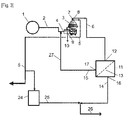
- Fig. 2 shows an example of a conventional cheese starting material milk production device.
- a centrifugal separator (3) that centrifugally separates milk (2) into a cream fraction (5) and a skim milk fraction (6); a microfilter (11) which subjects the skim milk fraction (6) to treatment using a microfilter membrane (13) and which has an outlet (16) for a permeate (14) having a reduced bacteria content and an outlet (17) for a retentate (15) containing the residual bacteria that do not pass through the microfilter membrane; and a high temperature sterilization unit (24) which sterilizes a mixed liquid containing the retentate (15) and the cream fraction (5), and a sterilized mixed liquid (25) containing the retentate (15) and the cream fraction (5) is combined with the permeate (14) to form a cheese starting material milk (26).
- the cheese starting material milk production of the present invention does not require high temperature sterilization treatment of the retentate of the skim milk fraction, and accordingly, does not cause denaturing to proteins or flavor components, has no risk of affecting the flavor of the cheese product, and has low energy consumption due to the retentate of the skim milk fraction not being heated to a high temperature.
- Fig. 3 shows another example of a conventional cheese starting material milk production device.
- a centrifugal separator (7) that centrifugally separates milk (2) into a cream fraction (5) and a skim milk fraction (6); a microfilter (11) which subjects the skim milk fraction (6) to treatment using a microfilter membrane (13) and which has an outlet (16) for a permeate (14) having a reduced bacteria content and an outlet (17) for a retentate (15) containing the residual bacteria that do not pass through the microfilter membrane; a pipe (27) for returning the retentate (15) from the retentate outlet (17) to a milk supply port (4) in the centrifugal separator (3); and a high temperature sterilization unit (24) which sterilizes the cream fraction (5), and a sterilized cream fraction (25) is combined with the permeate (14) to form a cheese starting material milk (26).
- the cheese starting material milk production of the present invention has no risk of contaminating the cream fraction or the skim milk fraction due to bacteria remaining in the centrifugal separator, increases the bacteria removal rate in the centrifugal separator and does not require a large capacity centrifugal separator.
- Milk having a fat content of 4.05% and a protein content of 3.47% is supplied to a first centrifugal separator at a rate of 10,000 liters per hour.
- a cream fraction having a fat content of 40.00% is removed from the first centrifugal separator at a rate of 1,000 liters per hour. Meanwhile, a skim milk fraction having a fat content of 0.05% and a protein content of 3.60% is removed from the first centrifugal separator at a rate of 9,000 liters per hour.
- the skim milk fraction is supplied to a microfilter, and a permeate having a fat content of 0.04% and a protein content of 3.58% is removed at a rate of 8,550 liters per hour. Meanwhile, a retentate having a fat content of 0.24% and a protein content of 3.98% is removed at a rate of 450 liters per hour.
- the 450 liters per hour of retentate is introduced into a second centrifugal separator.
- a clean fraction is removed from the second centrifugal separator, mixed with the skim milk fraction, and supplied to the microfilter.
- a high bacteria content fraction is discharged as a sludge from the second centrifugal separator to outside the system.
- the stream of the cream fraction which is an essential component for cheese, is sterilized by being heated to a high temperature of 121°C.
- the permeate is mixed with the heat treated cream fraction stream, and this mixture is used as a standardized milk for the cheese ultimately produced.
- This invention can be used to produce a cheese starting material milk.
Landscapes
- Life Sciences & Earth Sciences (AREA)
- Engineering & Computer Science (AREA)
- Chemical & Material Sciences (AREA)
- Animal Husbandry (AREA)
- Chemical Kinetics & Catalysis (AREA)
- Water Supply & Treatment (AREA)
- Environmental Sciences (AREA)
- Zoology (AREA)
- Polymers & Plastics (AREA)
- Food Science & Technology (AREA)
- Wood Science & Technology (AREA)
- Dairy Products (AREA)
- Micro-Organisms Or Cultivation Processes Thereof (AREA)
Claims (2)
- Vorrichtung zum Erzeugen einer Ausgangsmaterialmilch für Käse, wobei die Vorrichtung Folgendes umfasst: Ausgangsmaterial-Zufuhrmittel, die eine Ausgangsmaterialmilch zuführen; eine erste Zentrifugen-Abscheidevorrichtung, die einen Zufuhranschluss für die Ausgangsmaterialmilch aufweist, die Ausgangsmaterialmilch durch Zentrifugieren in einen Sahneanteil und einen Magermilchanteil trennt, und einen Auslass für den Sahneanteil, einen Auslass für den Magermilchanteil und einen Abflussanschluss für Rückstand aufweist; einen Mikrofilter, der einen Zufuhranschluss für den Magermilchanteil aufweist, den Magermilchanteil einer Behandlung mit einer Mikrofiltermembran des Querströmungstyps unterzieht, und einen Auslass für ein Permeat, das einen verringerten Bakteriengehalt hat, und einen Auslass für ein Retentat, das die verbleibenden Bakterien enthält, die nicht durch die Mikrofiltermembran gelangen, aufweist;
gekennzeichnet durch
eine zweite Zentrifugen-Abscheidevorrichtung, die einen Zufuhranschluss für das Retentat aufweist, das Retentat mittels Zentrifugieren in einen sauberen Anteil, der einen niedrigen Bakteriengehalt aufweist, und einen Anteil mit hohem Bakteriengehalt trennt, und einen Auslass für den sauberen Anteil und einen Abflussanschluss für den Anteil mit hohem Bakteriengehalt aufweist; Mittel zum Zurückführen des sauberen Anteils von dem Auslass für den sauberen Anteil zu dem Magermilchanteil-Zufuhranschluss in dem Mikrofilter bzw. zu dem Ausgangsmaterialmilch-Zufuhranschluss in der ersten Zentrifugen-Abscheidevorrichtung; und eine Hochtemperatur-Sterilisiereinheit, die den Sahneanteil sterilisiert; und wobei der sterilisierte Sahneanteil und das Permeat kombiniert werden, um eine Ausgangsmaterialmilch für Käse zu bilden. - Verfahren zum Erzeugen einer Ausgangsmaterialmilch für Käse, wobei das Verfahren dadurch gekennzeichnet ist, dass von einem Ausgangsmaterial-Zufuhrmittel eine Ausgangsmaterialmilch zugeführt wird, die Ausgangsmaterialmilch einem Zufuhranschluss in einer ersten Zentrifugen-Abscheidevorrichtung zugeführt wird, die Ausgangsmaterialmilch durch Zentrifugieren in einen Sahneanteil und einen Magermilchanteil getrennt wird, der Sahneanteil von einem Auslass für den Sahneanteil, der Magermilchanteil von einem Auslass für den Magermilchanteil und ein Rückstand von einem Abflussanschluss für Rückstand ausgeleitet werden, der Magermilchanteil einem Zufuhranschluss in einem Mikrofilter zugeführt wird, der Magermilchanteil einer Behandlung mit einer Mikrofiltermembran des Querströmungstyps unterzogen wird, um so den Magermilchanteil in ein Permeat, das einen verringerten Bakteriengehalt hat, und ein Retentat, das die verbleibenden Bakterien enthält, die nicht durch die Mikrofiltermembran gelangen, zu trennen, das Permeat und das Retentat ausgeleitet werden, das Retentat einem Zufuhranschluss in einer zweiten Zentrifugen-Abscheidevorrichtung zugeführt wird, das Retentat mittels Zentrifugieren in einen sauberen Anteil, der eine niedrigen Bakteriengehalt aufweist, und einen Anteil mit hohem Bakteriengehalt getrennt wird, der Anteil mit hohem Bakteriengehalt ausgeleitet wird, der saubere Anteil zu dem Magermilchanteil-Zufuhranschluss in dem Mikrofilter bzw. zu dem Ausgangsmaterialmilch-Zufuhranschluss in der ersten Zentrifugen-Abscheidevorrichtung zurückgeführt wird, der saubere Anteil in einer Hochtemperatur-Sterilisiereinheit sterilisiert wird, und der sterilisierte Sahneanteil und das Permeat kombiniert werden, um eine Ausgangsmaterialmilch für Käse zu bilden.
Applications Claiming Priority (2)
| Application Number | Priority Date | Filing Date | Title |
|---|---|---|---|
| JP2011243065 | 2011-11-07 | ||
| PCT/JP2012/078400 WO2013069546A1 (ja) | 2011-11-07 | 2012-11-01 | チーズ原料乳の製造装置及び製造法 |
Publications (3)
| Publication Number | Publication Date |
|---|---|
| EP2777389A1 EP2777389A1 (de) | 2014-09-17 |
| EP2777389A4 EP2777389A4 (de) | 2015-09-23 |
| EP2777389B1 true EP2777389B1 (de) | 2016-10-05 |
Family
ID=48289923
Family Applications (1)
| Application Number | Title | Priority Date | Filing Date |
|---|---|---|---|
| EP12847456.6A Not-in-force EP2777389B1 (de) | 2011-11-07 | 2012-11-01 | Verfahren zur herstellung und vorrichtung zur herstellung von milch als käseausgangsmaterial |
Country Status (7)
| Country | Link |
|---|---|
| US (1) | US20140287118A1 (de) |
| EP (1) | EP2777389B1 (de) |
| CN (1) | CN103917088B (de) |
| BR (1) | BR112014010887A2 (de) |
| DK (1) | DK2777389T3 (de) |
| RU (1) | RU2582257C2 (de) |
| WO (1) | WO2013069546A1 (de) |
Families Citing this family (6)
| Publication number | Priority date | Publication date | Assignee | Title |
|---|---|---|---|---|
| US10721940B2 (en) | 2011-07-21 | 2020-07-28 | Kraft Food Group Brands Llc | Methods for reducing viscosity and delaying onset of cold gelation of high solids concentrated milk products |
| EP2679098B1 (de) | 2012-06-26 | 2017-08-09 | DMK Deutsches Milchkontor GmbH | Milchpulver mit hohem molkenproteinindex |
| DE102014019014B4 (de) | 2014-12-18 | 2020-09-17 | Gea Tds Gmbh | Verfahren und Anlage zur Behandlung von Milch zur Herstellung von Käsereimilch mit einem reduzierten Gehalt an Keimen und Bakterien |
| WO2024213855A1 (fr) * | 2023-04-12 | 2024-10-17 | Eurial | Procédé de fabrication d'un fromage |
| FR3147683A1 (fr) * | 2023-04-12 | 2024-10-18 | Eurial | Procédé de fabrication d’un fromage à partir d’un mélange laitier |
| FR3147684A1 (fr) * | 2023-04-12 | 2024-10-18 | Eurial | Procédé de traitement d’un lait pour la fabrication d’un fromage |
Family Cites Families (25)
| Publication number | Priority date | Publication date | Assignee | Title |
|---|---|---|---|---|
| SU120985A1 (ru) * | 1958-08-04 | 1958-11-30 | Г.А. Потков | Способ непрерывного сепарировани молока, сливок и т.п. продуктов и сепаратор дл осуществлени способа |
| SE451791B (sv) * | 1984-09-11 | 1987-11-02 | Alfa Laval Food & Dairy Eng | Sett och anleggning for framstellning av mjolk med lag bakteriehalt |
| DE3802305C1 (en) * | 1988-01-27 | 1989-10-05 | Westfalia Separator Ag, 4740 Oelde, De | Process and apparatus for the centrifugal removal of bacteria from milk |
| DE3842980C2 (de) * | 1988-12-21 | 1995-06-29 | Westfalia Separator Ag | Verfahren zur zentrifugalen Behandlung von Käsereimilch und Zentrifuge zur Durchführung des Verfahrens |
| JP2879153B2 (ja) | 1989-09-26 | 1999-04-05 | 株式会社日阪製作所 | 液体食品の滅菌装置 |
| DK169510B1 (da) * | 1993-05-13 | 1994-11-14 | Apv Pasilac As | Anlæg og fremgangsmåde til behandling af mælk |
| SE506683C2 (sv) * | 1995-05-17 | 1998-02-02 | Tetra Laval Holdings & Finance | Sätt vid framställning av konsumtionsmjölk med lång hållbarhet |
| SE519853E (sv) * | 1997-06-19 | 2005-03-29 | Tetra Laval Holdings & Finance | Metod för framställning av steril skummjölk |
| DE19807294C2 (de) * | 1998-02-20 | 2001-08-30 | Westfalia Separator Ag | Molkeentrahmungsstation mit einem Klärseparator und einem Entrahmungsseparator |
| DK174656B1 (da) * | 1999-06-04 | 2003-08-11 | Apv Pasilac As | Fremgangsmåde og anlæg til behandling af mælk |
| DE10036085C1 (de) * | 2000-07-25 | 2002-01-24 | Westfalia Separator Food Tec G | Verfahren zur Entkeimung von Milch |
| RU2264717C2 (ru) * | 2001-02-15 | 2005-11-27 | Ниро А/С | Способ производства молочного продукта с пониженным содержанием спор и бактерий и установка для его осуществления, способ получения молочной сыворотки с пониженным содержанием спор и бактерий и установка для его осуществления |
| AU2003205559A1 (en) * | 2002-02-20 | 2003-09-09 | Novozymes A/S | Process for producing cheese |
| JP3910593B2 (ja) * | 2004-02-17 | 2007-04-25 | 森永乳業株式会社 | 液体の殺菌装置および牛乳類の殺菌方法 |
| SE526828C2 (sv) * | 2004-03-15 | 2005-11-08 | Tetra Laval Holdings & Finance | Metod att effektivisera fettavskiljning vid separering av en flytande livsmedelsprodukt |
| DE102004035223A1 (de) * | 2004-07-21 | 2006-02-16 | Westfalia Separator Ag | Separator und Verfahren zur Entkeimung von Rohmilch oder Molke |
| CN101396045B (zh) * | 2007-09-26 | 2011-09-14 | 光明乳业股份有限公司 | 一种生产牛奶的方法及制得的牛奶 |
| CN101317606B (zh) * | 2008-05-29 | 2011-07-27 | 丁然 | 一种保全营养的奶粉生产方法 |
| CN101317599B (zh) * | 2008-06-24 | 2011-12-28 | 内蒙古蒙牛乳业(集团)股份有限公司 | 一种无乳糖全脂牛奶及其制备方法 |
| CN101380043A (zh) * | 2008-10-17 | 2009-03-11 | 石家庄君乐宝乳业有限公司 | 一种新鲜干酪制备方法 |
| BRPI1007274A2 (pt) * | 2009-01-27 | 2015-08-25 | Arla Foods Amba | Leite e produtos relacionados a leite de longo prazo de validade e um processo e instalação de processamento de leite para sua fabricação. |
| CN101647490B (zh) * | 2009-09-14 | 2011-12-28 | 内蒙古蒙牛乳业(集团)股份有限公司 | 一种保留牛乳中活性成分和热敏物质的酸奶及其生产方法 |
| US20120183658A1 (en) * | 2009-09-16 | 2012-07-19 | Gea Mechanical Equipment Gmbh | Method for producing fresh milk having a longer shelf life |
| CN201805874U (zh) * | 2010-02-23 | 2011-04-27 | 北京三元食品股份有限公司 | 分离牛奶生产酪蛋白和乳清蛋白的装置 |
| CN101926408A (zh) * | 2010-02-23 | 2010-12-29 | 北京三元食品股份有限公司 | 对牛奶进行分离以生产酪蛋白和乳清蛋白的方法及装置 |
-
2012
- 2012-11-01 EP EP12847456.6A patent/EP2777389B1/de not_active Not-in-force
- 2012-11-01 WO PCT/JP2012/078400 patent/WO2013069546A1/ja not_active Ceased
- 2012-11-01 US US14/356,585 patent/US20140287118A1/en not_active Abandoned
- 2012-11-01 RU RU2014118355/10A patent/RU2582257C2/ru not_active IP Right Cessation
- 2012-11-01 DK DK12847456.6T patent/DK2777389T3/en active
- 2012-11-01 CN CN201280054705.0A patent/CN103917088B/zh not_active Expired - Fee Related
- 2012-11-01 BR BR112014010887A patent/BR112014010887A2/pt not_active IP Right Cessation
Also Published As
| Publication number | Publication date |
|---|---|
| RU2014118355A (ru) | 2015-12-20 |
| US20140287118A1 (en) | 2014-09-25 |
| RU2582257C2 (ru) | 2016-04-20 |
| WO2013069546A1 (ja) | 2013-05-16 |
| CN103917088A (zh) | 2014-07-09 |
| BR112014010887A2 (pt) | 2017-05-02 |
| CN103917088B (zh) | 2016-02-24 |
| EP2777389A4 (de) | 2015-09-23 |
| EP2777389A1 (de) | 2014-09-17 |
| DK2777389T3 (en) | 2017-01-09 |
Similar Documents
| Publication | Publication Date | Title |
|---|---|---|
| EP2777388B1 (de) | Herstellungsverfahren und vorrichtung zur herstellung eines milchausgangsmaterials für magermilch | |
| EP2777389B1 (de) | Verfahren zur herstellung und vorrichtung zur herstellung von milch als käseausgangsmaterial | |
| AU2010297385B2 (en) | Method for producing fresh milk having a longer shelf life | |
| AU770623B2 (en) | Method and plant for treating milk | |
| JPS62500141A (ja) | 細菌含有量の少ない牛乳製造の方法とプラント | |
| NZ266437A (en) | Milk separation: raw milk centrifuged into cream, skim milk and sludge fractions, filtered skim milk recycled back to centrifuge | |
| US12532895B2 (en) | Production and separation of milk fractions with electrodialysis | |
| EP2790492B1 (de) | Verfahren zur herstellung von milch | |
| AU2010338115B2 (en) | Method for reducing the bacterial content of a food and/or biological medium of interest containing lipid droplets | |
| DK2661968T3 (en) | Process for making cheese milk (II) | |
| DK2661967T3 (en) | Process for making cheese milk | |
| CA2932365A1 (en) | Process for the production of near sterile whey protein concentrates | |
| DK174377B1 (da) | Fremgangsmåde og anlæg til adskillelse af fedt fra proteiner i vallematerialer | |
| US7527817B2 (en) | Method for reducing the total bacteria count in aqueous dispersions of non-homogeneous two-phase or multi-phase mixtures | |
| CN114206120B (zh) | 从生山羊奶去除孢子的方法、制备纯化山羊奶的方法、所产山羊奶和其用途及奶酪制作方法 | |
| SE518901C2 (sv) | Metod för förbehandling av mjölk vid mikrofiltrering | |
| CN209825088U (zh) | 一种利用乳品深加工制取酪蛋白的装置 | |
| CN107760738A (zh) | 低聚糖的提取方法 | |
| CN101700076A (zh) | 一种膜过滤长时法生产农家干酪的方法 | |
| Dhillon et al. | Advances in Non-Thermal Membrane Processing for Nutrient Recovery in the Dairy Industry: A Comprehensive Review | |
| CN114521587A (zh) | 一种超高温灭菌乳及提高其稳定性的牛乳加工方法和应用 | |
| Dhillon et al. | Advances in Non-Thermal Membrane Processing |
Legal Events
| Date | Code | Title | Description |
|---|---|---|---|
| PUAI | Public reference made under article 153(3) epc to a published international application that has entered the european phase |
Free format text: ORIGINAL CODE: 0009012 |
|
| 17P | Request for examination filed |
Effective date: 20140610 |
|
| AK | Designated contracting states |
Kind code of ref document: A1 Designated state(s): AL AT BE BG CH CY CZ DE DK EE ES FI FR GB GR HR HU IE IS IT LI LT LU LV MC MK MT NL NO PL PT RO RS SE SI SK SM TR |
|
| DAX | Request for extension of the european patent (deleted) | ||
| RA4 | Supplementary search report drawn up and despatched (corrected) |
Effective date: 20150826 |
|
| RIC1 | Information provided on ipc code assigned before grant |
Ipc: B01D 61/14 20060101ALI20150820BHEP Ipc: A01J 11/12 20060101AFI20150820BHEP Ipc: A23C 9/142 20060101ALI20150820BHEP Ipc: A01J 11/08 20060101ALI20150820BHEP |
|
| REG | Reference to a national code |
Ref country code: DE Ref legal event code: R079 Ref document number: 602012023892 Country of ref document: DE Free format text: PREVIOUS MAIN CLASS: A01J0011120000 Ipc: A01J0011060000 |
|
| GRAP | Despatch of communication of intention to grant a patent |
Free format text: ORIGINAL CODE: EPIDOSNIGR1 |
|
| RIC1 | Information provided on ipc code assigned before grant |
Ipc: A01J 11/06 20060101AFI20160412BHEP |
|
| INTG | Intention to grant announced |
Effective date: 20160504 |
|
| GRAS | Grant fee paid |
Free format text: ORIGINAL CODE: EPIDOSNIGR3 |
|
| GRAA | (expected) grant |
Free format text: ORIGINAL CODE: 0009210 |
|
| AK | Designated contracting states |
Kind code of ref document: B1 Designated state(s): AL AT BE BG CH CY CZ DE DK EE ES FI FR GB GR HR HU IE IS IT LI LT LU LV MC MK MT NL NO PL PT RO RS SE SI SK SM TR |
|
| REG | Reference to a national code |
Ref country code: GB Ref legal event code: FG4D |
|
| REG | Reference to a national code |
Ref country code: CH Ref legal event code: EP |
|
| REG | Reference to a national code |
Ref country code: AT Ref legal event code: REF Ref document number: 833751 Country of ref document: AT Kind code of ref document: T Effective date: 20161015 |
|
| REG | Reference to a national code |
Ref country code: IE Ref legal event code: FG4D |
|
| REG | Reference to a national code |
Ref country code: DE Ref legal event code: R096 Ref document number: 602012023892 Country of ref document: DE |
|
| REG | Reference to a national code |
Ref country code: DK Ref legal event code: T3 Effective date: 20170102 |
|
| PGFP | Annual fee paid to national office [announced via postgrant information from national office to epo] |
Ref country code: DK Payment date: 20161110 Year of fee payment: 5 Ref country code: DE Payment date: 20161025 Year of fee payment: 5 |
|
| REG | Reference to a national code |
Ref country code: NL Ref legal event code: MP Effective date: 20161005 |
|
| REG | Reference to a national code |
Ref country code: LT Ref legal event code: MG4D |
|
| PG25 | Lapsed in a contracting state [announced via postgrant information from national office to epo] |
Ref country code: LV Free format text: LAPSE BECAUSE OF FAILURE TO SUBMIT A TRANSLATION OF THE DESCRIPTION OR TO PAY THE FEE WITHIN THE PRESCRIBED TIME-LIMIT Effective date: 20161005 Ref country code: BE Free format text: LAPSE BECAUSE OF NON-PAYMENT OF DUE FEES Effective date: 20161130 |
|
| REG | Reference to a national code |
Ref country code: AT Ref legal event code: MK05 Ref document number: 833751 Country of ref document: AT Kind code of ref document: T Effective date: 20161005 |
|
| PG25 | Lapsed in a contracting state [announced via postgrant information from national office to epo] |
Ref country code: LT Free format text: LAPSE BECAUSE OF FAILURE TO SUBMIT A TRANSLATION OF THE DESCRIPTION OR TO PAY THE FEE WITHIN THE PRESCRIBED TIME-LIMIT Effective date: 20161005 Ref country code: GR Free format text: LAPSE BECAUSE OF FAILURE TO SUBMIT A TRANSLATION OF THE DESCRIPTION OR TO PAY THE FEE WITHIN THE PRESCRIBED TIME-LIMIT Effective date: 20170106 Ref country code: NO Free format text: LAPSE BECAUSE OF FAILURE TO SUBMIT A TRANSLATION OF THE DESCRIPTION OR TO PAY THE FEE WITHIN THE PRESCRIBED TIME-LIMIT Effective date: 20170105 Ref country code: SE Free format text: LAPSE BECAUSE OF FAILURE TO SUBMIT A TRANSLATION OF THE DESCRIPTION OR TO PAY THE FEE WITHIN THE PRESCRIBED TIME-LIMIT Effective date: 20161005 |
|
| PG25 | Lapsed in a contracting state [announced via postgrant information from national office to epo] |
Ref country code: NL Free format text: LAPSE BECAUSE OF FAILURE TO SUBMIT A TRANSLATION OF THE DESCRIPTION OR TO PAY THE FEE WITHIN THE PRESCRIBED TIME-LIMIT Effective date: 20161005 Ref country code: BE Free format text: LAPSE BECAUSE OF FAILURE TO SUBMIT A TRANSLATION OF THE DESCRIPTION OR TO PAY THE FEE WITHIN THE PRESCRIBED TIME-LIMIT Effective date: 20161005 Ref country code: AT Free format text: LAPSE BECAUSE OF FAILURE TO SUBMIT A TRANSLATION OF THE DESCRIPTION OR TO PAY THE FEE WITHIN THE PRESCRIBED TIME-LIMIT Effective date: 20161005 Ref country code: FI Free format text: LAPSE BECAUSE OF FAILURE TO SUBMIT A TRANSLATION OF THE DESCRIPTION OR TO PAY THE FEE WITHIN THE PRESCRIBED TIME-LIMIT Effective date: 20161005 Ref country code: ES Free format text: LAPSE BECAUSE OF FAILURE TO SUBMIT A TRANSLATION OF THE DESCRIPTION OR TO PAY THE FEE WITHIN THE PRESCRIBED TIME-LIMIT Effective date: 20161005 Ref country code: PL Free format text: LAPSE BECAUSE OF FAILURE TO SUBMIT A TRANSLATION OF THE DESCRIPTION OR TO PAY THE FEE WITHIN THE PRESCRIBED TIME-LIMIT Effective date: 20161005 Ref country code: PT Free format text: LAPSE BECAUSE OF FAILURE TO SUBMIT A TRANSLATION OF THE DESCRIPTION OR TO PAY THE FEE WITHIN THE PRESCRIBED TIME-LIMIT Effective date: 20170206 Ref country code: IS Free format text: LAPSE BECAUSE OF FAILURE TO SUBMIT A TRANSLATION OF THE DESCRIPTION OR TO PAY THE FEE WITHIN THE PRESCRIBED TIME-LIMIT Effective date: 20170205 Ref country code: RS Free format text: LAPSE BECAUSE OF FAILURE TO SUBMIT A TRANSLATION OF THE DESCRIPTION OR TO PAY THE FEE WITHIN THE PRESCRIBED TIME-LIMIT Effective date: 20161005 Ref country code: HR Free format text: LAPSE BECAUSE OF FAILURE TO SUBMIT A TRANSLATION OF THE DESCRIPTION OR TO PAY THE FEE WITHIN THE PRESCRIBED TIME-LIMIT Effective date: 20161005 |
|
| REG | Reference to a national code |
Ref country code: CH Ref legal event code: PL |
|
| REG | Reference to a national code |
Ref country code: DE Ref legal event code: R097 Ref document number: 602012023892 Country of ref document: DE |
|
| PG25 | Lapsed in a contracting state [announced via postgrant information from national office to epo] |
Ref country code: EE Free format text: LAPSE BECAUSE OF FAILURE TO SUBMIT A TRANSLATION OF THE DESCRIPTION OR TO PAY THE FEE WITHIN THE PRESCRIBED TIME-LIMIT Effective date: 20161005 Ref country code: RO Free format text: LAPSE BECAUSE OF FAILURE TO SUBMIT A TRANSLATION OF THE DESCRIPTION OR TO PAY THE FEE WITHIN THE PRESCRIBED TIME-LIMIT Effective date: 20161005 Ref country code: LI Free format text: LAPSE BECAUSE OF NON-PAYMENT OF DUE FEES Effective date: 20161130 Ref country code: CZ Free format text: LAPSE BECAUSE OF FAILURE TO SUBMIT A TRANSLATION OF THE DESCRIPTION OR TO PAY THE FEE WITHIN THE PRESCRIBED TIME-LIMIT Effective date: 20161005 Ref country code: CH Free format text: LAPSE BECAUSE OF NON-PAYMENT OF DUE FEES Effective date: 20161130 Ref country code: SK Free format text: LAPSE BECAUSE OF FAILURE TO SUBMIT A TRANSLATION OF THE DESCRIPTION OR TO PAY THE FEE WITHIN THE PRESCRIBED TIME-LIMIT Effective date: 20161005 Ref country code: MC Free format text: LAPSE BECAUSE OF FAILURE TO SUBMIT A TRANSLATION OF THE DESCRIPTION OR TO PAY THE FEE WITHIN THE PRESCRIBED TIME-LIMIT Effective date: 20161005 |
|
| PLBE | No opposition filed within time limit |
Free format text: ORIGINAL CODE: 0009261 |
|
| STAA | Information on the status of an ep patent application or granted ep patent |
Free format text: STATUS: NO OPPOSITION FILED WITHIN TIME LIMIT |
|
| REG | Reference to a national code |
Ref country code: IE Ref legal event code: MM4A |
|
| REG | Reference to a national code |
Ref country code: FR Ref legal event code: ST Effective date: 20170731 |
|
| PG25 | Lapsed in a contracting state [announced via postgrant information from national office to epo] |
Ref country code: SM Free format text: LAPSE BECAUSE OF FAILURE TO SUBMIT A TRANSLATION OF THE DESCRIPTION OR TO PAY THE FEE WITHIN THE PRESCRIBED TIME-LIMIT Effective date: 20161005 Ref country code: IT Free format text: LAPSE BECAUSE OF FAILURE TO SUBMIT A TRANSLATION OF THE DESCRIPTION OR TO PAY THE FEE WITHIN THE PRESCRIBED TIME-LIMIT Effective date: 20161005 Ref country code: BG Free format text: LAPSE BECAUSE OF FAILURE TO SUBMIT A TRANSLATION OF THE DESCRIPTION OR TO PAY THE FEE WITHIN THE PRESCRIBED TIME-LIMIT Effective date: 20170105 |
|
| 26N | No opposition filed |
Effective date: 20170706 |
|
| GBPC | Gb: european patent ceased through non-payment of renewal fee |
Effective date: 20170105 |
|
| PG25 | Lapsed in a contracting state [announced via postgrant information from national office to epo] |
Ref country code: LU Free format text: LAPSE BECAUSE OF NON-PAYMENT OF DUE FEES Effective date: 20161130 |
|
| PG25 | Lapsed in a contracting state [announced via postgrant information from national office to epo] |
Ref country code: FR Free format text: LAPSE BECAUSE OF NON-PAYMENT OF DUE FEES Effective date: 20161205 |
|
| PG25 | Lapsed in a contracting state [announced via postgrant information from national office to epo] |
Ref country code: IE Free format text: LAPSE BECAUSE OF NON-PAYMENT OF DUE FEES Effective date: 20161101 Ref country code: GB Free format text: LAPSE BECAUSE OF NON-PAYMENT OF DUE FEES Effective date: 20170105 Ref country code: SI Free format text: LAPSE BECAUSE OF FAILURE TO SUBMIT A TRANSLATION OF THE DESCRIPTION OR TO PAY THE FEE WITHIN THE PRESCRIBED TIME-LIMIT Effective date: 20161005 |
|
| PG25 | Lapsed in a contracting state [announced via postgrant information from national office to epo] |
Ref country code: HU Free format text: LAPSE BECAUSE OF FAILURE TO SUBMIT A TRANSLATION OF THE DESCRIPTION OR TO PAY THE FEE WITHIN THE PRESCRIBED TIME-LIMIT; INVALID AB INITIO Effective date: 20121101 |
|
| REG | Reference to a national code |
Ref country code: DE Ref legal event code: R119 Ref document number: 602012023892 Country of ref document: DE |
|
| REG | Reference to a national code |
Ref country code: DK Ref legal event code: EBP Effective date: 20171130 |
|
| PG25 | Lapsed in a contracting state [announced via postgrant information from national office to epo] |
Ref country code: CY Free format text: LAPSE BECAUSE OF FAILURE TO SUBMIT A TRANSLATION OF THE DESCRIPTION OR TO PAY THE FEE WITHIN THE PRESCRIBED TIME-LIMIT Effective date: 20161005 Ref country code: MK Free format text: LAPSE BECAUSE OF FAILURE TO SUBMIT A TRANSLATION OF THE DESCRIPTION OR TO PAY THE FEE WITHIN THE PRESCRIBED TIME-LIMIT Effective date: 20161005 |
|
| PG25 | Lapsed in a contracting state [announced via postgrant information from national office to epo] |
Ref country code: MT Free format text: LAPSE BECAUSE OF NON-PAYMENT OF DUE FEES Effective date: 20161101 |
|
| PG25 | Lapsed in a contracting state [announced via postgrant information from national office to epo] |
Ref country code: TR Free format text: LAPSE BECAUSE OF FAILURE TO SUBMIT A TRANSLATION OF THE DESCRIPTION OR TO PAY THE FEE WITHIN THE PRESCRIBED TIME-LIMIT Effective date: 20161005 Ref country code: DE Free format text: LAPSE BECAUSE OF NON-PAYMENT OF DUE FEES Effective date: 20180602 |
|
| PG25 | Lapsed in a contracting state [announced via postgrant information from national office to epo] |
Ref country code: DK Free format text: LAPSE BECAUSE OF NON-PAYMENT OF DUE FEES Effective date: 20171130 |
|
| PG25 | Lapsed in a contracting state [announced via postgrant information from national office to epo] |
Ref country code: AL Free format text: LAPSE BECAUSE OF FAILURE TO SUBMIT A TRANSLATION OF THE DESCRIPTION OR TO PAY THE FEE WITHIN THE PRESCRIBED TIME-LIMIT Effective date: 20161005 |