EP2777413A1 - Procédé de fabrication d'une chaussure, chaussure et dispositif d'exécution du procédé - Google Patents
Procédé de fabrication d'une chaussure, chaussure et dispositif d'exécution du procédé Download PDFInfo
- Publication number
- EP2777413A1 EP2777413A1 EP20130158694 EP13158694A EP2777413A1 EP 2777413 A1 EP2777413 A1 EP 2777413A1 EP 20130158694 EP20130158694 EP 20130158694 EP 13158694 A EP13158694 A EP 13158694A EP 2777413 A1 EP2777413 A1 EP 2777413A1
- Authority
- EP
- European Patent Office
- Prior art keywords
- pressure
- outer shell
- shoe
- user
- foot
- Prior art date
- Legal status (The legal status is an assumption and is not a legal conclusion. Google has not performed a legal analysis and makes no representation as to the accuracy of the status listed.)
- Granted
Links
Images

Classifications
-
- A—HUMAN NECESSITIES
- A43—FOOTWEAR
- A43B—CHARACTERISTIC FEATURES OF FOOTWEAR; PARTS OF FOOTWEAR
- A43B5/00—Footwear for sporting purposes
- A43B5/04—Ski or like boots
- A43B5/0405—Linings, paddings or insertions; Inner boots
-
- A—HUMAN NECESSITIES
- A43—FOOTWEAR
- A43B—CHARACTERISTIC FEATURES OF FOOTWEAR; PARTS OF FOOTWEAR
- A43B5/00—Footwear for sporting purposes
- A43B5/16—Skating boots
- A43B5/1616—Inner boots
-
- A—HUMAN NECESSITIES
- A43—FOOTWEAR
- A43B—CHARACTERISTIC FEATURES OF FOOTWEAR; PARTS OF FOOTWEAR
- A43B7/00—Footwear with health or hygienic arrangements
- A43B7/14—Footwear with health or hygienic arrangements with foot-supporting parts
- A43B7/28—Adapting the inner sole or the side of the upper of the shoe to the sole of the foot
-
- B—PERFORMING OPERATIONS; TRANSPORTING
- B29—WORKING OF PLASTICS; WORKING OF SUBSTANCES IN A PLASTIC STATE IN GENERAL
- B29D—PRODUCING PARTICULAR ARTICLES FROM PLASTICS OR FROM SUBSTANCES IN A PLASTIC STATE
- B29D35/00—Producing footwear
- B29D35/0054—Producing footwear by compression moulding, vulcanising or the like; Apparatus therefor
Definitions
- the present invention relates to a method for producing a shoe adapted to the foot of a user, which has a hard outer shell and an inner shoe, wherein at the same time an adjustment of the inner boot and the hard outer shell takes place on the foot shape of the user.
- the present invention also relates to a suitably manufactured shoe and to an apparatus for carrying out the aforementioned method.
- a ski boot or ski boot basically consists of an inner boot and an outer shell of solid plastic and a sole. Since each foot has an individual foot shape, there is never an optimal ski boot in the true sense, as there is no direct adaptation of the ski boot to the foot. Apart from the length or size decision, shells and inner shoes are the same for every ski boot. Especially with narrow feet, the grip in the ski boot is reduced; especially problematic is that the heel hold is given only inadequate. In thick feet, the formation of pressure points and blisters is increasingly observed, and there is a risk that the circulation of the foot is reduced by the pressure points, the feet of the user cool, especially in cold surroundings.
- a first attempt to alleviate the aforementioned problems was to foam out the liner.
- the liner is filled with foam, so that the liner adapts individually to the given foot shape of the user.
- Such methods are for example in the DE 37 14 063 or the WO 87/01566 described.
- the hard outer shell of such a ski boot remains completely unprocessed.
- a problem with such foaming methods is that during the foaming of the inner boot, a certain pressure acts on the outer shell due to the additional volume of the foam.
- the outer shell gives way to the resulting pressure and expands it.
- a chemically curable foam for example polyurethane foams
- the outer shell due to the shape memory of the thermoplastic materials returns to its original state and thus exerts pressure on the liner and thus on the foot of the user. Especially with prolonged wear, this can lead to a reduced wearing comfort and pain in the user.
- Such ski boots are affected by a high complaint rate and must be elaborately reworked.
- ski boots Another variant of the adaptation of ski boots is to heat the entire ski boot beyond the softening point of the thermoplastic material and to adapt the thus heated ski boot to the foot shape of the user. For this purpose, for example, the user climbs into the heated ski boot; then the boots are tightly closed and cured. Optionally, additional pressure can be exerted on the outer shell from the outside.
- Such methods are for example from WO 2009/046477 or the WO 2011/153567 known.
- a disadvantage of these methods, however, is that especially in extremely trained foot deformities, such as hallux valgus, hammertoes, etc., an inadequate adaptation of the ski boot to the predetermined foot shape is possible. Any fit problems are therefore still not fundamentally eliminable.
- the object of the present invention is therefore to provide a method for adapting a shoe, in particular a sports shoe, such as a ski boot, a touring boot, a skate, etc., which comprises a hard outer shell and an inner boot.
- the process should optimally depict the user's foot shape, be as simple as possible, and eliminate manual post-processing of the adjusted shoe.
- the present invention thus relates to a method for producing a shoe adapted to the foot of a user, which comprises an at least partially or completely formed of a thermoplastic material Outer shell and an at least partially foamed, fitted in the outer shell liner, wherein the outer shell at least partially or completely heated above the softening point of the thermoplastically deformable material, the foot of the user or the foot shape of the user reproducing baseboards in a for forming the at least partially foamed inner boot provided double-jacketed stocking having at least one compartment for receiving a curable foam, introduced the double-walled stocking together with the inserted foot or leg of the user or the foot shape of the user reproducing imported baseboards in the heated outer shell, the at least one Compartment of the double-walled stocking filled with a curable foam and / or with a curable foam-forming reagents, before curing of the foam at least partially from the outside to the Applied external shell pressure and the curable foam is cured.
- an optimal heel seat can be ensured, which is particularly important for shoes for sports purposes, such as ski boots, of great importance.
- the thickness of the liner can be reduced to the necessary minimum, so that it can also produce high quality, suitable for athletic shoes.
- the presented method is also standardized, precise, reproducible and feasible in the simplest way. Due to the fact that the shoe produced does not have to be reworked due to the ideal fit, in particular orthopedic previous knowledge or appropriately trained specialist personnel are eliminated.
- the method is also self-regulating, so that a large amount of experience of a user of the process can be omitted, which also reduces waste.
- the inventive method thus combines a thermal adaptation of the outer shell formed of thermoplastic material and a simultaneously taking place foaming of the liner.
- the outer shell may consist only partially of thermoplastically deformable materials; However, especially in ski boots, the outer shell is usually formed entirely of thermoplastically deformable materials.
- thermoplastically deformable materials are preferably understood as meaning all thermoplastic plastics which are used for outer shells in shoes, in particular in ski boots.
- Exemplary materials for this purpose are, for.
- polyurethanes polyolefins or polyvinyl chloride.
- possible usable materials reference is made to the prior art.
- the double-walled stocking has at least one compartment for receiving a curable foam, ie, the double-walled stocking represents the blank of the later finished foamed liner.
- the curable foam or the reagents that gave up to form the curable foam in the compartment of the liner are usually over in double-walled Stocking openings provided in this.
- the double-walled stocking preferably has further outlet openings for the curable foam, so that rapid and complete filling of the double-walled stocking with the curable foams or the corresponding reagents for forming these foams is possible.
- the double-legged stocking is applied to the foot of the user and the user's foot or leg is inserted into the outer shell with double-walled stocking.
- curable foams are in particular chemically curable foam systems in question or these chemically curable foams underlying reagents.
- Preferred curable foam systems are polyurethane foam systems; the corresponding underlying reagents are based on isocyanates and diols. By premixing these reagents and timely introduction into the at least one compartment of the double-walled sock, a uniform distribution of the foam and complete foaming of the double-walled stocking is thus achieved.
- curable silicone foams can also be used according to the present invention.
- the curable foam is cured; in the case of chemically curable foam systems, the curing takes place by itself, d. h., it must wait for the respective period of time until the foam has cured.
- Such curing times are known for each foamable system or can be determined in a simple manner. The curing is achieved when the foam system has the necessary inherent strength.
- a preferred embodiment of the present invention provides that the external pressure applied to the outer shell is maintained until the foam has cured. This ensures that during the curing process of the foam system no deformation of the liner and / or the outer shell can take place.
- the applied pressure acts substantially evenly at each point of the outer shell and acts in the direction Schuhinneres.
- the outer shell is closed before filling the at least one compartment of the double-walled stocking in a provided for the use state of the shoe closure position.
- closing may imply that existing laces are closed and / or especially in ski boots or Skates buckles are brought into the intended closed position and closed.
- the wearing comfort of the finished shoe can be further increased if, before inserting the user's foot or the footrest reproducing the user's foot shape, an insole adapted to the foot shape of the user is made and inserted into the double-walled strippage.
- the foot is measured, for example determines the foot size and a suitable outer shell or a suitable double-walled stocking for the production of the liner for the respective user is selected. Criteria for the selection of the outer shell and / or the double-walled stocking for the liner may also imply the athleticism, weight or other characteristics of the user.
- the material of the double-walled stocking is not limited, it must only be ensured that a permanent inclusion of the curable foam is guaranteed.
- Exemplary materials that can be used for the double-walled stocking are flexible plastic materials, such as polyurethanes, polyvinyl chloride, etc., but also textile materials or leather can be applied.
- the double-walled stocking is formed on the inside with a textile material.
- the double-walled stocking may also comprise a tongue in the front region, ie a part which bears against the user's tibia.
- This tongue can also be designed as a double-walled chamber and be foamed at the same time with the method according to the invention; It is also possible that the tongue is formed, for example, from thermoplastically deformable materials and adapts to the anatomical conditions of the foot or the leg of the user when applying the pressure according to the inventive method and the heat through the outer shell.
- a particularly preferred variant for the application of the external pressure on the outer shell provides that after insertion of the double-walled sock for applying the external pressure on the outer shell, the outer shell with imported double-walled stocking and the foot or leg of the user or the skirting in an interior a flexible pressure element is substantially or completely enveloping the outer shell is introduced and outside of the pressure element (outer space of the pressure element) an overpressure and / or in the interior of the pressure element, a negative pressure is generated, whereby the flexible pressure element conforms to the outer shell and exerts pressure on the outer shell ,
- the flexible pressure element used according to this particularly preferred variant of the present invention may in the simplest case be a sack-shaped element which can accommodate the shoe.
- this flexible pressure element By hermetically sealing this flexible pressure element (for example, by the fact that the pressure element is adapted to the lower leg of the user, or in that the pressure element is completely closed, as in the example of the imported Stephenangns), the pressure element can be evacuated, for example, so that due to the Atmospheric overpressure the flexible element conforms fully to the outer shell of the shoe and thereby exerts pressure on it.
- the details of such an embodiment is on the WO 2009/046477 A2 directed.
- the flexible pressure element is arranged in a separate compartment for this purpose, wherein the formation of an overpressure, for example by adding a compressed fluid, in particular a gas, more preferably air, is possible.
- an overpressure for example by adding a compressed fluid, in particular a gas, more preferably air, is possible.
- the flexible pressure element is pressed over the entire surface of the outer shell of the shoe and thereby exerts a uniformly distributed pressure on the outer shell.
- the shoe is first introduced into the flexible pressure element and the foaming of the double-walled stocking takes place only in the inserted state.
- the foaming of the double-walled stocking takes place only in the inserted state.
- the pressurization can be started immediately after filling the curable foam or the corresponding reagents with the pressurization.
- the outer shell is cooled, in particular by the fact that the outer space, i. the immediate vicinity of the flexible pressure element is partially or completely filled with a cooling fluid, preferably a liquid, in particular water.
- the cooling fluid used in this case preferably has temperatures which are below the softening point of the thermoplastic material; For example, tap water having temperatures between 0 ° C and 30 ° C may be preferably used.
- the applied pressure is 0.1 to 2.0 bar, preferably 0.2 to 1.0 bar, particularly preferably 0.3 to 0.5 bar, relative to atmospheric pressure.
- the present invention also relates to a shoe, preferably for sports purposes, in particular ski boots or ice skates, comprising an outer shell formed at least partially or completely of a thermoplastic material and an inner shoe at least partially foamed, fitted in the outer shell, can be produced or prepared according to a previously presented method.
- the shoe according to the invention is characterized in that both outer shell and inner shell are adapted in a single process step and thus have an optimal adaptation to the foot of a user. In particular, it is ensured in the shoe according to the invention that all existing spaces between the outer shell and liner are filled.
- the pressure-resistant formed compartment of the device according to the invention thus surrounds the flexible pressure element, which may be formed, for example, substantially sack-shaped.
- the flexible pressure element which may be formed, for example, substantially sack-shaped.
- a shoe can be inserted into the interior of the flexible pressure element.
- the outer space of the pressure element, d. H. the space between the flexible pressure element and the pressure-resistant compartment forms a closed space, so that an overpressure can be generated in this outer area and the flexible element is deformed by the overpressure, for example, can adapt to the contours of an imported shoe.
- the flexible pressure element is on the bottom side positively and / or non-positively connected to the bottom of the pressure-resistant compartment. According to this particularly preferred embodiment, during operation of the device, i. H. when applying an overpressure in the outer region of the flexible pressure element, ensure that this remains in place and is not expressed by the receiving opening. Particularly preferred here, if the fixation is a stand, e.g. in the form of a suitably sized pad for the imported shoe.
- in the vertical direction is the inlet for introducing a pressure-forming fluid and, if present, the outlet for releasing the pressure-forming fluid below the inlet for introducing a cooling fluid and, if present, the outlet for discharging the cooling fluid arranged.
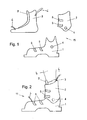
- FIG. 1 shows a well-known ski boot 11, comprising a lower shell 1, a cuff 2, an inner shoe 3 with a so-called tongue 3 'and a hinge 4, which connects the cuff 2 articulated to the lower shell 1; buckles 5 serve to close the ski boot.
- the inner shoe 3 is configured as a foamable inner shoe, that is designed as a double-walled stocking.
- the outer shell consisting of lower shell 1 and cuff 2, assembled via the joint 4; optionally, the outer shell is already provided in the factory in this state.
- the outer shell d. H. in particular the lower shell 1 or the cuff 2, partially or completely formed from a thermoplastically deformable material.
- the size of the outer shell and the innerboot is selected according to the shoe size of a user.
- the assembled outer shell is heated above the softening point of the thermoplastic material, for example in an oven or, for example, by a hot air blower.
- a hot air blower By means of a hot air blower, in particular only points of the outer shell can be heated, while the entire outer shell can be heated and thus converted into the thermoplastically deformable state when heated in an oven.
- the thermoplastic material of the outer shell is heated to temperatures above the softening point; preferred temperatures depend on the type of plastic and are usually in a range of about 70 - 120 ° C.
- the foot 7 of a user is inserted into the double-walled stocking for the innerboot 3 and inserted together with the innerboot 3 in the heated outer shell.
- the resulting state is in FIG. 2 shown. It should be ensured that the supply and discharge lines 6 are led out for the curable foam at appropriate locations from the outer shell, for example, at the rear of the boot or on a usually toe-side sealing point.
- the buckles 5 are then closed in the optimum for the user closure state of the ski boot 11.
- the in Fig. 2 shown boot 11 with user's foot 7 is in a state in which the thermoplastic material of the outer shell is still deformable, ie still has a temperature which is above the softening point for the thermoplastic material, in a device 100 according to the invention introduced.
- a device 100 according to the invention is in FIG. 3 shown.
- the device 100 according to the invention comprises two receiving openings 9 for introducing a pair of shoes, for example ski boots 11 Fig. 3
- Right receiving opening shown is only schematically shown, but functionally identical executed with the receiving opening 9 shown on the left and the underlying flexible element 10 absolutely identical.
- the device 100 according to the invention now comprises a flexible element 10, which adjoins the receiving opening 9 and extends down to the bottom of the device 100.
- the flexible element 10 may be configured, for example, as a PVC film.
- the thickness of the film should be so dimensioned that still a good flexibility of the flexible element 10 is ensured and on the other hand, overpressures of, for example, up to 1 bar, preferably up to 2 bar can be applied to the flexible element without this breaks .
- the flexible element 10 may consist of two flush-bonded or welded PVC films, so that there are two folds 10 'at the respective ends.
- the flexible element 10 is fixed to the bottom 17, for example by screws that connect the flexible element on the bottom side with the bottom of the compartment 8.
- the compartment 8 is pressure-tight with respect to the flexible element 10 is formed.
- the flexible element 10 is at the top in Area of the receiving opening 9 pressure-tight connected to the top of the compartment 8.
- the base-side fixing may further comprise a stand 18 for the imported shoe, so that a secure state is ensured during the implementation of the method according to the invention.
- the device 100 comprises a supply 13 for a pressure-exerting fluid, for example compressed air, which can be provided from a compressor.
- the feeder may have an overpressure or check valve 13 '.
- a drain 15 for the pressure exerting fluid, such as air is provided, for example in the form of a pressure relief valve 15 ', with which a predetermined pressure can be adjusted, for. B. about 0.4 bar.
- an inlet 14 for a cooling fluid, such as water, is provided, which is mounted in the lower part of the device 100 according to the invention.
- a drain 16 for the cooling fluid is provided, which is mounted in the lower part of the device 100 according to the invention.
- a drain 16 for the cooling fluid is provided. Both inlet 14 and outlet 16 may also be equipped with a check valve.
- the ski boot together with the user's foot is introduced via the receiving opening 9 into the interior of the flexible pressure element 10 until the ski boot comes to a standstill on the stand 18. Subsequently, the double-walled stocking of the liner 3 is foamed via the leads 6 with a curable foam.
- compressed air is introduced via the inlet 13 into the pressure-resistant compartment 8 and supplied to the outer space 12 'of the flexible pressure element 10, so that an overpressure builds up in the outer space 11 with respect to the inner space 12 " can be set to a predefined value via the overpressure valve 15 ', so that air is discharged via the pressure valve 15' to the environment if the predefined value exceeds the predetermined value Pressed against the ski boot 11 located in the interior 12 ", whereby the overpressure is transmitted to the outer shell, which is still in the thermoplastically deformable state.
- the outer shell is pressed onto the inner shoe and further on the foot 7 of the user, whereby both the inner shoe and the outer shell to the exact foot shape of the user be adjusted.
- the pressure is maintained until the foam is completely cured. As soon as the pressure has adjusted to the predefined value, ie is completely formed, it is possible to start introducing water into the pressure-resistant compartment 8 via the inlet 14, so that the compartment 8 and thus also the exterior space 12 'are filled with water. As a result, heat is transported away by the flexible element 10 into the water flowing around the flexible element. Cool water is preferably used for this purpose (eg at a temperature of 10 ° C.), so that, for example, the thermoplastic outer shell is already cooled during hardening of the foam and this is converted into the hard state. However, it is also possible to wait for a period of time, for. B. until the foam is partially or completely cured until it starts with the supply of water as the cooling medium. After completion of the process, the overpressure is released and water is discharged via the outlet 16. The user may exit the device 100.
- Cool water is preferably used for this purpose (eg at a temperature of 10 ° C.), so that, for example, the thermoplastic outer shell is
Landscapes
- Health & Medical Sciences (AREA)
- General Health & Medical Sciences (AREA)
- Physical Education & Sports Medicine (AREA)
- Epidemiology (AREA)
- Public Health (AREA)
- Engineering & Computer Science (AREA)
- Mechanical Engineering (AREA)
- Footwear And Its Accessory, Manufacturing Method And Apparatuses (AREA)
Priority Applications (2)
| Application Number | Priority Date | Filing Date | Title |
|---|---|---|---|
| SI201330448A SI2777413T1 (sl) | 2013-03-12 | 2013-03-12 | Postopek za izdelavo čevlja, čevelj in naprava za izvedbo postopka |
| EP13158694.3A EP2777413B1 (fr) | 2013-03-12 | 2013-03-12 | Procédé de fabrication d'une chaussure, chaussure et dispositif d'exécution du procédé |
Applications Claiming Priority (1)
| Application Number | Priority Date | Filing Date | Title |
|---|---|---|---|
| EP13158694.3A EP2777413B1 (fr) | 2013-03-12 | 2013-03-12 | Procédé de fabrication d'une chaussure, chaussure et dispositif d'exécution du procédé |
Publications (2)
| Publication Number | Publication Date |
|---|---|
| EP2777413A1 true EP2777413A1 (fr) | 2014-09-17 |
| EP2777413B1 EP2777413B1 (fr) | 2016-11-02 |
Family
ID=47915439
Family Applications (1)
| Application Number | Title | Priority Date | Filing Date |
|---|---|---|---|
| EP13158694.3A Active EP2777413B1 (fr) | 2013-03-12 | 2013-03-12 | Procédé de fabrication d'une chaussure, chaussure et dispositif d'exécution du procédé |
Country Status (2)
| Country | Link |
|---|---|
| EP (1) | EP2777413B1 (fr) |
| SI (1) | SI2777413T1 (fr) |
Citations (7)
| Publication number | Priority date | Publication date | Assignee | Title |
|---|---|---|---|---|
| FR2111147A5 (fr) * | 1970-10-09 | 1972-06-02 | Tessaro Vanio | |
| DE2320407A1 (de) * | 1973-02-12 | 1974-08-15 | Alfred Palau | Verfahren zur herstellung eines innenschuhs fuer skischuhe |
| WO1987001566A1 (fr) | 1985-09-17 | 1987-03-26 | Skischuhfabrik Dynafit Gesellschaft M.B.H. | Procede de fabrication d'un element interieur de chaussure de ski |
| DE3714063A1 (de) | 1986-04-29 | 1987-12-17 | Roswitha Lutz | Verfahren zum ausschaeumen von skistiefeln |
| EP0842619A2 (fr) * | 1996-10-16 | 1998-05-20 | Dolomite S.P.A. | Procédé de fabrication de chaussures de sport à tige souple, comme une chaussure pour planche de neige de similaire, et chaussures fabriquées par ce procédé |
| WO2009046477A2 (fr) | 2007-10-12 | 2009-04-16 | Fischer Sports Gmbh | Procédé de fabrication de chaussures, embauchoir à cet effet, et chaussure |
| WO2011153567A1 (fr) | 2010-06-07 | 2011-12-15 | Fischer Sports Gmbh | Dispositif et procédé pour adapter une chaussure |
-
2013
- 2013-03-12 SI SI201330448A patent/SI2777413T1/sl unknown
- 2013-03-12 EP EP13158694.3A patent/EP2777413B1/fr active Active
Patent Citations (7)
| Publication number | Priority date | Publication date | Assignee | Title |
|---|---|---|---|---|
| FR2111147A5 (fr) * | 1970-10-09 | 1972-06-02 | Tessaro Vanio | |
| DE2320407A1 (de) * | 1973-02-12 | 1974-08-15 | Alfred Palau | Verfahren zur herstellung eines innenschuhs fuer skischuhe |
| WO1987001566A1 (fr) | 1985-09-17 | 1987-03-26 | Skischuhfabrik Dynafit Gesellschaft M.B.H. | Procede de fabrication d'un element interieur de chaussure de ski |
| DE3714063A1 (de) | 1986-04-29 | 1987-12-17 | Roswitha Lutz | Verfahren zum ausschaeumen von skistiefeln |
| EP0842619A2 (fr) * | 1996-10-16 | 1998-05-20 | Dolomite S.P.A. | Procédé de fabrication de chaussures de sport à tige souple, comme une chaussure pour planche de neige de similaire, et chaussures fabriquées par ce procédé |
| WO2009046477A2 (fr) | 2007-10-12 | 2009-04-16 | Fischer Sports Gmbh | Procédé de fabrication de chaussures, embauchoir à cet effet, et chaussure |
| WO2011153567A1 (fr) | 2010-06-07 | 2011-12-15 | Fischer Sports Gmbh | Dispositif et procédé pour adapter une chaussure |
Also Published As
| Publication number | Publication date |
|---|---|
| EP2777413B1 (fr) | 2016-11-02 |
| SI2777413T1 (sl) | 2017-04-26 |
Similar Documents
| Publication | Publication Date | Title |
|---|---|---|
| EP2575525B1 (fr) | Appareil et procédé pour ajuster une chaussure | |
| DE3802035C2 (fr) | ||
| DE69620477T2 (de) | Schuhanpassungssystem | |
| AT505989B1 (de) | Verfahren zur herstellung eines an den fuss eines benützers angepassten schuhs | |
| DE69613559T2 (de) | Vorrichtung und verfahren zum wärmen einer fütterung für schuhwerk | |
| DE2122907A1 (de) | Fußbekleidung | |
| DE2244691B2 (de) | Skistiefel und verfahren zu seiner herstellung | |
| AT512305B1 (de) | Vorrichtung und Verfahren zur Herstellung einer an einen Fuß bzw. ein Bein eines Benutzers angepassten Schale eines Schischuhs | |
| DE102011011185A1 (de) | Verfahren zur Herstellung von Skischuhen | |
| DE102010015145B4 (de) | Thermoplastisch verformbare Schuheinlegesohle | |
| EP2777413B1 (fr) | Procédé de fabrication d'une chaussure, chaussure et dispositif d'exécution du procédé | |
| EP2636327B1 (fr) | Plastique pour semelle de chaussure | |
| EP2589311A1 (fr) | Procédé et dispositif de fabrication et d'adaptation de semelles orthopédiques adaptées de manière individuelle | |
| AT518893B1 (de) | Verfahren und Vorrichtung zum Anpassen eines Kleidungsstückes an einen Körperteil | |
| DE60300258T2 (de) | Komfortartikel für einen Sportschuh | |
| DE102013007450A1 (de) | Einlegesohle, Vorrichtung und Verfahren zur Herstellung einer Einlegesohle | |
| DE3805591C2 (de) | Schuhwerk, insbesondere Wander- oder Sportschuh | |
| DE19706015C2 (de) | Verfahren und Vorrichtung zur Herstellung von Fußbettungen | |
| DE2716998A1 (de) | Verfahren zur herstellung eines stiefels mit einer schale, die an die gestalt des fusses des traegers anpassbar ist | |
| DE102010018827B4 (de) | Verfahren und Vorrichtung zum Verbinden einer Sohle mit Fußbett und Schuhschaft | |
| AT523284B1 (de) | Sportschuh und Verfahren zum Anpassen eines solchen Sportschuhs an die Fußform eines Benutzers | |
| EP2710912A1 (fr) | Procédé de fabrication d'une première combinée | |
| EP1952710A1 (fr) | Chaussure à largeur variable et son procédé de fabrication | |
| DE102018222412B4 (de) | Schuheinlegesohle mit Belüftungsfunktion | |
| AT372258B (de) | Zwischenlage zur anpassung einer nicht dehnbaren huelle an einen teil des menschlichen koerpers |
Legal Events
| Date | Code | Title | Description |
|---|---|---|---|
| PUAI | Public reference made under article 153(3) epc to a published international application that has entered the european phase |
Free format text: ORIGINAL CODE: 0009012 |
|
| 17P | Request for examination filed |
Effective date: 20130312 |
|
| AK | Designated contracting states |
Kind code of ref document: A1 Designated state(s): AL AT BE BG CH CY CZ DE DK EE ES FI FR GB GR HR HU IE IS IT LI LT LU LV MC MK MT NL NO PL PT RO RS SE SI SK SM TR |
|
| AX | Request for extension of the european patent |
Extension state: BA ME |
|
| R17P | Request for examination filed (corrected) |
Effective date: 20141017 |
|
| RBV | Designated contracting states (corrected) |
Designated state(s): AL AT BE BG CH CY CZ DE DK EE ES FI FR GB GR HR HU IE IS IT LI LT LU LV MC MK MT NL NO PL PT RO RS SE SI SK SM TR |
|
| RIC1 | Information provided on ipc code assigned before grant |
Ipc: A43B 7/28 20060101ALI20150311BHEP Ipc: B29D 35/00 20100101ALI20150311BHEP Ipc: A43B 5/04 20060101AFI20150311BHEP Ipc: A43B 5/16 20060101ALI20150311BHEP |
|
| GRAP | Despatch of communication of intention to grant a patent |
Free format text: ORIGINAL CODE: EPIDOSNIGR1 |
|
| INTG | Intention to grant announced |
Effective date: 20160226 |
|
| GRAJ | Information related to disapproval of communication of intention to grant by the applicant or resumption of examination proceedings by the epo deleted |
Free format text: ORIGINAL CODE: EPIDOSDIGR1 |
|
| INTC | Intention to grant announced (deleted) | ||
| GRAR | Information related to intention to grant a patent recorded |
Free format text: ORIGINAL CODE: EPIDOSNIGR71 |
|
| GRAS | Grant fee paid |
Free format text: ORIGINAL CODE: EPIDOSNIGR3 |
|
| GRAA | (expected) grant |
Free format text: ORIGINAL CODE: 0009210 |
|
| INTG | Intention to grant announced |
Effective date: 20160922 |
|
| AK | Designated contracting states |
Kind code of ref document: B1 Designated state(s): AL AT BE BG CH CY CZ DE DK EE ES FI FR GB GR HR HU IE IS IT LI LT LU LV MC MK MT NL NO PL PT RO RS SE SI SK SM TR |
|
| REG | Reference to a national code |
Ref country code: GB Ref legal event code: FG4D Free format text: NOT ENGLISH |
|
| REG | Reference to a national code |
Ref country code: AT Ref legal event code: REF Ref document number: 840891 Country of ref document: AT Kind code of ref document: T Effective date: 20161115 Ref country code: CH Ref legal event code: EP |
|
| REG | Reference to a national code |
Ref country code: IE Ref legal event code: FG4D Free format text: LANGUAGE OF EP DOCUMENT: GERMAN |
|
| REG | Reference to a national code |
Ref country code: DE Ref legal event code: R096 Ref document number: 502013005147 Country of ref document: DE |
|
| REG | Reference to a national code |
Ref country code: NL Ref legal event code: FP |
|
| PG25 | Lapsed in a contracting state [announced via postgrant information from national office to epo] |
Ref country code: LV Free format text: LAPSE BECAUSE OF FAILURE TO SUBMIT A TRANSLATION OF THE DESCRIPTION OR TO PAY THE FEE WITHIN THE PRESCRIBED TIME-LIMIT Effective date: 20161102 |
|
| REG | Reference to a national code |
Ref country code: LT Ref legal event code: MG4D |
|
| REG | Reference to a national code |
Ref country code: FR Ref legal event code: PLFP Year of fee payment: 5 |
|
| PG25 | Lapsed in a contracting state [announced via postgrant information from national office to epo] |
Ref country code: GR Free format text: LAPSE BECAUSE OF FAILURE TO SUBMIT A TRANSLATION OF THE DESCRIPTION OR TO PAY THE FEE WITHIN THE PRESCRIBED TIME-LIMIT Effective date: 20170203 Ref country code: NO Free format text: LAPSE BECAUSE OF FAILURE TO SUBMIT A TRANSLATION OF THE DESCRIPTION OR TO PAY THE FEE WITHIN THE PRESCRIBED TIME-LIMIT Effective date: 20170202 Ref country code: SE Free format text: LAPSE BECAUSE OF FAILURE TO SUBMIT A TRANSLATION OF THE DESCRIPTION OR TO PAY THE FEE WITHIN THE PRESCRIBED TIME-LIMIT Effective date: 20161102 Ref country code: LT Free format text: LAPSE BECAUSE OF FAILURE TO SUBMIT A TRANSLATION OF THE DESCRIPTION OR TO PAY THE FEE WITHIN THE PRESCRIBED TIME-LIMIT Effective date: 20161102 |
|
| PG25 | Lapsed in a contracting state [announced via postgrant information from national office to epo] |
Ref country code: IS Free format text: LAPSE BECAUSE OF FAILURE TO SUBMIT A TRANSLATION OF THE DESCRIPTION OR TO PAY THE FEE WITHIN THE PRESCRIBED TIME-LIMIT Effective date: 20170302 Ref country code: HR Free format text: LAPSE BECAUSE OF FAILURE TO SUBMIT A TRANSLATION OF THE DESCRIPTION OR TO PAY THE FEE WITHIN THE PRESCRIBED TIME-LIMIT Effective date: 20161102 Ref country code: PL Free format text: LAPSE BECAUSE OF FAILURE TO SUBMIT A TRANSLATION OF THE DESCRIPTION OR TO PAY THE FEE WITHIN THE PRESCRIBED TIME-LIMIT Effective date: 20161102 Ref country code: RS Free format text: LAPSE BECAUSE OF FAILURE TO SUBMIT A TRANSLATION OF THE DESCRIPTION OR TO PAY THE FEE WITHIN THE PRESCRIBED TIME-LIMIT Effective date: 20161102 Ref country code: PT Free format text: LAPSE BECAUSE OF FAILURE TO SUBMIT A TRANSLATION OF THE DESCRIPTION OR TO PAY THE FEE WITHIN THE PRESCRIBED TIME-LIMIT Effective date: 20170302 Ref country code: ES Free format text: LAPSE BECAUSE OF FAILURE TO SUBMIT A TRANSLATION OF THE DESCRIPTION OR TO PAY THE FEE WITHIN THE PRESCRIBED TIME-LIMIT Effective date: 20161102 Ref country code: FI Free format text: LAPSE BECAUSE OF FAILURE TO SUBMIT A TRANSLATION OF THE DESCRIPTION OR TO PAY THE FEE WITHIN THE PRESCRIBED TIME-LIMIT Effective date: 20161102 |
|
| PG25 | Lapsed in a contracting state [announced via postgrant information from national office to epo] |
Ref country code: EE Free format text: LAPSE BECAUSE OF FAILURE TO SUBMIT A TRANSLATION OF THE DESCRIPTION OR TO PAY THE FEE WITHIN THE PRESCRIBED TIME-LIMIT Effective date: 20161102 Ref country code: SK Free format text: LAPSE BECAUSE OF FAILURE TO SUBMIT A TRANSLATION OF THE DESCRIPTION OR TO PAY THE FEE WITHIN THE PRESCRIBED TIME-LIMIT Effective date: 20161102 Ref country code: RO Free format text: LAPSE BECAUSE OF FAILURE TO SUBMIT A TRANSLATION OF THE DESCRIPTION OR TO PAY THE FEE WITHIN THE PRESCRIBED TIME-LIMIT Effective date: 20161102 Ref country code: DK Free format text: LAPSE BECAUSE OF FAILURE TO SUBMIT A TRANSLATION OF THE DESCRIPTION OR TO PAY THE FEE WITHIN THE PRESCRIBED TIME-LIMIT Effective date: 20161102 |
|
| REG | Reference to a national code |
Ref country code: DE Ref legal event code: R097 Ref document number: 502013005147 Country of ref document: DE |
|
| PG25 | Lapsed in a contracting state [announced via postgrant information from national office to epo] |
Ref country code: SM Free format text: LAPSE BECAUSE OF FAILURE TO SUBMIT A TRANSLATION OF THE DESCRIPTION OR TO PAY THE FEE WITHIN THE PRESCRIBED TIME-LIMIT Effective date: 20161102 Ref country code: BG Free format text: LAPSE BECAUSE OF FAILURE TO SUBMIT A TRANSLATION OF THE DESCRIPTION OR TO PAY THE FEE WITHIN THE PRESCRIBED TIME-LIMIT Effective date: 20170202 |
|
| PLBE | No opposition filed within time limit |
Free format text: ORIGINAL CODE: 0009261 |
|
| STAA | Information on the status of an ep patent application or granted ep patent |
Free format text: STATUS: NO OPPOSITION FILED WITHIN TIME LIMIT |
|
| 26N | No opposition filed |
Effective date: 20170803 |
|
| PG25 | Lapsed in a contracting state [announced via postgrant information from national office to epo] |
Ref country code: MC Free format text: LAPSE BECAUSE OF FAILURE TO SUBMIT A TRANSLATION OF THE DESCRIPTION OR TO PAY THE FEE WITHIN THE PRESCRIBED TIME-LIMIT Effective date: 20161102 |
|
| REG | Reference to a national code |
Ref country code: IE Ref legal event code: MM4A |
|
| PG25 | Lapsed in a contracting state [announced via postgrant information from national office to epo] |
Ref country code: LU Free format text: LAPSE BECAUSE OF NON-PAYMENT OF DUE FEES Effective date: 20170312 |
|
| PG25 | Lapsed in a contracting state [announced via postgrant information from national office to epo] |
Ref country code: IE Free format text: LAPSE BECAUSE OF NON-PAYMENT OF DUE FEES Effective date: 20170312 |
|
| REG | Reference to a national code |
Ref country code: BE Ref legal event code: MM Effective date: 20170331 |
|
| REG | Reference to a national code |
Ref country code: FR Ref legal event code: PLFP Year of fee payment: 6 |
|
| PG25 | Lapsed in a contracting state [announced via postgrant information from national office to epo] |
Ref country code: BE Free format text: LAPSE BECAUSE OF NON-PAYMENT OF DUE FEES Effective date: 20170331 |
|
| PG25 | Lapsed in a contracting state [announced via postgrant information from national office to epo] |
Ref country code: MT Free format text: LAPSE BECAUSE OF FAILURE TO SUBMIT A TRANSLATION OF THE DESCRIPTION OR TO PAY THE FEE WITHIN THE PRESCRIBED TIME-LIMIT Effective date: 20161102 |
|
| PG25 | Lapsed in a contracting state [announced via postgrant information from national office to epo] |
Ref country code: HU Free format text: LAPSE BECAUSE OF FAILURE TO SUBMIT A TRANSLATION OF THE DESCRIPTION OR TO PAY THE FEE WITHIN THE PRESCRIBED TIME-LIMIT; INVALID AB INITIO Effective date: 20130312 |
|
| PG25 | Lapsed in a contracting state [announced via postgrant information from national office to epo] |
Ref country code: CY Free format text: LAPSE BECAUSE OF NON-PAYMENT OF DUE FEES Effective date: 20161102 |
|
| PG25 | Lapsed in a contracting state [announced via postgrant information from national office to epo] |
Ref country code: MK Free format text: LAPSE BECAUSE OF FAILURE TO SUBMIT A TRANSLATION OF THE DESCRIPTION OR TO PAY THE FEE WITHIN THE PRESCRIBED TIME-LIMIT Effective date: 20161102 |
|
| PG25 | Lapsed in a contracting state [announced via postgrant information from national office to epo] |
Ref country code: TR Free format text: LAPSE BECAUSE OF FAILURE TO SUBMIT A TRANSLATION OF THE DESCRIPTION OR TO PAY THE FEE WITHIN THE PRESCRIBED TIME-LIMIT Effective date: 20161102 |
|
| PG25 | Lapsed in a contracting state [announced via postgrant information from national office to epo] |
Ref country code: AL Free format text: LAPSE BECAUSE OF FAILURE TO SUBMIT A TRANSLATION OF THE DESCRIPTION OR TO PAY THE FEE WITHIN THE PRESCRIBED TIME-LIMIT Effective date: 20161102 |
|
| PGFP | Annual fee paid to national office [announced via postgrant information from national office to epo] |
Ref country code: SI Payment date: 20250227 Year of fee payment: 13 |
|
| PGFP | Annual fee paid to national office [announced via postgrant information from national office to epo] |
Ref country code: CH Payment date: 20250401 Year of fee payment: 13 |
|
| REG | Reference to a national code |
Ref country code: CH Ref legal event code: U11 Free format text: ST27 STATUS EVENT CODE: U-0-0-U10-U11 (AS PROVIDED BY THE NATIONAL OFFICE) Effective date: 20260401 |
|
| PGFP | Annual fee paid to national office [announced via postgrant information from national office to epo] |
Ref country code: GB Payment date: 20260324 Year of fee payment: 14 |
|
| PGFP | Annual fee paid to national office [announced via postgrant information from national office to epo] |
Ref country code: DE Payment date: 20260318 Year of fee payment: 14 |
|
| PGFP | Annual fee paid to national office [announced via postgrant information from national office to epo] |
Ref country code: AT Payment date: 20260320 Year of fee payment: 14 |
|
| PGFP | Annual fee paid to national office [announced via postgrant information from national office to epo] |
Ref country code: IT Payment date: 20260324 Year of fee payment: 14 |
|
| PGFP | Annual fee paid to national office [announced via postgrant information from national office to epo] |
Ref country code: NL Payment date: 20260319 Year of fee payment: 14 |
|
| PGFP | Annual fee paid to national office [announced via postgrant information from national office to epo] |
Ref country code: FR Payment date: 20260320 Year of fee payment: 14 |
|
| PGFP | Annual fee paid to national office [announced via postgrant information from national office to epo] |
Ref country code: CZ Payment date: 20260306 Year of fee payment: 14 |