EP2782017A1 - Arithmetische Verarbeitungsvorrichtung und Steuerverfahren der arithmetischen Verarbeitungsvorrichtung - Google Patents
Arithmetische Verarbeitungsvorrichtung und Steuerverfahren der arithmetischen Verarbeitungsvorrichtung Download PDFInfo
- Publication number
- EP2782017A1 EP2782017A1 EP20130198269 EP13198269A EP2782017A1 EP 2782017 A1 EP2782017 A1 EP 2782017A1 EP 20130198269 EP20130198269 EP 20130198269 EP 13198269 A EP13198269 A EP 13198269A EP 2782017 A1 EP2782017 A1 EP 2782017A1
- Authority
- EP
- European Patent Office
- Prior art keywords
- buffer
- address
- write
- data
- arithmetic processing
- Prior art date
- Legal status (The legal status is an assumption and is not a legal conclusion. Google has not performed a legal analysis and makes no representation as to the accuracy of the status listed.)
- Pending
Links
Images


Classifications
-
- G—PHYSICS
- G06—COMPUTING OR CALCULATING; COUNTING
- G06F—ELECTRIC DIGITAL DATA PROCESSING
- G06F5/00—Methods or arrangements for data conversion without changing the order or content of the data handled
- G06F5/06—Methods or arrangements for data conversion without changing the order or content of the data handled for changing the speed of data flow, i.e. speed regularising or timing, e.g. delay lines, FIFO buffers; over- or underrun control therefor
- G06F5/10—Methods or arrangements for data conversion without changing the order or content of the data handled for changing the speed of data flow, i.e. speed regularising or timing, e.g. delay lines, FIFO buffers; over- or underrun control therefor having a sequence of storage locations each being individually accessible for both enqueue and dequeue operations, e.g. using random access memory
- G06F5/12—Means for monitoring the fill level; Means for resolving contention, i.e. conflicts between simultaneous enqueue and dequeue operations
- G06F5/14—Means for monitoring the fill level; Means for resolving contention, i.e. conflicts between simultaneous enqueue and dequeue operations for overflow or underflow handling, e.g. full or empty flags
-
- G—PHYSICS
- G06—COMPUTING OR CALCULATING; COUNTING
- G06F—ELECTRIC DIGITAL DATA PROCESSING
- G06F12/00—Accessing, addressing or allocating within memory systems or architectures
- G06F12/02—Addressing or allocation; Relocation
- G06F12/08—Addressing or allocation; Relocation in hierarchically structured memory systems, e.g. virtual memory systems
- G06F12/0802—Addressing of a memory level in which the access to the desired data or data block requires associative addressing means, e.g. caches
- G06F12/0804—Addressing of a memory level in which the access to the desired data or data block requires associative addressing means, e.g. caches with main memory updating
-
- G—PHYSICS
- G06—COMPUTING OR CALCULATING; COUNTING
- G06F—ELECTRIC DIGITAL DATA PROCESSING
- G06F12/00—Accessing, addressing or allocating within memory systems or architectures
- G06F12/02—Addressing or allocation; Relocation
- G06F12/08—Addressing or allocation; Relocation in hierarchically structured memory systems, e.g. virtual memory systems
- G06F12/0802—Addressing of a memory level in which the access to the desired data or data block requires associative addressing means, e.g. caches
- G06F12/0806—Multiuser, multiprocessor or multiprocessing cache systems
- G06F12/0815—Cache consistency protocols
- G06F12/0831—Cache consistency protocols using a bus scheme, e.g. with bus monitoring or watching means
-
- G—PHYSICS
- G06—COMPUTING OR CALCULATING; COUNTING
- G06F—ELECTRIC DIGITAL DATA PROCESSING
- G06F12/00—Accessing, addressing or allocating within memory systems or architectures
- G06F12/02—Addressing or allocation; Relocation
- G06F12/08—Addressing or allocation; Relocation in hierarchically structured memory systems, e.g. virtual memory systems
- G06F12/12—Replacement control
- G06F12/121—Replacement control using replacement algorithms
- G06F12/123—Replacement control using replacement algorithms with age lists, e.g. queue, most recently used [MRU] list or least recently used [LRU] list
Definitions
- the embodiments discussed herein are directed to an arithmetic processing apparatus and a control method of an arithmetic processing apparatus.
- a multicore system which executes processing by using a plurality of CPUs (Central Processing Units) adopts a structure in which the CPUs each have a cache memory and all the CPUs share a large-capacity, low-speed external memory (main memory or the like). It is also known that, in each of the CPUs, a write buffer is provided between the cache memory and the external memory in order to absorb the time for writing data from the cache memory to the external memory.
- CPUs Central Processing Units
- the cache memories each have a function called a snoop to keep coherency of cache data (cache coherency) among the CPUs.
- the CPU receiving the snoop waits an access request from a CPU core to the cache memory, which leads to performance deterioration.
- an arithmetic processing apparatus includes a plurality of arithmetic processing parts which access one external memory via a bus, the arithmetic processing parts each including a cache memory, a processing part, a write buffer, and a control part.
- the write buffer is provided between the cache memory and the external memory and has a plurality of stages of buffers each holding a set of data to be written to the external memory and an address of a write destination.
- the control part compares an address of a write destination and the addresses stored in the buffers, and when any of the buffers has an address agreeing with the address of the write destination, overwrites data to the buffer and logically moves the buffer to a last stage.
- FIG. 1 is a diagram illustrating a configuration example of a multicore system as an arithmetic processing apparatus in a present embodiment.
- the multicore system in this embodiment includes a plurality of CPUs 10-1, 10-2, 10-3, ... and a memory controller 20.
- the CPUs 10-1, 10-2, 10-3, ... and the memory controller 20 are connected to a bus BUS.
- the memory controller 20 is connected to a main memory 30 being an external memory.
- the main memory 30 is shared by all the CPUs 10-1, 10-2, 10-3, ... .
- the CPUs 10-1, 10-2, 10-3 access the main memory 30 via the bus BUS and the memory controller 20.
- the CPUs 10-1, 10-2, 10-3, ... each include a CPU core 11, a cache memory 12, a cache controller 13, a write buffer 14, and a write buffer controller 15.
- FIG. 1 mainly illustrates the configuration involved in write of data.
- the CPU core 11 sequentially reads commands from the main memory 30 and so on and executes arithmetic processing according to the read commands.
- the cache memory 12 holds data used for the arithmetic processing in the CPU core 11.
- the cache memory 12 includes a cache tag memory 16 in which address information of cache data and status information indicating a status and so on of the cache data are stored, and a cache data memory 17 in which the cache data are stored.
- the cache tag memory 16 has an area AD1 where to store the address information of the cache data and an area ST1 where to store the status information of the cache data.
- the cache data memory 17 has an area DT1 where to store the cache data.
- the cache controller 13 executes control regarding the cache memory 12. For example, the cache controller 13 writes and reads information and data to/from the cache memory 12, and determines whether or not requested data is stored in the cache memory 12.
- the write buffer 14 is a buffer which holds data to be written to the main memory 30 from each of the CPUs 10-1, 10-2, 10-3, ... and addresses of write destinations.
- the write buffer 14 has a plurality of stages of buffers, each stage corresponding to one entry.
- the buffers on the respective stages in the write buffer 14 each have an area AD2 where to store the address of the write destination, an area ST2 where to store status information regarding the held data, and an area DT2 where to store the write data.
- the write buffer controller 15 executes control regarding the write buffer 14.
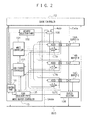
- FIG. 2 is a diagram illustrating a configuration example of the write buffer 14 and the write buffer controller 15 illustrated in FIG. 1 .
- FIG. 2 illustrates an example where the write buffer 14 is a three-stage buffer of a buffer A 14A, a buffer B 14B, and a buffer C 14C, but it is noted that the embodiment is not limited to this, and the number of the buffer stages in the write buffer 14 is an arbitrary plural number.
- the buffers 14A, 14B, 14C each have an area ADD, an empty bit E, a snoop bit S, and an area DAT.
- the area ADD is an area where to store the address of the write destination regarding the data to be written to the main memory 30, and the area DAT is an area where to store the data to be written to the main memory 30.
- the empty bit E is a bit indicating whether or not the corresponding buffer is in an empty state where no write data is stored, in other words, indicating whether or not data is writable to the buffer.
- a value of the empty bit E is "1" when the buffer is in the empty state (writable), and is "0" when the buffer is not in the empty state (not writable).
- the snoop bit S is a bit indicating whether or not the data written in the buffer is data coherently read from another CPU.
- a value of the snoop bit S is set to "0" at the time when data is written to the corresponding buffer, and is set to "1" when an address of a coherent read request being a snoop request, which is received from the other CPU, agrees with the address stored in the area ADD.
- the write buffer controller 15 includes a buffer control part 101, an address selection part 102, a LRU (Least Recently Used) status controller 103, a write controller 104, and a read selection part 105.
- the buffer control part 101 controls the address selection part 102, the LRU status controller 103, the write controller 104, and the read selection part 105 that the write buffer controller 15 includes.
- the address selection part 102 controls a selector 106 according to an output of the buffer control part 101.
- the address selection part 102 controls the selector 106 so that the selector 106 selects an address Addr in response to a write request from the own CPU to the main memory 30 while selects an address (snoop address) SAddr in response to a snoop request from another CPU, and outputs the selected address.
- the address Addr is an address that is input via the cache controller 13, at the time of the write request from the own CPU to the main memory 30.
- the address (snoop address) SAddr is an address that is input via the bus BUS, at the time of the snoop request from the other CPU.
- the LRU status controller 103 controls a LRU status regarding the buffer A 14A, the buffer B 14B, and the buffer C 14C.
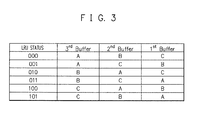
- the LRU status controller 103 manages and controls the LRU status (update status) regarding the buffer A 14A, the buffer B 14B, and the buffer C 14C, by using 3-bit information as illustrated in FIG. 3 , for instance.
- a 3rd buffer represents a buffer updated last (newest buffer)
- a 2nd buffer represents a buffer updated second
- a 1st buffer represents a buffer updated first.
- the 3rd buffer, the 2nd buffer, and the 1st buffer mean the same as above.
- the buffer C 14C is a buffer updated first
- the buffer B 14B is a buffer updated second
- the buffer A 14A is a buffer updated last (newest buffer).
- the buffer A 14A is a buffer updated first
- the buffer B 14B is a buffer updated second
- the buffer C 14C is a buffer updated last (newest buffer).
- the write controller 104 controls the write to the buffer A 14A, the buffer B 14B, and the buffer C 14C according to an output of the buffer control part 101 and an output of the LRU status controller 103.
- the read selection part 105 controls a buffer selector 108 according to an output of the buffer control part 101 and an output of the LRU status controller 103, and outputs, to the bus BUS, the addresses and the data written in the buffer A 14A, the buffer B 14B, and the buffer C 14C.
- Comparators 107A, 107B, 107C each determine whether or not the address stored in the area ADD agrees with the address output from the selector 106 when the value of the empty bit E of the corresponding buffer is "0", and output the determination result to the LRU status controller 103.
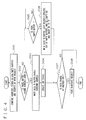
- FIG. 4 is a flowchart representing an example of the write processing to the write buffer 14 in this embodiment.
- a write request control signal, the address Addr, and data Data are input via the cache controller 13.
- the buffer control part 101 of the write buffer controller 15 Upon receiving the write request control signal, the buffer control part 101 of the write buffer controller 15 notifies to the functional parts 102, 103, 104 that this request is a write request to the write buffer 14 from the cache memory 12.
- the address selection part 102 controls the selector 106 so that the selector 106 selects and outputs the address Addr input via the cache controller 13. Then, the comparators 107A, 107B, 107C each compare the address stored in the buffer whose empty bit E does not have a value "1" (which is not in the empty state) and the address Addr of the write request, and output the result to the LRU status controller 103 (S101).
- the LRU status controller 103 determines whether or not any of the buffer A 14A, the buffer B 14B, and the buffer C 14C has an agreeing address (S102). When the determination results in that there is a buffer having the agreeing address (YES at S102), the LRU status controller 103 instructs the write controller 104 to write the data to this buffer. The write controller 104 writes (overwrites) the data Data to the buffer having the agreeing address (S103).
- the LRU status controller 103 updates the LRU status so that the buffer which has the agreeing address and to which the data Data is written becomes the buffer on the last stage (newest buffer) (S104). That is, the LRU status controller 103 changes information of the LRU status in the following ways ⁇ a1> to ⁇ a6> so that the buffer which has the agreeing address and to which the data Data is written is logically moved to the last stage.
- the LRU status controller 103 logically moves the buffer to which the data from the cache memory 12 is written, to the last stage.
- an address of data that the CPU accesses when executing the processing often has locality. Therefore, by logically moving the buffer to which the data from the cache memory 12 is written, to the last stage, it is possible to elongate the time before the write is executed to the main memory 30, regarding data at an address highly possible to be accessed again. This makes it possible to reduce the occurrence of a cache miss in the CPU, which makes it possible to reduce the generation frequency of a coherent read request being the snoop request to improve performance.
- the LRU status controller 103 determines whether or not there is a buffer whose empty bit E has a value "1" (which is in the empty state) (S105). When the determination results in that there is no buffer whose empty bit E has the value "1", that is, when the values of the empty bits E of all the buffers are "0" (NO at S105), the write to the buffer is kept waited.
- the LRU status controller 103 instructs the write controller 104 to write the address and the data to the buffer according to the LRU status.
- the write controller 104 writes the address Addr and the data Data to the designated buffer, that is, the buffer updated least recently, out of the buffers whose empty bits E have the value "1", and sets values of its empty bit E and snoop bit S to "0" (S106). Then, the processing goes to Step S107.
- the buffer control part 101 refers to the status information which is stored in the cache memory 12 together with the data whose write is requested, and determines whether or not this data is shared by another CPU.
- the buffer control part 101 issues an invalidate request requesting the invalidity of the cache data to the other CPU (S108). In the above-described manner, the write processing to the write buffer 14 is ended.
- the buffer control part 101 issues a write request to the memory controller 20 via the bus BUS. Based on an output of the buffer control part 101 and an output of the LRU status controller 103, the address and the data stored in the 1st buffer are read and transferred to the memory controller 20 by the read selection part 105 and the buffer selector 108. Upon receiving the address and the data, the memory controller 20 writes the data to an area at the corresponding address of the main memory 30, and issues a write completion notice when the write is completed.
- the write controller 104 sets the value of the empty bit E of the 1st buffer to "1".
- the write controller 104 outputs, to the cache controller 13, information indicating that the write of the data is completed.
- the cache controller 13 receiving the information changes the status information of the cache memory 12 so that the status information indicates that the data is shared with another CPU.
- the cache memory 12 is accessed not when a request is received regarding data coherently read in response to a request from another CPU, but the cache memory 12 is accessed when the write to the main memory 30 is completed. This alleviates an obstruction to an access to the cache memory 12 from the CPU core 11, which can improve performance.
- the LRU status controller 103 changes the information of the LRU status so as to set the 1st buffer as the 3rd buffer, the 2nd buffer as the 1st buffer, and the 3rd buffer as the 2nd buffer, that is, so as to rotate them. For example, when the LRU status before the change is "000” (CBA), it is changed to "100” (BAC), and when the LRU status before the change is "001" (BCA), it is changed to "010" (CAB). Note that, when the value of the empty bit E of the 1st buffer is "1", the aforesaid write processing to the main memory 30 is not executed.
- FIG. 5 is a flowchart representing an example of the processing relating to the snoop request in this embodiment.
- the CPU issues a coherent read request as the snoop request to the cache memory of another CPU, when data corresponding to an access request does not exist in the cache memory 12 of the own CPU and a cache miss occurs.
- the comparators 107A, 107B, 107C each compare the address stored in the buffer whose empty bit E does not have the value "1" (which is not in the empty state) and an address of the snoop request, and output the comparison result to the LRU status controller 103 (S201).
- the LRU status controller 103 determines whether or not there is a buffer having an agreeing address (S202). When the determination results in that there is a buffer having the agreeing address, the processing goes to Step S203, and otherwise, a response to that effect is returned and the processing is ended, and the coherent read is executed to the cache memory 12 (S205).
- Step S203 based on an output of the buffer control part 101 and an output of the LRU status controller 103, the CPU transmits data in the buffer having the agreeing address to the CPU being a request origin, by the read selection part 105 and the buffer selector 108. Then, the write controller 104 sets the value of the snoop bit S of the buffer having the agreeing address to "1".
- the LRU status controller 103 updates the LRU status so that the buffer having the agreeing address becomes the last stage buffer (newest buffer) (S204). That is, the LRU status controller 103 changes the information of the LRU status in the following ways ⁇ b1> to ⁇ b6> so as to logically move the buffer having the agreeing address to the last stage.
- cache coherency since coherency of cache data (cache coherency) is kept by the data operation in the write buffer 14, it is possible to reduce snoop operations to the cache memory and also to reduce write operations to the main memory, which contributes to performance improvement of the apparatus.
- the update status of the buffers on the respective stages that the write buffer 14 has is managed and controlled by using the LRU algorithm, but this is not restrictive, and the update status of the buffers may be managed and controlled by using another algorithm or the like.
- the disclosed arithmetic processing apparatus is capable of reducing the generation of snoops to the cache memory by keeping coherency of cache data by a data operation in the write buffer, enabling an improvement in performance.
Landscapes
- Engineering & Computer Science (AREA)
- Theoretical Computer Science (AREA)
- Physics & Mathematics (AREA)
- General Engineering & Computer Science (AREA)
- General Physics & Mathematics (AREA)
- Memory System Of A Hierarchy Structure (AREA)
Applications Claiming Priority (1)
| Application Number | Priority Date | Filing Date | Title |
|---|---|---|---|
| JP2013055470A JP2014182488A (ja) | 2013-03-18 | 2013-03-18 | 演算処理装置、及び演算処理装置の制御方法 |
Publications (1)
| Publication Number | Publication Date |
|---|---|
| EP2782017A1 true EP2782017A1 (de) | 2014-09-24 |
Family
ID=49911238
Family Applications (1)
| Application Number | Title | Priority Date | Filing Date |
|---|---|---|---|
| EP20130198269 Pending EP2782017A1 (de) | 2013-03-18 | 2013-12-19 | Arithmetische Verarbeitungsvorrichtung und Steuerverfahren der arithmetischen Verarbeitungsvorrichtung |
Country Status (3)
| Country | Link |
|---|---|
| US (1) | US9262122B2 (de) |
| EP (1) | EP2782017A1 (de) |
| JP (1) | JP2014182488A (de) |
Families Citing this family (2)
| Publication number | Priority date | Publication date | Assignee | Title |
|---|---|---|---|---|
| CN107291629B (zh) * | 2016-04-12 | 2020-12-25 | 华为技术有限公司 | 一种用于访问内存的方法和装置 |
| US10579526B2 (en) * | 2017-02-08 | 2020-03-03 | Arm Limited | Responding to snoop requests |
Citations (4)
| Publication number | Priority date | Publication date | Assignee | Title |
|---|---|---|---|---|
| EP0793178A2 (de) * | 1996-02-27 | 1997-09-03 | Sun Microsystems, Inc. | Rückschreibpuffer und -verfahren in einem Mehrrechnersystem |
| JPH09293060A (ja) | 1996-04-24 | 1997-11-11 | Hitachi Ltd | キャッシュコヒーレンシ制御方法、および、これを用いたマルチプロセッサシステム |
| JPH09311820A (ja) | 1996-03-19 | 1997-12-02 | Hitachi Ltd | マルチプロセッサシステム |
| US5745732A (en) * | 1994-11-15 | 1998-04-28 | Cherukuri; Ravikrishna V. | Computer system including system controller with a write buffer and plural read buffers for decoupled busses |
Family Cites Families (10)
| Publication number | Priority date | Publication date | Assignee | Title |
|---|---|---|---|---|
| JPS61237145A (ja) | 1985-04-15 | 1986-10-22 | Hitachi Ltd | ストアバツフアの制御方式 |
| JPH0744459A (ja) | 1993-07-29 | 1995-02-14 | Matsushita Electric Ind Co Ltd | キャッシュ制御方法およびキャッシュ制御装置 |
| US6038644A (en) | 1996-03-19 | 2000-03-14 | Hitachi, Ltd. | Multiprocessor system with partial broadcast capability of a cache coherent processing request |
| JP3340047B2 (ja) | 1997-03-11 | 2002-10-28 | 株式会社日立製作所 | マルチプロセッサシステムおよび複製タグの制御方法 |
| US6067608A (en) * | 1997-04-15 | 2000-05-23 | Bull Hn Information Systems Inc. | High performance mechanism for managing allocation of virtual memory buffers to virtual processes on a least recently used basis |
| US6321300B1 (en) * | 1999-05-14 | 2001-11-20 | Rise Technology Company | Apparatus and method for dynamically reconfigurable timed flushing of a queue of coalescing write buffers |
| US6401175B1 (en) * | 1999-10-01 | 2002-06-04 | Sun Microsystems, Inc. | Shared write buffer for use by multiple processor units |
| US6851030B2 (en) * | 2002-10-16 | 2005-02-01 | International Business Machines Corporation | System and method for dynamically allocating associative resources |
| US8352685B2 (en) * | 2010-08-20 | 2013-01-08 | Apple Inc. | Combining write buffer with dynamically adjustable flush metrics |
| US8935484B2 (en) * | 2011-03-31 | 2015-01-13 | Hewlett-Packard Development Company, L.P. | Write-absorbing buffer for non-volatile memory |
-
2013
- 2013-03-18 JP JP2013055470A patent/JP2014182488A/ja active Pending
- 2013-12-19 EP EP20130198269 patent/EP2782017A1/de active Pending
-
2014
- 2014-01-09 US US14/150,819 patent/US9262122B2/en not_active Expired - Fee Related
Patent Citations (4)
| Publication number | Priority date | Publication date | Assignee | Title |
|---|---|---|---|---|
| US5745732A (en) * | 1994-11-15 | 1998-04-28 | Cherukuri; Ravikrishna V. | Computer system including system controller with a write buffer and plural read buffers for decoupled busses |
| EP0793178A2 (de) * | 1996-02-27 | 1997-09-03 | Sun Microsystems, Inc. | Rückschreibpuffer und -verfahren in einem Mehrrechnersystem |
| JPH09311820A (ja) | 1996-03-19 | 1997-12-02 | Hitachi Ltd | マルチプロセッサシステム |
| JPH09293060A (ja) | 1996-04-24 | 1997-11-11 | Hitachi Ltd | キャッシュコヒーレンシ制御方法、および、これを用いたマルチプロセッサシステム |
Also Published As
| Publication number | Publication date |
|---|---|
| US20140281059A1 (en) | 2014-09-18 |
| JP2014182488A (ja) | 2014-09-29 |
| US9262122B2 (en) | 2016-02-16 |
Similar Documents
| Publication | Publication Date | Title |
|---|---|---|
| US20110173400A1 (en) | Buffer memory device, memory system, and data transfer method | |
| CN101593161B (zh) | 确保微处理器的快取存储器层级数据一致性的装置与方法 | |
| JP5445581B2 (ja) | コンピュータシステム、制御方法、記録媒体及び制御プログラム | |
| JP2010191638A (ja) | キャッシュ装置 | |
| EP2028595B1 (de) | Hierarchisches Cache-Speichersystem | |
| EP2530598B1 (de) | Datenlieferungsvorrichtung, Cache-Vorrichtung, Datenlieferungsverfahren und Cache-Verfahren | |
| US20120246410A1 (en) | Cache memory and cache system | |
| US20110087841A1 (en) | Processor and control method | |
| US20140297966A1 (en) | Operation processing apparatus, information processing apparatus and method of controlling information processing apparatus | |
| KR101284969B1 (ko) | 정보 처리 장치, 메모리 제어 방법 및 메모리 제어 장치 | |
| US20110167223A1 (en) | Buffer memory device, memory system, and data reading method | |
| US20240345774A1 (en) | Information processing system | |
| US20120260041A1 (en) | Simultaneous eviction and cleaning operations in a cache | |
| EP2782017A1 (de) | Arithmetische Verarbeitungsvorrichtung und Steuerverfahren der arithmetischen Verarbeitungsvorrichtung | |
| US9983994B2 (en) | Arithmetic processing device and method for controlling arithmetic processing device | |
| CN109840220B (zh) | 零颠簸高速缓存队列管理器 | |
| JP2011248389A (ja) | キャッシュメモリ、キャッシュメモリシステム | |
| US6839806B2 (en) | Cache system with a cache tag memory and a cache tag buffer | |
| US7779205B2 (en) | Coherent caching of local memory data | |
| CN110737407A (zh) | 一种支持混合写策略的数据缓冲存储器实现方法 | |
| US20150309934A1 (en) | Arithmetic processing apparatus and method for controlling same | |
| US20090013130A1 (en) | Multiprocessor system and operating method of multiprocessor system | |
| JP4924970B2 (ja) | データ処理システム | |
| JP4904802B2 (ja) | キャッシュメモリ及びプロセッサ | |
| JP2006260378A (ja) | 半導体集積回路 |
Legal Events
| Date | Code | Title | Description |
|---|---|---|---|
| PUAI | Public reference made under article 153(3) epc to a published international application that has entered the european phase |
Free format text: ORIGINAL CODE: 0009012 |
|
| 17P | Request for examination filed |
Effective date: 20131219 |
|
| AK | Designated contracting states |
Kind code of ref document: A1 Designated state(s): AL AT BE BG CH CY CZ DE DK EE ES FI FR GB GR HR HU IE IS IT LI LT LU LV MC MK MT NL NO PL PT RO RS SE SI SK SM TR |
|
| AX | Request for extension of the european patent |
Extension state: BA ME |
|
| R17P | Request for examination filed (corrected) |
Effective date: 20140820 |
|
| RBV | Designated contracting states (corrected) |
Designated state(s): AL AT BE BG CH CY CZ DE DK EE ES FI FR GB GR HR HU IE IS IT LI LT LU LV MC MK MT NL NO PL PT RO RS SE SI SK SM TR |
|
| RIC1 | Information provided on ipc code assigned before grant |
Ipc: G06F 12/0831 20160101ALI20160922BHEP Ipc: G06F 12/12 20060101AFI20160922BHEP Ipc: G06F 12/0804 20160101ALI20160922BHEP Ipc: G06F 12/08 20060101ALI20160922BHEP Ipc: G06F 12/123 20160101ALI20160922BHEP Ipc: G06F 5/14 20060101ALI20160922BHEP |
|
| GRAP | Despatch of communication of intention to grant a patent |
Free format text: ORIGINAL CODE: EPIDOSNIGR1 |
|
| INTG | Intention to grant announced |
Effective date: 20161028 |
|
| 18D | Application deemed to be withdrawn |
Effective date: 20170308 |
|
| STAA | Information on the status of an ep patent application or granted ep patent |
Free format text: STATUS: THE APPLICATION HAS BEEN WITHDRAWN |
|
| 18W | Application withdrawn |
Effective date: 20161027 |
|
| D18D | Application deemed to be withdrawn (deleted) |