EP2784549A2 - Systèmes et procédés sismiques utilisant des indicateurs de répétabilité de tir - Google Patents
Systèmes et procédés sismiques utilisant des indicateurs de répétabilité de tir Download PDFInfo
- Publication number
- EP2784549A2 EP2784549A2 EP14161213.5A EP14161213A EP2784549A2 EP 2784549 A2 EP2784549 A2 EP 2784549A2 EP 14161213 A EP14161213 A EP 14161213A EP 2784549 A2 EP2784549 A2 EP 2784549A2
- Authority
- EP
- European Patent Office
- Prior art keywords
- shot
- indicator
- indicators
- generating
- criteria
- Prior art date
- Legal status (The legal status is an assumption and is not a legal conclusion. Google has not performed a legal analysis and makes no representation as to the accuracy of the status listed.)
- Withdrawn
Links
- 238000000034 method Methods 0.000 title claims abstract description 58
- 230000035945 sensitivity Effects 0.000 claims abstract description 6
- 238000005286 illumination Methods 0.000 claims description 27
- 238000004458 analytical method Methods 0.000 claims description 6
- 238000011156 evaluation Methods 0.000 claims description 2
- 230000008569 process Effects 0.000 abstract description 8
- 238000003908 quality control method Methods 0.000 abstract description 4
- 230000006870 function Effects 0.000 description 11
- 230000006854 communication Effects 0.000 description 8
- 238000004891 communication Methods 0.000 description 8
- 238000012545 processing Methods 0.000 description 8
- 229930195733 hydrocarbon Natural products 0.000 description 6
- 150000002430 hydrocarbons Chemical class 0.000 description 6
- 239000004215 Carbon black (E152) Substances 0.000 description 5
- 230000005055 memory storage Effects 0.000 description 4
- 238000005457 optimization Methods 0.000 description 4
- 238000003491 array Methods 0.000 description 3
- 238000013500 data storage Methods 0.000 description 3
- 230000007246 mechanism Effects 0.000 description 3
- 238000013459 approach Methods 0.000 description 2
- 230000007175 bidirectional communication Effects 0.000 description 2
- 238000003384 imaging method Methods 0.000 description 2
- 230000000007 visual effect Effects 0.000 description 2
- XLYOFNOQVPJJNP-UHFFFAOYSA-N water Substances O XLYOFNOQVPJJNP-UHFFFAOYSA-N 0.000 description 2
- 241000282414 Homo sapiens Species 0.000 description 1
- 241001028048 Nicola Species 0.000 description 1
- 239000000654 additive Substances 0.000 description 1
- 230000000996 additive effect Effects 0.000 description 1
- 230000000295 complement effect Effects 0.000 description 1
- 239000002131 composite material Substances 0.000 description 1
- 238000004590 computer program Methods 0.000 description 1
- 238000013480 data collection Methods 0.000 description 1
- 230000007423 decrease Effects 0.000 description 1
- 230000005284 excitation Effects 0.000 description 1
- 230000002452 interceptive effect Effects 0.000 description 1
- 239000004973 liquid crystal related substance Substances 0.000 description 1
- 238000005259 measurement Methods 0.000 description 1
- 238000012986 modification Methods 0.000 description 1
- 230000004048 modification Effects 0.000 description 1
- 238000004859 neutralization-reionization mass spectrometry Methods 0.000 description 1
- 230000037361 pathway Effects 0.000 description 1
- 238000001228 spectrum Methods 0.000 description 1
- 238000012546 transfer Methods 0.000 description 1
- 230000035899 viability Effects 0.000 description 1
Images


Classifications
-
- G—PHYSICS
- G01—MEASURING; TESTING
- G01V—GEOPHYSICS; GRAVITATIONAL MEASUREMENTS; DETECTING MASSES OR OBJECTS; TAGS
- G01V1/00—Seismology; Seismic or acoustic prospecting or detecting
- G01V1/28—Processing seismic data, e.g. for interpretation or for event detection
- G01V1/34—Displaying seismic recordings or visualisation of seismic data or attributes
-
- G—PHYSICS
- G01—MEASURING; TESTING
- G01V—GEOPHYSICS; GRAVITATIONAL MEASUREMENTS; DETECTING MASSES OR OBJECTS; TAGS
- G01V1/00—Seismology; Seismic or acoustic prospecting or detecting
- G01V1/28—Processing seismic data, e.g. for interpretation or for event detection
- G01V1/34—Displaying seismic recordings or visualisation of seismic data or attributes
- G01V1/345—Visualisation of seismic data or attributes, e.g. in 3D cubes
-
- G—PHYSICS
- G01—MEASURING; TESTING
- G01V—GEOPHYSICS; GRAVITATIONAL MEASUREMENTS; DETECTING MASSES OR OBJECTS; TAGS
- G01V1/00—Seismology; Seismic or acoustic prospecting or detecting
- G01V1/02—Generating seismic energy
-
- G—PHYSICS
- G01—MEASURING; TESTING
- G01V—GEOPHYSICS; GRAVITATIONAL MEASUREMENTS; DETECTING MASSES OR OBJECTS; TAGS
- G01V1/00—Seismology; Seismic or acoustic prospecting or detecting
-
- G—PHYSICS
- G01—MEASURING; TESTING
- G01V—GEOPHYSICS; GRAVITATIONAL MEASUREMENTS; DETECTING MASSES OR OBJECTS; TAGS
- G01V1/00—Seismology; Seismic or acoustic prospecting or detecting
- G01V1/28—Processing seismic data, e.g. for interpretation or for event detection
-
- G—PHYSICS
- G01—MEASURING; TESTING
- G01V—GEOPHYSICS; GRAVITATIONAL MEASUREMENTS; DETECTING MASSES OR OBJECTS; TAGS
- G01V1/00—Seismology; Seismic or acoustic prospecting or detecting
- G01V1/28—Processing seismic data, e.g. for interpretation or for event detection
- G01V1/30—Analysis
- G01V1/308—Time lapse or 4D effects, e.g. production related effects to the formation
-
- G—PHYSICS
- G01—MEASURING; TESTING
- G01V—GEOPHYSICS; GRAVITATIONAL MEASUREMENTS; DETECTING MASSES OR OBJECTS; TAGS
- G01V1/00—Seismology; Seismic or acoustic prospecting or detecting
- G01V1/38—Seismology; Seismic or acoustic prospecting or detecting specially adapted for water-covered areas
-
- G—PHYSICS
- G01—MEASURING; TESTING
- G01V—GEOPHYSICS; GRAVITATIONAL MEASUREMENTS; DETECTING MASSES OR OBJECTS; TAGS
- G01V1/00—Seismology; Seismic or acoustic prospecting or detecting
- G01V1/38—Seismology; Seismic or acoustic prospecting or detecting specially adapted for water-covered areas
- G01V1/3861—Seismology; Seismic or acoustic prospecting or detecting specially adapted for water-covered areas control of source arrays, e.g. for far field control
-
- G—PHYSICS
- G01—MEASURING; TESTING
- G01V—GEOPHYSICS; GRAVITATIONAL MEASUREMENTS; DETECTING MASSES OR OBJECTS; TAGS
- G01V2200/00—Details of seismic or acoustic prospecting or detecting in general
- G01V2200/10—Miscellaneous details
- G01V2200/12—Clock synchronization-related issues
-
- G—PHYSICS
- G01—MEASURING; TESTING
- G01V—GEOPHYSICS; GRAVITATIONAL MEASUREMENTS; DETECTING MASSES OR OBJECTS; TAGS
- G01V2210/00—Details of seismic processing or analysis
- G01V2210/10—Aspects of acoustic signal generation or detection
- G01V2210/12—Signal generation
- G01V2210/127—Cooperating multiple sources
Definitions
- Embodiments of the subject matter disclosed herein generally relate to methods and systems for seismic data processing and, more particularly, to mechanisms and techniques for improving 4D repeatability and/or 3D stability of seismic features related to individual shots or a set of shots.
- Marine-based seismic data acquisition and processing techniques are used to generate a profile (image) of a geophysical structure (subsurface) of the strata underlying the seafloor.
- This profile does not necessarily provide an accurate location for oil and gas reservoirs, but it may suggest, to those trained in the field, the presence or absence of oil and/or gas reservoirs. Thus, providing an improved image of the subsurface in a shorter period of time is an ongoing process.
- the acquisition of data in marine-based seismic methods usually produces different results in source strength and signature based on differences in acquisition configuration and sub-surface conditions. Further data processing and interpretation of seismic data can be improved when the data collection methods produce results with the greatest degree of repeatability. For example, determining during an acquisition survey that a problem has developed that will degrade the results of the acquisition survey by generating imaging with a low degree of repeatability is important to producing the highest quality seismic imaging.
- a first survey (or one vintage) taken at a first time operates as a baseline to indicate the potential presence/absence of hydrocarbon deposits in a given area.
- a second survey (or another vintage), taken later, operates to indicate the potential presence/absence of hydrocarbon deposits in the same geographical area, e.g., after removal of the hydrocarbons has occurred.
- a 4D picture (where time is the fourth dimension) can be developed which can be used for a number of purposes, e.g., to determine the continued viability of a hydrocarbon field or where to drill for example.
- the first and second surveys need to be performed in a very similar manner, e.g., shot position, receiver position, and other important parameters for a seismic survey. This gives rise to a need to make surveys highly repeatable and to determine when subsequent surveys are not accurate repetitions of an earlier baseline survey.
- the seismic data acquired by the receivers should be released from the source wave field variability in order to correctly restore quantitative features related to the subsurface properties.
- the source signature stability is therefore important for both 3D and 4D surveys, to ensure that there are no artificial variations that could be interpreted as variations in the subsurface geology or reservoir state.
- multi-criteria shot indicator which indicates the repeatability and/or stability of one or more shots in a seismic survey.
- the multi-criteria shot indicator be formed using two or more mono-indicators, e.g., each of which is associated with a different shot quality parameter.
- a method for generating a multi-criteria shot indicator associated with repeatability of a seismic acquisition includes the steps of generating a plurality of shot indicators wherein the plurality of shot indicators are associated with determining a repeatability of one or more shots, generating a plurality of weighting values associated, respectively, with the plurality of shot indicators, applying the plurality of weighting values to the plurality of shot indicators and generating a plurality of weighted shot indicators; and summing the plurality of weighted shot indicators to generate the multi-criteria shot indicator.
- a method for generating a multi-criteria shot indicator associated with repeatability or stability of seismic surveying includes generating a plurality of shot indicators, wherein the plurality of shot indicators are associated, respectively, with determining repeatability or stability of one or more shots and comprise at least two of: a surface geometry indicator, a target illumination indicator, a travel time at target indicator, a source signature indicator and a noise indicator; and combining the plurality of shot indicators to generate the multi-criteria shot indicator.
- a system for generating a multi-criteria shot indicator based on seismic data includes one or more processors configured to execute computer instructions and a memory configured to store the computer instructions wherein the computer instructions further comprise a shot indicator component for generating a plurality of shot indicators, wherein the plurality of shot indicators comprise at least two of: a surface geometry indicator, a target illumination indicator, a travel time at target indicator, a source signature indicator and a noise indicator; and a summing component for summing the plurality of shot indicators to generate a multi-criteria shot indicator.
- a multi-criteria shot indicator can be a composite of a number of individual shot indicators, e.g., two or more of: a surface geometry indicator, a target illumination indicator, a travel time at target indicator, a source signature indicator and a noise indicator.
- Individual shot indicators can be weighted prior to their combination to generate a multi-criteria shot indicator.
- Such methods and systems can, for example, be used in the quality control of the data acquisition and help guide those performing seismic surveys to makes infill decisions during the surveys.
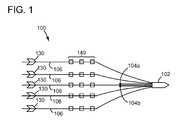
- a data acquisition system 100 includes a ship 102 towing a plurality of streamers 106 that can extend one or more kilometers behind the ship 102.
- Each of the streamers 106 can include one or more birds 130 that maintain the streamer 106 in a known fixed position relative to other streamers 106, and the one or more birds 130 are capable of moving the streamers 106 as desired according to bi-directional communications received by the birds 130 from the ship 102.
- the streamers 106 also each carry a plurality of receivers 140, e.g., geophones and/or hydrophones.
- One or more source arrays 104a,b can also be towed by ship 102, or another ship, for generating seismic waves.
- Source arrays 104a,b can be placed either in front of or behind the receivers 140, or both behind and in front of the receivers 140.
- the seismic waves generated by the source arrays 104a,b propagate downward, reflect off of, and penetrate the seafloor, wherein the refracted waves eventually are reflected by one or more reflecting structures (not shown in Figure 1 ) back to the surface.
- the reflected seismic waves then propagate upward and are detected by the receivers 140 disposed on the streamers 106.
- the seismic waves then reflect off of the surface of the body of water traveling downward and are once again detected by the receivers 140 disposed on streamers 106 as receiver ghosts.
- This process is generally referred to as "shooting" a particular geographical area of interest (GAI), with the GAI sometimes also being referred to as a "cell”.
- GAI geographical area of interest
- the signals recorded by seismic receivers 140 vary in time, having energy peaks that may correspond to reflectors between layers in the subsurface being imaged by the seismic acquisition. In reality, since the sea floor and the air/water are highly reflective, some of the peaks correspond to multiple reflections or spurious reflections that should be eliminated before the geophysical structure can be correctly imaged. As will be appreciated by those skilled in the art, a large number of different data processing techniques can be applied to the raw seismic data to make the image of the subsurface more accurate by removing or reducing the impact of noise and other data that negatively impacts its accuracy.
- a source array includes a plurality of individual wave sources. An individual wave source may be an air gun, a cluster of air guns or a marine vibrator.
- the wave generated by the source array is directional, i.e., the shape of the wave, or the signature varies with the direction until, at a great enough distance, the wave starts having a stable shape. After the shape becomes stable, the amplitude of the wave decreases inversely proportional to the distance from the source.
- the region where the signature shape no longer changes significantly with distance is known as the "far-field,” in contrast to the "near-field” region where the shape varies based on the distance from the source.
- Knowledge of the wave source's far-field signature is desirable in order to extract information about the geological structure generating the detected wave upon receiving the far-field input wave.
- an equivalent notional signature for each individual source may be calculated for each of the guns using near-field measurements (see e.g., U.S. Patent No. 4,476,553 the disclosure of which is incorporated herein by reference).
- the equivalent notional signature is a representation of the amplitude of the wave due to an individual wave source as a function of time, the source array's far-field signature being a superposition of the notional signatures corresponding to each of the individual sources.
- the equivalent notional signature is a tool for representing the contribution of an individual source to the far-field signature, such that the individual source contribution is decoupled from contributions of other individual wave sources in the source array.
- a "shot” refers to a system comprising one source position and all associated receiver positions along the cables (i.e., the receivers' instantaneous positions when the source is fired).
- the summed indicators I 0 +I 1... need not be weighted at all, i.e., each W j may be equal to 1.
- equation (1) there can, of course be any number of shot indicators which are summed to generate the multi-criteria shot indicator I.
- the pool can include five indicators, e.g., indicator I 1 can be based on surface geometry, indicator I 2 can be based on illumination, indicator I 3 can be based on travel time, indicator I 4 can be based on source signature and indicator I 5 can be based on noise.
- indicator I 1 can be based on surface geometry
- indicator I 2 can be based on illumination
- indicator I 3 can be based on travel time
- indicator I 4 can be based on source signature
- indicator I 5 can be based on noise.
- Examples of mono-criterion indicators, I j , and weights, W j , are presented hereafter for individual shots (or sets of shots) paired between, for example, base and monitor surveys.
- 4D seismic surveying refers to the technique of taking one seismic survey of a particular geographical area at a first time (i.e., the baseline survey) and another seismic survey of the same geographical area at a later time (i.e., the monitor survey). The baseline survey and the monitor survey can then be compared for various purposes, e.g., to observe changes in the hydrocarbon deposits in a geographical area which has an active well operating therein.
- k 1 to n (n being the number of receivers within the set of cables or streamers)
- the surface geometry indicator also can be evaluated with various metrics calculated using ⁇ s and ⁇ r i .
- One of the most classical methods which can be used as a surface geometry indicator according to an embodiment is the computation of the so-called "minimal ⁇ S+ ⁇ R distance".
- the distance between base and monitor source positions ⁇ S and the distance between base and monitor receiver positions ⁇ R are computed and summed for each trace.
- the pair of base trace and monitor trace for which the summed distance ⁇ S+ ⁇ R is minimal is selected and defines the "minimal ⁇ S+ ⁇ R distance" metric which can be used as the surface geometry indicator.
- metrics could be computed and used, e.g., metrics which account for trace offsets and azimuths.
- the target illumination indicator I 2 is, according to an embodiment, related to mismatches in target illumination between base shots and monitor shots.
- the target illumination indicator I 2 can be evaluated, for example, by determining a similarity metric between shot imprints from the baseline and monitor surveys.
- a shot imprint can be defined as the target illumination associated with a single acquisition shot.
- target illumination refers to the number of source-receiver pairs for which reflections occur at a given point.
- a shot imprint shows the summation of illuminations obtained from one source and all of the receivers in the towed streamer array(s).
- One way to generate the indicator I 2 is to process the shot imprint as images represented by pixels with different intensities, i.e., associated with reflection point locations and either hit count or illumination amplitude. These representations, i.e., current imprints and reference imprints, are then compared using an image registration metric.
- this type of illumination indicator I 2 the interested reader is directed to U.S. Patent Application Serial No. 14/102,592 , entitled "A Repeatability Indicator Based on Shot Illumination for Seismic Acquisition, filed on December 11, 2013, the disclosure of which is hereby incorporated by reference in its entirety.
- the travel time indicator is related to the 4D mismatches between travel times recorded for a baseline survey and corresponding travel times for each hit on target in a monitor survey.
- the travel time indicator I 3 can be evaluated from reflection travel times computed on the target for some, or all, of the source-receiver couples in both the baseline and monitor surveys
- the source signature indicator is related to the variability of the source signature with respect to a reference signature.
- the reference signature can defined either for the current survey for a 3D shot-to-shot stability analysis, or from a base shot signature for a 4D evaluation.
- the source signature can then be evaluated based on near-field or far-field signatures from various metrics, e.g., NRMS, peak-to-bubble ratio, directivity, etc., as will be appreciated by those skilled in the art.
- the seismic noise indicator is related to the seismic noise, e.g., the seismic signal to noise ratio, recorded on the shot or, more characteristically, on the shot-line.
- the noise is measured on a time window applied to the seismic traces of the shot gathers, generally before the first arrival of the seismic signals on the top of the seismic gather or at the bottom of the gather where little energy comes from late reflections.
- the time window for the signal is generally centered around the first arrival signal.
- Frequency amplitude spectra are then computed on several traces, for both signal and noise time windows, and the signal to noise ratio is computed either for each frequency component or for a given frequency bandwidth.
- one or more of the summed indicators may (or may not) be weighted to generate the multi-criteria shot indicator according to various embodiments. The weights can be adjusted to allocate more or less importance to each of the repeatability indicators in the summed multi-criteria shot indicator.
- Sensitivity factor f 0 can be set to a high value if the shot illumination imprint is located on the reservoir area of interest for 4D analysis and can be set low if the shot illumination imprint is not located on the reservoir area of interest.
- the multi-criteria shot indicator system can set f 1 low in the case of strong data redundancy and high in the case of critical coverage.
- a method 200 for generating a multi-criteria shot indicator is depicted.
- a plurality of shot indicators are generated, wherein the plurality of shot indicators are associated respectively, with one or more shots.
- each of the plurality of shot indicators which are generated provide information relevant to the repeatability of the associated one or more shots.
- a plurality of weighting values is generated wherein the weighting values are associated, respectively, with the plurality of shot indicators.
- the plurality of weighting values is applied to the plurality of shot indicators to generate a plurality of weighted shot indicators.
- An example of a technique for applying a weighting value to a shot indicator is multiplying the shot indicator by the weighting value. It will be appreciated by those skilled in the art that the embodiment of Figure 2 is not intended to imply that each of the shot indicators must have its own associated weighting value.
- Indicators which are not weighted can, for example, be represented in equation (2) above by assigning a value of "1" to the respective weighting value W i for shot indicators that are unweighted, if any.
- the plurality of weighted shot indicators is summed to generate a multi-criteria shot indicator. It should be noted in the exemplary method embodiment of Figure 2 that different groups of weighted shot indicators can be summed to generate different multi-criteria shot indicators.
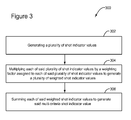
- FIG. 3 another method embodiment 300 for generating a multi-criteria shot indicator is depicted.
- a plurality of shot indicator values is generated.
- the shot indicators provide information for determining the repeatability and/or stability of the associated one or more shots.
- each of the plurality of shot indicators is multiplied by an assigned weighting factor to generate a plurality of weighted shot indicator values. Note that, in this embodiment, the usage of weighting is optional and that step 304 can be omitted.
- the plurality of weighted shot indicators is summed to generate a multi-criteria shot indicator value. It should be noted that different groups of weighted shot indicators can be summed to generate different multi-criteria shot indicators.
- an additional step of outputting the multi-criteria shot value and/or storing the multi-criteria shot value in memory can be provided so that a marine seismic acquisition operator can use the indicator to determine, e.g., whether the shot or group of shots associated with the multi-criteria indicator should be repeated in order to improve the repeatability or stability of those shot(s).
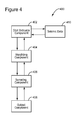
- a multi-criteria shot indicator generating system 400 comprises a shot indicator component 402, a weighting component 404, a summing component 406, an output component 408 and seismic data 410.
- the shot indicator component 402 provides the capability to generate a plurality of shot indicators based on the seismic data 410 as described above. It should further be noted the seismic data 410 can be provided from either offline or online sources.
- the weighting component 404 provides the capability to generate a plurality of weighting values. As described earlier, the weighting values are associated with the plurality of shot indicators.
- the summing component 406 provides the capability to apply the weighting values to the shot indicators and to sum the weighted shot indicators to generate a multi-criteria shot indicator.
- the output component 408 provides the capability to deliver multi-criteria shot indicators for further processing. It should be noted in the embodiment node 400 that the multi-criteria shot indicators can be delivered locally, i.e., onboard the seismic vessel or to a remote location, i.e., land based, for analysis and decision making.
- weights W i Another purpose for the weights W i is to normalize each of the repeatability indicators I i in the integrated multi-criteria shot indicator in order to make each mono indicator dimensionless to enable the system or algorithm to sum the various dimensionless mono indicators together. This, in turn, enables embodiments to assess the repeatability of a monitor line versus a corresponding base line and to determine whether to accept, as valid, a given monitor line: Stated differently, the weighted, summed multi-criteria shot indicator can be considered to be a cost function. As will be appreciated by those skilled in the art, in mathematical optimization and decision theory, a cost function (or equivalently a loss function) is a function that maps an event, or values of one or more variables, onto a real number which represents a "cost" associated with the event.
- optimization approaches seek generally to minimize the cost function.
- the multi-criteria shot indicator analysis and decision making process described in the foregoing embodiments can thus be translated into an optimization problem of the cost function (e.g., a minimization of the cost function).
- the normalized 4D-indicator "I" described above is not limited to being a weighted sum of various indicators qualifying the repeatability/stability of the shot as shown in equation (1). Instead, it can be also a weighted product or any type of combination of the individual indicators.
- the form of the cost function generally depends on the method chosen to solve the optimization problem.
- a fuzzy logic approach could be used to the decision making problem so that the individual mono indicators are mixed together in a different way than described above.
- the mono indicators are mapped into fuzzy variables in order to define ranges of the quality of the 4D repeatability. All of the fuzzy variables corresponding to each mono indicator (e.g., far field source variability, illumination imprint matching, specular travel time misfit, signal to noise, etc.) are then contributing together to a global decision on the quality of the repeatability of the line, which is reached after a de-fuzzification process is performed.
- the computing device(s) or other network nodes involved in the integrated multi-criteria shot indicator generation can be any type of computing device capable of processing and communicating seismic data associated with a seismic survey.
- An example of a representative computing system capable of carrying out operations in accordance with these embodiments is illustrated in Figure 5 .
- System 500 includes, among other items, server 501, source/receiver interface 502, internal data/communications bus (bus) 504, processor(s) 508 (those of ordinary skill in the art can appreciate that in modern server systems, parallel processing is becoming increasingly prevalent, and whereas a single processor would have been used in the past to implement many or at least several functions, it is more common currently to have a single dedicated processor for certain functions (e.g., digital signal processors) and therefore could be several processors, acting in serial and/or parallel, as required by the specific application), universal serial bus (USB) port 510, compact disk (CD)/digital video disk (DVD) read/write (R/W) drive 512, floppy diskette drive 514 (though less used currently, many servers still include this device), and data storage unit 532.
- USB universal serial bus
- CD compact disk
- DVD digital video disk
- R/W read/write
- Data storage unit 532 itself can comprise hard disk drive (HDD) 516 (these can include conventional magnetic storage media, but, as is becoming increasingly more prevalent, can include flash drive-type mass storage devices 524, among other types), ROM device(s) 518 (these can include electrically erasable (EE) programmable ROM (EEPROM) devices, ultra-violet erasable PROM devices (UVPROMs), among other types), and random access memory (RAM) devices 520.
- Usable with USB port 510 is flash drive device 524, and usable with CD/DVD R/W device 512 are CD/DVD disks 534 (which can be both read and write-able).
- Usable with diskette drive device 514 are floppy diskettes 537.
- Each of the memory storage devices, or the memory storage media can contain parts or components, or in its entirety, executable software programming code (software) 536 that can implement part or all of the portions of the method described herein.
- processor 508 itself can contain one or different types of memory storage devices (most probably, but not in a limiting manner, RAM memory storage media 520) that can store all or some of the components of software 536.
- system 500 also comprises user console 534, which can include keyboard 528, display 526, and mouse 530. All of these components are known to those of ordinary skill in the art, and this description includes all known and future variants of these types of devices.
- Display 526 can be any type of known display or presentation screen, such as liquid crystal displays (LCDs), light emitting diode displays (LEDs), plasma displays, cathode ray tubes (CRTs), among others.
- User console 535 can include one or more user interface mechanisms such as a mouse, keyboard, microphone, touch pad, touch screen, voice-recognition system, among other inter-active inter-communicative devices.
- System 500 can further include communications satellite/global positioning system (GPS) transceiver device 538, to which is electrically connected at least one antenna 540 (according to an exemplary embodiment, there would be at least one GPS receive-only antenna, and at least one separate satellite bi-directional communications antenna).
- GPS global positioning system
- System 500 can access internet 542, either through a hard wired connection, via I/O interface 522 directly, or wirelessly via antenna 540, and transceiver 538.
- Server 501 can be coupled to other computing devices, such as those that operate or control the equipment of ship 102, via one or more networks.
- Server 501 may be part of a larger network configuration as in a global area network (GAN) (e.g., internet 542), which ultimately allows connection to various landlines.
- GAN global area network
- system 500 being designed for use in seismic exploration, will interface with one or more sources 104a,b and one or more receivers 140. These, as previously described, are attached to streamers 106, to which are also attached birds 130 that are useful to maintain positioning. As further previously discussed, sources 104 and receivers 140 can communicate with server 501 either through an electrical cable that is part of streamer 106, or via a wireless system that can communicate via antenna 540 and transceiver 538 (collectively described as communications conduit 546).
- user console 535 provides a means for personnel to enter commands and configuration into system 500 (e.g., via a keyboard, buttons, switches, touch screen and/or joy stick).
- Display device 526 can be used to show: streamer 1066 position; visual representations of acquired data; source 104 and receiver 140 status information; survey information; and other information important to the seismic data acquisition process.
- Source and receiver interface unit 502 can receive the hydrophone seismic data from receiver 140 though streamer communication conduit 548 (discussed above) that can be part of streamer 106, as well as streamer 106 position information from birds 130; the link is bi-directional so that commands can also be sent to birds 130 to maintain proper streamer positioning.
- Source and receiver interface unit 502 can also communicate bi-directionally with sources 104 through the streamer communication conduit 548 that can be part of streamer 106. Excitation signals, control signals, output signals and status information related to source 4 can be exchanged by streamer communication conduit 548 between system 500 and source 4.
- Bus 504 allows a data pathway for items such as: the transfer and storage of data that originate from either the source sensors or streamer receivers; for processor 508 to access stored data contained in data storage unit memory 532; for processor 508 to send information for visual display to display 526; or for the user to send commands to system operating programs/software 536 that might reside in either the processor 508 or the source and receiver interface unit 502.
- System 500 can be used to implement the methods described above associated with integrated multi-criteria shot indicator generation according to an exemplary embodiment.
- Hardware, firmware, software or a combination thereof may be used to perform the various steps and operations described herein.
- software 536 for carrying out the above discussed steps can be stored and distributed on multi-media storage devices such as devices 516, 518, 520, 524, 534, and/or 537 (described above) or other form of media capable of portably storing information (e.g., universal serial bus (USB) flash drive 526).
- USB universal serial bus
- these techniques can be applied in either an "offline", e.g., at a land-based data processing center or an “online” manner, i.e., in near real time while onboard the seismic vessel.
- integrated multi-criteria shot indicator generation associated with a given target can be performed at the end of each acquired line during a 4D survey.
- Integrated shot indicators according to these embodiments provide an easy way to assess simultaneously the repeatability and stability of many parameters (e.g., one scalar indicator is synthetized to assess several criteria).
- Such embodiments are applicable to any type of seismic acquisition system, e.g., systems using geophones, hydrophones, multi-component receivers, or any other type of receiver device or any combination of receiver devices, any type of source (e.g., multi-level sources), any type of streamer/cable, e.g., horizontal, slanted, curved profile, etc., undershoot or node acquisition.
- any type of seismic acquisition system e.g., systems using geophones, hydrophones, multi-component receivers, or any other type of receiver device or any combination of receiver devices
- any type of source e.g., multi-level sources
- any type of streamer/cable e.g., horizontal, slanted, curved profile, etc., undershoot or node acquisition.
- the disclosed embodiments provide a server node, and a method for multi-criteria shot indicator generation associated with seismic data. It should be understood that this description is not intended to limit the invention. On the contrary, the embodiments are intended to cover alternatives, modifications and equivalents, which are included in the spirit and scope of the invention. Further, in the detailed description of the embodiments, numerous specific details are set forth in order to provide a comprehensive understanding of the invention. However, one skilled in the art would understand that various embodiments may be practiced without such specific details.
Landscapes
- Life Sciences & Earth Sciences (AREA)
- Physics & Mathematics (AREA)
- Engineering & Computer Science (AREA)
- Remote Sensing (AREA)
- Geology (AREA)
- Environmental & Geological Engineering (AREA)
- Acoustics & Sound (AREA)
- General Life Sciences & Earth Sciences (AREA)
- General Physics & Mathematics (AREA)
- Geophysics (AREA)
- Oceanography (AREA)
- Fluid Mechanics (AREA)
- Geophysics And Detection Of Objects (AREA)
- Testing Of Devices, Machine Parts, Or Other Structures Thereof (AREA)
Applications Claiming Priority (1)
| Application Number | Priority Date | Filing Date | Title |
|---|---|---|---|
| US201361805266P | 2013-03-26 | 2013-03-26 |
Publications (2)
| Publication Number | Publication Date |
|---|---|
| EP2784549A2 true EP2784549A2 (fr) | 2014-10-01 |
| EP2784549A3 EP2784549A3 (fr) | 2015-10-14 |
Family
ID=50345872
Family Applications (1)
| Application Number | Title | Priority Date | Filing Date |
|---|---|---|---|
| EP14161213.5A Withdrawn EP2784549A3 (fr) | 2013-03-26 | 2014-03-24 | Systèmes et procédés sismiques utilisant des indicateurs de répétabilité de tir |
Country Status (4)
| Country | Link |
|---|---|
| US (1) | US20140297189A1 (fr) |
| EP (1) | EP2784549A3 (fr) |
| AU (1) | AU2014201749A1 (fr) |
| BR (1) | BR102014007152A2 (fr) |
Cited By (1)
| Publication number | Priority date | Publication date | Assignee | Title |
|---|---|---|---|---|
| CN107923991A (zh) * | 2015-03-26 | 2018-04-17 | 英国石油勘探运作有限公司 | 地震勘测方法 |
Families Citing this family (1)
| Publication number | Priority date | Publication date | Assignee | Title |
|---|---|---|---|---|
| US9733374B2 (en) * | 2012-12-17 | 2017-08-15 | Cgg Services Sas | Repeatability indicator based on shot illumination for seismic acquisition |
Citations (1)
| Publication number | Priority date | Publication date | Assignee | Title |
|---|---|---|---|---|
| US4476553A (en) | 1981-05-29 | 1984-10-09 | The British National Oil Corporation | Method of determining the signatures of arrays of marine seismic sources |
Family Cites Families (7)
| Publication number | Priority date | Publication date | Assignee | Title |
|---|---|---|---|---|
| US6148264A (en) * | 1998-07-06 | 2000-11-14 | Exxonmobil Upstream Research Company | Method for removing seismic noise caused by external activity |
| GB2420408B (en) * | 2004-11-19 | 2008-03-12 | Geophysique Cie Gle | Method for processing at least two sets of seismic data |
| US8781749B2 (en) * | 2007-12-28 | 2014-07-15 | Westerngeco L.L.C. | Attenuating noise in seismic data |
| US7944774B2 (en) * | 2008-05-07 | 2011-05-17 | Apache Corporation | Method for determining adequacy of seismic data coverage of a subsurface area being surveyed and its application to selecting sensor array geometry |
| US8717846B2 (en) * | 2008-11-10 | 2014-05-06 | Conocophillips Company | 4D seismic signal analysis |
| AU2009344283B2 (en) * | 2009-04-16 | 2013-09-12 | Landmark Graphics Corporation | Seismic imaging systems and methods employing a fast target-oriented illumination calculation |
| US9007870B2 (en) * | 2012-05-31 | 2015-04-14 | Pgs Geophysical As | Seismic surveying techniques with illumination areas identifiable from primary and higher-order reflections |
-
2014
- 2014-03-07 US US14/200,185 patent/US20140297189A1/en not_active Abandoned
- 2014-03-24 EP EP14161213.5A patent/EP2784549A3/fr not_active Withdrawn
- 2014-03-24 AU AU2014201749A patent/AU2014201749A1/en not_active Abandoned
- 2014-03-25 BR BR102014007152A patent/BR102014007152A2/pt not_active IP Right Cessation
Patent Citations (1)
| Publication number | Priority date | Publication date | Assignee | Title |
|---|---|---|---|---|
| US4476553A (en) | 1981-05-29 | 1984-10-09 | The British National Oil Corporation | Method of determining the signatures of arrays of marine seismic sources |
Cited By (2)
| Publication number | Priority date | Publication date | Assignee | Title |
|---|---|---|---|---|
| CN107923991A (zh) * | 2015-03-26 | 2018-04-17 | 英国石油勘探运作有限公司 | 地震勘测方法 |
| CN107923991B (zh) * | 2015-03-26 | 2021-03-30 | 英国石油勘探运作有限公司 | 地震勘测方法 |
Also Published As
| Publication number | Publication date |
|---|---|
| US20140297189A1 (en) | 2014-10-02 |
| AU2014201749A1 (en) | 2014-10-16 |
| BR102014007152A2 (pt) | 2016-06-28 |
| EP2784549A3 (fr) | 2015-10-14 |
Similar Documents
| Publication | Publication Date | Title |
|---|---|---|
| US10466378B2 (en) | Impact assessment of marine seismic surveys | |
| US9684085B2 (en) | Wavefield modelling and 4D-binning for seismic surveys from different acquisition datums | |
| US9594180B2 (en) | Removing ghost reflections from marine seismic data | |
| US11442186B2 (en) | Source-receiver position estimation using direct arrival modeling and inversion | |
| US10386518B2 (en) | Device and method for deblending simultaneous shooting data using an iterative approach | |
| US20140200814A1 (en) | Dip tomography for estimating depth velocity models by inverting pre-stack dip information present in migrated/un-migrated pre-/post-stack seismic data | |
| US9651693B2 (en) | Target-oriented 4D binning in common reflection point | |
| US9733374B2 (en) | Repeatability indicator based on shot illumination for seismic acquisition | |
| CA2790420A1 (fr) | Dispositif et methode de determination de la forme d'un streamer | |
| US20140297190A1 (en) | Monitoring of source signature directivity in seismic systems | |
| US9798025B2 (en) | Regularization of multi-component seismic data | |
| EP2743737A2 (fr) | Procédés et systèmes pour le contrôle de la qualité de cartes d'éclairage sismique | |
| EP2784549A2 (fr) | Systèmes et procédés sismiques utilisant des indicateurs de répétabilité de tir | |
| US10338251B2 (en) | Method and apparatus for directional designature | |
| US20140297191A1 (en) | Predicting sensitivity to positioning for seismic surveys | |
| US20160084976A1 (en) | Processing of multi-sensor streamer data | |
| Svay et al. | Innovations for geophysical monitoring of 3D and 4D marine surveys | |
| GB2530661A (en) | Impact assessment of marine seismic surveys | |
| MX2013015014A (es) | Metodos y sistemas para control de calidad de mapas de iluminacion sismicos. |
Legal Events
| Date | Code | Title | Description |
|---|---|---|---|
| 17P | Request for examination filed |
Effective date: 20140324 |
|
| AK | Designated contracting states |
Kind code of ref document: A2 Designated state(s): AL AT BE BG CH CY CZ DE DK EE ES FI FR GB GR HR HU IE IS IT LI LT LU LV MC MK MT NL NO PL PT RO RS SE SI SK SM TR |
|
| AX | Request for extension of the european patent |
Extension state: BA ME |
|
| PUAI | Public reference made under article 153(3) epc to a published international application that has entered the european phase |
Free format text: ORIGINAL CODE: 0009012 |
|
| PUAL | Search report despatched |
Free format text: ORIGINAL CODE: 0009013 |
|
| AK | Designated contracting states |
Kind code of ref document: A3 Designated state(s): AL AT BE BG CH CY CZ DE DK EE ES FI FR GB GR HR HU IE IS IT LI LT LU LV MC MK MT NL NO PL PT RO RS SE SI SK SM TR |
|
| AX | Request for extension of the european patent |
Extension state: BA ME |
|
| RIC1 | Information provided on ipc code assigned before grant |
Ipc: G01V 1/34 20060101ALI20150910BHEP Ipc: G01V 1/38 20060101ALI20150910BHEP Ipc: G01V 1/02 20060101AFI20150910BHEP Ipc: G01V 1/30 20060101ALI20150910BHEP |
|
| R17P | Request for examination filed (corrected) |
Effective date: 20160414 |
|
| RBV | Designated contracting states (corrected) |
Designated state(s): AL AT BE BG CH CY CZ DE DK EE ES FI FR GB GR HR HU IE IS IT LI LT LU LV MC MK MT NL NO PL PT RO RS SE SI SK SM TR |
|
| STAA | Information on the status of an ep patent application or granted ep patent |
Free format text: STATUS: THE APPLICATION IS DEEMED TO BE WITHDRAWN |
|
| 18D | Application deemed to be withdrawn |
Effective date: 20181002 |