EP2784847B1 - H2V3O8 lithié à surface modifiée - Google Patents
H2V3O8 lithié à surface modifiée Download PDFInfo
- Publication number
- EP2784847B1 EP2784847B1 EP13176170.2A EP13176170A EP2784847B1 EP 2784847 B1 EP2784847 B1 EP 2784847B1 EP 13176170 A EP13176170 A EP 13176170A EP 2784847 B1 EP2784847 B1 EP 2784847B1
- Authority
- EP
- European Patent Office
- Prior art keywords
- aluminum
- coating
- source
- cathode material
- lithium
- Prior art date
- Legal status (The legal status is an assumption and is not a legal conclusion. Google has not performed a legal analysis and makes no representation as to the accuracy of the status listed.)
- Active
Links
Images



Classifications
-
- H—ELECTRICITY
- H01—ELECTRIC ELEMENTS
- H01M—PROCESSES OR MEANS, e.g. BATTERIES, FOR THE DIRECT CONVERSION OF CHEMICAL ENERGY INTO ELECTRICAL ENERGY
- H01M4/00—Electrodes
- H01M4/02—Electrodes composed of, or comprising, active material
- H01M4/36—Selection of substances as active materials, active masses, active liquids
- H01M4/48—Selection of substances as active materials, active masses, active liquids of inorganic oxides or hydroxides
-
- C—CHEMISTRY; METALLURGY
- C01—INORGANIC CHEMISTRY
- C01D—COMPOUNDS OF ALKALI METALS, i.e. LITHIUM, SODIUM, POTASSIUM, RUBIDIUM, CAESIUM, OR FRANCIUM
- C01D15/00—Lithium compounds
- C01D15/02—Oxides; Hydroxides
-
- H—ELECTRICITY
- H01—ELECTRIC ELEMENTS
- H01M—PROCESSES OR MEANS, e.g. BATTERIES, FOR THE DIRECT CONVERSION OF CHEMICAL ENERGY INTO ELECTRICAL ENERGY
- H01M10/00—Secondary cells; Manufacture thereof
- H01M10/05—Accumulators with non-aqueous electrolyte
- H01M10/052—Li-accumulators
-
- H—ELECTRICITY
- H01—ELECTRIC ELEMENTS
- H01M—PROCESSES OR MEANS, e.g. BATTERIES, FOR THE DIRECT CONVERSION OF CHEMICAL ENERGY INTO ELECTRICAL ENERGY
- H01M4/00—Electrodes
- H01M4/02—Electrodes composed of, or comprising, active material
- H01M4/13—Electrodes for accumulators with non-aqueous electrolyte, e.g. for lithium-accumulators; Processes of manufacture thereof
- H01M4/139—Processes of manufacture
-
- H—ELECTRICITY
- H01—ELECTRIC ELEMENTS
- H01M—PROCESSES OR MEANS, e.g. BATTERIES, FOR THE DIRECT CONVERSION OF CHEMICAL ENERGY INTO ELECTRICAL ENERGY
- H01M4/00—Electrodes
- H01M4/02—Electrodes composed of, or comprising, active material
- H01M4/36—Selection of substances as active materials, active masses, active liquids
- H01M4/362—Composites
- H01M4/366—Composites as layered products
-
- H—ELECTRICITY
- H01—ELECTRIC ELEMENTS
- H01M—PROCESSES OR MEANS, e.g. BATTERIES, FOR THE DIRECT CONVERSION OF CHEMICAL ENERGY INTO ELECTRICAL ENERGY
- H01M4/00—Electrodes
- H01M4/02—Electrodes composed of, or comprising, active material
- H01M4/36—Selection of substances as active materials, active masses, active liquids
- H01M4/48—Selection of substances as active materials, active masses, active liquids of inorganic oxides or hydroxides
- H01M4/485—Selection of substances as active materials, active masses, active liquids of inorganic oxides or hydroxides of mixed oxides or hydroxides for inserting or intercalating light metals, e.g. LiTi2O4 or LiTi2OxFy
-
- H—ELECTRICITY
- H01—ELECTRIC ELEMENTS
- H01M—PROCESSES OR MEANS, e.g. BATTERIES, FOR THE DIRECT CONVERSION OF CHEMICAL ENERGY INTO ELECTRICAL ENERGY
- H01M4/00—Electrodes
- H01M4/02—Electrodes composed of, or comprising, active material
- H01M4/36—Selection of substances as active materials, active masses, active liquids
- H01M4/48—Selection of substances as active materials, active masses, active liquids of inorganic oxides or hydroxides
- H01M4/52—Selection of substances as active materials, active masses, active liquids of inorganic oxides or hydroxides of nickel, cobalt or iron
-
- H—ELECTRICITY
- H01—ELECTRIC ELEMENTS
- H01M—PROCESSES OR MEANS, e.g. BATTERIES, FOR THE DIRECT CONVERSION OF CHEMICAL ENERGY INTO ELECTRICAL ENERGY
- H01M4/00—Electrodes
- H01M4/02—Electrodes composed of, or comprising, active material
- H01M4/62—Selection of inactive substances as ingredients for active masses, e.g. binders, fillers
-
- H—ELECTRICITY
- H01—ELECTRIC ELEMENTS
- H01M—PROCESSES OR MEANS, e.g. BATTERIES, FOR THE DIRECT CONVERSION OF CHEMICAL ENERGY INTO ELECTRICAL ENERGY
- H01M10/00—Secondary cells; Manufacture thereof
- H01M10/05—Accumulators with non-aqueous electrolyte
- H01M10/052—Li-accumulators
- H01M10/0525—Rocking-chair batteries, i.e. batteries with lithium insertion or intercalation in both electrodes; Lithium-ion batteries
-
- H—ELECTRICITY
- H01—ELECTRIC ELEMENTS
- H01M—PROCESSES OR MEANS, e.g. BATTERIES, FOR THE DIRECT CONVERSION OF CHEMICAL ENERGY INTO ELECTRICAL ENERGY
- H01M10/00—Secondary cells; Manufacture thereof
- H01M10/42—Methods or arrangements for servicing or maintenance of secondary cells or secondary half-cells
- H01M10/4235—Safety or regulating additives or arrangements in electrodes, separators or electrolyte
-
- H—ELECTRICITY
- H01—ELECTRIC ELEMENTS
- H01M—PROCESSES OR MEANS, e.g. BATTERIES, FOR THE DIRECT CONVERSION OF CHEMICAL ENERGY INTO ELECTRICAL ENERGY
- H01M4/00—Electrodes
- H01M4/02—Electrodes composed of, or comprising, active material
- H01M4/04—Processes of manufacture in general
- H01M4/049—Manufacturing of an active layer by chemical means
-
- H—ELECTRICITY
- H01—ELECTRIC ELEMENTS
- H01M—PROCESSES OR MEANS, e.g. BATTERIES, FOR THE DIRECT CONVERSION OF CHEMICAL ENERGY INTO ELECTRICAL ENERGY
- H01M4/00—Electrodes
- H01M4/02—Electrodes composed of, or comprising, active material
- H01M4/13—Electrodes for accumulators with non-aqueous electrolyte, e.g. for lithium-accumulators; Processes of manufacture thereof
- H01M4/139—Processes of manufacture
- H01M4/1391—Processes of manufacture of electrodes based on mixed oxides or hydroxides, or on mixtures of oxides or hydroxides, e.g. LiCoOx
-
- H—ELECTRICITY
- H01—ELECTRIC ELEMENTS
- H01M—PROCESSES OR MEANS, e.g. BATTERIES, FOR THE DIRECT CONVERSION OF CHEMICAL ENERGY INTO ELECTRICAL ENERGY
- H01M4/00—Electrodes
- H01M4/02—Electrodes composed of, or comprising, active material
- H01M4/36—Selection of substances as active materials, active masses, active liquids
-
- H—ELECTRICITY
- H01—ELECTRIC ELEMENTS
- H01M—PROCESSES OR MEANS, e.g. BATTERIES, FOR THE DIRECT CONVERSION OF CHEMICAL ENERGY INTO ELECTRICAL ENERGY
- H01M4/00—Electrodes
- H01M4/02—Electrodes composed of, or comprising, active material
- H01M4/36—Selection of substances as active materials, active masses, active liquids
- H01M4/38—Selection of substances as active materials, active masses, active liquids of elements or alloys
- H01M4/40—Alloys based on alkali metals
- H01M4/405—Alloys based on lithium
-
- Y—GENERAL TAGGING OF NEW TECHNOLOGICAL DEVELOPMENTS; GENERAL TAGGING OF CROSS-SECTIONAL TECHNOLOGIES SPANNING OVER SEVERAL SECTIONS OF THE IPC; TECHNICAL SUBJECTS COVERED BY FORMER USPC CROSS-REFERENCE ART COLLECTIONS [XRACs] AND DIGESTS
- Y02—TECHNOLOGIES OR APPLICATIONS FOR MITIGATION OR ADAPTATION AGAINST CLIMATE CHANGE
- Y02E—REDUCTION OF GREENHOUSE GAS [GHG] EMISSIONS, RELATED TO ENERGY GENERATION, TRANSMISSION OR DISTRIBUTION
- Y02E60/00—Enabling technologies; Technologies with a potential or indirect contribution to GHG emissions mitigation
- Y02E60/10—Energy storage using batteries
Definitions
- the invention relates to the field of high energy density lithium ion batteries. It especially concerns improved cathode materials, in particular surface modified Li x H 2-x V 3 O 8 cathode material.
- Vanadium oxides have attracted great interest for the positive electrode in lithium ion batteries over the past few decades.
- V 2 O 5 was initially pointed as a very promising cathodic electro active material due to its low atomic mass, high oxidation number of vanadium (V) and easiness of synthesis in an industrial scale [1]. While close to three lithium equivalents can be inserted into the V 2 O 5 crystal lattice when the battery is first discharged down to 2 V, less than two lithium equivalents can actually be quasi-reversibly intercalated into the structure [2]. This fact hindered the dissemination of this compound as a standard for mass production cathodes so far. However, research continued on other vanadium oxide structures like Li x V 3 O 8 and H 2 V 3 O 8 . Both of these cathodic materials are promising candidates for commercial lithium ion batteries but stability issues on long term cycling are still to be solved [3, 4].
- H 2 V 3 O 8 shows low thermal stability. It is known that structural water present in this compound (also written as V 3 O 7 ⁇ H 2 O) is released when heated above 200 °C [2, 7]. It is generally accepted that the anhydrous material is obtained at a temperature close to 350 °C. This property limits the choice of possible compounds to coat the surface of H 2 V 3 O 8 .
- metal oxides like MgO, Al 2 O 3 , SiO 2 , TiO 2 , ZnO, SnO 2 , ZrO 2 , glasses and phosphates, for example, have been extensively studied as surface coatings for lithium ion cathodes.
- the object of the invention was to increase the capacity retention of the lithium intercalation under charge and discharge cycling of the H 2 V 3 O 8 compound as lithium ion battery cathode.
- the present invention provides a cathode material for rechargeable lithium ion battery with improved cycling stability obtained by surface modification with Al(OH) 3 , performed at low temperature in aqueous media.
- this surface modification with Al(OH) 3 is termed coating or decoration.
- a coating is a thick layer covering the entire surface of a particle of electro active material while a decoration is a (usually thinner) layer that forms a partial coating only, i.e. does not cover the entire surface.
- one object of the present invention is a method for preparing an at least partially stabilized electro active cathode material (EAM) for rechargeable lithium ion batteries based on Li x H 2-x V 3 O 8 by applying a coating / decoration of Al(OH) 3 .
- EAM electro active cathode material
- the coating / decorating step is performed in that a soluble aluminum source, preferably an aluminum salt hydrate, is added to a suspension comprising chemically lithiated H 2 V 3 O 8 , followed by addition of a base up to a pH of 7 to 8.
- a suitable base is simultaneously a Br ⁇ nsted and a Lewis base, i.e. is simultaneously able to raise the pH and to complex the Lewis acid Al (III), in particular aqueous ammonia.
- This step preferably is performed in aqueous media at low temperature, i.e. below 100 °C, such as 70 to 90°C, preferably about 80°C.
- the suspension comprising chemically lithiated H 2 V 3 O 8 , is formed in situ from H 2 V 3 O 8 , a lithium source and a reducing agent as described in [6] and is used without any separation and/or purification step. It is also within the scope of the present invention to provide the Al(OH) 3 coated / decorated EAM with a graphene layer as described in [6].
- the rechargeable lithium ion cell is formed by an assembled stack composed of a cathode, a separator, an electrolytic layer and an anode.
- Suitable anode materials include e.g. lithium, lithium alloys, Li x C 6 , silicides and nano-silicon-based materials.
- the electrolytic layer preferably includes a spacer and an aprotic solvent or a mixture of aprotic solvents with dissolved lithium salt.
- a suitable spacer is a foam filled with electrolyte.
- a battery may be made up of several stacks and is sealed in a container.
- the cathode material is essentially composed of the modified Li x H 2-x V 3 O 8 and carbon black.
- the use of a binder is possible, but not compulsory.
- a cathode is formed by coating a current collector with such cathode material.
- Li x H 2-x V 3 O 8 retains the H 2 V 3 O 8 structure ( Pnam ) .
- x is ranging from 0.1 to 1.5 and preferably is close to 1.5.
- the lithiation process is advantageously performed immediately before the coating / decorating reaction.
- Li + source and reducing agent preferably consist of or contains a reducing lithium salt, much preferred lithium ascorbate.
- the Al(OH) 3 coating is preferably produced in a one pot multistep reaction starting with phase pure H 2 V 3 O 8 as starting material, followed by a chemical lithiation of the starting material. Subsequently surface coating or decorating with aluminum hydroxide is performed.
- Al(OH) 3 is generated from an aluminum salt hydrate, e.g. a salt selected from Al(NO 3 ) 3 .9H 2 O, AlCl 3 .6H 2 O or Al 2 (SO 4 ) 3 .18H 2 O, preferably AlCl 3 .6H 2 O or Al(NO 3 ) 3 .9H 2 O.
- the hydroxide is generated in situ by addition of a base that is simultaneously a Br ⁇ nsted and a Lewis base, preferably aqueous ammonia (NH 3 ).
- NH 3 aqueous ammonia
- the amount of aluminum used should be comprised between 0.5 wt% and 10 wt%, preferably between 1 and 3 wt%, more preferred between 1 and 2 %, and most preferred about 1.5 wt% referred to H 2 V 3 O 8 .
- the amount used essentially corresponds to the amount of the coating/decoration and the thickness of the coating can be adjusted by the amount of aluminum used for performing the reaction.
- the coating/decorating preferably is performed in a one pot method, it is assumed that the Al(OH) 3 coating/decoration may comprise some impurities like ascorbate (if Li ascorbate is used for lithiation) or NH 3 (if NH 3 is used as base) or AIO(OH).
- a lithium ion battery assembled with such cathodic intercalation material shows higher stability over 200 cycles compared to the uncoated Li x H 2-x V 3 O 8 .
- the Al(OH) 3 coated Li x H 2-x V 3 O 8 with an Al amount of 1.5 wt.% referred to H 2 V 3 O 8 shows a capacity retention of 89% compared to 67% of the uncoated Li x H 2-x V 3 O 8 .
- the Al(OH) 3 coating or decoration inhibits vanadium dissolution during cycling either by increasing the structural stability of the fibers and/or by surface passivation.
- the deposition of an amorphous Al(OH) 3 coating film on the surface of the EAM in aqueous media at low temperature is an additional step during the chemical lithiation of H 2 V 3 O 8 using a Li + source together with a reducing agent, in particular a reducing agent with a redox potential close to the one of ascorbic acid/ascorbate.
- a presently much preferred lithium source and reduction agent is lithium ascorbate.
- the whole process consists of a multistep one pot reaction where the H 2 V 3 O 8 fibers are first at least partially and preferably partially lithiated and then coated / decorated. A full surface coverage with the Al(OH) 3 thin film can be achieved with higher aluminum contents while surface decorations are obtained with lower aluminum contents.
- a soluble aluminum source (an aluminum salt hydrate) is added to the suspension prepared in situ from H 2 V 3 O 8 , a lithium source and a reducing agent.
- the coating / decorating reaction is then induced by the addition of a diluted ammonia solution and takes place at pH comprised between 7 and 8.
- a diluted ammonia solution takes place at pH comprised between 7 and 8.
- phase pure H 2 V 3 O 8 fibers may be prepared following the method described in the co-owned published United States patent application US 2012/0100402 A1 [6]: 3 g of VOSO 4 ⁇ 5H 2 O were dissolved in 50 mL deionized water. 2 mL of 25 wt.% ammonia (NH 4 OH) were then added to the previous suspension. The dense precipitate which formed immediately was filtered and the grey wet solid product collected, put in a TEFLON® vessel of an autoclave and dispersed in 400 mL distilled water. After addition of 1 mL 12 M HCl, the autoclave was sealed and the suspension treated hydrothermally for 48 h at 220 °C.
- the green to green-yellow solid product was filtered, washed with water and isopropanol and dried overnight at 100 °C in air. 750 mg of H 2 V 3 O 8 were obtained by such method.
- the vanadium yield equaled 70%.
- the chemical lithiation of the H 2 V 3 O 8 fibers prepared as described in the example 1 was performed using lithium ascorbate as a reducing and complexation agent in aqueous media at ambient temperature.
- a solution containing ascorbic acid and the lithium salt, preferably LiOH was prepared.
- 30 mg (0.17 mmol) of ascorbic acid (Sigma Aldrich L-Ascorbic acid 99%) were dissolved in 15 mL MilliQ water (18.2 M ⁇ cm) and 15 mg LiOH ⁇ H 2 O (Alfa Aesar monohydrate 56.5% min.) (0.20 mmol min.) were then added.
- the solution was stirred until the pH stabilized, usually for about 30 minutes. This solution will be called S1, onwards.
- a second suspension, named S2, containing 100 mg of the green H 2 V 3 O 8 fibers dispersed in 50 mL MilliQ water was prepared.
- the pH of this suspension was close to 4.
- the lithium ascorbate solution (S1) was subsequently added to the suspension containing the H 2 V 3 O 8 compound (S2). Thereby the pH of S2 was neutralized due to the excess of lithium hydroxide in S1. After a few minutes under stirring, the pH decreased from 10 to a value close to 7.
- the suspended fibers now showed a bluish color (suspension S3) which indicates that to some extent the vanadium oxidation state was reduced from vanadium (V) to vanadium (IV).
- this fact is an indication that Li + was incorporated in the H 2 V 3 O 8 structure.
- This color change - or rather the absence of further color change - is an indication that the lithiation reaction has been completed.
- Figs. 1a, 1b and 1c show the surface roughness of the uncoated fibers and those decorated / coated with 1.5 wt.% and 3 wt.% aluminum.
- the images were obtained using a Helium ion microscope. Although only a minor change in surface roughness can be discerned between the uncoated and 1.5 wt.% Al samples, a clear homogenous coverage of the surface of the fibers was identified in the 3 wt.% Al sample ( Fig. 1c ).
- High magnification images of the surface obtained by HRTEM are shown in Figs. 2a , 2b and 2c .
- a clear coverage of the Li x H 2-x V 3 O 8 surface by amorphous Al(OH) 3 can be seen on the 3 wt.% aluminum composition.
- the morphology of this coating is uniform as confirmed by the images present in Fig. 1c and Fig. 2c .
- a rough thin layer covers the surface, with the Al(OH) 3 film thickness ranging from 3 to 10 nm.
- the influence of the coating thickness and surface coverage on the electrochemical performance of the EAM will be discussed later in this text. No identifiable crystalline structure changes of the EAM was induced by the coating, independently of the amount of aluminum used. No additional crystalline phase could be detected by X-ray diffraction, although 3 wt.% of a crystalline Al phase should give a signal. Results are show in Fig.
- low magnification SEM/EDX allows characterizing the bulk composition of the compounds.
- XPS analysis on the uncoated and 3 wt.% aluminum compound was performed. Results are summarized in Table 2. EDX results indicate that the yield of the coating reaction is close to 40%. A very high aluminum surface concentration is confirmed by XPS on the 3 wt.% aluminum compound. Table 2.
- Fig. 5 shows the normalized differential scanning calorimetry curves obtained with pristine H 2 V 3 O 8 , Li x H 2-x V 3 O 8 and Al(OH) 3 coated Li x H 2-x V 3 O 8 compounds. A clear shift towards higher temperatures for the dehydration reaction was observed on the coated samples. This reaction can be described as [2, 7]: H 2 V 3 O 8 ⁇ V 3 O 7 + H 2 O
- the degree of aluminum hydroxide surface coverage and film thickness can be adjusted in a nonlinear manner by the amount of aluminum in the deposition reaction.
- Batteries were made to characterize electrochemically the stability of the cathodic storage materials.
- 20 mg of coated / decorated or uncoated Li x H 2-x V 3 O 8 compound were first dispersed ultrasonically in 5 mL THF (Alfa Aesar 99%).
- 10 mg of Carbon black (Super P® from TIMCAL) were then added and ultrasonically mixed for a few minutes until a dark homogenous suspension was obtained allowing the carbon and the EAM to be intimately mixed.
- Half of the suspension volume was transferred to a mortar and gently stirred with a pestle. The THF evaporation resulted in a thick paste.
- This paste containing the EAM was then transferred to an aluminum current collector, pressed with paper sheet to absorb remaining THF and allowed to dry in air before performing a heat treatment at 180 °C for 10 minutes under air. Close to 4 mg of EAM were deposited on the current collector by this process.
- the batteries were assembled in an argon filled glove box ( ⁇ 0.1% H 2 O and ⁇ 0.1% O 2 ) by building a vertical stack composed by the aluminum current collector containing the EAM, a polypropylene Celgard separator, a silica foam spacer filled with Merck® LP 50 electrolyte (1 M LiPF 6 in EC/EMC 1:1), and a metallic lithium anode. The stack is contained inside a well tighten stainless steel cell.
- the batteries assembled as described were subjected to galvanostatic charge/discharge cycles between 4.05 V and 2.2 V vs. Li/Li + at a current rate of 100 A/kg.
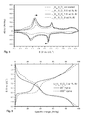
- Fig. 6 shows the variation in the battery voltage as a function of the intercalated lithium in the uncoated Li x H 2-x V 3 O 8 cathode for the 20 th and 200 th cycles.
- a specific charge of 240 Ah/kg was measured for this compound.
- Close to 2.5 mole of lithium atoms were intercalated per mole of EAM during the discharge between 4.05 V and 2.2 V vs. Li/Li + .
- Typical voltage profiles of H 2 V 3 O 8 were registered under charge/discharge where several voltage plateaus can be seen.
- the coulombic efficiency between discharge and charge was close to 98.7% on 20 th cycle and increased with the number of cycles to 99.4% on the 200 th cycle.
- Fig. 7 is similar to Fig. 6 showing the voltage profiles registered on Li x H 2-x V 3 O 8 decorated with nominal 1.5 wt% aluminum.
- a lower specific charge ca. 203 Ah/kg
- the capacity retention after 200 cycles compared to the 20 th cycle was close to 89% which was much higher than for the uncoated fibers.
- the Li x H 2-x V 3 O 8 - 1.5 wt.% Al compound could still intercalate 2 mole of lithium atoms per mole of H 2 V 3 O 8 compared to 1.7 of the uncoated compound.
- Fig. 11 shows the variation of the capacity as a function of the number of cycles in the batteries assembled with uncoated and coated / decorated compounds.
- the stability under charge and discharge cycles of Li x H 2-x V 3 O 8 fibers can be increased by means of an Al(OH) 3 surface coating / decoration performed in aqueous media at low temperature.
- the presence of the aluminum hydroxide coating increases the capacity retention of Li x H 2-x V 3 O 8 under cycling.
- Thermo-gravimetric data corroborates the electrochemical results indicating that the structural stability of Li x H 2-x V 3 O 8 improves with the coating.
Landscapes
- Chemical & Material Sciences (AREA)
- Chemical Kinetics & Catalysis (AREA)
- Electrochemistry (AREA)
- General Chemical & Material Sciences (AREA)
- Engineering & Computer Science (AREA)
- Inorganic Chemistry (AREA)
- Composite Materials (AREA)
- Materials Engineering (AREA)
- Manufacturing & Machinery (AREA)
- Organic Chemistry (AREA)
- Battery Electrode And Active Subsutance (AREA)
- Inorganic Compounds Of Heavy Metals (AREA)
- Secondary Cells (AREA)
Claims (16)
- Procédé de modification d'une surface d'un matériau pour cathode électroactif au moins partiellement stabilisé pour batteries lithium-ion rechargeables à base de LixH2-xV3O8 comprenant l'étape de fournir un matériau pour cathode électroactif au moins partiellement stabilisé pour batteries lithium-ion rechargeables à base de LixH2-xV3O8 et l'étape d'appliquer un revêtement ou un décor de Al(OH)3 sur du H2V3O8 lithié chimiquement.
- Procédé selon la revendication 1, dans lequel l'étape d'appliquer un revêtement ou un décor est réalisée de sorte qu'une source d'aluminium soluble, de préférence un hydrate de sel d'aluminium, est ajoutée à une suspension comprenant du H2V3O8 lithié chimiquement, suivie par l'addition d'une base qui est simultanément une base de Brønstedt et une base de Lewis, en particulier de l'ammoniac en solution aqueuse, jusqu'à un pH de 7 à 8.
- Procédé selon la revendication 1 ou 2, dans lequel la source d'aluminium est une source de Al(III) choisie parmi Al(NO3)3·9H2O, AlCl3·6H2O ou Al2(SO4)3·18H2O, de préférence AlCl3·6H2O ou Al(NO3)3·9H2O.
- Procédé selon l'une quelconque des revendications précédentes, dans lequel le ratio Al(III):NH3 est 1:1.
- Procédé selon l'une quelconque des revendications précédentes, dans lequel l'aluminium est utilisé dans une quantité telle que la masse d'aluminium est de 0.5% à 10% en poids, plus préférentiellement dans une quantité de 1 % à 3% en poids, par rapport à la masse de H2V3O8.
- Procédé selon l'une quelconque des revendications précédentes, dans lequel l'aluminium est utilisé dans une quantité telle que la masse d'aluminium est de 1% à 2% en poids, en particulier 1.5% en poids, par rapport à la masse de H2V3O8.
- Procédé selon l'une quelconque des revendications précédentes, dans lequel le H2V3O8 lithié chimiquement est produit par lithiation chimique de H2V3O8 utilisant au moins une source de Li+ et au moins un agent réducteur.
- Procédé selon l'une quelconque des revendications précédentes, dans lequel la source de Li+ et le au moins un agent réducteur contient ou de préférence consiste en ascorbate de lithium.
- Procédé selon l'une quelconque des revendications précédentes, dans lequel x dans LixH2-xV3O8 est compris entre 0,1 et 1,5, et de préférence est égal à 1,5.
- Procédé selon l'une quelconque des revendications précédentes, dans lequel l'étape d'appliquer un revêtement ou un décor est réalisée en milieu aqueux à une température inférieure à 100°C, de préférence à une température comprise entre 70°C et 90°C, en particulier à 80°C.
- Procédé selon l'une quelconque des revendications précédentes, effectué par une réaction monotope en plusieurs étapes utilisant H2V3O8 comme produit de départ.
- LixH2-xV3O8 à surface modifiée en tant que matériau pour cathode actif pour batteries lithium-ion rechargeables, la modification de surface étant un revêtement ou un décor de Al(OH)3.
- Matériau pour cathode contenant ou consistant en un mélange de LixH2-xV3O8 à surface modifiée selon la revendication 12 et de noir de carbone et éventuellement d'un liant.
- Cathode consistant en un matériau pour cathode selon la revendication 13 sur un collecteur de courant.
- Cellule électrochimique comprenant un empilement dans l'ordre suivant d'une cathode selon la revendication 14, d'un séparateur, d'une couche d'électrolyte, de préférence un matériau espaceur rempli d'électrolyte, et d'une anode.
- Batterie comprenant au moins une cellule électrochimique selon la revendication 15.
Priority Applications (6)
| Application Number | Priority Date | Filing Date | Title |
|---|---|---|---|
| EP13176170.2A EP2784847B1 (fr) | 2013-03-26 | 2013-07-11 | H2V3O8 lithié à surface modifiée |
| TW103108448A TWI531536B (zh) | 2013-03-26 | 2014-03-11 | 表面改性的鋰化hvo |
| JP2014061444A JP5760108B2 (ja) | 2013-03-26 | 2014-03-25 | リチウム化表面改質h2v3o8 |
| KR1020140034916A KR101615807B1 (ko) | 2013-03-26 | 2014-03-25 | 표면 개질된 리튬화된 h2v3o8 |
| US14/226,183 US9391323B2 (en) | 2013-03-26 | 2014-03-26 | Surface modified lithiated H2V3O8 |
| CN201410116448.XA CN104078675B (zh) | 2013-03-26 | 2014-03-26 | 表面改性的锂化h2v3o8 |
Applications Claiming Priority (2)
| Application Number | Priority Date | Filing Date | Title |
|---|---|---|---|
| EP13161096 | 2013-03-26 | ||
| EP13176170.2A EP2784847B1 (fr) | 2013-03-26 | 2013-07-11 | H2V3O8 lithié à surface modifiée |
Publications (2)
| Publication Number | Publication Date |
|---|---|
| EP2784847A1 EP2784847A1 (fr) | 2014-10-01 |
| EP2784847B1 true EP2784847B1 (fr) | 2015-09-30 |
Family
ID=48782245
Family Applications (1)
| Application Number | Title | Priority Date | Filing Date |
|---|---|---|---|
| EP13176170.2A Active EP2784847B1 (fr) | 2013-03-26 | 2013-07-11 | H2V3O8 lithié à surface modifiée |
Country Status (6)
| Country | Link |
|---|---|
| US (1) | US9391323B2 (fr) |
| EP (1) | EP2784847B1 (fr) |
| JP (1) | JP5760108B2 (fr) |
| KR (1) | KR101615807B1 (fr) |
| CN (1) | CN104078675B (fr) |
| TW (1) | TWI531536B (fr) |
Families Citing this family (6)
| Publication number | Priority date | Publication date | Assignee | Title |
|---|---|---|---|---|
| JP6259704B2 (ja) * | 2014-04-14 | 2018-01-10 | 株式会社日立製作所 | 全固体電池用電極の製造方法及び全固体電池の製造方法 |
| US10647589B2 (en) * | 2015-03-31 | 2020-05-12 | Jx Nippon Mining & Metals Corporation | Polyoxometalate and method for producing polyoxometalate |
| CN106384808B (zh) * | 2016-11-29 | 2019-09-06 | 湖南三迅新能源科技有限公司 | 一种锂离子电池正极片及其制备方法、锂离子电池 |
| CN112863898A (zh) * | 2019-11-27 | 2021-05-28 | 中国科学院大连化学物理研究所 | 一种用于锂离子电容器正极的补锂添加剂及其应用 |
| EP4167311A1 (fr) | 2021-10-15 | 2023-04-19 | Belenos Clean Power Holding AG | Matériau actif d'électrode pour une cellule de batterie et son procédé de fabrication |
| CN116613304B (zh) * | 2023-07-21 | 2023-10-24 | 帕瓦(长沙)新能源科技有限公司 | 含水v3o7-石墨烯正极材料及其制备方法和应用 |
Citations (1)
| Publication number | Priority date | Publication date | Assignee | Title |
|---|---|---|---|---|
| EP1195825A2 (fr) * | 2000-10-09 | 2002-04-10 | Samsung SDI Co. Ltd. | Matière active positive pour batterie rechargeable au lithium et méthode de préparation |
Family Cites Families (9)
| Publication number | Priority date | Publication date | Assignee | Title |
|---|---|---|---|---|
| FR2655777A1 (fr) | 1989-12-11 | 1991-06-14 | Accumulateurs Fixes | Generateur electrochimique rechargeable comprenant une cathode a base d'oxyde de vanadium. |
| US6004697A (en) * | 1997-12-05 | 1999-12-21 | Minnesota Mining & Manufacturing Co. | Modified lithium vanadium oxide electrode materials products and methods |
| WO2002013291A2 (fr) * | 2000-08-04 | 2002-02-14 | E.I. Dupont De Nemours And Company | Compositions d'hydrate d'oxyde de trivanadium |
| US7435509B2 (en) * | 2002-09-10 | 2008-10-14 | Uchicago Argonne, Llc | Electrode for a lithium cell |
| US8835027B2 (en) * | 2007-09-21 | 2014-09-16 | Uchicago Argonne, Llc | Positive electrodes for lithium batteries |
| TW201002623A (en) * | 2008-05-30 | 2010-01-16 | Basf Se | Process for preparing lithium vanadium oxides and their use as cathode material |
| EP2445049B1 (fr) * | 2010-10-22 | 2018-06-20 | Belenos Clean Power Holding AG | Amélioration de la performance d'électrode (anode et cathode) par la formation composite d'oxyde de graphène |
| EP2629353A1 (fr) * | 2012-02-17 | 2013-08-21 | Belenos Clean Power Holding AG | Batterie secondaire non aqueuse dotée d'un matériau actif à cathode mélangée |
| EP2747175B1 (fr) * | 2012-12-21 | 2018-08-15 | Belenos Clean Power Holding AG | Composites auto-assemblés d'oxyde de graphène et de H4V3O8 |
-
2013
- 2013-07-11 EP EP13176170.2A patent/EP2784847B1/fr active Active
-
2014
- 2014-03-11 TW TW103108448A patent/TWI531536B/zh active
- 2014-03-25 KR KR1020140034916A patent/KR101615807B1/ko active Active
- 2014-03-25 JP JP2014061444A patent/JP5760108B2/ja active Active
- 2014-03-26 CN CN201410116448.XA patent/CN104078675B/zh active Active
- 2014-03-26 US US14/226,183 patent/US9391323B2/en active Active
Patent Citations (1)
| Publication number | Priority date | Publication date | Assignee | Title |
|---|---|---|---|---|
| EP1195825A2 (fr) * | 2000-10-09 | 2002-04-10 | Samsung SDI Co. Ltd. | Matière active positive pour batterie rechargeable au lithium et méthode de préparation |
Also Published As
| Publication number | Publication date |
|---|---|
| TW201504150A (zh) | 2015-02-01 |
| JP5760108B2 (ja) | 2015-08-05 |
| US9391323B2 (en) | 2016-07-12 |
| EP2784847A1 (fr) | 2014-10-01 |
| JP2014192159A (ja) | 2014-10-06 |
| CN104078675A (zh) | 2014-10-01 |
| CN104078675B (zh) | 2017-04-12 |
| US20140295271A1 (en) | 2014-10-02 |
| KR20140117300A (ko) | 2014-10-07 |
| TWI531536B (zh) | 2016-05-01 |
| KR101615807B1 (ko) | 2016-04-26 |
Similar Documents
| Publication | Publication Date | Title |
|---|---|---|
| Chae et al. | Organic electrolyte-based rechargeable zinc-ion batteries using potassium nickel hexacyanoferrate as a cathode material | |
| Kim et al. | A nano-LiNbO 3 coating layer and diffusion-induced surface control towards high-performance 5 V spinel cathodes for rechargeable batteries | |
| Miao et al. | Li2ZrO3-coated 0.4 Li2MnO3· 0.6 LiNi1/3Co1/3Mn1/3O2 for high performance cathode material in lithium-ion battery | |
| Fu et al. | Improved rate performance of Prussian blue cathode materials for sodium ion batteries induced by ion-conductive solid-electrolyte interphase layer | |
| Omarova et al. | Nickel hexacyanoferrate nanoparticles as a low cost cathode material for lithium-ion batteries | |
| Wang et al. | In situ sulfur deposition route to obtain sulfur–carbon composite cathodes for lithium–sulfur batteries | |
| Mao et al. | High electrochemical performance based on the TiO 2 nanobelt@ few-layered MoS 2 structure for lithium-ion batteries | |
| CN110945689B (zh) | 具有新型组分的电池单元 | |
| EP2784847B1 (fr) | H2V3O8 lithié à surface modifiée | |
| CN110870102B (zh) | 具有酸化阴极和锂阳极的电池 | |
| US20150017322A1 (en) | Sulphates of use as electrode materials | |
| US20130260260A1 (en) | Protected Transition Metal Hexacyanoferrate Battery Electrode | |
| WO2015183557A1 (fr) | Additifs d'électrolyte pour batteries au lithium-soufre | |
| Liu et al. | One-pot synthesis of carbon-coated nanosized LiTi2 (PO4) 3 as anode materials for aqueous lithium ion batteries | |
| Sun et al. | Synthesis of high power type LiMn1. 5Ni0. 5O4 by optimizing its preparation conditions | |
| US9023527B2 (en) | H4V3O8, a new vanadium(IV) oxide electroactive material for aqueous and non aqueous batteries | |
| Wang et al. | Preparation and performance of 0.5 Li 2 MnO 3· 0.5 LiNi 1/3 Co 1/3 Mn 1/3 O 2 with a fusiform porous micro-nano structure | |
| US9647266B2 (en) | Amorphous titania/carbon composite electrode materials | |
| EP3978429A1 (fr) | Batterie secondaire au sodium-ion aqueuse | |
| Park et al. | Effect of Oxidative Synthesis Conditions on the Performance of Single‐Crystalline LiMn2‐xMxO4 (M= Al, Fe, and Ni) Spinel Cathodes in Lithium‐Ion Batteries | |
| WO2014178170A1 (fr) | Électrode protégée de batterie d'hexacyanoferrate de métal de transition | |
| CN106415911A (zh) | 用于锂‑硫电池的电解质添加剂 | |
| Shang et al. | Effects of Li2O2 on structure and electrochemical properties of LiNi0. 88Co0. 09Al0. 03O2 cathode materials | |
| CA3086960A1 (fr) | Materiaux d'oxyde de lithium-nickel revetus de phosphate de manganese | |
| Hu et al. | Zirconium phosphate wrapped LiMn1. 5Ni0. 5O4 used in lithium ion batteries as high voltage cathode material |
Legal Events
| Date | Code | Title | Description |
|---|---|---|---|
| 17P | Request for examination filed |
Effective date: 20130711 |
|
| AK | Designated contracting states |
Kind code of ref document: A1 Designated state(s): AL AT BE BG CH CY CZ DE DK EE ES FI FR GB GR HR HU IE IS IT LI LT LU LV MC MK MT NL NO PL PT RO RS SE SI SK SM TR |
|
| AX | Request for extension of the european patent |
Extension state: BA ME |
|
| PUAI | Public reference made under article 153(3) epc to a published international application that has entered the european phase |
Free format text: ORIGINAL CODE: 0009012 |
|
| R17P | Request for examination filed (corrected) |
Effective date: 20150401 |
|
| RBV | Designated contracting states (corrected) |
Designated state(s): AL AT BE BG CH CY CZ DE DK EE ES FI FR GB GR HR HU IE IS IT LI LT LU LV MC MK MT NL NO PL PT RO RS SE SI SK SM TR |
|
| GRAP | Despatch of communication of intention to grant a patent |
Free format text: ORIGINAL CODE: EPIDOSNIGR1 |
|
| RIC1 | Information provided on ipc code assigned before grant |
Ipc: H01M 4/36 20060101AFI20150629BHEP Ipc: H01M 4/485 20100101ALI20150629BHEP Ipc: H01M 4/1391 20100101ALI20150629BHEP Ipc: C01D 15/02 20060101ALI20150629BHEP Ipc: H01M 10/42 20060101ALN20150629BHEP Ipc: H01M 4/62 20060101ALI20150629BHEP Ipc: H01M 10/0525 20100101ALN20150629BHEP |
|
| INTG | Intention to grant announced |
Effective date: 20150714 |
|
| GRAS | Grant fee paid |
Free format text: ORIGINAL CODE: EPIDOSNIGR3 |
|
| GRAA | (expected) grant |
Free format text: ORIGINAL CODE: 0009210 |
|
| AK | Designated contracting states |
Kind code of ref document: B1 Designated state(s): AL AT BE BG CH CY CZ DE DK EE ES FI FR GB GR HR HU IE IS IT LI LT LU LV MC MK MT NL NO PL PT RO RS SE SI SK SM TR |
|
| REG | Reference to a national code |
Ref country code: CH Ref legal event code: EP Ref country code: GB Ref legal event code: FG4D |
|
| REG | Reference to a national code |
Ref country code: AT Ref legal event code: REF Ref document number: 752907 Country of ref document: AT Kind code of ref document: T Effective date: 20151015 |
|
| REG | Reference to a national code |
Ref country code: IE Ref legal event code: FG4D |
|
| REG | Reference to a national code |
Ref country code: CH Ref legal event code: NV Representative=s name: ICB INGENIEURS CONSEILS EN BREVETS SA, CH |
|
| REG | Reference to a national code |
Ref country code: DE Ref legal event code: R096 Ref document number: 602013003273 Country of ref document: DE |
|
| PG25 | Lapsed in a contracting state [announced via postgrant information from national office to epo] |
Ref country code: NO Free format text: LAPSE BECAUSE OF FAILURE TO SUBMIT A TRANSLATION OF THE DESCRIPTION OR TO PAY THE FEE WITHIN THE PRESCRIBED TIME-LIMIT Effective date: 20151230 Ref country code: LV Free format text: LAPSE BECAUSE OF FAILURE TO SUBMIT A TRANSLATION OF THE DESCRIPTION OR TO PAY THE FEE WITHIN THE PRESCRIBED TIME-LIMIT Effective date: 20150930 Ref country code: FI Free format text: LAPSE BECAUSE OF FAILURE TO SUBMIT A TRANSLATION OF THE DESCRIPTION OR TO PAY THE FEE WITHIN THE PRESCRIBED TIME-LIMIT Effective date: 20150930 Ref country code: LT Free format text: LAPSE BECAUSE OF FAILURE TO SUBMIT A TRANSLATION OF THE DESCRIPTION OR TO PAY THE FEE WITHIN THE PRESCRIBED TIME-LIMIT Effective date: 20150930 Ref country code: GR Free format text: LAPSE BECAUSE OF FAILURE TO SUBMIT A TRANSLATION OF THE DESCRIPTION OR TO PAY THE FEE WITHIN THE PRESCRIBED TIME-LIMIT Effective date: 20151231 |
|
| REG | Reference to a national code |
Ref country code: NL Ref legal event code: MP Effective date: 20150930 |
|
| REG | Reference to a national code |
Ref country code: LT Ref legal event code: MG4D |
|
| REG | Reference to a national code |
Ref country code: AT Ref legal event code: MK05 Ref document number: 752907 Country of ref document: AT Kind code of ref document: T Effective date: 20150930 |
|
| PG25 | Lapsed in a contracting state [announced via postgrant information from national office to epo] |
Ref country code: SE Free format text: LAPSE BECAUSE OF FAILURE TO SUBMIT A TRANSLATION OF THE DESCRIPTION OR TO PAY THE FEE WITHIN THE PRESCRIBED TIME-LIMIT Effective date: 20150930 Ref country code: HR Free format text: LAPSE BECAUSE OF FAILURE TO SUBMIT A TRANSLATION OF THE DESCRIPTION OR TO PAY THE FEE WITHIN THE PRESCRIBED TIME-LIMIT Effective date: 20150930 Ref country code: RS Free format text: LAPSE BECAUSE OF FAILURE TO SUBMIT A TRANSLATION OF THE DESCRIPTION OR TO PAY THE FEE WITHIN THE PRESCRIBED TIME-LIMIT Effective date: 20150930 |
|
| PG25 | Lapsed in a contracting state [announced via postgrant information from national office to epo] |
Ref country code: SK Free format text: LAPSE BECAUSE OF FAILURE TO SUBMIT A TRANSLATION OF THE DESCRIPTION OR TO PAY THE FEE WITHIN THE PRESCRIBED TIME-LIMIT Effective date: 20150930 Ref country code: ES Free format text: LAPSE BECAUSE OF FAILURE TO SUBMIT A TRANSLATION OF THE DESCRIPTION OR TO PAY THE FEE WITHIN THE PRESCRIBED TIME-LIMIT Effective date: 20150930 Ref country code: IT Free format text: LAPSE BECAUSE OF FAILURE TO SUBMIT A TRANSLATION OF THE DESCRIPTION OR TO PAY THE FEE WITHIN THE PRESCRIBED TIME-LIMIT Effective date: 20150930 Ref country code: EE Free format text: LAPSE BECAUSE OF FAILURE TO SUBMIT A TRANSLATION OF THE DESCRIPTION OR TO PAY THE FEE WITHIN THE PRESCRIBED TIME-LIMIT Effective date: 20150930 Ref country code: CZ Free format text: LAPSE BECAUSE OF FAILURE TO SUBMIT A TRANSLATION OF THE DESCRIPTION OR TO PAY THE FEE WITHIN THE PRESCRIBED TIME-LIMIT Effective date: 20150930 Ref country code: NL Free format text: LAPSE BECAUSE OF FAILURE TO SUBMIT A TRANSLATION OF THE DESCRIPTION OR TO PAY THE FEE WITHIN THE PRESCRIBED TIME-LIMIT Effective date: 20150930 Ref country code: IS Free format text: LAPSE BECAUSE OF FAILURE TO SUBMIT A TRANSLATION OF THE DESCRIPTION OR TO PAY THE FEE WITHIN THE PRESCRIBED TIME-LIMIT Effective date: 20160130 |
|
| PG25 | Lapsed in a contracting state [announced via postgrant information from national office to epo] |
Ref country code: RO Free format text: LAPSE BECAUSE OF FAILURE TO SUBMIT A TRANSLATION OF THE DESCRIPTION OR TO PAY THE FEE WITHIN THE PRESCRIBED TIME-LIMIT Effective date: 20150930 Ref country code: AT Free format text: LAPSE BECAUSE OF FAILURE TO SUBMIT A TRANSLATION OF THE DESCRIPTION OR TO PAY THE FEE WITHIN THE PRESCRIBED TIME-LIMIT Effective date: 20150930 Ref country code: PT Free format text: LAPSE BECAUSE OF FAILURE TO SUBMIT A TRANSLATION OF THE DESCRIPTION OR TO PAY THE FEE WITHIN THE PRESCRIBED TIME-LIMIT Effective date: 20160201 Ref country code: PL Free format text: LAPSE BECAUSE OF FAILURE TO SUBMIT A TRANSLATION OF THE DESCRIPTION OR TO PAY THE FEE WITHIN THE PRESCRIBED TIME-LIMIT Effective date: 20150930 |
|
| REG | Reference to a national code |
Ref country code: FR Ref legal event code: PLFP Year of fee payment: 4 |
|
| REG | Reference to a national code |
Ref country code: DE Ref legal event code: R097 Ref document number: 602013003273 Country of ref document: DE |
|
| PLBE | No opposition filed within time limit |
Free format text: ORIGINAL CODE: 0009261 |
|
| STAA | Information on the status of an ep patent application or granted ep patent |
Free format text: STATUS: NO OPPOSITION FILED WITHIN TIME LIMIT |
|
| PG25 | Lapsed in a contracting state [announced via postgrant information from national office to epo] |
Ref country code: DK Free format text: LAPSE BECAUSE OF FAILURE TO SUBMIT A TRANSLATION OF THE DESCRIPTION OR TO PAY THE FEE WITHIN THE PRESCRIBED TIME-LIMIT Effective date: 20150930 |
|
| 26N | No opposition filed |
Effective date: 20160701 |
|
| PG25 | Lapsed in a contracting state [announced via postgrant information from national office to epo] |
Ref country code: SI Free format text: LAPSE BECAUSE OF FAILURE TO SUBMIT A TRANSLATION OF THE DESCRIPTION OR TO PAY THE FEE WITHIN THE PRESCRIBED TIME-LIMIT Effective date: 20150930 |
|
| PG25 | Lapsed in a contracting state [announced via postgrant information from national office to epo] |
Ref country code: BE Free format text: LAPSE BECAUSE OF FAILURE TO SUBMIT A TRANSLATION OF THE DESCRIPTION OR TO PAY THE FEE WITHIN THE PRESCRIBED TIME-LIMIT Effective date: 20150930 |
|
| PG25 | Lapsed in a contracting state [announced via postgrant information from national office to epo] |
Ref country code: MC Free format text: LAPSE BECAUSE OF FAILURE TO SUBMIT A TRANSLATION OF THE DESCRIPTION OR TO PAY THE FEE WITHIN THE PRESCRIBED TIME-LIMIT Effective date: 20150930 |
|
| REG | Reference to a national code |
Ref country code: IE Ref legal event code: MM4A |
|
| REG | Reference to a national code |
Ref country code: FR Ref legal event code: PLFP Year of fee payment: 5 |
|
| PG25 | Lapsed in a contracting state [announced via postgrant information from national office to epo] |
Ref country code: IE Free format text: LAPSE BECAUSE OF NON-PAYMENT OF DUE FEES Effective date: 20160711 |
|
| PG25 | Lapsed in a contracting state [announced via postgrant information from national office to epo] |
Ref country code: LU Free format text: LAPSE BECAUSE OF NON-PAYMENT OF DUE FEES Effective date: 20160711 |
|
| GBPC | Gb: european patent ceased through non-payment of renewal fee |
Effective date: 20170711 |
|
| PG25 | Lapsed in a contracting state [announced via postgrant information from national office to epo] |
Ref country code: GB Free format text: LAPSE BECAUSE OF NON-PAYMENT OF DUE FEES Effective date: 20170711 |
|
| PG25 | Lapsed in a contracting state [announced via postgrant information from national office to epo] |
Ref country code: HU Free format text: LAPSE BECAUSE OF FAILURE TO SUBMIT A TRANSLATION OF THE DESCRIPTION OR TO PAY THE FEE WITHIN THE PRESCRIBED TIME-LIMIT; INVALID AB INITIO Effective date: 20130711 Ref country code: SM Free format text: LAPSE BECAUSE OF FAILURE TO SUBMIT A TRANSLATION OF THE DESCRIPTION OR TO PAY THE FEE WITHIN THE PRESCRIBED TIME-LIMIT Effective date: 20150930 |
|
| REG | Reference to a national code |
Ref country code: FR Ref legal event code: PLFP Year of fee payment: 6 |
|
| PG25 | Lapsed in a contracting state [announced via postgrant information from national office to epo] |
Ref country code: CY Free format text: LAPSE BECAUSE OF FAILURE TO SUBMIT A TRANSLATION OF THE DESCRIPTION OR TO PAY THE FEE WITHIN THE PRESCRIBED TIME-LIMIT Effective date: 20150930 Ref country code: MK Free format text: LAPSE BECAUSE OF FAILURE TO SUBMIT A TRANSLATION OF THE DESCRIPTION OR TO PAY THE FEE WITHIN THE PRESCRIBED TIME-LIMIT Effective date: 20150930 Ref country code: MT Free format text: LAPSE BECAUSE OF NON-PAYMENT OF DUE FEES Effective date: 20160731 |
|
| PG25 | Lapsed in a contracting state [announced via postgrant information from national office to epo] |
Ref country code: BG Free format text: LAPSE BECAUSE OF FAILURE TO SUBMIT A TRANSLATION OF THE DESCRIPTION OR TO PAY THE FEE WITHIN THE PRESCRIBED TIME-LIMIT Effective date: 20150930 |
|
| PG25 | Lapsed in a contracting state [announced via postgrant information from national office to epo] |
Ref country code: TR Free format text: LAPSE BECAUSE OF FAILURE TO SUBMIT A TRANSLATION OF THE DESCRIPTION OR TO PAY THE FEE WITHIN THE PRESCRIBED TIME-LIMIT Effective date: 20150930 Ref country code: AL Free format text: LAPSE BECAUSE OF FAILURE TO SUBMIT A TRANSLATION OF THE DESCRIPTION OR TO PAY THE FEE WITHIN THE PRESCRIBED TIME-LIMIT Effective date: 20150930 |
|
| P01 | Opt-out of the competence of the unified patent court (upc) registered |
Effective date: 20230718 |
|
| PGFP | Annual fee paid to national office [announced via postgrant information from national office to epo] |
Ref country code: FR Payment date: 20250620 Year of fee payment: 13 |
|
| PGFP | Annual fee paid to national office [announced via postgrant information from national office to epo] |
Ref country code: DE Payment date: 20250620 Year of fee payment: 13 |
|
| PGFP | Annual fee paid to national office [announced via postgrant information from national office to epo] |
Ref country code: CH Payment date: 20250801 Year of fee payment: 13 |