EP2785032B1 - Echounterdrücker und echounterdrückungsverfahren - Google Patents
Echounterdrücker und echounterdrückungsverfahren Download PDFInfo
- Publication number
- EP2785032B1 EP2785032B1 EP12863916.8A EP12863916A EP2785032B1 EP 2785032 B1 EP2785032 B1 EP 2785032B1 EP 12863916 A EP12863916 A EP 12863916A EP 2785032 B1 EP2785032 B1 EP 2785032B1
- Authority
- EP
- European Patent Office
- Prior art keywords
- signal
- self
- adaptive filter
- threshold
- end voice
- Prior art date
- Legal status (The legal status is an assumption and is not a legal conclusion. Google has not performed a legal analysis and makes no representation as to the accuracy of the status listed.)
- Active
Links
Images


Classifications
-
- H—ELECTRICITY
- H04—ELECTRIC COMMUNICATION TECHNIQUE
- H04M—TELEPHONIC COMMUNICATION
- H04M9/00—Arrangements for interconnection not involving centralised switching
- H04M9/08—Two-way loud-speaking telephone systems with means for conditioning the signal, e.g. for suppressing echoes for one or both directions of traffic
- H04M9/082—Two-way loud-speaking telephone systems with means for conditioning the signal, e.g. for suppressing echoes for one or both directions of traffic using echo cancellers
-
- G—PHYSICS
- G10—MUSICAL INSTRUMENTS; ACOUSTICS
- G10K—SOUND-PRODUCING DEVICES; METHODS OR DEVICES FOR PROTECTING AGAINST, OR FOR DAMPING, NOISE OR OTHER ACOUSTIC WAVES IN GENERAL; ACOUSTICS NOT OTHERWISE PROVIDED FOR
- G10K11/00—Methods or devices for transmitting, conducting or directing sound in general; Methods or devices for protecting against, or for damping, noise or other acoustic waves in general
- G10K11/16—Methods or devices for protecting against, or for damping, noise or other acoustic waves in general
Definitions
- the present invention relates to a method for canceling the acoustics echo in the mobile communication field, in particular, to an echo canceller and an echo cancellation method.
- An echo canceller generally adopts a self-adaptive echo cancellation method.
- the self-adaptive filter generates, through identifying an impact response to an acoustic feedback channel, a signal that is same with an echo, and then subtracts the echo signal from a mixed signal of a near-end voice and the echo, to achieve the purpose of the echo cancellation. In this way, it not only can guarantee that the influence on the voice quality is minimum, but also obtains maximum suppression on the echo.
- the greatest characteristic of the self-adaptive echo cancellation technology is that: it does not limit space in which the acoustic feedback channel locates, that is, regardless of the internal space size, regardless of its internal furnishings, and regardless of the position in which the speaker is, it tracks the change of the acoustics characteristic in the room automatically and suppress to the maximum extent the echo and even howling caused by the acoustic feedback.
- the traditional double-end detection module generally adopts a Geigel method and a correlation detection method.
- the complexity of the Geigel method is low and it is easy to be realized, but the determination of a threshold is very difficult, and the effect under the noise environment is relatively bad; while the correlation detection method mainly relies on detections of the near-end and far-end voices, which causes the performance of the filter to worsen when the noise is larger or the path is mutated.
- the traditional path detection module adopts a structure of master-slave filters, and the added slave filter is generally a window with a total length of 128ms, and is used for covering the whole echo path; however, the cost and complexity of this method are both very high.
- the echo changes as well, which makes the performance of the double-end detection method, of which the original performance is good, worsen due to threshold failure.
- Prior art examples are disclosed by US6035034 and US2004/086109 .
- the technical problem solved by the present invention is to provide an echo canceller and an echo cancellation method as defined in the independent claims, to reach very good convergence effect and double-end communication effect at the initialization stage.
- an initial coefficient of the self-adaptive filter is 0.
- the echo canceller further comprises a random sequence sending portion, wherein, the random sequence sending portion is configured to: send a random sequence to the speaker when establishing a communication link, wherein the random sequence passes through the echo path and the microphone to form the echo signal and the echo signal is transmitted to the self-adaptive filter, so as to perform initialization to the self-adaptive filter; and the self-adaptive filter is configured to: train by adopting the echo signal formed by the random sequence, and store a coefficient obtained from training as an initial coefficient.
- the random sequence and the voice signal are uncorrelated.
- the voice signal detection portion comprises a detection threshold initialization unit, a near-end voice judgment unit, a far-end voice judgment unit and a control signal sending unit, wherein:
- control signal send unit is configured to send the control signal to control the self-adaptive filter and the path change detection portion according to the following way:
- the detection threshold initialization unit is configured to estimate the initial value of the voice detection threshold according to the following way:
- the near-end voice judgment unit is configured to judge whether there is a near-end voice signal according to the following way:
- the first near-end voice detection threshold is equal to the first far-end voice detection threshold
- the second near-end voice detection threshold is equal to the second far-end voice detection threshold
- the voice signal detection portion further comprises a correlation calculation unit and a threshold change control unit, wherein:
- the threshold change control unit is configured to re-calculate the near-end voice detection threshold according to the following way:
- the path change detection portion comprises: a second self-adaptive filter, a self-adaptive filter performance calculation unit, a second self-adaptive filter performance calculation unit and a performance comparison unit, wherein:
- An echo cancellation method comprises:
- the echo cancellation method further comprises: setting an initial coefficient of the self-adaptive filter as 0.
- the echo cancellation method further comprises:
- the step of detecting, by a voice signal detection portion a communication status, controlling the self-adaptive filter according to the communication status, and controlling startup of a path change detection portion according to the communication status comprises:
- the step of the voice signal detection portion sending a control signal to control the self-adaptive filter and the path change detection portion comprises:
- the step of the voice signal detection portion estimating an initial value of a voice detection threshold by adopting the stored near-end signal comprises:
- the step of the voice signal detection portion judging whether there is a near-end voice signal comprises:
- the first near-end voice detection threshold is equal to the first far-end voice detection threshold
- the second near-end voice detection threshold is equal to the second far-end voice detection threshold
- the echo cancellation method further comprises:
- the echo cancellation method further comprises:
- the present invention after adopting the above-mentioned technical scheme, can reach very good convergence effect at the initialization stage, and has a certain stability during the double-end communication; the random sequence has a prompt tone function and has very good practicability; it reduces the mutual influence between the double-end communication detection and the path mutation detection; and it improves the echo cancellation performance of an echo suppressor during the double-end communication and the path mutation.
- a traditional echo canceller does not consider an initialization problem of a self-adaptive filter, which makes the performance of the self-adaptive filter is not good in an initial stage for echo suppression.
- the present embodiment uses transient muting resources to send a random sequence used for initializing the self-adaptive filter, and extracts environmental noises to estimate an initial threshold of voice detection.
- an initial coefficient of the self-adaptive filter is not set as a zero vector but replaced by a simulation value of an echo path, thus making the convergence of the self-adaptive filter be faster and the steady state error be less at the initialization stage.
- Sending the random sequence uncorrelated with the voice signal makes the self-adaptive filter itself have a certain robustness during an double-end communication. Meanwhile, the random sequence can remind users that the voice channel is already got through, which has very good practicability.
- An echo canceller of the present embodiment includes: a self-adaptive filter, a random sequence sending portion, a voice signal detection portion and a path change detection portion, wherein:
- the present embodiment adopts the voice detection method based on a voice energy estimation, and the method uses a desired signal of the second self-adaptive filter to perform a double-end communication detection.
- the second self-adaptive filter can be easier to distinguish an echo and a near-end voice because its order is smaller, so a detection result which is more accurate than that of the self-adaptive filter can be obtained. It is judged as the double-end communication when both the far-end communication and the near-end communication are performed at the same time.
- the present embodiment according to the characteristic that the voice points appear continuously, judges whether there is the near-end voice in a single point, adds the voice point into a sliding window after judging, and judges that the near-end voice exists when the near-end voice point in the window exceeds a threshold value, which improves the accuracy of the voice detection.
- the voice signal detection portion can set the initial threshold of the voice detection according to a preliminary estimation of the noises.
- the path change detection portion utilizes the performance difference of the second self-adaptive filter and the self-adaptive filter to judge whether the patch change occurs, wherein, the desired signal of the second self-adaptive filter is obtained by the coefficients of the self-adaptive filter and the far-end voice signal. Because the second self-adaptive filter simulates the first several orders of coefficients of the echo path, it can reach a very good convergence effect, and it can judge the changing of the path more clearly after the path changes.
- the near-end voice detection threshold is automatically adjusted after the path changes: when a correlation of a receiving signal and a far-end voice signal is greater than a threshold, thus there is no near-end voice during a correlation detection, and meanwhile, if appearance of the near-end voice can be detected according to the original threshold, then the threshold should be updated.
- the new threshold is obtained with the help of the estimation of the near-end signal energy and a given gain, and it stops until two detection results are consistent.
- the present embodiment improves the accuracy of the voice detection, reduces mutual influence of the path detection and the double-end detection, and improves the robustness of the echo canceller.
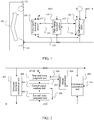
- FIG. 1 is a structure diagram of the echo canceller of the present embodiment.
- the echo canceller includes: a speaker 101, a microphone 102, a self-adaptive filter 103, a voice signal detection portion 104 and a path change detection portion 105.
- x(n) is a far-end voice signal
- d(n) is a receiving signal (near-end signal)
- e(n) is an error signal
- n represents time.
- the receiving signal includes one or more of a near-end voice signal, an echo signal and an environmental noise.
- the far-end voice signal x(n) is propagated in an echo path 100 through the speaker 101, and is picked up by the microphone 102, to form the echo signal.
- the self-adaptive filter 103 receives the far-end voice signal x(n) as a training signal to simulate the echo path 100, and cancels the echo signal in the receiving signal.
- the self-adaptive filter 103 it can use a Variable Step Size Normalized Least Mean Square (VSS-NLMS) algorithm generally, and the order is usually selected as 512 ⁇ 1024.
- VSS-NLMS Variable Step Size Normalized Least Mean Square
- the near-end voice signal may appear in the echo path (in a double-end communication), and the near-end voice signal has a bad effect on the self-adaptive filter 103, thus the voice signal detection portion 104 detects whether the near-end signal contains the near-end voice signal, hereby controlling the next work of the self-adaptive filter 103.
- the path change detection portion 105 detects whether the echo path 100 changes. Once the path changes, it needs that the self-adaptive filter 103 is able to change with it fast.
- the path change detection portion 105 is also used for controlling the work of the self-adaptive filter 103. Because mutual influence exists between the double-end communication and the path change, the path change detection portion 105 sends a control signal 107 to control threshold updating of the voice signal detection portion 104 after the path changes.
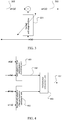
- FIG. 2 is a structure diagram of a voice signal detection portion 104 in the echo canceller of the present embodiment, supposing that the second self-adaptive filter is adopted to simulate the first L coefficients of the echo path 100.
- the order of the second self-adaptive filter is L (which generally is 32 ⁇ 128), and d1(n) is obtained by a convolution of the first L orders of coefficients of the self-adaptive filter 103 and the far-end voice signal x(n), that is, the desired signal of the second self-adaptive filter.
- a detection threshold initialization unit 201 stores the near-end signal while the communication link is established, and estimates the voice detection threshold according to a formula 1 and a formula 2, wherein the voice detection threshold is as an initial value of a near-end voice detection threshold of a near-end voice judgment unit 202 and an initial value of a far-end voice detection threshold of a far-end voice judgment unit 203.
- Threshold 0 K ⁇ E v 2
- Threshold 0 the initial value of the voice detection threshold
- v ( n ) the near-end signal stored by the detection threshold initialization unit 201
- N is a signal length and generally is 1000 ⁇ 3000
- K is a voice threshold estimation gain and generally is 3 ⁇ 5.
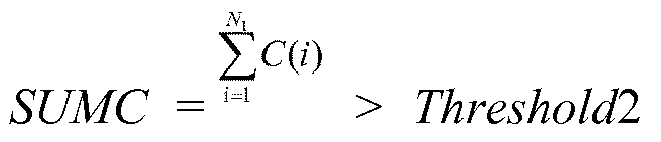
- the near-end voice judgment unit 202 is used for judging whether there is a near-end voice signal, and it performs the initial judgment according to formula 3. Due to misjudgment of the near-end voice on each point which is caused by unbalanced voice loudnesses, the near-end voice judgment unit 202, according to the characteristic that the voice points appear continuously, adds the point into a sliding window after judging whether there is the near-end voice in a single point, and judges that the near-end voice exists when the near-end voice points in the window exceed a threshold value, that is, it uses formula 4 to perform the final judgment.
- the far-end signal judgment unit 203 is the same as the above-mentioned work method, but it performs the initial judgment according to formula 5 and uses formula 6 to perform the final judgment.
- Threshold is a first near-end voice detection threshold
- Threshold2 is a second near-end voice detection threshold
- Threshholdl is a first far-end voice detection threshold
- Threshold3 is a second far-end voice detection threshold
- N 1 , N 2 is length of the sliding window and generally is 100 ⁇ 300
- M M + S , wherein M is a starting point of the sliding window and S is sliding length of the sliding window and generally is 50 ⁇ 150.
- the result of the voice judgment is input to a control signal sending unit 204 which sends a control signal 108 to control the self-adaptive filter 103 and the path change detection portion 105.
- the self-adaptive filter is closed at this moment;
- the path change detection portion 105 performs the path change detection.
- the echo path change may cause the uprush of the echo signals, it results in that there is no near-end voice signal while there are only the echo signals, but the near-end voice judgment unit 202 still judges that there is the near-end voice, and then it needs to judge whether the voice detection threshold is to be adjusted after the path changes.
- the result of the path change detection is fed back by a control signal 107 to control a correlation calculation unit 205. If it is detected that there is the path change, then the correlation calculation unit 205 is started.
- the correlation calculation unit 205 calculates the correlation of the receiving signal d(n) and the far-end voice signal x(n); when the correlation is greater than a setting correlation comparison threshold, it is illustrated that there is no near-end voice signal at this moment, and if the detection result 207 of the near-end voice judgment unit 202 is that there is the near-end voice signal, then it is illustrated that the threshold is invalid; and a threshold change control unit 206 sends out a control signal 208 to change the near-end voice detection threshold at this moment.
- the updating of the threshold is provided by formula 7.
- Threshold5 is a correlation comparison threshold and is generally set as 0.2 ⁇ 0.4; ⁇ is a signal variance, G 1 is a voice threshold estimation gain and generally is 3 ⁇ 5.
- FIG. 3 is a structure diagram of the second self-adaptive filter
- FIG. 4 is a structure diagram of the path change detection portion 105.
- an input signal of the second self-adaptive filter 301 is the far-end voice signal x(n), the desired signal is d1(n), and the error signal is el(n).
- the second self-adaptive filter 301 simulates the first L coefficients of the echo path 100. Because its order is smaller than the self-adaptive filter, the convergence effect is good, it can track the changing of the path faster after the path changes, and it judges whether the path change occurs by comparing the performances of the self-adaptive filters.
- d and e respectively represent the desired signal and the error signal of the calculated self-adaptive filter.
- ERLE1 is a performance value of the second self-adaptive filter
- ERLE2 is a performance value of the self-adaptive filter
- Threshold4 is a threshold of the path mutation and generally set as 15 ⁇ 20.
- the control signal 107 is provided finally to control the self-adaptive filter 103 and the voice signal detection portion 104.
- the self-adaptive filter 103 is restarted when the path mutation occurs, and the correlation calculation unit 205 of the voice signal detection portion 104 is opened at the same time.
- VSS-NLMS Variable Step Size Normalized Least Mean Square
- FIG. 5 is a flow of the echo cancellation method of embodiment 1 of the present embodiment, including the following steps:
- the detection threshold initialization unit 201 stores the near-end signal while the communication link is established, and estimates the voice detection threshold according to formula 1 and formula 2 as the initial threshold of the near-end voice judgment unit 202 and the far-end voice judgment unit 203.
- a random sequence sending portion 601 sends a random sequence voluntarily, to perform initialization to the self-adaptive filter 103.
- FIG. 6 is the structure diagram of the echo canceller of the present embodiment, and usually the random sequence is selected as an M sequence.
- the random sequence sent by the random sequence sending portion 601 is transmitted to the microphone 102 via the echo path 100 to form the echo signal so as to perform initialization to the self-adaptive filter 103, and the self-adaptive filter 103 uses the Variable Step Size Normalized Least Mean Square (VSS-NLMS) algorithm to perform the training, and the coefficient obtained from training are stored as the initial coefficient of the self-adaptive filter.
- VSS-NLMS Variable Step Size Normalized Least Mean Square
- the initial coefficient of the self-adaptive filter is not set as a 0 vector quantity but replaced by a preliminary simulation value of the echo path, thus making the convergence of the filter at the initialization stage be faster and the steady state error be less.
- the random sequence that is uncorrelated with any voice signal is adopted by the present embodiment, so that it makes the self-adaptive filter itself have a certain robustness during the double-end communication. Meanwhile, the random sequence sent after the voice communication link is established can remind the user that the voice channel is already connected, which has very good practicability.
- the order of the second self-adaptive filter is L (generally is 32 ⁇ 128)
- d1(n) is obtained by the convolution of the first L order coefficients of the self-adaptive filter 103 and the far-end signal x(n), that is, the desired signal of the second self-adaptive filter
- this signal is as the input and the near-end voice judgment unit 202 of the voice signal detection portion 104 judges whether there is the near-end voice signal in it; and the initial judgment is performed according to formula 3, and the final judgment is performed by using formula 4.
- the receiving signal d(n) of the self-adaptive filter is adopted as the input signal of the near-end voice judgment unit 202 of the voice signal detection portion 104.
- the voice signal is initially judged by adopting a frame structure and according to formula 10.
- the present invention can reach very good convergence effect at the initialization stage after adopting the above-mentioned technical scheme, and has a certain stability during the double-end communication; the random sequence has a prompt tone function and has very good practicability; it reduces the mutual influence between the double-end communication detection and the path mutation detection; and it improves the echo cancellation performance of an echo suppressor during the double-end communication and the path mutation. Therefore, the present invention has very strong industrial practicability.
Landscapes
- Engineering & Computer Science (AREA)
- Signal Processing (AREA)
- Physics & Mathematics (AREA)
- Acoustics & Sound (AREA)
- Multimedia (AREA)
- Cable Transmission Systems, Equalization Of Radio And Reduction Of Echo (AREA)
- Telephone Function (AREA)
Claims (15)
- Ein Echounterdrücker, umfassend: einen selbstadaptiven Filter (103), einen Sprachsignal-Erfassungsabschnitt (104) und einen Pfadänderungs-Erfassungsabschnitt (105), wobei ein Fernend-Sprachsignal x(n) in einem Echopfad (100) durch einen Lautsprecher (101) ausgebreitet wird und von einem Mikrofon (102) aufgenommen wird, um ein Echosignal zu bilden, wobei
der selbstadaptive Filter (103) so ausgebildet ist, dass er das Fernend-Sprachsignal x(n) als Trainingssignal empfängt, um den Echopfad (100) zu simulieren, und das Echosignal in einem Nahendsignal d(n) unterdrückt,
der Sprachsignal-Erfassungsabschnitt (104) ausgebildet ist, um zu erfassen, ob das Nahendsignal d(n) ein Nahend-Sprachsignal enthält und somit den selbstadaptiven Filter (103) steuert, und
der Pfadänderungs-Erfassungsabschnitt (105) ausgebildet ist, um zu erfassen, ob eine Änderung auf dem Echopfad (100) eintritt, und den selbstadaptiven Filter (103) abhängig davon steuert, ob die Änderung auf dem Echopfad (100) eintritt oder nicht,
wobei der Pfadänderungs-Erfassungsabschnitt (105) Folgendes umfasst: einen zweiten selbstadaptivens Filter (301), eine selbstadaptive Filterleistungsberechnungseinheit (401), eine zweite selbstadaptive Filterleistungsberechnungseinheit (402) und eine Leistungsvergleichseinheit (403), wobei:ein Eingangssignal des zweiten selbstadaptiven Filters (301) das Fernend-Sprachsignal x(n) ist, ein gewünschtes Signal d1(n) ein Wert ist, der durch die Faltung der Koeffizienten der ersten L-Ordnungen des selbstadaptiven Filters und des Fernend-Sprachsignals gewonnen wird, und ein Fehlersignal e1(n) ein Fehlersignal der Faltung ist, wobei der zweite selbstadaptive Filter (301) ausgebildet ist, um die ersten L-Koeffizienten des Echopfades (100) zu simulieren,die selbstadaptive Filterleistungsberechnungseinheit (401) ausgebildet ist, um die Leistung des selbstadaptiven Filters (103) zu berechnen und ein Ergebnis an die Leistungsvergleichseinheit (403) zu senden,die zweite selbstadaptive Filterleistungsberechnungseinheit (402) ausgebildet ist, um die Leistung des selbstadaptiven Filters (301) zu berechnen und ein Ergebnis an die Leistungsvergleichseinheit (403) zu senden, unddie Leistungsvergleichseinheit (403) ausgebildet ist, um die von der selbstadaptiven Filterleistungsberechnungseinheit (401) und der zweiten selbstadaptiven Filterleistungsberechnungseinheit (402) gesendeten Ergebnisse zu empfangen und dann zu beurteilen, ob eine Pfadmutation eintritt, den selbstadaptiven Filter (103) neu zu starten, wenn festgestellt wird, dass die Pfadmutation eintritt, und den selbstadaptiven Filter (103) normal zu aktualisieren, wenn festgestellt wird, dass keine Pfadmutation eintritt. - Echounterdrücker nach Anspruch 1, wobei ein Anfangskoeffizient des selbstadaptiven Filters (103) 0 ist, oder
der Echounterdrücker ferner einen Zufallssequenz-Sendeabschnitt (601) umfasst, wobei
der Zufallssequenz-Sendeabschnitt (601) ausgebildet ist, um eine Zufallssequenz an den Lautsprecher (101) zu senden, wenn eine Kommunikationsverbindung aufgebaut wird, wobei die Zufallssequenz den Echopfad und das Mikrofon (102) passiert, um das Echosignal zu bilden, und das Echosignal an den selbstadaptiven Filter (103) übertragen wird, um eine Initialisierung des selbstadaptiven Filters (103) durchzuführen, und
der selbstadaptive Filter (103) so ausgebildet ist, dass er trainiert, indem er das durch die Zufallssequenz gebildete Echosignal annimmt und einen aus dem Training als Anfangskoeffizienten erhaltenen Koeffizienten speichert;
vorzugsweise sind die Zufallssequenz und das Sprachsignal unkorreliert. - Echounterdrücker nach Anspruch 2, wobei der Sprachsignal-Erfassungsabschnitt (104) eine Erfassungsschwellen-Initialisierungseinheit (201), eine Nahend-Sprachbeurteilungseinheit (202), eine Fernend-Sprachbeurteilungseinheit (203) und eine Steuersignal-Sendeeinheit (204) umfasst, wobei:die Erfassungsschwellen-Initialisierungseinheit (201) ausgebildet ist, um das Nahendsignal (d(n)) zu speichern, wenn die Kommunikationsverbindung aufgebaut wird, und einen Anfangswert einer Spracherfassungsschwelle zu schätzen, indem das gespeicherte Nahendsignal angenommen wird, wobei der Anfangswert wie ein Anfangswert einer Nahend-Spracherfassungsschwelle der Nahend-Sprachbeurteilungseinheit (202) und ein Anfangswert einer Fernend-Spracherfassungsschwelle der Fernend-Sprachbeurteilungseinheit (203) ist,die Nahend-Sprachbeurteilungseinheit (202) ausgebildet ist, um zu beurteilen, ob das Nahend-Sprachsignal vorhanden ist, und ein Ergebnis einer Nahend-Sprachbeurteilung in die Steuersignal-Sendeeinheit (204) einzugeben,die Fernend-Sprachbeurteilungseinheit (203) ausgebildet ist, um zu beurteilen, ob ein Fernend-Sprachsignal vorhanden ist, und ein Ergebnis einer Fernend-Sprachbeurteilung in die Steuersignal-Sendeeinheit (204) einzugeben, unddie Steuersignal-Sendeeinheit (204) ausgebildet ist, um ein Steuersignal (108) zu senden, um den selbstadaptiven Filter (103) und den Pfadänderungs-Erfassungsabschnitt (105) zu steuern, nachdem das Ergebnis der Nahend-Sprachbeurteilung und das Ergebnis der Fernend-Sprachbeurteilung eingegangen sind.
- Echounterdrücker nach Anspruch 3, wobei die Steuersignal-Sendeeinheit (204) ausgebildet ist, um das Steuersignal zu senden, um den selbstadaptiven Filter (103) und den Pfadänderungs-Erfassungsabschnitt (105) folgender Art und Weise entsprechend zu ändern:Schließen des selbstadaptiven Filters (103) während einer Nahend-Kommunikation oder Stummschaltung,Sperren des selbstadaptiven Filters (103) während einer Doppelend-Kommunikation, wobei dies mit dem Nicht-Aktualisieren von Koeffizienten des selbstadaptiven Filters (103) gleichwertig ist,Starten des Pfadänderungs-Erfassungsabschnitts (105) während einer Nicht-Nahend-Kommunikation, Nicht-Stummschaltung und Nicht-Doppelend-Kommunikation,und/oderdie Erfassungsschwellen-Initialisierungseinheit (201) ausgebildet ist, um den Anfangswert der Spracherfassungsschwelle gemäß der folgenden Weise zu schätzen:Berechnen des Anfangswertes der Spracherfassungsschwelle durch Annehmen von Threshhold0 = K · E(v 2), wobei Threshhold0 der Anfangswert der Spracherfassungsschwelle ist, K eine Sprachschwellenschätzungsverstärkung ist,
 und/oderdie Nahend-Sprachbeurteilungseinheit (202) ausgebildet ist, um zu beurteilen, ob ein Nahend-Sprachsignal gemäß der folgenden Weise vorhanden ist:Hinzufügen von 1 zu einem Zähler C(n), wenn d1(n)2 > Threshold, und Beurteilen, ob ein Nahend-Sprachsignal im Nahendsignal enthalten ist, wenn

 die Fernend-Sprachbeurteilungseinheit (203) ausgebildet ist, um zu beurteilen, ob ein Fernend-Sprachsignal gemäß der folgenden Weise vorhanden ist:Hinzufügen von 1 zu einem Zähler D(n), wenn x(n)2 > Threshold1, und Beurteilen, ob ein Fernend-Sprachsignal im Fernendsignal enthalten ist, wenn
 vorzugsweise ist die erste Nahend-Spracherfassungsschwelle gleich der ersten Fernend-Spracherfassungsschwelle und die zweite Nahend-Spracherfassungsschwelle gleich der zweiten Fernend-Spracherfassungsschwelle.
 - Echounterdrücker nach Anspruch 3, wobei der Sprachsignalerfassungsabschnitt (104) ferner eine Korrelationsberechnungseinheit (205) und eine Schwellenänderungs-Steuereinheit (206) umfasst, wobei:die Korrelationsberechnungseinheit (205) so ausgebildet ist, dass sie ein von dem Pfadänderungs-Erfassungsabschnitt (105) gesendetes Pfadänderungs-Erfassungsergebnis empfängt, eine Korrelation des Nahendsignals und des Fernend-Sprachsignals berechnet, wenn sich der Echopfad ändert, feststellt, dass kein Nahend-Sprachsignal in dem Nahendsignal vorhanden ist, wenn die Korrelation größer als eine Korrelationsvergleichsschwelle ist, und ein Beurteilungsergebnis der Nahend-Sprachbeurteilungseinheit (202) überprüft und feststellt, dass die erste Nahend-Spracherfassungsschwelle ungültig ist, wenn das Ergebnis, der Beurteilung ist, dass das Nahend-Sprachsignal vorhanden ist, unddie Schwellenänderungs-Steuereinheit (206) so ausgebildet ist, dass sie: wenn die erste Nahend-Spracherfassungsschwelle ungültig ist, die Nahend-Spracherfassungsschwelle neu berechnet und ein Steuersignal (208) an die Nahend-Sprachbeurteilungseinheit (202) sendet, um die Nahend-Spracherfassungsschwelle zu ändern.
- Echounterdrücker nach Anspruch 5, wobei die Schwellenänderungs-Steuereinheit (206) so ausgebildet ist, dass sie die Nahend-Spracherfassungsschwelle gemäß der folgenden Weise neu berechnet:Beurteilen, ob
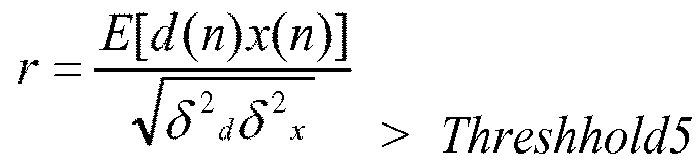
 wenn ja, dann Bestimmen, dass Threshold = G1·•E(d 2), wobei, wenn Threshold die erste Nahend-Spracherfassungsschwelle ist, Threshhold5 die Korrelationsvergleichsschwelle ist, δ eine Signalvarianz ist und G1 eine Sprachschwellenschätzungsverstärkung ist.
 - Echounterdrücker nach einem der Ansprüche 5 bis 6, wobei
die Leistungsvergleichseinheit (403) auch ausgebildet ist zum Öffnen der Korrelationsberechnungseinheit (205) des Sprachsignalerfassungsabschnitts (104), wenn festgestellt wird, dass die Pfadmutation eintritt. - Echounterdrücker nach Ansprüche 7, wobei:die selbstadaptive Filterleistungsberechnungseinheit (401) ausgebildet ist, dass sie die Leistung des selbstadaptiven Filters gemäß der folgenden Weise berechnet: Berechnen der Leistung des selbstadaptiven Filters nach
 die zweite selbstadaptive Filterleistungsberechnungseinheit (402) ausgebildet ist, dass sie die Leistung des zweiten selbstadaptiven Filters gemäß der folgenden Weise berechnet: Berechnen der Leistung des selbstadaptiven Filters nach
 die Leistungsvergleichseinheit (403) ausgebildet ist, dass sie beurteilt, ob die Pfadmutation auf folgende Weise erfolgt: Empfangen der Leistungswerte, die von der selbstadaptiven Filterleistungsberechnungseinheit (401) und der zweiten selbstadaptiven Filterleistungsberechnungseinheit (402) berechnet und bei diesen bezogen wurden, und beurteilt, ob ERLE1 - ERLE2 > Threshold4 vorhanden ist, wobei Threshhold4 eine Pfadmutationsschwelle ist; wenn ja, dann stellt sie fest, dass der Echopfad mutiert.
 - Ein Echounterdrückungsverfahren, umfassend:ein Fernend-Sprachsignal, das in einem Echopfad durch einen Lautsprecher ausgebreitet wird und von einem Mikrofon aufgenommen wird, um ein Echosignal zu bilden,Empfangen eines Fernend-Sprachsignals durch einen selbstadaptiven Filter als Trainingssignal zum Simulieren des Echopfades und zum Unterdrücken des Echosignals in einem Nahendsignal,Erfassen durch einen Sprachsignal-Erfassungsabschnitt, ob das Nahendsignal d(n) ein Nahend-Sprachsignal enthält, und somit Steuern des selbstadaptiven Filters, undErfassen durch den Pfadänderungs-Erfassungsabschnitt, ob eine Änderung auf dem Echopfad eintritt, und Steuern des selbstadaptiven Filters, je nachdem, ob die Änderung auf dem Echopfad eintritt oder nicht,Übernehmen des ferngesteuerten Sprachsignals als Eingangssignal eines zweiten selbstadaptiven Filters, Übernehmen eines Werts, der durch die Faltung der Koeffizienten der ersten L-Ordnungen des selbstadaptiven Filters und des Fernend-Sprachsignals als ein gewünschtes Signal des zweiten selbstadaptiven Filters gewonnen wird, und Übernehmen eines Fehlersignals der Faltung als Fehlersignal des zweiten selbstadaptiven Filters und Simulieren der ersten L-Koeffizienten des Echopfades durch den zweiten selbstadaptiven Filter,Berechnen der Leistung des selbstadaptiven Filters und der Leistung des zweiten selbstadaptiven Filters und Beurteilen, ob eine Pfadmutation eintritt, Neustarten des selbstadaptiven Filters bei Feststellung, das die Pfadmutation eintritt, und gleichzeitiges Starten der Korrelationsberechnung, sowie normales Aktualisieren des selbstadaptiven Filters, wenn festgestellt wird, dass keine Pfadmutation eintritt.
- Echounterdrückungsverfahren nach Anspruch 9, ferner umfassend: Einstellen eines Anfangskoeffizienten des selbstadaptiven Filters als 0, oder
Senden, durch einen Zufallssequenz-Sendeabschnitt, eine Zufallssequenz an den Lautsprecher, wenn eine Kommunikationsverbindung aufgebaut wird, wobei die Zufallssequenz den Echopfad und das Mikrofon passiert, um das Echosignal zu bilden, und das Echosignal an den selbstadaptiven Filter übertragen wird, um eine Initialisierung des selbstadaptiven Filters durchzuführen, und Durchführen, durch den selbstadaptiven Filter, eines Trainings durch Annehmen des von der Zufallssequenz gebildeten Echosignals sowie Speichern eines aus dem Training gewonnenen Koeffizienten als Anfangskoeffizient. - Echounterdrückungsverfahren nach Anspruch 10, wobei der Schritt des Feststellens, durch einen Sprachsignalerfassungsabschnitt, ob das Nahendsignal d(n) ein Nahend-Sprachsignal enthält, und auf diese Weise des Steuerns des selbstadaptiven Filters Folgendes umfasst:Speichern, durch den Sprachsignalerfassungsabschnitt, des Nahendsignals beim Aufbauen der Kommunikationsverbindung und Schätzen eines Anfangswertes einer Spracherfassungsschwelle durch Annehmen des gespeicherten Nahendsignals, wobei der Anfangswert ein Anfangswert einer Nahend-Spracherfassungsschwelle und ein Anfangswert einer Fernend-Spracherfassungsschwelle ist,Beurteilen, durch den Sprachsignalerfassungsabschnitt, ob ein Nahend-Sprachsignal vorhanden ist und ob ein Fernend-Sprachsignal vorhanden ist, und Senden eines Steuersignals zum Steuern des selbstadaptiven Filters und des Pfadänderungs-Erfassungsabschnitts.
- Echounterdrückungsverfahren nach Anspruch 11, wobei der Schritt des Sprachsignalerfassungsabschnitts, der ein Steuersignal sendet, um das selbstadaptive Filter und den Pfadänderungs-Erfassungsabschnitt zu steuern, Folgendes umfasst:Schließen (505) des selbstadaptiven Filters während einer Nahend-Kommunikation oder Stummschaltung,Sperren (507) des selbstadaptiven Filters während einer Doppelend-Kommunikation, wobei dies mit dem Nicht-Aktualisieren von Koeffizienten des selbstadaptiven Filters gleichwertig ist,Starten (508) einer Korrelationsberechnungseinheit des Pfadänderungs-Erfassungsabschnitts während einer Nicht-Nahend-Kommunikation, Nicht-Stummschaltung und Nicht-Doppelend-Kommunikation,und/oderder Schritt des Schätzens eines Anfangswertes einer Sprachsignal-Erfassungsschwelle durch Annehmen des gespeicherten Nahendsignals Folgendes umfasst:Berechnen des Anfangswertes der Spracherfassungsschwelle durch die Sprachsignal-Erfassungsschwelle durch Annehmen von Threshhold0 = K · E(v 2), wobei Threshhold0 der Anfangswert der Spracherfassungsschwelle ist, K eine Sprachschwellenschätzungsverstärkung ist,
 der Schritt des Sprachsignal-Erfassungsabschnitts, der beurteilt, ob ein Nahend-Sprachsignal vorhanden ist, Folgendes umfasst:Hinzufügen von 1 zu einem Zähler C(n), wenn d1(n)2 > Threshold, und Beurteilen, ob ein Nahend-Sprachsignal im Nahendsignal enthalten ist, wenn

 der Schritt des Sprachsignal-Erfassungsabschnitts, der beurteilt, ob ein Nahend-Sprachsignal vorhanden ist, Folgendes umfasst: Hinzufügen von 1 zu einem Zähler D(n), wenn x(n)2 > Threshold1, und Beurteilen, ob ein Fernend-Sprachsignal im Fernendsignal enthalten ist, wenn
 vorzugsweise ist die erste Nahend-Spracherfassungsschwelle gleich der ersten Fernend-Spracherfassungsschwelle und die zweite Nahend-Spracherfassungsschwelle gleich der zweiten Fernend-Spracherfassungsschwelle.
 - Echounterdrückungsverfahren nach Anspruch 11, ferner umfassend:Empfangen, durch den Sprachsignal-Erfassungsabschnitt, eines Pfadänderungs-Erfassungsergebnisses, das durch den Pfadänderungs-Erfassungsabschnitt gesendet wird, Berechnen einer Korrelation des Nahendsignals und des Fernend-Sprachsignals, wenn sich der Echopfad ändert, Feststellen, dass in dem Nahendsignal keine Nahend-Sprachsignal enthalten ist, wenn die Korrelation größer als eine Korrelationsvergleichsschwelle ist, und Überprüfen eines Beurteilungsergebnisses, ob ein Nahend-Sprachsignal vorhanden ist, und Feststellen, dass die erste Nahend-Spracherfassungsschwelle ungültig ist, wenn das Beurteilungsergebnis darin besteht, dass das Nahend-Sprachsignal vorhanden ist, undwenn die erste Nahend-Spracherfassungsschwelle ungültig ist, der Sprachsignalerfassungsabschnitt die Nahend-Spracherfassungsschwelle neu berechnet und ein Steuersignal sendet, um die Nahend-Spracherfassungsschwelle zu ändern.Vorzugsweise umfasst der Schritt des erneuten Berechnens der Nahend-Spracherfassungsschwelle:Beurteilen, ob

 wenn ja, dann Bestimmen, dass Threshold = G1·•E(d 2), wobei, wenn Threshold die erste Nahend-Spracherfassungsschwelle ist, Threshhold5 die Korrelationsvergleichsschwelle ist, δ eine Signalvarianz ist und G1 eine Sprachschwellenschätzungsverstärkung ist.
 - Echounterdrückungsverfahren nach Anspruch 13, ferner umfassend:beim Feststellen, dass eine Pfadmutation eintritt, Starten der Korrelationsberechnung.
- Echounterdrückungsverfahren nach Anspruch 14, wobei:der Schritt des Berechnens der Leistung des selbstadaptiven Filters Folgendes umfasst: Berechnen der Leistung des selbstadaptiven Filters nach
 der Schritt der Berechnung der Leistung des zweiten selbstadaptiven Filters Folgendes umfasst: Berechnen der Leistung des zweiten selbstadaptiven Filters nach
 der Schritt des Beurteilens, ob die Pfadmutation auftritt, Folgendes umfasst: Beurteilen, ob ERLE1 - ERLE2 > Threshold4 vorhanden ist, wobei Threshhold4 eine Pfadmutationsschwelle ist; wenn ja, dann des Feststellens, dass der Echopfad mutiert.
Applications Claiming Priority (2)
| Application Number | Priority Date | Filing Date | Title |
|---|---|---|---|
| CN201110442191.3A CN103179296B (zh) | 2011-12-26 | 2011-12-26 | 一种回波抵消器及回波抵消方法 |
| PCT/CN2012/072395 WO2013097357A1 (zh) | 2011-12-26 | 2012-03-15 | 一种回波抵消器及回波抵消方法 |
Publications (3)
| Publication Number | Publication Date |
|---|---|
| EP2785032A1 EP2785032A1 (de) | 2014-10-01 |
| EP2785032A4 EP2785032A4 (de) | 2015-06-10 |
| EP2785032B1 true EP2785032B1 (de) | 2017-08-16 |
Family
ID=48638906
Family Applications (1)
| Application Number | Title | Priority Date | Filing Date |
|---|---|---|---|
| EP12863916.8A Active EP2785032B1 (de) | 2011-12-26 | 2012-03-15 | Echounterdrücker und echounterdrückungsverfahren |
Country Status (6)
| Country | Link |
|---|---|
| US (1) | US9282195B2 (de) |
| EP (1) | EP2785032B1 (de) |
| CN (1) | CN103179296B (de) |
| ES (1) | ES2644579T3 (de) |
| PT (1) | PT2785032T (de) |
| WO (1) | WO2013097357A1 (de) |
Families Citing this family (24)
| Publication number | Priority date | Publication date | Assignee | Title |
|---|---|---|---|---|
| GB2515592B (en) * | 2013-12-23 | 2016-11-30 | Imagination Tech Ltd | Echo path change detector |
| GB2536742B (en) * | 2015-08-27 | 2017-08-09 | Imagination Tech Ltd | Nearend speech detector |
| EP3354004B1 (de) * | 2015-09-25 | 2021-10-27 | Microsemi Semiconductor (U.S.) Inc. | Vorrichtung und verfahren zur erkennung von akustischer echopfadveränderung |
| CN105677240B (zh) * | 2015-12-30 | 2019-04-23 | 上海联影医疗科技有限公司 | 数据删除方法及系统 |
| CN107786755B (zh) * | 2016-08-30 | 2020-12-15 | 合肥君正科技有限公司 | 一种双端通话检测方法和装置 |
| CN108076239B (zh) * | 2016-11-14 | 2021-04-16 | 深圳联友科技有限公司 | 一种改善ip电话回声的方法 |
| WO2019051841A1 (zh) * | 2017-09-18 | 2019-03-21 | 深圳市汇顶科技股份有限公司 | 确定滤波器系数的方法及其装置、终端 |
| EP3692703B9 (de) * | 2017-10-04 | 2021-11-17 | proactivaudio GmbH | Echokompensator und verfahren dafür |
| CN107888792B (zh) * | 2017-10-19 | 2019-09-17 | 浙江大华技术股份有限公司 | 一种回声消除方法、装置及系统 |
| CN108712585A (zh) * | 2018-05-09 | 2018-10-26 | 质音通讯科技(深圳)有限公司 | 通话终端、滤波器的初始化方法、装置、设备及存储介质 |
| GB2577905A (en) * | 2018-10-10 | 2020-04-15 | Nokia Technologies Oy | Processing audio signals |
| CN110600048B (zh) * | 2019-08-23 | 2022-03-25 | Oppo广东移动通信有限公司 | 音频校验方法、装置、存储介质及电子设备 |
| CN110995951B (zh) * | 2019-12-13 | 2021-09-03 | 展讯通信(上海)有限公司 | 基于双端发声检测的回声消除方法、装置及系统 |
| CN111277718B (zh) * | 2020-01-21 | 2021-10-08 | 上海推乐信息技术服务有限公司 | 一种回声消除系统及其方法 |
| CN111556210B (zh) * | 2020-04-23 | 2021-10-22 | 深圳市未艾智能有限公司 | 通话语音处理方法与装置、终端设备和存储介质 |
| CN111968658B (zh) * | 2020-06-30 | 2024-02-06 | 北京百度网讯科技有限公司 | 语音信号的增强方法、装置、电子设备和存储介质 |
| CN111970610B (zh) * | 2020-08-26 | 2022-05-20 | 展讯通信(上海)有限公司 | 回声路径检测方法、音频信号处理方法及系统、存储介质、终端 |
| CN112053700B (zh) * | 2020-08-31 | 2023-02-07 | 浙江大华技术股份有限公司 | 场景识别方法、装置、电子设备以及计算机可读存储介质 |
| DE102020213051A1 (de) * | 2020-10-15 | 2022-04-21 | Sivantos Pte. Ltd. | Verfahren zum Betrieb eines Hörhilfegeräts sowie Hörhilfegerät |
| TWI761075B (zh) * | 2021-02-09 | 2022-04-11 | 瑞昱半導體股份有限公司 | 回音抵消系統以及回音抵消方法 |
| CN114978238B (zh) * | 2021-02-18 | 2024-07-02 | 瑞昱半导体股份有限公司 | 回音抵消系统以及回音抵消方法 |
| CN113362842B (zh) * | 2021-06-30 | 2022-11-11 | 北京小米移动软件有限公司 | 音频信号处理方法及装置 |
| TWI790718B (zh) * | 2021-08-19 | 2023-01-21 | 宏碁股份有限公司 | 會議終端及用於會議的回音消除方法 |
| CN115881080B (zh) * | 2023-03-02 | 2023-05-26 | 全时云商务服务股份有限公司 | 一种语音通信系统中的声反馈处理方法及装置 |
Family Cites Families (6)
| Publication number | Priority date | Publication date | Assignee | Title |
|---|---|---|---|---|
| US6035034A (en) | 1996-12-20 | 2000-03-07 | Telefonaktiebolaget L M Ericsson (Publ) | Double talk and echo path change detection in a telephony system |
| JP3922997B2 (ja) * | 2002-10-30 | 2007-05-30 | 沖電気工業株式会社 | エコーキャンセラ |
| EP1827002A1 (de) * | 2006-02-22 | 2007-08-29 | Alcatel Lucent | Verfahren zur Anpassungsregelung eines Filters |
| US7817797B2 (en) * | 2006-06-07 | 2010-10-19 | Mitel Networks Corporation | Method and apparatus for detecting echo path changes in an acoustic echo canceller |
| FR2952263B1 (fr) | 2009-10-29 | 2012-01-06 | Univ Paris Descartes | Procede et dispositif d'annulation d'echo acoustique par tatouage audio |
| CN101826328A (zh) * | 2010-04-29 | 2010-09-08 | 浙江工业大学 | 嵌入式无线可视门铃中的回音抵消方法 |
-
2011
- 2011-12-26 CN CN201110442191.3A patent/CN103179296B/zh active Active
-
2012
- 2012-03-15 ES ES12863916.8T patent/ES2644579T3/es active Active
- 2012-03-15 WO PCT/CN2012/072395 patent/WO2013097357A1/zh not_active Ceased
- 2012-03-15 PT PT128639168T patent/PT2785032T/pt unknown
- 2012-03-15 US US14/368,953 patent/US9282195B2/en active Active
- 2012-03-15 EP EP12863916.8A patent/EP2785032B1/de active Active
Non-Patent Citations (1)
| Title |
|---|
| None * |
Also Published As
| Publication number | Publication date |
|---|---|
| EP2785032A1 (de) | 2014-10-01 |
| WO2013097357A1 (zh) | 2013-07-04 |
| PT2785032T (pt) | 2017-10-30 |
| US20140329568A1 (en) | 2014-11-06 |
| CN103179296B (zh) | 2017-02-15 |
| ES2644579T3 (es) | 2017-11-29 |
| US9282195B2 (en) | 2016-03-08 |
| EP2785032A4 (de) | 2015-06-10 |
| CN103179296A (zh) | 2013-06-26 |
Similar Documents
| Publication | Publication Date | Title |
|---|---|---|
| EP2785032B1 (de) | Echounterdrücker und echounterdrückungsverfahren | |
| CN109348072B (zh) | 一种应用于回声抵消系统的双端通话检测方法 | |
| CN103222192B (zh) | 信号处理设备和信号处理方法 | |
| Paleologu et al. | A variable step-size affine projection algorithm designed for acoustic echo cancellation | |
| US10250740B2 (en) | Echo path change detector | |
| US6434110B1 (en) | Full-duplex speakerphone circuit including a double-talk detector | |
| JP4456622B2 (ja) | ダブルトーク検出器、ダブルトーク検出方法及びエコーキャンセラ | |
| CN111052767B (zh) | 音频处理装置、音频处理方法以及信息处理装置 | |
| US8644522B2 (en) | Method and system for modeling external volume changes within an acoustic echo canceller | |
| US20090123002A1 (en) | System and method for providing step size control for subband affine projection filters for echo cancellation applications | |
| CN111989934B (zh) | 回声消除装置、回声消除方法、信号处理芯片及电子设备 | |
| Yang et al. | Statistical convergence analysis for optimal control of DFT-domain adaptive echo canceler | |
| CN111199748A (zh) | 回声消除方法、装置、设备以及存储介质 | |
| US8934622B2 (en) | Method for detecting double-talk condition and system using the same | |
| US20130218558A1 (en) | Method and system for detection of onset of near-end signal in an echo cancellation system | |
| CN115834778B (zh) | 一种回声消除方法、装置、电子设备及存储介质 | |
| CN111355855B (zh) | 回声处理方法、装置、设备及存储介质 | |
| WO2017012350A1 (zh) | 一种判断滤波器状态发散的方法及装置 | |
| CN116647621B (zh) | 回声消除方法、装置、设备及存储介质 | |
| CN113345457B (zh) | 一种基于贝叶斯理论的声学回声消除自适应滤波器及滤波方法 | |
| CN103533193B (zh) | 残留回波消除方法及装置 | |
| Gordy et al. | A perceptual performance measure for adaptive echo cancellers in packet-based telephony | |
| Paleologu et al. | A practical solution for the regularization of the affine projection algorithm | |
| WO2018087855A1 (ja) | エコーキャンセラ装置、エコー消去方法、及びエコー消去プログラム | |
| Lee et al. | A statistical model based post-filtering algorithm for residual echo suppression. |
Legal Events
| Date | Code | Title | Description |
|---|---|---|---|
| PUAI | Public reference made under article 153(3) epc to a published international application that has entered the european phase |
Free format text: ORIGINAL CODE: 0009012 |
|
| 17P | Request for examination filed |
Effective date: 20140626 |
|
| AK | Designated contracting states |
Kind code of ref document: A1 Designated state(s): AL AT BE BG CH CY CZ DE DK EE ES FI FR GB GR HR HU IE IS IT LI LT LU LV MC MK MT NL NO PL PT RO RS SE SI SK SM TR |
|
| DAX | Request for extension of the european patent (deleted) | ||
| RA4 | Supplementary search report drawn up and despatched (corrected) |
Effective date: 20150511 |
|
| RIC1 | Information provided on ipc code assigned before grant |
Ipc: H04M 9/08 20060101AFI20150504BHEP |
|
| GRAP | Despatch of communication of intention to grant a patent |
Free format text: ORIGINAL CODE: EPIDOSNIGR1 |
|
| INTG | Intention to grant announced |
Effective date: 20170322 |
|
| GRAS | Grant fee paid |
Free format text: ORIGINAL CODE: EPIDOSNIGR3 |
|
| GRAA | (expected) grant |
Free format text: ORIGINAL CODE: 0009210 |
|
| AK | Designated contracting states |
Kind code of ref document: B1 Designated state(s): AL AT BE BG CH CY CZ DE DK EE ES FI FR GB GR HR HU IE IS IT LI LT LU LV MC MK MT NL NO PL PT RO RS SE SI SK SM TR |
|
| REG | Reference to a national code |
Ref country code: GB Ref legal event code: FG4D |
|
| REG | Reference to a national code |
Ref country code: CH Ref legal event code: EP |
|
| REG | Reference to a national code |
Ref country code: IE Ref legal event code: FG4D |
|
| REG | Reference to a national code |
Ref country code: AT Ref legal event code: REF Ref document number: 920126 Country of ref document: AT Kind code of ref document: T Effective date: 20170915 |
|
| REG | Reference to a national code |
Ref country code: DE Ref legal event code: R096 Ref document number: 602012036139 Country of ref document: DE |
|
| REG | Reference to a national code |
Ref country code: PT Ref legal event code: SC4A Ref document number: 2785032 Country of ref document: PT Date of ref document: 20171030 Kind code of ref document: T Free format text: AVAILABILITY OF NATIONAL TRANSLATION Effective date: 20171016 |
|
| REG | Reference to a national code |
Ref country code: NL Ref legal event code: MP Effective date: 20170816 |
|
| REG | Reference to a national code |
Ref country code: LT Ref legal event code: MG4D |
|
| REG | Reference to a national code |
Ref country code: AT Ref legal event code: MK05 Ref document number: 920126 Country of ref document: AT Kind code of ref document: T Effective date: 20170816 |
|
| PG25 | Lapsed in a contracting state [announced via postgrant information from national office to epo] |
Ref country code: SE Free format text: LAPSE BECAUSE OF FAILURE TO SUBMIT A TRANSLATION OF THE DESCRIPTION OR TO PAY THE FEE WITHIN THE PRESCRIBED TIME-LIMIT Effective date: 20170816 Ref country code: LT Free format text: LAPSE BECAUSE OF FAILURE TO SUBMIT A TRANSLATION OF THE DESCRIPTION OR TO PAY THE FEE WITHIN THE PRESCRIBED TIME-LIMIT Effective date: 20170816 Ref country code: FI Free format text: LAPSE BECAUSE OF FAILURE TO SUBMIT A TRANSLATION OF THE DESCRIPTION OR TO PAY THE FEE WITHIN THE PRESCRIBED TIME-LIMIT Effective date: 20170816 Ref country code: NO Free format text: LAPSE BECAUSE OF FAILURE TO SUBMIT A TRANSLATION OF THE DESCRIPTION OR TO PAY THE FEE WITHIN THE PRESCRIBED TIME-LIMIT Effective date: 20171116 Ref country code: NL Free format text: LAPSE BECAUSE OF FAILURE TO SUBMIT A TRANSLATION OF THE DESCRIPTION OR TO PAY THE FEE WITHIN THE PRESCRIBED TIME-LIMIT Effective date: 20170816 Ref country code: AT Free format text: LAPSE BECAUSE OF FAILURE TO SUBMIT A TRANSLATION OF THE DESCRIPTION OR TO PAY THE FEE WITHIN THE PRESCRIBED TIME-LIMIT Effective date: 20170816 |
|
| PG25 | Lapsed in a contracting state [announced via postgrant information from national office to epo] |
Ref country code: RS Free format text: LAPSE BECAUSE OF FAILURE TO SUBMIT A TRANSLATION OF THE DESCRIPTION OR TO PAY THE FEE WITHIN THE PRESCRIBED TIME-LIMIT Effective date: 20170816 Ref country code: BG Free format text: LAPSE BECAUSE OF FAILURE TO SUBMIT A TRANSLATION OF THE DESCRIPTION OR TO PAY THE FEE WITHIN THE PRESCRIBED TIME-LIMIT Effective date: 20171116 Ref country code: LV Free format text: LAPSE BECAUSE OF FAILURE TO SUBMIT A TRANSLATION OF THE DESCRIPTION OR TO PAY THE FEE WITHIN THE PRESCRIBED TIME-LIMIT Effective date: 20170816 Ref country code: PL Free format text: LAPSE BECAUSE OF FAILURE TO SUBMIT A TRANSLATION OF THE DESCRIPTION OR TO PAY THE FEE WITHIN THE PRESCRIBED TIME-LIMIT Effective date: 20170816 Ref country code: GR Free format text: LAPSE BECAUSE OF FAILURE TO SUBMIT A TRANSLATION OF THE DESCRIPTION OR TO PAY THE FEE WITHIN THE PRESCRIBED TIME-LIMIT Effective date: 20171117 Ref country code: IS Free format text: LAPSE BECAUSE OF FAILURE TO SUBMIT A TRANSLATION OF THE DESCRIPTION OR TO PAY THE FEE WITHIN THE PRESCRIBED TIME-LIMIT Effective date: 20171216 |
|
| REG | Reference to a national code |
Ref country code: FR Ref legal event code: PLFP Year of fee payment: 7 |
|
| PG25 | Lapsed in a contracting state [announced via postgrant information from national office to epo] |
Ref country code: CZ Free format text: LAPSE BECAUSE OF FAILURE TO SUBMIT A TRANSLATION OF THE DESCRIPTION OR TO PAY THE FEE WITHIN THE PRESCRIBED TIME-LIMIT Effective date: 20170816 Ref country code: RO Free format text: LAPSE BECAUSE OF FAILURE TO SUBMIT A TRANSLATION OF THE DESCRIPTION OR TO PAY THE FEE WITHIN THE PRESCRIBED TIME-LIMIT Effective date: 20170816 Ref country code: DK Free format text: LAPSE BECAUSE OF FAILURE TO SUBMIT A TRANSLATION OF THE DESCRIPTION OR TO PAY THE FEE WITHIN THE PRESCRIBED TIME-LIMIT Effective date: 20170816 |
|
| REG | Reference to a national code |
Ref country code: DE Ref legal event code: R097 Ref document number: 602012036139 Country of ref document: DE |
|
| PG25 | Lapsed in a contracting state [announced via postgrant information from national office to epo] |
Ref country code: SM Free format text: LAPSE BECAUSE OF FAILURE TO SUBMIT A TRANSLATION OF THE DESCRIPTION OR TO PAY THE FEE WITHIN THE PRESCRIBED TIME-LIMIT Effective date: 20170816 Ref country code: EE Free format text: LAPSE BECAUSE OF FAILURE TO SUBMIT A TRANSLATION OF THE DESCRIPTION OR TO PAY THE FEE WITHIN THE PRESCRIBED TIME-LIMIT Effective date: 20170816 Ref country code: SK Free format text: LAPSE BECAUSE OF FAILURE TO SUBMIT A TRANSLATION OF THE DESCRIPTION OR TO PAY THE FEE WITHIN THE PRESCRIBED TIME-LIMIT Effective date: 20170816 |
|
| PLBE | No opposition filed within time limit |
Free format text: ORIGINAL CODE: 0009261 |
|
| STAA | Information on the status of an ep patent application or granted ep patent |
Free format text: STATUS: NO OPPOSITION FILED WITHIN TIME LIMIT |
|
| 26N | No opposition filed |
Effective date: 20180517 |
|
| PG25 | Lapsed in a contracting state [announced via postgrant information from national office to epo] |
Ref country code: SI Free format text: LAPSE BECAUSE OF FAILURE TO SUBMIT A TRANSLATION OF THE DESCRIPTION OR TO PAY THE FEE WITHIN THE PRESCRIBED TIME-LIMIT Effective date: 20170816 |
|
| REG | Reference to a national code |
Ref country code: CH Ref legal event code: PL |
|
| PG25 | Lapsed in a contracting state [announced via postgrant information from national office to epo] |
Ref country code: MC Free format text: LAPSE BECAUSE OF FAILURE TO SUBMIT A TRANSLATION OF THE DESCRIPTION OR TO PAY THE FEE WITHIN THE PRESCRIBED TIME-LIMIT Effective date: 20170816 |
|
| REG | Reference to a national code |
Ref country code: BE Ref legal event code: MM Effective date: 20180331 |
|
| REG | Reference to a national code |
Ref country code: IE Ref legal event code: MM4A |
|
| PG25 | Lapsed in a contracting state [announced via postgrant information from national office to epo] |
Ref country code: LU Free format text: LAPSE BECAUSE OF NON-PAYMENT OF DUE FEES Effective date: 20180315 |
|
| PG25 | Lapsed in a contracting state [announced via postgrant information from national office to epo] |
Ref country code: IE Free format text: LAPSE BECAUSE OF NON-PAYMENT OF DUE FEES Effective date: 20180315 |
|
| PG25 | Lapsed in a contracting state [announced via postgrant information from national office to epo] |
Ref country code: CH Free format text: LAPSE BECAUSE OF NON-PAYMENT OF DUE FEES Effective date: 20180331 Ref country code: BE Free format text: LAPSE BECAUSE OF NON-PAYMENT OF DUE FEES Effective date: 20180331 Ref country code: LI Free format text: LAPSE BECAUSE OF NON-PAYMENT OF DUE FEES Effective date: 20180331 |
|
| PG25 | Lapsed in a contracting state [announced via postgrant information from national office to epo] |
Ref country code: MT Free format text: LAPSE BECAUSE OF NON-PAYMENT OF DUE FEES Effective date: 20180315 |
|
| PG25 | Lapsed in a contracting state [announced via postgrant information from national office to epo] |
Ref country code: HU Free format text: LAPSE BECAUSE OF FAILURE TO SUBMIT A TRANSLATION OF THE DESCRIPTION OR TO PAY THE FEE WITHIN THE PRESCRIBED TIME-LIMIT; INVALID AB INITIO Effective date: 20120315 |
|
| PG25 | Lapsed in a contracting state [announced via postgrant information from national office to epo] |
Ref country code: HR Free format text: LAPSE BECAUSE OF FAILURE TO SUBMIT A TRANSLATION OF THE DESCRIPTION OR TO PAY THE FEE WITHIN THE PRESCRIBED TIME-LIMIT Effective date: 20170816 Ref country code: MK Free format text: LAPSE BECAUSE OF NON-PAYMENT OF DUE FEES Effective date: 20170816 Ref country code: CY Free format text: LAPSE BECAUSE OF FAILURE TO SUBMIT A TRANSLATION OF THE DESCRIPTION OR TO PAY THE FEE WITHIN THE PRESCRIBED TIME-LIMIT Effective date: 20170816 |
|
| PG25 | Lapsed in a contracting state [announced via postgrant information from national office to epo] |
Ref country code: AL Free format text: LAPSE BECAUSE OF FAILURE TO SUBMIT A TRANSLATION OF THE DESCRIPTION OR TO PAY THE FEE WITHIN THE PRESCRIBED TIME-LIMIT Effective date: 20170816 |
|
| PGFP | Annual fee paid to national office [announced via postgrant information from national office to epo] |
Ref country code: TR Payment date: 20210312 Year of fee payment: 10 |
|
| PGFP | Annual fee paid to national office [announced via postgrant information from national office to epo] |
Ref country code: FR Payment date: 20241231 Year of fee payment: 14 |
|
| PGFP | Annual fee paid to national office [announced via postgrant information from national office to epo] |
Ref country code: DE Payment date: 20241231 Year of fee payment: 14 Ref country code: PT Payment date: 20250312 Year of fee payment: 14 |
|
| PGFP | Annual fee paid to national office [announced via postgrant information from national office to epo] |
Ref country code: IT Payment date: 20250211 Year of fee payment: 14 Ref country code: GB Payment date: 20250102 Year of fee payment: 14 |
|
| PGFP | Annual fee paid to national office [announced via postgrant information from national office to epo] |
Ref country code: ES Payment date: 20250411 Year of fee payment: 14 |