EP2785192B1 - Frittiertes lebensmittelprodukt mit reduziertem ölgehalt - Google Patents
Frittiertes lebensmittelprodukt mit reduziertem ölgehalt Download PDFInfo
- Publication number
- EP2785192B1 EP2785192B1 EP12854177.8A EP12854177A EP2785192B1 EP 2785192 B1 EP2785192 B1 EP 2785192B1 EP 12854177 A EP12854177 A EP 12854177A EP 2785192 B1 EP2785192 B1 EP 2785192B1
- Authority
- EP
- European Patent Office
- Prior art keywords
- oil
- par
- frying
- food pieces
- fried food
- Prior art date
- Legal status (The legal status is an assumption and is not a legal conclusion. Google has not performed a legal analysis and makes no representation as to the accuracy of the status listed.)
- Active
Links
Images
Classifications
-
- A—HUMAN NECESSITIES
- A47—FURNITURE; DOMESTIC ARTICLES OR APPLIANCES; COFFEE MILLS; SPICE MILLS; SUCTION CLEANERS IN GENERAL
- A47J—KITCHEN EQUIPMENT; COFFEE MILLS; SPICE MILLS; APPARATUS FOR MAKING BEVERAGES
- A47J37/00—Baking; Roasting; Grilling; Frying
- A47J37/12—Deep fat fryers, e.g. for frying fish or chips
- A47J37/1214—Deep fat fryers, e.g. for frying fish or chips the food being transported through an oil-bath
-
- A—HUMAN NECESSITIES
- A23—FOODS OR FOODSTUFFS; TREATMENT THEREOF, NOT COVERED BY OTHER CLASSES
- A23L—FOODS, FOODSTUFFS OR NON-ALCOHOLIC BEVERAGES, NOT OTHERWISE PROVIDED FOR; PREPARATION OR TREATMENT THEREOF
- A23L19/00—Products from fruits or vegetables; Preparation or treatment thereof
- A23L19/10—Products from fruits or vegetables; Preparation or treatment thereof of tuberous or like starch containing root crops
- A23L19/12—Products from fruits or vegetables; Preparation or treatment thereof of tuberous or like starch containing root crops of potatoes
- A23L19/18—Roasted or fried products, e.g. snacks or chips
-
- A—HUMAN NECESSITIES
- A23—FOODS OR FOODSTUFFS; TREATMENT THEREOF, NOT COVERED BY OTHER CLASSES
- A23L—FOODS, FOODSTUFFS OR NON-ALCOHOLIC BEVERAGES, NOT OTHERWISE PROVIDED FOR; PREPARATION OR TREATMENT THEREOF
- A23L5/00—Preparation or treatment of foods or foodstuffs, in general; Food or foodstuffs obtained thereby; Materials therefor
- A23L5/10—General methods of cooking foods, e.g. by roasting or frying
- A23L5/11—General methods of cooking foods, e.g. by roasting or frying using oil
-
- A—HUMAN NECESSITIES
- A23—FOODS OR FOODSTUFFS; TREATMENT THEREOF, NOT COVERED BY OTHER CLASSES
- A23L—FOODS, FOODSTUFFS OR NON-ALCOHOLIC BEVERAGES, NOT OTHERWISE PROVIDED FOR; PREPARATION OR TREATMENT THEREOF
- A23L5/00—Preparation or treatment of foods or foodstuffs, in general; Food or foodstuffs obtained thereby; Materials therefor
- A23L5/10—General methods of cooking foods, e.g. by roasting or frying
- A23L5/11—General methods of cooking foods, e.g. by roasting or frying using oil
- A23L5/12—Processes other than deep-frying or float-frying using cooking oil in direct contact with the food
Definitions
- the present invention relates to an improved method for the production of a fried snack food with reduced oil content.
- Conventional potato chip products are prepared by the basic steps of slicing peeled, raw potatoes, water washing the slices to remove surface starch and frying the potato slices in hot oil until a moisture content of about 1% to 2% by weight is achieved. The fried slices are then salted or seasoned and packaged.
- Raw potato slices normally have moisture contents from 75% to 85% by weight depending on the type of potato and the environmental growing conditions. When potato slices are fried in hot oil, the moisture present boils. This results in burst cell walls and the formation of holes and voids which allow for oil absorption into the potato slices yielding significant oil contents.
- the oil content of potato chips is important for many reasons. Most important is its contribution to the overall organoleptic desirability of potato chips. Too high an oil content may render the chips greasy or oily and hence less desirable to consumers. On the other hand, it is possible to make chips so low in oil that they lack flavor and seem harsh in texture. Some nutritional guidelines also indicate it is desirable to maintain a diet low in oil or fat.
- WO-A-00/08950 discloses a method and apparatus for making bowl-shaped snack food products.
- WO-A-97/40706 discloses a process for making reduced-oil masa chips.
- US-A-4,929,461 discloses a process for producing batch type potato chips on a continuous basis.
- the present invention provides a method according to claim 1 for making fried food products. Preferred features are defined in the dependent claims.
- the proposed invention provides a method for producing fried food pieces.
- food pieces are par-fried by immersion in hot oil at a first temperature, and then finish fried by contact with hot oil at a higher second temperature.
- the finish frying step is accomplished by passing the par-fried food pieces through a hot oil curtain.
- the fried food pieces produced according to the present invention contain less oil than conventionally fried food pieces, yet retain the desirable visual, taste, and textural qualities of the higher oil fried food pieces.
- the present invention is directed to a method for producing fried food products with reduced oil content.
- moisture leaves the food product as steam, and the food product absorbs some of the oil in which it is fried.
- the embodiments described below are directed towards fried potato slices, but the invention in its broadest application applies to any food product that absorbs oil in the process of being fried and during subsequent cooling.
- the invention is designed to reduce, but not eliminate, the overall oil content of the finished food product.
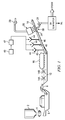
- Whole potatoes stored in hopper 2 are dispensed into a slicing apparatus 4 which drops potato slices into a water wash 6.
- the wash step is optional.
- the frying oil entering the fryer is maintained at an initial temperature between about 160°C (320°F) to about 193°C (380°F) more preferably between about 168°C (335°F) and about 188°C (370°F).
- Any conventional frying medium can be used in accordance with various embodiments of the present invention, including frying mediums with digestible and/or non-digestible oils.
- the fryer may be a continuous single flow or multizone fryer which utilizes devices such as paddle wheels, 14A and 14B, and a submergible conveyor belt 16 to control the flow of potato slices (not shown) through the fryer 10.
- Food pieces can include whole or pieces of a variety of fruits and vegetables, as well as legumes, nuts and seeds.
- Food pieces can also include fabricated chip products such as fabricated potato chips and tortilla chips.
- Food pieces may also include extruded collets made from corn meal or other starchy ingredients, which may be direct expanded extruded products or non-expanded extruded products.
- the potato slices or food pieces are par-fried to an intermediate moisture content and then removed from the fryer, preferably by a perforated endless belt conveyor 18 (sometimes referred to as a takeout conveyor).
- a perforated endless belt conveyor 18 sometimes referred to as a takeout conveyor. If no hot oil is added to the frying oil or if the oil is not otherwise heated during frying, at the location the perforated endless belt conveyor 18 contacts the frying oil, the frying oil comprises a final par-fry temperature of between about 143°C (290°F) to about 166°C (330°F) and more preferably between about 149°C (300°F) to about 160°C (320°F).
- the final par-fry oil temperature, as that term is used herein, of the first immersion frying step is the oil temperature at the location of the takeout means.
- the takeout means will typically comprise a takeout conveyor 18, as depicted in Figure 1 , and for a batch process the takeout means will typically be a perforated basket or takeout conveyor.
- the final par-fry oil temperature is the temperature of the oil at the location of the food pieces as they are being removed from the oil by the takeout means.
- the food pieces exit the fryer comprising an oil content of between about 30% and about 45% by weight, and an intermediate moisture content above 2% by weight, or in another embodiment above 3% by weight.
- the intermediate moisture content is between 1.5% and 15% by weight, or in another embodiment, between about 3% and about 10% by weight, or combinations of the foregoing ranges.
- the par-fried food pieces comprise an intermediate moisture content between about 2% and 10% by weight, and most preferably between about 3% and 6% by weight.
- the final moisture content of the food pieces is less than about 10%, and more preferably less than about 5%, by weight of the food products below the intermediate moisture content of the food pieces.
- the slices are then subjected to a hot oil finish frying step, which in a preferred embodiment, is accomplished by one or more hot oil curtains 46 disposed over the takeout conveyor 18.
- a hot oil curtain 46 is a volume of oil flowing from an oil dispenser 44 above the takeout conveyor 18, through the food products on the takeout conveyor and the takeout conveyor.
- the hot oil curtain 46 spans substantially the entire width of the takeout conveyor. Oil from the hot oil curtain 46 can be collected underneath the takeout conveyor in its own receptacle separate from the hot oil used for immersion frying, or can drain into the hot oil used for immersion frying.
- the oil used for the hot oil curtain is fed from an oil source 40, optionally through a heat exchanger 42, and into the oil dispensers 44 above the takeout conveyor 18.
- the oil source 40 is a source of fresh or reconditioned oil, and in another embodiment, the oil source 40 is the same oil used in the immersion fryer 10.
- the temperature of the hot oil curtain is greater than the final par-fry oil temperature of the first immersion frying step.
- Applicants have measured the vapor pressure of water inside a potato slice at different product temperatures and moisture contents. It was found that in order to maintain the vapor pressure inside the potato chip above 14.7 psia (or approximately atmospheric pressure), the product temperature must be above about 133°C to 154°C (270°F to 310°F) at moisture contents ranging from 1% to 2% moisture content. Therefore, Applicants theorize that the product temperature must be at least this high in order for water vapor inside the potato chip to resist the absorption of oil via capillary action.
- the product temperature must likely be even higher than these temperatures to overcome gravitational and capillary forces that may also favor absorption of oil, and will certainly need to be higher if water vapor is used to expel oil from the void spaces within the potato chip.
- the oil temperature must be higher than the desired product temperature to account for the commercially needed high rates of heat transfer between the oil and the product.
- Applicants have discovered that when an oil temperature of 171°C (340°F) is used in the finish frying step, no oil is removed or absorbed in the final product as compared to products that are fried to their final moisture content in one frying step.
- a finish frying oil temperature of 143°C (290°F) causes more oil to be absorbed by the final product
- a finish frying oil temperature of 199°C (390°F) causes less oil to be absorbed in the final product.
- the temperature of the hot oil curtain is at least about 177°C (350°F), and in a preferred embodiment at least about 196°C (385°F). In a preferred embodiment, the temperature of the hot oil curtain is greater than 171°C (340°F) and less than 213°C (415°F). In another embodiment, the difference between the final par-fry oil temperature in the first frying step and the initial finish-fry oil temperature in the finish frying step is at least 17°C (30°F). In a preferred embodiment, the difference is at least 28°C (50°F). In a most preferred embodiment, the system is configured with the ability to feed oil at different temperatures to each oil dispenser 44 to allow for a highly controlled finish frying step.
- the food pieces are subjected to a first frying step by immersion in oil at a first temperature, followed by a second frying step by passing the food products under at least one hot oil curtain at a second temperature, which is greater than the first temperature.
- a known process for continuous immersion frying of potato slices uses an initial oil temperature of 177°C to 182°C (350°F to 360°F), a final oil temperature of about 93°C to 160°C (270°F to 320°F), and a residence time of about 190 seconds. If hot oil is not added to the system, the oil cools as the food pieces are fried. The potato slices exit this frying process at a moisture content of about 1.4% by weight.
- potato slices are immersion fried at about the same initial oil temperature and on the same continuous frying equipment, but the residence time is reduced to about 80 seconds to 180 seconds, or in a preferred embodiment the residence time is reduced to about 80 seconds to 130 seconds. Then, as described above, the slices are removed from the hot oil, preferably as a product bed on a takeout conveyor, and subjected to finish frying by passing the product bed under at least one hot oil curtain.
- the first immersion frying step is followed by a second, short time, high temperature immersion frying step.
- the takeout conveyor from the first step can feed the par-fried food products into a second volume of oil maintained at a higher temperature than the oil temperature used for the first immersion frying step. More than one conveyor, or a different transfer means, may be used between the frying steps.
- the residence time in the second immersion fryer is less than 10 seconds, and more preferably less than 5 seconds, to bring the moisture content of the potato slices to a final moisture content of less than 2% by weight for washed potato slices, and less than about 2.5% by weight for unwashed kettle-style potato chips.
- the finish fried food products can be removed from the second volume of oil by any convenient means, such as a second takeout conveyor or a perforated basket.
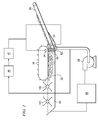
- the products being fried by immersion in hot oil can be subjected to a hot oil finish frying step by providing a submerged hot oil curtain inside the frying oil 10.
- a submerged hot oil curtain is depicted by the shaded region 56 of Figure 2 .
- the submerged hot oil curtain 56 is provided by at least one hot oil dispenser 54 located above the product bed 50 as it passes under the submerger 16.
- the submerged hot oil curtain 56 is supplemented by at least one oil dispenser 54 located below the product bed 50 as it moves from the submerger 16 to the takeout conveyor 18.
- the oil dispensers 54 can be fed by a fresh oil source 40 which is heated by a heat exchanger 42, but may also be fed, in whole or in part, by oil recycled from the fryer.
- the submerged hot oil curtain can represent a narrow band or region of oil between the submerger 16 and takeout conveyor 18.
- the hot oil is restricted to the regions inside the fryer near the oil dispensers 54 because the recirculation system drain 62 is located near the product exit end of the fryer.
- the recirculation system uses at least one pump 58 and heat exchanger 60 to recycle the oil to the product entrance end of the fryer. This maintains a well-defined region of hot oil in close proximity to the submerger 16 and takeout conveyor 18 that constitutes the submerged hot oil curtain 56.
- Providing a submerged hot oil curtain may provide advantages over other embodiments with respect to oil quality and product coverage. Because the oil in the submerged hot oil curtain will be in contact with air for a shorter period of time than the hot oil curtain located above the takeout conveyor, the oil in the submerged oil curtain may not oxidize as quickly. Also, the fact that the products are already submerged in oil when they pass through the submerged oil curtain will also help provide more uniformly cooked food products. As can be seen in Figures 1 and 2 , the hot oil curtain in either hot oil curtain embodiment is in close proximity to the takeout conveyor.
- inventive process has several surprising advantages over known frying methods.
- the fried food products that are produced by the invention comprise a lower oil content than food products subjected to known immersion frying processes.
- potato slices produced by the inventive method comprise an oil content of about 30%
- potato slices produced using only an immersion frying step would comprise an oil content of about 35%. This result was surprising because the inventive fried food products also have flavor, color and texture characteristics similar to fried food products produced by known frying methods. Even though the invention is not limited by theory, Applicants believe that the hot oil finish frying step reduces oil content in several ways.
- the viscosity of frying oil generally decreases with increasing temperature. Applicants believe that the hotter oil used in the finish frying step of the present invention drains more efficiently from the slices on the takeout conveyor.
- the hot oil also likely causes a rapid increase in chip temperature which converts most of the water remaining inside the potato slices into steam, which exits the slices. Applicants believe that this steam also ejects a portion of the oil that had been absorbed into the slice during immersion frying. Applicants have observed that when typical potato slices are fried using previous immersion frying methods, after a residence time in the oil of between about 80 seconds and 130 seconds, the bubbling of potato slices inside the fryer slows substantially - a point referred to as the bubble end point. The bubble end point will vary according to potato slice (or generally food product) characteristics and oil temperature, but regardless of conditions the bubble end point is visually perceptible by a skilled artisan.
- Applicants believe that at this point, the remaining water inside the potato slices has stopped converting to steam as efficiently as before, and oil starts absorbing into the potato slices after the bubble end point.
- Applicants propose to remove the potato slices from the first frying step before or shortly after the bubble end point, and subject them to a short time/higher temperature finish frying step to remove the remaining water and reduce the oil content of the final product.
- the potato slices are removed from the first frying step within about 10 seconds of (before or after) the bubble end point.
- the potato slices are removed from the first frying step less than about 50 seconds after the bubble end point, and in a preferred embodiment less than about 30 seconds after the bubble end point.
- the potato slices bubble rapidly as the water remaining in the slices is converted to steam.
- the fact that the hot oil is not continuously in contact with the food product during the final frying step is also thought to resist the absorption of oil. Also, because the food pieces are kept hot during the second frying step, water vapor present inside the potato chip will remain in the vapor state for a longer period of time and resist oil uptake that is believe to occur during cooling.
- the equipment used to carry out the inventive method can be easily retrofitted onto existing frying equipment.
- Equipment that can be retrofitted reduces the capital costs of implementing the inventive method.
- the inventive method can dramatically increase the capacity and throughput of existing frying equipment.
- the immersion frying time for potato chips can be reduced from about 190 seconds to between 80 and 130 seconds (preferably, between about 100-120 seconds).
- Such a reduced frying time could allow an existing fryer that has the capacity to produce 2,724 kg (6,000 pounds) of fried food pieces per hour, when modified according to the present invention, to produce about 4,540 kg (10,000 pounds) per hour of fried food pieces.
- the quality of the oil will be consistently higher because of the lower duty cycle and potentially higher fresh oil replenishment rate.
- the inventive method can also be coupled with a post-fry deoiling step.
- the deoiling step uses a steam knife/steam sweep surrounding the takeout conveyor to actively remove oil from the surface of the fried food pieces.
- the gas knife 20 passes a flow of an inert gas selected from one or more inert gases comprising superheated steam, nitrogen, carbon dioxide, and mixtures thereof, at a positive pressure fed by pump 29 above the fried food pieces and the gas sweep 34 provides a negative pressure provided by pump 39 below said fried food pieces.
- An oil eliminator can be used to separate the oil collected in the sweep stream.
- the inventive method can also be coupled with a post-fry dehydration step.
- Shelf-stable snack foods are dried to a moisture content below about 2% by weight, or below about 1.5% by weight.
- the food pieces described above are finish fried to a moisture content above about 2% by weight, and then subjected to a drying step that dehydrates the food pieces to a moisture content below about 2% by weight, or below about 1.5% by weight.
- the drying step can be one or a combination of hot air drying, microwave drying, infrared drying, or impingement drying. Other non-frying drying methods which are known in the art can be used.
- Control samples of potato chips were made by washing, peeling and slicing potatoes as is known in the art.
- the potato slices were then washed to remove surface starch.
- the control slices were fried in a batch immersion frying process at an initial oil temperature of 178°C (353°F) for about 190 seconds to a final moisture content below about 2% by weight.
- the resulting control potato chips had an average oil content of about 43% by weight of potato chips.
- a second set of similarly prepared potato slices was fried in a batch immersion fryer at an initial par-fry oil temperature of 178°C (353°F) for about 190 seconds, then removed from the batch fryer and, in a second batch fryer, dipped in oil at an initial finish-fry oil temperature of about 88°C (190°F) for about 30 seconds.
- the resulting potato chips had an average oil content of about 62% by weight of potato chips, which was significantly higher than the control sample.
- a third set of similarly prepared potato slices was fried in a batch immersion frying process at an initial par-fry oil temperature of 178°C (353°F) for about 190 seconds, then removed from the batch fryer and dipped in oil at an initial finish-fry temperature of about 149°C (300°F) for about 30 seconds.
- the resulting potato chips had an average oil content of about 57% by weight of potato chips, higher than the control sample.
- a fourth set of similarly prepared potato slices was fried in a batch immersion frying process at an initial par-fry oil temperature of 178°C (353°F) for about 190 seconds, then removed from the batch fryer and dipped in oil at an initial finish-fry temperature of about 199°C (390°F) for about 30 seconds.
- the resulting potato chips had an average oil content of about 38% by weight of potato chips, or 5% less oil by weight of the potato chips than the control sample.
- Table 1 Hot Oil Curtain Finish Fry Data Intermediate Moisture Content Oil Curtain Temperature Final Moisture Content Final Oil Content 1.8% 199°C (390°F) 1.3% 32.64% 2.59% 199°C (390°F) 1.43% 31.42% 2.94% 177°C (350°F) 1.25% 31.77% 2.94% 196°C (385°F) 1.02% 30.57% 2.94% 210°C (410°F) 1.25% 31.83%
- the intermediate moisture content is the moisture content of the potato slice after removal from the immersion frying step
- the final moisture content is the moisture content of the potato slices after the hot oil curtain frying step.
- tortilla chip preforms were made by sheeting a masa dough and cutting the sheet into pieces.
- One set of these preforms was a control set, and was fried in a batch fryer having an initial par-fry oil temperature of about 185°C (365°F) for about 55 seconds, to a final moisture content of about 1.4% by weight, which fried tortilla chips exhibited an oil content of about 25.7% by weight.
- Known fried tortilla chips produced on a continuous tortilla chip line comprise a moisture content of about 1.1%, and an oil content of about 23.5%.
- Other tortilla chip preforms were subjected to a first batch frying step having an initial par-fry oil temperature of about 185°C (365°F) for several different time periods, followed by a second batch frying step for 5 seconds in oil at a temperature of 199°C (390°F).
- Experimental sets were run using first frying step times of 25, 30, 35, 40 and 45 seconds, which produced fried tortilla chip sets which comprised about 20%, 20%, 21.5%, 21.5% and 21.5%, respectively.
- the experimental sets showed an oil reduction in absolute percentage terms from control of between 5.7% and 4.2% by weight of the chips, and between a 22% and 16% percentage reduction relative to the control sample.
Landscapes
- Chemical & Material Sciences (AREA)
- Engineering & Computer Science (AREA)
- Food Science & Technology (AREA)
- Oil, Petroleum & Natural Gas (AREA)
- Health & Medical Sciences (AREA)
- Nutrition Science (AREA)
- Life Sciences & Earth Sciences (AREA)
- Polymers & Plastics (AREA)
- Preparation Of Fruits And Vegetables (AREA)
- General Preparation And Processing Of Foods (AREA)
- Frying-Pans Or Fryers (AREA)
Claims (8)
- Verfahren zur Herstellung frittierter Lebensmittelprodukte, das die folgenden Schritte umfasst:Bereitstellen mehrerer Lebensmittelstücke;Anfrittieren der Lebensmittelstücke durch Eintauchen in heißes Öl, wobei das heiße Öl eine Anfrittierölanfangstemperatur und eine Anfrittierölendtemperatur umfasst, um anfrittierte Lebensmittelstücke zu produzieren;Herausnehmen der anfrittierten Lebensmittelstücke aus dem heißen Öl undEndfrittieren der anfrittierten Lebensmittelstücke durch Kontakt mit heißem Öl mit einer Endfrittierölanfangstemperatur, wobei die Endfrittierölanfangstemperatur höher als die Anfrittierölendtemperatur ist, um die frittierten Lebensmittelstücke zu produzieren,wobei der Anfrittierschritt das Anfrittieren der Lebensmittelstücke auf einen Zwischenfeuchtigkeitsgehalt zwischen 1,5 Gew.-% und 15 Gew.-% umfasst, wobei der Endfrittierschritt das Endfrittieren der anfrittierten Lebensmittelstücke auf einen Endfeuchtigkeitsgehalt von weniger als 2 Gew.-% und weniger als der Zwischenfeuchtigkeitsgehalt umfasst, und wobei der Endfrittierschritt das Eintauchfrittieren der anfrittierten Lebensmittelstücke für weniger als 10 Sekunden umfasst, wobei die Anfrittierölendtemperatur zwischen 132 °C und 177 °C (270 °F und 350 °F) liegt und wobei die Endfrittierölanfangstemperatur höher als 177 °C (350 °F) ist.
- Verfahren nach Anspruch 1, wobei der Endfrittierschritt das Endfrittieren der anfrittierten Lebensmittelstücke durch Führen der anfrittierten Lebensmittelstücke durch mindestens einen heißen Ölvorhang umfasst.
- Verfahren nach Anspruch 1, wobei der Endfrittierschritt das Endfrittieren der anfrittierten Lebensmittelstücke durch Führen der anfrittierten Lebensmittelstücke durch mindestens einen heißen Ölvorhang umfasst und wobei(i) der mindestens eine heiße Ölvorhang weiterhin mehrere heiße Ölvorhänge umfasst, und wobei mindestens ein heißer Ölvorhang eine Ölanfangstemperatur umfasst, die sich von einer Öltemperatur von mindestens einem anderen heißen Ölvorhang unterscheidet;
oder(ii) der Herausnehmungsschritt das Herausnehmen der anfrittierten Lebensmittelstücke unter Verwendung eines Herausnahmeförderers umfasst und wobei der mindestens eine heiße Ölvorhang über dem Herausnahmeförderer angeordnet ist;
oder(iii) der mindestens eine heiße Ölvorhang ein überspülter heißer Ölvorhang ist. - Verfahren nach Anspruch 1, wobei der Endfrittierschritt das Eintauchfrittieren der anfrittierten Lebensmittelstücke für weniger als 5 Sekunden umfasst.
- Verfahren nach Anspruch 1, das weiterhin einen Entölungsschritt umfasst,
gegebenenfalls wobei der Entölungsschritt das Abstreifen von Öl von den frittierten Lebensmittelstücken unter Verwendung einer Gasschneide und einer Gasspülung umfasst. - Verfahren nach Anspruch 1, das weiterhin das Trocknen der frittierten Lebensmittelstücke auf einen Feuchtigkeitsgehalt unter 2 Gew.-% umfasst.
- Verfahren nach Anspruch 3, wobei der heiße Ölvorhang ein überspülter heißer Ölvorhang in unmittelbarer Nähe zu einem Herausnahmemittel ist, das die Lebensmittelstücke aus dem heißen Öl herausnimmt.
- Verfahren nach Anspruch 1, das weiterhin einen Unterschied zwischen der
Anfrittierölanfangstemperatur und der Endfrittierölanfangstemperatur von mindestens 17 °C (30 °F), gegebenenfalls mindestens 28 °C (50 °F) umfasst.
Applications Claiming Priority (2)
| Application Number | Priority Date | Filing Date | Title |
|---|---|---|---|
| US13/308,285 US8945648B2 (en) | 2011-11-30 | 2011-11-30 | Fried food product with reduced oil content |
| PCT/US2012/067345 WO2013082457A1 (en) | 2011-11-30 | 2012-11-30 | Fried food product with reduced oil content |
Publications (3)
| Publication Number | Publication Date |
|---|---|
| EP2785192A1 EP2785192A1 (de) | 2014-10-08 |
| EP2785192A4 EP2785192A4 (de) | 2015-06-17 |
| EP2785192B1 true EP2785192B1 (de) | 2016-07-06 |
Family
ID=48467108
Family Applications (1)
| Application Number | Title | Priority Date | Filing Date |
|---|---|---|---|
| EP12854177.8A Active EP2785192B1 (de) | 2011-11-30 | 2012-11-30 | Frittiertes lebensmittelprodukt mit reduziertem ölgehalt |
Country Status (6)
| Country | Link |
|---|---|
| US (3) | US8945648B2 (de) |
| EP (1) | EP2785192B1 (de) |
| ES (1) | ES2587851T3 (de) |
| MX (2) | MX340496B (de) |
| RU (1) | RU2616359C2 (de) |
| WO (1) | WO2013082457A1 (de) |
Families Citing this family (9)
| Publication number | Priority date | Publication date | Assignee | Title |
|---|---|---|---|---|
| US20170035078A1 (en) * | 2015-08-04 | 2017-02-09 | Frito-Lay North America,Inc. | Method and system for producing a fried food product |
| US10736463B2 (en) * | 2016-03-17 | 2020-08-11 | Henny Penny Corporation | Multiport/rotary valve sensor using hall effect control |
| US10485380B2 (en) * | 2016-10-26 | 2019-11-26 | Frito-Lay North America, Inc. | System and method for controlling oil content in fried food products |
| CN107897234A (zh) * | 2017-11-29 | 2018-04-13 | 重庆市纭凡食品开发有限责任公司 | 切片油炸包装一体装置 |
| WO2020027263A1 (ja) * | 2018-08-01 | 2020-02-06 | 株式会社ニチレイフーズ | 油ちょう済み食品の製造方法 |
| CN112021960A (zh) * | 2020-07-30 | 2020-12-04 | 广州富港万嘉智能科技有限公司 | 对双面煎制设备的加热程度控制方法、计算机可读存储介质及双面煎制设备 |
| CN112514935B (zh) * | 2020-12-15 | 2025-02-25 | 江苏狼王机械科技有限公司 | 用于控制油炸食物产品中的油含量的系统及方法 |
| US12022836B2 (en) | 2021-02-11 | 2024-07-02 | Frito-Lay North America, Inc. | Snack food chip |
| GB2636843A (en) * | 2023-12-22 | 2025-07-02 | Believe In Science Ltd | Fryer and frying process |
Family Cites Families (44)
| Publication number | Priority date | Publication date | Assignee | Title |
|---|---|---|---|---|
| US2177166A (en) | 1938-05-28 | 1939-10-24 | Kenneth E Bemis | Method of and means for deep-fat frying of foods |
| CA867683A (en) | 1967-10-25 | 1971-04-06 | National Sea Products Limited | Continuous frying device and method |
| US3733202A (en) | 1970-11-18 | 1973-05-15 | Pillsbury Co | Deep fat frying process |
| USRE31819E (en) * | 1973-04-27 | 1985-01-29 | General Mills, Inc. | Chip separating from a fried ribbon |
| GB1486419A (en) | 1973-11-15 | 1977-09-21 | United Biscuits Ltd | Method and apparatus for treating food pieces |
| US4189994A (en) | 1978-04-03 | 1980-02-26 | Schmader Richard W | Method and apparatus for use in frying doughnuts |
| US4269861A (en) | 1979-02-21 | 1981-05-26 | Heat And Control, Inc. | Process for preparing french fried potatoes and apparatus |
| ATE4769T1 (de) | 1979-08-06 | 1983-10-15 | General Foods Corporation | Gefrorenes, in scheiben geschnittenes kartoffelprodukt zum simulieren von in fett gebackenen kartoffeln und verfahren zur herstellung. |
| US4537786A (en) | 1983-12-05 | 1985-08-27 | Frito-Lay, Inc. | Method of preparing low oil fried potato chips |
| US4503127A (en) | 1983-12-05 | 1985-03-05 | Frito-Lay, Inc. | Hot oil pretreatment of fried vegetable products |
| US4563944A (en) | 1984-06-29 | 1986-01-14 | Frito-Lay, Inc. | Product orienting conveyor |
| US4741912A (en) | 1985-12-19 | 1988-05-03 | Anheuser-Busch Companies, Inc. | Continuous multistage isothermal frying process to produce high crunch potato chips |
| US4980187A (en) | 1986-08-27 | 1990-12-25 | Mike-Sell's Potato Chip Co. | Method for preparing batch-type potato chips |
| US4929461A (en) | 1986-12-22 | 1990-05-29 | Frito-Lay, Inc. | Process for producing batch type potato chips on a continuous basis |
| US4844930A (en) | 1987-07-22 | 1989-07-04 | Borden, Inc. | Method for making potato chips |
| US4956189A (en) | 1988-03-07 | 1990-09-11 | Mike-Sell's Potato Chip Co. | Potato chip precooking method |
| US4923705A (en) | 1988-09-30 | 1990-05-08 | Borden, Inc. | Continuous method for making kettle style potato chips |
| US4882984A (en) * | 1988-10-07 | 1989-11-28 | Raytheon Company | Constant temperature fryer assembly |
| US4933199A (en) * | 1989-02-01 | 1990-06-12 | Frito-Lay, Inc. | Process for preparing low oil potato chips |
| CA2042654C (en) * | 1990-05-18 | 1996-10-01 | William Douglas Henson | Apparatus and process for producing kettle-style chips |
| US5846589A (en) | 1996-04-29 | 1998-12-08 | Recot, Inc. | Process of making a reduced oil snack chip |
| CZ341998A3 (cs) | 1996-04-29 | 1999-03-17 | The Procter & Gamble Company | Olejem potažené předsmažené bramborové hranolky a způsob jejich přípravy |
| US6129939A (en) | 1998-08-17 | 2000-10-10 | Recot, Inc. | Method for making bowl-shaped snack food products |
| US6067899A (en) | 1998-12-29 | 2000-05-30 | Heat & Control, Inc. | Breaded products fryer |
| US6703065B2 (en) | 1999-04-26 | 2004-03-09 | The Procter & Gamble Co. | Fabricated potato chips |
| US6251465B1 (en) | 1999-11-17 | 2001-06-26 | Recot, Inc. | Process for producing sheetable potato dough from raw potato stock |
| US6830767B2 (en) | 2000-05-27 | 2004-12-14 | The Procter & Gamble Co. | Method for constrain-frying snack pieces having intact surface features |
| US7074446B2 (en) | 2003-10-30 | 2006-07-11 | Frito-Lay North America, Inc. | Method for making a dual-textured food substrate having large seasoning bits |
| US7303777B2 (en) | 2004-07-20 | 2007-12-04 | Frito-Lay North America, Inc. | Method for continuously making kettle style potato chips |
| US20060083831A1 (en) | 2004-10-14 | 2006-04-20 | Caridis Andrew A | Forming and cooking with controlled curtain spillage |
| US20060088633A1 (en) | 2004-10-26 | 2006-04-27 | Barber Keith A | Process to produce a reduced fat potato chip |
| US8318229B2 (en) | 2005-01-24 | 2012-11-27 | Frito-Lay North America, Inc. | Method for controlling bulk density of fried snack pieces |
| PL1978825T3 (pl) | 2006-01-30 | 2010-11-30 | Bma Nederland B V | Sposób i urządzenie do wielostopniowego smażenia produktu |
| US7993693B2 (en) | 2006-07-19 | 2011-08-09 | Frito-Lay Trading Company Gmbh | Process for making a healthy snack food |
| US20110281005A1 (en) | 2007-07-13 | 2011-11-17 | Frito-Lay North America, Inc. | Method for reducing the oil content of potato chips |
| US20090297671A1 (en) | 2008-06-02 | 2009-12-03 | Frito-Lay North America, Inc. | Infusion Method for Vacuum Fried Fruit Leveraging |
| US8372467B2 (en) | 2008-07-22 | 2013-02-12 | Heat And Control, Inc. | Universal potato chip cooker |
| US20100040750A1 (en) * | 2008-08-13 | 2010-02-18 | Assaad Kimberly Nicole | Method and apparatus to produce a fried food product having a reduced level of fat and acrylamide |
| US20100051419A1 (en) | 2008-08-27 | 2010-03-04 | Pravin Maganlal Desai | System, method and apparatus for lowering the variability of temperature, moisture content, and acrylamide level in a food product |
| US8371568B2 (en) | 2010-05-25 | 2013-02-12 | Xerox Corporation | Actuator and dual bin size belt system for multiple size media transport |
| US20120052169A1 (en) | 2010-08-31 | 2012-03-01 | Frito-Lay North America, Inc. | Serial cooking method and system |
| US20120103764A1 (en) | 2010-10-29 | 2012-05-03 | Multi-Fill, Inc. | Conveyor belt connector |
| GB2481471B (en) | 2011-01-31 | 2012-06-20 | Frito Lay Trading Co Gmbh | Apparatus and method for separating food slices |
| US8613969B2 (en) | 2011-07-22 | 2013-12-24 | Frito-Lay North America, Inc. | Low pressure deoiling of fried food product |
-
2011
- 2011-11-30 US US13/308,285 patent/US8945648B2/en active Active
-
2012
- 2012-11-30 MX MX2014006474A patent/MX340496B/es active IP Right Grant
- 2012-11-30 RU RU2014125305A patent/RU2616359C2/ru not_active IP Right Cessation
- 2012-11-30 EP EP12854177.8A patent/EP2785192B1/de active Active
- 2012-11-30 ES ES12854177.8T patent/ES2587851T3/es active Active
- 2012-11-30 WO PCT/US2012/067345 patent/WO2013082457A1/en not_active Ceased
- 2012-11-30 MX MX2016009035A patent/MX377559B/es unknown
-
2014
- 2014-09-02 US US14/475,061 patent/US20140366748A1/en not_active Abandoned
- 2014-09-02 US US14/475,039 patent/US10517431B2/en active Active
Also Published As
| Publication number | Publication date |
|---|---|
| MX377559B (es) | 2025-03-04 |
| US20130136834A1 (en) | 2013-05-30 |
| EP2785192A1 (de) | 2014-10-08 |
| US8945648B2 (en) | 2015-02-03 |
| RU2616359C2 (ru) | 2017-04-14 |
| US20140366748A1 (en) | 2014-12-18 |
| US20140366747A1 (en) | 2014-12-18 |
| EP2785192A4 (de) | 2015-06-17 |
| MX2014006474A (es) | 2014-08-27 |
| MX340496B (es) | 2016-07-11 |
| ES2587851T3 (es) | 2016-10-27 |
| WO2013082457A1 (en) | 2013-06-06 |
| RU2014125305A (ru) | 2016-01-27 |
| US10517431B2 (en) | 2019-12-31 |
Similar Documents
| Publication | Publication Date | Title |
|---|---|---|
| US10517431B2 (en) | Fried food product with reduced oil content | |
| RU2539142C1 (ru) | Удаление масла при низком давлении из обжаренного пищевого продукта | |
| CA2908368C (en) | Method and system for producing a fried food product | |
| MX2011001674A (es) | Metodo y aparato para producir un producto alimenticio frito teniendo un nivel reducido en grasa y acrilamida. | |
| WO2017024162A1 (en) | Method and system for producing a fried food product | |
| CA2905757C (en) | Fried food product with reduced oil content | |
| WO2006047129A2 (en) | Improved process to produce a reduce fat potato chip | |
| US20130202756A1 (en) | Fried food product with reduced oil content | |
| US20120052169A1 (en) | Serial cooking method and system | |
| AU2014272185B2 (en) | Potato chip | |
| US20130266720A1 (en) | Potato chip |
Legal Events
| Date | Code | Title | Description |
|---|---|---|---|
| PUAI | Public reference made under article 153(3) epc to a published international application that has entered the european phase |
Free format text: ORIGINAL CODE: 0009012 |
|
| 17P | Request for examination filed |
Effective date: 20140627 |
|
| AK | Designated contracting states |
Kind code of ref document: A1 Designated state(s): AL AT BE BG CH CY CZ DE DK EE ES FI FR GB GR HR HU IE IS IT LI LT LU LV MC MK MT NL NO PL PT RO RS SE SI SK SM TR |
|
| DAX | Request for extension of the european patent (deleted) | ||
| RA4 | Supplementary search report drawn up and despatched (corrected) |
Effective date: 20150520 |
|
| RIC1 | Information provided on ipc code assigned before grant |
Ipc: A47J 37/12 20060101ALI20150513BHEP Ipc: A23L 1/217 20060101ALI20150513BHEP Ipc: A23C 15/14 20060101AFI20150513BHEP Ipc: A23L 1/01 20060101ALI20150513BHEP |
|
| GRAP | Despatch of communication of intention to grant a patent |
Free format text: ORIGINAL CODE: EPIDOSNIGR1 |
|
| RIC1 | Information provided on ipc code assigned before grant |
Ipc: A47J 37/12 20060101ALI20160125BHEP Ipc: A23L 5/20 20160101ALI20160125BHEP Ipc: A23C 15/14 20060101AFI20160125BHEP Ipc: A23L 19/18 20160101ALI20160125BHEP |
|
| INTG | Intention to grant announced |
Effective date: 20160219 |
|
| GRAS | Grant fee paid |
Free format text: ORIGINAL CODE: EPIDOSNIGR3 |
|
| GRAA | (expected) grant |
Free format text: ORIGINAL CODE: 0009210 |
|
| AK | Designated contracting states |
Kind code of ref document: B1 Designated state(s): AL AT BE BG CH CY CZ DE DK EE ES FI FR GB GR HR HU IE IS IT LI LT LU LV MC MK MT NL NO PL PT RO RS SE SI SK SM TR |
|
| REG | Reference to a national code |
Ref country code: GB Ref legal event code: FG4D |
|
| REG | Reference to a national code |
Ref country code: AT Ref legal event code: REF Ref document number: 810028 Country of ref document: AT Kind code of ref document: T Effective date: 20160715 Ref country code: CH Ref legal event code: EP |
|
| REG | Reference to a national code |
Ref country code: IE Ref legal event code: FG4D |
|
| REG | Reference to a national code |
Ref country code: DE Ref legal event code: R096 Ref document number: 602012020316 Country of ref document: DE |
|
| REG | Reference to a national code |
Ref country code: NL Ref legal event code: FP |
|
| REG | Reference to a national code |
Ref country code: ES Ref legal event code: FG2A Ref document number: 2587851 Country of ref document: ES Kind code of ref document: T3 Effective date: 20161027 |
|
| REG | Reference to a national code |
Ref country code: LT Ref legal event code: MG4D |
|
| REG | Reference to a national code |
Ref country code: FR Ref legal event code: PLFP Year of fee payment: 5 |
|
| REG | Reference to a national code |
Ref country code: AT Ref legal event code: MK05 Ref document number: 810028 Country of ref document: AT Kind code of ref document: T Effective date: 20160706 |
|
| PG25 | Lapsed in a contracting state [announced via postgrant information from national office to epo] |
Ref country code: FI Free format text: LAPSE BECAUSE OF FAILURE TO SUBMIT A TRANSLATION OF THE DESCRIPTION OR TO PAY THE FEE WITHIN THE PRESCRIBED TIME-LIMIT Effective date: 20160706 Ref country code: IT Free format text: LAPSE BECAUSE OF FAILURE TO SUBMIT A TRANSLATION OF THE DESCRIPTION OR TO PAY THE FEE WITHIN THE PRESCRIBED TIME-LIMIT Effective date: 20160706 Ref country code: NO Free format text: LAPSE BECAUSE OF FAILURE TO SUBMIT A TRANSLATION OF THE DESCRIPTION OR TO PAY THE FEE WITHIN THE PRESCRIBED TIME-LIMIT Effective date: 20161006 Ref country code: IS Free format text: LAPSE BECAUSE OF FAILURE TO SUBMIT A TRANSLATION OF THE DESCRIPTION OR TO PAY THE FEE WITHIN THE PRESCRIBED TIME-LIMIT Effective date: 20161106 Ref country code: HR Free format text: LAPSE BECAUSE OF FAILURE TO SUBMIT A TRANSLATION OF THE DESCRIPTION OR TO PAY THE FEE WITHIN THE PRESCRIBED TIME-LIMIT Effective date: 20160706 Ref country code: LT Free format text: LAPSE BECAUSE OF FAILURE TO SUBMIT A TRANSLATION OF THE DESCRIPTION OR TO PAY THE FEE WITHIN THE PRESCRIBED TIME-LIMIT Effective date: 20160706 Ref country code: RS Free format text: LAPSE BECAUSE OF FAILURE TO SUBMIT A TRANSLATION OF THE DESCRIPTION OR TO PAY THE FEE WITHIN THE PRESCRIBED TIME-LIMIT Effective date: 20160706 |
|
| PGFP | Annual fee paid to national office [announced via postgrant information from national office to epo] |
Ref country code: FR Payment date: 20161123 Year of fee payment: 5 |
|
| PG25 | Lapsed in a contracting state [announced via postgrant information from national office to epo] |
Ref country code: AT Free format text: LAPSE BECAUSE OF FAILURE TO SUBMIT A TRANSLATION OF THE DESCRIPTION OR TO PAY THE FEE WITHIN THE PRESCRIBED TIME-LIMIT Effective date: 20160706 Ref country code: SE Free format text: LAPSE BECAUSE OF FAILURE TO SUBMIT A TRANSLATION OF THE DESCRIPTION OR TO PAY THE FEE WITHIN THE PRESCRIBED TIME-LIMIT Effective date: 20160706 Ref country code: LV Free format text: LAPSE BECAUSE OF FAILURE TO SUBMIT A TRANSLATION OF THE DESCRIPTION OR TO PAY THE FEE WITHIN THE PRESCRIBED TIME-LIMIT Effective date: 20160706 Ref country code: PL Free format text: LAPSE BECAUSE OF FAILURE TO SUBMIT A TRANSLATION OF THE DESCRIPTION OR TO PAY THE FEE WITHIN THE PRESCRIBED TIME-LIMIT Effective date: 20160706 Ref country code: PT Free format text: LAPSE BECAUSE OF FAILURE TO SUBMIT A TRANSLATION OF THE DESCRIPTION OR TO PAY THE FEE WITHIN THE PRESCRIBED TIME-LIMIT Effective date: 20161107 Ref country code: GR Free format text: LAPSE BECAUSE OF FAILURE TO SUBMIT A TRANSLATION OF THE DESCRIPTION OR TO PAY THE FEE WITHIN THE PRESCRIBED TIME-LIMIT Effective date: 20161007 |
|
| PGFP | Annual fee paid to national office [announced via postgrant information from national office to epo] |
Ref country code: ES Payment date: 20161128 Year of fee payment: 5 Ref country code: BE Payment date: 20161128 Year of fee payment: 5 |
|
| REG | Reference to a national code |
Ref country code: DE Ref legal event code: R097 Ref document number: 602012020316 Country of ref document: DE |
|
| PG25 | Lapsed in a contracting state [announced via postgrant information from national office to epo] |
Ref country code: EE Free format text: LAPSE BECAUSE OF FAILURE TO SUBMIT A TRANSLATION OF THE DESCRIPTION OR TO PAY THE FEE WITHIN THE PRESCRIBED TIME-LIMIT Effective date: 20160706 Ref country code: RO Free format text: LAPSE BECAUSE OF FAILURE TO SUBMIT A TRANSLATION OF THE DESCRIPTION OR TO PAY THE FEE WITHIN THE PRESCRIBED TIME-LIMIT Effective date: 20160706 |
|
| PGFP | Annual fee paid to national office [announced via postgrant information from national office to epo] |
Ref country code: TR Payment date: 20161108 Year of fee payment: 5 |
|
| PLBE | No opposition filed within time limit |
Free format text: ORIGINAL CODE: 0009261 |
|
| STAA | Information on the status of an ep patent application or granted ep patent |
Free format text: STATUS: NO OPPOSITION FILED WITHIN TIME LIMIT |
|
| PG25 | Lapsed in a contracting state [announced via postgrant information from national office to epo] |
Ref country code: SK Free format text: LAPSE BECAUSE OF FAILURE TO SUBMIT A TRANSLATION OF THE DESCRIPTION OR TO PAY THE FEE WITHIN THE PRESCRIBED TIME-LIMIT Effective date: 20160706 Ref country code: BG Free format text: LAPSE BECAUSE OF FAILURE TO SUBMIT A TRANSLATION OF THE DESCRIPTION OR TO PAY THE FEE WITHIN THE PRESCRIBED TIME-LIMIT Effective date: 20161006 Ref country code: CZ Free format text: LAPSE BECAUSE OF FAILURE TO SUBMIT A TRANSLATION OF THE DESCRIPTION OR TO PAY THE FEE WITHIN THE PRESCRIBED TIME-LIMIT Effective date: 20160706 Ref country code: DK Free format text: LAPSE BECAUSE OF FAILURE TO SUBMIT A TRANSLATION OF THE DESCRIPTION OR TO PAY THE FEE WITHIN THE PRESCRIBED TIME-LIMIT Effective date: 20160706 Ref country code: SM Free format text: LAPSE BECAUSE OF FAILURE TO SUBMIT A TRANSLATION OF THE DESCRIPTION OR TO PAY THE FEE WITHIN THE PRESCRIBED TIME-LIMIT Effective date: 20160706 |
|
| 26N | No opposition filed |
Effective date: 20170407 |
|
| REG | Reference to a national code |
Ref country code: CH Ref legal event code: PL |
|
| PG25 | Lapsed in a contracting state [announced via postgrant information from national office to epo] |
Ref country code: CH Free format text: LAPSE BECAUSE OF NON-PAYMENT OF DUE FEES Effective date: 20161130 Ref country code: LI Free format text: LAPSE BECAUSE OF NON-PAYMENT OF DUE FEES Effective date: 20161130 |
|
| REG | Reference to a national code |
Ref country code: IE Ref legal event code: MM4A |
|
| PG25 | Lapsed in a contracting state [announced via postgrant information from national office to epo] |
Ref country code: SI Free format text: LAPSE BECAUSE OF FAILURE TO SUBMIT A TRANSLATION OF THE DESCRIPTION OR TO PAY THE FEE WITHIN THE PRESCRIBED TIME-LIMIT Effective date: 20160706 |
|
| PG25 | Lapsed in a contracting state [announced via postgrant information from national office to epo] |
Ref country code: LU Free format text: LAPSE BECAUSE OF NON-PAYMENT OF DUE FEES Effective date: 20161130 |
|
| PG25 | Lapsed in a contracting state [announced via postgrant information from national office to epo] |
Ref country code: IE Free format text: LAPSE BECAUSE OF NON-PAYMENT OF DUE FEES Effective date: 20161130 |
|
| PG25 | Lapsed in a contracting state [announced via postgrant information from national office to epo] |
Ref country code: HU Free format text: LAPSE BECAUSE OF FAILURE TO SUBMIT A TRANSLATION OF THE DESCRIPTION OR TO PAY THE FEE WITHIN THE PRESCRIBED TIME-LIMIT; INVALID AB INITIO Effective date: 20121130 |
|
| PG25 | Lapsed in a contracting state [announced via postgrant information from national office to epo] |
Ref country code: MC Free format text: LAPSE BECAUSE OF FAILURE TO SUBMIT A TRANSLATION OF THE DESCRIPTION OR TO PAY THE FEE WITHIN THE PRESCRIBED TIME-LIMIT Effective date: 20160706 Ref country code: MK Free format text: LAPSE BECAUSE OF FAILURE TO SUBMIT A TRANSLATION OF THE DESCRIPTION OR TO PAY THE FEE WITHIN THE PRESCRIBED TIME-LIMIT Effective date: 20160706 Ref country code: CY Free format text: LAPSE BECAUSE OF FAILURE TO SUBMIT A TRANSLATION OF THE DESCRIPTION OR TO PAY THE FEE WITHIN THE PRESCRIBED TIME-LIMIT Effective date: 20160706 |
|
| REG | Reference to a national code |
Ref country code: FR Ref legal event code: ST Effective date: 20180731 Ref country code: BE Ref legal event code: FP Effective date: 20161003 Ref country code: BE Ref legal event code: MM Effective date: 20171130 |
|
| PG25 | Lapsed in a contracting state [announced via postgrant information from national office to epo] |
Ref country code: MT Free format text: LAPSE BECAUSE OF NON-PAYMENT OF DUE FEES Effective date: 20161130 |
|
| PG25 | Lapsed in a contracting state [announced via postgrant information from national office to epo] |
Ref country code: AL Free format text: LAPSE BECAUSE OF FAILURE TO SUBMIT A TRANSLATION OF THE DESCRIPTION OR TO PAY THE FEE WITHIN THE PRESCRIBED TIME-LIMIT Effective date: 20160706 Ref country code: FR Free format text: LAPSE BECAUSE OF NON-PAYMENT OF DUE FEES Effective date: 20171130 |
|
| PG25 | Lapsed in a contracting state [announced via postgrant information from national office to epo] |
Ref country code: BE Free format text: LAPSE BECAUSE OF NON-PAYMENT OF DUE FEES Effective date: 20171130 |
|
| REG | Reference to a national code |
Ref country code: ES Ref legal event code: FD2A Effective date: 20181226 |
|
| PG25 | Lapsed in a contracting state [announced via postgrant information from national office to epo] |
Ref country code: ES Free format text: LAPSE BECAUSE OF NON-PAYMENT OF DUE FEES Effective date: 20171201 |
|
| REG | Reference to a national code |
Ref country code: DE Ref legal event code: R082 Ref document number: 602012020316 Country of ref document: DE Representative=s name: PAGE, WHITE & FARRER GERMANY LLP, DE |
|
| PG25 | Lapsed in a contracting state [announced via postgrant information from national office to epo] |
Ref country code: TR Free format text: LAPSE BECAUSE OF NON-PAYMENT OF DUE FEES Effective date: 20171130 |
|
| P01 | Opt-out of the competence of the unified patent court (upc) registered |
Effective date: 20230518 |
|
| PGFP | Annual fee paid to national office [announced via postgrant information from national office to epo] |
Ref country code: NL Payment date: 20251126 Year of fee payment: 14 |
|
| PGFP | Annual fee paid to national office [announced via postgrant information from national office to epo] |
Ref country code: DE Payment date: 20251128 Year of fee payment: 14 |
|
| PGFP | Annual fee paid to national office [announced via postgrant information from national office to epo] |
Ref country code: GB Payment date: 20251127 Year of fee payment: 14 |