EP2786801A2 - Adsorbens mit Fähigkeit zur CO2-Abscheidung aus Gasgemischen - Google Patents
Adsorbens mit Fähigkeit zur CO2-Abscheidung aus Gasgemischen Download PDFInfo
- Publication number
- EP2786801A2 EP2786801A2 EP20140163420 EP14163420A EP2786801A2 EP 2786801 A2 EP2786801 A2 EP 2786801A2 EP 20140163420 EP20140163420 EP 20140163420 EP 14163420 A EP14163420 A EP 14163420A EP 2786801 A2 EP2786801 A2 EP 2786801A2
- Authority
- EP
- European Patent Office
- Prior art keywords
- adsorbent
- carbon dioxide
- methane
- adsorption
- pressure
- Prior art date
- Legal status (The legal status is an assumption and is not a legal conclusion. Google has not performed a legal analysis and makes no representation as to the accuracy of the status listed.)
- Withdrawn
Links
- 239000003463 adsorbent Substances 0.000 title claims abstract description 172
- 239000000203 mixture Substances 0.000 title claims abstract description 57
- CURLTUGMZLYLDI-UHFFFAOYSA-N Carbon dioxide Chemical compound O=C=O CURLTUGMZLYLDI-UHFFFAOYSA-N 0.000 claims abstract description 318
- VNWKTOKETHGBQD-UHFFFAOYSA-N methane Chemical compound C VNWKTOKETHGBQD-UHFFFAOYSA-N 0.000 claims abstract description 272
- 229910002092 carbon dioxide Inorganic materials 0.000 claims abstract description 185
- 239000001569 carbon dioxide Substances 0.000 claims abstract description 184
- 238000001179 sorption measurement Methods 0.000 claims abstract description 75
- OKTJSMMVPCPJKN-UHFFFAOYSA-N Carbon Chemical compound [C] OKTJSMMVPCPJKN-UHFFFAOYSA-N 0.000 claims abstract description 56
- 229910052799 carbon Inorganic materials 0.000 claims abstract description 55
- 238000000034 method Methods 0.000 claims description 34
- 239000008188 pellet Substances 0.000 claims description 19
- 229920000642 polymer Polymers 0.000 claims description 19
- 229920001577 copolymer Polymers 0.000 claims description 18
- 239000005033 polyvinylidene chloride Substances 0.000 claims description 16
- 229920001328 Polyvinylidene chloride Polymers 0.000 claims description 14
- 238000001994 activation Methods 0.000 claims description 10
- 239000002033 PVDF binder Substances 0.000 claims description 9
- 238000003795 desorption Methods 0.000 claims description 9
- 229920002981 polyvinylidene fluoride Polymers 0.000 claims description 9
- 239000002245 particle Substances 0.000 claims description 6
- BAPJBEWLBFYGME-UHFFFAOYSA-N Methyl acrylate Chemical compound COC(=O)C=C BAPJBEWLBFYGME-UHFFFAOYSA-N 0.000 claims description 4
- 239000006057 Non-nutritive feed additive Substances 0.000 claims description 4
- PPBRXRYQALVLMV-UHFFFAOYSA-N Styrene Chemical compound C=CC1=CC=CC=C1 PPBRXRYQALVLMV-UHFFFAOYSA-N 0.000 claims description 4
- 239000000654 additive Substances 0.000 claims description 4
- 239000011324 bead Substances 0.000 claims description 4
- 230000003213 activating effect Effects 0.000 claims description 3
- 238000004519 manufacturing process Methods 0.000 claims description 3
- 238000002844 melting Methods 0.000 claims description 3
- 230000008018 melting Effects 0.000 claims description 3
- NLHHRLWOUZZQLW-UHFFFAOYSA-N Acrylonitrile Chemical compound C=CC#N NLHHRLWOUZZQLW-UHFFFAOYSA-N 0.000 claims description 2
- VEXZGXHMUGYJMC-UHFFFAOYSA-M Chloride anion Chemical compound [Cl-] VEXZGXHMUGYJMC-UHFFFAOYSA-M 0.000 claims description 2
- VVQNEPGJFQJSBK-UHFFFAOYSA-N Methyl methacrylate Chemical compound COC(=O)C(C)=C VVQNEPGJFQJSBK-UHFFFAOYSA-N 0.000 claims description 2
- BZHJMEDXRYGGRV-UHFFFAOYSA-N Vinyl chloride Chemical compound ClC=C BZHJMEDXRYGGRV-UHFFFAOYSA-N 0.000 claims description 2
- 239000011449 brick Substances 0.000 claims description 2
- 239000004744 fabric Substances 0.000 claims description 2
- XUCNUKMRBVNAPB-UHFFFAOYSA-N fluoroethene Chemical compound FC=C XUCNUKMRBVNAPB-UHFFFAOYSA-N 0.000 claims description 2
- 229910021385 hard carbon Inorganic materials 0.000 claims description 2
- 210000002268 wool Anatomy 0.000 claims description 2
- 239000011368 organic material Substances 0.000 claims 1
- 239000007789 gas Substances 0.000 abstract description 70
- 239000003345 natural gas Substances 0.000 abstract description 17
- 239000003245 coal Substances 0.000 abstract description 5
- 238000000746 purification Methods 0.000 abstract description 5
- 238000007670 refining Methods 0.000 abstract description 2
- 230000008569 process Effects 0.000 description 19
- 239000000463 material Substances 0.000 description 18
- 238000013459 approach Methods 0.000 description 15
- XLYOFNOQVPJJNP-UHFFFAOYSA-N water Substances O XLYOFNOQVPJJNP-UHFFFAOYSA-N 0.000 description 13
- 239000011148 porous material Substances 0.000 description 12
- 229910001868 water Inorganic materials 0.000 description 12
- 239000000356 contaminant Substances 0.000 description 10
- 238000012360 testing method Methods 0.000 description 10
- 239000000126 substance Substances 0.000 description 9
- 238000000926 separation method Methods 0.000 description 8
- 230000008901 benefit Effects 0.000 description 7
- 239000000047 product Substances 0.000 description 7
- RWSOTUBLDIXVET-UHFFFAOYSA-N Dihydrogen sulfide Chemical compound S RWSOTUBLDIXVET-UHFFFAOYSA-N 0.000 description 6
- 230000004913 activation Effects 0.000 description 6
- 125000004122 cyclic group Chemical group 0.000 description 6
- -1 e.g. Substances 0.000 description 6
- 239000007858 starting material Substances 0.000 description 6
- QGZKDVFQNNGYKY-UHFFFAOYSA-N Ammonia Chemical compound N QGZKDVFQNNGYKY-UHFFFAOYSA-N 0.000 description 5
- 230000000274 adsorptive effect Effects 0.000 description 5
- 239000000446 fuel Substances 0.000 description 5
- 229910000037 hydrogen sulfide Inorganic materials 0.000 description 5
- 238000000197 pyrolysis Methods 0.000 description 5
- 230000008929 regeneration Effects 0.000 description 5
- 238000011069 regeneration method Methods 0.000 description 5
- 238000005201 scrubbing Methods 0.000 description 5
- 238000003860 storage Methods 0.000 description 5
- 239000002699 waste material Substances 0.000 description 5
- XEEYBQQBJWHFJM-UHFFFAOYSA-N Iron Chemical compound [Fe] XEEYBQQBJWHFJM-UHFFFAOYSA-N 0.000 description 4
- 239000012528 membrane Substances 0.000 description 4
- 230000000717 retained effect Effects 0.000 description 4
- 238000004458 analytical method Methods 0.000 description 3
- 230000029087 digestion Effects 0.000 description 3
- 238000009826 distribution Methods 0.000 description 3
- 238000005516 engineering process Methods 0.000 description 3
- 230000007717 exclusion Effects 0.000 description 3
- 230000002349 favourable effect Effects 0.000 description 3
- 238000002360 preparation method Methods 0.000 description 3
- 239000007787 solid Substances 0.000 description 3
- 238000005033 Fourier transform infrared spectroscopy Methods 0.000 description 2
- 238000010521 absorption reaction Methods 0.000 description 2
- 229910021529 ammonia Inorganic materials 0.000 description 2
- 238000001311 chemical methods and process Methods 0.000 description 2
- 238000009792 diffusion process Methods 0.000 description 2
- 238000000605 extraction Methods 0.000 description 2
- 238000009472 formulation Methods 0.000 description 2
- 229910052742 iron Inorganic materials 0.000 description 2
- 230000004048 modification Effects 0.000 description 2
- 238000012986 modification Methods 0.000 description 2
- 230000003252 repetitive effect Effects 0.000 description 2
- 238000001991 steam methane reforming Methods 0.000 description 2
- 239000002028 Biomass Substances 0.000 description 1
- OTMSDBZUPAUEDD-UHFFFAOYSA-N Ethane Chemical compound CC OTMSDBZUPAUEDD-UHFFFAOYSA-N 0.000 description 1
- 239000013032 Hydrocarbon resin Substances 0.000 description 1
- 229920006370 Kynar Polymers 0.000 description 1
- 239000002156 adsorbate Substances 0.000 description 1
- 229910000323 aluminium silicate Inorganic materials 0.000 description 1
- 150000001412 amines Chemical class 0.000 description 1
- 239000011230 binding agent Substances 0.000 description 1
- 238000009835 boiling Methods 0.000 description 1
- 230000003139 buffering effect Effects 0.000 description 1
- 239000003575 carbonaceous material Substances 0.000 description 1
- 230000015556 catabolic process Effects 0.000 description 1
- 239000003054 catalyst Substances 0.000 description 1
- 239000000919 ceramic Substances 0.000 description 1
- 230000008859 change Effects 0.000 description 1
- 238000006243 chemical reaction Methods 0.000 description 1
- NEHMKBQYUWJMIP-UHFFFAOYSA-N chloromethane Chemical compound ClC NEHMKBQYUWJMIP-UHFFFAOYSA-N 0.000 description 1
- 238000002485 combustion reaction Methods 0.000 description 1
- 238000004320 controlled atmosphere Methods 0.000 description 1
- 230000001351 cycling effect Effects 0.000 description 1
- 238000006477 desulfuration reaction Methods 0.000 description 1
- 230000023556 desulfurization Effects 0.000 description 1
- 238000001035 drying Methods 0.000 description 1
- 230000000694 effects Effects 0.000 description 1
- 238000002474 experimental method Methods 0.000 description 1
- 239000011521 glass Substances 0.000 description 1
- 229920006270 hydrocarbon resin Polymers 0.000 description 1
- 239000012535 impurity Substances 0.000 description 1
- 239000010871 livestock manure Substances 0.000 description 1
- VUZPPFZMUPKLLV-UHFFFAOYSA-N methane;hydrate Chemical compound C.O VUZPPFZMUPKLLV-UHFFFAOYSA-N 0.000 description 1
- 239000002808 molecular sieve Substances 0.000 description 1
- 238000006386 neutralization reaction Methods 0.000 description 1
- 229910000069 nitrogen hydride Inorganic materials 0.000 description 1
- 230000035699 permeability Effects 0.000 description 1
- 239000012466 permeate Substances 0.000 description 1
- 231100000572 poisoning Toxicity 0.000 description 1
- 230000000607 poisoning effect Effects 0.000 description 1
- 239000002994 raw material Substances 0.000 description 1
- 239000000376 reactant Substances 0.000 description 1
- 230000001172 regenerating effect Effects 0.000 description 1
- 238000000611 regression analysis Methods 0.000 description 1
- 229920005989 resin Polymers 0.000 description 1
- 239000011347 resin Substances 0.000 description 1
- 238000005204 segregation Methods 0.000 description 1
- 239000010865 sewage Substances 0.000 description 1
- 238000007873 sieving Methods 0.000 description 1
- URGAHOPLAPQHLN-UHFFFAOYSA-N sodium aluminosilicate Chemical compound [Na+].[Al+3].[O-][Si]([O-])=O.[O-][Si]([O-])=O URGAHOPLAPQHLN-UHFFFAOYSA-N 0.000 description 1
- 241000894007 species Species 0.000 description 1
- 230000002459 sustained effect Effects 0.000 description 1
- 238000003786 synthesis reaction Methods 0.000 description 1
- 239000003826 tablet Substances 0.000 description 1
- 238000012795 verification Methods 0.000 description 1
- 239000010457 zeolite Substances 0.000 description 1
Images



Classifications
-
- B—PERFORMING OPERATIONS; TRANSPORTING
- B01—PHYSICAL OR CHEMICAL PROCESSES OR APPARATUS IN GENERAL
- B01D—SEPARATION
- B01D53/00—Separation of gases or vapours; Recovering vapours of volatile solvents from gases; Chemical or biological purification of waste gases, e.g. engine exhaust gases, smoke, fumes, flue gases, aerosols
- B01D53/02—Separation of gases or vapours; Recovering vapours of volatile solvents from gases; Chemical or biological purification of waste gases, e.g. engine exhaust gases, smoke, fumes, flue gases, aerosols by adsorption, e.g. preparative gas chromatography
-
- B—PERFORMING OPERATIONS; TRANSPORTING
- B01—PHYSICAL OR CHEMICAL PROCESSES OR APPARATUS IN GENERAL
- B01D—SEPARATION
- B01D53/00—Separation of gases or vapours; Recovering vapours of volatile solvents from gases; Chemical or biological purification of waste gases, e.g. engine exhaust gases, smoke, fumes, flue gases, aerosols
- B01D53/02—Separation of gases or vapours; Recovering vapours of volatile solvents from gases; Chemical or biological purification of waste gases, e.g. engine exhaust gases, smoke, fumes, flue gases, aerosols by adsorption, e.g. preparative gas chromatography
- B01D53/04—Separation of gases or vapours; Recovering vapours of volatile solvents from gases; Chemical or biological purification of waste gases, e.g. engine exhaust gases, smoke, fumes, flue gases, aerosols by adsorption, e.g. preparative gas chromatography with stationary adsorbents
-
- B—PERFORMING OPERATIONS; TRANSPORTING
- B01—PHYSICAL OR CHEMICAL PROCESSES OR APPARATUS IN GENERAL
- B01D—SEPARATION
- B01D53/00—Separation of gases or vapours; Recovering vapours of volatile solvents from gases; Chemical or biological purification of waste gases, e.g. engine exhaust gases, smoke, fumes, flue gases, aerosols
- B01D53/34—Chemical or biological purification of waste gases
- B01D53/46—Removing components of defined structure
- B01D53/62—Carbon oxides
-
- B—PERFORMING OPERATIONS; TRANSPORTING
- B01—PHYSICAL OR CHEMICAL PROCESSES OR APPARATUS IN GENERAL
- B01J—CHEMICAL OR PHYSICAL PROCESSES, e.g. CATALYSIS OR COLLOID CHEMISTRY; THEIR RELEVANT APPARATUS
- B01J20/00—Solid sorbent compositions or filter aid compositions; Sorbents for chromatography; Processes for preparing, regenerating or reactivating thereof
- B01J20/02—Solid sorbent compositions or filter aid compositions; Sorbents for chromatography; Processes for preparing, regenerating or reactivating thereof comprising inorganic material
- B01J20/20—Solid sorbent compositions or filter aid compositions; Sorbents for chromatography; Processes for preparing, regenerating or reactivating thereof comprising inorganic material comprising free carbon; comprising carbon obtained by carbonising processes
-
- B—PERFORMING OPERATIONS; TRANSPORTING
- B01—PHYSICAL OR CHEMICAL PROCESSES OR APPARATUS IN GENERAL
- B01J—CHEMICAL OR PHYSICAL PROCESSES, e.g. CATALYSIS OR COLLOID CHEMISTRY; THEIR RELEVANT APPARATUS
- B01J20/00—Solid sorbent compositions or filter aid compositions; Sorbents for chromatography; Processes for preparing, regenerating or reactivating thereof
- B01J20/28—Solid sorbent compositions or filter aid compositions; Sorbents for chromatography; Processes for preparing, regenerating or reactivating thereof characterised by their form or physical properties
- B01J20/28002—Solid sorbent compositions or filter aid compositions; Sorbents for chromatography; Processes for preparing, regenerating or reactivating thereof characterised by their form or physical properties characterised by their physical properties
- B01J20/28011—Other properties, e.g. density, crush strength
-
- B—PERFORMING OPERATIONS; TRANSPORTING
- B01—PHYSICAL OR CHEMICAL PROCESSES OR APPARATUS IN GENERAL
- B01J—CHEMICAL OR PHYSICAL PROCESSES, e.g. CATALYSIS OR COLLOID CHEMISTRY; THEIR RELEVANT APPARATUS
- B01J20/00—Solid sorbent compositions or filter aid compositions; Sorbents for chromatography; Processes for preparing, regenerating or reactivating thereof
- B01J20/28—Solid sorbent compositions or filter aid compositions; Sorbents for chromatography; Processes for preparing, regenerating or reactivating thereof characterised by their form or physical properties
- B01J20/28014—Solid sorbent compositions or filter aid compositions; Sorbents for chromatography; Processes for preparing, regenerating or reactivating thereof characterised by their form or physical properties characterised by their form
- B01J20/28016—Particle form
-
- B—PERFORMING OPERATIONS; TRANSPORTING
- B01—PHYSICAL OR CHEMICAL PROCESSES OR APPARATUS IN GENERAL
- B01J—CHEMICAL OR PHYSICAL PROCESSES, e.g. CATALYSIS OR COLLOID CHEMISTRY; THEIR RELEVANT APPARATUS
- B01J20/00—Solid sorbent compositions or filter aid compositions; Sorbents for chromatography; Processes for preparing, regenerating or reactivating thereof
- B01J20/30—Processes for preparing, regenerating, or reactivating
- B01J20/3078—Thermal treatment, e.g. calcining or pyrolizing
-
- C—CHEMISTRY; METALLURGY
- C12—BIOCHEMISTRY; BEER; SPIRITS; WINE; VINEGAR; MICROBIOLOGY; ENZYMOLOGY; MUTATION OR GENETIC ENGINEERING
- C12M—APPARATUS FOR ENZYMOLOGY OR MICROBIOLOGY; APPARATUS FOR CULTURING MICROORGANISMS FOR PRODUCING BIOMASS, FOR GROWING CELLS OR FOR OBTAINING FERMENTATION OR METABOLIC PRODUCTS, i.e. BIOREACTORS OR FERMENTERS
- C12M47/00—Means for after-treatment of the produced biomass or of the fermentation or metabolic products, e.g. storage of biomass
- C12M47/18—Gas cleaning, e.g. scrubbers; Separation of different gases
-
- B—PERFORMING OPERATIONS; TRANSPORTING
- B01—PHYSICAL OR CHEMICAL PROCESSES OR APPARATUS IN GENERAL
- B01D—SEPARATION
- B01D2253/00—Adsorbents used in seperation treatment of gases and vapours
- B01D2253/10—Inorganic adsorbents
- B01D2253/102—Carbon
-
- B—PERFORMING OPERATIONS; TRANSPORTING
- B01—PHYSICAL OR CHEMICAL PROCESSES OR APPARATUS IN GENERAL
- B01D—SEPARATION
- B01D2253/00—Adsorbents used in seperation treatment of gases and vapours
- B01D2253/20—Organic adsorbents
- B01D2253/202—Polymeric adsorbents
-
- B—PERFORMING OPERATIONS; TRANSPORTING
- B01—PHYSICAL OR CHEMICAL PROCESSES OR APPARATUS IN GENERAL
- B01D—SEPARATION
- B01D2253/00—Adsorbents used in seperation treatment of gases and vapours
- B01D2253/30—Physical properties of adsorbents
- B01D2253/302—Dimensions
- B01D2253/304—Linear dimensions, e.g. particle shape, diameter
-
- B—PERFORMING OPERATIONS; TRANSPORTING
- B01—PHYSICAL OR CHEMICAL PROCESSES OR APPARATUS IN GENERAL
- B01D—SEPARATION
- B01D2253/00—Adsorbents used in seperation treatment of gases and vapours
- B01D2253/30—Physical properties of adsorbents
- B01D2253/302—Dimensions
- B01D2253/308—Pore size
-
- B—PERFORMING OPERATIONS; TRANSPORTING
- B01—PHYSICAL OR CHEMICAL PROCESSES OR APPARATUS IN GENERAL
- B01D—SEPARATION
- B01D2253/00—Adsorbents used in seperation treatment of gases and vapours
- B01D2253/30—Physical properties of adsorbents
- B01D2253/302—Dimensions
- B01D2253/311—Porosity, e.g. pore volume
-
- B—PERFORMING OPERATIONS; TRANSPORTING
- B01—PHYSICAL OR CHEMICAL PROCESSES OR APPARATUS IN GENERAL
- B01D—SEPARATION
- B01D2256/00—Main component in the product gas stream after treatment
- B01D2256/24—Hydrocarbons
- B01D2256/245—Methane
-
- B—PERFORMING OPERATIONS; TRANSPORTING
- B01—PHYSICAL OR CHEMICAL PROCESSES OR APPARATUS IN GENERAL
- B01D—SEPARATION
- B01D2257/00—Components to be removed
- B01D2257/50—Carbon oxides
- B01D2257/504—Carbon dioxide
-
- B—PERFORMING OPERATIONS; TRANSPORTING
- B01—PHYSICAL OR CHEMICAL PROCESSES OR APPARATUS IN GENERAL
- B01D—SEPARATION
- B01D2258/00—Sources of waste gases
- B01D2258/05—Biogas
-
- B—PERFORMING OPERATIONS; TRANSPORTING
- B01—PHYSICAL OR CHEMICAL PROCESSES OR APPARATUS IN GENERAL
- B01D—SEPARATION
- B01D53/00—Separation of gases or vapours; Recovering vapours of volatile solvents from gases; Chemical or biological purification of waste gases, e.g. engine exhaust gases, smoke, fumes, flue gases, aerosols
- B01D53/02—Separation of gases or vapours; Recovering vapours of volatile solvents from gases; Chemical or biological purification of waste gases, e.g. engine exhaust gases, smoke, fumes, flue gases, aerosols by adsorption, e.g. preparative gas chromatography
- B01D53/04—Separation of gases or vapours; Recovering vapours of volatile solvents from gases; Chemical or biological purification of waste gases, e.g. engine exhaust gases, smoke, fumes, flue gases, aerosols by adsorption, e.g. preparative gas chromatography with stationary adsorbents
- B01D53/0462—Temperature swing adsorption
-
- B—PERFORMING OPERATIONS; TRANSPORTING
- B01—PHYSICAL OR CHEMICAL PROCESSES OR APPARATUS IN GENERAL
- B01D—SEPARATION
- B01D53/00—Separation of gases or vapours; Recovering vapours of volatile solvents from gases; Chemical or biological purification of waste gases, e.g. engine exhaust gases, smoke, fumes, flue gases, aerosols
- B01D53/02—Separation of gases or vapours; Recovering vapours of volatile solvents from gases; Chemical or biological purification of waste gases, e.g. engine exhaust gases, smoke, fumes, flue gases, aerosols by adsorption, e.g. preparative gas chromatography
- B01D53/04—Separation of gases or vapours; Recovering vapours of volatile solvents from gases; Chemical or biological purification of waste gases, e.g. engine exhaust gases, smoke, fumes, flue gases, aerosols by adsorption, e.g. preparative gas chromatography with stationary adsorbents
- B01D53/047—Pressure swing adsorption
- B01D53/0476—Vacuum pressure swing adsorption
-
- B—PERFORMING OPERATIONS; TRANSPORTING
- B01—PHYSICAL OR CHEMICAL PROCESSES OR APPARATUS IN GENERAL
- B01D—SEPARATION
- B01D53/00—Separation of gases or vapours; Recovering vapours of volatile solvents from gases; Chemical or biological purification of waste gases, e.g. engine exhaust gases, smoke, fumes, flue gases, aerosols
- B01D53/02—Separation of gases or vapours; Recovering vapours of volatile solvents from gases; Chemical or biological purification of waste gases, e.g. engine exhaust gases, smoke, fumes, flue gases, aerosols by adsorption, e.g. preparative gas chromatography
- B01D53/04—Separation of gases or vapours; Recovering vapours of volatile solvents from gases; Chemical or biological purification of waste gases, e.g. engine exhaust gases, smoke, fumes, flue gases, aerosols by adsorption, e.g. preparative gas chromatography with stationary adsorbents
- B01D53/047—Pressure swing adsorption
- B01D53/053—Pressure swing adsorption with storage or buffer vessel
-
- Y—GENERAL TAGGING OF NEW TECHNOLOGICAL DEVELOPMENTS; GENERAL TAGGING OF CROSS-SECTIONAL TECHNOLOGIES SPANNING OVER SEVERAL SECTIONS OF THE IPC; TECHNICAL SUBJECTS COVERED BY FORMER USPC CROSS-REFERENCE ART COLLECTIONS [XRACs] AND DIGESTS
- Y02—TECHNOLOGIES OR APPLICATIONS FOR MITIGATION OR ADAPTATION AGAINST CLIMATE CHANGE
- Y02C—CAPTURE, STORAGE, SEQUESTRATION OR DISPOSAL OF GREENHOUSE GASES [GHG]
- Y02C20/00—Capture or disposal of greenhouse gases
- Y02C20/40—Capture or disposal of greenhouse gases of CO2
-
- Y—GENERAL TAGGING OF NEW TECHNOLOGICAL DEVELOPMENTS; GENERAL TAGGING OF CROSS-SECTIONAL TECHNOLOGIES SPANNING OVER SEVERAL SECTIONS OF THE IPC; TECHNICAL SUBJECTS COVERED BY FORMER USPC CROSS-REFERENCE ART COLLECTIONS [XRACs] AND DIGESTS
- Y02—TECHNOLOGIES OR APPLICATIONS FOR MITIGATION OR ADAPTATION AGAINST CLIMATE CHANGE
- Y02P—CLIMATE CHANGE MITIGATION TECHNOLOGIES IN THE PRODUCTION OR PROCESSING OF GOODS
- Y02P20/00—Technologies relating to chemical industry
- Y02P20/151—Reduction of greenhouse gas [GHG] emissions, e.g. CO2
-
- Y—GENERAL TAGGING OF NEW TECHNOLOGICAL DEVELOPMENTS; GENERAL TAGGING OF CROSS-SECTIONAL TECHNOLOGIES SPANNING OVER SEVERAL SECTIONS OF THE IPC; TECHNICAL SUBJECTS COVERED BY FORMER USPC CROSS-REFERENCE ART COLLECTIONS [XRACs] AND DIGESTS
- Y02—TECHNOLOGIES OR APPLICATIONS FOR MITIGATION OR ADAPTATION AGAINST CLIMATE CHANGE
- Y02P—CLIMATE CHANGE MITIGATION TECHNOLOGIES IN THE PRODUCTION OR PROCESSING OF GOODS
- Y02P20/00—Technologies relating to chemical industry
- Y02P20/50—Improvements relating to the production of bulk chemicals
- Y02P20/59—Biological synthesis; Biological purification
-
- Y—GENERAL TAGGING OF NEW TECHNOLOGICAL DEVELOPMENTS; GENERAL TAGGING OF CROSS-SECTIONAL TECHNOLOGIES SPANNING OVER SEVERAL SECTIONS OF THE IPC; TECHNICAL SUBJECTS COVERED BY FORMER USPC CROSS-REFERENCE ART COLLECTIONS [XRACs] AND DIGESTS
- Y10—TECHNICAL SUBJECTS COVERED BY FORMER USPC
- Y10T—TECHNICAL SUBJECTS COVERED BY FORMER US CLASSIFICATION
- Y10T428/00—Stock material or miscellaneous articles
- Y10T428/29—Coated or structually defined flake, particle, cell, strand, strand portion, rod, filament, macroscopic fiber or mass thereof
- Y10T428/2982—Particulate matter [e.g., sphere, flake, etc.]
Definitions
- the present disclosure relates to an adsorbent material that is useful for adsorptive removal of carbon dioxide from gas mixtures containing carbon dioxide in combination with other gases, e.g., natural gas containing carbon dioxide, biogas from anaerobic digestion processes, coal bed methane, and output gas mixtures from steam-methane-reforming processes.
- gases e.g., natural gas containing carbon dioxide, biogas from anaerobic digestion processes, coal bed methane, and output gas mixtures from steam-methane-reforming processes.
- the disclosure additionally relates to CO 2 capture apparatus utilizing such adsorbent material and to methods of using the adsorbent.
- Natural gas composed primarily of methane, is ubiquitous as a fuel source.
- biogas sources including fermented sewage, municipal waste, livestock manure, and general biomass.
- the composition of the biogas available from these sources is primarily methane (CH 4 ) at typically 60 to 90% and carbon dioxide (CO 2 ) at approximately 10 to 40%, with a variety of other components present in lesser concentrations depending upon the specific source. Conversion of these available gases to fuel energy is an attractive and green alternative to continued waste and atmospheric release, particularly in light of the greenhouse impact of these gases.
- CH 4 methane
- CO 2 carbon dioxide
- Conversion of these available gases to fuel energy is an attractive and green alternative to continued waste and atmospheric release, particularly in light of the greenhouse impact of these gases.
- the biogas In order for the biogas to be utilized as a replacement for natural gas, it typically must be upgraded to ⁇ 97% CH 4 , ( ⁇ 3% CO 2 ), with other restrictions placed on trace impurities depending on utility company guidelines and local regulations.
- methane In addition to its utility as a fuel, methane is employed in a number of chemical processes.
- gas components other than methane e.g., carbon dioxide, hydrogen sulfide, ammonia, water, siloxanes, etc.
- gas components other than methane e.g., carbon dioxide, hydrogen sulfide, ammonia, water, siloxanes, etc.
- many combustion processes employed to manufacture glass and ceramics are sensitive to the BTU content of fuel, and variations attributable to the presence of carbon dioxide or gas components other than methane can create severe process and quality issues.
- significant concentrations of carbon dioxide result in lower yields of ultimate products if the CO 2 is present as a major contaminant in the methane being used as a reactant.
- Water scrubbing is currently the most popular separation technique and takes advantage of the higher aqueous solubility of CO 2 versus CH 4 to preferentially remove CO 2 from the methane/CO 2 mixture when contacted with water.
- This can be a relatively high flow rate and low cost approach to upgrading the methane concentration but since the solubility of CO 2 in the water can vary significantly with changing temperature, system performance can differ from site to site. CO 2 solubility in water improves greatly at lower temperatures and higher pressures but maintaining these conditions adds significant cost and size to the system. Additionally, since the water dissolves other contaminants such as H 2 S or NH 3 , the pH of the water can change and cause varying effectiveness in CO 2 capture. This approach also requires handling and neutralization of great volumes of water and drying of the effluent methane before use.
- Chemical scrubbing can be performed at close to atmospheric pressure due to the use of engineered chemicals such as amine solutions with much higher CO 2 capacities than water. Typically these chemical solutions are regenerated by addition of heat to drive off the captured CO 2 . Though the systems can often be designed and constructed at lower cost and smaller size than water scrubbing systems, there is a higher energy cost in regeneration.
- Chemical adsorption uses specially designed materials to react with the contaminants to be captured or to catalyze their breakdown. This approach is used quite regularly and effectively for removal of H 2 S contaminants in natural gas sources.
- One of the drawbacks with this approach is that typically a separate column is required for each targeted contaminant and the catalysts or chemicals can be expensive and often they cannot be regenerated and have a short life cycle. This creates much waste for disposal from the process.
- Cryogenic separation takes advantage of the different boiling points and vapor pressures of the gases in the mixture to separate the desired species from the contaminants, but this is harder to do effectively at high flow rates and therefore requires large storage vessels and gas handling equipment able to withstand the associated temperature cycles and pressures. As a result, this approach can be quite capital intensive.
- Membrane separation provides gas purification by use of precision engineered membranes that allow the passage of certain gas molecules while preventing that of others. Typically the CO 2 , water, and ammonia are allowed to permeate while the methane is retained and thereby concentrated.
- the membranes can be fairly costly, and this approach normally must be paired with another technique such as chemical absorption for removal of the H 2 S. Additionally, the retained methane is typically only concentrated to approximately 90% and must often go through an additional pressure swing adsorption step to raise the concentration above 97%. Furthermore, the yields from such processes only approach 50-70%.
- PSA Pressure swing adsorption
- This approach utilizes specialty porous solid adsorbents which selectively adsorb CO 2 much more readily than they do CH 4 .
- Well-tuned PSA systems can give high methane yields and very high purity.
- the effluent methane stream is typically relatively dry and free of significant water vapor.
- This technology can be readily adaptable to different climates, different feed sources, and different scales.
- the energy demands for regeneration of the PSA adsorbent beds are variable and depend upon the particular adsorbent used, but can be quite low in comparison to a number of the other approaches.
- the solid adsorbent is the fundamental component of the PSA system approach. These adsorbents are typically selected from among a vast commercial supply of zeolites, activated carbons, carbon molecular sieves (CMS), and specialty designed aluminosilicates and titanosilicates. Many of these adsorbents are susceptible to poisoning in the presence of H 2 S or physically degrade over time due to moisture in the gas streams. Properties of the adsorbent are critical to the determination of the cost of operating a PSA system.
- the adsorbent it is desirable for the adsorbent to exhibit high volumetric adsorption capacity for CO 2 , high selectivity of CO 2 over CH 4 , low heat of adsorption to enable low energy regeneration, high kinetic rates of adsorption for CO 2 at relatively low pressures to minimize bed size and pressure requirements, physical stability in the environment of use, and insensitivity to the various contaminants in the feed stream to enable long service life to be achieved.
- the present disclosure relates to an adsorbent material with utility for adsorptive removal of carbon dioxide from gas mixtures containing same, such as gas mixtures containing carbon dioxide in combination with methane, e.g., natural gas containing carbon dioxide, biogas from anaerobic digestion processes, coal bed methane, and output gas mixtures from steam-methane-reforming processes.
- the disclosure additionally relates to methods of using such adsorbent material for CO 2 capture and removal from gas mixtures, and to apparatus designed for utilizing such adsorbent for CO 2 capture and removal methods.
- the disclosure relates in one aspect to an adsorbent material that is selective for carbon dioxide in contact with gas mixtures including carbon dioxide and methane, such adsorbent having a carbon dioxide adsorption capacity at 1 bar pressure of greater than 50 cm 3 carbon dioxide per gram of adsorbent at 273K, a methane adsorption capacity at 1 bar pressure of less than 35 cm 3 methane per gram of adsorbent at 21°C, and a bulk density of greater than 0.55 gram per cubic centimeter of volume.
- the disclosure relates to an adsorbent, e.g., a carbon pyrolyzate adsorbent, which is selective for carbon dioxide in contact with gas mixtures including carbon dioxide and methane.
- adsorbent e.g., a carbon pyrolyzate adsorbent, which is selective for carbon dioxide in contact with gas mixtures including carbon dioxide and methane.
- Such adsorbent exhibits the following properties:
- the disclosure relates to a method of making a carbon pyrolyzate adsorbent with the above characteristics (i)-(vi), such method comprising pyrolyzing a polymer or copolymer of polyvinylidene fluoride or polyvinylidene chloride to form a pyrolyzate, and activating the pyrolyzate under sufficient conditions of environment, pressure, temperature, and time to yield the carbon pyrolyzate adsorbent having the characteristics (i)-(vi).
- Such apparatus comprises at least one adsorbent bed of carbon pyrolyzate adsorbent that is selective for carbon dioxide in contact with the gas mixture.
- the carbon pyrolyzate adsorbent has a carbon dioxide adsorbent capacity at 1 bar pressure of greater than 50 cm 3 carbon dioxide per gram of adsorbent, a methane adsorption capacity at 1 bar pressure of less than 35 cm 3 methane per gram of adsorbent, and a bulk density of greater than 0.55 gram per cubic centimeter of volume.
- the at least one adsorbent bed is arranged (i) for contacting with the gas mixture during a first period of time to adsorb carbon dioxide on the carbon pyrolyzate adsorbent in the bed, and discharge from the bed a carbon dioxide-reduced methane gas, and (ii) for desorbing previously adsorbed carbon dioxide from the carbon pyrolyzate adsorbent in the bed during a second period of time.
- the adsorbent in such apparatus may comprise a carbon adsorbent having the aforementioned characteristics (i)-(vi).
- the disclosure relates to a method of removing carbon dioxide from a gas mixture including carbon dioxide and methane, such method comprising contacting the gas mixture with a carbon pyrolyzate adsorbent having a carbon dioxide adsorbent capacity at 1 bar pressure of greater than 50 cm 3 carbon dioxide per gram of adsorbent at 273K, a methane adsorption capacity at 1 bar pressure of less than 35 cm 3 methane per gram of adsorbent at 21°C, and a bulk density of greater than 0.55 gram per cubic centimeter of volume.
- a carbon adsorbent having the above-mentioned characteristics (i)-(vi).
- the present disclosure relates to an improved adsorbent material and use of such adsorbent material in apparatus and methods for the adsorptive removal of carbon dioxide from gas mixtures including carbon dioxide and methane, e.g., natural gas, biogas, coal bed methane, syngas, etc., containing carbon dioxide as an undesired contaminant of such gas mixture.
- gas mixtures including carbon dioxide and methane, e.g., natural gas, biogas, coal bed methane, syngas, etc., containing carbon dioxide as an undesired contaminant of such gas mixture.
- the present disclosure reflects the discovery of a carbon adsorbent, e.g., a carbon pyrolyzate adsorbent, which is usefully employed to separate carbon dioxide from gas mixtures containing carbon dioxide and methane.
- a carbon adsorbent e.g., a carbon pyrolyzate adsorbent
- Adsorptive separation of carbon dioxide/methane gas mixtures has been considered very difficult, in consequence of the very close sizes of the respective carbon dioxide and methane molecules - methane has a molecular size of 0.38 nm and carbon dioxide has a molecular size of 0.32 nanometers (MINI dimensions).
- the adsorbent of the present disclosure is highly selective for carbon dioxide over methane. It relies not solely on physical segregation of the gas molecules based on molecular size, but rather enhances that selectivity via favorable kinetics for CO 2 physical adsorption and the exclusion of CH 4 capture.
- the adsorbent of the present disclosure has the additional benefit that by excluding methane from adsorption, the heat of adsorption associated with methane capture is eliminated or minimized. Such exclusion of methane thereby serves to keep the adsorbent, and beds of adsorbent containing same, cooler than would be the case if methane adsorption were occurring simultaneously with CO 2 adsorption.
- the adsorbent of the disclosure in various embodiments comprises an adsorbent material that is selective for carbon dioxide in contact with gas mixtures including carbon dioxide and methane.
- adsorbent has a carbon dioxide adsorption capacity at 1 bar pressure of greater than 50 cm 3 carbon dioxide per gram of adsorbent at 273K, a methane adsorption capacity at 1 bar pressure of less than 35 cm 3 methane per gram of adsorbent at 21°C, and a bulk density of greater than 0.55 gram per cubic centimeter of volume.
- the adsorbent has the following characteristics: (i) total ash content of less than 1%, preferably ⁇ 0.7%, most preferably ⁇ 0.5% as measured by ASTM D2866, e.g., an ash content that is in a range of from 0.05% to 0.5%; (ii) bulk density, as measured by ASTM D2854, of greater than 0.55 g/cc and less than 1.25 g/cc, preferably >0.60 g/cc and ⁇ 1.15 g/cc, most preferably >0.65 g/cc and ⁇ 1.00 g/cc; (iii) carbon dioxide adsorption capacity measured at 1 bar pressure and a temperature of 273 Kelvin of greater than 50 cm3 carbon dioxide per gram of adsorbent, preferably >75 cc/g, and most preferably >85 cc/g, e.g., a carbon dioxide adsorption capacity at 1 bar pressure of greater than 50 cm 3 and up to 200 cm 3 or
- the adsorbent of the disclosure may be of any suitable form, and may in specific embodiments have a form selected from among monolith, block, brick, bar, disc, columnar, honeycomb, channeled block, fibrous wool, felt, fabric, sponge, mat, particulate, tablet, pellet, extrudate, and bead forms.
- Preferred forms in specific implementations may include particulate, tablet, pellet, bead, and extrudate forms.
- Particulate forms of the adsorbent may have any suitable particle size.
- the particulate adsorbent comprises adsorbent particles of particle size in a range of 0.1 to 7.0 mm.
- the porosity of the adsorbent of the present disclosure may be of any suitable character that imparts selectivity for carbon dioxide over methane.
- the carbon pyrolyzate adsorbent includes porosity in which at least 60% of the surface area is within pores having pore size in a range of from 0.30 nm to 0.40 nm, preferably with a pore size distribution focused near 0.36 nanometers.
- the adsorbent of the present disclosure may be made pyrolyzing a polymer or copolymer to form a pyrolyzate and activating the pyrolyzate under sufficient conditions of environment, pressure, temperature, and time to yield the adsorbent, e.g., a carbon pyrolyzate adsorbent having such characteristics (i)-(vi).
- the pyrolysis is carried out to carbonize to pyrolyze the pyrolyzable starting material and form a carbon pyrolyzate adsorbent, at suitable process conditions and for sufficient time to achieve the desired properties, including selectivity for carbon dioxide over methane when both are present in a gas mixture contacted with the adsorbent.
- the process conditions including temperature, pressure, duration, atmosphere, etc. are readily determined within the skill in the art based on the disclosure herein, to achieve the adsorbent of the present disclosure. Such determination may involve preparation of pyrolyzates of the starting material as processed at successively varying conditions to establish a set of process conditions that yields the adsorbent material of the desired character.
- the adsorbent may be formed as a pyrolyzate of any suitable starting material that is pyrolyzable to form the adsorbent of the disclosure.
- the starting material subjected to pyrolysis is advantageously an organic resin, such as a fluoro- or chloro-carbon polymer or copolymer, a hydrocarbon resin, etc.
- Such carbon pyrolyzate adsorbent may comprise a non-graphitizing hard carbon having narrow slit-shaped micropores.
- the adsorbent may for example comprise a pyrolyzate of polyvinylidene fluoride (PVDF), polyvinylidene chloride (PVDC), or a copolymer of polyvinylidene fluoride or polyvinylidene chloride with acrylonitrile, styrene, methyl acrylate, vinyl fluoride, vinyl chloride, or methyl methacrylate.
- PVDF polyvinylidene fluoride
- PVDC polyvinylidene chloride
- copolymer of polyvinylidene fluoride or polyvinylidene chloride with acrylonitrile, styrene, methyl acrylate, vinyl fluoride, vinyl chloride, or methyl methacrylate PVDF
- PVDC polyvinylidene chloride
- Saran® Dow Chemical Company, Inc.
- Ixan® or Diofan® Solvay Advanced Polymers, LLC
- Daran® Olesboro Specialty Polymers
- Vycar® Librizol Advanced Materials, Inc.
- Kynar® Kynar®
- PVDF and PVDC are especially desirable carbon source polymers because upon pyrolysis they yield non-graphitizing hard carbons comprising high surface area within narrow slit-shaped micropores which have been demonstrated to have tunable pore width useful for molecular sieving behavior.
- the polyvinylidene fluoride or polyvinyilidene chloride raw material source may also contain other additives or processing aids in low concentrations as necessary in order to achieve the desired handling characteristics without detriment to the porosity in the resulting carbon pyrolyzate.
- the carbon pyrolyzate adsorbent comprises micropores that are "tunable" via an activation process, e.g., a process of controlled environment, pressure, temperature, and time, to improve selectivity of carbon dioxide adsorption in preference to methane adsorption, as compared to a pyrolyzate that is not processed by such activation process.
- an activation process e.g., a process of controlled environment, pressure, temperature, and time
- the carbon pyrolyzate adsorbent may be derived from a polymer or copolymer comprising greater than 50% by weight polyvinylidene chloride, preferably >60% PVDC, and most preferably > 70% PVDC, up to 100% PVDC.
- the polymer or copolymer formulation may optionally include up to 15% by weight, e.g., from 0.1% to 15% by weight, based on the total weight of the formulation, of other additives or processing aids as necessary or desirable for material forming and handling without detriment to the porosity characteristics of the resulting carbon pyrolyzate adsorbent.
- the starting polymer or copolymer may have a density in a range of from 0.75 to 1.75 g/cc, and a melting point in a range of from 125°C to 265°C.
- the disclosure further contemplates an apparatus for removing carbon dioxide from a gas mixture including carbon dioxide and methane.
- Such apparatus may comprise, in specific implementations, at least one adsorbent bed of carbon pyrolyzate adsorbent that is selective for carbon dioxide in contact with the gas mixture.
- the carbon pyrolyzate adsorbent may be of any suitable character, having any of the characteristics herein described, and may for example have a carbon dioxide adsorbent capacity at 1 bar pressure of greater than 50 cm 3 carbon dioxide per gram of adsorbent, a methane adsorption capacity at 1 bar pressure of less than 35 cm 3 methane per gram of adsorbent, and a bulk density of greater than 0.55 gram per cubic centimeter of volume.
- the at least one adsorbent bed may be arranged, in specific embodiments, for (i) contacting with the gas mixture during a first period of time to adsorb carbon dioxide on the carbon pyrolyzate adsorbent in the bed, and discharge from the bed a carbon dioxide-reduced methane gas, and (ii) desorbing previously adsorbed carbon dioxide from the carbon pyrolyzate adsorbent in the bed during a second period of time.
- each of the at least one adsorbent bed may be disposed in an adsorber vessel through which the gas mixture is arranged to flow during the first period of time, and which is arranged for desorption of carbon dioxide from the carbon pyrolyzate adsorbent in the bed during the second period of time.
- the apparatus may for example comprise two or more adsorber vessels, arranged for cyclic alternating and repetitive operation in which one or more of the adsorber vessels is(are) adsorbing carbon dioxide from the gas mixture on the carbon pyrolyzate adsorbent bed therein, while the other(s) of said adsorber vessels is(are) desorbing previously adsorbed carbon dioxide from the carbon pyrolyzate adsorbent bed therein, or in a pressure balancing or standby operation mode awaiting resumption of adsorbing operation.
- each of the at least one adsorbent bed(s) may be disposed in an adsorber vessel through which the gas mixture is arranged to flow during the first period of time, and which is arranged for desorption of carbon dioxide from the carbon pyrolyzate adsorbent in the bed during the second period of time.
- Vessels may be manifold together with inlet and outlet manifolds each of which is valved and arranged for corresponding operation in which one vessel is on-stream while the other(s) is(are) off-stream, being regenerated or in standby condition awaiting renewal of the on-stream operation, so that each of the multiple vessels progresses through a cycle in an alternating, repeating manner.
- the adsorption system apparatus may comprise two adsorber vessels, arranged for cyclic alternating and repetitive operation in which one of the adsorber vessels is adsorbing carbon dioxide from the gas mixture on the carbon pyrolyzate adsorbent bed therein, while the other of said adsorber vessels is desorbing previously adsorbed carbon dioxide from the carbon pyrolyzate adsorbent bed therein, or is in standby operation awaiting resumption of adsorbing operation.
- the multiple vessels may be configured and arranged for any suitable cyclic operation.
- they may be configured and arranged for pressure or vacuum swing operation, temperature swing operation, pressure/vacuum swing operation, or temperature/pressure swing operation.
- the carbon pyrolyzate adsorbent in the respective beds in the adsorption system apparatus can be of any suitable character as described above for the adsorbent of the present disclosure. Additionally, cascading bed or falling bed approaches are also contemplated as a part of this disclosure.
- the adsorbent of the present disclosure is usefully employed for removing carbon dioxide from a gas mixture including carbon dioxide and methane, by contacting the gas mixture with a carbon pyrolyzate adsorbent of the disclosure, e.g., a carbon pyrolyzate adsorbent having a carbon dioxide adsorbent capacity at 1 bar pressure of greater than 50 cm 3 carbon dioxide per gram of adsorbent at 273K, a methane adsorption capacity at 1 bar pressure of less than 35 cm 3 methane per gram of adsorbent at 21°C, and a bulk density of greater than 0.55 gram per cubic centimeter of volume.
- a carbon pyrolyzate adsorbent of the disclosure e.g., a carbon pyrolyzate adsorbent having a carbon dioxide adsorbent capacity at 1 bar pressure of greater than 50 cm 3 carbon dioxide per gram of adsorbent at 273K, a methane a
- the adsorbent in any of the above-described apparatus and methods may comprise adsorbent of any specific character within the broad scope of the present disclosure.
- adsorbent is highly effective to exclude methane while adsorbing carbon dioxide, and can be utilized in a wide variety of applications in which such methane exclusion/carbon dioxide adsorption is useful for separation and purification purposes. Examples include, without limitation, biogas upgrading, natural gas purification, coal bed methane, and refining operations applications.
- FIG. 1 is a schematic representation of a process system 10 for adsorptive removal of carbon dioxide from a methane/CO 2 mixture, utilizing the carbon pyrolyzate adsorbent of the present disclosure.
- a methane/CO 2 gas mixture e.g., at 50 psi or other suitable pressure
- a methane/CO 2 gas mixture e.g., at 50 psi or other suitable pressure
- the surge vessel 14 "Natural Gas Receiver"
- the influent gas mixture flows in line 16 to the feed manifold 24 of the carbon dioxide removal system 18.
- the carbon dioxide removal system 18 comprises adsorbent beds in adsorber vessels 20 and 22.
- the adsorber vessels are manifolded to one another, at their inlet ends, by feed manifold 24 containing flow control valves 26 and 28, feed/discharge lines 30 and 32, and carbon dioxide extraction manifold 34 containing flow control valves 36 and 38, and at their outlet ends, by a discharge manifold 50 containing flow control valves 52 and 54, flow equalization manifold 44 containing flow control valves 46 and 48, and feed/discharge lines 40 and 42.
- Carbon dioxide storage vessel 72 Joined to the carbon dioxide extraction manifold 34 is a carbon dioxide discharge line 66 coupled to vacuum pump 68, which in turn discharges the vacuum pumped carbon dioxide in discharge line 70 to the carbon dioxide storage vessel 72.
- the carbon dioxide storage vessel 72 has a carbon dioxide effluent line 74.
- Carbon dioxide storage vessel 72 may be replaced by a scrubber or abatement system or by another process for which the CO2 is a feed stream, or the carbon dioxide may be compressed for storage and transport, or may be purged to atmosphere or flared, or other suitable disposition.
- the process system 10 also includes a methane discharge line 56 joined to discharge manifold 50 for flowing the carbon dioxide-reduced gas (methane gas) to the "Methane" Receiver 58, which serves as a surge tank for the carbon dioxide-reduced gas received from the carbon dioxide removal system 18.
- the "Methane” Receiver tank 58 is arranged to discharge carbon dioxide-reduced gas in line 60.
- the product carbon dioxide-reduced gas may be flowed to a downstream use or other disposition facility, such as a chemical synthesis facility, natural gas pipeline or transport facility, other natural gas-utilizing process facility, or alternatively cycled for further upgrading.
- a downstream use or other disposition facility such as a chemical synthesis facility, natural gas pipeline or transport facility, other natural gas-utilizing process facility, or alternatively cycled for further upgrading.
- the on-stream one of the adsorber vessels 20 and 22 receives the influent natural gas, and produces carbon dioxide-reduced gas that flows to the surge vessel 58, from which it is discharged from the system.
- valves in the inlet and outlet manifolds of the carbon dioxide removal system 18 will be modulated as to their open/closed positions, to effectuate the continuous operation and cyclic alternating adsorption and desorption steps in the respective adsorber vessels.
- This cyclic operation may be performed by manually switching valves or automatically using programmed logic control and automatic valves and components.
- a commercial polyvinylidene chloride copolymer was pyrolyzed, in both bead and pellet form, then activated under varied conditions of atmosphere, pressure, time and temperature as depicted in Table 1 below.
- the resulting carbon pyrolyzate adsorbent samples were then evaluated for equilibrium methane capacity at 1 bar pressure and 21°C and for carbon dioxide capacity at 1 bar pressure and 0°C, with the results set out in Table 1.
- the carbon adsorbent prepared via pyrolysis of the selected commercial polyvinylidene chloride (PVDC) copolymer at temperatures above 650°C is typified by a high carbon dioxide adsorption capacity of approximately 95 cm 3 per gram of adsorbent at 1 bar pressure and 0°C.
- PVDC polyvinylidene chloride
- methane adsorption capacity on the order of 40 cm 3 per gram of adsorbent at 1 bar pressure and 21 °C.
- the porosity of pyrolyzate carbon adsorbents derived from PVDC polymers can be altered by treating with an additional activation process step utilizing controlled atmosphere and temperature for a defined length of time.
- Those knowledgeable in carbon adsorbent preparation and skilled in the art can readily identify recipes to modify the pore size distribution of these carbons by varying activation pressure, atmosphere, temperature, and time.
- Table 1 shows a series of samples prepared using the same carbon adsorbent resulting from pyrolysis of this particular PVDC copolymer and subsequently activated using varied activation recipes. An iterative treat and test approach was used to identify favorable activation conditions.
- Sample C was treated in a manner which reduced the CH 4 adsorption to ⁇ 26 cc/g but retained most of the CO 2 capacity.
- the activation recipe employed for Sample D reduced the methane adsorption capacity of the adsorbent by over 85%, to ⁇ 5 cc/g. This is consistent with narrowing or closure of portals to the pores in the adsorbent material to dimensions of approximately 0.38 - 0.40 nm and lower, sufficient to exclude methane or to limit its diffusion rate.
- Samples E and F were prepared using recipes to test this hypothesis. Both showed greater selectivity for carbon dioxide over methane in comparison to the non-activated material. Equilibrium methane capacity was reduced by at least 25% to 30 cc/g or less while keeping the CO 2 capacity up close to 90 cc/g. It is believed that under dynamic conditions of competing adsorption on this adsorbent from mixtures of methane and carbon dioxide, selectivity would be even better than indicated by the equilibrium adsorption results from neat gases due to favorable kinetics for the CO 2 adsorption.
- Example 1 The data developed in Example 1 prompted the preparation of a carbon pyrolyzate adsorbent from a commercial polyvinylidene chloride copolymer starting material, which was activated under conditions identified through multiple regression analysis of the Table 1 data.
- the resulting carbon pyrolyzate adsorbent pellet material identified as sample E00129-080, was then analyzed for adsorption capacity for both methane and carbon dioxide at 20°C.
- the isothermal equilibrium adsorption values in terms of weight of gas adsorbed as a percentage of weight of adsorbent pellets for Sample E00129-080 are shown in FIG. 2 .
- Both CO 2 and CH 4 adsorption data on this sample at 20°C are plotted as a function of pressure in Torr. It can be seen that the sample shows a capacity for carbon dioxide adsorption which is greater than six times the capacity for methane at 760 Torr. This plot can also be used to estimate capacities for the two gases under gas mixture conditions.
- An 80/20 ratio of methane to carbon dioxide in a feed stream at atmospheric pressure would give roughly a CO 2 partial pressure of 152 Torr and a CH 4 partial pressure of approximately 608 Torr.
- the narrowing of pore size accomplished by precision tuning of the activation conditions can yield a carbon structure which impedes or hinders the adsorption of the methane molecules in the gas mixture while still allowing adsorption of the carbon dioxide molecules.
- the approach takes advantage of the very slightly larger minimum dimension of methane molecule structure (0.38 nm) versus that of the carbon dioxide molecule (0.32 nm) and the unique carbon pyrolyzate adsorbent with tunable slit pores to physically hinder adsorption of the marginally larger molecule.
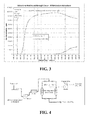
- FIG. 3 shows a plot of the dynamic adsorption behavior that one might see from one of the samples listed in Table 1.
- the data shown represent infrared (FTIR) analysis results on a flowing gas stream as it exits a 12-inch packed adsorbent bed of one of these carbon pyrolyzate samples.
- the inlet feed gas is an 80% methane, 20% carbon dioxide mixture.
- the feed gas is switched from a bypass mode to flow through the bed.
- the adsorbent immediately captures both the methane and the carbon dioxide and the effluent stream shows no evidence of either gas for approximately 3.5 minutes as the air previously adsorbed on the carbon is replaced.
- the methane concentration downstream of the adsorbent bed is building back to its original level while the carbon dioxide is completely adsorbed. Then the test shows exclusively methane in the product stream for about 30 minutes before the CO 2 starts to slowly come back. For approximately 42 minutes during the run, the methane concentration is measured to be >33:1 in comparison to the carbon dioxide. This would be an appropriate product gas composition to be eligible to feed back into a natural gas pipeline or be utilized as compressed natural gas for vehicle fuel. The low CO 2 concentration would also be advantageous for use in a power generator or combined heat and power schemes.
- a multiple bed pressure swing adsorption system could utilize such CO 2 breakthrough information via a feedback loop and control system for determining the length of ideal adsorption cycle before switching to a regeneration mode for the bed.
- the gas at various points in the system was able to be monitored for CO 2 content using an infrared (IR) based CO 2 monitor able to measure in the range of 0 to 30% CO 2 concentration.
- IR infrared
- Inlet and outlet streams were measured constantly for CO 2 concentration throughout the testing.
- the feed stream, following desulfurization by the iron sponge was found to have a fairly constant CO 2 concentration of approximately 13.4%.
- Inlet and outlet flow rates were also monitored throughout the testing using mass flow meters.
- the average CO 2 concentration during the testing was approximately 2.7%, giving a methane product purity of roughly 97% or slightly higher.
- the process was also quite efficient with respect to methane yield. It was calculated that 87 to 90% of the methane entering the system was retained as usable high purity product.
- the carbon adsorbent pellet sample used for the aforementioned field trial was analyzed fully in the laboratory. Table 2 contains the data obtained on this carbon material. Ash content of the carbon sample was measured to be less than 0.1% according to ASTM D2866. This purity is important for stable performance in industrial operation for long lifetime materials in a cyclic operation, gas mixture environment. Tapped density of Sample E00129-080 was measured as 0.73 g/cc according to ASTM D2854. Particle density can play a large role in high volumetric adsorption capacity to help keep system size and power requirements minimized. Radial crush strength on the 3.2 mm diameter x 2.2 mm thick pellets was measured to be 19 kilopounds according to ASTM D4179.
- the axial crush strength was found to be too high to be determined using the standard pellet crush strength equipment. It should be noted that this is the crush strength of a binderless pellet.
- the total composition of the pellets is microporous carbon, and no organic binder material has been added to lend strength at a sacrifice to adsorption capacity. This physical strength of the pellets can prevent crushing and attrition in a deep adsorbent vessel or tall bed configuration. It is the combination of these numerous properties that make the carbon pyrolyzate adsorbent of this embodiment especially attractive for the application of CO 2 /m and ethane separation.
Landscapes
- Chemical & Material Sciences (AREA)
- Analytical Chemistry (AREA)
- Chemical Kinetics & Catalysis (AREA)
- Engineering & Computer Science (AREA)
- Organic Chemistry (AREA)
- Health & Medical Sciences (AREA)
- Life Sciences & Earth Sciences (AREA)
- Oil, Petroleum & Natural Gas (AREA)
- General Chemical & Material Sciences (AREA)
- Bioinformatics & Cheminformatics (AREA)
- Biotechnology (AREA)
- Biomedical Technology (AREA)
- Wood Science & Technology (AREA)
- Zoology (AREA)
- Inorganic Chemistry (AREA)
- Thermal Sciences (AREA)
- Physics & Mathematics (AREA)
- Sustainable Development (AREA)
- General Engineering & Computer Science (AREA)
- General Health & Medical Sciences (AREA)
- Genetics & Genomics (AREA)
- Biochemistry (AREA)
- Environmental & Geological Engineering (AREA)
- Microbiology (AREA)
- Solid-Sorbent Or Filter-Aiding Compositions (AREA)
- Separation Of Gases By Adsorption (AREA)
Applications Claiming Priority (1)
| Application Number | Priority Date | Filing Date | Title |
|---|---|---|---|
| US13/857,385 US9186650B2 (en) | 2013-04-05 | 2013-04-05 | Adsorbent having utility for CO2 capture from gas mixtures |
Publications (2)
| Publication Number | Publication Date |
|---|---|
| EP2786801A2 true EP2786801A2 (de) | 2014-10-08 |
| EP2786801A3 EP2786801A3 (de) | 2014-11-19 |
Family
ID=50439222
Family Applications (1)
| Application Number | Title | Priority Date | Filing Date |
|---|---|---|---|
| EP20140163420 Withdrawn EP2786801A3 (de) | 2013-04-05 | 2014-04-03 | Adsorbens mit Fähigkeit zur CO2-Abscheidung aus Gasgemischen |
Country Status (4)
| Country | Link |
|---|---|
| US (2) | US9186650B2 (de) |
| EP (1) | EP2786801A3 (de) |
| CA (1) | CA2848090A1 (de) |
| IN (1) | IN2014DE00971A (de) |
Cited By (2)
| Publication number | Priority date | Publication date | Assignee | Title |
|---|---|---|---|---|
| EP2855009A4 (de) * | 2012-05-29 | 2016-04-13 | Entegris Inc | Kohlenstoffadsorptionsmittel zur entfernung von schwefelwasserstoff aus gasen und regenerierung des adsorptionsmittels |
| WO2016122842A1 (en) * | 2015-01-27 | 2016-08-04 | Dow Global Technologies Llc | Separation of nitrogen from hydrocarbon gas using pyrolyzed sulfonated macroporous ion exchange resin |
Families Citing this family (22)
| Publication number | Priority date | Publication date | Assignee | Title |
|---|---|---|---|---|
| US8679231B2 (en) | 2011-01-19 | 2014-03-25 | Advanced Technology Materials, Inc. | PVDF pyrolyzate adsorbent and gas storage and dispensing system utilizing same |
| GB201301742D0 (en) * | 2013-01-31 | 2013-03-20 | Linde Ag | Separation of biologically generated gas streams |
| US11440815B2 (en) | 2013-02-22 | 2022-09-13 | Anschutz Exploration Corporation | Method and system for removing hydrogen sulfide from sour oil and sour water |
| US9708196B2 (en) | 2013-02-22 | 2017-07-18 | Anschutz Exploration Corporation | Method and system for removing hydrogen sulfide from sour oil and sour water |
| US9186650B2 (en) | 2013-04-05 | 2015-11-17 | Entegris, Inc. | Adsorbent having utility for CO2 capture from gas mixtures |
| EP3030339A1 (de) * | 2013-08-06 | 2016-06-15 | Dow Global Technologies LLC | Verfahren zur gewinnung von erdgasflüssigkeiten aus erdgas unter verwendung eines adsorptionsmittels mit vernetztem makroporösem polymer |
| WO2016069316A1 (en) * | 2014-10-27 | 2016-05-06 | Dow Global Technologies Llc | Temperature controlled adsorption process for recovering condensable hydrocarbons from a methane rich stream |
| US9579628B2 (en) | 2015-04-15 | 2017-02-28 | Air Products And Chemicals, Inc. | Perforated adsorbent particles |
| TW201733915A (zh) * | 2015-11-13 | 2017-10-01 | 艾克頌美孚研究工程公司 | 逆滲透膜及分離 |
| KR101779764B1 (ko) * | 2016-02-04 | 2017-09-19 | 한국과학기술연구원 | 바이오가스에 포함된 실록산 화합물의 제거를 위한 재생 가능한 고분자 소재, 이를 이용한 실록산 제거 방법 및 이를 위한 장치 |
| EP3548172B1 (de) * | 2016-11-30 | 2020-12-09 | Solvay SA | Fortschrittliche poröse kohlenstoffhaltige materialien und verfahren zur herstellung davon |
| US20190039890A1 (en) * | 2017-08-01 | 2019-02-07 | Korea Institute Of Science And Technology | High purity hydrogen production device and high purity hydrogen production method |
| US11298675B2 (en) | 2017-09-20 | 2022-04-12 | The Curators Of The University Of Missouri | 3D printed zeolite monoliths for CO2 removal |
| CN113660993A (zh) | 2019-01-28 | 2021-11-16 | 苏斯蒂昂公司 | 基于金属氧化物类可再生吸附剂的连续脱硫方法 |
| US11577217B2 (en) * | 2019-12-12 | 2023-02-14 | Praxair Technology, Inc. | Dopant fluid storage and dispensing systems utilizing high performance, structurally modified particulate carbon adsorbents |
| CN111467929B (zh) * | 2020-04-15 | 2022-06-17 | 禁核试北京国家数据中心 | 一种稀薄气体吸附捕集装置及其吸附捕集工艺与应用 |
| CN111871366B (zh) * | 2020-07-31 | 2023-03-14 | 宁夏博实科技有限公司 | 基于钛硅分子筛的吸附剂及其制备方法和应用 |
| EP4329921A4 (de) * | 2021-04-30 | 2025-06-25 | Carbon Holdings Intellectual Properties, LLC | Hybridverfahren zur kohlenstoffabscheidung |
| WO2023055691A1 (en) * | 2021-09-29 | 2023-04-06 | Entegris, Inc. | Adsorbent-type storage and delivery vessels with high purity delivery of gas, and related methods |
| US12151200B2 (en) * | 2022-12-31 | 2024-11-26 | Uop Llc | Treatment of biogas by pressure swing adsorption |
| US12523346B2 (en) | 2023-05-26 | 2026-01-13 | Caterpillar Inc. | System and method for transportation of captured carbon |
| CN116532090A (zh) * | 2023-06-28 | 2023-08-04 | 昆山市恒安工业气体有限公司 | 一种天然气纯化材料、制备方法及其纯化工艺 |
Family Cites Families (32)
| Publication number | Priority date | Publication date | Assignee | Title |
|---|---|---|---|---|
| JPS5247758B2 (de) | 1974-06-20 | 1977-12-05 | ||
| US5071820A (en) | 1990-05-25 | 1991-12-10 | Atlanta Gas Light Company | Carbonaceous material with high micropore and low macropore volume and process for producing same |
| US5518528A (en) | 1994-10-13 | 1996-05-21 | Advanced Technology Materials, Inc. | Storage and delivery system for gaseous hydride, halide, and organometallic group V compounds |
| US5707424A (en) | 1994-10-13 | 1998-01-13 | Advanced Technology Materials, Inc. | Process system with integrated gas storage and delivery unit |
| US5704967A (en) | 1995-10-13 | 1998-01-06 | Advanced Technology Materials, Inc. | Fluid storage and delivery system comprising high work capacity physical sorbent |
| US6030698A (en) | 1994-12-19 | 2000-02-29 | Lockheed Martin Energy Research Corporation | Activated carbon fiber composite material and method of making |
| CN1048954C (zh) | 1995-03-30 | 2000-02-02 | 日本酸素株式会社 | 多孔性碳质材料、其制造方法及其用途 |
| US5614459A (en) | 1995-06-07 | 1997-03-25 | Universidad De Antioquia | Process for making activated charcoal |
| DE69718137T2 (de) | 1996-05-20 | 2003-10-09 | Advanced Technology Materials, Inc. | Flüssigkeitsbehälter und -abgabesystem mit physikalischem sorptionsmittel mit hoher kapazität |
| US5993766A (en) | 1996-05-20 | 1999-11-30 | Advanced Technology Materials, Inc. | Gas source and dispensing system |
| KR20000016668A (ko) | 1996-06-14 | 2000-03-25 | 마싸 앤 피네간 | 개질 탄소 흡착제 및 이를 사용한 흡착 방법 |
| US6051096A (en) | 1996-07-11 | 2000-04-18 | Nagle; Dennis C. | Carbonized wood and materials formed therefrom |
| US6309446B1 (en) | 1997-02-17 | 2001-10-30 | Kanebo, Ltd. | Activated carbon for adsorptive storage of gaseous compound |
| WO1999041010A1 (fr) | 1998-02-17 | 1999-08-19 | Kanebo, Limited | Carbone active pour adsorption et stockage d'un compose gazeux |
| US20030157014A1 (en) | 2000-04-27 | 2003-08-21 | Qing Wang | Pyrolyzed hard carbon material, preparation and its applications |
| EP1335788B1 (de) | 2000-09-20 | 2011-02-23 | Chevron U.S.A. Inc. | Membranen mit gemischter matrix und pyrolisierten kohlenstoffsiebteilchen und verfahren zur herstellung derselben |
| EP1392600A4 (de) | 2001-02-28 | 2005-02-23 | Penn State Res Found | Mikro- und mesoporöse aktivkohle und verfahren zu ihrer behandlung |
| WO2004043859A2 (en) | 2002-11-13 | 2004-05-27 | Showa Denko K.K. | Active carbon, production method thereof and polarizable electrode |
| US6991671B2 (en) | 2002-12-09 | 2006-01-31 | Advanced Technology Materials, Inc. | Rectangular parallelepiped fluid storage and dispensing vessel |
| US7494530B2 (en) | 2002-12-10 | 2009-02-24 | Advanced Technology Materials, Inc. | Gas storage and dispensing system with monolithic carbon adsorbent |
| US8002880B2 (en) | 2002-12-10 | 2011-08-23 | Advanced Technology Materials, Inc. | Gas storage and dispensing system with monolithic carbon adsorbent |
| US6743278B1 (en) | 2002-12-10 | 2004-06-01 | Advanced Technology Materials, Inc. | Gas storage and dispensing system with monolithic carbon adsorbent |
| JP2006007127A (ja) | 2004-06-28 | 2006-01-12 | Shimadzu Corp | 繊維状炭素を用いた吸着方法及び吸着剤 |
| WO2006022329A1 (ja) | 2004-08-26 | 2006-03-02 | Kuraray Chemical Co., Ltd | 蒸散燃料ガス吸着材及び蒸散燃料ガス捕集装置、並びに活性炭及びその製造方法 |
| JP2009518277A (ja) | 2005-12-09 | 2009-05-07 | ドレクセル ユニバーシティー | メソ多孔質炭素 |
| KR100924214B1 (ko) | 2006-12-08 | 2009-10-29 | 주식회사 엘지화학 | 분무 건조 또는 분무 열분해를 이용한 중형 다공성 탄소구조체의 제조 방법 및 분무 건조용 조성물 |
| WO2009011750A2 (en) * | 2007-06-29 | 2009-01-22 | Advanced Fuel Research, Inc. | Carbon-based sorbent for gas storage, and method for preparation thereof |
| US20120024157A1 (en) | 2010-07-29 | 2012-02-02 | ADSORPTECH Inc. | Method to clean impurities from bio-gas using adsorption |
| US8679231B2 (en) | 2011-01-19 | 2014-03-25 | Advanced Technology Materials, Inc. | PVDF pyrolyzate adsorbent and gas storage and dispensing system utilizing same |
| JP6085569B2 (ja) | 2011-01-31 | 2017-02-22 | インテグリス・インコーポレーテッド | Co2回収に利用される炭素熱分解生成物吸着剤並びにその製造及び使用方法 |
| US20140027352A1 (en) | 2011-04-18 | 2014-01-30 | Advanced Technology Materials, Inc. | Carbon adsorbent and process for separating high-octane components from low-octane components in a naptha raffinate stream using such carbon adsorbent |
| US9186650B2 (en) | 2013-04-05 | 2015-11-17 | Entegris, Inc. | Adsorbent having utility for CO2 capture from gas mixtures |
-
2013
- 2013-04-05 US US13/857,385 patent/US9186650B2/en not_active Expired - Fee Related
-
2014
- 2014-04-03 CA CA 2848090 patent/CA2848090A1/en not_active Abandoned
- 2014-04-03 IN IN971DE2014 patent/IN2014DE00971A/en unknown
- 2014-04-03 EP EP20140163420 patent/EP2786801A3/de not_active Withdrawn
-
2015
- 2015-08-24 US US14/833,225 patent/US9283512B2/en not_active Expired - Fee Related
Non-Patent Citations (2)
| Title |
|---|
| ANDREAS BUSCH ET AL: "CBM and CO2-ECBM related sorption processes in coal: A review", INTERNATIONAL JOURNAL OF COAL GEOLOGY, ELSEVIER, AMSTERDAM, NL, vol. 87, no. 2, 26 April 2011 (2011-04-26), pages 49 - 71, XP028240740, ISSN: 0166-5162, [retrieved on 20110526], DOI: 10.1016/J.COAL.2011.04.011 * |
| ZHANG LEI ET AL: "A study of laboratory testing and calculation methods for coal sorption isotherms", JOURNAL OF COAL SCIENCE AND ENGINEERING (CHINA), SPRINGER BERLIN HEIDELBERG, BERLIN/HEIDELBERG, vol. 19, no. 2, 30 May 2013 (2013-05-30), pages 193 - 202, XP035311442, ISSN: 1006-9097, [retrieved on 20130530], DOI: 10.1007/S12404-013-0214-4 * |
Cited By (2)
| Publication number | Priority date | Publication date | Assignee | Title |
|---|---|---|---|---|
| EP2855009A4 (de) * | 2012-05-29 | 2016-04-13 | Entegris Inc | Kohlenstoffadsorptionsmittel zur entfernung von schwefelwasserstoff aus gasen und regenerierung des adsorptionsmittels |
| WO2016122842A1 (en) * | 2015-01-27 | 2016-08-04 | Dow Global Technologies Llc | Separation of nitrogen from hydrocarbon gas using pyrolyzed sulfonated macroporous ion exchange resin |
Also Published As
| Publication number | Publication date |
|---|---|
| CA2848090A1 (en) | 2014-10-05 |
| IN2014DE00971A (de) | 2015-06-05 |
| US9186650B2 (en) | 2015-11-17 |
| EP2786801A3 (de) | 2014-11-19 |
| US20140298992A1 (en) | 2014-10-09 |
| US20150360164A1 (en) | 2015-12-17 |
| US9283512B2 (en) | 2016-03-15 |
Similar Documents
| Publication | Publication Date | Title |
|---|---|---|
| US9283512B2 (en) | Adsorbent having utility for CO2 capture from gas mixtures | |
| JP6085569B2 (ja) | Co2回収に利用される炭素熱分解生成物吸着剤並びにその製造及び使用方法 | |
| AU2021290220B2 (en) | Method for inerting activated carbon in biogas purification equipment | |
| Ryckebosch et al. | Techniques for transformation of biogas to biomethane | |
| CA2604249C (en) | Temperature swing adsorption system | |
| US7393381B2 (en) | Removing siloxanes from a gas stream using a mineral based adsorption media | |
| CN102015065B (zh) | 使用沸石咪唑酯骨架结构材料分离氮和二氧化碳 | |
| US7875106B2 (en) | Adsorbent and adsorbent bed for materials capture and separation processes | |
| CA2814035C (en) | Method for separating off carbon dioxide in biogas plants | |
| US9126139B2 (en) | Carbon adsorbent for hydrogen sulfide removal from gases containing same, and regeneration of adsorbent | |
| US10449479B2 (en) | Increasing scales, capacities, and/or efficiencies in swing adsorption processes with hydrocarbon gas feeds | |
| CN104994932A (zh) | 使用褐煤提升的活性炭从气体去除硅氧烷和为此使用的吸附介质 | |
| CN102533369A (zh) | 一种用于沼气提纯的工艺方法 | |
| Plaza et al. | Evaluation of microporous biochars produced by single-step oxidation for postcombustion CO2 capture under humid conditions | |
| Karimi et al. | Biomass as a source of adsorbents for CO2 capture | |
| Shah et al. | Recent developments in pressure swing adsorption for biomethane production | |
| WO2008072215A2 (en) | Separation column and pressure swing adsorption process for gas purification | |
| Janetaisong et al. | Pelletization of iron oxide based sorbents for hydrogen sulfide removal | |
| WO2019075578A1 (en) | DEHYDRATION USING BIOSORBENTS IN MODULATED MODIFIED ADSORPTION | |
| Sami et al. | Performance analysis of a pressure swing adsorption unit in removing biogas impurities using zeolite 13X | |
| Vijay et al. | Pressure Swing Adsorption | |
| TW202541905A (zh) | 一種用於廢氣流的藻基生物質材料、相關方法及裝置 | |
| González Plaza et al. | Evaluation of Microporous Biochars Produced by Single-step Oxidation for Postcombustion CO2 Capture under Humid Conditions | |
| Gil Matellanes et al. | Carbon adsorbents for CO2 capture from bio-hydrogen and biogas streams: Breakthrough adsorption study |
Legal Events
| Date | Code | Title | Description |
|---|---|---|---|
| PUAI | Public reference made under article 153(3) epc to a published international application that has entered the european phase |
Free format text: ORIGINAL CODE: 0009012 |
|
| 17P | Request for examination filed |
Effective date: 20140403 |
|
| AK | Designated contracting states |
Kind code of ref document: A2 Designated state(s): AL AT BE BG CH CY CZ DE DK EE ES FI FR GB GR HR HU IE IS IT LI LT LU LV MC MK MT NL NO PL PT RO RS SE SI SK SM TR |
|
| AX | Request for extension of the european patent |
Extension state: BA ME |
|
| PUAL | Search report despatched |
Free format text: ORIGINAL CODE: 0009013 |
|
| AK | Designated contracting states |
Kind code of ref document: A3 Designated state(s): AL AT BE BG CH CY CZ DE DK EE ES FI FR GB GR HR HU IE IS IT LI LT LU LV MC MK MT NL NO PL PT RO RS SE SI SK SM TR |
|
| AX | Request for extension of the european patent |
Extension state: BA ME |
|
| RIC1 | Information provided on ipc code assigned before grant |
Ipc: B01D 53/02 20060101ALI20141015BHEP Ipc: B01D 53/047 20060101ALI20141015BHEP Ipc: C01B 31/08 20060101ALI20141015BHEP Ipc: B01J 20/20 20060101AFI20141015BHEP Ipc: B01J 20/28 20060101ALI20141015BHEP |
|
| R17P | Request for examination filed (corrected) |
Effective date: 20150518 |
|
| RBV | Designated contracting states (corrected) |
Designated state(s): AL AT BE BG CH CY CZ DE DK EE ES FI FR GB GR HR HU IE IS IT LI LT LU LV MC MK MT NL NO PL PT RO RS SE SI SK SM TR |
|
| RAP1 | Party data changed (applicant data changed or rights of an application transferred) |
Owner name: ENTEGRIS INC. |
|
| 17Q | First examination report despatched |
Effective date: 20170707 |
|
| STAA | Information on the status of an ep patent application or granted ep patent |
Free format text: STATUS: THE APPLICATION IS DEEMED TO BE WITHDRAWN |
|
| 18D | Application deemed to be withdrawn |
Effective date: 20171118 |