EP2792145B1 - Distribution à compatibilité descendante d'un contenu cinématographique numérique à plage dynamique étendue - Google Patents
Distribution à compatibilité descendante d'un contenu cinématographique numérique à plage dynamique étendue Download PDFInfo
- Publication number
- EP2792145B1 EP2792145B1 EP12808596.6A EP12808596A EP2792145B1 EP 2792145 B1 EP2792145 B1 EP 2792145B1 EP 12808596 A EP12808596 A EP 12808596A EP 2792145 B1 EP2792145 B1 EP 2792145B1
- Authority
- EP
- European Patent Office
- Prior art keywords
- video signal
- image
- digital image
- digital cinema
- digital
- Prior art date
- Legal status (The legal status is an assumption and is not a legal conclusion. Google has not performed a legal analysis and makes no representation as to the accuracy of the status listed.)
- Active
Links
Images



Classifications
-
- G—PHYSICS
- G06—COMPUTING OR CALCULATING; COUNTING
- G06T—IMAGE DATA PROCESSING OR GENERATION, IN GENERAL
- G06T5/00—Image enhancement or restoration
- G06T5/90—Dynamic range modification of images or parts thereof
-
- H—ELECTRICITY
- H04—ELECTRIC COMMUNICATION TECHNIQUE
- H04N—PICTORIAL COMMUNICATION, e.g. TELEVISION
- H04N19/00—Methods or arrangements for coding, decoding, compressing or decompressing digital video signals
- H04N19/46—Embedding additional information in the video signal during the compression process
-
- H—ELECTRICITY
- H04—ELECTRIC COMMUNICATION TECHNIQUE
- H04N—PICTORIAL COMMUNICATION, e.g. TELEVISION
- H04N19/00—Methods or arrangements for coding, decoding, compressing or decompressing digital video signals
- H04N19/10—Methods or arrangements for coding, decoding, compressing or decompressing digital video signals using adaptive coding
- H04N19/169—Methods or arrangements for coding, decoding, compressing or decompressing digital video signals using adaptive coding characterised by the coding unit, i.e. the structural portion or semantic portion of the video signal being the object or the subject of the adaptive coding
- H04N19/186—Methods or arrangements for coding, decoding, compressing or decompressing digital video signals using adaptive coding characterised by the coding unit, i.e. the structural portion or semantic portion of the video signal being the object or the subject of the adaptive coding the unit being a colour or a chrominance component
-
- H—ELECTRICITY
- H04—ELECTRIC COMMUNICATION TECHNIQUE
- H04N—PICTORIAL COMMUNICATION, e.g. TELEVISION
- H04N19/00—Methods or arrangements for coding, decoding, compressing or decompressing digital video signals
- H04N19/30—Methods or arrangements for coding, decoding, compressing or decompressing digital video signals using hierarchical techniques, e.g. scalability
-
- H—ELECTRICITY
- H04—ELECTRIC COMMUNICATION TECHNIQUE
- H04N—PICTORIAL COMMUNICATION, e.g. TELEVISION
- H04N19/00—Methods or arrangements for coding, decoding, compressing or decompressing digital video signals
- H04N19/85—Methods or arrangements for coding, decoding, compressing or decompressing digital video signals using pre-processing or post-processing specially adapted for video compression
-
- H—ELECTRICITY
- H04—ELECTRIC COMMUNICATION TECHNIQUE
- H04N—PICTORIAL COMMUNICATION, e.g. TELEVISION
- H04N9/00—Details of colour television systems
- H04N9/64—Circuits for processing colour signals
- H04N9/68—Circuits for processing colour signals for controlling the amplitude of colour signals, e.g. automatic chroma control circuits
-
- H—ELECTRICITY
- H04—ELECTRIC COMMUNICATION TECHNIQUE
- H04N—PICTORIAL COMMUNICATION, e.g. TELEVISION
- H04N9/00—Details of colour television systems
- H04N9/77—Circuits for processing the brightness signal and the chrominance signal relative to each other, e.g. adjusting the phase of the brightness signal relative to the colour signal, correcting differential gain or differential phase
-
- G—PHYSICS
- G06—COMPUTING OR CALCULATING; COUNTING
- G06T—IMAGE DATA PROCESSING OR GENERATION, IN GENERAL
- G06T2200/00—Indexing scheme for image data processing or generation, in general
- G06T2200/16—Indexing scheme for image data processing or generation, in general involving adaptation to the client's capabilities
-
- G—PHYSICS
- G06—COMPUTING OR CALCULATING; COUNTING
- G06T—IMAGE DATA PROCESSING OR GENERATION, IN GENERAL
- G06T2207/00—Indexing scheme for image analysis or image enhancement
- G06T2207/10—Image acquisition modality
- G06T2207/10016—Video; Image sequence
-
- G—PHYSICS
- G06—COMPUTING OR CALCULATING; COUNTING
- G06T—IMAGE DATA PROCESSING OR GENERATION, IN GENERAL
- G06T2207/00—Indexing scheme for image analysis or image enhancement
- G06T2207/10—Image acquisition modality
- G06T2207/10024—Color image
-
- G—PHYSICS
- G06—COMPUTING OR CALCULATING; COUNTING
- G06T—IMAGE DATA PROCESSING OR GENERATION, IN GENERAL
- G06T2207/00—Indexing scheme for image analysis or image enhancement
- G06T2207/20—Special algorithmic details
- G06T2207/20048—Transform domain processing
-
- G—PHYSICS
- G06—COMPUTING OR CALCULATING; COUNTING
- G06T—IMAGE DATA PROCESSING OR GENERATION, IN GENERAL
- G06T2207/00—Indexing scheme for image analysis or image enhancement
- G06T2207/20—Special algorithmic details
- G06T2207/20172—Image enhancement details
- G06T2207/20208—High dynamic range [HDR] image processing
Definitions
- the present disclosure relates to image processing for digital cinema as well as preprocessing and coding of digital image and/or video content. More particularly, an embodiment of the present invention relates to backwards-compatible delivery of digital cinema content with extended range and related preprocessing and coding methods.
- the term 'dynamic range' may relate to a capability of the human visual system (HVS) to perceive a range of intensity (e.g., luminance, luma) in an image, e.g., from darkest darks to brightest brights.
- DR relates to a 'scene-referred' intensity.
- DR may also relate to the ability of a display device to adequately or approximately render an intensity range of a particular breadth. In this sense, DR relates to a 'display-referred' intensity.
- HVS human visual system
- high dynamic range relates to a DR breadth that spans the some 14-15 orders of magnitude of the HVS.
- well adapted humans with essentially normal vision e.g., in one or more of a statistical, biometric or opthamological sense
- an intensity range that spans about 15 orders of magnitude.
- Adapted humans may perceive dim light sources of a few photons.
- these same humans may perceive the near painfully brilliant intensity of the noonday sun in desert, sea or snow (or even glance into the sun, however briefly to prevent damage). This span though is available to 'adapted' humans, e.g., those whose HVS has a time period in which to reset and adjust.
- VDR visual dynamic range'
- HVS HVS
- VDR may relate to a DR that spans 5-6 orders of magnitude.
- future digital cinema systems may be capable of a DR (e.g. VDR) that is higher than the SDR/LDR of conventional digital cinema systems as well as a larger color gamut than the color gamut of conventional digital cinema systems.
- VDR a DR
- the challenge is providing digital cinema content which may be displayed on conventional SDR, small color gamut systems at a standard quality level as well as more advanced VDR, larger color gamut systems at a correspondingly higher quality level.
- US 2011/0194618 A1 discloses a method for compressing visual dynamic range and wide color gamut video.
- a first image stream has a first dynamic range and a first color space.
- the second image stream has a second dynamic range, which is higher than the first dynamic range.
- the first image stream and the second image stream are received in a layered codec.
- the first image stream is in the codec's base layer; the second image stream is in its enhancement layer.
- the first image stream is encoded to obtain an encoded image stream, which is decoded to obtain a decoded image stream.
- the decoded image stream is converted from the first non-linear or linear color space to a second, different color space to obtain a color converted image stream.
- a higher dynamic range image representation of the color converted image stream is generated to obtain a transformed image stream.
- Inverse tone mapping parameters are generated based on the transformed image stream and the second image stream.
- a residual bit stream is generated by subtracting the transformed image stream from the decoded second image stream.
- the second image stream is reconstructed from the inverse tone mapped decoded first image stream by adding the decoded residual data.
- a method of decoding a coded digital cinema bitstream comprising: providing a coded digital cinema bitstream; providing mapping parameters; decoding the coded digital cinema bitstream, the decoding producing a first decoded digital cinema image or video with a first dynamic range and a first color gamut; and expanding the first dynamic range and the first color gamut of the first decoded digital cinema image or video by inverse mapping the first decoded digital cinema image or video with the mapping parameters, thus obtaining a second decoded digital cinema image or video with a second dynamic range higher than the first dynamic range and a second color gamut larger than the first color gamut.
- a method of decoding a coded digital cinema bitstream comprising: providing a coded digital cinema bitstream; providing mapping parameters; decoding the coded digital cinema bitstream, the decoding producing a first decoded digital cinema image or video with a first dynamic range and a first color gamut; and compressing the first dynamic range and the first color gamut of the first decoded digital cinema image or video by forward mapping the first decoded digital cinema image or video with the mapping parameters, thus obtaining a second decoded digital cinema image or video with a second dynamic range lower than the first dynamic range and a second color gamut smaller than the first color gamut.
- a method of pre-processing a digital image or video signal comprising: processing the digital image or video signal by performing color grading to produce a first digital image or video signal having a first dynamic range and a first color gamut, and a second digital image or video signal having a second dynamic range and a second color gamut, the second dynamic range being higher than the first dynamic range and the second color gamut being larger than the first color gamut; producing a first normalized digital image or video signal by pre-processing the first digital image or video signal; producing a second normalized digital image or video signal by pre-processing the second digital image or video signal, wherein the first normalized digital image or video signal is obtainable from the second normalized digital image or video signal through a forward mapping and the second normalized digital image or video signal is obtainable from the first normalized digital image or video signal through an inverse mapping; and producing forward mapping parameters and inverse mapping parameters.
- a method of estimating nonlinear forward mapping parameters for digital image or video signals comprising: providing a first digital image or video signal; providing a second digital image or video signal; providing a matrix; inverting the matrix and applying the inverted matrix to the first digital image or video signal, thus obtaining an intermediate digital image or video signal; and producing nonlinear transformation parameters corresponding to a nonlinear transformation between the second digital image or video signal and the intermediate digital image or video signal.
- a method of estimating matrix forward mapping parameters for digital image or video signals comprising: at the providing a first digital image or video signal; providing a second digital image or video signal; providing a nonlinear transformation; applying the nonlinear transformation to the second digital image or video signal, thus obtaining an intermediate digital image or video signal; and producing matrix transformation parameters corresponding to a matrix transformation between the intermediate digital image or video signal and the first digital image or video signal.
- a method of determining forward mapping parameters for digital image or video signals comprising: (a) setting an input matrix equal to an identity matrix; (b) providing a first digital image or video signal; (c) providing a second digital image or video signal; (d) inverting the input matrix, thus obtaining an inverted matrix and applying the inverted matrix to the first digital image or video signal, thus obtaining an intermediate first digital image or video signal; (e) producing nonlinear transformation parameters corresponding to a nonlinear transformation between the second digital image or video signal and the intermediate first digital image or video signal; (f) applying the nonlinear transformation parameters to the second digital image or video signal, thus obtaining an intermediate second digital image or video signal; (g) producing an estimated matrix corresponding to a matrix transformation between the intermediate second digital image or video signal and the first digital image or video signal; (h) repeating steps (d) through (g), wherein the input matrix of step (d) is set equal to the estimated matrix of step (g); and (i) iterating step (h
- a method of determining forward mapping parameters for digital image or video signals comprising: (a) setting input nonlinear transformation parameters to identity; (b) providing a first digital image or video signal; (c) providing a second digital image or video signal; (d) applying the input nonlinear transformation parameters to the second digital image or video signal, thus obtaining an intermediate second digital image or video signal; (e) producing a matrix corresponding to a matrix transformation between the intermediate second digital image or video signal and the first digital image or video signal; (f) inverting the matrix and applying the inverted matrix to the first digital image or video signal, thus obtaining an intermediate first digital image or video signal; (g) producing estimated nonlinear transformation parameters corresponding to a nonlinear transformation between the second digital image or video signal and the intermediate first digital image or video signal; (h) repeating steps (d) through (g), wherein the input nonlinear transformation parameters of step (d) are set equal to the estimated nonlinear transformation parameters of step (g); and (i) iterating step (
- a system configured to decode a coded digital cinema bitstream, the system comprising: a decoder configured to decode the coded digital cinema bitstream and produce a first decoded digital cinema image or video; and a mapping applicator configured to expand a first dynamic range and a first color gamut of the first decoded digital cinema image or video by inverse mapping the first decoded digital cinema image or video with mapping parameters, thus obtaining a second decoded digital cinema image or video with a second dynamic range higher than the first dynamic range and a second color gamut larger than the first color gamut.
- a system configured to decode a coded digital cinema bitstream, the system comprising: a decoder configured to decode the coded digital cinema bitstream and produce a first decoded digital cinema image or video; and a mapping applicator configured to compress a first dynamic range and a first color gamut of the first decoded digital cinema image or video by forward mapping the first decoded digital cinema image or video with mapping parameters, thus obtaining a second decoded digital cinema image or video with a second dynamic range lower than the first dynamic range and a second color gamut smaller than the first color gamut.
- a system configured to pre-process a digital image or video signal, the system comprising: a color grading module configured to process the digital image or video signal to produce a first digital image or video signal having a first dynamic range and a first color gamut, and a second digital image or video signal having a second dynamic range and a second color gamut, the second dynamic range being higher than the first dynamic range in the second color gamut being larger than the first color gamut; and a preprocessor configured to produce a first normalized digital image or video signal by preprocessing the first digital image or video signal; configured to produce a second normalized digital image or video signal by preprocessing the second digital image or video signal, wherein the first normalized digital image or video signal is obtainable from the second normalized digital image or video signal through a forward mapping and the second normalized digital image or video signal is obtainable from the first normalized digital image or video signal through an inverse mapping; and configured to produce forward mapping parameters and inverse mapping parameters.
- digital cinema refers to the projection of a theatrical motion picture through a digital cinema projection system.
- digital cinema signal refers to a signal representing digital cinema information.
- digital image or video signal refer to digital content which may be, by way of example and not of limitation, live action, rendered CGI (computer-generated imagery), or from any source capable of producing a digital image or video signal.
- FIG. 1A depicts a schematic diagram of a digital cinema decoding architecture in accordance with an embodiment of the present disclosure.
- a coded bitstream (105A) is input to a decoder (110A).
- the bitstream comprises a 12-bit digital cinema signal with a 4:4:4 color representation. Typical input bit rates are in the 125-250 Mbps range.
- the digital cinema signal has a dynamic range, e.g. a 2000:1 dynamic range, and a color gamut, e.g. a P3 color gamut.
- the decoder (110A) can be any decoder able to operate on a digital cinema signal, e.g. a JPEG-2000 decoder.
- the decoder (110A) outputs a first digital cinema image or video (115A) with the same dynamic range and color gamut of the coded input bitstream (105A).
- Inverse mapping is performed on the digital cinema image or video (115A) by a mapping applicator (120A) to expand the dynamic range and color gamut of the image or video.
- a mapping applicator 120A
- the inverse of a nonlinear transformation N followed by a matrix transformation M, i.e. (M ⁇ N) -1 (where the ⁇ indicates the transformation on the right is carried out prior to the transformation on the left) is performed.
- the nonlinear transformation N can be a six segment, cubic spline, while matrix M can be a 3x3 matrix.
- the nonlinear transformation parameters Nj and matrix parameters Mij are sent to the mapping applicator (120A) as mapping metadata (125A).
- the mapping applicator can be implemented as a three-dimensional (3-D) lookup table. While 3-D lookup tables in general are known to those skilled in the art, an embodiment according to the present disclosure may use the 3-D lookup table to produce VDR digital cinema video.
- the mapping applicator (120A) outputs a second 12-bit, 4:4:4 digital cinema image or video (130A) with a higher dynamic range and a larger color gamut than the dynamic range and color gamut of the first digital cinema image or video (115A).
- the second digital cinema image or video (130A) can have a 10000:1 dynamic range, and a color gamut larger than P3.
- the decoding architecture of FIG. 1A provides a dual-layered digital cinema content.
- the output (135A) of the first layer provides a 12-bit, 4:4:4 digital cinema signal (115A) with a first dynamic range and first color gamut
- the output (140A) of the second layer provides a 12-bit, 4:4:4 digital cinema signal (130A) with a second dynamic range higher than the first dynamic range and a second color gamut larger than the first color gamut.
- the architecture of FIG. 1A thus provides a 'single inventory', backwards-compatible, approach for digital cinema content, which can be used both with (a) digital cinema projectors compatible with the first dynamic range and the first color gamut and (b) digital cinema projectors compatible with the second dynamic range and second color gamut.
- Output (135A) will be sent to the first type of projectors, while output (140A) will be sent to the second type of projectors.
- decoder (110A) and mapping applicator (120A) may be located in a projector (150A) and one of the outputs (135A, 140A) can be sent to a screen (160A).
- decoding and mapping architecture of FIG. 1A is a residual-free architecture, where no residual is employed to improve decoding of the digital cinema bitstream (105A).
- the output (135A) represents a conventional/LDR/SDR digital cinema version
- the output (140A) represents a VDR/HDR digital cinema version.
- LDR/SDR or VDR/HDR version will depend on the kind of projector available to theatres.
- FIG. 1B depicts a schematic diagram of a digital cinema decoding architecture in accordance with an alternative embodiment of the present disclosure. Such architecture is similar to the embodiment of FIG. 1A with the following differences.
- Coded bitstream (105B) of FIG. 1B is characterized by a higher dynamic range and a larger color gamut than coded bitstream (105A) of FIG. 1A .
- First digital cinema video (115B) is sent to forward mapping applicator (120B) to produce a second digital cinema video (130B) with a lower dynamic range and a smaller color gamut than the first digital cinema video (115B).
- the output (135B) represents a VDR/HDR digital cinema version
- the output (140B) represents a conventional/LDR/SDR digital cinema version.
- LDR/SDR or VDR/HDR version will depend on the kind of projector available to theatres.
- FIGS. 1A and 1B have been described in terms of conventional/SDR layer vs. VDR/HDR layer, the person skilled in the art will understand that other layered forms and denominations are also possible, such as base layer vs. enhancement layer, first enhancement layer vs. second enhancement layer, and so on.
- FIG. 1A depicts details of a decoding architecture of a digital cinema bitstream.
- FIG. 2 depicts instead an example of a pre-processing architecture of a digital cinema image or video prior to coding.
- the pre-processing architecture of FIG. 2 can be used in combination with the decoding architecture of FIG. 1A .
- a captured digital cinema signal (205) is input to a color grading module (210), which outputs a first digital cinema signal (215) with a first dynamic range and color gamut and a second digital cinema signal (220) with a second dynamic range higher than the first dynamic range and a second color gamut larger than the first color gamut.
- signal (215) can be an LDR/SDR signal
- signal (220) can be a VDR/HDR signal.
- the first digital cinema signal (215) and second digital cinema signal (220) are then normalized in a preprocessor (225), thus producing a first normalized digital cinema signal (230) and a second normalized digital cinema signal (235), where the second normalized digital cinema signal (235) is identical to the second digital cinema signal (220).
- the processing through the preprocessor (225) allows the first normalized digital cinema signal (230) and the second normalized digital cinema signal (235) to be related by invertible mapping.
- digital cinema signal (230) can be obtained from digital cinema signal (235) through forward mapping
- digital cinema signal (235) can be obtained from digital cinema signal (230) through inverse mapping.
- the first signal (230) is indicated by SDR* (where * is to indicate a normalized version of input (215)) and the second signal (235) is indicated by VDR* (which is usually equal to the VDR input (220) to numerical precision)
- SDR* (M ⁇ N)VDR*, where M ⁇ N is the forward mapping operator mentioned above.
- the preprocessor (225) also produces inverse and/or forward mapping parameters (240) and/or (245) to be sent, e.g., as metadata.
- Such parameters allow obtaining signal (235) from signal (230) through inverse mapping or signal (230) from signal (235) through forward mapping.
- the mapping parameters obtained and the mapping performed are such that inverse mapping the SDR* signal will exactly reproduce the VDR signal.
- the first normalized digital cinema signal (230) is then encoded in an encoder (250) and sent to a digital cinema system as a coded bitstream (255).
- Encoder (250) can be, for example, an encoder configured to process the first signal (e.g., an SDR* signal (230)) and not the second signal (e.g., a VDR* signal (235)). See, for example, encoder 312 in Fig. 9A of the above mentioned PCT Application PCT/US2011/048861 .
- the second signal e.g., a VDR* signal (335)
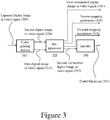
- FIG. 3 Such embodiment can be combined with FIG. 1B in a manner similar to the combination of FIGS. 2 and 1A .
- Normalization pre-processing as described in FIGS. 2 and 3 can be used to prepare image or video data for backwards-compatible delivery in distribution systems such as digital cinema systems.
- compatibility between the first and the second digital signals discussed above is obtained at the output of the preprocessor (225/325), where an SDR* signal can be obtained from a VDR* signal and vice versa.
- the embodiments of FIGS. 2-3 allow different realizations (various levels of SDR) of a master image or video (e.g., VDR) to be derived by transforming the master image or video with a transformation that is invertible.
- one such transformation is the M ⁇ N transformation.
- a non-linear transformation N followed by a linear matrix transformation M are performed.
- VDR image or video can be recovered from the SDR image or video:
- SDR and VDR images or videos are often created in separate color grading passes.
- the SDR version typically satisfies Equation (1) approximately, but not necessarily exactly.
- the function of normalization is to determine a modified version of the SDR, i.e. SDR*.
- SDR* and the original VDR satisfy Equation (1) exactly and, furthermore, SDR* and SDR are typically indistinguishable visually.
- SDR and SDR* can be visually indistinguishable approximately 99% of the time, and in cases where there are visible differences, such differences can be visible only when the sequence is halted at a particular frame.
- input bitstream (105A) of FIG. 1A corresponds to the encoded bitstream (255) of FIG. 2
- mapping metadata (125A) of FIG. 1A correspond to inverse mapping parameters (240) of FIG. 2
- the decoding architecture of FIG. 1A can be used in conjunction with the encoding architecture of FIG. 2 .
- the encoding architecture of FIG. 3 can be used with alternative decoding architectures based on that depicted in FIG. 1B .
- Input bitstream (105B) of FIG. 1B corresponds to the encoded bitstream (355) of FIG. 3
- mapping metadata (125B) of FIG. 1B correspond to forward mapping parameters (345) of FIG. 3 .
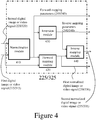
- FIG. 4 depicts a schematic representation of an embodiment of the preprocessor (225/325) of FIGS. 2 and 3 in greater detail.
- First signal (215/315) and second signal (220/320) are sent to a normalization module (410) which determines the forward mapping parameters of nonlinear transformation N j [] and the forward mapping parameters M ij of matrix transformation M. An example of how these parameters are obtained will be later explained in detail.
- Such forward mapping parameters (245/345) are input to a forward mapping module (420) together with the second signal (220/320) in order to obtain the first normalized digital cinema signal (230/330) discussed with reference to FIGS. 2 and 3 , e.g. an SDR* signal.
- Forward mapping parameters (245/345) are also input to an inversion module (430) to obtain inverse mapping parameters (240/340).
- Such inverse mapping parameters (240/340) are input to an inverse mapping module (440) to obtain the second normalized digital cinema signal (235/335) of FIGS. 2 and 3 .
- N and M can be first estimated from the original data.
- N can be modeled as a piecewise polynomial such as a piecewise cubic spline with typically 5-6 segments, while M can be a 3x3 matrix.
- the routine EstimateN[] inverts the matrix M and applies that to the SDR image or video. N is then the transformation between VDR and M -1 •SDR. Similarly, the routine EstimateM[] applies the non-linear transformation to VDR and then M is the transformation between N[VDR] and SDR. Thus, there are two estimation sequences, depending upon whether N or M is first estimated:
- N and M can also be used, such as software optimization packages (e.g. MATLAB).
- software optimization packages e.g. MATLAB
- FIG. 5 depicts a typical non-linearity when clipping occurs at both the low and high limits of intensity.
- the clipping should be softened.
- FIG. 5 depicts varying degrees of softening. The greater the softening the larger the differences between SDR and SDR* for the clipped pixels, so the desire to maintain visual equivalence between SDR and SDR* constrains this softening.
- the methods and systems described in the present disclosure may be implemented in hardware, software, firmware or any combination thereof.
- Features described as blocks, modules or components may be implemented together (e.g., in a logic device such as an integrated logic device) or separately (e.g., as separate connected logic devices).
- the software portion of the methods of the present disclosure may comprise a computer-readable medium which comprises instructions that, when executed, perform, at least in part, the described methods.
- the computer-readable medium may comprise, for example, a random access memory (RAM) and/or a read-only memory (ROM).
- the instructions may be executed by a processor (e.g., a digital signal processor (DSP), an application specific integrated circuit (ASIC), or a field programmable logic array (FPGA)).
- DSP digital signal processor
- ASIC application specific integrated circuit
- FPGA field programmable logic array
Landscapes
- Engineering & Computer Science (AREA)
- Multimedia (AREA)
- Signal Processing (AREA)
- Physics & Mathematics (AREA)
- General Physics & Mathematics (AREA)
- Theoretical Computer Science (AREA)
- Compression Or Coding Systems Of Tv Signals (AREA)
Claims (13)
- Procédé pour produire des signaux d'image ou vidéo numériques normalisés (230, 235, 330, 335) et des paramètres de mappage (240, 245, 340, 345) à partir d'un signal d'image ou vidéo numérique capturé (205, 305), le procédé comprenant les étapes suivantes :traiter le signal d'image ou vidéo numérique (205, 305) en procédant à un étalonnage des couleurs pour produire un premier signal d'image ou vidéo numérique (215, 315) ayant une première plage dynamique et une première gamme de couleurs, et un second signal d'image ou vidéo numérique (220, 320) ayant une seconde plage dynamique et une seconde gamme de couleurs, la seconde plage dynamique étant supérieure à la première plage dynamique, et la seconde gamme de couleurs étant supérieure à la première gamme de couleurs ;produire des paramètres de mappage aval (245, 345) pour un mappage aval, qui est un mappage inversible, et produire des paramètres de mappage inverse (240, 340) pour un mappage inverse qui est l'inverse du mappage aval ;produire un premier signal d'image ou vidéo numérique normalisé (230, 330) en effectuant le mappage aval sur le second signal d'image ou vidéo numérique (220, 320) ;produire un second signal d'image ou vidéo numérique normalisé (235, 335) en effectuant le mappage inverse sur le premier signal d'image ou vidéo numérique normalisé (230, 330) de telle sorte que le second signal d'image ou vidéo numérique normalisé (235, 335) soit égal au second signal d'image ou vidéo numérique normalisé (220, 320) avec une précision numérique, et où le premier signal d'image ou vidéo numérique normalisé (230, 330) peut être obtenu à partir du second signal d'image ou vidéo numérique normalisé (235, 335) par le mappage aval ;où la production du premier signal d'image ou vidéo numérique normalisé (230, 330) par le mappage aval comprend les étapes suivantes :effectuer une transformation non linéaire inversible N sur le second signal d'image ou vidéo numérique (220, 320), etlors de l'exécution de la transformation non linéaire, effectuer une transformation matricielle inversible M pour obtenir le premier signal d'image ou vidéo numérique normalisé (230, 330) ;où la production des paramètres de mappage aval (245, 345) comprend les étapes suivantes :(a1) définir une matrice d'entrée (M0) égale à une matrice identité ;(b1) inverser la matrice d'entrée (M0) pour obtenir une matrice inversée et appliquer la matrice inversée au premier signal d'image ou vidéo numérique (215, 315),obtenant ainsi un premier signal d'image ou vidéo numérique intermédiaire ;(c1) produire des paramètres de mappage aval en déterminant des paramètres de transformation non linéaires estimés (N0) correspondant à une transformation non linéaire N entre le second signal d'image ou vidéo numérique (220, 320) et le premier signal d'image ou vidéo numérique intermédiaire ;(d1) appliquer les paramètres de transformation non linéaire estimés (N1) au second signal d'image ou vidéo numérique (220, 320), obtenant ainsi un second signal d'image ou vidéo numérique intermédiaire ;(e1) produire des paramètres de mappage aval en déterminant une matrice estimée (M1) correspondant à la transformation matricielle M entre le second signal d'image ou vidéo numérique intermédiaire et le premier signal d'image ou vidéo numérique (215, 315) ;(f1) répéter les étapes (b1) à (e1), où la matrice d'entrée de l'étape (b1) est définie égale à la matrice estimée de l'étape (e1) ; et(g1) itérer l'étape (f1) jusqu'à ce qu'un résultat souhaité soit obtenu ;ou la production des paramètres de mappage aval (245, 345) comprend les étapes suivantes :(a2) définir des paramètres de transformation non linéaire d'entrée (N0) à l'identité ;(b2) appliquer les paramètres de transformation non linéaire d'entrée au second signal d'image ou vidéo numérique (220, 320) pour obtenir un second signal d'image ou vidéo numérique intermédiaire ;(c2) produire des paramètres de mappage aval en déterminant une matrice estimée (M0) correspondant à une transformation matricielle M entre le second signal d'image ou vidéo numérique intermédiaire et le premier signal d'image ou vidéo numérique (215, 315) ;(d2) inverser la matrice M et appliquer la matrice inversée M-1 au premier signal d'image ou vidéo numérique (215, 315), obtenant ainsi un premier signal d'image ou vidéo numérique intermédiaire ;(e2) produire des paramètres de mappage aval (245, 345) en déterminant les paramètres de transformation non-linéaire estimés (N1) correspondant à la transformation non-linéaire N entre le second signal d'image ou vidéo numérique (220, 320) et le premier signal d'image ou vidéo numérique intermédiaire ;(f2) répéter les étapes (b2) à (e2), où les paramètres de transformation non-linéaire d'entrée de l'étape (b2) sont définis égaux aux paramètres de transformation non-linéaire estimés de l'étape (e2) ; et(g2) itérer l'étape (f2) jusqu'à ce qu'un résultat souhaité soit obtenu.
- Procédé selon la revendication 1, dans lequel l'exécution du mappage l'aval comprend de calculer :
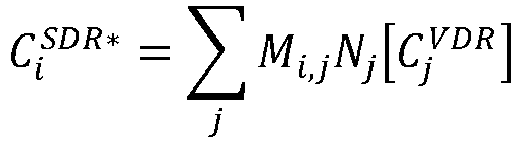 où
où où Ni est la ième composante de la transformation non linéaire N,où Mi,j est le i,jème élément de la transformation matricielle linéaire M, etoù
- Procédé selon la revendication 1 ou la revendication 2, dans lequel l'exécution du mappage inverse comprend de calculer :
 où
où où Ni -1 est la ième composante de l'inverse de la transformation non linéaire N,où
 où
où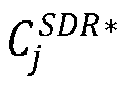
- Procédé selon l'une quelconque des revendications 1 à 3, comprenant en outre l'étape suivante :produire un flux binaire cinématographique numérique codé (105A, 255), où le flux binaire cinématographique numérique codé (105A, 255) comprend le premier signal d'image ou vidéo cinématographique numérique normalisé (115A, 230).
- Procédé selon l'une quelconque des revendications 1 à 3, comprenant en outre l'étape suivante :produire un flux binaire cinématographique numérique codé (105A, 255), où le flux binaire cinématographique numérique codé (105A, 255) comprend le second signal d'image ou vidéo cinématographique numérique normalisé (115B, 335).
- Procédé de décodage d'un flux binaire cinématographique numérique codé (105A, 255) avec des paramètres de mappage inverse (125A, 240), où le flux binaire cinématographique numérique codé (105A, 255) comprend le premier signal d'image ou vidéo cinématographique numérique normalisé (115A, 230) et où le premier signal d'image ou vidéo cinématographique numérique normalisé (115A, 230) et les paramètres de mappage inverse (125A, 240) sont produits selon le procédé de l'une quelconque des revendications 1 à 5, le procédé comprenant les étapes suivantes :décoder le flux binaire cinématographique numérique codé (105A, 255), le décodage produisant le premier signal d'image ou vidéo cinématographique numérique normalisé (115A, 230) ;étendre la première plage dynamique et la première gamme de couleurs du premier signal d'image ou vidéo cinématographique numérique normalisé (115A, 230) en effectuant le mappage inverse sur le premier signal d'image ou vidéo cinématographique numérique normalisé (115A, 230) avec les paramètres de mappage inverse (125A, 240) pour obtenir le second signal d'image ou vidéo cinématographique numérique normalisé (130A, 235).
- Procédé de décodage d'un flux binaire cinématographique numérique codé (105B, 355) avec des paramètres de mappage aval (125B, 345), où le flux binaire cinématographique numérique codé (105B, 355) comprend le second signal d'image ou vidéo cinématographique numérique normalisé (115B, 335) et où le second signal d'image ou vidéo cinématographique numérique normalisé (115B, 335) et les paramètres de mappage aval (125B, 345) sont produits selon le procédé de l'une quelconque des revendications 1 à 5, le procédé comprenant les étapes suivantes :décoder le flux binaire cinématographique numérique codé (105B, 355), le décodage produisant le second signal d'image ou vidéo cinématographique numérique normalisé (115B, 335) ;compresser la seconde plage dynamique et la seconde gamme de couleurs du second signal d'image ou vidéo cinématographique numérique normalisé (115B, 335) en effectuant le mappage aval sur le second signal d'image ou vidéo cinématographique numérique normalisé (115B, 335) avec les paramètres de mappage aval (125B, 345) pour obtenir le premier signal d'image ou vidéo cinématographique numérique normalisé (130B, 330).
- Procédé selon l'une quelconque des revendications 1 à 7, dans lequel la transformation non linéaire N comprend une fonction spline de degré 3 à six segments.
- Procédé selon l'une quelconque des revendications 1 à 8, dans lequel la transformation matricielle utilise une matrice 3x3.
- Système configuré pour décoder un flux binaire cinématographique numérique codé (105A, 255) avec des paramètres de mappage inverse (125A, 240) en exécutant le procédé de la revendication 6, le système comprenant :un décodeur (110A) qui est configuré pour décoder le flux binaire cinématographique numérique codé (105A, 255) et produire le premier signal d'image ou vidéo cinématographique numérique normalisé (115A, 230) ; etun applicateur de mappage (120A) qui est configuré pour étendre la première plage dynamique et la première gamme de couleurs du premier signal d'image ou vidéo cinématographique numérique normalisé (115A, 230) en effectuant le mappage inverse sur le premier signal d'image ou vidéo cinématographique numérique normalisé (115A, 230) avec les paramètres de mappage inverse (125A, 240) afin d'obtenir le second signal d'image ou vidéo cinématographique numérique normalisé (130A, 235) avec la seconde plage dynamique qui est supérieure à la première plage dynamique et la seconde gamme de couleurs qui est supérieure à la première gamme de couleurs.
- Système configuré pour décoder un flux binaire cinématographique numérique codé (105B, 355) avec des paramètres de mappage aval en exécutant le procédé selon la revendication 7, le système comprenant :un décodeur (110B) qui est configuré pour décoder le flux binaire cinématographique numérique codé (105B, 355) et produire le second signal d'image ou vidéo cinématographique numérique normalisé (115B, 335) ; etun applicateur de mappage (120B) qui est configuré pour compresser la seconde plage dynamique et la seconde gamme de couleurs du second signal d'image ou vidéo cinématographique numérique normalisé (115B, 335) en effectuant le mappage aval sur le second signal d'image ou vidéo cinématographique numérique normalisé (115B, 335) avec les paramètres de mappage aval (125B, 345) pour obtenir le premier signal d'image ou vidéo cinématographique numérique normalisé (130B, 330) avec la première plage dynamique qui est inférieure à la seconde plage dynamique et la première gamme de couleurs qui est inférieure à la seconde gamme de couleurs.
- Système configuré pour produire des signaux d'image ou vidéo numériques normalisés (230, 235, 330, 335) et des paramètres de mappage (240, 245, 340, 345) à partir d'un signal d'image ou vidéo numérique (205, 305) en exécutant le procédé de l'une quelconque des revendications 1 à 5, le système comprenant :un module d'étalonnage des couleurs (210, 310) qui est configuré pour traiter le signal d'image ou vidéo numérique (205, 305) pour produire le premier signal d'image ou vidéo numérique (215, 315) et le second signal d'image ou vidéo numérique (220, 320) ; etun préprocesseur (225, 325) qui est configuré pour produire le premier signal d'image ou vidéo numérique normalisé (230, 330) en prétraitant le premier signal d'image ou vidéo numérique (215, 315) ; configuré pour produire le second signal d'image ou vidéo numérique normalisé (235, 335) en prétraitant le second signal d'image ou vidéo numérique (220, 320) ; et configuré pour produire les paramètres de mappage aval (245, 345) et les paramètres de mappage inverse (240, 340).
- Support lisible par ordinateur contenant un ensemble d'instructions qui amène un ordinateur à exécuter le procédé décrit dans une ou plusieurs des revendications 1 à 9.
Applications Claiming Priority (2)
| Application Number | Priority Date | Filing Date | Title |
|---|---|---|---|
| US201161576141P | 2011-12-15 | 2011-12-15 | |
| PCT/US2012/068275 WO2013090120A1 (fr) | 2011-12-15 | 2012-12-06 | Distribution à compatibilité descendante d'un contenu cinématographique numérique à plage dynamique étendue |
Publications (2)
| Publication Number | Publication Date |
|---|---|
| EP2792145A1 EP2792145A1 (fr) | 2014-10-22 |
| EP2792145B1 true EP2792145B1 (fr) | 2018-03-21 |
Family
ID=47459142
Family Applications (1)
| Application Number | Title | Priority Date | Filing Date |
|---|---|---|---|
| EP12808596.6A Active EP2792145B1 (fr) | 2011-12-15 | 2012-12-06 | Distribution à compatibilité descendante d'un contenu cinématographique numérique à plage dynamique étendue |
Country Status (3)
| Country | Link |
|---|---|
| US (2) | US8872981B1 (fr) |
| EP (1) | EP2792145B1 (fr) |
| WO (1) | WO2013090120A1 (fr) |
Families Citing this family (20)
| Publication number | Priority date | Publication date | Assignee | Title |
|---|---|---|---|---|
| US8866975B1 (en) | 2013-05-02 | 2014-10-21 | Dolby Laboratories Licensing Corporation | Backwards-compatible delivery of digital cinema content with higher dynamic range and related preprocessing and coding methods |
| TWI630820B (zh) | 2013-07-19 | 2018-07-21 | 新力股份有限公司 | File generation device, file generation method, file reproduction device, and file reproduction method |
| TWI630821B (zh) | 2013-07-19 | 2018-07-21 | 新力股份有限公司 | File generation device, file generation method, file reproduction device, and file reproduction method |
| TWI632810B (zh) * | 2013-07-19 | 2018-08-11 | 新力股份有限公司 | Data generating device, data generating method, data reproducing device, and data reproducing method |
| EP3072288B1 (fr) | 2013-11-22 | 2019-06-12 | Dolby Laboratories Licensing Corporation | Procédés et systèmes de mappage tonal inverse |
| US10542265B2 (en) * | 2014-09-09 | 2020-01-21 | Dolby Laboratories Licensing Corporation | Self-adaptive prediction method for multi-layer codec |
| US9589313B2 (en) * | 2015-01-09 | 2017-03-07 | Vixs Systems, Inc. | Dynamic range converter with pipelined architecture and methods for use therewith |
| US9860504B2 (en) | 2015-01-09 | 2018-01-02 | Vixs Systems, Inc. | Color gamut mapper for dynamic range conversion and methods for use therewith |
| US9560330B2 (en) * | 2015-01-09 | 2017-01-31 | Vixs Systems, Inc. | Dynamic range converter with reconfigurable architecture and methods for use therewith |
| US9558538B2 (en) * | 2015-01-09 | 2017-01-31 | Vixs Systems, Inc. | Dynamic range converter with frame by frame adaptation and methods for use therewith |
| US9544560B2 (en) * | 2015-01-09 | 2017-01-10 | Vixs Systems, Inc. | Dynamic range converter with generic architecture and methods for use therewith |
| CN111654697B (zh) | 2015-01-30 | 2022-07-19 | 交互数字Vc控股公司 | 对彩色画面进行编码和解码的方法和装置 |
| JP6425264B2 (ja) * | 2015-02-26 | 2018-11-21 | Necディスプレイソリューションズ株式会社 | 色変換データ生成装置、色変換データ生成方法、及び表示装置 |
| EP3113495A1 (fr) * | 2015-06-30 | 2017-01-04 | Thomson Licensing | Procédés et dispositifs de codage et de décodage d'une image couleur hdr |
| EP3113496A1 (fr) | 2015-06-30 | 2017-01-04 | Thomson Licensing | Procédé et dispositif de codage d'une image hdr et d'une image sdr obtenus à partir de l'image hdr au moyen de fonctions de mappage de couleurs |
| EP3329679A1 (fr) | 2015-07-28 | 2018-06-06 | VID SCALE, Inc. | Architectures de codage vidéo de plage dynamique élevée ayant de multiples modes de fonctionnement |
| KR102337438B1 (ko) * | 2016-03-18 | 2021-12-09 | 코닌클리케 필립스 엔.브이. | Hdr 비디오의 인코딩 및 디코딩 |
| EP3255872A1 (fr) | 2016-06-10 | 2017-12-13 | Thomson Licensing | Procédé de mappage de couleurs sources d'une image dans un plan de chromaticité |
| TWI812874B (zh) * | 2019-10-01 | 2023-08-21 | 美商杜拜研究特許公司 | 張量乘積之b平滑曲線預測子 |
| US12206759B1 (en) * | 2020-12-22 | 2025-01-21 | Systems & Technology Research, Llc | System and method of digital steganography |
Citations (1)
| Publication number | Priority date | Publication date | Assignee | Title |
|---|---|---|---|---|
| WO2012027405A2 (fr) * | 2010-08-25 | 2012-03-01 | Dolby Laboratories Licensing Corporation | Extension de la dynamique d'une image |
Family Cites Families (24)
| Publication number | Priority date | Publication date | Assignee | Title |
|---|---|---|---|---|
| US5621660A (en) | 1995-04-18 | 1997-04-15 | Sun Microsystems, Inc. | Software-based encoder for a software-implemented end-to-end scalable video delivery system |
| US6920188B1 (en) * | 2000-11-16 | 2005-07-19 | Piradian, Inc. | Method and apparatus for processing a multiple-component wide dynamic range signal |
| US7075460B2 (en) | 2004-02-13 | 2006-07-11 | Hewlett-Packard Development Company, L.P. | Methods for scaling encoded data without requiring knowledge of the encoding scheme |
| US7504968B2 (en) | 2004-02-13 | 2009-03-17 | Hewlett-Packard Development Company, L.P. | Media data decoding device |
| US7797454B2 (en) | 2004-02-13 | 2010-09-14 | Hewlett-Packard Development Company, L.P. | Media data transcoding devices |
| JP5676070B2 (ja) | 2004-11-01 | 2015-02-25 | テクニカラー インコーポレイテツド | 拡張された色空間コンテンツのマスタリングおよび配信を行う方法およびシステム |
| KR101299074B1 (ko) * | 2006-03-03 | 2013-08-30 | 허니웰 인터내셔널 인코포레이티드 | 홍채 인코딩 시스템 |
| US8880571B2 (en) | 2006-05-05 | 2014-11-04 | Microsoft Corporation | High dynamic range data format conversions for digital media |
| US7800628B2 (en) * | 2006-06-16 | 2010-09-21 | Hewlett-Packard Development Company, L.P. | System and method for generating scale maps |
| US7854518B2 (en) * | 2006-06-16 | 2010-12-21 | Hewlett-Packard Development Company, L.P. | Mesh for rendering an image frame |
| WO2009002321A1 (fr) | 2007-06-27 | 2008-12-31 | Thomson Licensing | Amélioration de qualité d'image |
| BRPI0721640A2 (pt) | 2007-06-27 | 2013-01-29 | Thomson Licensing | aperfeiÇoamento de qualidade de imagem |
| KR101662696B1 (ko) * | 2008-08-22 | 2016-10-05 | 톰슨 라이센싱 | 콘텐츠 전달 방법 및 시스템 |
| CN102388612B (zh) * | 2009-03-13 | 2014-10-08 | 杜比实验室特许公司 | 高动态范围、可视动态范围和宽色域视频的分层压缩 |
| CN102804785A (zh) | 2009-04-13 | 2012-11-28 | 瑞尔D股份有限公司 | 编码、解码和发布增强分辨率的立体视频 |
| JP2011049740A (ja) * | 2009-08-26 | 2011-03-10 | Sony Corp | 画像処理装置および方法 |
| US8788277B2 (en) * | 2009-09-11 | 2014-07-22 | The Trustees Of Columbia University In The City Of New York | Apparatus and methods for processing a signal using a fixed-point operation |
| US8599932B2 (en) | 2009-12-18 | 2013-12-03 | General Instrument Corporation | Carriage systems encoding or decoding JPEG 2000 video |
| US8606009B2 (en) | 2010-02-04 | 2013-12-10 | Microsoft Corporation | High dynamic range image generation and rendering |
| CN103004213B (zh) * | 2010-06-08 | 2016-04-20 | 杜比实验室特许公司 | 色调和色域映射方法和装置 |
| US9509935B2 (en) * | 2010-07-22 | 2016-11-29 | Dolby Laboratories Licensing Corporation | Display management server |
| EP4053786B1 (fr) * | 2010-11-23 | 2023-12-27 | Dolby Laboratories Licensing Corporation | Affichage des images de plage dynamique élevée sur un dispositif d'affichage avec variation d'intensité lumineuse locale utilisant des métadonnées de mappage pour réduction de profondeur de bit |
| US8743291B2 (en) * | 2011-04-12 | 2014-06-03 | Dolby Laboratories Licensing Corporation | Quality assessment for images that have extended dynamic ranges or wide color gamuts |
| US9357197B2 (en) * | 2012-05-24 | 2016-05-31 | Dolby Laboratories Licensing Corporation | Multi-layer backwards-compatible video delivery for enhanced dynamic range and enhanced resolution formats |
-
2012
- 2012-12-06 EP EP12808596.6A patent/EP2792145B1/fr active Active
- 2012-12-06 WO PCT/US2012/068275 patent/WO2013090120A1/fr not_active Ceased
- 2012-12-06 US US14/363,861 patent/US8872981B1/en active Active
-
2014
- 2014-09-03 US US14/476,512 patent/US8922720B1/en active Active
Patent Citations (1)
| Publication number | Priority date | Publication date | Assignee | Title |
|---|---|---|---|---|
| WO2012027405A2 (fr) * | 2010-08-25 | 2012-03-01 | Dolby Laboratories Licensing Corporation | Extension de la dynamique d'une image |
Also Published As
| Publication number | Publication date |
|---|---|
| WO2013090120A1 (fr) | 2013-06-20 |
| US20140368732A1 (en) | 2014-12-18 |
| US20140327822A1 (en) | 2014-11-06 |
| US8922720B1 (en) | 2014-12-30 |
| US8872981B1 (en) | 2014-10-28 |
| EP2792145A1 (fr) | 2014-10-22 |
Similar Documents
| Publication | Publication Date | Title |
|---|---|---|
| EP2792145B1 (fr) | Distribution à compatibilité descendante d'un contenu cinématographique numérique à plage dynamique étendue | |
| CN103535038B (zh) | 用于分层vdr编码的有效架构 | |
| US8866975B1 (en) | Backwards-compatible delivery of digital cinema content with higher dynamic range and related preprocessing and coding methods | |
| US10158835B2 (en) | Extending image dynamic range | |
| CN106095352B (zh) | 改进不同显示能力之间基于感知照度非线性的图像数据交换的装置和方法 | |
| EP2702764B1 (fr) | Quantificateur résiduel de récepteur de la vitamine d non linéaire | |
| RU2619886C2 (ru) | Кодирование перцепционно-квантованного видеоконтента в многоуровневом кодировании vdr | |
| US9781417B2 (en) | High dynamic range, backwards-compatible, digital cinema | |
| EP3069513B1 (fr) | Pré-juxtaposition en codage vidéo à dynamique élevée | |
| EP3891995B1 (fr) | Interpolation de fonctions de remodelage dans l'imagerie hdr | |
| CN102388612A (zh) | 高动态范围、可视动态范围和宽色域视频的分层压缩 | |
| EP3659339B1 (fr) | Mappage inverse à canal unique pour un traitement d'image/vidéo | |
| EP3371975B1 (fr) | Prédiction inter-couches linéaire par morceaux pour codage vidéo dynamique élevé | |
| EP3300368A1 (fr) | Procédé d'encodage et de décodage vidéo, et encodeur/décodeur vidéo | |
| US9374576B2 (en) | Fused region-based VDR prediction | |
| WO2016123001A1 (fr) | Codage et décodage prédictifs d'image avec quantification à base de groupes de pixels | |
| CN110999300A (zh) | 用于图像/视频处理的单通道逆映射 | |
| HK1186032A (en) | Extending image dynamic range | |
| HK1186032B (en) | Extending image dynamic range | |
| HK1199955B (en) | Device and method of improving the perceptual luminance nonlinearity-based image data | |
| HK1231194A1 (en) | Device and method of improving the perceptual luminance nonlinearity-based image data exchange across different display capabilities | |
| HK1231196A1 (en) | Device and method of improving the perceptual luminance nonlinearity-based image data exchange across different display capabilities | |
| HK1231192A1 (en) | Device and method of improving the perceptual luminance nonlinearity-based image data exchange across different display capabilities | |
| HK1231195A1 (en) | Device and method of improving the perceptual luminance nonlinearity-based image data exchange across different display capabilities | |
| HK1231191A1 (en) | Device and method of improving the perceptual luminance nonlinearity-based image data exchange across different display capabilities |
Legal Events
| Date | Code | Title | Description |
|---|---|---|---|
| PUAI | Public reference made under article 153(3) epc to a published international application that has entered the european phase |
Free format text: ORIGINAL CODE: 0009012 |
|
| 17P | Request for examination filed |
Effective date: 20140715 |
|
| AK | Designated contracting states |
Kind code of ref document: A1 Designated state(s): AL AT BE BG CH CY CZ DE DK EE ES FI FR GB GR HR HU IE IS IT LI LT LU LV MC MK MT NL NO PL PT RO RS SE SI SK SM TR |
|
| DAX | Request for extension of the european patent (deleted) | ||
| 17Q | First examination report despatched |
Effective date: 20160316 |
|
| RAP1 | Party data changed (applicant data changed or rights of an application transferred) |
Owner name: DOLBY LABORATORIES LICENSING CORPORATION |
|
| REG | Reference to a national code |
Ref country code: DE Ref legal event code: R079 Ref document number: 602012044288 Country of ref document: DE Free format text: PREVIOUS MAIN CLASS: H04N0007260000 Ipc: H04N0019460000 |
|
| GRAP | Despatch of communication of intention to grant a patent |
Free format text: ORIGINAL CODE: EPIDOSNIGR1 |
|
| STAA | Information on the status of an ep patent application or granted ep patent |
Free format text: STATUS: GRANT OF PATENT IS INTENDED |
|
| RIC1 | Information provided on ipc code assigned before grant |
Ipc: H04N 19/46 20140101AFI20170920BHEP Ipc: H04N 19/85 20140101ALI20170920BHEP |
|
| INTG | Intention to grant announced |
Effective date: 20171024 |
|
| RIN1 | Information on inventor provided before grant (corrected) |
Inventor name: VOGT, WALTER C. Inventor name: GISH, WALTER C. |
|
| GRAS | Grant fee paid |
Free format text: ORIGINAL CODE: EPIDOSNIGR3 |
|
| GRAA | (expected) grant |
Free format text: ORIGINAL CODE: 0009210 |
|
| STAA | Information on the status of an ep patent application or granted ep patent |
Free format text: STATUS: THE PATENT HAS BEEN GRANTED |
|
| AK | Designated contracting states |
Kind code of ref document: B1 Designated state(s): AL AT BE BG CH CY CZ DE DK EE ES FI FR GB GR HR HU IE IS IT LI LT LU LV MC MK MT NL NO PL PT RO RS SE SI SK SM TR |
|
| REG | Reference to a national code |
Ref country code: GB Ref legal event code: FG4D |
|
| REG | Reference to a national code |
Ref country code: CH Ref legal event code: EP |
|
| REG | Reference to a national code |
Ref country code: AT Ref legal event code: REF Ref document number: 982351 Country of ref document: AT Kind code of ref document: T Effective date: 20180415 |
|
| REG | Reference to a national code |
Ref country code: IE Ref legal event code: FG4D |
|
| REG | Reference to a national code |
Ref country code: DE Ref legal event code: R096 Ref document number: 602012044288 Country of ref document: DE |
|
| REG | Reference to a national code |
Ref country code: NL Ref legal event code: MP Effective date: 20180321 |
|
| PG25 | Lapsed in a contracting state [announced via postgrant information from national office to epo] |
Ref country code: NO Free format text: LAPSE BECAUSE OF FAILURE TO SUBMIT A TRANSLATION OF THE DESCRIPTION OR TO PAY THE FEE WITHIN THE PRESCRIBED TIME-LIMIT Effective date: 20180621 Ref country code: FI Free format text: LAPSE BECAUSE OF FAILURE TO SUBMIT A TRANSLATION OF THE DESCRIPTION OR TO PAY THE FEE WITHIN THE PRESCRIBED TIME-LIMIT Effective date: 20180321 Ref country code: HR Free format text: LAPSE BECAUSE OF FAILURE TO SUBMIT A TRANSLATION OF THE DESCRIPTION OR TO PAY THE FEE WITHIN THE PRESCRIBED TIME-LIMIT Effective date: 20180321 Ref country code: LT Free format text: LAPSE BECAUSE OF FAILURE TO SUBMIT A TRANSLATION OF THE DESCRIPTION OR TO PAY THE FEE WITHIN THE PRESCRIBED TIME-LIMIT Effective date: 20180321 Ref country code: CY Free format text: LAPSE BECAUSE OF FAILURE TO SUBMIT A TRANSLATION OF THE DESCRIPTION OR TO PAY THE FEE WITHIN THE PRESCRIBED TIME-LIMIT Effective date: 20180321 |
|
| REG | Reference to a national code |
Ref country code: LT Ref legal event code: MG4D |
|
| REG | Reference to a national code |
Ref country code: AT Ref legal event code: MK05 Ref document number: 982351 Country of ref document: AT Kind code of ref document: T Effective date: 20180321 |
|
| PG25 | Lapsed in a contracting state [announced via postgrant information from national office to epo] |
Ref country code: GR Free format text: LAPSE BECAUSE OF FAILURE TO SUBMIT A TRANSLATION OF THE DESCRIPTION OR TO PAY THE FEE WITHIN THE PRESCRIBED TIME-LIMIT Effective date: 20180622 Ref country code: RS Free format text: LAPSE BECAUSE OF FAILURE TO SUBMIT A TRANSLATION OF THE DESCRIPTION OR TO PAY THE FEE WITHIN THE PRESCRIBED TIME-LIMIT Effective date: 20180321 Ref country code: BG Free format text: LAPSE BECAUSE OF FAILURE TO SUBMIT A TRANSLATION OF THE DESCRIPTION OR TO PAY THE FEE WITHIN THE PRESCRIBED TIME-LIMIT Effective date: 20180621 Ref country code: SE Free format text: LAPSE BECAUSE OF FAILURE TO SUBMIT A TRANSLATION OF THE DESCRIPTION OR TO PAY THE FEE WITHIN THE PRESCRIBED TIME-LIMIT Effective date: 20180321 Ref country code: LV Free format text: LAPSE BECAUSE OF FAILURE TO SUBMIT A TRANSLATION OF THE DESCRIPTION OR TO PAY THE FEE WITHIN THE PRESCRIBED TIME-LIMIT Effective date: 20180321 |
|
| PG25 | Lapsed in a contracting state [announced via postgrant information from national office to epo] |
Ref country code: NL Free format text: LAPSE BECAUSE OF FAILURE TO SUBMIT A TRANSLATION OF THE DESCRIPTION OR TO PAY THE FEE WITHIN THE PRESCRIBED TIME-LIMIT Effective date: 20180321 Ref country code: AL Free format text: LAPSE BECAUSE OF FAILURE TO SUBMIT A TRANSLATION OF THE DESCRIPTION OR TO PAY THE FEE WITHIN THE PRESCRIBED TIME-LIMIT Effective date: 20180321 Ref country code: EE Free format text: LAPSE BECAUSE OF FAILURE TO SUBMIT A TRANSLATION OF THE DESCRIPTION OR TO PAY THE FEE WITHIN THE PRESCRIBED TIME-LIMIT Effective date: 20180321 Ref country code: IT Free format text: LAPSE BECAUSE OF FAILURE TO SUBMIT A TRANSLATION OF THE DESCRIPTION OR TO PAY THE FEE WITHIN THE PRESCRIBED TIME-LIMIT Effective date: 20180321 Ref country code: RO Free format text: LAPSE BECAUSE OF FAILURE TO SUBMIT A TRANSLATION OF THE DESCRIPTION OR TO PAY THE FEE WITHIN THE PRESCRIBED TIME-LIMIT Effective date: 20180321 Ref country code: ES Free format text: LAPSE BECAUSE OF FAILURE TO SUBMIT A TRANSLATION OF THE DESCRIPTION OR TO PAY THE FEE WITHIN THE PRESCRIBED TIME-LIMIT Effective date: 20180321 Ref country code: PL Free format text: LAPSE BECAUSE OF FAILURE TO SUBMIT A TRANSLATION OF THE DESCRIPTION OR TO PAY THE FEE WITHIN THE PRESCRIBED TIME-LIMIT Effective date: 20180321 |
|
| PG25 | Lapsed in a contracting state [announced via postgrant information from national office to epo] |
Ref country code: CZ Free format text: LAPSE BECAUSE OF FAILURE TO SUBMIT A TRANSLATION OF THE DESCRIPTION OR TO PAY THE FEE WITHIN THE PRESCRIBED TIME-LIMIT Effective date: 20180321 Ref country code: SK Free format text: LAPSE BECAUSE OF FAILURE TO SUBMIT A TRANSLATION OF THE DESCRIPTION OR TO PAY THE FEE WITHIN THE PRESCRIBED TIME-LIMIT Effective date: 20180321 Ref country code: AT Free format text: LAPSE BECAUSE OF FAILURE TO SUBMIT A TRANSLATION OF THE DESCRIPTION OR TO PAY THE FEE WITHIN THE PRESCRIBED TIME-LIMIT Effective date: 20180321 Ref country code: SM Free format text: LAPSE BECAUSE OF FAILURE TO SUBMIT A TRANSLATION OF THE DESCRIPTION OR TO PAY THE FEE WITHIN THE PRESCRIBED TIME-LIMIT Effective date: 20180321 |
|
| PG25 | Lapsed in a contracting state [announced via postgrant information from national office to epo] |
Ref country code: PT Free format text: LAPSE BECAUSE OF FAILURE TO SUBMIT A TRANSLATION OF THE DESCRIPTION OR TO PAY THE FEE WITHIN THE PRESCRIBED TIME-LIMIT Effective date: 20180723 |
|
| REG | Reference to a national code |
Ref country code: DE Ref legal event code: R097 Ref document number: 602012044288 Country of ref document: DE |
|
| PLBE | No opposition filed within time limit |
Free format text: ORIGINAL CODE: 0009261 |
|
| STAA | Information on the status of an ep patent application or granted ep patent |
Free format text: STATUS: NO OPPOSITION FILED WITHIN TIME LIMIT |
|
| PG25 | Lapsed in a contracting state [announced via postgrant information from national office to epo] |
Ref country code: DK Free format text: LAPSE BECAUSE OF FAILURE TO SUBMIT A TRANSLATION OF THE DESCRIPTION OR TO PAY THE FEE WITHIN THE PRESCRIBED TIME-LIMIT Effective date: 20180321 |
|
| 26N | No opposition filed |
Effective date: 20190102 |
|
| PG25 | Lapsed in a contracting state [announced via postgrant information from national office to epo] |
Ref country code: SI Free format text: LAPSE BECAUSE OF FAILURE TO SUBMIT A TRANSLATION OF THE DESCRIPTION OR TO PAY THE FEE WITHIN THE PRESCRIBED TIME-LIMIT Effective date: 20180321 |
|
| REG | Reference to a national code |
Ref country code: CH Ref legal event code: PL |
|
| GBPC | Gb: european patent ceased through non-payment of renewal fee |
Effective date: 20181206 |
|
| PG25 | Lapsed in a contracting state [announced via postgrant information from national office to epo] |
Ref country code: MC Free format text: LAPSE BECAUSE OF FAILURE TO SUBMIT A TRANSLATION OF THE DESCRIPTION OR TO PAY THE FEE WITHIN THE PRESCRIBED TIME-LIMIT Effective date: 20180321 Ref country code: LU Free format text: LAPSE BECAUSE OF NON-PAYMENT OF DUE FEES Effective date: 20181206 |
|
| REG | Reference to a national code |
Ref country code: IE Ref legal event code: MM4A |
|
| REG | Reference to a national code |
Ref country code: BE Ref legal event code: MM Effective date: 20181231 |
|
| PG25 | Lapsed in a contracting state [announced via postgrant information from national office to epo] |
Ref country code: IE Free format text: LAPSE BECAUSE OF NON-PAYMENT OF DUE FEES Effective date: 20181206 |
|
| PG25 | Lapsed in a contracting state [announced via postgrant information from national office to epo] |
Ref country code: BE Free format text: LAPSE BECAUSE OF NON-PAYMENT OF DUE FEES Effective date: 20181231 |
|
| PG25 | Lapsed in a contracting state [announced via postgrant information from national office to epo] |
Ref country code: GB Free format text: LAPSE BECAUSE OF NON-PAYMENT OF DUE FEES Effective date: 20181206 Ref country code: LI Free format text: LAPSE BECAUSE OF NON-PAYMENT OF DUE FEES Effective date: 20181231 Ref country code: CH Free format text: LAPSE BECAUSE OF NON-PAYMENT OF DUE FEES Effective date: 20181231 |
|
| PG25 | Lapsed in a contracting state [announced via postgrant information from national office to epo] |
Ref country code: MT Free format text: LAPSE BECAUSE OF NON-PAYMENT OF DUE FEES Effective date: 20181206 |
|
| PG25 | Lapsed in a contracting state [announced via postgrant information from national office to epo] |
Ref country code: TR Free format text: LAPSE BECAUSE OF FAILURE TO SUBMIT A TRANSLATION OF THE DESCRIPTION OR TO PAY THE FEE WITHIN THE PRESCRIBED TIME-LIMIT Effective date: 20180321 |
|
| PG25 | Lapsed in a contracting state [announced via postgrant information from national office to epo] |
Ref country code: HU Free format text: LAPSE BECAUSE OF FAILURE TO SUBMIT A TRANSLATION OF THE DESCRIPTION OR TO PAY THE FEE WITHIN THE PRESCRIBED TIME-LIMIT; INVALID AB INITIO Effective date: 20121206 Ref country code: MK Free format text: LAPSE BECAUSE OF NON-PAYMENT OF DUE FEES Effective date: 20180321 |
|
| PG25 | Lapsed in a contracting state [announced via postgrant information from national office to epo] |
Ref country code: IS Free format text: LAPSE BECAUSE OF FAILURE TO SUBMIT A TRANSLATION OF THE DESCRIPTION OR TO PAY THE FEE WITHIN THE PRESCRIBED TIME-LIMIT Effective date: 20180721 |
|
| P01 | Opt-out of the competence of the unified patent court (upc) registered |
Effective date: 20230512 |
|
| PGFP | Annual fee paid to national office [announced via postgrant information from national office to epo] |
Ref country code: DE Payment date: 20251126 Year of fee payment: 14 |
|
| PGFP | Annual fee paid to national office [announced via postgrant information from national office to epo] |
Ref country code: FR Payment date: 20251119 Year of fee payment: 14 |