EP2792568B2 - Véhicule sur rails en plusieurs parties - Google Patents
Véhicule sur rails en plusieurs parties Download PDFInfo
- Publication number
- EP2792568B2 EP2792568B2 EP14159170.1A EP14159170A EP2792568B2 EP 2792568 B2 EP2792568 B2 EP 2792568B2 EP 14159170 A EP14159170 A EP 14159170A EP 2792568 B2 EP2792568 B2 EP 2792568B2
- Authority
- EP
- European Patent Office
- Prior art keywords
- car
- rail vehicle
- cars
- doors
- door
- Prior art date
- Legal status (The legal status is an assumption and is not a legal conclusion. Google has not performed a legal analysis and makes no representation as to the accuracy of the status listed.)
- Active
Links
Images
Classifications
-
- B—PERFORMING OPERATIONS; TRANSPORTING
- B61—RAILWAYS
- B61D—BODY DETAILS OR KINDS OF RAILWAY VEHICLES
- B61D1/00—Carriages for ordinary railway passenger traffic
-
- B—PERFORMING OPERATIONS; TRANSPORTING
- B61—RAILWAYS
- B61D—BODY DETAILS OR KINDS OF RAILWAY VEHICLES
- B61D19/00—Door arrangements specially adapted for rail vehicles
Definitions
- the invention lies in the field of vehicle technology and in particular rail vehicle technology and relates to a rail vehicle.
- Operator requirements for comfort and capacity on the one hand and safety requirements on the other are often only reconcilable by compromise.
- Operators, particularly in local passenger transport desire a high seating capacity and, in particular, a high overall capacity while simultaneously ensuring good passenger flow during boarding and alighting.
- a large number of seats can hinder passenger flow in the rail vehicle.
- an excessive number of doors limits the seating capacity.
- Examples of rail vehicles are in the DE 600 06 864 T2 and DE 199 26 940A1 described.
- the length of the rail vehicle can be adapted to the traffic flow, with the motorization being distributed across several rail vehicle carriages in order to maintain a constant specific traction power even when the rail vehicle is lengthened or shortened.
- the middle car has no doors, which increases the number of seats but limits the flow of people.
- EP 1 024 070 A1 describes a rail vehicle with multiple carriages, each with two individual bogies. Each carriage in this document has the same number of doors, namely two, per carriage side.
- the aforementioned rail vehicles do not take into account the problem of a gap between the rail vehicle and the platform.
- the car body can only have a maximum width to ensure that the car body does not come into contact with the edge of a curved platform when cornering. If the car body is chosen to be too narrow for safety reasons, there is a risk that the distance to the platform in the track curve will be too great, resulting in a larger gap between the platform edge and the middle or ends of a car body.
- extendable sliding steps can be provided when the rail vehicle is stopped. However, these increase the weight and require additional installation space. In addition, the use of sliding steps increases passenger boarding times due to the retraction and extension process.
- a multi-part rail vehicle is provided with two end cars and at least one intermediate car, each of the cars having two separate bogies.
- the intermediate car has an even number of doors on each side, and the two end cars have a different number of doors on each side than the intermediate car, with all cars having a uniform central car body shell segment.
- a door is understood to be a door that, during normal operation, is available to passengers for entering and exiting the passenger compartment.
- Each door has two door tracks.
- the individual carriages of the rail vehicle are each equipped with two separate bogies. This makes it possible to equip the individual carriages with a comparatively large carriage length without exceeding the permissible axle load.
- the car body can also be wider with an otherwise identical car body length, since the distance between the pivot pins of the individual bogies is very large in Jakobs bogies. This causes a comparatively large deflection of the car body center when cornering, which can only be compensated by reducing the car body width.
- the multi-part rail vehicle presented here therefore allows for a large car body width with a comparatively small gap between Platform edge and rail vehicle.
- the use of two separate bogies per wagon is advantageous when extending or shortening the rail vehicle, as the wagons can be uncoupled and coupled without additional aids such as support wagons.
- the even number of doors in the intermediate car ensures that there is no door in the middle of the intermediate car, viewed longitudinally. This is precisely where the distance between the platform edge and the rail vehicle can be greatest on concave platforms. Additional sliding steps that extend when the train stops to bridge the gap are therefore unnecessary. This saves weight and installation space. Overall, the car body width can be optimized and the requirements of the Technical Specification for Interoperability - Accessibility for Persons with Reduced Mobility (TSI PRM) can be met without a sliding step.
- TTI PRM Technical Specification for Interoperability - Accessibility for Persons with Reduced Mobility
- the rail vehicle is preferably designed as a multiple unit.
- the rail vehicle is three-part, with the middle car having four doors on each side, each with two door tracks, and the end cars having two doors on each side, each with two door tracks.
- the rail vehicle is three-part, with the middle car having two doors on each side, each with two door tracks, and the end cars having three doors on each side, each with two door tracks.
- a door track is the width required for a passenger to enter or exit the rail vehicle.
- a door with two door tracks therefore describes a door that can be used by two passengers simultaneously and independently of each other.
- the middle car has only two doors on each side, the doors are typically arranged symmetrically to the center of the car in the longitudinal direction. In contrast to the two middle doors in the solution with four doors, they are a greater distance from the center of the car in the longitudinal direction, so that in this case the distances of the doors of the middle car from a convex and a concave platform show only a small difference. This is more comfortable for passengers when the rail vehicle stops on a curved track.
- the curved geometry is the distance from the longitudinal center of the carriage to the track center.
- the solution presented here essentially aims to achieve the most even distribution of doors possible over the overall length of the rail vehicle. If the middle car has four doors, only two doors are required per end car. This allows two doors of the middle car to be located on each side near the two ends of the middle car, making them easily accessible for passengers in the end cars.
- the end cars have no doors at the ends coupled to the middle car.
- a seating area or a multi-purpose area, for example, can then be located between the coupled end of the end car and the door closest to it.
- a three-car rail vehicle with a total of 16 doorways on each side offers the same seating capacity as, for example, a four-car rail vehicle with a total of 16 doorways and the same overall length.
- the three-car rail vehicle has the advantage of requiring fewer transitions between the cars, which reduces the installation space for drive systems and installations.
- the rail vehicle comprises a first intermediate car with an even number of doors on each side and at least one second intermediate car with an odd number of doors on each side.
- the rail vehicle can thus be four-car or have more than four cars.
- the or each second intermediate car comprises car body modules which correspond to the car body modules of the nearest end car and the first intermediate car.
- the first intermediate car has a transition segment with a door at each of its ends
- the or each second intermediate car has a transition segment with a door at one end and a doorless transition segment at the other end, wherein all intermediate cars have the same central car body shell segment on which the respective transition segments are arranged.
- all cars have the same distance D between the pivot pins of their respective bogies. This allows for the use of uniform car body modules for the end cars and the intermediate car(s). This reduces the design and manufacturing effort. This also allows the use of identical side wall modules for both the end cars and the intermediate car(s).
- At least one of the two bogies of each of the two end cars comprises at least one drive axle.
- the end cars are driven.
- each end car includes a propulsion system. This achieves a more favorable mass distribution per rail vehicle and more efficient cable routing.
- the central car body segment can be constructed from individual car body elements.
- the central car body shell segment is then supplemented by end segments adapted to the respective function of the car, for example power head segments or transition segments.
- each end car has a doorless transition segment to the intermediate car, which extends from the central car body shell segment to the end of the end car that is coupled to the intermediate car.
- Seats are preferably arranged in this transition segment, with the seats being accessible from both the nearest door of the end car and the nearest door of the intermediate car.
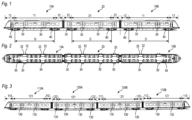
- Figure 1 shows a three-part rail vehicle according to a first embodiment.
- the rail vehicle in the form of a multiple unit comprises two end cars 10A, 10B and an intermediate car 20 coupled to and connecting the end cars 10A, 10B.
- Each car 10A, 10B, 20 has two separate bogies 40, so that the rail vehicle has a total of six bogies.
- the end cars 10A, 10B can each have at least one driven bogie.
- the bogie 40 of each end car 10A, 10B arranged adjacent to the intermediate car 20 can be designed as a drive bogie.
- the other bogies are then trailer bogies 40.
- the drive bogies 40 it is also possible to place the drive bogies 40 at the respective end of the rail vehicle or to equip the end cars 10A, 10B with two drive bogies.
- the intermediate car 20 can also have one or even two drive bogies, which allows the overall traction power to be increased and distributed more evenly.
- the end cars 10A, 10B and the middle car 20 each have a central car body shell segment 11, 21, which is constructed identically for all cars.
- the central car body shell segment 11, 21 extends between the pivot pins of the bogies 40, the distance D between which is Figure 1
- the central car body shell segment 11, 21 has the same overhangs on both sides.
- the middle car 20 has an even number of doors 30. Specifically, it has four doors.
- the end cars 10A, 10B have a different number, specifically two doors in this case. This means that both the middle car 20 and the end cars 10A, 10B each have an even number of doors.
- the gap is smaller in the area of the individual doors. Additional sliding steps can be dispensed with there, also in compliance with the TSI PRM. This results in a maximum car body width without side wall recesses in the end wall area, combined with an optimal length of the individual rail vehicle cars.
- Each door 30 comprises two door tracks 32, which are marked with small arrows in the Figure 2 are indicated. There are then 16 door tracks on each side of the rail vehicle.
- the central car body shell segment 11, 21 of all cars is completed with side wall modules that have two doors. These are arranged symmetrically to the center of the respective central car body shell segment.
- the central car body shell segments 11, 21 and the side wall modules attached to them can thus be the same for all cars 10A, 10B, and 20. This standardizes the car body shells, which has a beneficial effect on the manufacturing process and repair.
- identical side wall modules can be used.
- Each central car body shell segment 11, 21 can be constructed from individual modules, for example, in the grid of the window divider.
- the overhangs i.e., the distance from the pivot pin to the respective end of the central car body shell segment, can be the same.
- the structure of the three-car rail vehicle described here is highly standardized, which is particularly evident in uniform main dimensions, such as identical pivot pin spacing, identical overhangs, identical window dividers, and/or identical door cutouts.
- the middle car 20 has two transition segments 22.
- the end cars 10A, 10B each have a head segment 13 and a transition segment 12.
- the transition segments 12, 22 allow the cars to be coupled together and provide a passage for passengers between the individual cars, thus creating a continuous passenger area.
- the end cars 10A, 10B also include impact protection structures integrated in the area of the power car segments.
- transition segments 22 of the intermediate car 20 essentially each have a door 30 on each side.
- transition segments 12 of the end cars are doorless.
- the transition segments 12 thus extend the seating area of the central car body shell segment 11.
- either two or three windows are arranged between adjacent doors 30, defining corresponding seating areas or multi-purpose areas.
- the seating arrangement of the three-car rail vehicle is shown in Figure 2 shown, whereby in order to achieve the largest possible number of seats, the multi-purpose areas are limited to areas of the power car segments 13.
- the multi-purpose areas, in the Figure 2 marked 50 are suitable for wheelchair users.
- the rail vehicle comprises a total of 196 seats and thus has a very high number of seats while at the same time providing a sufficiently good flow of people due to the even distribution of the doors.
- the three-car rail vehicle presented here has one more bogie. This somewhat reduces the available space for installations such as control cabinets or the like. However, this is acceptable and can be solved structurally. For example, some of the installations can be accommodated in the driver's cab or in the space between the driver's cab and the passenger compartment. It is also possible to integrate installation equipment into the passenger compartment.
- the main transformer of the rail vehicle is formed by two separate transformers distributed between both end cars. This improves the mass distribution in particular and also has a positive effect on the cable routes and thus on losses.
- Figure 3 shows a four-part rail vehicle according to a second embodiment.
- the rail vehicle in the form of a multiple unit comprises two end cars 110A, 110B, a first intermediate car 120A, and a second intermediate car 120B.
- the first intermediate car 120A can also be referred to as the central intermediate car and corresponds in its structure to the intermediate car 20 from Figure 1 , meaning it has an even number of doors on each side, specifically four doors 130 on each side.
- the end cars 110A, 110B correspond in their construction to the end cars 10A, 10B from Figure 1 and also have two doors on each side.
- the first (central) intermediate car 120A is coupled to the end car 110A and the second intermediate car 120B, which in turn is coupled to the end car 110B.
- the second intermediate car 120B has an odd number of doors on each side, specifically three doors on each side.
- the second intermediate car 120B typically has one fewer door on each side than the first intermediate car 120A, with this door being omitted at its end facing the first intermediate car 120A.
- the first intermediate car 120A and the second intermediate car 120B each have the same central car body shell segment 121, which corresponds to the car body shell segment 21 from Figure 1
- the central car body shell segment 121 therefore has two doors 130 on each side, each with two door tracks.
- a transition segment 122 with a door 130 on each side is arranged at each end of the central car body shell segment.
- the central car body shell segment 121 of the second intermediate car 120B has a transition segment 122 with a door on only one end.
- a doorless transition segment 112 is arranged on the other end, which corresponds to the doorless transition segment 112 of the end cars 110A, 110B.
- the second intermediate car 120B therefore has a transition segment 122 of the first intermediate car 120A at one end and a transition segment 112 of the end cars 110A, 110B at its other end and therefore uses the modular bodyshell design of these two car types.
- the second intermediate car 120B with its doorless transition segment 112 is coupled to the first intermediate car 120A, the seating capacity is increased without disrupting the flow of passengers, since the ferry passengers can enter and leave this area via the door in the transition segment 122 of the first intermediate car 120A.
- the second intermediate car 120B with its transition segment 122 which has a door 130 on each side, coupled to the end car 110B and thus allows access to the doorless transition segment 112 of the end car 110B.
- the Figure 3 The embodiment shown can be extended by further second intermediate carriages 120B.
- a further second intermediate carriage can be arranged between the Figure 3 shown second intermediate car 120B and the end car 110B, whereby it has the same "orientation" as the already existing second intermediate car 120B, ie this also points with its doorless transition segment to the first intermediate car 110A.
- any number of second intermediate cars 120B can be integrated, with their respective doorless transition segments 112 each pointing to the central intermediate car 120A and their respective transition segments 122 with doors pointing to the respective adjacent end cars.
Landscapes
- Engineering & Computer Science (AREA)
- Mechanical Engineering (AREA)
- Transportation (AREA)
- Platform Screen Doors And Railroad Systems (AREA)
Claims (13)
- Véhicule ferroviaire en plusieurs parties comportant deux voitures d'extrémité (10A, 10B, 110A, 110B) et au moins une voiture centrale (20, 120A), dans lequel la voiture centrale (20, 120A) possède un nombre pair de portes (30, 130) de chaque côté qui, lors du fonctionnement normal, sont à la disposition des passagers pour entrer dans l'habitacle et également pour en sortir, dans lequel chaque porte présente deux voies de porte, et en ce que les deux voitures d'extrémité (10A, 10B, 110A, 110B) possèdent un nombre de portes (30, 130) de chaque côté différent de celui de la voiture centrale (20, 120A), lesquelles portes, lors du fonctionnement normal, sont à la disposition des passagers pour entrer dans l'habitacle et également pour en sortir, dans lequel chaque porte présente deux voies de porte,
dans lequel
toutes les voitures (10A, 10B, 20, 110A, 110B, 120A, 120B) présentent un segment de structure porteuse de caisse de voiture (11, 21, 121) central uniforme, et en ce que chacune des voitures (10A, 10B, 20) dispose de deux bogies (40) propres. - Véhicule ferroviaire en plusieurs parties selon la revendication 1, caractérisé en ce que le véhicule ferroviaire est en trois parties avec une voiture centrale (20) qui présente de chaque côté quatre portes (30) comportant respectivement deux voies de porte (32), et en ce que les voitures d'extrémité (10A, 10B) présentent de chaque côté respectivement deux portes (30) comportant respectivement deux voies de porte (32).
- Véhicule ferroviaire en plusieurs parties selon la revendication 1, caractérisé en ce que le véhicule ferroviaire est en trois parties avec une voiture centrale (20) qui présente de chaque côté deux portes (30) comportant respectivement deux voies de porte (32), et en ce que les voitures d'extrémité (10A, 10B) présentent de chaque côté respectivement trois portes (30) comportant respectivement deux voies de porte (32).
- Véhicule ferroviaire en plusieurs parties selon la revendication 1, caractérisé en ce que le véhicule ferroviaire comprend une première voiture centrale (120A) comportant le nombre pair de portes (130) de chaque côté et au moins une seconde voiture centrale (120B) comportant un nombre impair de portes (130) de chaque côté.
- Véhicule ferroviaire en plusieurs parties selon la revendication 4, caractérisé en ce que la seconde voiture centrale ou chaque seconde voiture centrale (120B) comprend des modules de caisse de voiture qui correspondent aux modules de caisse de voiture de la voiture d'extrémité (110A, 110B) et de la première voiture centrale (120A) respectivement les plus proches.
- Véhicule ferroviaire en plusieurs parties selon la revendication 4 ou 5, caractérisé en ce que la première voiture centrale (120A) présente à chacune de ses extrémités respectivement un segment d'intercirculation (122) avec porte, et en ce que la seconde voiture centrale ou chaque seconde voiture centrale (120B) présente à une extrémité respective un segment d'intercirculation (122) avec porte et à l'autre extrémité respective un segment d'intercirculation (112) sans porte, dans lequel toutes les voitures centrales (120A, 120B) présentent respectivement le même segment de structure porteuse de caisse de voiture (111) central sur lequel sont disposés les segments d'intercirculation (112, 122) respectifs.
- Véhicule ferroviaire en plusieurs parties selon l'une des revendications 1 à 6, caractérisé en ce que toutes les voitures (10A, 10B, 20, 110A, 110B, 120A, 120B) présentent respectivement la même distance D entre les pivots de leurs bogies (40) respectifs.
- Véhicule ferroviaire en plusieurs parties selon l'une des revendications 1 à 7, caractérisé en ce que toutes les voitures (10A, 10B, 20, 110A, 110B, 120A, 120B) présentent respectivement le même porte-à-faux.
- Véhicule ferroviaire en plusieurs parties selon l'une des revendications 1 à 8, caractérisé en ce que toutes les voitures (10A, 10B, 20, 110A, 110B, 120A, 120B) présentent respectivement le même séparateur de fenêtres.
- Véhicule ferroviaire en plusieurs parties selon l'une des revendications 1 à 9, caractérisé en ce que toutes les voitures (10A, 10B, 20, 110A, 110B, 120A, 120B) présentent respectivement des découpes de porte identiques.
- Véhicule ferroviaire en plusieurs parties selon l'une des revendications 1 à 10, caractérisé en ce qu'au moins l'un des deux bogies (40) de chacune des deux voitures d'extrémité (10A, 10B, 110A, 110B) comprend au moins un essieu moteur.
- Véhicule ferroviaire en plusieurs parties selon l'une des revendications 1 à 11, caractérisé en ce que chaque voiture d'extrémité (10A, 10B, 110A, 110B) comprend un transformateur.
- Véhicule ferroviaire en plusieurs parties selon l'une des revendications 1 à 12, caractérisé en ce que chaque voiture d'extrémité (10A, 10B, 110A, 110B) présente un segment d'intercirculation (12, 112) sans porte vers la ou les voitures centrales (20, 120A, 120B) qui s'étend depuis le segment de structure porteuse de caisse de voiture (11, 121) central de la voiture d'extrémité (10A, 10B, 110A, 110B) jusqu'à l'extrémité de la voiture d'extrémité (10A, 10B, 110A, 110B) qui est accouplée à la voiture centrale (20, 120A, 120B) respectivement adjacente.
Applications Claiming Priority (1)
| Application Number | Priority Date | Filing Date | Title |
|---|---|---|---|
| DE102013102698.2A DE102013102698A1 (de) | 2013-03-15 | 2013-03-15 | Mehrteiliges Schienenfahrzeug |
Publications (3)
| Publication Number | Publication Date |
|---|---|
| EP2792568A1 EP2792568A1 (fr) | 2014-10-22 |
| EP2792568B1 EP2792568B1 (fr) | 2019-02-27 |
| EP2792568B2 true EP2792568B2 (fr) | 2025-06-18 |
Family
ID=50241237
Family Applications (1)
| Application Number | Title | Priority Date | Filing Date |
|---|---|---|---|
| EP14159170.1A Active EP2792568B2 (fr) | 2013-03-15 | 2014-03-12 | Véhicule sur rails en plusieurs parties |
Country Status (2)
| Country | Link |
|---|---|
| EP (1) | EP2792568B2 (fr) |
| DE (1) | DE102013102698A1 (fr) |
Families Citing this family (3)
| Publication number | Priority date | Publication date | Assignee | Title |
|---|---|---|---|---|
| EP3251912B1 (fr) * | 2016-06-01 | 2022-04-20 | Bombardier Transportation GmbH | Véhicule ferroviaire avec différentes zones de passagers |
| DE102019133596B4 (de) * | 2019-12-09 | 2026-02-12 | Bombardier Transportation Gmbh | Schienenfahrzeug und Schienentransportsystem |
| CN111874023B (zh) * | 2020-08-13 | 2022-04-08 | 中车株洲电力机车有限公司 | 轨道交通车辆、轨道交通车辆车门控制方法及系统 |
Citations (21)
| Publication number | Priority date | Publication date | Assignee | Title |
|---|---|---|---|---|
| DE1900649A1 (de) † | 1968-01-02 | 1969-08-28 | Johns Manville | Asbestfaserhaltiger Gegenstand und Verfahren zu seiner Herstellung |
| EP0599235A1 (fr) † | 1992-11-27 | 1994-06-01 | ABB HENSCHEL WAGGON UNION GmbH | Véhicule guidé |
| DE9411486U1 (de) † | 1994-07-15 | 1994-09-08 | Waggonbau Ammendorf Gmbh, 06132 Halle | Schienenfahrzeug, insbesondere für den Nahverkehr |
| DE9416537U1 (de) † | 1994-10-14 | 1994-12-01 | Waggonbau Ammendorf Gmbh, 06132 Halle | Nahverkehrszug |
| EP0630797A1 (fr) † | 1993-06-22 | 1994-12-28 | AEG Schienenfahrzeuge GmbH | Véhicule ferroviaire à plancher bas |
| EP0631917A1 (fr) † | 1993-07-01 | 1995-01-04 | SGP Verkehrstechnik Gesellschaft m.b.H. | Véhicule ferroviaire |
| EP0687613A1 (fr) † | 1994-06-15 | 1995-12-20 | SGP Verkehrstechnik Gesellschaft m.b.H. | Train articulé |
| EP0616936B1 (fr) † | 1993-03-25 | 1997-01-29 | Jenbacher Energiesysteme Aktiengesellschaft | Train articulé |
| DE19619212A1 (de) † | 1996-05-13 | 1997-11-20 | Duewag Ag | Wagenkasten eines Schienenfahrzeuges |
| DE19725323A1 (de) † | 1997-06-10 | 1998-12-17 | Abb Daimler Benz Transp | Flughafenzubringer |
| EP1024070A1 (fr) † | 1999-01-27 | 2000-08-02 | Alstom | Rame ferroviaire modulaire et convoi ferroviaire formé de telles rames |
| DE29910324U1 (de) † | 1999-06-14 | 2000-10-26 | ALSTOM LHB GmbH, 38239 Salzgitter | Modulares, mehrteiliges Mehrsystem-Schienenfahrzeug, insbesondere Zweisystem-Schienenfahrzeug |
| US6196136B1 (en) † | 1996-06-19 | 2001-03-06 | Hitachi, Ltd. | Car and side structure for car and method of manufacturing the same |
| JP2004131008A (ja) † | 2002-10-11 | 2004-04-30 | Kyosan Electric Mfg Co Ltd | 可動ホーム柵装置 |
| EP2165907A1 (fr) † | 2008-09-22 | 2010-03-24 | Bombardier Transportation GmbH | Carrosserie de caisse de voiture et procédé de rééquipement d'une caisse de voiture |
| EP2223841A1 (fr) † | 2009-02-26 | 2010-09-01 | Siemens Aktiengesellschaft | Caisse allongée pour véhicules ferroviaires et train automoteur composé de ces véhicules |
| EP2305529A2 (fr) † | 2009-09-30 | 2011-04-06 | Deutsches Zentrum für Luft- und Raumfahrt e.V. | Caisse de voiture modulaire |
| EP1958844B1 (fr) † | 2007-02-16 | 2011-07-13 | ALSTOM Transport SA | Procédé de fabrication d'un sous-ensemble de rame de transport de voyageurs |
| DE102011051634A1 (de) † | 2011-07-07 | 2013-01-10 | Bombardier Transportation Gmbh | Konstruktionsverfahren zum Aufbau eines Schienenfahrzeugwagens, Verfahren zur Herstellung eines Schienenfahrzeugwagens, und Schienenfahrzeugfamilie |
| EP1966022B1 (fr) † | 2005-12-23 | 2014-05-07 | Bombardier Transportation GmbH | Vehicule ferroviaire transformable |
| EP1967436B1 (fr) † | 2007-03-08 | 2018-11-21 | ALSTOM Transport Technologies | Rame ferroviaire de transport de voyageurs |
Family Cites Families (1)
| Publication number | Priority date | Publication date | Assignee | Title |
|---|---|---|---|---|
| DE19926940A1 (de) | 1999-06-14 | 2000-12-21 | Alstom Lhb Gmbh | Modulares, mehrteiliges Mehrsystem-Schienenfahrzeug, insbesondere Zweisystem-Schienenfahrzeug |
-
2013
- 2013-03-15 DE DE102013102698.2A patent/DE102013102698A1/de active Pending
-
2014
- 2014-03-12 EP EP14159170.1A patent/EP2792568B2/fr active Active
Patent Citations (21)
| Publication number | Priority date | Publication date | Assignee | Title |
|---|---|---|---|---|
| DE1900649A1 (de) † | 1968-01-02 | 1969-08-28 | Johns Manville | Asbestfaserhaltiger Gegenstand und Verfahren zu seiner Herstellung |
| EP0599235A1 (fr) † | 1992-11-27 | 1994-06-01 | ABB HENSCHEL WAGGON UNION GmbH | Véhicule guidé |
| EP0616936B1 (fr) † | 1993-03-25 | 1997-01-29 | Jenbacher Energiesysteme Aktiengesellschaft | Train articulé |
| EP0630797A1 (fr) † | 1993-06-22 | 1994-12-28 | AEG Schienenfahrzeuge GmbH | Véhicule ferroviaire à plancher bas |
| EP0631917A1 (fr) † | 1993-07-01 | 1995-01-04 | SGP Verkehrstechnik Gesellschaft m.b.H. | Véhicule ferroviaire |
| EP0687613A1 (fr) † | 1994-06-15 | 1995-12-20 | SGP Verkehrstechnik Gesellschaft m.b.H. | Train articulé |
| DE9411486U1 (de) † | 1994-07-15 | 1994-09-08 | Waggonbau Ammendorf Gmbh, 06132 Halle | Schienenfahrzeug, insbesondere für den Nahverkehr |
| DE9416537U1 (de) † | 1994-10-14 | 1994-12-01 | Waggonbau Ammendorf Gmbh, 06132 Halle | Nahverkehrszug |
| DE19619212A1 (de) † | 1996-05-13 | 1997-11-20 | Duewag Ag | Wagenkasten eines Schienenfahrzeuges |
| US6196136B1 (en) † | 1996-06-19 | 2001-03-06 | Hitachi, Ltd. | Car and side structure for car and method of manufacturing the same |
| DE19725323A1 (de) † | 1997-06-10 | 1998-12-17 | Abb Daimler Benz Transp | Flughafenzubringer |
| EP1024070A1 (fr) † | 1999-01-27 | 2000-08-02 | Alstom | Rame ferroviaire modulaire et convoi ferroviaire formé de telles rames |
| DE29910324U1 (de) † | 1999-06-14 | 2000-10-26 | ALSTOM LHB GmbH, 38239 Salzgitter | Modulares, mehrteiliges Mehrsystem-Schienenfahrzeug, insbesondere Zweisystem-Schienenfahrzeug |
| JP2004131008A (ja) † | 2002-10-11 | 2004-04-30 | Kyosan Electric Mfg Co Ltd | 可動ホーム柵装置 |
| EP1966022B1 (fr) † | 2005-12-23 | 2014-05-07 | Bombardier Transportation GmbH | Vehicule ferroviaire transformable |
| EP1958844B1 (fr) † | 2007-02-16 | 2011-07-13 | ALSTOM Transport SA | Procédé de fabrication d'un sous-ensemble de rame de transport de voyageurs |
| EP1967436B1 (fr) † | 2007-03-08 | 2018-11-21 | ALSTOM Transport Technologies | Rame ferroviaire de transport de voyageurs |
| EP2165907A1 (fr) † | 2008-09-22 | 2010-03-24 | Bombardier Transportation GmbH | Carrosserie de caisse de voiture et procédé de rééquipement d'une caisse de voiture |
| EP2223841A1 (fr) † | 2009-02-26 | 2010-09-01 | Siemens Aktiengesellschaft | Caisse allongée pour véhicules ferroviaires et train automoteur composé de ces véhicules |
| EP2305529A2 (fr) † | 2009-09-30 | 2011-04-06 | Deutsches Zentrum für Luft- und Raumfahrt e.V. | Caisse de voiture modulaire |
| DE102011051634A1 (de) † | 2011-07-07 | 2013-01-10 | Bombardier Transportation Gmbh | Konstruktionsverfahren zum Aufbau eines Schienenfahrzeugwagens, Verfahren zur Herstellung eines Schienenfahrzeugwagens, und Schienenfahrzeugfamilie |
Non-Patent Citations (30)
| Title |
|---|
| "Technische Daten der Baureihe 442", BOMBARDIER TRANSPORTATION, 13 September 2012 (2012-09-13), Talent 2 Nürnberg, Germany, pages 1 - 14, XP002728446, Retrieved from the Internet <URL:http://www.nahverkehr-franken.de/sbahn/442- techdat.html> [retrieved on 20140813] † |
| A. KORTEMEYER ET AL.: "Mit Combino in die Zukunft", NAHVERKERS-PRAXIS, June 1996 (1996-06-01), XP055660991, Retrieved from the Internet <URL:https://www.g-st.ch/trambasel/spezial/doku/combino/comzukun.pdf> † |
| ANONYMOUS: "Die mariazellerbahn technik pur auf schmaler spur", WEBARCHIVE, pages 1 - 2, XP055671267 † |
| ANONYMOUS: "London underground 1967stock", WIKIPEDIA, 12 March 2013 (2013-03-12), London, pages 1 - 7, XP055671231 † |
| ANONYMOUS: "NSB set to introduce class 70 EMUs", RAILWAY GAZETTE INTERNATIONAL, 20 November 2019 (2019-11-20), pages 1 - 4, XP000114459 † |
| ANONYMOUS: "Rolling stock data sheet, 2nd edition", WEBARCHIVE, pages 1, XP055671264 † |
| ANONYMOUS: "SL C20", WIKIPEDIA, 23 February 2013 (2013-02-23), pages 1 - 4, XP055671238 † |
| ANONYMOUS: "Tailor-made trains", RAILWAY GAZETTE INTERNATIONAL, pages 1 - 4, XP001573711 † |
| D. BENSON ET AL.: "Transport and Distribution. Made simple", 1975, W. H. ALLEN & COMPANY, article "The Physical components of Transport", pages: 83, XP055661098 † |
| Deutsche Triebwagen 2011 † |
| Die neuen Triebzüge der Baureihe 474/874 für die Hamburger S-Bahn 04/98 † |
| DOSTAL MICHEAL: "Deutsche Bahn Und privatbahnen", GERAMOND, pages 1 - 7, XP055671259 † |
| Elektrotriebwagen 16 2017 † |
| G. DIETZ ET AL.: "Deutsche Schnelltriebwagen. Vom Fliegenden Hamburger zum ET 403 der DB", 2003, EK-VERLAG, pages: 194 - 199, XP055660959 † |
| G. PAHL ET AL.: "Konstruktionslehre. Grundlagen erfolgreicher Produktentwicklung. Methoden und Anwendungen", 2005, SPRINGER, article "Entwickeln von Baureihen und Baukästen", XP055540100 † |
| H. SCHMIDT: "Beitrag zum Variantenmanagement und zur Pro- zessoptimierung im Wagenkastenbau von Schienenfahrzeugen", DISSERTATION VON DIPLOM-INGENIEUR, 29 July 2002 (2002-07-29), TU Berlin, XP055539644, Retrieved from the Internet <URL:https://depositonce.tu-berlin.de/handle/11303/852> † |
| J. JANICKI ET AL.: "Schienenfahrzeugtechnik", 2008, BAHN FACHVERLAG, article "Grundlagen", pages: 16-19, 35, 37, 58 - 61, 76, 81, 83, 97, 174, XP055660972 † |
| J. YUAN: "Stochastic Modelling of Train Delays and Delay Propagation in Stations", THESIS, September 2006 (2006-09-01), TU Delft, XP055660226 † |
| KOPP ET AL.: "Plattform Desiro ML für hohe Fahrzeugflexibilität im Regionalverkehr", ELEKTRISCHE BAHNEN, vol. 105, no. Heft 10, 2007, pages 503 - 511, XP055660407 † |
| KOPP M. ET AL.: "Triebzüge Desiro ML für die SNCB", ELEKTRISCHE BAHNEN, vol. 110, no. Heft 8-9, 2012, pages 414 - 419, XP055660405 † |
| MÖLLER G. D. ET AL.: "Die modulare Regionalfahrzeugfamilie Desiro", ETR - EISENBAHNTECHNISCHE RUNDSCHAU, vol. 49, no. 1-2, 2000, pages 44, 46-50, XP055540102 † |
| ROTTER RICHARD, ET AL.: "Erfahrungen mit elektrischen Nahverkehrstriebwagen bei den österreichischen bundesbahnen", ELEKTRISCHE BAHNEN EB, 1987, pages 325 - 335, XP055671262 † |
| SCHLAHT J. ET AL.: "Inspiro - Die neue Metro Plattform", EISENBAHNTECHNISCHE RUNDSCHAU (ETR), vol. 2011, no. 6, June 2011 (2011-06-01), pages 16 - 21, XP055660404 † |
| STUDER GUIDO: "Combino'' bei den BVB", TRAM BASEL, 13 November 2009 (2009-11-13), XP055540107, Retrieved from the Internet <URL:https://www.g-st.ch/trambasel/spezial/combino_basel.html> † |
| Triebwagen deutscher Eisenbahnen (Part 1) 31 12 1977 † |
| Triebwagen deutscher Eisenbahnen (Part 2) † |
| Triebwagenarchiv (Part 1) 1979 † |
| Triebwagenarchiv (Part 2) † |
| V. VUCHIC: "Urban Transit. Systems and Technology", 2007, JOHN WILEY, article "Rolling Stock", pages: 329 - 330, 333, 335, XP055661092 † |
| ZENO PILLMANN: "Der Schnelltriebzug der Baureihe 403/404 der Deutschen Bundesbahn", EISENBAHN-REVUE INTERNATIONAL NR. 3/1999, vol. 1999, no. 3, March 1999 (1999-03-01), pages 103 - 107, XP055660967 † |
Also Published As
| Publication number | Publication date |
|---|---|
| EP2792568B1 (fr) | 2019-02-27 |
| EP2792568A1 (fr) | 2014-10-22 |
| DE102013102698A1 (de) | 2014-09-18 |
Similar Documents
| Publication | Publication Date | Title |
|---|---|---|
| EP2543570B1 (fr) | Procédé de réalisation d'un véhicule ferroviaire, procédé de fabrication d'un véhicule ferroviaire et famille de véhicules ferroviaires | |
| DE60103069T2 (de) | Doppelstöckige Eisenbahnwagen mit Durchgangseinrichtungen in beiden Stöcken | |
| EP3868626B1 (fr) | Véhicule de transport des personnes | |
| EP0631917B1 (fr) | Véhicule ferroviaire | |
| EP2535236B1 (fr) | Chariot de véhicule sur rails doté d'une zone de fauteuil roulant ainsi que véhicule sur rails | |
| DE9421209U1 (de) | Doppelstöckiges Schienenfahrzeug zur Beförderung von Personen im Nah- und Fernverkehr auf Strecken mit unterschiedlichen Bahnsteighöhen | |
| EP3164313B2 (fr) | Véhicule ferroviaire réalisé sous la forme d'une rame articulée | |
| EP0577938B1 (fr) | Voiture auto-motrice articulée pour trafic ferroviaire | |
| EP1966022B1 (fr) | Vehicule ferroviaire transformable | |
| EP0616936A1 (fr) | Train articulé | |
| EP2792568B1 (fr) | Véhicule sur rails en plusieurs parties | |
| DE202012013488U1 (de) | Triebzug mit mindestens einem angetriebenen Einzeldeckwagen | |
| WO2019025127A1 (fr) | Véhicule ferroviaire à éléments multiples | |
| EP3909825B1 (fr) | Véhicules ferroviaires pourvu d'étage supérieur, d'étage inférieur et d'étage intermédiaire | |
| EP0599235A1 (fr) | Véhicule guidé | |
| EP2969699B1 (fr) | Véhicule ferroviaire modulaire comprenant des modules de différentes largeurs | |
| EP3972883B1 (fr) | Véhicule ferroviaire | |
| DE102017115542B4 (de) | Schienenfahrzeugverband | |
| EP0891909A1 (fr) | Voiture - pilote carénée à deux niveaux | |
| EP3109121B1 (fr) | Bati tournant pour vehicules ferroviaire a plusieurs articulations et vehicules ferroviaire a plusieurs articulations | |
| DE102017200641A1 (de) | oFahrzeug zur Personenbeförderung | |
| DE102019203962A1 (de) | Schienenfahrzeug zur Personenbeförderung mit Wagenübergangsmodulen | |
| EP3737598B1 (fr) | Caisson de pont de véhicule et véhicule ferroviaire à plusieurs unités | |
| DE29507057U1 (de) | Doppelstöckiges Schienenfahrzeug mit Niederflureinstiegen, insbesondere Doppelstockmittel- oder Steuerwagen | |
| EP2247485B1 (fr) | Vehicule ferroviaire a deux etages |
Legal Events
| Date | Code | Title | Description |
|---|---|---|---|
| PUAI | Public reference made under article 153(3) epc to a published international application that has entered the european phase |
Free format text: ORIGINAL CODE: 0009012 |
|
| 17P | Request for examination filed |
Effective date: 20140312 |
|
| AK | Designated contracting states |
Kind code of ref document: A1 Designated state(s): AL AT BE BG CH CY CZ DE DK EE ES FI FR GB GR HR HU IE IS IT LI LT LU LV MC MK MT NL NO PL PT RO RS SE SI SK SM TR |
|
| AX | Request for extension of the european patent |
Extension state: BA ME |
|
| R17P | Request for examination filed (corrected) |
Effective date: 20150420 |
|
| RBV | Designated contracting states (corrected) |
Designated state(s): AL AT BE BG CH CY CZ DE DK EE ES FI FR GB GR HR HU IE IS IT LI LT LU LV MC MK MT NL NO PL PT RO RS SE SI SK SM TR |
|
| RAP1 | Party data changed (applicant data changed or rights of an application transferred) |
Owner name: BOMBARDIER TRANSPORTATION GMBH |
|
| GRAP | Despatch of communication of intention to grant a patent |
Free format text: ORIGINAL CODE: EPIDOSNIGR1 |
|
| STAA | Information on the status of an ep patent application or granted ep patent |
Free format text: STATUS: GRANT OF PATENT IS INTENDED |
|
| INTG | Intention to grant announced |
Effective date: 20180713 |
|
| GRAJ | Information related to disapproval of communication of intention to grant by the applicant or resumption of examination proceedings by the epo deleted |
Free format text: ORIGINAL CODE: EPIDOSDIGR1 |
|
| STAA | Information on the status of an ep patent application or granted ep patent |
Free format text: STATUS: REQUEST FOR EXAMINATION WAS MADE |
|
| INTC | Intention to grant announced (deleted) | ||
| GRAP | Despatch of communication of intention to grant a patent |
Free format text: ORIGINAL CODE: EPIDOSNIGR1 |
|
| STAA | Information on the status of an ep patent application or granted ep patent |
Free format text: STATUS: GRANT OF PATENT IS INTENDED |
|
| INTG | Intention to grant announced |
Effective date: 20181004 |
|
| GRAS | Grant fee paid |
Free format text: ORIGINAL CODE: EPIDOSNIGR3 |
|
| GRAA | (expected) grant |
Free format text: ORIGINAL CODE: 0009210 |
|
| STAA | Information on the status of an ep patent application or granted ep patent |
Free format text: STATUS: THE PATENT HAS BEEN GRANTED |
|
| AK | Designated contracting states |
Kind code of ref document: B1 Designated state(s): AL AT BE BG CH CY CZ DE DK EE ES FI FR GB GR HR HU IE IS IT LI LT LU LV MC MK MT NL NO PL PT RO RS SE SI SK SM TR |
|
| REG | Reference to a national code |
Ref country code: GB Ref legal event code: FG4D Free format text: NOT ENGLISH |
|
| REG | Reference to a national code |
Ref country code: CH Ref legal event code: EP |
|
| REG | Reference to a national code |
Ref country code: DE Ref legal event code: R096 Ref document number: 502014010904 Country of ref document: DE |
|
| REG | Reference to a national code |
Ref country code: AT Ref legal event code: REF Ref document number: 1100885 Country of ref document: AT Kind code of ref document: T Effective date: 20190315 |
|
| REG | Reference to a national code |
Ref country code: IE Ref legal event code: FG4D Free format text: LANGUAGE OF EP DOCUMENT: GERMAN |
|
| REG | Reference to a national code |
Ref country code: CH Ref legal event code: PK Free format text: BERICHTIGUNGEN |
|
| REG | Reference to a national code |
Ref country code: CH Ref legal event code: NV Representative=s name: TR-IP CONSULTING LLC, CH |
|
| RIN2 | Information on inventor provided after grant (corrected) |
Inventor name: HARTUNG, HEIKO Inventor name: DUERSCHMIED, FRANK Inventor name: SEIDLER, GABRIELE |
|
| REG | Reference to a national code |
Ref country code: NL Ref legal event code: MP Effective date: 20190227 |
|
| REG | Reference to a national code |
Ref country code: LT Ref legal event code: MG4D |
|
| PG25 | Lapsed in a contracting state [announced via postgrant information from national office to epo] |
Ref country code: SE Free format text: LAPSE BECAUSE OF FAILURE TO SUBMIT A TRANSLATION OF THE DESCRIPTION OR TO PAY THE FEE WITHIN THE PRESCRIBED TIME-LIMIT Effective date: 20190227 Ref country code: NL Free format text: LAPSE BECAUSE OF FAILURE TO SUBMIT A TRANSLATION OF THE DESCRIPTION OR TO PAY THE FEE WITHIN THE PRESCRIBED TIME-LIMIT Effective date: 20190227 Ref country code: LT Free format text: LAPSE BECAUSE OF FAILURE TO SUBMIT A TRANSLATION OF THE DESCRIPTION OR TO PAY THE FEE WITHIN THE PRESCRIBED TIME-LIMIT Effective date: 20190227 Ref country code: PT Free format text: LAPSE BECAUSE OF FAILURE TO SUBMIT A TRANSLATION OF THE DESCRIPTION OR TO PAY THE FEE WITHIN THE PRESCRIBED TIME-LIMIT Effective date: 20190627 Ref country code: NO Free format text: LAPSE BECAUSE OF FAILURE TO SUBMIT A TRANSLATION OF THE DESCRIPTION OR TO PAY THE FEE WITHIN THE PRESCRIBED TIME-LIMIT Effective date: 20190527 Ref country code: FI Free format text: LAPSE BECAUSE OF FAILURE TO SUBMIT A TRANSLATION OF THE DESCRIPTION OR TO PAY THE FEE WITHIN THE PRESCRIBED TIME-LIMIT Effective date: 20190227 |
|
| PG25 | Lapsed in a contracting state [announced via postgrant information from national office to epo] |
Ref country code: IS Free format text: LAPSE BECAUSE OF FAILURE TO SUBMIT A TRANSLATION OF THE DESCRIPTION OR TO PAY THE FEE WITHIN THE PRESCRIBED TIME-LIMIT Effective date: 20190627 Ref country code: BG Free format text: LAPSE BECAUSE OF FAILURE TO SUBMIT A TRANSLATION OF THE DESCRIPTION OR TO PAY THE FEE WITHIN THE PRESCRIBED TIME-LIMIT Effective date: 20190527 Ref country code: HR Free format text: LAPSE BECAUSE OF FAILURE TO SUBMIT A TRANSLATION OF THE DESCRIPTION OR TO PAY THE FEE WITHIN THE PRESCRIBED TIME-LIMIT Effective date: 20190227 Ref country code: RS Free format text: LAPSE BECAUSE OF FAILURE TO SUBMIT A TRANSLATION OF THE DESCRIPTION OR TO PAY THE FEE WITHIN THE PRESCRIBED TIME-LIMIT Effective date: 20190227 Ref country code: GR Free format text: LAPSE BECAUSE OF FAILURE TO SUBMIT A TRANSLATION OF THE DESCRIPTION OR TO PAY THE FEE WITHIN THE PRESCRIBED TIME-LIMIT Effective date: 20190528 Ref country code: LV Free format text: LAPSE BECAUSE OF FAILURE TO SUBMIT A TRANSLATION OF THE DESCRIPTION OR TO PAY THE FEE WITHIN THE PRESCRIBED TIME-LIMIT Effective date: 20190227 |
|
| PG25 | Lapsed in a contracting state [announced via postgrant information from national office to epo] |
Ref country code: SK Free format text: LAPSE BECAUSE OF FAILURE TO SUBMIT A TRANSLATION OF THE DESCRIPTION OR TO PAY THE FEE WITHIN THE PRESCRIBED TIME-LIMIT Effective date: 20190227 Ref country code: IT Free format text: LAPSE BECAUSE OF FAILURE TO SUBMIT A TRANSLATION OF THE DESCRIPTION OR TO PAY THE FEE WITHIN THE PRESCRIBED TIME-LIMIT Effective date: 20190227 Ref country code: AL Free format text: LAPSE BECAUSE OF FAILURE TO SUBMIT A TRANSLATION OF THE DESCRIPTION OR TO PAY THE FEE WITHIN THE PRESCRIBED TIME-LIMIT Effective date: 20190227 Ref country code: DK Free format text: LAPSE BECAUSE OF FAILURE TO SUBMIT A TRANSLATION OF THE DESCRIPTION OR TO PAY THE FEE WITHIN THE PRESCRIBED TIME-LIMIT Effective date: 20190227 Ref country code: EE Free format text: LAPSE BECAUSE OF FAILURE TO SUBMIT A TRANSLATION OF THE DESCRIPTION OR TO PAY THE FEE WITHIN THE PRESCRIBED TIME-LIMIT Effective date: 20190227 Ref country code: RO Free format text: LAPSE BECAUSE OF FAILURE TO SUBMIT A TRANSLATION OF THE DESCRIPTION OR TO PAY THE FEE WITHIN THE PRESCRIBED TIME-LIMIT Effective date: 20190227 Ref country code: CZ Free format text: LAPSE BECAUSE OF FAILURE TO SUBMIT A TRANSLATION OF THE DESCRIPTION OR TO PAY THE FEE WITHIN THE PRESCRIBED TIME-LIMIT Effective date: 20190227 Ref country code: ES Free format text: LAPSE BECAUSE OF FAILURE TO SUBMIT A TRANSLATION OF THE DESCRIPTION OR TO PAY THE FEE WITHIN THE PRESCRIBED TIME-LIMIT Effective date: 20190227 |
|
| REG | Reference to a national code |
Ref country code: DE Ref legal event code: R026 Ref document number: 502014010904 Country of ref document: DE |
|
| PG25 | Lapsed in a contracting state [announced via postgrant information from national office to epo] |
Ref country code: LU Free format text: LAPSE BECAUSE OF NON-PAYMENT OF DUE FEES Effective date: 20190312 Ref country code: SM Free format text: LAPSE BECAUSE OF FAILURE TO SUBMIT A TRANSLATION OF THE DESCRIPTION OR TO PAY THE FEE WITHIN THE PRESCRIBED TIME-LIMIT Effective date: 20190227 Ref country code: PL Free format text: LAPSE BECAUSE OF FAILURE TO SUBMIT A TRANSLATION OF THE DESCRIPTION OR TO PAY THE FEE WITHIN THE PRESCRIBED TIME-LIMIT Effective date: 20190227 |
|
| PLBI | Opposition filed |
Free format text: ORIGINAL CODE: 0009260 |
|
| REG | Reference to a national code |
Ref country code: BE Ref legal event code: MM Effective date: 20190331 |
|
| PLAX | Notice of opposition and request to file observation + time limit sent |
Free format text: ORIGINAL CODE: EPIDOSNOBS2 |
|
| PLAZ | Examination of admissibility of opposition: despatch of communication + time limit |
Free format text: ORIGINAL CODE: EPIDOSNOPE2 |
|
| PLBI | Opposition filed |
Free format text: ORIGINAL CODE: 0009260 |
|
| PG25 | Lapsed in a contracting state [announced via postgrant information from national office to epo] |
Ref country code: MC Free format text: LAPSE BECAUSE OF FAILURE TO SUBMIT A TRANSLATION OF THE DESCRIPTION OR TO PAY THE FEE WITHIN THE PRESCRIBED TIME-LIMIT Effective date: 20190227 |
|
| 26 | Opposition filed |
Opponent name: STADLER RAIL AG Effective date: 20191122 Opponent name: SIEMENS MOBILITY GMBH Effective date: 20191122 |
|
| 26 | Opposition filed |
Opponent name: ALSTOM TRANSPORT TECHNOLOGIES Effective date: 20191218 |
|
| PG25 | Lapsed in a contracting state [announced via postgrant information from national office to epo] |
Ref country code: IE Free format text: LAPSE BECAUSE OF NON-PAYMENT OF DUE FEES Effective date: 20190312 |
|
| REG | Reference to a national code |
Ref country code: CH Ref legal event code: PCAR Free format text: NEW ADDRESS: ROUTE DU COUTSET 18, 1485 NUVILLY (CH) |
|
| PG25 | Lapsed in a contracting state [announced via postgrant information from national office to epo] |
Ref country code: FR Free format text: LAPSE BECAUSE OF NON-PAYMENT OF DUE FEES Effective date: 20190427 Ref country code: BE Free format text: LAPSE BECAUSE OF NON-PAYMENT OF DUE FEES Effective date: 20190331 Ref country code: SI Free format text: LAPSE BECAUSE OF FAILURE TO SUBMIT A TRANSLATION OF THE DESCRIPTION OR TO PAY THE FEE WITHIN THE PRESCRIBED TIME-LIMIT Effective date: 20190227 |
|
| PG25 | Lapsed in a contracting state [announced via postgrant information from national office to epo] |
Ref country code: TR Free format text: LAPSE BECAUSE OF FAILURE TO SUBMIT A TRANSLATION OF THE DESCRIPTION OR TO PAY THE FEE WITHIN THE PRESCRIBED TIME-LIMIT Effective date: 20190227 |
|
| PLBB | Reply of patent proprietor to notice(s) of opposition received |
Free format text: ORIGINAL CODE: EPIDOSNOBS3 |
|
| PG25 | Lapsed in a contracting state [announced via postgrant information from national office to epo] |
Ref country code: MT Free format text: LAPSE BECAUSE OF FAILURE TO SUBMIT A TRANSLATION OF THE DESCRIPTION OR TO PAY THE FEE WITHIN THE PRESCRIBED TIME-LIMIT Effective date: 20190227 |
|
| PLBG | Opposition deemed not to have been filed |
Free format text: ORIGINAL CODE: 0009274 |
|
| 26D | Opposition deemed not to have been filed |
Opponent name: ALSTOM TRANSPORT TECHNOLOGIES Effective date: 20200826 |
|
| PG25 | Lapsed in a contracting state [announced via postgrant information from national office to epo] |
Ref country code: CY Free format text: LAPSE BECAUSE OF FAILURE TO SUBMIT A TRANSLATION OF THE DESCRIPTION OR TO PAY THE FEE WITHIN THE PRESCRIBED TIME-LIMIT Effective date: 20190227 |
|
| PLAB | Opposition data, opponent's data or that of the opponent's representative modified |
Free format text: ORIGINAL CODE: 0009299OPPO |
|
| PG25 | Lapsed in a contracting state [announced via postgrant information from national office to epo] |
Ref country code: HU Free format text: LAPSE BECAUSE OF FAILURE TO SUBMIT A TRANSLATION OF THE DESCRIPTION OR TO PAY THE FEE WITHIN THE PRESCRIBED TIME-LIMIT; INVALID AB INITIO Effective date: 20140312 |
|
| R26 | Opposition filed (corrected) |
Opponent name: SIEMENS MOBILITY GMBH Effective date: 20191122 |
|
| PG25 | Lapsed in a contracting state [announced via postgrant information from national office to epo] |
Ref country code: MK Free format text: LAPSE BECAUSE OF FAILURE TO SUBMIT A TRANSLATION OF THE DESCRIPTION OR TO PAY THE FEE WITHIN THE PRESCRIBED TIME-LIMIT Effective date: 20190227 |
|
| APAH | Appeal reference modified |
Free format text: ORIGINAL CODE: EPIDOSCREFNO |
|
| APBM | Appeal reference recorded |
Free format text: ORIGINAL CODE: EPIDOSNREFNO |
|
| APBP | Date of receipt of notice of appeal recorded |
Free format text: ORIGINAL CODE: EPIDOSNNOA2O |
|
| APBM | Appeal reference recorded |
Free format text: ORIGINAL CODE: EPIDOSNREFNO |
|
| APBP | Date of receipt of notice of appeal recorded |
Free format text: ORIGINAL CODE: EPIDOSNNOA2O |
|
| APBM | Appeal reference recorded |
Free format text: ORIGINAL CODE: EPIDOSNREFNO |
|
| APBP | Date of receipt of notice of appeal recorded |
Free format text: ORIGINAL CODE: EPIDOSNNOA2O |
|
| APBQ | Date of receipt of statement of grounds of appeal recorded |
Free format text: ORIGINAL CODE: EPIDOSNNOA3O |
|
| APBQ | Date of receipt of statement of grounds of appeal recorded |
Free format text: ORIGINAL CODE: EPIDOSNNOA3O |
|
| P01 | Opt-out of the competence of the unified patent court (upc) registered |
Effective date: 20230822 |
|
| APBU | Appeal procedure closed |
Free format text: ORIGINAL CODE: EPIDOSNNOA9O |
|
| PUAH | Patent maintained in amended form |
Free format text: ORIGINAL CODE: 0009272 |
|
| STAA | Information on the status of an ep patent application or granted ep patent |
Free format text: STATUS: PATENT MAINTAINED AS AMENDED |
|
| 27A | Patent maintained in amended form |
Effective date: 20250618 |
|
| AK | Designated contracting states |
Kind code of ref document: B2 Designated state(s): AL AT BE BG CH CY CZ DE DK EE ES FI FR GB GR HR HU IE IS IT LI LT LU LV MC MK MT NL NO PL PT RO RS SE SI SK SM TR |
|
| REG | Reference to a national code |
Ref country code: DE Ref legal event code: R102 Ref document number: 502014010904 Country of ref document: DE |
|
| PGFP | Annual fee paid to national office [announced via postgrant information from national office to epo] |
Ref country code: CH Payment date: 20250401 Year of fee payment: 12 |
|
| REG | Reference to a national code |
Ref country code: CH Ref legal event code: U11 Free format text: ST27 STATUS EVENT CODE: U-0-0-U10-U11 (AS PROVIDED BY THE NATIONAL OFFICE) Effective date: 20260401 |
|
| PGFP | Annual fee paid to national office [announced via postgrant information from national office to epo] |
Ref country code: GB Payment date: 20260324 Year of fee payment: 13 |
|
| PGFP | Annual fee paid to national office [announced via postgrant information from national office to epo] |
Ref country code: DE Payment date: 20260319 Year of fee payment: 13 |
|
| PGFP | Annual fee paid to national office [announced via postgrant information from national office to epo] |
Ref country code: AT Payment date: 20260320 Year of fee payment: 13 |