EP2793166A2 - Zielbilderkennungsvorrichtung, Steuerverfahren und Steuerprogramm dafür, Aufzeichnungsmedium und Digitalkamera - Google Patents
Zielbilderkennungsvorrichtung, Steuerverfahren und Steuerprogramm dafür, Aufzeichnungsmedium und Digitalkamera Download PDFInfo
- Publication number
- EP2793166A2 EP2793166A2 EP20140154828 EP14154828A EP2793166A2 EP 2793166 A2 EP2793166 A2 EP 2793166A2 EP 20140154828 EP20140154828 EP 20140154828 EP 14154828 A EP14154828 A EP 14154828A EP 2793166 A2 EP2793166 A2 EP 2793166A2
- Authority
- EP
- European Patent Office
- Prior art keywords
- image
- detection
- target
- unit
- detection result
- Prior art date
- Legal status (The legal status is an assumption and is not a legal conclusion. Google has not performed a legal analysis and makes no representation as to the accuracy of the status listed.)
- Ceased
Links
Images




Classifications
-
- G—PHYSICS
- G06—COMPUTING OR CALCULATING; COUNTING
- G06V—IMAGE OR VIDEO RECOGNITION OR UNDERSTANDING
- G06V40/00—Recognition of biometric, human-related or animal-related patterns in image or video data
- G06V40/10—Human or animal bodies, e.g. vehicle occupants or pedestrians; Body parts, e.g. hands
- G06V40/16—Human faces, e.g. facial parts, sketches or expressions
- G06V40/161—Detection; Localisation; Normalisation
- G06V40/167—Detection; Localisation; Normalisation using comparisons between temporally consecutive images
-
- H—ELECTRICITY
- H04—ELECTRIC COMMUNICATION TECHNIQUE
- H04N—PICTORIAL COMMUNICATION, e.g. TELEVISION
- H04N23/00—Cameras or camera modules comprising electronic image sensors; Control thereof
- H04N23/60—Control of cameras or camera modules
- H04N23/61—Control of cameras or camera modules based on recognised objects
- H04N23/611—Control of cameras or camera modules based on recognised objects where the recognised objects include parts of the human body
-
- H—ELECTRICITY
- H04—ELECTRIC COMMUNICATION TECHNIQUE
- H04N—PICTORIAL COMMUNICATION, e.g. TELEVISION
- H04N5/00—Details of television systems
- H04N5/76—Television signal recording
- H04N5/765—Interface circuits between an apparatus for recording and another apparatus
- H04N5/77—Interface circuits between an apparatus for recording and another apparatus between a recording apparatus and a television camera
- H04N5/772—Interface circuits between an apparatus for recording and another apparatus between a recording apparatus and a television camera the recording apparatus and the television camera being placed in the same enclosure
-
- H—ELECTRICITY
- H04—ELECTRIC COMMUNICATION TECHNIQUE
- H04N—PICTORIAL COMMUNICATION, e.g. TELEVISION
- H04N5/00—Details of television systems
- H04N5/76—Television signal recording
- H04N5/907—Television signal recording using static stores, e.g. storage tubes or semiconductor memories
-
- H—ELECTRICITY
- H04—ELECTRIC COMMUNICATION TECHNIQUE
- H04N—PICTORIAL COMMUNICATION, e.g. TELEVISION
- H04N9/00—Details of colour television systems
- H04N9/79—Processing of colour television signals in connection with recording
- H04N9/80—Transformation of the television signal for recording, e.g. modulation, frequency changing; Inverse transformation for playback
- H04N9/804—Transformation of the television signal for recording, e.g. modulation, frequency changing; Inverse transformation for playback involving pulse code modulation of the colour picture signal components
- H04N9/8042—Transformation of the television signal for recording, e.g. modulation, frequency changing; Inverse transformation for playback involving pulse code modulation of the colour picture signal components involving data reduction
- H04N9/8047—Transformation of the television signal for recording, e.g. modulation, frequency changing; Inverse transformation for playback involving pulse code modulation of the colour picture signal components involving data reduction using transform coding
Definitions
- the present invention relates to a target-image detecting device that detects a target image as a part of photographed images and as an image of a target object from the photographed images, a control method and a control program of the target-image detecting device, a recording medium, and a digital camera.
- an image that is erroneously recognized is detected and not detected in some cases.
- detection hysteresis of the face region detected in the concerned frame is decided as invalid when the face region is not continuously detected in a predetermined number or more of continuous frames after the concerned frame.
- the compartment-line recognizing device described in Japanese Patent Unexamined Publication No. 2013-003634 is for detecting an image (target image) of a compartment line from a photographed image of a road surface. Even when an image of the concerned compartment line is detected at less than a predetermined number of times, the compartment-line recognizing device makes the re-detection as firm when the image is continuously re-detected at a predetermined number of times. Accordingly, a compartment line that is once undetected can be properly re-detected.
- a target image that is erroneously recognized is detected and not detected in some cases as described above, and accordingly, detection information is output and not output. Therefore, when a detection frame (detection mark) that indicates detection of a target image is attempted to be displayed in a region of the detected target image, for example, the detection frame is displayed and not displayed in some cases. As a result, visual quality is poor.
- the present invention has been made in view of the above problem.
- An object of the invention is to provide a target-image detecting device capable of preventing output of a detection result of an erroneously detected target image.
- a target-image detecting device is a device that detects a target image as a part of photographed images and as an image of a target object from the photographed images.
- the target-image detecting device includes a memory unit configured to store information, an obtaining unit configured to sequentially obtain a plurality of the photographed images which configure a moving image, a detecting unit configured to detect a target image included in the photographed image which is obtained by the obtaining unit, generate a detection result, and accumulate the generated detection result in the memory unit as detection hysteresis, and a deciding unit configured to refer to the detection hysteresis of the memory unit, decide whether the detection result of a target image of the same target object is included in a latest predetermined number of detection results, and output the detection result when the detection result is included, and not to output the detection result when the detection result is not included.
- a method for controlling a target-image detecting device is a method for detecting a target image as a part of photographed images and as an image of a target object from the photographed images.
- the method includes an obtaining step of sequentially obtaining a plurality of the photographed images which configure a moving image, a detecting step of detecting a target image included in the photographed image obtained in the obtaining step, generating a detection result, and accumulating the generated detection result in the memory unit as detection hysteresis, and a deciding step of referring to the detection hysteresis of the memory unit. deciding whether a detection result of a target image of the same target object is included in a latest predetermined number of detection results, and outputting the detection result when the detection result is included, and not outputting the detection result when the detection result is not included.
- a plurality of photographed images that configure a moving image are sequentially obtained.
- a target image included in the obtained photographed image is detected, and the detection result is accumulated in the memory unit as detection hysteresis.
- a target image that is erroneously recognized is detected and not detected from the photographed image in some cases. Therefore, in the present invention, it is decided whether a detection result of a target image of the same target object is included in a latest predetermined number of detection results.
- the detection result is output as a proper detection.
- the detection result is not output. Accordingly, output of a detection result of an erroneously detected target object can be prevented.
- the predetermined number is an integer equal to or larger than one.
- a decision whether a target object of a target image is the same is made based on at least one of information such as a position, a size, and similarity.
- the deciding unit may decide whether a target image of which a target object is the same as that of the target image detected by the detecting unit is included in a latest predetermined number of detection results. In this case, a detection result of a target image that is continuously detected is output, and other detection results are not output. Therefore, output of a detection result of an erroneously detected target object can be securely prevented.
- the deciding unit may decide whether a detection result of a target image of the same target object is included in at least a predetermined number of detection results during a latest predetermined period. In this case, even when a target image cannot be temporarily detected, a detection result of the target image can be detected when at least a predetermined number of the target images are detected during a latest predetermined period. As a result, a problem due to temporary inability of detection can be solved.
- the detecting unit accumulates identification information for identifying the detected target image in the memory unit by relating the identification information to the detection result, and when a target image of which a target object detected this time is the same as that of the target image detected in the past, the detecting unit accumulates identification information that is the same as identification information of the target image detected in the past in the memory unit by relating the identification information to a detection result of the target image detected this time, and the deciding unit preferably makes the decision by using the identification information of the target image. In this case, since the deciding unit can make the decision by using only identification information of the target image from hysteresis information of the memory unit, quick processing and operation become possible.
- the following digital camera has an effect similar to that described above, the digital camera including a photographing unit configured to perform photographing of a subject and generate a plurality of photographed images which configure a moving image, and a display unit configured to display information, wherein the digital camera includes a target-image detecting device according to any one of claims 1 to 4 that detects a target image as a part of the photographed images and as an image of a target object from the photographed images, and a synthesizing unit configured to synthesize a detection mark indicating detection of the target image with the photographed image and make the display unit display the synthesized image, based on the detection result from the target-image detecting device.
- the detection mark an arbitrary mark such as a detection frame that indicates a region of the detected target image can be used.
- the target-image detecting device may be realized by a computer.
- a control program of a target-image detecting device for realizing the target-image detecting device by making the computer operate as each unit included in the target-image detecting device, and a computer-readable recording medium in which the control program is recorded are also within a category of the present invention.
- the target-image detecting device decides whether a detection result of a target image of the same target object is included in a latest predetermined number of detection results.
- the target-image detecting device outputs the detection result as a proper detection.
- the target-image detecting device does not output the detection result. Therefore, there is an effect that output of a detection result of an erroneously detected target object can be prevented.
- the "same face image” means that "a face image (target image) of a face as a target object is the same”.
- Fig. 1 is a block diagram showing a schematic configuration of a digital camera according to the present embodiment.
- a photographing unit 11 photographs and sequentially generates a plurality of photographed images that configure a moving image.
- An image processing unit 12 sequentially processes the images, and a display unit 13 sequentially displays the images as live-view images.
- an image compressing unit 15 image-compresses the photographed images that are image-processed by the image processing unit 12. Thereafter, the image-processed photographed images are recorded by an image recording unit 16.
- the digital camera 10 includes the photographing unit 11, the image processing unit 12, the display unit 13, the operating unit 14, the image compressing unit 15, the image recording unit 16, and an image synthesizing unit (synthesizing unit) 17. Further, as shown in Fig. 1 , the digital camera 10 includes a controller (target-image detecting device) 20 and a memory unit 21.
- the photographing unit 11 is for photographing a subject, and includes an optical system such as a lens group, a diaphragm, and an imaging element, and includes a circuit system such as an amplifier and an A/D converter.
- the imaging element there are a CCD and a CMOS (Complementary Metal-oxide Semiconductor) image sensor.
- the photographing unit 11 generates photographed images by the photographing, converts the photographed images into data of the photographed image, and transmits data-converted photographed images to the image processing unit 12.
- the image processing unit 12 is for performing image processing such as a matrix calculation, a gamma correction, adjustment of a white balance, to the data of photographed images from the photographing unit 11.
- the image processing unit 12 generates data of photographed images for display, for recording, and for face detection, from the image-processed, photographed images, and transmits the generated data of photographed images to the display unit 13, the image compressing unit 15, and the controller 20.
- the data of photographed images for display and for face detection may be the same.
- the image synthesizing unit 17 is for synthesizing an image (for example, an image for an OSD (On-Screen Display)) from the controller 20, to the photographed images from the image processing unit 12.
- the image synthesizing unit 17 transmits data of a synthetic image as a synthesized image, to the display unit 13.
- the display unit 13 is configured by display devices such as an LCD (Liquid-Crystal Display Element), an organic EL (Electroluminescence) display, and a plasma display.
- the display unit 13 display-outputs various information such as characters and images, based on data of a synthetic image from the image synthesizing unit 17.
- the operating unit 14 is for receiving various inputs from the user based on a user's operation, and is configured by an input button, a touch panel, and other input devices.
- the operating unit 14 converts user-operated information into operation data, and transmits the operation data to the controller 20.
- an input device there are pointing devices such as a keyboard, a numerical keypad, and a mouse.
- the image compressing unit 15 is for compressing data of photographed images from the image processing unit 12, in accordance with a system such as JPEG (Joint Photographic Experts Group) and MPEG (Moving Picture Expert Group).
- the image compressing unit 15 records the compressed data of photographed images in the image recording unit 16.
- the image recording unit 16 is for recording information, and is particularly for recording data of photographed images compressed by the image compressing unit 15.
- the image recording unit 16 is configured by a nonvolatile storage device such as a flash memory and a hard disc.
- the controller 20 integrally controls operations of various configurations in the digital camera 10.
- the controller 20 is configured by a computer including a CPU (Central Processing Unit) and a memory, for example, and performs operation control of various configurations by making the computer execute control programs. Details of the controller 20 are described later.
- CPU Central Processing Unit
- the memory unit 21 is configured by a nonvolatile storage device such as a flash memory and a ROM (Read Only Memory), and a volatile storage device such as a RAM (Random Access Memory). Contents that are stored in the nonvolatile storage device are the control programs, OS (operating system) programs, other various programs, and various operation set values. On the other hand, contents that are stored in the volatile storage device are work files, temporary files, and the like. Details of the memory unit 21 are described later.
- the controller 20 obtains photographed images processed by the image processing unit 12, detects a face image included in the obtained photographed images, generates an image of a detection frame (detection mark) indicating a region of a detected face image, and transmits the generated image of the detection frame to the image synthesizing unit 17. Accordingly, the image synthesizing unit 17 synthesizes an image of a detection frame from the controller 20, to the photographed images from the image processing unit 12. The synthesized synthetic image is display-output via the display unit 13.
- the controller 20 decides whether a face image that is the same as a face image detected this time is included by a predetermined number in the latest predetermined number (two, for example) of photographed images. That is, the controller 20 decides whether a face image that is the same as a face image detected this time is continuously included at (predetermined number plus one) times including the photographed image this time.
- the controller 20 decides that a face image that is the same as a face image detected this time is continuously included, the controller 20 decides that the face image has not been erroneously detected but has been properly detected, and generates the image of the detection frame.
- the controller 20 decides that a face image that is the same as a face image detected this time is not continuously included, the controller 20 decides that there is a possibility that the face image has been erroneously detected, and omits generation of the image of the detection frame.
- a detection frame is not displayed immediately.
- a detection frame is displayed when a face image has been continuously detected at (predetermined number plus one) or more times.
- Fig. 2 is a view showing an example of a synthetic image sequentially displayed by the digital camera 10 in the present embodiment.
- Fig. 10 is a view showing an example of a synthetic image sequentially displayed by a conventional digital camera, as a comparative example.
- a face image of a dog is detected in all photographed images of first to sixth frames.
- a face image of a stuffed toy of a bear is erroneously detected in photographed images of second and sixths frames in the example of Fig. 10 .
- the digital camera When the conventional digital camera detects a face image from a photographed image, the digital camera synthesizes an image of a detection frame in a region of the detected face image, to the photographed image, and displays the synthesized image. Therefore, as shown in Fig. 10A to Fig. 10F , a detection frame fd concerning the face image of the dog is displayed in all of the first to sixth frames. On the other hand, a detection frame fb concerning the face image of the stuffed toy of the bear is displayed in only the second and sixth frames. Therefore, the detection frame flashes, and visual quality is poor and a display quality becomes low.
- the detection frame fd is not displayed.
- the detection frame fd is displayed in the third frame and after the third frame.
- the detection frame fd is not displayed in a predetermined number of frames at the beginning of the detection.
- a period of one frame is 1/30 second, which is extremely a short period for the user, this does not become a problem.
- the face image of the stuffed toy of the bear is not detected in the first, third, fourth, and fifth frames. Therefore, the detection frame fb is not displayed. In the second and sixth frames, the face image is detected only once. Therefore, the detection frame fb is not displayed. That is, Since there are no frames that are continuously detected at three or more times, the detection frame fb is not displayed. Therefore, flash of the detection frame due to erroneous detection can be prevented, and reduction of a display quality can be prevented.
- the controller 20 includes an image obtaining unit (obtaining unit) 30, a face detecting unit (detecting unit) 31, a proper-detection deciding unit (deciding unit) 32, and a detection-frame generating unit (synthesizing unit) 33.
- the memory unit 21 includes a detection-hysteresis memory unit 40 and a threshold-value memory unit 41.
- the detection-hysteresis memory unit 40 accumulates a detection result of the face detection as detection hysteresis.
- the detection result includes an ID (Identification Information) (hereinafter, "face ID") of a detected face image, feature information, size, and position information. Further, the detection result may include a detection date and time of a detected face image and other information.
- the threshold-value memory unit 41 stores a threshold value for deciding whether a detection is a proper detection.
- the image obtaining unit 30 is for obtaining data of a photographed image from the image processing unit 12. Upon obtaining data of the photographed image, the image obtaining unit 30 transmits the obtained data of the photographed image to the face detecting unit 31.
- the face detecting unit 31 has a face detecting function of detecting a face image from a plurality of face images concerning a moving image consisting of the face images in time series, and a face trace function of tracing the face image by detecting the detected face image from subsequent photographed images.
- a face image known face detection techniques can be used such as using template matching, detecting a skin-color region, detecting an outline of a face, and detecting a feature point of a face.
- the face detecting unit 31 upon receiving data of the photographed image from the image obtaining unit 30, the face detecting unit 31 detects a face image from the photographed image.
- the face detecting unit 31 accumulates a detection result of the detected face image as detection hysteresis in the detection-hysteresis memory unit 40, and also transmits a face ID out of the detection result to the proper-detection deciding unit 32.
- the face detecting unit 31 refers to the detection hysteresis of the detection-hysteresis memory unit 40, and decides whether a face image that is the same as a latest detected face image is present in the face image detected this time (face trace).
- the face detecting unit 31 applies the same face ID to the same face image.
- a detailed process of face detection and face trace performed by the face detecting unit 31 is the same as a conventional process, and therefore, the description of the detailed process is omitted.
- the proper-detection deciding unit 32 decides whether detection of a face image by the face detecting unit 31 is proper. Specifically, the proper-detection deciding unit 32 refers to the detection-hysteresis memory unit 40, and decides whether the face ID received from the face detecting unit 31 is included in the detection hysteresis of latest predetermined number (two, for example) of frames. When the face ID is included in the detection hysteresis, the proper-detection deciding unit 32 decides the detection as proper detection, and transmits the face ID to the detection-frame generating unit 33.
- the proper-detection deciding unit 32 decides the detection as not proper detection, and omits transmission of the face ID to the detection-frame generating unit 33.
- the proper-detection deciding unit 32 may not transmit any face ID or may notify that a face image has not been detected (undetected), to the detection-frame generating unit 33.
- the detection-frame generating unit 33 is for generating an image of a detection frame indicating that a face image has been detected. Specifically, upon obtaining a face ID from the proper-detection deciding unit 32, the detection-frame generating unit 33 searches a size and position information corresponding to the obtained face ID, from the detection hysteresis of the detection-hysteresis memory unit 40. Next, the detection-frame generating unit 33 generates an image of a detection frame in accordance with the searched size and position information, and transmits data of the generated image of the detection frame to the image synthesizing unit 17. Accordingly, the image synthesizing unit 17 synthesizes the image of the detection frame from the detection-frame generating unit 33, to the photographed image from the image processing unit 12, and display-outputs the synthesized image via the display unit 13.
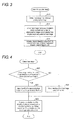
- Fig. 3 is a flowchart showing a flow of the process performed by the controller 20.
- the image obtaining unit 30 obtaines a photographed image in a moving image photographed by the photographing unit 11
- the face detecting unit 31 detects a face image from the obtained photographed image, and accumulates a detection result as detection hysteresis in the detection-hysteresis memory unit 40 (S10).
- the proper-detection deciding unit 32 extracts a face image that is also included in a latest predetermined number of photographed images out of face images detected by the face detecting unit 31, as a properly detected face image (S11).
- the detection-frame generating unit 33 generates an image of a detection frame concerning the face image extracted by the proper-detection deciding unit 32, by referring to the detection hysteresis of the detection-hysteresis memory unit 40, and transmits the generated image to the image synthesizing unit 17 (S12).
- a photographed image that is image-processed by the image processing unit 12 is synthesized with the image of the detection frame by the image synthesizing unit 17, and the synthesized image is displayed by the display unit 13. Thereafter, the process of the controller 20 is ended.
- FIG. 4 is a flowchart showing a flow of a face detection process performed by the face detecting unit 31. The face detection process is executed for each detected face image.
- the face detecting unit 31 upon detecting a face image from a photographed image, the face detecting unit 31 refers to the detection hysteresis of the detection-hysteresis memory unit 40, and decides whether a face image that is the same as the face image detected this time is present in latest detected face images (S20). When a face image that is the same as the face image detected this time is present, the face detecting unit 31 applies a face ID of the corresponding face image to the face image detected this time (S21). When a face image that is the same as the face image detected this time is not present, the face detecting unit 31 applies a new face ID to the face image detected this time (S22).
- the face detecting unit 31 accumulates the detection result in the detection-hysteresis memory unit 40 as detection hysteresis (S23). Thereafter, the face detection process is ended.
- Fig. 5 is a view showing, in a table form, an example of data that is input and output by the proper-detection deciding unit 32 for each frame.
- the example of Fig. 5 corresponds to the example of Fig. 2 .
- the face detecting unit 31 applies ID1 as the face ID to the face image of the dog that is detected in the first frame and that is traced afterward.
- the face detecting unit 31 applies ID2 as the face ID of the face image of the stuffed toy of the bear, when the face image is detected in the second frame. Since the face image is not able to be detected in the third to fifth frames, the face image cannot be traced. Therefore, when the face image is detected in the sixth frame, ID3 that is different from ID2 is applied as a face ID.
- the proper-detection deciding unit 32 does not output any face ID, by deciding that a face image has not been detected, because latest two frames are not present although ID1 is input in the first frame.
- the proper-detection deciding unit 32 does not output any face ID, by deciding that a face image has not been detected.
- the proper-detection deciding unit 32 outputs ID1.
- ID1 and ID3 are input, and ID1 is also input in latest two frames. Therefore, ID1 is output.
- ID3 is not input in latest two frames, ID3 is not output.
- Fig. 6 is a view showing, in a table form, an example of data that is input and output by the proper-detection deciding unit 32, for each frame.
- the proper-detection deciding unit 32 decides that the face image is a properly detected face image.
- ID1 is input in the first frame, but latest one frame is not present. Therefore, the proper-detection deciding unit 32 does not output any face ID, by deciding that a face image has not been detected.
- the proper-detection deciding unit 32 does not output any face ID, by deciding that a face image has not been detected.
- the third, fifth, seventh, ninth, eleventh, and thirteenth frames although new ID2 to ID7 are input respectively, no face ID is input in latest one frame, and therefore, no face ID is output.
- the proper-detection deciding unit 32 does not output any face ID, by deciding that a face image has not been detected.
- ID7 is input and ID7 is also input in latest one frame. Therefore, the proper-detection deciding unit 32 outputs ID7.
- the face detecting unit 31 detects a face image in the first, third, fifth, seventh, ninth, eleventh, and thirteenth to fifteenth frames.
- the detection-frame generating unit 33 generates a detection frame in only the fourteenth and fifteenth frames in which the face image (ID7) is continuously detected in two frames. Accordingly, a detection frame is not displayed in the first to thirteenth frames, and is displayed in the fourteenth and fifteenth frames. As a result, flash display of a detection frame in the first to twelfth frames can be prevented, and reduction in a display quality can be prevented.
- the digital camera 10 according to the present embodiment has a configuration similar to that of the digital camera 10 shown in Fig. 1 , except that a decision process of the proper-detection deciding unit 32 is different. Configurations and processing operations similar to those described in the above embodiment are attached with the same reference symbols, and their descriptions are omitted.
- the proper-detection deciding unit 32 refers to the detection-hysteresis memory unit 40, and decides whether a face ID received from the face detecting unit 31 is included in detection hysteresis of at least a predetermined number (two, for example) of frames in latest predetermined number (four, for example) of frames.
- the proper-detection deciding unit 32 decides the detection as proper detection, and transmits the face ID to the detection-frame generating unit 33.
- the proper-detection deciding unit 32 decides the detection as not proper detection, and omits transmission of the face ID to the detection-frame generating unit 33.
- Fig. 7 is a view showing, in a table form, an example of data that is input and output by the proper-detection deciding unit 32, for each frame.
- the proper-detection deciding unit 32 decides that the face image is a properly detected face image.
- the proper-detection deciding unit 32 does not output any face ID, by deciding that a face image has not been detected.
- ID1 is input in only one frame out of latest frames, and therefore, no face ID is output.
- the proper-detection deciding unit 32 does not output any face ID, by deciding that a face image has not been detected.
- ID1 is input in two frames out of latest four frames. Therefore, the proper-detection deciding unit 32 outputs ID1.
- the face detecting unit 31 does not detect a face image in the fifth frame, the face detecting unit 31 detects the same face image (ID1) in two frames out of latest four frames. Therefore, the detection-frame generating unit 33 generates a detection frame. Accordingly, delay in display of a detection frame due to a temporary failure in detection of a face image can be prevented.
- Fig. 8 is a view showing, in a table form, an example of data that is input and output by the proper-detection deciding unit 32, for each frame.
- the proper-detection deciding unit 32 decides that the face image is a properly detected face image.
- the proper-detection deciding unit 32 refers to detection hysteresis of a latest few frames, the proper-detection deciding unit 32 may also refer to a latest dozen of frames.
- the digital camera 10 according to the present embodiment has a configuration to that of the digital camera 10 shown in Fig. 1 , except that a decision process of the proper-detection deciding unit 32 is different. Configurations and processing operations similar to those described in the above embodiment are attached with the same reference symbols, and their descriptions are omitted.
- the proper-detection deciding unit 32 refers to the detection-hysteresis memory unit 40, and decides whether a face ID received from the face detecting unit 31 is included in detection hysteresis during a latest predetermined period (two seconds, for example).
- the proper-detection deciding unit 32 decides the detection as proper detection, and transmits the face ID to the detection-frame generating unit 33.
- the proper-detection deciding unit 32 decides the detection as not proper detection, and omits transmission of the face ID to the detection-frame generating unit 33.
- Fig. 9 is a view showing, in a table form, an example of data that is input and output by the proper-detection deciding unit 32, for each 0.2 second.
- the proper-detection deciding unit 32 decides that the face image is a properly detected face image.
- the proper-detection deciding unit 32 does not output any face ID, by deciding that a face image has not been detected. Since ID1 is input during latest two second, the proper-detection deciding unit 32 outputs ID after 2.2 seconds from the beginning.
- the proper-detection deciding unit 32 can also make decision in a time unit in place of a frame unit.
- the control block (particularly, the controller 20) of the digital camera 10 may be realized by a logic circuit (hardware) constituted by an integrated circuit (IC chip) and the like, or may be realized by software using a CPU (Central Processing Unit).
- a logic circuit hardware constituted by an integrated circuit (IC chip) and the like
- CPU Central Processing Unit
- the digital camera 10 includes the CPU that executes instructions of programs as software for realizing each function, a ROM (Read Only Memory) or a storage device (these are referred to as “recording mediums”) in which the programs and various data are recorded to be able to be read by a computer (or the CPU), and a RAM (Random Access Memory) that develops the programs. Then, when the computer (or the CPU) executes the programs by reading the programs from the recording mediums, the object of the present invention is achieved.
- the recording mediums it is possible to use "non-transitory tangible media” such as a tape, a disc, a card, a semiconductor memory, and a programmable logic circuit.
- the programs may be supplied to the computer via a transmittable arbitrary transmission medium (a communication network, a broadcasting wave, and the like).
- a transmittable arbitrary transmission medium a communication network, a broadcasting wave, and the like.
- the present invention can be also realized in a mode of a data signal embedded in a carrier wave in which the programs are embodied by electronic transmission.
- the present invention is not limited to the embodiments, and can be variously changed within a range disclosed in claims.
- An embodiment obtained by suitably combining technical units disclosed in different embodiments is also included in a technical range of the present invention.
- a face image of a person, an animal, and the like is detected from a photographed image and is recognized.
- an image of a whole body of a person, an animal, and the like may be detected, and an image of a ball, a vehicle, and other objects may be detected. That is, the present invention can be applied to detect an arbitrary target image included in an obtained photographed image.
- the present invention is applied to the digital camera 10.
- the present invention can be applied to an arbitrary electronic device having a photographing unit such as a portable telephone, a smartphone, and a PDA (Personal Digital Assistant).
- a photographing unit such as a portable telephone, a smartphone, and a PDA (Personal Digital Assistant).
- the target-image detecting device decides whether a detection result of a target image of the same target object is included in a latest predetermined number of detection results.
- the target-image detecting device outputs the detection result as a proper detection.
- the target-image detecting device does not output the detection result. Therefore, output of a detection result of an erroneously detected target object can be prevented. Consequently, in addition to the face detection, the target-image detecting device can be applied to an arbitrary device that detects a target image such as a ball detection and a vehicle detection from a photographed image.
Landscapes
- Engineering & Computer Science (AREA)
- Multimedia (AREA)
- Signal Processing (AREA)
- Oral & Maxillofacial Surgery (AREA)
- Human Computer Interaction (AREA)
- Physics & Mathematics (AREA)
- General Physics & Mathematics (AREA)
- General Health & Medical Sciences (AREA)
- Theoretical Computer Science (AREA)
- Health & Medical Sciences (AREA)
- Studio Devices (AREA)
- Image Analysis (AREA)
- Camera Data Copying Or Recording (AREA)
- Indication In Cameras, And Counting Of Exposures (AREA)
- Image Processing (AREA)
Applications Claiming Priority (1)
| Application Number | Priority Date | Filing Date | Title |
|---|---|---|---|
| JP2013085298A JP6136504B2 (ja) | 2013-04-15 | 2013-04-15 | 対象画像検出デバイス、その制御方法および制御プログラム、記録媒体、並びにデジタルカメラ |
Publications (2)
| Publication Number | Publication Date |
|---|---|
| EP2793166A2 true EP2793166A2 (de) | 2014-10-22 |
| EP2793166A3 EP2793166A3 (de) | 2017-01-11 |
Family
ID=50112739
Family Applications (1)
| Application Number | Title | Priority Date | Filing Date |
|---|---|---|---|
| EP14154828.9A Ceased EP2793166A3 (de) | 2013-04-15 | 2014-02-12 | Zielbilderkennungsvorrichtung, Steuerverfahren und Steuerprogramm dafür, Aufzeichnungsmedium und Digitalkamera |
Country Status (4)
| Country | Link |
|---|---|
| US (1) | US9430710B2 (de) |
| EP (1) | EP2793166A3 (de) |
| JP (1) | JP6136504B2 (de) |
| CN (1) | CN104104860B (de) |
Cited By (2)
| Publication number | Priority date | Publication date | Assignee | Title |
|---|---|---|---|---|
| EP3557524A4 (de) * | 2016-12-16 | 2020-08-12 | Clarion Co., Ltd. | Bildverarbeitungsvorrichtung und umgebungserkennungsvorrichtung |
| US12439155B2 (en) | 2020-01-29 | 2025-10-07 | Canon Kabushiki Kaisha | Display control apparatus and control method |
Families Citing this family (4)
| Publication number | Priority date | Publication date | Assignee | Title |
|---|---|---|---|---|
| US10373381B2 (en) * | 2016-03-30 | 2019-08-06 | Microsoft Technology Licensing, Llc | Virtual object manipulation within physical environment |
| JP6924413B2 (ja) * | 2017-12-25 | 2021-08-25 | オムロン株式会社 | データ生成装置、データ生成方法及びデータ生成プログラム |
| CN111798698B (zh) * | 2020-06-24 | 2022-04-08 | 中国第一汽车股份有限公司 | 一种前方目标车辆的确定方法、装置及车辆 |
| JP7795907B2 (ja) * | 2021-12-24 | 2026-01-08 | 株式会社オプトル | 情報処理装置、情報処理システム、情報処理方法およびプログラム |
Citations (2)
| Publication number | Priority date | Publication date | Assignee | Title |
|---|---|---|---|---|
| JP2009005239A (ja) | 2007-06-25 | 2009-01-08 | Sony Computer Entertainment Inc | 符号化処理装置および符号化処理方法 |
| JP2013003634A (ja) | 2011-06-13 | 2013-01-07 | Toyota Motor Corp | 区画線認識装置、区画線認識方法、プログラム及び媒体 |
Family Cites Families (9)
| Publication number | Priority date | Publication date | Assignee | Title |
|---|---|---|---|---|
| JP4489608B2 (ja) * | 2004-03-31 | 2010-06-23 | 富士フイルム株式会社 | ディジタル・スチル・カメラ,画像再生装置および顔画像表示装置ならびにそれらの制御方法 |
| JP4350725B2 (ja) * | 2005-08-05 | 2009-10-21 | キヤノン株式会社 | 画像処理方法、画像処理装置、及び、画像処理方法をコンピュータに実行させるためのプログラム |
| JP5156196B2 (ja) * | 2006-03-31 | 2013-03-06 | イーストマン コダック カンパニー | 撮像装置 |
| JP2010049148A (ja) * | 2008-08-25 | 2010-03-04 | Nikon Corp | 画像認識装置及び撮像装置 |
| JP5127692B2 (ja) * | 2008-12-25 | 2013-01-23 | キヤノン株式会社 | 撮像装置及びその追尾方法 |
| JP5317710B2 (ja) * | 2009-01-07 | 2013-10-16 | キヤノン株式会社 | 画像処理装置、その制御方法、プログラム及び記録媒体 |
| JP5272775B2 (ja) * | 2009-02-12 | 2013-08-28 | 株式会社ニコン | 電子スチルカメラ |
| JP5398341B2 (ja) * | 2009-05-11 | 2014-01-29 | キヤノン株式会社 | 物体認識装置及び物体認識方法 |
| JP5510287B2 (ja) * | 2010-11-22 | 2014-06-04 | カシオ計算機株式会社 | 被写体検出装置、被写体検出方法及びプログラム |
-
2013
- 2013-04-15 JP JP2013085298A patent/JP6136504B2/ja active Active
-
2014
- 2014-02-12 EP EP14154828.9A patent/EP2793166A3/de not_active Ceased
- 2014-02-27 US US14/191,918 patent/US9430710B2/en active Active
- 2014-03-05 CN CN201410078994.9A patent/CN104104860B/zh active Active
Patent Citations (2)
| Publication number | Priority date | Publication date | Assignee | Title |
|---|---|---|---|---|
| JP2009005239A (ja) | 2007-06-25 | 2009-01-08 | Sony Computer Entertainment Inc | 符号化処理装置および符号化処理方法 |
| JP2013003634A (ja) | 2011-06-13 | 2013-01-07 | Toyota Motor Corp | 区画線認識装置、区画線認識方法、プログラム及び媒体 |
Non-Patent Citations (2)
| Title |
|---|
| ANONYMOUS: "MathWorks: Motion-Based Multiple Object Tracking", MATHWORKS DOCUMENTATION, RELEASE VERSION 2013A, 7 March 2013 (2013-03-07), XP055765718, Retrieved from the Internet <URL:https://nl.mathworks.com/help/doc-archives.html> [retrieved on 20210115] * |
| SALTI S ET AL: "Adaptive Appearance Modeling for Video Tracking: Survey and Evaluation", IEEE TRANSACTIONS ON IMAGE PROCESSING, IEEE SERVICE CENTER, PISCATAWAY, NJ, US, vol. 21, no. 10, 1 October 2012 (2012-10-01), pages 4334 - 4348, XP011492183, ISSN: 1057-7149, DOI: 10.1109/TIP.2012.2206035 * |
Cited By (2)
| Publication number | Priority date | Publication date | Assignee | Title |
|---|---|---|---|---|
| EP3557524A4 (de) * | 2016-12-16 | 2020-08-12 | Clarion Co., Ltd. | Bildverarbeitungsvorrichtung und umgebungserkennungsvorrichtung |
| US12439155B2 (en) | 2020-01-29 | 2025-10-07 | Canon Kabushiki Kaisha | Display control apparatus and control method |
Also Published As
| Publication number | Publication date |
|---|---|
| US20140307918A1 (en) | 2014-10-16 |
| EP2793166A3 (de) | 2017-01-11 |
| CN104104860A (zh) | 2014-10-15 |
| JP6136504B2 (ja) | 2017-05-31 |
| JP2014207622A (ja) | 2014-10-30 |
| CN104104860B (zh) | 2017-11-10 |
| US9430710B2 (en) | 2016-08-30 |
Similar Documents
| Publication | Publication Date | Title |
|---|---|---|
| US8396316B2 (en) | Method and apparatus for processing image | |
| KR101603017B1 (ko) | 제스처 인식 장치 및 제스처 인식 장치의 제어 방법 | |
| US9430710B2 (en) | Target-image detecting device, control method and control program thereof, recording medium, and digital camera | |
| US11523062B2 (en) | Image capture apparatus and method for controlling the same | |
| US11068706B2 (en) | Image processing device, image processing method, and program | |
| CN113302907B (zh) | 拍摄方法、装置、设备及计算机可读存储介质 | |
| KR102327779B1 (ko) | 이미지 처리 방법 및 장치 | |
| US9973687B2 (en) | Capturing apparatus and method for capturing images without moire pattern | |
| US20180205879A1 (en) | Image processing apparatus, image processing method, and recording medium | |
| US20130308835A1 (en) | Mobile Communication Device with Image Recognition and Method of Operation Therefor | |
| CN105407285A (zh) | 拍摄控制方法及装置 | |
| CN108353129B (zh) | 拍摄设备及其控制方法 | |
| US20150262379A1 (en) | Imaging apparatus and a method of tracking a subject in the imaging apparatus | |
| CN107172354A (zh) | 视频处理方法、装置、电子设备及存储介质 | |
| US20100188520A1 (en) | Imaging device and storage medium storing program | |
| US20160189413A1 (en) | Image creation method, computer-readable storage medium, and image creation apparatus | |
| CN105654451A (zh) | 一种图像的处理方法和装置 | |
| US10373329B2 (en) | Information processing apparatus, information processing method and storage medium for determining an image to be subjected to a character recognition processing | |
| US10009545B2 (en) | Image processing apparatus and method of operating the same | |
| JP7517412B2 (ja) | 検出装置 | |
| US20200322519A1 (en) | Image capturing and processing device, electronic instrument, image capturing and processing method, and recording medium | |
| KR102372711B1 (ko) | 영상 촬영 장치 및 이의 제어 방법 | |
| KR20140061226A (ko) | 영상을 표시하는 방법 및 이를 위한 장치 | |
| US9088699B2 (en) | Image communication method and apparatus which controls the output of a captured image | |
| CN104754217A (zh) | 一种拍摄方法及终端 |
Legal Events
| Date | Code | Title | Description |
|---|---|---|---|
| PUAI | Public reference made under article 153(3) epc to a published international application that has entered the european phase |
Free format text: ORIGINAL CODE: 0009012 |
|
| 17P | Request for examination filed |
Effective date: 20140212 |
|
| AK | Designated contracting states |
Kind code of ref document: A2 Designated state(s): AL AT BE BG CH CY CZ DE DK EE ES FI FR GB GR HR HU IE IS IT LI LT LU LV MC MK MT NL NO PL PT RO RS SE SI SK SM TR |
|
| AX | Request for extension of the european patent |
Extension state: BA ME |
|
| PUAL | Search report despatched |
Free format text: ORIGINAL CODE: 0009013 |
|
| AK | Designated contracting states |
Kind code of ref document: A3 Designated state(s): AL AT BE BG CH CY CZ DE DK EE ES FI FR GB GR HR HU IE IS IT LI LT LU LV MC MK MT NL NO PL PT RO RS SE SI SK SM TR |
|
| AX | Request for extension of the european patent |
Extension state: BA ME |
|
| RIC1 | Information provided on ipc code assigned before grant |
Ipc: H04N 5/907 20060101ALI20161208BHEP Ipc: H04N 5/77 20060101ALI20161208BHEP Ipc: H04N 9/804 20060101ALI20161208BHEP Ipc: G06K 9/32 20060101ALI20161208BHEP Ipc: H04N 5/232 20060101ALI20161208BHEP Ipc: G06K 9/00 20060101AFI20161208BHEP |
|
| STAA | Information on the status of an ep patent application or granted ep patent |
Free format text: STATUS: REQUEST FOR EXAMINATION WAS MADE |
|
| R17P | Request for examination filed (corrected) |
Effective date: 20170221 |
|
| RBV | Designated contracting states (corrected) |
Designated state(s): AL AT BE BG CH CY CZ DE DK EE ES FI FR GB GR HR HU IE IS IT LI LT LU LV MC MK MT NL NO PL PT RO RS SE SI SK SM TR |
|
| STAA | Information on the status of an ep patent application or granted ep patent |
Free format text: STATUS: EXAMINATION IS IN PROGRESS |
|
| 17Q | First examination report despatched |
Effective date: 20171009 |
|
| APBK | Appeal reference recorded |
Free format text: ORIGINAL CODE: EPIDOSNREFNE |
|
| APBN | Date of receipt of notice of appeal recorded |
Free format text: ORIGINAL CODE: EPIDOSNNOA2E |
|
| APBR | Date of receipt of statement of grounds of appeal recorded |
Free format text: ORIGINAL CODE: EPIDOSNNOA3E |
|
| APAF | Appeal reference modified |
Free format text: ORIGINAL CODE: EPIDOSCREFNE |
|
| APAI | Date of receipt of notice of appeal modified |
Free format text: ORIGINAL CODE: EPIDOSCNOA2E |
|
| APBT | Appeal procedure closed |
Free format text: ORIGINAL CODE: EPIDOSNNOA9E |
|
| STAA | Information on the status of an ep patent application or granted ep patent |
Free format text: STATUS: THE APPLICATION HAS BEEN REFUSED |
|
| 18R | Application refused |
Effective date: 20230606 |