EP2793207A2 - Système et procédé de supervision de sports - Google Patents
Système et procédé de supervision de sports Download PDFInfo
- Publication number
- EP2793207A2 EP2793207A2 EP20140162990 EP14162990A EP2793207A2 EP 2793207 A2 EP2793207 A2 EP 2793207A2 EP 20140162990 EP20140162990 EP 20140162990 EP 14162990 A EP14162990 A EP 14162990A EP 2793207 A2 EP2793207 A2 EP 2793207A2
- Authority
- EP
- European Patent Office
- Prior art keywords
- sensor
- motion
- players
- data
- projectiles
- Prior art date
- Legal status (The legal status is an assumption and is not a legal conclusion. Google has not performed a legal analysis and makes no representation as to the accuracy of the status listed.)
- Ceased
Links
Images



Classifications
-
- G—PHYSICS
- G06—COMPUTING OR CALCULATING; COUNTING
- G06V—IMAGE OR VIDEO RECOGNITION OR UNDERSTANDING
- G06V40/00—Recognition of biometric, human-related or animal-related patterns in image or video data
- G06V40/20—Movements or behaviour, e.g. gesture recognition
- G06V40/23—Recognition of whole body movements, e.g. for sport training
-
- G—PHYSICS
- G09—EDUCATION; CRYPTOGRAPHY; DISPLAY; ADVERTISING; SEALS
- G09B—EDUCATIONAL OR DEMONSTRATION APPLIANCES; APPLIANCES FOR TEACHING, OR COMMUNICATING WITH, THE BLIND, DEAF OR MUTE; MODELS; PLANETARIA; GLOBES; MAPS; DIAGRAMS
- G09B19/00—Teaching not covered by other main groups of this subclass
- G09B19/003—Repetitive work cycles; Sequence of movements
- G09B19/0038—Sports
Definitions
- the present invention generally relates to sports monitoring systems, and more specifically, to sports monitoring systems for determining one or more periods of time when one or more projectiles are likely to be spatially closely associated with one or more players. Further, the present disclosure relates to methods of operating the sports monitoring systems. Furthermore, the present disclosure also relates to software products recorded on machine-readable data storage media, wherein the software products are executable upon computing hardware to implement aforesaid methods.
- US patent application US 8,353,791 discloses a method of tracking possession of a sports projectile such as a ball. Based on disclosure a ball has short range radio beacon and each player has receiver for the radio beacon signals and GPS. System can be used to determine which player is in possession of the ball. Problem with said solution is that ball possession could be determined to be on any player in proximity of the ball.
- the present disclosure seeks to provide a sports monitoring system.
- the present disclosure also seeks to provide a method of operating the sports monitoring system.
- inventions of the present disclosure provide a sports monitoring system.
- the sports monitoring system includes one or more projectiles that are useable in a game to be played by one or more players, one or more sensor units for the players to wear, and a data processing arrangement.
- Each projectile is provided therein with an associated motion sensing arrangement that is operable to generate one or more motion-indicative signals, and a data recording arrangement that is operable to record the motion-indicative signals as a function of time.
- a motion sensing arrangement of a particular projectile may be operable to provide data indicative of acceleration and/or rotation and/or orientation of that particular projectile as a function of time, wherefrom the motion-indicative signals corresponding to that particular projectile may be generated.
- the motion sensing arrangement of each projectile may include at least one of following sensors: accelerometer, magnetometer, pressure sensor, temperature sensor, gyroscopic sensor, microphone, Global Positioning System (GPS) sensor or other location sensor for indoor and/or outdoor positioning, and timer.
- GPS Global Positioning System
- Each sensor unit is provided therein with an associated motion sensing arrangement that is operable to generate one or more motion-indicative signals, and a data recording arrangement that is operable to record the motion-indicative signals as a function of time.
- a motion sensing arrangement of a particular sensor unit may be operable to provide data indicative of acceleration and/or rotation and/or orientation of a player wearing that particular sensor unit as a function of time, wherefrom the motion-indicative signals corresponding to the player may be generated.
- the motion sensing arrangement of each sensor unit may include at least one of following sensors: accelerometer, magnetometer, pressure sensor, temperature sensor, gyroscopic sensor, microphone, GPS sensor or other location sensor for indoor and/or outdoor positioning and timer.
- the term "wear” can include a sensor which is attached in a player for example with band, a sensor embedded or attached in clothes such as shoes, helmet, shirt etc. and a sensor embedded in a sporting equipment carried by the player.
- the data processing arrangement is operable to receive data pertaining to the motion-indicative signals from at least one of the projectiles and/or at least one of the sensor units.
- the at least one of the projectiles may be operable to communicate its recorded data (i.e., data pertaining to the motion-indicative signals corresponding to the projectiles) to the data processing arrangement via a wireless communication link.
- the at least one of the sensor units may be operable to communicate its recorded data (i.e., data pertaining to the motion-indicative signals corresponding to the players) to the data processing arrangement via a wireless communication link.
- the data processing arrangement is operable to perform a temporal correlation of the data so received, to determine one or more periods of time when the projectiles are likely to be spatially closely associated with the players.
- the temporal correlation is performed to determine when the players have been in contact with the projectiles during playing of the game, and/or when mutual contact between a plurality of players has occurred during playing of the game.
- embodiments of the present disclosure provide a method of operating the sports monitoring system.
- embodiments of the present disclosure provide a software product recorded on machine-readable data storage media, wherein the software product is executable upon computing hardware for implementing the method of operating the sports monitoring system.
- Embodiments of the present disclosure substantially eliminate the aforementioned problems in the prior art, and enable users to know when one or more players have been in contact with one or more projectiles during playing of the game, and/or when mutual contact between a plurality of players has occurred during playing of the game, and enable users to collect statistical data indicative of movements and/or spatial positions of the players and/or the projectiles as a function of time, and thereby further analyze the statistical data, for example, to provide feedback on the performance of the players and/or to edit video content recorded by various cameras concurrently during playing of the game.
- an underlined number is employed to represent an item over which the underlined number is positioned or an item to which the underlined number is adjacent.
- a non-underlined number relates to an item identified by a line linking the non-underlined number to the item. When a number is non-underlined and accompanied by an associated arrow, the non-underlined number is used to identify a general item at which the arrow is pointing.
- Embodiments of the present disclosure provide a sports monitoring system.
- the sports monitoring system includes one or more projectiles, one or more sensor units for one or more players to wear, and a data processing arrangement.
- the projectiles are useable in a game to be played by the players.
- Each of the projectiles is provided therein with an associated motion sensing arrangement and a data recording arrangement.
- the motion sensing arrangement is operable to generate one or more motion-indicative signals
- the data recording arrangement is operable to record the motion-indicative signals as a function of time.
- each of the projectiles may, for example, include at least one of following sensors: accelerometer, magnetometer, pressure sensor, temperature sensor, gyroscopic sensor, microphone, Global Positioning System (GPS) sensor, or other indoor / outdoor location sensors and timer.
- sensors accelerometer, magnetometer, pressure sensor, temperature sensor, gyroscopic sensor, microphone, Global Positioning System (GPS) sensor, or other indoor / outdoor location sensors and timer.
- GPS Global Positioning System
- each of the sensor units is provided therein with an associated motion sensing arrangement and a data recording arrangement.
- the motion sensing arrangement is operable to generate one or more motion-indicative signals
- the data recording arrangement is operable to record the motion-indicative signals as a function of time.
- each of the sensor units may, for example, include at least one of following sensors: accelerometer, magnetometer, pressure sensor, temperature sensor, gyroscopic sensor, microphone, GPS sensor or other indoor/outdoor location sensor, and timer.
- the data processing arrangement is operable to receive data pertaining to the motion-indicative signals from at least one of the projectiles and/or at least one of the sensor units.
- the at least one of the projectiles may be operable to communicate its recorded data to the data processing arrangement via a wireless communication link.
- the at least one of the sensor units may be operable to communicate its recorded data to the data processing arrangement via a wireless communication link.
- the data processing arrangement is operable to perform a temporal correlation of the data so received, to determine one or more periods of time when the projectiles are likely to be spatially closely associated with the players.
- the temporal correlation is performed to determine when the players have been in contact with the projectiles during playing of the game, and/or when mutual contact between a plurality of players has occurred during playing of the game.
- At least one of the data processing arrangement and the sensor units may utilize a portable computing device for their implementation within the sports monitoring system.
- Fig. 1 is a schematic illustration of an example playing scenario in which a sports monitoring system is implemented pursuant to the present disclosure.
- Fig. 1 shows a portion of a playing area, where one or more players, depicted as a player 102a, a player 102b and a player 102c , are playing a game.
- the player 102a, the player 102b and the player 102c are hereinafter collectively referred to as players 102.
- the sports monitoring system includes one or more projectiles, depicted as a projectile 104 in Fig. 1 .
- the projectile 104 is useable in the game to be played by the players 102.
- the projectile 104 is provided therein with an associated motion sensing arrangement and a data recording arrangement (not shown in Fig. 1 ).
- the motion sensing arrangement of the projectile 104 is operable to generate one or more motion-indicative signals corresponding to the projectile 104.
- the data recording arrangement of the projectile 104 is then operable to record the motion-indicative signals as a function of time.
- the motion sensing arrangement of the projectile 104 may be operable to provide data indicative of acceleration and/or rotation and/or orientation of the projectile 104 as a function of time, wherefrom the aforementioned motion-indicative signals corresponding to the projectile 104 may be generated.
- the motion sensing arrangement of the projectile 104 may include at least one of following sensors: accelerometer, magnetometer, pressure sensor, temperature sensor, gyroscopic sensor, microphone, GPS sensor or other indoor/outdoor location sensor, and timer.
- the motion-indicative signals corresponding to the projectile 104 may include information about at least one of: an identification code (ID) associated with the projectile 104, one or more movements (for example, accelerations and/or rotations and/or orientations) of the projectile 104, one or more spatial positions of the projectile 104, sound received by microphone, and associated time stamps.
- ID an identification code
- the received (and recorded) audio can be used for time stamping purposes.
- recorded sound can be used to determine if a projectile is in motion i.e. used as motion-indicative signal.
- the sports monitoring system also includes one or more sensor units for the players 102 to carry, for example, by wearing the sensor units during playing of the game.
- the player 102a is wearing a sensor unit 106a
- the player 102b is wearing a sensor unit 106b
- the player 102c is wearing a sensor unit 106c.
- the sensor unit 106a, the sensor unit 106b and the sensor unit 106c are hereinafter referred to as the sensor units 106.
- the players 102 may, for example, wear the sensor units 106 by a detachable attachment to waist, wrist, ankle, or any other suitable part of body or in the sporting equipment carried by the players 102.
- the sensor unit 106 is attached to player 102 in a way that it is possible to determine orientation of the player 102 in respect to playing field.
- player 102 might have more than one sensor 106.
- the sports monitoring system may be implemented for use in a game of ice hockey, wherein the playing area may be an ice hockey rink, and the projectile 104 may be a hockey puck.
- the player 102a may be carrying and/or wearing one or more sports equipments, such as a hockey stick, hockey skates, a hockey helmet, protective gloves and various protective pads, during playing of the game.
- the sensor unit 106a may be implemented spatially within at least one of the sports equipments carried and/or worn by the player 102a.
- Each of the sensor units 106 is provided therein with an associated motion sensing arrangement and a data recording arrangement (not shown in Fig. 1 ).
- the motion sensing arrangement of the sensor unit 106a is operable to generate one or more motion-indicative signals corresponding to the player 102a wearing the sensor unit 106a.
- the motion sensing arrangements of the sensor unit 106b and the sensor unit 106c are operable to generate one or more motion-indicative signals corresponding to the player 102b and the player 102c wearing the sensor unit 106b and the sensor unit 106c, respectively.
- each of the sensor units 106 is then operable to record the corresponding motion-indicative signals as a function of time.
- the motion sensing arrangements of the sensor units 106 may be operable to provide data indicative of acceleration and/or rotation and/or orientation of the players 102 as a function of time, wherefrom the aforementioned motion-indicative signals corresponding to the players 102 may be generated.
- the motion sensing arrangement of each of the sensor units 106 may include at least one of following sensors: accelerometer, magnetometer, pressure sensor, temperature sensor, gyroscopic sensor, microphone, GPS sensor or other indoor/outdoor location sensor, and timer.
- the motion-indicative signals corresponding to the player 102a may include information about at least one of: an ID associated with the player 102a, one or more movements (for example, accelerations and/or rotations and/or orientations) of the player 102a, one or more spatial positions of the player 102a, sound received by microphone in a sensor and associated time stamps.
- the received (and recorded) audio can be used for time stamping purposes.
- recorded sound can be used to determine if a player is in motion i.e. used as motion-indicative signal.
- the sports monitoring system includes a data processing arrangement (not shown in Fig. 1 ) that is operable to receive data pertaining to the motion-indicative signals from the projectile 104 and/or at least one of the sensor units 106.
- the projectile 104 may be operable to communicate its recorded data (i.e., data pertaining to the motion-indicative signals corresponding to the projectile 104) to the data processing arrangement via a wireless communication link.
- the at least one of the sensor units 106 may be operable to communicate its recorded data (i.e., data pertaining to the motion-indicative signals corresponding to the players 102) to the data processing arrangement via a wireless communication link.
- the data processing arrangement is operable to perform a temporal correlation of the data so received, to determine one or more periods of time when the projectile 104 is likely to be spatially closely associated with the players 102.
- the temporal correlation is performed to determine when the players 102 have been in contact with the projectile 104 during playing of the game, and/or when mutual contact between a plurality of players from amongst the players 102 has occurred during playing of the game.
- Embodiments of the present disclosure are suitable for sports such as American football, football, soccer, hockey, ice hockey, and basketball, but not limited thereto.
- the sports monitoring system has been implemented for use in a game of American football, wherein the playing area corresponds to a football field, and the projectile 104 corresponds to a football.
- the number of projectiles in a game 104 might be more than one.
- the player 102a During playing of the game of American football, the player 102a holds the projectile 104 for a particular period of time, as shown in Fig. 1 .
- the temporal correlation between the data pertaining to the player 102a and the projectile 104 enables the data processing arrangement to determine the particular period of time when the player 102a has been in contact with the projectile 104 during playing of the game. Details of how the temporal correlation is performed have been provided in conjunction with Figs. 5 and 6 .
- Fig. 1 is merely an example, which should not unduly limit the scope of the claims herein.
- One of ordinary skill in the art would recognize many variations, alternatives, and modifications of embodiments herein.
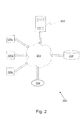
- Fig. 2 is a schematic illustration of a sports monitoring system 200, in accordance with an embodiment of the present disclosure.
- the sports monitoring system 200 includes the projectile 104, the sensor units 106 and a data processing arrangement 202.
- a wireless communication network 204 couples the projectile 104, the sensor units 106 and the data processing arrangement 202 in communication with each other.
- the wireless communication network 204 can be a collection of individual networks, interconnected with each other and functioning as a single large network. Typical examples of such individual networks include, although are not limited to, Wireless Local Area Networks (WLAN) and Wireless Personal-Area Networks (WPAN).
- WLAN Wireless Local Area Networks
- WPAN Wireless Personal-Area Networks
- the projectile 104 is operable to communicate its recorded data (i.e., data pertaining to the motion-indicative signals corresponding to the projectile 104) to the data processing arrangement 202 via a wireless communication link.
- the sensor units 106 are operable to communicate their recorded data (i.e., data pertaining to the motion-indicative signals corresponding to the players 102) to the data processing arrangement 202 via wireless communication links.
- the projectile 104 and/or the sensor units 106 are operable to create a virtual sensor network by sharing their recorded data amongst themselves. In such a case, at least one of the sensor units 106 and/or the projectile 104 is required to communicate the recorded data to the data processing arrangement 202.
- At least one of the sensor units 106 and/or the projectile 104 is operable to collect the recorded data from the sensor units 106 and/or the projectile 104, and communicate the data so collected to the data processing arrangement 202.
- the data processing arrangement 202 is operable to receive data pertaining to the motion-indicative signals corresponding to the projectile 104 and the players 102, and perform a temporal correlation of the data so received, to determine one or more periods of time when the projectile 104 is likely to be spatially closely associated with the players 102.
- the temporal correlation is performed to determine at least one of:
- the data processing arrangement 202 may perform the temporal correlation either periodically or concurrently during playing of the game. Alternatively, the data processing arrangement 202 may perform the temporal correlation after the game is over.
- the data processing arrangement 202 may perform the temporal correlation concurrently during playing of the game, to collect statistical data indicative of movements and/or spatial positions of the players 102 and/or the projectile 104 as a function of time.
- the data processing arrangement 202 may be coupled in communication with one or more cameras (not shown in Fig. 2 ) installed in the playing area. Accordingly, the data processing arrangement 202 may be operable to analyze the statistical data for editing video content recorded by the cameras. In this way, the video content may be edited concurrently during playing of the game.
- the data processing arrangement 202 may be coupled in communication with a remote server (not shown in Fig. 2 ) that may be operable to collect statistical data indicative of movements and/or spatial positions of the players 102 and/or the projectile 104 as a function of time.
- the remote server may, for example, be operable to further analyze the statistical data to provide feedback on the performance of the players 102.
- the sports monitoring system 200 may include one or more databases, depicted as a database 206 in Fig. 2 .
- the data processing arrangement 202 may be coupled in communication with the database 206, whereat the data processing arrangement 202 may store data pertaining to the periods of time when the players 102 have been in contact with the projectile 104 and/or when mutual contact between the plurality of players from amongst the players 102 has occurred during playing of the game.
- the data processing arrangement 202 may be implemented using a wireless device / a portable computing device that includes computing hardware which is operable to execute one or more software products recorded on machine-readable data storage media.
- the computing hardware comprises a controller, microcontroller or processor device, as is generally described herein.
- the wireless device may be spatially positioned in a proximity of the playing area.
- Typical examples of such a wireless device / a portable computing device include, although are not limited to, a smart telephone, a Mobile Internet Device (MID), a tablet computer, an Ultra-Mobile Personal Computer (UMPC), a phablet, a Personal Digital Assistant (PDA), a web pad, a Personal Computer (PC), a Handheld PC, a laptop computer, and a server.
- At least one of the data processing arrangement 202 and the sensor units 106 utilizes a smart telephone for its implementation within the sports monitoring system 200.
- the sports monitoring system 200 is not limited to a specific number of projectiles, sensor units, data processing arrangements and databases.
- Fig. 2 is merely an example, which should not unduly limit the scope of the claims herein.
- One of ordinary skill in the art would recognize many variations, alternatives, and modifications of embodiments herein.
- Fig. 3 is a schematic illustration of various components in an example implementation of a sensor unit 300, in accordance with an embodiment of the present disclosure.
- the sensor unit 300 could be implemented either as the sensor units 106 or spatially within the projectile 104. For illustration purposes only, let us consider that the sensor unit 300 is implemented spatially within the projectile 104.
- the sensor unit 300 includes, but is not limited to, a memory 302, a processor 304, a configuration of sensors 306, a wireless interface 308, and a system bus 310 that operatively couples various components including memory 302, processor 304, the sensors 306 and the wireless interface 308.
- Memory 302 stores a motion sensing module 312 and a data recording module 314.
- the sensors 306 may include at least one of: accelerometer, magnetometer, pressure sensor, temperature sensor, gyroscopic sensor, microphone, GPS sensor or other indoor/outdoor location sensor, and timer. Outputs generated by the sensors 306 may, for example, be indicative of accelerations and/or rotations and/or orientations of the projectile 104 as a function of time.
- the motion sensing module 312 may be interfaced with the sensors 306 When executed on processor 304 , the motion sensing module 312 is operable to resolve and integrate the outputs generated by the sensors 306 into the aforementioned motion-indicative signals corresponding to the projectile 104.
- the motion-indicative signals may include information about at least one of: an ID pertaining to the sensor unit 300, one or more movements (for example, accelerations and/or rotations and/or orientations) of the projectile 104, one or more spatial positions of the projectile 104, and associated time stamps.
- the ID may, for example, be a Media Access Control (MAC) address, a Terminal Identifier (TID), or other identification pertaining to the sensor unit 300.
- MAC Media Access Control
- TID Terminal Identifier
- the sensors 306 may include a GPS sensor for determining one or more absolute spatial positions of the projectile 104 upon a surface of the Earth.
- the wireless communication network 204 may be employed to determine one or more relative spatial positions of the projectile 104, for example, by way of triangulation.
- the wireless communication network 204 may, for example, include wireless routers for Wi-Fi communication, or Bluetooth base stations ("Bluetooth" is a registered trademark).
- the sensors 306 may include a timer for including the time stamps in the motion-indicative signals.
- processor 304 may provide system time as reference for including the time stamps in the motion-indicative signals.
- the data recording module 314 When executed on processor 304, the data recording module 314 is operable to record the motion-indicative signals as a function of time.
- the sensor unit 300 may include one or more data storage media (not shown in Fig. 3 ) for storing the recorded data as a function of time.
- the sensor unit 300 may be coupled in communication with the database 206, whereat the data recording module 314 may store the recorded data either periodically or on real-time basis.
- the sensor unit 300 is operable to communicate its recorded data to the data processing arrangement 202 using the wireless interface 308.
- the sensor unit 300 and the sensor units 106 are operable to create a virtual sensor network by sharing their recorded data amongst themselves.
- at least one of the sensor units 106 and/or the sensor unit 300 is required to communicate the recorded data (i.e., data pertaining to the motion-indicative signals corresponding to the players 102 and the projectile 104) to the data processing arrangement 202.
- the sensor unit 300 is operable to collect the recorded data from the sensor units 106 , and communicate the data so collected to the data processing arrangement 202 using the wireless interface 308.
- the wireless interface 308 may be used to upload new configuration and/or software updates to the sensor unit 300.
- the sensor unit 300 may also include a power source (not shown in Fig. 3 ) for supplying electrical power to various components of the sensor unit 300.
- the power source may, for example, be a battery or other suitable power storage means.
- Fig. 3 is merely an example, which should not unduly limit the scope of the claims herein. It is to be understood that the specific designation for the sensor unit 300 is for the convenience of reader and is not to be construed as limiting the sensor unit 300 to specific numbers, types, or arrangements of modules and/or components of the sensor unit 300. One of ordinary skill in the art would recognize many variations, alternatives, and modifications of embodiments of the present disclosure.
- the sensor units 106 could be implemented in a manner similar to the example implementation of the sensor unit 300.
- the sensor unit 300 has been implemented spatially within the projectile 104 for illustration purposes only.
- the sensors 306 and the motion sensing module 312 form a part of the aforementioned motion sensing arrangement of the projectile 104
- the data recording module 314 forms a part of the aforementioned data recording arrangement of the projectile 104.
- Fig. 4 is an illustration of a method of operating the sports monitoring system 200, in accordance with an embodiment of the present disclosure.
- the method is depicted as a collection of steps in a logical flow diagram, which represents a sequence of steps that can be implemented in hardware, software, or a combination thereof.
- the sports monitoring system 200 is provided with one or more projectiles, such as the projectile 104.
- the projectile 104 is provided therein with the associated motion sensing arrangement and the data recording arrangement, as described earlier.
- the step 402 includes a sub-step of arranging for the motion sensing arrangement of the projectile 104 to include at least one of following sensors: accelerometer, magnetometer, pressure sensor, temperature sensor, gyroscopic sensor, microphone, GPS sensor or other indoor/outdoor location sensor, and timer.
- the step 402 includes a step 404 and a step 406.
- the motion sensing arrangement of the projectile 104 operates to generate the motion-indicative signals corresponding to the projectile 104.
- the data recording arrangement of the projectile 104 operates to record the motion-indicative signals generated at the step 404.
- the motion-indicative signals are recorded as a function of time.
- the sports monitoring system 200 is provided with one or more sensor units, such as the sensor units 106 that are wearable by the players 102.
- each of the sensor units 106 is provided therein with the associated motion sensing arrangement and the data recording arrangement, as described earlier.
- the step 408 includes a sub-step of arranging for the motion sensing arrangement of each of the sensor units 106 to include at least one of following sensors: accelerometer, magnetometer, pressure sensor, temperature sensor, gyroscopic sensor, microphone, GPS sensor or other indoor/outdoor location sensor, and timer.
- the step 408 includes a step 410 and a step 412.
- the motion sensing arrangements of the sensor units 106 operate to generate the motion-indicative signals corresponding to the players 102.
- the data recording arrangements of the sensor units 106 operate to record the corresponding motion-indicative signals generated at the step 410.
- the motion-indicative signals are recorded as a function of time.
- the method includes an additional step in which at least one of the sensor units 106 and/or the projectile 104 operates to communicate its recorded data (i.e., data pertaining to the motion-indicative signals corresponding to the players 102 and/or the projectile 104) to the data processing arrangement 202 via a wireless communication link, as described earlier.
- its recorded data i.e., data pertaining to the motion-indicative signals corresponding to the players 102 and/or the projectile 104
- the projectile 104 and/or the sensor units 106 may perform one or more additional steps of sharing their recorded data amongst themselves to create a virtual sensor network.
- at least one of the sensor units 106 and/or the projectile 104 may perform an additional step of collecting the recorded data from the sensor units 106 and/or the projectile 104.
- the data processing arrangement 202 operates to receive data pertaining to the motion-indicative signals from the projectile 104 and/or at least one of the sensor units 106, and perform a temporal correlation of the data so received. Based on the temporal correlation performed at the step 414, the data processing arrangement 202 operates to determine one or more periods of time when the projectile 104 is likely to be spatially closely associated with the players 102 .
- the step 414 is performed to determine at least one of:
- the step 414 may be performed either periodically or concurrently during playing of the game. Alternatively, the step 414 may be performed after the game is over.
- the method may also include an additional step of arranging for at least one of the data processing arrangement 202 and the sensor units 106 to utilize a smart telephone for their implementation within the sports monitoring system 200.
- the steps 402 to 414 are only illustrative and other alternatives can also be provided where one or more steps are added, one or more steps are removed, or one or more steps are provided in a different sequence without departing from the scope of the claims herein.
- the step 402 may be performed simultaneously with the step 408.
- the steps 404 and 406 may be performed simultaneously with the steps 410 and 412, for example, during playing of the game.
- the method may include an additional step of collecting statistical data indicative of movements and/or spatial positions of players 102 and/or the projectile 104 as a function of time,
- the method may include an additional step of analyzing the statistical data for at least one of:
- Such an analysis may, for example, be performed either concurrently during playing of the game or after the game is over. Additionally consumers accessing the system could be provided performance related statistics from the venue and/or other content and information related to the game. Consumers could for example download video clips related to the game in their mobile terminal or a computer at home.
- Fig. 5 is an illustration of an example set of motion-indicative signals as functions of time, in accordance with an embodiment of the present disclosure.
- the example set of motion-indicative signals includes a motion-indicative signal 502 corresponding to the projectile 104, a motion-indicative signal 504a corresponding to the player 102a, a motion-indicative signal 504b corresponding to the player 102b, and a motion-indicative signal 504c corresponding to the player 102c.
- the motion-indicative signals 502, 504a, 504b and 504c have been depicted as functions of time, in Fig. 5 .
- the data processing arrangement 202 performs a temporal correlation between the motion-indicative signals 502, 504a, 504b and 504c, to determine at least one of:
- the data processing arrangement 202 may perform the temporal correlation between the motion-indicative signals 502 and 504a, between the motion-indicative signals 502 and 504b, and between the motion-indicative signals 502 and 504c.
- the temporal correlation may, for example, be performed by way of sliding dot product.
- a sliding dot product may, for example, be calculated by sliding the motion-indicative signal 502 over the motion-indicative signal 504a.
- the value of the sliding dot product is considerably large during periods of time when the motion-indicative signals 502 and 504a substantially match with each other, i.e., when the projectile 104 is likely to be spatially closely associated with the player 102a.
- the temporal correlation between the motion-indicative signals 502 and 504a may be performed for a suitable period of time, for example, from a starting point of the motion-indicative signals 502 and 504a. Subsequently, the temporal correlation may be iteratively performed for other suitable periods of time. Accordingly, the temporal correlation may also indicate how dependence between the motion-indicative signals 502 and 504a varies with respect to time.
- the data processing arrangement 202 may perform a temporal correlation between the motion-indicative signals 504a, 504b and 504c, to determine the periods of time when mutual contact between a plurality of players from amongst the players 102 has occurred.
- Fig. 6 is an illustration of results of the temporal correlation performed on the example set of motion-indicative signals, in accordance with an embodiment of the present disclosure.
- the results of the temporal correlation performed on the motion-indicative signals 502, 504a, 504b and 504c are indicative of the following:
- results of the temporal correlation performed on the motion-indicative signals 504a, 504b and 504c may be indicative of the periods of time when mutual contact between a plurality of players from amongst the players 102 has occurred.
- the results may, for example, be indicative of one or more periods of time when a plurality of players moved in sync with each other. For example, a plurality of players involved in a tackle situation may be moving with apparently large accelerations and/or in the same direction at the same time.
- Embodiments of the present disclosure can be used for various purposes, including, though not limited to, enabling users to know when one or more players have been in contact with one or more projectiles during playing of the game, and/or when mutual contact between a plurality of players has occurred during playing of the game, and enabling users to collect statistical data indicative of movements and/or spatial positions of the players and/or the projectiles as a function of time, and thereby further analyze the statistical data, for example, to provide feedback on the performance of the players and/or to edit video content recorded by various cameras concurrently during playing of the game.
- the aspects of the disclosed embodiments may also include software and computer programs incorporating the process steps and instructions described above that are executed in one or more computers.
- one or more computing devices such as the data processing arrangement 202 and sensor units 106 of FIG. 2 or sensor unit 300 of FIG. 3 , for example, are generally adapted to utilize program storage devices embodying machine readable program source code, which is adapted to cause the computing devices to perform the method steps of the present disclosure.
- the program storage devices incorporating features of the present disclosure may be devised, made and used as a component of a machine utilizing optics, magnetic properties and/or electronics to perform the procedures and methods of the present disclosure.
- the program storage devices may include magnetic media such as a diskette or computer hard drive, which is readable and executable by a computer.
- the program storage devices could include optical disks, read-only-memory ("ROM”) floppy disks and semiconductor materials and chips.
- the computing devices generally described herein may also include one or more processors or microprocessors for executing stored programs.
- the computing device may include a data storage device for the storage of information and data.
- the computer program or software incorporating the processes and method steps incorporating features of the present disclosure may be stored in one or more computers on an otherwise conventional program storage device.
Landscapes
- Engineering & Computer Science (AREA)
- Business, Economics & Management (AREA)
- Physics & Mathematics (AREA)
- General Physics & Mathematics (AREA)
- Theoretical Computer Science (AREA)
- Entrepreneurship & Innovation (AREA)
- Educational Administration (AREA)
- Educational Technology (AREA)
- Health & Medical Sciences (AREA)
- Computer Vision & Pattern Recognition (AREA)
- General Health & Medical Sciences (AREA)
- Psychiatry (AREA)
- Social Psychology (AREA)
- Human Computer Interaction (AREA)
- Multimedia (AREA)
- Management, Administration, Business Operations System, And Electronic Commerce (AREA)
- Force Measurement Appropriate To Specific Purposes (AREA)
- Position Fixing By Use Of Radio Waves (AREA)
Applications Claiming Priority (1)
| Application Number | Priority Date | Filing Date | Title |
|---|---|---|---|
| US13/859,710 US9881206B2 (en) | 2013-04-09 | 2013-04-09 | Sports monitoring system and method |
Publications (2)
| Publication Number | Publication Date |
|---|---|
| EP2793207A2 true EP2793207A2 (fr) | 2014-10-22 |
| EP2793207A3 EP2793207A3 (fr) | 2014-11-05 |
Family
ID=50693427
Family Applications (1)
| Application Number | Title | Priority Date | Filing Date |
|---|---|---|---|
| EP20140162990 Ceased EP2793207A3 (fr) | 2013-04-09 | 2014-04-01 | Système et procédé de supervision de sports |
Country Status (2)
| Country | Link |
|---|---|
| US (1) | US9881206B2 (fr) |
| EP (1) | EP2793207A3 (fr) |
Families Citing this family (25)
| Publication number | Priority date | Publication date | Assignee | Title |
|---|---|---|---|---|
| US9636550B2 (en) | 2009-11-19 | 2017-05-02 | Wilson Sporting Goods Co. | Football sensing |
| US10751579B2 (en) | 2009-11-19 | 2020-08-25 | Wilson Sporting Goods Co. | Football sensing |
| US10668333B2 (en) | 2009-11-19 | 2020-06-02 | Wilson Sporting Goods Co. | Football sensing |
| US10821329B2 (en) | 2009-11-19 | 2020-11-03 | Wilson Sporting Goods Co. | Football sensing |
| US10159884B2 (en) | 2012-11-09 | 2018-12-25 | Wilson Sporting Goods Co. | Basketball make-miss shot sensing |
| US9623311B2 (en) | 2012-11-09 | 2017-04-18 | Wilson Sporting Goods Co. | Basketball sensing apparatus |
| US9901801B2 (en) | 2012-11-09 | 2018-02-27 | Wilson Sporting Goods Co. | Basketball sensing apparatus |
| US9844704B2 (en) | 2012-11-09 | 2017-12-19 | Wilson Sporting Goods Co. | Basketball sensing apparatus |
| US9283457B2 (en) | 2012-11-09 | 2016-03-15 | Wilson Sporting Goods Co. | Sport performance system with ball sensing |
| US9656142B2 (en) | 2012-11-09 | 2017-05-23 | Wilson Sporting Goods Co. | Basketball shot determination system |
| US9724570B2 (en) | 2012-11-09 | 2017-08-08 | Wilson Sporting Goods Co. | Ball lighting |
| US9656140B2 (en) | 2012-11-09 | 2017-05-23 | Wilson Sporting Goods Co. | Sport performance system with ball sensing |
| US9656143B2 (en) | 2012-11-09 | 2017-05-23 | Wilson Sporting Goods Co. | Basketball shot determination system |
| US10159296B2 (en) | 2013-01-18 | 2018-12-25 | Riddell, Inc. | System and method for custom forming a protective helmet for a customer's head |
| US10569135B2 (en) * | 2013-12-27 | 2020-02-25 | Sony Corporation | Analysis device, recording medium, and analysis method |
| US20150377694A1 (en) * | 2014-06-25 | 2015-12-31 | The Board Of Trustees Of The University Of Alabama | Systems and methods for remotely sensing and assessing collision impacts |
| US9916001B2 (en) | 2014-07-08 | 2018-03-13 | Wilson Sporting Goods Co. | Sport equipment input mode control |
| US11033796B2 (en) | 2016-07-20 | 2021-06-15 | Riddell, Inc. | System and methods for designing and manufacturing a bespoke protective sports helmet |
| US20180050263A1 (en) * | 2016-08-16 | 2018-02-22 | Colt R. Correa | Game Communication Assembly and Method of Operating Same |
| CN106621280B (zh) * | 2016-12-09 | 2019-05-03 | 深圳未网科技有限公司 | 运动统计系统及应用于该运动统计系统的通信方法 |
| WO2020037279A1 (fr) | 2018-08-16 | 2020-02-20 | Riddell, Inc. | Système et procédé de conception et de fabrication d'un casque de protection |
| CA3169309A1 (fr) | 2018-11-21 | 2020-05-28 | Riddell, Inc. | Casque de sport recreatif de protection avec des composants fabriques de facon additive pour gerer des forces d'impact |
| US20200188733A1 (en) * | 2018-12-12 | 2020-06-18 | Riddell, Inc. | Systems and methods for providing training opportunities based on data collected from monitoring a physiological parameter of persons engaged in physical activity |
| WO2024040547A1 (fr) * | 2022-08-26 | 2024-02-29 | 深圳市韶音科技有限公司 | Système, dispositif et procédé de surveillance de mouvement |
| US20250065206A1 (en) * | 2023-08-21 | 2025-02-27 | Samuel Yong-En Jin | Feedback System for Wearable Devices for Detecting and Improving American Football Spin Moves |
Citations (3)
| Publication number | Priority date | Publication date | Assignee | Title |
|---|---|---|---|---|
| US20100283630A1 (en) * | 2009-05-05 | 2010-11-11 | Advanced Technologies Group, LLC | Sports telemetry system for collecting performance metrics and data |
| US20120278023A1 (en) * | 2011-04-29 | 2012-11-01 | Zheng Han | Method of confirming motion parameters apparatus for the same, and motion assisting device |
| US8353791B2 (en) | 2007-08-15 | 2013-01-15 | Catapult Innovations Pty Ltd | Tracking balls in sports |
Family Cites Families (29)
| Publication number | Priority date | Publication date | Assignee | Title |
|---|---|---|---|---|
| FR2710434B1 (fr) | 1993-09-20 | 1995-11-10 | Daver Gil | Dispositif d'acquisition en temps réel de données relatives à des personnes en mouvement. |
| US6411725B1 (en) | 1995-07-27 | 2002-06-25 | Digimarc Corporation | Watermark enabled video objects |
| GB9706839D0 (en) | 1997-04-04 | 1997-05-21 | Orad Hi Tec Systems Ltd | Graphical video systems |
| US7499077B2 (en) | 2001-06-04 | 2009-03-03 | Sharp Laboratories Of America, Inc. | Summarization of football video content |
| US6950123B2 (en) | 2002-03-22 | 2005-09-27 | Intel Corporation | Method for simultaneous visual tracking of multiple bodies in a closed structured environment |
| US6710713B1 (en) | 2002-05-17 | 2004-03-23 | Tom Russo | Method and apparatus for evaluating athletes in competition |
| US7620466B2 (en) | 2004-02-23 | 2009-11-17 | Wellspring Software | Sporting event statistics tracking and computation system and method |
| US20060178235A1 (en) * | 2005-02-05 | 2006-08-10 | Avaya Technology Corp. | Apparatus and method for determining participant contact with a sports object |
| ES2790885T3 (es) | 2005-03-29 | 2020-10-29 | Sportvu Ltd | Seguimiento de objetos en tiempo real y captura de movimiento en eventos deportivos |
| US20070135243A1 (en) | 2005-12-12 | 2007-06-14 | Larue Michael B | Active sports tracker and method |
| US8611723B2 (en) | 2006-09-06 | 2013-12-17 | James Andrew Aman | System for relating scoreboard information with event video |
| EP2073905B1 (fr) | 2006-09-11 | 2014-12-31 | James A. Aman | Système et procédés permettant de traduire des données sportives en statistiques et en mesures de performance |
| DE102007001820B3 (de) * | 2006-10-12 | 2008-01-24 | Cairos Technologies Ag | Konzept zur Erkennung eines Kontakts mit einem Spielgerät |
| US9848172B2 (en) | 2006-12-04 | 2017-12-19 | Isolynx, Llc | Autonomous systems and methods for still and moving picture production |
| US20080140233A1 (en) | 2006-12-12 | 2008-06-12 | International Business Machines Corporation | Determining team effectiveness through sporting events |
| US20090111582A1 (en) | 2007-10-31 | 2009-04-30 | Motorola, Inc. | Method and Apparatus for Tracking Sports Play |
| US20090262137A1 (en) | 2008-01-10 | 2009-10-22 | Walker Jay S | Systems and methods for presenting prediction in a broadcast |
| US8279051B2 (en) | 2008-04-14 | 2012-10-02 | Naser Mohammed Khan | Realtime coaching system |
| US9185361B2 (en) | 2008-07-29 | 2015-11-10 | Gerald Curry | Camera-based tracking and position determination for sporting events using event information and intelligence data extracted in real-time from position information |
| US20100030350A1 (en) | 2008-07-29 | 2010-02-04 | Pvi Virtual Media Services, Llc | System and Method for Analyzing Data From Athletic Events |
| US8628453B2 (en) * | 2008-12-05 | 2014-01-14 | Nike, Inc. | Athletic performance monitoring systems and methods in a team sports environment |
| US8231506B2 (en) | 2008-12-05 | 2012-07-31 | Nike, Inc. | Athletic performance monitoring systems and methods in a team sports environment |
| US8172722B2 (en) * | 2008-12-05 | 2012-05-08 | Nike, Inc. | Athletic performance monitoring systems and methods in a team sports environment |
| GB0907870D0 (en) | 2009-05-07 | 2009-06-24 | Univ Catholique Louvain | Systems and methods for the autonomous production of videos from multi-sensored data |
| US20110071792A1 (en) | 2009-08-26 | 2011-03-24 | Cameron Miner | Creating and viewing multimedia content from data of an individual's performance in a physical activity |
| US9392941B2 (en) * | 2010-07-14 | 2016-07-19 | Adidas Ag | Fitness monitoring methods, systems, and program products, and applications thereof |
| US8517870B2 (en) | 2010-09-07 | 2013-08-27 | Infomotion Sports Technologies, Inc. | Electronic component enclosure for an inflated object |
| US20120271440A1 (en) | 2011-04-19 | 2012-10-25 | Performance International Rennul Ab | System For Acquiring and Processing Data Pertaining to a Shot of an Object, Such As A Puck or a Ball, On A Goal on a Playing Field |
| TR201103856A1 (tr) | 2011-04-20 | 2012-11-21 | Krea İçeri̇k Hi̇zmetleri̇ Ve Prodüksi̇yon Anoni̇m Şi̇rketi̇ | Bir müsabaka takip sistemi. |
-
2013
- 2013-04-09 US US13/859,710 patent/US9881206B2/en active Active
-
2014
- 2014-04-01 EP EP20140162990 patent/EP2793207A3/fr not_active Ceased
Patent Citations (3)
| Publication number | Priority date | Publication date | Assignee | Title |
|---|---|---|---|---|
| US8353791B2 (en) | 2007-08-15 | 2013-01-15 | Catapult Innovations Pty Ltd | Tracking balls in sports |
| US20100283630A1 (en) * | 2009-05-05 | 2010-11-11 | Advanced Technologies Group, LLC | Sports telemetry system for collecting performance metrics and data |
| US20120278023A1 (en) * | 2011-04-29 | 2012-11-01 | Zheng Han | Method of confirming motion parameters apparatus for the same, and motion assisting device |
Also Published As
| Publication number | Publication date |
|---|---|
| US20140303759A1 (en) | 2014-10-09 |
| US9881206B2 (en) | 2018-01-30 |
| EP2793207A3 (fr) | 2014-11-05 |
Similar Documents
| Publication | Publication Date | Title |
|---|---|---|
| US9881206B2 (en) | Sports monitoring system and method | |
| US9235765B2 (en) | Video and motion event integration system | |
| JP6814196B2 (ja) | 統合されたセンサおよびビデオモーション解析方法 | |
| CN108369646B (zh) | 多传感器事件检测和标记系统 | |
| EP3222039B1 (fr) | Système d'intégration de vidéo et d'événement de mouvement | |
| US9396385B2 (en) | Integrated sensor and video motion analysis method | |
| US20210308525A1 (en) | Increasing accuracy in workout autodetection systems and methods | |
| US9646209B2 (en) | Sensor and media event detection and tagging system | |
| US9418705B2 (en) | Sensor and media event detection system | |
| US8905855B2 (en) | System and method for utilizing motion capture data | |
| JP2018525645A (ja) | インテリジェントグランドシステム及びデータ取得方法 | |
| CN106464848A (zh) | 运动事件辨识和视频同步系统及方法 | |
| WO2017011818A1 (fr) | Capteur et système de détection et de marquage d'événement multimédia | |
| US20230402066A1 (en) | Intelligent sports video and data generation from ai recognition events | |
| WO2017218962A1 (fr) | Système de détection, de confirmation et de publication d'événements qui intègre des données de capteurs et des médias sociaux |
Legal Events
| Date | Code | Title | Description |
|---|---|---|---|
| PUAL | Search report despatched |
Free format text: ORIGINAL CODE: 0009013 |
|
| PUAI | Public reference made under article 153(3) epc to a published international application that has entered the european phase |
Free format text: ORIGINAL CODE: 0009012 |
|
| 17P | Request for examination filed |
Effective date: 20140401 |
|
| AK | Designated contracting states |
Kind code of ref document: A2 Designated state(s): AL AT BE BG CH CY CZ DE DK EE ES FI FR GB GR HR HU IE IS IT LI LT LU LV MC MK MT NL NO PL PT RO RS SE SI SK SM TR |
|
| AX | Request for extension of the european patent |
Extension state: BA ME |
|
| AK | Designated contracting states |
Kind code of ref document: A3 Designated state(s): AL AT BE BG CH CY CZ DE DK EE ES FI FR GB GR HR HU IE IS IT LI LT LU LV MC MK MT NL NO PL PT RO RS SE SI SK SM TR |
|
| AX | Request for extension of the european patent |
Extension state: BA ME |
|
| R17P | Request for examination filed (corrected) |
Effective date: 20140916 |
|
| RIC1 | Information provided on ipc code assigned before grant |
Ipc: G09B 19/00 20060101AFI20141002BHEP |
|
| R17P | Request for examination filed (corrected) |
Effective date: 20150309 |
|
| RBV | Designated contracting states (corrected) |
Designated state(s): AL AT BE BG CH CY CZ DE DK EE ES FI FR GB GR HR HU IE IS IT LI LT LU LV MC MK MT NL NO PL PT RO RS SE SI SK SM TR |
|
| 17Q | First examination report despatched |
Effective date: 20150430 |
|
| STAA | Information on the status of an ep patent application or granted ep patent |
Free format text: STATUS: THE APPLICATION HAS BEEN REFUSED |
|
| 18R | Application refused |
Effective date: 20160603 |