EP2796156A1 - Biomedizinische Vorrichtung zum Pumpen von Blut eines Patienten oder eines Tieres durch einen sekundären intra- oder extrakorporalen Blutkreislauf - Google Patents
Biomedizinische Vorrichtung zum Pumpen von Blut eines Patienten oder eines Tieres durch einen sekundären intra- oder extrakorporalen Blutkreislauf Download PDFInfo
- Publication number
- EP2796156A1 EP2796156A1 EP13002157.9A EP13002157A EP2796156A1 EP 2796156 A1 EP2796156 A1 EP 2796156A1 EP 13002157 A EP13002157 A EP 13002157A EP 2796156 A1 EP2796156 A1 EP 2796156A1
- Authority
- EP
- European Patent Office
- Prior art keywords
- blood
- heart
- patient
- pump
- measuring device
- Prior art date
- Legal status (The legal status is an assumption and is not a legal conclusion. Google has not performed a legal analysis and makes no representation as to the accuracy of the status listed.)
- Withdrawn
Links
- 239000008280 blood Substances 0.000 title claims abstract description 154
- 210000004369 blood Anatomy 0.000 title claims abstract description 154
- 238000005086 pumping Methods 0.000 title claims abstract description 15
- 241001465754 Metazoa Species 0.000 title claims abstract description 10
- 210000004204 blood vessel Anatomy 0.000 claims abstract description 34
- 230000001105 regulatory effect Effects 0.000 claims abstract description 16
- 230000002861 ventricular Effects 0.000 claims description 32
- 238000002604 ultrasonography Methods 0.000 claims description 21
- 238000000034 method Methods 0.000 claims description 13
- 238000005259 measurement Methods 0.000 claims description 12
- 208000010496 Heart Arrest Diseases 0.000 claims description 8
- 230000000747 cardiac effect Effects 0.000 claims description 8
- 230000002792 vascular Effects 0.000 claims description 8
- 238000002618 extracorporeal membrane oxygenation Methods 0.000 claims description 5
- 230000033001 locomotion Effects 0.000 claims description 5
- 238000012886 linear function Methods 0.000 claims description 4
- 210000005240 left ventricle Anatomy 0.000 description 12
- 230000006870 function Effects 0.000 description 11
- 210000000709 aorta Anatomy 0.000 description 7
- 230000036316 preload Effects 0.000 description 7
- 230000000541 pulsatile effect Effects 0.000 description 6
- 230000010412 perfusion Effects 0.000 description 5
- 230000007180 physiological regulation Effects 0.000 description 5
- 206010019280 Heart failures Diseases 0.000 description 4
- 230000004217 heart function Effects 0.000 description 4
- 238000002513 implantation Methods 0.000 description 4
- 238000011084 recovery Methods 0.000 description 4
- PXFBZOLANLWPMH-UHFFFAOYSA-N 16-Epiaffinine Natural products C1C(C2=CC=CC=C2N2)=C2C(=O)CC2C(=CC)CN(C)C1C2CO PXFBZOLANLWPMH-UHFFFAOYSA-N 0.000 description 3
- 230000006978 adaptation Effects 0.000 description 3
- 230000017531 blood circulation Effects 0.000 description 3
- 230000036772 blood pressure Effects 0.000 description 3
- 230000001419 dependent effect Effects 0.000 description 3
- 238000009111 destination therapy Methods 0.000 description 3
- 238000001514 detection method Methods 0.000 description 3
- 238000000502 dialysis Methods 0.000 description 3
- 238000012545 processing Methods 0.000 description 3
- 230000002123 temporal effect Effects 0.000 description 3
- 238000002054 transplantation Methods 0.000 description 3
- 208000001871 Tachycardia Diseases 0.000 description 2
- 206010003119 arrhythmia Diseases 0.000 description 2
- 230000006793 arrhythmia Effects 0.000 description 2
- 230000008081 blood perfusion Effects 0.000 description 2
- 230000002612 cardiopulmonary effect Effects 0.000 description 2
- 230000008859 change Effects 0.000 description 2
- 230000004087 circulation Effects 0.000 description 2
- 230000001276 controlling effect Effects 0.000 description 2
- 238000004146 energy storage Methods 0.000 description 2
- 238000012986 modification Methods 0.000 description 2
- 230000004048 modification Effects 0.000 description 2
- 210000005241 right ventricle Anatomy 0.000 description 2
- 238000005070 sampling Methods 0.000 description 2
- 230000035945 sensitivity Effects 0.000 description 2
- 230000006794 tachycardia Effects 0.000 description 2
- 241001631457 Cannula Species 0.000 description 1
- 206010018910 Haemolysis Diseases 0.000 description 1
- 206010037423 Pulmonary oedema Diseases 0.000 description 1
- 230000002159 abnormal effect Effects 0.000 description 1
- 230000001133 acceleration Effects 0.000 description 1
- 230000009471 action Effects 0.000 description 1
- QVGXLLKOCUKJST-UHFFFAOYSA-N atomic oxygen Chemical compound [O] QVGXLLKOCUKJST-UHFFFAOYSA-N 0.000 description 1
- 230000001746 atrial effect Effects 0.000 description 1
- 238000004364 calculation method Methods 0.000 description 1
- 206010061592 cardiac fibrillation Diseases 0.000 description 1
- 238000013500 data storage Methods 0.000 description 1
- 230000003205 diastolic effect Effects 0.000 description 1
- 238000006073 displacement reaction Methods 0.000 description 1
- 230000002600 fibrillogenic effect Effects 0.000 description 1
- 239000012530 fluid Substances 0.000 description 1
- 210000002837 heart atrium Anatomy 0.000 description 1
- 230000008588 hemolysis Effects 0.000 description 1
- 239000007943 implant Substances 0.000 description 1
- 230000006872 improvement Effects 0.000 description 1
- 230000000670 limiting effect Effects 0.000 description 1
- 238000013507 mapping Methods 0.000 description 1
- 230000003287 optical effect Effects 0.000 description 1
- 229910052760 oxygen Inorganic materials 0.000 description 1
- 239000001301 oxygen Substances 0.000 description 1
- 230000000737 periodic effect Effects 0.000 description 1
- 230000008560 physiological behavior Effects 0.000 description 1
- 230000035479 physiological effects, processes and functions Effects 0.000 description 1
- 230000002685 pulmonary effect Effects 0.000 description 1
- 230000004044 response Effects 0.000 description 1
- 210000005245 right atrium Anatomy 0.000 description 1
- 238000009987 spinning Methods 0.000 description 1
- 238000002560 therapeutic procedure Methods 0.000 description 1
- 208000003663 ventricular fibrillation Diseases 0.000 description 1
- 239000002699 waste material Substances 0.000 description 1
- XLYOFNOQVPJJNP-UHFFFAOYSA-N water Substances O XLYOFNOQVPJJNP-UHFFFAOYSA-N 0.000 description 1
Images


Classifications
-
- A—HUMAN NECESSITIES
- A61—MEDICAL OR VETERINARY SCIENCE; HYGIENE
- A61M—DEVICES FOR INTRODUCING MEDIA INTO, OR ONTO, THE BODY; DEVICES FOR TRANSDUCING BODY MEDIA OR FOR TAKING MEDIA FROM THE BODY; DEVICES FOR PRODUCING OR ENDING SLEEP OR STUPOR
- A61M1/00—Suction or pumping devices for medical purposes; Devices for carrying-off, for treatment of, or for carrying-over, body-liquids; Drainage systems
- A61M1/36—Other treatment of blood in a by-pass of the natural circulatory system, e.g. temperature adaptation, irradiation ; Extra-corporeal blood circuits
- A61M1/3607—Regulation parameters
-
- A—HUMAN NECESSITIES
- A61—MEDICAL OR VETERINARY SCIENCE; HYGIENE
- A61B—DIAGNOSIS; SURGERY; IDENTIFICATION
- A61B5/00—Measuring for diagnostic purposes; Identification of persons
- A61B5/02—Detecting, measuring or recording for evaluating the cardiovascular system, e.g. pulse, heart rate, blood pressure or blood flow
- A61B5/02028—Determining haemodynamic parameters not otherwise provided for, e.g. cardiac contractility or left ventricular ejection fraction
-
- A—HUMAN NECESSITIES
- A61—MEDICAL OR VETERINARY SCIENCE; HYGIENE
- A61B—DIAGNOSIS; SURGERY; IDENTIFICATION
- A61B5/00—Measuring for diagnostic purposes; Identification of persons
- A61B5/02—Detecting, measuring or recording for evaluating the cardiovascular system, e.g. pulse, heart rate, blood pressure or blood flow
- A61B5/026—Measuring blood flow
- A61B5/029—Measuring blood output from the heart, e.g. minute volume
-
- A—HUMAN NECESSITIES
- A61—MEDICAL OR VETERINARY SCIENCE; HYGIENE
- A61B—DIAGNOSIS; SURGERY; IDENTIFICATION
- A61B5/00—Measuring for diagnostic purposes; Identification of persons
- A61B5/103—Measuring devices for testing the shape, pattern, colour, size or movement of the body or parts thereof, for diagnostic purposes
- A61B5/107—Measuring physical dimensions, e.g. size of the entire body or parts thereof
- A61B5/1073—Measuring volume, e.g. of limbs
-
- A—HUMAN NECESSITIES
- A61—MEDICAL OR VETERINARY SCIENCE; HYGIENE
- A61B—DIAGNOSIS; SURGERY; IDENTIFICATION
- A61B5/00—Measuring for diagnostic purposes; Identification of persons
- A61B5/103—Measuring devices for testing the shape, pattern, colour, size or movement of the body or parts thereof, for diagnostic purposes
- A61B5/107—Measuring physical dimensions, e.g. size of the entire body or parts thereof
- A61B5/1076—Measuring physical dimensions, e.g. size of the entire body or parts thereof for measuring dimensions inside body cavities, e.g. using catheters
-
- A—HUMAN NECESSITIES
- A61—MEDICAL OR VETERINARY SCIENCE; HYGIENE
- A61B—DIAGNOSIS; SURGERY; IDENTIFICATION
- A61B5/00—Measuring for diagnostic purposes; Identification of persons
- A61B5/15—Devices for taking samples of blood
- A61B5/150007—Details
- A61B5/150015—Source of blood
- A61B5/15003—Source of blood for venous or arterial blood
-
- A—HUMAN NECESSITIES
- A61—MEDICAL OR VETERINARY SCIENCE; HYGIENE
- A61B—DIAGNOSIS; SURGERY; IDENTIFICATION
- A61B5/00—Measuring for diagnostic purposes; Identification of persons
- A61B5/15—Devices for taking samples of blood
- A61B5/150007—Details
- A61B5/150206—Construction or design features not otherwise provided for; manufacturing or production; packages; sterilisation of piercing element, piercing device or sampling device
- A61B5/150229—Pumps for assisting the blood sampling
-
- A—HUMAN NECESSITIES
- A61—MEDICAL OR VETERINARY SCIENCE; HYGIENE
- A61B—DIAGNOSIS; SURGERY; IDENTIFICATION
- A61B5/00—Measuring for diagnostic purposes; Identification of persons
- A61B5/48—Other medical applications
- A61B5/4836—Diagnosis combined with treatment in closed-loop systems or methods
-
- A—HUMAN NECESSITIES
- A61—MEDICAL OR VETERINARY SCIENCE; HYGIENE
- A61B—DIAGNOSIS; SURGERY; IDENTIFICATION
- A61B5/00—Measuring for diagnostic purposes; Identification of persons
- A61B5/68—Arrangements of detecting, measuring or recording means, e.g. sensors, in relation to patient
- A61B5/6846—Arrangements of detecting, measuring or recording means, e.g. sensors, in relation to patient specially adapted to be brought in contact with an internal body part, i.e. invasive
- A61B5/6867—Arrangements of detecting, measuring or recording means, e.g. sensors, in relation to patient specially adapted to be brought in contact with an internal body part, i.e. invasive specially adapted to be attached or implanted in a specific body part
- A61B5/6869—Heart
-
- A—HUMAN NECESSITIES
- A61—MEDICAL OR VETERINARY SCIENCE; HYGIENE
- A61B—DIAGNOSIS; SURGERY; IDENTIFICATION
- A61B8/00—Diagnosis using ultrasonic, sonic or infrasonic waves
-
- A—HUMAN NECESSITIES
- A61—MEDICAL OR VETERINARY SCIENCE; HYGIENE
- A61B—DIAGNOSIS; SURGERY; IDENTIFICATION
- A61B8/00—Diagnosis using ultrasonic, sonic or infrasonic waves
- A61B8/12—Diagnosis using ultrasonic, sonic or infrasonic waves in body cavities or body tracts, e.g. by using catheters
-
- A—HUMAN NECESSITIES
- A61—MEDICAL OR VETERINARY SCIENCE; HYGIENE
- A61B—DIAGNOSIS; SURGERY; IDENTIFICATION
- A61B8/00—Diagnosis using ultrasonic, sonic or infrasonic waves
- A61B8/42—Details of probe positioning or probe attachment to the patient
- A61B8/4245—Details of probe positioning or probe attachment to the patient involving determining the position of the probe, e.g. with respect to an external reference frame or to the patient
-
- A—HUMAN NECESSITIES
- A61—MEDICAL OR VETERINARY SCIENCE; HYGIENE
- A61M—DEVICES FOR INTRODUCING MEDIA INTO, OR ONTO, THE BODY; DEVICES FOR TRANSDUCING BODY MEDIA OR FOR TAKING MEDIA FROM THE BODY; DEVICES FOR PRODUCING OR ENDING SLEEP OR STUPOR
- A61M1/00—Suction or pumping devices for medical purposes; Devices for carrying-off, for treatment of, or for carrying-over, body-liquids; Drainage systems
- A61M1/36—Other treatment of blood in a by-pass of the natural circulatory system, e.g. temperature adaptation, irradiation ; Extra-corporeal blood circuits
- A61M1/3621—Extra-corporeal blood circuits
- A61M1/3653—Interfaces between patient blood circulation and extra-corporal blood circuit
- A61M1/3659—Cannulae pertaining to extracorporeal circulation
-
- A—HUMAN NECESSITIES
- A61—MEDICAL OR VETERINARY SCIENCE; HYGIENE
- A61M—DEVICES FOR INTRODUCING MEDIA INTO, OR ONTO, THE BODY; DEVICES FOR TRANSDUCING BODY MEDIA OR FOR TAKING MEDIA FROM THE BODY; DEVICES FOR PRODUCING OR ENDING SLEEP OR STUPOR
- A61M1/00—Suction or pumping devices for medical purposes; Devices for carrying-off, for treatment of, or for carrying-over, body-liquids; Drainage systems
- A61M1/36—Other treatment of blood in a by-pass of the natural circulatory system, e.g. temperature adaptation, irradiation ; Extra-corporeal blood circuits
- A61M1/3621—Extra-corporeal blood circuits
- A61M1/3666—Cardiac or cardiopulmonary bypass, e.g. heart-lung machines
-
- A—HUMAN NECESSITIES
- A61—MEDICAL OR VETERINARY SCIENCE; HYGIENE
- A61M—DEVICES FOR INTRODUCING MEDIA INTO, OR ONTO, THE BODY; DEVICES FOR TRANSDUCING BODY MEDIA OR FOR TAKING MEDIA FROM THE BODY; DEVICES FOR PRODUCING OR ENDING SLEEP OR STUPOR
- A61M1/00—Suction or pumping devices for medical purposes; Devices for carrying-off, for treatment of, or for carrying-over, body-liquids; Drainage systems
- A61M1/36—Other treatment of blood in a by-pass of the natural circulatory system, e.g. temperature adaptation, irradiation ; Extra-corporeal blood circuits
- A61M1/3621—Extra-corporeal blood circuits
- A61M1/3666—Cardiac or cardiopulmonary bypass, e.g. heart-lung machines
- A61M1/3667—Cardiac or cardiopulmonary bypass, e.g. heart-lung machines with assisted venous return
-
- A—HUMAN NECESSITIES
- A61—MEDICAL OR VETERINARY SCIENCE; HYGIENE
- A61M—DEVICES FOR INTRODUCING MEDIA INTO, OR ONTO, THE BODY; DEVICES FOR TRANSDUCING BODY MEDIA OR FOR TAKING MEDIA FROM THE BODY; DEVICES FOR PRODUCING OR ENDING SLEEP OR STUPOR
- A61M60/00—Blood pumps; Devices for mechanical circulatory actuation; Balloon pumps for circulatory assistance
- A61M60/10—Location thereof with respect to the patient's body
- A61M60/104—Extracorporeal pumps, i.e. the blood being pumped outside the patient's body
- A61M60/109—Extracorporeal pumps, i.e. the blood being pumped outside the patient's body incorporated within extracorporeal blood circuits or systems
-
- A—HUMAN NECESSITIES
- A61—MEDICAL OR VETERINARY SCIENCE; HYGIENE
- A61M—DEVICES FOR INTRODUCING MEDIA INTO, OR ONTO, THE BODY; DEVICES FOR TRANSDUCING BODY MEDIA OR FOR TAKING MEDIA FROM THE BODY; DEVICES FOR PRODUCING OR ENDING SLEEP OR STUPOR
- A61M60/00—Blood pumps; Devices for mechanical circulatory actuation; Balloon pumps for circulatory assistance
- A61M60/10—Location thereof with respect to the patient's body
- A61M60/104—Extracorporeal pumps, i.e. the blood being pumped outside the patient's body
- A61M60/109—Extracorporeal pumps, i.e. the blood being pumped outside the patient's body incorporated within extracorporeal blood circuits or systems
- A61M60/113—Extracorporeal pumps, i.e. the blood being pumped outside the patient's body incorporated within extracorporeal blood circuits or systems in other functional devices, e.g. dialysers or heart-lung machines
-
- A—HUMAN NECESSITIES
- A61—MEDICAL OR VETERINARY SCIENCE; HYGIENE
- A61M—DEVICES FOR INTRODUCING MEDIA INTO, OR ONTO, THE BODY; DEVICES FOR TRANSDUCING BODY MEDIA OR FOR TAKING MEDIA FROM THE BODY; DEVICES FOR PRODUCING OR ENDING SLEEP OR STUPOR
- A61M60/00—Blood pumps; Devices for mechanical circulatory actuation; Balloon pumps for circulatory assistance
- A61M60/10—Location thereof with respect to the patient's body
- A61M60/122—Implantable pumps or pumping devices, i.e. the blood being pumped inside the patient's body
- A61M60/165—Implantable pumps or pumping devices, i.e. the blood being pumped inside the patient's body implantable in, on, or around the heart
- A61M60/178—Implantable pumps or pumping devices, i.e. the blood being pumped inside the patient's body implantable in, on, or around the heart drawing blood from a ventricle and returning the blood to the arterial system via a cannula external to the ventricle, e.g. left or right ventricular assist devices
-
- A—HUMAN NECESSITIES
- A61—MEDICAL OR VETERINARY SCIENCE; HYGIENE
- A61M—DEVICES FOR INTRODUCING MEDIA INTO, OR ONTO, THE BODY; DEVICES FOR TRANSDUCING BODY MEDIA OR FOR TAKING MEDIA FROM THE BODY; DEVICES FOR PRODUCING OR ENDING SLEEP OR STUPOR
- A61M60/00—Blood pumps; Devices for mechanical circulatory actuation; Balloon pumps for circulatory assistance
- A61M60/10—Location thereof with respect to the patient's body
- A61M60/122—Implantable pumps or pumping devices, i.e. the blood being pumped inside the patient's body
- A61M60/165—Implantable pumps or pumping devices, i.e. the blood being pumped inside the patient's body implantable in, on, or around the heart
- A61M60/178—Implantable pumps or pumping devices, i.e. the blood being pumped inside the patient's body implantable in, on, or around the heart drawing blood from a ventricle and returning the blood to the arterial system via a cannula external to the ventricle, e.g. left or right ventricular assist devices
- A61M60/183—Implantable pumps or pumping devices, i.e. the blood being pumped inside the patient's body implantable in, on, or around the heart drawing blood from a ventricle and returning the blood to the arterial system via a cannula external to the ventricle, e.g. left or right ventricular assist devices drawing blood from both ventricles, e.g. bi-ventricular assist devices [BiVAD]
-
- A—HUMAN NECESSITIES
- A61—MEDICAL OR VETERINARY SCIENCE; HYGIENE
- A61M—DEVICES FOR INTRODUCING MEDIA INTO, OR ONTO, THE BODY; DEVICES FOR TRANSDUCING BODY MEDIA OR FOR TAKING MEDIA FROM THE BODY; DEVICES FOR PRODUCING OR ENDING SLEEP OR STUPOR
- A61M60/00—Blood pumps; Devices for mechanical circulatory actuation; Balloon pumps for circulatory assistance
- A61M60/20—Type thereof
- A61M60/205—Non-positive displacement blood pumps
- A61M60/216—Non-positive displacement blood pumps including a rotating member acting on the blood, e.g. impeller
-
- A—HUMAN NECESSITIES
- A61—MEDICAL OR VETERINARY SCIENCE; HYGIENE
- A61M—DEVICES FOR INTRODUCING MEDIA INTO, OR ONTO, THE BODY; DEVICES FOR TRANSDUCING BODY MEDIA OR FOR TAKING MEDIA FROM THE BODY; DEVICES FOR PRODUCING OR ENDING SLEEP OR STUPOR
- A61M60/00—Blood pumps; Devices for mechanical circulatory actuation; Balloon pumps for circulatory assistance
- A61M60/20—Type thereof
- A61M60/205—Non-positive displacement blood pumps
- A61M60/216—Non-positive displacement blood pumps including a rotating member acting on the blood, e.g. impeller
- A61M60/226—Non-positive displacement blood pumps including a rotating member acting on the blood, e.g. impeller the blood flow through the rotating member having mainly radial components
- A61M60/232—Centrifugal pumps
-
- A—HUMAN NECESSITIES
- A61—MEDICAL OR VETERINARY SCIENCE; HYGIENE
- A61M—DEVICES FOR INTRODUCING MEDIA INTO, OR ONTO, THE BODY; DEVICES FOR TRANSDUCING BODY MEDIA OR FOR TAKING MEDIA FROM THE BODY; DEVICES FOR PRODUCING OR ENDING SLEEP OR STUPOR
- A61M60/00—Blood pumps; Devices for mechanical circulatory actuation; Balloon pumps for circulatory assistance
- A61M60/20—Type thereof
- A61M60/205—Non-positive displacement blood pumps
- A61M60/216—Non-positive displacement blood pumps including a rotating member acting on the blood, e.g. impeller
- A61M60/237—Non-positive displacement blood pumps including a rotating member acting on the blood, e.g. impeller the blood flow through the rotating member having mainly axial components, e.g. axial flow pumps
-
- A—HUMAN NECESSITIES
- A61—MEDICAL OR VETERINARY SCIENCE; HYGIENE
- A61M—DEVICES FOR INTRODUCING MEDIA INTO, OR ONTO, THE BODY; DEVICES FOR TRANSDUCING BODY MEDIA OR FOR TAKING MEDIA FROM THE BODY; DEVICES FOR PRODUCING OR ENDING SLEEP OR STUPOR
- A61M60/00—Blood pumps; Devices for mechanical circulatory actuation; Balloon pumps for circulatory assistance
- A61M60/20—Type thereof
- A61M60/247—Positive displacement blood pumps
- A61M60/253—Positive displacement blood pumps including a displacement member directly acting on the blood
- A61M60/268—Positive displacement blood pumps including a displacement member directly acting on the blood the displacement member being flexible, e.g. membranes, diaphragms or bladders
-
- A—HUMAN NECESSITIES
- A61—MEDICAL OR VETERINARY SCIENCE; HYGIENE
- A61M—DEVICES FOR INTRODUCING MEDIA INTO, OR ONTO, THE BODY; DEVICES FOR TRANSDUCING BODY MEDIA OR FOR TAKING MEDIA FROM THE BODY; DEVICES FOR PRODUCING OR ENDING SLEEP OR STUPOR
- A61M60/00—Blood pumps; Devices for mechanical circulatory actuation; Balloon pumps for circulatory assistance
- A61M60/30—Medical purposes thereof other than the enhancement of the cardiac output
- A61M60/36—Medical purposes thereof other than the enhancement of the cardiac output for specific blood treatment; for specific therapy
- A61M60/37—Haemodialysis, haemofiltration or diafiltration
-
- A—HUMAN NECESSITIES
- A61—MEDICAL OR VETERINARY SCIENCE; HYGIENE
- A61M—DEVICES FOR INTRODUCING MEDIA INTO, OR ONTO, THE BODY; DEVICES FOR TRANSDUCING BODY MEDIA OR FOR TAKING MEDIA FROM THE BODY; DEVICES FOR PRODUCING OR ENDING SLEEP OR STUPOR
- A61M60/00—Blood pumps; Devices for mechanical circulatory actuation; Balloon pumps for circulatory assistance
- A61M60/30—Medical purposes thereof other than the enhancement of the cardiac output
- A61M60/36—Medical purposes thereof other than the enhancement of the cardiac output for specific blood treatment; for specific therapy
- A61M60/38—Blood oxygenation
-
- A—HUMAN NECESSITIES
- A61—MEDICAL OR VETERINARY SCIENCE; HYGIENE
- A61M—DEVICES FOR INTRODUCING MEDIA INTO, OR ONTO, THE BODY; DEVICES FOR TRANSDUCING BODY MEDIA OR FOR TAKING MEDIA FROM THE BODY; DEVICES FOR PRODUCING OR ENDING SLEEP OR STUPOR
- A61M60/00—Blood pumps; Devices for mechanical circulatory actuation; Balloon pumps for circulatory assistance
- A61M60/40—Details relating to driving
- A61M60/403—Details relating to driving for non-positive displacement blood pumps
- A61M60/405—Details relating to driving for non-positive displacement blood pumps the force acting on the blood contacting member being hydraulic or pneumatic
-
- A—HUMAN NECESSITIES
- A61—MEDICAL OR VETERINARY SCIENCE; HYGIENE
- A61M—DEVICES FOR INTRODUCING MEDIA INTO, OR ONTO, THE BODY; DEVICES FOR TRANSDUCING BODY MEDIA OR FOR TAKING MEDIA FROM THE BODY; DEVICES FOR PRODUCING OR ENDING SLEEP OR STUPOR
- A61M60/00—Blood pumps; Devices for mechanical circulatory actuation; Balloon pumps for circulatory assistance
- A61M60/40—Details relating to driving
- A61M60/403—Details relating to driving for non-positive displacement blood pumps
- A61M60/422—Details relating to driving for non-positive displacement blood pumps the force acting on the blood contacting member being electromagnetic, e.g. using canned motor pumps
-
- A—HUMAN NECESSITIES
- A61—MEDICAL OR VETERINARY SCIENCE; HYGIENE
- A61M—DEVICES FOR INTRODUCING MEDIA INTO, OR ONTO, THE BODY; DEVICES FOR TRANSDUCING BODY MEDIA OR FOR TAKING MEDIA FROM THE BODY; DEVICES FOR PRODUCING OR ENDING SLEEP OR STUPOR
- A61M60/00—Blood pumps; Devices for mechanical circulatory actuation; Balloon pumps for circulatory assistance
- A61M60/50—Details relating to control
- A61M60/508—Electronic control means, e.g. for feedback regulation
- A61M60/515—Regulation using real-time patient data
-
- A—HUMAN NECESSITIES
- A61—MEDICAL OR VETERINARY SCIENCE; HYGIENE
- A61M—DEVICES FOR INTRODUCING MEDIA INTO, OR ONTO, THE BODY; DEVICES FOR TRANSDUCING BODY MEDIA OR FOR TAKING MEDIA FROM THE BODY; DEVICES FOR PRODUCING OR ENDING SLEEP OR STUPOR
- A61M60/00—Blood pumps; Devices for mechanical circulatory actuation; Balloon pumps for circulatory assistance
- A61M60/50—Details relating to control
- A61M60/508—Electronic control means, e.g. for feedback regulation
- A61M60/562—Electronic control means, e.g. for feedback regulation for making blood flow pulsatile in blood pumps that do not intrinsically create pulsatile flow
-
- A—HUMAN NECESSITIES
- A61—MEDICAL OR VETERINARY SCIENCE; HYGIENE
- A61M—DEVICES FOR INTRODUCING MEDIA INTO, OR ONTO, THE BODY; DEVICES FOR TRANSDUCING BODY MEDIA OR FOR TAKING MEDIA FROM THE BODY; DEVICES FOR PRODUCING OR ENDING SLEEP OR STUPOR
- A61M60/00—Blood pumps; Devices for mechanical circulatory actuation; Balloon pumps for circulatory assistance
- A61M60/80—Constructional details other than related to driving
- A61M60/802—Constructional details other than related to driving of non-positive displacement blood pumps
- A61M60/818—Bearings
- A61M60/82—Magnetic bearings
-
- A—HUMAN NECESSITIES
- A61—MEDICAL OR VETERINARY SCIENCE; HYGIENE
- A61M—DEVICES FOR INTRODUCING MEDIA INTO, OR ONTO, THE BODY; DEVICES FOR TRANSDUCING BODY MEDIA OR FOR TAKING MEDIA FROM THE BODY; DEVICES FOR PRODUCING OR ENDING SLEEP OR STUPOR
- A61M60/00—Blood pumps; Devices for mechanical circulatory actuation; Balloon pumps for circulatory assistance
- A61M60/80—Constructional details other than related to driving
- A61M60/802—Constructional details other than related to driving of non-positive displacement blood pumps
- A61M60/818—Bearings
- A61M60/824—Hydrodynamic or fluid film bearings
-
- A—HUMAN NECESSITIES
- A61—MEDICAL OR VETERINARY SCIENCE; HYGIENE
- A61M—DEVICES FOR INTRODUCING MEDIA INTO, OR ONTO, THE BODY; DEVICES FOR TRANSDUCING BODY MEDIA OR FOR TAKING MEDIA FROM THE BODY; DEVICES FOR PRODUCING OR ENDING SLEEP OR STUPOR
- A61M60/00—Blood pumps; Devices for mechanical circulatory actuation; Balloon pumps for circulatory assistance
- A61M60/80—Constructional details other than related to driving
- A61M60/802—Constructional details other than related to driving of non-positive displacement blood pumps
- A61M60/818—Bearings
- A61M60/825—Contact bearings, e.g. ball-and-cup or pivot bearings
-
- A—HUMAN NECESSITIES
- A61—MEDICAL OR VETERINARY SCIENCE; HYGIENE
- A61M—DEVICES FOR INTRODUCING MEDIA INTO, OR ONTO, THE BODY; DEVICES FOR TRANSDUCING BODY MEDIA OR FOR TAKING MEDIA FROM THE BODY; DEVICES FOR PRODUCING OR ENDING SLEEP OR STUPOR
- A61M60/00—Blood pumps; Devices for mechanical circulatory actuation; Balloon pumps for circulatory assistance
- A61M60/80—Constructional details other than related to driving
- A61M60/855—Constructional details other than related to driving of implantable pumps or pumping devices
- A61M60/871—Energy supply devices; Converters therefor
- A61M60/876—Implantable batteries
-
- A—HUMAN NECESSITIES
- A61—MEDICAL OR VETERINARY SCIENCE; HYGIENE
- A61M—DEVICES FOR INTRODUCING MEDIA INTO, OR ONTO, THE BODY; DEVICES FOR TRANSDUCING BODY MEDIA OR FOR TAKING MEDIA FROM THE BODY; DEVICES FOR PRODUCING OR ENDING SLEEP OR STUPOR
- A61M60/00—Blood pumps; Devices for mechanical circulatory actuation; Balloon pumps for circulatory assistance
- A61M60/80—Constructional details other than related to driving
- A61M60/855—Constructional details other than related to driving of implantable pumps or pumping devices
- A61M60/89—Valves
- A61M60/894—Passive valves, i.e. valves actuated by the blood
-
- A—HUMAN NECESSITIES
- A61—MEDICAL OR VETERINARY SCIENCE; HYGIENE
- A61B—DIAGNOSIS; SURGERY; IDENTIFICATION
- A61B5/00—Measuring for diagnostic purposes; Identification of persons
- A61B5/15—Devices for taking samples of blood
- A61B5/150992—Blood sampling from a fluid line external to a patient, such as a catheter line, combined with an infusion line; Blood sampling from indwelling needle sets, e.g. sealable ports, luer couplings or valves
-
- A—HUMAN NECESSITIES
- A61—MEDICAL OR VETERINARY SCIENCE; HYGIENE
- A61B—DIAGNOSIS; SURGERY; IDENTIFICATION
- A61B5/00—Measuring for diagnostic purposes; Identification of persons
- A61B5/68—Arrangements of detecting, measuring or recording means, e.g. sensors, in relation to patient
- A61B5/6846—Arrangements of detecting, measuring or recording means, e.g. sensors, in relation to patient specially adapted to be brought in contact with an internal body part, i.e. invasive
- A61B5/6867—Arrangements of detecting, measuring or recording means, e.g. sensors, in relation to patient specially adapted to be brought in contact with an internal body part, i.e. invasive specially adapted to be attached or implanted in a specific body part
- A61B5/6876—Blood vessel
-
- A—HUMAN NECESSITIES
- A61—MEDICAL OR VETERINARY SCIENCE; HYGIENE
- A61M—DEVICES FOR INTRODUCING MEDIA INTO, OR ONTO, THE BODY; DEVICES FOR TRANSDUCING BODY MEDIA OR FOR TAKING MEDIA FROM THE BODY; DEVICES FOR PRODUCING OR ENDING SLEEP OR STUPOR
- A61M2205/00—General characteristics of the apparatus
- A61M2205/04—General characteristics of the apparatus implanted
-
- A—HUMAN NECESSITIES
- A61—MEDICAL OR VETERINARY SCIENCE; HYGIENE
- A61M—DEVICES FOR INTRODUCING MEDIA INTO, OR ONTO, THE BODY; DEVICES FOR TRANSDUCING BODY MEDIA OR FOR TAKING MEDIA FROM THE BODY; DEVICES FOR PRODUCING OR ENDING SLEEP OR STUPOR
- A61M2205/00—General characteristics of the apparatus
- A61M2205/05—General characteristics of the apparatus combined with other kinds of therapy
- A61M2205/058—General characteristics of the apparatus combined with other kinds of therapy with ultrasound therapy
-
- A—HUMAN NECESSITIES
- A61—MEDICAL OR VETERINARY SCIENCE; HYGIENE
- A61M—DEVICES FOR INTRODUCING MEDIA INTO, OR ONTO, THE BODY; DEVICES FOR TRANSDUCING BODY MEDIA OR FOR TAKING MEDIA FROM THE BODY; DEVICES FOR PRODUCING OR ENDING SLEEP OR STUPOR
- A61M2205/00—General characteristics of the apparatus
- A61M2205/33—Controlling, regulating or measuring
-
- A—HUMAN NECESSITIES
- A61—MEDICAL OR VETERINARY SCIENCE; HYGIENE
- A61M—DEVICES FOR INTRODUCING MEDIA INTO, OR ONTO, THE BODY; DEVICES FOR TRANSDUCING BODY MEDIA OR FOR TAKING MEDIA FROM THE BODY; DEVICES FOR PRODUCING OR ENDING SLEEP OR STUPOR
- A61M2205/00—General characteristics of the apparatus
- A61M2205/33—Controlling, regulating or measuring
- A61M2205/3303—Using a biosensor
-
- A—HUMAN NECESSITIES
- A61—MEDICAL OR VETERINARY SCIENCE; HYGIENE
- A61M—DEVICES FOR INTRODUCING MEDIA INTO, OR ONTO, THE BODY; DEVICES FOR TRANSDUCING BODY MEDIA OR FOR TAKING MEDIA FROM THE BODY; DEVICES FOR PRODUCING OR ENDING SLEEP OR STUPOR
- A61M2205/00—General characteristics of the apparatus
- A61M2205/33—Controlling, regulating or measuring
- A61M2205/3306—Optical measuring means
-
- A—HUMAN NECESSITIES
- A61—MEDICAL OR VETERINARY SCIENCE; HYGIENE
- A61M—DEVICES FOR INTRODUCING MEDIA INTO, OR ONTO, THE BODY; DEVICES FOR TRANSDUCING BODY MEDIA OR FOR TAKING MEDIA FROM THE BODY; DEVICES FOR PRODUCING OR ENDING SLEEP OR STUPOR
- A61M2205/00—General characteristics of the apparatus
- A61M2205/33—Controlling, regulating or measuring
- A61M2205/3331—Pressure; Flow
-
- A—HUMAN NECESSITIES
- A61—MEDICAL OR VETERINARY SCIENCE; HYGIENE
- A61M—DEVICES FOR INTRODUCING MEDIA INTO, OR ONTO, THE BODY; DEVICES FOR TRANSDUCING BODY MEDIA OR FOR TAKING MEDIA FROM THE BODY; DEVICES FOR PRODUCING OR ENDING SLEEP OR STUPOR
- A61M2205/00—General characteristics of the apparatus
- A61M2205/33—Controlling, regulating or measuring
- A61M2205/3331—Pressure; Flow
- A61M2205/3334—Measuring or controlling the flow rate
-
- A—HUMAN NECESSITIES
- A61—MEDICAL OR VETERINARY SCIENCE; HYGIENE
- A61M—DEVICES FOR INTRODUCING MEDIA INTO, OR ONTO, THE BODY; DEVICES FOR TRANSDUCING BODY MEDIA OR FOR TAKING MEDIA FROM THE BODY; DEVICES FOR PRODUCING OR ENDING SLEEP OR STUPOR
- A61M2205/00—General characteristics of the apparatus
- A61M2205/33—Controlling, regulating or measuring
- A61M2205/3375—Acoustical, e.g. ultrasonic, measuring means
-
- A—HUMAN NECESSITIES
- A61—MEDICAL OR VETERINARY SCIENCE; HYGIENE
- A61M—DEVICES FOR INTRODUCING MEDIA INTO, OR ONTO, THE BODY; DEVICES FOR TRANSDUCING BODY MEDIA OR FOR TAKING MEDIA FROM THE BODY; DEVICES FOR PRODUCING OR ENDING SLEEP OR STUPOR
- A61M2205/00—General characteristics of the apparatus
- A61M2205/35—Communication
- A61M2205/3507—Communication with implanted devices, e.g. external control
- A61M2205/3515—Communication with implanted devices, e.g. external control using magnetic means
-
- A—HUMAN NECESSITIES
- A61—MEDICAL OR VETERINARY SCIENCE; HYGIENE
- A61M—DEVICES FOR INTRODUCING MEDIA INTO, OR ONTO, THE BODY; DEVICES FOR TRANSDUCING BODY MEDIA OR FOR TAKING MEDIA FROM THE BODY; DEVICES FOR PRODUCING OR ENDING SLEEP OR STUPOR
- A61M2205/00—General characteristics of the apparatus
- A61M2205/35—Communication
- A61M2205/3507—Communication with implanted devices, e.g. external control
- A61M2205/353—Communication with implanted devices, e.g. external control using mechanical means, e.g. subcutaneous pushbuttons
-
- A—HUMAN NECESSITIES
- A61—MEDICAL OR VETERINARY SCIENCE; HYGIENE
- A61M—DEVICES FOR INTRODUCING MEDIA INTO, OR ONTO, THE BODY; DEVICES FOR TRANSDUCING BODY MEDIA OR FOR TAKING MEDIA FROM THE BODY; DEVICES FOR PRODUCING OR ENDING SLEEP OR STUPOR
- A61M2230/00—Measuring parameters of the user
- A61M2230/04—Heartbeat characteristics, e.g. ECG, blood pressure modulation
-
- A—HUMAN NECESSITIES
- A61—MEDICAL OR VETERINARY SCIENCE; HYGIENE
- A61M—DEVICES FOR INTRODUCING MEDIA INTO, OR ONTO, THE BODY; DEVICES FOR TRANSDUCING BODY MEDIA OR FOR TAKING MEDIA FROM THE BODY; DEVICES FOR PRODUCING OR ENDING SLEEP OR STUPOR
- A61M60/00—Blood pumps; Devices for mechanical circulatory actuation; Balloon pumps for circulatory assistance
- A61M60/10—Location thereof with respect to the patient's body
- A61M60/122—Implantable pumps or pumping devices, i.e. the blood being pumped inside the patient's body
- A61M60/126—Implantable pumps or pumping devices, i.e. the blood being pumped inside the patient's body implantable via, into, inside, in line, branching on, or around a blood vessel
- A61M60/148—Implantable pumps or pumping devices, i.e. the blood being pumped inside the patient's body implantable via, into, inside, in line, branching on, or around a blood vessel in line with a blood vessel using resection or like techniques, e.g. permanent endovascular heart assist devices
Definitions
- the present invention concerns a biomedical apparatus for pumping blood of a human or an animal patient through a secondary intra- or extracorporeal blood circuit.
- the invention also concerns a method for operating such a biomedical apparatus.
- VADs ventricular assist devices
- ECMO extracorporeal membrane oxygenation
- VADs Ventricular assist devices
- VADs Ventricular assist devices
- VADs Ventricular assist devices
- VADs are used, when sufficient blood perfusion of patients with severe heart failure is to be restored by means of a mechanical blood pump.
- VADs are often used to partly or completely restore the blood perfusion of the patients for bridging the time period until transplantation.
- VADs have originally been developed for bridging to transplantation, the shortage of donor hearts has shifted the focus of clinicians and VAD developers to destination therapy and bridge to recovery.
- Bridge to recovery aims at later explantation of the VAD, due to recovery of the cardiac function during mechanical circulatory support.
- Destination therapy denotes the use of a VAD as a permanent implant. While recovery is the most desirable outcome of VAD therapy, only few patients show enough improvement in their cardiac function permitting the removal of the VAD. Thus, destination therapy remains a valid option for the treatment of severe heart failure.
- VADs can be categorized into three pump-type generations.
- First generation VADs are pneumatically or electrically actuated pulsatile volumetric pumps. Pulsatile VADs imitate the working principle of the human heart and require a pump chamber and two unidirectional-flow valves. These devices are bulky and inefficient but provide a physiological perfusion. Pulsatile VADs are nowadays used mainly for bi-ventricular support, where the balance between the left and the right ventricle poses an additional problem.
- Second generation VADs are axial or centrifugal turbodynamic pumps with classical contact bearings. These devices exert a pressure on the blood by a spinning rotor in the blood stream.
- third generation VADs are axial or centrifugal turbodynamic pumps with a magnetically levitated rotor or with a blood-immersed bearing.
- Second and third generation devices are small, efficient, and more reliable. Compared to pulsatile VADs, these devices, however, provide non-physiological perfusion.
- the physiological controller must prevent overpumping or underpumping, and within these limits, adapt the pump speed to meet the patient's demand.
- Overpumping denotes a misactuation of the VAD where the pump speed is chosen too high, which can lead to a complete emptying of the ventricle and eventually to ventricular suction.
- Underpumping denotes the situation where the pump speed is chosen too low, which leads to backflow through the pump and a congestion of blood before the left ventricle. This congestion increases left atrial and pulmonary venous pressures and can eventually lead to lung edema. Stagnation or backflow in the pump additionally promotes hemolysis, which is to be avoided.
- VADs in which the pump speed is controlled based on measurements of external dimensions of the heart by means of sonomicrometry.
- the disadvantage of these devices is that a plurality of sensors has to be attached to the heart, which requires additional medical interventions for the patient.
- sonomicrometry only allows to measure the distances between the sensors and, therefore, does not necessarily consider the real physical conditions of the heart.
- the present invention provides a biomedical apparatus for pumping blood of a human or an animal patient through a secondary intra- or extracorporeal blood circuit, comprising a blood pump for pumping blood, an inlet duct connected to the blood pump, for being inserted into a patient's circulatory system, in order to guide blood of the patient to the blood pump, and an outlet duct connected to the blood pump, for being inserted into the patient's circulatory system, in order to guide blood from the blood pump back to the patient's circulatory system.
- the biomedical apparatus further comprises a measuring device for measuring at least one physical parameter of the heart or of a blood vessel of the patient, and a controller for regulating the power of the blood pump based on the measured at least one physical parameter.
- the measuring device is adapted to be arranged inside the heart or the blood vessel, and the controller is configured to determine an estimate for an inner volume of the heart or of the blood vessel based on the measured at least one physical parameter and is configured to regulate the power of the blood pump depending on this estimate.
- the strategy to determine an estimate for an inner volume of the heart or of the blood vessel is inspired by the Frank-Starling law describing the physiological behaviour of the stroke volume of the heart depending on the volume of the heart. According to this law, the stroke volume increases in response to an increase in the volume of blood filling the heart (the end-diastolic volume) when all other factors remain constant.
- the controller adapts the pump speed according to the patient's perfusion demand. Hence, the controller is able to adapt the cardiac output very similarly to the physiological heart.
- the determination of an accurate and precise estimate for the inner volume becomes possible by arranging the measuring device inside the heart or the blood vessel, and in particular inside the inner volume to be measured.
- the measuring device By using an estimate for an inner volume of the heart or of the blood vessel, in order to control the blood pump, over- and underpumping are usually effectively prevented without any further measures.
- the biomedical apparatus is preferably a Ventricular Assist Device (VAD), a heart-lung machine or an extracorporeal membrane oxygenation (ECMO) apparatus. Further types of biomedical apparatuses are conceivable, such as for example a dialysis apparatus.
- the blood is pumped through a secondary intra- or extracorporeal blood circuit.
- the secondary blood circuit here refers to an additional, artificial circuit, in which blood from the (primary) circulatory system of the patient is guided to a blood pump, which pumps the blood back into the circulatory system of the patient.
- the blood can optionally be treated in a certain way.
- the blood can be oxygenated (ECMO, cardiopulmonary bypass), or waste and excess water can be removed from the blood (dialysis).
- the secondary blood circuit is usually an extracorporeal blood circuit.
- the secondary blood circuit is preferably, but not necessarily, an intracorporeal blood circuit, i.e. a blood circuit being entirely arranged within the body of the patient.
- the inlet duct and the outlet duct usually have a tubular form. They can be represented for example by flexible tubes.
- the inlet duct is an inlet cannula and/or the outlet duct is an outlet cannula.
- the inlet duct is advantageously adapted for being inserted into the heart, more advantageously for being inserted into one of the ventricles, and most advantageously for being inserted into the left ventricle, of the patient.
- the outlet duct is preferably adapted to be inserted into the aorta of the patient.
- the biomedical apparatus usually comprises a housing in which the blood pump and preferably also the controller are located.
- the apparatus usually also comprises an energy storage device, such as a battery or accumulator, or an electrical power connector for connecting the apparatus to an electrical power supply, in order to supply the blood pump with energy.
- the energy storage device is advantageously included in the housing of the apparatus.
- the blood pump is preferably a pneumatically or electrically actuated pump.
- Other types of pumps, such as hydraulically actuated pumps, are also conceivable of course.
- the blood pump can be a pulsatile volume displacement pump or a pump relying on a rotating impeller.
- the pump can particularly be an axial or a centrifugal turbodynamic pump with classical contact bearings, with a magnetically levitated rotor or with a blood-immersed bearing.
- the controller is provided for regulating the power, in particular the output power, of the blood pump based on the measured at least one physical parameter.
- the output power of the blood pump which is particularly dependent on the motor speed of the blood pump, directly influences the blood volume being pumped by the blood pump per time unit, i.e. the blood rate.
- an estimate for an inner volume of the heart or the blood vessel can be determined.
- the controller is configured to determine an estimate for an inner volume of the heart or of the blood vessel at end-diastole, in order to regulate the blood pump in a physiological way according to the Frank-Starling law.
- the at least one physical parameter is preferably measured such, that it reflects the periodic time curve of the volumetric change associated to the cardiac cycles.
- the inner volume reflected by the estimate is preferably the inner volume of one of the atria or the ventricles of the heart, in particular of the left ventricle, or the inner volume of a blood vessel determined over a certain length along the longitudinal direction of the blood vessel.
- the measuring device is preferably suited to measure the physical parameter with a temporal resolution of less than 400 ms, more preferably of less than 200 ms, and most preferably of less than 100 ms.
- the biomedical apparatus is preferably configured to measure the physical parameter with a temporal resolution of less than 400 ms, more preferably of less than 200 ms, and most preferably of less than 100 ms.
- the biomedical apparatus can comprise a suction detector, in order to prevent ventricular or vascular suction.
- the suction detector can be used as an add-on to the physiological regulation of the blood pump based on the measured physical parameter. As soon as suction occurs, the suction detector detects it and a suction release strategy is initiated, which temporarily overrules the physiological controller.
- the measuring device is arranged on the inlet duct, in particular in the region of a free end of the inlet duct.
- the implantation for example of a VAD in the body of the patient is particularly simple and associated with a minimal risk for the patient, because the implantation then usually does not comprise any additional steps as compared to the implantation of a customary VAD. Only the inlet duct and the outlet duct have to be inserted into the circulatory system of the patient, and no additional implantation or attachment of sensors or any further components to the heart or the blood vessel are necessary.
- the physical parameter is advantageously a distance between the measuring device and a ventricular wall of the heart or a distance between the measuring device and a vascular wall of the blood vessel.
- the measuring device is advantageously adapted for measuring at least one distance between the measuring device and a ventricular wall or between the measuring device and a vascular wall. The measurement of such a distance allows an accurate determination of the estimate for an inner volume of the heart of the blood vessel.
- the measuring device is advantageously adapted for measuring a plurality of distances between the measuring device and the ventricular wall or between the measuring device and the vascular wall in differing directions. A precise estimate for the inner volume can then be obtained, especially if all of these measured distances are combined for the determination of the estimate.
- the distances are preferably simultaneously measured in differing directions.
- the measuring device is a device which allows sending out an electromagnetical or a mechanical wave and which advantageously also allows receiving reflections of this wave, the reflections usually occurring due to tissue boundaries in the heart or in the blood vessel. By determining the travel time of the reflected wave, distances between tissue boundaries and the measuring device can be calculated.
- the wave is an ultrasound wave and the measuring device is an ultrasound measuring device suited for carrying out ultrasound measurements.
- the measuring device advantageously comprises a plurality of ultrasound transducers, in particular ultrasound transceivers.
- the ultrasound measuring device preferably operates in a frequency range from 20 kHz to 18 MHz, more preferably in a frequency range of 1 MHz to 15 MHz and most preferably in a frequency range of 3 MHz to 10 MHz.
- the wave is an electromagnetical wave, it is preferably light, in particular monochromatic light.
- the measuring device then preferably comprises a laser.
- the measuring device could also be adapted to measure an electrical conductance in the heart or the blood vessel to determine the respective inner volume. To this end, the measuring device can apply a conductance or an admittance technique.
- the controller is preferably configured to determine an estimate for the end-diastolic volume (EDV) of the heart, in order to regulate the power (or pump speed) of the blood pump.
- k prsw is in the range of 0.003 J/ml to 0.02 J/ml, and in particular in the range of 0.006 J/ml to 0.012 J/ml.
- EDV 0 is preferably in the range of 10 ml to 150 ml, in particular in the range of 25 ml to 90 ml.
- the controller is configured to also determine an estimate for the heart rate of the patient based on the measured at least one physical parameter.
- the heart rate can be used particularly for calculating the power of the blood pump after having determined the desired pump work per heartbeat.
- the heart rate can also be used for other purposes, such as for detecting a sudden arrhythmia, tachycardia or a ventricular fibrillation, in order to regulate the power of the blood pump according to a special scheme being specifically provided for such a case.
- the controller is advantageously configured to detect an asystolic cardiac motion, preferably by determining the pulsatility of the inner volume of the heart, and to regulate the power of the blood pump according to a special mode, if an asystolic cardiac motion has been detected. If the heart is assumed to be asystolic or to be in a state of arrhythmia, tachycardia or fibrillation, the regulation of the power of the blood pump is preferably carried out according to a special mode particularly suited for this case.
- the apparatus is configured to automatically switch into a special mode, when detecting such an abnormal functional state of the heart.
- the biomedical apparatus can comprise a device for allowing the patient or the medical personnel to manually switch the apparatus into the special mode.
- a method for operating a biomedical apparatus for pumping blood of a human or an animal patient through a secondary intra- or extracorporeal blood circuit is provided, wherein the biomedical apparatus is preferably constructed as stated above and comprises a blood pump for pumping blood, an inlet duct connected to the blood pump, for being inserted into a patient's circulatory system, in order to guide blood of the patient to the blood pump, and an outlet duct connected to the blood pump, for being inserted into the patient's circulatory system, in order to guide blood from the blood pump back to the patient's circulatory system.
- the method comprises at least the following steps:
- the physical parameter is measured by means of a measuring device arranged inside the heart or the blood vessel, and an estimate for an inner volume of the heart or of the blood vessel is determined based on the physical parameter.
- the power of the blood pump is regulated depending on this estimate.
- the physical parameter is measured by measuring at least one distance between the measuring device and a ventricular wall of the heart or between the measuring device and a vascular wall of the blood vessel, in particular by means of an ultrasound measurement and advantageously in a plurality of differing directions.
- FIG 1 an inventive embodiment of a biomedical apparatus for pumping blood of a human or an animal patient through a secondary intra- or extracorporeal blood circuit is shown.
- the apparatus of this embodiment is a Ventricular Assist Device (VAD) I used to partially or completely replace the function of a heart 2 of a patient with heart failure.
- VAD Ventricular Assist Device
- the VAD 1 comprises a blood pump 10, which can be a pneumatically or electrically actuated pulsatile volumetric pump, or an axial or centrifugal turbodynamic pump with classical contact bearings, with a magnetically levitated rotor or with a blood-immersed bearing.
- a blood pump 10 can be a pneumatically or electrically actuated pulsatile volumetric pump, or an axial or centrifugal turbodynamic pump with classical contact bearings, with a magnetically levitated rotor or with a blood-immersed bearing.
- a large variety of pumps of these kinds and suited for being used in a VAD are known to the person skilled in the art.
- the inlet cannula 11 serves to guide blood from the inside of the left ventricle 20 to the blood pump 10. Due to the pumping action of the blood pump 10 the blood is drawn through an inlet opening located at the free end of the inlet cannula 11 into the inlet cannula 11 and to the blood pump 10.
- an outlet duct or, here, an outlet cannula 12 is connected to the blood pump 10 on the opposite side relative to the inlet cannula 11.
- the outlet cannula 12 serves to guide the blood from the blood pump 10 back to the patient's circulatory system. To this end, the outlet cannula 12 is inserted into the aorta 3 of the patient.
- the inlet cannula 11, the blood pump 10 and the outlet cannula 12 together constitute a secondary blood circuit, which is preferably located completely inside the body of the patient.
- the blood streaming through this secondary blood circuit originates from the left ventricle 20 and streams into the aorta 3.
- the blood is pumped by the blood pump 10 in the direction towards the aorta 3.
- the blood pump 10 supports the function of the (failed) heart 2.
- the output power by which the blood is pumped into the outlet cannula 12 by the blood pump 10 is regulated by a controller 13 which is able to communicate with a measuring device 14 attached to the inlet cannula 11 and the blood pump 10.
- the controller 13 can particularly be represented by an integral circuit and preferably comprises at least one data storage module.
- the regulation of the power of the blood pump 10 by the controller 13 is based on the determination of an estimate for the inner volume of the left ventricle 20 at end-diastole.
- physical parameters in the form of a plurality of distances between the free end of the inlet cannula 11 and the inner surface of the ventricular wall 21 are measured in differing directions. These measurements are carried out by a plurality of ultrasound transceivers 14 being arranged on the free end of the inlet cannula 11.
- the ultrasound transceivers 14 are adapted both to send out ultrasound waves and to receive ultrasound waves.
- the ultrasound transceiver 14 sends out an ultrasound wave (see arrows in figure 1 ), which is reflected on the tissue boundary at the surface of the ventricular wall 21.
- the reflected ultrasound wave is received by the same (and optionally also by other) ultrasound transceiver(s) 14.
- the time period measured for the ultrasound wave to travel from the transceiver 14 to the ventricular wall 21 and back to the transceiver 14 is used to calculate the distance between the transceiver 14 and the inner surface of the ventricular wall 21. This calculation is usually carried out in the controller 13. From the different measurements of the distances between the inlet cannula 11 and the ventricular wall 21 in differing directions, an estimate for the actual left ventricular volume LVV at the time of the measurement is calculated by the controller 13.
- the estimate for the left ventricular volume is used to determine an estimate for the end-diastolic volume (EDV) of the heart 2.
- EDV end-diastolic volume
- PW des desired stroke work
- PRSW preload recruitable stroke work
- the regulation of the power of the blood pump 10 by means of the controller 13 is based on the theory of venous return ( Guyton AC, Hall JE. Textbook of Medical Physiology, 12th Edition. Saunders W B Co, 2010 .) and the Frank-Starling law of the heart.
- Figure 2 shows a graphical interpretation of the PRSW.
- This model states that the stroke work of the left ventricle increases linearly with the end-diastolic volume EDV.
- the input of the main control structure of the controller 13 is the estimate for the actual left ventricular volume LVV; the output is the desired pump speed N des , which in turn is transmitted to a pump speed controller of the blood pump 10.
- the control structure according to the present embodiment is implemented as a discrete-time system with a sampling frequency of 100 Hz.
- the main control structure of the controller 13 can be subdivided into three stages 1) - 3). In the first stage 1), signal processing algorithms are used to determine the end-diastolic volume EDV and the heart rate HR. In the second stage 2), the determined end-diastolic volume EDV and heart rate HR are used to calculate a desired pump power PP des . This part of the control structure imitates the PRSW.
- the third stage 3) of the algorithm uses the desired power to compute a desired pump speed that approximately achieves the desired power.
- the first stage 1) of the control structure takes the left ventricular volume LVV signal as an input and computes the end-diastolic volume EDV and the heart rate HR.
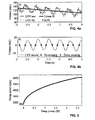
- the left ventricular volume signal (LVV raw) is low-pass filtered using a second-order IIR filter.
- the resulting signal is denoted with LVV filt. in figure 4a .
- the last 3 s of the LVV signal are acquired at every time step.
- Figure 4a shows the 3 s window with the raw and the filtered LVV signals.
- the instantaneous HR and EDV signals are calculated from this window as follows: First, an affine function is fitted to the filtered LVV signal using the least-squares method (linear fit in figure 4a ). This affine function represents the offset and a linear trend of the LW signal. Second, this affine function is subtracted from the filtered signal, which yields a zero-mean sine-like signal as shown in Figure 4b . Third, all zero crossings and the direction of their crossing are detected. Fourth, the time intervals between all subsequent downward crossings and all subsequent upward crossings are calculated. Fifth, the heart rate HR is calculated by dividing 60 by the median of all previously calculated time intervals.
- the estimate for the end-diastolic volume EDV is calculated by taking the maximum value of the filtered LVV signal between the last downward crossing and the last preceding upward crossing as indicated in Figure 4a . All six steps of the algorithm are repeated at every time-step of the controller 13.
- the HR and EDV detection described above is not valid, since the LVV signal does not have a sine-like shape. Such a case is detected by the signal processing procedure, and an alternative algorithm is then used by the controller 13 for the HR and EDV detection.
- the detection of an asystolic heart is based on the pulsatility of the LVV signal. This implementation allows the controller 13 to be used in patients without a regular or an undetectable heart rate.
- the second stage 2) of the main control structure of the controller 13, as shown in figure 3 consists of one part describing the preload recruitable stroke work PRSW and an additional part to include the heart rate HR.
- This function calculates the desired pump work per heartbeat PW des (t) at a time t.
- the two parameters EDV 0 and k prsw can be adapted by the physician,by trained medical personnel or by the patient.
- the third stage 3) of the main control algorithm consists of a low-pass filter and a lookup-table.
- the low-pass element is a first-order IIR filter with a cut-off frequency of 1 rad/s.
- the pump-power lookup-table (PPLUT) is a mapping between the hydraulic pump power and the pump speed. The actual power delivered by the pump is not only a function of the pump speed, but also the resistance against the pump flow and the fluid viscosity, but for the implementation in the controller 13, these dependencies are neglected and the pump speed directly mapped to a pump power.
- Figure 5 shows the pump-power lookup-table PPLUT implemented in the controller 13.
- the presented controller 13 adapts the cardiac output very similar to the physiological circulation, while effectively preventing overpumping and underpumping.
- the controller 13 shows a high sensitivity towards preload changes and a low sensitivity to afterload changes.
- the pump speed adaptation with regard to the blood pump 10 is fast and keeps the left ventricular volume in a safe range.
- the main control structure of the controller 13 is very simple and only two parameters need to be adapted, namely k prsw and EDV 0 .
- the adaptation of these two parameters could be made by the physician, trained medical personnel, or the patient in order to find a comfortable level of perfusion. As long as k prsw is kept between certain limits, the controller 13 retains its safe operation.
- the controller 13 with the main control structure as presented above could also be used for controlling the output power of a blood pump in an extracorporeal membrane oxygenation (ECMO) apparatus, a heart-lung machine or a dialysis apparatus.
- ECMO extracorporeal membrane oxygenation
- the measurement of the distances does not necessarily be carried out by means of ultrasound transceivers.
- Optical measuring devices, such as a laser, or an electrical conductance measuring device, such as an admittance or conductance catheter, could also be used for this purpose.
- the inlet and the outlet cannulas do not necessarily be inserted into in the left ventricle 20 and the aorta 3, respectively, but could be inserted at any other location of the circulatory system, depending on the concrete purpose of the biomedical apparatus. It would also be conceivable to construct the measuring device as a separate part with respect to the inlet cannula and to even arrange the measuring device at a different location in the circulatory system than the inlet cannula.
- the inlet cannula could be inserted into the aorta 3 or into any other blood vessel and the measuring device could be located in the left ventricle.
- the controller 13 is used as the low-level controller in a hierarchical control system.
- a high-level control system could then influence the k prsw of the controller and influence the controller gain, while maintaining the safe operation of the controller.
- Such a high level controller could be based on an additional measurement, e.g. a measurement of the patient movement (acceleration sensor) or the blood oxygen concentration.
- a measurement of the patient movement (acceleration sensor) or the blood oxygen concentration e.g. a measurement of the patient movement (acceleration sensor) or the blood oxygen concentration.
- VAV Ventricular Assist Device
- VFD Ultrasound transceivers
- Heart 10 Blood pump 20
- Left ventricle 11
- Inlet cannula 21
- Ventricular wall 12
- Outlet cannula 3
Landscapes
- Health & Medical Sciences (AREA)
- Heart & Thoracic Surgery (AREA)
- Life Sciences & Earth Sciences (AREA)
- Engineering & Computer Science (AREA)
- Cardiology (AREA)
- Public Health (AREA)
- Veterinary Medicine (AREA)
- Biomedical Technology (AREA)
- Animal Behavior & Ethology (AREA)
- General Health & Medical Sciences (AREA)
- Hematology (AREA)
- Anesthesiology (AREA)
- Mechanical Engineering (AREA)
- Physics & Mathematics (AREA)
- Medical Informatics (AREA)
- Pathology (AREA)
- Surgery (AREA)
- Molecular Biology (AREA)
- Biophysics (AREA)
- Vascular Medicine (AREA)
- Pulmonology (AREA)
- Radiology & Medical Imaging (AREA)
- Nuclear Medicine, Radiotherapy & Molecular Imaging (AREA)
- Oral & Maxillofacial Surgery (AREA)
- Dentistry (AREA)
- Physiology (AREA)
- Manufacturing & Machinery (AREA)
- Emergency Medicine (AREA)
- Fluid Mechanics (AREA)
- Urology & Nephrology (AREA)
- External Artificial Organs (AREA)
Priority Applications (4)
| Application Number | Priority Date | Filing Date | Title |
|---|---|---|---|
| EP13002157.9A EP2796156A1 (de) | 2013-04-24 | 2013-04-24 | Biomedizinische Vorrichtung zum Pumpen von Blut eines Patienten oder eines Tieres durch einen sekundären intra- oder extrakorporalen Blutkreislauf |
| US14/786,242 US9669147B2 (en) | 2013-04-24 | 2014-04-22 | Biomedical apparatus for pumping blood of a human or an animal patient through a secondary intra- or extracorporeal blood circuit |
| EP14720044.8A EP2988795B1 (de) | 2013-04-24 | 2014-04-22 | Biomedizinische vorrichtung zum pumpen von blut eines patienten oder eines tieres durch einen sekundären intra- oder extrakorporalen blutkreislauf |
| PCT/EP2014/001064 WO2014173527A1 (en) | 2013-04-24 | 2014-04-22 | Biomedical apparatus for pumping blood of a human or an animal patient through a secondary intra- or extracorporeal blood circuit |
Applications Claiming Priority (1)
| Application Number | Priority Date | Filing Date | Title |
|---|---|---|---|
| EP13002157.9A EP2796156A1 (de) | 2013-04-24 | 2013-04-24 | Biomedizinische Vorrichtung zum Pumpen von Blut eines Patienten oder eines Tieres durch einen sekundären intra- oder extrakorporalen Blutkreislauf |
Publications (1)
| Publication Number | Publication Date |
|---|---|
| EP2796156A1 true EP2796156A1 (de) | 2014-10-29 |
Family
ID=48190679
Family Applications (2)
| Application Number | Title | Priority Date | Filing Date |
|---|---|---|---|
| EP13002157.9A Withdrawn EP2796156A1 (de) | 2013-04-24 | 2013-04-24 | Biomedizinische Vorrichtung zum Pumpen von Blut eines Patienten oder eines Tieres durch einen sekundären intra- oder extrakorporalen Blutkreislauf |
| EP14720044.8A Not-in-force EP2988795B1 (de) | 2013-04-24 | 2014-04-22 | Biomedizinische vorrichtung zum pumpen von blut eines patienten oder eines tieres durch einen sekundären intra- oder extrakorporalen blutkreislauf |
Family Applications After (1)
| Application Number | Title | Priority Date | Filing Date |
|---|---|---|---|
| EP14720044.8A Not-in-force EP2988795B1 (de) | 2013-04-24 | 2014-04-22 | Biomedizinische vorrichtung zum pumpen von blut eines patienten oder eines tieres durch einen sekundären intra- oder extrakorporalen blutkreislauf |
Country Status (3)
| Country | Link |
|---|---|
| US (1) | US9669147B2 (de) |
| EP (2) | EP2796156A1 (de) |
| WO (1) | WO2014173527A1 (de) |
Cited By (3)
| Publication number | Priority date | Publication date | Assignee | Title |
|---|---|---|---|---|
| US11045640B2 (en) * | 2016-03-02 | 2021-06-29 | Eth Zurich | Biomedical apparatus with a pressure-regulated blood pump |
| US11628293B2 (en) | 2018-09-21 | 2023-04-18 | Abiomed, Inc. | Use of optical fiber sensor as a diagnostic tool in catheter-based medical devices |
| CN116688272A (zh) * | 2023-08-07 | 2023-09-05 | 遂宁市中心医院 | 一种重症患者血压血氧维持方法 |
Families Citing this family (55)
| Publication number | Priority date | Publication date | Assignee | Title |
|---|---|---|---|---|
| EP2349097B1 (de) * | 2008-10-10 | 2024-07-03 | MedicalTree Patent Ltd. | Verbesserte künstliche herzklappe |
| US8562507B2 (en) | 2009-02-27 | 2013-10-22 | Thoratec Corporation | Prevention of aortic valve fusion |
| WO2012040551A1 (en) | 2010-09-24 | 2012-03-29 | Thoratec Corporation | Generating artificial pulse |
| EP3287154B1 (de) * | 2016-08-23 | 2019-10-09 | Abiomed Europe GmbH | Ventrikelunterstützungsvorrichtung |
| DK3515523T3 (da) * | 2016-09-19 | 2021-05-17 | Abiomed Inc | Kardiovaskulart hjælpesystem som kvantificerer hjertefunktion og fremmer hjerterestitution |
| EP3311860A1 (de) * | 2016-10-20 | 2018-04-25 | Berlin Heart GmbH | Kanüle, kanülensystem, herzpumpensystem und verfahren zur volumenentlastung eines herzens |
| EP3600478B1 (de) | 2017-03-29 | 2024-06-26 | Tc1 Llc | Druckmessende herzunterstützungsvorrichtungen |
| EP3600477B1 (de) | 2017-03-29 | 2022-10-26 | Tc1 Llc | Kommunikationsarchitektur für herzbehandlungssysteme |
| EP3928830B1 (de) | 2017-03-29 | 2024-07-10 | Tc1 Llc | Einstellung eines pumpenprotokolls basierend auf unregelmässigem herzrhythmus |
| EP4732889A2 (de) | 2017-06-07 | 2026-04-29 | Supira Medical, Inc. | Vorrichtungen, systeme und verfahren zur bewegung intravaskulärer flüssigkeiten |
| JP7319266B2 (ja) | 2017-11-13 | 2023-08-01 | シファメド・ホールディングス・エルエルシー | 血管内流体移動デバイス、システム、および使用方法 |
| EP4085965A1 (de) | 2018-02-01 | 2022-11-09 | Shifamed Holdings, LLC | Intravaskuläre blutpumpen und verfahren zur verwendung und herstellung |
| EP4461341A3 (de) | 2018-03-15 | 2025-01-15 | Tc1 Llc | Verfahren und systeme zur verhinderung von rechtsherzinsuffizienz |
| EP3768341A1 (de) | 2018-03-19 | 2021-01-27 | Tc1 Llc | Vorrichtungen und verfahren zur koordinierten ventrikulären unterstützung und herzrhythmusverwaltung |
| DE102018208538A1 (de) | 2018-05-30 | 2019-12-05 | Kardion Gmbh | Intravasale Blutpumpe und Verfahren zur Herstellung von elektrischen Leiterbahnen |
| DE102018208945A1 (de) | 2018-06-06 | 2019-12-12 | Kardion Gmbh | Analysevorrichtung und Verfahren zum Analysieren einer Viskosität eines Fluids |
| DE102018208913A1 (de) | 2018-06-06 | 2019-12-12 | Kardion Gmbh | Verfahren zum Betreiben eines implantierten, ventrikulären Unterstützungssystems |
| DE102018208879A1 (de) | 2018-06-06 | 2020-01-30 | Kardion Gmbh | Verfahren zur Bestimmung eines Fluid-Gesamtvolumenstroms im Bereich eines implantierten, vaskuläres Unterstützungssystems |
| DE102018208916A1 (de) | 2018-06-06 | 2019-12-12 | Kardion Gmbh | Sensorikeinheit für ein Implantationssystem zur medizinischen Unterstützung eines Patienten und Verfahren zum Herstellen einer Sensorikeinheit |
| DE102018208929A1 (de) | 2018-06-06 | 2019-12-12 | Kardion Gmbh | Verfahren zur Bestimmung einer Strömungsgeschwindigkeit eines durch ein implantiertes, vaskuläres Unterstützungssystem strömenden Fluids |
| DE102018208931A1 (de) | 2018-06-06 | 2019-12-12 | Kardion Gmbh | Vorrichtung zum Bestimmen eines Herzzeitvolumens für ein Herzunterstützungssystem, Herzunterstützungssystem und Verfahren zum Bestimmen eines Herzzeitvolumens |
| DE102018208862A1 (de) | 2018-06-06 | 2019-12-12 | Kardion Gmbh | Implantierbares, vaskuläres Unterstützungssystem |
| DE102018208870A1 (de) | 2018-06-06 | 2019-12-12 | Kardion Gmbh | Verfahren zur Bestimmung eines Fluid-Volumenstroms durch ein implantiertes, vaskuläres Unterstützungssystem |
| DE102018208936A1 (de) | 2018-06-06 | 2019-12-12 | Kardion Gmbh | Bestimmvorrichtung und Verfahren zum Bestimmen einer Viskosität eines Fluids |
| DE102018208933A1 (de) | 2018-06-06 | 2019-12-12 | Kardion Gmbh | Verfahren zur Bestimmung einer Strömungsgeschwindigkeit eines durch ein implantiertes, vaskuläres Unterstützungssystem strömenden Fluids |
| DE102018208899A1 (de) | 2018-06-06 | 2019-12-12 | Kardion Gmbh | Verfahren zum Ermitteln der Schallgeschwindigkeit in einem Fluid im Bereich eines implantierten, vaskulären Unterstützungssystems |
| DE102018208892A1 (de) | 2018-06-06 | 2019-12-12 | Kardion Gmbh | Sensorkopfvorrichtung für ein minimalinvasives Herzunterstützungssystem und Verfahren zum Herstellen einer Sensorkopfvorrichtung für ein Herzunterstützungssystem |
| DE102018210076A1 (de) | 2018-06-21 | 2019-12-24 | Kardion Gmbh | Verfahren und Vorrichtung zum Erkennen eines Verschleißzustands eines Herzunterstützungssystems, Verfahren und Vorrichtung zum Betreiben eines Herzunterstützungssystems und Herzunterstützungssystem |
| US11241570B2 (en) | 2018-07-17 | 2022-02-08 | Tc1 Llc | Systems and methods for inertial sensing for VAD diagnostics and closed loop control |
| US12161857B2 (en) | 2018-07-31 | 2024-12-10 | Shifamed Holdings, Llc | Intravascular blood pumps and methods of use |
| DE102018213350A1 (de) | 2018-08-08 | 2020-02-13 | Kardion Gmbh | Vorrichtung und Verfahren zur Überwachung eines Gesundheitszustands des Patienten |
| WO2020073047A1 (en) | 2018-10-05 | 2020-04-09 | Shifamed Holdings, Llc | Intravascular blood pumps and methods of use |
| WO2020102133A1 (en) * | 2018-11-15 | 2020-05-22 | Medtronic, Inc. | Method of estimating heart rate and detecting tachyarrhythmia |
| EP3721801A1 (de) | 2019-04-12 | 2020-10-14 | ETH Zurich | Kardiale vorrichtung, verfahren und computerprogrammprodukt |
| GB2584109A (en) * | 2019-05-21 | 2020-11-25 | Haemair Ltd | Control system |
| EP3996797A4 (de) | 2019-07-12 | 2023-08-02 | Shifamed Holdings, LLC | Intravaskuläre blutpumpen und verfahren zur herstellung und verwendung |
| US11654275B2 (en) | 2019-07-22 | 2023-05-23 | Shifamed Holdings, Llc | Intravascular blood pumps with struts and methods of use and manufacture |
| EP4010046A4 (de) | 2019-08-07 | 2023-08-30 | Calomeni, Michael | Katheterblutpumpen und zusammenklappbare pumpengehäuse |
| US12121713B2 (en) | 2019-09-25 | 2024-10-22 | Shifamed Holdings, Llc | Catheter blood pumps and collapsible blood conduits |
| US12102815B2 (en) | 2019-09-25 | 2024-10-01 | Shifamed Holdings, Llc | Catheter blood pumps and collapsible pump housings |
| EP4034192B1 (de) | 2019-09-25 | 2025-12-24 | Supira Medical, Inc. | Intravaskuläre blutpumpensysteme und verfahren zur verwendung und steuerung davon |
| US12453808B2 (en) | 2019-11-07 | 2025-10-28 | Jeko Metodiev Madjarov | Cannula for apical cannulation |
| EP4072650A4 (de) | 2019-12-11 | 2024-01-10 | Shifamed Holdings, LLC | Absteigende aorten- und hohlvenenblutpumpen |
| WO2021127503A1 (en) | 2019-12-19 | 2021-06-24 | Shifamed Holdings, Llc | Intravascular blood pumps, motors, and fluid control |
| US11896812B1 (en) | 2023-01-27 | 2024-02-13 | Lifebridge Technologies Llc | Versatile modular heart pump for non-blood contacting ventricular function augmentation |
| US12115363B1 (en) | 2023-08-10 | 2024-10-15 | Lifebridge Technologies Llc | System and method for introducing a construct either on or around the surface of the heart |
| US12478773B2 (en) | 2020-10-01 | 2025-11-25 | Lifebridge Technologies Llc | Dynamic drive system for cardiac systolic and diastolic assist |
| US12478475B2 (en) | 2020-10-01 | 2025-11-25 | Lifebridge Technologies Llc | Single tube pressurization system for a heart pump |
| US12440338B2 (en) | 2020-10-01 | 2025-10-14 | Lifebridge Technologies Llc | Minimally invasive heart pump with modular adjustable construct insertion |
| US12263332B2 (en) | 2022-09-13 | 2025-04-01 | Lifebridge Technologies Llc | Material characteristics ideal for providing either partial or total mechanical support to the failing or arrested heart and method for developing ideal characteristics for underlying cardiac disorders |
| US11383076B2 (en) * | 2020-10-01 | 2022-07-12 | Lifebridge Technologies, Llc | Pump regulation based on heart size and function |
| WO2022225950A1 (en) * | 2021-04-22 | 2022-10-27 | Cardio Vol, Llc | Method and apparatus for assisting a heart |
| EP4387708A4 (de) * | 2021-08-19 | 2025-05-21 | Cardiovol, LLC | Verfahren und vorrichtung zur unterstützung eines herzens |
| WO2023140806A1 (en) | 2022-01-19 | 2023-07-27 | Istanbul Bilgi Universitesi | A biventricular assist system |
| CN120916798A (zh) * | 2023-03-01 | 2025-11-07 | 布鲁塞尔大学 | 体外膜氧合的控制方法和系统 |
Citations (10)
| Publication number | Priority date | Publication date | Assignee | Title |
|---|---|---|---|---|
| WO2000069490A1 (en) | 1999-05-18 | 2000-11-23 | Sonometrics Corporation | System for incorporating sonomicrometer functions into medical instruments and implantable biomedical devices |
| US6422990B1 (en) | 1997-11-26 | 2002-07-23 | Vascor, Inc. | Blood pump flow rate control method and apparatus utilizing multiple sensors |
| WO2002065908A1 (en) | 2001-02-23 | 2002-08-29 | Heart Assist Technologies Pty Ltd | Determining the volume of a normal heart and its pathological and treated variants by using dimension sensors |
| US20030032853A1 (en) * | 2001-03-13 | 2003-02-13 | Theodosios Korakianitis | Optimized pulsatile-flow ventricular-assist device and total artificial heart |
| WO2004073796A2 (en) | 2003-02-19 | 2004-09-02 | Tal Yair | Device and method for regulating blood flow |
| US6918870B1 (en) * | 1999-06-17 | 2005-07-19 | Heart Assist Technologies Pty Ltd | Assist device for the failing heart |
| US20070073393A1 (en) * | 2005-09-26 | 2007-03-29 | Abiomed, Inc. | Method and apparatus for pumping blood |
| WO2008104858A2 (en) * | 2007-02-27 | 2008-09-04 | Miracor Medical Systems Gmbh | Catheter to assist the performance of a heart |
| EP2298375A1 (de) * | 2008-06-11 | 2011-03-23 | Sun Medical Technology Research Corporation | Kontrollvorrichtung für ein künstliches herz, künstliches herzsystem und verfahren zur kontrolle eines künstlichen herzens |
| WO2012167876A1 (de) * | 2011-06-10 | 2012-12-13 | Rheinisch-Westfälische Technische Hochschule Aachen (RWTH) | Blutentnahmekanüle einer die herzfunktion ersetzenden oder unterstützenden pumpe |
Family Cites Families (9)
| Publication number | Priority date | Publication date | Assignee | Title |
|---|---|---|---|---|
| US4925443A (en) * | 1987-02-27 | 1990-05-15 | Heilman Marlin S | Biocompatible ventricular assist and arrhythmia control device |
| US6298269B1 (en) * | 1999-04-19 | 2001-10-02 | Cardiac Pacemakers, Inc. | Cardiac rhythm management system with ultrasound for autocapture or other applications |
| US6360123B1 (en) * | 1999-08-24 | 2002-03-19 | Impulse Dynamics N.V. | Apparatus and method for determining a mechanical property of an organ or body cavity by impedance determination |
| US6438408B1 (en) * | 2000-12-28 | 2002-08-20 | Medtronic, Inc. | Implantable medical device for monitoring congestive heart failure |
| US6511413B2 (en) * | 2001-05-16 | 2003-01-28 | Levram Medical Devices, Ltd. | Single cannula ventricular-assist method and apparatus |
| US20080097226A1 (en) * | 2005-06-09 | 2008-04-24 | Mcconnell Patrick I | Evaluation of cardiac function using left ventricular pressure during LVAD support |
| US20110270331A1 (en) * | 2010-04-02 | 2011-11-03 | Sunshine Heart Company Pty Ltd | Combination heart assist systems, methods, and devices |
| WO2014044287A1 (en) * | 2012-09-21 | 2014-03-27 | Rheinisch-Westfälische Technische Hochschule Aachen | Method of controlling the speed of an ventricular assist device (vad) and ventricular assist device. |
| WO2014085806A1 (en) * | 2012-11-30 | 2014-06-05 | The Penn State Research Foundation | Smart tip lvad inlet cannula |
-
2013
- 2013-04-24 EP EP13002157.9A patent/EP2796156A1/de not_active Withdrawn
-
2014
- 2014-04-22 US US14/786,242 patent/US9669147B2/en not_active Expired - Fee Related
- 2014-04-22 EP EP14720044.8A patent/EP2988795B1/de not_active Not-in-force
- 2014-04-22 WO PCT/EP2014/001064 patent/WO2014173527A1/en not_active Ceased
Patent Citations (10)
| Publication number | Priority date | Publication date | Assignee | Title |
|---|---|---|---|---|
| US6422990B1 (en) | 1997-11-26 | 2002-07-23 | Vascor, Inc. | Blood pump flow rate control method and apparatus utilizing multiple sensors |
| WO2000069490A1 (en) | 1999-05-18 | 2000-11-23 | Sonometrics Corporation | System for incorporating sonomicrometer functions into medical instruments and implantable biomedical devices |
| US6918870B1 (en) * | 1999-06-17 | 2005-07-19 | Heart Assist Technologies Pty Ltd | Assist device for the failing heart |
| WO2002065908A1 (en) | 2001-02-23 | 2002-08-29 | Heart Assist Technologies Pty Ltd | Determining the volume of a normal heart and its pathological and treated variants by using dimension sensors |
| US20030032853A1 (en) * | 2001-03-13 | 2003-02-13 | Theodosios Korakianitis | Optimized pulsatile-flow ventricular-assist device and total artificial heart |
| WO2004073796A2 (en) | 2003-02-19 | 2004-09-02 | Tal Yair | Device and method for regulating blood flow |
| US20070073393A1 (en) * | 2005-09-26 | 2007-03-29 | Abiomed, Inc. | Method and apparatus for pumping blood |
| WO2008104858A2 (en) * | 2007-02-27 | 2008-09-04 | Miracor Medical Systems Gmbh | Catheter to assist the performance of a heart |
| EP2298375A1 (de) * | 2008-06-11 | 2011-03-23 | Sun Medical Technology Research Corporation | Kontrollvorrichtung für ein künstliches herz, künstliches herzsystem und verfahren zur kontrolle eines künstlichen herzens |
| WO2012167876A1 (de) * | 2011-06-10 | 2012-12-13 | Rheinisch-Westfälische Technische Hochschule Aachen (RWTH) | Blutentnahmekanüle einer die herzfunktion ersetzenden oder unterstützenden pumpe |
Non-Patent Citations (3)
| Title |
|---|
| GLOWER DD; SPRATT JA; SNOW ND ET AL.: "Linearity of the frank-starling relationship in the intact heart: the concept of preload recruitable stroke work", CIRC, vol. 71, 1985, pages 994 - 1009 |
| GUYTON AC; HALL JE: "Textbook of Medical Physiology", 2010, SAUNDERS W B CO |
| TAKEUCHI M; ODAKE M; TAKAOKA H; HAYASHI Y; YOKOYAMA M: "Comparison between preload recruitable stroke work and the end-systolic pressure-volume relationship in man", EUR HEART J, vol. 13, 1992, pages 80 - 84 |
Cited By (5)
| Publication number | Priority date | Publication date | Assignee | Title |
|---|---|---|---|---|
| US11045640B2 (en) * | 2016-03-02 | 2021-06-29 | Eth Zurich | Biomedical apparatus with a pressure-regulated blood pump |
| US11628293B2 (en) | 2018-09-21 | 2023-04-18 | Abiomed, Inc. | Use of optical fiber sensor as a diagnostic tool in catheter-based medical devices |
| US12589239B2 (en) | 2018-09-21 | 2026-03-31 | Abiomed, Inc. | Use of optical fiber sensor as a diagnostic tool in catheter-based medical devices |
| CN116688272A (zh) * | 2023-08-07 | 2023-09-05 | 遂宁市中心医院 | 一种重症患者血压血氧维持方法 |
| CN116688272B (zh) * | 2023-08-07 | 2023-10-20 | 遂宁市中心医院 | 一种控制ecmo系统的方法 |
Also Published As
| Publication number | Publication date |
|---|---|
| WO2014173527A1 (en) | 2014-10-30 |
| US20160101230A1 (en) | 2016-04-14 |
| US9669147B2 (en) | 2017-06-06 |
| EP2988795A1 (de) | 2016-03-02 |
| EP2988795B1 (de) | 2018-10-17 |
Similar Documents
| Publication | Publication Date | Title |
|---|---|---|
| EP2988795B1 (de) | Biomedizinische vorrichtung zum pumpen von blut eines patienten oder eines tieres durch einen sekundären intra- oder extrakorporalen blutkreislauf | |
| EP3423125B1 (de) | Biomedizinische vorrichtung mit druckregulierter blutpumpe | |
| US11779234B2 (en) | Pressure sensing ventricular assist devices and methods of use | |
| AU2019290143B2 (en) | Systems and methods for system identification | |
| US7238151B2 (en) | Permanent heart assist system | |
| Schima et al. | Noninvasive monitoring of rotary blood pumps: necessity, possibilities, and limitations | |
| US20060229488A1 (en) | Blood pressure detecting device and system | |
| JPWO1999033502A1 (ja) | 連続流血液ポンプを用いた血流循環補助装置および生体の血流循環状態の診断装置 | |
| Slaughter et al. | Intraoperative evaluation of the HeartMate II flow estimator | |
| Bertram | Measurement for implantable rotary blood pumps | |
| US20220175316A1 (en) | Cardiac Device, Method and Computer Program Product | |
| CN109793954A (zh) | 一种基于左心室辅助装置lvad的无差别自适应的生理控制方法 | |
| CN118267610A (zh) | 导管泵的位置监测装置、方法和心室辅助装置 | |
| US20100121133A1 (en) | Apparatus and methods for measuring pressure and flow in cardiac assist devices and peripheral vasculature | |
| AlOmari et al. | Non-invasive estimation and control of inlet pressure in an implantable rotary blood pump for heart failure patients | |
| WO2020093084A1 (en) | Ventricular function determination | |
| Gawlikowski et al. | The methods of physical parameters measurement regarding the heart supporting automation | |
| Kim et al. | Application of a phase-locked loop counterpulsation control algorithm to a pneumatic pulsatile VAD | |
| Kang et al. | Outflow monitoring of a pneumatic ventricular assist device using external pressure sensors | |
| Cysyk et al. | Rotary blood pump control using integrated inlet pressure sensor | |
| KR102957521B1 (ko) | 신장 기능을 개선하기 위한 심장 보조 장치의 사용 | |
| AU2004257347B2 (en) | Blood pressure detecting device and system | |
| CN120884250A (zh) | 抽吸检测装置、方法、心室辅助系统和计算机程序 | |
| Gopalakrishnan et al. | Evaluation of a minimally invasive cardiac function estimator for patients with rotary VAD support | |
| Scolletta et al. | Analysis of arterial pulse and ventricular devices |
Legal Events
| Date | Code | Title | Description |
|---|---|---|---|
| PUAI | Public reference made under article 153(3) epc to a published international application that has entered the european phase |
Free format text: ORIGINAL CODE: 0009012 |
|
| 17P | Request for examination filed |
Effective date: 20130424 |
|
| AK | Designated contracting states |
Kind code of ref document: A1 Designated state(s): AL AT BE BG CH CY CZ DE DK EE ES FI FR GB GR HR HU IE IS IT LI LT LU LV MC MK MT NL NO PL PT RO RS SE SI SK SM TR |
|
| AX | Request for extension of the european patent |
Extension state: BA ME |
|
| STAA | Information on the status of an ep patent application or granted ep patent |
Free format text: STATUS: THE APPLICATION IS DEEMED TO BE WITHDRAWN |
|
| 18D | Application deemed to be withdrawn |
Effective date: 20150430 |