EP2796337A1 - Verfahren zur Bestimmung des Spurverlaufes eines schienengebundenen Fahrzeugs - Google Patents
Verfahren zur Bestimmung des Spurverlaufes eines schienengebundenen Fahrzeugs Download PDFInfo
- Publication number
- EP2796337A1 EP2796337A1 EP20130164791 EP13164791A EP2796337A1 EP 2796337 A1 EP2796337 A1 EP 2796337A1 EP 20130164791 EP20130164791 EP 20130164791 EP 13164791 A EP13164791 A EP 13164791A EP 2796337 A1 EP2796337 A1 EP 2796337A1
- Authority
- EP
- European Patent Office
- Prior art keywords
- track
- curvature
- value
- estimated
- error
- Prior art date
- Legal status (The legal status is an assumption and is not a legal conclusion. Google has not performed a legal analysis and makes no representation as to the accuracy of the status listed.)
- Granted
Links
Images



Classifications
-
- B—PERFORMING OPERATIONS; TRANSPORTING
- B61—RAILWAYS
- B61L—GUIDING RAILWAY TRAFFIC; ENSURING THE SAFETY OF RAILWAY TRAFFIC
- B61L25/00—Recording or indicating positions or identities of vehicles or trains or setting of track apparatus
- B61L25/02—Indicating or recording positions or identities of vehicles or trains
- B61L25/026—Relative localisation, e.g. using odometer
-
- B—PERFORMING OPERATIONS; TRANSPORTING
- B61—RAILWAYS
- B61L—GUIDING RAILWAY TRAFFIC; ENSURING THE SAFETY OF RAILWAY TRAFFIC
- B61L2205/00—Communication or navigation systems for railway traffic
- B61L2205/04—Satellite based navigation systems, e.g. global positioning system [GPS]
Definitions
- the invention is related to a method for determining the track course of a track bound vehicle.
- a track bound vehicle can be for example a train or another vehicle in railroad traffic. Further, it can be any other vehicle which is bound to a track, meaning the vehicle is not able to leave this track under ordinary conditions.
- inertial sensors For this purpose, it is known to use inertial sensors.
- a drawback when using inertial sensors is that no method is known in order to determine the reliability of a determination of the position of the vehicle based on their function. For applications which are relevant to safety, for example in railroad traffic, this information is required.
- the inventive method for determining the track course of a track bound vehicle comprises the following method steps:
- the inventive method can be used for a plurality of applications which will be described in more detail later.
- the first and second wrong decision probability can be identical or differ from each other.
- first and second error distribution in particular for each user sensor are determined each by a long time measurement in a static laboratory environment meaning that the conditions which might influence the function of the sensors are kept constant in this environment so that the exact error distribution of the sensor or sensors used can be determined. It is preferred that the first and the second error distribution are estimated.
- the quality of the performed curvature determination is determined in terms of a wrong decision probability.
- Standard curvatures in railroad traffic can be for example 0.4x10 ⁇ (-3) l/m for a radius of 2.5km til 5.26x10 ⁇ (-3) l/m for a radius of 190m.
- a decision between the first estimated curvature k ⁇ 1 and the second estimated curvature value k ⁇ 2 is taken such that the value leading to the lowest wrong decision probability is chosen.
- the minimum distance between k1 and k2 is obtained such that the reliability requirements (Pfa and Pmd) are just fulfilled. That is for any k3>k2, the probability of miss-detection is smaller than the required on: Pmd(k3) ⁇ Pmd(k2)
- a further possible application of the inventive method is to determine a minimum difference between two standard curvatures which is required to be able to distinguish between them with a predefined wrong decision probability. For example it might follow from the inventive method that a minimum difference of 0.45x10 -3 l/m is necessary in order to fulfill the predefined wrong decision probability 10 -5 at a velocity of 36.72km/h.
- the wrong decision probability can be a value between 10 -4 and 10 -6 .
- a further possible application of the inventive method is that a minimum speed can be specified for the vehicle for passing a switch which is required in order to be able to determine the correct function of the switch with a predefined wrong decision probability.
- a minimum speed can be specified for the vehicle for passing a switch which is required in order to be able to determine the correct function of the switch with a predefined wrong decision probability.
- the track curvature of the track bound vehicle is measured by at least one sensor in or at the track bound vehicle.
- the inventive method can be used as a subsidiary system which is part of an overall system (for example a system for localizing a vehicle in a map).
- an overall system for example a system for localizing a vehicle in a map.
- a curvature of the track course of the vehicle is determined. If this is done only in one snap-shot it is possible to reduce the number of possible positions of the vehicle in a map to all these positions which have the specified curvature. As an alternative it is possible to determine a plurality of subsequent curvatures, meaning that a plurality of curvatures of the vehicle is recorded over time. These recorded curvatures can be compared to the curvatures on a map so that it is possible to precisely identify the track course of the vehicle on the map.
- the inventive method can be used in order to determine sensor errors, so that the sensor can be calibrated.
- the track curvature is determined by using the above described sensors in particular based on three different methods which will be described later in more detail.
- each of these three curvature determination methods can result in a different minimum detectable curvature difference and a different vehicle speed dependency. For example, one method might result in lower required vehicle speeds which are necessary in order to be able to fulfill a required predefined wrong decision probability at different standard curvatures while another method might require higher speeds for the same preconditions. Since the performance order of the three methods is not constant over speed, it is preferred to switch between the three curvature determination methods depending on the speed and sensor quality. For example, if automotive grade sensors are used, it might be beneficial to use method 2 for 0-45km/h and method 3 for higher speeds ( Figure 10 ).
- this curvature determination method for a first speed range which allows the vehicle to travel with lower speeds at given curvatures and wrong decision probabilities while a second (and possibly third) different curvature determination method is used for another speed range in which this other curvature determination method allows the vehicle to travel with lower speed in order to achieve the same results.
- each method it is further possible to adapt the weight of each method depending on the camber of a track (namely the rotation around an x-axis running parallel to the longitudinal direction of the vehicle). It is further possible to choose the weight of each method based on an ascending or descending slope of the track (namely a rotation around the y-axis of the vehicle).
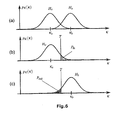
- Fig. 1 shows qualitatively the expected error distribution p k ( k ⁇ ) of a curvature determination error.
- the error distribution is used as an input for a threshold test, which for example can result in a minimum required curvature difference between two tracks.
- a first threshold T 1 is defined in the first error distribution (see Fig. 2 ).
- the probability of false alert is marked with P fa in Fig. 2 .
- the probability of misdetection is marked with P md in Fig. 3 .Since both probabilities characterize the allowed decision error for either curvature one or two, they could be considered equal and can be called probability of wrong decision.
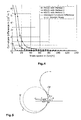
- Fig. 4 shows some examples of these MDCD values, whereby three different curvature determination methods and inertial sensors of very high quality have been used.
- the curvature difference minima shown in Fig. 4 have been calculated based on a wrong decision probability of 10 -5 and tactical grade sensors. They are further dependent on the speed of the vehicle.
- the horizontal lines indicate the standard curvatures which are used in German railroad traffic (and their differences). The end of each of these horizontal lines indicates the maximum speed on these tracks. Therefore, the right, upper area shows vehicle speeds which are higher than the allowed German maximum speed on the respective track and hence, they are not relevant.
- the inventive method can also be applied for determining the position of the vehicle in a three dimensional space. In this case additional sensors will be necessary since a three dimensional position cannot be determined by using the described three sensors.
- a more complex error model can be used for example by assuming that the bias of the sensors is defective meaning that it is not constant over a time. The same applies to the scale factor of the sensors.
- GNSS Global Navigation Satellite Systems
- the signals provided by satellites are often blocked and reflected by surrounding obstacles like trees, terrain and buildings. So the signals coming to the receiving GNSS antenna might not be the direct signals but distorted ones. This has a huge impact on the achievable position accuracy, system availability, continuity and integrity. Consequently, pure satellite based navigation/localization systems may fail to provide the required system performance particularly for safety-of-life critical railway applications.
- GNSS is generally delivering an absolute positioning which is often not what matters in rail navigation.
- RCAS The core idea of RCAS is to broadcast the position and intended track of trains as well as additional information like vehicle size to all other trains in the area using an ad-hoc train-to-train communication system. This enables train drivers to have an up-to-date accurate knowledge of the traffic situation in the vicinity, and act in consequence.
- the two main methods are map matching and dead reckoning system.
- the former obtains an absolute 3D position estimating using GNSS and additional sensors for each epoch and matches this position with the track map. This could be done by choosing the closest point in the track as the best estimate.
- the second approach the movement of the train relatively to a reference point is estimated incorporating all available sensors. Hence the position within the map is directly known. This approach can provide a more accurate and reliable solution since no intermediate solution is computed.
- Train localization/navigation using GNSS and IMU has been investigated by many different authors some of them providing novel and promising techniques using Bayesian filters [6].
- An ideal accelerometer would directly sense m (t) but in a non ideal case, the measured acceleration or turn rate is decomposed into a proportional part (proportional to a scaling factor s f ) and a time dependent drift part b ( t ) .
- the latter can be modeled by a constant offset b 0 as well as a time varying b 1 ( t ) and a sampling noise component ⁇ m :
- b t b 0 + b 1 t + ⁇ m .
- the offset b 0 stays constant during each run and is corrected by an initial calibration of the sensors.
- the sampling noise is assumed to be Gaussian distributed with zero-mean and a variance ⁇ m 2 .
- du t s f ⁇ m t + b 0 + b 1 t ⁇ dt + ⁇ m ⁇ d ⁇ B t , 2
- the first one uses a generator of the Ito-diffusion process defined by the stochastic differential equation and derive a partial differential equation, so called Kolmogorov Forward Equation or Fokker Planck Equation. Its solution is a transition probability density function of the solution process (see [4] and [3]).
- the second method takes advantage of the fact that the process solution is Gaussian distributed, if the initial state densities can be assumed to be also Gaussian distributed. Hence, it is sufficient to investigate the evolution of the corresponding expectation and variance of the transition density function. In the section below, we apply the second concept and discuss the results.
- ⁇ ⁇ ( t ) is function of B t ,1 , we kept the cross products as non necessarily zero terms.
- Equation (11) can be expressed in terms of ⁇ rather than ⁇ and observing that
- Second method ⁇ 2 Here, we observe a ratio between a normally distributed random variable and a folded normal distribution (the absolute value of a normally distributed random variable). In the case of a ratio between two independent, normally distributed random variables with zero mean, the distribution of the ratio follows a Cauchy distribution.
- One possibility is to exclude the samples of a CT (t),
- the area to exclude using a pretest should not be too large for one reason essentially: the exclusion reduces the availability of the test statistics (for each sample falling in the excluded area, the corresponding test statistics is set as unavailable). But the closer the exclusion bounds are to zero, the wider the distribution of the test statistics and therefore the smaller the minimum detectable curvature difference (MDCD).
- H a ⁇ T ⁇ ⁇ p K ⁇
- GNSS is not longer available, the velocity is drifting from its initial value considering a coasting using along track accelerometer.
- the localization problem consists of determining the track segment ID, the direction of displacement and the curvilinear abscissa on the track segment.
- a track segment is defined as a path between two switches.
- velocity fixes a coasting with the inertial unit based on along track, cross track accelerometers and a heading rate gyro using the characteristics defined in Table 2.
- the coasting time is not longer than 1 second when at least 5 satellites are visible which is generally the case. But in some cases (long tunnels or in the general case of bad satellite visibility or when the satellite signals are blocked or reflected by a strong multipath environment) the coasting time could be last much longer (up to several minutes).
- the error in the information is stationary and can be overbounded by a Gaussian distribution for a non zero required integrity risk. This overbound remains constant assuming the error is a stationary process.
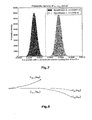
- the MDCD is a function of the velocity of the train. Intuitively the larger the velocity of the train, the smaller the dispersion of the test statistic.
- the MDCD curves cross at a speed of approximately 50 [km/h]. This suggests a velocity based test selection: below 50 [km/h] we use ⁇ 2 to make our decision and above this limit, we use ⁇ 3 which performs better.
- a more efficient strategy could consist of defining a weighted combination of both test statistics enabling even lower MDCD. However, this is beyond the scope of this paper.
- the expectation and the variance of the Gaussian overbound of the sensor errors are analytically expressed and the test statistics after pretreatment of the random denominators (exclusion of an interval around zero to prevent heavy tailed distributions) are investigated using Monte Carlo simulations.
- the minimum detectable curvatures difference is determined for three different classes of IMUs, namely consumer, automotive and tactical grade.
- the resulting MDCD curves have been compared to standard curvatures and their performance have been assessed.
- ⁇ 1 in addition to being unavailable a large part of the time (exclusion of the high density around zero of the cross track acceleration) provides when a bad performance.
- ⁇ 2 and ⁇ 3 show best results with a maximum availability when the train is moving. A performance crossover can be observed for the consumer and automotive grade IMUs. That is ⁇ 3 can outperform ⁇ 2 when the velocity of the train is larger than 50 km/h.
- ⁇ 3 depends on the cross track acceleration which is difficult to sense in a more realistic dynamic scenarios (for a non-perfect horizontal plan of motion, for which the gravity vector may introduce a component in cross track direction).
- ⁇ 2 shows a real improvement as it can be reliably used for a large range of velocities. Furthermore, it has a dependency on the heading rate rather than on the accelerations which makes it more robust to realistic scenarios (non-perfect horizontal displacements).
Landscapes
- Engineering & Computer Science (AREA)
- Mechanical Engineering (AREA)
- Navigation (AREA)
Priority Applications (1)
| Application Number | Priority Date | Filing Date | Title |
|---|---|---|---|
| EP13164791.9A EP2796337B1 (de) | 2013-04-22 | 2013-04-22 | Verfahren zur Bestimmung des Spurverlaufes eines schienengebundenen Fahrzeugs |
Applications Claiming Priority (1)
| Application Number | Priority Date | Filing Date | Title |
|---|---|---|---|
| EP13164791.9A EP2796337B1 (de) | 2013-04-22 | 2013-04-22 | Verfahren zur Bestimmung des Spurverlaufes eines schienengebundenen Fahrzeugs |
Publications (2)
| Publication Number | Publication Date |
|---|---|
| EP2796337A1 true EP2796337A1 (de) | 2014-10-29 |
| EP2796337B1 EP2796337B1 (de) | 2015-12-09 |
Family
ID=48184080
Family Applications (1)
| Application Number | Title | Priority Date | Filing Date |
|---|---|---|---|
| EP13164791.9A Not-in-force EP2796337B1 (de) | 2013-04-22 | 2013-04-22 | Verfahren zur Bestimmung des Spurverlaufes eines schienengebundenen Fahrzeugs |
Country Status (1)
| Country | Link |
|---|---|
| EP (1) | EP2796337B1 (de) |
Cited By (6)
| Publication number | Priority date | Publication date | Assignee | Title |
|---|---|---|---|---|
| US20190143963A1 (en) * | 2016-05-19 | 2019-05-16 | Zf Friedrichshafen Ag | Method for determining a safe speed at a future way point |
| EP3499271A1 (de) * | 2017-12-18 | 2019-06-19 | Siemens Aktiengesellschaft | Ermittlung einer position eines fahrzeugs |
| CN111854776A (zh) * | 2019-04-30 | 2020-10-30 | 北京京东尚科信息技术有限公司 | 导航的处理方法、装置、设备及存储介质 |
| CN111866709A (zh) * | 2020-06-29 | 2020-10-30 | 重庆邮电大学 | 一种面向运动目标的室内Wi-Fi定位误差界估计方法 |
| CN112531683A (zh) * | 2020-11-19 | 2021-03-19 | 国网湖北省电力有限公司电力科学研究院 | 一种基于奥恩斯坦-乌伦贝克过程求解的配网线路负荷预测方法 |
| CN116828398A (zh) * | 2023-08-29 | 2023-09-29 | 中国信息通信研究院 | 一种跟踪行为识别方法、装置、电子设备和存储介质 |
Families Citing this family (1)
| Publication number | Priority date | Publication date | Assignee | Title |
|---|---|---|---|---|
| US10062288B2 (en) * | 2016-07-29 | 2018-08-28 | GM Global Technology Operations LLC | Systems and methods for autonomous driving merging management |
-
2013
- 2013-04-22 EP EP13164791.9A patent/EP2796337B1/de not_active Not-in-force
Non-Patent Citations (11)
| Title |
|---|
| AMBIKE S ET AL: "A methodology for implementing the curvature theory approach to path tracking with planar robots", MECHANISM AND MACHINE THEORY, PERGAMON, AMSTERDAM, NL, vol. 43, no. 10, 20 December 2007 (2007-12-20), pages 1225 - 1235, XP023613321, ISSN: 0094-114X, [retrieved on 20071220], DOI: 10.1016/J.MECHMACHTHEORY.2007.10.010 * |
| ANJA GROSCH; BOUBEKER BELABBAS: "Parameter Study of Loosely Coupled INS/GNSS Integrity Performance", PROCEEDINGS OF LEEE/ION PLANS, 24 April 2012 (2012-04-24) |
| ANJA GROSCH; BOUBEKER BELABBAS; MICHAEL MEURER: "European Space Research and Technology Centre (ESTEC", NAVITEC 2010, article "Redundant Inertial-Aided GBAS for Civil Aviation" |
| ANTONI BROQUETAS; ADOLF COMERON; ANTONI GELONCH; JOSEP M. FUERTES; J. ANTONIO CASTRO; DAMIÀ FELIP; MIGUEL A. LÓPEZ; JOSÉ A. PUL: "Track Detection in Railway Sidings Based on MEMS Gyroscope Sensors", SENSORS, vol. 12, no. 12, 2012, pages 16228 - 16249 |
| BERNT OKSENDAL: "Stochastic Differential Equations", 2007, SPRINGER |
| D. V. HINKLEY: "On the Ratio of Two Correlated Normal Random Variables", BIOMETRIKA, vol. 56, no. 3, 1969, pages 635 - 639 |
| DEMOZ GEBRE-EGZIABHER: "Design and Performance Analysis of a Low-Cost Aided Dead Reckoning Navigator", PHD THESIS, 2004 |
| GERLACH K ET AL: "Multi-hypothesis based map-matching algorithm for precise train positioning", INFORMATION FUSION, 2009. FUSION '09. 12TH INTERNATIONAL CONFERENCE ON, IEEE, PISCATAWAY, NJ, USA, 6 July 2009 (2009-07-06), pages 1363 - 1369, XP031511969, ISBN: 978-0-9824438-0-4 * |
| H. JOCHIM; F. LADEMANN: "Planung von Bahnanlagen", 2009, CARL HANSER VERLAG |
| OLIVER HEIRICH; ANDREAS LEHNER; PATRICK ROBERTSON; THOMAS STRANG: "Measurement and Analysis of Train Motion and Railway Track Characteristics with Inertial Sensors", INTELLIGENT TRANSPORTATION SYSTEMS CONFERENCE (ITSC, 2011 |
| OLIVER HEIRICH; PATRICK ROBERTSON; ADRIAN CARDALDA GARCIA; THOMAS STRANG: "Bayesian Train Localization Method Extended By 3D Geometric Railway Track Observations From Inertial Sensors", 15TH INTERNATIONAL CONFERENCE ON INFORMATION FUSION, 9 July 2012 (2012-07-09) |
Cited By (8)
| Publication number | Priority date | Publication date | Assignee | Title |
|---|---|---|---|---|
| US20190143963A1 (en) * | 2016-05-19 | 2019-05-16 | Zf Friedrichshafen Ag | Method for determining a safe speed at a future way point |
| EP3499271A1 (de) * | 2017-12-18 | 2019-06-19 | Siemens Aktiengesellschaft | Ermittlung einer position eines fahrzeugs |
| CN111854776A (zh) * | 2019-04-30 | 2020-10-30 | 北京京东尚科信息技术有限公司 | 导航的处理方法、装置、设备及存储介质 |
| CN111854776B (zh) * | 2019-04-30 | 2024-04-16 | 北京京东乾石科技有限公司 | 导航的处理方法、装置、设备及存储介质 |
| CN111866709A (zh) * | 2020-06-29 | 2020-10-30 | 重庆邮电大学 | 一种面向运动目标的室内Wi-Fi定位误差界估计方法 |
| CN112531683A (zh) * | 2020-11-19 | 2021-03-19 | 国网湖北省电力有限公司电力科学研究院 | 一种基于奥恩斯坦-乌伦贝克过程求解的配网线路负荷预测方法 |
| CN116828398A (zh) * | 2023-08-29 | 2023-09-29 | 中国信息通信研究院 | 一种跟踪行为识别方法、装置、电子设备和存储介质 |
| CN116828398B (zh) * | 2023-08-29 | 2023-11-28 | 中国信息通信研究院 | 一种跟踪行为识别方法、装置、电子设备和存储介质 |
Also Published As
| Publication number | Publication date |
|---|---|
| EP2796337B1 (de) | 2015-12-09 |
Similar Documents
| Publication | Publication Date | Title |
|---|---|---|
| EP2796337B1 (de) | Verfahren zur Bestimmung des Spurverlaufes eines schienengebundenen Fahrzeugs | |
| Jing et al. | Integrity monitoring of GNSS/INS based positioning systems for autonomous vehicles: State-of-the-art and open challenges | |
| EP3605504A1 (de) | Bestimmungsvorrichtung, bestimmungsverfahren und programm | |
| CN103424119B (zh) | 导航装置 | |
| EP2784445B1 (de) | Ausgewählte Aspekte einer erweiterten Anwendung zur autonomen Empfängerintegritätsüberwachung eines Navigationsfilters auf Kalman-Filter-Basis | |
| Barrios et al. | Trajectory estimations using smartphones | |
| Huang et al. | Design of a fault detection and isolation system for intelligent vehicle navigation system | |
| Sun et al. | Integrated solution for anomalous driving detection based on BeiDou/GPS/IMU measurements | |
| US10571281B2 (en) | Information processing apparatus and method | |
| EP3605498A1 (de) | Ausgabevorrichtung, steuerungsverfahren, programm und speichermedium | |
| Suganuma et al. | Localization for autonomous vehicle on urban roads | |
| Zinoune et al. | Sequential FDIA for autonomous integrity monitoring of navigation maps on board vehicles | |
| Winter et al. | Increasing accuracy in train localization exploiting track-geometry constraints | |
| Cai et al. | Study on key technologies of GNSS-based train state perception for train-centric railway signaling | |
| Rojas et al. | Quantitative resilience assessment of GPS, IMU, and LiDAR sensor fusion for vehicle localization using resilience engineering theory | |
| Jacob et al. | Vehicle trajectory analysis: an advanced tool for road safety | |
| Palmer et al. | Robust odometry using sensor consensus analysis | |
| Boehringer | Train location based on fusion satellite and train-borne sensor data | |
| No et al. | Diagnostics of GNSS-based Virtual Balise in railway using embedded odometry and track geometry | |
| Barrios et al. | Predicting Vehicle Trajectory | |
| Brocard et al. | Infrastructure free solution for train positioning using track database | |
| Alasaadi et al. | Parkzoom: A parking spot identification system | |
| Dean et al. | Highway evaluation of terrain-aided localization using particle filters | |
| Belabbas et al. | Novel integrity monitoring for train navigation using a GNSS-IMU Bayesian position estimator and a curvature change detector | |
| RU2668597C1 (ru) | Способ выявления неисправностей и отказов бортовых измерителей параметров движения и спутниковых навигационных систем движущихся объектов |
Legal Events
| Date | Code | Title | Description |
|---|---|---|---|
| PUAI | Public reference made under article 153(3) epc to a published international application that has entered the european phase |
Free format text: ORIGINAL CODE: 0009012 |
|
| 17P | Request for examination filed |
Effective date: 20140331 |
|
| AK | Designated contracting states |
Kind code of ref document: A1 Designated state(s): AL AT BE BG CH CY CZ DE DK EE ES FI FR GB GR HR HU IE IS IT LI LT LU LV MC MK MT NL NO PL PT RO RS SE SI SK SM TR |
|
| AX | Request for extension of the european patent |
Extension state: BA ME |
|
| GRAP | Despatch of communication of intention to grant a patent |
Free format text: ORIGINAL CODE: EPIDOSNIGR1 |
|
| INTG | Intention to grant announced |
Effective date: 20150617 |
|
| GRAS | Grant fee paid |
Free format text: ORIGINAL CODE: EPIDOSNIGR3 |
|
| GRAA | (expected) grant |
Free format text: ORIGINAL CODE: 0009210 |
|
| AK | Designated contracting states |
Kind code of ref document: B1 Designated state(s): AL AT BE BG CH CY CZ DE DK EE ES FI FR GB GR HR HU IE IS IT LI LT LU LV MC MK MT NL NO PL PT RO RS SE SI SK SM TR |
|
| REG | Reference to a national code |
Ref country code: GB Ref legal event code: FG4D |
|
| REG | Reference to a national code |
Ref country code: AT Ref legal event code: REF Ref document number: 764435 Country of ref document: AT Kind code of ref document: T Effective date: 20151215 Ref country code: CH Ref legal event code: EP |
|
| REG | Reference to a national code |
Ref country code: IE Ref legal event code: FG4D |
|
| REG | Reference to a national code |
Ref country code: DE Ref legal event code: R096 Ref document number: 602013004070 Country of ref document: DE |
|
| REG | Reference to a national code |
Ref country code: FR Ref legal event code: PLFP Year of fee payment: 4 |
|
| REG | Reference to a national code |
Ref country code: LT Ref legal event code: MG4D |
|
| REG | Reference to a national code |
Ref country code: NL Ref legal event code: MP Effective date: 20151209 |
|
| PG25 | Lapsed in a contracting state [announced via postgrant information from national office to epo] |
Ref country code: ES Free format text: LAPSE BECAUSE OF FAILURE TO SUBMIT A TRANSLATION OF THE DESCRIPTION OR TO PAY THE FEE WITHIN THE PRESCRIBED TIME-LIMIT Effective date: 20151209 Ref country code: NO Free format text: LAPSE BECAUSE OF FAILURE TO SUBMIT A TRANSLATION OF THE DESCRIPTION OR TO PAY THE FEE WITHIN THE PRESCRIBED TIME-LIMIT Effective date: 20160309 Ref country code: LT Free format text: LAPSE BECAUSE OF FAILURE TO SUBMIT A TRANSLATION OF THE DESCRIPTION OR TO PAY THE FEE WITHIN THE PRESCRIBED TIME-LIMIT Effective date: 20151209 |
|
| REG | Reference to a national code |
Ref country code: AT Ref legal event code: MK05 Ref document number: 764435 Country of ref document: AT Kind code of ref document: T Effective date: 20151209 |
|
| PG25 | Lapsed in a contracting state [announced via postgrant information from national office to epo] |
Ref country code: GR Free format text: LAPSE BECAUSE OF FAILURE TO SUBMIT A TRANSLATION OF THE DESCRIPTION OR TO PAY THE FEE WITHIN THE PRESCRIBED TIME-LIMIT Effective date: 20160310 Ref country code: FI Free format text: LAPSE BECAUSE OF FAILURE TO SUBMIT A TRANSLATION OF THE DESCRIPTION OR TO PAY THE FEE WITHIN THE PRESCRIBED TIME-LIMIT Effective date: 20151209 Ref country code: SE Free format text: LAPSE BECAUSE OF FAILURE TO SUBMIT A TRANSLATION OF THE DESCRIPTION OR TO PAY THE FEE WITHIN THE PRESCRIBED TIME-LIMIT Effective date: 20151209 Ref country code: NL Free format text: LAPSE BECAUSE OF FAILURE TO SUBMIT A TRANSLATION OF THE DESCRIPTION OR TO PAY THE FEE WITHIN THE PRESCRIBED TIME-LIMIT Effective date: 20151209 Ref country code: LV Free format text: LAPSE BECAUSE OF FAILURE TO SUBMIT A TRANSLATION OF THE DESCRIPTION OR TO PAY THE FEE WITHIN THE PRESCRIBED TIME-LIMIT Effective date: 20151209 Ref country code: RS Free format text: LAPSE BECAUSE OF FAILURE TO SUBMIT A TRANSLATION OF THE DESCRIPTION OR TO PAY THE FEE WITHIN THE PRESCRIBED TIME-LIMIT Effective date: 20151209 |
|
| PG25 | Lapsed in a contracting state [announced via postgrant information from national office to epo] |
Ref country code: IS Free format text: LAPSE BECAUSE OF FAILURE TO SUBMIT A TRANSLATION OF THE DESCRIPTION OR TO PAY THE FEE WITHIN THE PRESCRIBED TIME-LIMIT Effective date: 20151209 |
|
| PG25 | Lapsed in a contracting state [announced via postgrant information from national office to epo] |
Ref country code: CZ Free format text: LAPSE BECAUSE OF FAILURE TO SUBMIT A TRANSLATION OF THE DESCRIPTION OR TO PAY THE FEE WITHIN THE PRESCRIBED TIME-LIMIT Effective date: 20151209 Ref country code: IT Free format text: LAPSE BECAUSE OF FAILURE TO SUBMIT A TRANSLATION OF THE DESCRIPTION OR TO PAY THE FEE WITHIN THE PRESCRIBED TIME-LIMIT Effective date: 20151209 |
|
| PG25 | Lapsed in a contracting state [announced via postgrant information from national office to epo] |
Ref country code: AT Free format text: LAPSE BECAUSE OF FAILURE TO SUBMIT A TRANSLATION OF THE DESCRIPTION OR TO PAY THE FEE WITHIN THE PRESCRIBED TIME-LIMIT Effective date: 20151209 Ref country code: SK Free format text: LAPSE BECAUSE OF FAILURE TO SUBMIT A TRANSLATION OF THE DESCRIPTION OR TO PAY THE FEE WITHIN THE PRESCRIBED TIME-LIMIT Effective date: 20151209 Ref country code: IS Free format text: LAPSE BECAUSE OF FAILURE TO SUBMIT A TRANSLATION OF THE DESCRIPTION OR TO PAY THE FEE WITHIN THE PRESCRIBED TIME-LIMIT Effective date: 20160409 Ref country code: PT Free format text: LAPSE BECAUSE OF FAILURE TO SUBMIT A TRANSLATION OF THE DESCRIPTION OR TO PAY THE FEE WITHIN THE PRESCRIBED TIME-LIMIT Effective date: 20160411 Ref country code: BE Free format text: LAPSE BECAUSE OF NON-PAYMENT OF DUE FEES Effective date: 20160430 Ref country code: RO Free format text: LAPSE BECAUSE OF FAILURE TO SUBMIT A TRANSLATION OF THE DESCRIPTION OR TO PAY THE FEE WITHIN THE PRESCRIBED TIME-LIMIT Effective date: 20151209 Ref country code: SM Free format text: LAPSE BECAUSE OF FAILURE TO SUBMIT A TRANSLATION OF THE DESCRIPTION OR TO PAY THE FEE WITHIN THE PRESCRIBED TIME-LIMIT Effective date: 20151209 Ref country code: EE Free format text: LAPSE BECAUSE OF FAILURE TO SUBMIT A TRANSLATION OF THE DESCRIPTION OR TO PAY THE FEE WITHIN THE PRESCRIBED TIME-LIMIT Effective date: 20151209 |
|
| REG | Reference to a national code |
Ref country code: DE Ref legal event code: R097 Ref document number: 602013004070 Country of ref document: DE |
|
| PLBE | No opposition filed within time limit |
Free format text: ORIGINAL CODE: 0009261 |
|
| STAA | Information on the status of an ep patent application or granted ep patent |
Free format text: STATUS: NO OPPOSITION FILED WITHIN TIME LIMIT |
|
| PG25 | Lapsed in a contracting state [announced via postgrant information from national office to epo] |
Ref country code: PL Free format text: LAPSE BECAUSE OF FAILURE TO SUBMIT A TRANSLATION OF THE DESCRIPTION OR TO PAY THE FEE WITHIN THE PRESCRIBED TIME-LIMIT Effective date: 20151209 Ref country code: DK Free format text: LAPSE BECAUSE OF FAILURE TO SUBMIT A TRANSLATION OF THE DESCRIPTION OR TO PAY THE FEE WITHIN THE PRESCRIBED TIME-LIMIT Effective date: 20151209 |
|
| 26N | No opposition filed |
Effective date: 20160912 |
|
| PG25 | Lapsed in a contracting state [announced via postgrant information from national office to epo] |
Ref country code: SI Free format text: LAPSE BECAUSE OF FAILURE TO SUBMIT A TRANSLATION OF THE DESCRIPTION OR TO PAY THE FEE WITHIN THE PRESCRIBED TIME-LIMIT Effective date: 20151209 |
|
| REG | Reference to a national code |
Ref country code: CH Ref legal event code: PL |
|
| PG25 | Lapsed in a contracting state [announced via postgrant information from national office to epo] |
Ref country code: BE Free format text: LAPSE BECAUSE OF FAILURE TO SUBMIT A TRANSLATION OF THE DESCRIPTION OR TO PAY THE FEE WITHIN THE PRESCRIBED TIME-LIMIT Effective date: 20151209 Ref country code: LU Free format text: LAPSE BECAUSE OF FAILURE TO SUBMIT A TRANSLATION OF THE DESCRIPTION OR TO PAY THE FEE WITHIN THE PRESCRIBED TIME-LIMIT Effective date: 20160422 |
|
| REG | Reference to a national code |
Ref country code: IE Ref legal event code: MM4A |
|
| PG25 | Lapsed in a contracting state [announced via postgrant information from national office to epo] |
Ref country code: LI Free format text: LAPSE BECAUSE OF NON-PAYMENT OF DUE FEES Effective date: 20160430 Ref country code: CH Free format text: LAPSE BECAUSE OF NON-PAYMENT OF DUE FEES Effective date: 20160430 |
|
| REG | Reference to a national code |
Ref country code: FR Ref legal event code: PLFP Year of fee payment: 5 |
|
| PG25 | Lapsed in a contracting state [announced via postgrant information from national office to epo] |
Ref country code: IE Free format text: LAPSE BECAUSE OF NON-PAYMENT OF DUE FEES Effective date: 20160422 |
|
| GBPC | Gb: european patent ceased through non-payment of renewal fee |
Effective date: 20170422 |
|
| PG25 | Lapsed in a contracting state [announced via postgrant information from national office to epo] |
Ref country code: GB Free format text: LAPSE BECAUSE OF NON-PAYMENT OF DUE FEES Effective date: 20170422 |
|
| REG | Reference to a national code |
Ref country code: FR Ref legal event code: PLFP Year of fee payment: 6 |
|
| PG25 | Lapsed in a contracting state [announced via postgrant information from national office to epo] |
Ref country code: HU Free format text: LAPSE BECAUSE OF FAILURE TO SUBMIT A TRANSLATION OF THE DESCRIPTION OR TO PAY THE FEE WITHIN THE PRESCRIBED TIME-LIMIT; INVALID AB INITIO Effective date: 20130422 |
|
| PG25 | Lapsed in a contracting state [announced via postgrant information from national office to epo] |
Ref country code: MK Free format text: LAPSE BECAUSE OF FAILURE TO SUBMIT A TRANSLATION OF THE DESCRIPTION OR TO PAY THE FEE WITHIN THE PRESCRIBED TIME-LIMIT Effective date: 20151209 Ref country code: MC Free format text: LAPSE BECAUSE OF FAILURE TO SUBMIT A TRANSLATION OF THE DESCRIPTION OR TO PAY THE FEE WITHIN THE PRESCRIBED TIME-LIMIT Effective date: 20151209 Ref country code: HR Free format text: LAPSE BECAUSE OF FAILURE TO SUBMIT A TRANSLATION OF THE DESCRIPTION OR TO PAY THE FEE WITHIN THE PRESCRIBED TIME-LIMIT Effective date: 20151209 Ref country code: CY Free format text: LAPSE BECAUSE OF FAILURE TO SUBMIT A TRANSLATION OF THE DESCRIPTION OR TO PAY THE FEE WITHIN THE PRESCRIBED TIME-LIMIT Effective date: 20151209 Ref country code: MT Free format text: LAPSE BECAUSE OF NON-PAYMENT OF DUE FEES Effective date: 20160430 |
|
| PG25 | Lapsed in a contracting state [announced via postgrant information from national office to epo] |
Ref country code: BG Free format text: LAPSE BECAUSE OF FAILURE TO SUBMIT A TRANSLATION OF THE DESCRIPTION OR TO PAY THE FEE WITHIN THE PRESCRIBED TIME-LIMIT Effective date: 20151209 |
|
| PG25 | Lapsed in a contracting state [announced via postgrant information from national office to epo] |
Ref country code: AL Free format text: LAPSE BECAUSE OF FAILURE TO SUBMIT A TRANSLATION OF THE DESCRIPTION OR TO PAY THE FEE WITHIN THE PRESCRIBED TIME-LIMIT Effective date: 20151209 Ref country code: TR Free format text: LAPSE BECAUSE OF FAILURE TO SUBMIT A TRANSLATION OF THE DESCRIPTION OR TO PAY THE FEE WITHIN THE PRESCRIBED TIME-LIMIT Effective date: 20151209 |
|
| PGFP | Annual fee paid to national office [announced via postgrant information from national office to epo] |
Ref country code: FR Payment date: 20230320 Year of fee payment: 11 |
|
| PGFP | Annual fee paid to national office [announced via postgrant information from national office to epo] |
Ref country code: DE Payment date: 20230320 Year of fee payment: 11 |
|
| REG | Reference to a national code |
Ref country code: DE Ref legal event code: R119 Ref document number: 602013004070 Country of ref document: DE |
|
| PG25 | Lapsed in a contracting state [announced via postgrant information from national office to epo] |
Ref country code: DE Free format text: LAPSE BECAUSE OF NON-PAYMENT OF DUE FEES Effective date: 20241105 |
|
| PG25 | Lapsed in a contracting state [announced via postgrant information from national office to epo] |
Ref country code: FR Free format text: LAPSE BECAUSE OF NON-PAYMENT OF DUE FEES Effective date: 20240430 |
|
| PG25 | Lapsed in a contracting state [announced via postgrant information from national office to epo] |
Ref country code: FR Free format text: LAPSE BECAUSE OF NON-PAYMENT OF DUE FEES Effective date: 20240430 Ref country code: DE Free format text: LAPSE BECAUSE OF NON-PAYMENT OF DUE FEES Effective date: 20241105 |