EP2797633B1 - Biocomposite pour la régénération de tissu et d'organes lésés, kit pour préparer le biocomposite, procédé de préparation du biocomposite - Google Patents
Biocomposite pour la régénération de tissu et d'organes lésés, kit pour préparer le biocomposite, procédé de préparation du biocomposite Download PDFInfo
- Publication number
- EP2797633B1 EP2797633B1 EP12861904.6A EP12861904A EP2797633B1 EP 2797633 B1 EP2797633 B1 EP 2797633B1 EP 12861904 A EP12861904 A EP 12861904A EP 2797633 B1 EP2797633 B1 EP 2797633B1
- Authority
- EP
- European Patent Office
- Prior art keywords
- biocomposite
- cells
- scaffold
- nucleic acid
- nucleic acids
- Prior art date
- Legal status (The legal status is an assumption and is not a legal conclusion. Google has not performed a legal analysis and makes no representation as to the accuracy of the status listed.)
- Active
Links
Images


Classifications
-
- A—HUMAN NECESSITIES
- A61—MEDICAL OR VETERINARY SCIENCE; HYGIENE
- A61L—METHODS OR APPARATUS FOR STERILISING MATERIALS OR OBJECTS IN GENERAL; DISINFECTION, STERILISATION OR DEODORISATION OF AIR; CHEMICAL ASPECTS OF BANDAGES, DRESSINGS, ABSORBENT PADS OR SURGICAL ARTICLES; MATERIALS FOR BANDAGES, DRESSINGS, ABSORBENT PADS OR SURGICAL ARTICLES
- A61L27/00—Materials for grafts or prostheses or for coating grafts or prostheses
- A61L27/02—Inorganic materials
- A61L27/12—Phosphorus-containing materials, e.g. apatite
-
- A—HUMAN NECESSITIES
- A61—MEDICAL OR VETERINARY SCIENCE; HYGIENE
- A61K—PREPARATIONS FOR MEDICAL, DENTAL OR TOILETRY PURPOSES
- A61K35/00—Medicinal preparations containing materials or reaction products thereof with undetermined constitution
- A61K35/12—Materials from mammals; Compositions comprising non-specified tissues or cells; Compositions comprising non-embryonic stem cells; Genetically modified cells
-
- A—HUMAN NECESSITIES
- A61—MEDICAL OR VETERINARY SCIENCE; HYGIENE
- A61K—PREPARATIONS FOR MEDICAL, DENTAL OR TOILETRY PURPOSES
- A61K47/00—Medicinal preparations characterised by the non-active ingredients used, e.g. carriers or inert additives; Targeting or modifying agents chemically bound to the active ingredient
- A61K47/50—Medicinal preparations characterised by the non-active ingredients used, e.g. carriers or inert additives; Targeting or modifying agents chemically bound to the active ingredient the non-active ingredient being chemically bound to the active ingredient, e.g. polymer-drug conjugates
- A61K47/69—Medicinal preparations characterised by the non-active ingredients used, e.g. carriers or inert additives; Targeting or modifying agents chemically bound to the active ingredient the non-active ingredient being chemically bound to the active ingredient, e.g. polymer-drug conjugates the conjugate being characterised by physical or galenical forms, e.g. emulsion, particle, inclusion complex, stent or kit
- A61K47/6901—Conjugates being cells, cell fragments, viruses, ghosts, red blood cells or viral vectors
-
- A—HUMAN NECESSITIES
- A61—MEDICAL OR VETERINARY SCIENCE; HYGIENE
- A61K—PREPARATIONS FOR MEDICAL, DENTAL OR TOILETRY PURPOSES
- A61K47/00—Medicinal preparations characterised by the non-active ingredients used, e.g. carriers or inert additives; Targeting or modifying agents chemically bound to the active ingredient
- A61K47/50—Medicinal preparations characterised by the non-active ingredients used, e.g. carriers or inert additives; Targeting or modifying agents chemically bound to the active ingredient the non-active ingredient being chemically bound to the active ingredient, e.g. polymer-drug conjugates
- A61K47/69—Medicinal preparations characterised by the non-active ingredients used, e.g. carriers or inert additives; Targeting or modifying agents chemically bound to the active ingredient the non-active ingredient being chemically bound to the active ingredient, e.g. polymer-drug conjugates the conjugate being characterised by physical or galenical forms, e.g. emulsion, particle, inclusion complex, stent or kit
- A61K47/6921—Medicinal preparations characterised by the non-active ingredients used, e.g. carriers or inert additives; Targeting or modifying agents chemically bound to the active ingredient the non-active ingredient being chemically bound to the active ingredient, e.g. polymer-drug conjugates the conjugate being characterised by physical or galenical forms, e.g. emulsion, particle, inclusion complex, stent or kit the form being a particulate, a powder, an adsorbate, a bead or a sphere
- A61K47/6923—Medicinal preparations characterised by the non-active ingredients used, e.g. carriers or inert additives; Targeting or modifying agents chemically bound to the active ingredient the non-active ingredient being chemically bound to the active ingredient, e.g. polymer-drug conjugates the conjugate being characterised by physical or galenical forms, e.g. emulsion, particle, inclusion complex, stent or kit the form being a particulate, a powder, an adsorbate, a bead or a sphere the form being an inorganic particle, e.g. ceramic particles, silica particles, ferrite or synsorb
-
- A—HUMAN NECESSITIES
- A61—MEDICAL OR VETERINARY SCIENCE; HYGIENE
- A61K—PREPARATIONS FOR MEDICAL, DENTAL OR TOILETRY PURPOSES
- A61K48/00—Medicinal preparations containing genetic material which is inserted into cells of the living body to treat genetic diseases; Gene therapy
- A61K48/0008—Medicinal preparations containing genetic material which is inserted into cells of the living body to treat genetic diseases; Gene therapy characterised by an aspect of the 'non-active' part of the composition delivered, e.g. wherein such 'non-active' part is not delivered simultaneously with the 'active' part of the composition
- A61K48/0025—Medicinal preparations containing genetic material which is inserted into cells of the living body to treat genetic diseases; Gene therapy characterised by an aspect of the 'non-active' part of the composition delivered, e.g. wherein such 'non-active' part is not delivered simultaneously with the 'active' part of the composition wherein the non-active part clearly interacts with the delivered nucleic acid
- A61K48/0041—Medicinal preparations containing genetic material which is inserted into cells of the living body to treat genetic diseases; Gene therapy characterised by an aspect of the 'non-active' part of the composition delivered, e.g. wherein such 'non-active' part is not delivered simultaneously with the 'active' part of the composition wherein the non-active part clearly interacts with the delivered nucleic acid the non-active part being polymeric
-
- A—HUMAN NECESSITIES
- A61—MEDICAL OR VETERINARY SCIENCE; HYGIENE
- A61L—METHODS OR APPARATUS FOR STERILISING MATERIALS OR OBJECTS IN GENERAL; DISINFECTION, STERILISATION OR DEODORISATION OF AIR; CHEMICAL ASPECTS OF BANDAGES, DRESSINGS, ABSORBENT PADS OR SURGICAL ARTICLES; MATERIALS FOR BANDAGES, DRESSINGS, ABSORBENT PADS OR SURGICAL ARTICLES
- A61L27/00—Materials for grafts or prostheses or for coating grafts or prostheses
- A61L27/14—Macromolecular materials
- A61L27/22—Polypeptides or derivatives thereof, e.g. degradation products
- A61L27/24—Collagen
-
- A—HUMAN NECESSITIES
- A61—MEDICAL OR VETERINARY SCIENCE; HYGIENE
- A61L—METHODS OR APPARATUS FOR STERILISING MATERIALS OR OBJECTS IN GENERAL; DISINFECTION, STERILISATION OR DEODORISATION OF AIR; CHEMICAL ASPECTS OF BANDAGES, DRESSINGS, ABSORBENT PADS OR SURGICAL ARTICLES; MATERIALS FOR BANDAGES, DRESSINGS, ABSORBENT PADS OR SURGICAL ARTICLES
- A61L27/00—Materials for grafts or prostheses or for coating grafts or prostheses
- A61L27/36—Materials for grafts or prostheses or for coating grafts or prostheses containing ingredients of undetermined constitution or reaction products thereof, e.g. transplant tissue, natural bone, extracellular matrix
- A61L27/38—Materials for grafts or prostheses or for coating grafts or prostheses containing ingredients of undetermined constitution or reaction products thereof, e.g. transplant tissue, natural bone, extracellular matrix containing added animal cells
- A61L27/3804—Materials for grafts or prostheses or for coating grafts or prostheses containing ingredients of undetermined constitution or reaction products thereof, e.g. transplant tissue, natural bone, extracellular matrix containing added animal cells characterised by specific cells or progenitors thereof, e.g. fibroblasts, connective tissue cells, kidney cells
-
- A—HUMAN NECESSITIES
- A61—MEDICAL OR VETERINARY SCIENCE; HYGIENE
- A61L—METHODS OR APPARATUS FOR STERILISING MATERIALS OR OBJECTS IN GENERAL; DISINFECTION, STERILISATION OR DEODORISATION OF AIR; CHEMICAL ASPECTS OF BANDAGES, DRESSINGS, ABSORBENT PADS OR SURGICAL ARTICLES; MATERIALS FOR BANDAGES, DRESSINGS, ABSORBENT PADS OR SURGICAL ARTICLES
- A61L27/00—Materials for grafts or prostheses or for coating grafts or prostheses
- A61L27/40—Composite materials, i.e. containing one material dispersed in a matrix of the same or different material
- A61L27/44—Composite materials, i.e. containing one material dispersed in a matrix of the same or different material having a macromolecular matrix
- A61L27/46—Composite materials, i.e. containing one material dispersed in a matrix of the same or different material having a macromolecular matrix with phosphorus-containing inorganic fillers
-
- A—HUMAN NECESSITIES
- A61—MEDICAL OR VETERINARY SCIENCE; HYGIENE
- A61L—METHODS OR APPARATUS FOR STERILISING MATERIALS OR OBJECTS IN GENERAL; DISINFECTION, STERILISATION OR DEODORISATION OF AIR; CHEMICAL ASPECTS OF BANDAGES, DRESSINGS, ABSORBENT PADS OR SURGICAL ARTICLES; MATERIALS FOR BANDAGES, DRESSINGS, ABSORBENT PADS OR SURGICAL ARTICLES
- A61L27/00—Materials for grafts or prostheses or for coating grafts or prostheses
- A61L27/50—Materials characterised by their function or physical properties, e.g. injectable or lubricating compositions, shape-memory materials, surface modified materials
- A61L27/54—Biologically active materials, e.g. therapeutic substances
-
- A—HUMAN NECESSITIES
- A61—MEDICAL OR VETERINARY SCIENCE; HYGIENE
- A61L—METHODS OR APPARATUS FOR STERILISING MATERIALS OR OBJECTS IN GENERAL; DISINFECTION, STERILISATION OR DEODORISATION OF AIR; CHEMICAL ASPECTS OF BANDAGES, DRESSINGS, ABSORBENT PADS OR SURGICAL ARTICLES; MATERIALS FOR BANDAGES, DRESSINGS, ABSORBENT PADS OR SURGICAL ARTICLES
- A61L27/00—Materials for grafts or prostheses or for coating grafts or prostheses
- A61L27/50—Materials characterised by their function or physical properties, e.g. injectable or lubricating compositions, shape-memory materials, surface modified materials
- A61L27/58—Materials at least partially resorbable by the body
-
- A—HUMAN NECESSITIES
- A61—MEDICAL OR VETERINARY SCIENCE; HYGIENE
- A61L—METHODS OR APPARATUS FOR STERILISING MATERIALS OR OBJECTS IN GENERAL; DISINFECTION, STERILISATION OR DEODORISATION OF AIR; CHEMICAL ASPECTS OF BANDAGES, DRESSINGS, ABSORBENT PADS OR SURGICAL ARTICLES; MATERIALS FOR BANDAGES, DRESSINGS, ABSORBENT PADS OR SURGICAL ARTICLES
- A61L2300/00—Biologically active materials used in bandages, wound dressings, absorbent pads or medical devices
- A61L2300/20—Biologically active materials used in bandages, wound dressings, absorbent pads or medical devices containing or releasing organic materials
- A61L2300/258—Genetic materials, DNA, RNA, genes, vectors, e.g. plasmids
-
- A—HUMAN NECESSITIES
- A61—MEDICAL OR VETERINARY SCIENCE; HYGIENE
- A61L—METHODS OR APPARATUS FOR STERILISING MATERIALS OR OBJECTS IN GENERAL; DISINFECTION, STERILISATION OR DEODORISATION OF AIR; CHEMICAL ASPECTS OF BANDAGES, DRESSINGS, ABSORBENT PADS OR SURGICAL ARTICLES; MATERIALS FOR BANDAGES, DRESSINGS, ABSORBENT PADS OR SURGICAL ARTICLES
- A61L2300/00—Biologically active materials used in bandages, wound dressings, absorbent pads or medical devices
- A61L2300/60—Biologically active materials used in bandages, wound dressings, absorbent pads or medical devices characterised by a special physical form
- A61L2300/64—Animal cells
-
- A—HUMAN NECESSITIES
- A61—MEDICAL OR VETERINARY SCIENCE; HYGIENE
- A61L—METHODS OR APPARATUS FOR STERILISING MATERIALS OR OBJECTS IN GENERAL; DISINFECTION, STERILISATION OR DEODORISATION OF AIR; CHEMICAL ASPECTS OF BANDAGES, DRESSINGS, ABSORBENT PADS OR SURGICAL ARTICLES; MATERIALS FOR BANDAGES, DRESSINGS, ABSORBENT PADS OR SURGICAL ARTICLES
- A61L2400/00—Materials characterised by their function or physical properties
- A61L2400/06—Flowable or injectable implant compositions
-
- A—HUMAN NECESSITIES
- A61—MEDICAL OR VETERINARY SCIENCE; HYGIENE
- A61L—METHODS OR APPARATUS FOR STERILISING MATERIALS OR OBJECTS IN GENERAL; DISINFECTION, STERILISATION OR DEODORISATION OF AIR; CHEMICAL ASPECTS OF BANDAGES, DRESSINGS, ABSORBENT PADS OR SURGICAL ARTICLES; MATERIALS FOR BANDAGES, DRESSINGS, ABSORBENT PADS OR SURGICAL ARTICLES
- A61L2430/00—Materials or treatment for tissue regeneration
- A61L2430/02—Materials or treatment for tissue regeneration for reconstruction of bones; weight-bearing implants
Definitions
- An object of the invention pertains to a biocomposite for the use in medicine and veterinary to restore injured tissue and organs in mammalians, to a kit for making the biocomposite, a method of making the biocomposite, a method of treating inquiries, and a method of delivering nucleic acids.
- Composite scaffolds for tissue repair are known in the prior art, see e.g. RU 2 170 104 C2 which discloses composite scaffolds comprising a nucleic acids for attracting cells from the patient in which it is implanted, US 2006/024377 A1 and US 2011/229970 A1 which disclose composite scaffolds comprising nucleic acids and cells, or WO 02/087411 A2 which discloses composite scaffolds loaded with transfected cells or loaded with nucleic acids to transfect cells in vivo or in vitro, but not both together.
- the present invention as defined in the attached claims differs from said prior art, inter alia, in that the biocomposite comprises both transfected cells and nucleic acids for transfection.
- tissue and organ restoration are based on engineered tissue constructions that contain either different cell populations or various genetic constructions (nucleic acids). Although both trends - cellular and genetic - are promising, they have moderate and limited efficacy.
- a method according to which only a genetic construction is administered with ultrasound is, e.g., described in ( Greenleaf W.J., Bolander M.E., Sarkar G. et al. Artificial cavitation nuclei significantly enhance acoustically induced cell transfection. Ultrasound in Medicine and Biology 1998; 24(4): 587-595 ; Schratzberger P., Krainin J.G., Schratzberger G. et al. Transcutaneous ultrasound augments naked DNA transfection of skeletalmuscle. Molecular Therapy 2002, 6(5): 576-583 ).
- the efficiency of administration of genetic constructions is low when parameters of ultrasonic radiation safe for a recipient are used.
- nucleic acids are administered in a complex with liposomes
- a modified method i.e., the administration of a combination of a liposome conjugate with genetic constructions using physical factors (e.g., ultrasound) is, e.g., described in ( Roos A.K., Eriksson F., Timmons J.A.. Skin electroporation: effects on transgene expression, DNA persistence and local tissue environment.
- PLoS One is described in ( Fraley R., Subramani S., Berg P. et al. Introduction of liposome-encapsulated SV40 DNA into cells. J Biol Chem. 1980; 255(21): 10431-5
- a modified method i.e., the administration of a combination of a liposome conjugate with genetic constructions using physical factors (e.g., ultrasound) is, e.g., described in ( Roos A.K., Eriksson F., Timmons J.A.. Skin electroporation: effects
- a method according to which nucleic acids are administered via electroporation is, e.g., described in ( Roos A.K., Eriksson F., Timmons J.A.. Skin electroporation: effects on transgene expression, DNA persistence and local tissue environment. PLoS One. 2009; 4(9): e7226 ; Schertzer J.D., Lynch G.S. Plasmid-based gene transfer in mouse skeletal muscle by electroporation. Methods Mol Biol. 2008; 433: 115-25 ).
- this method is based on the application of electric field which pushes genetic constructions (alone or in a complex with other components, e.g., an adjuvant) through a biological membrane. As a result of this method, a significant portion of genetic constructions is damaged. This method does not allow achieving the prolonged effect and, therefore, it is necessity to use the method repeatedly.
- a method of locally administering an engineered tissue construction which includes a three-dimensional scaffold and cells adhered to its surface is, e.g., described in (Deev R.V., Tsipkina N.V., Bozo I.Ya., Pinaeva G.P.,Tuhiliv R.M., A method of combining cultured osteogenic cells and a three-dimensional matrix-carrier, RU o2008150694, issued December 22, 2008).
- the cells require an active blood supply.
- a critical distance from the hemomicrocirculatory bloodstream, beyond which cells inevitably die, is 200-500 ⁇ M (see e.g., Polykandriotis E., Arkudas A., Horch R. et al.
- tissue engineering constructions of a significantly larger size can be used (from 1 cm 3 ).
- transplantation of a such large construction may damage a tissue area and may inevitably result in death of a larger proportion of the administered cells (especially the cells located in a central part of the biocomposite) which significantly reduces the efficiency of the method.
- the effectiveness of a tissue engineering construction in repairing a bone defect (or other applications) mainly depends upon survival of the cells which are comprised in a biocomposite.
- the cells of the tissue engineering construction need oxygenation and, therefore, the bigger tissue engineering construction, the more cells may die after transplantation (especially, the cells located in the central part (closer to the "nucleus") of the tissue engineering construction).
- the efficiency of the repair may not be high (e.g., the efficiency may be the same as that of the scaffold without the cells). Therefore, small size tissue engineering constructions are more effective for bone replacement compared to the same scaffold without the cells. This problem of oxygenation is well-known.
- tissue engineering constructions are preferably used to repair large bone defects; however, in this case, one have to use tissue engineering constructions of a big size, and the majority of their cells may die and, therefore, the final efficiency becomes lower.
- An activated matrix, a method of making the matrix, and local administration of nucleic acids into the matrix of a biocompatible made of various materials to provide reparative processes are, e.g., described in (Goldstein S.A., Methods of in vivo gene transfection for reparative wound regeneration, RU o2170104, issued June 10, 2001).
- these technical approaches are related to a two-component product which includes a scaffold and a genetic construction. In this method, a cellular element which is required for the optimal histotypical restoration of tissue and organs, is absent and, therefore, the efficiency of the product application is moderate.
- One known approach is to combine a scaffold and cells (tissue engineering approach) in a biocomposite.
- tissue engineering approach tissue engineering approach
- the complex contains a large volume of the biocomposite (greater than 1 cm 3 )
- the cells included in the biocomposite after transplantation into a recipient die because of the insufficient blood stream supply.
- the larger is a biocomposite the more cells included in the biocomposite and located inside the scaffold die. Only cells located at the periphery survive. This problem of a blood supply of tissue-engineered biocomposites exists and has not been solved up to now.
- nucleic acids carried by a non-viral delivery system, e.g., a plasmid
- a non-viral delivery system e.g., a plasmid
- Nucleic acids included in viral delivery systems provide a higher level of transfection (e.g., the efficiency of transfection is up to 40-45%); however, virus-based systems are less "safe", as they are introduced via viral particles (e.g., retrovirus, adenovirus, or lentivirus).
- An object of the invention pertains to a biocomposite for the use in medicine and veterinary to restore injured tissue and organs in mammalians, to a kit for making the biocomposite, a method of making the biocomposite, a method of treating inquiries, and a method of delivering nucleic acids contained in the biocomposite.
- An object of the invention has been achieved by the present inventors the first embodiment of which includes a biocomposite comprising a scaffold, at least one nucleic acid and cells which provide reparative regeneration as defined in the claims.
- the biocomposite is suitable for providing reparative processes in injured mammalians.
- the scaffold is a solid organic or inorganic material selected from the group consisting of a metallic material, collagen, chitosan, calcium phosphate, hydroxyapatite, bioceramic, bioglass, alluminate material, purified proteins extracellular matrix products or a combination thereof.
- the scaffold is at least one liquid selected from the group consisting of a 0.9% NaCL solution, a dextrane solution, a saline solution, a solution of hyaluronic, and a chondroitin-sulphuric acid.
- the scaffold is at least one material selected from the group consisting of a collagen, an alginate, a gelatin gel, a colloidal solution, an ointment, and a cream.
- the scaffold comprises at least one material selected from the group consisting of a solid, a liquid, a gel, an ointment and a cream materials.
- the scaffold can also be nanostructured.
- the at least one nucleic acid as defined in the claims is a DNA which is included in a vector molecule.
- a biocomposite can comprise autogenous and/or allogenous cells.
- the cells are derivates of one or various cytogenetic lines.
- the biocomposite comprises stem, progenitor or differentiated cells, or a combination of variously differentiated cells.
- the cells are derived from mammalians immediately prior to adding the cells to a biocomposite, or cells which are preliminarily exposed to laboratory technologies of cellular processing.
- the present description contemplates a method of making a biocomposite comprises combining at least one nucleic acid with a scaffold, thereby creating a complex, and then adding cells to the created complex, wherein the cells are preliminarily transfected with at least one nucleic acid, which can be the same or different from the at least one nucleic acid combined with the scaffold, and wherein the cells provide histotypical reparative regeneration.
- a biocomposite comprising preliminary transfecting cells, which provide histotypical reparative regeneration, with at least one nucleic acid and then combining the transfected cells with a scaffold.
- the biocomposite as described herein can be used in a method for healing injury in a mammalian comprising administering the biocomposite according to the exemplified embodiments to a mammalian in need.
- the biocomposite is administered directly to a damaged tissue area as a part of a surgical operation or manipulation.
- the biocomposite can be administered in an intravenous, intra-arterial, intramuscular, intradermic, subcutaneous, intraosteal, endolumbar, subdural, intraarticular, or an orendobulbar injection.
- the biocomposite is applied topically.
- the present description also relates to a method of delivery of at least one nucleic acid comprised in the biocomposite, the method comprises administering the biocomposite to a mammalian in need thereof.
- kits for preparation of a biococomposite comprises a vessel comprising a complex of a scaffold and at least one nucleic acid and a separate vessel for combining the complex with a biological fluid or a culture medium with cells which provide reparative regeneration.
- at least one nucleic acid is a DNA which is included in a vector molecule, wherein the vector is a plasmid, a virus, an episome, or a transposone.
- the cells can be derived from mammalians immediately prior to adding the cells into the biocomposite, or cells which are preliminarily exposed to laboratory technologies of cellular processing.
- a biocomposite for providing reparative processes in injured mammalians may comprise a scaffold, at least one nucleic acid and cells which provide reparative regeneration.
- the present inventors have found a new method of histotypical healing injuries in mammalians by administering to a recipient a uniform gene-cellular complex for an optimal (pronounced and prolonged) manifestation of a target action.
- the new method increases efficacy and efficiency of tissue and organ restoration due to, among others:
- an object of this application is a new biocomposite for providing reparative processes in injured mammalians which comprises a scaffold, cells, and at least one nucleic acid.
- the interaction of cells and nucleic acids in this biocomposite is akin to symbioses, i.e., the cells provide an increase in the expression level of nucleic acids and act as a delivery-like vehicle, while free nucleic acids (located on the scaffold rather then in the cells of the biocomposite) transfect cells of a recipient (after transplantation of the biocomposite) and expression products of the nucleic acids increase a survival rate of the cells of the biocomposite and/or regulate their morphofunctional activity, depending upon the type of nucleic acids that are used for making a biocomposite (e.g., nucleic acids containing genes of angiogenic, trophic, and any other factors).
- the present description discloses a biocomposite which includes a scaffold, at least one nucleic acid and at least one type of cells providing histotypical reparative regeneration as an agent that provides reparative processes in injured mammalians.
- nucleic acids are selected from the group consisting of: a DNA-coding gene, DNA-noncoding gene, DNA which is contained in a vector molecule (e.g., plasmids, viruses, episomes, transposones), free linear DNA, single-stranded RNA, double-stranded RNA, RNA with modified ribonucleotides, 5'-cap-dependent/independent RNA, 3'-poly(A)-dependent/independent RNA, microRNA, siRNA, and a combination thereof.
- the nucleic acids may be included into a composition in several possible variants depending upon a relevant scaffold component.
- a biocomposite for restoration of tissue and organs contains at least one nucleic acid or their various combinations, wherein at least one nucleic acid may optionally encode at least one gene. In one embodiment, at least one polycassete genetic construction is used.
- VEGF vascular endothelial growth factor
- SDF-1 stromal cell-derived factor-1
- a scaffold can be of solid organic or inorganic nature, and may be at least one material selected from the group consisting of: a metallic material, collagen, chitosan, calcium phosphate, hydroxyapatite, bioceramic, bioglass, alluminate material, purified protein, extracellular matrix product, and a combination thereof.
- the scaffold is three-dimensional.
- a scaffold can be liquid.
- the scaffold is at least one solution selected from the group consisting of a 0.9% NaCL solution, a dextrane solution, a saline solution (e.g., a Ringer's, Hank's solution), and an organic acid solution (e.g., components of an amorphous substance of an extracellular matrix (e.g., hyaluronic or chondroitin-sulphuric acid)).
- a scaffold is in at least one form selected from the group consisting of a gel (e.g., collagen, alginate, or gelatin), a colloidal solution, an ointment, and a cream form.
- a gel e.g., collagen, alginate, or gelatin
- a scaffold may represent a complex material which contains a solid, liquid, gel, ointment, or cream material and various combinations thereof.
- a scaffold may contain at least one nanostructured material.
- the selection of a cell population is determined by the histogenetic nature of a tissue for which integrity reparation with the derived biocomposite is targeted.
- To produce a biocomposite it is appropriate to use such types of cells which are able to differentiate while moving to the cells of damaged tissues or are already differentiated cells corresponding to the cells of the damaged tissue, as well as the cells which are able to provide a process of histotypical reparative regeneration.
- Such cells include almost any cells which are able to produce necessary growth factors or indirectly optimize a reparative process, e.g., by stimulation and/or angiogenesis.
- a biocomposite contains autogenous and/or allogenous cells.
- the cells may be derived from one or more cytogenetic lines.
- a biocomposite contains stem, progenitor or differentiated cells, or a combination thereof.
- the biocomposite may contain cells which are derived directly from mammalians, i.e., cells which are used in the biocomposite immediately after they have been obtained from mammalians without applying further laboratory technologies of cellular processing (e.g., without using further culturing, immunophenotyping, and/or induction of differentiation), i.e., so-called "fresh" cells.
- the fresh cells are cells that are obtained from a mammalian and are only minimally processed, e.g., centrifuged and/or filtered, and then are immediately administered to the mammalian.
- a biocomposite contains cells which have been exposed to laboratory technologies of cellular processing (e.g., further culturing, immunophenotyping, induction of differentiation and/or transfection with at least one genetic construction).
- the cells may be frozen after being obtained from mammalians.
- the interaction of nucleic acids and a scaffold may be a reversible interaction of a genetic construction with the scaffold components by means of formation of weak (temporary) chemical bonds between the scaffold components and nucleic acids, by means of impregnation of the nucleic acids into the scaffold structure (for example, a liquid, ointment or gel carrier), or by application of the nucleic acids to the surface of a solid scaffold with various adhesive substances. Due to the reversible interaction between the nucleic acids and scaffold, after the biocomposite contacts (interacts) with biological fluids (in particular, after the administration to a recipient), genetic constructions are subsequently released due to certain factors of the recipient bed, and also due to bioresorption of the scaffold (when the scaffold includes bioresorbtive materials).
- the components of the scaffold which are able to make chemical bonds with nucleic acids may be represented by, for example, hydroxyapatite, fluoroapatite (e.g., Giovannini R., Freitag R. Comparison of different types of ceramic hydroxyapatite for the chromatographic separation of plasmid DNA and a recombinant anti-Rhesus D antiorganism. Bioseparation 2001; 9:359-368 ), carbonylimidazol (e.g., Sousa A., Tomaz C.T., Sousa F. et al. Successful application of monolithic innovative technology using a carbonyldiimidazole disk to purify supercoiled plasmid DNA suitable for pharmaceutical applications.
- the scaffold protects an active substance - compartmentalized nucleic acids - from damaging tissue factors of the recipient and allows to prolong the effect due to a temporary chemical bond with the genetic construction. Strength of the chemical bonds between the nucleic acids and scaffold may be different depending upon scaffold materials and a type of the nucleic acids. The strength of the chemical bonds varies from the absence of the bond to almost an irreversible bond.
- nucleic acids and cells which form a biocomposite are realized through cell transfection with a genetic construction.
- Nucleic acids are introduced into the cells both in vitro prior to combining with a scaffold, and as a part of the scaffold when the nucleic acids are first combined with the scaffold, and then cells are added.
- the number of nucleic acids for obtaining a biocomposite is defined by the scaffold's capacity, which is the maximum number of nucleic acids which can be located on the surface of the scaffold as well as by the number of nucleic acids which may transfect a cell population to be combined with the scaffold for making a biocomposite.
- the number of nucleic acids for obtaining a biocomposite depends on the specific situation and can be determined by a skilled person.
- Cells which form a biocomposite are adhered to the surface of a solid scaffold due to various mechanisms of cell-matrix and cell-cell interaction, or localized inside a liquid, gel or ointment carrier.
- the number of the cells which are required for making a biocomposite is defined by the surface area of the scaffold (for a solid scaffold) or by the volume of the scaffold (for a liquid and gel scaffold), and by the lowest required concentration for providing reparative regeneration of a damaged tissue, and also may be determined based on certain conditions.
- the synergistic effect of nucleic acids and cells may be different depending on the technology of their combination with the scaffold into a uniform medical product, and depending upon types of genetic constructions and cells.
- the synergistic effect is implemented at both stages: when a biocomposite (product) is obtained and immediately after its transplantation to a recipient.
- a biocomposite product
- synergy is obtained by cell transfection with nucleic acids (with the entirely pull of nucleic acids in transfection in vitro or by a part of the nucleic acids in transfection after combining with a scaffold), which provides an increase of the number of the introduced nucleic acids, and also allows to optimize properties of a cell population by induction of expression of target genes which are located on the introduced nucleic acids.
- An effective technology of obtaining the synergistic effect is cell transfection in vitro (a combination of the cells and nucleic acids) and a combination of a scaffold with already transfected cells, a combination of the cells with the complex "scaffold - nucleic acids,” cell transfection in vitro and a subsequent combination with the complex "scaffold - nucleic acids.”
- a less effective variant of obtaining the synergistic effect includes a combination of the cells with a scaffold and the subsequent addition of nucleic acids. This technology for the addition of nucleic acids uses reagents and physical factors (e.g., drying) damaging to the cells. When administered to a recipient, genetic constructions, transported by the cells of the recipient's bed and by the cells of the transplanted product, are expressed, and expression products induce and preserve a morphofunctional activity, including activity of the cells introduced into the biocomposite.
- the biocomposite can be used for effective delivery of nucleic acids to a subject, e.g., mammalians.
- the biocomposite may be also used to provide histotypical reparation of injuries in mammalians.
- a biocomposite may be administered immediately to a damaged tissue area as a part of a surgical operation or manipulation.
- the biocomposite (with a liquid or gel carrier) may be administered to a recipient in the form of injections (e.g., intravenous, intra-arterial, intramuscular, intradermic, subcutaneous, intraosteal, endolumbar, subdural, intraarticular, endobulbar) or may be used in the form of an application (with a liquid, gel, cream, or ointment carrier).
- kits for making a biocomposite which includes two components/vessels: one component is for keeping a complex of "scaffold - nucleic acids" in an appropriate vessel, and the other component is for combining the complex of "scaffold - nucleic acids” with a medium or culture fluid and cells and for transportation of the cells.
- the first component of the kit is a product having two layers: an internal layer which is sterile inside and outside and is used for keeping a complex of "scaffold - nucleic acids" and for the preservation of its sterility; and an external layer which is sterile only inside, but not outside.
- the external layer firmly fixes the internal layer and provides sterility of the internal part and protection from a mechanical damage. The external layer can be easily opened without any contact with the internal sterile part.
- the second component of the kit which is for combining the complex of "scaffold - nucleic acids" and cells, represents a sterile vessel made from glass or polymer materials and has a volume required for carrying the scaffold with the nucleic acids and a culture medium or a biological fluid (for example, blood) with the cells.
- the sterile vessel is also packed with two layers, the internal sterile layer on both sides and the external layer which is sterile inside but not outside.
- the kit for making a biocomposite contains a complex of a scaffold with at least one nucleic acid in one vessel and a second vessel for combining the complex with a biological fluid or a culture medium which contain cells which provide histotypical reparative regeneration.
- Example 1 Chemical binding of a nucleic acid and a scaffold.
- Example 2 Transplantation of the complex created in example 1.
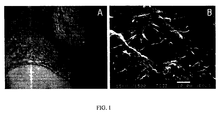
- Figures 1-4 illustrate data which confirm the efficacy and efficiency of administration of the chemically compartmentalized genetic material and cells to provide reparative osteogenesis.
- This example shows feasibility of the combination of nucleic acids, cells and scaffold, possibility of administration of the created medical product to a recipient, and also demonstrates more rapid and effective restoration of the bone integrity in a rabbit shank bone compared to the closest analogues, wherein the result of this experiment was obtained one month earlier when the new biocomposite was used.
- the complexes were prepared which include the following scaffold materials (each material in a different scaffold) and nucleic acids in the amounts indicated below:
- Different types of cells (which were obtained by different technologies) for specific scaffolds were: a culture of multipotent mesenchymal stromal cells, culture of fibroblasts, culture of periostal osteogenic cells; or fresh blood with cells, or stromal vascular cells fraction, obtained with the special apparatus (e.g., Cytori).
- the special apparatus e.g., Cytori
- Cranial defects (diameter 10 mm) of parietal bones were chosen as the model of critical size bone defects.
- the bilateral identical defects were made to every animal (rabbits).
- the biocomposites (a complex of a scaffold and a plasmid carrying a vegf-gene ), to which fresh autologous blood was added immediately before implantation into the bone defects, were implanted into the defects of right parietal bones (experimental group) while the scaffold without nucleic acids and cells (fresh blood) both (control 1), or the scaffold with the blood cells only (control 2), or the scaffold with the nucleic acids only (control 3) were used for the left side of cranium. Results were evaluated in 15, 30, 45, 60, 90 days.
- the exemplified embodiments are applicable in medical practice, especially for stimulation of reparative processes in tissue, as well as in veterinary for treatment of mammalians.
Landscapes
- Health & Medical Sciences (AREA)
- Life Sciences & Earth Sciences (AREA)
- Chemical & Material Sciences (AREA)
- Medicinal Chemistry (AREA)
- Veterinary Medicine (AREA)
- Epidemiology (AREA)
- Public Health (AREA)
- General Health & Medical Sciences (AREA)
- Animal Behavior & Ethology (AREA)
- Engineering & Computer Science (AREA)
- Dermatology (AREA)
- Transplantation (AREA)
- Oral & Maxillofacial Surgery (AREA)
- Biomedical Technology (AREA)
- Pharmacology & Pharmacy (AREA)
- Cell Biology (AREA)
- Inorganic Chemistry (AREA)
- Molecular Biology (AREA)
- Zoology (AREA)
- Biotechnology (AREA)
- Virology (AREA)
- Bioinformatics & Cheminformatics (AREA)
- Chemical Kinetics & Catalysis (AREA)
- Botany (AREA)
- Biophysics (AREA)
- Urology & Nephrology (AREA)
- Composite Materials (AREA)
- Materials Engineering (AREA)
- Biochemistry (AREA)
- Genetics & Genomics (AREA)
- Hematology (AREA)
- Developmental Biology & Embryology (AREA)
- Immunology (AREA)
- Ceramic Engineering (AREA)
- Medicines Containing Material From Animals Or Micro-Organisms (AREA)
- Micro-Organisms Or Cultivation Processes Thereof (AREA)
- Medicines That Contain Protein Lipid Enzymes And Other Medicines (AREA)
- Materials For Medical Uses (AREA)
- Medicinal Preparation (AREA)
- Polymers & Plastics (AREA)
Claims (10)
- Biocomposite comprenant :- un échafaudage,- au moins un acide nucléique situé sur ledit échafaudage, ledit au moins un acide nucléique codant pour au moins un gène choisi dans le groupe constitué du facteur de croissance endothélial vasculaire (VEGF) et du facteur-1 (SDF-1) dérivé de cellules stromales, et- des cellules qui produisent une régénération réparatrice et ont été transfectées par au moins un acide nucléique, ledit au moins un acide nucléique codant pour au moins un gène choisi dans le groupe constitué du facteur de croissance endothélial vasculaire (VEGF) et du facteur-1 (SDF-1) dérivé de cellules stromales, etledit biocomposite étant pour utilisation en tant que médicament.
- Biocomposite selon la revendication 1, pour utilisation dans un procédé de cicatrisation de lésion, ledit biocomposite étant adapté pour administration à un mammifère en ayant besoin, de préférence ledit biocomposite est adapté pour administration directe à une région de tissu endommagée dans le cadre d'une opération ou manipulation chirurgicale, ledit biocomposite étant en outre adapté de préférence pour l'administration dans une injection intramusculaire, intra-articulaire, intra-osseuse, intraveineuse, intra-artérielle, intradermique, sous-cutanée, endolombaire, sous-durale, ou endobulbaire, ledit biocomposite étant en outre adapté de préférence pour application topique.
- Biocomposite selon l'une quelconque des revendications 1 à 2, pour utilisation dans un procédé d'administration dudit au moins un acide nucléique compris dans ledit biocomposite à un mammifère en ayant besoin, ledit biocomposite étant adapté pour application audit mammifère.
- Biocomposite selon l'une quelconque des revendications 1 à 3, dans lequel:a) l'échafaudage est un matériau organique ou inorganique solide choisi dans le groupe constitué de : un produit de matrice extracellulaire, le collagène, l'hydroxyapatite, le phosphate de calcium, des protéines purifiées, une biocéramique, un bioverre, le chitosane, un matériau d'aluminate, un matériau métallique ou une combinaison de ceux-ci ; oub) l'échafaudage est au moins un liquide choisi dans le groupe constitué de : une solution de NaCl à 0,9 %, une solution de dextrane, une solution saline, une solution d'acide hyaluronique, et chondroïtine-acide sulfurique ; ouc) l'échafaudage est au moins un matériau choisi dans le groupe constitué de : un collagène, un alginate, un gel de gélatine, une solution colloïdale, une pommade, et une crème ; oud) l'échafaudage comprend au moins un matériau choisi dans le groupe constitué de : un solide, un liquide, un gel, une pommade et un matériau de crème ; oue) l'échafaudage est nanostructuré.
- Biocomposite selon l'une quelconque des revendications 1 à 4, dans lequel l'au moins un acide nucléique est un ADN qui est inclus dans une molécule de vecteur, le vecteur étant choisi dans un groupe constitué de : un plasmide, un virus, un épisome, un transposon.
- Biocomposite selon l'une quelconque des revendications 1 à 5, qui comprend des cellules autogènes et/ou allogènes.
- Biocomposite selon l'une quelconque des revendications 1 à 6, dans lequel les cellules sont dérivées d'une ou plusieurs lignées cytogénétiques.
- Biocomposite selon l'une quelconque des revendications 1 à 7, qui comprend des cellules souches, progénitrices ou différenciées, ou une combinaison de cellules diversement différenciées.
- Biocomposite selon l'une quelconque des revendications 1 à 8, dans lequel les cellules sont dérivées de mammifères immédiatement avant l'ajout des cellules au biocomposite, ou des cellules qui ont été préalablement exposées à des technologies de laboratoire de traitement cellulaire.
- Procédé de fabrication d'un biocomposite selon la revendication 1 pour l'utilisation selon la revendication 1, comprenant : la combinaison dudit au moins un acide nucléique avec ledit échafaudage, de manière à créer un complexe, et l'ajout desdites cellules transfectées au complexe créé de l'échafaudage et de l'au moins un acide nucléique.
Applications Claiming Priority (2)
| Application Number | Priority Date | Filing Date | Title |
|---|---|---|---|
| RU2011153873/15A RU2519326C2 (ru) | 2011-12-29 | 2011-12-29 | Биокомпозит для обеспечения восстановительных процессов после повреждения у млекопитающего, способ его получения (варианты) и применения |
| PCT/RU2012/001103 WO2013100818A2 (fr) | 2011-12-29 | 2012-12-24 | Biocomposite pour la régénération de tissu et d'organes lésés, kit pour préparer le biocomposite, procédé de préparation du biocomposite et procédé de traitement de lésions |
Publications (3)
| Publication Number | Publication Date |
|---|---|
| EP2797633A2 EP2797633A2 (fr) | 2014-11-05 |
| EP2797633A4 EP2797633A4 (fr) | 2015-01-14 |
| EP2797633B1 true EP2797633B1 (fr) | 2016-11-30 |
Family
ID=48698765
Family Applications (1)
| Application Number | Title | Priority Date | Filing Date |
|---|---|---|---|
| EP12861904.6A Active EP2797633B1 (fr) | 2011-12-29 | 2012-12-24 | Biocomposite pour la régénération de tissu et d'organes lésés, kit pour préparer le biocomposite, procédé de préparation du biocomposite |
Country Status (9)
| Country | Link |
|---|---|
| US (1) | US9730959B2 (fr) |
| EP (1) | EP2797633B1 (fr) |
| CN (1) | CN104203285A (fr) |
| CA (1) | CA2866483C (fr) |
| EA (1) | EA031108B1 (fr) |
| ES (1) | ES2617338T3 (fr) |
| RU (1) | RU2519326C2 (fr) |
| UA (1) | UA112450C2 (fr) |
| WO (1) | WO2013100818A2 (fr) |
Families Citing this family (13)
| Publication number | Priority date | Publication date | Assignee | Title |
|---|---|---|---|---|
| US9352003B1 (en) | 2010-05-14 | 2016-05-31 | Musculoskeletal Transplant Foundation | Tissue-derived tissuegenic implants, and methods of fabricating and using same |
| US10130736B1 (en) | 2010-05-14 | 2018-11-20 | Musculoskeletal Transplant Foundation | Tissue-derived tissuegenic implants, and methods of fabricating and using same |
| RU2597786C2 (ru) * | 2015-02-10 | 2016-09-20 | Общество с ограниченной ответственностью "НекстГен" | Способ создания персонализированного ген-активированного имплантата для регенерации костной ткани |
| ES2584107B2 (es) * | 2016-05-02 | 2017-04-06 | Universidade De Santiago De Compostela | Andamio biodegradable que comprende ARN mensajero |
| KR101710615B1 (ko) | 2016-09-07 | 2017-02-27 | 주식회사 파마리서치프로덕트 | 생착률을 증가시킨 이식용 진피층 및 이의 제조 방법 |
| RU2623171C1 (ru) * | 2016-10-07 | 2017-06-22 | Общество с ограниченной ответственностью "ГИСТОГРАФТ" | Способ получения оптимизированного твердого ген-активированного материала, способ получения твердого матрикса носителя, оптимизированный твердый ген-активированный материал для регенерации тканей |
| RU2634576C1 (ru) * | 2016-10-24 | 2017-10-31 | Федеральное государственное бюджетное научное учреждение "Томский национальный исследовательский медицинский центр Российской академии наук" (Томский НИМЦ) | Способ стимуляции регенерации тканей |
| CN106943624B (zh) * | 2017-05-08 | 2019-12-10 | 佛山今兰生物科技有限公司 | 一种具有基因调控功能的硬组织工程支架的制备方法 |
| CN109663149A (zh) * | 2017-10-17 | 2019-04-23 | 天津大学 | 非病毒类载体投递MicroRNA与骨粉的复合材料及其制备方法 |
| CN110393822A (zh) * | 2018-04-23 | 2019-11-01 | 香港賽寧生物工程技術有限公司 | 胶原蛋白-羟基磷灰石复合小分子骨材料的制备方法 |
| CN112386744B (zh) * | 2020-10-14 | 2022-04-26 | 中山大学附属第六医院 | 一种药物缓释水凝胶半嵌入式复合支架及其制备方法 |
| CN113351165B (zh) * | 2021-04-29 | 2023-04-14 | 中石化石油工程技术服务有限公司 | 矿区饮用水除氟工艺 |
| KR102814689B1 (ko) * | 2023-12-15 | 2025-05-29 | 주식회사 파마리서치 | Dna 단편 혼합물 및 다가 알코올을 포함하는 조직 수복용 생체 재료 조성물 |
Family Cites Families (19)
| Publication number | Priority date | Publication date | Assignee | Title |
|---|---|---|---|---|
| US5962427A (en) * | 1994-02-18 | 1999-10-05 | The Regent Of The University Of Michigan | In vivo gene transfer methods for wound healing |
| US20040266715A1 (en) | 1999-03-31 | 2004-12-30 | Wong Liang Fong | Neurite regeneration |
| US7022522B2 (en) * | 1998-11-13 | 2006-04-04 | Limin Guan | Macroporous polymer scaffold containing calcium phosphate particles |
| US6479064B1 (en) | 1999-12-29 | 2002-11-12 | Children's Medical Center Corporation | Culturing different cell populations on a decellularized natural biostructure for organ reconstruction |
| EP1409647A4 (fr) | 2001-04-30 | 2009-09-09 | Yissum Res Dev Co | Squelettes composites et procedes d'utilisation associes pour generer des greffes de tissus complexes |
| CA2483778A1 (fr) | 2002-04-29 | 2003-11-13 | Gel-Del Technologies, Inc. | Systemes de fixation et de confinement structurels de matrices biologiques et procedes d'utilisation de ceux-ci |
| US7211275B2 (en) * | 2004-01-16 | 2007-05-01 | Massachusetts Institute Of Technology | Composite materials for controlled release of water soluble products |
| US20050272153A1 (en) | 2004-01-27 | 2005-12-08 | Zou Xuenong | Bone tissue engineering by ex vivo stem cells ongrowth into three-dimensional trabecular metal |
| RU2297848C2 (ru) | 2005-05-11 | 2007-04-27 | Александр Веньяминович Иткес | Генно-инженерная конструкция vegf-ибмед (vegf-ibmed) |
| US20070212332A1 (en) | 2005-08-11 | 2007-09-13 | Department Of Veterans Affairs | Methods for accelerating bone repair |
| AU2006287306A1 (en) * | 2005-09-09 | 2007-03-15 | Duke University | Tissue engineering methods and compositions |
| RU2343928C1 (ru) | 2007-04-03 | 2009-01-20 | Открытое акционерное общество "Институт стволовых клеток человека" | Способ получения ядросодержащих клеток из пуповинной крови |
| JP5795166B2 (ja) | 2007-11-28 | 2015-10-14 | オルガノジェネシス インク. | 生命工学による組織コンストラクト並びに生産及び使用のための方法 |
| RU2359030C1 (ru) | 2008-03-19 | 2009-06-20 | Общество С Ограниченной Ответственностью "Лаборатория Клеточных Технологий" | Способ получения эндотелиальных клеток из эмбриональных стволовых клеток человека (варианты) |
| RU2384618C2 (ru) | 2008-03-27 | 2010-03-20 | Общество С Ограниченной Ответственностью "Лаборатория Клеточных Технологий" | Способ получения фибробластоподобных клеток из пупочного канатика новорожденного |
| RU2414916C2 (ru) | 2008-12-22 | 2011-03-27 | Российская академия наук. Учреждение Российской академии наук институт цитологии РАН (ИНЦ РАН) | Способ совмещения культивированных остеогенных клеток и трехмерного материала-носителя |
| RU2407063C2 (ru) | 2009-03-02 | 2010-12-20 | Федеральное государственное учреждение "Российский научно-исследовательский институт травматологии и ортопедии им. Р.Р.Вредена Федерального агентства по высокотехнологичной медицинской помощи" (ФГУ "РНИИТО им. Р.Р.Вредена Росмедтехнологий") | Способ моделирования злокачественных соединительнотканных опухолей (сарком) |
| RU2399667C1 (ru) | 2009-04-10 | 2010-09-20 | Общество С Ограниченной Ответственностью "Лаборатория Клеточных Технологий" | Способ получения плюрипотентных клеток |
| US20110229970A1 (en) * | 2010-03-05 | 2011-09-22 | Florida State University Research Foundation | Dual-chamber perfusion bioreactor for orthopedic tissue interfaces and methods of use |
-
2011
- 2011-12-29 RU RU2011153873/15A patent/RU2519326C2/ru active
-
2012
- 2012-12-24 WO PCT/RU2012/001103 patent/WO2013100818A2/fr not_active Ceased
- 2012-12-24 EA EA201400401A patent/EA031108B1/ru active IP Right Revival
- 2012-12-24 CN CN201280064772.0A patent/CN104203285A/zh active Pending
- 2012-12-24 UA UAA201405515A patent/UA112450C2/uk unknown
- 2012-12-24 EP EP12861904.6A patent/EP2797633B1/fr active Active
- 2012-12-24 US US14/369,008 patent/US9730959B2/en active Active
- 2012-12-24 ES ES12861904.6T patent/ES2617338T3/es active Active
- 2012-12-24 CA CA2866483A patent/CA2866483C/fr active Active
Non-Patent Citations (1)
| Title |
|---|
| None * |
Also Published As
| Publication number | Publication date |
|---|---|
| WO2013100818A3 (fr) | 2013-09-06 |
| US20140341870A1 (en) | 2014-11-20 |
| US9730959B2 (en) | 2017-08-15 |
| CN104203285A (zh) | 2014-12-10 |
| ES2617338T3 (es) | 2017-06-16 |
| RU2519326C2 (ru) | 2014-06-10 |
| WO2013100818A2 (fr) | 2013-07-04 |
| CA2866483C (fr) | 2019-01-29 |
| EP2797633A2 (fr) | 2014-11-05 |
| EA201400401A1 (ru) | 2014-07-30 |
| CA2866483A1 (fr) | 2013-07-04 |
| UA112450C2 (uk) | 2016-09-12 |
| RU2011153873A (ru) | 2013-07-10 |
| EA031108B1 (ru) | 2018-11-30 |
| EP2797633A4 (fr) | 2015-01-14 |
Similar Documents
| Publication | Publication Date | Title |
|---|---|---|
| EP2797633B1 (fr) | Biocomposite pour la régénération de tissu et d'organes lésés, kit pour préparer le biocomposite, procédé de préparation du biocomposite | |
| Hu et al. | Detachable microneedle patches deliver mesenchymal stromal cell factor-loaded nanoparticles for cardiac repair | |
| Ma et al. | Multilayer injectable hydrogel system sequentially delivers bioactive substances for each wound healing stage | |
| JP6595446B2 (ja) | 細胞移植のための足場 | |
| Gu et al. | Technological advances of 3D scaffold-based stem cell/exosome therapy in tissues and organs | |
| Boisserand et al. | Biomaterial applications in cell‐based therapy in experimental stroke | |
| Umar | Stem cell’s secretome delivery systems | |
| Wang et al. | New perspectives and prospects of microRNA delivery in diabetic wound healing | |
| Chu et al. | Research progress of gene therapy combined with tissue engineering to promote bone regeneration | |
| Wang et al. | Preparation of genetically or chemically engineered exosomes and their therapeutic effects in bone regeneration and anti-inflammation | |
| Lundy et al. | Scalable technologies in the manufacture and deployment of cell-free cardiac therapies | |
| Carnes | Tuning the Biophysical and Biochemical Cues of Fibrin Microthread Scaffolds Towards the Treatment of Volumetric Muscle Loss | |
| US12600990B2 (en) | MRNA induced expression of bone morphogenic protein and receptor and methods related thereto | |
| King | Harnessing a Platform Hydrogel Technology and Stem Cell Therapies for Cancer Treatment and Regenerative Medicine | |
| Esmaeilzadeh et al. | Free and encapsulated stem cells for skin regeneration | |
| Roy et al. | Review of the Drug Delivery Systems and Materials for Wound Healing Application | |
| Galili | Macrophages recruitment and activation by-gal nanoparticles accelerate regeneration and can improve biomaterials efficacy in tissue engineering | |
| US11992581B2 (en) | Methods of producing optimized gene-activated materials | |
| Tutar et al. | Ian Situ Tissue Engineering: A New | |
| Galili | Let us know how access to this document benefits you. | |
| Su | Design of Immunoactive Biomaterials for Therapeutic Applications | |
| Deev et al. | Efficiency of Gene-Activated Osteoplastic Material with Plasmid DNA Containing VEGF Gene for Bone Defects Healing | |
| Tabata | A new concept of biomaterials to induce tissue regeneration | |
| Krebs | Localized and Sustained Release of Plasmid DNA Or SiRNA from Biomaterial Scaffolds to Promote Osteogenesis | |
| Tabata | Delivery Technology of Growth Factors to Realize Tissue Regeneration Therapy |
Legal Events
| Date | Code | Title | Description |
|---|---|---|---|
| PUAI | Public reference made under article 153(3) epc to a published international application that has entered the european phase |
Free format text: ORIGINAL CODE: 0009012 |
|
| 17P | Request for examination filed |
Effective date: 20140729 |
|
| AK | Designated contracting states |
Kind code of ref document: A2 Designated state(s): AL AT BE BG CH CY CZ DE DK EE ES FI FR GB GR HR HU IE IS IT LI LT LU LV MC MK MT NL NO PL PT RO RS SE SI SK SM TR |
|
| A4 | Supplementary search report drawn up and despatched |
Effective date: 20141217 |
|
| RIC1 | Information provided on ipc code assigned before grant |
Ipc: A61K 48/00 20060101ALI20141211BHEP Ipc: A61K 47/48 20060101AFI20141211BHEP Ipc: C12N 15/64 20060101ALI20141211BHEP Ipc: A61K 38/18 20060101ALI20141211BHEP Ipc: A61L 27/38 20060101ALI20141211BHEP Ipc: C12N 5/0789 20100101ALI20141211BHEP Ipc: A61L 27/54 20060101ALI20141211BHEP Ipc: A61L 27/40 20060101ALI20141211BHEP |
|
| RIN1 | Information on inventor provided before grant (corrected) |
Inventor name: BOZO, IL'YA YADIGEROVICH Inventor name: KISELEV, SERGEJ L'VOVICH Inventor name: FILONENKO, ELENA SERGEEVNA Inventor name: DEEV, ROMAN VADIMOVICH Inventor name: ISAEV, ARTUR ALEKSANDROVICH |
|
| DAX | Request for extension of the european patent (deleted) | ||
| 17Q | First examination report despatched |
Effective date: 20151014 |
|
| REG | Reference to a national code |
Ref country code: DE Ref legal event code: R079 Ref document number: 602012026186 Country of ref document: DE Free format text: PREVIOUS MAIN CLASS: A61K0047480000 Ipc: A61L0027120000 |
|
| GRAP | Despatch of communication of intention to grant a patent |
Free format text: ORIGINAL CODE: EPIDOSNIGR1 |
|
| RIC1 | Information provided on ipc code assigned before grant |
Ipc: A61L 27/12 20060101AFI20160526BHEP Ipc: A61L 27/38 20060101ALI20160526BHEP Ipc: A61L 27/54 20060101ALI20160526BHEP |
|
| INTG | Intention to grant announced |
Effective date: 20160624 |
|
| GRAS | Grant fee paid |
Free format text: ORIGINAL CODE: EPIDOSNIGR3 |
|
| GRAA | (expected) grant |
Free format text: ORIGINAL CODE: 0009210 |
|
| AK | Designated contracting states |
Kind code of ref document: B1 Designated state(s): AL AT BE BG CH CY CZ DE DK EE ES FI FR GB GR HR HU IE IS IT LI LT LU LV MC MK MT NL NO PL PT RO RS SE SI SK SM TR |
|
| REG | Reference to a national code |
Ref country code: CH Ref legal event code: EP Ref country code: GB Ref legal event code: FG4D |
|
| REG | Reference to a national code |
Ref country code: AT Ref legal event code: REF Ref document number: 849200 Country of ref document: AT Kind code of ref document: T Effective date: 20161215 |
|
| REG | Reference to a national code |
Ref country code: IE Ref legal event code: FG4D |
|
| REG | Reference to a national code |
Ref country code: DE Ref legal event code: R096 Ref document number: 602012026186 Country of ref document: DE |
|
| REG | Reference to a national code |
Ref country code: FR Ref legal event code: PLFP Year of fee payment: 5 |
|
| REG | Reference to a national code |
Ref country code: SE Ref legal event code: TRGR |
|
| REG | Reference to a national code |
Ref country code: CH Ref legal event code: NV Representative=s name: TROESCH SCHEIDEGGER WERNER AG, CH |
|
| PG25 | Lapsed in a contracting state [announced via postgrant information from national office to epo] |
Ref country code: LV Free format text: LAPSE BECAUSE OF FAILURE TO SUBMIT A TRANSLATION OF THE DESCRIPTION OR TO PAY THE FEE WITHIN THE PRESCRIBED TIME-LIMIT Effective date: 20161130 |
|
| REG | Reference to a national code |
Ref country code: LT Ref legal event code: MG4D |
|
| REG | Reference to a national code |
Ref country code: NL Ref legal event code: MP Effective date: 20161130 |
|
| REG | Reference to a national code |
Ref country code: AT Ref legal event code: MK05 Ref document number: 849200 Country of ref document: AT Kind code of ref document: T Effective date: 20161130 |
|
| PG25 | Lapsed in a contracting state [announced via postgrant information from national office to epo] |
Ref country code: NO Free format text: LAPSE BECAUSE OF FAILURE TO SUBMIT A TRANSLATION OF THE DESCRIPTION OR TO PAY THE FEE WITHIN THE PRESCRIBED TIME-LIMIT Effective date: 20170228 Ref country code: LT Free format text: LAPSE BECAUSE OF FAILURE TO SUBMIT A TRANSLATION OF THE DESCRIPTION OR TO PAY THE FEE WITHIN THE PRESCRIBED TIME-LIMIT Effective date: 20161130 Ref country code: GR Free format text: LAPSE BECAUSE OF FAILURE TO SUBMIT A TRANSLATION OF THE DESCRIPTION OR TO PAY THE FEE WITHIN THE PRESCRIBED TIME-LIMIT Effective date: 20170301 |
|
| PG25 | Lapsed in a contracting state [announced via postgrant information from national office to epo] |
Ref country code: BE Free format text: LAPSE BECAUSE OF NON-PAYMENT OF DUE FEES Effective date: 20161231 Ref country code: RS Free format text: LAPSE BECAUSE OF FAILURE TO SUBMIT A TRANSLATION OF THE DESCRIPTION OR TO PAY THE FEE WITHIN THE PRESCRIBED TIME-LIMIT Effective date: 20161130 Ref country code: AT Free format text: LAPSE BECAUSE OF FAILURE TO SUBMIT A TRANSLATION OF THE DESCRIPTION OR TO PAY THE FEE WITHIN THE PRESCRIBED TIME-LIMIT Effective date: 20161130 Ref country code: FI Free format text: LAPSE BECAUSE OF FAILURE TO SUBMIT A TRANSLATION OF THE DESCRIPTION OR TO PAY THE FEE WITHIN THE PRESCRIBED TIME-LIMIT Effective date: 20161130 Ref country code: HR Free format text: LAPSE BECAUSE OF FAILURE TO SUBMIT A TRANSLATION OF THE DESCRIPTION OR TO PAY THE FEE WITHIN THE PRESCRIBED TIME-LIMIT Effective date: 20161130 Ref country code: PT Free format text: LAPSE BECAUSE OF FAILURE TO SUBMIT A TRANSLATION OF THE DESCRIPTION OR TO PAY THE FEE WITHIN THE PRESCRIBED TIME-LIMIT Effective date: 20170330 Ref country code: PL Free format text: LAPSE BECAUSE OF FAILURE TO SUBMIT A TRANSLATION OF THE DESCRIPTION OR TO PAY THE FEE WITHIN THE PRESCRIBED TIME-LIMIT Effective date: 20161130 |
|
| REG | Reference to a national code |
Ref country code: ES Ref legal event code: FG2A Ref document number: 2617338 Country of ref document: ES Kind code of ref document: T3 Effective date: 20170616 |
|
| PG25 | Lapsed in a contracting state [announced via postgrant information from national office to epo] |
Ref country code: NL Free format text: LAPSE BECAUSE OF FAILURE TO SUBMIT A TRANSLATION OF THE DESCRIPTION OR TO PAY THE FEE WITHIN THE PRESCRIBED TIME-LIMIT Effective date: 20161130 |
|
| PG25 | Lapsed in a contracting state [announced via postgrant information from national office to epo] |
Ref country code: SK Free format text: LAPSE BECAUSE OF FAILURE TO SUBMIT A TRANSLATION OF THE DESCRIPTION OR TO PAY THE FEE WITHIN THE PRESCRIBED TIME-LIMIT Effective date: 20161130 Ref country code: CZ Free format text: LAPSE BECAUSE OF FAILURE TO SUBMIT A TRANSLATION OF THE DESCRIPTION OR TO PAY THE FEE WITHIN THE PRESCRIBED TIME-LIMIT Effective date: 20161130 Ref country code: DK Free format text: LAPSE BECAUSE OF FAILURE TO SUBMIT A TRANSLATION OF THE DESCRIPTION OR TO PAY THE FEE WITHIN THE PRESCRIBED TIME-LIMIT Effective date: 20161130 Ref country code: EE Free format text: LAPSE BECAUSE OF FAILURE TO SUBMIT A TRANSLATION OF THE DESCRIPTION OR TO PAY THE FEE WITHIN THE PRESCRIBED TIME-LIMIT Effective date: 20161130 Ref country code: RO Free format text: LAPSE BECAUSE OF FAILURE TO SUBMIT A TRANSLATION OF THE DESCRIPTION OR TO PAY THE FEE WITHIN THE PRESCRIBED TIME-LIMIT Effective date: 20161130 |
|
| PG25 | Lapsed in a contracting state [announced via postgrant information from national office to epo] |
Ref country code: BE Free format text: LAPSE BECAUSE OF FAILURE TO SUBMIT A TRANSLATION OF THE DESCRIPTION OR TO PAY THE FEE WITHIN THE PRESCRIBED TIME-LIMIT Effective date: 20161130 Ref country code: SM Free format text: LAPSE BECAUSE OF FAILURE TO SUBMIT A TRANSLATION OF THE DESCRIPTION OR TO PAY THE FEE WITHIN THE PRESCRIBED TIME-LIMIT Effective date: 20161130 Ref country code: BG Free format text: LAPSE BECAUSE OF FAILURE TO SUBMIT A TRANSLATION OF THE DESCRIPTION OR TO PAY THE FEE WITHIN THE PRESCRIBED TIME-LIMIT Effective date: 20170228 |
|
| REG | Reference to a national code |
Ref country code: DE Ref legal event code: R097 Ref document number: 602012026186 Country of ref document: DE |
|
| PG25 | Lapsed in a contracting state [announced via postgrant information from national office to epo] |
Ref country code: MC Free format text: LAPSE BECAUSE OF FAILURE TO SUBMIT A TRANSLATION OF THE DESCRIPTION OR TO PAY THE FEE WITHIN THE PRESCRIBED TIME-LIMIT Effective date: 20161130 |
|
| REG | Reference to a national code |
Ref country code: IE Ref legal event code: MM4A |
|
| PLBE | No opposition filed within time limit |
Free format text: ORIGINAL CODE: 0009261 |
|
| STAA | Information on the status of an ep patent application or granted ep patent |
Free format text: STATUS: NO OPPOSITION FILED WITHIN TIME LIMIT |
|
| PG25 | Lapsed in a contracting state [announced via postgrant information from national office to epo] |
Ref country code: LU Free format text: LAPSE BECAUSE OF NON-PAYMENT OF DUE FEES Effective date: 20161224 |
|
| 26N | No opposition filed |
Effective date: 20170831 |
|
| PG25 | Lapsed in a contracting state [announced via postgrant information from national office to epo] |
Ref country code: SI Free format text: LAPSE BECAUSE OF FAILURE TO SUBMIT A TRANSLATION OF THE DESCRIPTION OR TO PAY THE FEE WITHIN THE PRESCRIBED TIME-LIMIT Effective date: 20161130 Ref country code: IE Free format text: LAPSE BECAUSE OF NON-PAYMENT OF DUE FEES Effective date: 20161224 |
|
| REG | Reference to a national code |
Ref country code: FR Ref legal event code: PLFP Year of fee payment: 6 |
|
| PG25 | Lapsed in a contracting state [announced via postgrant information from national office to epo] |
Ref country code: HU Free format text: LAPSE BECAUSE OF FAILURE TO SUBMIT A TRANSLATION OF THE DESCRIPTION OR TO PAY THE FEE WITHIN THE PRESCRIBED TIME-LIMIT; INVALID AB INITIO Effective date: 20121224 |
|
| PG25 | Lapsed in a contracting state [announced via postgrant information from national office to epo] |
Ref country code: CY Free format text: LAPSE BECAUSE OF FAILURE TO SUBMIT A TRANSLATION OF THE DESCRIPTION OR TO PAY THE FEE WITHIN THE PRESCRIBED TIME-LIMIT Effective date: 20161130 Ref country code: IS Free format text: LAPSE BECAUSE OF FAILURE TO SUBMIT A TRANSLATION OF THE DESCRIPTION OR TO PAY THE FEE WITHIN THE PRESCRIBED TIME-LIMIT Effective date: 20161130 Ref country code: MK Free format text: LAPSE BECAUSE OF FAILURE TO SUBMIT A TRANSLATION OF THE DESCRIPTION OR TO PAY THE FEE WITHIN THE PRESCRIBED TIME-LIMIT Effective date: 20161130 |
|
| PG25 | Lapsed in a contracting state [announced via postgrant information from national office to epo] |
Ref country code: MT Free format text: LAPSE BECAUSE OF NON-PAYMENT OF DUE FEES Effective date: 20161224 |
|
| PG25 | Lapsed in a contracting state [announced via postgrant information from national office to epo] |
Ref country code: TR Free format text: LAPSE BECAUSE OF FAILURE TO SUBMIT A TRANSLATION OF THE DESCRIPTION OR TO PAY THE FEE WITHIN THE PRESCRIBED TIME-LIMIT Effective date: 20161130 |
|
| PG25 | Lapsed in a contracting state [announced via postgrant information from national office to epo] |
Ref country code: AL Free format text: LAPSE BECAUSE OF FAILURE TO SUBMIT A TRANSLATION OF THE DESCRIPTION OR TO PAY THE FEE WITHIN THE PRESCRIBED TIME-LIMIT Effective date: 20161130 |
|
| PGFP | Annual fee paid to national office [announced via postgrant information from national office to epo] |
Ref country code: FR Payment date: 20250613 Year of fee payment: 14 |
|
| REG | Reference to a national code |
Ref country code: CH Ref legal event code: U11 Free format text: ST27 STATUS EVENT CODE: U-0-0-U10-U11 (AS PROVIDED BY THE NATIONAL OFFICE) Effective date: 20260101 |
|
| PGFP | Annual fee paid to national office [announced via postgrant information from national office to epo] |
Ref country code: DE Payment date: 20250616 Year of fee payment: 14 |
|
| PGFP | Annual fee paid to national office [announced via postgrant information from national office to epo] |
Ref country code: GB Payment date: 20251016 Year of fee payment: 14 |
|
| PGFP | Annual fee paid to national office [announced via postgrant information from national office to epo] |
Ref country code: SE Payment date: 20251001 Year of fee payment: 14 |
|
| PGFP | Annual fee paid to national office [announced via postgrant information from national office to epo] |
Ref country code: ES Payment date: 20260105 Year of fee payment: 14 |
|
| PGFP | Annual fee paid to national office [announced via postgrant information from national office to epo] |
Ref country code: IT Payment date: 20260128 Year of fee payment: 14 |
|
| PGFP | Annual fee paid to national office [announced via postgrant information from national office to epo] |
Ref country code: CH Payment date: 20260101 Year of fee payment: 14 |