EP2799408A1 - Panneaux muraux en plâtre renforcés par de la cellulose ioniquement réticulée - Google Patents
Panneaux muraux en plâtre renforcés par de la cellulose ioniquement réticulée Download PDFInfo
- Publication number
- EP2799408A1 EP2799408A1 EP14161230.9A EP14161230A EP2799408A1 EP 2799408 A1 EP2799408 A1 EP 2799408A1 EP 14161230 A EP14161230 A EP 14161230A EP 2799408 A1 EP2799408 A1 EP 2799408A1
- Authority
- EP
- European Patent Office
- Prior art keywords
- cationic
- cellulose
- anionic
- starch
- composite
- Prior art date
- Legal status (The legal status is an assumption and is not a legal conclusion. Google has not performed a legal analysis and makes no representation as to the accuracy of the status listed.)
- Withdrawn
Links
- 229920002678 cellulose Polymers 0.000 title claims description 34
- 239000001913 cellulose Substances 0.000 title claims description 34
- 239000010440 gypsum Substances 0.000 title abstract description 12
- 229910052602 gypsum Inorganic materials 0.000 title abstract description 12
- 229920002472 Starch Polymers 0.000 claims abstract description 87
- 235000019698 starch Nutrition 0.000 claims abstract description 87
- 125000002091 cationic group Chemical group 0.000 claims abstract description 69
- 239000008107 starch Substances 0.000 claims abstract description 64
- 239000000654 additive Substances 0.000 claims abstract description 53
- 230000000996 additive effect Effects 0.000 claims abstract description 44
- 239000002131 composite material Substances 0.000 claims abstract description 37
- 238000004132 cross linking Methods 0.000 claims abstract description 27
- 125000000129 anionic group Chemical group 0.000 claims abstract description 18
- 230000003993 interaction Effects 0.000 claims abstract description 13
- 238000011065 in-situ storage Methods 0.000 claims abstract description 5
- RTZKZFJDLAIYFH-UHFFFAOYSA-N Diethyl ether Chemical compound CCOCC RTZKZFJDLAIYFH-UHFFFAOYSA-N 0.000 claims description 40
- 229920006321 anionic cellulose Polymers 0.000 claims description 21
- 238000006467 substitution reaction Methods 0.000 claims description 16
- 229920001059 synthetic polymer Polymers 0.000 claims description 13
- 229920000642 polymer Polymers 0.000 claims description 12
- 238000005728 strengthening Methods 0.000 claims description 10
- 229920006318 anionic polymer Polymers 0.000 claims description 8
- 229920002134 Carboxymethyl cellulose Polymers 0.000 claims description 7
- 239000001768 carboxy methyl cellulose Substances 0.000 claims description 7
- 235000010948 carboxy methyl cellulose Nutrition 0.000 claims description 7
- 239000008112 carboxymethyl-cellulose Substances 0.000 claims description 7
- 150000001412 amines Chemical class 0.000 claims description 6
- 239000012074 organic phase Substances 0.000 claims description 4
- 125000002887 hydroxy group Chemical group [H]O* 0.000 claims description 3
- 239000012071 phase Substances 0.000 claims description 3
- 229920003086 cellulose ether Polymers 0.000 abstract description 11
- 230000002708 enhancing effect Effects 0.000 abstract description 8
- 239000013078 crystal Substances 0.000 abstract description 6
- 235000002017 Zea mays subsp mays Nutrition 0.000 description 31
- 241000482268 Zea mays subsp. mays Species 0.000 description 28
- 239000000203 mixture Substances 0.000 description 25
- XLYOFNOQVPJJNP-UHFFFAOYSA-N water Substances O XLYOFNOQVPJJNP-UHFFFAOYSA-N 0.000 description 23
- HEMHJVSKTPXQMS-UHFFFAOYSA-M Sodium hydroxide Chemical compound [OH-].[Na+] HEMHJVSKTPXQMS-UHFFFAOYSA-M 0.000 description 21
- 239000000243 solution Substances 0.000 description 16
- 229920006320 anionic starch Polymers 0.000 description 15
- 239000007787 solid Substances 0.000 description 13
- VEXZGXHMUGYJMC-UHFFFAOYSA-N Hydrochloric acid Chemical compound Cl VEXZGXHMUGYJMC-UHFFFAOYSA-N 0.000 description 12
- 238000006243 chemical reaction Methods 0.000 description 10
- 239000008187 granular material Substances 0.000 description 9
- 238000000034 method Methods 0.000 description 9
- 230000002195 synergetic effect Effects 0.000 description 9
- LFQSCWFLJHTTHZ-UHFFFAOYSA-N Ethanol Chemical compound CCO LFQSCWFLJHTTHZ-UHFFFAOYSA-N 0.000 description 8
- 239000007864 aqueous solution Substances 0.000 description 8
- 239000002002 slurry Substances 0.000 description 8
- OKKJLVBELUTLKV-UHFFFAOYSA-N Methanol Chemical compound OC OKKJLVBELUTLKV-UHFFFAOYSA-N 0.000 description 6
- 230000001965 increasing effect Effects 0.000 description 6
- 229920000728 polyester Polymers 0.000 description 6
- 238000002360 preparation method Methods 0.000 description 6
- 239000000047 product Substances 0.000 description 6
- SQGYOTSLMSWVJD-UHFFFAOYSA-N silver(1+) nitrate Chemical compound [Ag+].[O-]N(=O)=O SQGYOTSLMSWVJD-UHFFFAOYSA-N 0.000 description 6
- 238000004090 dissolution Methods 0.000 description 5
- 150000004676 glycans Chemical class 0.000 description 5
- 230000014759 maintenance of location Effects 0.000 description 5
- 230000005012 migration Effects 0.000 description 5
- 238000013508 migration Methods 0.000 description 5
- 229920001282 polysaccharide Polymers 0.000 description 5
- 239000005017 polysaccharide Substances 0.000 description 5
- 230000004044 response Effects 0.000 description 5
- 229920000856 Amylose Polymers 0.000 description 4
- IJGRMHOSHXDMSA-UHFFFAOYSA-N Atomic nitrogen Chemical compound N#N IJGRMHOSHXDMSA-UHFFFAOYSA-N 0.000 description 4
- FAPWRFPIFSIZLT-UHFFFAOYSA-M Sodium chloride Chemical compound [Na+].[Cl-] FAPWRFPIFSIZLT-UHFFFAOYSA-M 0.000 description 4
- 125000000218 acetic acid group Chemical group C(C)(=O)* 0.000 description 4
- 230000000295 complement effect Effects 0.000 description 4
- -1 poly(styrene sulfonate) Polymers 0.000 description 4
- GHCVXTFBVDVFGE-UHFFFAOYSA-N 4-amino-6-chloro-1,3,5-triazin-2-ol Chemical compound NC1=NC(O)=NC(Cl)=N1 GHCVXTFBVDVFGE-UHFFFAOYSA-N 0.000 description 3
- 229920002261 Corn starch Polymers 0.000 description 3
- KFZMGEQAYNKOFK-UHFFFAOYSA-N Isopropanol Chemical compound CC(C)O KFZMGEQAYNKOFK-UHFFFAOYSA-N 0.000 description 3
- 229920000881 Modified starch Polymers 0.000 description 3
- 239000004368 Modified starch Substances 0.000 description 3
- 240000008042 Zea mays Species 0.000 description 3
- 235000016383 Zea mays subsp huehuetenangensis Nutrition 0.000 description 3
- 125000004063 butyryl group Chemical group O=C([*])C([H])([H])C([H])([H])C([H])([H])[H] 0.000 description 3
- 125000002057 carboxymethyl group Chemical group [H]OC(=O)C([H])([H])[*] 0.000 description 3
- 238000001816 cooling Methods 0.000 description 3
- 239000008120 corn starch Substances 0.000 description 3
- 230000007423 decrease Effects 0.000 description 3
- 238000001035 drying Methods 0.000 description 3
- 229940034040 ethanol / isopropyl alcohol Drugs 0.000 description 3
- 239000000706 filtrate Substances 0.000 description 3
- XMBWDFGMSWQBCA-UHFFFAOYSA-N hydrogen iodide Chemical compound I XMBWDFGMSWQBCA-UHFFFAOYSA-N 0.000 description 3
- 230000006872 improvement Effects 0.000 description 3
- 235000009973 maize Nutrition 0.000 description 3
- 238000002156 mixing Methods 0.000 description 3
- 229910001961 silver nitrate Inorganic materials 0.000 description 3
- 238000003756 stirring Methods 0.000 description 3
- 239000000725 suspension Substances 0.000 description 3
- VEXZGXHMUGYJMC-UHFFFAOYSA-M Chloride anion Chemical compound [Cl-] VEXZGXHMUGYJMC-UHFFFAOYSA-M 0.000 description 2
- 239000004971 Cross linker Substances 0.000 description 2
- 229920001612 Hydroxyethyl starch Polymers 0.000 description 2
- 229910000831 Steel Inorganic materials 0.000 description 2
- 230000008901 benefit Effects 0.000 description 2
- 238000000576 coating method Methods 0.000 description 2
- 229920006037 cross link polymer Polymers 0.000 description 2
- 238000009826 distribution Methods 0.000 description 2
- 238000001704 evaporation Methods 0.000 description 2
- 230000008020 evaporation Effects 0.000 description 2
- 238000004817 gas chromatography Methods 0.000 description 2
- 229940071870 hydroiodic acid Drugs 0.000 description 2
- 239000001341 hydroxy propyl starch Substances 0.000 description 2
- 229940050526 hydroxyethylstarch Drugs 0.000 description 2
- 235000013828 hydroxypropyl starch Nutrition 0.000 description 2
- HVTICUPFWKNHNG-UHFFFAOYSA-N iodoethane Chemical compound CCI HVTICUPFWKNHNG-UHFFFAOYSA-N 0.000 description 2
- 238000004519 manufacturing process Methods 0.000 description 2
- 239000000463 material Substances 0.000 description 2
- 239000011159 matrix material Substances 0.000 description 2
- 229910052757 nitrogen Inorganic materials 0.000 description 2
- 239000003960 organic solvent Substances 0.000 description 2
- 230000000717 retained effect Effects 0.000 description 2
- 239000011780 sodium chloride Substances 0.000 description 2
- 238000010561 standard procedure Methods 0.000 description 2
- 239000010959 steel Substances 0.000 description 2
- 239000000126 substance Substances 0.000 description 2
- 125000001424 substituent group Chemical group 0.000 description 2
- PUVAFTRIIUSGLK-UHFFFAOYSA-M trimethyl(oxiran-2-ylmethyl)azanium;chloride Chemical compound [Cl-].C[N+](C)(C)CC1CO1 PUVAFTRIIUSGLK-UHFFFAOYSA-M 0.000 description 2
- 241000196324 Embryophyta Species 0.000 description 1
- IAYPIBMASNFSPL-UHFFFAOYSA-N Ethylene oxide Chemical compound C1CO1 IAYPIBMASNFSPL-UHFFFAOYSA-N 0.000 description 1
- 229920001732 Lignosulfonate Polymers 0.000 description 1
- 102220630102 Myogenic factor 5_C68F_mutation Human genes 0.000 description 1
- GOOHAUXETOMSMM-UHFFFAOYSA-N Propylene oxide Chemical compound CC1CO1 GOOHAUXETOMSMM-UHFFFAOYSA-N 0.000 description 1
- 229920001131 Pulp (paper) Polymers 0.000 description 1
- 239000002253 acid Substances 0.000 description 1
- 125000005605 benzo group Chemical group 0.000 description 1
- 239000011230 binding agent Substances 0.000 description 1
- 150000007942 carboxylates Chemical class 0.000 description 1
- FOCAUTSVDIKZOP-UHFFFAOYSA-N chloroacetic acid Chemical compound OC(=O)CCl FOCAUTSVDIKZOP-UHFFFAOYSA-N 0.000 description 1
- 239000000356 contaminant Substances 0.000 description 1
- 238000010411 cooking Methods 0.000 description 1
- 239000003431 cross linking reagent Substances 0.000 description 1
- 230000001419 dependent effect Effects 0.000 description 1
- 239000002270 dispersing agent Substances 0.000 description 1
- 239000006185 dispersion Substances 0.000 description 1
- 230000000694 effects Effects 0.000 description 1
- 239000000839 emulsion Substances 0.000 description 1
- 150000002170 ethers Chemical class 0.000 description 1
- 239000008394 flocculating agent Substances 0.000 description 1
- 238000009472 formulation Methods 0.000 description 1
- 238000001879 gelation Methods 0.000 description 1
- 238000010438 heat treatment Methods 0.000 description 1
- 229920006158 high molecular weight polymer Polymers 0.000 description 1
- 230000002209 hydrophobic effect Effects 0.000 description 1
- 230000009878 intermolecular interaction Effects 0.000 description 1
- 230000008863 intramolecular interaction Effects 0.000 description 1
- FMKOJHQHASLBPH-UHFFFAOYSA-N isopropyl iodide Chemical compound CC(C)I FMKOJHQHASLBPH-UHFFFAOYSA-N 0.000 description 1
- 238000005259 measurement Methods 0.000 description 1
- 239000010813 municipal solid waste Substances 0.000 description 1
- 239000002245 particle Substances 0.000 description 1
- 125000002467 phosphate group Chemical group [H]OP(=O)(O[H])O[*] 0.000 description 1
- 229920001467 poly(styrenesulfonates) Polymers 0.000 description 1
- 239000002244 precipitate Substances 0.000 description 1
- 230000008569 process Effects 0.000 description 1
- 238000012545 processing Methods 0.000 description 1
- 230000002787 reinforcement Effects 0.000 description 1
- 230000003014 reinforcing effect Effects 0.000 description 1
- 238000004513 sizing Methods 0.000 description 1
- FDRCDNZGSXJAFP-UHFFFAOYSA-M sodium chloroacetate Chemical compound [Na+].[O-]C(=O)CCl FDRCDNZGSXJAFP-UHFFFAOYSA-M 0.000 description 1
- 239000003381 stabilizer Substances 0.000 description 1
- 239000007858 starting material Substances 0.000 description 1
- 230000008961 swelling Effects 0.000 description 1
- 230000009044 synergistic interaction Effects 0.000 description 1
- 239000004753 textile Substances 0.000 description 1
- 239000002562 thickening agent Substances 0.000 description 1
Images

Classifications
-
- C—CHEMISTRY; METALLURGY
- C04—CEMENTS; CONCRETE; ARTIFICIAL STONE; CERAMICS; REFRACTORIES
- C04B—LIME, MAGNESIA; SLAG; CEMENTS; COMPOSITIONS THEREOF, e.g. MORTARS, CONCRETE OR LIKE BUILDING MATERIALS; ARTIFICIAL STONE; CERAMICS; REFRACTORIES; TREATMENT OF NATURAL STONE
- C04B24/00—Use of organic materials as active ingredients for mortars, concrete or artificial stone, e.g. plasticisers
- C04B24/24—Macromolecular compounds
- C04B24/38—Polysaccharides or derivatives thereof
- C04B24/383—Cellulose or derivatives thereof
-
- C—CHEMISTRY; METALLURGY
- C08—ORGANIC MACROMOLECULAR COMPOUNDS; THEIR PREPARATION OR CHEMICAL WORKING-UP; COMPOSITIONS BASED THEREON
- C08B—POLYSACCHARIDES; DERIVATIVES THEREOF
- C08B11/00—Preparation of cellulose ethers
- C08B11/02—Alkyl or cycloalkyl ethers
- C08B11/04—Alkyl or cycloalkyl ethers with substituted hydrocarbon radicals
- C08B11/10—Alkyl or cycloalkyl ethers with substituted hydrocarbon radicals substituted with acid radicals
- C08B11/12—Alkyl or cycloalkyl ethers with substituted hydrocarbon radicals substituted with acid radicals substituted with carboxylic radicals, e.g. carboxymethylcellulose [CMC]
-
- C—CHEMISTRY; METALLURGY
- C08—ORGANIC MACROMOLECULAR COMPOUNDS; THEIR PREPARATION OR CHEMICAL WORKING-UP; COMPOSITIONS BASED THEREON
- C08B—POLYSACCHARIDES; DERIVATIVES THEREOF
- C08B11/00—Preparation of cellulose ethers
- C08B11/02—Alkyl or cycloalkyl ethers
- C08B11/04—Alkyl or cycloalkyl ethers with substituted hydrocarbon radicals
- C08B11/14—Alkyl or cycloalkyl ethers with substituted hydrocarbon radicals with nitrogen-containing groups
-
- C—CHEMISTRY; METALLURGY
- C08—ORGANIC MACROMOLECULAR COMPOUNDS; THEIR PREPARATION OR CHEMICAL WORKING-UP; COMPOSITIONS BASED THEREON
- C08L—COMPOSITIONS OF MACROMOLECULAR COMPOUNDS
- C08L1/00—Compositions of cellulose, modified cellulose or cellulose derivatives
- C08L1/08—Cellulose derivatives
- C08L1/26—Cellulose ethers
- C08L1/28—Alkyl ethers
- C08L1/286—Alkyl ethers substituted with acid radicals, e.g. carboxymethyl cellulose [CMC]
-
- C—CHEMISTRY; METALLURGY
- C08—ORGANIC MACROMOLECULAR COMPOUNDS; THEIR PREPARATION OR CHEMICAL WORKING-UP; COMPOSITIONS BASED THEREON
- C08L—COMPOSITIONS OF MACROMOLECULAR COMPOUNDS
- C08L1/00—Compositions of cellulose, modified cellulose or cellulose derivatives
- C08L1/08—Cellulose derivatives
- C08L1/26—Cellulose ethers
- C08L1/28—Alkyl ethers
- C08L1/288—Alkyl ethers substituted with nitrogen-containing radicals
-
- C—CHEMISTRY; METALLURGY
- C09—DYES; PAINTS; POLISHES; NATURAL RESINS; ADHESIVES; COMPOSITIONS NOT OTHERWISE PROVIDED FOR; APPLICATIONS OF MATERIALS NOT OTHERWISE PROVIDED FOR
- C09J—ADHESIVES; NON-MECHANICAL ASPECTS OF ADHESIVE PROCESSES IN GENERAL; ADHESIVE PROCESSES NOT PROVIDED FOR ELSEWHERE; USE OF MATERIALS AS ADHESIVES
- C09J101/00—Adhesives based on cellulose, modified cellulose, or cellulose derivatives
- C09J101/08—Cellulose derivatives
- C09J101/26—Cellulose ethers
- C09J101/28—Alkyl ethers
- C09J101/286—Alkyl ethers substituted with acid radicals
-
- C—CHEMISTRY; METALLURGY
- C09—DYES; PAINTS; POLISHES; NATURAL RESINS; ADHESIVES; COMPOSITIONS NOT OTHERWISE PROVIDED FOR; APPLICATIONS OF MATERIALS NOT OTHERWISE PROVIDED FOR
- C09J—ADHESIVES; NON-MECHANICAL ASPECTS OF ADHESIVE PROCESSES IN GENERAL; ADHESIVE PROCESSES NOT PROVIDED FOR ELSEWHERE; USE OF MATERIALS AS ADHESIVES
- C09J101/00—Adhesives based on cellulose, modified cellulose, or cellulose derivatives
- C09J101/08—Cellulose derivatives
- C09J101/26—Cellulose ethers
- C09J101/28—Alkyl ethers
- C09J101/288—Alkyl ethers substituted with nitrogen containing radicals
-
- C—CHEMISTRY; METALLURGY
- C08—ORGANIC MACROMOLECULAR COMPOUNDS; THEIR PREPARATION OR CHEMICAL WORKING-UP; COMPOSITIONS BASED THEREON
- C08K—Use of inorganic or non-macromolecular organic substances as compounding ingredients
- C08K3/00—Use of inorganic substances as compounding ingredients
- C08K3/30—Sulfur-, selenium- or tellurium-containing compounds
-
- C—CHEMISTRY; METALLURGY
- C08—ORGANIC MACROMOLECULAR COMPOUNDS; THEIR PREPARATION OR CHEMICAL WORKING-UP; COMPOSITIONS BASED THEREON
- C08L—COMPOSITIONS OF MACROMOLECULAR COMPOUNDS
- C08L2205/00—Polymer mixtures characterised by other features
- C08L2205/02—Polymer mixtures characterised by other features containing two or more polymers of the same C08L -group
Definitions
- the field of the invention is polymer chemistry, more specifically, polymer chemistry for additives to improve the properties of compositions of matter for use in forming composite articles of manufacture, coatings and materials.
- Cationic starches are traditionally used on the wet end of paper manufacturing to increase wet strength and bind anionic "trash" in the wood pulp.
- Anionic and amphoteric starches are also used in paper formulations and at the size press of paper-making to improve finish and dry strength.
- Amphoteric starches contain both cationic and anionic substituents.
- Charged starches are also used as flocculants in water treatment plants to remove contaminants.
- the cationic groups on charged starches are commonly quaternary amines and the anionic substituents are usually carboxylate or phosphate groups.
- Carboxymethyl cellulose an anionic cellulose derivative, is the most commonly used cellulose ether. It is mainly used as a thickener, but it is also used as an emulsion stabilizer, and textile warp sizing.
- Ionic interactions between a strength enhancing additive and a crosslinking additive provide a stable binding agent that substantially increases the toughness and strength of composites, coatings and other materials.
- ionic interactions limit the crosslinked strength enhancing additive to the surface of a wallboard core that is transformed during insitu crosslinking.
- a network of polymer and inorganic crystals is formed that synergistically increases the nail pull resistance and strength of a composition of matter formed by mixing an inorganic phase, the strength enhancing additive and the crosslinking additive with water. It is thought, without limiting in anyway, that hydrophobic and hydrophilic substituent groups may be selected to provide chemical affinity for gypsum crystals, for example.
- the additives disperse substantially throughout the composite by dissolution and are retained within composite by the ionic interactions, which prevents excessive migration to the surfaces of the composite.
- cationic cellulose can be produced by substituting some of the hydroxyl groups along the polymer backbone with cationic substituents, such as those containing quaternary amines.
- the cationic cellulose can be used with an ionic crosslinking additive to form a crosslinked polymer network in the same way as cationic starches described herein.
- cationic starches can be used to impart strength improvement to gypsum composites.
- the amount of improvement is dependent on the molecular weight, and thus viscosity, as well as the degree of substitution of the starch.
- Un-thinned cationic starches are too viscous to diffuse out of the granule during heating and thus remain as discrete particles in the inorganic matrix.
- Acid-thinning decreases viscosity, allowing the starch to disperse throughout the gypsum core and increasing the nail pull resistance of the composite.
- the cationic nature of the starch results in greater improvement than with an acid-modified starch of similar viscosity. This can be attributed to greater interaction with the polar surface of the gypsum crystals.
- Strength enhancement is improved by including an anionic polymer that interacts with the acid-thinned cationic starch to form a network of ionic cross-links that binds the starch in the core.
- a cationic starch with an anionic cross-linker provides a unique method of obtaining strength-enhancing starch distribution and retention in the gypsum core while maintaining low slurry viscosity.
- the starch granules remain un-dissolved during mixing because of their cold water insolubility.
- the temperature of the stucco slurry in wallboard plants varies, but is often warmer than 100 F.
- the starch must therefore have limited or no solubility at this temperature. This is accomplished with a cationic starch by limiting the degree of substitution (DS). For example, one embodiment has a degree of substitution selected in a range less than 3 wt%.
- the starch granules swell and burst, releasing starch into solution.
- Granule swelling is increased by electrostatic repulsion of the cationic groups of the starch and granule rupture is facilitated by the stress of the gypsum crystals on the swollen granules, such as during a forming process.
- the molecules in solution natturally diffuse to water devoid of starch, resulting in distribution of starch substantially throughout the composite.
- the anionic crosslinking additive which could be an anionic starch, the two additives interact to give a synergistic increase in viscosity.
- the high viscosity of the ionically cross-linked polymer system prevents further migration of the starch, such as during evaporation of the water, and improves starch retention in the composite.
- the cationic starch solution precipitates during evaporation of the water, producing a reinforcing film over the gypsum crystals. If the DS of the cationic starch is too low, the starch is likely to retrograde. Retrogradation, or re-association of starch molecules, reduces film strength and negatively affects strength-enhancement. Therefore, the DS of cationic starches for composites should be at least 0.3 wt%.
- the cationic starch have a peak viscosity of between 100 and 10,000 cps for 20 wt% solids at 195 F and a DS of between 0.3 and 3 wt%. More preferably, it has a peak viscosity of between 1,000 and 3,000 cps for 20 wt% solids at 195 F and a DS from 1.5 to 2.5 wt%.
- Viscosity measurements were used to analyze the interaction between cationic starches and anionic crosslinking additives, including anionic starches.
- a rapid viscoanalysis (RVA) technique was used to determine starch viscosity response to cooking and subsequent cooling. The procedure begins by adding a cool (25C) chamber of starch to a rheometer with a hot water jacket (90C). The temperature of the chamber rises quickly to 90C and is held at 90C for 8 minutes and then cooled to 50C over the next 4 minutes and held at 50C for an additional 10 minutes.
- the rheometer used was a Brookfield DVII+ Pro with spindle #SC4-21 and a TC-112P water bath.
- a general response of starches to this type of temperature profile is low initial viscosity for the insoluble starch dispersion, increase to peak viscosity at the gel temperature of the starch as granules swell, decrease to trough viscosity as granules burst and starch enters solution, and increase to final viscosity as the solution is cooled.
- Starch granules in a gypsum matrix follow a similar temperature profile as the composite is dried. Although there is no cooling stage during drying, the final viscosity indicates the behavior of the starch as intra-molecular interactions increase, as when concentration increases as the composite dries. Thus, both cooling and drying lead to similar increases in the synergestic viscosity of the additives.
- the viscosity profiles and values for cationic starches and anionic starches and polymers were measured individually and compared to various combinations to determine the level of ionic association.
- a blend of two polymers in solution that have no interaction has a viscosity that follows a logarithmic rule of mixtures. This allows the calculation of the theoretical viscosity of a blend of starches if there was no association.
- the increase of the measured viscosity of a combination of cationic and anionic starch over the theoretical viscosity indicates the degree of interaction between the two.
- This technique can be used to determine the DS, viscosity, and ratio of starches for which there is maximum interaction.
- a commercially available cationic starch, Cato 2A from National Starch and Chemical Co was acid-thinned for two hours.
- Wescote 3050 an anionic starch from Western Polymer Co, was also acid-thinned for two hours.
- Cationic starches can be combined with anionic starches or anionic cellulose ethers to improve gypsum composite strength.
- Certain anionic synthetic polymers also show interaction with cationic starches and can be used to improve retention in the core.
- High molecular weight polymers with a high concentration of anionic groups associate most strongly with cationic starches because of more opportunities for interaction per polymer chain. For example, I million molecular weight (MW) poly(styrene sulfonate) increases the viscosity of cationic starches at low additive levels.
- lignin sulfonates which are commonly used in gypsum wallboard as dispersants, give no synergistic viscosity rise with cationic starches even at higher concentrations.
- anionic starches include no increase in slurry viscosity and no migration prior to starch dissolution. Similar properties may be achieved using anionic cellulose ether, such as carboxymethyl cellulose, by using an anionic cellulose ether with a DS that is low enough to prevent dissolution in cold water.
- Cold water means water at a processing temperature less than the temperature of the composition when it is heated, such as during setting or drying, for example.
- Cationic cellulose ether may be used in some cases in place of cationic starch as a strength enhancing additive.
- Cellulose ethers may impart higher tensile strength and toughness than cationic substituted starches.
- the cationic cellulose may be used in combination with an anionic cellulose, anionic starch, or synthetic anionic polymer to ionically cross-link it.
- the preferred cationic cellulose ether of the invention has a low enough DS to make it cold water insoluble but is soluble at higher temperatures.
- Cold water soluble charged cellulose ethers may also be used but may increase the viscosity of the slurry.
- a low molecular weight charged cellulose ether and a complementary cold water insoluble charged cellulose ether may be used to prevent migration without significantly increasing slurry viscosity.
- complimentary refers to ionic-cationic or cationic-anionic complementary charges.
- complementary charged polysaccharides or a charged polysaccharide with a complementary charged synthetic polymer may be used to improve strength enhancement and retention in the core.
- Examples include but are not limited to: cationic cellulose ether with anionic cellulose ether; cationic starch with anionic starch; cationic starch with anionic cellulose ether; cationic cellulose ether with anionic starch; anionic cellulose ether with cationic synthetic polymer; cationic cellulose ether with anionic synthetic polymer; anionic starch with cationic synthetic polymer; and cationic starch with anionic synthetic polymer.
- a cationic synthetic polymer may be added with other anionic synthetic polymers to improve the strength enhancement and retention in the core, so long as the specific polymers are selected to be retained in the wallboard core.
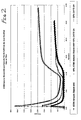
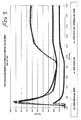
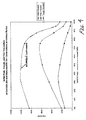
- Figures 1-4 show the synergistic effect of adding an anionic substituted starch and a cationic, acid-modified starch on the measured viscosity of slurry including water and 20 wt% solids (combination of the two additives). It is believed, without limiting the invention, that the synergistic increase in viscosity is associated with a decrease in migration of the substituted starch, such that the substituted starch is dispersed substantially throughout the composite. Thus, the substituted starch substantially strengthens the composite.
- Figs. 1-3 are RVA plots showing the synergistic interaction between cationic and anionic starches. In each chart, the mixture is compared to each starch alone. The total solids in each run is 20%.
- Fig. 4 shows synergy of CATO2A and Wescote 3050 for increasing CATO2A polymer percent addition.
- the amount of crosslinking additive is no greater than 30 wt% of the total weight of both the strengthening additive and crosslinking additive.
- the degree of substitution of the strength enhancing additive is selected in a range from 0.5-3 wt%, which prevents dissolution of the strength enhancing additive during mixing in cold water, but provides sufficient charged substituent groups to ionically crosslink with the crosslinking agent.
- the range selected depends on several factors, including the ratio of crosslinking additive to strength enhancing additive.
- Acid-thinned dent corn starch (10% w/w) was dispersed in an aqueous solution of isopropyl alcohol (7% by weight). While the mixture was vigorously stirred at room temperature, 3 parts of sodium hydroxide and 5 parts of sodium monochloroacetate were added. The temperature of the mixture was then raised to 40°C and stirred at that temperature for 3 hours. The resulting carboxymethyl starch was filtered and washed several times with 85% ethanol until the filtrate gave a negative response to silver nitrate solution. The obtained starch was then dried in an oven overnight at 40°C.
- a 2 L steel reactor was charged with 100 parts acid-thinned dent corn starch, 1.5 parts sodium hydroxide, 3 parts sodium chloride, and 500 parts of water. The reactor was sealed and then flushed several times with nitrogen. The mixture was vigorously stirred at room temperature for 20 minutes. The reactor was then charged with 3 parts propylene oxide, and the resulting mixture was then heated at 50°C for 4 hours. Following the desired amount of time, the mixture was cooled to 30°C and stirred at that temperature for 19 hours. The slurry was then neutralized with 37% by weight hydrochloric acid. The white solid was washed with water followed by an additional wash of an aqueous solution of methanol. The solid was then filtered and dried at 50°C for 12 hours.
- the hydroxypropyl substitution content was determined according to the method of ASTM D 3876-96 (2001).
- the hydroxypropyl starch was dried in an oven to remove residual moisture and then treated with an aqueous solution of hydroiodic acid, liberating ispropyl iodide.
- the isopropyl iodide was extracted in situ with an organic solvent and quantitated by gas chromatography using an internal standard technique.
- Table 2 shows the results for the products obtained according to the procedure outlined above. Table 2 Samples Substitution % DS Reaction 1 2.30% 0.063 Reaction 2 2.34% 0.064 Reaction 3 2.33% 0.064 Reaction 4 2.39% 0.066 Reaction 5 2.20% 0.060
- a 2 L steel reactor was charged with 100 parts starch, 1.5 parts sodium hydroxide, 3 parts sodium chloride, and 500 parts of water. The reactor was sealed and then flushed several times with nitrogen. The mixture was vigorously stirred at room temperature for 20 minutes. The head space was evacuated and the stirrer turned off. The head space was pressurized with 20 psi of ethylene oxide after which the stirrer was turned on, and the resulting mixture was then heated at 50°C for 3.5 hours. Following the desired amount of time, the mixture was cooled to 30°C and stirred at that temperature for 19 hours. The slurry was then neutralized with 37% by weight hydrochloric acid. The white solid was washed with water followed by an additional wash of an aqueous solution of methanol. The solid was then filtered and dried at 50°C for 12 hours.
- the hydroxypropyl substitution content was determined according to the method of ASTM D 4794-94 (1998).
- the hydroxyethyl starch was dried in an oven to remove residual moisture and then treated with an aqueous solution of hydroiodic acid, liberating iodoethane.
- the iodoethane was extracted in situ with an organic solvent and quantitated by gas chromatography using an internal standard technique.
- Table 3 shows the results for the products obtained according to the procedure outlined above.
- Table 3 Samples Substitution % DS Reaction 1 2.60% 0.096 Reaction 2 2.97% 0.110 Reaction 3 2.73% 0.100
- Table 4 Summary of ICBM Substituted Starches ICBM Starting Material Substitution Conc.
Landscapes
- Chemical & Material Sciences (AREA)
- Organic Chemistry (AREA)
- Health & Medical Sciences (AREA)
- Engineering & Computer Science (AREA)
- Polymers & Plastics (AREA)
- Medicinal Chemistry (AREA)
- Chemical Kinetics & Catalysis (AREA)
- Materials Engineering (AREA)
- Biochemistry (AREA)
- Life Sciences & Earth Sciences (AREA)
- Ceramic Engineering (AREA)
- Structural Engineering (AREA)
- Compositions Of Macromolecular Compounds (AREA)
- Polysaccharides And Polysaccharide Derivatives (AREA)
- Curing Cements, Concrete, And Artificial Stone (AREA)
Applications Claiming Priority (3)
| Application Number | Priority Date | Filing Date | Title |
|---|---|---|---|
| US60349104P | 2004-08-20 | 2004-08-20 | |
| US10/952,123 US7101426B2 (en) | 2004-08-20 | 2004-09-27 | Inorganic matrix composite reinforced by ionically crosslinked polymer |
| EP05787880.3A EP1786863B1 (fr) | 2004-08-20 | 2005-08-19 | panneaux en plâtre renforcés par des amidons réticulés ioniquement |
Related Parent Applications (2)
| Application Number | Title | Priority Date | Filing Date |
|---|---|---|---|
| EP05787880.3A Division-Into EP1786863B1 (fr) | 2004-08-20 | 2005-08-19 | panneaux en plâtre renforcés par des amidons réticulés ioniquement |
| EP05787880.3A Division EP1786863B1 (fr) | 2004-08-20 | 2005-08-19 | panneaux en plâtre renforcés par des amidons réticulés ioniquement |
Publications (1)
| Publication Number | Publication Date |
|---|---|
| EP2799408A1 true EP2799408A1 (fr) | 2014-11-05 |
Family
ID=35908459
Family Applications (2)
| Application Number | Title | Priority Date | Filing Date |
|---|---|---|---|
| EP14161230.9A Withdrawn EP2799408A1 (fr) | 2004-08-20 | 2005-08-19 | Panneaux muraux en plâtre renforcés par de la cellulose ioniquement réticulée |
| EP05787880.3A Expired - Lifetime EP1786863B1 (fr) | 2004-08-20 | 2005-08-19 | panneaux en plâtre renforcés par des amidons réticulés ioniquement |
Family Applications After (1)
| Application Number | Title | Priority Date | Filing Date |
|---|---|---|---|
| EP05787880.3A Expired - Lifetime EP1786863B1 (fr) | 2004-08-20 | 2005-08-19 | panneaux en plâtre renforcés par des amidons réticulés ioniquement |
Country Status (13)
| Country | Link |
|---|---|
| US (1) | US7101426B2 (fr) |
| EP (2) | EP2799408A1 (fr) |
| JP (1) | JP5026972B2 (fr) |
| CA (1) | CA2570129C (fr) |
| DK (1) | DK1786863T3 (fr) |
| ES (1) | ES2491191T3 (fr) |
| HR (1) | HRP20140762T1 (fr) |
| MX (1) | MX2007002039A (fr) |
| PL (1) | PL1786863T3 (fr) |
| PT (1) | PT1786863E (fr) |
| RS (1) | RS53488B1 (fr) |
| SI (1) | SI1786863T1 (fr) |
| WO (1) | WO2006023825A1 (fr) |
Families Citing this family (21)
| Publication number | Priority date | Publication date | Assignee | Title |
|---|---|---|---|---|
| EP3002264B1 (fr) | 2003-12-10 | 2020-06-17 | Saint-Gobain Placo | Composite organique-inorganique |
| US11338548B2 (en) | 2005-06-09 | 2022-05-24 | United States Gypsum Company | Light weight gypsum board |
| US9840066B2 (en) | 2005-06-09 | 2017-12-12 | United States Gypsum Company | Light weight gypsum board |
| US7731794B2 (en) | 2005-06-09 | 2010-06-08 | United States Gypsum Company | High starch light weight gypsum wallboard |
| US11306028B2 (en) | 2005-06-09 | 2022-04-19 | United States Gypsum Company | Light weight gypsum board |
| USRE44070E1 (en) | 2005-06-09 | 2013-03-12 | United States Gypsum Company | Composite light weight gypsum wallboard |
| US9802866B2 (en) | 2005-06-09 | 2017-10-31 | United States Gypsum Company | Light weight gypsum board |
| US20080070026A1 (en) * | 2005-06-09 | 2008-03-20 | United States Gypsum Company | High hydroxyethylated starch and high dispersant levels in gypsum wallboard |
| DE102005037777A1 (de) * | 2005-08-10 | 2007-02-15 | Construction Research & Technology Gmbh | Additiv für bauchemische Anwendung |
| US20070137861A1 (en) * | 2005-12-21 | 2007-06-21 | Jiten Chatterji | Methods of cementing using cationic cellulose ethers as fluid loss control additives |
| US20080202415A1 (en) * | 2007-02-28 | 2008-08-28 | David Paul Miller | Methods and systems for addition of cellulose ether to gypsum slurry |
| US7803296B2 (en) * | 2007-06-11 | 2010-09-28 | United States Gypsum Company | Methods and systems for preparing gypsum slurry containing a cellulose ether |
| AT505928B1 (de) * | 2007-11-20 | 2009-05-15 | Tulln Zuckerforschung Gmbh | Baustoffzusammensetzung |
| MX386432B (es) | 2013-12-20 | 2025-03-18 | Gold Bond Building Products Llc | Placa de yeso con aglutinante de almidón mejorado. |
| EA035369B1 (ru) | 2014-06-02 | 2020-06-03 | Эйнево Текнолоджиз, Ллс | Модифицированный крахмал и способы его получения и использования |
| CN108779387B (zh) | 2015-11-23 | 2022-07-01 | 艾纳沃技术有限责任公司 | 涂层颗粒以及该涂层颗粒的制备方法和使用方法 |
| US10781139B2 (en) | 2017-06-07 | 2020-09-22 | United States Gypsum Company | Joint compound with sulfonated starch |
| MX2021014677A (es) * | 2019-05-31 | 2022-04-06 | Tate & Lyle Ingredients Americas Llc | Suspensiones de sulfato de calcio que incluyen almidón catiónico, métodos para usarlas y artículos hechos con las mismas. |
| CN111302699B (zh) * | 2020-03-24 | 2022-01-07 | 日照弗尔曼新材料科技有限公司 | 一种湿拌混合砂浆保塑剂 |
| MX2021003837A (es) | 2020-04-02 | 2021-10-04 | Gold Bond Building Products Llc | Metodo de formacion de un panel de yeso que incluye una capa de almidon. |
| CN111423144A (zh) * | 2020-05-13 | 2020-07-17 | 重庆大学 | 一种混凝土钢筋阻锈剂及其制备方法和使用方法 |
Citations (3)
| Publication number | Priority date | Publication date | Assignee | Title |
|---|---|---|---|---|
| US3660338A (en) * | 1966-04-29 | 1972-05-02 | American Cyanamid Co | Amphoteric strengthening agents for paper |
| EP0614858A1 (fr) * | 1990-12-26 | 1994-09-14 | The Hera Corporation | Matériau de construction en plâtre modifié par un géopolymère |
| WO2004043872A2 (fr) * | 2002-11-12 | 2004-05-27 | Innovative Construction And Building Materials | Panneau mural renforce |
Family Cites Families (22)
| Publication number | Priority date | Publication date | Assignee | Title |
|---|---|---|---|---|
| US2388543A (en) * | 1942-04-02 | 1945-11-06 | Certain Teed Prod Corp | Process of preparing plaster casts |
| US3414467A (en) * | 1964-09-03 | 1968-12-03 | Keep Chemical Company | Gypsum wallboard and process of making the same |
| US3462283A (en) * | 1967-02-28 | 1969-08-19 | Penock & Ford Ltd | Monofunctionally substituted hydrophobic starch and film-forming dispersions prepared therefrom |
| US3672922A (en) * | 1970-01-26 | 1972-06-27 | Penick & Ford Ltd | Benzyl starch emulsion coating compositions |
| US4021257A (en) * | 1973-11-02 | 1977-05-03 | Tile Council Of America, Inc. | Cementious composition for use in preparing pointing compounds or mortar compounds |
| US4505775A (en) * | 1983-06-24 | 1985-03-19 | Weyerhaeuser Company | Method for preparation of cationic cellulose |
| US4654085A (en) * | 1984-10-11 | 1987-03-31 | Henkel Kommanditgesellschaft Auf Aktien | Additive for cementitious compositions |
| EP0245718B1 (fr) * | 1986-05-12 | 1991-12-27 | National Starch and Chemical Investment Holding Corporation | Composés adhésifs pour bande de jointure utilisant une émulsion stabilisée d'amidon |
| US5104731A (en) * | 1990-08-24 | 1992-04-14 | Arkwright Incorporated | Dry toner imaging films possessing an anti-static matrix layer |
| FR2715064B1 (fr) * | 1994-01-14 | 1996-02-09 | Oreal | Compositions cosmétiques en aérosol, aérosols les contenant et utilisations. |
| FR2748744B1 (fr) * | 1996-05-15 | 1998-08-14 | Roquette Freres | Nouvelle composition de platre contenant un compose amylace |
| JP3795160B2 (ja) * | 1996-12-25 | 2006-07-12 | ピジョン株式会社 | 刺激応答開繊性付与液 |
| JP4063913B2 (ja) * | 1997-04-01 | 2008-03-19 | 日本曹達株式会社 | キトサンとアニオン性多糖類水溶液とからなる紡糸用組成物およびその繊維 |
| DE19729305C2 (de) * | 1997-07-09 | 2000-07-06 | Aventis Res & Tech Gmbh & Co | Thermoplastische Mischung auf Basis von Stärke enthaltend mindestens eine kationische und mindestens eine anionische Stärke, Verfahren zu ihrer Herstellung sowie Verwendung |
| US6447615B2 (en) * | 1999-08-10 | 2002-09-10 | National Starch And Chemical Investment Holding Corporation | Sago fluidity starch and use thereof |
| DE10003495C2 (de) * | 2000-01-27 | 2003-04-03 | Wacker Polymer Systems Gmbh | Hydrophobierungsmittel zur Hydrophobierung von gipsgebundenen Baustoffen, Verfahren zu dessen Herstellung sowie dessen Verwendung |
| US6743830B2 (en) * | 2001-03-07 | 2004-06-01 | Innovative Construction And Building Materials | Construction board materials with engineered microstructures |
| US20030084980A1 (en) * | 2001-11-06 | 2003-05-08 | Seufert James F | Lightweight gypsum wallboard and method of making same |
| DE10220659A1 (de) | 2002-05-09 | 2003-11-27 | Wacker Chemie Gmbh | Behandlung von Gips mit H-Siloxan und Stärkeether |
| US6846856B1 (en) * | 2002-05-20 | 2005-01-25 | Innovative Construction And Building Materials | Mixed organic and inorganic composites with intermingled facial layers |
| US6783587B2 (en) * | 2002-09-11 | 2004-08-31 | National Gypsum Properties, Llc | Lightweight wallboard compositions containing natural polymers |
| JP4255289B2 (ja) * | 2003-01-07 | 2009-04-15 | レンゴー株式会社 | 複合体及びその製造方法 |
-
2004
- 2004-09-27 US US10/952,123 patent/US7101426B2/en not_active Expired - Lifetime
-
2005
- 2005-08-19 SI SI200531878T patent/SI1786863T1/sl unknown
- 2005-08-19 ES ES05787880.3T patent/ES2491191T3/es not_active Expired - Lifetime
- 2005-08-19 HR HRP20140762TT patent/HRP20140762T1/hr unknown
- 2005-08-19 JP JP2007528075A patent/JP5026972B2/ja not_active Expired - Fee Related
- 2005-08-19 PL PL05787880T patent/PL1786863T3/pl unknown
- 2005-08-19 EP EP14161230.9A patent/EP2799408A1/fr not_active Withdrawn
- 2005-08-19 PT PT57878803T patent/PT1786863E/pt unknown
- 2005-08-19 MX MX2007002039A patent/MX2007002039A/es active IP Right Grant
- 2005-08-19 WO PCT/US2005/029727 patent/WO2006023825A1/fr not_active Ceased
- 2005-08-19 RS RSP20140422 patent/RS53488B1/sr unknown
- 2005-08-19 DK DK05787880.3T patent/DK1786863T3/da active
- 2005-08-19 EP EP05787880.3A patent/EP1786863B1/fr not_active Expired - Lifetime
- 2005-08-19 CA CA2570129A patent/CA2570129C/fr not_active Expired - Fee Related
Patent Citations (3)
| Publication number | Priority date | Publication date | Assignee | Title |
|---|---|---|---|---|
| US3660338A (en) * | 1966-04-29 | 1972-05-02 | American Cyanamid Co | Amphoteric strengthening agents for paper |
| EP0614858A1 (fr) * | 1990-12-26 | 1994-09-14 | The Hera Corporation | Matériau de construction en plâtre modifié par un géopolymère |
| WO2004043872A2 (fr) * | 2002-11-12 | 2004-05-27 | Innovative Construction And Building Materials | Panneau mural renforce |
Also Published As
| Publication number | Publication date |
|---|---|
| MX2007002039A (es) | 2007-10-11 |
| WO2006023825A1 (fr) | 2006-03-02 |
| US20060037515A1 (en) | 2006-02-23 |
| CA2570129A1 (fr) | 2006-03-02 |
| US7101426B2 (en) | 2006-09-05 |
| ES2491191T3 (es) | 2014-09-05 |
| EP1786863A4 (fr) | 2013-01-16 |
| CA2570129C (fr) | 2010-08-17 |
| EP1786863B1 (fr) | 2014-05-14 |
| HRP20140762T1 (hr) | 2014-09-26 |
| EP1786863A1 (fr) | 2007-05-23 |
| PT1786863E (pt) | 2014-08-27 |
| DK1786863T3 (da) | 2014-08-18 |
| SI1786863T1 (sl) | 2014-09-30 |
| PL1786863T3 (pl) | 2014-11-28 |
| RS53488B1 (sr) | 2015-02-27 |
| HK1105654A1 (en) | 2008-02-22 |
| JP2008510857A (ja) | 2008-04-10 |
| JP5026972B2 (ja) | 2012-09-19 |
Similar Documents
| Publication | Publication Date | Title |
|---|---|---|
| EP2799408A1 (fr) | Panneaux muraux en plâtre renforcés par de la cellulose ioniquement réticulée | |
| DE69925741T2 (de) | Klebemittelzusammensetzung | |
| US7048794B2 (en) | Organic-inorganic composite | |
| US6303000B1 (en) | Paper making process utilizing a reactive cationic starch composition | |
| EP2212259A1 (fr) | Composition de matériau de construction | |
| EP3137507A1 (fr) | Composition comprenant des fibres de cellulose et des agents de réticulation, des éthers de cellulose réticulés hydrosolubles et leur procédé de production | |
| HK1223086A1 (en) | Organic-inorganic composite | |
| EP1937891B1 (fr) | Epaississant pour systemes de peinture | |
| US7500485B1 (en) | Foamed tobacco products and method of making same | |
| CN101001907B (zh) | 离子交联聚合物增强的无机基质复合材料 | |
| HK1105654B (en) | Inorganic matrix composite reinforced by ionically crosslinked polymer | |
| Desmarais et al. | Hydroxyalkyl and ethyl ethers of cellulose | |
| WO2009036721A2 (fr) | Agent de revêtement pour matières fibreuses, son procédé de fabrication et son utilisation | |
| DE102015115804B3 (de) | Verwendung von Celluloseethern mit 3-Azido-hydroxyalkyl-Gruppen in wasserunlöslichen Klebstoffen | |
| CN100532308C (zh) | 有机-无机复合物 | |
| Ismail et al. | Characterization of tapioca starch plasticized by 1-ethyl-3-methylimidazolium acetate | |
| CN120463830A (zh) | 一种羧甲基淀粉、水溶膜及其制备方法 | |
| KR102264565B1 (ko) | 증점제 조성물 및 이를 포함하는 접착제 | |
| DE202007019610U1 (de) | Beschichtungsmittel für Faserstoffe | |
| EP2860234A1 (fr) | Utilisation d'un mélange polysaccharide-protéine chimiquement modifié comme additif pour des fluides de forage |
Legal Events
| Date | Code | Title | Description |
|---|---|---|---|
| PUAI | Public reference made under article 153(3) epc to a published international application that has entered the european phase |
Free format text: ORIGINAL CODE: 0009012 |
|
| 17P | Request for examination filed |
Effective date: 20140324 |
|
| AC | Divisional application: reference to earlier application |
Ref document number: 1786863 Country of ref document: EP Kind code of ref document: P |
|
| AK | Designated contracting states |
Kind code of ref document: A1 Designated state(s): AT BE BG CH CY CZ DE DK EE ES FI FR GB GR HU IE IS IT LI LT LU LV MC NL PL PT RO SE SI SK TR |
|
| AX | Request for extension of the european patent |
Extension state: AL BA HR MK YU |
|
| STAA | Information on the status of an ep patent application or granted ep patent |
Free format text: STATUS: THE APPLICATION IS DEEMED TO BE WITHDRAWN |
|
| 18D | Application deemed to be withdrawn |
Effective date: 20150507 |