EP2800366B1 - Dispositif de traitement de données, procédé de traitement de données, programme, dispositif de fourniture de table de données d'application et procédé de fourniture de table de données d'application - Google Patents
Dispositif de traitement de données, procédé de traitement de données, programme, dispositif de fourniture de table de données d'application et procédé de fourniture de table de données d'application Download PDFInfo
- Publication number
- EP2800366B1 EP2800366B1 EP12863245.2A EP12863245A EP2800366B1 EP 2800366 B1 EP2800366 B1 EP 2800366B1 EP 12863245 A EP12863245 A EP 12863245A EP 2800366 B1 EP2800366 B1 EP 2800366B1
- Authority
- EP
- European Patent Office
- Prior art keywords
- application
- information processing
- information
- ait
- processing apparatus
- Prior art date
- Legal status (The legal status is an assumption and is not a legal conclusion. Google has not performed a legal analysis and makes no representation as to the accuracy of the status listed.)
- Active
Links
Images







Classifications
-
- H—ELECTRICITY
- H04—ELECTRIC COMMUNICATION TECHNIQUE
- H04N—PICTORIAL COMMUNICATION, e.g. TELEVISION
- H04N21/00—Selective content distribution, e.g. interactive television or video on demand [VOD]
- H04N21/20—Servers specifically adapted for the distribution of content, e.g. VOD servers; Operations thereof
- H04N21/25—Management operations performed by the server for facilitating the content distribution or administrating data related to end-users or client devices, e.g. end-user or client device authentication, learning user preferences for recommending movies
- H04N21/262—Content or additional data distribution scheduling, e.g. sending additional data at off-peak times, updating software modules, calculating the carousel transmission frequency, delaying a video stream transmission, generating play-lists
- H04N21/26283—Content or additional data distribution scheduling, e.g. sending additional data at off-peak times, updating software modules, calculating the carousel transmission frequency, delaying a video stream transmission, generating play-lists for associating distribution time parameters to content, e.g. to generate electronic programme guide data
-
- H—ELECTRICITY
- H04—ELECTRIC COMMUNICATION TECHNIQUE
- H04H—BROADCAST COMMUNICATION
- H04H20/00—Arrangements for broadcast or for distribution combined with broadcast
- H04H20/86—Arrangements characterised by the broadcast information itself
- H04H20/93—Arrangements characterised by the broadcast information itself which locates resources of other pieces of information, e.g. URL [Uniform Resource Locator]
-
- H—ELECTRICITY
- H04—ELECTRIC COMMUNICATION TECHNIQUE
- H04H—BROADCAST COMMUNICATION
- H04H60/00—Arrangements for broadcast applications with a direct linking to broadcast information or broadcast space-time; Broadcast-related systems
- H04H60/76—Arrangements characterised by transmission systems other than for broadcast, e.g. the Internet
- H04H60/81—Arrangements characterised by transmission systems other than for broadcast, e.g. the Internet characterised by the transmission system itself
- H04H60/82—Arrangements characterised by transmission systems other than for broadcast, e.g. the Internet characterised by the transmission system itself the transmission system being the Internet
-
- H—ELECTRICITY
- H04—ELECTRIC COMMUNICATION TECHNIQUE
- H04N—PICTORIAL COMMUNICATION, e.g. TELEVISION
- H04N21/00—Selective content distribution, e.g. interactive television or video on demand [VOD]
- H04N21/20—Servers specifically adapted for the distribution of content, e.g. VOD servers; Operations thereof
- H04N21/23—Processing of content or additional data; Elementary server operations; Server middleware
- H04N21/239—Interfacing the upstream path of the transmission network, e.g. prioritizing client content requests
- H04N21/2393—Interfacing the upstream path of the transmission network, e.g. prioritizing client content requests involving handling client requests
- H04N21/2396—Interfacing the upstream path of the transmission network, e.g. prioritizing client content requests involving handling client requests characterized by admission policies
-
- H—ELECTRICITY
- H04—ELECTRIC COMMUNICATION TECHNIQUE
- H04N—PICTORIAL COMMUNICATION, e.g. TELEVISION
- H04N21/00—Selective content distribution, e.g. interactive television or video on demand [VOD]
- H04N21/40—Client devices specifically adapted for the reception of or interaction with content, e.g. set-top-box [STB]; Operations thereof
- H04N21/43—Processing of content or additional data, e.g. demultiplexing additional data from a digital video stream; Elementary client operations, e.g. monitoring of home network or synchronising decoder's clock; Client middleware
- H04N21/434—Disassembling of a multiplex stream, e.g. demultiplexing audio and video streams, extraction of additional data from a video stream; Remultiplexing of multiplex streams; Extraction or processing of SI; Disassembling of packetised elementary stream
- H04N21/4345—Extraction or processing of SI, e.g. extracting service information from an MPEG stream
-
- H—ELECTRICITY
- H04—ELECTRIC COMMUNICATION TECHNIQUE
- H04N—PICTORIAL COMMUNICATION, e.g. TELEVISION
- H04N21/00—Selective content distribution, e.g. interactive television or video on demand [VOD]
- H04N21/40—Client devices specifically adapted for the reception of or interaction with content, e.g. set-top-box [STB]; Operations thereof
- H04N21/43—Processing of content or additional data, e.g. demultiplexing additional data from a digital video stream; Elementary client operations, e.g. monitoring of home network or synchronising decoder's clock; Client middleware
- H04N21/435—Processing of additional data, e.g. decrypting of additional data, reconstructing software from modules extracted from the transport stream
- H04N21/4351—Processing of additional data, e.g. decrypting of additional data, reconstructing software from modules extracted from the transport stream involving reassembling additional data, e.g. rebuilding an executable program from recovered modules
-
- H—ELECTRICITY
- H04—ELECTRIC COMMUNICATION TECHNIQUE
- H04N—PICTORIAL COMMUNICATION, e.g. TELEVISION
- H04N21/00—Selective content distribution, e.g. interactive television or video on demand [VOD]
- H04N21/40—Client devices specifically adapted for the reception of or interaction with content, e.g. set-top-box [STB]; Operations thereof
- H04N21/43—Processing of content or additional data, e.g. demultiplexing additional data from a digital video stream; Elementary client operations, e.g. monitoring of home network or synchronising decoder's clock; Client middleware
- H04N21/437—Interfacing the upstream path of the transmission network, e.g. for transmitting client requests to a VOD server
-
- H—ELECTRICITY
- H04—ELECTRIC COMMUNICATION TECHNIQUE
- H04N—PICTORIAL COMMUNICATION, e.g. TELEVISION
- H04N21/00—Selective content distribution, e.g. interactive television or video on demand [VOD]
- H04N21/80—Generation or processing of content or additional data by content creator independently of the distribution process; Content per se
- H04N21/81—Monomedia components thereof
- H04N21/8166—Monomedia components thereof involving executable data, e.g. software
-
- H—ELECTRICITY
- H04—ELECTRIC COMMUNICATION TECHNIQUE
- H04H—BROADCAST COMMUNICATION
- H04H2201/00—Aspects of broadcast communication
- H04H2201/40—Aspects of broadcast communication characterised in that additional data relating to the broadcast data are available via a different channel than the broadcast channel
-
- H—ELECTRICITY
- H04—ELECTRIC COMMUNICATION TECHNIQUE
- H04N—PICTORIAL COMMUNICATION, e.g. TELEVISION
- H04N21/00—Selective content distribution, e.g. interactive television or video on demand [VOD]
- H04N21/20—Servers specifically adapted for the distribution of content, e.g. VOD servers; Operations thereof
- H04N21/27—Server based end-user applications
- H04N21/278—Content descriptor database or directory service for end-user access
Definitions
- the present technology relates to an information processing apparatus, an information processing method, a program, an application information table supplying apparatus, and an application information table supplying method that are capable of executing an application associated with broadcast content by using an application management table.
- HbbTV Hybrid Broadcast Broadband TV
- ETSI TS 102 796 As the standard of the HbbTV, "ETSI TS 102 796" (see Non-patent Document 1) is developed in Europe. Additionally, also in Japan, a standard “ARIB STD-B23” (see Non-patent Document 2) according to the "ETSI TS 102 796" is developed.
- WO 2011/088257 A2 discloses systems, apparatus and methods providing an automatic capability for generating interactivity event applications for execution on receiver devices within a broadcast network based upon interactivity event application data, information and sequence logic.
- Interactivity event content providers may provide to a broadcast network interactivity event application data, event metadata information and sequence logic a broadcast network. Such applications may be transmitted via the broadcast network.
- Transmitted applications may be activated in receiver devices in response to receiving a signal from a real-time broadcast stream.
- Activation signals may be used to synchronize application activation with an event in a media program so downloaded applications may be activated in synchrony with broadcast programs.
- Interactive applications may be dynamically generated at run time. Multiple interactive applications may be generated from a same set of interactivity application data, each targeting different types of devices. Signaling mechanisms may signal multiple return unicast channels for user responses.
- EP 1085758 A2 discloses broadcast program information processing apparatus which is capable of smoothly downloading broadcast program information to a plurality of broadcast program information receiving apparatuses from a data server in which the broadcast program information is stored.
- the broadcast program information receiving apparatus having a device for accessing a data server having a database in which the broadcast program information is stored and for downloading the broadcast program information downloads the broadcast program information at one of a random timing, a preset time, a random timing generated based on a preset time, a time set by a management server which manages the data server, a time set by a table in which access times to the data server are set for each region, a time set for each service provider which can be connected to the data server, and an access time to a data server, which is determined in accordance with a load distribution state of the data server.
- EP 2 320 650 A1 discloses a digital broadband digital receiver.
- An application information table is transmitted, for a group of channel related programs, to the digital broadband digital receiver for allowing the receiver to have access to all the related programs.
- AIT Application Information Table
- An information terminal that has acquired an AIT section accesses a server (application server) in which the application is stored, based on location information of an application that is included in the AIT section, acquires that application, and subsequently controls the application based on an application control code described in the AIT section.
- the AIT section acquired from broadcast is concurrently acquired in an information processing apparatus of each user. For that reason, acquisition requests for an application from the information processing apparatuses of the respective users to the application server tend to be concentrated in a short period of time. When a huge amount of the acquisition requests for an application to the application server is concentrated in a short period of time in such a manner, due to the increased load of the application server, in the worst case, there may be a possibility that the server is brought down and the application cannot be provided to the users.
- an object of the present technology to provide an information processing apparatus, an information processing method, a program, an application information table supplying apparatus, and an application information table supplying method that are capable of stably supplying an application processed together with broadcast content.
- second information on a valid period of processing based on the first information may be stored, and the controller may determine, based on the second information, on or off of execution of the processing based on the first information.
- the controller may determine whether the valid period of the processing has elapsed or not based on the second information, and when the valid period has elapsed, cancel the processing based on the first information and transmit the request for acquiring the application.
- Fig. 1 is a diagram showing the general outline of an information processing system of this embodiment.
- An information processing system 1 of this embodiment includes a broadcast facility 100, a first network 200 such as the Internet, an application server 300, an XML-AIT server 400, an edge router 500, a second network 600 such as a LAN (Local Area Network), and an information processing apparatus 700.
- a broadcast facility 100 a broadcast facility 100
- a first network 200 such as the Internet
- an application server 300 an XML-AIT server 400
- an edge router 500 such as a LAN (Local Area Network)
- a second network 600 such as a LAN (Local Area Network)
- the broadcast facility 100 (application information table supplying apparatus) transmits a digital broadcast signal via, for example, communication media such as ground waves, satellite waves, and an IP (Internet Protocol) network.
- the broadcast facility 100 sends an AV stream, into which streams of videos, voices, subtitles, and the like are multiplexed, and a so-called broadcast stream, on which data accompanying the AV stream and the like are superimposed.
- the data accompanying the AV stream includes markup languages such as HTML and BML, an application described in a scripting language such as a Java (registered trademark) script, an AIT (Application Information Table) section constituted of information for managing an application, and the like. That is, the broadcast facility 100 includes a supply unit 101 that supplies the AIT section to the information processing apparatus 700.
- the application server 300 is capable of being connected to the first network 200 and provides an application, which is processed together with the broadcast stream, to the information processing apparatus 700 via the first network 200.
- the XML-AIT server 400 (application information table supplying apparatus) is capable of being connected to the first network 200 and delivers an XML (Extensible Markup Language)-AIT for managing an application, which is provided from the application server 300, to the information processing apparatus 700 via the first network 200. That is, the XML-AIT server 400 includes a supply unit 401 that supplies the XML-AIT to the information processing apparatus 700.
- XML Extensible Markup Language
- the application server 300 and the XML-AIT server 400 may be one server.
- Those servers are each constituted of a typical computer system. Specifically, those servers each include a CPU (Central Processing Unit), a main memory, storage, a user interface, and the like.
- the main memory stores a program for causing the computer system to operate so as to supply the XML-AIT to the information processing apparatus 700, and the like, and the CPU executes the program to serve as the supply unit 401 that supplies the XML-AIT to the information processing apparatus 700.
- a CPU Central Processing Unit
- main memory stores a program for causing the computer system to operate so as to supply the XML-AIT to the information processing apparatus 700, and the like
- the CPU executes the program to serve as the supply unit 401 that supplies the XML-AIT to the information processing apparatus 700.
- the edge router 500 is a router for connecting the first network 200 and the second network 600.
- the second network 600 may be wired or wireless.
- the information processing apparatus 700 is, for example, a personal computer, a mobile phone, a smartphone, a television apparatus, a game device, a tablet terminal, an audio-video reproduction device, or the like, but a specific product form is not determined.
- the information processing apparatus 700 receives the digital broadcast signal from the broadcast facility 100 and modulates the digital broadcast signal to acquire a transport stream.
- the information processing apparatus 700 can separate a broadcast stream from this transport stream and decode the broadcast stream to be output to a display unit (not shown) and a speaker unit (not shown), or a recording apparatus (not shown) connected to the information processing apparatus 700.
- each of the display unit, the speaker unit, and the recording apparatus may be incorporated in the information processing apparatus 700 or may be connected, as devices independent from each other, to the information processing apparatus 700 directly or via the second network 600.
- a device including the display unit and the speaker unit may be connected to the information processing apparatus 700 directly or via the second network 600.
- the information processing apparatus 700 can extract an application and PSI/SI (Program Specific Information/Service Information) including the AIT section from the acquired transport stream and interpret the AIT section to perform control of the application.
- PSI/SI Program Specific Information/Service Information
- the information processing apparatus 700 can combine a video signal generated by the execution of this application with video and subtitle signals of the broadcast content described above to be output to the display unit.
- the information processing apparatus 700 can acquire an application from the application server 300 via the first network 200, the edge router 500, and the second network 600. Similarly, the information processing apparatus 700 can acquire a file of the XML-AIT from the XML-AIT server 400. The information processing apparatus 700 can interpret the acquired XML-AIT to perform control on the application acquired from the application server 300 or the application acquired via the broadcast.
- the application is provided from the broadcast facility 100 and the application server 300 to the information processing apparatus 700.
- the application is constituted of, for example, an HTML (Hyper Text Markup Language) document, a BML (Broadcast Markup Language) document, an MHEG (Multimedia and Hypermedia information coding) document, a Java (registered trademark) script, a still-image file, and a moving-image file.
- HTML Hyper Text Markup Language
- BML Broadcast Markup Language
- MHEG Multimedia and Hypermedia information coding
- Java registered trademark
- the application may be visible or invisible.
- a visible application is an application whose state can be seen by a user through a screen.
- An invisible application is an application whose state cannot be seen by the user through the screen.
- an application used when a browser is being activated in a transparent state that is invisible to the user an application to record a viewing time or information for specifying broadcast content viewed in the information processing apparatus and to deliver such viewing time and information to a specific server for the purpose of a rating survey or the like, and the like are conceived.
- the application may be a bidirectional-type application capable of changing presented information or function according to an operation of the user of the information processing apparatus 700 or may be an application for unidirectionally presenting information to the user.
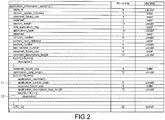
- Fig. 2 is a diagram showing the data structure of the AIT.
- the AIT is a table in which various types of information on applications, application control codes for controlling applications, and the like are stored. Specifically, the AIT stores a table ID, a section syntax indicator, a section length, an application form, a version number, a current next indicator, a section number, a last section number, a common descriptor loop length, an application information loop length, an application identifier, an application control code 11, an application descriptor loop length, an application descriptor 12, and the like.
- the application descriptor 12 a randomized latency descriptor that has the purpose of distributing a load to the application server 300 can be described. This randomized latency descriptor will be described later in detail.
- Fig. 3 is a diagram showing the data structure of the XML-AIT.
- the XML-AIT stores, for each application, an application name, an application identifier, an application descriptor, an application type, an application control code 21, an application visibility, a flag indicating validity in only the current service, an application priority, an application version, a version conforming to a platform profile, an icon, a storage function capability, a transport protocol descriptor, an application location descriptor, an application boundary descriptor, an application specific descriptor, an application usage descriptor, a randomized latency descriptor 22, and the like.
- the randomized latency descriptor 22 is the same as the randomized latency descriptor that can be described in the application descriptor 12 of the AIT.
- the randomized latency descriptor is information newly implemented from the system according to the embodiment of the present technology for the purpose of temporally distributing the load of the application server 300.
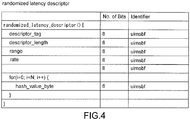
- Fig. 4 is a diagram showing the data structure of the randomized latency descriptor.
- the randomized latency descriptor is constituted of a descriptor tag for identifying the randomized latency descriptor (descriptor_tag), a descriptor length (descriptor_length), a time range in which access to the application server 300 is distributed (range), a distribution number of an access timing (rate), an absolute time at which the distribution of the access is ended (randomize_end_time), its length (randomize_end_time_length), and the like.
- the range (range) and the distribution number (rate) correspond to first information, which is to calculate a random timing for each request for acquiring, from the server, an application that can be processed together with broadcast content.
- the absolute time corresponds to second information associated with a valid period of processing based on the first information described above.
- the life cycle of the application is dynamically controlled by the information processing apparatus 700 based on the application control codes 11 and 21 stored in the AIT section and the XML-AIT, respectively.
- Fig. 5 is a diagram showing the definitions of the application control codes 11 and 21 stored in the AIT of the AIT section and the XML-AIT.
- the "AUTOSTART" is a code of an instruction to automatically activate the application along with the selection of a service. This is not applied to the case where the application is already in execution.
- the "PRESENT" is a code of an instruction to make the application in an executable state while the service is being selected. However, the target application is not automatically activated along with the selection of a service and is activated when an activation instruction is received from the user.
- the "DESTROY" is a code of an instruction to permit the termination of the application.
- the "KILL” is a code of an instruction to force-quit the application.
- the "PREFETCH” is a code of an instruction to perform caching of the application.
- the "REMOTE” is a code indicating an application that cannot be acquired in the current transport stream. Such an application can be acquired from a different transport stream or cache to be used.
- the "DISABLED" is a code indicating the prohibition of the activation of the application.
- the "PLAYBACK_AUTOSTART” is a code for activating an application along with the reproduction of broadcast content recorded in storage (recording apparatus).
- Fig. 6 is a block diagram showing the configuration of the information processing apparatus 700 of this embodiment.
- the information processing apparatus 700 includes a broadcast interface 701, a demultiplexer 702, an output processing unit 703, a video decoder 704, a voice decoder 705, a subtitle decoder 706, a communication interface 707, and an application controller 708 (controller).
- the broadcast interface 701 includes an antenna and a tuner and receives a signal of digital broadcast whose channel is selected by the user using those antenna and tuner.
- the broadcast interface 701 outputs a transport stream to the demultiplexer 702.
- the transport stream is obtained by performing demodulation processing or the like on the received digital broadcast signal.
- the demultiplexer 702 separates a stream packet of the broadcast content, a packet of the application, and a packet of the AIT section from the transport stream.
- the demultiplexer 702 separates a video ES (Elementary Stream), a voice ES, and a subtitle ES from the stream packet of the broadcast content.
- the demultiplexer 702 delivers the video ES to the video decoder 704, the voice ES to the voice decoder 705, the subtitle ES to the subtitle decoder 706, and the packet of the application and the packet of the PSI/SI including the AIT section to the application controller 708.
- the video decoder 704 decodes the video ES to generate a video signal and outputs the generated video signal to the output processing unit 703.
- the voice decoder 705 decodes the voice ES to generate a voice signal and outputs the generated voice signal to the output processing unit 703.
- the subtitle decoder 706 decodes the subtitle ES to generate a subtitle signal and outputs the generated subtitle signal to the output processing unit 703.
- the broadcast interface 701, the demultiplexer 702, the output processing unit 703, the video decoder 704, the voice decoder 705, and the subtitle decoder 706 correspond to a broadcast content processing unit that receives and processes the broadcast content.
- the communication interface 707 is an interface for communicating with an external device via the second network 600 such as a LAN.
- the communication interface 707 may perform wireless or wired communication.
- the application controller 708 is a controller that performs processing on the control of the application.
- the output processing unit 703 combines the video signal from the video decoder 704, the voice signal from the voice decoder 705, the subtitle signal from the subtitle decoder 706, and the video signal, the voice signal, and the like from the application controller 708 with one another and outputs the resultant signal to a recording apparatus (not shown), and a display unit and a speaker unit (not shown), which are connected to the information processing apparatus 700.
- a part or the whole of the configuration including at least the application controller 708 of the information processing apparatus 700 described above is constituted of a computer including a CPU (Central Processing Unit) and a main memory and a program.
- a CPU Central Processing Unit
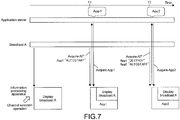
- Fig. 7 is a diagram showing the typical operation example of the activation of an application based on the AIT section.
- Fig. 8 is a flowchart of the operation example shown in Fig. 7 .
- the information processing apparatus 700 receives broadcast content transmitted from the broadcast facility 100 of a station whose channel is selected by the user by use of a remote controller or the like and performs decoding processing or the like on video data, voice data, subtitle data, and the like to output the broadcast content to the display unit and the speaker unit that are connected to the information processing apparatus 700 (Step S101).
- the broadcast interface 701 receives a digital broadcast signal of the broadcast content from the broadcast facility 100 of the station whose channel is selected by the user and outputs a transport stream to the demultiplexer 702, the transport stream being obtained by performing demodulation processing or the like on the digital broadcast signal.
- the demultiplexer 702 separates a stream packet of the broadcast content from the transport stream and further separates the stream packet of the broadcast content into a video ES, a voice ES, and a subtitle ES.
- the separated video ES, voice ES, and subtitle ES are decoded in the video decoder 704, the voice decoder 705, and the subtitle decoder 706, respectively, and combined in the output processing unit 703 to be output to the display unit and the speaker unit.
- an AIT section in which an AIT on an application App1 is stored is superimposed on the broadcast content and transmitted from the broadcast facility 100.
- location information of the application App1 and an application control code "AUTOSTART" instructing activation are stored.
- the location information that serves as information necessary for acquiring the application App1 from the application server 300 is constituted of communication protocol information such as HTTP (Hypertext Transfer Protocol), a URL (Uniform Resource Locator), and the like.
- the demultiplexer 702 separates a packet of the application App1 and a packet of the AIT section from the transport stream and supplies the separated packets to the application controller 708.
- the application controller 708 analyzes the AIT section (Step S103).
- the application controller 708 accesses the application server 300 based on the location information described in that AIT section to acquire the application App1 and activates the application App1 (N of Step S104, Y of Step S105, and Step S106).
- the activated application App1 is visualized (presented) together with the video of a broadcast program A displayed on the display unit, for example.
- the update of the AIT section occurs.
- the application controller 708 of the information processing apparatus 700 can be informed of the occurrence of the update of the AIT section based on a version number in the data structure of the AIT section.
- the application control code "DESTROY” or “KILL” that instructs the termination of the application App1 and the application control code "AUTOSTART" that instructs the activation of the next application App2 are described in the updated AIT section.
- the application controller 708 of the information processing apparatus 700 terminates the application App1 according to the application control code "DESTROY” or "KILL" for the application App1 that is described in this AIT section (Y of Step S104 and End). Further, the application controller 708 acquires an application App2 according to the "AUTOSTART" that is stored in the AIT section as an application control code for the application App2 (Y of Step S105 and S106) and activates the application App2 (Step S105). Consequently, the application App2 is presented together with the video of the broadcast program A, instead of the application App1.
- Step S107 after the application controller 708 performs processing such as transferring the state of the application according to that application control code (Step S107), the application controller 708 waits for the next AIT section.
- each of the application App1 and the application App2 is not necessarily displayed simultaneously with the video of the broadcast program and may be displayed on the entire screen. Further, if each of the application App1 and the application App2 is displayed while sharing the area with the video of the broadcast program, each of the application App1 and the application App2 may be displayed to be separate from the video of the broadcast program vertically or horizontally. In the case where the application is displayed on the entire screen, the video of the broadcast program is not displayed, but also in this state, the tuner of the broadcast interface 701 is in the channel-selected state and the receiving state of the broadcast stream including the AIT section is continued.
- the AIT section is received by many information processing apparatuses at the same time or in a very short period of time.
- many information processing apparatuses 700A, 700B, ... exist in the information processing system 1. So, in the case where each of the information processing apparatuses 700A, 700B, ... intends to activate an application based on the content described in the AIT of the AIT section, it is thought that the access to the application server 300 to acquire that application is concentrated. When the access to the application server 300 is concentrated and the load of the application server 300 is excessively increased, there is a possibility that a response time is increased and the service is stopped.
- the randomized latency descriptor 22 shown in Fig. 4 is newly implemented, in the AIT of the AIT section, as information for providing a shift to a timing at which each of the information processing apparatuses 700A, 700B, ... accesses the application server 300 in order to acquire an application.
- Fig. 10 is a diagram showing the operation example of the distribution of access to the application server 300 at the time of using the AIT section, while focusing on the operations of the two information processing apparatuses 700A and 700B shown in Fig. 9 .
- Fig. 11 is a flowchart of the operation example shown in Fig. 10 .
- one information processing apparatus 700A is referred to as a "first information processing apparatus”
- the other information processing apparatus 700B is referred to as a "second information processing apparatus”.
- both of the first information processing apparatus 700A and the second information processing apparatus 700B select a channel of broadcast A (Step S201) and display the broadcast A on the respective display units.
- an AIT section in which an AIT on the application App1 is stored is superimposed on the broadcast content and transmitted from the broadcast facility 100. It is assumed that in this AIT section, location information of the application App1 and an application control code "AUTOSTART" instructing activation are stored.
- Each of the first information processing apparatus 700A and the first information processing apparatus 700A receives the AIT section at substantially the same timing (Step S202), analyzes the AIT stored in the AIT section (Step S203), and performs control on the application App1 based on a result of the analysis.
- the application controller 708 of each of the first information processing apparatus 700A and the first information processing apparatus 700A terminates the application being executed (End).
- the application controller 708 of each of the first information processing apparatus 700A and the first information processing apparatus 700A starts processing of determining a timing at which an acquisition request for the application to the application server 300 is transmitted based on the randomized latency descriptor 22 described in the AIT. This processing will be described later.
- the application controller 708 transfers the state of the application according to that application control code (Step S206). After that, the application controller 708 enters a standby state for the next AIT section.
- the application controller 708 checks if the randomized latency descriptor is described in the AIT of the received AIT section. In the case where the randomized latency descriptor is not described, the application controller 708 executes the application control code "AUTOSTART" described in the AIT. That is, the application controller 708 transmits the acquisition request for the application to the application server 300 as quickly as possible. Consequently, in this case, the temporal distribution of the access to the application server 300 is not performed.
- the application controller 708 compares the absolute time (randomize_end_time) in the randomized latency descriptor 22 with the current time, the absolute time indicating a time at which the distribution of the access is ended, and determines whether the absolute time (randomize_end_time) has elapsed at the current time (Step S207). As a result of the determination, in the case where the absolute time (randomize_end_time) has elapsed at the current time (Y of Step S207), the application controller 708 executes the application control code "AUTOSTART" described in the AIT (Step S211).
- the application controller 708 calculates a timing of the transmission of the acquisition request for an application to the application server 300 as follows (Step S208).
- the application controller 708 extracts a distribution number (rate) of an access timing from the randomized latency descriptor 22 of the received AIT and determines one integer value N at random from the values including 1 to the values of (rate+1). Subsequently, the application controller 708 extracts a value of a time range (range) in which the access to the application server 300 is distributed, from the randomized latency descriptor 22 of the received AIT.
- the LatencyPeriod calculated in the first information processing apparatus 700A corresponds to Td1 of Fig. 10
- the LatencyPeriod calculated in the second information processing apparatus 700B corresponds to Td2 of Fig. 10 . Consequently, from each of the first information processing apparatus 700A and the second information processing apparatus 700B, 3 shifts are ensured at high probability for the timing at which the acquisition request for an application is transmitted.
- any descriptor and calculation method may be adopted.
- an upper-limit elapse time from the acquisition timing of the XML-AIT may be adopted instead of the absolute time (randomize_end_time).
- the application controller 708 of each of the first information processing apparatus 700A and the second information processing apparatus 700B transmits the acquisition request for an application to the application server 300 at a timing calculated in each application controller 708.
- the application server 300 returns a corresponding application App1 to each acquisition request for an application.
- the application server 300 of each of the first information processing apparatus 700A and the second information processing apparatus 700B activates the application App1 according to the application control code "AUTOSTART" described in the AIT (Step S209).
- the application controller 708 transfers the state of the application App1 according to that application control code (Step S210). After that, the application controller 708 enters a standby state for the next AIT section.
- Fig. 12 is a diagram showing the typical operation example of the activation of an application by using the XML-AIT.
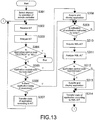
- Fig. 13 is a flowchart on the operation example shown in Fig. 12 .
- the operation from the channel selection of broadcast by an operation of a user using a remote controller to the control of the application based on the AIT section is basically the same as in "1. Typical Operation Example of Activation of Application Based on AIT Section".
- each of the first information processing apparatus 700A and the first information processing apparatus 700A during the presentation of the application Appl, when a predetermined condition such as an instruction from the user or time is established (Y of Step S309), the above-mentioned script incorporated in the application App1 is executed, and thus the application controller 708 acquires a new XML-AIT from the XML-AIT server 400 (Step S310) and analyzes the new XML-AIT (Step S311).
- the application controller 708 terminates the application App1 (Step S314). Furthermore, according to the application control code "AUTOSTART" for the application App2 that is described in the XML-AIT (Y of Step S312), the application controller 708 acquires the application App2 from the application server 300 based on the location information of the application App2 described in that XML-AIT and activates the application App2 (Step S313).
- the application controller 708 transfers the state of the application App2 according to the next application control code described in the XML-AIT (Step S314). After that, the application controller 708 enters a standby state for the next AIT section.
- the XML-AIT is transmitted to the information processing apparatus 700 by communication via the Internet. For that reason, as compared with the AIT section, a probability that the temporal concentration of the load of the application server 300 occurs is low.
- a script that contains a createApplication() function and the like and is incorporated in the application for example, the application App1 described above
- the AIT of the AIT section is simultaneously executed on the plurality of information processing apparatuses 700 depending on temporal conditions such as the absolute time. Also in such a case, it is thought that the plurality of information processing apparatuses 700 transmit the acquisition requests for an application to the application server 300 at substantially the same time and the load of the application server 300 is increased.
- the randomized latency descriptor 22 shown in Fig. 4 is newly implemented also in the XML-AIT.
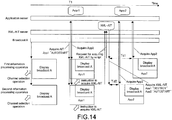
- Fig. 14 is a diagram showing the operation example of the distribution of access to the application server 300 at the time of using the XML-AIT.
- Fig. 15 is a flowchart of the operation example shown in Fig. 14 .
- an operation in which the transmission of acquisition requests for an application from the plurality of information processing apparatuses 700 to the application server 300 is temporally distributed based on the XML-AIT is basically the same as the operation based on the AIT of the AIT section.
- each of the first information processing apparatus 700A and the first information processing apparatus 700A during the presentation of the application Appl, when a predetermined condition such as an instruction from the user or time is established (Y of Step S409), the above-mentioned script incorporated in the application App1 is executed, and thus the application controller 708 acquires a new XML-AIT from the XML-AIT server 400 (Step S410) and analyzes the new XML-AIT (Step S411).
- the application controller 708 terminates the application App1 (Step S417).
- the application controller 708 calculates a timing of the transmission of the acquisition request for an application to the application server 300 based on the randomized latency descriptor 22 described in the acquired XML-AIT (Step S415).
- a specific method of calculating the timing is as described in "2. Operation Example of Distribution of Server Access at Time of Using AIT Section". Consequently, from each of the first information processing apparatus 700A and the second information processing apparatus 700B, a shift is ensured for the timing at which the acquisition request for an application is transmitted.
- the application controller 708 of each of the first information processing apparatus 700A and the second information processing apparatus 700B transmits the acquisition request for an application to the application server 300 at a timing calculated in each application controller 708.
- the application server 300 returns a corresponding application App2 to each acquisition request for an application.
- the application server 300 of each of the first information processing apparatus 700A and the second information processing apparatus 700B activates the application App2 according to the application control code "AUTOSTART" described in the AIT (Step S416).
- the application controller 708 transfers the state of the application App1 according to that application control code (Step S417). After that, the application controller 708 enters a standby state for the next AIT section.
Landscapes
- Engineering & Computer Science (AREA)
- Signal Processing (AREA)
- Multimedia (AREA)
- Databases & Information Systems (AREA)
- General Engineering & Computer Science (AREA)
- Software Systems (AREA)
- Computer Security & Cryptography (AREA)
- Two-Way Televisions, Distribution Of Moving Picture Or The Like (AREA)
- Information Transfer Between Computers (AREA)
Claims (7)
- Appareil de traitement d'informations, comprenant :une unité de traitement de contenu de radiodiffusion (704, 705, 706), configurée pour recevoir un contenu de radiodiffusion et pour traiter le contenu de radiodiffusion reçu, ledit contenu de radiodiffusion reçu comprenant des données vidéo et des données audio ;un contrôleur (708) configuré pour :acquérir, à partir du contenu de radiodiffusion ou d'un serveur de table d'informations d'application, une table d'informations d'application pour une demande à transmettre à un serveur d'applications pour acquérir une application à exécuter simultanément avec la reproduction du contenu de radiodiffusion, la table d'informations d'application incluant une première information pour calculer un temps aléatoire où la demande d'acquisition doit être transmise, etcalculer, sur la base de la première information, le temps aléatoire ; etune interface de communication (707), configurée pour transmettre au serveur d'applications, au temps aléatoire calculé, la demande d'acquisition d'une application à exécuter simultanément avec la reproduction du contenu de radiodiffusion.
- Appareil de traitement d'informations selon la revendication 1, dans lequel :une seconde information sur une période de validité de traitement, basée sur la première information, est stockée dans la table d'informations d'application, etle contrôleur (708) est configuré pour déterminer, sur la base de la seconde information, si le temps aléatoire doit être calculé ou non sur la base de la première information et si la demande d'acquisition de l'application doit être transmise ou non au serveur d'applications.
- Appareil de traitement d'informations selon la revendication 2, dans lequel :
le contrôleur (708) est configuré pour déterminer si la période de validité du traitement s'est écoulée ou non sur la base de la seconde information, et quand la période de validité s'est écoulée, pour annuler le calcul du temps aléatoire sur la base de la première information et pour transmettre la demande d'acquisition de l'application. - Procédé de traitement d'informations, consistant à :recevoir et traiter un contenu de radiodiffusion, ledit contenu de radiodiffusion reçu comprenant des données vidéo et des données audio ;acquérir, à partir du contenu de radiodiffusion ou d'un serveur de table d'informations d'application, une table d'informations d'application pour une demande à transmettre à un serveur d'applications pour acquérir une application à exécuter simultanément avec la reproduction du contenu de radiodiffusion, la table d'informations d'application incluant une première information pour calculer un temps aléatoire où la demande d'acquisition doit être transmise ;calculer, sur la base de la première information, le temps aléatoire ; ettransmettre au serveur d'applications, au temps aléatoire calculé, la demande d'acquisition d'une application à exécuter simultanément avec la reproduction du contenu de radiodiffusion.
- Programme informatique qui, lorsqu'il est exécuté par l'appareil de traitement d'informations selon la revendication 1, amène l'ordinateur à réaliser les étapes du procédé de traitement d'informations selon la revendication 4.
- Appareil de fourniture de table d'informations d'application, comprenant :
une unité de fourniture (401), configurée pour fournir une table d'informations d'application à l'appareil de traitement d'informations selon la revendication 1 pour une demande à transmettre par l'appareil de traitement d'informations selon la revendication 1 à un serveur d'applications pour acquérir une application à exécuter simultanément avec la reproduction d'un contenu de radiodiffusion, ledit contenu de radiodiffusion reçu comprenant des données vidéo et des données audio, la table d'informations d'application stockant une première information pour amener l'appareil de traitement d'informations selon la revendication 1 à calculer un temps aléatoire où la demande d'acquisition d'une application doit être transmise par l'appareil de traitement d'informations selon la revendication 1 au serveur d'applications. - Procédé de fourniture de table d'informations d'application, consistant à :
fournir, par une unité de fourniture (401), une table d'informations d'application à l'appareil de traitement d'informations selon la revendication 1 pour une demande à transmettre par l'appareil de traitement d'informations selon la revendication 1 à un serveur d'applications pour acquérir une application à exécuter simultanément avec la reproduction d'un contenu de radiodiffusion, ledit contenu de radiodiffusion reçu comprenant des données vidéo et des données audio, la table d'informations d'application stockant une première information pour amener l'appareil de traitement d'informations selon la revendication 1 à calculer un temps aléatoire où la demande d'acquisition d'une application doit être transmise par l'appareil de traitement d'informations selon la revendication 1 au serveur d'applications.
Applications Claiming Priority (2)
| Application Number | Priority Date | Filing Date | Title |
|---|---|---|---|
| JP2011286944 | 2011-12-27 | ||
| PCT/JP2012/007527 WO2013099101A1 (fr) | 2011-12-27 | 2012-11-22 | Dispositif de traitement de données, procédé de traitement de données, programme, dispositif de fourniture de table de données d'application et procédé de fourniture de table de données d'application |
Publications (3)
| Publication Number | Publication Date |
|---|---|
| EP2800366A1 EP2800366A1 (fr) | 2014-11-05 |
| EP2800366A4 EP2800366A4 (fr) | 2015-08-05 |
| EP2800366B1 true EP2800366B1 (fr) | 2019-03-27 |
Family
ID=48696652
Family Applications (1)
| Application Number | Title | Priority Date | Filing Date |
|---|---|---|---|
| EP12863245.2A Active EP2800366B1 (fr) | 2011-12-27 | 2012-11-22 | Dispositif de traitement de données, procédé de traitement de données, programme, dispositif de fourniture de table de données d'application et procédé de fourniture de table de données d'application |
Country Status (5)
| Country | Link |
|---|---|
| US (1) | US10771832B2 (fr) |
| EP (1) | EP2800366B1 (fr) |
| JP (3) | JP5516826B2 (fr) |
| CN (1) | CN104025616A (fr) |
| WO (1) | WO2013099101A1 (fr) |
Families Citing this family (16)
| Publication number | Priority date | Publication date | Assignee | Title |
|---|---|---|---|---|
| JP5857636B2 (ja) * | 2011-11-02 | 2016-02-10 | ソニー株式会社 | 情報処理装置、情報処理方法及びプログラム |
| WO2015029401A1 (fr) | 2013-08-29 | 2015-03-05 | パナソニック インテレクチュアル プロパティ コーポレーション オブ アメリカ | Procédé de transmission, procédé de réception, dispositif de transmission et dispositif de réception |
| JP6625318B2 (ja) | 2013-08-29 | 2019-12-25 | パナソニック インテレクチュアル プロパティ コーポレーション オブ アメリカPanasonic Intellectual Property Corporation of America | 送信方法および受信方法 |
| JP6505996B2 (ja) * | 2013-08-30 | 2019-04-24 | パナソニック インテレクチュアル プロパティ コーポレーション オブ アメリカPanasonic Intellectual Property Corporation of America | 受信方法、及び、受信装置 |
| WO2015045324A1 (fr) * | 2013-09-30 | 2015-04-02 | ソニー株式会社 | Dispositif récepteur, dispositif de diffusion, dispositif serveur et procédé de réception |
| JP2017508327A (ja) * | 2013-12-23 | 2017-03-23 | エルジー エレクトロニクス インコーポレイティド | 一つ以上のネットワークで放送コンテンツを送受信する装置及び方法 |
| JP6309639B2 (ja) | 2014-01-13 | 2018-04-11 | エルジー エレクトロニクス インコーポレイティド | 1つ以上のネットワークを介して放送コンテンツを送信又は受信するための方法及び装置 |
| JP2016111508A (ja) * | 2014-12-05 | 2016-06-20 | シャープ株式会社 | 受信装置、情報処理装置、情報処理方法、及びプログラム |
| US20160182977A1 (en) * | 2014-12-19 | 2016-06-23 | Telefonaktiebolaget L M Ericsson (Publ) | User interaction with advertisements on hybrid terminals |
| US11362748B2 (en) * | 2016-06-08 | 2022-06-14 | Saturn Licensing Llc | Reception device, transmission device, and data processing method |
| JP6693343B2 (ja) * | 2016-08-31 | 2020-05-13 | 富士通株式会社 | 機器、情報処理方法、情報処理プログラム及び情報処理システム |
| CN106604114A (zh) * | 2016-12-16 | 2017-04-26 | 传线网络科技(上海)有限公司 | 一种视频数据播放、提供及获取的方法及装置 |
| ES2895060T3 (es) | 2017-03-28 | 2022-02-17 | Beijing Xiaomi Mobile Software Co Ltd | Método y aparato para configurar periodo de señal |
| JP6400783B2 (ja) * | 2017-05-12 | 2018-10-03 | 株式会社東芝 | 放送受信装置、および、受信方法、伝送方法 |
| JP6400784B2 (ja) * | 2017-05-12 | 2018-10-03 | 株式会社東芝 | 放送受信装置、および、受信方法、伝送方法 |
| JP6545875B2 (ja) * | 2018-08-10 | 2019-07-17 | 株式会社東芝 | 放送受信装置および受信方法、伝送方法 |
Citations (1)
| Publication number | Priority date | Publication date | Assignee | Title |
|---|---|---|---|---|
| EP2320650A1 (fr) * | 2009-10-20 | 2011-05-11 | Lg Electronics Inc. | Procédé de traitement d'application dans un récepteur de diffusion numérique connecté à un réseau interactif et récepteur de diffusion numérique |
Family Cites Families (20)
| Publication number | Priority date | Publication date | Assignee | Title |
|---|---|---|---|---|
| JP2001092744A (ja) * | 1999-09-17 | 2001-04-06 | Sony Corp | 放送番組情報処理装置 |
| US7028327B1 (en) | 2000-02-02 | 2006-04-11 | Wink Communication | Using the electronic program guide to synchronize interactivity with broadcast programs |
| JP2002232374A (ja) * | 2001-01-31 | 2002-08-16 | Matsushita Electric Ind Co Ltd | 放送装置 |
| US7584491B2 (en) | 2001-04-25 | 2009-09-01 | Sony Corporation | System and method for managing interactive programming and advertisements in interactive broadcast systems |
| JP2005012545A (ja) | 2003-06-19 | 2005-01-13 | Dainippon Printing Co Ltd | データ放送番組視聴者からのデータ送信受付け方法 |
| US8407752B2 (en) | 2004-03-18 | 2013-03-26 | Digimarc Corporation | Synchronizing broadcast content with corresponding network content |
| JP4403048B2 (ja) | 2004-10-12 | 2010-01-20 | 日本放送協会 | コンテンツ提供サーバ、ユーザ端末、コンテンツ提供プログラム、及びコンテンツ取得プログラム |
| WO2006075557A1 (fr) * | 2005-01-17 | 2006-07-20 | Matsushita Electric Industrial Co., Ltd. | Dispositif d'execution de programme |
| EP1686807A1 (fr) | 2005-01-27 | 2006-08-02 | Nagra France Sarl | Méthode de répartition de la charge d'un centre de gestion transmettant des informations à un grand nombre d'unités d'utilisateur |
| JP4831605B2 (ja) * | 2006-01-24 | 2011-12-07 | Kddi株式会社 | 通信システムおよびその発呼規制方法ならびに視聴者端末 |
| JP2008097314A (ja) | 2006-10-12 | 2008-04-24 | Kddi Corp | 端末からのアクセス要求を空間的及び/又は時間的に分散させる仮接続方法、サーバ及びプログラム |
| KR100781534B1 (ko) * | 2006-12-08 | 2007-12-03 | 삼성전자주식회사 | 방송 수신 장치에 적합한 애플리케이션의 기능을 구성하고실행하는 장치 및 방법 |
| US20090144793A1 (en) * | 2007-12-03 | 2009-06-04 | Himax Technologies Limited | Method for obtaining service map information, apparatus therefor, and method for fast performing application in service according to the service map information |
| JP4735700B2 (ja) * | 2008-10-08 | 2011-07-27 | ソニー株式会社 | 受信装置、受信方法、サーバ装置 |
| KR101485461B1 (ko) * | 2008-10-23 | 2015-01-22 | 삼성전자주식회사 | Ait를 이용한 애플리케이션의 제공 방법 및 그 장치 |
| JP2010262452A (ja) | 2009-05-01 | 2010-11-18 | Ntt Docomo Inc | 通信装置 |
| JP5493627B2 (ja) | 2009-09-15 | 2014-05-14 | ソニー株式会社 | 情報処理装置、データ管理方法、およびプログラム |
| US20110177774A1 (en) * | 2010-01-13 | 2011-07-21 | Qualcomm Incorporated | Dynamic generation, delivery, and execution of interactive applications over a mobile broadcast network |
| JP5569053B2 (ja) | 2010-03-11 | 2014-08-13 | ソニー株式会社 | コンテンツ配信装置、コンテンツ配信方法および送信サーバ |
| WO2014003394A1 (fr) * | 2012-06-25 | 2014-01-03 | Lg Electronics Inc. | Appareil et procédé de traitement d'un service interactif |
-
2012
- 2012-11-22 CN CN201280063472.0A patent/CN104025616A/zh active Pending
- 2012-11-22 EP EP12863245.2A patent/EP2800366B1/fr active Active
- 2012-11-22 JP JP2013530469A patent/JP5516826B2/ja active Active
- 2012-11-22 WO PCT/JP2012/007527 patent/WO2013099101A1/fr not_active Ceased
- 2012-11-22 US US14/365,140 patent/US10771832B2/en active Active
-
2014
- 2014-04-04 JP JP2014077866A patent/JP5949825B2/ja active Active
-
2016
- 2016-06-02 JP JP2016110612A patent/JP6207673B2/ja active Active
Patent Citations (1)
| Publication number | Priority date | Publication date | Assignee | Title |
|---|---|---|---|---|
| EP2320650A1 (fr) * | 2009-10-20 | 2011-05-11 | Lg Electronics Inc. | Procédé de traitement d'application dans un récepteur de diffusion numérique connecté à un réseau interactif et récepteur de diffusion numérique |
Non-Patent Citations (1)
| Title |
|---|
| ETSI: "ETSI TS 102 809 V1.1.1 Digital Video Broadcasting (DVB); Signalling and carriage of interactive applications and services in Hybrid broadcast/broadband environments", 7 January 2010 (2010-01-07), pages 1 - 98, XP055120418, Retrieved from the Internet <URL:http://www.etsi.org/deliver/etsi_ts/102800_102899/102809/01.01.01_60/ts_102809v010101p.pdf> [retrieved on 20140527] * |
Also Published As
| Publication number | Publication date |
|---|---|
| JPWO2013099101A1 (ja) | 2015-04-30 |
| JP5949825B2 (ja) | 2016-07-13 |
| US20140344884A1 (en) | 2014-11-20 |
| JP2016187196A (ja) | 2016-10-27 |
| JP2014158273A (ja) | 2014-08-28 |
| JP5516826B2 (ja) | 2014-06-11 |
| EP2800366A4 (fr) | 2015-08-05 |
| JP6207673B2 (ja) | 2017-10-04 |
| EP2800366A1 (fr) | 2014-11-05 |
| CN104025616A (zh) | 2014-09-03 |
| US10771832B2 (en) | 2020-09-08 |
| WO2013099101A1 (fr) | 2013-07-04 |
Similar Documents
| Publication | Publication Date | Title |
|---|---|---|
| EP2800366B1 (fr) | Dispositif de traitement de données, procédé de traitement de données, programme, dispositif de fourniture de table de données d'application et procédé de fourniture de table de données d'application | |
| KR101689050B1 (ko) | 정보 처리 장치, 데이터 관리 방법 및 기록 매체 | |
| US9661371B2 (en) | Method for transmitting a broadcast service, apparatus for receiving same, and method for processing an additional service using the apparatus for receiving same | |
| US9838741B2 (en) | Method for transmitting broadcast service, method for receiving broadcast service, and apparatus for receiving broadcast service | |
| US9723376B2 (en) | Information processing apparatus, server apparatus, information processing method, server processing method, and program | |
| EP2858374B1 (fr) | Dispositif de traitement d'informations, procédé de traitement d'informations, programme et dispositif de transmission de table d'informations d'application | |
| US9723362B2 (en) | Method for transmitting and receiving broadcast service and receiving device thereof | |
| JP2012244340A (ja) | 受信機連携システム | |
| EP2890144A1 (fr) | Dispositif de traitement d'informations, procédé de traitement d'informations, programme et dispositif serveur | |
| EP2775706A1 (fr) | Dispositif de traitement d'informations, procédé de traitement d'informations et programme | |
| JP6973454B2 (ja) | 情報処理システムおよび送受信方法 | |
| US11051069B2 (en) | Apparatus and method for providing service in digital broadcasting system | |
| JP2012244338A (ja) | 端末連携システム |
Legal Events
| Date | Code | Title | Description |
|---|---|---|---|
| PUAI | Public reference made under article 153(3) epc to a published international application that has entered the european phase |
Free format text: ORIGINAL CODE: 0009012 |
|
| 17P | Request for examination filed |
Effective date: 20140623 |
|
| AK | Designated contracting states |
Kind code of ref document: A1 Designated state(s): AL AT BE BG CH CY CZ DE DK EE ES FI FR GB GR HR HU IE IS IT LI LT LU LV MC MK MT NL NO PL PT RO RS SE SI SK SM TR |
|
| DAX | Request for extension of the european patent (deleted) | ||
| RA4 | Supplementary search report drawn up and despatched (corrected) |
Effective date: 20150707 |
|
| RIC1 | Information provided on ipc code assigned before grant |
Ipc: H04N 21/435 20110101ALI20150701BHEP Ipc: H04N 21/437 20110101ALI20150701BHEP Ipc: H04N 7/173 20110101ALI20150701BHEP Ipc: G06F 13/00 20060101ALI20150701BHEP Ipc: H04H 20/93 20080101ALI20150701BHEP Ipc: H04N 21/434 20110101ALI20150701BHEP Ipc: H04H 60/82 20080101ALI20150701BHEP Ipc: H04N 21/239 20110101AFI20150701BHEP Ipc: H04N 21/81 20110101ALI20150701BHEP Ipc: H04N 21/262 20110101ALI20150701BHEP |
|
| STAA | Information on the status of an ep patent application or granted ep patent |
Free format text: STATUS: EXAMINATION IS IN PROGRESS |
|
| 17Q | First examination report despatched |
Effective date: 20170828 |
|
| RAP1 | Party data changed (applicant data changed or rights of an application transferred) |
Owner name: SATURN LICENSING LLC |
|
| GRAP | Despatch of communication of intention to grant a patent |
Free format text: ORIGINAL CODE: EPIDOSNIGR1 |
|
| STAA | Information on the status of an ep patent application or granted ep patent |
Free format text: STATUS: GRANT OF PATENT IS INTENDED |
|
| INTG | Intention to grant announced |
Effective date: 20181016 |
|
| GRAS | Grant fee paid |
Free format text: ORIGINAL CODE: EPIDOSNIGR3 |
|
| GRAA | (expected) grant |
Free format text: ORIGINAL CODE: 0009210 |
|
| STAA | Information on the status of an ep patent application or granted ep patent |
Free format text: STATUS: THE PATENT HAS BEEN GRANTED |
|
| AK | Designated contracting states |
Kind code of ref document: B1 Designated state(s): AL AT BE BG CH CY CZ DE DK EE ES FI FR GB GR HR HU IE IS IT LI LT LU LV MC MK MT NL NO PL PT RO RS SE SI SK SM TR |
|
| REG | Reference to a national code |
Ref country code: GB Ref legal event code: FG4D |
|
| REG | Reference to a national code |
Ref country code: CH Ref legal event code: EP |
|
| REG | Reference to a national code |
Ref country code: AT Ref legal event code: REF Ref document number: 1114423 Country of ref document: AT Kind code of ref document: T Effective date: 20190415 |
|
| REG | Reference to a national code |
Ref country code: IE Ref legal event code: FG4D |
|
| REG | Reference to a national code |
Ref country code: DE Ref legal event code: R096 Ref document number: 602012058418 Country of ref document: DE |
|
| REG | Reference to a national code |
Ref country code: NL Ref legal event code: FP |
|
| PG25 | Lapsed in a contracting state [announced via postgrant information from national office to epo] |
Ref country code: NO Free format text: LAPSE BECAUSE OF FAILURE TO SUBMIT A TRANSLATION OF THE DESCRIPTION OR TO PAY THE FEE WITHIN THE PRESCRIBED TIME-LIMIT Effective date: 20190627 Ref country code: LT Free format text: LAPSE BECAUSE OF FAILURE TO SUBMIT A TRANSLATION OF THE DESCRIPTION OR TO PAY THE FEE WITHIN THE PRESCRIBED TIME-LIMIT Effective date: 20190327 Ref country code: SE Free format text: LAPSE BECAUSE OF FAILURE TO SUBMIT A TRANSLATION OF THE DESCRIPTION OR TO PAY THE FEE WITHIN THE PRESCRIBED TIME-LIMIT Effective date: 20190327 Ref country code: FI Free format text: LAPSE BECAUSE OF FAILURE TO SUBMIT A TRANSLATION OF THE DESCRIPTION OR TO PAY THE FEE WITHIN THE PRESCRIBED TIME-LIMIT Effective date: 20190327 |
|
| PG25 | Lapsed in a contracting state [announced via postgrant information from national office to epo] |
Ref country code: RS Free format text: LAPSE BECAUSE OF FAILURE TO SUBMIT A TRANSLATION OF THE DESCRIPTION OR TO PAY THE FEE WITHIN THE PRESCRIBED TIME-LIMIT Effective date: 20190327 Ref country code: BG Free format text: LAPSE BECAUSE OF FAILURE TO SUBMIT A TRANSLATION OF THE DESCRIPTION OR TO PAY THE FEE WITHIN THE PRESCRIBED TIME-LIMIT Effective date: 20190627 Ref country code: LV Free format text: LAPSE BECAUSE OF FAILURE TO SUBMIT A TRANSLATION OF THE DESCRIPTION OR TO PAY THE FEE WITHIN THE PRESCRIBED TIME-LIMIT Effective date: 20190327 Ref country code: GR Free format text: LAPSE BECAUSE OF FAILURE TO SUBMIT A TRANSLATION OF THE DESCRIPTION OR TO PAY THE FEE WITHIN THE PRESCRIBED TIME-LIMIT Effective date: 20190628 Ref country code: HR Free format text: LAPSE BECAUSE OF FAILURE TO SUBMIT A TRANSLATION OF THE DESCRIPTION OR TO PAY THE FEE WITHIN THE PRESCRIBED TIME-LIMIT Effective date: 20190327 |
|
| REG | Reference to a national code |
Ref country code: AT Ref legal event code: MK05 Ref document number: 1114423 Country of ref document: AT Kind code of ref document: T Effective date: 20190327 |
|
| PG25 | Lapsed in a contracting state [announced via postgrant information from national office to epo] |
Ref country code: EE Free format text: LAPSE BECAUSE OF FAILURE TO SUBMIT A TRANSLATION OF THE DESCRIPTION OR TO PAY THE FEE WITHIN THE PRESCRIBED TIME-LIMIT Effective date: 20190327 Ref country code: IT Free format text: LAPSE BECAUSE OF FAILURE TO SUBMIT A TRANSLATION OF THE DESCRIPTION OR TO PAY THE FEE WITHIN THE PRESCRIBED TIME-LIMIT Effective date: 20190327 Ref country code: SK Free format text: LAPSE BECAUSE OF FAILURE TO SUBMIT A TRANSLATION OF THE DESCRIPTION OR TO PAY THE FEE WITHIN THE PRESCRIBED TIME-LIMIT Effective date: 20190327 Ref country code: PT Free format text: LAPSE BECAUSE OF FAILURE TO SUBMIT A TRANSLATION OF THE DESCRIPTION OR TO PAY THE FEE WITHIN THE PRESCRIBED TIME-LIMIT Effective date: 20190727 Ref country code: AL Free format text: LAPSE BECAUSE OF FAILURE TO SUBMIT A TRANSLATION OF THE DESCRIPTION OR TO PAY THE FEE WITHIN THE PRESCRIBED TIME-LIMIT Effective date: 20190327 Ref country code: ES Free format text: LAPSE BECAUSE OF FAILURE TO SUBMIT A TRANSLATION OF THE DESCRIPTION OR TO PAY THE FEE WITHIN THE PRESCRIBED TIME-LIMIT Effective date: 20190327 Ref country code: CZ Free format text: LAPSE BECAUSE OF FAILURE TO SUBMIT A TRANSLATION OF THE DESCRIPTION OR TO PAY THE FEE WITHIN THE PRESCRIBED TIME-LIMIT Effective date: 20190327 Ref country code: RO Free format text: LAPSE BECAUSE OF FAILURE TO SUBMIT A TRANSLATION OF THE DESCRIPTION OR TO PAY THE FEE WITHIN THE PRESCRIBED TIME-LIMIT Effective date: 20190327 |
|
| PG25 | Lapsed in a contracting state [announced via postgrant information from national office to epo] |
Ref country code: SM Free format text: LAPSE BECAUSE OF FAILURE TO SUBMIT A TRANSLATION OF THE DESCRIPTION OR TO PAY THE FEE WITHIN THE PRESCRIBED TIME-LIMIT Effective date: 20190327 Ref country code: PL Free format text: LAPSE BECAUSE OF FAILURE TO SUBMIT A TRANSLATION OF THE DESCRIPTION OR TO PAY THE FEE WITHIN THE PRESCRIBED TIME-LIMIT Effective date: 20190327 |
|
| PG25 | Lapsed in a contracting state [announced via postgrant information from national office to epo] |
Ref country code: AT Free format text: LAPSE BECAUSE OF FAILURE TO SUBMIT A TRANSLATION OF THE DESCRIPTION OR TO PAY THE FEE WITHIN THE PRESCRIBED TIME-LIMIT Effective date: 20190327 Ref country code: IS Free format text: LAPSE BECAUSE OF FAILURE TO SUBMIT A TRANSLATION OF THE DESCRIPTION OR TO PAY THE FEE WITHIN THE PRESCRIBED TIME-LIMIT Effective date: 20190727 |
|
| REG | Reference to a national code |
Ref country code: DE Ref legal event code: R097 Ref document number: 602012058418 Country of ref document: DE |
|
| PG25 | Lapsed in a contracting state [announced via postgrant information from national office to epo] |
Ref country code: DK Free format text: LAPSE BECAUSE OF FAILURE TO SUBMIT A TRANSLATION OF THE DESCRIPTION OR TO PAY THE FEE WITHIN THE PRESCRIBED TIME-LIMIT Effective date: 20190327 |
|
| PLBE | No opposition filed within time limit |
Free format text: ORIGINAL CODE: 0009261 |
|
| STAA | Information on the status of an ep patent application or granted ep patent |
Free format text: STATUS: NO OPPOSITION FILED WITHIN TIME LIMIT |
|
| PG25 | Lapsed in a contracting state [announced via postgrant information from national office to epo] |
Ref country code: SI Free format text: LAPSE BECAUSE OF FAILURE TO SUBMIT A TRANSLATION OF THE DESCRIPTION OR TO PAY THE FEE WITHIN THE PRESCRIBED TIME-LIMIT Effective date: 20190327 |
|
| 26N | No opposition filed |
Effective date: 20200103 |
|
| PG25 | Lapsed in a contracting state [announced via postgrant information from national office to epo] |
Ref country code: TR Free format text: LAPSE BECAUSE OF FAILURE TO SUBMIT A TRANSLATION OF THE DESCRIPTION OR TO PAY THE FEE WITHIN THE PRESCRIBED TIME-LIMIT Effective date: 20190327 |
|
| REG | Reference to a national code |
Ref country code: CH Ref legal event code: PL |
|
| PG25 | Lapsed in a contracting state [announced via postgrant information from national office to epo] |
Ref country code: MC Free format text: LAPSE BECAUSE OF FAILURE TO SUBMIT A TRANSLATION OF THE DESCRIPTION OR TO PAY THE FEE WITHIN THE PRESCRIBED TIME-LIMIT Effective date: 20190327 Ref country code: LU Free format text: LAPSE BECAUSE OF NON-PAYMENT OF DUE FEES Effective date: 20191122 Ref country code: CH Free format text: LAPSE BECAUSE OF NON-PAYMENT OF DUE FEES Effective date: 20191130 Ref country code: LI Free format text: LAPSE BECAUSE OF NON-PAYMENT OF DUE FEES Effective date: 20191130 |
|
| REG | Reference to a national code |
Ref country code: BE Ref legal event code: MM Effective date: 20191130 |
|
| PG25 | Lapsed in a contracting state [announced via postgrant information from national office to epo] |
Ref country code: IE Free format text: LAPSE BECAUSE OF NON-PAYMENT OF DUE FEES Effective date: 20191122 |
|
| PG25 | Lapsed in a contracting state [announced via postgrant information from national office to epo] |
Ref country code: BE Free format text: LAPSE BECAUSE OF NON-PAYMENT OF DUE FEES Effective date: 20191130 |
|
| PG25 | Lapsed in a contracting state [announced via postgrant information from national office to epo] |
Ref country code: CY Free format text: LAPSE BECAUSE OF FAILURE TO SUBMIT A TRANSLATION OF THE DESCRIPTION OR TO PAY THE FEE WITHIN THE PRESCRIBED TIME-LIMIT Effective date: 20190327 |
|
| PG25 | Lapsed in a contracting state [announced via postgrant information from national office to epo] |
Ref country code: MT Free format text: LAPSE BECAUSE OF FAILURE TO SUBMIT A TRANSLATION OF THE DESCRIPTION OR TO PAY THE FEE WITHIN THE PRESCRIBED TIME-LIMIT Effective date: 20190327 Ref country code: HU Free format text: LAPSE BECAUSE OF FAILURE TO SUBMIT A TRANSLATION OF THE DESCRIPTION OR TO PAY THE FEE WITHIN THE PRESCRIBED TIME-LIMIT; INVALID AB INITIO Effective date: 20121122 |
|
| PG25 | Lapsed in a contracting state [announced via postgrant information from national office to epo] |
Ref country code: MK Free format text: LAPSE BECAUSE OF FAILURE TO SUBMIT A TRANSLATION OF THE DESCRIPTION OR TO PAY THE FEE WITHIN THE PRESCRIBED TIME-LIMIT Effective date: 20190327 |
|
| P01 | Opt-out of the competence of the unified patent court (upc) registered |
Effective date: 20230514 |
|
| PGFP | Annual fee paid to national office [announced via postgrant information from national office to epo] |
Ref country code: NL Payment date: 20251124 Year of fee payment: 14 |
|
| PGFP | Annual fee paid to national office [announced via postgrant information from national office to epo] |
Ref country code: DE Payment date: 20251126 Year of fee payment: 14 |
|
| PGFP | Annual fee paid to national office [announced via postgrant information from national office to epo] |
Ref country code: GB Payment date: 20251125 Year of fee payment: 14 |
|
| PGFP | Annual fee paid to national office [announced via postgrant information from national office to epo] |
Ref country code: FR Payment date: 20251125 Year of fee payment: 14 |