EP2801230B1 - Procédé de prise en charge de communications entre des véhicules dans un système de communications basé sur tdd, et système de communications basé sur tdd - Google Patents
Procédé de prise en charge de communications entre des véhicules dans un système de communications basé sur tdd, et système de communications basé sur tdd Download PDFInfo
- Publication number
- EP2801230B1 EP2801230B1 EP12726749.0A EP12726749A EP2801230B1 EP 2801230 B1 EP2801230 B1 EP 2801230B1 EP 12726749 A EP12726749 A EP 12726749A EP 2801230 B1 EP2801230 B1 EP 2801230B1
- Authority
- EP
- European Patent Office
- Prior art keywords
- base station
- peer
- segments
- mobile communication
- subframes
- Prior art date
- Legal status (The legal status is an assumption and is not a legal conclusion. Google has not performed a legal analysis and makes no representation as to the accuracy of the status listed.)
- Not-in-force
Links
- 238000004891 communication Methods 0.000 title claims description 82
- 238000000034 method Methods 0.000 title claims description 16
- 238000010295 mobile communication Methods 0.000 claims description 37
- 230000005540 biological transmission Effects 0.000 claims description 25
- 230000011218 segmentation Effects 0.000 claims description 11
- 230000000737 periodic effect Effects 0.000 claims description 8
- 238000005457 optimization Methods 0.000 claims description 3
- 238000005192 partition Methods 0.000 claims description 3
- 238000005516 engineering process Methods 0.000 description 4
- 238000011161 development Methods 0.000 description 3
- 230000018109 developmental process Effects 0.000 description 3
- 230000001413 cellular effect Effects 0.000 description 2
- 238000013461 design Methods 0.000 description 2
- 230000007246 mechanism Effects 0.000 description 2
- 238000012986 modification Methods 0.000 description 2
- 230000004048 modification Effects 0.000 description 2
- 230000006978 adaptation Effects 0.000 description 1
- 230000002411 adverse Effects 0.000 description 1
- 230000015556 catabolic process Effects 0.000 description 1
- 230000000694 effects Effects 0.000 description 1
- 230000002452 interceptive effect Effects 0.000 description 1
- 230000007774 longterm Effects 0.000 description 1
- 238000007670 refining Methods 0.000 description 1
- 238000013468 resource allocation Methods 0.000 description 1
- 230000011664 signaling Effects 0.000 description 1
- 238000000638 solvent extraction Methods 0.000 description 1
- 238000001228 spectrum Methods 0.000 description 1
- 230000002269 spontaneous effect Effects 0.000 description 1
Images


Classifications
-
- H—ELECTRICITY
- H04—ELECTRIC COMMUNICATION TECHNIQUE
- H04W—WIRELESS COMMUNICATION NETWORKS
- H04W72/00—Local resource management
- H04W72/50—Allocation or scheduling criteria for wireless resources
- H04W72/51—Allocation or scheduling criteria for wireless resources based on terminal or device properties
-
- H—ELECTRICITY
- H04—ELECTRIC COMMUNICATION TECHNIQUE
- H04W—WIRELESS COMMUNICATION NETWORKS
- H04W72/00—Local resource management
- H04W72/20—Control channels or signalling for resource management
- H04W72/23—Control channels or signalling for resource management in the downlink direction of a wireless link, i.e. towards a terminal
-
- H—ELECTRICITY
- H04—ELECTRIC COMMUNICATION TECHNIQUE
- H04W—WIRELESS COMMUNICATION NETWORKS
- H04W76/00—Connection management
- H04W76/10—Connection setup
- H04W76/14—Direct-mode setup
Definitions
- the present invention relates to a method for supporting vehicular communication in a TDD-based communication system, comprising at least one base station and a plurality of vehicles being equipped with mobile communication devices, wherein the radio resources of the communication system are divided in time into consecutive frames, the frames being partitioned into downlink subframes for transmissions from a base station to the mobile communication devices and into uplink subframes for transmissions from the mobile communication devices to a base station, wherein the frames further include peer-to-peer subframes being assigned to mobile communication devices for direct communication between mobile communication devices, and wherein a base station divides its coverage into segments in such a way that simultaneous transmissions within the same peer-to-peer subframe being performed in different segments do not interfere with each other.
- the present invention relates to a TDD-based communication system with vehicular communication support, comprising at least one base station and a plurality of vehicles being equipped with mobile communication devices, wherein the radio resources of the communication system are divided in time into consecutive frames, the frames being partitioned into downlink subframes for transmissions from a base station to the mobile communication devices and into uplink subframes for transmissions from the mobile communication devices to a base station, wherein the at least one base station is configured to further partition the frames by including peer-to-peer subframes being assigned to mobile communication devices for direct communication between mobile communication devices, and to divide its coverage into segments in such a way that simultaneous transmissions within the same peer-to-peer subframe being performed in different segments do not interfere with each other.
- the present invention relates to a base station for deployment in TDD-based communication system.
- Vehicular communication is a key technology in the roadmap of the future Intelligent Transport Systems (ITS) because it promises to improve road safety and traffic efficiency.
- ITS Intelligent Transport Systems
- VANET vehicular ad hoc network
- Major effort has been invested in developing ad hoc vehicular communication using short-range communication technologies such as IEEE 802.11 (WLAN).
- WLAN IEEE 802.11
- a major deployment problem that vehicular communication is currently facing is that it is a cooperative technology, i.e., its effects can be best realized when a certain percentage of vehicles are equipped with this technology.
- the deployment for this system appears rather slow (or stagnant).
- beacon message also called heartbeat, basic safety message, or cooperative awareness message (CAM).
- CAM cooperative awareness message
- This message is periodically broadcast by each vehicle and contains the vehicle's status such as vehicle's position, speed, and heading. This message allows a vehicle to be aware of others in its surrounding. Using the periodic CAM messages received from others, a vehicle can detect potential collisions with other vehicles in its vicinity. Since this message serves important safety purposes, it requires low communication latency (e.g. below 100 ms).
- EP 1 389 856 A1 discloses a method for allocating radio communication resources in a self-organizing (e.g. TDD-based) radio communication system.
- the radio resources of the communication system are divided in time into consecutive phases including an Uplink phase, a Downlink phase and a Direct Link phase (DiL phase) for direct communication between user stations.
- the resource allocation occurring during direct communication between user stations can be monitored and controlled by a central entity, e.g. by a wireless access point (AP).
- AP wireless access point
- At least two first user stations communicating with one another while using the same resources and on the other hand at least two second user stations communicating with one another while using the same resources are in each case situated in different areas of the radio communication system, between which essentially no interference exists during the communication while using the resources.
- the aforementioned object is accomplished by a method comprising the features of claim 1.
- a method comprising the features of claim 1.
- the base station maintains a location table that keeps track of the current positions of the vehicles in its coverage area.
- a TDD-based communication system comprising the features of claim 10.
- the at least one base station is further configured to maintain a location table that keeps track of the current positions of the vehicles in its coverage area.
- a base station comprising the features of claim 15. According to this claim, such a base station is configured to maintain a location table that keeps track of the current positions of the vehicles in its coverage area.
- the aforementioned object can be achieved by exploiting the local data exchange of direct device-to-device communication (D2D) and spatial reuse of the wireless spectrum in a base station's coverage.
- D2D direct device-to-device communication
- peer-to-peer subframes are employed that base stations assign to mobile communication devices for direct communication between them.
- D2D communication local data traffic is offloaded from the mobile networks.
- base stations divide their coverage into segments (geographic zones) in such a way that simultaneous transmissions in different segments do not interfere with each other. In this way, the spatial reuse, and ultimately the cell capacity, is increased so that vehicular communication becomes more scalable in terms of load and attains low communication latency for the broadcast of periodic messages.
- the base station maintains a location table that keeps track of all vehicles in its coverage area. For instance, this location table may be maintained based on received registration messages from the vehicles. In this case, i.e. when the base station collects registration messages from all vehicles in its coverage, it is aware of the vehicles' current position. It is noted that while the vehicles' location update incurs a signaling overhead, this overhead is low when compared to the periodic messages (e.g., CAM) transmitted by the vehicles. On average, the location update is transmitted once per second whereas periodic CAMs are transmitted at a frequency of 10 Hz.
- the periodic messages e.g., CAM
- the present invention can be suitably applied, though not limited thereto, to LTE networks. While current state-of-the-art solutions cannot address performance issues for ITS domain in LTE-based vehicular communication, like low delay/latency and high scalability, according to the present invention the latency for data exchange between vehicles in LTE-based vehicular communication is significantly reduced. Since latency plays an important role for traffic safety, the present invention improves the effectiveness for ITS safety applications. Moreover, by increasing spatial reuse within a base station's coverage area, the cell capacity is increased, thereby improving the scalability for LTE-based vehicular communication, e.g., by applying embodiments of methods according to the invention more vehicles can be served by a base station.
- the peer-to-peer subframes like the uplink and downlink subframes, are controlled by the base station. This means that while data is exchanged directly between mobile communication devices, i.e. without the base station being involved in the data transmissions, the base station is still in the control of the network and assigns resources/timeslots to the vehicles.
- each mobile communication device contained in a vehicle transmits a registration message (like a location update) to the base station, preferably on a periodical basis (e.g. once per second).
- the registration messages may contain the vehicle ID (i.e. the ID of the vehicle to which said mobile communication device is associated), its position, its heading and a timestamp.
- the registration messages may contain further information elements and/or different combinations of information.
- the mobile communication devices are configured to use a lower level of transmit power in the peer-to-peer subframes than that of the uplink subframes.
- a lower level of transmit power in the peer-to-peer subframes than that of the uplink subframes.
- Such implementation proves to be advantageous for two reasons. First, data messages in vehicular communication usually contain local importance (i.e., the presence of a vehicle in a given vicinity). Second, low transmit power allows spatial reuse of the same subframe at different geographic locations that are sufficiently far away from each other, i.e. mobile communication devices that are far away from each other can transmit a message in a peer-to-peer subframe simultaneously.
- a base station's coverage area typically a few km 2
- multiple subareas typically a few hundred m 2
- the base station is configured to treat each segment as an independent zone with regard to the assignment of the P subframes to the UEs. This means that the same P subframe can be assigned to different UEs if these UEs belong to different segments. Thus, spatial reuse is increased with the number of segments.
- the base station may generate the segments according to geography locations. For instance, in order to realize a suitable adaptation to real traffic scenarios the segments may be aligned along a street. In this case, a vehicle may be assigned to a segment if it moves into a certain geographic area.
- the base station may generate the segments according to the current interference situation in the network.
- vehicles may form clusters which are distant enough from each other to avoid mutual interference.
- segments may move along with vehicles as long as the relative distance, and therefore also the propagation condition between vehicles, does not change significantly.
- a time-varying assignment of time slots may be realized to allow vehicles nearby to communicate directly with each other.
- the base station divides its coverage into varying segments in such a way that nearby vehicles belong to the same segment from time to time in order to enable these vehicles to directly communicate with each other.
- the timescale it may be provided, for instance, that a base station changes the segmentation of its coverage from frame to frame.
- a base station determines the subareas/segments for each epoch in a dynamic and flexible manner according to some optimization criteria.
- the length of an epoch may be defined to correspond to the frame duration. Segments within a base station's coverage area do not necessarily have the same size. For example, when the vehicle density on different streets or street segments is heterogeneous, the base station can choose small subareas when the vehicle density is high (thus increasing the spatial reuse). On the other hand, when the vehicle density for some streets or street segments is low, the base station can select larger subareas (thus increasing the communication range between vehicles in these subareas).
- a base station is configured to define alternative sets of segments, wherein each set of subareas may cover the entire coverage area of the base station.
- the base station may then use for each of its frames another set of segments from the alternative sets of segments.
- the base station cycles through all the sets of subareas such that a set of subarea is active for a base station's frame.
- the base station may then group or cluster the vehicles according to the subareas of the active set. For example, there are different ways to divide a base station's coverage area into smaller circles or rectangles. Each circle or rectangle can be a subarea and each of the ways for partitioning presents a set of subareas.
- the handover for the P subframes may be similar to that for the U and D subframes. Since the current base station keeps track of the vehicle's position, it can prepare for the handover and inform its neighbor base station about the current vehicle's position when detecting that the vehicle is about to leave its coverage area. The new base station can create a temporary entry in its location table for the vehicle and starts assigning P subframes for this vehicle. The temporary entry for the vehicle may be configured to be only valid for a short time period in the location table (e.g. 1-2 seconds) and will be deleted if the vehicle does not send any location update within this period.
- a short time period in the location table e.g. 1-2 seconds
- LTE Long Term Evolution
- UE User Equipment
- eNodeB a base station
- the application of the present invention is not limited to LTE networks. In fact, it is possible to apply the invention in any other TDD-based mobile cellular networks, like for instance UMTS networks.
- TD-LTE radio resources are divided in time into consecutive frames.
- a frame is partitioned into uplink and downlink subframes, as described in document 3GPP, "TS 36.211 V10.4.0; Evolved Universal Terrestrial Radio Access (E-UTRA); Physical Channels and Modulation", Dec. 2011.
- Downlink subframes are used for data transmission from a base station (eNodeB) to the user equipment (UE).
- Uplink subframes are used for data transmission from UEs to a base station.
- all data transmissions go to or come from a base station.
- most mobile cellular networks (including LTE, UMTS, etc) implement a hierarchical network topology.
- UEs To alleviate this shortcoming, it is better for UEs to communicate with each other directly.
- device-to-device communication data is exchanged directly between the UEs but the base station is still in the control of the network and assigns the time slots to the vehicles.
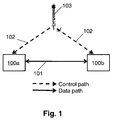
- the idea of device-to-device communication is illustrated in Fig. 1 , where two vehicles 100a and 100b communicate directly with each other via data path 101.
- the respective control path 102 is established via eNodeB 103.
- device-to-device communication has been proposed in 3GPP for offloading local data traffic from the mobile networks, it is currently not suited for vehicular communication.
- the present invention aims at refining device-to-device communication such that it can support vehicular communication efficiently.
- the present invention improves the network capacity so that LTE-based vehicular communication becomes more scalable in terms of load and attains low communication latency for the broadcast of periodic messages.
- peer-to-peer subframes For device-to-device communication, a new type of time subframes, denoted peer-to-peer subframes or P, is defined so that UEs can communicate directly with each other. Like the uplink and downlink subframes, the peer-to-peer subframes are controlled by the base station. However, once a P subframe is assigned to a UE, this UE can use this time slot to transmit its data to other UE(s) (in a unicast or broadcast fashion).
- Uplink-downlink configuration Downlink-to-Uplink Switch-point periodicity Subframe number 0 1 2 3 4 5 6 7 8 9 0 5 ms D S U U U D S U U U 1 5 ms D S U U D D S U U D 2 5 ms D S U D D D S U D D 3 10 ms D S U U U D D D D D D 4 10 ms D S U U D D D D D 5 10 ms D S U D D D D D D D D D 6 5 ms D S U U U U D S U U U D S U U D
- the base station assigns three subframes of a frame - subframes 7, 8 and 9 - as P subframes to UEs within its coverage area for the purpose of direct device-to-device communication.
- the base station divides its coverage into segments, i.e. their coverage area is partitioned into geographic zones, such that simultaneous transmissions in different segments/zones do not interfere with each other.
- the spatial reuse, and ultimately the cell capacity can be significantly increased. Since the messages exchanged among the UEs have only local importance, the UEs can use a low level of transmit power in the P subframes (as compared to the transmit power used in U subframes). As a result, further increase of the cell capacity can be achieved.
- the segments may be aligned according to geography locations. For instance, in the embodiment of Fig. 2 , the segments 200 are aligned along a street 201. For the purpose of simplification and clarity, only two segments 200a and 200b are depicted in Fig. 2 . It will be appreciated by those skilled in the art that in real scenarios the coverage area of a base station may be partitioned according to geography locations, e.g. along a street, into a plurality of segments, e.g. several tens or even hundreds of segments.
- a vehicle is assigned to a segment if it moves into a certain geographic area. For instance, in the situation illustrated in Fig. 2 , vehicles 202, 203 and 204 are assigned to segment 200a, whereas vehicles 205, 206 and 207 are assigned to segment 200b. Since the segments are bound to geographic locations and since the vehicles are moving, vehicles will be leaving the area of a certain segment and will enter into the area of another segment. For instance, assuming that the vehicles depicted in Fig. 2 move from left to right, vehicle 204 is about to leave segment 200a and will shortly afterwards enter into segment 200b.
- the base station treats each segment as an independent zone with regard to the assignment of the P subframes to the UEs. This means that the same P subframe can be assigned to different UEs if these UEs belong to different segments. Thus, spatial reuse is increased with the number of segments.
- FIG. 3 An illustration of the assignment of the P subframes in different segments is depicted in Fig. 3 . Same reference numerals denote the same components as in connection with Fig. 2 .
- a P subframe within segment 200a is assigned to vehicle 202 (as indicated by the darkened P subframe) and to vehicle 205 within segment 200b. Due to this assignment, vehicles 202 and 205 are enabled to transmit data, either in a unicast or in a broadcast fashion.
- the assignment of P subframes changes, as illustrated in the middle part of Fig. 3 , where a P subframe within segment 200a is assigned to vehicle 203 and within segment 200b to vehicle 206. Still later (illustrated in the lower part of Fig. 3 ), a P subframe within segment 200a is assigned to vehicle 204 and within segment 200b to vehicle 207.
- a P subframe may be assigned to multiple vehicles that belong to different segments as long as they are sufficiently far from each other such that their simultaneous transmissions do not interfere with each other.
- FIG. 4 An illustration of an embodiment of sliding scheduling is shown in Fig. 4 .
- same reference numerals denote the same components as in connection with Figs. 2 and 3 .
- the situation illustrated in the upper part of Fig. 4 corresponds with the illustrated in Fig. 2 .
- the problem arises that, e.g., vehicles 204 and 205 cannot communicate with each other, as mentioned above.
- the base station modifies the segmentation in order to alleviate this problem. More specifically, the depicted part of the street 201 is now covered by a total of three segments 200c, 200d, and 200e. Since vehicles 204 and 205 are now located in the same segment, which is segment 200d, they are enabled to communicate directly with each other.
- the base station After another time interval the base station returns to the previous segmentation with segments 200a and 200b, and, after the next time interval, it switches again to the segmentation with the three segments 200c, 200d, and 200e, etc.
- the period of sliding grouping is 2 and the sliding scheduling reduces to alternate grouping.
- more complex sliding schedules may be applied depending on the specific radio environment and traffic situation.
- sliding patterns of grouping/clustering vehicles can be determined by applying the following pseudo code for vehicles and a base station:
Landscapes
- Engineering & Computer Science (AREA)
- Computer Networks & Wireless Communication (AREA)
- Signal Processing (AREA)
- Mobile Radio Communication Systems (AREA)
Claims (15)
- Procédé de prise en charge de communications entre des véhicules dans un système de communications basé sur TDD comprenant au moins une station de base (103) et une pluralité de véhicules (202, 203, 204, 205, 206, 207) équipés de dispositifs de communication mobile,
dans lequel les ressources radio du système de communications sont réparties dans le temps en trames consécutives, les trames étant subdivisées en sous-trames de liaison descendante destinées à des transmissions d'une station de base vers les dispositifs de communication mobile et en sous-trames de liaison ascendante destinées à des transmissions des dispositifs de communication mobile vers une station de base (103),
dans lequel les trames comprennent en outre des sous-trames d'homologue à homologue attribuées à des dispositifs de communication mobile pour une communication directe entre des dispositifs de communication mobile, et
dans lequel une station de base (103) divise sa zone de couverture en segments (200) de telle manière que des transmissions simultanées dans la même sous-trame d'homologue à homologue effectuées dans différents segments (200) n'interfèrent pas les unes sur les autres,
caractérisé en ce que la station de base (103) gère une table de localisation permettant de suivre les positions actuelles des véhicules (202, 203, 204, 205, 206, 207) dans sa zone de couverture. - Procédé selon la revendication 1, dans lequel les sous-trames d'homologue à homologue sont organisées par la station de base (103).
- Procédé selon la revendication 1 ou 2, dans lequel des dispositifs de communication mobile transmettent à des intervalles de temps périodiques un message d'enregistrement à la station de base (103),
dans lequel chaque message d'enregistrement envoyé par un dispositif de communication mobile comprend de préférence un ID du véhicule auquel ledit dispositif de communication mobile est associé, la position dudit véhicule, la direction de déplacement dudit véhicule et/ou un horodatage. - Procédé selon l'une quelconque des revendications 1 à 3, dans lequel des dispositifs de communication mobile utilisent une puissance de transmission réduite pour les transmissions en sous-trames d'homologue à homologue, comparativement à la puissance de transmission utilisée pour les transmissions en sous-trames de liaison ascendante.
- Procédé selon l'une quelconque des revendications 1 à 4, dans lequel la station de base (103) traite chaque segment (200) comme une zone indépendante par rapport à l'attribution de sous-trames d'homologue à homologue à des dispositifs de communication mobile et/ou
dans lequel les segments (200) de la zone de couverture d'une station de base (103) sont alignés sur des rues (201). - Procédé selon l'une quelconque des revendications 1 à 5, dans lequel les segments (200) de la zone de couverture d'une station de base (103) sont créés sur la base de la situation actuelle en termes d'interférences dans le système de communications et/ou
dans lequel les segments (200) de la zone de couverture d'une station de base (103) sont créés d'une manière telle que des véhicules (202, 203, 204, 205, 206, 207) forment des grappes qui sont suffisamment distantes les unes des autres pour éviter toute interférence mutuelle et/ou
dans lequel des véhicules (202, 203, 204, 205, 206, 207) sont occasionnellement groupés en différents segments (200). - Procédé selon l'une quelconque des revendications 1 à 6, dans lequel une station de base (103) modifie de trame en trame la segmentation de sa zone de couverture et/ou
dans lequel une station de base (103) crée la segmentation de sa zone de couverture de manière dynamique en fonction de critères d'optimisation prédéfinis et/ou
dans lequel une station de base (103) crée la segmentation de sa zone de couverture en adaptant la taille des segments (200) à la densité locale des véhicules. - Procédé selon l'une quelconque des revendications 1 à 7, dans lequel des ensembles alternatifs de segments (200) sont définis, dans lequel une station de base (103) utilise pour chacune des trames de la station de base (103) un autre ensemble de segments (200) provenant desdits ensembles alternatifs de segments (200).
- Procédé selon l'une quelconque des revendications 1 à 8, dans lequel un transfert intercellulaire d'un véhicule depuis une station de base - la station de base actuelle - vers une autre station de base - la nouvelle station de base - comprend les étapes au cours desquelles
ladite station de base actuelle suit la position d'un véhicule,
ladite station de base actuelle informe ladite nouvelle station de base de la position actuelle du véhicule lorsqu'elle détecte que le véhicule va quitter sa zone de couverture,
la nouvelle station de base crée une entrée temporaire dans sa table de localisation correspondant au véhicule, et
la nouvelle station de base commence à attribuer des sous-trames d'homologue à homologue destinées au véhicule. - Système de communications basé sur TDD avec prise en charge des communications entre des véhicules comprenant au moins une station de base (103) et une pluralité de véhicules (202, 203, 204, 205, 206, 207) équipés de dispositifs de communication mobile,
dans lequel les ressources radio du système de communications sont réparties dans le temps en trames consécutives, les trames étant subdivisées en sous-trames de liaison descendante destinées à des transmissions d'une station de base (103) vers les dispositifs de communication mobile et en sous-trames de liaison ascendante destinées à des transmissions des dispositifs de communication mobile vers une station de base (103),
dans lequel ladite au moins une station de base (103) est conçue pour subdiviser davantage les trames en intégrant des sous-trames d'homologue à homologue attribuées à des dispositifs de communication mobile pour une communication directe entre des dispositifs de communication mobile et pour diviser sa zone de couverture en segments (200) de telle manière que des transmissions simultanées dans la même sous-trame d'homologue à homologue effectuées dans différents segments (200) n'interfèrent pas les unes sur les autres,
caractérisé en ce que ladite au moins une station de base (103) est en outre conçue pour gérer une table de localisation permettant de suivre les positions actuelles des véhicules (202, 203, 204, 205, 206, 207) dans sa zone de couverture. - Système de communications selon la revendication 10, dans lequel la station de base (103) est conçue pour organiser les sous-trames d'homologue à homologue.
- Système de communications selon la revendication 10 ou 11, dans lequel la station de base (103) est conçue pour traiter chaque segment (200) comme une zone indépendante par rapport à l'attribution de sous-trames d'homologue à homologue à des dispositifs de communication mobile et/ou
dans lequel la station de base (103) est conçue pour aligner les segments (200) sur des rues (201). - Système de communications selon l'une quelconque des revendications 10 à 12, dans lequel la station de base (103) est conçue pour créer les segments (200) sur la base de la situation actuelle en termes d'interférence dans le système de communications et/ou
dans lequel la station de base (103) est conçue pour créer les segments (200) d'une manière telle que des véhicules (202, 203, 204, 205, 206, 207) forment des grappes qui sont suffisamment distantes les unes des autres pour éviter toute interférence mutuelle et/ou
dans lequel la station de base (103) est conçue pour grouper occasionnellement des véhicules (202, 203, 204, 205, 206, 207) en différents segments (200). - Système de communications selon l'une quelconque des revendications 10 à 13, dans lequel la station de base (103) est conçue pour modifier de trame en trame la segmentation de sa zone de couverture et/ou
dans lequel la station de base (103) est conçue pour créer la segmentation de sa zone de couverture de manière dynamique en fonction de critères d'optimisation prédéfinis et/ou
dans lequel la station de base (103) est conçue pour créer la segmentation de sa zone de couverture en adaptant la taille des segments (200) à la densité locale des véhicules. - Station de base conçue pour un déploiement dans un système de communications basé sur TDD selon l'une quelconque des revendications 10 à 14, dans laquelle la station de base est conçue pour
subdiviser davantage les trames en intégrant des sous-trames d'homologue à homologue attribuées à des dispositifs de communication mobile pour une communication directe entre des dispositifs de communication mobile, et
diviser sa zone de couverture en segments (200) de telle manière que des transmissions simultanées dans la même sous-trame d'homologue à homologue effectuées dans différents segments (200) n'interfèrent pas les unes sur les autres,
caractérisée en ce que la station de base est en outre conçue pour gérer une table de localisation permettant de suivre les positions actuelles des véhicules (202, 203, 204, 205, 206, 207) dans sa zone de couverture.
Applications Claiming Priority (1)
| Application Number | Priority Date | Filing Date | Title |
|---|---|---|---|
| PCT/EP2012/057193 WO2013156072A1 (fr) | 2012-04-19 | 2012-04-19 | Procédé de prise en charge de communications entre des véhicules dans un système de communications basé sur tdd, et système de communications basé sur tdd |
Publications (2)
| Publication Number | Publication Date |
|---|---|
| EP2801230A1 EP2801230A1 (fr) | 2014-11-12 |
| EP2801230B1 true EP2801230B1 (fr) | 2016-11-09 |
Family
ID=46246034
Family Applications (1)
| Application Number | Title | Priority Date | Filing Date |
|---|---|---|---|
| EP12726749.0A Not-in-force EP2801230B1 (fr) | 2012-04-19 | 2012-04-19 | Procédé de prise en charge de communications entre des véhicules dans un système de communications basé sur tdd, et système de communications basé sur tdd |
Country Status (2)
| Country | Link |
|---|---|
| EP (1) | EP2801230B1 (fr) |
| WO (1) | WO2013156072A1 (fr) |
Cited By (1)
| Publication number | Priority date | Publication date | Assignee | Title |
|---|---|---|---|---|
| WO2019156266A1 (fr) * | 2018-02-09 | 2019-08-15 | 엘지전자(주) | Dispositif de communication v2x et procédé de communication v2x d'un dispositif de communication v2x |
Families Citing this family (4)
| Publication number | Priority date | Publication date | Assignee | Title |
|---|---|---|---|---|
| KR102179098B1 (ko) * | 2014-07-11 | 2020-11-16 | 현대자동차주식회사 | Lte-tdd 기반의 차량간 통신 방법 |
| CN105516214B (zh) * | 2014-09-22 | 2020-05-15 | 电信科学技术研究院 | 一种车联网系统中的信息上报和资源分配方法、装置 |
| CN106162736B (zh) * | 2016-06-22 | 2021-12-21 | 江苏迪纳数字科技股份有限公司 | 面向车联网的自适应的介质访问控制方法 |
| EP4107863A4 (fr) * | 2020-02-20 | 2024-08-28 | ATC Technologies, LLC | Concept d'opérations de réseau cdma-ia et couche de contrôle d'accès au support (mac) |
Family Cites Families (3)
| Publication number | Priority date | Publication date | Assignee | Title |
|---|---|---|---|---|
| EP1389856A1 (fr) * | 2002-08-13 | 2004-02-18 | Siemens Aktiengesellschaft | Procède d'allocation de ressources de radio dans un système de radiocommunication ad-hoc |
| JP5245522B2 (ja) * | 2008-05-07 | 2013-07-24 | 富士通株式会社 | 無線リソース割当装置、無線リソース割当システムおよび無線リソース割当方法 |
| EP2534907A1 (fr) * | 2010-02-11 | 2012-12-19 | Nokia Siemens Networks Oy | Contrôle de dispositifs de communication |
-
2012
- 2012-04-19 WO PCT/EP2012/057193 patent/WO2013156072A1/fr not_active Ceased
- 2012-04-19 EP EP12726749.0A patent/EP2801230B1/fr not_active Not-in-force
Cited By (1)
| Publication number | Priority date | Publication date | Assignee | Title |
|---|---|---|---|---|
| WO2019156266A1 (fr) * | 2018-02-09 | 2019-08-15 | 엘지전자(주) | Dispositif de communication v2x et procédé de communication v2x d'un dispositif de communication v2x |
Also Published As
| Publication number | Publication date |
|---|---|
| EP2801230A1 (fr) | 2014-11-12 |
| WO2013156072A1 (fr) | 2013-10-24 |
Similar Documents
| Publication | Publication Date | Title |
|---|---|---|
| US11671880B2 (en) | Wireless telecommunications system, terminal device, infrastructure equipment, integrated circuitry and methods | |
| CN104981021B (zh) | 一种车联网系统中的资源调度方法和设备 | |
| Gupta et al. | Medium access control protocols for safety applications in Vehicular Ad-Hoc Network: A classification and comprehensive survey | |
| Tung et al. | A cluster based architecture for intersection collision avoidance using heterogeneous networks | |
| US8843143B2 (en) | Wireless base station and mobile station | |
| US10879963B2 (en) | Method and device for configuring a single frequency network | |
| CN103002501A (zh) | 一种移动中继的实现方法及系统 | |
| CN108029125A (zh) | 一种通信设备以及用于v2x通信的方法 | |
| EP2801230B1 (fr) | Procédé de prise en charge de communications entre des véhicules dans un système de communications basé sur tdd, et système de communications basé sur tdd | |
| US20180234800A1 (en) | Local and global message distribution policy in an intelligent transport system using wireless communications | |
| KR102824846B1 (ko) | 무선 자원 할당을 위한 방법 및 장치 | |
| CN103517280B (zh) | 适用于无定形节点网络中干扰抑制的半静态频率复用方法 | |
| Ye et al. | Mobility management for LTE-based heterogeneous vehicular network in V2X scenario | |
| Yang et al. | Mobility management in VANET | |
| Lakshminarasimhan et al. | C-V2X resource deployment architecture based on moving network convoys | |
| Ayoob et al. | Hybrid LTE-VANETs based optimal radio access selection | |
| Mohammed et al. | Hybrid LTE-VANETs based optimal radio access selection | |
| Ali et al. | Performance enhancement of C-V2X mode-3 with smart handover and wide area DENM propagation | |
| JP5717094B2 (ja) | セルラーワイヤレスネットワークにおける移動局間直接通信 | |
| US20260067703A1 (en) | Channel access blocking reduction for a sidelink communication on resources of an unlicensed spectrum | |
| Ali et al. | Load balancing C-V2X Mode-3 with overlapping cell architecture and smart handover | |
| Ali et al. | Hybrid LTE-VANETs Based Optimal Radio Access Selection |
Legal Events
| Date | Code | Title | Description |
|---|---|---|---|
| PUAI | Public reference made under article 153(3) epc to a published international application that has entered the european phase |
Free format text: ORIGINAL CODE: 0009012 |
|
| 17P | Request for examination filed |
Effective date: 20140805 |
|
| AK | Designated contracting states |
Kind code of ref document: A1 Designated state(s): AL AT BE BG CH CY CZ DE DK EE ES FI FR GB GR HR HU IE IS IT LI LT LU LV MC MK MT NL NO PL PT RO RS SE SI SK SM TR |
|
| RIN1 | Information on inventor provided before grant (corrected) |
Inventor name: MAEDER, ANDREAS Inventor name: LE, LONG |
|
| DAX | Request for extension of the european patent (deleted) | ||
| 17Q | First examination report despatched |
Effective date: 20151019 |
|
| RIC1 | Information provided on ipc code assigned before grant |
Ipc: H04W 72/04 20090101AFI20160205BHEP Ipc: H04W 76/02 20090101ALN20160205BHEP |
|
| GRAP | Despatch of communication of intention to grant a patent |
Free format text: ORIGINAL CODE: EPIDOSNIGR1 |
|
| INTG | Intention to grant announced |
Effective date: 20160624 |
|
| GRAS | Grant fee paid |
Free format text: ORIGINAL CODE: EPIDOSNIGR3 |
|
| GRAA | (expected) grant |
Free format text: ORIGINAL CODE: 0009210 |
|
| RAP1 | Party data changed (applicant data changed or rights of an application transferred) |
Owner name: NEC CORPORATION |
|
| AK | Designated contracting states |
Kind code of ref document: B1 Designated state(s): AL AT BE BG CH CY CZ DE DK EE ES FI FR GB GR HR HU IE IS IT LI LT LU LV MC MK MT NL NO PL PT RO RS SE SI SK SM TR |
|
| REG | Reference to a national code |
Ref country code: GB Ref legal event code: FG4D |
|
| REG | Reference to a national code |
Ref country code: AT Ref legal event code: REF Ref document number: 844930 Country of ref document: AT Kind code of ref document: T Effective date: 20161115 Ref country code: CH Ref legal event code: EP |
|
| REG | Reference to a national code |
Ref country code: IE Ref legal event code: FG4D |
|
| REG | Reference to a national code |
Ref country code: DE Ref legal event code: R096 Ref document number: 602012025142 Country of ref document: DE |
|
| PG25 | Lapsed in a contracting state [announced via postgrant information from national office to epo] |
Ref country code: LV Free format text: LAPSE BECAUSE OF FAILURE TO SUBMIT A TRANSLATION OF THE DESCRIPTION OR TO PAY THE FEE WITHIN THE PRESCRIBED TIME-LIMIT Effective date: 20161109 |
|
| REG | Reference to a national code |
Ref country code: LT Ref legal event code: MG4D |
|
| REG | Reference to a national code |
Ref country code: NL Ref legal event code: MP Effective date: 20161109 |
|
| REG | Reference to a national code |
Ref country code: AT Ref legal event code: MK05 Ref document number: 844930 Country of ref document: AT Kind code of ref document: T Effective date: 20161109 |
|
| REG | Reference to a national code |
Ref country code: FR Ref legal event code: PLFP Year of fee payment: 6 |
|
| PG25 | Lapsed in a contracting state [announced via postgrant information from national office to epo] |
Ref country code: NO Free format text: LAPSE BECAUSE OF FAILURE TO SUBMIT A TRANSLATION OF THE DESCRIPTION OR TO PAY THE FEE WITHIN THE PRESCRIBED TIME-LIMIT Effective date: 20170209 Ref country code: LT Free format text: LAPSE BECAUSE OF FAILURE TO SUBMIT A TRANSLATION OF THE DESCRIPTION OR TO PAY THE FEE WITHIN THE PRESCRIBED TIME-LIMIT Effective date: 20161109 Ref country code: SE Free format text: LAPSE BECAUSE OF FAILURE TO SUBMIT A TRANSLATION OF THE DESCRIPTION OR TO PAY THE FEE WITHIN THE PRESCRIBED TIME-LIMIT Effective date: 20161109 Ref country code: NL Free format text: LAPSE BECAUSE OF FAILURE TO SUBMIT A TRANSLATION OF THE DESCRIPTION OR TO PAY THE FEE WITHIN THE PRESCRIBED TIME-LIMIT Effective date: 20161109 Ref country code: GR Free format text: LAPSE BECAUSE OF FAILURE TO SUBMIT A TRANSLATION OF THE DESCRIPTION OR TO PAY THE FEE WITHIN THE PRESCRIBED TIME-LIMIT Effective date: 20170210 |
|
| PG25 | Lapsed in a contracting state [announced via postgrant information from national office to epo] |
Ref country code: ES Free format text: LAPSE BECAUSE OF FAILURE TO SUBMIT A TRANSLATION OF THE DESCRIPTION OR TO PAY THE FEE WITHIN THE PRESCRIBED TIME-LIMIT Effective date: 20161109 Ref country code: HR Free format text: LAPSE BECAUSE OF FAILURE TO SUBMIT A TRANSLATION OF THE DESCRIPTION OR TO PAY THE FEE WITHIN THE PRESCRIBED TIME-LIMIT Effective date: 20161109 Ref country code: AT Free format text: LAPSE BECAUSE OF FAILURE TO SUBMIT A TRANSLATION OF THE DESCRIPTION OR TO PAY THE FEE WITHIN THE PRESCRIBED TIME-LIMIT Effective date: 20161109 Ref country code: PL Free format text: LAPSE BECAUSE OF FAILURE TO SUBMIT A TRANSLATION OF THE DESCRIPTION OR TO PAY THE FEE WITHIN THE PRESCRIBED TIME-LIMIT Effective date: 20161109 Ref country code: FI Free format text: LAPSE BECAUSE OF FAILURE TO SUBMIT A TRANSLATION OF THE DESCRIPTION OR TO PAY THE FEE WITHIN THE PRESCRIBED TIME-LIMIT Effective date: 20161109 Ref country code: RS Free format text: LAPSE BECAUSE OF FAILURE TO SUBMIT A TRANSLATION OF THE DESCRIPTION OR TO PAY THE FEE WITHIN THE PRESCRIBED TIME-LIMIT Effective date: 20161109 Ref country code: PT Free format text: LAPSE BECAUSE OF FAILURE TO SUBMIT A TRANSLATION OF THE DESCRIPTION OR TO PAY THE FEE WITHIN THE PRESCRIBED TIME-LIMIT Effective date: 20170309 Ref country code: IS Free format text: LAPSE BECAUSE OF FAILURE TO SUBMIT A TRANSLATION OF THE DESCRIPTION OR TO PAY THE FEE WITHIN THE PRESCRIBED TIME-LIMIT Effective date: 20170309 |
|
| PG25 | Lapsed in a contracting state [announced via postgrant information from national office to epo] |
Ref country code: SK Free format text: LAPSE BECAUSE OF FAILURE TO SUBMIT A TRANSLATION OF THE DESCRIPTION OR TO PAY THE FEE WITHIN THE PRESCRIBED TIME-LIMIT Effective date: 20161109 Ref country code: RO Free format text: LAPSE BECAUSE OF FAILURE TO SUBMIT A TRANSLATION OF THE DESCRIPTION OR TO PAY THE FEE WITHIN THE PRESCRIBED TIME-LIMIT Effective date: 20161109 Ref country code: DK Free format text: LAPSE BECAUSE OF FAILURE TO SUBMIT A TRANSLATION OF THE DESCRIPTION OR TO PAY THE FEE WITHIN THE PRESCRIBED TIME-LIMIT Effective date: 20161109 Ref country code: CZ Free format text: LAPSE BECAUSE OF FAILURE TO SUBMIT A TRANSLATION OF THE DESCRIPTION OR TO PAY THE FEE WITHIN THE PRESCRIBED TIME-LIMIT Effective date: 20161109 Ref country code: EE Free format text: LAPSE BECAUSE OF FAILURE TO SUBMIT A TRANSLATION OF THE DESCRIPTION OR TO PAY THE FEE WITHIN THE PRESCRIBED TIME-LIMIT Effective date: 20161109 |
|
| REG | Reference to a national code |
Ref country code: DE Ref legal event code: R097 Ref document number: 602012025142 Country of ref document: DE |
|
| PG25 | Lapsed in a contracting state [announced via postgrant information from national office to epo] |
Ref country code: IT Free format text: LAPSE BECAUSE OF FAILURE TO SUBMIT A TRANSLATION OF THE DESCRIPTION OR TO PAY THE FEE WITHIN THE PRESCRIBED TIME-LIMIT Effective date: 20161109 Ref country code: BG Free format text: LAPSE BECAUSE OF FAILURE TO SUBMIT A TRANSLATION OF THE DESCRIPTION OR TO PAY THE FEE WITHIN THE PRESCRIBED TIME-LIMIT Effective date: 20170209 Ref country code: SM Free format text: LAPSE BECAUSE OF FAILURE TO SUBMIT A TRANSLATION OF THE DESCRIPTION OR TO PAY THE FEE WITHIN THE PRESCRIBED TIME-LIMIT Effective date: 20161109 Ref country code: BE Free format text: LAPSE BECAUSE OF FAILURE TO SUBMIT A TRANSLATION OF THE DESCRIPTION OR TO PAY THE FEE WITHIN THE PRESCRIBED TIME-LIMIT Effective date: 20161109 |
|
| PLBE | No opposition filed within time limit |
Free format text: ORIGINAL CODE: 0009261 |
|
| STAA | Information on the status of an ep patent application or granted ep patent |
Free format text: STATUS: NO OPPOSITION FILED WITHIN TIME LIMIT |
|
| 26N | No opposition filed |
Effective date: 20170810 |
|
| PG25 | Lapsed in a contracting state [announced via postgrant information from national office to epo] |
Ref country code: SI Free format text: LAPSE BECAUSE OF FAILURE TO SUBMIT A TRANSLATION OF THE DESCRIPTION OR TO PAY THE FEE WITHIN THE PRESCRIBED TIME-LIMIT Effective date: 20161109 |
|
| REG | Reference to a national code |
Ref country code: CH Ref legal event code: PL |
|
| REG | Reference to a national code |
Ref country code: IE Ref legal event code: MM4A |
|
| PG25 | Lapsed in a contracting state [announced via postgrant information from national office to epo] |
Ref country code: MC Free format text: LAPSE BECAUSE OF FAILURE TO SUBMIT A TRANSLATION OF THE DESCRIPTION OR TO PAY THE FEE WITHIN THE PRESCRIBED TIME-LIMIT Effective date: 20161109 |
|
| PG25 | Lapsed in a contracting state [announced via postgrant information from national office to epo] |
Ref country code: CH Free format text: LAPSE BECAUSE OF NON-PAYMENT OF DUE FEES Effective date: 20170430 Ref country code: LU Free format text: LAPSE BECAUSE OF NON-PAYMENT OF DUE FEES Effective date: 20170419 Ref country code: LI Free format text: LAPSE BECAUSE OF NON-PAYMENT OF DUE FEES Effective date: 20170430 |
|
| REG | Reference to a national code |
Ref country code: FR Ref legal event code: PLFP Year of fee payment: 7 |
|
| PG25 | Lapsed in a contracting state [announced via postgrant information from national office to epo] |
Ref country code: IE Free format text: LAPSE BECAUSE OF NON-PAYMENT OF DUE FEES Effective date: 20170419 |
|
| PG25 | Lapsed in a contracting state [announced via postgrant information from national office to epo] |
Ref country code: MT Free format text: LAPSE BECAUSE OF NON-PAYMENT OF DUE FEES Effective date: 20170419 |
|
| PG25 | Lapsed in a contracting state [announced via postgrant information from national office to epo] |
Ref country code: HU Free format text: LAPSE BECAUSE OF FAILURE TO SUBMIT A TRANSLATION OF THE DESCRIPTION OR TO PAY THE FEE WITHIN THE PRESCRIBED TIME-LIMIT; INVALID AB INITIO Effective date: 20120419 |
|
| PG25 | Lapsed in a contracting state [announced via postgrant information from national office to epo] |
Ref country code: CY Free format text: LAPSE BECAUSE OF FAILURE TO SUBMIT A TRANSLATION OF THE DESCRIPTION OR TO PAY THE FEE WITHIN THE PRESCRIBED TIME-LIMIT Effective date: 20161109 |
|
| PG25 | Lapsed in a contracting state [announced via postgrant information from national office to epo] |
Ref country code: MK Free format text: LAPSE BECAUSE OF FAILURE TO SUBMIT A TRANSLATION OF THE DESCRIPTION OR TO PAY THE FEE WITHIN THE PRESCRIBED TIME-LIMIT Effective date: 20161109 |
|
| PG25 | Lapsed in a contracting state [announced via postgrant information from national office to epo] |
Ref country code: TR Free format text: LAPSE BECAUSE OF FAILURE TO SUBMIT A TRANSLATION OF THE DESCRIPTION OR TO PAY THE FEE WITHIN THE PRESCRIBED TIME-LIMIT Effective date: 20161109 |
|
| PG25 | Lapsed in a contracting state [announced via postgrant information from national office to epo] |
Ref country code: AL Free format text: LAPSE BECAUSE OF FAILURE TO SUBMIT A TRANSLATION OF THE DESCRIPTION OR TO PAY THE FEE WITHIN THE PRESCRIBED TIME-LIMIT Effective date: 20161109 |
|
| PGFP | Annual fee paid to national office [announced via postgrant information from national office to epo] |
Ref country code: FR Payment date: 20210310 Year of fee payment: 10 |
|
| PGFP | Annual fee paid to national office [announced via postgrant information from national office to epo] |
Ref country code: GB Payment date: 20210324 Year of fee payment: 10 |
|
| PGFP | Annual fee paid to national office [announced via postgrant information from national office to epo] |
Ref country code: DE Payment date: 20210323 Year of fee payment: 10 |
|
| REG | Reference to a national code |
Ref country code: DE Ref legal event code: R119 Ref document number: 602012025142 Country of ref document: DE |
|
| GBPC | Gb: european patent ceased through non-payment of renewal fee |
Effective date: 20220419 |
|
| PG25 | Lapsed in a contracting state [announced via postgrant information from national office to epo] |
Ref country code: GB Free format text: LAPSE BECAUSE OF NON-PAYMENT OF DUE FEES Effective date: 20220419 Ref country code: FR Free format text: LAPSE BECAUSE OF NON-PAYMENT OF DUE FEES Effective date: 20220430 Ref country code: DE Free format text: LAPSE BECAUSE OF NON-PAYMENT OF DUE FEES Effective date: 20221103 |