EP2801338A2 - Brosse à dents électrique dotée de dispositifs accessoires - Google Patents
Brosse à dents électrique dotée de dispositifs accessoires Download PDFInfo
- Publication number
- EP2801338A2 EP2801338A2 EP14001568.6A EP14001568A EP2801338A2 EP 2801338 A2 EP2801338 A2 EP 2801338A2 EP 14001568 A EP14001568 A EP 14001568A EP 2801338 A2 EP2801338 A2 EP 2801338A2
- Authority
- EP
- European Patent Office
- Prior art keywords
- toothbrush
- glass
- display device
- charging station
- combination according
- Prior art date
- Legal status (The legal status is an assumption and is not a legal conclusion. Google has not performed a legal analysis and makes no representation as to the accuracy of the status listed.)
- Granted
Links
Images


Classifications
-
- A—HUMAN NECESSITIES
- A61—MEDICAL OR VETERINARY SCIENCE; HYGIENE
- A61C—DENTISTRY; APPARATUS OR METHODS FOR ORAL OR DENTAL HYGIENE
- A61C17/00—Devices for cleaning, polishing, rinsing or drying teeth, teeth cavities or prostheses; Saliva removers; Dental appliances for receiving spittle
- A61C17/16—Power-driven cleaning or polishing devices
- A61C17/22—Power-driven cleaning or polishing devices with brushes, cushions, cups, or the like
- A61C17/221—Control arrangements therefor
-
- A—HUMAN NECESSITIES
- A61—MEDICAL OR VETERINARY SCIENCE; HYGIENE
- A61C—DENTISTRY; APPARATUS OR METHODS FOR ORAL OR DENTAL HYGIENE
- A61C17/00—Devices for cleaning, polishing, rinsing or drying teeth, teeth cavities or prostheses; Saliva removers; Dental appliances for receiving spittle
- A61C17/16—Power-driven cleaning or polishing devices
- A61C17/22—Power-driven cleaning or polishing devices with brushes, cushions, cups, or the like
- A61C17/224—Electrical recharging arrangements
Definitions
- the present invention relates to a combination of an electric toothbrush with one or more accessory devices, wherein the one or one of the accessory devices is a toothbrush glass.
- An electric toothbrush (hereinafter sometimes referred to only as a "toothbrush”) of the presently considered type has a handpiece which is gripped during use by hand and with which the toothbrush is guided.
- the toothbrush may further comprise a removable brush head on which the bristles are arranged.
- the brush head is connected by a releasable connection, generally a frictional or positive, in particular latching connector with the handpiece and can after a certain period of use - for example, every three months or depending on the degree of wear - be easily replaced.
- a charging station may be provided, to which the toothbrush is coupled and via which an existing in the toothbrush battery, which serves to power the toothbrush, can be charged. Charging generally takes place inductively.
- the toothbrush may, for example, have a pressure sensor for the strength of the pressure exerted on the teeth during cleaning, or a timer for monitoring the recommended cleaning time, be it individually or individually for each quadrant of the dentition.
- the toothbrush can monitor the charge status of your battery.
- the brush attachment can also have means by which the handpiece can recognize the brush attachment, in particular wirelessly, and thus determine, for example, the useful life of the brush attachment. for example, an RFID tag.
- the numerous functions of the electric toothbrush result in a wealth of information to be communicated to the user before, during or after brushing.
- these include, for example, the currently selected program, the instantaneous pressure strength, the current toothbrush duration, the charge status of the rechargeable battery or the recommended time for a replacement of the brush head.
- the selection of the cleaning program can be difficult to control via a visual display on the handpiece when the toothbrush is in use in the mouth of the user, or the control must be made awkward on the mirror image of the toothbrush in the bathroom mirror.
- non-optical display forms are also used.
- the expiration of the recommended cleaning time in total or in quadrants is often signaled to the user by a brief interruption ("stuttering") of the toothbrush drive.
- stuttering a brief interruption
- only a very low information density can be achieved.
- constant information of the user about the exact remaining time until the recommended cleaning time can not be achieved thereby.
- the WO 2008/060482 A2 proposes to solve this problem, a separate from the toothbrush display, for example in the form of an LCD (liquid crystal display), wherein a data transmission connection between the toothbrush and the display consists.
- the display is designed as a standalone device and can be attached, for example, to a mirror, on a work surface or console or on a bathroom cabinet.
- the present invention is based on the object to provide an alternative arrangement with an electric toothbrush and a display device.
- the invention provides for a combination of an electric toothbrush with one or more accessory devices, wherein the one or one of the accessory devices is a toothbrush glass and the toothbrush glass has at least one display device.
- toothbrush glass is understood to mean a cup-shaped container, which is used in particular for rinsing the mouth after brushing.
- a toothbrush glass is preferably made of glass, plastic or metal, but can also be made of other materials.
- the toothbrush glass is completely or partially transparent.
- An embodiment of the dentifrice glass made of a very stable material also increases the attractiveness for the user, since this does not have to worry that the provided with the display device and therefore possibly quite expensive toothbrush glass is destroyed, for example, when it falls on a sink or on a tile floor, which would be very likely in a version made of glass or a brittle plastic.
- the dentifrice glass have a dirt-repellent surface or a corresponding coating, for example by a so-called “self-cleaning effect” or “lotus effect”, so that the recognizability of the display device is not limited by the deposits formed during use of the dentifrice glass, such as or limescale or toothpaste residue is impaired.
- the display device It is particularly preferred to pour the display device into the material of the toothbrush glass in order to enclose it in a water-tight and airtight manner and to protect it against mechanical stresses.
- the toothbrush glass and the display device are preferably also heat-resistant. This makes it possible that the toothbrush glass can be cleaned with the display device, for example in the dishwasher.
- a display device is a device for the visual display of information and / or other visual representations.
- Other visual representations also include those visual representations that serve exclusively or predominantly for illumination purposes.
- the display device may consist of a single or multiple, separate elements, for example, one or more luminous points or surfaces.
- the display device consists of a continuous surface, which is usually referred to as a screen or display.
- This area may again comprise individual, discrete display elements such as symbols, in particular numbers, letters or other characters, or symbols composed of several subelements such as strokes ("segment display", for digits in particular "7-segment display”).
- the surface can also be covered continuously with display elements, for example in the form of a matrix of individual pixels.
- LED inorganic light-emitting diodes
- OLED organic light emitting diodes
- LCD liquid crystal displays
- monochromatic and multicolor display devices are conceivable, wherein the latter, the color pixels are formed, for example, in the usual manner from three subpixels of different colors.
- a toothbrush glass is generally present anyway in the environment of use of a toothbrush, both electric and manual, no additional accessory device, such as a separate display, has to be provided in this way. This is desirable for both aesthetic reasons and hygienic, since in this way no further object is added to the bathroom, which itself must be cleaned and / or before cleaning the object to which the display is attached - for example, the bathroom mirror - only must be removed.
- the display device can be designed so that it is almost or completely invisible when not in use when integrated into the toothbrush glass.
- a dentifrice glass as a support for a display device is advantageous because it offers a relatively large area compared to a toothbrush, which can be used as a display surface.
- the display of all or some of such information related to the toothbrush on the display significantly increases the comfort of the user.
- the display of the currently selected cleaning program on the display device solves the problem that the user can not see a display for the cleaning program on the handpiece of the toothbrush while the toothbrush is in his mouth.
- the display device is integrated in a side wall and / or in the bottom of the dentifrice glass. This makes it possible to use a relatively large area for the display device.
- the information displayed on the display device are aligned perpendicular or nearly vertical and easy to read, especially at a flat viewing angle with respect to the horizontal.
- the information displayed on the display device are arranged horizontally or almost horizontally and in particular at a steep viewing angle with respect to the horizontal well readable.
- At least a part of the display device can be integrated in a side wall and at least one part in the bottom of the dentifrice glass.
- the display device is arranged in a, in particular substantially cylindrical or frustoconical, side wall of the dentifrice glass completely or partially circumferentially.
- circumferential is meant a looping around the toothbrush glass in at least one plane running parallel to its bottom.
- a completely encircling indicator therefore closes on the circumference of the dentifrice glass and thus has a tubular or tubular shape, which may be, for example, cylindrical or frusto-conical according to the side wall of the dentifrice glass.
- a peripheral display device thus has no planar shape, as usual in conventional displays, but preferably a curved shape and / or a shape with at least a kink.
- the peripheral display device is preferably manufactured in such a way that the observer barely or not at all perceives a possible joint formed during its production from a planar, sheet-shaped display device, so that information such as writing or graphics can also be displayed over this joint and thus in Circumferentially infinitely and without interruption are displaced. As a result, special visual effects such as a rotating or a spirally moving font are possible.
- the display device can also be arranged non-circulating, in particular only on a part of the side surface of the toothbrush glass.
- the dentifrice glass has the shape of a prism or a truncated pyramid with a substantially n-angular cross-section and with n substantially planar side surfaces, where n is 4, 5 or 6, for example.
- the display device may then have n separate sub-surfaces, which are each arranged on one of the n side surfaces of the dentifrice glass.
- the display device can also be arranged only on one or more, but not on all n side surfaces of the toothbrush glass.
- the display device In the case of a toothbrush glass with a substantially quadrangular cross-section, it may be sufficient, for example, to arrange the display device only on one of the four side surfaces, the toothbrush glass then having to be positioned so that the user can easily see the side surface with the display device.
- the information displayed on the display device can be recognized on the outside and / or on the inside of the dentifrice glass.
- the toothbrush glass is completely or partially transparent and has a display device which can be seen both from its inside and from its outside. Then, the information on the display device in one of the two alternatives can be simply displayed in mirror image in order to achieve a correct page visibility from the page in question (inside and outside of Zahnputzglases).
- the toothbrush glass preferably has two display devices, of which one can be seen from the inside and one from the outside.
- An intransparent layer or the non-transparent material of the toothbrush glass is then preferably arranged between the two display devices in order to prevent the information displayed on one of the display devices from showing through to the other side of the dentifrice glass and thus an undesired overlay of the information displayed on the two display devices.
- information can be displayed simultaneously on only one display device or on both display devices, each of which can be recognized in the correct direction.
- the toothbrush glass preferably has a display device which can only be seen from the inside or only from the outside. In this case, it is already determined by the manufacture of the toothbrush glass, from which side the information displayed on the display device can be seen in the correct side.
- Both a laterally correct representation of information on the inside and on the outside of the dentifrice glass can be advantageous, depending on the position in which the toothbrush glass is placed during the presentation of the information relative to the user and from which angle from the user viewing the display accordingly. If the viewing angle relative to the horizontal is relatively flat, the front outside of the toothbrush glass can be seen particularly well. If, on the other hand, the viewing angle relative to the horizontal is relatively steep, then the rear inside of the toothbrush glass can be seen particularly well. This applies to a dentifrice glass with vertical walls, but in particular also for a dentifrice glass with upwardly outwardly inclined walls, since in this case the angles between the viewing direction and the front and the rear wall of the dentifrice glass are different.
- the information displayed on the display device can also be scaled, in particular vertically and / or horizontally stretched or compressed, and / or equalized.
- scaling it can be achieved that the user perceives the information again approximately with the correct proportions at an expected non-vertical angle on the toothbrush glass, for example from diagonally above.
- curvatures, especially different curvatures, in the surface of the dentifrice glass for the perception of information by the user can be at least partially compensated again.
- the accessories include a toothbrush glass and a charging station, wherein the toothbrush is chargeable by the charging station and the toothbrush is in the toothbrush glass during the charging process.
- Charging generally takes place by inductive energy transfer from at least one primary coil arranged in the charging station to at least one secondary coil arranged in the electric toothbrush, the energy transfer preferably taking place through the toothbrush glass.
- the toothbrush glass is preferably made of a non-magnetic and non-electrically conductive material such as glass or plastic.
- a combination of an electric toothbrush, an associated charging station and a toothbrush glass, wherein the toothbrush is chargeable by the charging station and the toothbrush is in the toothbrush glass during the charging process, is in particular from DE 296 18 742 U1 , of the DE 10 2007 053 985 A1 and the WO 2012/085819 A1 known and also available as a product on the market.
- the display device draws energy for their operation from the charging station.
- the display device does not need to have its own power supply, in particular via its own power supply, in contrast to a conventional separate display, which has its own power supply, for example in the form of a rechargeable or non-rechargeable battery or a power supply.
- a conventional separate display which has its own power supply, for example in the form of a rechargeable or non-rechargeable battery or a power supply.
- the latter leads to increased maintenance for the user, who needs to charge or replace the battery regularly, or to another cable for connection to a power outlet.
- the combination proposed in the present variant does not work - again in contrast to a separate display or to a separate charging station for the electric toothbrush - like a "foreign body" in the bathroom, which it is aesthetic and / or hygienic reasons or because of the necessary maintenance as possible to avoid.
- the toothbrush glass in this variant preferably has a further secondary coil, via which inductive energy is transmitted from the already existing, generated by the charging station magnetic energy to the toothbrush glass.
- This secondary coil is preferably arranged in the bottom or in the sidewall of the dentifrice glass, wherein a central axis of the secondary coil preferably coincides substantially with a central axis of the dentifrice glass, and preferably has approximately the same diameter as the dentifrice glass itself.
- the conversion of the energy inductively transferred to the toothbrush glass into a suitable voltage, in particular a DC voltage, for supplying the display device is similar to that known from an electric toothbrush, for example by rectification and smoothing of a high-frequency alternating voltage generated by the secondary coil.
- a power supply for the display device in the toothbrush glass can be realized in a simple manner, which manages in particular without moving or exchangeable components, for example a battery.
- the secondary coil and the necessary electronics can - like the display itself - also be poured into the material of the dentifrice glass and are thus water and airtight and maintenance-free enclosed in the dentifrice glass.
- the toothbrush glass with the charging station is detachably connectable and the toothbrush glass in the connected state with the charging station relative to the charging station movable, in particular rotatable.
- the toothbrush glass and / or the charging station detection means in particular at least one sensor and / or at least one marking element, which are adapted to detect the position and / or orientation of the dentifrice glass, in particular its rotational position, relative to the charging station.
- At least one sensor is preferably arranged on or in the toothbrush glass and at least one marking element is arranged on or in the loading station, wherein the marking element is preferably mounted circumferentially near the circumference of the charging station and wherein the marking element can be recognized by the sensor. But it can also be reversed the marking element on or in the dentifrice glass and the sensor be mounted on or in the charging station.
- the toothbrush glass In a charging station fixed relative to the environment, the toothbrush glass thus recognizes its position, in particular its rotational position, relative to the surroundings as soon as a reference position is known to it by the recognition means.
- the toothbrush glass can detect in this way whether the display device or certain parts thereof are aligned so that the user can recognize them.
- the display device can be controlled so that the displayed information for the user are arranged clearly recognizable, preferably approximately perpendicular to the expected due to the placement of the dentifrice viewing direction of the user.
- the display device is arranged circumferentially, in particular in the case of a cylindrical or conical toothbrush glass, the information can simply be displayed in the area which faces the user, wherein this area can preferably be determined steplessly.
- the display device In the case of, for example, a prismatic toothbrush glass, for example, having a substantially quadrangular cross section and having four substantially planar side surfaces, the display device, however, four separate sub-areas, which are each arranged on a side surface of the dentifrice glass have.
- a partial area can be selected by the automatic detection of the rotational position of the dentifrice glass, on which the information to be displayed is best visible to the user, preferably that partial area which faces the user the most.
- a mechanical marking element provided, for example in the form of a circumferential groove or a circumferential ridge whose depth or height changes continuously or stepwise.
- a sensor in the form of a spring-loaded in the direction of the charging station element is arranged on the underside of Zahnputzglases, for example, a ball that slides or rolls in the groove or on the web on the loading station.
- a plurality of marking elements for example in the form of mutually spaced marks with a specific physical property, which are circumferentially mounted on the toothbrush glass or on the charging station.
- the sensor then generates individual pulses when passing the marks, which are counted and from which the angle of rotation of the toothbrush glass can be determined.
- a particular marking element is preferably designed as a reference marking element, in that it is arranged at a specific reference position and possesses a different strength of the physical property used than the other marking elements.
- the sensor When painting over the Referenzmark istsdeems the sensor then generates a pulse of a different strength than the other marking elements, from which the reference position can be detected.
- input values can be transmitted to the display device by changing the position and / or the orientation of the toothbrush glass relative to the charging station and / or by producing and / or by releasing the connection of the toothbrush glass with the charging station.
- a selection function is controlled by rotating the toothbrush glass on the charging station (corresponding to the movement of a mouse pointer on a computer or the rotation of a dial on a device). This may be, for example, a cursor pointing to a series of symbols or a selection of an entry in a menu, the selection of the icon or menu item preferably being confirmed by briefly lifting and replacing the dentifrice glass from the charging station ,
- the confirmation function (corresponding to clicking a mouse button or pressing the enter key on a computer) may also provide another input element, such as a microswitch in or under the surface of the charging station, which preferably operates by light pressure with the toothbrush glass becomes.
- another input element such as a microswitch in or under the surface of the charging station, which preferably operates by light pressure with the toothbrush glass becomes.
- the display device can be configured, for example by input of the date and time, a user name to be displayed or various options such as the standard cleaning routine of the electric toothbrush.
- the input values contain control commands for controlling the toothbrush.
- the toothbrush glass with the display device can preferably be used as a type of "remote control" for the electric toothbrush. Controlled is preferably the switching on and off of the toothbrush, the cleaning program, the speed or the intensity of the movements of the toothbrush.
- the control commands can be displayed to the user in a clearly visible and intuitive manner on the display device in the toothbrush glass, for example by symbols representing operational states of the toothbrush or by bars for displaying continuously variable values. This solves the problem that the operation of operating elements on the handpiece of the toothbrush is difficult and in particular an optical display on the handpiece is barely recognizable when the toothbrush is in the mouth of the user.
- the toothbrush switches off automatically by releasing the connection of the toothbrush glass with the charging station. This saves the user from turning off the toothbrush separately and facilitates the toothbrushing process when the user wants to rinse his mouth immediately after finishing the cleaning operation, for example, when he has already filled the toothbrush glass with water before the beginning of the cleaning operation.
- the display device is switched on and off by the manufacture and / or by releasing the connection of the toothbrush glass with the charging station.
- This feature can be implemented particularly easily in connection with the embodiment of the invention in which the display device draws energy for its operation from the charging station, preferably by inductive energy transfer from a primary coil in the charging station to a secondary coil in the dentifrice. Since the display device no longer draws any energy from the charging station when it is being disconnected from the charging station or receives too little power from the charging station for its operation, it switches itself off in this state or is switched off by a suitable electronic energy detection circuit. Conversely, since the display device draws enough power from the charging station to operate in the state connected to the charging station, it turns itself on or is turned on by the electronic power detection circuit.
- the display device turns off when removing the toothbrush from the toothbrush glass or when putting the toothbrush into the toothbrush glass.
- suitable detection means which detect whether the toothbrush is set in the toothbrush glass or not, for example by measuring the load of the magnetic field generated by the charging station by the secondary coil of the toothbrush.
- This embodiment has the advantage that the display device is switched off when the toothbrush is set in the toothbrush glass and thus is not used. In this state, the display device may also be at least partially obscured by the toothbrush and therefore would not be easily read anyway. Furthermore, in this state, the power provided by the charging station may be needed to charge the toothbrush and is no longer sufficient to operate the display device. Conversely, the display device in this embodiment is turned on when the toothbrush is not set in the dentifrice glass and thus is likely to be in use.
- the display device when set to the toothbrush glass toothbrush, whereby non-use of the toothbrush is detected, the display device go into a "standby mode" in which, for example, only the time and / or the battery charge status are displayed.
- the display device switches off after a certain period of time after setting the toothbrush in the toothbrush glass or even after a certain time without activity of the toothbrush or goes into standby mode with a time delay.
- the display device and the toothbrush are set up for a wireless transmission of information from the toothbrush to the display device and / or vice versa.
- the information transmission preferably takes place via a standardized wireless communication technology, for example a near field communication technology such as RFID, a radio technology such as Bluetooth, ANT, Zigbee or WLAN (in particular according to the IEEE 802.11 standard) or a mobile radio technology such as GSM, GPRS, UMTS or LTE.
- the transmission of information from the toothbrush and / or the display device to and / or from an external communication device preferably a mobile telephone (in particular a so-called smartphone), a tablet or a notebook computer, which or which already uses the communication technology already used , such as Wi-Fi or Bluetooth.
- an external communication device preferably a mobile telephone (in particular a so-called smartphone), a tablet or a notebook computer, which or which already uses the communication technology already used , such as Wi-Fi or Bluetooth.
- the operation in particular the configuration, the display device and / or the toothbrush, made via the external communication device.
- the input and display options of the external communication device such as a screen or a keyboard, can be used for convenient input and output.
- both the display device and the toothbrush for the purpose of information transmission depending on the intended direction or directions of information transmission, each equipped with at least one transmitter and / or at least one receiver for each communication technology or connected to such.
- the transmitter and / or receiver for the display device are preferably arranged in the toothbrush glass and can be connected within the toothbrush glass with the display device.
- the transmitter and / or receiver for the toothbrush are preferably arranged in the handpiece and / or in the brush attachment.
- a transmitter in the handpiece preferably transmits one or more of the above-mentioned information regarding the condition of the toothbrush and / or the current cleaning process.
- a receiver in the handpiece preferably receives the above-mentioned control commands for the toothbrush.
- a transmitter in the brush attachment preferably transmits identification information for the brush attachment, for example an identification number or the name of the user assigned to the brush attachment, preferably at the time of attachment of the brush attachment to the handpiece. From this it can be calculated, for example, including the duty cycle of the toothbrush, how long a certain brushhead was used. It can also be determined how long the brush head was in use (time since its first use). This information and a determined therefrom, when the replacement of the brush of a specific user is recommended, can then be displayed on the display device. Only the assignment of a new brush attachment to a user must be communicated by this, for example in the form of the abovementioned input values, the display device or an information processing unit connected thereto.
- the display of the name of the user of a plugged onto the handpiece brush on the display device can continue to prevent the risk that a user brushes his teeth with the wrong brush.
- information may be transmitted between the transmitter / receivers associated with the toothbrush, preferably the transmitter / receivers in the brush and handpiece.
- the transmitter and / or receiver has a shorter range, for example, a transmitter in the brush, which is formed only as a passive RFID tag with limited range due to the limited space in the brush.
- This then sends its information first to a receiver in the handpiece, where the information may be further processed and then from a transmitter in the handpiece to a receiver in the display device be transmitted.
- the information transfer preferably takes place unidirectionally from the toothbrush to the display device or from the display device to the toothbrush, but can also take place bidirectionally from the toothbrush to the display device and vice versa.
- the information transfer information is preferably transmitted, which relate to the toothbrush.
- the above-mentioned information about the state of the toothbrush and / or about the current brushing process are preferably transmitted.
- the above-mentioned control commands are preferably transmitted.
- the toothbrush can also be used for the control, in particular for the configuration, of the display device.
- certain commands entered via these operating elements of the toothbrush are then interpreted as control commands for the display device and transmitted by means of the wireless information transmission from the toothbrush to the display device.
- the switching on and off of the display device, the setting of the date, the time, the user name o. ⁇ . be made conveniently over the toothbrush, without having to be provided on the toothbrush glass with the display own controls.
- both the toothbrush and the toothbrush glass each have a secondary coil for inductive energy transmission, and the wireless information transmission takes place between these two secondary coils.
- the two secondary coils are preferably coupled by a magnetic field and transmitted by a modulation of this magnetic field information from the toothbrush to the display device in the dentifrice glass and / or vice versa.
- one of the secondary coils assumes the function of an RFID reader and the other secondary coil the function of an RFID tag.
- the information transmission can take place separately from or even simultaneously with the inductive energy transmission to the two secondary coils in the toothbrush or in the toothbrush glass, preferably from the primary coil in a charging station.
- This multiple use of the secondary coils in the toothbrush and toothbrush glass for the transmitter and / or receiver only a few additional components, in particular no more coils needed in the toothbrush or toothbrush.
- the display device for wireless information transmission with a charging station and the charging station for wireless information transmission with the toothbrush is set up.
- the charging station acts as a kind of "relay" for the transmission of information between the toothbrush and the display device. This can be advantageous since in the charging station generally a larger space for electronic components for the transmitter, receiver and / or associated information processing units and a larger required for their operation electrical power is available.
- the toothbrush is chargeable by the charging station, and the toothbrush is in the toothbrush glass during the charging process.
- the toothbrush glass can be made simpler and thus cheaper, which represents an advantage in particular in the case of a replacement of the toothbrush glass for the user.
- the information transmission between the charging station and the toothbrush glass in this embodiment preferably takes place via a primary coil in the charging station and a secondary coil in the toothbrush glass, which are intended to inductively transfer energy from the charging station to the toothbrush glass and thus to the display device. Furthermore, the information transfer between the charging station and the toothbrush in this embodiment preferably takes place via the primary coil in the charging station and a secondary coil in the toothbrush, which are intended to transmit energy from the charging station to the toothbrush inductively.
- the two secondary coils each assume the function of an RFID tag and the primary coil the function of an RFID reader.
- only one of the two information transmission links can be realized by a modulation of the magnetic field and the other by another technology.
- Fig. 1 shows a combination according to the invention of an electric toothbrush 1 with a toothbrush glass 6, which has a display device 10 in three different versions a), b) and c) for different arrangements of the display device 10 within the dentifrice glass 6, which are used alternatively or combined with each other can.
- the electric toothbrush 1 has a handpiece 2 and a replaceable brushhead 3 in a conventional manner.
- the brush attachment 3 has a round bristle head 3a, which performs a rotationally oscillating movement. But it can just as a vibrating bristle head or a vibrating brush for a so-called Sonic toothbrush or a brush with another type of movement, for example, with a linear reciprocating motion, or be mounted with a combination of the said types of movement.
- the handpiece 2 has an on / off switch 4 and a rocker switch 5, on which a marked with "+" first button 5a and a marked with "-" second button 5b are arranged.
- a rocker switch 5 for example, one of several available toothbrushing programs can be selected by the sequence of programs with the first button 5 a cyclically in one direction or with the second button 5 b cyclically in the opposite direction.
- the rocker switch 5 for example, the speed of movement of the toothbrush can be adjusted.
- controls such as switches, mechanical buttons or sensor buttons, slide or the like may be arranged.
- Toothbrush 1 is set up for bidirectional information exchange with display device 10 in toothbrush glass 6 via a wireless connection, indicated by the arrow pointing in both directions.
- a corresponding transmitter / receiver is arranged both in the toothbrush 1 and in the toothbrush glass 6, which, however, are not shown.
- a wireless connection for example via a standardized radio technology such as Bluetooth or WLAN or a proprietary radio technology or via an optical such as an infrared connection is known from the prior art for use between an electric toothbrush and an external display device and is therefore not described here.
- the toothbrush glass 6 is preferably made of a transparent, scratch-resistant and impact-resistant plastic such as polycarbonate.
- the display device 10 is preferably an LCD or OLED display, preferably in a transparent design.
- the power supply of the display device 10 is preferably carried out via a rechargeable or non-rechargeable battery (not shown), which is arranged in the wall 7, 8 or in the bottom 9 of the toothbrush glass 6 protected from moisture and electrically connected to the display device 10. If a non-rechargeable long-life battery, preferably a lithium battery, is used, it may even be cast in the denture glass 6 material.
- the dentifrice glass 6 has a slightly conical, downwardly tapering shape.
- a rear wall surface 7, a front wall surface 8 and a bottom 9 of the toothbrush glass 6 visible, the rear and the front wall surface 7, 8 are of course defined only relative to the rotational position of the toothbrush glass 6 and the viewing direction.
- the display device 10 is visible in the rear wall surface 7 of the toothbrush glass 6.
- This visibility is advantageous when the dentifrice glass 6 has a large conicity and / or the viewing angle is relatively steep, for example, when the toothbrush glass 6 in front of the user on the rear edge of the sink and thus is relatively low.
- the viewing angle with respect to the display device 10 that is, the angle between the viewing direction and a tangent plane of the wall surface 7 at the viewpoint, is relatively large, for example, greater than 60 degrees, resulting in good readability results.
- the display device 10 In order to achieve readability of the information on the display device 10 in the rear wall surface 7, the information must be reversed - assuming that the display device 10 is readable from the outside by default.
- the display device 10 should be arranged relatively high up, as close to the upper edge of the dentifrice glass 6 or the information in this area of the display device 10 so that not the front edge of the upper edge of the dentifrice glass 6 or the front wall 8, the readability of the information impaired or even prevented. This could for example be the case if the material of the toothbrush glass 6 is dirty or not completely transparent or has a high refractive index, whereby the information visible behind it can be distorted.
- the display device 10 is visible in the front wall surface 8 of the toothbrush glass 6.
- This visibility is advantageous when the dentifrice glass 6 has a low conicity and / or the viewing angle is relatively flat, for example, when the toothbrush glass 6 is in front of the user on a console or in a wall mount and thus relatively high.
- the viewing angle with respect to the display device 10 is again relatively large, for example greater than 60 degrees, which again results in good readability.
- the information In order to achieve a readability of the information on the display device 10 in the front wall surface 8, the information must - under the same assumption as above - be displayed in the correct page.
- the height of the information displayed relative to the toothbrush glass 6 in this case generally plays no role, since no impairment of the readability of the information is given by other areas of the dentifrice glass 6.
- Fig. 1 c the display device 10 is visible in the bottom 9 of the toothbrush glass 6. This visibility is advantageous when the viewing angle is very steep, for example, when the toothbrush glass 6 is very close to the user on a vanity, a sink or the like and thus very deep. Under these conditions, when the display device 10 is visible in the floor 9, the viewing angle with respect to the display device 10 is very large, for example almost 90 degrees, resulting in a very good readability.
- Which of the arrangements according to the Fig. 1a) - c) is used may be fixed by the manufacturer of the toothbrush glass according to the invention by the arrangement of the display device 10 and their programming.
- the arrangement can be selected by the user through the configuration of the display device 10, in which case on the one hand the display device 10 must extend to all areas of the toothbrush glass 6 (rear wall 7, front wall 8 and / or bottom 9) which are in question and the control the display device 10 must have means for displaying the information in either of these areas in the correct direction or reversed.
- the information is represented by the (in each case user view) concave or convex wall curvature distorted.
- This distortion can be "calculated out” by a corresponding, “oppositely distorted” representation of the information on the display device 10 and thereby at least partially canceled.
- the display device 10 according to the embodiment in Fig. 1 has three areas 10a, 10b, 10c:
- the current toothbrush duration is displayed (in Fig. 1: "1
- the toothbrushing time is indicated by the wireless connection to the display device 10 by the toothbrush 1.
- the indication of toothbrush duration helps the user to maintain the recommended toothbrush duration (for example, 2 minutes)
- the currently selected toothbrushing program can be displayed, which is selected via the rocker button 5 of the toothbrush 1 (in Fig. 1 also not shown).
- the state of charge of the battery is also communicated to the display device 10 by the toothbrush 1 through the wireless connection.
- Area 10c displays the current date and time (in Fig. 1 : "April 12, 2013, 6:30 pm").
- a clock and a calendar in the control of the display device 10
- the display device 10 it is possible to dispense on the toothbrush 1 largely or even completely on display elements that would be difficult to see anyway during brushing.
- the display device 10 has the further advantage that it still works when the battery of the toothbrush 1 is empty, since it has a separate from the toothbrush 1 power supply, so that the information is retained in the display device 10 in this case.
- Fig. 2 shows in cross section a combination according to the invention of an electric toothbrush 1, a toothbrush glass 6 with a display device 10 and a charging station 11.
- the cylindrical toothbrush glass 6 is on the charging station 11 and is secured by a low lateral enclosure wall 11a against slipping.
- the toothbrush 1 is inclined in the dentifrice glass 6.
- the vertical magnetic field generated by the primary coil 14 acts almost uniformly through the entire surface of the bottom 9 of the dentifrice glass 6.
- a secondary coil 16 with a cylindrical, solid spool 17 is arranged at the lower end in the direction of extension of the handpiece 2.
- the secondary coil 16 is not quite perpendicular because of the inclination of the toothbrush 1 in the toothbrush glass 6, but is still sufficiently flowed through by the magnetic field generated by the primary coil 14 to induce in the secondary coil 16, a voltage through which in the usual way the battery the toothbrush 1 is charged.
- the inductive charging of the toothbrush 1 in any position of the inclined (or alternatively also vertical) standing toothbrush 1 in the toothbrush glass 6 is possible.
- the primary coil 14 in the charging station 11 and the secondary coil 16 in the toothbrush 1 are also conceivable.
- the primary coil 14 may also be arranged in the lateral surrounding wall 11 a of the charging station 11. In this case, the surrounding wall 11a is then extended correspondingly far upwards, so that the primary coil 14 in the charging station 11 revolves around the toothbrush glass 6 and surrounds the inclined secondary coil 16 in the toothbrush 1.
- Other arrangements are from the DE 10 2007 053 985 A1 as well as from the WO 2012/085819 A1 known.
- the charging station 11 is connected via a cable 12 and a plug 13 to the mains.
- the other necessary for the inductive energy transfer components such as a transformer, control electronics for generating the necessary frequency of the current in the primary coil 14, the corresponding rectifier circuit in the toothbrush 1 for the voltage induced in the secondary coil 16, etc. are well known and in Fig. 2 not shown.
- a secondary coil 18 is disposed in the wall 7, 8 of the toothbrush glass 6 at its lower end, whose diameter corresponds approximately to the diameter of the primary coil 14. But it is also possible that the two diameters are different.
- the primary coil 14 in the charging station 11 and the secondary coil 18 in the toothbrush glass 6 are coaxial one above the other. In other arrangements, however, it is also possible, for example, for the primary coil 14 to surround the secondary coil 18 or for the secondary coil 18 to surround the primary coil 14. The arrangement must merely be such that an inductive energy transfer from the primary coil 14 to the secondary coil 18 is possible.
- the secondary coil 18 may also be arranged in the bottom 9 of the toothbrush glass 6.
- the bottom 9 may in this case also have a coil core for the secondary coil 18 in the form of a cylindrical, flat disc.
- the diameter of the secondary coil 18 and / or the coil core in the bottom of the dentifrice glass 6 may be approximately equal to the diameter of the dentifrice glass 6 or be less to keep the radially outer portion of the bottom 9 free, so that the inductive energy transfer to the secondary coil 16 of the toothbrush 1 not is too heavily influenced.
- suitable electronic components such as a demodulation circuit, a signal processor and / or a microprocessor (not shown) for display to the display device 10 forward.
- the display device 10 When using a data transmission between the charging station 11 and the display device 10 and the transmitter / receiver for the transmission of information between the display device 10 and the toothbrush 1 in the charging station 11 may be arranged.
- the display device 10 then uses the charging station 11 as a "relay" in the transmission of information to or from the toothbrush 1. This is particularly advantageous because the space in the dentifrice glass 6 is very limited and therefore in toothbrush glass 6 as few components should be arranged or As little functionality as possible should be included.
- Both the secondary coil 18 and the display device 10 and the other to the latter Power supply and control necessary electronic components are in the embodiment in Fig. 2 firmly integrated into the material of Zahnputzglases 6, and preferably poured in its manufacture in the material. But it is also possible to produce the toothbrush glass 6 separately from the secondary coil 18, the display device 10 and / or of the other components and only then the secondary coil 18, the display device 10 and / or the other components on, on or in the dentifrice 6th to assemble.
- the charging station 11 can supply in this way both the toothbrush 1 and the display device 10 with electrical energy.
- the inductive energy transfer can also be controlled so that only either the toothbrush 1 or the display device 10 is supplied.
- the charging station 11 preferably determines the load on the inductive energy transfer circuit on the secondary side and recognizes whether energy is being transferred to the toothbrush 1 and / or the display device 10 in a straight manner. If energy is transmitted both to the toothbrush 1 and to the display device 10, a control signal is preferably transmitted to the display device 10, as a result of which the display device 10 switches itself off or goes into a sleep mode.
- the display device 10 can switch off automatically when the toothbrush glass 6 is lifted from the charging station 11, since the inductive energy transfer is then interrupted and the display device 10 is no longer supplied with electrical energy. This may be desirable because, when using the dentifrice lens 6 to rinse the mouth after brushing, the user may be irritated by the display of information on the display 10, and the information would be barely noticeable anyway.
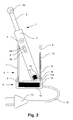
- the display device is in this embodiment, a rotating, transparent display 10, preferably an OLED display, which is arranged on the entire circumference of the wall of a cylindrical toothbrush glass 6.
- the display 10 is in the form of a rectangular Strip produced and is inserted into the wall of the dentifrice glass 6 or glued to this, whereby a vertical joint 10f is formed.
- the horizontal upper edge 10d, the horizontal lower edge 10e and the vertical joint 10f of the display 10 are in Fig. 3 indicated by dashed lines. However, since the display 10 is transparent, the lines 10d, 10e and 10f are nearly invisible.
- the display 10 is integrated into the material of the toothbrush glass 6, preferably polycarbonate, in such a way that the information can also be displayed across the joint 10 f, without the readability being appreciably impaired at this point.
- the in Fig. 3 Illustrated user dialog for inputting the user name exemplified four areas, namely the prompt 10g, the input field 10h, the character selection bar 10i and the input instructions 10j.
- the command prompt 10g informs the user which configuration information is to be entered in this user dialog, in this case the user name.
- the previously entered characters are displayed (in this case "LI"), whereby a cursor marks the position of the next character to be entered.
- the input instructions 10j inform the user of the input commands available in this user dialog, which in this case are the following input commands:
- the user can rotate the toothbrush glass 6 about its own axis to select a character ("turn glass to choose character.”). This movement is in Fig. 3 indicated by a double arrow surrounding the toothbrush glass 6.
- the section of the alphabet shown in the character selection bar 10i moves forward or backward depending on the direction of rotation, so that the selected character also changes in the middle. Since the display 10 around the entire circumference of Toothbrush glass 6 rotates, can always be achieved by a corresponding rotation of the opposite displacement of the information shown the impression of an almost stationary information display on the display 10.
- the user can press the toothbrush glass 6 down to confirm the selected character and so in the input field 10h to take over ("Press glass to select character.”). This movement is indicated by two vertical double arrows on the left and right of the charging station 11.
- the user can push down the toothbrush glass 6 twice in quick succession to complete the input of characters in the input field 10h and to accept the entered character string into the configuration information to be entered, in this case the user name ("Double-press glass to terminate.”).
- the gestures “rotate”, “press” and “double press” of the dentifrice glass 6 correspond approximately to the gestures used in other input means such as computer mice, car navigation system knobs, etc., “move”, “rotate”, “click” and “double-click ". These gestures are therefore already familiar to many users and can therefore be used intuitively.
- the marking elements 20 are permanent magnets.
- the sensor 21 is accordingly a sensor which can convert the change of a magnetic field into an electrical voltage or a switch state, preferably around a Hall sensor or a reed switch.
- the sensor 21 moves over a plurality of marking elements 20 and thus generates a series of voltage changes or electrical pulses which are evaluated or counted by a suitable electronic circuit arranged in the toothbrush glass 6. From this, the angle is determined by which the toothbrush glass 6 is rotated.
- one of the marker elements 20 may be a weaker or stronger magnet than the other marker elements 20, or one of the marker elements 20 may be omitted altogether.
- the electronic circuit in the toothbrush glass 6 can then recognize the reference position via this different marking element 20 or across the gap.
- the charging station 11 has a fixed position relative to the user (given, for example, by its shape defining a unique "front” of the charging station 11)
- the information can be displayed on the display 10 using the reference position such that they are always turned “forwards", ie towards the assumed direction of the user.
- the top 24 of the charging station 11 is mounted on a plurality of compression springs 22, which are arranged circumferentially and preferably at equal angular intervals, and can perform a slight vertical stroke. If the pressure on the upper side 24 is omitted, it is returned to its original position by the compression springs 22.
- the vertical movement of the upper side 24 is detected by a probe 23 which is arranged under the upper side 24 in the charging station 11 and generates a corresponding electrical pulse when the toothbrush glass 6 is released or released. This pulse is transmitted by a - preferably already provided anyway - wireless communication link from the charging station 11 to the toothbrush glass 6 and is there to control the display 10 as described above, for example, to signal a user input, evaluated.
- the arrangement of the marking elements 20 and the sensor 21 is also possible vice versa, d. H. the marking elements 20 are in the bottom of the dentifrice glass 6 and the sensor 21 is arranged in the surface 24 of the charging station 11. In this case, the signals from the sensor 21 to the display 10 are transmitted wirelessly.
- the toothbrush 1 is set into a “configuration mode” by prolonged pressing of the on / off switch 4 (for about three seconds) and later returned to the normal "toothbrushing mode” as well.
- the on / off switch 4 and the rocker switch 5 do not have the usual functions for switching on / off the toothbrush 1 or for selecting the cleaning program or controlling the movement speed of the toothbrush 1.
- the selection option on the display 10 in both directions repeated or prolonged pressing the first button 5a and the second button 5b on the rocker button 5 (instead of turning the toothbrush glass 6). Accordingly, the input is confirmed by pressing the on / off switch 4 once (instead of depressing the dentifrice glass 6) once or several times.
- the input commands are then transmitted via the existing transmitter / receiver in the toothbrush 1 and in the toothbrush glass 6 or in the charging station 11.
- buttons for selecting information for example, by traversing a list in two directions, and a button to confirm an input.
- toothbrush glass 6 can also be other controls such as entire keypads, such as numeric or alphanumeric keypads, provided on toothbrush glass 6.
- These operating elements are preferably arranged in the form of sensor keys under the surface of the toothbrush glass 6, which operate for example capacitively and are actuated by touching the surface of the toothbrush glass 6, so that the controls are protected against moisture as well as the display device 10 in the dentifrice 6th
- the entire display device 10 or parts thereof may be configured as a touch-sensitive screen, ie as a so-called “touchscreen”.
- a touch-sensitive screen ie as a so-called "touchscreen”.
- her familiar input method can be transferred to the display device 10, in particular the usual input gestures such as typing, wiping or pulling, in particular with one finger or with multiple fingers simultaneously.
Landscapes
- Health & Medical Sciences (AREA)
- Dentistry (AREA)
- Epidemiology (AREA)
- Life Sciences & Earth Sciences (AREA)
- Animal Behavior & Ethology (AREA)
- General Health & Medical Sciences (AREA)
- Public Health (AREA)
- Veterinary Medicine (AREA)
- Brushes (AREA)
Applications Claiming Priority (1)
| Application Number | Priority Date | Filing Date | Title |
|---|---|---|---|
| DE102013007758.3A DE102013007758A1 (de) | 2013-05-06 | 2013-05-06 | Elektrische Zahnbürste mit Zubehöreinrichtungen |
Publications (3)
| Publication Number | Publication Date |
|---|---|
| EP2801338A2 true EP2801338A2 (fr) | 2014-11-12 |
| EP2801338A3 EP2801338A3 (fr) | 2014-12-03 |
| EP2801338B1 EP2801338B1 (fr) | 2019-01-02 |
Family
ID=50677923
Family Applications (1)
| Application Number | Title | Priority Date | Filing Date |
|---|---|---|---|
| EP14001568.6A Not-in-force EP2801338B1 (fr) | 2013-05-06 | 2014-05-05 | Brosse à dents électrique dotée de dispositifs accessoires |
Country Status (2)
| Country | Link |
|---|---|
| EP (1) | EP2801338B1 (fr) |
| DE (1) | DE102013007758A1 (fr) |
Cited By (3)
| Publication number | Priority date | Publication date | Assignee | Title |
|---|---|---|---|---|
| CN107154238A (zh) * | 2017-07-11 | 2017-09-12 | 深圳市同洁科技有限公司 | 一种电动牙刷led点阵显示装置 |
| WO2018107629A1 (fr) * | 2016-12-14 | 2018-06-21 | 成都市易冲无线科技有限公司 | Système résonant de charge sans fil et procédé de charge pour brosse à dents électrique |
| CN110074886A (zh) * | 2019-06-04 | 2019-08-02 | 深圳市宝丽洁科技有限公司 | 一种无线充电电动牙刷 |
Citations (4)
| Publication number | Priority date | Publication date | Assignee | Title |
|---|---|---|---|---|
| DE29618742U1 (de) | 1996-10-28 | 1997-01-16 | Rowenta-Werke GmbH, 63071 Offenbach | Kombination einer wiederaufladbaren elektrischen Zahnbürste mit einem Spülbecher |
| WO2008060482A2 (fr) | 2006-11-15 | 2008-05-22 | The Gillette Company | Produits de soin personnel, et procédés associés |
| DE102007053985A1 (de) | 2007-11-13 | 2009-05-14 | Olpp, Dieter, Dr. | Elektrische Zahnbürste mit zugehöriger Ladestation |
| WO2012085819A1 (fr) | 2010-12-22 | 2012-06-28 | Koninklijke Philips Electronics N.V. | Combinaison de verre de rinçage et de chargeur pour brosse à dents électrique |
Family Cites Families (5)
| Publication number | Priority date | Publication date | Assignee | Title |
|---|---|---|---|---|
| EP0634151B1 (fr) * | 1993-03-24 | 1999-07-28 | Koninklijke Philips Electronics N.V. | Brosse à dents électrique |
| DE4334293A1 (de) * | 1993-10-08 | 1995-04-13 | Carola Wuensche | Zahnputzbecher |
| DE29708801U1 (de) * | 1997-05-17 | 1998-09-10 | Hajek-Brucklacher, Eva, 70190 Stuttgart | Zahnputzbecher |
| DE10100795A1 (de) * | 2001-01-10 | 2002-08-14 | Braun Gmbh | Aufladbares Elektrogerät, Ladestation für ein solches Elektrogerät und Verfahren zur Datenübertragung zwischen einem solchen Elektrogerät und einer Ladestation hierfür |
| DE202012103815U1 (de) * | 2012-10-04 | 2012-11-28 | Zhuji City Fengqiao Fengxing Handicraft Factory | Becherhalter mit Temperaturanzeige |
-
2013
- 2013-05-06 DE DE102013007758.3A patent/DE102013007758A1/de not_active Withdrawn
-
2014
- 2014-05-05 EP EP14001568.6A patent/EP2801338B1/fr not_active Not-in-force
Patent Citations (4)
| Publication number | Priority date | Publication date | Assignee | Title |
|---|---|---|---|---|
| DE29618742U1 (de) | 1996-10-28 | 1997-01-16 | Rowenta-Werke GmbH, 63071 Offenbach | Kombination einer wiederaufladbaren elektrischen Zahnbürste mit einem Spülbecher |
| WO2008060482A2 (fr) | 2006-11-15 | 2008-05-22 | The Gillette Company | Produits de soin personnel, et procédés associés |
| DE102007053985A1 (de) | 2007-11-13 | 2009-05-14 | Olpp, Dieter, Dr. | Elektrische Zahnbürste mit zugehöriger Ladestation |
| WO2012085819A1 (fr) | 2010-12-22 | 2012-06-28 | Koninklijke Philips Electronics N.V. | Combinaison de verre de rinçage et de chargeur pour brosse à dents électrique |
Cited By (3)
| Publication number | Priority date | Publication date | Assignee | Title |
|---|---|---|---|---|
| WO2018107629A1 (fr) * | 2016-12-14 | 2018-06-21 | 成都市易冲无线科技有限公司 | Système résonant de charge sans fil et procédé de charge pour brosse à dents électrique |
| CN107154238A (zh) * | 2017-07-11 | 2017-09-12 | 深圳市同洁科技有限公司 | 一种电动牙刷led点阵显示装置 |
| CN110074886A (zh) * | 2019-06-04 | 2019-08-02 | 深圳市宝丽洁科技有限公司 | 一种无线充电电动牙刷 |
Also Published As
| Publication number | Publication date |
|---|---|
| EP2801338B1 (fr) | 2019-01-02 |
| EP2801338A3 (fr) | 2014-12-03 |
| DE102013007758A1 (de) | 2014-11-06 |
Similar Documents
| Publication | Publication Date | Title |
|---|---|---|
| DE10117905B4 (de) | Haushaltgerät mit einer Anzeigevorrichtung | |
| EP2801338B1 (fr) | Brosse à dents électrique dotée de dispositifs accessoires | |
| DE102016225232A1 (de) | Bedienvorrichtung mit einem Bedienknauf | |
| DE102014010352A1 (de) | Interaktiver Spiegel | |
| DE102012105466B4 (de) | Vibrator | |
| EP3238880A1 (fr) | Machine-outil manuelle comprenant une unité de limitation de couple électronique | |
| DE102014218493A1 (de) | Anzeige- und Bedienvorrichtung, insbesondere für ein Kraftfahrzeug, Bedienelement und Kraftfahrzeug | |
| DE4408951A1 (de) | Tragbare Kommunikationseinrichtung | |
| DE102007053985B4 (de) | Elektrische Zahnbürste mit zugehöriger Ladestation | |
| DE102010047829A1 (de) | Mechanische Pipette | |
| DE102020125468A1 (de) | Kraftbetriebenes Werkzeug mit elektrisch gesteuerter Umkehranordnung | |
| WO2019051523A1 (fr) | Télécommande pour cameras | |
| EP2420903B1 (fr) | Montre électronique comprenant des éléments d'affichage opto-électroniques. | |
| DE202008009828U1 (de) | Jonglier-Einrichtung | |
| DE102013218019A1 (de) | Anzeigeeinrichtung und -Verfahren | |
| WO2001032052A1 (fr) | Brosse a dents | |
| EP2989652B1 (fr) | Elément de commande autoalimenté pour un appareil pouvant être commandé | |
| DE10100795A1 (de) | Aufladbares Elektrogerät, Ladestation für ein solches Elektrogerät und Verfahren zur Datenübertragung zwischen einem solchen Elektrogerät und einer Ladestation hierfür | |
| EP3926239A1 (fr) | Appareil électroménager doté d'un dispositif de commande et procédé de commande d'un appareil électroménager | |
| EP2818718A1 (fr) | Support de pompe à vide avec unité de commande sans fil | |
| DE112017002130T5 (de) | Zahnbürste | |
| CN207813237U (zh) | 智能锁滑盖自动关闭装置 | |
| DE102020121218A1 (de) | System aus einem Haushaltsgerät und einem eine optische Anzeigeeinrichtung aufweisenden Akkumulator | |
| DE102020116948B4 (de) | Ladeplatte mit einer einstellbaren Ladestelle und Ladesteuerverfahren dafür | |
| DE202018004434U1 (de) | Kerze mit künstlicher Flamme und flexibler, biegsamer elektronischer Anzeige und transparenter Außenwand |
Legal Events
| Date | Code | Title | Description |
|---|---|---|---|
| PUAL | Search report despatched |
Free format text: ORIGINAL CODE: 0009013 |
|
| PUAI | Public reference made under article 153(3) epc to a published international application that has entered the european phase |
Free format text: ORIGINAL CODE: 0009012 |
|
| 17P | Request for examination filed |
Effective date: 20140505 |
|
| AK | Designated contracting states |
Kind code of ref document: A2 Designated state(s): AL AT BE BG CH CY CZ DE DK EE ES FI FR GB GR HR HU IE IS IT LI LT LU LV MC MK MT NL NO PL PT RO RS SE SI SK SM TR |
|
| AX | Request for extension of the european patent |
Extension state: BA ME |
|
| AK | Designated contracting states |
Kind code of ref document: A3 Designated state(s): AL AT BE BG CH CY CZ DE DK EE ES FI FR GB GR HR HU IE IS IT LI LT LU LV MC MK MT NL NO PL PT RO RS SE SI SK SM TR |
|
| AX | Request for extension of the european patent |
Extension state: BA ME |
|
| RIC1 | Information provided on ipc code assigned before grant |
Ipc: A61C 17/22 20060101AFI20141027BHEP |
|
| R17P | Request for examination filed (corrected) |
Effective date: 20150519 |
|
| RBV | Designated contracting states (corrected) |
Designated state(s): AL AT BE BG CH CY CZ DE DK EE ES FI FR GB GR HR HU IE IS IT LI LT LU LV MC MK MT NL NO PL PT RO RS SE SI SK SM TR |
|
| GRAP | Despatch of communication of intention to grant a patent |
Free format text: ORIGINAL CODE: EPIDOSNIGR1 |
|
| STAA | Information on the status of an ep patent application or granted ep patent |
Free format text: STATUS: GRANT OF PATENT IS INTENDED |
|
| INTG | Intention to grant announced |
Effective date: 20180206 |
|
| GRAJ | Information related to disapproval of communication of intention to grant by the applicant or resumption of examination proceedings by the epo deleted |
Free format text: ORIGINAL CODE: EPIDOSDIGR1 |
|
| STAA | Information on the status of an ep patent application or granted ep patent |
Free format text: STATUS: REQUEST FOR EXAMINATION WAS MADE |
|
| GRAP | Despatch of communication of intention to grant a patent |
Free format text: ORIGINAL CODE: EPIDOSNIGR1 |
|
| STAA | Information on the status of an ep patent application or granted ep patent |
Free format text: STATUS: GRANT OF PATENT IS INTENDED |
|
| INTC | Intention to grant announced (deleted) | ||
| INTG | Intention to grant announced |
Effective date: 20180713 |
|
| GRAS | Grant fee paid |
Free format text: ORIGINAL CODE: EPIDOSNIGR3 |
|
| GRAA | (expected) grant |
Free format text: ORIGINAL CODE: 0009210 |
|
| STAA | Information on the status of an ep patent application or granted ep patent |
Free format text: STATUS: THE PATENT HAS BEEN GRANTED |
|
| AK | Designated contracting states |
Kind code of ref document: B1 Designated state(s): AL AT BE BG CH CY CZ DE DK EE ES FI FR GB GR HR HU IE IS IT LI LT LU LV MC MK MT NL NO PL PT RO RS SE SI SK SM TR |
|
| REG | Reference to a national code |
Ref country code: GB Ref legal event code: FG4D Free format text: NOT ENGLISH |
|
| REG | Reference to a national code |
Ref country code: CH Ref legal event code: EP Ref country code: AT Ref legal event code: REF Ref document number: 1083437 Country of ref document: AT Kind code of ref document: T Effective date: 20190115 |
|
| REG | Reference to a national code |
Ref country code: DE Ref legal event code: R096 Ref document number: 502014010507 Country of ref document: DE |
|
| REG | Reference to a national code |
Ref country code: IE Ref legal event code: FG4D Free format text: LANGUAGE OF EP DOCUMENT: GERMAN |
|
| REG | Reference to a national code |
Ref country code: NL Ref legal event code: MP Effective date: 20190102 |
|
| REG | Reference to a national code |
Ref country code: LT Ref legal event code: MG4D Ref country code: DE Ref legal event code: R084 Ref document number: 502014010507 Country of ref document: DE |
|
| REG | Reference to a national code |
Ref country code: GB Ref legal event code: 746 Effective date: 20190530 |
|
| PG25 | Lapsed in a contracting state [announced via postgrant information from national office to epo] |
Ref country code: NL Free format text: LAPSE BECAUSE OF FAILURE TO SUBMIT A TRANSLATION OF THE DESCRIPTION OR TO PAY THE FEE WITHIN THE PRESCRIBED TIME-LIMIT Effective date: 20190102 |
|
| PG25 | Lapsed in a contracting state [announced via postgrant information from national office to epo] |
Ref country code: SE Free format text: LAPSE BECAUSE OF FAILURE TO SUBMIT A TRANSLATION OF THE DESCRIPTION OR TO PAY THE FEE WITHIN THE PRESCRIBED TIME-LIMIT Effective date: 20190102 Ref country code: PT Free format text: LAPSE BECAUSE OF FAILURE TO SUBMIT A TRANSLATION OF THE DESCRIPTION OR TO PAY THE FEE WITHIN THE PRESCRIBED TIME-LIMIT Effective date: 20190502 Ref country code: ES Free format text: LAPSE BECAUSE OF FAILURE TO SUBMIT A TRANSLATION OF THE DESCRIPTION OR TO PAY THE FEE WITHIN THE PRESCRIBED TIME-LIMIT Effective date: 20190102 Ref country code: LT Free format text: LAPSE BECAUSE OF FAILURE TO SUBMIT A TRANSLATION OF THE DESCRIPTION OR TO PAY THE FEE WITHIN THE PRESCRIBED TIME-LIMIT Effective date: 20190102 Ref country code: FI Free format text: LAPSE BECAUSE OF FAILURE TO SUBMIT A TRANSLATION OF THE DESCRIPTION OR TO PAY THE FEE WITHIN THE PRESCRIBED TIME-LIMIT Effective date: 20190102 Ref country code: NO Free format text: LAPSE BECAUSE OF FAILURE TO SUBMIT A TRANSLATION OF THE DESCRIPTION OR TO PAY THE FEE WITHIN THE PRESCRIBED TIME-LIMIT Effective date: 20190402 Ref country code: PL Free format text: LAPSE BECAUSE OF FAILURE TO SUBMIT A TRANSLATION OF THE DESCRIPTION OR TO PAY THE FEE WITHIN THE PRESCRIBED TIME-LIMIT Effective date: 20190102 |
|
| PG25 | Lapsed in a contracting state [announced via postgrant information from national office to epo] |
Ref country code: IS Free format text: LAPSE BECAUSE OF FAILURE TO SUBMIT A TRANSLATION OF THE DESCRIPTION OR TO PAY THE FEE WITHIN THE PRESCRIBED TIME-LIMIT Effective date: 20190502 Ref country code: BG Free format text: LAPSE BECAUSE OF FAILURE TO SUBMIT A TRANSLATION OF THE DESCRIPTION OR TO PAY THE FEE WITHIN THE PRESCRIBED TIME-LIMIT Effective date: 20190402 Ref country code: HR Free format text: LAPSE BECAUSE OF FAILURE TO SUBMIT A TRANSLATION OF THE DESCRIPTION OR TO PAY THE FEE WITHIN THE PRESCRIBED TIME-LIMIT Effective date: 20190102 Ref country code: GR Free format text: LAPSE BECAUSE OF FAILURE TO SUBMIT A TRANSLATION OF THE DESCRIPTION OR TO PAY THE FEE WITHIN THE PRESCRIBED TIME-LIMIT Effective date: 20190403 Ref country code: LV Free format text: LAPSE BECAUSE OF FAILURE TO SUBMIT A TRANSLATION OF THE DESCRIPTION OR TO PAY THE FEE WITHIN THE PRESCRIBED TIME-LIMIT Effective date: 20190102 Ref country code: RS Free format text: LAPSE BECAUSE OF FAILURE TO SUBMIT A TRANSLATION OF THE DESCRIPTION OR TO PAY THE FEE WITHIN THE PRESCRIBED TIME-LIMIT Effective date: 20190102 |
|
| PGFP | Annual fee paid to national office [announced via postgrant information from national office to epo] |
Ref country code: FR Payment date: 20190524 Year of fee payment: 6 |
|
| REG | Reference to a national code |
Ref country code: DE Ref legal event code: R097 Ref document number: 502014010507 Country of ref document: DE |
|
| PG25 | Lapsed in a contracting state [announced via postgrant information from national office to epo] |
Ref country code: IT Free format text: LAPSE BECAUSE OF FAILURE TO SUBMIT A TRANSLATION OF THE DESCRIPTION OR TO PAY THE FEE WITHIN THE PRESCRIBED TIME-LIMIT Effective date: 20190102 Ref country code: RO Free format text: LAPSE BECAUSE OF FAILURE TO SUBMIT A TRANSLATION OF THE DESCRIPTION OR TO PAY THE FEE WITHIN THE PRESCRIBED TIME-LIMIT Effective date: 20190102 Ref country code: CZ Free format text: LAPSE BECAUSE OF FAILURE TO SUBMIT A TRANSLATION OF THE DESCRIPTION OR TO PAY THE FEE WITHIN THE PRESCRIBED TIME-LIMIT Effective date: 20190102 Ref country code: DK Free format text: LAPSE BECAUSE OF FAILURE TO SUBMIT A TRANSLATION OF THE DESCRIPTION OR TO PAY THE FEE WITHIN THE PRESCRIBED TIME-LIMIT Effective date: 20190102 Ref country code: EE Free format text: LAPSE BECAUSE OF FAILURE TO SUBMIT A TRANSLATION OF THE DESCRIPTION OR TO PAY THE FEE WITHIN THE PRESCRIBED TIME-LIMIT Effective date: 20190102 Ref country code: SK Free format text: LAPSE BECAUSE OF FAILURE TO SUBMIT A TRANSLATION OF THE DESCRIPTION OR TO PAY THE FEE WITHIN THE PRESCRIBED TIME-LIMIT Effective date: 20190102 Ref country code: AL Free format text: LAPSE BECAUSE OF FAILURE TO SUBMIT A TRANSLATION OF THE DESCRIPTION OR TO PAY THE FEE WITHIN THE PRESCRIBED TIME-LIMIT Effective date: 20190102 |
|
| PGFP | Annual fee paid to national office [announced via postgrant information from national office to epo] |
Ref country code: GB Payment date: 20190621 Year of fee payment: 6 |
|
| PLBE | No opposition filed within time limit |
Free format text: ORIGINAL CODE: 0009261 |
|
| STAA | Information on the status of an ep patent application or granted ep patent |
Free format text: STATUS: NO OPPOSITION FILED WITHIN TIME LIMIT |
|
| PG25 | Lapsed in a contracting state [announced via postgrant information from national office to epo] |
Ref country code: SM Free format text: LAPSE BECAUSE OF FAILURE TO SUBMIT A TRANSLATION OF THE DESCRIPTION OR TO PAY THE FEE WITHIN THE PRESCRIBED TIME-LIMIT Effective date: 20190102 |
|
| 26N | No opposition filed |
Effective date: 20191003 |
|
| REG | Reference to a national code |
Ref country code: CH Ref legal event code: PL |
|
| PG25 | Lapsed in a contracting state [announced via postgrant information from national office to epo] |
Ref country code: CH Free format text: LAPSE BECAUSE OF NON-PAYMENT OF DUE FEES Effective date: 20190531 Ref country code: MC Free format text: LAPSE BECAUSE OF FAILURE TO SUBMIT A TRANSLATION OF THE DESCRIPTION OR TO PAY THE FEE WITHIN THE PRESCRIBED TIME-LIMIT Effective date: 20190102 Ref country code: LI Free format text: LAPSE BECAUSE OF NON-PAYMENT OF DUE FEES Effective date: 20190531 |
|
| REG | Reference to a national code |
Ref country code: BE Ref legal event code: MM Effective date: 20190531 |
|
| PG25 | Lapsed in a contracting state [announced via postgrant information from national office to epo] |
Ref country code: SI Free format text: LAPSE BECAUSE OF FAILURE TO SUBMIT A TRANSLATION OF THE DESCRIPTION OR TO PAY THE FEE WITHIN THE PRESCRIBED TIME-LIMIT Effective date: 20190102 Ref country code: LU Free format text: LAPSE BECAUSE OF NON-PAYMENT OF DUE FEES Effective date: 20190505 |
|
| PG25 | Lapsed in a contracting state [announced via postgrant information from national office to epo] |
Ref country code: TR Free format text: LAPSE BECAUSE OF FAILURE TO SUBMIT A TRANSLATION OF THE DESCRIPTION OR TO PAY THE FEE WITHIN THE PRESCRIBED TIME-LIMIT Effective date: 20190102 |
|
| PG25 | Lapsed in a contracting state [announced via postgrant information from national office to epo] |
Ref country code: IE Free format text: LAPSE BECAUSE OF NON-PAYMENT OF DUE FEES Effective date: 20190505 |
|
| PG25 | Lapsed in a contracting state [announced via postgrant information from national office to epo] |
Ref country code: BE Free format text: LAPSE BECAUSE OF NON-PAYMENT OF DUE FEES Effective date: 20190531 |
|
| PGFP | Annual fee paid to national office [announced via postgrant information from national office to epo] |
Ref country code: DE Payment date: 20200531 Year of fee payment: 7 |
|
| REG | Reference to a national code |
Ref country code: AT Ref legal event code: MM01 Ref document number: 1083437 Country of ref document: AT Kind code of ref document: T Effective date: 20190505 |
|
| PG25 | Lapsed in a contracting state [announced via postgrant information from national office to epo] |
Ref country code: AT Free format text: LAPSE BECAUSE OF NON-PAYMENT OF DUE FEES Effective date: 20190505 |
|
| GBPC | Gb: european patent ceased through non-payment of renewal fee |
Effective date: 20200505 |
|
| PG25 | Lapsed in a contracting state [announced via postgrant information from national office to epo] |
Ref country code: GB Free format text: LAPSE BECAUSE OF NON-PAYMENT OF DUE FEES Effective date: 20200505 Ref country code: FR Free format text: LAPSE BECAUSE OF NON-PAYMENT OF DUE FEES Effective date: 20200531 |
|
| PG25 | Lapsed in a contracting state [announced via postgrant information from national office to epo] |
Ref country code: CY Free format text: LAPSE BECAUSE OF FAILURE TO SUBMIT A TRANSLATION OF THE DESCRIPTION OR TO PAY THE FEE WITHIN THE PRESCRIBED TIME-LIMIT Effective date: 20190102 |
|
| PG25 | Lapsed in a contracting state [announced via postgrant information from national office to epo] |
Ref country code: MT Free format text: LAPSE BECAUSE OF FAILURE TO SUBMIT A TRANSLATION OF THE DESCRIPTION OR TO PAY THE FEE WITHIN THE PRESCRIBED TIME-LIMIT Effective date: 20190102 Ref country code: HU Free format text: LAPSE BECAUSE OF FAILURE TO SUBMIT A TRANSLATION OF THE DESCRIPTION OR TO PAY THE FEE WITHIN THE PRESCRIBED TIME-LIMIT; INVALID AB INITIO Effective date: 20140505 |
|
| REG | Reference to a national code |
Ref country code: DE Ref legal event code: R119 Ref document number: 502014010507 Country of ref document: DE |
|
| PG25 | Lapsed in a contracting state [announced via postgrant information from national office to epo] |
Ref country code: DE Free format text: LAPSE BECAUSE OF NON-PAYMENT OF DUE FEES Effective date: 20211201 |
|
| PG25 | Lapsed in a contracting state [announced via postgrant information from national office to epo] |
Ref country code: MK Free format text: LAPSE BECAUSE OF FAILURE TO SUBMIT A TRANSLATION OF THE DESCRIPTION OR TO PAY THE FEE WITHIN THE PRESCRIBED TIME-LIMIT Effective date: 20190102 |